Introduction
Early adolescent substance use has been proposed to produce a cascade of physiological and neurobiological events that alter trajectories of brain development (Crews, He, & Hodge, Reference Cyders and Coskunpinar2007) and derail healthy self-regulation development (Squeglia et al., Reference Squeglia, Spadoni, Infante, Myers and Tapert2009b). Healthy development of self-regulation is critical to psychosocial adjustment, and deficits in adolescent self-regulatory abilities increase vulnerability for an array of adverse outcomes, including academic failure, antisocial behaviors, and psychopathology (Eisenberg, Smith, & Spinrad, Reference Eisenberg, Taylor, Widaman and Spinrad2011).
A large developmental literature has conceptualized self-regulation as an emergent individual difference referred to as effortful control (EC) composed of several facets, including the ability to inhibit behavior (inhibitory control), activate or initiate behavior (activation control), and control attention (attentional control) (Rothbart, Ellis, Rueda, & Posner, Reference Rothbart, Ellis, Rueda and Posner2003). EC is closely tied to executive functioning (EF) (Zhou, Chen, & Main, Reference Zhou, Chen and Main2012) and influenced by genes and the environment over time (Posner & Rothbart, Reference Posner and Rothbart1998). Indeed, there is evidence that a variety of environmental factors impact developmental trajectories of EC throughout adolescence and emerging adulthood (Eisenberg et al., Reference Elliott2005; Fosco, Caruthers, & Dishion, Reference French, Purwono, Zhao, Shen and Eisenberg2012). Brain-imaging studies suggest that EC is linked to changes in critical regions in the prefrontal cortex that underlie executive functions and that remain plastic throughout adolescence and emerging adulthood (Selemon, Reference Selemon2013; Vijayakumar et al., Reference Vijayakumar, Whittle, Dennison, Yücel, Simmons and Allen2014; Wei et al., Reference Wei, Guo, Baeken, Bi, Wang, Qiu and Wu2019). This suggests that EC is dynamic and potentially influenced by a variety of inputs. Of interest in the current study are potential effects of substance use on the development of EC.
Substance use and brain development
Substance use during adolescence may negatively impact healthy brain development and derail EC development (Squeglia, Jacobus, & Tapert, Reference Squeglia, Jacobus and Tapert2009a). Specifically, some empirical evidence suggests that adolescent alcohol use has negative effects on the development of self-regulatory abilities (Squeglia et al., Reference Squeglia, Spadoni, Infante, Myers and Tapert2009b). While there has been less prospective work on cannabis, recent findings suggest that frequent cannabis use during early adolescence predicts low levels of self-regulatory abilities in late adolescence (Castellanos-Ryan et al., Reference Cortina2017; Paige & Colder, Reference Paige and Colder2020). Similarly, cigarette smoking has been linked to deficits in several self-regulatory abilities, including attentional and inhibitory control (Ernst, Heishman, Spurgeon, & London, Reference Fosco, Caruthers and Dishion2001; Luijten et al., Reference Mason and Windle2011). However, the specific ages at which substance use is especially harmful and over what period of time these effects manifest remains unclear.
The sensitive-period hypothesis asserts that early adolescence (ages 11–14) represents a window of vulnerability when exposure to substances is particularly harmful (Guttmannova et al., Reference Heylen, Vasey, Dujardin, Vandevivere, Braet, De Raedt and Bosmans2011). Indeed, evidence suggests that discrete brain regions underlying EC, namely the prefrontal cortex, are maximally susceptible to substance use exposure effects during early adolescence (Crews et al., Reference Cyders and Coskunpinar2007; Selemon, Reference Selemon2013). Considering maturation of the prefrontal cortex occurs through emerging adulthood, the adverse impact of early substance use on EC may not manifest until late adolescence or emerging adulthood (Blakemore & Choudhury, Reference Buist, Deković, Meeus and van Aken2006). Several longitudinal studies support the sensitive-period hypothesis, reporting an association between early adolescent substance use and deficits in EF/EC several years later (Paige & Colder, Reference Paige and Colder2020; Squeglia et al., Reference Squeglia, Jacobus and Tapert2009a). However, support has not been unequivocal, with some studies reporting no association between early substance use and subsequent self-regulatory abilities (Tapert, Granholm, Leedy, & Brown, Reference Tapert, Granholm, Leedy and Brown2002; Teichner, Donohue, Crum, Azrin, & Golden, Reference Teichner, Donohue, Crum, Azrin and Golden2000). One potential reason for mixed support is the failure of past work to consider early substance use in the context of externalizing symptoms.
Substance use, externalizing symptoms, and effortful control
The lack of consensus in the substance use/EF literature has led to calls for future studies to examine more carefully the context of adolescent substance use (Guttmannova et al., Reference Heylen, Vasey, Dujardin, Vandevivere, Braet, De Raedt and Bosmans2011). Substance use does not occur in a vacuum, but instead is part of a larger constellation of externalizing symptoms including rule breaking and aggressive behaviors (Colder et al., Reference Crews, He and Hodge2013; Jessor, Reference Kanske and Kotz1991). Indeed, factor-analytic work shows that substance use and use-related problems consistently load onto a higher order externalizing factor, which lends further support to the notion that substance use is part of a larger constellation of externalizing symptoms (for a review, see Kotov et al., Reference Little, Rhemtulla, Gibson and Schoemann2017). An important finding from this factor-analytic work is that substance use is distinguished from another lower-order externalizing factor usually labelled conduct problems or antisocial behavior which is characterized by aggression, lack of empathy, and rule-breaking behaviors (Forbes, Tackett, Markon, & Krueger, Reference Gower and Crick2016; Krueger, Markon, Patrick, Benning, & Kramer, Reference Luijten, Littel and Franken2007).
Past work investigating the association between adolescent substance use and the development of EC has often failed to account for the broader context of externalizing symptoms that often accompany substance use. This is problematic considering there is empirical evidence that early externalizing symptoms, such as aggression and rule-breaking behaviors, predict deficits in EC through a developmental cascade that involves poor parenting and lack of support to develop strong EC (Eisenberg et al., Reference Elliott and Huizinga2015). Thus, failure to account for the broader context of externalizing symptoms that co-occur with substance use during adolescence leaves open the possibility that the relationship between substance use and poor EC is due to externalizing symptoms more broadly rather than the specific neurotoxic effects of substance use.
Hypotheses
Our goal was to distinguish externalizing symptoms and substance use effects on the development of adolescent EC. Hypotheses were tested using bifactor modeling because it provides a method for separating substance use specific variance from general externalizing symptoms. A general factor of externalizing symptoms was hypothesized to be associated with declines in EC across adolescence. There was also reason to expect that, in line with the proposed neurotoxic effects of substance use, the substance use specific factor would also be related to declines in EC after accounting for general externalizing symptoms.
Given that relationships between EC, externalizing symptoms, and substance use may operate bidirectionally (Eiden, Edwards, & Leonard, Reference Eisenberg, Spinrad and Eggum2007; Piehler, Véronneau, & Dishion, Reference Piehler, Véronneau and Dishion2012), a secondary goal of the current study is to examine possible reciprocal relationships. As healthy levels of EC are protective against a wide range of adverse psychosocial outcomes (Eiden et al., Reference Eisenberg, Spinrad and Eggum2007; Piehler et al., Reference Piehler, Véronneau and Dishion2012), high levels of EC were hypothesized to be associated with low levels of externalizing symptoms and substance use across adolescence (Esposito, Bacchini, Eisenberg, & Affuso, Reference Evans and Rothbart2017; Purwono, French, Eisenberg, & Christ, Reference Purwono, French, Eisenberg and Christ2019).
Method
Participants
The current sample of 387 adolescents and a caregiver was drawn from a longitudinal study of adolescent substance use and recruited using random-digit dialing (RDD) procedures. Adolescents were eligible for the study if they were between the ages of 11 or 12 at recruitment and did not have any disabilities that would preclude them from either understanding or completing the assessment. Recruitment started in April 2007 and was completed in February 2009.
The current study utilized substance use, externalizing symptoms, EC, and demographic data from Wave 1(W1) through Wave 9 (W9) of the longitudinal project. The average age of participants was 11.6, 12.6, 13.6, 14.6, 15.5, 16.6, 17.9, 18.9, 19.9 at W1–W9, respectively. The sample was evenly split on gender (55% female) and was predominantly non-Hispanic Caucasian (83.16%) or African-American (9.07%). Median family income at W1 was $70,000 and 6% of the families received public assistance income. The sample demographics compared well to demographics of families within our sampling frame, which was Erie County, NY (for detail about the sample, see Trucco, Colder, Wieczorek, Lengua, & Hawk, Reference Trucco, Colder, Wieczorek, Lengua and Hawk2014). Overall retention across waves was strong; after W1, sample size varied between N = 350 (90%) to N = 373 (96%).
Procedure
Interviews at W1–W3 were conducted annually in university research offices. Research assistants obtained consent from caregivers and assent from adolescents. Research assistants interviewed the caregiver and adolescent in separate rooms to enhance privacy. Families were compensated $75, $85, and $125 dollars at W1–W3, respectively.
Annual assessments at W4–W6 involved a brief telephone administered audio-computer-assisted self-interview (CASI) of substance use. The interview typically took between 10–15 minutes to complete. Parents provided consent over the phone and were given a phone number and PIN for their adolescent to use. Assent from the adolescent was obtained at the initiation of the audio-CASI survey.
The procedures for annual assessments at W7–W9 were similar to those used in W1–W3. Adolescents provided written informed consent after age 18 and were compensated $125 for completing the full assessment or $50 for completing only the online questionnaire. Caregivers were compensated $40.
Measures
Substance use
Substance use was assessed across W1 to W9 with questions assessing (1) past year frequency of alcohol/cigarette/cannabis use, and (2) past year quantity of alcohol/cigarette use, using the National Youth Survey (NYS) from Waves 1–6 (Elliott & Huizinga, Reference Ellis and Rothbart1983), and a question assessing alcohol frequency in conjunction with a weekly drinking/smoking calendar from W7–W9 (Cahalan, Cisin, & Crossley, Reference Colder, Scalco, Trucco, Read, Lengua, Wieczorek and Hawk1969). The quantity of cannabis used in the past year was not assessed. Several studies support the reliability and validity of self-reports of adolescent substance use, like the NYS (Del Boca & Darkes, Reference Eiden, Edwards and Leonard2003; Winters, Stinchfield, Henly, & Schwartz, Reference Winters, Stinchfield, Henly and Schwartz1990).
As expected given the age of the sample, rates of use were very low at W1 for alcohol (2.60% of the sample endorsed drinking in the past year), cannabis (0% of the sample endorsed using cannabis in the past year), and cigarette use (0.80% of the sample endorsed smoking cigarettes in the past year). Accordingly, we constructed the latent variables for substance use beginning at W2.
Effortful control
W2–W3 EC was assessed using caregiver reports on the Early Adolescent Temperament Questionnaire-Revised (EATQ-R) (Ellis & Rothbart, Reference Ernst, Heishman, Spurgeon and London1999). The EATQ-R contains 18 items assessing the three subdimensions of EC: activation control, attentional control, and inhibitory control. The items were rated on a 5-point response scale (1 = almost always untrue of your child, 5 = almost always true of your child). Sample items include, “When interrupted or distracted, forgets what s/he was about to say,” “Has a hard time waiting his/her turn to speak when excited,” and “Usually gets started right away on difficult assignments.” The means of each of the three subdimensions of EC were calculated to construct indicators for factor analysis. The EATQ-R is a widely utilized instrument and has demonstrated concurrent validity with theoretically similar scales of personality and prefrontal cortex maturation (Muris & Meesters, Reference Nigg2009; Vijayakumar et al., Reference Vijayakumar, Whittle, Dennison, Yücel, Simmons and Allen2014). Internal consistencies were 0.90 and 0.89 at W2 and W3, respectively.
At W7–W9, EC was assessed using adolescent self-reports on EC scale of the Adult Temperament Questionnaire (ATQ) (Evans & Rothbart, Reference Forbes, Tackett, Markon and Krueger2007). The ATQ utilizes developmentally appropriate items to measure the same constructs as the EATQ-R. The EC scale includes 19 items assessing EC that assess the same three subdimensions described above. Sample items included, “When interrupted or distracted, I usually can easily shift my attention back to whatever I was doing before,” “I can easily resist talking out of turn, even when I'm excited and want to express an idea,” and “If I think of something that needs to be done, I usually get right to work on it.” The items were rated on a 7-point response scale (1 = extremely untrue, 7 = extremely true). Mean values were calculated for each EC dimensions used as indicates for factor analysis. Concurrent validity of the EC scale has been supported by correlations with widely used measures of personality and EF (Kanske & Kotz, Reference Krueger, Markon, Patrick, Benning and Kramer2012; Rothbart, Ahadi, & Evans, Reference Rothbart, Ahadi and Evans2000). Internal consistencies were good across W7–W9 (α range = 0.80–0.82).
Externalizing symptoms
The Youth Self-Report (YSR) and Adult Self-Report (ASR) from the Achenbach System of Empirically Based Assessments (ASEBA, Achenbach & Rescorla, Reference Achenbach and Rescorla2001, Achenbach, Dumenci, & Rescorla, Reference Achenbach, Dumenci and Rescorla2003) were used to provide developmentally appropriate assessments of externalizing symptoms at W1–W3, and W7–W9, respectively. The YSR and ASR contain an externalizing dimension which assesses two subscales: rule breaking and aggressive behaviors. Items that measured substance use were removed from the externalizing dimension in order to avoid confounding with substance use variables measured by the NYS. The internal consistencies for rule-breaking were 0.72 and 0.75 at W2–W3, respectively, and 0.81, 0.79, and 0.81 at W7–W9, respectively. The internal consistencies for aggressive behaviors were 0.83 and 0.85 at W2–W3, respectively, and 0.84, 0.86, and 0.88 at W7–W9, respectively.
Demographic covariates
At W1, gender was reported by the caregiver and coded 0 for male and 1 for female.
Data analytic strategy
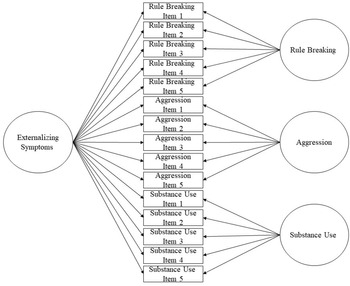
Structural equation modeling (SEM) with robust maximum likelihood estimation (MLR) was used to test the proposed reciprocal pathways using Mplus 8.2 (Muthén & Muthén, Reference Olson, Sameroff, Kerr, Lopez and Wellman1998–2018). MLR was used to accommodate the nonnormality of some of our observed endogenous variables. Our bifactor measurement model distinguished a general externalizing factor from specific lower factors of substance use, aggression, and rule breaking. Each observed measure was specified to load on two factors (a narrow specific factor and a broad general factor, see Figure 1) and factor covariances were set to zero.
Conceptual figure of externalizing symptoms bifactor model. The externalizing symptoms general factor represents the shared variance between rule-breaking, aggressive behaviors, and substance use. The rule breaking, aggressive behaviors, and substance use factors represent unique specific variance in each of these constructs after accounting for their shared variance.

Model building occurred in two steps. First, the externalizing symptoms bifactor measurement model was estimated at W2, W3, W7, W8, and W9. At each wave, the substance use specific factor was indicated by five items: alcohol frequency, alcohol quantity, cigarette frequency, cigarette quantity, and cannabis frequency. To reduce the number of model parameters, the rule breaking and aggressive behavior subscales of the YSR and ASR were each parceled into five bundles at each wave (Little, Rhemtulla, Gibson, & Schoemann, Reference Marsh, Hau and Wen2013). The externalizing symptoms bifactor models were estimated at each wave, and then combined to evaluate measurement invariance across time.
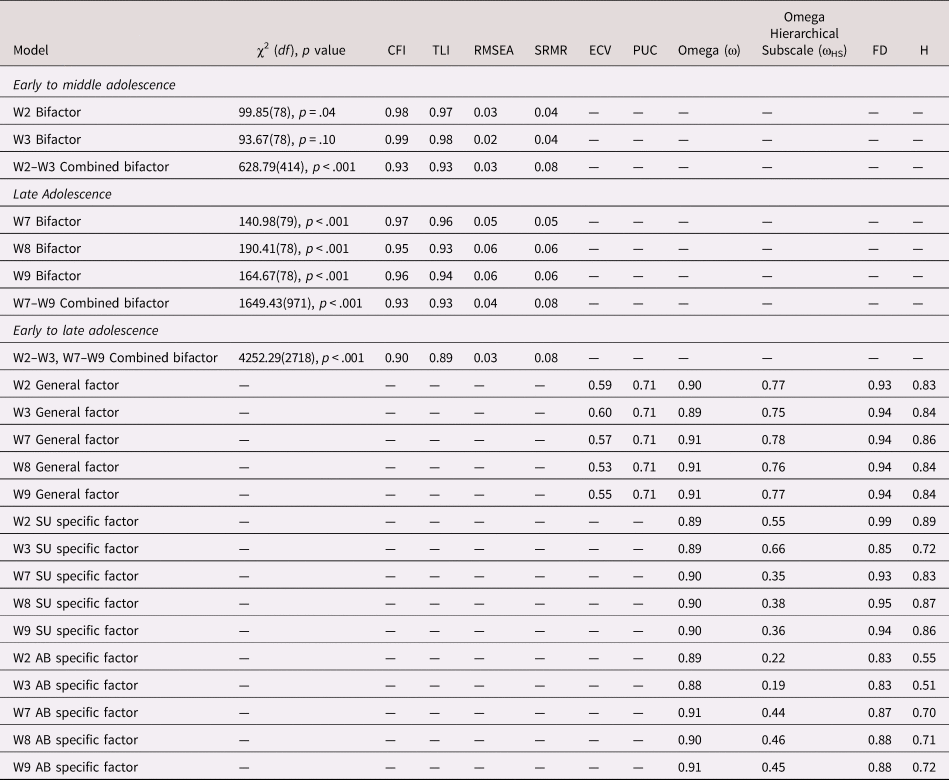
Bifactor model fit was assessed using conventional (e.g., comparative fit index [CFI], root mean square error approximation [RMSEA]) as well as alternative fit statistics developed for bifactor models, including omega (ω), omega subscale (ωs), omega hierarchical (ωH), omega hierarchical subscale (ωHS), and construct replicability (H) (Rodriguez, Reise, & Haviland, Reference Rodriguez, Reise and Haviland2016a). ω and ωs are the latent variable analogues to coefficient alpha for the general externalizing factor and specific factors, respectively. ωH differs from ω in that it only represents the variance from a single latent variable, whereas ω is a function of all common variance. ωHS is an index of the reliability of the specific factors after partitioning out the variance attributable to the general factor. ω, ωS, ωH, and ωHS values greater than .70 indicate acceptable reliability and values greater than .80 indicate good reliability (Cortina, Reference Crick, Ostrov, Kawabata, Flannery, Vazsonyi and Waldman1993; Rodriguez, Reise, & Haviland, Reference Rodriguez, Reise and Haviland2016b; Santos, Reference Santos1999; Tavakol & Dennick, Reference Tavakol and Dennick2011). To evaluate fit of the bifactor model, values greater than .70 for explained common variance (ECV) and percentage of uncontaminated variance (PUC) indicate little bias in fitting a multidimensional model in a unidimensional manner when using SEM techniques. Values of construct replicability, H, > .70 indicate that measured items adequately represented the latent factors (Hancock & Mueller Reference Hu and Bentler2001; Rodriguez et al., Reference Rodriguez, Reise and Haviland2016a).
EC was indicated by the inhibitory control, attentional control, and activation control subscales of the EATQ-R at W2 and W3 and the ATQ at W7, W8, and W9. The EC model was first estimated separately at each wave and then combined to evaluate measurement invariance across time.
The second step of our model building involved specifying a path model examining reciprocal effects between the bifactor model of externalizing symptoms and EC from early adolescence through emerging adulthood. Factor scores were estimated in Mplus for the bifactor and EC models, and then used for our path model. Factor scores were used instead of latent variables to reduce the ratio of parameters to participants, which is a common concern for longitudinal bifactor models given their complexity (McElroy, Belsky, Carragher, Fearon, & Patalay, Reference Moilanen, Shaw and Maxwell2018). Factor score determinacies greater than .70 (Tabachnick & Fidell, Reference Tabachnick and Fidell2013) indicate the factor scores were adequately correlated with the latent factors. The path model was built sequentially, such that within-time covariances and stabilities were added followed by cross-lagged paths from the bifactor model to EC and then EC to the general and specific factors of the bifactor model. It should be noted that covariances reflect within-time associations after accounting for stabilities and cross-lagged paths. Satorra-Bentler nested model tests were used to determine whether within-time covariances, stabilities, and cross-lagged paths could be constrained to be equal across time.
Fit of the path model was assessed using the CFI, Tucker–Lewis Index (TLI), RMSEA, and standardized root-mean-square residual (SRMR). Specific cut-offs for assessing “good” fit cannot be generalized across all models (Hu & Bentler, Reference Johnston, Miech, O'Malley, Bachman, Schulenberg and Patrick1999; Marsh, Hau, & Wen, Reference McElroy, Belsky, Carragher, Fearon and Patalay2004), therefore, ranges were used to determine the acceptability of model fit (for CFI and TLI, <.90 is poor, .90 to .94 is acceptable, and .95 is excellent; for RMSEA, > .08 is poor, .05 to .07 is acceptable, and .05 is excellent; and for SRMR, > .09 is poor, .06 to .09 is acceptable, and .06 is excellent).
Results
Measurement models
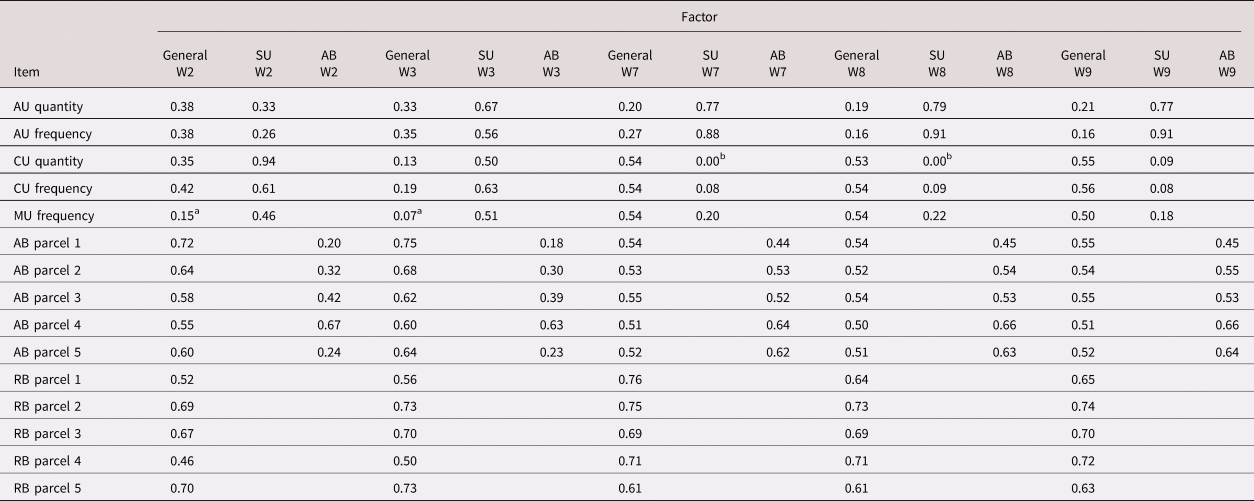
Fit of the single factor measurement models for externalizing symptoms and substance use ranged from providing a good to excellent fit of the data (χ2 = 2.12–13.05 with 3–5 df, ps = .02–.82, CFIs = .97–1.00, TLIs = .91–1.03, RMSEA = .00–.07, SRMR = .01–.03). More detailed information on these models can be found in Supplemental Materials 1. After estimating measurement models, we estimated bifactor models of externalizing symptoms at each wave. Initial estimation of bifactor models produced a negative residual variance for the rule-breaking specific factors. A negative residual variance in this context suggests that after accounting for the general externalizing symptoms factor there was little variability left in the rule-breaking specific factors. Removing the rule-breaking specific factors and allowing the rule-breaking items to load on the general externalizing factors led the models to estimate without negative variance estimates. Results for individual bifactor models estimated at each wave (W2, W3, W7, W8, W9) are presented in Table 1. Next, longitudinal measurement invariance of bifactor models was tested at W2–W3 (for the YSR subscales) and at W7–W9 (for the ASR subscales). Then, the independent measurement models were combined into an overall measurement model with correlated factors. Details of longitudinal measurement invariance can be found in Supplemental Materials 2 and fit information of final models is presented in Table 1. The final longitudinal externalizing symptoms bifactor measurement model including W2, W3, W7, W8, and W9 provided adequate fit to the data (χ2 = 4252.29(2718), p < .001, CFI = .90, TLI = .89, RMSEA = .03, SRMR = .08). Standardized factor loadings across all bifactor models are presented in Table 2. The substance use item loadings on the general externalizing factors ranged from 0.07 to 0.94 across waves. One factor loading was set to zero on the W7 specific substance use factor and a second factor loading was set to zero on the W8 specific substance use factor because they were not statistically significant. Substance use items (e.g., cannabis frequency, cigarette quantity and frequency, and alcohol quantity and frequency) had loadings of similar magnitude on the substance use specific factor across W2 and W3, while the substance use specific factors appear to be more representative of alcohol use across W7–9.
Bifactor results for single wave and multiple wave models

Note. W = wave, SU = substance use, AB = aggressive behavior, CFI = comparative fit index, TLI = Tucker–Lewis Index, RMSEA = root mean square error approximation, SRMR = standardized root-mean-square residual, ECV = explained common variance, PUC = percentage of uncontaminated variance, FD = factor score determinancy, H = construct replicability.
Standardized factor loadings for bifactor models across Waves 2, 3, 7, 8, and 9
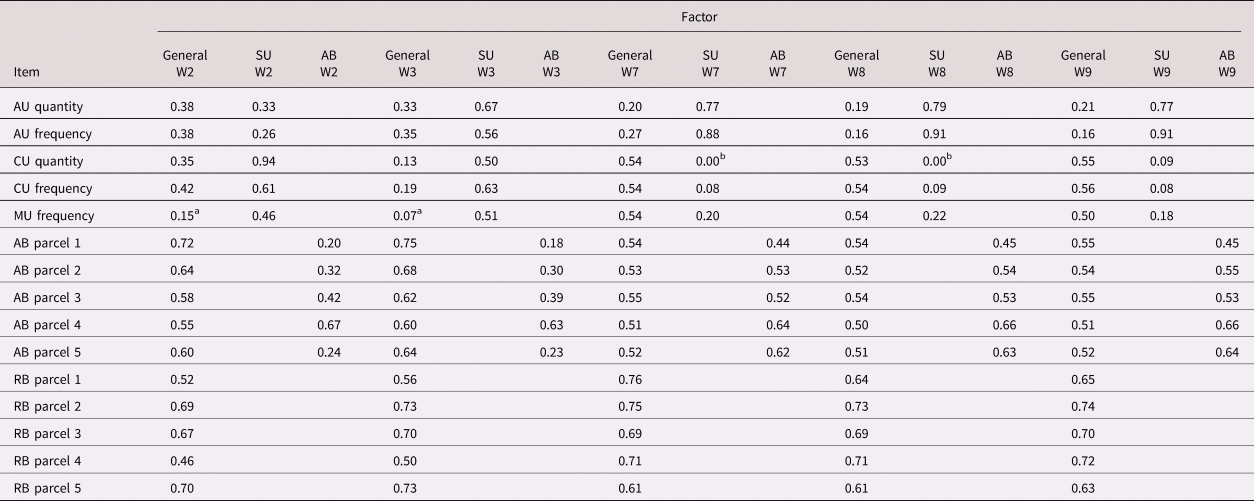
Note. N = 387.
a Factor loading was nonsignificant.
b Factor loading was set to zero because it did not significantly load onto the specific substance use factor.
W = wave, AU = alcohol use, CU = cigarette use, MU = marijuana use, AB = aggressive behavior, RB = rule-breaking.
Additional fit indices for the final bifactor model indicated that the factor loadings of a unidimensional externalizing factor at each wave would have resulted in biased factor loadings (ECV < .60 and PUC = .71). Thus, the values of ECV and PUC for the final model support the specification of a bifactor rather than a unidimensional model of externalizing symptoms. H values were greater than .70 for the externalizing general factor (H range = .83–.86) and substance use specific factor (H range = .72–.89). H values during early adolescence for the aggressive behavior factor suggested that this latent factor was less-adequately represented in early to middle adolescence (H range = .51–.55). The aggressive behavior specific factors were better represented by their items in late adolescence to emerging adulthood (H range.70–.72). ω and ωS values indicated that the general externalizing factor and specific factors all had acceptable reliability (ω/ωS > .88). ωH was acceptable across all waves for the general externalizing factor (ωH range = .75–.77) suggesting that these factors were the predominant sources of variance relative to the specific factors at each wave. ωHS ranged from .35 to .66 for the substance use specific factor and .19 to .46 for the aggressive behavior specific factor. Factor score (FS) determinacies, which reflect the correlation between the factor scores and true latent factor scores, were acceptable and ranged from .83 to .95. Overall, the conventional and alternative fit statistics suggest that the longitudinal bifactor model provided an adequate fit to the data.
Factor models for EC in early to middle adolescence (W2 and W3) (χ2 = 7.12(14), p = .93, CFI = 1.00, TLI = 1.01, RMSEA = .00, SRMR = .03) and in late adolescence to emerging adulthood (χ2 = 40.98(34), p = .19, CFI = .99, TLI = .99, RMSEA = .02, SRMR = .06) both fit the data well. As with the bifactor model, longitudinal measurement invariance was assessed in the early to middle adolescence (EATQ-R subscales) and late adolescence to emerging adulthood models (ATQ subscales, see Supplemental Materials 2). After establishing longitudinal measurement invariance, the final EC model spanning early adolescence to emerging adulthood was estimated and provided a good fit to the data (χ2 = 168.24(96), p < .001, CFI = .97, TLI = .97, RMSEA = .04, SRMR = .07). Lastly, factor score determinacies were estimated for EC at each wave based on this model and all factor scores were greater than .90 (FS range = .93–.97).
Path model
Details from fitting the path model can be found in Supplemental Materials 2. In general, stabilities path coefficients and within-time covariances were equal over time with a few exceptions (e.g., the stability for the substance use specific factor from W2 to W3 and within-time covariances between the general externalizing factor and EC at W2, W3, and W7). Adding stabilities and cross-lag paths improved model fit, and generally longitudinal equality constraints were supported. Lastly, gender was included as a statistical control variable and predicted all factors from the bifactor model as well as EC (see Supplemental Materials 2 for information regarding model constraints). The final path model provided an adequate fit to the data (χ2 = 604.02(170), p < .001, CFI = .94, TLI = .92, RMSEA = .08, SRMR = .08).
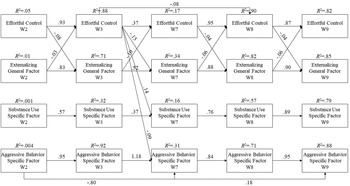
The results of this final path model indicated that the general factor was significantly associated with EC within-wave such that high levels on the externalizing general factor were associated with low levels of EC (r = −.32 to −.22, ps < .01) at all waves besides W3 (r = −.04, p = .55). At each wave, high levels on the aggressive behavior specific factor were associated with low levels of EC (r = −.21 to −.01, ps < .04). The substance use specific factor was unrelated to EC within-wave (r = −.01 to .00, ps = .82). Prospective cross-lagged paths indicated that high levels of the externalizing general factor were significantly prospectively associated with decreases in EC across all one wave lags (βs = −.06 to −.03, p < .01) as well as from W3 to W7 (β = −.10, p = .03) (see Figure 2). The aggressive behavior specific factors (βs range = −.04 to −.01, ps = .18–.32) and the substance use specific factors (βs = .00–.06, ps = .11–.75) were not prospectively associated with EC.Footnote 1 High levels of EC were prospectively associated with low levels on the externalizing general factor across both one wave lags (β = −.08 to −.04, ps < .01) as well as from W3 to W7 (β = −.15, p < .01). EC was unrelated to the substance use specific factor (β range = .00 to −.01, p = .82) across the one wave lags. However, high levels of EC were associated with high levels on the substance use specific factor from W3 to W7 (β = .14, p < .01).
Path model with externalizing bifactor and effortful control factor scores. W = wave. All included paths are significant at p < .05 and standardized parameter estimates are presented. Within-time covariances between the general externalizing factor and the substance use and aggressive behavior specific factors were constrained to zero. Covariances between effortful control and the general and specific factors within-wave were estimated but not depicted to simplify the figure. The aggressive behavior specific factors covaried with effortful control within-time across Waves 2 (cov = 0.00, p < .05), 3 (cov = 0.00, p < .05), 7 (cov = −0.01, p < .001), 8 (cov = 0.00, p < .05), and 9 (cov = 0.00, p < .05). Additionally, within-time covariances were significant between the externalizing general factor and effortful control across Waves 2 (cov = −0.02, p < .001), 7 (cov = −0.03, p < .001), 8 (cov = −0.01, p < .001), and 9 (cov = −0.01, p < .001).

Females had significantly higher levels of EC at W2 (β = .23, p < .01) and gender was unrelated to EC at all other waves (β = −.01, p = .31). Males had higher levels on the externalizing general factor at all waves (β range = −.11 to −.05, p < .01), besides W3 where females had higher levels on the general factor (β = .07, p = .01). Across waves, females consistently had higher levels of aggressive behavior (β = .02–.19, p < .001). There were no gender differences on substance use.
Discussion
Previous investigations have yielded inconsistent findings regarding whether the neurotoxic effects of substance use during early adolescence, a sensitive period of brain development, derail the development of healthy self-regulatory abilities (Tapert et al., Reference Tapert, Granholm, Leedy and Brown2002; Teichner et al., Reference Teichner, Donohue, Crum, Azrin and Golden2000). Notably, the larger constellation of externalizing symptoms in which substance use occurs contributes to deficits in EC across development (Eisenberg et al., Reference Elliott and Huizinga2015), and we propose that some of the confusion in this literature is due to failure to consider substance use within the context of externalizing symptoms. There is also uncertainty regarding developmental timing in this literature; it is unclear at which ages across late adolescence and emerging adulthood that the effects of early adolescent substance use would be expected to manifest (Guttmannova et al., Reference Heylen, Vasey, Dujardin, Vandevivere, Braet, De Raedt and Bosmans2011). Associations between substance use and EC are further complicated by the fact that the relationships between externalizing symptoms, substance use, and EC operate bidirectionally (Eiden et al., Reference Eisenberg, Spinrad and Eggum2007; Mason & Windle, Reference Meisel, Colder and Hawk2002; Piehler et al., Reference Piehler, Véronneau and Dishion2012). In this study, we attempted to address these limitations by using a longitudinal bifactor approach, which allowed us to investigate the effects of the general externalizing symptoms factor and the substance use specific factor on the development of EC across a 10-year period of adolescent development, accounting for reciprocal relationships between these constructs.
Prospective effects of externalizing symptoms and substance use on EC
Consistent with our first hypothesis, high levels on the general factor for externalizing symptoms consistently predicted low levels of EC across the entirety of the developmental period examined in the current analysis (ages 11–21). This corroborates findings from previous longitudinal studies that externalizing symptoms predict low levels of EC years later (Atherton, Zheng, Bleidorn, Robins, Reference Atherton, Zheng, Bleidorn and Robins2019; Eisenberg et al., Reference Eisenberg, Zhou, Spinrad, Valiente, Fabes and Liew2010). Notably, research on the development of EC has been concentrated in childhood (Rothbart & Rueda, Reference Rothbart, Rueda, Mayr, Awh and Keele2005). Therefore, our study makes an important contribution to the literature by demonstrating that externalizing symptoms continue to be associated with unhealthy developmental trajectories of EC across adolescence and into emerging adulthood.
The development of EC is facilitated by strong interpersonal relationships and experiences that help scaffold self-regulatory abilities. Some prior work suggests that externalizing symptoms can elicit negative feedback from the environment, including academic failure, peer exclusion, and poor attachment quality (Baumeister, DeWall, Ciarocco, Twenge, Reference Blakemore and Choudhury2005; Buist, Deković, Meeus, & van Aken, Reference Castellanos-Ryan, Pingault, Parent, Vitaro, Tremblay and Séguin2004; Eisenberg et al., Reference Elliott and Huizinga2015; Moilanen, Shaw, & Maxwell, Reference Muthén and Muthén2010), which in turn, may hamper healthy development of EC (Heylen et al., Reference Jessor2017). The relationship between early adolescent externalizing symptoms and subsequent declines in EC may also be at least somewhat accounted for by a shared genetic vulnerability (Sadeh et al., Reference Sadeh, Wolf, Logue, Lusk, Hayes, McGlinchey and Miller2016; Young et al., Reference Young, Friedman, Miyake, Willcutt, Corley, Haberstick and Hewitt2009). An important direction for future work using adolescent samples is to further elucidate the mechanisms which may underlie the relationship between externalizing symptoms and poor EC during this developmental period.
Our hypothesis that the substance use specific factor would also be related to low levels of EC after accounting for the general externalizing factor was not supported. The substance use specific factors were not prospectively related to EC across adolescence to emerging adulthood. While factor loadings suggest that the substance use specific factors were more equally representative of cannabis, cigarette, and alcohol use in early adolescence and more characteristic of alcohol use in late adolescence, prospective associations between the substance use specific factors and EC were nonsignificant across all waves. Given that the general externalizing factor accounted for rule breaking and aggressive behaviors associated with early adolescent substance use, our findings suggest that the unique, neurotoxic effects of early substance use on brain development were not related to levels of EC throughout the entire developmental period examined. This conclusion diverges from past work which asserts that the neurotoxic effects of substance use during a sensitive period of brain development derail healthy EF (Crews et al., Reference Cyders and Coskunpinar2007; Selemon, Reference Selemon2013; Squeglia et al, Reference Squeglia, Jacobus and Tapert2009a). However, as previously discussed, findings in this literature have been mixed, with several studies reporting no support for the sensitive-period hypothesis (Tapert et al., Reference Tapert, Granholm, Leedy and Brown2002; Teichner et al., Reference Teichner, Donohue, Crum, Azrin and Golden2000). Taken together with results from the current study, it may be that the relationship between early substance use and the development of EC operates within the larger constellation of externalizing symptoms in which adolescent substance use occurs.
Although results suggest that substance use is not uniquely related to EC, the current findings do not necessarily imply that adolescent substance use has no impact on the development of EC. Indeed, the general externalizing factor, which included substance use, was robustly related to declines in EC across the entire developmental period studied. Rather, findings emphasize the importance of the greater developmental context in which adolescent substance use occurs and call for more careful consideration of externalizing symptoms when testing the neurotoxic effects of adolescent substance use in future work. The inclusion of the broader externalizing context when considering the prospective effects of substance use on EC is consistent with recent calls for developmental psychopathology research to account for the hierarchical structure of psychopathology (Forbes et al., Reference Gower and Crick2016).
While the current study did not make predictions regarding the prospective relationships between other specific factors and EC, it should be noted that the aggressive behavior specific factor was also prospectively unrelated to EC across the entire longitudinal analysis. It was hard to make sense of this given the dearth of research investigating the unique effects of aggression on self-regulation across time. Moreover, the significant relationships between gender and the aggressive behavior specific factors across the sample suggested that this domain specific factor was not representative of physical aggression. Some items on this subscale concern emotional lability (e.g. “My mood swings between elation and depression”). After accounting for rule-breaking and substance use variance, unique variance for the aggressive behavior specific factors may have been representative of emotional lability or relational aggression. As adolescent females are more likely to endorse emotional lability (Stringaris & Goodman, Reference Stringaris and Goodman2009) and relational aggression (Crick, Ostrov, Kawabata, Reference Del Boca and Darkes2007), they had higher scores on the aggressive behavior specific factors. Nonsignificant associations between this domain specific factor and EC are perhaps unsurprising given the paucity of theory or prospective research that has investigated the impact of emotional lability or relational aggression on the development of EC across time.
Reciprocal relationships
A secondary aim of the current study was to examine reciprocal relationships. Consistent with our hypothesis, high levels of EC prospectively predicted low levels on the general externalizing symptoms factor across adolescence and emerging adulthood. This result supports a well-documented relationship in the literature; healthy EC protects against increases in externalizing psychopathology (Eisenberg et al., Reference Eisenberg, Zhou, Spinrad, Valiente, Fabes and Liew2010). Taken together with findings that externalizing symptoms lead to decreases in EC across our sample, results from the current study suggest that high levels of externalizing symptoms and poor EC operate in a problematic developmental cascade, reciprocally exacerbating each other over time. Indeed, inability to effectively inhibit behavior when necessary, activate behavior toward goal achievement, and control attention increases vulnerability for exhibiting externalizing behaviors (Olson, Sameroff, Kerr, Lopez, & Wellman, Reference Paige and Colder2005), which in turn leads to negative feedback from the environment, thereby further derailing healthy development of EC (Eisenberg et al., Reference Elliott and Huizinga2015).
Regarding bidirectional relationships between EC and the specific factors, there was little support for our hypothesis that high levels of EC would be related to low levels of the specific factors, including substance use and aggressive behaviors, across our longitudinal sample. Only one prospective association between EC and the aggressive behavior specific factor was significant. High levels of EC at W3 (M age = 13.6) predicted low levels of aggressive behavior at W7 (M age = 17.9). Based on the interpretation of the aggressive behavior specific factor discussed above, this finding supports past work which has demonstrated that healthy EC protects against emotional lability and relational aggression (Eisenberg et al., Reference Eisenberg, Zhou, Spinrad, Valiente, Fabes and Liew2010; Gower & Crick, Reference Guttmannova, Bailey, Hill, Lee, Hawkins, Woods and Catalano2011). The strong autoregressive effects from W7 (M age = 17.9) to W9 (M age = 19.9) for the aggressive behavior specific factors suggest that scores were stable across these ages, and may explain why the associations between EC and aggressive behaviors were no longer significant after W7.
Similarly, one prospective association between EC and the substance use specific factor was significant. However, the direction of this relationship was inconsistent with that which was hypothesized, such that high levels of EC at W3 (M age = 13.6) predicted high levels of substance use at W7 (M age = 17.9). After accounting for the general externalizing factor, the substance use specific factor may represent normative exploration of substance use, especially during late adolescence where our substance use specific factors are more representative of alcohol use. Indeed, light to moderate alcohol use becomes normative around ages 17 to 18 in American culture (Johnston et al., Reference Kotov, Krueger, Watson, Achenbach, Althoff, Bagby and Zimmerman2018), and some amount of use at these ages may be related to psychosocial adjustment in certain contexts (Peele & Brodsky, Reference Peele and Brodsky2000). Therefore, adolescents who have high levels of EC may choose to engage in substance use during this period in a normative, relatively benign way (Meisel, Colder, & Hawk, Reference Muris and Meesters2015). Indeed, past work has posited that high levels of EC contribute to good interpersonal skills, and these skills may drive youth to be more compliant to drinking norms (Piehler et al., Reference Piehler, Véronneau and Dishion2012). These findings may be consistent with past work which suggests that some experimentation with substance use, but not high levels of use which are more likely to be associated with externalizing symptoms, is positively related to psychosocial adjustment (Shedler & Block, Reference Shedler and Block1990). Notably, past work in this area has often failed to account for externalizing symptoms when testing the association between EC and subsequent substance use (French, Purwono, Zhao, Shen, & Eisenberg, Reference Greenland, Schlesselman and Criqui2019; Piehler et al., Reference Piehler, Véronneau and Dishion2012). Here again, findings from the current study emphasize the need to more carefully consider the broader context of problem behavior when investigating and interpreting direct associations between EC and narrow constructs.
Limitations
Findings from the current study should be interpreted within the context of certain limitations. There are drawbacks to using self-report questionnaires of EC, such as face validity of questions that may lead participants to answer in a socially desirable manner. Notably, the literature on self-regulation and EF faces many definitional and measurement issues (Nigg, Reference Nigg2017), and there is lack of consensus regarding a “gold standard” of measurement (Royall et al., Reference Royall, Lauterbach, Cummings, Reeve, Rummans, Kaufer and Coffey2002). While there are limitations to self-report questionnaires, there are also advantages to such measures. For example, behavioral tasks that are used to measure these constructs may assess only a “snapshot” of behavior in the lab which limits their ecological validity, whereas our questionnaires measure participants’ tendencies and behaviors in real, daily life (Cyders & Coskunpinar, Reference Dowsett and Livesey2011). Relatedly, it should also be noted that the longer time span (e.g., weaker stabilities of constructs) across W3 to W7 may have led to more robust associations between EC and the externalizing specific factors.
Still, it should be noted that past work that has studied adverse neurocognitive consequences of early substance use has utilized batteries of neuropsychological testing, including behavioral task measures (Brown, Tapert, Granholm, & Delis, Reference Cahalan, Cisin and Crossley2000; Tapert et al., Reference Tapert, Granholm, Leedy and Brown2002). Therefore, it is possible that null results from the current study regarding relationships between the substance use specific factors and EC may have been due to our operationalization of self-regulation. However, nonsignificant associations between substance use and self-regulation have also been reported in studies that have utilized behavioral task measures of EF (Tapert et al., Reference Tapert, Granholm, Leedy and Brown2002; Teichner et al., Reference Teichner, Donohue, Crum, Azrin and Golden2000). It has been suggested that neuroimaging methods allow a greater degree of localization of different executive functions (Elliott, Reference Esposito, Bacchini, Eisenberg and Affuso2003). Therefore, studies using neuroimaging methods may help mitigate confusion in this literature and provide more nuanced information regarding the ways in which substance use may impact the neurobiological development of self-regulation. Future work that seeks to elucidate the relationships between externalizing symptoms, substance use, and the development of self-regulatory abilities utilizing neuroimaging methods is warranted.
Additionally, our community sample provided an opportunity to examine substance use, externalizing symptoms, and EC within a normative developmental context. While our sample contained some regular substance users at later ages, levels of use in our community sample were mostly in the normative range. Therefore, it is possible that the neurotoxic effects of substance use may differ in samples that contain high levels of use. Here again, it should be noted that past work in substance abusing youth has yielded null associations between substance use and EF (Tapert et al., Reference Tapert, Granholm, Leedy and Brown2002; Teichner et al., Reference Teichner, Donohue, Crum, Azrin and Golden2000). Still, future work that aims to investigate this relationship may wish to utilize clinical samples. Additionally, caution should be used when generalizing results from the current study to a clinical population given our community sample.
EF is a complex domain with many facets (Nigg, Reference Nigg2017; Royall et al., Reference Royall, Lauterbach, Cummings, Reeve, Rummans, Kaufer and Coffey2002), and only part of this domain was covered in the current study. It is possible that substance use impacts some facets of EF and not others, and our study is not well-suited to address this issue. Relatedly, it is possible that EF deficits may be drug specific. For example, in our prior work we found that cannabis use was prospectively associated with low levels of attention, but not inhibitory control, and this was not true for alcohol (Paige & Colder, Reference Paige and Colder2020). Considering specific drug effects on different facets of EF is an important direction for future research.
Additionally, the current study did not test possible mechanisms which may underlie the relationship between externalizing symptoms and declines in EC, including academic failure, intrusive parenting, and peer exclusion. Including multiple mediators across five assessment points would have led to an overparameterized model, thereby improving model fit and biasing results. Relatedly, there may be a shared genetic vulnerability to executive dysfunction and externalizing psychopathology which the current study did not examine (Sadeh et al., Reference Sadeh, Wolf, Logue, Lusk, Hayes, McGlinchey and Miller2016; Young et al., Reference Young, Friedman, Miyake, Willcutt, Corley, Haberstick and Hewitt2009). Investigation of mechanisms that underlie the association between externalizing symptoms and poor EC during this developmental period is needed.
Finally, our analytic approach had certain limitations. While R 2 values indicate that our models explained a moderate to large amount of variance in the EC (R 2 = .17–.90), general externalizing (R 2 = .34–.85), substance use (R 2 = .16–.79), and aggressive behavior (R 2 = .31–.92) factors, our modeling approach made it difficult to examine effect sizes for each unique effect. One issue is that factor scores do not have a readily interpretable metric, and this makes it difficult to translate the path coefficients into statements about clinical significance of each path. While some have suggested using standardized regression coefficients as a metric of effect size (Peterson & Brown, Reference Peterson and Brown2005), others have raised concerns regarding this practice (Baguley, Reference Bierman, Nix, Greenberg, Blair and Domitrovich2009; Greenland, Schlesselman, Criqui, Reference Hancock and Mueller1987; Tukey, Reference Tukey1969). Accordingly, we relied on reportage of R 2 values to give readers a sense of effect size.
Relatedly, our research questions would ideally be tested using fully latent models, but such complex models were not feasible with our sample size. As an alternative, we utilized factor scores in order to reduce the ratio of parameters to participants (McElroy et al., Reference Moilanen, Shaw and Maxwell2018). Although it is common practice to use factor scores, they may be biased, especially when used as dependent variables (Skrondal & Laake, Reference Skrondal and Laake2001). In order to explore this issue, we estimated full latent models and compared results to those reported from models using factor scores.Footnote 2 Results from the latent variable models were largely consistent with results from the factor score model. A pattern that emerged was that with increasing model complexity, the standard errors in the model increased, which had modest impacts on inferential statistics. This suggests that moving to a fully latent model with increasing model complexity, parameter estimates were less stable, and supports our decision to use factor scores. Still, future studies may aim to recruit large sample sizes in order to test similar research questions using fully latent longitudinal bifactor models.
Conclusion
Findings from the current study demonstrate that externalizing symptoms and poor EC reinforce each other in a negative developmental cascade; externalizing symptoms predict low levels of EC, and poor EC predicts further increases in externalizing symptoms across adolescence and emerging adulthood. Strong evidence for these reciprocal relationships supports the importance of interventions that target the maintenance of EC throughout adolescence and emerging adulthood (Bierman, Nix, Greenberg, Blair, & Domitrovich, Reference Brown, Tapert, Granholm and Delis2008; Dowsett & Livesey, Reference Eisenberg, Smith, Spinrad, Vohs and Baumeister2000). Moreover, our results emphasize the need for research in this literature to adopt a developmental psychopathology perspective. While the general externalizing symptoms factor was robustly related to deficits in EC across our analysis, the substance use specific factors were not. It is critical for the field to account for the hierarchical structure of psychopathology, namely the broader externalizing context, when considering the impact of substance use on EC. Failure to do so leaves observed associations between substance use and EC open to the possibility that they are due to the larger constellation of externalizing symptoms, and proliferates confusion in this literature. Additionally, future work should aim to investigate the important ways in which other psychosocial factors including peers, parents, and academic functioning likely impact the development of EC across adolescence and emerging adulthood.
Supplementary material
The supplementary material for this article can be found at https://doi.org/10.1017/S0954579420000644.
Data statement
The data for this project are currently in the process of becoming publicly available at ICPSR.
Acknowledgements
This research was supported by a grant from the National Institute on Drug Abuse (R01DA019631) awarded to Craig R. Colder and a grant from the National Institute of Alcohol Abuse and Alcoholism (F31AA025521) awarded to Samuel N. Meisel. The funding sources had no involvement in the study design, collection, analysis, interpretation of the data, nor in the writing and submission of the current manuscript. The authors thank the families and children for their gracious participation in this work.
Conflict of interest
Declarations of interest: none. The authors report no potential competing interests.