INTRODUCTION
The genus Isurus includes mackerel sharks which belong to the Lamnidae family and comprises two species: shortfin mako Isurus oxyrinchus Rafinesque, 1809 and longfin mako Isurus paucus Guitart-Manday, 1966 (Compagno, Reference Compagno2001). Isurus paucus can be distinguished from I. oxyrinchus because the shape of its snout is not sharply pointed; the underside of the snout and the mouth are dusky in adults and subadults; the pectoral fin is about as long as the head and relatively broad-tipped in young and adults, and the origin of the anal fin is close to the insertion of the second dorsal fin (Compagno, Reference Compagno and Carpenter2002).
The longfin mako has a probable worldwide distribution in temperate and tropical waters, but it has been poorly recorded (Compagno, Reference Compagno2001; Compagno et al., Reference Compagno, Dando and Fowler2005). The longfin mako has been reported in Japan (Nakaya, Reference Nakaya, Masuda, Amaoka, Araga, Uyeno and Yoshino1984), Taiwan (Shen, Reference Shen1993), South Brazil (Amorim et al., Reference Amorim, Arfelli and Fagundes1998), Chile (Bustamantes et al., Reference Bustamantes, Concha and Lamilla2009), Hawaii (Mundy, Reference Mundy2005), Fiji (Seeto & Baldwin, Reference Seeto and Baldwin2010), the central Pacific (north-east of Micronesia, between Solomon and Nauru Islands, area south of the Johnston and Hawaiian Islands, near Phoenix Island, north of Hawaiian Islands (Compagno, Reference Compagno2001)) and the Mexican Pacific coast (Ruiz-Campos et al., Reference Ruiz-Campos, Castro-Aguirre, Balart, Campos-Dávila and Vélez-Marín2010).
The presence of this species in the western Atlantic has been reported by Garrick (Reference Garrick1967) and Dodrill & Gilmore (Reference Dodrill and Gilmore1979), in the north-eastern Gulf of Mexico (Killam & Parsons, Reference Killam and Parsons1986), north-west African and Iberian Peninsula coast (Moreno & Morón, Reference Moreno and Morón1992), Venezuela (Cervigón, Reference Cervigón2005) and mid-North Atlantic (Queiroz et al., Reference Queiroz, Araujo, Ribeiro, Tarroso, Xavier and Santos2008). This species had hitherto not been reported in the south-eastern Gulf of Mexico; this account is the first record of the species in these waters.
MATERIALS AND METHODS
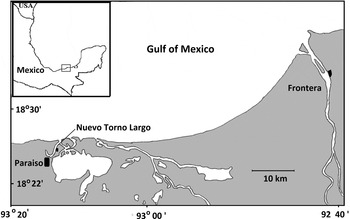
A male longfin mako was detected in Nuevo Torno Largo landing port (18o25′57.78″N 93o09′53.8″) on the south-east coast of the Gulf of Mexico (Figure 1) on 25 February 2011. It was identified based on Compagno (Reference Compagno and Carpenter2002). After landing, the mako was sold and transported to La Viga fish market in Mexico City. The shark was captured 110 km north-west of Paraiso, Tabasco, Mexico (18o49′45″N 94o08′14″W) by a small scale longline fisherman, using baited hooks set near the surface, at a maximum depth of 300 m. The depth information was given by the fisherman and this was estimated using a Garmin fishfinder.
Map of Tabasco, Mexico showing the location where longfin mako was detected.

RESULTS
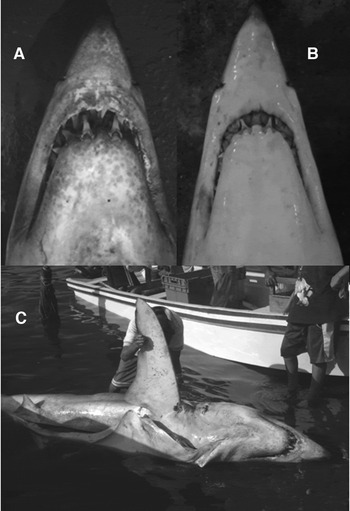
The longfin mako had a total length (TL, straight line distance from tip of snout to tip of tail) of 303 cm. Total weight was not taken; the gutted and headless weight of the specimen was 188 kg. The coloration of the ventral surface of the snout area was dark grey. Garrick (Reference Garrick1967) and Killam & Parsons (Reference Killam and Parsons1986) reported this coloration as an important distinguishing characteristic between I. paucus and the shortfin mako I. oxyrinchus which exhibits a creamy white coloration (Figure 2). Pectoral fin length measured 64 cm and represented about 21% of the TL. The origin of the dorsal fin was well behind the pectoral free rear tips. These are the main taxonomic characteristics for identifying a longfin mako (Bustamantes et al., Reference Bustamantes, Concha and Lamilla2009). A shark caudal fin was found in the stomach of the specimen; probably eaten by the longfin shark before being caught on the longline. On the same longline there were eight other sharks of the species Carcharhinus brevippina.
Comparison of snout and ventral coloration of Isurus paucus (A) and I. oxynchus (B), pectoral fin of the specimen detected of Isurus paucus (C).

DISCUSSION
This longfin mako capture extends the known range of the species well into the south-eastern Gulf of Mexico; however, the occurrence is rare since small scale shark fisheries and longline fleets in the southern Gulf of Mexico have not reported the presence of longfin mako (Oviedo et al., Reference Oviedo, González, Ramírez and Martínez Cruz2008; Ramírez et al., Reference Ramírez, Oviedo and González2008).
ACKNOWLEDGEMENTS
The authors gratefully acknowledge the workers in the capture reception centre in Torno Largo, Tabasco for providing support and fishing information. The authors also thank Fernando T. Wakida and Alvaro Hernandez Flores for proofreading an earlier version of this paper.