Effects of climate change are becoming more apparent and natural disasters are expected to increase in frequency and impact. On October 29, 2012, New York State (NYS) experienced the devastating effects of Hurricane Sandy (Sandy), a natural disaster with large impacts on state and local public health programs. Reference Shipp-Hilts, Mack and Eidson1 This especially impacted community programs for vulnerable populations who have special medical needs, including programs providing HIV/STD services.
In 2012, NYS had the highest HIV/AIDS prevalence in the nation with an estimated 130,000 people living with HIV. 2 Of prevalent cases, 21% resided outside New York City (NYC) boroughs. Government and nonprofit organizations have created community outpatient programs to provide services specific to people living with HIV and STDs. Counties outside of NYC that were severely impacted by Sandy and had a higher prevalence of HIV/STD, such as Nassau, Suffolk, and Westchester counties, have community programs that provide these services to people, including medical care and HIV/STD testing. Community programs are run and maintained by HIV/STD providers. These providers include physicians, counselors, and program directors and are essential in keeping program services running. Continuation of HIV health-care and community services is critical to maintain patients’ adherence to antiretroviral medications and ensure the efficacy of treatment and prevention.
The objective of the study was to assess HIV/STD providers’ experiences in providing HIV/STD services and their involvement in emergency activities during Sandy and develop recommendations for improved preparedness in the future. This information is critical for improving continuity of HIV/STD services during a natural disaster.
METHODS
A multi-agency Hurricane Sandy Research Guidance Team, led by the NYS Department of Health (NYSDOH), was formed to advise on study design, methods, data collection, analyses, and development of recommendations. The team included researchers and state and local members that had worked with the impacted service providers during Sandy. The study consisted of a 3-phase protocol: focus group, semi-structured interviews, and self-administered survey of HIV/STD providers to assess strengths, challenges, and recommendations for future emergency preparedness activities. The qualitative focus group and interviews aimed at gathering exploratory information regarding specific operational and service disruptions experienced and response strategies taken during Sandy. This information was used to support the development of a more complete survey instrument for the quantitative part of the study. HIV/STD providers from Nassau, Suffolk, and Westchester counties were selected because of severe Sandy impacts and critical service provision. Data collection took place from 2014 to 2015, gathering information about services and emergency activities conducted between October 26, 2012 and November 21, 2012. This timeframe reflected Sandy emergency response and recovery period.
Interview and Focus Group
Information was gathered by means of 1 focus group with 3 participants and 3 semi-structured individual participant interviews. The 1-h focus group was conducted by means of phone in December 2014 to explore issues faced by HIV/STD providers during the Sandy response and help formulate interview and survey questions. Individual interviews were conducted in January 2015 by means of phone or in person to further explore those issues. The interviews were 1 h in length with 1 interviewer and 1 transcriber participating in the calls. Participants were service providers who had their main practice in Nassau, Suffolk, and Westchester counties. They were recruited from a list of members of the NYS AIDS Advisory Council provided by the NYSDOH AIDS Institute.
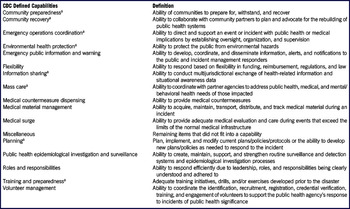
A previously developed codebook and NVivo Qualitative Software (QSR NVivo®) were used to code the focus group and interview transcripts. Reference Shipp-Hilts, Mack and Eidson1 Using open-coding and grounded theory methodology, key words were identified and were also coded as strengths or challenges related to the response, or as recommendations for future improvement. Strength, challenge, and recommendation key words were then organized into Centers for Disease Control and Prevention (CDC) public health preparedness capability categories, and additional study-defined preparedness capability categories (Table 1). All transcripts were coded by 2 coders with Cohen’s Kappa and percent agreement used to assess intercoder reliability. Codes had to be higher than 0.7 for Cohen’s Kappa and higher than 80% agreement to be valid and included in the study. Codes not meeting these limits were revaluated and negotiated until agreement was reached.
Public Health Preparedness Capabilities Used to Categorize Key Words From Qualitative Data in 2014 HIV/STD Provider Focus Group and 2015 Provider Interviews

Abbreviations: CDC, Centers for Disease Control and Prevention.
a Capabilities were defined for the purposes of this study.
Surveys
A survey link was emailed in early 2015 to 107 HIV/STD provider staff who served Nassau, Suffolk, and Westchester counties. These email addresses were obtained through the NYSDOH AIDS Institute. The anonymous survey was administered through SurveyMonkey®. Providers were given 3 wk (inclusive of reminder emails/phone calls) to complete the online survey or return a paper-based version by means of mail. The survey consisted of 28 multiple choice and open-ended questions. Questions regarding response and recovery, challenges, disrupted services, and participant and agency demographics were included in the survey. The survey data were analyzed using Statistical Analysis Software (SAS) version 9.4®. Frequencies and/or averages were calculated, depending on the question.
RESULTS
Interviews and Focus Group Analysis
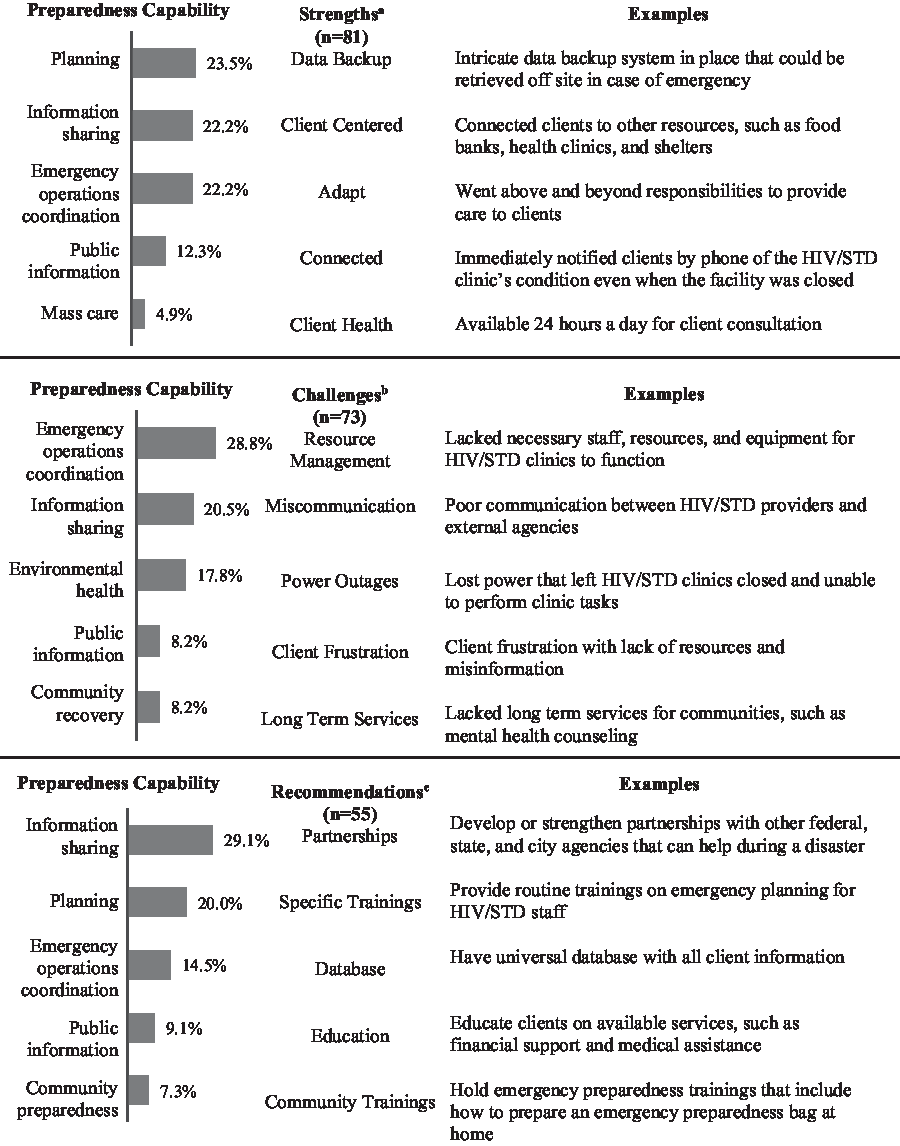
Three community service providers participated in the focus group and 3 additional community service providers participated in the individual interviews. These participants provided HIV/STD related behavioral, clinical, and counseling services. Analysis of the transcripts of the focus groups and interviews resulted in a total of 209 key words identified and classified as strengths, challenges, and recommendations. Overall, strengths represented 38.8% (81/209) of key words, followed by challenges (34.9%; 73/209) and recommendations (26.3%, 55/209) (Figure 1).
Most Cited Program Strengths, Challenges, and Recommendations Among Key Words Related to Hurricane Sandy for Each Emergency Capability: HIV/AIDS Provider 2014 Focus Group (n = 3) and 2015 Interviews (n = 3).

These key words were then organized under emergency preparedness capabilities. Providers found their programs to have sufficient data backup systems (planning), had effective communication with clients (information sharing), and that staff adapted quickly during the disaster (emergency operations coordination) (Figure 1). Programs did experience resource challenges (emergency operations coordination), had poor communication with outside partners (information sharing), and had severe power outages forcing clinics to close (environmental health). Recommendations from providers included strengthening partnerships with outside partners (information sharing), initiating trainings on emergency preparedness planning tailored to HIV/STD programs (planning), and creating more backup mechanisms to reduce program disruption (emergency operations coordination).
Survey Analysis
Of 107 HIV/STD providers surveyed, 52 (49%) responded. Of those responses, 21 (40.4%) were excluded because they had not participated in the response to Sandy (October 26, 2012 to November 21, 2012) and the recovery, resulting in a final sample of 31 providers offering HIV and/or STD services. Among the respondents, the number of years working for their current agency ranged from 1 to 29 y (n = 28), with a median of 5 y. Respondents included directors or coordinators (93%) and most were employed full-time (93%), and 41% were affiliated with a local health department. Most respondents reported moderate to severe impact (68%) on their programs. Although normal leadership structure was maintained (90%), there were modifications in staff roles and responsibilities.
Of the primary HIV/STD services, outreach and education program interruptions were reported by 84% of the respondents, followed by HIV-related support services (eg, food banks) (76%) and HIV/STD testing (64%), respectively. Some clinics were closed for a day or more. Half of the programs resumed services after 1 wk. Some services took 12 wk to resume (18%).
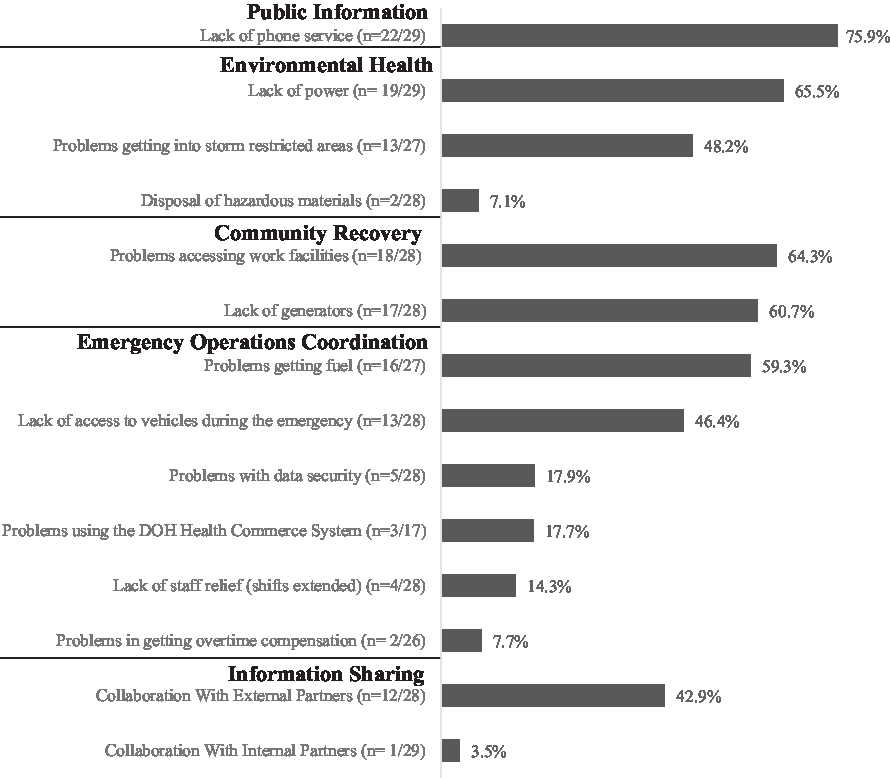
Respondents were asked about the challenges causing service interruptions. These challenges were then grouped for analysis by preparedness capability (Figure 2). Providers in the sample reported the most problems with a lack of phone service (public information), lack of power (environmental health protection), problems accessing work facilities, a lack of generators (community recovery), and problems getting fuel (emergency operations coordination).
Program Challenges Related to Hurricane Sandy, by Preparedness Capability: HIV/STD Provider 2015 Survey.

Several questions in the survey asked providers about their program preparedness and efficiency in carrying out plans. Sixty percent of providers in the sample strongly believed that their responsibilities were clearly defined, while nearly 50% believed there were not adequate existing resources during Sandy. Resource shortages included staffing due to inability to report to work (83%). Providers also noted a lack of transportation for clients and staff. Resources used to share information with clients during the emergency were mostly through phone calls (86%) and texts (51%).
State and local public health partners can assist community providers in response and recovery. While NYSDOH was reported as a useful resource by 40% of respondents, one-third did not use this resource. Many respondents did not use the local health department as a resource (52%) or the county emergency management office (43%).
Regarding preparedness post-Sandy, 89% of respondents had an emergency operations plan in place by 2015 and 62% had practiced the plan. Most (79%) also had protocols to advise clients of potential service disruptions before weather-related emergencies. For future weather-related disasters, most respondents felt very prepared (52%) or somewhat prepared (45%) as an employee and rated their program preparedness similarly.
DISCUSSION
Results showed that severe natural disasters like Sandy have great impacts on operations and services provided by HIV/STD community programs. Major operation disruptions included: limited access to phone communication, worksite, or service areas due to power outages or flood; lack of access to gas or work vehicles; and lack of generators to backup power. Communication and collaboration deficiencies with external local partners further prevented providers from more quickly overcoming these operational disruptions. Therefore, services provided to vulnerable populations during Sandy were also impacted with clinics being closed, limited communications with clients served, and disruption of support services especially regarding medication. However, with strengths in planning, information sharing, and emergency operation coordination, impacts of Sandy on most program operation and services were kept to minimum and over half of the programs resumed operations within a week. Additionally, survey results revealed that most respondents currently had an emergency plan in place and had practiced the plan.
Previous studies on emergency preparedness during Hurricane Katrina found data backup and retrieval to be a problem among HIV programs. Reference Clark, Besch and Murphy3 However, NYS providers in this study reported little or no problem regarding data backup systems. HIV/STD prevention and testing services were greatly impacted by Sandy. Several studies examining special populations post disaster found risky sexual and drug use behavior increased following a disaster. Reference Kissinger, Schmidt and Sanders4,Reference Pouget, Sandoval and Nikolopoulos5 These findings highlight the importance of continuity of existing services, but also illustrate a need for disaster-related outreach and education efforts that help clients engage in safer behaviors during these critical times.
Providers experienced heavy losses in food, equipment, testing, and additional resources for clients. Program facilities that closed for 1 wk or more following Sandy also reduced clients’ access to important services. For 2 programs, it took 12 wk before the program could continue normal services. Communication and formal agreements with external partners, such as use of partner agency equipment and facilities, can greatly reduce these losses and increase recovery time.
Providers in the sample recommended that HIV/STD service providers be assisted in developing a plan tailored to the needs of HIV/STD programs and their clients. Participants recommended the development of additional trainings to reduce this gap in emergency planning and implementation.
Limitations
A study limitation is that data collection took place 2 y after Sandy. Participants may have forgotten or misremembered certain events. The small convenience sample is also a significant limitation but does reflect the representativeness of the population in the findings.
Implications
Few studies have assessed the role of HIV/STD providers’ emergency management during weather-related natural disasters. This study offers insights on HIV/STD program strengths and challenges in emergency preparedness through the provider’s perspective. A key strength to this study was the mixed methods approach that incorporates qualitative and quantitative research strengths for more complete and comprehensive results. Service providers in this study served high-burden areas and high-need populations. The generalizability of specific findings or recommendations is unknown, but may be valuable as a collection of observations, insights, and knowledge gained from among a selected group of providers impacted by Sandy.
CONCLUSIONS
This study addressed 1 impact of our changing climate: increased weather-related disasters that have a high potential to disrupt services, especially those serving vulnerable populations like HIV/STD services. The mixed methods approach, which can be used in other studies, documented staff perceptions of a strong program response and client centered care during Sandy. Emergency planning was assessed through the HIV/STD provider perspective, including recommendations for future emergency preparedness activities. New York’s high HIV prevalence calls for emergency disaster planning to be included in HIV/STD care and management. The key public health preparedness capabilities that should be considered by HIV/STD provider programs include information sharing, planning, and emergency operations coordination.
Acknowledgments
We thank the Hurricane Sandy Guidance Team, NYSDOH Researchers, and HIV/STD Providers who participated in our research. Research conducted at New York State Department of Health, Office of Public Health Practice.
Funding
This work was supported by the Cooperative Agreement Number U01TP000567 from the Centers for Disease Control and Prevention (CDC). Its contents are solely the responsibility of the authors and do not necessarily represent the official views of CDC or the New York State Department of Health.
Conflicts of Interest
No potential conflict of interest was reported by the authors.