The overuse of antimicrobials has been linked to the rise of antimicrobial-resistant organisms, which are a cause of significant morbidity, mortality, and healthcare spending. 1 , Reference Ford, Fraser, Davis and Kodish 2 Of equal importance, unnecessary antimicrobial use increases the risk of patient harm due to adverse events and drug side effects. In response, antimicrobial stewardship programs (ASPs) were developed to optimize antimicrobial use. 1 , Reference Yeo 3 – Reference Fishman 7 Despite some progress,Reference Fishman 7 , Reference Davey, Marwick and Scott 8 unnecessary antimicrobial prescribing continues to occur at high rates in the United States.Reference Fishman 7
Antimicrobial use is particularly common among patients in end-of-life settings, with some studies noting use as high as 87%.Reference Thompson, Silveira, Vitale and Malani 9 Patients at the end of life often have multiple comorbidities present in addition to their primary illness, and these patients may be more susceptible to infections due to contributing factors such as medications, immunosuppression, malnutrition, and the presence of catheters or wounds.Reference Vitetta, Kenner and Sali 10 , Reference Hamilton and Fishman 11 Prior studies have noted that many end-of-life patients receive antimicrobials in the days or weeks prior to death.Reference Thompson, Silveira, Vitale and Malani 9 , Reference D’Agata and Mitchell 12 , Reference Chun, Rodgers, Vitale, Collins and Malani 13 Furthermore, some patients receive antimicrobials in the absence of adequate clinical symptoms to support the presence of a bacterial infection.Reference Furuno, Noble and Horne 14 Although quality of life is often cited for continuation of antimicrobials in this patient population, the literature supporting its use for this purpose is conflicting.Reference Vitetta, Kenner and Sali 10 , Reference Reinbolt, Shenk, White and Navari 15 , Reference Albrecht, McGregor, Fromme, Bearden and Furuno 16
Given the medical complexity of patients at the end of life, it can be difficult to apply ASP guidelines to this population. The decision to prescribe antimicrobials in end-of-life patients thus becomes both individualized and multifactorial, often requiring complex clinical decision making. In these situations, physicians may balance an awareness that antimicrobial resistance and an increased risk of adverse drug effects is linked to unnecessary prescribing17 with potentially competing interests of patients, patients’ families, or the healthcare system.Reference Ford, Fraser, Davis and Kodish 2 , Reference Metlay, Shea, Crossette and Asch 17 – Reference Leibovici, Paul and Ezra 20
Characterizing physician attitudes toward end-of-life antimicrobial prescribing is integral to understanding how physicians approach infections in this patient population and to optimizing antimicrobial use for patients at the end of life. The objectives of this study were (1) to examine the reasons why physicians continue or discontinue antimicrobials at the end of life and (2) to determine whether physicians prefer to continue antimicrobial use in specific end-of-life situations.
METHODS
Study Design and Participant Recruitment
A cross-sectional study of attending physicians and fellows with appointments at either the University of Pennsylvania or Children’s Hospital of Philadelphia (CHOP) was conducted from January 15 to April 10, 2017. Physicians with appointments at the University of Pennsylvania could work at the University of Pennsylvania Health System (UPHS), the Philadelphia Veterans Affairs Medical Center, or in a community or public health setting. These institutions are situated in a large urban area. The UPHS served as the coordinating site. In this study, physicians at CHOP and UPHS are referred to as pediatric and adult physicians, respectively.
Participants were selected for inclusion if they were physicians or fellows working in specialties commonly involved in medical decision making for patients at the end of life. Nonphysician providers who responded to this survey were excluded. Divisions targeted included critical care, hematology/oncology, hospice/palliative care, hospital medicine, immunology, infectious diseases, neonatology, and pulmonology. Physician contacts within the selected departments agreed to distribute the survey and send one reminder email during the study period. The survey instrument was administered electronically utilizing the REDCap system.Reference Harris, Taylor, Thielke, Payne, Gonzalez and Conde 21 Participants were informed in an introductory paragraph that the survey was created to study physician attitudes and decision making regarding antimicrobial use in end-of-life care. Participation in the survey was both voluntary and anonymous. No financial incentives were offered for participation. The University of Pennsylvania Institutional Review Board deemed this study exempt from review.
Survey Instrument
The study team drafted the initial survey, which was subsequently reviewed by a convenience sample of 3 physicians at both CHOP and UPHS in different specialties for readability, appropriateness, and length. Feedback from face-to-face sessions with these physicians was incorporated into the survey. The final instrument included 51 items (see Appendix). Demographic information was collected regarding respondents’ institution, age, gender, practice setting, and medical specialties. Physicians were asked about their attitudes regarding antimicrobial stewardship and antimicrobial resistance. Respondents were then asked to consider a patient who is at the end of life. “End of life” was defined based on the respondents’ own judgment and their clinical practice setting. A series of 5-point Likert-scale items followed, which asked survey participants to rate the relative importance of a given set of reasons for continuing or discontinuing antimicrobials. The last section of the survey instrument asked respondents how likely they were to continue an antimicrobial regimen for a series of infection types and clinical scenarios. Finally, 3 optional, open-ended questions were included in the survey to allow respondents to reflect on additional reasons to continue or discontinue antimicrobials, as well as on the topic of antimicrobial use in end-of-life care.
Statistical Analysis
Answers to 5-point Likert-scale items were condensed into a 3-point scale: (1) agree, neutral/not sure, disagree, (2) important, neutral/not sure, not important, and (3) often/always, sometimes, and rarely/never for descriptive analysis. Likert-scale items were further condensed into a binary scale for statistical testing. Data were analyzed using SPSS version 24.0 statistical software (IBM, Armonk, NY). Statistical tests performed included the 2-sample Z test, χ2 test, and Fisher exact tests. The level of significance for all statistical tests was α=0.05.
Free-text responses were analyzed for recurrent themes with the NVivo Suite version 11 software (QSR International, Melbourne, Australia) using standard methods of qualitative data analysis.Reference Huberman and Miles 22 All comments were reviewed in a 2-stage coding process by author J.E.S., a sociologist with expertise in qualitative data analysis. First, comments were reviewed for recurrent themes, which were identified and defined as analytic nodes in NVivo. Second, all responses were read line by line, and nodes were attached to relevant passages of data that represented that theme. While J.E.S. led node development and application, all authors participated in regular meetings throughout the analysis process to ensure reliability and to resolve any discrepancies by consensus.
RESULTS
Respondent Characteristics
Of the 637 physicians who were invited to participate in the survey, 283 completed it, for an overall response rate of 44.4%. The response rate was 37.5% (136 of 363) among CHOP physicians and 53.6% (147 of 274) among University of Pennsylvania physicians (P<.01). Approximately half of respondents were male (51.9%). The mean age of respondents was 43.2 years (standard deviation [SD], 11.1 years; interquartile range [IQR], 34.0–50.0 years). Common practice settings for survey participants included inpatient non–intensive care unit (non-ICU; 49.1%), followed by outpatient (26.9%) and inpatient ICU (17.3%). The most common specialties reported by respondents included pediatrics (n=74), infectious diseases (n=52), hematology/oncology (n=46), pulmonary (n=41), and critical care or ICU (n=40).
Physician Beliefs About Antimicrobial Use and Stewardship
Most respondents agreed with the following 2 statements: “The overuse of antibiotics contributes to antibiotic resistance” (96.1%) and “Medical practitioners have a responsibility to reduce the use of unnecessary antibiotics” (99.3%). In response to the statement: “Antimicrobial use in end of life care contributes to antibiotic resistance,” only 49.8% of physicians agreed, although this differed significantly between adult physicians and pediatric physicians (60.5% vs 38.2%; P<.001). More than one-third of physicians (n=108, 38.2%) were neutral or unsure of the relationship between end-of-life antimicrobial use and resistance, and among them, more than half were pediatricians (n=63, 58.3%).
Antimicrobial Continuation in End-of-Life Clinical Scenarios
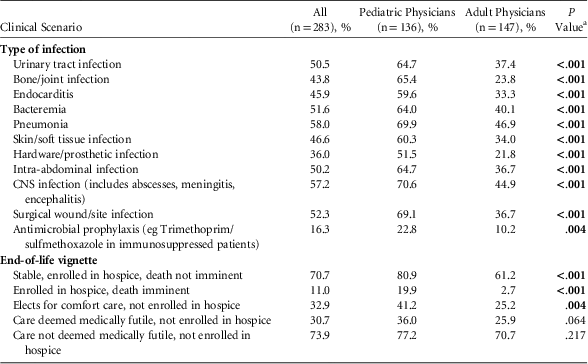
Physicians were provided a set of clinical scenarios and asked to rate their likelihood of continuing antimicrobial treatment (Table 1). The infections with the highest proportion of physicians opting to often or always continue treatment were pneumonia (58.0%) and CNS infections (57.2%). Few physicians would continue antimicrobial prophylaxis (16.3%) or attempt to treat hardware or prosthetic infections (36.0%). For every infection in our survey, a higher proportion of pediatricians would often or always continue antimicrobial treatment compared to adult physicians. This difference in proportions was statistically significant for all infections (P<.001) as well as for antimicrobial prophylaxis (P=.004).
Physician Perceptions Favoring Continuation of Antimicrobials in End-of-Life Clinical Scenarios: Percentage Responding Often/Always

a Calculated using χ2 test. Bold values indicate significance.
Most physicians would often or always continue antimicrobials for patients not in hospice whose care was not deemed medically futile (73.9%) or for stable patients enrolled in hospice (70.7%). Nearly one-fifth of pediatricians (n=27, 19.9%) would continue antimicrobial therapy for hospice patients whose death was imminent, compared to few adult physicians (n=4, 2.7%; P<.001). Pediatric physicians differed significantly from adult physicians in their preference for continuing antimicrobials for stable patients enrolled in hospice (n=110, 80.9% vs n=90, 61.2%; P<.001) and for patients not in hospice who elect comfort care (n=56, 41.2% vs n=37, 25.2%; P=.004).
Reasons for Continuation or Discontinuation of Antimicrobials at the End of Life
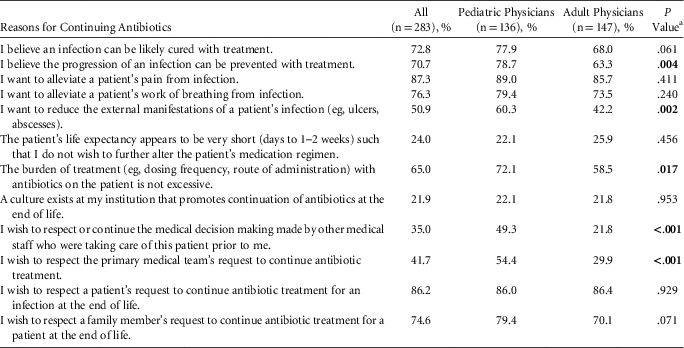
A summary of physician attitudes toward reasons for continuing antimicrobial use in end-of-life care is provided in Table 2. Most physicians believed it was important to respect a patient’s request to continue antimicrobial treatment for an infection at the end of life (86.2%) or to respect the request of a family member acting on behalf of the patient (74.6%). Relieving pain (87.3%) and work of breathing (76.3%) were also considered important by physicians. Adult and pediatric physicians differed significantly in their opinions regarding the importance of continuing antimicrobials for the progression of an infection (n=93, 63.3%, vs n=107, 78.7%; P=.004) or for reducing the external manifestations of an infection (n=62, 42.2% vs n=82, 60.3%; P=.002). A higher proportion of pediatric physicians considered respecting decision making made by prior medical staff (n=67, 49.3% vs n=32, 21.8%; P<.001) and respecting the primary team’s wishes (n=74, 54.4% vs n=44, 29.9%; P<.001) important reasons to continue antimicrobial therapy.
Reasons for Continuing Antimicrobials at the End of Life: Percentage of Physicians Responding Important/Extremely Important

a Calculated using χ2 test. Bold values indicate significance.
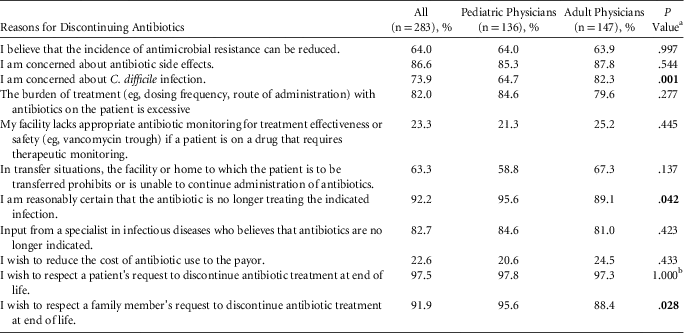
Physicians were also queried regarding reasons for discontinuing antimicrobial use (Table 3). Many physicians believed it was important to respect a patient’s request to discontinue antimicrobial treatment (97.5%) or to discontinue treatment if the antimicrobial was no longer treating the indicated infection (92.2%). Less than one-quarter of physicians (22.6%) believed that reducing the cost of antimicrobial use to the payor was an important reason for discontinuing treatment. The proportion of adult physicians who believed it was important to discontinue antimicrobial therapy due to concern for C. difficile infection differed significantly compared to pediatric physicians (n=121, 82.3% vs n=88, 64.7%; P=.001).
Reasons for Discontinuing Antimicrobials at the End of Life: Percentage of Physicians Responding Important/Extremely Important

NOTE. C. difficile, Clostridium difficile
a Calculated using χ2 test unless otherwise specified. Bold values indicate significance.
b Calculated using the Fisher exact test.
Open-Ended Questions
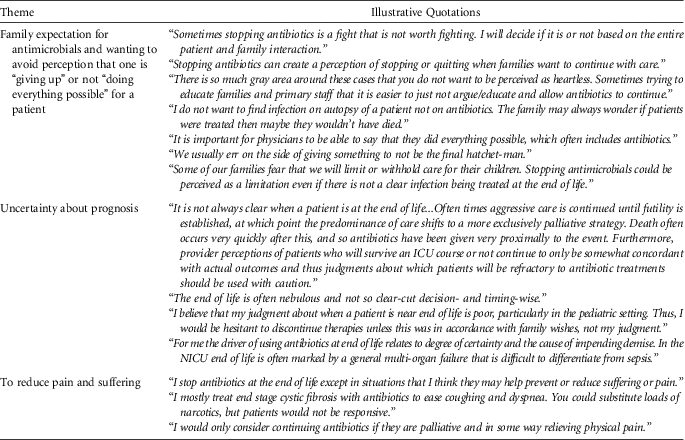
Overall, 73 respondents (25.8%) provided free-text answers to the open-ended questions included in the survey. Responses ranged in length from 17 to 128 words. Analysis of these responses revealed that decision making surrounding antimicrobial use is complex and based on multiple interacting factors that are difficult to generalize. Table 4 summarizes these reasons and provides exemplar verbatim quotations from the free-text responses.
Themes Identified from Free-Text Data With Illustrative Quotations

Respondents focused on 3 overarching reasons for continuing antimicrobials at the end of life. First, respondents suggested that they continued antimicrobials at the end of life to ensure that families perceived the care team as doing everything possible for their loved one. Physicians were motivated to not be perceived by families as “heartless” or “the final hatchet man” as a result of withholding treatment. Second, respondents suggested that knowing when a patient is near death is difficult and if a small possibility existed that therapy could prolong a patient’s life by even a few days, they would continue antimicrobials. As one respondent explains, “. . . antibiotics can be palliative. The extra few days they can provide may be important to that person or their family.” Third, respondents suggested that they continued antimicrobials to reduce physical pain or suffering from untreated infection (eg, decreasing dysuria by treating a urinary tract infection).
DISCUSSION
Unique considerations related to end-of-life care, including a focus on goals of care and improving quality of life,Reference Buss, Rock and McCarthy 23 , Reference Rodríguez-Prat, Monforte-Royo, Porta-Sales, Escribano and Balaguer 24 likely influence physician perceptions. Many physicians in our study considered palliation of pain and work of breathing important reasons to continue antimicrobials. The relationship between antimicrobial use and improvement in quality of life is controversial.Reference Vitetta, Kenner and Sali 10 , Reference Reinbolt, Shenk, White and Navari 15 , Reference Albrecht, McGregor, Fromme, Bearden and Furuno 16 A meta-analysis that explored symptom burden reduction with antimicrobial therapy in end-of-life patients noted marked variability; 60%–92% of patients with urinary tract infections and 0–53% with respiratory infections reported improvement.Reference Rosenberg, Albrecht and Fromme 25 Despite the lack of compelling evidence, many physicians may opt to try or continue antimicrobial therapy to palliate patient symptoms because they perceive the adverse consequences to be relatively low. Clinical guidelines, such as the Infectious Diseases Society of America’s clinical guidelines on hospital-acquired and ventilator-associated pneumonia, stress clinical criteria in identifying infection as opposed to biomarkers,Reference Kalil, Metersky and Klompas 26 which may influence a physician’s decision making. The Infectious Diseases Society of America’s pneumonia guidelines also recommend shorter antimicrobial courses and prompt de-escalation of therapy, given the lack of evidence of improved mortality or outcomes with prolonged treatment.Reference Kalil, Metersky and Klompas 26
Most physicians considered it important to respect a patient’s wish to continue antimicrobials at the end of life, and nearly all physicians considered it important to respect a patient’s request to discontinue antimicrobials. Physician sentiment regarding patient wishes may reflect medicine’s shift from a physician-driven to a shared decision making model.Reference Barry and Edgman-Levitan 27 , 28 Furthermore, patients at the end of life often have little control regarding many aspects of their medical care or prognosis. Studies have demonstrated the importance of dignity in the dying process and its interrelationship with patient autonomy.Reference Rodríguez-Prat, Monforte-Royo, Porta-Sales, Escribano and Balaguer 24 , Reference McCaffrey, Bradley, Ratcliffe and Currow 29 A desire to promote a patient’s or surrogate decision-maker’s autonomy in such situations may contribute to a physician’s consideration of patient wishes, especially with regard to minimally invasive interventions such as antimicrobial therapy.
Analysis of our free-text responses illustrated sociobehavioral reasons why antimicrobials might be continued at the end of life. Overall, the free-text responses in our study focused on the benefits of continuing antimicrobial therapy for end-of-life patients rather than the potential adverse effects of therapy. Respondents described a desire not to be perceived by families as withholding therapy for a patient. This finding is consistent with previous research, which notes that physicians are reluctant to pursue palliative care for dying patients. Reasons cited by physicians included feelings of personal failure,Reference Bakitas, Lyons, Hegel and Ahles 30 fear of letting patients down, and a desire to avoid difficult conversations.Reference Snow, Varela, Pardi, Adelman, Said and Reid 31 Many of our respondents also described how decision making at the end of life is complicated; the uncertainty surrounding a patient’s prognosis makes discontinuing antimicrobials difficult, especially when they may offer the opportunity to prolong life or palliate pain.
Approximately half of physicians agreed with the statement that antimicrobial use in end-of-life care contributed to resistance. The perception that antimicrobials would be used only for a short period of time or the relatively small number of patients at the end of life compared to other patient populations may be influencing physician attitudes. Physicians in our survey were also not as responsive to economic factors when making decisions regarding antimicrobial therapy; less than a quarter of respondents considered cost to the payor an important reason for discontinuing antimicrobials for end-of-life patients. Tension likely exists between physicians’ sense of responsibility to the public and their sense of duty to individual patients and their families.Reference Marcus, Clarfield and Moses 18 – Reference Leibovici, Paul and Ezra 20 , Reference Garau 32 Clinicians may weigh patient and societal factors differently in end-of-life care, which could encourage them to supersede antimicrobial stewardship in favor of patient-focused care.
Adult and pediatric physicians approached end-of-life antimicrobial use differently in our study. The proportion of pediatricians who considered respecting decision making made by prior physicians and respecting the primary team’s wishes important in continuing antimicrobial therapy differed significantly from adult physicians. These differences may be related to variability in institutional and professional culture or prescribing etiquette.Reference Charani, Castro-Sánchez and Holmes 33 – Reference Skodvin, Aase, Charani, Holmes and Smith 35 Previous work has examined how physician seniority and identification with a specific clinical group could influence prescribing behavior of physicians.Reference Charani, Castro-Sanchez and Sevdalis 34 A prevailing culture of noninterference could prevent modification of prescribing practices of colleagues. Conversely, a collaborative culture may also lead to an emphasis of importance on the medical decision making of other physicians. The role of prescribing etiquette has not been thoroughly explored with regards to antimicrobial use in end-of-life patients; further study is needed to elucidate how it influences physician prescribing behavior and stewardship practices.
Pediatricians were more likely to elect to treat any infection at the end of life compared to their adult counterparts (Table 1). The decision to continue conventional treatments versus the pursuit of palliative care, hospice, or nonintervention is multifactorial and subject to both physician and patient values.Reference Jin 36 – Reference Baumrucker, Stolick and Oertli 38 Considerations unique to the pediatric setting may include children having decades of unrealized life compared to adults, parental or guardian pressure for medical intervention, and the general treatability of most pediatric infections. Such factors may contribute to an overall willingness of pediatric physicians to continue antimicrobial therapy in patients at the end of life.
This study has several limitations. Survey responses may not reflect real-time medical decision making performed by physicians. Physician decision making also may involve the simultaneous consideration of multiple variables presented in our study. The relationship between variables was not examined and is better captured using an alternative study design such as vignette studies of medical choice and judgment.Reference Bachmann, Mühleisen, Bock, ter Reit, Held and Kessels 39 Physicians in different specialties may have discrepant exposure to terminally ill patients; meaningful subgroup analysis by specialty, which may identify attitudinal differences, was precluded by sample size. No information was collected on nonrespondents, so the degree of response bias could not be assessed. All survey participants were affiliated with large academic medical centers; the results of this study, therefore, may not be generalizable to other settings. Despite these limitations, our voluntary study yielded a robust response rate and captured meaningful responses from an array of physicians.
In conclusion, many factors, including patient-centeredness, workplace culture, and clinical considerations, contribute to the decision framework that physicians utilize when prescribing antimicrobials at the end of life. Adult and pediatric physicians approach antimicrobial use in their respective patient populations differently. Physicians may be overweighing the benefits of continuing antimicrobial therapy in patients at the end of life due to complex sociobehavioral factors. Cost and population health benefits, which are common ethical justifications for antimicrobial stewardship, may not resonate with physicians caring for these patients. Further research is needed to assess physician and patient attitudes and the factors that shape decision making to better guide antimicrobial recommendations at the end of life.
ACKNOWLEDGMENTS
The authors would like to recognize Drs Niharika Ganta, Jason Wagner, and Susan Coffin for their contributions during the preparation of the survey instrument. Additionally, we extend special thanks to Dr Matthew Bryan for his assistance with the statistical analysis.
Financial support: No financial support was provided relevant to this article.
Potential conflicts of interest: All authors report no conflicts of interest relevant to this article.
SUPPLEMENTARY MATERIAL
To view supplementary material for this article, please visit https://doi.org/10.1017/ice.2018.6.