We heartily endorse the overarching proposal of Ambridge, Kidd, Rowland, and Theakston (this issue) that frequency effects are ubiquitous and that models of first language acquisition must account for them. Ambridge et al., focus on the effects of frequency on lexical, morphological, and syntactic acquisition. In this commentary, we discuss analogous effects in phonological acquisition.
We focus first on the influence of phoneme frequency in the lexicon on children's productions, an influence that is observed even in the first year of life as children begin to babble. For example, in a longitudinal study of children acquiring English, French, Japanese, or Swedish, de Boysson-Bardies and Vihman (Reference de Boysson-Bardies and Vihman1991) found that the frequency of consonants produced in babbling reflected cross-language differences in the relative frequency of different consonants in the ambient adult languages.
The idea that frequency influences phoneme acquisition has been discussed in relationship to the much older observation that some sounds are more frequent than others in the phoneme inventories of the world's languages. As first articulated by Jakobson (Reference Jakobson and Keiler1941/1968), these macro-level frequencies are related to the order of acquisition of phonemes because they reflect universal physical and cognitive constraints on speech perception and production. Examples of the universal constraints proposed by Jakobson are that children should produce stops before fricatives and that they should produce voiceless unaspirated stops before either voiceless aspirated stops or voiced stops. In both of these instances, the motor control demands for the later-acquired sounds are greater. Fricatives require that the speaker precisely control a narrow constriction, while stops require only a ballistic closure gesture (Kent, Reference Kent, Ferguson, Menn and Stoel-Gammon1992). Similarly, the coordination of timing for the stop release relative to the onset of voicing are less demanding for voiceless unaspirated stops relative to either voiced or voiceless aspirated stops (Kewley-Port & Preston, Reference Kewley-Port and Preston1974).
Some more recent accounts suggest that these trends can be construed as micro-level frequency effects as well. For example, Stemberger and Bernardt (Reference Stemberger, Bernhardt and MacWhinney1999) suggest that consonant sounds that are observed in many languages also tend to occur frequently in the individual languages in which they occur. Such frequent consonants can then function as ‘default’ sounds in the language – i.e. ones that are produced accurately at an earlier age and also substitute for other consonants in young children's production errors because they then take fewer cognitive resources to process. This acquisition pattern provides evidence in phonological development for both the Prevent Error and Cause Error Theses of Ambridge and colleagues.
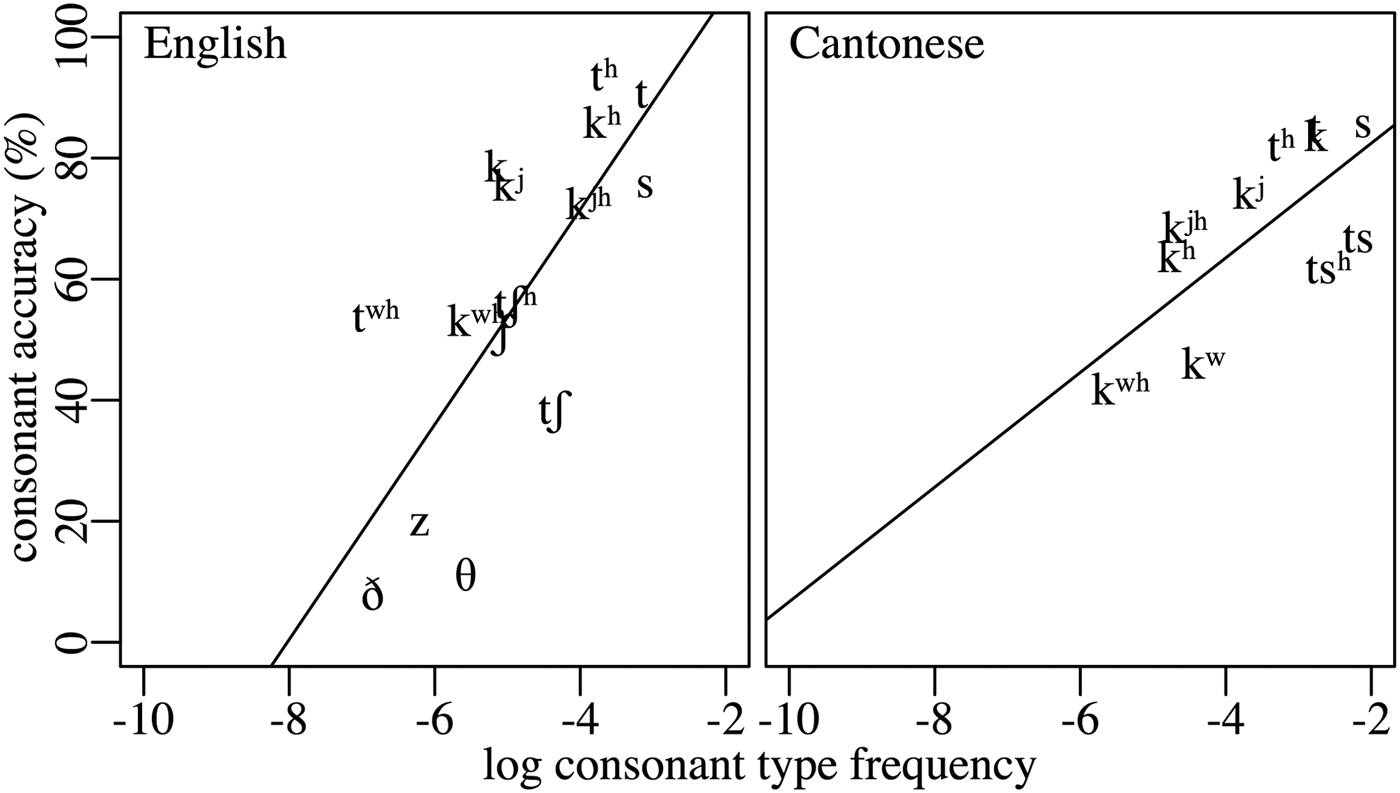
While Stemberger and Bernardt's (Reference Stemberger, Bernhardt and MacWhinney1999) account does not specify whether the effects on production accuracy are related to a consonant's token frequency or to its type frequency, our own research supports an account that focuses on type frequency. That is, the more words containing a sound that a child has learned to say, the more practiced the child becomes at recognizing and reproducing the sound abstracted away from the phonological contexts of a few specific words. This account predicts that there should be a correlation between consonant production accuracy and the type frequencies of the consonants in the lexicon of the specific language that a child is acquiring. Figure 1 shows some of our evidence for this account. There is a significant relationship between consonant frequency and accuracy in these two typologically unrelated languages (r 2 = ·56 in English and ·46 in Cantonese), providing evidence for the Age of Acquisition Thesis of Ambridge et al., Furthermore, it is type rather than token frequency that is predictive of accuracy. This is shown by the relationship between frequency and accuracy of /ð/ in English, which has a low type frequency, even though it has an extremely high token frequency.
Fig. 1.Consonant accuracy in a picture-prompted word-repetition task plotted against consonant frequency in an adult word list for English-speaking (left plot) and Cantonese-speaking (right plot) two- and three-year-olds. (Figure adapted from Beckman and Edwards, Reference Beckman and Edwards2010.)
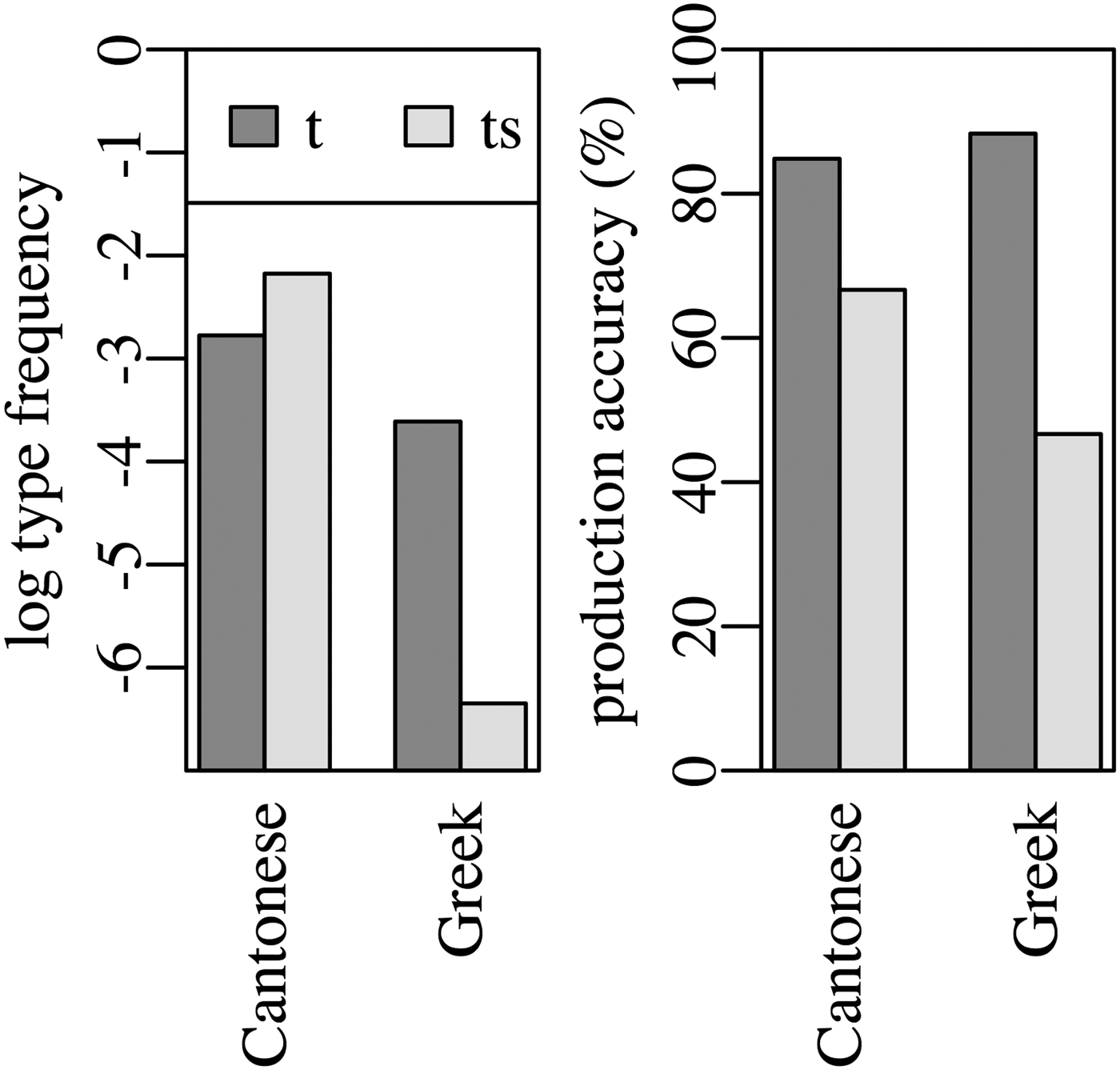
Insofar as a consonant sound has different type frequencies in different languages, this account predicts different patterns of phoneme acquisition across languages. That is, these effects of frequency will interact with universal constraints on production and perception (as in the Interaction Thesis of Ambridge and colleagues). One of Jakobson's universal constraints was that children should produce stops before affricates. Figure 2 shows a comparison between Greek and Cantonese for productions of /t/ and /ts/ by two- and three-year-olds. In both languages, /t/ is produced more accurately than /ts/. However, the frequency of /ts/ is much higher in Cantonese than in Greek and the difference in accuracy between /t/ and /ts/ is much smaller in Cantonese than in Greek.
Fig. 2.Log type frequency (left) and percent correct (right) for Cantonese and Greek /t/ and /ts/. (Figure adapted from Edwards and Beckman, Reference Edwards and Beckman2008.)
This account of the relationship between type frequency and accuracy originates in an earlier nonword repetition study on English-acquiring children in which Edwards, Beckman, and Munson (Reference Edwards, Beckman and Munson2004) found that children produced high-frequency two-phoneme sequences more accurately than low-frequency sequences. Furthermore, this effect of frequency on accuracy was moderated by vocabulary size: the larger a child's expressive vocabulary, the smaller the effect of phoneme sequence frequency on accuracy. Edwards and colleagues interpreted this result as support for their lexical scaffolding hypothesis. That is, children establish phonological representations for sublexical categories such as phonemes that are abstracted away from specific words only gradually, as they learn to hear and reproduce sounds and sound sequences in many different words. However, because the study included only English-acquiring children, the result also could be interpreted as just more evidence for universal constraints. That is, it could be the case that certain sounds and sound sequences are low in frequency (in English and other languages, too) precisely because they are more difficult to produce or perceive.
Figures 1 and 2 come from the paidologos project (http://www.ling.ohio-state.edu/~edwards/). The impetus for this project was to examine first language phonological acquisition cross-linguistically so that we could tease apart the two accounts. In the paidologos project, we examined the influence of frequency on phonological acquisition of lingual obstruents across six languages (American English, Cantonese, Greek, Japanese, Korean, and Mandarin) in two- to five-year-old children. We found that both phoneme frequency and phoneme sequence frequency influence the order of acquisition of phonemes cross-linguistically (e.g., Edwards & Beckman, Reference Edwards and Beckman2008; Li, Edwards & Beckman, Reference Li, Edwards and Beckman2009; Beckman & Edwards, Reference Beckman and Edwards2010). This result suggests that the effect of phoneme sequence frequency and the moderating effect of expressive vocabulary size on this effect that was observed in Edwards et al., (Reference Edwards, Beckman and Munson2004) do support the hypothesis that children's phonological representations gradually become more segmental as the size of their lexicon increases (e.g., Metsala & Walley, Reference Metsala, Walley, Metsala and Ehri1998; Edwards et al., Reference Edwards, Beckman and Munson2004; Sosa & Stoel-Gammon, Reference Sosa and Stoel-Gammon2012).
The effect of frequency on phonological acquisition is not limited to the phonemic level of representation. We also see an effect of frequency at the morphophonological level in the acquisition of the different allomorphs of inflectional markers for both plural (/s/, /z/, /əz/) and past tense (/d/, /t/, /əd/) suffixes. In general, children produce the more frequent forms of these inflections before the less frequent forms. That is, for both the plural and the past tense, the single-consonant forms (/s/, /z/, /t/, /d/) are produced by children before the syllabic forms (/əz/ and /əd/) (Derwing & Baker, Reference Derwing, Baker, Prideaux, Derwing and Baker1980; Marchman, Wulfeck & Ellis Weismer, Reference Marchman, Wulfeck and Ellis Weismer1999); these single-consonant forms have higher type and token frequencies than the syllabic forms.
In this commentary, we have reviewed research showing that there are frequency effects on phonological acquisition at all levels, as proposed in the Levels and Kinds Thesis of Ambridge et al., We have shown frequency effects beginning with the preverbal vocalizations of infants and continuing through development to the abstract phonotactic ‘rules’ and morphophonological alternations that influence word and sentence productions of young children. We conclude by returning to the Interaction Thesis of Ambridge and colleagues; frequency effects will interact with other influences on acquisition. In our research, we have come across several cross-linguistic differences that were difficult to understand, even if we took into account both universal constraints on production and perception and the influence of frequency. One such case is the acquisition of /s/ and /ʃ/ in Japanese and English. The two languages show opposite patterns of acquisition of /s/ and /ʃ/. In English, /s/ is acquired before /ʃ/ and [s] for /ʃ/ substitutions are common, while in Japanese, /ʃ/ is acquired before /s/ and one of the most common substitution patterns is [ʃ] for /s/ (see Li et al., Reference Li, Edwards and Beckman2009, and older literature reviewed there). Frequency plays a role, too. While /s/ is more frequent than /ʃ/ in both languages, there is a much larger difference in frequency between /s/ and /ʃ/ in English relative to Japanese. Our exploration of this contrast in the two languages suggests two additional influences. First, the spectral differentiation between /s/ and /ʃ/ is more robust in English. Because English /ʃ/ is rounded as well as produced with a more posterior lingual constriction relative to /s/, energy is focused at a much lower frequency and there is a very clear differentiation between the two consonants along acoustic dimensions such as peak frequency or spectral mean frequency. Second, a perception study with naive adults (Li, Munson, Edwards, Yoneyama & Hall, Reference Li, Munson, Edwards, Yoneyama and Hall2011) showed that Japanese- speaking adults tend to label acoustically intermediate tokens (produced by either Japanese-speaking or English-speaking children) as /ʃ/, while English-speaking adults label these same tokens as /s/. Thus, in order to understand cross-linguistic differences in order of acquisition of /s/ and /ʃ/ in English and Japanese, it is necessary to consider also cross-linguistic differences at the level of fine-grained phonetic cues – i.e., in language-specific production and perception norms as measured in the acoustic–auditory space for these two sounds.
In summary, based on our own experience in understanding the influence of frequency on phonological acquisition, we would argue that the Interaction Thesis is probably the most fruitful of the five theses of Ambridge et al., for understanding the effect of frequency on language acquisition. The type of analysis described here, which examines multiple influences on phonological acquisition simultaneously, and in several languages at once, is a model for examining the role of frequency on first language acquisition in other components of language and in the interactions among them.





 You have
Access
We heartily endorse the overarching proposal of Ambridge, Kidd, Rowland, and Theakston (this issue) that frequency effects are ubiquitous and that models of first language acquisition must account for them. Ambridge et al., focus on the effects of frequency on lexical, morphological, and syntactic acquisition. In this commentary, we discuss analogous effects in phonological acquisition.
We focus first on the influence of phoneme frequency in the lexicon on children's productions, an influence that is observed even in the first year of life as children begin to babble. For example, in a longitudinal study of children acquiring English, French, Japanese, or Swedish, de Boysson-Bardies and Vihman (Reference de Boysson-Bardies and Vihman1991) found that the frequency of consonants produced in babbling reflected cross-language differences in the relative frequency of different consonants in the ambient adult languages.
The idea that frequency influences phoneme acquisition has been discussed in relationship to the much older observation that some sounds are more frequent than others in the phoneme inventories of the world's languages. As first articulated by Jakobson (Reference Jakobson and Keiler1941/1968), these macro-level frequencies are related to the order of acquisition of phonemes because they reflect universal physical and cognitive constraints on speech perception and production. Examples of the universal constraints proposed by Jakobson are that children should produce stops before fricatives and that they should produce voiceless unaspirated stops before either voiceless aspirated stops or voiced stops. In both of these instances, the motor control demands for the later-acquired sounds are greater. Fricatives require that the speaker precisely control a narrow constriction, while stops require only a ballistic closure gesture (Kent, Reference Kent, Ferguson, Menn and Stoel-Gammon1992). Similarly, the coordination of timing for the stop release relative to the onset of voicing are less demanding for voiceless unaspirated stops relative to either voiced or voiceless aspirated stops (Kewley-Port & Preston, Reference Kewley-Port and Preston1974).
Some more recent accounts suggest that these trends can be construed as micro-level frequency effects as well. For example, Stemberger and Bernardt (Reference Stemberger, Bernhardt and MacWhinney1999) suggest that consonant sounds that are observed in many languages also tend to occur frequently in the individual languages in which they occur. Such frequent consonants can then function as ‘default’ sounds in the language – i.e. ones that are produced accurately at an earlier age and also substitute for other consonants in young children's production errors because they then take fewer cognitive resources to process. This acquisition pattern provides evidence in phonological development for both the Prevent Error and Cause Error Theses of Ambridge and colleagues.
While Stemberger and Bernardt's (Reference Stemberger, Bernhardt and MacWhinney1999) account does not specify whether the effects on production accuracy are related to a consonant's token frequency or to its type frequency, our own research supports an account that focuses on type frequency. That is, the more words containing a sound that a child has learned to say, the more practiced the child becomes at recognizing and reproducing the sound abstracted away from the phonological contexts of a few specific words. This account predicts that there should be a correlation between consonant production accuracy and the type frequencies of the consonants in the lexicon of the specific language that a child is acquiring. Figure 1 shows some of our evidence for this account. There is a significant relationship between consonant frequency and accuracy in these two typologically unrelated languages (r 2 = ·56 in English and ·46 in Cantonese), providing evidence for the Age of Acquisition Thesis of Ambridge et al., Furthermore, it is type rather than token frequency that is predictive of accuracy. This is shown by the relationship between frequency and accuracy of /ð/ in English, which has a low type frequency, even though it has an extremely high token frequency.
Consonant accuracy in a picture-prompted word-repetition task plotted against consonant frequency in an adult word list for English-speaking (left plot) and Cantonese-speaking (right plot) two- and three-year-olds. (Figure adapted from Beckman and Edwards, Reference Beckman and Edwards2010.)
Insofar as a consonant sound has different type frequencies in different languages, this account predicts different patterns of phoneme acquisition across languages. That is, these effects of frequency will interact with universal constraints on production and perception (as in the Interaction Thesis of Ambridge and colleagues). One of Jakobson's universal constraints was that children should produce stops before affricates. Figure 2 shows a comparison between Greek and Cantonese for productions of /t/ and /ts/ by two- and three-year-olds. In both languages, /t/ is produced more accurately than /ts/. However, the frequency of /ts/ is much higher in Cantonese than in Greek and the difference in accuracy between /t/ and /ts/ is much smaller in Cantonese than in Greek.
Log type frequency (left) and percent correct (right) for Cantonese and Greek /t/ and /ts/. (Figure adapted from Edwards and Beckman, Reference Edwards and Beckman2008.)
This account of the relationship between type frequency and accuracy originates in an earlier nonword repetition study on English-acquiring children in which Edwards, Beckman, and Munson (Reference Edwards, Beckman and Munson2004) found that children produced high-frequency two-phoneme sequences more accurately than low-frequency sequences. Furthermore, this effect of frequency on accuracy was moderated by vocabulary size: the larger a child's expressive vocabulary, the smaller the effect of phoneme sequence frequency on accuracy. Edwards and colleagues interpreted this result as support for their lexical scaffolding hypothesis. That is, children establish phonological representations for sublexical categories such as phonemes that are abstracted away from specific words only gradually, as they learn to hear and reproduce sounds and sound sequences in many different words. However, because the study included only English-acquiring children, the result also could be interpreted as just more evidence for universal constraints. That is, it could be the case that certain sounds and sound sequences are low in frequency (in English and other languages, too) precisely because they are more difficult to produce or perceive.
Figures 1 and 2 come from the paidologos project (http://www.ling.ohio-state.edu/~edwards/). The impetus for this project was to examine first language phonological acquisition cross-linguistically so that we could tease apart the two accounts. In the paidologos project, we examined the influence of frequency on phonological acquisition of lingual obstruents across six languages (American English, Cantonese, Greek, Japanese, Korean, and Mandarin) in two- to five-year-old children. We found that both phoneme frequency and phoneme sequence frequency influence the order of acquisition of phonemes cross-linguistically (e.g., Edwards & Beckman, Reference Edwards and Beckman2008; Li, Edwards & Beckman, Reference Li, Edwards and Beckman2009; Beckman & Edwards, Reference Beckman and Edwards2010). This result suggests that the effect of phoneme sequence frequency and the moderating effect of expressive vocabulary size on this effect that was observed in Edwards et al., (Reference Edwards, Beckman and Munson2004) do support the hypothesis that children's phonological representations gradually become more segmental as the size of their lexicon increases (e.g., Metsala & Walley, Reference Metsala, Walley, Metsala and Ehri1998; Edwards et al., Reference Edwards, Beckman and Munson2004; Sosa & Stoel-Gammon, Reference Sosa and Stoel-Gammon2012).
The effect of frequency on phonological acquisition is not limited to the phonemic level of representation. We also see an effect of frequency at the morphophonological level in the acquisition of the different allomorphs of inflectional markers for both plural (/s/, /z/, /əz/) and past tense (/d/, /t/, /əd/) suffixes. In general, children produce the more frequent forms of these inflections before the less frequent forms. That is, for both the plural and the past tense, the single-consonant forms (/s/, /z/, /t/, /d/) are produced by children before the syllabic forms (/əz/ and /əd/) (Derwing & Baker, Reference Derwing, Baker, Prideaux, Derwing and Baker1980; Marchman, Wulfeck & Ellis Weismer, Reference Marchman, Wulfeck and Ellis Weismer1999); these single-consonant forms have higher type and token frequencies than the syllabic forms.
In this commentary, we have reviewed research showing that there are frequency effects on phonological acquisition at all levels, as proposed in the Levels and Kinds Thesis of Ambridge et al., We have shown frequency effects beginning with the preverbal vocalizations of infants and continuing through development to the abstract phonotactic ‘rules’ and morphophonological alternations that influence word and sentence productions of young children. We conclude by returning to the Interaction Thesis of Ambridge and colleagues; frequency effects will interact with other influences on acquisition. In our research, we have come across several cross-linguistic differences that were difficult to understand, even if we took into account both universal constraints on production and perception and the influence of frequency. One such case is the acquisition of /s/ and /ʃ/ in Japanese and English. The two languages show opposite patterns of acquisition of /s/ and /ʃ/. In English, /s/ is acquired before /ʃ/ and [s] for /ʃ/ substitutions are common, while in Japanese, /ʃ/ is acquired before /s/ and one of the most common substitution patterns is [ʃ] for /s/ (see Li et al., Reference Li, Edwards and Beckman2009, and older literature reviewed there). Frequency plays a role, too. While /s/ is more frequent than /ʃ/ in both languages, there is a much larger difference in frequency between /s/ and /ʃ/ in English relative to Japanese. Our exploration of this contrast in the two languages suggests two additional influences. First, the spectral differentiation between /s/ and /ʃ/ is more robust in English. Because English /ʃ/ is rounded as well as produced with a more posterior lingual constriction relative to /s/, energy is focused at a much lower frequency and there is a very clear differentiation between the two consonants along acoustic dimensions such as peak frequency or spectral mean frequency. Second, a perception study with naive adults (Li, Munson, Edwards, Yoneyama & Hall, Reference Li, Munson, Edwards, Yoneyama and Hall2011) showed that Japanese- speaking adults tend to label acoustically intermediate tokens (produced by either Japanese-speaking or English-speaking children) as /ʃ/, while English-speaking adults label these same tokens as /s/. Thus, in order to understand cross-linguistic differences in order of acquisition of /s/ and /ʃ/ in English and Japanese, it is necessary to consider also cross-linguistic differences at the level of fine-grained phonetic cues – i.e., in language-specific production and perception norms as measured in the acoustic–auditory space for these two sounds.
In summary, based on our own experience in understanding the influence of frequency on phonological acquisition, we would argue that the Interaction Thesis is probably the most fruitful of the five theses of Ambridge et al., for understanding the effect of frequency on language acquisition. The type of analysis described here, which examines multiple influences on phonological acquisition simultaneously, and in several languages at once, is a model for examining the role of frequency on first language acquisition in other components of language and in the interactions among them.