A safety alert issued by the US Food and Drug Administration in February 2015 raised concerns of an association between multidrug-resistant (MDR) bacterial infections in patients who had undergone an endoscopic retrograde cholangiopancreatography procedure with reprocessed duodenoscopes. 1 The association between exposure to duodenoscopes and acquisition of MDR Enterobacteriaceae was reported earlier.Reference Gastmeier and Vonberg 2 , Reference Kovaleva, Peters, van der Mei and Degener 3 A physical feature of duodenoscopes called Albarran lever is considered a likely source for bacterial contamination.Reference Kovaleva, Peters, van der Mei and Degener 3 It is a movable “elevator” situated at the tip of the duodenoscope necessary to change the angle of auxiliary instruments. Cleaning followed by high-level disinfection of endoscopic equipment is an elaborate process requiring specific training and adherence to well-defined protocols. 4 , Reference Rutala and Weber 5 Current recommendations include periodic microbiologic monitoring of endoscopes in order to assess the quality of endoscope reprocessing procedures.Reference Rutala and Weber 6 , Reference Heeg 7 According to guidelines of the Viennese District Health Authorities, microbiologic monitoring of endoscope reprocessing consists of microbiologic sampling of all endoscopes at least once a year. Following the Food and Drug Administration safety alert, microbiologic surveillance data from all reprocessed endoscopes with Albarran lever used in our hospital, available from 2004 to date, were reviewed. The aim of our study was to evaluate the efficacy of current reprocessing procedures of duodenoscopes in our hospital.
Methods
The Vienna University Hospital is a tertiary care university teaching hospital with 2,137 beds. In our Division of Gastroenterology and Hepatology approximately 8,000 endoscopic procedures are performed yearly, 700 of them with duodenoscopes harboring an Albarran lever.
At the Vienna University Hospital, reprocessing of endoscopes as well as their accessories follows quality-controlled standard operating procedures. These consist of (1) pretreatment of the endoscope after patient examination, (2) manual cleaning of the endoscope, (3) high-level disinfection in an automated endoscope washer disinfector (AEWD), (4) drying, and (5) proper storage. Additional requirements for endoscopes with Albarran lever include the manual cleaning of the Albarran lever with a single-use soft brush as well as bringing the Albarran lever into midposition before loading the AEWD. For older models the Albarran tube adapter has to be fitted to the allocated cleaning channel. Regular biannual training of healthcare personnel involved in reprocessing is required.
Flexible endoscopes at our institution are reprocessed in AEWDs (Olympus) according to manufacturer’s instructions. All reprocessing steps are documented, traceable, and stored for 10 years. Performance criteria of our AEWDs are validated according to the European standard EN ISO 15883-4 8 before initial use and revalidated once a year and additionally after any repair work or modification in programming or chemistry.
At the Vienna University Hospital microbiologic sampling of all endoscopes and last rinse water of the AEWD is performed once a year. Sampling sites include each channel (air, water, suction, and biopsy), endoscope surface samples, and if applicable the Albarran lever. Additionally, a sample of the last rinse water is taken (data not included). The endoscope surface is sampled using contact agar plates (Envirocheck Rodac GKZ; Merck). Endoscope channels are flushed with 20 mL buffered peptone water (Merck) and the fluid is collected in a sterile container. The Albarran lever is separately sampled with a sterile swab. Specimens are labeled and immediately transferred to the microbiology laboratory for further analysis. The samples are inoculated onto both Columbia blood agar with 5% sheep blood (Becton Dickinson) and MacConkey agar plates. Culture plates were incubated aerobically at 37°C and examined after 24 and 48 h. All possibly significant isolates were identified to species level using standard microbiologic methods for culture and identification. Colony-forming units were counted and results expressed per 10 cm2 for contact cultures of endoscope surfaces and per mL otherwise. Antimicrobial resistance testing according to current European Committee on Antimicrobial Susceptibility Testing recommendations (www.eucast.org) was performed. A bacillus subtilis control plate was inoculated to detect residues of disinfectant.
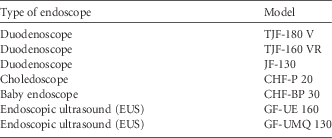
Microbiologically sampled endoscope models are listed in Table 1.
Endoscope Device Models Tested From 2004 to 2015

NOTE. All endoscopes were manufactured by Olympus.
Records of microbiologic testing were reviewed retrospectively for all endoscopes harboring an Albarran lever from November 2004 through March 2015.
Results
There are 8 duodenoscopes in rotational use at the Division of Gastroenterology and Hepatology. Overall there were 4 sites that were evaluated per duodenoscope (inclusive of the Albarran lever). This evaluation yielded a total of 412 microbiologic monitoring samples during the study period, including 88 samples of the Albarran lever. Results are shown in Table 2. None of the samples taken from the Albarran lever testing site yielded any growth of microorganisms. Contamination with skin bacteria was found in 45 (11%) of the 412 samples. One endoscope tested positive for aerobe spore-forming bacilli. This endoscope was reprocessed and yielded no growth on resampling.
Microbiologic Results of Duodenoscope Surveillance Samples Taken Between 2004 and 2015

a The affected duodenoscope was reprocessed and yielded no growth on resampling.
b 50 colony-forming units (CFU) aerobe spore-forming bacilli per mL.
c >100 CFU aerobe spore-forming bacilli per 10 cm2.
Discussion
The difficulties with duodenoscope reprocessing and the associated potential for bacterial transmission have been well documented.Reference Gastmeier and Vonberg 2 , Reference Kovaleva, Peters, van der Mei and Degener 3 Duodenoscopes are equipped with a mechanical lever called an Albarran lever, whose intricate design requires special attention during reprocessing. For this reason, only sampling data from endoscopes with an Albarran lever were included in our evaluation.
In our study none of the samples taken from the Albarran lever testing site showed growth of microorganisms during the study period. One duodenoscope tested positive for aerobe spore-forming bacilli. Follow-up by the infection control team revealed that the affected endoscope was part of the standby equipment and had not been in use for a prolonged period. Storage conditions of this endoscope were found to be inadequate. According to written reprocessing standard operating procedures this standby equipment should be reprocessed once a month if not used frequently.
Even though performed by highly trained infection control nurses, collection of the microbiologic samples, which requires sterile techniques, can be difficult with endoscopes being very long and flexible. This, rather than problems in reprocessing, might explain contamination with skin bacteria found.
We attribute the very low overall rate of microorganism growth in our samples to a multidimensional approach of infection control and quality control measures. Over the past 10 years, the personnel working at the reprocessing department were required to complete training at regular intervals. The arrival of new equipment is paired with reprocessing training. Written reprocessing guidelines are available to all employees and are in conjunction with strict adherence to the manufacturer’s recommendations. Moreover, the personnel turnover at the reprocessing department is low. Equipment upgrade is performed when a device is irreparably damaged but at least after 6 to 7 years. Additionally, the Department of Infection Control conducts periodic microbiologic sample collection of all endoscopic devices each year. The collections are performed by qualified infection control nurses. Surveillance records are archived for 10 years.
In Austria, an increase in clinically relevant MDR Enterobacteriaceae has been seen during recent years. 9 Given the increasing numbers of nosocomial infections due to MDR microorganisms shed with the stool, infection control teams should keep in mind that considerable transmission could occur when MDR bacteria meet insufficient processing of endoscopes. Our findings underline the significance of a standardized and reliable cleaning process of endoscopes before exposure to subsequent validated automated cleaning and high-level disinfection in an AEWD. We also strongly support the well-substantiated recommendation by Alfa et alReference Alfa, Olson and Al-Fadhaly 10 for ongoing monitoring of cleaning efficacy of washers used in healthcare facilities.
Limitations of our study comprise all the drawbacks of a retrospective study.
Acknowledgments
We thank Gerlinde Weilguny, RN (in charge of reprocessing at the endoscopy unit of the Vienna General Hospital), for her support during this retrospective study.
Financial support. The research fund of the Division of Hospital Hygiene, Medical University of Vienna.
Potential conflicts of interest. All authors report no conflicts of interest relevant to this article.