

Sociopolitical attitudes are commonly conceived of as extending along a continuum from liberal to conservative. Liberals generally show stronger support for things such as access to legal abortions, same-sex marriage, and open immigration policies, while conservatives are more inclined to respect authority and to be accepting of unequal social outcomes. Reference Haidt1,Reference Janoff-Bulman2 Political parties often define themselves as broadly liberal or conservative in orientation or at least take public positions on these sorts of matters, so liberalism/conservatism can have very important political implications.
Over the years, social scientists have taken a broad range of positions regarding the origins of individual differences on the liberal/conservative spectrum. Early research on the topic often suggested that the roots of those differences could be found in familial socialization processes that start early in life, Reference Altemeyer3,Reference Campbell, Converse, Miller and Stokes4,Reference Hyman5,Reference Jennings and Niemi6 with some researchers claiming that sociopolitical attitudes are influenced by authoritarian child-rearing practices, Reference Adorno, Frenkel-Brunswick, Levinson and Sanford7 an idea that is also found in more recent research. Reference Duriez, Soenens and Vansteenkiste8,Reference Fraley, Griffin, Belsky and Roisman9,Reference Oesterreich10 Another long-standing position maintains that the foundations of these attitudes lie in personality, broadly conceived. Reference Duckitt and Sibley11,12,Reference Jost, Kruglanski, Glaser and Sulloway13,Reference McClosky14 More recently, sociopolitical attitudes have been linked to disgust sensitivity. Reference Aarøe, Peterson and Arceneaux15,Reference Inbar, Pizarro, Iyer and Haidt16,Reference Terrizzi, Shook and McDaniel17 In much of the literature, it is acknowledged that situational and historical factors are also relevant to the acquisition of these orientations.
There is now a large body of evidence that suggests that in addition to a wide variety of environmental influences, genetic factors may play a role in the etiology of sociopolitical attitudes. Reference Alford, Funk and Hibbing18,Reference Bell, Schermer and Vernon19,Reference Oskarsson, Cesarini, Dawes, Fowler, Johannesson, Magnusson and Teorell20 It is typically reported that roughly one-third to two-thirds of individual differences in these characteristics are attributable to additive genetic effects, depending in part on how the attitudes are measured. Much of the current non–behavior genetic research on this topic commonly includes statements to the effect that genetic influences should be considered as possible distal causes.
The findings on the heritability of liberalism/conservatism and related political phenomena have created something of a paradigm shift in the social and behavioral sciences, such that purely environmental causal models are increasingly being challenged. But, as is typically the case when a new paradigm emerges, there are some issues pertaining to the new approach that have not been adequately addressed. One such issue stems from the fact that much of the quantitative behavior genetic work on sociopolitical attitudes has involved the analysis of twins only. Reference Neale and Maes21 This usually takes the form of a comparative analysis of the phenotypic similarity of monozygotic (MZ) twins (who are virtually genetically identical) and the observed similarity of dizygotic (DZ) twins (who share on average about half the genetic material that varies between human beings). Even though this classical twin study design allows one to disentangle heritability (i.e., the proportion of individual differences in a population that is due to genetic factors) from two kinds of environmental influence (one shared by twins and the other not shared), studies relying solely on twin data cannot take into account several specific sources of shared environmental effects, and they do not allow for the assessment of alternative explanations for effects shared by twins such as assortative mating on the part of the twins’ parents or genotype-environment correlation (rGE).
Given those shortcomings, the first research question addressed in this study was: “Is the new paradigm substantiated when a design incorporating more than just twins is used?” To answer it, the present research employed an extended twin family design (ETFD). Reference Keller, Medland and Duncan22,Reference Kandler, Gottschling and Spinath23 This design brings together data from MZ and DZ twins, as well as information on the twins’ parents and spouses. It not only provides estimates of the more commonly measured genetic and environmental transmissions of liberalism/conservatism offered by the classical twin design; it also permits a control for phenotypic assortment (assortative mating) on the basis of this trait and allows researchers to test for passive rGE. Reference Scarr and McCartney24 The latter occurs if the genotype that twins inherit from their parents correlates with the parental environment in which the twins are raised. The ETFD also provides estimates for a variety of shared environmental influences, including those coming from mothers only, fathers only, and both parents together; social effects shared by all family members (twins, parents, and spouses of twins); and environmental influences that did not originate with the parents but are shared by same-aged twin siblings only.
Another issue looming over genetically informed research into sociopolitical attitudes involves the fact that, to the best of our knowledge, all studies to date have been based entirely on self-reports. While there are measurement advantages to using self-reports, including the notion that the people completing them have access to information about themselves that may not be accessible to others, Reference Paulhus, Vazire, Robbins, Fraley and Krueger25,Reference Paunonen and O’Neill26 self-report data may be distorted because of socially desirable responding or other rater biases. Reference Moskowitz27 Apparently, other measurement methods such as peer reports have never been used to study liberalism/conservatism, even though, in general, ratings from well-informed peers can be quite informative and may provide a high level of psychometric quality and accuracy in capturing core attitudes. Reference Cohrs, Kämpfe-Hargrave and Riemann28 At the same time, like any measurement method, peer ratings have shortcomings, including a lack of direct access to the affect or cognition to be measured. Since some discrepancies between findings based on self-report versus peer measures have been observed for other constructs, Reference Clifton, Turkheimer and Oltmanns29 the second research question to be addressed was, “Do behavior genetic analyses of sociopolitical attitudes that are based on peer reports yield results that are consistent with those using self-reports?” The research described here was done using both self- and peer reports and thus provided a comparison and check for previous studies, which as mentioned used self-reports only.
A third concern with the new paradigm involves the extent to which the findings generated from it generalize cross-culturally. Behavior genetic analyses of liberalism/conservatism have been conducted in a number of countries, including the United Kingdom, the United States, Australia, Canada and Sweden, but to date, no analysis has been carried out with a German sample. Thus, our third research question was, “Can findings based on samples drawn from other countries be replicated with a German sample?” In order to determine whether German social and political settings moderate the genetic and social influences observed elsewhere, the present study used participants taken from the Jena Twin Study of Social Attitudes (JeTSSA). Reference Stößel, Kämpfe and Riemann30
To provide some background to the issues addressed in the analysis that follows, we will now consider several possible influences on individual differences in liberalism/conservatism. The corresponding variance components associated with these influences can be isolated with the data and research design used in this study.
Assortative mating and social homogamy
Only a small number of genetically informed studies of sociopolitical orientations have incorporated spouse similarity into their analyses 31,Reference Eaves and Hatemi32,Reference Hatemi, Hibbing, Medland, Keller, Alford, Smith, Martin and Eaves33 even though interspouse correlation in attitudes is substantial Reference Watson, Klohnen, Castillas, Simms, Haig and Berry34 and particularly high for political attitudes, Reference Alford, Hatemi, Hibbing, Martin and Eaves35,Reference Bouchard, Voland and Schiefenhövel36 and there is evidence that people seeking romantic relationships prefer partners who are politically similar to themselves. Reference Huber and Malhotra37 The similarity of the twins’ parents on liberalism/conservatism should to be taken into account because estimates of genetic and shared environmental variance components are biased in cases in which the trait analyzed is a phenotype that is directly relevant to mate choice — that is, when there is assortative mating based on the partly heritable phenotype. Reference Kandler, Bleidorn and Riemann38,Reference Watson, Beer and McDade-Montez39 Specifically, heritability may be underestimated and shared environmental effects overestimated unless assortative mating is taken into account. To avoid that problem, it is necessary to investigate the genetic and environmental sources of individual differences in this trait using an ETFD such as the one used here.
Spouse similarity, however, may not be due to phenotypic assortment but may instead stem from social homogamy, whereby mates are selected in a context of shared social backgrounds. Reference Eaves, Eysenck and Martin40 According to this notion, mates may be similar with regard to liberal/conservative orientation not because people seek out or find themselves attracted to potential partners who resemble them on this characteristic, but rather because the set of all possible mates appearing in their social circles just happens to have a level of liberalism/conservatism close to their own because of common social influences. Alford and colleagues 41 reported findings that do not support that contention, however, noting that concordance for political attitudes remained after controlling for a number of relevant social background factors.
Another possibility is that mates become more similar on this characteristic over time as they interact and influence each other through a process of attitudinal convergence, although, again, there is evidence that is not consistent with that hypothesis. Martin and coauthors Reference Martin, Eaves, Heath, Jardine, Feingold and Eysenck42 reported very low correlations between the duration of a marriage and absolute differences in spouses’ social attitudes, and Alford et al. 43 found that most spousal similarity in political attitudes was present early in the relationships and increased very little as time went on.
Some previous behavior genetic studies of liberalism/conservatism have investigated the effects of phenotypic assortment and social homogamy. Eaves and his coresearchers 44 reported findings indicating that there was evidence for both sources of spouse similarity. Alford and associates 45 found higher levels of heritability for a composite measure of Wilson-Patterson conservatism items Reference Wilson46 after controlling for parental agreement on the measure, which is consistent with phenotypic assortment. Eaves and Hatemi Reference Eaves and Hatemi47 reported substantial heritability estimates for a model that allowed for phenotypic assortment for attitudes toward abortion and gay rights, and Hatemi et al. 48 produced similar findings for a battery of Wilson-Patterson attitude items as well as for a composite liberalism/conservatism measure. However, all these previous studies either relied on the assumption of only one source of spouse similarity or could not directly take the contributions of different sources of spouse similarity into account, and they were all based on English-speaking samples. The current study’s design included parents and spouses of twins and thus allowed for the consideration of different sources of spouse similarity and for estimates of the contribution of both phenotypic assortment and social homogamy in the potential presence of each other; and as noted, a German sample was used.
Passive genotype-environment correlation
Although liberalism/conservatism has been shown to be partly heritable, children with a genetic predisposition for a particular orientation may also be exposed to parental social influences that reinforce it, as per the familial socialization literature cited earlier. In this way, there may be a correlation between children’s genetic makeup and the sort of parental environment in which they are raised (passive rGE), which would enhance their innate tendencies regarding liberalism/conservatism. The home environment may also be influenced by parental alleles that are not transmitted to the child, through a process of “genetic nurture,” Reference Kong, Thorleifsson, Frigge and Vilhjalmsson49 but our data did not allow a test for that. The ETFD used in this study did allow for a test for passive rGE, while controlling for the influence of parental similarity on this characteristic. If passive rGE is not taken into account, the contribution of shared environmental influences to the variance would be overestimated to the degree that passive rGE acts to increase individual differences in the trait. Reference Bleidorn, Hufer, Kandler, Hopwood and Riemann50
Some of the existing research on this topic has included a test for rGE. Eaves and Hatemi 51 reported weak and negative estimates of rGE in their research on attitudes toward abortion and gay rights, which indicated that, in a minor way, the parental environment counteracted rather than reinforced genetic predispositions regarding those issues. In their analysis of all Wilson-Patterson items, Hatemi et al. 52 also found mainly negligible or negative coefficients for rGE. Since both of those studies used American data and were based on the same data set, and since a negative passive rGE seems to be counterintuitive with respect to liberalism/conservatism, more research is necessary to assess the finding of marginal or even negative contributions of passive rGE. The current German-based study provided an opportunity make such an assessment by testing for passive rGE using self-reports of family members as well as across (parental) self-reports and (offspring’s) peer ratings, with the latter bringing a different rater perspective to bear on the issue.
Intrafamilial and extrafamilial environmental influences
In trying to understand the origins of individual differences in sociopolitical attitudes, it is helpful to estimate the influence of mothers and fathers acting together to socialize their children and the degree to which mothers acting alone and fathers acting alone affect their offspring’s characteristics. It may be the case that mothers and fathers provide similar socialization effects on their children’s liberalism/conservatism, but it is also possible that their influences are different. Traditionally, researchers have maintained that fathers’ influences predominate over mothers’, 53,Reference Kandel and Lesser54 although Acock and Bengtson Reference Acock and Bengtson55 found mothers to be more impactful. As mentioned, the ETFD used in this study permitted a disentanglement of common parental from mother-specific and father-specific influences on twins’ similarity.
Nonparental social influences are, of course, important to consider as well, including those shared by twins (e.g., peer influences or sibling interaction effects) and those that are unique to a particular twin sibling. Nonfamilial influences in particular deserve scrutiny, because there is evidence that shared familial effects on political attitudes decline after adolescence Reference Hatemi, Funk, Medland, Maes, Silberg, Martin and Eaves56 and the family is only one of several possible agents of socialization. Also, it is commonly reported that environmental influences not shared by twins explain a sizable portion of the variance in this trait. 57,58 The ETFD used in the current study allowed us to estimate the contribution of those different environmental sources of variance.
Sex and age differences
We also sought to determine whether sex and age differences in liberalism/conservatism were consistent across self- and peer reports. It is important to have valid indicators of these differences because they may affect the similarity between two specific family members on the trait, and if they are not controlled for they may bias the estimates of genetic and environmental influences.
Early studies often found that, in general, females were more conservative than males, Reference Feather59 although more recent studies have suggested the opposite, 60,61,Reference Jylhä, Cantal, Akrami and Milfont62 with some variation observed depending on the issue examined. 63,Reference Shapiro and Mahajan64 With regard to age, greater conservatism was usually found among older respondents. Reference Cornelis, Van Hiel, Roets and Kossowska65,Reference Tilley and Evans66
Aims of the current study
This study had three main goals, all of which address key issues in the new paradigm that have not been fully resolved. One goal was to bring together information from twins, their parents, and their spouses to examine a broad array of possible genetic and environmental sources of differences in liberalism/conservatism, several of which cannot be assessed with the commonly used twins-only design. A second was to address a measurement question arising from the fact that all previous studies of this topic were based on self-reports only. Our aim in that respect was to determine whether results based on peer reports were consistent with findings derived from self-reports. A third purpose was to find out whether the existing knowledge on liberalism/conservatism could be generalized to the German political scene, or whether previous findings reflect the peculiarities of the sociopolitical cultures from which their samples were drawn.
Method
Sample characteristics
The JeTSSA consisted of 1,981 individuals from 481 twin families (see Table 1). The sample included 394 complete twin pairs: 48 male and 178 female MZ twin pairs and 20 male, 81 female, and 67 opposite-sex dizygotic (DZ) twin pairs. About 66% of the mothers and 54% of the fathers of twins provided self-reports on liberalism/conservatism. In addition, spouses of twins (60%), including 276 spouses of MZ twins, 200 spouses of DZ twins, and 53 spouses of unmatched twins, provided self-ratings. The sample was heterogeneous with regard to education and employment status.
JeTSSA sample characteristics.

Note: MZ
 $=$
monozygotic, DZ
 $=$
dizygotic.
In addition to the self-reports provided by the family members, 1,333 well-informed peers (e.g., friends, spouses, or colleagues) assessed the twins’ liberalism/conservatism. The peers had to be reasonably well acquainted (at least a one-year acquaintanceship:
 $M_{\mathit{YEARS}}=11.48$
, 1–58 years). For each twin sibling, different peers provided assessments, with preference given to those peer raters who knew one twin very well but not the co-twin. For 752 twins (86%), at least one peer report was available, and for 581 twins (67%), two peer raters provided assessments.
Measures
Twins, their parents, and their spouses provided responses to the 21 attitude items listed in the Appendix. Independent peer raters assessed the twin siblings based on the same list. The items are similar in theme and content to Wilson-Patterson items in that they are concerned with issues that are only obliquely related to political matters (e.g., “employed mothers,” “promiscuity”) as well as issues that often figure directly in political campaigns and elections (e.g., “acceptance of asylum seekers,” “electoral franchise for naturalized foreigners”). None of the items pertained to economic matters such as welfare payments, taxation, free trade, or government subsidies for business, nor did they fully address other attitudinal dimensions such as social dominance or authoritarianism. To be sure, those other aspects are important, Reference Kandler, Bell and Riemann67 but our data did not permit an assessment of them.
The responses to the items were measured using a five-point scale that ranged from “strongly disagree” to “strongly agree.” A composite liberalism/conservatism measure was created by taking the arithmetic mean of the 21 scores (reverse-coded where appropriate, with a higher score indicating greater conservatism).Footnote
1
The internal consistency of the items was
 $\unicode[STIX]{x1D6FC}=0.76$
for self-reports (
 $\unicode[STIX]{x1D6FC}=0.76$
for twins,
 $\unicode[STIX]{x1D6FC}=0.73$
for parents of twins, and
 $\unicode[STIX]{x1D6FC}=0.78$
for spouses of twins) and
 $\unicode[STIX]{x1D6FC}=0.77$
for single peer reports (
 $\unicode[STIX]{x1D6FC}=0.83$
for averaged peer reports). Peer–peer consensus was
 $r=0.49$
, and the agreement between self-reports and averaged peer reports was
 $r=0.57$
. Thus, the psychometric quality of the measure appears to have been quite good. However, comparisons of the findings with results from prior work are made with the following caveat: the sample, study design, and measures used in this research were not the same as those employed in previous studies. Diversity in the operationalization of liberalism/conservatism is a common feature of the research in this area.
Reference Everett68
Analyses and results
Sex and age differences
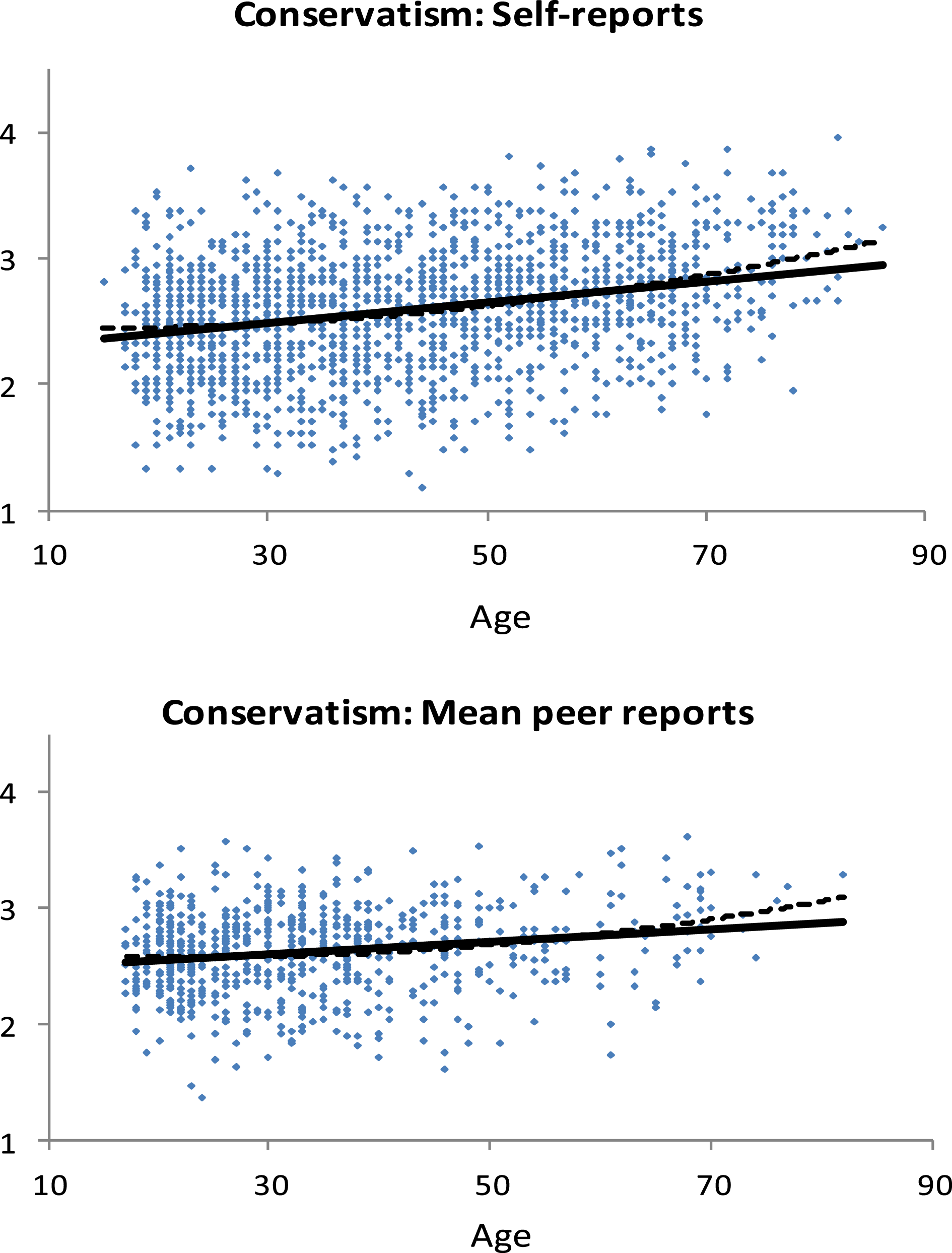
Men in the sample showed significantly higher conservatism than women (see Table 2), consistent with findings reported in contemporary studies. These differences appeared in both the self-report and peer-report data. Parents showed greater conservatism than their offspring and the spouses of their children, suggesting an age or a cohort effect on liberalism/conservatism. There was a linear increase in conservatism across age for both self-reports (
 $r=0.30$
) and averaged peer reports (
 $r=0.20$
; see Figure 1). These findings indicate consistent sex and age differences in liberalism/conservatism across the two rater perspectives.
Descriptive statistics.

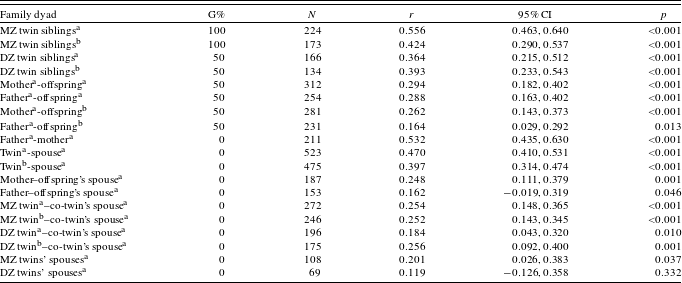
Family correlations of liberalism/conservatism for different familial relations (corrected for sex and age).

Notes: MZ
 $=$
monozygotic, DZ
 $=$
dizygotic. G%
 $=$
degree of biological relatedness in terms of the percentage of shared additive genetic influences. For parent-offspring and parent-offspring’s spouse relationships, only one twin with spouse was randomly assigned to be included in the correlation; parent-offspring, parent-offspring’s spouse, and spouse relations included unmatched twins and family. Correlations were estimated based on 1,000 bootstrap samples; 95% CI: robust 95% confidence interval. a. Self-reports. b. Peer reports.
Linear (solid line) and nonlinear (dotted line) age trends for conservatism based on self-reports (
 $N=1979$
) and averaged peer reports (
 $N=750$
). A linear age trend provided the most parsimonious and best explanation of the data points (individual social conservatism scores):
 $R^{2}=0.09$
for self-reports and
 $R^{2}=0.04$
for averaged peer reports.

Correlations between family members
The similarities between different types of family member regarding liberalism/conservatism are illustrated in the correlations shown in Table 3, which have been corrected for sex and age effects using a regression procedure Reference McGue and Bouchard69 because of the sex and age differences just noted. Standardized residuals from the regressions were used for the genetically informative twin family analyses that follow.
MZ twins tended to show larger correlations than DZ twins across self- and peer reports, indicating genetic influences. However, there was greater concordance across rater perspectives for DZ twins, who had nearly identical coefficients for self-reports (0.36) and peer reports (0.39). MZ twins showed somewhat larger differences across measurement methods, with a higher correlation for self-reports (0.56) than for peer reports (0.42). This difference across measurement methods by zygosity proved to be impactful and will be discussed in more depth later.
Parent-offspring correlations were smaller than MZ twin correlations and tended to be smaller than DZ twin correlations, indicating nonadditive genetic factors (i.e., effects due to allelic dominance within gene loci) or environmental influences shared by twin siblings but not with parents. Spousal similarity was substantial across self- and peer reports. Twin–co-twin’s spouse correlations and twins’ spouses’ correlations tended to be a bit larger for MZ than for DZ twins, suggesting genotypic assortment for liberalism/conservatism.
70,Reference Kandler, Lewis, Feldhaus and Riemann71
However, the parents–offspring’s spouse correlations as well as the twin–co-twin’s spouse and twins’ spouses’ correlations did not vary markedly (
 $r=0.12$
to
 $r=0.26$
), indicating that environmental influences shared by all family members, such as common social background (social homogamy), played some role in spousal similarity.
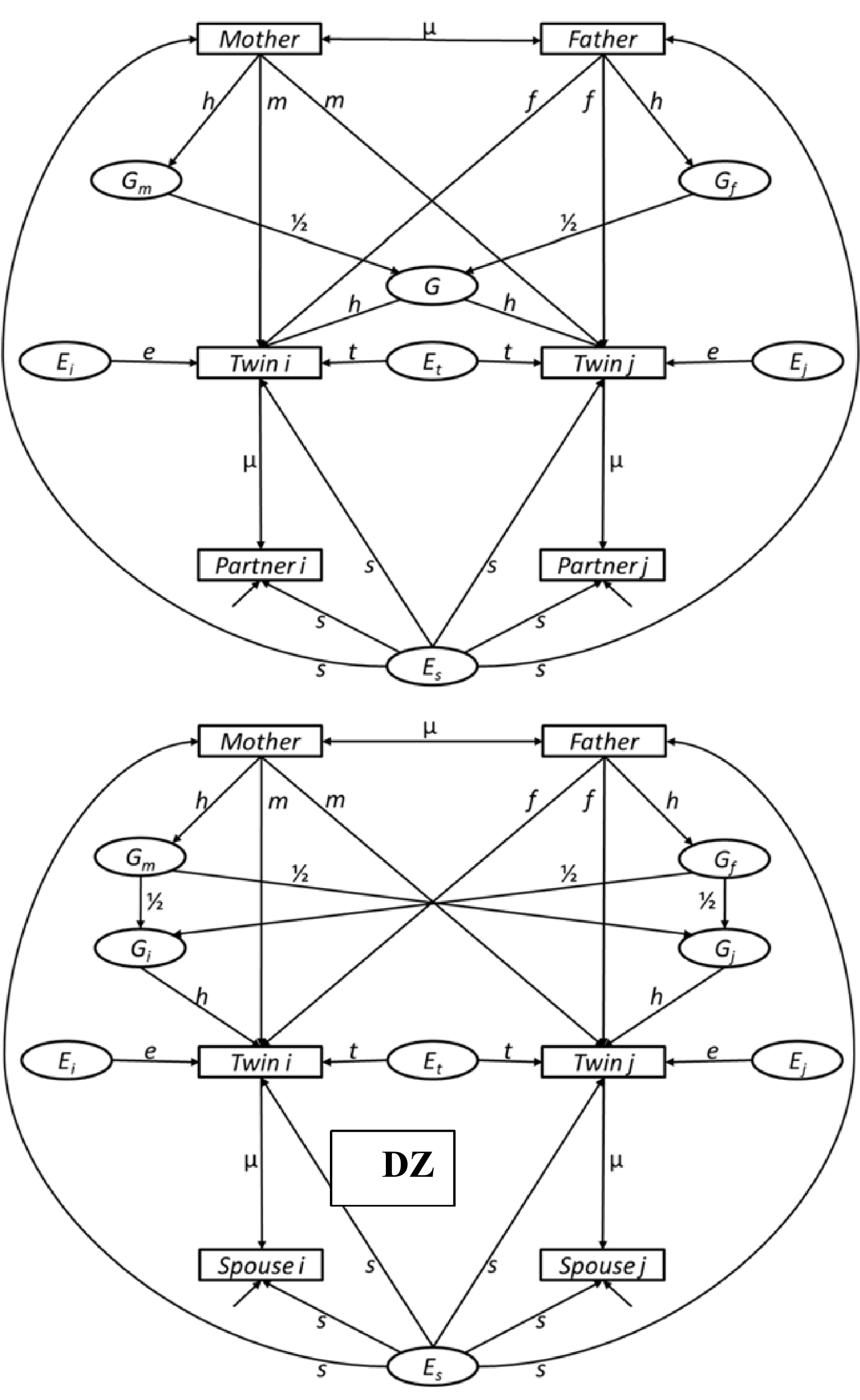
Extended twin family model for monozygotic (MZ) and dizygotic (DZ) twin families:
 $G=$
genetic factors;
 $E=$
environmental factors;
 $h=$
genetic effects;
 $m=$
environmental transmission from mother to offspring;
 $f=$
environmental transmission from father to offspring;
 $e=$
environmental effects not shared by twins (including measurement error);
 $\unicode[STIX]{x1D707}=$
phenotypic assortative mating;
 $t=$
environmental influences specifically shared by twins;
 $s=$
environmental effects shared by all family members; latent factor variances were fixed to one.

Genetic and environmental influences
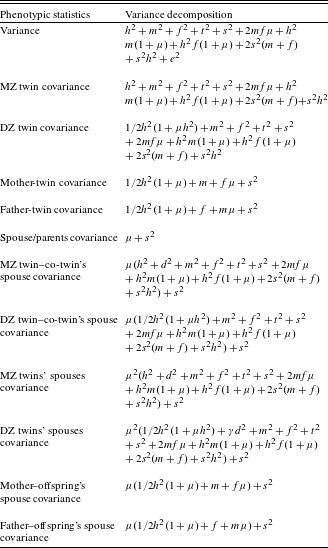
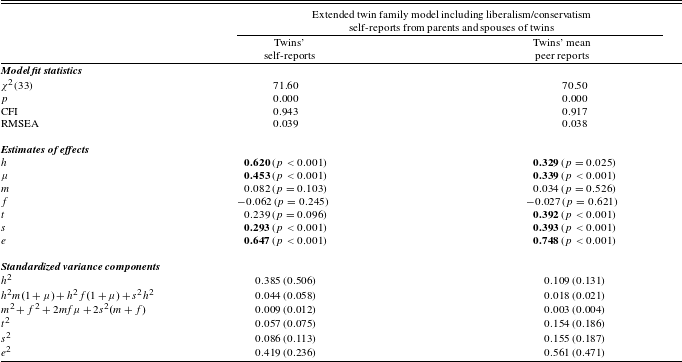
In the next step, we estimated the contributions of several different sources of variance using the ETFD, bringing to bear all available data from the twins, their parents, and the twins’ spouses (see Figure 2). We ran the first analysis with self-reports only, while the second used twins’ averaged peer reports instead of twins’ self-reports. The variance decomposition of the full model is presented in Table 4, with the results shown in Table 5. Both the model with self-reports only and the model with twins’ peer reports showed acceptable fit to the data (see Table 5), as indicated by root mean square error of approximation (RMSEA) values
 ${\leqslant}0.08$
and comparative fit index (CFI) values
 ${\geqslant}0.90$
.
Reference Hu and Bentler72
Model of twins reared together with twins’ parents and spouses.

Notes: h
 $=$
additive genetic effects;
 $m=$
environmental transmission from mother to offspring;
 $f=$
environmental transmission from father to offspring;
 $t=$
environmental influences shared by twins but not by other family members (i.e., nonparental influences shared by twins only);
 $\unicode[STIX]{x1D707}=$
assortative mating;
 $s=$
environmental effects due to shared social background (shared by all family members);
 $e=$
environmental effects not shared by twins (including measurement error).
Extended twin family model fit and estimates of genetic and environmental components as well as genotype-environment covariance.

Notes: The results are based on data from 224 monozygotic and 166 dizygotic twins, 304 mothers, 253 fathers, and 468 spouses of twins;
 $h=$
genetic effect;
 $\unicode[STIX]{x1D707}=$
assortative mating;
 $m=$
phenotypic maternal effect;
 $f=$
phenotypic paternal effect;
 $t=$
twin-specific environmental effects;
 $s=$
environmental effects shared by all family members;
 $e=$
residual effects;
 $h^{2}=$
heritability;
 $h^{2}m(1+\unicode[STIX]{x1D707})+h^{2}f(1+\unicode[STIX]{x1D707})+s^{2}h^{2}=$
variance due to passive genotype-environment correlation;
 $m^{2}+f^{2}+2mf\unicode[STIX]{x1D707}+2s^{2}$
(
 $m+f$
)
 $=$
environmentally mediated parental influences;
 $t^{2}=$
variance due to environmental influences shared by twins but not by other family members (i.e., nonparental influences shared by twins only);
 $s^{2}=$
variance due to environmental influences shared by all family members;
 $e^{2}=$
individual environmental component (
 $+$
error of measurement: 1–
 $\unicode[STIX]{x1D6FC}$
). Significant estimates of effects
 $(p<0.05)$
are shown in boldface. Estimates of variance components in parentheses are corrected for measurement error.
According to the model fitting results based only on the self-reports of family members, approximately 38.5% of the variance in liberalism/conservatism was attributable to additive genetic effects (
 $h^{2}$
). This figure rose to 50.6% when a correction for attenuation arising from measurement error was introduced, which was based on internal consistency estimates for the whole sample (
 $\unicode[STIX]{x1D6FC}=0.761$
; viz.:
 $h_{\text{CORR}}^{2}=h^{2}/\unicode[STIX]{x1D6FC}=0.385/$
0.761
 $=$
0.506). The corrected total estimate of the variance explained by additive genetic effects indicates that a substantial portion of individual differences in liberalism/conservatism for this German sample arose from genetic factors, which is broadly consistent with heritability estimates reported in twins-only studies conducted in other countries.
Passive rGE accounted for an additional 4.4% of the variance (5.8% when corrected for attenuation), which suggests that, in a small way, parental socialization reinforced the twins’ genetic proclivities with regard to liberalism/conservatism. This covariance component included the contribution of the covariance between parents’ genetic makeup and offspring’s shared parental environments (
 $h^{2}m(1+\unicode[STIX]{x1D707})+h^{2}f(1+\unicode[STIX]{x1D707})$
) and the covariance between genetic influences and environmental influences shared by all family members (
 $s^{2}h^{2}$
). Since the passive genotype-environment covariance component was positive, this finding was not consistent with the rGE results of previous studies
73,74
based on American data and different measures.
The estimate of the environmental influence provided solely by mothers (
 $m$
) was small and nonsignificant, as was that provided by fathers (
 $f$
). The variance explained by mothers’ and fathers’ joint environmental effects (
 $m^{2}\,+\,f^{2}\,+\,2mf\unicode[STIX]{x1D707}\,+\,2s^{2}(m\,+\,f)$
) was very small: 0.9% (1.2% corrected). This suggests that parental influences on individual differences in liberalism/conservatism were primarily genetically mediated rather than purely socially transmitted, a finding consistent with previous work on Americans.
75,76
The variance component derived from environmental influences shared by twins but not provided by parents (
 $t^{2}$
) was higher than the parental environmental effects but still relatively small, accounting for only 5.7% (7.5%) of the variance. Environmental influences shared by all family members (
 $s^{2}$
) — that is, those stemming from a common social background — accounted for 8.6% (11.3%). The largest component of the variance in liberalism/conservatism before correction for attenuation was attributable to environmental influences not shared by twins (
 $e^{2}$
, including error of measurement), which explained 41.9%. Once corrected for attenuation (i.e.,
 $e_{\text{CORR}}^{2}=(e^{2}-(1-\unicode[STIX]{x1D6FC}))/\unicode[STIX]{x1D6FC}$
), however, this portion decreased to 23.6%.
The self-report findings indicated a substantial contribution of assortative mating to spousal similarity in liberalism/conservatism. In fact, assortative mating explained about 84% of the similarity between spouses (
 $\unicode[STIX]{x1D707}/(\unicode[STIX]{x1D707}\,+\,s^{2})=0.453/(0.453\,+\,0.293^{2})=0.840$
). Thus, phenotypic assortment may have contributed to individual differences (and the genetic variance) in liberalism/conservatism beyond the social influences shared by spouses.
There were some notable differences in the results discussed earlier when the extended twin family model included data from twins’ averaged peer reports. The heritability (
 $h^{2}$
) figures were lower and nonparental environmental influences shared solely by twins (
 $t^{2}$
) were higher when peer data were included. Heritability accounted for only 10.9% (13.1%) of the variance, which is modest compared with our self-report figures and self-report findings reported in the literature. When the effect of passive rGE was added to heritability, the total for all genetic effects when peer reports were used was only 12.7% (15.2%), which is substantially lower than our estimates based on self-report data and those of earlier studies. Another notable difference across measurement methods was apparent in the results for environmental influences not shared by twins (
 $e^{2}$
), which were higher with the peer data: 56.1% (47.1%).
There were, however, some important similarities with the findings based on self-reports. The environmental influence provided solely by mothers (
 $m$
) was again small and nonsignificant, as was that provided by fathers (
 $f$
). The variance explained by mothers’ and fathers’ joint environmental effects also mirrored those for self-reports in that they were exceedingly small: 0.3% (0.4% corrected). Thus, the peer findings were consistent with those from self-reports in suggesting that parental influences on individual differences in liberalism/conservatism were primarily genetically rather than socially transmitted. The peer-report findings were also similar to those based on self-reports in that they indicated a considerable contribution of assortative mating to spouse similarity, which explained 69% of the variance (
 $\unicode[STIX]{x1D707}/(\unicode[STIX]{x1D707}\,+\,s^{2})=0.339/(0.339\,+\,0.393^{2})=0.688$
) when peer data were used.
Discussion and conclusions
The levels of heritability for liberalism/conservatism observed in the self-report findings in this study were largely consistent with those found in earlier research, indicating that with regard to additive genetic influences, the findings from twins-only designs were broadly substantiated with the ETFD used here. Since a German sample was used in the present study, the results also indicate international continuity with regard to self-report heritability levels. The German political and cultural milieu did not appear to moderate the levels of genetic influence detected in other studies.
Concordance with earlier self-report studies was also observed in the results showing a high level of assortative mating on the basis of liberalism/conservatism. Mating with regard to this characteristic does not appear to be random, which suggests that the classical (twins-only) design that is frequently used to analyze liberalism/conservatism (which assumes random mating on the trait of interest) is not appropriate for studies of this topic. One may also note that over time, such nonrandom mating increases the proportion of homozygous genotypes in the population and decreases the proportion of heterozygous ones, which may contribute in the long run to a polarizing effect that could, in conjunction with other factors, have an impact on ideological divisions in a society.
The findings for passive rGE observed in this study, although moderate in magnitude, underscore the importance of considering genotype-environment interplay when assessing the etiology of liberalism/conservatism. Genetic and environmental factors do not operate in isolation; they may reinforce or suppress each other. It is notable that in this study there was evidence of the former in that the data suggested that offspring’s genetically influenced predispositions toward liberalism/conservatism were strengthened to some degree by parental socialization. As noted, this finding is at odds with some previous research on Americans. 77,78
The self-report findings for the present study largely echoed previous self-report research that indicated that parental influences on liberalism/conservatism were primarily genetically mediated rather than purely socially transmitted. Once again, there is evidence that parental socialization makes only a modest contribution to the promulgation of sociopolitical attitudes. However, it may be that parental influences were not the same for each twin sibling, and consequently that environmental influences not shared by twins reflected nonshared parental influences to some degree. Our self-report study was also consistent with previous research in finding a substantial role for environmental influences that were not shared by twins.
Despite the substantial continuity observed between our self-report results and those found in previous research, some striking differences were evident when the self-report findings were compared with those based on peer reports. The heritability estimates produced by the models incorporating peer data were substantially lower, and nonshared environmental influences were higher. Heritability estimates for social attitudes do tend to be lower in peer- versus self-report studies, 79,Reference Zapko-Willmes and Kandler80 but the magnitude of the difference across measurement types was contrary to expectation and gives one pause when interpreting previous work on liberalism/conservatism.
The peer- versus self-report discrepancy in heritability observed here is especially puzzling in light of the fact that similar discrepancies have not been found in research that examined personality traits and other personality-related constructs, such as interests or creativity. Such studies, including those that have used the same data set as was employed here, have yielded estimates of genetic and environmental effects that were similar across the two rater perspectives. 81,Reference Kandler, Bleidorn, Riemann, Angleitner and Spinath82,Reference Kandler, Riemann, Angleitner, Spinath, Borkenau and Penke83 In addition, the level of agreement among raters as well as self-peer correlations for the personality variables observed in those studies were highly similar to the ones found for the liberalism/conservatism indicators used in the present research.
A separate study and additional data would be required to properly account for the differences in heritability levels across self- and peer reports found here. However, there is evidence that the heritability discrepancy across rater perspectives was rooted in zygosity. It was noted earlier that there was greater concordance in measured liberalism/conservatism across rater perspectives for DZ twins compared to MZ. DZ twins had nearly identical self- and peer-report correlations for the trait, whereas MZs showed a higher correlation with self-reports. This difference was consequential, since the higher MZ correlation in self-reports produced the higher heritability estimates observed when that rater perspective was used. Further indication that zygosity may be implicated in the heritability discrepancy appeared in post hoc tests. Peer–peer correlations did not differ between MZ and DZ twins, with
 $r=0.48$
in both cases, 95% confidence interval (CI) [0.39, 0.57] for MZ twins and 95% CI [0.37, 0.59] for DZ twins. However, the self-peer correlation
 $r=0.62$
for DZ twins was somewhat larger than the self-peer correlation
 $r=0.53$
for MZ twins, although there was a 95% CI [0.55, 0.69] for DZ twins and 95% CI [0.47, 0.60] for MZ twins. It is possible that among MZ twins, the measurement validity of self-reports exceeded that of peer reports for this trait, but further research is needed to address that issue. Alternatively, it may be that among MZs, something causes the overt expression of their liberalism/conservatism (which is what peer reports measure) to be somewhat different from their inner thoughts and feelings (which are tapped by self-reports). Again, more research is required to test that hypothesis.
More research is also called for to determine whether other traits and social attitudes show lower levels of heritability with peer data, and if so, whether such differences are related to zygosity. In any case, the results of this study suggest that researchers should take a hard look at the measurement validity of their indicators of liberalism/conservatism, and would do well to use more than one method or rater perspective to measure it. Using multiple measurement methods can only expand the ability of the new synthesis to answer questions about possible genetic and environmental influences on sociopolitical attitudes.
The role of genotype-environment interplay in contributing to liberalism/conservatism also deserves further study. In addition to further attention to passive rGE and other types of rGE, such as active or reactive rGE, analyses of genotype-environment interactions would be worthwhile. It seems quite plausible that genetic influences on liberalism/conservatism vary depending on the social environment, and vice versa. Knowing how particular environments bring out or suppress genetic tendencies on this trait would significantly expand our knowledge. It would also be good to examine why men and older people tend to be or become more conservative than women or younger people, as was observed here for both self-report and peer data, and to determine the extent to which those differences are related to genetic and/or environmental factors.
Finally, since this study and many others show sizable effects for unshared environmental influences — even after controlling for error of measurement — it would be advantageous to try to identify the sorts of social experiences that twins do not have in common that can result in genetically identical individuals having different levels of liberalism/conservatism. Are these differences related to different educational involvements? Work experiences? Media sources? Cultural or subcultural influences? Also to be considered in this context are genotype-environment interactions, which can be confounded with estimates of nonshared environmental influences if they are present but not taken into account.
Appendix. Liberalism/conservatism items