Introduction
The research on the factors related to subjective wellbeing in older people has occupied a central role in the area of gerontological studies (Atchley Reference Atchley and Maddox2001; Cohen-Mansfield Reference Cohen-Mansfield1996; Mannell and Dupuis Reference Mannell, Dupuis and Birren2007). However, contrary to the literature on the correlates of older people's subjective wellbeing, including life satisfaction, happiness and morale in Western societies (George Reference George and Eisdorfer1981, Reference George, Binstock and George2006; Larson Reference Larson1978; Mannell and Dupuis Reference Mannell, Dupuis and Birren2007), there is a relative paucity of such research in mainland China (Chen and Davey Reference Chen and Davey2008; Li Reference Li1995). This suggests a strong need to conduct more research on this topic in mainland China.
Besides the paucity of research, there are other reasons that more efforts should be devoted to the research on the correlates of older people's subjective wellbeing in mainland China. First, such research may serve to test research findings in Western societies. Second, the size of China's population, which is roughly one-fifth of the world's population, warrants research attention and efforts. Third, research on this topic is imperative for professionals working with the elderly to develop a solid knowledge base to work with older people in China.
With these concerns, the current study examined the relationship between family relations and life satisfaction among older people in mainland China. The study focused on life satisfaction because it has often been argued that life satisfaction is one of the most important criteria for describing the ageing process and is a construct universally accepted as a valid measure of quality of life for the elderly (Daatland Reference Daatland and Johnson2005; Lou Reference Lou2010; Salamon Reference Salamon1988; Westerhof, Dittmann-Kohli and Thissen Reference Westerhof, Dittmann-Kohli and Thissen2001). The present study was also carried out from a comparative perspective of two different hukous, described below.
Family relations and life satisfaction of older people
Family has been a safety net for older people throughout human history and the supportive function of family remains theoretically unchallenged (Pei and Pillai Reference Pei and Pillai1999). Research has indicated that older people and their children maintain a relationship throughout life and that the family provides care for older members (Brubaker Reference Brubaker and Brubaker1990; Rossi and Rossi Reference Rossi and Rossi1990). According to support/efficacy theory, social relations such as family relations affect health and wellbeing by instilling in the individuals a sense of self-worth and self-efficacy (Antonucci and Akiyama Reference Antonucci, Akiyama and Birren2007). Another theoretical perspective indicates that social relations help individuals learn how to regulate their emotions, which allows people to navigate the challenges and the choices confronted in daily life more competently, and thus optimise their overall wellbeing (Antonucci and Akiyama Reference Antonucci, Akiyama and Birren2007).
In studies on the relationship between family relations and life satisfaction among older people, an intergenerational solidarity model developed by Bengtson, Olander and Haddad (Reference Bengtson, Olander, Haddad and Gubrium1976) and Bengtson and Roberts (Reference Bengtson and Roberts1991) was often examined empirically. The model conceptualises intergenerational solidarity as a multi-dimensional factor with six components: association, affection, consensus, function, familism, and structure (Bengtson and Roberts Reference Bengtson and Roberts1991: 857). Research has shown that affectual solidarity, or the emotional component of solidarity, is positively associated with older people's life satisfaction (Connidis and McMullin Reference Connidis and McMullin1993; Lowenstein and Katz Reference Lowenstein and Katz2005; Lowenstein, Katz and Gur-Yaish Reference Lowenstein, Katz and Gur-Yaish2007). However, it has been argued that the model is useful in explaining objective solidarity (association), but not subjective solidarity (consensus and affection) and that association, consensus, and affection are not dimensions of one construct (Atkinson, Kivett and Campbell Reference Atkinson, Kivett and Campbell1986). This model has rarely been examined in the studies on older people's life satisfaction in Chinese societies, probably because the attributes for intergenerational solidity may be different between Chinese and Western cultures. For instance, research has indicated that emotional expression is regarded to be less significant and relevant in Chinese culture than in the Western cultures (Potter Reference Potter1988; Shek Reference Shek2001b). The research on the attributes of a happy family perceived by Chinese adolescents and their parents in Hong Kong also revealed that few respondents regarded emotional expression within the family and sensitivity to the emotions of family members as important attributes (Shek Reference Shek2001a; Shek and Chan Reference Shek and Chan1998).
In Chinese societies, family harmony and filial piety, or filial support to older parents, have been strongly emphasised (Chow Reference Chow, Chi, Chappel and Lubben2001; Shek Reference Shek2001a, Reference Shek2006). Chinese people have a high expectation of children's filial piety towards their parents (Kwan, Cheung and Ng Reference Kwan, Cheung and Ng2003). Conflict with family members and lack of family care make the elderly disappointed psychologically and endanger their security in old age, leading to a reduction in life satisfaction (Zhang and Yu Reference Zhang and Yu1998). A few studies on correlates of life satisfaction among older Chinese people have covered the factors of filial piety or filial support, family harmony and filial discrepancy, and identified these factors as significant contributing factors (Cheng and Chan Reference Cheng and Chan2006; Xiang, Wu and Liu Reference Xiang, Wu and Liu1994; Zhang and Yu Reference Zhang and Yu1998). Filial discrepancy is a subjective appraisal of filial support and refers to the gap between what children do and what parents expect from them (Cheng and Chan Reference Cheng and Chan2006). It has also been suggested in light of previous studies that other measures of family support, such as size of family support network and satisfaction with family support, are significant contributing factors to older Chinese people's life satisfaction (Chou and Chi Reference Chou and Chi1999, Reference Chou and Chi2001; Pei and Pillai Reference Pei and Pillai1999; Y. Q. Zhang Reference Zhang2002; Silverstein, Cong and Li Reference Silverstein, Cong and Li2006).
It should be noted that the main focus of studies on happiness and subject wellbeing published in Chinese journals in the past decade has been a general description of happiness or subjective wellbeing (Chen and Davey Reference Chen and Davey2008). Although a few studies (e.g. Cheng and Chan Reference Cheng and Chan2006; Chou and Chi Reference Chou and Chi2001; Zhang and Yu Reference Zhang and Yu1998) have examined or suggested the importance of family support network, satisfaction with family support, filial support, family harmony and filial discrepancy to older people's life satisfaction, there has been a lack of research that integrates all these factors and examines their individual importance in mainland China. Little has been known about the relative importance of these factors to older people's life satisfaction. This study contributes to the literature by filling this gap.
The hukou system and its impact on older people's lives in China
China has implemented the hukou system, an administrative system established in the 1950s, which took full effect in 1960, to control the movement of people between urban and rural areas (Cheng and Selden Reference Cheng and Selden1994). There are two kinds of hukous: agricultural and non-agricultural. Rural people are generally born with agricultural hukous and urban people non-agricultural hukous (Chan and Senser Reference Chan and Senser1997; Cheng and Selden Reference Cheng and Selden1994; Wang Reference Wang2005). However, although rural hukous and agricultural hukous are often used interchangeably, so are urban hukous and non-agricultural hukous; the hukou is therefore not a geographic concept. It is a concept that relates to people's social and economic positions. For example, workers in state-owned companies, teachers and government officials can live and work in rural areas, but hold non-agricultural hukous. In towns and counties where it is hard to be defined as urban or rural areas, people with different hukous also co-reside in the same regions.
The hukou system has affected many aspects of people's lives in mainland China. It has been argued that there are three main disparities in contemporary mainland China: the disparities between the peasants and the industrial workers, between the urban and rural areas, and among the regions, and that the hukou system was fundamentally responsible for all three disparities (Hu, Wang and Kang Reference Hu, Wang and Kang1995). With respect to social welfare, the Chinese government has intervened in rural residual relief work but has never been directly involved in rural social welfare (Hebel Reference Hebel, Eyferth and Vermeer2004). Social welfare benefits like government subsidised housing, medical care, retirement benefits, community cultural activities, and public employment opportunities in all but menial jobs were mainly available to those with local non-agricultural hukous (Liu Reference Liu2005; Wong Reference Wong1998; Wu and Treiman Reference Wu and Treiman2007. Zhang Reference Zhang2002). The hukou system has also institutionalised inequality and discrimination against people with agricultural hukous. It has created a rigid social hierarchy transmitted across generations, involving discrimination between urban and rural areas in economic, social, civil and cultural rights in China (Wang Reference Wang2005). Although the hukou system has gradually relaxed since the 1980s, the system still enjoys a strong institutional legitimacy and the essential features of the system remain basically unchanged; people's socio-economic eligibility has continued to be linked with hukou status despite the declining urban benefits in recent years (Chan and Zhang Reference Chan and Zhang1999; Wang Reference Wang2005).
For older people in mainland China, the two groups with different hukous have been different in many aspects. For instance, it was estimated that the average annual income was 11,963 Chinese Yuan for urban elderly and 2,722 Chinese Yuan for rural elderly in 2006 (China Research Center on Ageing 2008). It was also estimated that 78.0 per cent of urban elderly had pensions, but only 4.8 per cent rural elderly had pensions in 2006 (China Research Center on Ageing 2008). Given such disparity between urban and rural older people in mainland China, it is likely that the two groups of older people have had different concerns and expectations in their lives. The correlates of life satisfaction are also likely to be different between the two groups of older people. For example, older people with agricultural hukous have had to rely more heavily on family support and thus have been more likely to regard family support network, filial support and family harmony as important barometers of their life satisfaction. However, life satisfaction and its correlates between the two groups of older people with different hukous in China have rarely been examined in the literature. In this regard, the present study was also pioneering in nature.
Research questions and hypotheses of the study
In this study, the principal question was whether family support network, satisfaction with family support, filial support, family harmony and filial discrepancy were associated with life satisfaction for the two groups of older people with different hukous. If there were relationships between family support network, satisfaction with family support, filial support, family harmony, and filial discrepancy and life satisfaction among both groups, the study would go further to examine whether the relationships were different between them. It was hypothesised that the five factors of family relations were associated significantly with life satisfaction for both groups. It was also hypothesised that the relationships between the five factors and life satisfaction were significantly different between the two groups.
Mancini and Sandifer argued that ‘[i]n studies of aging, factors such as health, economic resources, and mobility must always be taken into account because they are access variables that often explain the behavior and life style of older people’ (1995: 135–6, italics in the original text). Thus, the socio-demographic variables of sex, age, marital status, education, health and finance were also included as control variables in the present study.
Methods
Participants and procedure
The participants in the present study included 279 older people with agricultural hukous and 292 older people with non-agricultural hukous in Putian, Fujian, China. Putian is situated in the central coastal area of eastern Fujian Province. It faces Taiwan across the sea to the east and adjoins the city of Fuzhou, the capital of Fujian Province, on the north. It has an area of 4,200 square kilometres and had a population of 3.02 million in 2006 (City Government of Putian 2007). The present study applied a non-probability sampling. The researcher mainly chose to approach the older people in places where they gather, such as temples, activity centres for the elderly, parks and so on. Because older people who gathered in one temple or activity centre might share common characteristics, such as the strain of finance, education level and so on, the researcher thus decided not to interview more than 25 respondents in one temple, activity centre, or park in the present study. Given that the present study involved retrospective thoughts, monetary estimates, and projections and estimates of relationship with other people, all respondents were required to be mentally able for daily social and mental functioning.
The data in the present study were collected from December 2008 to February 2009. Considering that many respondents were likely to have difficulty in reading and writing because of poor education or poor vision, this study adopted a face-to-face interview approach using a questionnaire composed mainly of close-ended questions. The anonymity and confidentiality of replies was emphasised to encourage honest responding. The interview started after the oral consent of the respondents was obtained.
Measures
Life satisfaction
The dependent variable of life satisfaction was measured by the five-item Satisfaction with Life Scale (SWLS) designed by Diener et al. (Reference Diener, Emmons, Larsen and Griffin1985). Diener et al. (Reference Diener, Emmons, Larsen and Griffin1985) also noted that the scale was suited for use with different age groups. The Chinese version of the SWLS translated by Shek (Reference Shek1998) was used in the present study. Internal consistencies of the Chinese version of SWLS scores ranged from 0.71 to 0.82 for samples of Chinese participants in Hong Kong (Sachs Reference Sachs2003; Shek Reference Shek1998, Reference Shek2005). The construct validity of the Chinese SWLS was also supported by its correlation with a single item satisfaction measure (Leung and Leung Reference Leung and Leung1992). A study with a nationally representative sample of 4,795 respondents in China also revealed that SWLS has high internal consistency reliability and a one-factor structure (Bai et al. Reference Bai, Wu, Zheng and Ren2010).
Family support network
Three items measuring family support network in the abbreviated version of the Lubben Social Network Scale (LSNS-6; Lubben and Gironda Reference Lubben, Gironda, Berkman and Harooytan2003) were used in the present study. LSNS-6 consists of two parts, one part measuring family support network and the other measuring friend support network. Lubben et al. (Reference Lubben, Blozik, Gillmann, Iliffe, Kruse, Beck and Stuck2006) evaluated the LSNS-6 among a sample of older adults in Hamburg (Germany), Solothurn (Switzerland) and London (United Kingdom), and concluded that the LSNS-6 should be considered for inclusion in practice protocols of gerontological practitioners. Although the LSNS-6 has rarely been used in gerontological studies in Chinese societies, probably because it is a relatively new version, the LSNS has frequently been used to measure informal social network support of Chinese older people (e.g.Chou and Chi Reference Chou and Chi1999; Lou Reference Lou2010). The three items used in this study asked respondents to indicate the number of relatives they see or hear from at least once a month, they feel at ease with that they can talk about private matters and they feel close to such that they could call on them for help, respectively. The response alternatives for the three items range from 0=none, 1=one, 2=two, 3=three or four, 4=five to eight to 5=nine or more. A sum of the scores of the three items was computed, with higher scores indicating more family support network.
Satisfaction with family support
Satisfaction with family support was measured by using a five-point Likert scale, with 1 for ‘very dissatisfied’, 2 for ‘dissatisfied’, 3 for ‘neutral’, 4 for ‘satisfied’ and 5 for ‘very satisfied’.
Filial support
Respondents were asked to indicate the frequency of six filial behaviours of their children in the past year by using a five-point Likert scale that ranges from 1 for ‘very little’ to 5 for ‘very much’. The six behaviours were taking care, assisting financially, respecting, obeying, showing consideration and greeting. The score of filial support was obtained by adding the six scores of filial behaviours. The scale has been widely used in previous studies in Chinese societies (Gallois et al. Reference Gallois, Giles, Ota, Pierson, Ng, Lim, Maher, Somera, Ryan, Harwood, Lasry, Adair and Dion1999; Kwan, Cheung and Ng Reference Kwan, Cheung and Ng2003; Ng et al. Reference Ng, Loong, Liu and Weatherall2000; Yue and Ng Reference Yue and Ng1999).
Filial discrepancy
Respondents were asked to rate the degree to which the same six filial behaviours of their children met their expectation in the past year, on a five-point scale (1=very much below my expectation, 2=somewhat below my expectation, 3=almost meets my expectation, 4=somewhat above my expectation and 5=very much above my expectation). The score of filial discrepancy was obtained by adding the six scores of older people's expectations about filial behaviours.
Family harmony
Family harmony was measured by asking the respondents to indicate whether their family was harmonious, using a five-point Likert scale, with 1 for ‘very disharmonious’, 2 for ‘disharmonious’, 3 for ‘neutral’, 4 for ‘harmonious’ and 5 for ‘very harmonious’. The use of a single item to measure family harmony was also adopted by other academia (e.g. Lau et al. Reference Lau, Lew, Hau, Cheung and Berndt1990; Roth and Robbins Reference Roth and Robbins2004; Zhang and Yu Reference Zhang and Yu1998).
Financial strain
This study used financial strain to measure respondents' finance. The scale of financial strain was developed by Chou and Chi (Reference Chou and Chi2002) in their study of older Chinese people in Hong Kong. The scale had four items. Three items asked respondents whether they had enough money to pay for their needs in food, in medical services and daily expenses, using a three-point scale ranging from 1=enough to 3=not enough. The fourth item asked respondents to rate how difficult it was for them to pay their monthly bill, using a four-point scale, ranging from 1=not difficult at all to 4=very difficult. A sum of the scores of these four items was computed, with higher scores indicating great financial strain. The Crobach's alpha of the scale in Chou and Chi's (Reference Chou and Chi2002) study was 0.91.
Health
Self-rated health of respondents in the present study was measured by asking: ‘How would you rate your present health?’ The response format had five alternatives: 1=very poor, 2=poor, 3=fair, 4=good and 5=very good. Self-rated health has frequently been used to assess health conditions for older people, including Chinese people (e.g. Chi and Boey Reference Chi and Boey1993; Lou Reference Lou2010). It has also been suggested that a single self-reported item is a valid measure of health status among older people (Idler and Angel Reference Idler and Angel1990; Liang, Bennett and Gu Reference Liang, Bennett and Gu1993).
Other socio-demographic variables
The other socio-demographic information was consisted of sex (1=male and 2=female), age (in years based on identity card), education (in years of formal education), marital status (1=married, 2=single, 3=widowed, 4=separated and 5=divorced), and hukou status (1=non-agricultural hukou and 2=agricultural hukou).
Analysis
The data in this study were coded and analysed by using Statistical Package for the Social Sciences (SPSS) 15.0 for Windows. Prior to data entry, all questionnaires were checked for completeness. Sixteen questionnaires filled in by older people with agricultural hukous and 23 filled in by older people with non-agricultural hukous were not entirely completed. Among the 39 questionnaires, seven had no response to family harmony; six had no response to self-perceived health status; four had no response to satisfaction with family support; and nine had no response to two or more items in Satisfaction with Life Scale. To avoid the potential negative impacts of missing values on the analyses, the 39 questionnaires were excluded from this study. This research had a large dataset to do multivariate analyses after deleting the cases with missing values. It was also suggested that listwise deletion was the least problematic method for handling missing values (Allison Reference Allison2001). As a result, the participants in this study included 263 older people with agricultural hukous and 269 older people with non-agricultural hukous. Prior to any substantial analysis, all data were checked for entry errors. Frequencies and histograms were generated for all variables to assess distributions and outlying cases. To determine if independent variables were associated significantly with life satisfaction, the techniques of bivariate analyses were first used. Control variables were then examined using multivariate analysis.
Results
Descriptive statistics and preliminary analysis
Shown in Table 1, of the 263 respondents with agricultural hukous, 44.5 per cent were male. Of the 269 respondents with non-agricultural hukous, 47.6 per cent were male. With respect to marital status, the older people who were single were excluded from the present investigation because the study involved the examination of filial piety and other factors related to family. The results indicated that among those with agricultural hukous, 63.7 per cent were married, 36.5 were widowed and 0.8 were divorced. Among those with non-agricultural hukous, 69.5 per cent were married, 27.1 were widowed and 3.3 were divorced. For the convenience of further analyses, the widowed and the divorced were combined into one response alternative, as shown in Table 1. A Chi-squared test indicated no significant difference in the frequency distribution of sex, marital status and self-perceived health status between the two groups of respondents with different hukous.
A brief summary of descriptive statistics of the variables for the two groups of respondents with different hukous

Notes: AH: agricultural hukous. NH: non-agricultural hukous. SD: standard deviation.
Significance levels: * p<0.05, ** p<0.01, *** p<0.001.
Table 1 also displays a summary of the means and standard deviations of continuous variables and the Cronbach's alpha reliability of multi-item scales regarding the two groups of older people with different hukous. The results showed that older people with agricultural hukous had less formal education, higher financial strain, less finial support and higher life satisfaction. An independent-samples t-test was conducted to compare the mean differences between the two groups. The results indicated that the mean scores for the two groups were significantly different regarding the variables of years of formal education, financial strain, family support network, satisfaction with family support, filial support, family harmony and life satisfaction. The values of Cronbach's alpha reliability of multi-item variables adopted in the present study ranged from 0.70 to 0.93.
Predicting life satisfaction
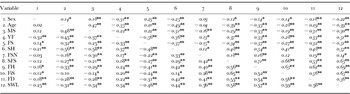
This study intended to investigate if family support network, satisfaction with family support, family harmony, filial support and filial discrepancy were associated with life satisfaction. Regression analysis was used to examine the relationships between independent and dependent variables. Before regression analyses, correlation analyses were performed to examine the relationships among all variables for the two groups of older people with different hukous. Table 2 presents the matrix of Pearson's correlation coefficients for the variables. Shown in the table, all independent variables were correlated significantly with the dependent variable of life satisfaction for both groups.
The matrix of correlation coefficients

Notes: Italic numbers are used for older people with non-agricultural hukous (N=269) and regular numbers for older people with agricultural hukous (N=263). MS: marital status. YF: years of formal education. FS: financial strain. SH: self-perceived health status. FSN: family support network. SFS: satisfaction with family support. FH: family harmony. FiS: filial support. FD: filial discrepancy. SWL: Satisfaction with Life Scale.
Significance levels: * p<0.05 (two-tailed test), ** p<0.01 (two-tailed test).
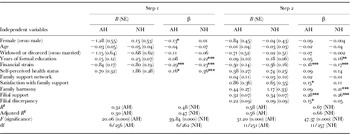
A two-step hierarchical regression was performed separately to examine the life satisfaction of older people with different hukous. The variables of sex, age, marital status, years of formal education, financial strain and self-perceived health status were entered to explain life satisfaction first. The factors related to family relations: family support network, satisfaction with family support, family harmony, filial support and filial discrepancy, were then entered into a regression equation to see which of these factors predicted life satisfaction beyond the effects of socio-demographics, health and financial strain. The results of the hierarchical regression model for the two groups of older people are summarised in Table 3.
Hierarchical regression of life satisfaction on the variables of family relations and control variables

Notes: AH: agricultural hukous. NH: non-agricultural hukous. df: degrees of freedom.
Significance levels: * p<0.05, ** p<0.01, *** p<0.001.
In step one of the hierarchical regression analysis, financial strain and health contributed significantly to explaining life satisfaction for both groups. The results also demonstrated that sex was associated significantly with life satisfaction of older people with agricultural hukous and years of formal education were related significantly with life satisfaction of older people with non-agricultural hukous. In step two of the hierarchical regression analysis, after controlling for socio-demographic variables, financial strain and self-perceived health status, filial support were found to exert significant impacts on life satisfaction for both groups of older people. Satisfaction with family support and filial discrepancy related significantly with life satisfaction of older people with agricultural hukous. Family harmony related significantly with life satisfaction of older people with non-agricultural hukous. The results also demonstrated that financial strain was associated significantly with life satisfaction for both groups of older people. The variables of years of formal education and self-perceived health were associated significantly with life satisfaction of older people with non-agricultural hukous.
Furthermore, regression findings showed that overall model explained 58 per cent (F=31.20, p<0.001) and 67 per cent (F=47.37, p<0.001) of variance for older people with agricultural hukous and non-agricultural hukous, respectively. In addition, the values of variance inflation factor for all the independent variables examined in both regression analyses were below 2.9, indicating that there was not the problem of multicollinearity (O'Brien Reference O'Brien2007). The normal P-P plot of regression-standardised residuals showed that the residuals were normally distributed and the scatter plot of the standardised residuals on the standardised predicted values showed that there were no problems of heteroskedasticity in both regression analyses.
The z-test was performed to test for the equality of regression coefficients of financial strain and filial support in the two regressions. The formula for this statistical test was
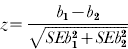
(Clogg, Eva and Adamantios Reference Clogg, Eva and Adamantios1995; Paternoster et al. Reference Paternoster, Brame, Mazerolle and Piquero1998). The results showed that the values of z for the variables of financial strain and filial support were equal to 0.28 (p=0.78, two-tailed test) and −0.06 (p=0.95, two-tailed test), respectively. The findings demonstrated that there was not significant difference regarding regression coefficients of financial strain and filial support between the two regressions.
Discussion
The relationships between life satisfaction and family relations
The aim of this study was to examine and compare the impact of family support network, satisfaction with family support, filial support, family harmony and filial discrepancy on life satisfaction between the two groups of older people with different hukous. Correlation analyses revealed that all five factors were correlated significantly with life satisfaction for both groups of older people. The regression results indicated that satisfaction with family support and filial discrepancy were only associated significantly with life satisfaction among older people with agricultural hukous and family harmony was only associated significantly with life satisfaction among older people with agricultural hukous. These findings partly supported the hypothesis that the relationships between the five factors and life satisfaction were significantly different between the two groups. The regression analyses singled out that filial support contributed significantly to explaining life satisfaction for both groups of older people. The z-test indicated that there was not significant difference regarding regression coefficients of filial support in the two regressions. Furthermore, social support network was not a significant factor for both groups of older people in regression analyses. These findings did not support the hypothesis that the relationships between the five factors and life satisfaction were significantly different between the two groups.
The findings of the present study showed that family relations played a significant role in contributing to older people's life satisfaction. The effect was identified when the contribution of socio-demographic and other factors were controlled. These were consistent with the findings that family relations were important to older people's life in Chinese societies (Cheng and Chan Reference Cheng and Chan2006; Chi and Chou Reference Chou and Chi2001; Silverstein, Cong and Li Reference Silverstein, Cong and Li2006; Xiang, Wu and Liu Reference Xiang, Wu and Liu1994; Xiong Reference Xiong1999; Yeung and Fung Reference Yeung and Fung2007; Zhang and Yu Reference Zhang and Yu1998). The study also revealed that among the five factors about family relations, only filial support contributed to explaining life satisfaction for both groups of older people. This seemed understandable because filial support has been strongly emphasised in Chinese societies (Chow Reference Chow, Chi, Chappel and Lubben2001; Shek Reference Shek2001a, Reference Shek2006) and Chinese people have a high expectation of filial support (Kwan, Cheung and Ng Reference Kwan, Cheung and Ng2003). Furthermore, social welfare for the elderly has been underdeveloped and family support has been the major source of old age security, especially for older people with agricultural hukous in mainland China (Leung Reference Leung, Yoon and Hendricks2005; Sun Reference Sun2002).
The regression analyses showed that satisfaction with family support and filial discrepancy only contributed to explaining life satisfaction of older people with agricultural hukous and that family harmony was only associated with life satisfaction of older people with non-agricultural hukous. It was possible that there was a lack of state-subsidised pension system and other social welfare services for older people with agricultural hukous (Hebel Reference Hebel, Eyferth and Vermeer2004). The majority of then had to rely heavily on family members for financial, emotional and other kinds of support. Thus, both objective and subjective aspects of family support might become their primary concerns. Accordingly, besides objective measures of family support, such as filial support, subjective measures of family support, such as satisfaction with family support and filial discrepancy, appeared to be associated significantly with their life satisfaction. On the other hand, the majority of older people with non-agricultural hukous had a pension and also enjoyed other social welfare privileges (China Research Center on Ageing 2008; Wang Reference Wang2005). Family support might be less crucial to their life. Thus, satisfaction with family support and filial discrepancy did not emerge as significant variables in regression analysis. With respect to family harmony, perhaps older people who were less constrained by financial strain put their mind and heart to achieve or maintain it to a higher degree. Therefore, family harmony played a more important role for the life satisfaction of older people with non-agricultural hukous.
It was also possible the majority of older people with agricultural hukous lived in rural areas and the majority of older people with non-agricultural hukous lived in urban areas. The living environments and lifestyles were likely to be different between the two groups of older people. The present study found that older people with non-agricultural hukous had significantly more years of formal education, as shown in Table 1. Due to these differences, the two groups of older people might have different coping strategies or styles to adjust to ageing. Accordingly, their perceptions of the significance or importance of factors, such as satisfaction with family support, family harmony and filial discrepancy in their lives, might be different. The effects of these factors on life satisfaction between the two groups of older people with different hukous need to be examined more sensitively in the future.
According to the results of correlation analyses shown in Table 2, five variables of family support network, satisfaction with family support, family harmony, filial support and filial discrepancy were interrelated. It was likely that the more harmonious the relationships between children and parents were and the greater the family support network, the more filial support the children were likely to provide for their parents, and hence the more closely the children's support was likely to meet their parents' expectations and the more satisfied older people might be with their family support. However, the interpretation of the research findings would be enhanced by in-depth interviews to ascertain the actual interrelationships between these variables.
Based on the results in Table 1, older people with non-agricultural hukous had significantly higher levels of satisfaction with family support, filial support, family harmony and life satisfaction than the elderly with agricultural hukous. Given the hereditary nature of the hukou system and the disparity of social welfare services between people with agricultural and non-agricultural hukous (Chan and Senser Reference Chan and Senser1997; Hebel Reference Hebel, Eyferth and Vermeer2004; Hu, Wang and Kang Reference Hu, Wang and Kang1995; Wang Reference Wang2005), it seemed understandable that the children of older people with agricultural hukous had fewer resources to support their parents. Thus, older people with agricultural hukous had lower levels of filial support and satisfaction with family support. Furthermore, as discussed previously, older people with non-agricultural hukous might put their mind and heart on family harmony to a higher degree. As a result, they had a higher level of family harmony. Since filial support, family harmony, education and finance were contributing factors to older people's life satisfaction (Cheng and Chan Reference Cheng and Chan2006; Mannell and Dupuis Reference Mannell, Dupuis and Birren2007; Zhang and Yu Reference Zhang and Yu1998), it seemed reasonable that older people with non-agricultural hukous had a higher level of life satisfaction.
Findings from this study led us to two major conclusions. First, family relations exerted significant impact on life satisfaction for both groups of older people with different hukous in mainland China. Second, among the five measures of family relations examined in this study, only filial support contributed to explaining life satisfaction for both groups of older people. Three measures of family relations: satisfaction with family support, family harmony and filial discrepancy, had different impacts on life satisfaction between the two groups of older people. Because family-related factors were likely to be interrelated and were embedded in the social and environmental context, their impact on life satisfaction among older people with different hukous in China should be further explored. Nevertheless, the findings of this research enriched our knowledge on the correlates of life satisfaction among older people with different hukous in China.
Limitations and direction of future studies
The present study had some limitations. First, the study was conducted in one city and the sample was not randomly selected. The respondents were likely to be relatively healthy and active people living in the communities. Therefore, the ability to generalise the findings in the present study is limited. Caution should be taken in the interpretation and possible application of the present research findings. Future studies may apply random sampling and include a larger sample size in more cities. Second, the present study was a cross-sectional study. It prohibited making a conclusion about the directionality of the relationships. It did not allow for the determination of cause and effect about life satisfaction among older people. Future empirical studies with a qualitative or a longitudinal design with repeated surveys may be able to establish causal relationships in the studies on the factors associated with life satisfaction among older people. Third, this study applied self-reported measures. Given that self-report requires the respondents to answer accurately and relies heavily on recall, this method of assessment may reflect some patterns of reporting biases or personal bias, such as the biases related to self-representation and social desirability. Future studies with other kinds of measures should be conducted to examine life satisfaction and its correlates between the two groups of older people with different hukous. Last but not the least, this study only focused on five measures of family relations. It is acknowledge that the operationalisation of family relations may focus on other measures, such as the frequency of family support and so on. Future studies can integrate more measures to further explore the conceptualisation of family relations. Despite the limitations, this study can be regarded as pioneering in nature, given that to date there have been few studies examining and comparing the relationships between family relations and life satisfaction between the two groups of older people with different hukous in China.
Implications
The findings in the present study revealed that older people with agricultural hukous had lower life satisfaction. They also had less formal education, more financial strain, and higher level of filial support. Given the inequality and discriminatory nature of the hukou system, it was undoubtedly shown that efforts should be made to end the hukou system to promote the wellbeing of rural people in China as well as an equal and just society in all of China. The findings also implied that policies and programmes that encourage and support family activities are needed to promote filial support in mainland China. It has been argued that the economic and social system changes in China since the foundation of People's Republic of China have removed the economic foundation (private ownership of property such as land) supporting the status of the aged in the family (Xu Reference Xu2001). Xu also points out that in rural areas, old age has become linked with poverty and many social and economic disadvantages. Filial support to them has often been fraught with uncertainties and largely depended on children's willingness and capacities. Furthermore, the social changes in mainland China, such as modernisation and urbanisation, are likely to have been unfavourable to intergenerational cohesion and the maintenance of filial practice. It has been argued that socioeconomic development may erode the traditional practice of respect for the elderly among Chinese youths (Zhang Reference Zhang2004; Zhang and Montgomery Reference Zhang and Montgomery2003). Besides developing and promoting formal support systems for older people, professionals working with the elderly in mainland China should also be concerned about social and economic changes and find effective ways to promote filial support to older people and their family harmony. Programmes could be organised to provide adult children information on ageing and communication in order to make adult children aware of their ageing parents' needs and to improve the quality of interactions between older people and their children. Programmes to help older people understand the knowledge and behaviours that younger family members would like them to acquire (Strom and Strom Reference Strom and Strom2000) to assist parents to attend more to the emotional needs of their children (Andrew Reference Andrew2002) could also be applied to promote family harmony and filial support.