Introduction
Faba bean (Vicia faba L.) is one of the most important ancient grain legume crops of the Mediterranean region including Turkey and is grown on approximately 3 million hectare worldwide (Link et al., Reference Link, Abdelmula, Von Kittlitz, Bruns, Riemer and Stelling1999). Trait analyses have distinguished three main biotypes of domesticated faba bean: large-seeded (macrosperma), small-seeded (microsperma) and medium-sized seed types. Large-seeded faba beans are usually used as food, medium-sized beans are used as food and feed, and small-sized beans are mainly used as feed (Duc et al., Reference Duc, Bao, Baum, Redden, Sadiki, Suso, Vishniakova and Zong2010). In Turkey and Mediterranean regions, large-seeded varieties are preferred, whereas in Europe and America small-seeded faba beans are consumed.
Modern plant breeding has succeeded spectacularly in raising the crop productivity in line with the rising human population (Baloch et al., Reference Baloch, Kurt, Arıoğlu and Özkan2010; Andeden et al., Reference Andeden, Baloch, Muazzez, Kilian and Özkan2013). However, its reliance on a small number of elite cultivars has eroded the genetic base of crops and, in particular, endangers the continued existence of landraces, which represent a repository of allelic variation that may be needed to achieve further genetic advance for yield and quality. International surveys have clearly shown the urgent need to save and manage local landraces (Jarvis et al., Reference Jarvis, Meyer, Klemick, Guarino, Smale, Brown, Sadiki, Sthapit and Hodgkin2000), because these landraces have considerable breeding importance as they contain valuable co-adapted genes for future cultivation practices and future breeding for higher yield and better quality (Harlan, Reference Harlan1975).
A large number of faba bean landraces have arisen over time because of differences in traditional farming practices and taste preferences. These landraces are a valuable source of genetic variation and are often adapted to local conditions (Karaköy et al., Reference Karaköy, Erdem, Baloch, Toklu, Eker, Kilian and Özkan2012). In the last decade, few varieties have been developed within Turkey and these faba bean cultivars were introduced and selected from the International Center for Agricultural Research in the Dry Areas (ICARDA) breeding lines. These faba bean landraces are still local agro-ecotypes, usually named after their cultivation area. Socio-economic changes have led to a dramatic reduction of landrace cultivation and to the disappearance of local populations from all parts of Turkey.
Little is known about the origin and domestication of faba bean. Numerous previous studies (Cubero, Reference Cubero1973, Reference Cubero1974) have proposed the near east and south-eastern Turkey as the postulated area of faba bean domestication. According to Muratova (Reference Muratova1931) and Maxted (Reference Maxted1995), genus Vicia is originated in south-eastern Europe and south-western Asia. Duc et al. (Reference Duc, Bao, Baum, Redden, Sadiki, Suso, Vishniakova and Zong2010) pointed out that ‘faba’ originated from a Greek word, meaning ‘to eat’, emphasizing that faba bean was used as food and feed by earlier Greeks and Romans, which highlights the antiquity of the faba bean in the Mediterranean area. The Mediterranean region, with a concentration of large-seeded varieties, is considered a secondary centre (Muratova, Reference Muratova1931). Small farmers continue to grow different landraces selected for their adaptation to local environmental conditions. These landraces could play significant roles in future breeding. In particular, we sought to characterize agronomic, morphological and quality characteristics of the faba bean landraces and provide information about diversity in faba bean landraces present to international breeders interested in Turkish faba bean genetic resources.
Materials and methods
Plant material and crop sowing
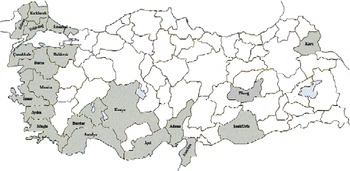
The research materials comprised 178 faba bean landraces representing various geographical regions of Turkey and four commercial cultivars (Eresen-87, Salkım, Filiz-99 and Kıtık-2003) released in the last few years. All these cultivars were widely grown in different faba bean growing areas in Turkey. Cultivars ‘Eresen-87 and Salkım’ were grown in the Marmara region, whereas Filiz-99 and Kıtık-2003 were mostly grown in Aegean and Mediterranean regions. In the last two decades, faba bean landraces from all over Turkey were collected from different groups of researchers and organization. The collected set of landraces used in our study was preserved at the ICARDA genebank. The seeds of the landraces were obtained from the ICARDA genebank, Aleppo/Syria, to study the phenotypic diversity of agronomic and quality traits. Identification numbers and collection sites are shown in Table S1 (available online), and the collection sites alone are shown in Fig. 1. Field experiments were conducted in the 2010–11 growing period at the research and implementation area of Çukurova Agricultural Research Institute, Adana (37°00′56″N, 35°21′29″E), Turkey, with a typical natural Mediterranean climate having high precipitation in winter and spring and high temperature and drought condition in summer. Four commonly grown Turkish faba bean cultivars were included as controls in the field experiment. All faba bean landraces and the four cultivars were sown in December 2010, on a well-prepared seedbed, using a randomized blocked design with replications. All landraces and cultivars were grown in plots of four rows, each 4 m in length, with 10 cm between plants within a row and 50 cm between rows. All plots were treated identically with the standard local agricultural practices.
(colour online). Geographic distribution of 178 faba bean landraces collected from different provinces of Turkey. Adana: 1–3, Antakya: 4–6, Antalya: 7–11, Aydin: 12–17, Balikeser: 18–52, Burdur: 53, Bursa: 54–62, Çanakale: 53–106, Edirne: 107–110, Elazig: 111–112, Icel: 113–116, Izmir: 117–139, Istanbul: 140, Kars: 141, Kirklareli: 141–144, Konya: 145–149, Manisa: 150–160, Muğla: 161–166, Tekirdağ: 167–177, Urfa: 178.

Data collection of different traits
Ten plants per plot (each landrace) were randomly selected and labelled, and data of 15 morphological and agronomical traits and six quality-related traits were recorded. The 21 traits were days to emergence (days), days to flowering (days), days to pods (days), days to maturity (days), plant height (cm), height of the first pod (cm), number of branches per plant, length of the pods (cm), number of pods per plant, number of seeds per pod, number of ovules per pod, diameter of the seeds (mm), length of the seeds (mm), 100-seed weight (g), grain yield (ton/ha), ash content (%), crude fibre content (%), fat content (%), moisture percentage (%), protein content (%) and starch content (%). The data on the 15 morphological and six quality traits were recorded based on the procedures of International Plant Genetic Resources Institute (IPGRI) and ICARDA (1985).
Days to emergence were calculated when 90% of the seed germinated. The days to flowering was recorded when 50% of the plants flowered. Days to pods were calculated from the date of emergence to the development of pods in 50% of the plants. Days to maturity were calculated from the date of emergence to harvesting of plants. The pod length was calculated from an average of 20 pods randomly selected from each accession. The number of seeds per pod and the number of ovules per pod were also counted from each of these pods and averaged. The plant height was measured from ten plants from the ground level to the highest growing point using a meter rod. The number of pods per plant, the height of first pods and the number of primary branches per plant were recorded from the same ten plants used for plant height. The number of seeds per plant was counted from the seeds obtained from ten plants and then averaged. The seed length and the seed width were calculated using a micrometer gauge to an accuracy of 0.01 mm, from 40 randomly selected seeds from each accession. The 100-seed weight was obtained from three random samples of 100 seeds from each plot. The yield was recorded from the seeds obtained from each plot and converted into tonnes per hectare.
For the quality analysis, seeds of the faba bean landraces were randomly taken from the harvested lot of each plot. The seeds of each landrace from each of three replications were mixed as bulk and data on different quality characteristics were recorded as three independent measurements from the bulk of each landrace. Protein, fat, ash, fibre, starch and moisture were determined in the seeds according to the standard methods of analysis (AOAC, 1990).
Statistical analyses
Standard one-way analyses of variances were performed for each trait, using the JUMP statistical software package (SAS Institute, 2002). Significant differences (P≤ 0.05) were detected between accessions for all studied agro-morphological and quality traits. Standard deviations (SD) were calculated for each landrace for different studied characteristics. Correlation among studied traits was calculated using the Pearson correlation procedure implemented in the JUMP software. Standardized trait mean values were used to perform the principal component analysis (PCA) and cluster analyses using NTSYS-pc (Rohlf, Reference Rohlf2004). To group the landraces based on their morphological dissimilarity, a cluster analysis and PCA were conducted based on Euclidean distances and applying the unweighted pair-group method with arithmetic mean (UPGMA) (Rohlf, Reference Rohlf2004).
Results
Diversity of agro-morphological and quality traits among landraces
The mean values for all agro-morphological characteristics in Turkish faba bean landraces are provided in Table S2 (available online). They harboured a high diversity among most of the studied characteristics. The number of branches per plant varied from 2.33 to 10.5 (for Çanakkale37 and Tekirdağ3). The number of pods per plant varied from 4 to 79 (for landraces of Muğla2 and Çanakkale39). The average length of the pods ranged from 5.86 to 13.2 cm (for landraces of Çanakkale6 and Konya2), whereas the height of the first pod differed between 5 cm for Balıkesir2 and 34 cm for İzmir15. The highest number of seeds per pod was found in landraces of Kırklareli3 (4.80), Çanakkale44 (4.60), and Adana2, Balıkesir33 and Kırklareli2 (4.40), whereas the lowest number of seeds per pod was observed in Çanakkale6 (1.40). The number of ovules per pods ranged from two for Çanakkale6 to five for landrace İzmir10 (Table S2, available online).
In regard to adaptation traits, the İzmir9 landrace took a minimum time (20 d) for emergence after sowing, whereas the maximum time to emergence (27 d) was recorded in landrace Çanakkale38. Plant height ranged from 40 cm for landrace Balıkesir2 to 97.6 cm for İzmir15. Landrace Balıkesir35 was early in flowering at 92 d, whereas late flowering landraces were Edirne3 and Elazığ1 (128 d), Edirne2 (127 d), and Çanakkale43 and Tekirdağ6 (126 d). Maximum days to pods were recorded in Edirne3 (144 d), preceded by Edirne2 (143 d), Balıkesir24 (141 d), İzmir15 and Tekirdağ2 (140 d), whereas minimum days to pods were found in Balıkesir35. Landraces Edirne3 and Elazığ1 matured late at 181 d and landrace Balıkesir35 matured early at 145 d.
There was also variation for seed characteristics and seed dimensions. The analysis of variance showed significant difference for seed weight, seed length and seed diameter (data not shown). The Çanakkale37 landrace showed the lowest 100-seed weight with 13.8 g, whereas the highest 100-seed weight was found in Edirne3 (166.8 g) followed by Adana2 (165.2 g) and İzmir6 (164.9 g). The maximum seed length of 24.8 mm and the maximum seed diameter of 17.2 mm were recorded for Balıkesir3, whereas minimum values were observed for Aydın6 (10.1 and 8.2 mm, respectively). The mean grain yield for all landraces was 2.240 ton/ha. Konya5 showed the highest grain yield (4.5 ton/ha), whereas Çanakkale37 had the lowest grain yield (0.22 ton/ha) (Table S2, available online).
The average values for six quality characteristics studied for these 178 Turkish faba bean landraces are given in Table S2 (available online). There was a significant variation in the protein content. The mean protein content varied from 21.93 to 27.38% showing the highest protein levels in İzmir14 and the lowest in Balıkesir18, Çanakkale7, Çanakkale13, Çanakkale25, Çanakkale32, Çanakkale39 and Tekirdağ1 (Table S2, available online). The mean fat content was 1.65% and ranged from 1.14 to 1.99%. The crude fibre contents varied between 7.77% (Balıkesir1) and 10.41% (Antakya1, Antalya4, Balıkesir4 and Tekirdağ9) with an overall mean of 8.85%. A wide diversity was also found for starch and ash contents with ranges of 39.28–45.28% and 4.28–4.55% and mean values of 42.63 and 4.43%, respectively. The moisture percentage also differed between 10.08 and 13.52%.
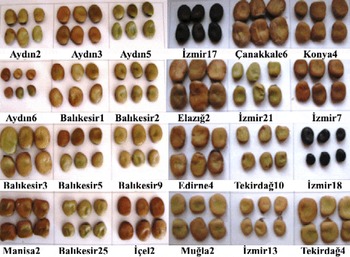
Generally, landraces having the extreme value for one character show a similar trend for other traits. For example, Adana2 has the highest number of seeds per pod with the highest 100-seed weight with good seed dimensions and other characters. Balıkesir35 was the earliest flowering and earliest maturing landrace, with a medium plant height and a high seed weight. Among 178 landraces, 37 accessions had high, 111 had medium and 30 had lower seed weight. In the case of seed diameter, 30 had higher, 130 had medium and 18 had lower values. For protein contents, 38 landraces showed higher, 116 showed medium and 24 showed lower protein contents (Table S2, available online). There was a high diversity among Turkish faba bean landraces in seed colour, seed shape and seed size. Some landraces with different seed shapes, seed colour, seed size, seed weight and morphology are shown in Fig. 2. Only four landraces were early in flowering, 129 were medium in flowering and the rest were late in flowering. Twenty-three landraces showed a high number of pods per plant, 99 had a medium number of pods per plant and 56 had a lower number of pods per plant. Thirty-seven landraces showed a longer plant height, 93 had a medium plant height and 48 had a shorter plant height (Table S2, available online).
(colour online). Diversity of seed morphology of some Turkish faba bean landraces.

Furthermore, we studied the diversity of landraces according to their region of origin or collection by comparing their mean values. Table S3 (available online) lists the mean values and SDs for agro-morphological and quality characteristics according to their geographical regions. According to overall mean values of landraces for regions, landraces from Elazığ had the highest pod length, seed diameter, seed length and 100-seed weight. Landraces from İzmir and Kırklareli were the earliest in flowering, earlier in maturing and earlier in poding. Landraces from İstanbul had a short stature whereas landraces from Antakya had the tallest stature. Landraces from Urfa and Adana produced the maximum number of pods per plant, and landraces from Edirne harboured the highest number of branches per plant. In the case of quality traits, landraces from various regions were very close for protein contents with variation between 22.34 and 24.76%. Urfa accession enjoyed the highest starch contents, and landraces from Konya suffered the lowest starch contents.
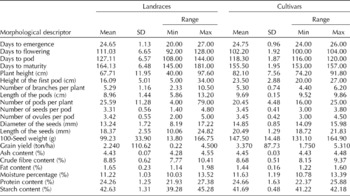
The maximum, minimum, mean and SD values for landraces and cultivars are presented in Table 1. Four faba bean cultivars were included in this study as control to compare with landraces. For most of the studied traits, the range and mean values among landraces were much higher than those among cultivars. The maximum and minimum values for days to flowering, days to pods and days to maturity and plant height were within a narrow range for cultivars when compared with the landraces, which exhibited wide ranges for these characters. Similarly, for seed and quality traits, landraces showed a higher diversity in comparison with cultivars.
List of the 19 morphological descriptors utilized in this study with means, SD and ranges for the 178 faba bean landraces and four cultivars

Correlation among morphological and quality traits and PCA
Phenotypic traits have been of great importance during the introduction of crop plants, because traits such as plant height, days to flowering and maturity, and seed yield have been selection criteria during domestication. Therefore, an overview based on association between traits has a strong relationship with the introduction of the crop. Statistical comparisons of relationships among 21 agronomical and morphological traits for 178 landraces and four cultivars landraces are shown in Table S4 (available online). The large number of observations raised the test power, providing significance to most of the correlations. There was a significant positive correlation in the number of seeds per pod with the length of the pods, the length of the seeds, the number of ovules per pod, the grain yield and the 100-seed weight, and a negative correlation with days to flowering, days to pods and days to maturity (Table S4, available online). The length of the pods was positively correlated with the diameter and the length of the seeds, and the number of ovules per pod. The 100-seed weight was positively associated with the length of the pods, the diameter of the seeds, the length of the seeds and the plant height (Table S4, available online). The plant height was positively correlated with the height of the first pod, the number of branches per plant, the number of pods per plant, days to flowering and days to maturity, and negatively correlated with days to emergence (Table S4, available online). The grain yield was positively associated with the 100-seed weight, the plant height, the height of the first pod, the number of branches per plant and the number of pods per plant (Table S4, available online). Days to flowering were positively correlated with days to pods, days to maturity, the plant height and the height of the first pod (Table S4, available online).
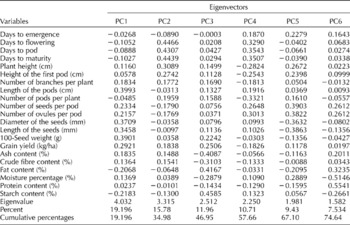
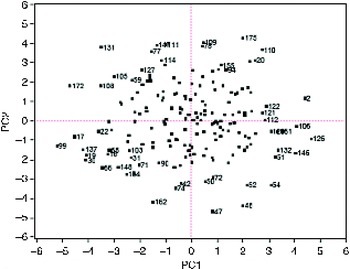
Multivariate analyses have been utilized to measure the diversity in germplasm collections and evaluate the relative contributions that various traits add to the total variability in a crop germplasm collection. These analyses permit germplasm entries to be classified into groups with similar traits. In this study, the principal component results for accessions and geographical regions showed a consistent and large diversity in investigated traits and quality traits (Table 2). The PCA, based on 15 phenotypic traits and six quality traits, was used to identify the patterns of variation within a set of 182 accession representing 24 geographical regions. The first two PCAs were used to draw a graph in order to see the pattern of variation among landraces. The PCA discriminates all landraces into four groups (Fig. 3). Using a PCA based on the correlation matrix, it appeared that the first six principal components accounted for 74% of the total variance (Table 2; Fig. 3). The first principal component (PC1) accounted for approximately 19% of the total phenotypic variation and showed the highest positive correlation with the length of the pods, the 100-seed weight, the diameter of the seeds, the length of the seeds and the grain yield, but a negative correlation with starch and fat contents. PC2 accounted for 15.8% phenotypic variability and was highly dependent on days to flowering, days to pods, days to maturity, the plant height and the height of the first pod. PC3 was built from crude fibre, grain yield and 100-seed weight and accounted for 12% of the total variability.
Eigenvectors, eigenvalues, individual and cumulative percentages of variation explained by the first six principal components (PC) after assessing morphological and quality traits in Turkish faba bean landraces

(colour online). Multivariate PCA of 178 Turkish faba bean landraces.

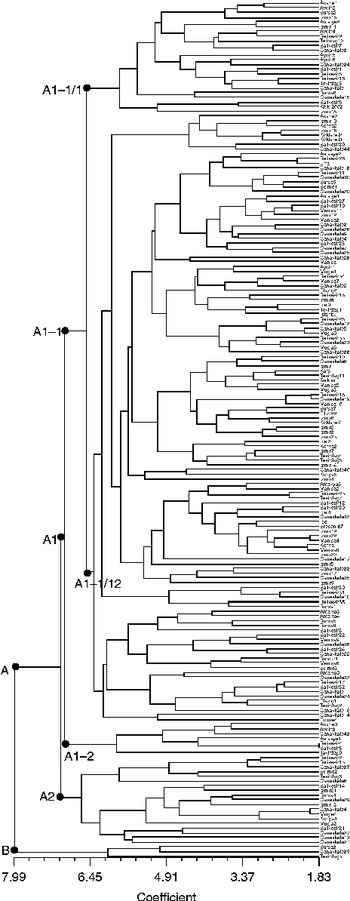
The cluster analysis was used to reveal the relationship among landraces, as different accessions within a cluster are assumed to be more closely related to each other in terms of the agro-morphological traits under consideration than those accessions placed in different clusters. Association among 178 Turkish faba bean landraces and four commercial cultivars was revealed by UPGMA cluster analyses based on Euclidian distance coefficients (Fig. 4) for 15 agro-morphological and six quality traits. The cluster analysis classified all landraces and cultivars into two main clusters A and B (Fig. 4). Cluster B contained only three landraces (Tekirdağ3, Çanakale39 and Bursa3). Cluster A was divided into two main groups A1 and A2. Cluster A2 contained 19 landraces whereas cluster A1 was again partitioned into two subgroups A1-1 and A1-2 (with six accessions). A1-1 went again into subdivision with A1-1/1 and A1-1/2. Subcluster A1-1/1 enjoyed with 24 accessions whereas the rest of the 130 accessions were placed in A1-1/2, which was again subdivided into many small groups (Fig. 4). The landraces collected from different provinces of Turkey were distributed over all clusters, indicating the existence of more diversity.
Association among 178 Turkish faba bean landraces and four commercial cultivars as revealed by UPGMA cluster analyses based on 15 agro-morphological and six quality traits.

Discussion
Landraces are of paramount importance for their potential utilization in crop improvement and in conservation programmes. A large number of faba bean landraces have been collected from different parts of Turkey, the most important centre of diversity. However, information on the extent and pattern of genetic diversity in these landraces is not systematically available. The 178 landraces differed significantly from one another with respect to all of the morphological, agronomic and quality traits and showed a considerable level of phenotypic variation (Table 1; Table S2, available online). Our results are in good agreement with those of previous studies, underlining the inherent heterogeneity of faba bean due to cross-pollination by insects (Escribano et al., Reference Escribano, Santalla, Casquero and De Ron1998). Duc et al. (Reference Duc, Bao, Baum, Redden, Sadiki, Suso, Vishniakova and Zong2010) reported that ICARDA have an extensive faba bean collection exceeding 2470 landrace accessions representing 41 countries. A wide phenotypic variation was expressed for different agronomic and morphological traits in their study. However, their study included only a small set of landraces from Turkey. Li-Juan et al. (Reference Li-Juan, Zhao-Hai, Zhao-Jie, Ming-Shi, Han-Qing, Saxena, Weigand and Li- Juan1993) analysed agronomic and yield traits of 1500 germplasm accessions from different provinces of China. Compared with Chinese faba bean landraces, Turkish faba bean accessions had a higher number of seeds per pod and a longer pod length. We observed that the seed weight, seeds per pod, the pod length and seed dimensions in Turkish faba bean landraces were also considerably higher than those in the famous Sicilian landrace Larga di Leonforte, which has a great appeal from consumer and has specific traits appreciated by farmers as well as breeders (Gresta et al., Reference Gresta, Avolai, Albertini, Raggi and Abbate2010). Similarly, Terzopoulos and Bebeli (Reference Terzopoulos and Bebeli2008) and Keneni et al. (Reference Keneni, Jarso, Wolabu and Dino2005) also described a high morphological diversity in traits of Greek and Ethiopian faba bean landraces.
Correlation coefficients for the agro-morphological and quality parameters were examined for possible correlations with each other to determine whether the selection for stability in one trait might concurrently affect the stability in other quality parameters. In this study, positive and negative correlations were found among different agro-morphological and quality traits in faba bean landraces (Table S4, available online). Positive association among different traits showed that an improvement of one character might simultaneously improve the other desired trait (Yucel et al., Reference Yucel, Baloch and Ozkan2009; Comertpay et al., Reference Comertpay, Baloch, Kilian, Ülger and Özkan2012). For example, positive correlation among yield and seed traits such as kernel length and seed diameter showed that an improvement in physical properties of the seed also results in an improvement in the plant yield. Positive association of days to flowering with plant height could be used for developing early maturing and short statured cultivars with thicker grains.
To analyse the structure of the genetic diversity among the set of 178 landraces representing 24 provinces of Turkey, we performed a PCA based on phenotypic means. Using a PCA based on the correlation matrix, it appeared that the first six principal components accounted for approximately 75% of the total variance (Table 2). In PC1, seed weight, length of the pod, length of the seed and diameter of the seed were effective main sources of variation, whereas, in PC2, landraces were discriminated mainly through days to flowering, days to maturity and days to pods. The cluster analysis revealed that accessions within each cluster belonged to different provinces (Fig. 4), which suggested that there was no clear relationship between accessions and geographical diversity and revealed that the diversity in faba bean landraces collected from various geographical part of the Turkey is not uniform. Therefore, more emphasis has to be directed to landraces level rather than geographical level as a source of diversity in this germplasm. However, this cluster analysis was constructed using the morphological data based on a 1-year field experiment, which could be strongly affected from different factors such as environmental conditions, soil properties, topography of the land and precipitation (Fig. 1). It is important to note that, among the four commercial faba bean cultivars used in this study, only one cultivar Kıtık-2003 was placed in the different group, whereas the rest of the three cultivars were positioned in A1-1/2 group showing a high resemblance or a low diversity in the cultivars according to studied agro-morphological traits and as well as quality traits. Within the cultivars, Eresen-87 is a single plant selection from landraces. Eresen-87 was developed from the selection of local population called Sakız. Other three cultivars (Kıtık-2003, Salkım and Filiz-99) were introduced and selected from the ICARDA breeding lines. Unfortunately, we do not have further information at the moment in order to identify the exact history of these cultivars introduced from ICARDA.
A wide diversity of adaptation traits such as earliness and length of the flowering period, maturity and days to emergence and other plant characteristics offer the possibility of adapting the crop to diverse agro-ecological environments. Morphological variation can, of course, be of direct application in a breeding context – for example, the wide variation in the flowering time (92–128 d) in these landraces indicates a wealth of allelic variation of relevance to the development of cultivars adapted to regions of Turkey, which have short or long growing seasons. In addition, the landraces were sampled from a very variable set of environmental and geographical locations (Fig. 1), which also tends to increase the level of diversity (Angelo et al., Reference Angelo, Pinheiro de Carvalho, Ganança, Abreu, Sousa, Marques dos Santos, Vieira and Motto2008).
In spite of heavy consumption of legumes including faba bean in Turkish diet and the availability of rich genetic resources, legume breeding in Turkey falls far behind cereals and other industrial crops (Özer et al., Reference Özer, Karaköy, Toklu, Baloch, Kilian and Özkan2010; Karaköy et al., Reference Karaköy, Erdem, Baloch, Toklu, Eker, Kilian and Özkan2012; Özer et al., Reference Özer, Tümer, Baloch, Karakoy, Toklu and Özkan2012; Toklu et al., Reference Toklu, Bicer and Karakoy2009). The yield and quality of cereals, soybean, cotton and other crops in Turkey have showed tremendous improvements due to breeding activities. However, breeding activities for faba bean is negligible. Only a few faba bean cultivars are available, and most of these were selected from the ICARDA breeding lines. Therefore, there is urgent need to increase the effort in faba bean breeding to develop cultivars with high yields and better quality. This is the initial step in reporting the diversity of faba bean genetic resources, which will be important for the success of breeding programme in Turkey.
Lev-Yadun et al. (Reference Lev-Yadun, Gopher and Abbo2000) proposed a ‘core area’ for the origin of agriculture within the Fertile Crescent. This was based on the proposition that wild einkorn and wild emmer from this area are genetically more closely related to the domesticated crop plants than elsewhere, and legume crops such as chickpea and lentil are believed to be originated in south-eastern Turkey. The origin and domestication centre of faba bean remains unknown and debatable, and it is believed that cultivated faba bean might be widely originated from the Middle East and then dispersed to Asia, Europe, Africa and Far East (Cubero, Reference Cubero1973, Reference Cubero1974). In the present study, we also observed that Turkish faba bean landraces harboured a high phenotypic diversity compared with Chinese, Greek and ICARDA world collection, and this could support the postulate that Turkey could also be one of the most important diversity centres for faba bean and might be its domestication centre. However, detailed and careful investigation is required to support this hypothesis.
Supplementary material
To view supplementary material for this article, please visit http://dx.doi.org/10.1017/S1479262113000208
Acknowledgements
We are grateful to Dr Ali Ismail (genebank-ICARDA) for providing the Turkish faba bean landraces.