Introduction
In various contexts, scholars have associated the attempted ‘export’ of specific American products, practices, and values with a phenomenon variously labelled as American ‘cultural imperialism’, ‘cultural hegemony’, or ‘soft power’.Footnote 1 Sport and physical culture have been singled out as particularly potent elements in this process of the ‘construction of an American world order’.Footnote 2 This article contributes to a better understanding of the global transfer and reception of American fitness ideologies and practices by exploring their impact in a region that has so far mostly escaped the attention of historians interested in ‘Americanization’ processes.Footnote 3 While there exists a copious literature on the dissemination of American games and sports all over the world and particularly in Latin America and East Asia,Footnote 4 there has been almost no scholarly engagement with the influence of the American-style ‘empire of sports’ on the Indian subcontinent.Footnote 5 However, not only does this contribution add a new regional facet to the existing global histories of America's ‘moral empire’; it also aims to test the limits of their explanatory power through a detailed historical case study that points to the importance of local contexts and also takes into account the agency of those at the receiving end of American modernizing missions. It will be argued that the intensification of economic and cultural American influences did not eo ipso mean that North American models could be transplanted in a simple or straightforward manner to non-Western contexts. Rather, the ‘American’ physical fitness programmes that eventually came to be adopted in South Asia were products of complex local interactions and negotiations between distinct and often oppositional groups of actors, including British colonial administrators and Indian nationalists. Under these particular circumstances, the programmes eventually acquired very specific ‘pidginized’ forms, drawing as they did on highly diverse cultural resources.Footnote 6
Besides adding to the global histories of sport or American soft power, the article also makes an intervention in current debates in South Asian history. The fact that there has been little scholarly interest in the impact of American fitness ideals and sporting missions on the Indian subcontinent is interesting in itself. It is obviously not the case that the topic would be insignificant for the region. Quite the reverse: many historians have pointed to the fact that the introduction of modern forms of sport and physical culture has had a particularly noteworthy impact on the political history of late-colonial South Asia. During the first three decades of the twentieth century, Western notions of fitness found their way into both the rhetoric and practice of educational and political projects of religious reformers from various backgrounds as well as political leaders ranging from Indian revolutionary ‘terrorists’ to apostles of non-violence like M. K. Gandhi.Footnote 7 In spite of all their ideological differences, these actors shared the belief that physical training would render South Asians fit for the challenges of a modern age perceived as hostile, ‘effeminating’, and corrupting, thus preparing them for the hardships of the political struggles ahead of them if self-rule was to be a realistic political objective.
With very few exceptions—particularly the pioneering work of social anthropologist Joseph Alter needs to be acknowledged hereFootnote 8—the existing literature, however, has addressed the transfer of the notions and practices of physical and moral fitness in this region almost exclusively within a rather narrow imperial frame of reference, focusing either on the role of the colonial state or on the handful of British missionaries who were targeting an equally minuscule group of Indian aristocrats in imperial colleges.Footnote 9 Inspired by a relatively new current in South Asian history that advocates the exploration of transnational entanglements of South Asian social formations, politics, cultures, and economics beyond empire, this study highlights the importance of Indo-American interactions during the first four decades of the twentieth century.Footnote 10 It starts with the observation that the new ‘body language’ and the modern physical practices that took root in late-colonial India were indeed closely connected to the increasingly intense worldwide circulation of American ‘mass culture’.Footnote 11 As recent research has documented, the sub-continental enthusiasm for all things American discernible especially after the First World War, when the United States of America had acquired the role of a ‘great power’ also on the global political stage, included a fancy for Hollywood movies, jazz, and Ford automobiles.Footnote 12 What is less known is that this ‘new Americanism’ in South Asia also extended to ideals of fitness, beauty, and masculinity, and that a huge market existed for ‘lurid physical culture magazines usually emanating from America’ precisely at the same time, illustrated with posed photographs of well-trained body builders.Footnote 13
The growing popularity of sports and fitness programmes in late-colonial South Asia can therefore hardly be understood as the product of a closed and unilateral system of ‘imperial diffusion’, as J. A. Mangan and others have argued.Footnote 14 The fact that this earlier scholarly narrative aligned perfectly with the powerful and persistent conventional wisdom ‘that Britain is the birthplace of modern sports and that sports diffused from the homeland to the rest of the world’Footnote 15 perhaps serves to explain why even younger historians interested in the history of sports in colonial South Asia tend to overlook global connections and remain fixated on the imperial frame of reference.Footnote 16
While it would be ludicrous to deny that colonial agencies remain crucial to understanding the reception and adaptation of ‘Western’ sports and physical culture regimes in India, there were also other important players. Physical culture and fitness had become something of a global obsession by the turn of the twentieth century and a broad variety of training regimes and ‘systems’, ranging from German Turnen, via Scandinavian callisthenics and Japanese Jiu-Jitsu to body-building regimes advocated by the famous Anglo-German strongman Eugen Sandow, were disseminated in the subcontinent as well as in the rest of Asia.Footnote 17 The case study at hand focuses pars pro toto on an agency that has been described by historians of various other world regions as playing a crucial role for the transnational circulation of fitness ideals and practices,Footnote 18 but has, again, been neglected by scholars of South Asian history.Footnote 19 The globally active and United States of America-dominated Young Men's Christian Association (better known as the YMCA, or simply ‘the Y’) was not only one of the most visible and influential elements of the famous Protestant International that was at the peak of its powers by the turn of the twentieth centuryFootnote 20; it was also ‘an institution equipped to carry the gospel of sport all over the world’ and hence a mainstay of America's ‘moral empire’.Footnote 21 To be sure, the (often transnationally constructed) sports and fitness schemes it attempted to disseminate in South Asia were undoubtedly represented as Western, but they were simultaneously advertised as specifically American. The emphasis on the ‘progressive’, ‘liberal’, and ‘egalitarian’ character associated with the United States of America and their supposed compatibility with Indian nationalism were arguably their biggest selling points, as they marked them as being clearly distinct from the kind of Westernness associated with the colonial rulers. This ties in with an argument recently made by American historian Paul Kramer, who views the United States of America in the early twentieth century as an example of ‘imperial formations that worked through the nation’ and consequently ‘profited from both the presence and the disintegration of older, European colonial worlds’. In other words, American agencies could support anti-colonial nationalisms and present their own crypto-imperial schemes as ‘radical, modernist breaks with a homogenized Western European “imperial” past and present characterized by repression, corruption, and decadence’.Footnote 22
The article starts with a brief sketch of the history of the YMCA. It recapitulates the Christian civil society organization's emergence in the West, traces its spread to South Asia, and elucidates its complex relations with British colonial authorities as well as Indian anti-colonial nationalists. Against the backdrop of these overall configurations, the development of the Y's specific ‘scientific’ and ‘democratic’ programme of fitness training and physical education in North America is scrutinized in the subsequent section before its implementation in India is explored in greater detail. The bulk of this latter part focuses on the activities of the leading American fitness experts working for the Indian YMCA and assesses the role of the pioneering College of Physical Education (MCPE) in Madras, founded in 1920. This institution became an icon of the association's engagement with physical fitness and was soon emulated by both British colonial officials and Indian nationalist politicians. The third and fourth sections focus on interrogating the goals of American physical directors serving in India by analysing Y-brochures, journal articles, and speeches of the leading secretaries involved. The fifth and final sub-chapter complicates this apparent success story. It does so by switching the focus from the reconstruction of the Y's agenda and self-representations to a close analysis of the quasi-imperial ideological underpinnings of its physical programme in the Indian subcontinent, thus revealing the inconsistency of its liberal rhetoric. The subsequent brief inventory of its actual reception and effects likewise brings out the manifold contradictions and limitations that were characteristic of the YMCA's pseudo-egalitarian sports scheme.
The YMCA's passage to India
The original Young Men's Christian Association was founded in London in 1844 as a reaction to the rapid cultural transformations and social disruptions taking place in industrializing Britain during the first half of the nineteenth century. The subsequent spread and growth of the organization whose avowed aim it was to provide young (mostly middle-class) males with a healthy, moral, and religious environment in the heart of the fast-growing and allegedly ‘debauched’ urban centres in the West were nothing short of spectacular. Countless branches opened in various European countries and particularly in the United States of America and Canada, where the new lay association met with immediate success. As early as 1855, its spokesmen laid claim to its being a universal organization at the first YMCA world conference held in Paris.Footnote 23 Using the ‘imperial highways’ of the British empire, the association made inroads into the non-Western world before long. In 1857, the first branch in South Asia was founded in Calcutta and the movement gradually grew in the region in the following years. In 1882, Ceylon (today's Sri Lanka) followed suit when a Y-headquarters was opened in Colombo.Footnote 24 Even though Geneva was chosen as the site for the Headquarters of the Universal Union of YMCAs in 1878, North America and Britain (and the latter's white settler colonies) unmistakably remained the most important strongholds of the Christian lay movement, and the Y's expansion in British-controlled territories in South Asia was eventually complete when the first branch opened in Burma in 1899.Footnote 25
The rapid growth of the novel organization was hampered during the first three decades of its existence on the Indian subcontinent due to the fact that the early South Asian branches were solely run by British YMCA members.Footnote 26 This hugely limited the appeal of the Y to South Asians, as the local associations perfectly aligned with the official politics of social distance between rulers and ruled and, almost without exception, were at pains to exclude ‘natives’ from their ranks and catered exclusively to the small communities of Europeans and ‘Eurasians’Footnote 27 residing in South Asia.Footnote 28 It was only in the 1890s that the spread of the Y movement in India, Burma, and Ceylon gained new momentum under the energetic leadership of young American missionaries who were part of a widespread evangelical revivalist movement in North America that culminated in the establishment of the Student Volunteer Movement (SVM) in Northfield, Massachusetts, in 1886.Footnote 29 Three years later, the YMCA of the United States of America and Canada started its ‘foreign work’ scheme.Footnote 30 Formally under the umbrella World Alliance in Geneva, the North American association operated in actual practice largely independently during the next decades not least because it had vast funds of its own at its disposal.Footnote 31 The vanguards of the Y's zealous student missionaries arrived in India in 1889, determined to achieve ‘the evangelization of the world in this generation’.Footnote 32 David McConaughy, the first American secretary of the Indian YMCA, who was paid by the American head office in New York, completely restructured the organization, from 1890 onwards, ushering in a period of continuing and massive growth rates over the next 30 years.Footnote 33 McConaughy made it a point that the Association was ‘democratized’, affording ‘its privileges alike to all young men without distinction of race, rank and religion’.Footnote 34 It took some time to overcome the opposition of conservative British association members, some of whom were reluctant to give up the politics of social distance between what were called ‘the natives’ and ‘the ruling race’ in the parlance of the time.Footnote 35
In spite of this scepticism, the democratization strategy soon yielded positive results: the number of sub-continental associations rose from 35 in 1891 to 151 in 1901, and 241 in 1921, while the total membership grew from fewer than 2,000 to more than 10,000 during the same period.Footnote 36 Due to this spectacular expansion, South Asia became the second most important ‘foreign mission field’ in Asia after China by the turn of the twentieth century. The period of growth would continue over the next two decades, with the YMCA reaching the pinnacle of its influence in the 1920s before financial problems in the wake of the great depression led to gradual decline of the American presence in South Asia. Before the early 1930s, however, the impact of the American national YMCA in India remained much bigger than that of the World Association in Geneva: in 1925, for example, 42 out of approximately 70 ‘foreign secretaries’ working in India, Burma, and Ceylon were exclusively on the payroll of the North American YMCAs, whose members annually pumped more than US$ 220,000 into the project of ‘uplifting’ the sub-continental population morally and materially.Footnote 37
The strategy adopted to achieve such uplift underwent some changes with time and, as will be spelt out below, these changes had a tangible impact on the dissemination of the gospel of fitness. A strong focus on the creamy layer of ‘anglicized’ South Asian College students in big cities characterized the early period of expansion preceding the First World War.Footnote 38 This elitism was coterminous with the period when the British empire and its civilizing mission were widely admired by the first generation of American YMCA secretaries as well as by American presidents.Footnote 39 The Christian Association's imperial romance found expression in a large number of Anglo-American joint ventures and reached its peak during the Great War, when the United States of America-dominated Indian Y supported the British war effort through its comprehensive ‘army work’ scheme and was, in turn, heavily subsidized by the Indian and British governments.Footnote 40
During and after the war, more and more South Asians rose to positions of prominence in the Indian and Ceylonese Y. Some of them, like K. T. Paul, who became the first Indian general secretary, had connections to the broad array of Indian social service organizations that mushroomed in the political ferment of the 1900s and 1910s.Footnote 41 It was partly through their influence that the work among urban students was complemented by other efforts that considerably broadened the Association's constituency on the subcontinent. At the same time, the broader shift ‘[f]rom evangelism to general service’ that occurred in the North American Y in the interwar periodFootnote 42 also led to some influential Y-secretaries in India starting a more intense engagement with the less privileged segments of the population in the big cities as well as in rural areas with their newly devised ‘industrial work’ and ‘rural reconstruction’ schemes.Footnote 43 This suggests the dwindling importance of religious conversion and a considerable extension of the organization's agenda into the seemingly more secular realm of constructive social work and community development by the beginning of the interwar period. It remains open to debate, however, whether the new focus can indeed be interpreted as an indicator of secularization or rather as one of the ‘tactical retreats’ C. A. Bayly has described as typical of the ‘new style religion’ that emerged from the late nineteenth century onwards. According to Bayly, these retreats cannot be understood as evidence of the erosion of the power of religion, but rather of the growing entanglement of religious and secular agendas that ultimately aimed at the conquest of ‘new areas’ of ‘cultural and social life’, to spread the old religious message more efficiently.Footnote 44 At any rate, it is obvious that this new ‘social’ outlook provided ideal circumstances for the intensification of the Y's sports and fitness programmes.
Affected by this general reorientation, the political allegiance of the protestant lay organization also began to change. By the early 1920s, some of the Indian and American Y representatives started to openly show their sympathies for the Gandhi-led Indian National Congress (INC).Footnote 45 Their critical attitude reflected a profound shift in the general political climate in the United States of America where the Indian case, pushed by a small lobby group of Irish and South Asian expatriates, was discussed sympathetically in the American Congress as well as in the American labour movement.Footnote 46 This trend was further reinforced through the massive media coverage of Gandhi's Civil Disobedience campaign in the early 1930s that considerably increased the number of sympathizers of Indian nationalism in America. The new developments were much to the chagrin of many British YMCA members, some of whom started to criticize the organization's almost complete dependence on American funding, while others lamented that a once respectable Christian institution was now apparently ‘given over to an insidious type of agitation’.Footnote 47 In 1927, London's The Times even speculated that the Indian Y had become a platform for people who were ‘not only anti-British, but actually Bolshevist in aims and ideals’.Footnote 48 Unimpressed by such reproaches, some American agents of the Y continued to condemn the ‘methods of irresponsible violence on the part of Government agents’,Footnote 49 while others extolled the empowerment of women through the ‘Gandhi movement’.Footnote 50 Still others outspokenly celebrated the intensification of the nationalist campaign in the 1930s as an ‘hour of opportunity’ for the Y and its agenda, observing thatFootnote 51:
India has perhaps the greatest claim in the world today for American help. . . . The association should be at the forefront of analyzing the present and growing needs along the lines of citizenship-training, training in inter-national [sic!] thinking and relationships . . . a new leadership is being born and India is one [sic!] the move. . . . It is the association's hour of opportunity. . . . The crest of the tide is coming soon. Are we ready?Footnote 52
By the early 1940s, the political shift of camps had been more or less completed. The message in a strategy paper on the YMCA's post-war policy that the association's ‘primary concern [was] for the human element rather than forms and systems’ was an oblique way of stating that the Y's loyalty would henceforth be with the future Indian national leaders and no longer with the imperial government.Footnote 53 Since the promised development aid ‘along the lines of citizenship training and international thinking’ was closely linked to the specific variety of ‘physical work’ developed by the Y, we next need to zoom in on the role of sports and fitness in the association.
Preparing for the ‘modern strain’: the place of sports in the North American YMCA
It has been indicated already that, in its first British and continental European avatars, the YMCA was conceived as an ‘evangelical antidote to urban vice’ providing for the spiritual needs of middle-class bachelors.Footnote 54 Initially, it did so primarily by organizing prayer meetings, tea parties, and bible-reading circles.Footnote 55 It was only in the 1870s, after YMCA branches began to mushroom in the United States of America and Canada, that sports became an accepted component of the Y's work and the gym a standard feature of the average YMCA headquarters.Footnote 56 Whilst the acceptance of recreational physical activities was somewhat slow in the movement's country of origin, the provision of physical culture facilities soon proved to be the biggest single point of attraction of the expanding Christian lay organization in North America.Footnote 57 The resulting need for ‘physical instructors’ was consequently met through the opening of the International YMCA Training School (later renamed Springfield College) in Springfield, Massachusetts, in 1885. It became the first Christian academic institution to offer an organized course in physical education from 1887 onwards.Footnote 58 Under the aegis of sporting pioneer Luther H. Gulick (1865–1918), New England colleges like Springfield and neighbouring Holyoke soon became famous as the sites where older evangelical conceptions, hostile of physicality, were discarded, and sports and religion began to be integrated ‘around the concept of body-building’.Footnote 59 In the process, the freshly trained ‘physical directors’ of the YMCA invented and popularized new safe and sanitized team games like basketball and volleyball.Footnote 60 Somewhat ironically, the success of the physical programme indicated a shift that gradually transformed the association from a protective shield against a ‘godless’ modernity into an agency obsessed with ‘physical efficiency’, preparing Christians for precisely the same ‘modern strain’ and teaching them how to cope with the stiff competition prevailing in capitalist societies, always ensuring that they could ‘do the most and the best work’, as Gulick put it.Footnote 61
For the purpose of this article, it is important to note that, at least in the self-perception of its inventors, the peculiar variety of sport, fitness, and physical education that was cultivated in Springfield differed in important ways from the more conventional practices they believed to be still prevalent in Britain. Clifford Putney has shown, for instance, that the new team sports promoted in the Massachusetts colleges were advertised as being different from established ‘solitary and antisocial’ physical activities like dumbbell exercises and drills and instead emphasized sociability and the recreational aspect of fitness training.Footnote 62 The fact that Gulick regarded play and pleasure as ‘the most character determining force within a people’Footnote 63 also explains the YMCA's sports philosopher's political and social engagement in endeavours that were typical of the social engineering projects undertaken in the Progressive Era. Thus, Gulick served as chairman of the Playground Extension Committee and founder of the Camp Fire Girls and Boy Scouts of America in the first decades of the twentieth century.Footnote 64 The emphasis on play also entailed a strong condemnation of sport professionalism and one-sided or extreme forms of training. Physical fitness as propagated by the Y was after all not primarily built to produce winning athletes, but rather to create better citizens and more moral men and fathers.Footnote 65 This stress on symmetry, balance, and the ‘earnest desire . . . to develop thoroughly rounded manly character’ rather than muscle-bound bodies is crucial for understanding the nature of the physical education and ‘leadership-training’ programmes adopted later in the YMCA's South Asian mission fields.Footnote 66
In America and Canada, sport definitely played a pivotal role in the training of Y cadres already by the 1890s. The Y Leader's Corps and high-school fraternities recruited their members not primarily on the basis of their academic brilliance and exemplary conduct, but rather according to their athletic accomplishments.Footnote 67 This facet, too, would later resurface in the South Asian context, where it was taken for granted that ‘boys who are trained and grow up under efficient physical supervision, are the boys who . . . prove to be leaders in their walks of life’.Footnote 68
A third key aspect promoted by Gulick and his associates consisted of what could be termed a ‘scientific’ approach to issues of fitness and physical education.Footnote 69 The Springfield school connected physical training to broader schemes of public health, social hygiene, and even eugenics. In an article published in 1890, Gulick celebrated the new ‘science’ of physical education for being
in line with the most thorough modern physiological psychology . . . and with our modern conception of evolution, as it works to develop a superior race. This profession offers to its students a large and broad field for intellectual activity, involving for its fullest appreciation a profound knowledge of man through physiology, anatomy, psychology, history and philosophy.Footnote 70
Consequently, he regarded schemes of physical education as ‘fundamental in the up-building of the nation’. Such large-scale bio-moral engineering, however, could only be achieved once it was assured that fitness programmes were implemented by professional experts, by ‘men of collegiate training, philosophical minds broad purposes and earnest hearts’.Footnote 71 In other words, the physical directors trained in Springfield and similar places held the key to both nation-building and ‘racial improvement’. How strong the impact of the International YMCA College would become in South Asia can be gathered from the travelogue of Laurence Doggett, long-term president of the YMCA Training College, who visited the subcontinent in 1936–37 and proudly mentioned that altogether ‘some twenty’ Springfield alumni were ‘giving spiritual leadership to the youth of India, Burma and Ceylon’.Footnote 72 This begs the question about their actual role in South Asia and thus leads to the next section.
Working out IndiaFootnote 73
First experiments
Not surprisingly, the creation of training facilities and the organization of sports events became regular features of most Y branches in South Asia almost immediately after the North American influence became palpable in the region. In an editorial of the Young Men of India of November 1890, the founding of an athletic club in Madras was announced as an important event that would mark the first step of turning the Indian YMCA into the ‘most powerful factor in the field of athletics’.Footnote 74 A few months later, the Madras branch was granted a piece of land near its headquarters that could be used as athletic grounds where ‘the American Game of Baseball, for which a nice outfit was sent by friends from the New York City Y.M.C.A.’, was played for the first time on Indian soil.Footnote 75 Before long, the Madras Y endeavoured to lure young Indians with the advantages of a potential membership, starting its list of benefits with the observation that ‘[f]or physical culture, athletic grounds specially set apart by Government are used by the members for Cricket, Badminton, Tennis, Base-Ball and Foot-Ball’.Footnote 76 While, the nice outfit notwithstanding, baseball failed to garner the attention of the cricket-crazy Indian elite youth over the long term, another YMCA innovation was an immediate success. In October 1897, that is four years after the historic first college match had taken place in the United States of America,Footnote 77 an ‘exhibition match’ of basketball was organized on the Y's premises in Madras. If the report of a local newspaper is to be trusted, the game was introduced as being ‘less rough and more scientific’ than football and ‘awakened lively interest among the spectators’.Footnote 78 However, even the approval of basketball could not match the tremendous popularity of another Y innovation. Financed largely through a substantial donation by the American Association veteran and department store tycoon John Wannamaker,Footnote 79 the Madras branch of the Y had opened a new head office in an imposing four-storey building in the most expensive downtown area of Madras in 1900. Like the Y's American ‘manhood factories’ it emulated,Footnote 80 the new headquarters contained not only affordable accommodation, a well-stocked library, lecture halls, and rooms for socializing activities, but also a ‘Gymnasium fully equipped with up-to date apparatus’.Footnote 81 Taken together, these features assured that the Y-headquarters would function as one of the ‘showrooms of modernity’ in its American incarnation. They allowed the elite youth of the city glimpses into the latest scientific knowledge and political debates and gave them access to cutting-edge technologies of self-empowerment through physical exercise.
The gym, in particular, became a magnet for Madras's Indian middle-class youths from various backgrounds. Before long, other branches in the subcontinent copied it as they did the other sport facilities and physical culture classes, and could soon compete with the pioneers in Madras. Within less than two decades, body-building equipment and other sports facilities became a staple item in the Indian YMCA in much the same way as they were in North America and places like China or Brazil.Footnote 82 Clearly, the early initiatives with sport and fitness programmes in South Asia were strategically calculated to draw more ‘native’ youngsters into the Y with a view to preparing the ground for their future conversion. Since fitness training was regarded as the major point of attraction, the sites for gyms and athletic grounds were sometimes explicitly chosen to guarantee maximum public visibility of the sporting activities.Footnote 83 The available statistical evidence seems to confirm that this strategy was at least partly successful. It is no exaggeration to state that the YMCA's role as an agency specialized in spreading the gospel of physical fitness and health had begun to outshine its work as a religious body aiming at the proselytization of India's ‘teeming masses’ by the end of the 1910s. A table published in the Annual Report for 1919 suggests that South Asians were evidently more interested in the sports programmes offered by the organization than in its religious activities. In Calcutta, for instance, the ‘physical sessions’ of the local Y were frequented 30,552 times, whereas the bible classes counted only 5,337 visitors. In Colombo, the figures were 6,594 and 807, respectively.Footnote 84 Though some of the more conservative European Y-members saw the tremendous success of sport and fitness programmes as a mixed blessing and ‘did not grasp the value’ of the physical aspect ‘for the furtherance of the Kingdom of God in India’,Footnote 85 others recognized the potential in using fitness schemes (and, even more importantly, physical education) for purposes that by far transcended the role of a decoy designed to prepare the ground for the wholesale evangelization of India. Instead of merely promoting South Asia's spiritual salvation, the advocates of the Y's ‘physical work’ relentlessly repeated during the 1910s and 1920s that it could be used to further the political empowerment and societal betterment on the subcontinent.
Colonial complicity, cultural distance, and the emergence of a pedagogic fitness scheme
The Indian YMCA's more in-depth engagement not only with games and sports as healthy leisure activities, but with comprehensive schemes of physical training and hygiene education began in earnest when Dr John Henry Gray (1879–1964) took up his position in India as the first proponent of what he himself referred to as the Y's ‘fully qualified scientific leadership’.Footnote 86 He was born in India as the son of American medical missionaries and sent to the United States of America for education when he was four. He joined the YMCA at the age of ten and graduated from the YMCA International Training College in Springfield, where he attracted attention as ‘captain of the football team and a star in all forms of athletics’ before gaining an MD from the Medical School of Columbia University. In 1908, he eventually returned to India to take over the post of physical director at the Calcutta Y. From 1910 to 1919, he additionally filled the newly created post as the first National Physical Director of the YMCAs of India, Burma, and Ceylon. From 1920 to 1927, he held a similar position in China, where he was instrumental in setting up a school for physical education and played a momentous role in the development of modern sport in that country.Footnote 87
The creation of a distinct physical department in the Indian YMCA in 1910 bears testimony to the fact that Gray had managed to convince the more religious-minded YMCA functionaries in most South Asian branches of the manifold advantages emanating from sports events and newly devised fitness programmes. His most powerful argument apparently was that ‘physical work is one of the best iconoclastic means at our command’.Footnote 88 In a programmatic article penned in 1910, John Gray contended that the transformative power of sport could arouse the supposedly inert Indian society and cure one of its fundamental problems: the rivalry and tensions that existed between various religious and social groups:
Men cannot come into physical contact and keep caste, religious or social . . . . Men cannot form pyramids and do combination work on the floor and remember or really care whether they are Brahmins or Mahomedans [sic!], mercantile or tradesmen. . . . But one must indeed really love his Indian brother if he is going to be smeared with his perspiration in tumbling and Basketball. Come with me some hot June night to the College Branch [of the Calcutta YMCA] and I will show you what I mean.Footnote 89
The Y's first professional physical director in India was convinced that physical work would ‘smash . . . its way into time-hoary religious and social customs’, thereby eventually achieving the Christian association's long-term goal of ‘breaking down Hinduism’.Footnote 90 But the expected benefit was not limited to the collapse of ‘Oriental superstitions’ and the resulting opportunities for proselytization. Following Gulick's quasi-eugenic argument, Gray also firmly believed that the YMCA's fitness programme would have an equally positive impact in the political realm, inciting India to awake from its ‘state of semi-hibernation’ and eventually assume a more ‘prominent place in the family of Nations’.Footnote 91 The Y's signature games, he declared, could open up new horizons, as they were ‘giving the Indian a real taste of democracy in play, synchronising with foretastes of democracy in many other lines’.Footnote 92
Last, but not least, the physical work could also solve the most immediate health problems of Indians, who, in Gray's view, deserved the unflattering title of being ‘the sickest nation of the world’.Footnote 93 Combining Luther Gulick's scientific approach to physical culture with the insights received during his medical training at Columbia, John Henry Gray constantly emphasized that the knowledge of hygiene and sanitation was an indispensable part of the fitness package. His combined programme of ‘character-building, sports and scientific health education’Footnote 94 soon impressed the British imperial administration, which eventually offered their ‘hearty cooperation and financial support’.Footnote 95 Within a year after his arrival in Calcutta, British officials from the provincial government approached Gray with an offer to take over the training school for gymnastics masters and drill instructors who served in public educational institutions. Between 1909 and 1914, he worked part-time as an official Advisor for Physical Education to the Government of Bengal, invested with an astounding power to influence colonial body politics in India's most important province.Footnote 96 His tasks were manifold: he served on the committee of enquiry into school and college hygiene, trained teachers, lectured in schools and universities, developed curricula, and wrote textbooks as well as handbooks with standardized rules for various sports and games. He even assumed a pioneering role by pushing the construction of playgrounds in India's urban centres and the establishment of public swimming pools in Calcutta.Footnote 97 Other regional governments followed suit, with ‘eight provinces in all requesting trained physical directors from America’.Footnote 98 By the 1920s, the joint venture between the British colonial state and the American-led Christian lay organization had even spilled over to Burma and Ceylon. The few princely states who had a reputation for their ‘progressive’ style of administration (like Travancore and Baroda) also employed foreign fitness experts who had been trained by the Y.Footnote 99 Thus, by 1917, no fewer than 18 YMCA physical directors worked for various administrations.Footnote 100 Most of them were American and the few non-Americans—such as the Englishman Donald Munro, who became physical director in Bombay in 1913—were culturally and ideologically assimilated by sending them to Springfield for their degree in physical education.Footnote 101 The American industry could also potentially benefit from this American bias. In a plan for sport facilities to be set up at Nagpur University that John H. Gray designed in 1914, he made it a point that ‘all heavy apparatus should be American goods’ and only ‘balls, nets etc.’ could be of British manufacture.Footnote 102 It was no exaggeration, therefore, when K. T. Paul (1876–1931), the first Indian general secretary of the sub-continental Y, proudly declared that same year that the association was ‘dominating the physical education of the high school boys in the entire country’.Footnote 103 Highlighting the role of the Y should by no means make us forget the fact that other influential organizations and individuals from a broad array of backgrounds tried simultaneously to spread the gospel of fitness in India. It is important to note, however, that few, if any, could count on a similar degree of acceptance and support by the British colonial government. The ultimate evidence of the Y's extraordinary reputation in the realm of sport and fitness is provided by the fact that the Government of India selected two YMCA directors to become the coaches of the first Indian Olympic teams later in the 1920s.Footnote 104
The infrastructural support and financial backing received from the imperial authorities rested largely on their conviction that the specific scientific approach propagated by Gray and other Y-secretaries in the spirit of the Springfield College was markedly superior to the established British, let alone indigenous, forms of physical exercise for schoolboys and students.Footnote 105 If sports classes existed at all, they consisted of mere tedious drill and were constantly criticized by YMCA spokesmen. The ‘gymnastics masters’ (often ex-servicemen trained in the colonial army), it was maintained, were ‘as a whole not selected because of any particular qualification’ and failed to ‘take into consideration the educational and moral value of exercise and play’ that was so central to the Springfield scheme.Footnote 106 It is also intriguing that, in spite of being on the payroll of the Government of Bengal for years, Gray himself stressed his distance from the British colonial administration that he dismissed as anachronistic ‘paternalistic autocracy’.Footnote 107 The Columbia-trained doctor repeatedly highlighted the ‘American-ness’ of both himself as well as of his specific approach to physical education. In an article written in the 1950s, he recalled his first encounter with status-conscious British officials in 1908:
The fact that I was an M.D. and from a Medical School recognized by the British, gave me without question a place in the British Colonial order. One of my secret joys was to watch the British try to classify me. They never really did. I was a new specie.Footnote 108
Thirty years later, during a lecture tour in the United States of America in 1938, Gray put ‘America's pioneering role in India's awakening’ into stark relief and dwelled at length on his own efforts undertaken with a view to ‘enlisting the sympathetic cooperation of Governments, in order to make possible the introduction of North American conceptions of physical education, recreation and sanitation’.Footnote 109 Even conceding that a part of the rhetoric was due to the fact that Gray needed to impress potential American donors, one can hardly doubt that he saw himself as representative of a superior modern and scientific variety of fitness education. He had developed a strong sense of mission not only vis-à-vis the ‘natives’ of South Asia, but also towards their supposedly outmoded colonial masters, who were ridiculed by one of his American fellow secretaries in Calcutta as ‘foolish old bull-headed lime-juicers’.Footnote 110 This ties in with the more general observation recently made by Mark Dyreson and others that, according to the popular American self-perception of the 1920s, the United States of America had surpassed their erstwhile role model on the playing fields, with Britain henceforth being widely represented ‘as a veteran athlete who had passed the champion's crown to a younger and worthier successor’.Footnote 111 That this new self-perception as a ‘great power’ in the fields of international sports coalesced with the role the United States of America had acquired in the international political system after the Great War hardly needs further emphasis.
The Madras College of Physical Education
During the First World War, the ‘old paternalistic authorities’ of British India were so impressed with the YMCA's innovative sports programme (which had also formed an important part of the Y's army work) that they announced a grant of Rs 300,000 for the establishment of a Central College of Physical Education in Bangalore, to be run by the Y but controlled by the colonial administration. The plan, however, was cancelled after the political turmoil that followed the Amritsar Massacre of 1919.Footnote 112 Besides, the YMCA leadership in India (which now included more Indians in high and middle positions) had become extremely sensitive to the political atmosphere of the time and tried to avoid an all-too-conspicuous association with the colonial authorities.Footnote 113
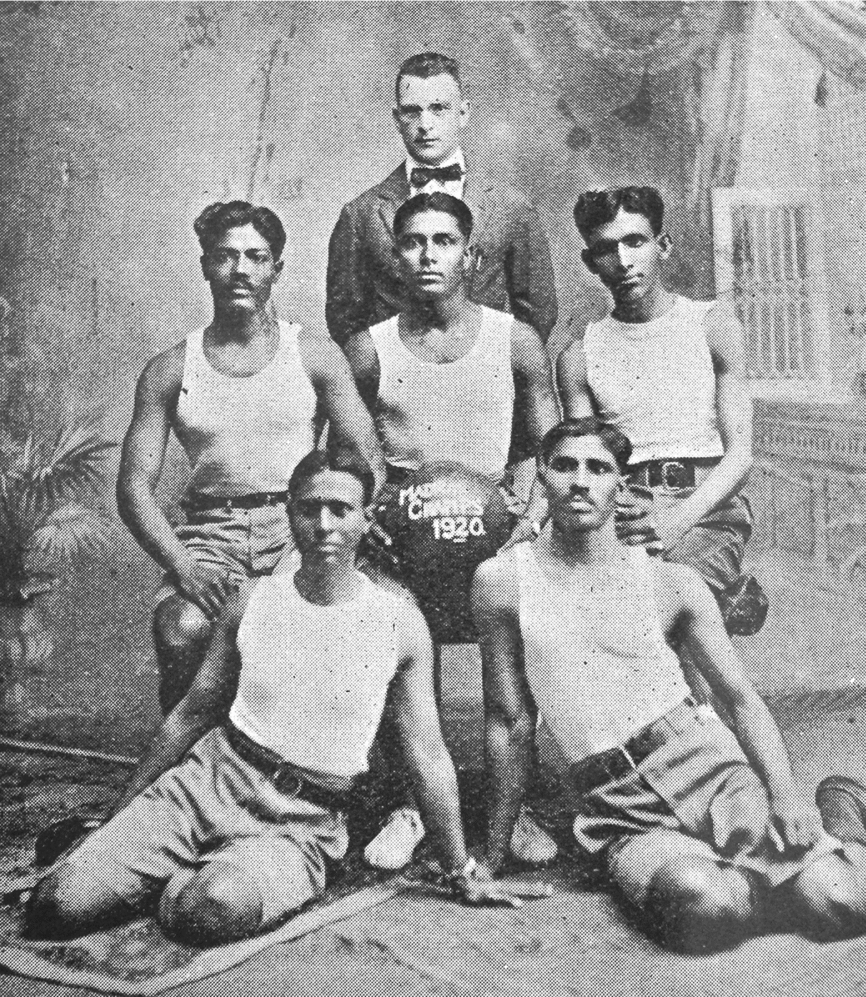
It was at this juncture that the organization's most ambitious project to further India's moral character and physical fitness was launched. The proposed College of Physical Education was eventually erected in the Y's South Indian stronghold of Madras, and it was not run in cooperation with the colonial state, but rather solely along the lines of the YMCA, reflecting the Association's growing self-confidence and changing political outlook. The new institution was decisively shaped by its charismatic American founder Harry Crowe Buck (1884–1943), remembered even today as one of the outstanding pioneers of modern sports in India.Footnote 114 Buck, too, was a Springfield-trained devotee of scientific fitness education. Only in his early thirties when he arrived in Madras in 1919, he had far-reaching visions of what the right type of ‘somatic engineering’ could do for India.Footnote 115 As he was convinced that the association could make a much greater contribution to the country's advancement ‘by training the sons of India to take upon their own shoulders the task of the physical regeneration of their people’,Footnote 116 he developed the scheme for a new institution that would be exclusively concerned with the training of ‘native’ physical instructors. In August 1920, Buck's experiment started with a mere five students on the premises of the Madras YMCA but, within a decade, the MCPE had acquired a sub-continental visibility.Footnote 117
Pioneers of physical education in India: H. C. Buck and the first generation of Madras College of Physical Education (MCPE) students (1920). Source: KFYA.

It relocated to the Madras suburb of Royapettah in 1923.Footnote 118 The new site offered more room for outdoor games and exercises and mud huts were built as hostels.Footnote 119 The growth of the institution was such that even the new home of the pioneering institution became too small after a few years. Thanks to a generous grant of 65 acres of land by the Government of Madras, the institution then moved to its final location in Saidapet in 1932.Footnote 120 The housing of both students and sports facilities had been very basic in Royapettah but a donation of US$ 35,000 was received from Vincent Massey, scion of the famous Canadian tractor manufacturers, philanthropist, and future governor general of Canada. This allowed the construction of permanent brick buildings, a huge hall (aptly christened Massey Hall), a swimming pool, gymnasiums, and separate fields for cricket, football, basketball, volleyball, hockey, and ‘indigenous sports’ on the new site.Footnote 121 The School of Physical Education had by now grown into a genuine college officially affiliated to the University of Madras. The number of its students also rose from five in the pioneering class of 1920 to 64 in 1930.Footnote 122 By the end of the 1930s, the college attracted around 100 students every year from all parts of the subcontinent to its one-year diploma programme and had ‘developed into a fine all-India institution’, recognized by the imperial government.Footnote 123 The most spectacular act of official recognition of the MCPE came already in 1932, when Harry Buck and his wife Marie received the prestigious Kaiser-i-Hind Medal from the hands of the viceroy.Footnote 124
In spite of his being decorated with one of the highest orders of the British Indian empire, Harry C. Buck, like the pioneer Gray before him, underscored the specific American character of the new institution as expressed in its combination of playful voluntarism and the sound scientificity of the fitness education it offered. Buck, who was described by a contemporary as ‘a typical American’,Footnote 125 stressed that the new college was unique in the subcontinent in that it was a direct outcome of the YMCA's scientific physical programme and had been developed specifically for India ‘backed by American leadership and aid’. Its main goal was to catalyse the ‘desirable transfer of emphasis’ from the ‘meaningless drills’ of the earlier British efforts in physical education to activities that were much ‘better suited to the nature and needs of the Indian young men’.Footnote 126 He thus self-consciously continued the strategy of distancing the Y's programme from what was regarded as an outdated approach associated with the colonial regime. For instance, in a report on the inauguration of the Saidapet facilities in 1932, he reiterated that the Y's programme was ‘based on the fundamental urge for play’ and proudly declared that, due to the successful spread of this gospel through the dozens of graduates that the MCPE had already produced, it was no longer judged necessary ‘to use the word “compulsory” in connection with physical education in schools and colleges’.Footnote 127 Buck also followed his predecessor, John Gray, in drawing direct connections between fitness training and democracy, possibly guided by the emphasis on the importance of voluntary participation in fitness activities. The fact that the Madras College drew students from all over South Asia who spoke different languages and represented a wide range of social and religious backgrounds further reinforced the self-representation of the Indian Y in general and the MCPE in particular as a ‘school for democracy’—an image that became popular by the end of the interwar period.Footnote 128 This view is particularly strongly articulated in the institution's 1940 prospectus, which highlighted the reconciliatory capacity of the institution:
The fact that the Y.M.C.A. College is an All-India Institution makes it unique in its cosmopolitan nature, and the opportunity it presents for social education, and in helping to build up inter-sectional and inter-religious friendships. Our students come to us from all parts of India, Burmah [sic!] and Ceylon. We also had them from Egypt, Siam, and Africa and have visions of the College becoming the College of Physical Education for the Orient. . . . This opportunity of learning to live happily with others of totally different backgrounds is an experience that we crave for larger and larger numbers of the youth of this country.Footnote 129
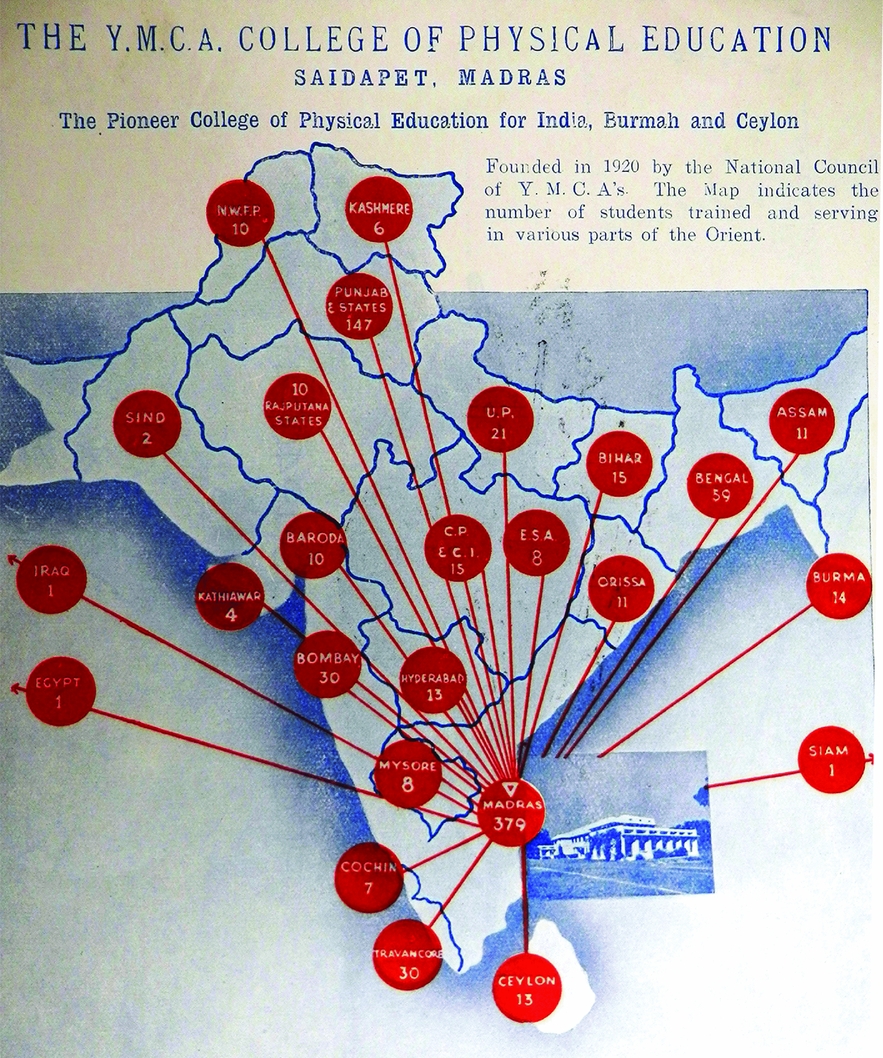
The message was reinforced through an illustration placing the MCPE prominently on a map of the Indian subcontinent (see Figure 2). Such a visual representation, of course, had strong nationalistic overtones, since the physical shape of India had been invested with manifold political meanings since the early 1900s and had become an almost omnipresent icon in the Congress's nationalistic mass campaigns of the interwar years.Footnote 130 It is worthwhile having a closer look at this remarkable image. The beneficent impact of the physical education imparted at Saidapet, it seems, radiates across the entire region. The spread across India of the physical directors trained in the college could thus ensure that their internalized values of democratic citizenship and the capacity to mediate conflicts could reach thousands of students in schools and colleges in each and every province of a country that would soon deserve to be free of the shackles of British colonial rule under their tutelage. This ‘preparation for democracy’ strategy would thus perfectly correspond to the one implemented by American Y-secretary Elwood Brown in America's own Asian colony, the Philippines.Footnote 131
Map indicating the region of origin of the Madras College of Physical Education (MCPE) graduates. Source: KFYA.

The great expectations from MCPE's graduates can also be inferred from the flowery prose used by Harry Buck and John H. Gray, who described the college's alumni as ‘leaders with vision, initiative, resourcefulness [and] intelligence’, as a ‘stalwart group of . . . men, India's finest’ and ‘apostles’ who would ‘go forth as physical directors in universities and colleges all over India’ to ‘render a high type of patriotic service’ by taking on the ‘necessary work of the physical regeneration of their people.’Footnote 132 Indeed, as a ‘directory of students’ in the MCPE's monthly mouthpiece Vyayam suggests, more than 200 of the college graduates had found employment. Quite a few worked for local YMCA branches but the majority of them served as physical instructors in a college, high school or some other educational institution or as advisers to a provincial government or princely state.Footnote 133 A fairly typical example can illustrate that at least some of them indeed exerted a palpable influence in the development of sport and physical education in the subcontinent. Harbail Singh, a Punjabi graduate of the class of 1931, found a job as Director of Physical Education in the Khalsa College, Amritsar, immediately after graduation. Once in office, he established a gym, systematized the methods of physical instruction, and introduced a new style of ‘scientific Hockey’. The success of the latter allowed him to lead the college's hockey team to a number of regional and national titles and coach it on a widely reported tour to Australia and New Zealand in 1934.Footnote 134 After 15 fruitful years in the Khalsa College, Harbail Sigh reached a position of even greater influence when he became ‘Chief Organiser of Sports in the Faridkot State’ in 1946.Footnote 135
As discussed above, such the physical regeneration advocated by the MCPE was to be achieved not solely through team sports and exercise, but also through the spread of knowledge on hygiene and sanitation. Besides classes in anatomy and physiology, the curriculum of the Madras College therefore also contained compulsory courses in ‘Tropical Hygiene and Sanitation’, ‘Personal Hygiene’, as well as ‘Sex Hygiene’.Footnote 136 The last, in particular, was highlighted as being important preparation for the service the graduates could later offer to the country's adolescent youth through their ‘instructional and guiding influence’.Footnote 137 Even before graduation, the MCPE students had opportunities to apply their expertise in integrated community projects like the Saidapet health project. This venture was aimed at bettering the living conditions of the communities inhabiting the Madras suburb in which the college was situated.Footnote 138 It seems safe to assume that this type of direct practical engagement further enhanced the acceptance of the Christian college not only among the local population, but also within the Gandhian movement, which was almost simultaneously carrying out experiments with ‘constructive programmes’ of community development with a similar bio-moral focus.Footnote 139
It is important in this context to keep in mind that the foundation of the MCPE took place at a time when the Indian provincial governments were no longer controlled by nominated British officials, but by elected Indian representatives, due to constitutional reforms implemented by the Government of India in the wake of the First World War.Footnote 140 This made an intense cooperation with local governments possible, without risking losing the sympathy of the Indian National Congress and other currents within the anti-colonial movement. Long after his retirement, J. H. Gray explained the appeal that the Y's physical-education programme had for India's nationalist activists and politicians, many of whom were otherwise ostentatiously critical of the ‘aping’ of Western ways and instead stressing the value of all things swadeshi (Hindi: ‘coming from one's own country’) by saying that the patriotic leaders of the national movement were aware that India was ‘physically the poorest country of the world’ and therefore ‘naturally recognized the need for racial vitality and gave their full support’.Footnote 141 It should be added that the wide acceptance of the YMCA's programme of spreading the value of hygiene and generally improving South Asia's ‘human material’ was fairly predictable given the popularity of Eugenic thought prevailing in the subcontinent particularly during the interwar period.Footnote 142
Especially after the next round of constitutional reforms had been implemented and the India-wide elections of 1937 had catapulted the Congress governments into power in most provinces, the INC indeed clearly approved of the Y's efforts in cultivating the health and fitness of India's future citizens. C. J. Varkey, Minister of Law and Education in the INC-led provincial Government of Madras, visited the MCPE in Saidapet in July 1939 and celebrated the college as a lighthouse institution for the entire South Asian region. Perhaps unsurprisingly, the minister singled out the collectivizing aspect of the Y's fitness scheme as being the most praiseworthy. Varkey was particularly impressed by the mass callisthenics demonstration he had witnessed and declared in his address to the college's students and faculty that through the contribution of the MCPE physical education had become a ‘subject of study of social value’, as the institution's approach to sport was no longer ‘selfish and individualistic’, but ‘scientific and socialistic’.Footnote 143
Thus, the appreciation of the Y's fitness programme by prominent nationalist politicians might be read as a confirmation of the claim made in in-house histories that the Christian lay organization had not only grown more ‘secular’ in its outlook but had ‘become truly national’ and even was ‘in complete agreement with the patriotic aspirations of India’.Footnote 144 The YMCA's scientific-cum-democratic fitness scheme, it would appear, functioned as a dynamic tool of empowerment for young South Asians, who would be thoroughly transformed physically and mentally in a way that would lend their ambitions for political self-government authority and credibility, or, to use the rather more gendered language of a contemporary American Y-secretary, that ‘would encourage the evolution of a virile manhood more consistent with national aspirations’.Footnote 145 The Y-institutions, free from the Britons’ ‘unconscious racial arrogance’,Footnote 146 would thus train an elite community of apt and responsible young leaders well able to guide their country into a modernity resembling the American model rather than that of the British colonial masters.
However, such an interpretation, I would argue, is simplistic and overlooks important facets of the Y-programme that need to be addressed. In order to understand the limits of physical education's emancipatory potential and better grasp the ambiguities of the YMCA's body politics, it is instructive to look closer at the ideological underpinnings of the project of ‘working out India’ that developed out of the strange convergence of evangelical missionary zeal, colonial governance considerations, and the concerns of anti-colonial nationalists.
Somatic Orientalism and Indian Eigensinn: limitations and modifications of the YMCA's ‘democratizing fitness’ project
The focus, thus far, has been on the programmatic aspect of the Y's physical work, on what North American fitness pioneers such as Gray and Buck wanted to do and less on what they actually achieved or how Indians reacted to their schemes. In the remaining few pages of this article, I am going to argue that the success of the Y's specific North American ‘democratizing fitness programme’ was severely curtailed by powerful influences coming from the two opposing ends of the political spectrum in late-colonial India. First, in spite of the continuing efforts to distance themselves from the ‘paternalistic authoritarianism’ of the British Raj, North American YMCA secretaries remained heavily indebted to the colonial rulers on a discursive level. Sharing what I call the somatic Orientalism of the Raj,Footnote 147 they constructed native bodies (and, for that matter, societies) as fundamentally different and ‘hopelessly defective’, as the influential Y-secretary George Sherwood Eddy put it.Footnote 148 While this might have made it easy for colonial administrators to identify with the Y's project of keeping ‘youth in harness’,Footnote 149 it seems plausible that it simultaneously undermined their purportedly egalitarian and inclusive democratizing agenda, although it is of course difficult to assess the effects that this ideological inconsistency had on its Indian target groups.
Second, the ‘physical renaissance’ of India and the experiments in nationalistic subject formation that went hand in hand with it cannot be understood as the results of a mere absorption of Western influences, as they were profoundly shaped by local Indian actors and the persistence of existing traditions of physical activities and games. Even modernist fitness experts like Harry C. Buck, otherwise extremely optimistic about the societal effects of physical work, soon had to admit that ‘one cannot bring a purely Western programme of physical training to the Orient and expect it to be a huge success’.Footnote 150 His observation reminds us of the importance of Indian agency and Eigensinn,Footnote 151 and perfectly reinforces a point widely accepted among sport historians—that the transfer of Western forms of games or physical exercise to the non-Western world can be better understood as a process of translation or a remaking rather than a unilateral diffusion or dissemination.Footnote 152 But let us turn to the persistence of imperial somatic Orientalism first.
Like generations of British colonial administrators before them, on whose shoulders they stood when it came to ‘knowing the country’, leading American Y-activists perceived India as ‘stationary’ and standing in need of ‘awakening’.Footnote 153 On the basis of this general assessment, they made discriminatory and condescending commentaries on Indian groups and individuals that were almost interchangeable with the familiar imperial original. Predictably, Y-secretaries tended to reproduce the entire range of existing stereotypes about educated Bengalis in the province's urban centres, describing them as ‘terribly indolent’ and ‘effeminate’ people who seemed like ‘incomplete editions of the English’.Footnote 154 In similar vein, the 50,000-odd college and high-school students residing in Calcutta's ‘poorly supervised messes’ were collectively introduced as ignorant, weak, and degenerate victims of immoral influences and unhygienic living conditions in an annual report written in 1917:
Immoral influences are around them and the low physical vitality of the average school boy or college man is also due to malnutrition . . . or ignorance in matters of personal hygiene. Their ignorance of the simple rules of health, such as eating, sleeping, the care of the body etc. is appalling.Footnote 155
An author writing in the Y's journal Foreign Mail underscored the beneficial impact of medical check-ups that were compulsory for everyone who wanted to attend the association's sports facilities, observing that the physical examinations allowed
not only to combat weakness and disease, but to show the way to victory over the sin that is almost invariably inducing physical difficulties. It is seldom an Indian is examined who could be pronounced normal; either he suffers from chronic malarial attacks, hook-worm, alimentary troubles, diabetes, nephritis and the like, or shows marks of malnutrition.Footnote 156
According to J. H. Gray, the ‘abnormal’ state of Indian bodies was aggravated by the corrupting influence of Hinduism. Especially the Hindu propensity to asceticism had allegedly led to ‘incalculable losses in impaired racial vitality [and] physical suffering’.Footnote 157 While ‘the sin’ alluded to in the Foreign Mail article refers in all likelihood to masturbation, physical director Arthur Noehren used even more outspoken terms when he maintained that ‘venereal diseases, including syphilis, are very common and often traced to semi-religious practices’.Footnote 158 Even a sober rationalist like Harry Buck would subscribe to the fundamental otherness (read: deficiency) of oriental bodies. The discursive repertoire of the colonial politics of difference is a recognizable subtext when he lists the specificities that supposedly rendered his work with South Asian students different from the training of Western undergraduates, making it ‘more of an exercise in preventive medicine’.Footnote 159 Among the features he regarded as typical of oriental students, he mentions, amongst others, ‘disinclination to exercise’, ‘lack of activities that develop hardihood’, ‘improper diet’, and the ‘widespread use of drugs’.Footnote 160
It has already been pointed out that such a diagnosis of individual bodies went in tandem with equally negative assessments of professedly backward and stationary South Asian societies and belief systems. In this context, too, the pervasive influence of deep-seated colonial ascriptions and stereotypes is ubiquitous. Whereas the ‘scourges’ of Hinduism, with its stark hierarchies and particularly the caste system, were very obviously logical targets of the harshest criticisms uttered by American secretaries,Footnote 161 it might come as a surprise that Buddhist society in Burma was seen as equally degenerate. Because the dominant philosophy in Burma was ‘Buddhist un-social [sic!]’, as Warren D. Healy, the Y physical director in Rangoon, upheld in 1931, the entire Burmese population allegedly lacked ‘social consciousness’ and was therefore incapable of nation-building without the Y's help.Footnote 162
This kind of somatic Orientalism was critical in defining the role of the MCPE graduates and portraying them as leaders in educating their ‘physically illiterate’ South Asian countrymen, thereby building up their weak and feeble bodies and reorganizing their fragmented and heterogeneous societies. The improvement and refinement of the bodies and characters of the institution's South Asian graduates were crucial for the success of this mission. It is striking how precise a vision Buck and his fellow instructors had of the end-product of their nation-building workout in Saidapet:
The model of man that modern Physical Education aims to build is slender in type, graceful, not heavy muscularly, clear eyed, supple not tense, alert, erect, easy on his feet, enthusiastic, happy, forceful, imaginative, self-controlled, true, clean, with a sense of fair play, who loves the companionship of his fellows and who has the fear of God in his heart.Footnote 163
Interestingly, collective spirit and group solidarity are strongly emphasized elements even when the effect on a single individual is described. This quote also allows us a glimpse into the ideals of the specific bodies and masculinities that were envisaged as a result of Buck's ambitious endeavour in somatic engineering. The ‘model of man’ and the capable leader embodied by the MCPE-educated physical directors, it seems, was to be brought into full congruence with North American Protestant ideals of health, beauty, and efficiency. In the process, he was also purged of all physical and mental traits that marked his ‘Oriental’ origins.
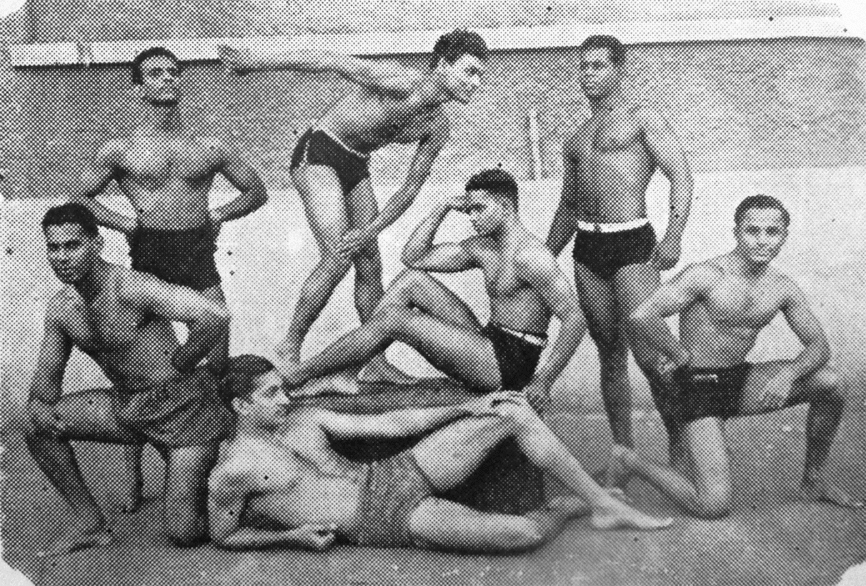
The interpretation of the Y's fitness training as an exercise in ‘de-Orientalization’ is supported by a rare photograph showing the participants of a ‘Perfect Physique Competition’ that was organized by the physical director of the Colombo YMCA in 1939 (see Figure 3). Given the multi-ethnic composition of Ceylonese society, it can hardly be a coincidence that exclusively light-skinned young men with what would probably have been described by contemporaries as ‘European features’ were chosen to represent the perfect physique of Ceylonese youth. Moreover, the poses adopted by the young sportsmen are reminiscent of Greek and Roman sculptures, which would corroborate the interpretation that the Y's physical work in South Asia was inspired by the same aesthetic ideal that has been famously described by George Mosse as the ‘positive stereotype’ of Western masculinity.Footnote 164 The transformation brought about in the gyms, pitches, and athletic grounds patronized by the YMCA in South Asia seems to have amounted to a process of ‘bleaching’ as it were, diminishing the gulf between Oriental bodies and Western physiques.Footnote 165 By shaping their bodies along Western lines, and consequently physically inscribing them with a normative code of masculinity, then, the Y-trained South Asian youth could also hope to partake of the prestige ascribed to ‘whiteness’. This clearly was an attractive option given the prevailing imperial world order sarcastically described by a contemporary Indian intellectual as ‘albinocracy’.Footnote 166
‘De-Orientalized’ bodies? Participants of the ‘Perfect Physique Competition’ organized by the Colombo YMCA, 1939. Source: KFYA.

In sum, then, it is safe to conclude that, in spite of the North American Y-secretaries’ protracted efforts to present themselves as an egalitarian and inclusive force clearly distinct from and superior to the British, and as embodying an imperially untainted alternative model of modernity to be emulated by ‘Young India’, their schemes rested on ideological foundations that shared much common ground with the discursive repertoire of the British imperial civilizing mission. If this obvious tension between inclusive rhetoric and the persistence of deep-seated racial prejudice seems incongruous, it has to be noted that a very similar racialist logic undergirded the Y's physical work schemes in East Asia and the Philippines.Footnote 167 It may also be helpful to take a look at a comparable phenomenon in the United States of America: in spite of all the lip service paid to ‘Christian brotherhood’, ‘egalitarianism’, and ‘interracial dialogue’, YMCAs for African Americans remained strictly segregated from their counterparts catering to a white clientele until the late 1940s.Footnote 168
As stated above, the North American ‘athletic crusade’ in India did not quite work out as per the original design of the first generation of the YMCA's sports experts for other reasons as well. Springfield-trained physical directors like John Gray had a deep contempt for existing South Asian traditions of games and physical exercise whose ‘methods and practices’ they regarded as ‘contrary to those based on modern scientific knowledge’.Footnote 169 Even though the Association's fitness experts left no opportunity to stress that they were trying to replace the existing archaic and individualistic system of ‘physical torture’ that they saw as characteristic of Hindu traditions with a rational, scientific, and socially beneficent system of ‘physical culture’,Footnote 170 the local practices so dismissed turned out to be surprisingly resilient. Especially after the inclusion of non-elite groups in the Y-schemes, it was no longer possible to completely ignore what was usually labelled ‘native’ or indigenous sports. The sports programme designed for the mill-hands of central Indian textile factories that were part of the YMCA industrial work scheme, for instance, prominently included pahalvānī (a.k.a. bhāratīya kuśtī), a traditional Indian form of wrestling.Footnote 171 This is significant, as this particular martial art had been rediscovered and cultivated by Hindu nationalists and revolutionaries since the last decade of the nineteenth century and acquired a slightly nativist and nationalistic touch by the interwar period.Footnote 172
One major reason why the YMCA leadership could not ignore the popularity of ‘patriotic’ indigenous sports and physical culture schemes was the growing competition from various Indian agencies. Although the high-caste, middle-class, and predominantly English-educated leadership of the INC soon adopted a positive stance towards the Christian association's fitness schemes, this was not the case for the entire political and religious spectrum. As soon as the reinvigorated Indian YMCA had its first limited accomplishments in converting high-status Indian, Ceylonese, and Burmese youths to Christianity, religious authorities and self-proclaimed spokesmen of a wide array of faiths and denominations prevalent in South Asia (namely Hinduism, Buddhism, Sikhism, Arya Dharm, and Jainism) reacted by founding their own youth organizations in a mimetic impulse of self-defence. As a result, by the 1910s, there existed for instance a Young Man's Hindu Association an Arya Kumar Sabha or Young Men's Arya Association (founded by the Hindu reform movement Arya Samaj), a Young Men's Sikh Association, a Young Men's Buddhist Association (in Burma and Ceylon), and even a Jain Young Men's Association.Footnote 173 Practically all of these ‘pirate copied’ young men's organizations, as well as a host of other bodies, offered their own sport and fitness programmes.Footnote 174 These were doubtlessly inspired by the Y-scheme, but they were often presented as the culturally authentic South Asian alternative, purportedly rooted in the living tradition of indigenous practices.Footnote 175 While, in many cases—Swami Kuvalayananda’ Yoga schemes would be another case in pointFootnote 176—there were direct contacts of Indian physical programmes with the Y's physical work, this is not clear in other cases. Nonetheless, even if there was no immediate influence, there were many other instances of local projects for the development of alternative masculinities and bio-moral modernities that competed with the Christian association's offerings.Footnote 177 Consequently, if the YMCA's fitness experts wanted to attract a growing number of Indian students and at the same time retain their credibility as an ally of (moderate) Indian nationalism, they had to include Indian games and exercises in their physical fitness schemes.
A more direct form of pressure aligning their training programmes to local demands resulted from the cooperation of the physical directors with the Congress-led provincial governments. Thus, Arthur G. Noehren, who served as Director of Physical Education for the Government of Bombay in the late 1920s, was asked to write a physical-education syllabus for the schools in that province. While preparing the proposed publication, he visited dozens of ‘native’ gymnasiums and akhārās (wrestling centres), hoping to acquire ‘some concrete knowledge of exercises . . . that would represent the genius of Western India’.Footnote 178 Almost simultaneously, Harry Buck, who held a similar position in Madras, sat on an expert committee on physical education. Since 17 out of the 23 committee members were Indians, it is not surprising that one of the resolutions framed in the concluding session prescribed that the new scheme of physical education to be adopted in the province's schools and colleges ‘should be so framed as to suit local conditions’ and hence include ‘local games of an indigenous nature in revival of the past glory of India’.Footnote 179 Even in the YMCA flagship institution at Saidapet, Indian exercises and games became part of an ever more eclectic curriculum.Footnote 180 By the end of the 1940s, Buck's Book of Rules, a serial publication pioneered by Harry Buck in 1929, contained chapters on no fewer than four different Indian games: Atya-Patya, Kho-Kho, Hututu, and Kabaddi. Footnote 181
Not everybody among the YMCA members was happy about this new politics of ‘going native’. Arthur Noehren, for example, contended that Indian forms of body-building and muscle control were anachronistic and might perhaps ‘be featured in a circus tent’, whereas they seemed completely ‘out of place on a school compound’.Footnote 182 Another expert insisted that the newly adopted Indian callisthenic exercises like dandas and baithaks, ‘besides putting an undue strain on the physical organs’, were also ‘individualistic in type’ and consequently held ‘no inherent social development value’.Footnote 183 However, at a time when the leadership of the Indian YMCA increasingly shifted to Indian secretaries who made no secret of their patriotic propensities, such protests were of little effect. Far from merely disseminating a ready-made American blueprint of fitness and physical culture, the YMCA ultimately contributed to the creation of what has been aptly described by Mark Singleton as ‘hybridized though distinctly Indian culture of sport and exercise’.Footnote 184 As he has shown, this hybridization cut in two directions. While Harry Buck somewhat reluctantly introduced modified forms of yoga āsanas (postures) into the MCPE's curriculum in the 1920s, in spite of his concerns with their ‘subjective’ character, Swami Kulvayananda, the single most important Indian advocate of ‘modern’ yoga, ‘developed his rigorous posture work at least partially to refute Buck's assertion of the inadequacy of āsana as a complete physical program’.Footnote 185 It seems plausible that this recalibration of haṭha yoga that brought this Indian body practice closer to the YMCA's ‘scientific approach’ and its well-established holistic ‘mind–body–spirit’ ideal considerably increased its export potential in the following years and decades.Footnote 186
Conclusion
This study has demonstrated that the spread of the global idiom of fitness and modern forms of sport in late-colonial South Asia cannot be fruitfully understood as an act of transfer solely undertaken by the British rulers. It has become evident that the activities of an international but American-dominated civil society organization have mediated and shaped this process in important ways. The YMCA's physical programme was initially used as an iconoclastic device and subordinated to the overarching goal of winning Indian, Ceylonese, and Burmese converts. After the First World War, however, sport and fitness schemes became the most important components of the broader liberal modernization project the YMCA had meanwhile adopted in its Asian mission fields. The ultimate objective was to achieve no longer a large-scale religious conversion in the first place, but rather a conversion to a particular kind of modernity—what one might call a modernity in an American adumbration.Footnote 187 This agenda was reflected in the fact that the first generation of the Y's physical directors in South Asia relentlessly stressed the putatively superior American (read: progressive and egalitarian) character of their training programme. The type of fitness education that had been developed in the pioneering physical training college in Springfield seemed to lend itself perfectly to the needs of the Indian national movement with which the Y-leadership increasingly sympathized. It focused on the training of responsible and self-controlled leaders and citizens, it was ‘scientific’ and therefore supposedly much more efficient than existing programmes, it integrated physical culture and team sports into a wider project of societal improvement that also included hygiene and sanitation, and promised to achieve nothing less than ‘the development of a superior race’.Footnote 188 Perhaps most importantly, the emphasis on playfulness and voluntarism that was cultivated by the Y turned the association's physical work schemes supposedly into ideal ‘schools of democracy’ that would entice Indians, Ceylonese, and Burmese into following the American model also when it came to the level of state-building. Although there was stiff competition by other fitness systems, the Y exercised a considerable influence directly by attracting tens of thousands of South Asian youth to their colleges, training classes, and tournaments, but also indirectly through the role of YMCA physical directors as advisers to several provincial and princely governments—not to mention the impact of the many sub-continental ‘pirate copies’ offering vernacularized versions of the association's fitness scheme. The national significance of the Y's fitness schemes reached its peak in the 1930s with the flourishing of the MCPE in Saidapet—which soon found Indian emulators in Hyderabad and BombayFootnote 189—and the autonomy of Congress-led provincial governments. The college's graduates would serve as multipliers of the norms and values they had internalized through games and exercise, sharing them with tens of thousands of pupils and students all over the subcontinent.
Whereas the overall significance of the physical campaign certainly cannot be denied, the limitations, contradictions, and problematic aspects of the scheme are also apparent. The last section has demonstrated that the Y's supposedly inclusive and emancipatory discourses and practices of physical fitness were over-determined by the powerful influences of the racialized colonial discourse of difference on the one hand and the Eigensinn of Indian nationalists as expressed in their agenda of discovering indigenous sports on the other. As a result of these twin influences, the fitness programme of the Indian Y was less democratic and liberating than its champions assumed, as the ideological basis of the Y continued to be rife with the imperial tropes of somatic Orientalism predicated on the idea of fundamental racial difference between Westerners and South Asians. This ambivalence could even serve as a concrete example of a phenomenon that has been described by Paul Kramer in abstract terms as the reliance of international ‘non-state actors’ on the infrastructure, protection, and ideological resources of imperial states, which helps understand their seemingly paradox role in ‘reimagining and reforming but not dismantling colonialism’.Footnote 190
Furthermore, a brief look at the practical level has suggested it was also less of an ‘American crusade’ or establishment of an American cultural hegemony than the established literature might lead us to believe. ‘Sportified’ versions of local games and physical exercises played an ever-increasing role in the numerous institutions of the Y in South Asia, leading eventually to the thorough ‘pidginization’ of its fitness regime. Clearly, by the 1940s, the Indian avatar of the YMCA's physical work scheme differed substantially from the North American blueprint. The kind of modernity it embodied was as ‘muscular’ as it was idiosyncratic.