Introduction
Thyroidectomy is a common operation, with around 10 000 performed per year in the UK.Reference Nouraei, Virk, Middleton, Aylin, Mace and Vaz1 It is a relatively safe procedure, but major complications such as significant post-operative haematoma, permanent recurrent laryngeal nerve injury and long-term hypoparathyroidism have been reported to occur in 5–10 per cent of patients.Reference Bergamaschi, Becouarn, Ronceray and Arnaud2
The most common complication following thyroidectomy is post-surgical hypocalcaemia and/or hypoparathyroidism. This is likely multifactorial, with parathyroid gland injury, devascularisation and inadvertent parathyroidectomy generally accepted as the usual mechanisms.Reference Edafe, Antakia, Laskar, Uttley and Balasubramanian3 Most cases are transient, but long-term hypocalcaemia can occur as a result of persistent parathyroid gland dysfunction, necessitating calcium and vitamin D supplementation.Reference Bergamaschi, Becouarn, Ronceray and Arnaud2 Lifelong treatment with calcium and vitamin D is associated with soft-tissue calcification, kidney stones, nephrocalcinosis and renal failure.Reference Underbjerg, Sikjaer, Mosekilde and Rejnmark4 Furthermore, in patients with stable calcium and vitamin D levels, post-surgical hypoparathyroidism or hypocalcaemia is associated with reduced quality of life as a result of physical, mental and emotional symptoms, suggesting that low parathyroid hormone (PTH) levels directly influence the patients’ quality of life.Reference Büttner, Musholt and Singer5
Inadvertent parathyroidectomy is the unintentional removal of one or more parathyroid glands during central compartment neck surgery. These are usually identified as part of the pathology specimen.Reference Chew, Li, Ng, Chan and Fleming6 Inadvertent parathyroidectomy is a relatively frequent occurrence in thyroid surgery, with a reported incidence of 2.9 –31.0 per cent.Reference Chew, Li, Ng, Chan and Fleming6–Reference Asya, Yumuşakhuylu, Gündoğdu, İncaz and Oysu25
The relationship between inadvertent parathyroidectomy and post-surgical hypoparathyroidism or hypocalcaemia is controversial, with conflicting results in the recent literature.Reference Chew, Li, Ng, Chan and Fleming6,Reference Vasileiadis, Charitoudis, Vasileiadis, Kykalos and Karatzas9,Reference Yazici, Bozkurt, Citgez, Kaya, Mihmanli and Uludag18 Even if there is a limited overall impact, understanding the risk factors for inadvertent parathyroidectomy may allow the thyroid surgeon to exercise appropriate caution in patients who are at high risk for post-surgical hypoparathyroidism or hypocalcaemia. This may also facilitate the development of preventative measures to help reduce its incidence. Reported risk factors for inadvertent parathyroidectomy include a pre-operative diagnosis of malignancy, central neck dissection, total thyroidectomy and re-operative surgery.Reference Bai, Chen and Chen7
This study primarily aimed to evaluate the incidence of inadvertent parathyroidectomy and identify any potential risk factors in a high-volume thyroid surgery unit. The study also aimed to review pathology reporting in relation to inadvertent parathyroidectomy, determine the location of inadvertently removed parathyroid glands, and explore the relationship between inadvertent parathyroidectomy and temporary or permanent post-surgical hypoparathyroidism or hypocalcaemia.
Materials and methods
This is a retrospective observational study of thyroid operations performed in Sheffield Teaching Hospitals National Health Service (NHS) Foundation Trust between October 2015 and September 2020. Eligible patients were adults undergoing total or near-total thyroidectomy, completion thyroidectomy, or hemithyroidectomy, with or without central neck dissection. The exclusion criteria included patient age of less than 16 years, limited thyroid resection (isthmectomy), re-operative neck dissection or concomitant parathyroid surgery.
Clinical records were reviewed to obtain data on patient demographics, details of surgery (including details on parathyroid identification), reported histology information, and follow-up clinical and biochemical data on post-surgical hypoparathyroidism. Definite identification of parathyroid glands at surgery was recorded; in the event of this not being mentioned or if the parathyroid glands were described as possible or probable, identification was recorded as ‘unclear’.
The volume (V) of thyroid tissue resected (considered an ellipsoid) was determined from the recorded dimensions, and calculated as V = (height (cm) × width (cm) × length (cm) × π/6). If any dimensions were unclear from the histopathology report, they were recorded as ‘unclear’, and the volume of thyroid tissue was not calculated.
Inadvertent parathyroidectomy was defined as the reported identification of any parathyroid tissue in the pathological specimen. The histopathology specimens of all patients who had an inadvertent parathyroidectomy were reviewed to determine the location of the inadvertently removed glands. The location was classified into three categories: intrathyroidal (defined as a gland completely surrounded by thyroid tissue), subcapsular (defined as lying underneath the false capsule of the thyroid) and extracapsular (defined as a gland lying outside the thyroid capsule). In addition, in order to evaluate whether inadvertent parathyroidectomy may be under-reported, histopathology specimens were reviewed from a random sample of cases where there was no mention of the presence of parathyroid tissue in the histopathology report.
Long-term post-surgical hypoparathyroidism or hypocalcaemia was defined as dependence on calcium or vitamin D supplements to maintain normocalcaemia at six months after surgery.
All data were collected on a Microsoft Excel spreadsheet and transferred to IBM SPSS software (version 26) for statistical analysis. Descriptive data were reported using frequencies or percentages for categorical data, means and standard deviations for parametric data, and medians and ranges for non-parametric quantitative data. Inferential methods were based on the data type and distribution, and used to compare patients grouped into an ‘inadvertent parathyroidectomy group’ (those with confirmed presence of parathyroid tissue in the histopathology report) and a ‘no inadvertent parathyroidectomy group’ (including all patients in whom there was either confirmed absence or no mention of any parathyroid tissue in the histopathology report). Univariable analyses were performed using the Mann–Whitney U test for continuous variables, and either Fisher's exact test or chi-square test for categorical variables. All statistical tests were two-sided, and a p-value of less than 0.05 was considered statistically significant. Factors that were significant on univariable analyses were evaluated with multivariable analyses using binary logistic regression.
The study was registered and approved by the clinical effectiveness unit in Sheffield Teaching Hospitals NHS Foundation Trust (reference number: 10181). As this was a retrospective observational study, individual patient consent and formal ethical approval were not required. All data were initially collected and stored on NHS computers, and analysis was performed only after the removal of patient identifiers.
Results
Of 955 patients who underwent thyroid surgery, 899 patients were included in the study after excluding those who underwent isthmectomy, re-operative neck dissection and concomitant parathyroid surgery. Overall, inadvertent parathyroidectomy occurred in 166 of 899 patients (18.5 per cent).
Risk factors for inadvertent parathyroidectomy
Table 1 shows the inadvertent parathyroidectomy rate stratified by surgical procedure, whether central neck dissection was performed and whether surgery was re-operative. The inadvertent parathyroidectomy rate per lobe in patients who had completion thyroidectomy (117 completion thyroidectomies, of which 7 were bilateral) was 34.7 per cent (43 inadvertent parathyroidectomies of the 124 lobes removed); this is higher than the inadvertent parathyroidectomy rate per lobe of both hemithyroidectomy and near-total or total thyroidectomy, at 13.2 per cent (50 out of 378) and 9.0 per cent (73 out of 808), respectively.
Inadvertent parathyroidectomy* in thyroid surgery patients

* Inadvertent excision of at least one parathyroid gland.
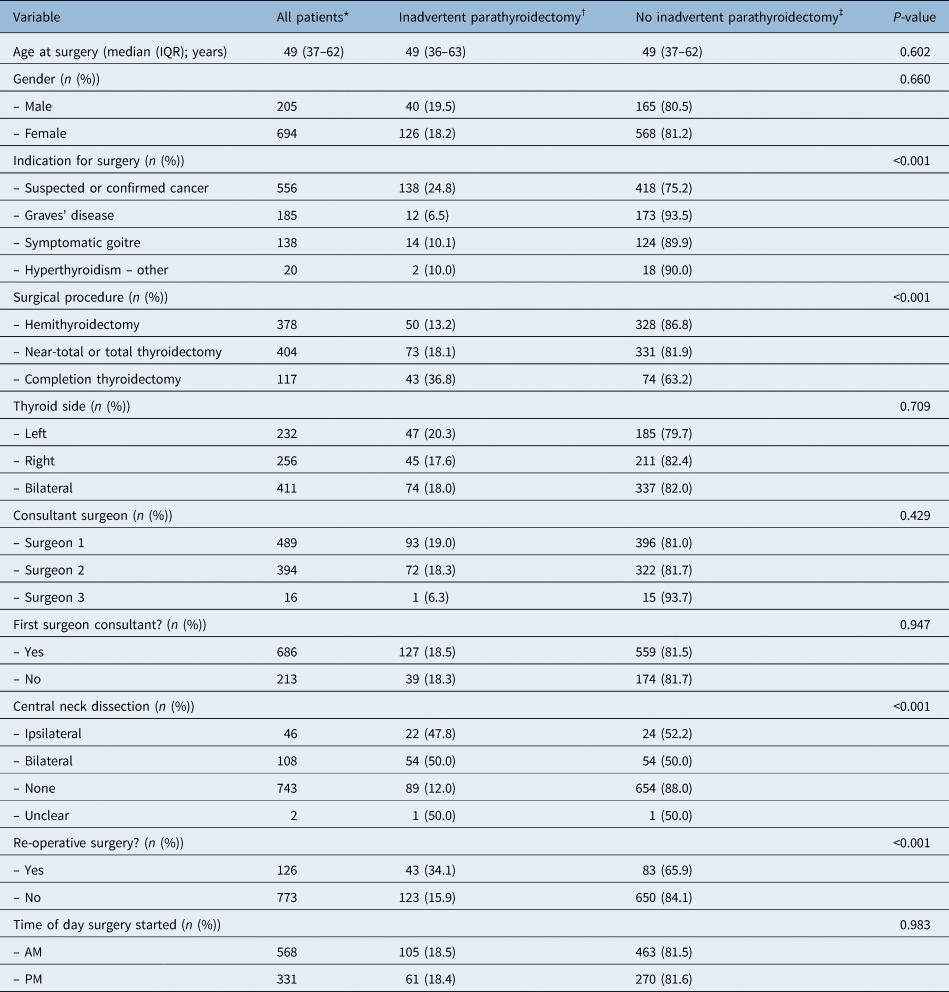
Table 2 shows the demographic, clinical and operative characteristics of the included patients, and the outcomes in relation to inadvertent parathyroidectomy.
Univariate analysis of demographic, clinical and operative characteristics of thyroidectomy patients

*n = 899; †n = 166; ‡n = 733. IQR = interquartile range
The number of parathyroid glands identified intra-operatively, per lobe resected, was examined in 743 patients (89 who had an inadvertent parathyroidectomy and 654 with no inadvertent parathyroidectomy) who underwent thyroidectomy without central neck dissection. The proportion of patients who had an inadvertent parathyroidectomy identified intra-operatively was: 14.0 per cent (n = 14) in those with no parathyroid glands identified, 14.3 per cent (n = 43) in those with one parathyroid gland identified per lobe resected and 9.7 per cent (n = 20) in those with two parathyroid glands identified per lobe resected. Univariable analysis showed no significant relationship between the intra-operative identification of parathyroid glands and inadvertent parathyroidectomy (p = 0.331).
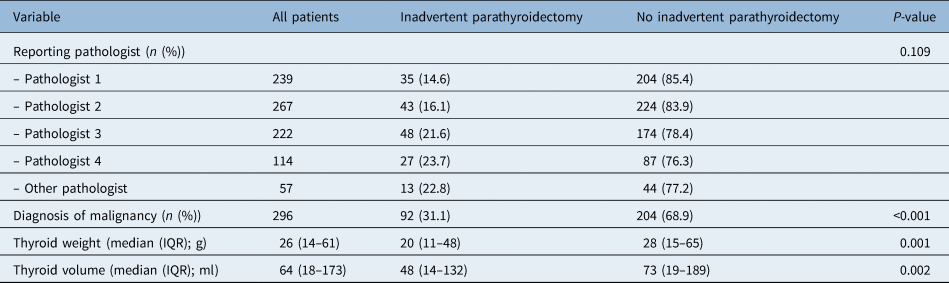
Table 3 shows the inadvertent parathyroidectomy rate stratified by: the reporting pathologist, thyroid weight, thyroid volume and histological diagnosis. Of 786 cases where data were available, the median specimen weight was significantly lower in the inadvertent parathyroidectomy group compared with the no inadvertent parathyroidectomy group (20 g vs 28 g, p = 0.001). Of 838 patients where data were available, the median volume of resected thyroid tissue was significantly lower in the inadvertent parathyroidectomy group compared with the no inadvertent parathyroidectomy group (48 ml vs 73 ml, p = 0.002).
Inadvertent parathyroidectomy stratified by reporting pathologist, thyroid weight, volume and histology

IQR = interquartile range
Factors included for multivariable analysis were: indication for surgery, surgical procedure, central neck dissection, re-operative surgery, pathological diagnosis of malignancy and weight of resected thyroid tissue. The only factor with a significant influence on inadvertent parathyroidectomy rate was central neck dissection (p < 0.001).
Pathology
Most patients who had an inadvertent parathyroidectomy had one parathyroid gland excised (n = 145, 87.9 per cent); only a minority had two (n = 16, 9.7 per cent), three (n = 3, 1.8 per cent) or four (n = 1, 0.6 per cent) parathyroid glands excised. In one case, there were several minute fragments of parathyroid tissue.
The presence or absence of parathyroid tissue was not commented on in 38.9 per cent (350 out of 899) of histopathology reports, constituting almost half of the no inadvertent parathyroidectomy group (47.7 per cent, 350 out of 733). There was considerable individual variation in reporting practice amongst histopathologists; the proportion of reports with no mention of parathyroid tissue ranged from 6.7 per cent to 81.2 per cent amongst the six histopathologists.
The histopathology specimens from 165 patients in the inadvertent parathyroidectomy group were reviewed. Most excised parathyroid glands were found in an extracapsular location, with 53.3 per cent (88 out of 165) of specimens containing an extracapsular gland. An intrathyroidal parathyroid gland was identified in 10.9 per cent (18 out of 165) of specimens, and a subcapsular parathyroid gland was identified in 29.1 per cent (48 out of 165). In five cases (3.0 per cent), no parathyroid gland was identified on review of the specimen. The location of parathyroid tissue was unclear in seven cases (4.2 per cent), and the slides were unavailable for review in three cases (1.8 per cent).
Specimens were reviewed from a random sample of 49 cases in which there was no mention of the presence of parathyroid tissue in the histopathology report. A parathyroid gland was identified in 10.2 per cent of specimens (5 out of 49). The location of parathyroid glands was extracapsular in two, intrathyroidal in two and subcapsular in one specimen.
Inadvertent parathyroidectomy and post-surgical hypoparathyroidism or hypocalcaemia
The relationships between inadvertent parathyroidectomy and outcomes related to post-surgical hypoparathyroidism or hypocalcaemia are presented in Table 4. Patients who had an inadvertent parathyroidectomy had significantly lower day 1 adjusted calcium levels (p < 0.001), lower day 1 PTH levels (p < 0.001), a greater requirement for calcium supplements at discharge (p < 0.001) and higher rates of six-month hypoparathyroidism (p < 0.01) compared with patients with no inadvertent parathyroidectomy.
Univariate analysis of temporary and permanent PoSH in near-total or total or completion thyroidectomy patients stratified by occurrence of inadvertent parathyroidectomy

*n = 116; †n = 405. PoSH = post-surgical hypoparathyroidism or hypocalcaemia; IQR = interquartile range; PTH = parathyroid hormone
The relationship between the number of inadvertently excised parathyroid glands and outcomes related to post-surgical hypoparathyroidism or hypocalcaemia is presented in Table 5. There were no significant relationships between the number of excised parathyroid glands and day 1 adjusted calcium levels, day 1 PTH levels, the requirement for calcium supplements at discharge or rates of six-month hypoparathyroidism.
Univariate analysis of temporary and permanent PoSH in near-total or total or completion thyroidectomy patients stratified by number of inadvertently excised parathyroid glands

*n = 102; †n = 14. PoSH = post-surgical hypoparathyroidism or hypocalcaemia; IQR = interquartile range; PTH = parathyroid hormone
Discussion
The overall incidence of inadvertent parathyroidectomy in this study was within the range reported in the literature. Several factors may contribute to the wide variation in reported inadvertent parathyroidectomy rates. Many studies (including this report) included thyroid lobectomy in the analysis of inadvertent parathyroidectomy,Reference Bai, Chen and Chen7,Reference Alraddadi, Aldhahri, Almayouf, Alharbi, Malas and Nasrullah8,Reference Mencio, Calcatera, Ogola, Mahady, Shiller and Roe10,Reference McGoldrick, Majeed, Achakzai and Redmond11,Reference Ataş, Akkurt, Saylam and Tez13–Reference Lin, Hsueh, Wu, Yu and Chao16,Reference Yazici, Bozkurt, Citgez, Kaya, Mihmanli and Uludag18,Reference Abboud, Sleilaty, Braidy, Zeineddine, Ghorra and Abadjian20,Reference Karadeniz and Akcay21,Reference Barrios, Shafqat, Alam, Ali, Patio and Filarski23–Reference Asya, Yumuşakhuylu, Gündoğdu, İncaz and Oysu25 whereas others analyse only total or near-total thyroidectomy cases.Reference Chew, Li, Ng, Chan and Fleming6,Reference Bai, Chen and Chen7,Reference Vasileiadis, Charitoudis, Vasileiadis, Kykalos and Karatzas9,Reference Christakis, Zacharopoulou, Galanopoulos, Kafetzis, Dimas and Roukounakis12,Reference Zheng, Song, Cai, Wang, Han and Wu17,Reference Applewhite, White, Xiong, Pasternak, Abdulrasool and Ogawa19,Reference Du, Fang, Zhang, Cui, Zhao and Lou22 Some studies excluded patients undergoing re-operative thyroid surgeryReference Yazici, Bozkurt, Citgez, Kaya, Mihmanli and Uludag18,Reference Abboud, Sleilaty, Braidy, Zeineddine, Ghorra and Abadjian20,Reference Karadeniz and Akcay21 or central neck dissection.Reference Karadeniz and Akcay21 The criteria used to define inadvertent parathyroidectomy are inconsistent: many studies do not report a clear definition,Reference Alraddadi, Aldhahri, Almayouf, Alharbi, Malas and Nasrullah8,Reference Vasileiadis, Charitoudis, Vasileiadis, Kykalos and Karatzas9,Reference McGoldrick, Majeed, Achakzai and Redmond11,Reference Christakis, Zacharopoulou, Galanopoulos, Kafetzis, Dimas and Roukounakis12,Reference Özden, Erdoğan, Simsek, Saylam, Yıldız and Tez15,Reference Abboud, Sleilaty, Braidy, Zeineddine, Ghorra and Abadjian20,Reference Du, Fang, Zhang, Cui, Zhao and Lou22,Reference Asya, Yumuşakhuylu, Gündoğdu, İncaz and Oysu25 some consider any amount of parathyroid tissue in the specimen,Reference Chew, Li, Ng, Chan and Fleming6,Reference Mencio, Calcatera, Ogola, Mahady, Shiller and Roe10,Reference Ataş, Akkurt, Saylam and Tez13,Reference Hone, Tikka, Kaleva, Hoey, Alexander and Balfour14,Reference Lin, Hsueh, Wu, Yu and Chao16–Reference Yazici, Bozkurt, Citgez, Kaya, Mihmanli and Uludag18,Reference Barrios, Shafqat, Alam, Ali, Patio and Filarski23,Reference Alanzi, Ghafouri, Khalifa, Hawsawi and Alzaidi24 whereas others specify the need for an entire parathyroid gland to be present.Reference Applewhite, White, Xiong, Pasternak, Abdulrasool and Ogawa19
Risk factors for inadvertent parathyroidectomy
This report suggests that factors relating to inadvertent parathyroidectomy on univariable analyses include: a pre-operative indication of suspected or confirmed cancer, the extent of surgery, central neck dissection and re-operative thyroid surgery. In a recent systematic reviewReference Bai, Chen and Chen7 of 2033 inadvertent parathyroidectomy events in 16 423 patients, risk factors for inadvertent parathyroidectomy included: malignancy (relative risk = 1.60), central neck dissection (relative risk = 2.35), total thyroidectomy (relative risk = 1.42) and re-operative surgery (relative risk = 1.81). More recent studies have also identified a pre-operative indication of malignancy as a risk factor for inadvertent parathyroidectomy on univariableReference Chew, Li, Ng, Chan and Fleming6,Reference McGoldrick, Majeed, Achakzai and Redmond11,Reference Ataş, Akkurt, Saylam and Tez13,Reference Asya, Yumuşakhuylu, Gündoğdu, İncaz and Oysu25 or multivariable analysis.Reference Vasileiadis, Charitoudis, Vasileiadis, Kykalos and Karatzas9,Reference Zheng, Song, Cai, Wang, Han and Wu17 This study also demonstrated a pathological diagnosis of malignancy to be associated with a higher rate of inadvertent parathyroidectomy, like other studies.Reference Chew, Li, Ng, Chan and Fleming6,Reference Vasileiadis, Charitoudis, Vasileiadis, Kykalos and Karatzas9,Reference McGoldrick, Majeed, Achakzai and Redmond11,Reference Ataş, Akkurt, Saylam and Tez13,Reference Hone, Tikka, Kaleva, Hoey, Alexander and Balfour14,Reference Lin, Hsueh, Wu, Yu and Chao16,Reference Applewhite, White, Xiong, Pasternak, Abdulrasool and Ogawa19,Reference Karadeniz and Akcay21,Reference Barrios, Shafqat, Alam, Ali, Patio and Filarski23 Potential explanations for this include extrathyroidal extent of cancer into adjacent tissue, and the concomitant performance of central neck dissection, which is an independent risk factor for inadvertent parathyroidectomy, in this study as in others.Reference Chew, Li, Ng, Chan and Fleming6,Reference Vasileiadis, Charitoudis, Vasileiadis, Kykalos and Karatzas9,Reference Mencio, Calcatera, Ogola, Mahady, Shiller and Roe10,Reference Ataş, Akkurt, Saylam and Tez13,Reference Hone, Tikka, Kaleva, Hoey, Alexander and Balfour14,Reference Lin, Hsueh, Wu, Yu and Chao16,Reference Zheng, Song, Cai, Wang, Han and Wu17,Reference Applewhite, White, Xiong, Pasternak, Abdulrasool and Ogawa19,Reference Barrios, Shafqat, Alam, Ali, Patio and Filarski23 Parathyroid glands lying outside the thyroid capsule may be embedded within fibro-adipose tissue and/or mistaken for lymph nodes, and are therefore at risk of inadvertent removal during central neck dissection.Reference Zheng, Song, Cai, Wang, Han and Wu17
This report found no association between gender and inadvertent parathyroidectomy, which is compatible with most other recent studies.Reference Chew, Li, Ng, Chan and Fleming6,Reference Alraddadi, Aldhahri, Almayouf, Alharbi, Malas and Nasrullah8–Reference McGoldrick, Majeed, Achakzai and Redmond11,Reference Hone, Tikka, Kaleva, Hoey, Alexander and Balfour14,Reference Lin, Hsueh, Wu, Yu and Chao16,Reference Zheng, Song, Cai, Wang, Han and Wu17,Reference Applewhite, White, Xiong, Pasternak, Abdulrasool and Ogawa19–Reference Du, Fang, Zhang, Cui, Zhao and Lou22,Reference Alanzi, Ghafouri, Khalifa, Hawsawi and Alzaidi24,Reference Asya, Yumuşakhuylu, Gündoğdu, İncaz and Oysu25 This study also found no association between age at surgery and inadvertent parathyroidectomy, in keeping with recent literature.Reference Chew, Li, Ng, Chan and Fleming6,Reference Vasileiadis, Charitoudis, Vasileiadis, Kykalos and Karatzas9–Reference Hone, Tikka, Kaleva, Hoey, Alexander and Balfour14,Reference Zheng, Song, Cai, Wang, Han and Wu17,Reference Applewhite, White, Xiong, Pasternak, Abdulrasool and Ogawa19,Reference Karadeniz and Akcay21–Reference Barrios, Shafqat, Alam, Ali, Patio and Filarski23
A retrospective review of 1114 thyroidectomies by Barrios et al.Reference Barrios, Shafqat, Alam, Ali, Patio and Filarski23 found that, on multivariable analysis, low-volume surgeons had a significantly higher incidence of inadvertent parathyroidectomy. In contrast, a study by Lin et al.Reference Lin, Hsueh, Wu, Yu and Chao16 reported that surgeon volume has no influence on inadvertent parathyroidectomy. Similarly, this study found that the seniority of the first surgeon had no association with the occurrence of inadvertent parathyroidectomy, in concordance with other recent studies.Reference Chew, Li, Ng, Chan and Fleming6,Reference Asya, Yumuşakhuylu, Gündoğdu, İncaz and Oysu25 Junior surgeons in this series were always supervised, and it is possible that ‘high-risk’ patients were more likely to have a senior surgeon as the first operator.
No association was found between the number of parathyroid glands seen per lobe resected and inadvertent parathyroidectomy. On the contrary, a retrospective review of 1767 total thyroidectomies by Applewhite et al.Reference Applewhite, White, Xiong, Pasternak, Abdulrasool and Ogawa19 reported that the number of glands identified intra-operatively was inversely correlated with the number of glands seen on histological review. While this supports the approach of ‘routine’ parathyroid gland identification, dissection in search of all four parathyroid glands poses the risk of inadvertent damage to parathyroid blood supply,Reference Chang and Lang26 and, given the possibility of ectopic glands,Reference Wang27,Reference Phitayakorn and McHenry28 the identification of all parathyroid glands may not always be possible.
Some studies have reported that a larger weight of thyroid tissue was associated with an increased incidence of inadvertent parathyroidectomy.Reference Vasileiadis, Charitoudis, Vasileiadis, Kykalos and Karatzas9,Reference Zheng, Song, Cai, Wang, Han and Wu17 Conversely, other studies, like this one, report that a smaller weight of thyroid gland was predictive of a higher rate of inadvertent parathyroidectomy,Reference Christakis, Zacharopoulou, Galanopoulos, Kafetzis, Dimas and Roukounakis12 or found no relationship at all.Reference Chew, Li, Ng, Chan and Fleming6,Reference Hone, Tikka, Kaleva, Hoey, Alexander and Balfour14,Reference Barrios, Shafqat, Alam, Ali, Patio and Filarski23 Similarly, this report found a lower thyroid volume to be associated with a higher risk of inadvertent parathyroidectomy, whereas other studies reported that a greater volume increased the risk of inadvertent parathyroidectomy,Reference Vasileiadis, Charitoudis, Vasileiadis, Kykalos and Karatzas9 or found no association.Reference Christakis, Zacharopoulou, Galanopoulos, Kafetzis, Dimas and Roukounakis12
Location of excised glands
Intrathyroidal parathyroid glands were previously believed to be a rare occurrence,Reference Wang27 but recent studies suggest that the incidence of intrathyroidal glands ranges from 2.2 to 50 per cent.Reference Bai, Chen and Chen7,Reference Vasileiadis, Charitoudis, Vasileiadis, Kykalos and Karatzas9,Reference Christakis, Zacharopoulou, Galanopoulos, Kafetzis, Dimas and Roukounakis12,Reference Ataş, Akkurt, Saylam and Tez13,Reference Özden, Erdoğan, Simsek, Saylam, Yıldız and Tez15–Reference Yazici, Bozkurt, Citgez, Kaya, Mihmanli and Uludag18,Reference Karadeniz and Akcay21,Reference Phitayakorn and McHenry28 In this study, intrathyroidal parathyroid glands were found in 10.9 per cent of specimens with reported inadvertent parathyroidectomy. In this series, extracapsular parathyroid glands were found in 53.3 per cent of inadvertent parathyroidectomy specimens. Similarly, other recent studies report that 37–86 per cent of inadvertently excised parathyroid glands are extracapsular.Reference Vasileiadis, Charitoudis, Vasileiadis, Kykalos and Karatzas9,Reference Christakis, Zacharopoulou, Galanopoulos, Kafetzis, Dimas and Roukounakis12,Reference Ataş, Akkurt, Saylam and Tez13,Reference Özden, Erdoğan, Simsek, Saylam, Yıldız and Tez15–Reference Yazici, Bozkurt, Citgez, Kaya, Mihmanli and Uludag18,Reference Abboud, Sleilaty, Braidy, Zeineddine, Ghorra and Abadjian20 Meticulous intra-operative identification of parathyroid glands may contribute to a reduction in the incidence of inadvertent parathyroidectomy.Reference Applewhite, White, Xiong, Pasternak, Abdulrasool and Ogawa19,Reference Abboud, Sleilaty, Braidy, Zeineddine, Ghorra and Abadjian20 Recognition of inadvertent parathyroidectomy during surgery allows auto-transplantation of the inadvertently resected parathyroid gland,Reference Abboud, Sleilaty, Braidy, Zeineddine, Ghorra and Abadjian20 a practice that may reduce the risk of long-term hypoparathyroidism.Reference Edafe, Antakia, Laskar, Uttley and Balasubramanian3
Pathology reporting in inadvertent parathyroidectomy
A high proportion of histopathology reports did not mention the presence or absence of parathyroid tissue. Like other retrospective studies examining factors relating to inadvertent parathyroidectomy, our no inadvertent parathyroidectomy group included patients in whom there was no mention of the parathyroid tissue in the formal histopathology report, assuming that no mention of parathyroid equates to true absence of parathyroid in the specimen.
Of the reports with no mention of parathyroid tissue, a review of a sample of slides found that 10.2 per cent contained parathyroid tissue. Conversely, in 3.0 per cent of specimens where parathyroid tissue was described in the histopathology report, a review could not confirm this finding. These findings are suggestive of under-reporting of inadvertent parathyroidectomy. The inconsistency in reporting of inadvertent parathyroidectomy may in part be explained by the Royal College of Pathologists’ standards and datasets for reporting cancers. For thyroid cancer histopathology reports, it is recommended that the presence of any parathyroid tissue or glands should be stated, but reporting of inadvertent parathyroidectomy is not considered to be a core data item.Reference Stephenson, Sarah and Johnson29 Highlighting the importance of inadvertent parathyroidectomy amongst pathologists and emphasising its role as a marker of quality – for both the operation and histology reporting – may help address the problem.
Inadvertent parathyroidectomy and post-surgical hypoparathyroidism or hypocalcaemia
This study identified a six-month post-surgical hypoparathyroidism or hypocalcaemia rate of 10.4 per cent, with the incidence rising to 19.8 per cent in those who had an inadvertent parathyroidectomy. The high incidence of six-month post-surgical hypoparathyroidism or hypocalcaemia in this cohort may be explained by the relatively high rate of central neck dissection (an independent risk factor for permanent hypoparathyroidism),Reference Salem, Bergenfelz, Nordenström and Almquist30 and the criteria used to define six-month post-surgical hypoparathyroidism or hypocalcaemia (patients requiring calcium or vitamin D supplements at six months).
This report found significant relationships between inadvertent parathyroidectomy and both transient and permanent post-surgical hypoparathyroidism or hypocalcaemia, consistent with other reports.Reference Bai, Chen and Chen7,Reference Vasileiadis, Charitoudis, Vasileiadis, Kykalos and Karatzas9,Reference Ataş, Akkurt, Saylam and Tez13,Reference Lin, Hsueh, Wu, Yu and Chao16,Reference Zheng, Song, Cai, Wang, Han and Wu17,Reference Barrios, Shafqat, Alam, Ali, Patio and Filarski23 However, other studies report no association between inadvertent parathyroidectomy and hypocalcaemia.Reference Chew, Li, Ng, Chan and Fleming6,Reference Özden, Erdoğan, Simsek, Saylam, Yıldız and Tez15,Reference Yazici, Bozkurt, Citgez, Kaya, Mihmanli and Uludag18,Reference Abboud, Sleilaty, Braidy, Zeineddine, Ghorra and Abadjian20–Reference Du, Fang, Zhang, Cui, Zhao and Lou22 Most published studies on the relationship do not evaluate the viability and vascularisation of preserved parathyroid glands, or parathyroid gland auto-transplantation – factors that may influence the development of post-surgical hypoparathyroidism or hypocalcaemia. We found no significant relationship between the number of excised glands and post-surgical hypoparathyroidism or hypocalcaemia; however, the number of patients who had two or more inadvertently excised glands was low, thereby limiting the power of statistical analysis.
Preventative methods
Surgical loupes have been shown to improve identification of anatomy intra-operatively, and may reduce post-operative complications following thyroid surgery.Reference D'Orazi, Panunzi, di Lorenzo, Ortensi, Cialini and Anichini31 Alraddadi et al.Reference Alraddadi, Aldhahri, Almayouf, Alharbi, Malas and Nasrullah8 found that, in a series of 270 thyroidectomies (where 65.4 per cent of patients were operated on with loupes), loupes had no significant influence on the inadvertent parathyroidectomy rate. In contrast, Pata et al.Reference Pata, Casella, Mittempergher, Cirillo and Salerni32 compared 126 patients undergoing total thyroidectomy with the routine use of 2.5× loupe magnification with a control group of 118 patients operated on without the use of loupes; these authors found that the inadvertent parathyroidectomy rate was significantly lower with loupes than without loupes (12.7 per cent vs 25.4 per cent respectively, p = 0.01).
Near-infrared autofluorescence has been shown to be a valuable aid in the identification of parathyroid glands intra-operatively because of their autofluorescent properties,Reference Kim, Lee, Jung, Kim, Kim and Hwang33 but its role in preventing inadvertent parathyroidectomy is unclear.Reference DiMarco, Chotalia, Bloxham, McIntyre, Tolley and Palazzo34,Reference Benmiloud, Godiris-Petit, Gras, Gillot, Turrin and Penaranda35 A recent systematic review and meta-analysis by Wang et al.,Reference Wang, Zhu, Liu, Yao and Wu36 which included 7 studies involving 1480 patients, assessed the ability of near-infrared autofluorescence to protect parathyroid gland function during thyroid surgery. The results suggest that near-infrared autofluorescence significantly reduces the risk of inadvertent parathyroidectomy and hypocalcaemia on the day after surgery
• Most inadvertently excised parathyroid glands are found in an extracapsular location
• Around 10 per cent of inadvertently excised parathyroid glands are intrathyroidal
• Inadvertent parathyroidectomy significantly increases the risk of post-surgical hypoparathyroidism
• The false negative rate for inadvertent parathyroidectomy in histopathology reports may be as high as 10 per cent
Extracapsular inadvertent parathyroidectomy could be used as a surrogate marker for the quality of surgery. With a better understanding of the risk factors for inadvertent parathyroidectomy, confounding variables could be adjusted for, allowing surgeons to benchmark their performance. An unusually high rate of extracapsular inadvertent parathyroidectomy cases could alert surgeons to review their practice and surgical approach. A prerequisite for this would be mandatory reporting of inadvertent parathyroidectomy, including the location of excised parathyroid glands, acknowledging that intrathyroidal parathyroid gland excision is unavoidable.
Limitations
The main limitation of our study is its retrospective nature. Inherent in this are the elements of missing data – most notably data on weight and volume, some histopathology slides, and data on long-term post-surgical hypoparathyroidism or hypocalcaemia. The no inadvertent parathyroidectomy group included all patients who had no mention of parathyroid tissue in the histopathology report; however, this had a 10 per cent false negative rate. Data on parathyroid auto-transplantation were not recorded, nor was the viability of preserved parathyroid glands, both of which may have influenced the rate of post-surgical hypoparathyroidism or hypocalcaemia. The number of patients who had two or more inadvertently excised parathyroid glands was low, limiting analysis of the relationships between the number of excised glands and outcomes related to post-surgical hypoparathyroidism or hypocalcaemia.
Conclusion
Inadvertent parathyroidectomy is a common and potentially under-reported event in thyroidectomy that significantly increases the risk of transient and long-term post-surgical hypoparathyroidism or hypocalcaemia. Central neck dissection is an independent risk factor for inadvertent parathyroidectomy. The high proportion of extracapsular parathyroid glands contributing to inadvertent parathyroidectomy highlights the need for research into the effectiveness of appropriate preventative methods such as near-infrared autofluorescence. Pathologists should consider routine reporting of the presence or absence of inadvertent parathyroidectomy and the location of the inadvertently removed glands.
Competing interests
None declared.