1 Introduction
Anyone who has dealt with grammars, whether comprehensive reference grammars or large-scale grammars aimed at implementation, is acutely aware that they are not reducible to a few simple, general principles and properties of specific, individual lexical items. Some areas have ‘funky’ syntax and semantics requiring idiosyncratic statements. These areas may make use of standard syntactic and semantic combinatoric means, but something else also needs to be said that does not need to be said for any other semantic area. Consider, for example, number names. (1) illustrates their partially idiosyncratic syntax and semantics in English (Smith Reference Smith, Webelhuth, Koenig and Kathol1999).

Stated informally, the semantic import of concatenating an expression
 $a$
denoting a number from 1 to 100 and an expression
 $b$
denoting a number equal to or greater than
 $10^{2}$
is multiplicative. So, twenty-two million is
 $22\times 10^{6}$
. However, the semantic import of concatenating an expression
 $c$
that ends with an expression denoting a power of 10 with an expression
 $d$
is additive. So, twenty-two million thirty-three thousand eight hundred twenty six
is
 $(22\times 10^{6})+((33\times 10^{3})+((8\times 10^{2})+26))$
. Finally, the semantic import of concatenating an expression
 $e$
denoting 20 …90 with a digit is additive. So, twenty six is
 $26$
.
Smith (Reference Smith, Webelhuth, Koenig and Kathol1999) describes the syntax of English number names through standard phrase-structural schemata: a head followed by a complement schema and a head preceded by a specifier schema, i.e., the standard English phrase-structural fare. But to get the semantics right, a few idiosyncrasies must be stipulated; in particular, multiplicative semantics is associated with the head-specifier schema whereas additive semantics is associated with the head-complement schema. Furthermore, stipulation of this compositional semantic effect cannot be relegated to lexical items. Simplex number names (digits, teens, one hundred) do not inherently select number name complements or specifiers and thus, in contrast to typical heads, their combinatorics cannot be predicted from their lexical meaning. Although lexicalizing (through, say, lexical rules) the distribution of simplex numbers in complex number names is possible – one can always lexicalize a distributional pattern – from our vantage point, this amounts to recognizing the need to stipulate the association between phrase-structural combinatorics and semantic combinatorics. The existence of ‘funky’ syntax in some corners of the grammar of natural languages has been observed for a long time. It underlies the notion of grammaire locale ‘local grammar’ developed in Gross (Reference Gross1995, Reference Gross2002) or the notion of Appendix to the Grammar or the grammar of idiomatic expressions in Fillmore, Kay & O’Connor (Reference Fillmore, Kay and O’Connor1988: 504).
But languages’ domain-specific syntax is not always as well circumscribed as the English number names. Sometimes it permeates patterns of more general import so that domain-specific, morphosyntactic constraints are interspersed with more general constraints. In fact, Fillmore et al. (Reference Fillmore, Kay and O’Connor1988: 504) hint that it is the case in the following quote:

The existence of pervasive domain-specific syntax raises the question of whether grammars – aside from some very general computational mechanism of the kind Hauser, Chomsky & Fitch (Reference Hauser, Chomsky and Fitch2002) or Müller (Reference Müller2013) discusses (see Pinker & Jackendoff Reference Pinker and Jackendoff2005 for a rejoinder about the strictly linguistic nature of this kind of computational mechanism) – inherently interleave general and specific constraints and that the encoding of a particular message (henceforth, message structure) most often requires a combination of broad generalizations, more circumscribed generalizations, and generalizations of very narrow import. In other words, Fillmore et al.’s Appendix to the Grammar might not be just an appendix but characteristic of the entire grammar.
In this paper, we describe the grammar of possession in Oneida (Northern Iroquoian), a case where domain-specific syntax permeates disparate areas of the grammar, both derivational and inflectional, specifically: referencing of semantic arguments, noun incorporation, expression of quantity, and negation. In each of these areas, something unique must be stated when a word encodes, among other meaning components, a possession relation. But some of what is special to possession is also shared across two or more of these areas. To speak metaphorically, the uniqueness of the morphosyntax of words encoding possession is woven throughout the fabric of the grammar of Oneida and in each of these areas, some of the same partially idiosyncratic threads recur.
That the grammar of possession is somewhat special in many languages is not new, as several cross-linguistic studies of the morphosyntax of possession have shown (among others, the collection of papers in Payne & Barshi Reference Payne, Barshi, Payne and Barshi1999). To take a simple example, it is not uncommon within and across languages for verbs denoting possession relations to link their semantic arguments to grammatical functions or surface positions differently from verbs denoting relations within other semantic domains. For example, English has doublets such as own and belong to. The verb own maps its proto-agent and proto-patient arguments (Dowty Reference Dowty1991) onto surface expressions just like other possession verbs (lack, miss, lose, need, have), but belong to maps its proto-agent and proto-patient arguments idiosyncratically. The situation in Oneida is more complex though. Possession is special in several ways, illustrated with the examples in (2) through (6).Footnote [2]

The verb form in (2) only references the possessor, the first person singular, with the pronominal prefix wak-. In other contexts though, pronominal prefixes reference up to two animate arguments. The fact that only the possessor is referenced on verbs that denote relations of possession is discussed in Section 3. The example in (3) is an alienably possessed noun inflected with the third person masculine singular possessive prefix lao-. As discussed in Section 4, possessive prefixes are a sub-category of pronominal prefixes otherwise occurring on verbs. The example in (4) is representative of a small set of stative verbs that can (or must) incorporate a noun; in this case, the pronominal prefix references the possessor only when there is an incorporated noun, as discussed in Section 5. A special negation pattern that applies to nominal stems is exemplified in the example in (5) and discussed in Section 6. Finally (6) is an example of a quantification pattern that is unique to possession, discussed in Section 7.
The upshot of these possession-specific structures is that in Oneida, the grammar of possession works differently from that of other domains in several distinct ways. Crucially, one difference is not entirely predictive of other differences. For each message structure, the expression of possession uses some constraints that are very general and apply widely; for example, semantic arguments of inflected stems are referenced by pronominal prefixes. Some constraints are specific to possession; for example, how semantic arguments are referenced when the meaning of a stem includes possession. And some constraints are needed only in very specific circumstances; for example, only when the stem means ‘it is not mine, not my …’.
Our goal in this paper is to describe the rather unique grammar of possession in Oneida to show how regularities and idiosyncrasies can be intricately woven together in the grammar of a single semantic domain, and then from this draw some more speculative conclusions about the architecture of natural language grammars. The next section provides a short background on argument referencing in Oneida, the distribution of pronominal prefixes. Then we embark on our investigation of the grammar of possession and the structures illustrated in (2) through (6), before returning in Section 8 to the more general issue of what the grammar of possession in Oneida tells us about the architecture of grammars.
2 Argument referencing in Oneida
Oneida (Northern Iroquoian) is a polysynthetic language historically spoken in the state of New York. During the 1800s, groups of Oneidas established settlements in southwestern Ontario and in the vicinity of Green Bay, Wisconsin. Oneida is presently spoken by speakers who learned Oneida as a first language only in Ontario at the Oneida Nation of the Thames, where according to latest estimates, there are only 40 or so fluent speakers. All three communities though (the Oneida Nation presently located near Syracuse, New York, the Oneida Nation of the Thames, and the Oneida Nation of Wisconsin) are making strides when it comes to second language speakers. The examples in this paper are from the Oneida Nation of the Thames and are attested in the texts published in Michelson, Kennedy & Doxtator (Reference Michelson, Kennedy and Doxtator2016); excerpts give the name of the speaker and the page where the excerpt can be found. Negative equatives, as in (5), were provided by the late Norma Kennedy, who also brought this negative pattern to Michelson’s attention.
In Oneida, as in the other Iroquoian languages, much of the grammatical action is in the morphology; what is in many languages a matter of syntax (referencing or realization of arguments, negation, quantification) is partly or wholly expressed morphologically in Oneida. In this section, we provide a very minimal background on Oneida morphology, just what is relevant to the bulk of the paper. Grammatical descriptions, aimed at a range of levels, are provided by Abbott (Reference Abbott2000), Lounsbury (Reference Lounsbury1953), and Part III of Michelson et al. (Reference Michelson, Kennedy and Doxtator2016).
Like other Iroquoian languages, all nouns and verbsFootnote [3] are obligatorily inflected with a pronominal prefix that distinguishes person (first, second, third, and inclusive versus exclusive), number (singular, dual, plural), and, in third person, gender. Gender is somewhat complex (Michelson Reference Michelson, Hellinger and Motschenbacher2015) in that four semantic or controller genders are distinguished (masculine, feminine, feminine-zoic, neuter) but in terms of form, there are only three gender categories (masculine, feminine-indefinite, and feminine-zoic/neuter).
Of primary importance for the selection of the appropriate pronominal prefix is how many semantic arguments a stem takes (adicity) and whether the arguments are animate or inanimate. Verbs, as well as kinship terms (Koenig & Michelson Reference Koenig and Michelson2010), take portmanteau-like transitive prefixes when both proto-agent and proto-patient arguments are animate. Two verb forms with transitive prefixes are given in (7).

The prefix hak- references both the masculine singular proto-agent and first person singular source of the verb -nʌskw- ‘steal from’, and the prefix hi- references both the first person singular proto-agent and masculine singular source. Verbs and nouns that have only one animate argument take intransitive prefixes.
The example in (8) has two verb forms that both have only one animate argument.

The first verb, -k- ‘eat’, has two semantic arguments (i.e., it is a dyadic verb), but only one of the arguments is animate; the second verb, -taʔ- ‘stop, stand up’, has only one semantic argument (i.e., it is a monadic verb), the same animate argument as the first verb, the first person exclusive plural. Both verbs are inflected with the prefix yakwa- referencing the animate argument. The inanimate proto-patient argument of the verb ‘eat’ is not referenced on the verb. There are two categories (paradigm classes) of intransitive prefix: Agent and Patient. Although semantically motivated in many cases, the selection of Agent versus Patient prefixes is a lexical property of individual stems (Mithun Reference Mithun, Dahlstrom and Macauley1984, Michelson Reference Michelson and Van Valin1991, Koenig & Michelson Reference Koenig and Michelson2015a).
Finally, because all verbs are obligatorily inflected with a pronominal prefix, if a verb has no animate semantic arguments, the prefix that occurs as a default is the feminine-zoic singular (abbreviated z/n). The example in (9) includes several forms with a default feminine-zoic prefix.

Again, the selection of Agent versus Patient is lexically determined. The verb form for ‘it’s hot’ is inflected with the feminine-zoic singular Patient prefix yo-. Nouns also take intransitive Agent and Patient prefixes but, crucially, certain prefixes that begin in the glides w and y lack the glide word initially when the prefix occurs with a noun stem. Thus in (9), the feminine-zoic singular Patient prefix has the form o- on the nouns for ‘feather’ and ‘blanket’. We will call the pronominal prefixes that occur on nouns entity prefixes (henceforth, ep).
The example in (7) above also exemplifies noun incorporation, a salient and well-described process in Oneida and other Iroquoian languages (Mithun Reference Mithun, Dahlstrom and Macauley1984, Woodbury Reference Woodbury1975). The pronominal prefix that occurs on a verb is unaffected by the presence of an incorporated noun; a verb takes the same prefix whether or not the verb has incorporated a noun. For example, the verb -nʌskw- ‘steal (from)’ in (7) is inflected with the same prefixes when the verb occurs without an incorporated noun; for example,  ‘he stole (it) from me’ or
 ‘I stole (it) from him’ (Michelson Reference Michelson and Van Valin1991).
This very brief introduction to Oneida morphology highlights a few general facts against which we can evaluate the grammar of possession in the rest of this paper. First, the semantic adicity of the predicate associated with the stem matters: semantically dyadic verbs, when both of the predicate’s arguments are animate, are inflected differently from semantically monadic predicates. Second, there are two paradigm classes on intransitive pronominal prefixes, Agent and Patient classes, and, while most often semantically motivated, the assignment of prefixes cannot be predicted and is a property of each stem. Third, whether the stem is a verb stem or a noun stem matters: in the latter case, the glides of certain pronominal prefixes are absent when the prefix is word-initial. Finally, typically, noun incorporation has no effect on the selection of the pronominal prefix. We summarize these general constraints on argument referencing below. In the next few sections, we show how stems that include possession in their meaning not only partly abide by these general constraints but also deviate from these norms.
General constraints on argument referencing in Oneida:
-
1. Adicity: Up to two animate semantic arguments are referenced inflectionally by pronominal prefixes.
-
2. Paradigm classes: Intransitive prefixes fall into two paradigm classes, the Agent and Patient classes.
-
3. Nominal vs. verbal exponents: The form of the exponents of semantic arguments depends on whether a word describes an entity/object or an event/situation.
-
4. The inertness of noun incorporation: Noun incorporation has no effect on the referencing of a stem’s semantic arguments.
3 Referencing arguments of possession relations
We begin with the first two generalizations mentioned above as they constitute two properties that differentiate how arguments of possession relations are referenced compared to the arguments of all other semantic relations. The first property has to do with the distribution of Agent and Patient prefixes with stems whose meaning includes a possession relation; the second has to do with the fact that only possessors are referenced by prefixes.
As shown with the examples in (10) and (11), Agent prefixes occur with inalienably possessed nouns and Patient prefixes occur with alienably possessed nouns. Inalienable nouns include not only most permanent body parts, but also -yan- ‘footprint’, -yeluʔt- ‘corpse, figure’, -asl- ‘smell’, and -wʌn- ‘voice’. Note that a few verbs, such as -nuhwak- ‘hurt, pain’, require patient prefixes regardless of alienability. (See also Michelson et al. Reference Michelson, Kennedy and Doxtator2016 for (in)alienability in Oneida and Mithun Reference Mithun, Chappell and McGregor1996 for Mohawk.) Outside of possession, the verb -a- ‘be a size’ takes Agent prefixes, as in (12) and (13).

The constraint below ensures the proper selection of Agent and Patient prefixes when possession is part of the meaning of the stem. As with other constraints and rules in this paper, we provide an informal English statement of the constraint in the text and a more formal Head-driven Phrase-Structure Grammar (HPSG) representation of the constraint in the Appendix (see Pollard & Sag Reference Pollard and Sag1987, Pollard & Sag Reference Pollard and Sag1994 or Müller Reference Müller2016, among others, for introductions to HPSG).

The second property of argument referencing that is specific to possession is that only the possessor is referenced. As mentioned in Section 2, the Oneida pronominal prefix system is sensitive to the distinction between animate and inanimate arguments – only animate arguments are marked – and the distinction between semantically monadic and semantically dyadic predicates: stems whose meanings are predicates with one animate argument or no animate arguments are inflected with intransitive (Agent or Patient) prefixes while stems whose meanings are predicates with two animate arguments take transitive prefixes. The distinction between intransitive and transitive prefixes cuts across the sorts of things a predicate is used to describe, in particular whether it is used to describe an entity or a situation. Even words that are used to describe entities can bear transitive prefixes provided they encode a predicate with two animate arguments. A case in point is kinship terms; examples are given in (14) and (15).

The form for ‘my grandfather’ in (14) is inflected with the transitive prefix lak-, the word-initial variant of the prefix that occurs with the first form of the verb ‘steal’ in example (7) above, and the form for ‘my son’ in (15) is inflected with the transitive prefix li-, the word-initial variant of the prefix that occurs with the second instance of ‘steal’ in (7). As argued in Koenig & Michelson (Reference Koenig and Michelson2010), most kinship terms in Oneida describe entities, a member of the kinship relation, but because they contribute a semantic content that is relational, for example, the kin relation between (grand)parent and (grand)child, they have two animate arguments and thus take transitive prefixes. The transitive prefix references both the senior and junior members of the relation. In (14), the masculine singular is the senior member – the grandparent – and the first person singular is the junior member, and in (15), the masculine singular is the junior member – the son – and the first person singular is the senior member.
Given that Oneida pronominal prefixes are sensitive to whether the predicate associated with an inflected word has two animate arguments or fewer than two animate arguments, we would expect transitive prefixes when both the possessor and the possessum are animate. This is not the case. Both possessor and possessum are animate in (17), yet the verb takes the same prefix, the first person singular Patient wak-, as the verb in (16) with one animate argument. The fact that the verb -yʌ-/-ʌ- ‘put, have’ in (17) has two animate arguments does not seem to affect pronominal prefix inflection. The verb form in (2) in Section 1 is another example of this.

We state this constraint about Oneida inflectional morphology as follows.

Koenig & Michelson (Reference Koenig and Michelson2015a) argue that semantic arguments in Oneida are not realized in the sense of Levin & Rappaport Hovav (Reference Levin and Rappaport Hovav2005); instead they are only referenced inflectionally through pronominal prefixes. Linking constraints between the semantic arguments of stems and an ordered list of semantic indices ensure that inflectional rules have access to the relevant information about a stem’s semantic arguments so that the appropriate pronominal prefix is selected. In the example in (18), 3 > 1sg is the information conveyed by the inflectional features of the word, namely that a third person proto-agent acted on a first person singular proto-patient (see Koenig & Michelson Reference Koenig and Michelson2015a or Koenig & Michelson Reference Koenig, Michelson, Baerman and Corbett2015b for more details on pronominal prefixes).

The constraint that ensures that all animate arguments of a verb are part of the list of morphosyntactic feature sets relevant to pronominal prefix selection was mentioned at the end of Section 2. Given the data from possession in (16) and (17), that adicity constraint is only a default; it applies only when no other constraint provides conflicting information (see Lascarides & Copestake Reference Lascarides and Copestake1999 on the approach to defaults most relevant to the formal model we provide in the Appendix). The default is overridden by the Possession Monadicity constraint (pm) stated above, which is specific to possession. Up until now, this constraint has been exemplified with verbs denoting a possession relation; we will see in the next section that it also applies to possessed nouns.
4 Pronominal prefixes marking possessors on nouns
Relevant to possessed nouns is which argument is referenced by the pronominal prefix (the possessor) and the form of the prefix, which differs both from prefixes on verbs and from prefixes on non-possessed nouns. First, the prefix references the possessor rather than the possessum despite the fact that the possessor is not an argument of the noun root. For example, the prefix lao- in (19) references whose fur it is and not the fur itself, and the prefix la- in (20) references whose nose it is and not the nose. In contrast, the pronominal prefix on non-possessed nouns like  ‘feather’ and
 ‘blanket’ in (9) is the default feminine-zoic singular prefix o- since the only argument of the predicate denoted by these nouns, their referential argument (Higginbotham Reference Higginbotham1985), is inanimate. Possessed nouns thus involve a shift in what is referenced morphologically by pronominal prefixes.

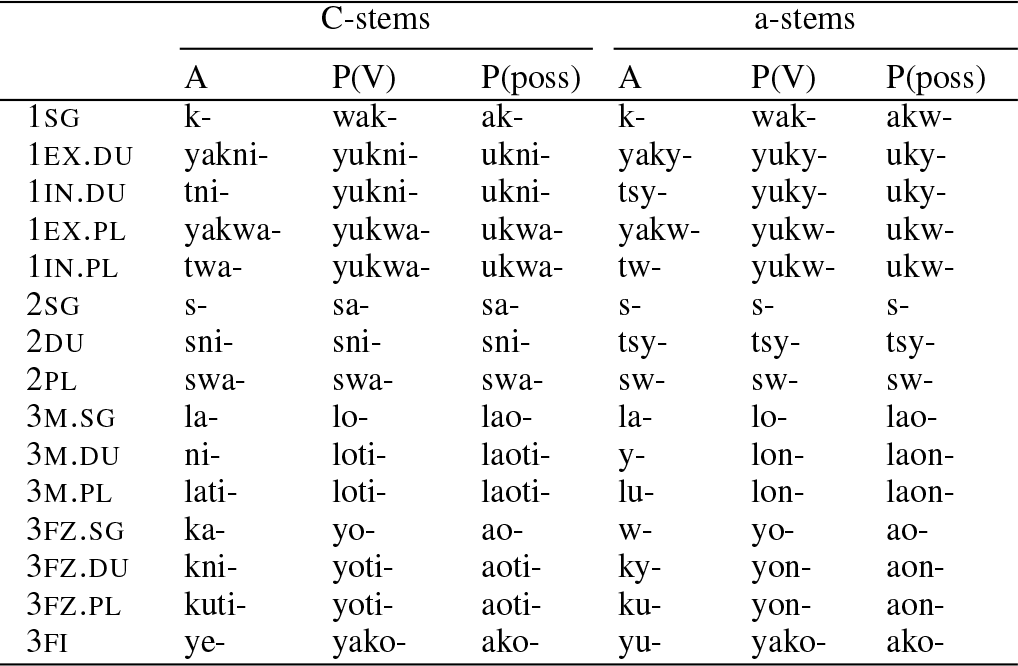
Second, while inalienably possessed nouns take intransitive Agent prefixes – the same Agent prefixes that occur on verbs – alienably possessed nouns take a set of pronominal prefixes that are clearly related to intransitive Patient prefixes on verbs, both in terms of which person, number and gender categories are distinguished by the prefixes and in terms of their form, but are not always identical to them. We will refer to the Patient prefixes that occur with alienably possessed nouns as Possessive Patient prefixes. (Note that inalienably possessed nouns have a locative ending loc rather than the noun suffix nsf that occurs on non-possessed nouns and alienably possessed nouns.) Table 1 gives Patient and Possessive Patient prefixes for stems that begin in a consonant or in the vowel a, by far the two most frequent stem types. Agent prefixes are given for comparison to highlight the person, number, and gender distinctions associated with each set. Note that a single exponent can instantiate both the general constraint that arguments of nouns lack a word-initial glide and the possessed noun-specific constraint that there are special Possessive Patient prefixes (compare yoti- on verbs vs. aoti- on nouns).
C-stem and a-stem Agent, Patient and Possessive Patient prefixes (word-initial forms).

Because they make the same semantic distinctions as Patient prefixes that occur on verbs, Possessive Patient prefixes and Patient prefixes are considered here as belonging to one and the same category. Just their form differs, which can be attributed to the fact that Patient prefixes occur on verbs and Possessive Patient prefixes occur on possessed nouns. (The next section provides another argument for this classification.) Indeed, while the closely related Mohawk language also has Possessive Patient prefixes, other Northern Iroquoian languages, such as Onondaga or Seneca, inflect alienably possessed nouns with the intransitive Patient prefixes that otherwise occur on verbs. See Martin (Reference Martin2016) for Mohawk, Woodbury (Reference Woodbury2018) for Onondaga, and Chafe (Reference Chafe2015) for Seneca.
To model the observations we just discussed, we posit three constraints. Possession Addition (pa), stated below, adds the meaning of possession to a noun stem.Footnote [4]

Possession Dominance (pd), stated below, ensures that it is the added possession relation that is relevant to inflection and that the correct semantic argument is referenced (the possessor).

key in the statement of Possession Dominance is an attribute that selects the portion of a lexical entry’s semantic content relevant to inflection or, in other languages, argument realization (see Koenig & Davis Reference Koenig and Davis2006 for details on the notion of key.) Because linking constraints in Oneida relate semantic arguments of the key relation to inflectional structure, we model Possession Dominance through a key shift: Whenever a stem includes in its semantic content a possession relation, it is that relation that is the stem’s key whose arguments are referenced by pronominal prefixes. With stems that include only one semantic relation (the typical case), the choice of key is, of course, trivial (there is only one choice). But when a stem includes more than one semantic predicate, the choice of key is critical; Possession Dominance says that in those cases, in Oneida, it is the possession relation that is the key.
Finally, specific exponence constraints ensure that inalienably possessed nouns (stems that describe entities but whose key semantic relation is an inalienable possession relation) are properly inflected. We describe below one form such constraints can take, following Koenig & Michelson (Reference Koenig, Michelson, Baerman and Corbett2015b). Nothing critical hinges on the particular form exponence rules have. What is critical is that the rules of exponence that are specific to possession are sensitive to the prefix category (Patient), the stem type, i.e., a noun stem (describing an entity) versus a verb stem (describing a situation), and the fact that the key, in the case of Possessive Patient prefixes, is an alienable possession relation.

Summing up, there are four constraints that speakers must acquire to properly inflect possessed nouns and which must be combined with the more general inflectional constraints we mentioned in Section 2: (1) a possession relation is added without the possession relation being overtly marked by a particular morpheme (pa); (2) Possession Dominance, modeled via a key shift (pd); (3) selection – specific to possession – of Agent prefixes (inalienable) versus Patient prefixes (alienable) (in); (4) prefix forms that are specific to nouns whose key is an alienable possession relation, which we call Possessive Patient prefixes (pp).
Each of the four constraints we just listed is used to ensure stable communication about a specialized domain, in this case, possession. When combined with the more general constraints about inflectional argument referencing summarized at the end of Section 2, these constraints ensure that the particular message that is communicated is that the noun’s referent is possessed and that its possessor has certain properties (person, number, gender). What is fascinating is that these four constraints are not always used concurrently. The second and third constraints (pd and in), in particular, apply to more than possessed nouns. The third constraint (in) pertains to all stems that include a possession relation in their meaning; the second constraint (pd) is not only relevant to possessed nouns but also, as we shall see, when possessed nouns are incorporated into verbs.
5 Possessed Noun Incorporation
Noun incorporation typically has no effect on the selection of pronominal prefixes, as we mentioned in Section 2. A glaring class of exceptions to this generalization involves possession. Consider the verb forms in (21) and (22).

In (21a), the stem -anuhyanit-/-anú⋅yanit- ‘dirty’ takes the default feminine-zoic singular prefix as expected since the argument is inanimate. The verb form in (21b) also has this default prefix since the incorporation of -nuhs- ‘house’ does not affect pronominal prefix selection. Now compare the verb forms in (22a) and (22b), where the incorporated noun is possessed. A prefix referencing an animate argument, the feminine-/indefinite in (22a), is possible only when there is an incorporated noun. Without incorporation (22b), a prefix that references animate arguments cannot occur. The examples in (22) appear to be inconsistent with the generalization that noun incorporation does not affect prefix selection.
However, when a possessed noun is incorporated, the pattern of assignment of Agent and Patient prefixes discussed in Section 3 applies. The examples in (10) and (11) are repeated below as (23) and (24). Verbs incorporating inalienably possessed nouns select Agent prefixes while verbs incorporating alienably possessed nouns select Patient prefixes. The fact that, when incorporated, an alienably possessed noun causes the verb to select a Patient prefix (even when otherwise the verb would select an Agent prefix) shows that the verb’s key has changed; the key now corresponds to the possession relation. In addition, the fact that the pronominal prefixes are intransitive Patient prefixes further supports our claim that Possessive Patient prefixes are Patient prefixes.

As with possessed nouns, what is being referenced by the pronominal prefix is not a semantic argument of the verb: what is being referenced is not what is dirty (a house) but whose house is dirty, namely the possessor. We call this message structure Possessed Noun Incorporation and state the constraint relevant to this set of verbs and this message structure below.

The possessed noun incorporation message structure is not productive. It applies only to a small subset of verbs that occur only in the stative aspect rather than with the full set of possible aspect suffixes – stative, habitual, and punctual. In Michelson & Doxtator (Reference Michelson and Doxtator2002), the distinction is designated v.s. versus v.a. for stative versus active verbs, respectively. The stative verbs that occur with possessed noun incorporation include -a- ‘be a size’, -aksʌ- ‘be bad, in poor condition’, -athole- ‘be cold’, -es-/-us- ‘be long’, -iyo- ‘be good, nice’, -kste- ‘be heavy’, -okaʔt- ‘be rough’, and -oʔtʌ- ‘be a kind of’. Some verbs that one would expect to participate in the pattern, given their meaning and their status as v.s. verbs, cannot. Among these are -akʌle- ‘be scarce’, -(a)takwʌhtʌ-/-akwʌhtʌ- ‘be flat’, -atshat- ‘be damp’, -hnil- ‘be hard’, -kat- ‘be fast-moving’, -nolu- ‘be precious, expensive’, -stathʌ- ‘be dry’, -tʌs- ‘be thick’, and -ʔshatst(e)- ‘be strong’. Furthermore, for some verbs (e.g., -a- ‘be a size’, -aksʌ- ‘be bad, in poor condition’, -es-/-us- ‘be long’, -iyo- ‘be good, nice’, -oʔtʌ- ‘be a kind of’), possessed noun incorporation seems productive in that it applies to most semantically appropriate incorporable nouns. For others, the pattern is less productive or unproductive. For example, -atyesʌ- ‘be cheap’ can incorporate the nouns for ‘car’ and ‘blanket’ (-ʔslehtatyesʌ-, -kʌhatyesʌ-) with a special sense: ‘have cheap cars’ (for sale, say if someone owns a used-car lot) or ‘have cheap blankets’ (if someone owns a store that sells blankets). Or -okaʔt- ‘be rough’ is attested only with incorporated -ʔsleht- ‘car’ (i.e., ‘have a rough ride’), -kste- ‘be heavy’ with the noun stem for ‘work’ (thus -yoʔtʌhslakste- ‘have a heavy job, have heavy work or a lot of work’), and -ʔnestskʌ- ‘be soft, loose’ only with the root -nawil- ‘tooth.’ Attempts to elicit other incorporated nouns garner a clear commentary that the results are not words that would be used by a fluent speaker.
To understand the function of possessed noun incorporation in Oneida, it should first be noted that stative verbs can express concepts that in other languages are expressed by adjectives; see Chafe (Reference Chafe2012) on the absence of adjectives in Seneca. As already shown above with -anuhyaniht- ‘be dirty’, many of these stative verbs can incorporate nouns. Some incorporate nouns relatively productively (for example, -kste ‘be heavy’ and -tʌs- ‘be thick’), some obligatorily (for example, -iyo- ‘be nice, good’), and others less productively or even unproductively (for example, -okaʔt- ‘be rough’), in part perhaps due to their meaning. (Of course, active verbs also vary in how productively they incorporate nouns.) In terms of its use, the entire verb seems to be as much about the incorporated entity as about its attribute. Possessed Noun Incorporation piggybacks on this function of noun incorporation and provides a way to express in a single predication both the notion of possession and a salient property of the incorporated noun’s denotation, akin to English sentences like (25).

Possessed Noun Incorporation is relatively unproductive, we surmise, because of the pragmatics associated with its use. The examples that occur in the texts published in Michelson et al. (Reference Michelson, Kennedy and Doxtator2016), most of which are not traditional, oft-repeated tales but instead spontaneously, unrehearsed tellings, mostly involve situations where the verb describes something that is, or was, a part of Oneida culture or attests to a circumstance that was a common part of life. For example, Clifford Cornelius spoke of being very poor when he and his father and brothers used to cut wood for a living, and he used the verb tyukwanuhsatho⋅lé⋅ ‘we had a really cold house, ours was such a cold house’, and Mercy Doxtator used the verb yakokhwahlá⋅tsles ‘she had a long table’ when describing the custom of people going from the house of one farmer to another to help out, and enormous amounts of food being prepared for all the workers. In a similar vein, the form for ‘her house is dirty, hers is a dirty house’ was used by Olive Elm when describing her auntie’s house and why she did not want to eat there when they visited; in this case, the pragmatic function seems to involve a more specific characterization of a person who figures prominently in the narration. It is hard to pin down exactly all the pragmatics of Possessed Noun Incorporation, but it seems to be roughly paraphrasable in English with sentences of the form illustrated in (25), where possession and the fact that the house is nice are both asserted (the point of uttering (25) is not to assert that Joanne has a house – a typically pragmatically rather uninformative statement – but to assert that Joanne’s house is nice). Possessed Noun Incorporation combines the phonologically unmarked addition of possession to the meaning of a noun on the one hand and noun incorporation on the other hand in order to simultaneously assert possession and a culturally or discourse salient property in a language that does not have the kind of attributive adjective–noun modification construction the English sentence in (25) illustrates.
Modeling possessed noun incorporation involves constraints that have independent motivation either within Oneida grammar or within the grammar of other languages. Koenig & Davis (Reference Koenig and Davis2006) argue that for English verbs whose meaning involves more than a single predicate (e.g., verbs of transfer) the verb’s key is a matter of lexical selection. Lexical key selection, they argue, is responsible for the syntactic difference between verbs such as buy and sell, or between pay and charge, as in their approach the value of a key attribute records the predicate in a verb’s meaning that matters for selection of direct argument positions (typically, of course, verb meanings include a single predicate that will perforce be this verb’s key). Koenig & Davis furthermore suggest that in some cases, one of the side effects of valence alternations is to induce key shifts, as for example in the spray/load alternation, where the change of location predicate serves as the key of one valence alternate of load and the change of state predicate serves as the key of the other valence alternate.
We suggest that the same shift in key is involved in Oneida possessed noun incorporation. In this case, the key of the stem shifts from the predicate associated with the stem to the possession relation: It is not the ‘being dirty’ predication that is relevant to pronominal prefix selection, but it is the additional (and not otherwise overtly marked) possession relation that is now relevant. This is in accordance with the Possession Dominance constraint we discussed above: When a stem includes in its meaning a possession relation, it is the possession relation that determines pronominal prefix selection. Once this key shift occurs, everything follows given the rest of Oneida morphology.
Our model of possessed noun incorporation relies on the general (derivational) noun incorporation constraint stated below.

But it also includes the construction-specific PossInc constraint stated above, which states that there is a class of stative verbs for which the incorporated noun can be a possessed noun, i.e., nouns that have added to their meaning a possession relation. Possession Dominance (pd), the standard exponence rules for verbs, and (in)alienability paradigm class assignment constraints (in) will do the rest and ensure the proper meaning and selection of the appropriate pronominal prefix. Note that positing a general Possessed Noun Incorporation class of verbs does not preclude the inclusion of subtypes of this construction for particular combinations of possessed nouns and stative verbs that have been lexicalized. As Sandra & Rice (Reference Sandra and Rice1995), Riehemann (Reference Riehemann1998), and Koenig (Reference Koenig1999) stress, general patterns and particular instances can simultaneously be part of a language’s grammar.
To summarize, aside from the general constraints on referencing arguments stated in Section 2, the possessed noun incorporation message structure involves: (1) the incorporation of possessed nouns into (some) morphologically stative verbs (PossInc), (2) the phonologically unmarked addition of a possession relation to noun stems (pa), (3) Possession Dominance (pd), and (4) the possession-specific rules for assignment of a stem to the Agent or Patient paradigm class (in). Only the first of these constraints is new and specific to the possessed noun incorporation construction. The second constraint (pa) applies to nouns in general, as we discussed in the previous section. The third constraint (pd) is a property of all stems that include in their meaning a possession relation and so is the fourth constraint (in), as discussed in Sections 3 and 4, respectively. This list of constraints illustrates once more an important characteristic of the approach to specialized-domain grammars we are pursuing here: producing forms for a particular message structure requires using constraints of various generality and only some of those constraints are specific to that message structure (in this case, PossInc). The use of some constraints is ubiquitous. Other constraints (pd and in) pertain to a particular semantic domain (in this case, all stems that include a possession relation). Still other constraints (pa) apply to a subset of lexical entries that belong to that particular semantic domain (e.g., nouns that can add a notion of possession to their meaning). Finally, some constraints apply to a small set of noun–verb combinations and this is the case for the first constraint (PossInc), which applies to a small set of verbs (maybe a dozen) and, at least for some of these verbs, only to some noun stems (although this latter restriction may be pragmatically based). What is important is that constraints specific to a particular message structure can build on each other.
Our analysis of Oneida possessed noun incorporation differs from Baker’s (Reference Baker, Payne and Barsh1999) analysis of the corresponding Mohawk pattern in that the pattern follows from the Possession Dominance constraint in our analysis whereas it follows from the following putative general constraint in Baker’s analysis (p. 301).

Both analyses posit constraints that ensure the possessor argument of the possessed relation contributed by the incorporated stem is referenced rather than the argument of the incorporating stative verb. Baker’s constraint is seemingly more general than our Possession Dominance constraint, but this is illusory, as various additional constraints restrain its applicability mostly to stems covered by our Possessed Noun Incorporation rule.Footnote [5] Properly restricting (26) to stative verbs requires stipulating that the argument structure of active, but not stative, verbs include an event variable. Even under the view that some stative predicates do not include an event variable, like that of Kratzer (Reference Kratzer, Carlson and Pelletier1995) – contra Pustejovsky (Reference Pustejovsky1991) or Kamp & Reyle (Reference Kamp and Reyle1993) – stative verbs such as the Mohawk verb -’tsu- ‘be dirty’ in (27) are stage-level predicates and should include an event variable and not be able to participate in possessed noun incorporation, contra the facts.

Additionally, if the event variable is treated as an argument on a par with themes, possessors, and the like, as it must be in Baker’s analysis, it should be subject to Baker’s polysynthesis parameter condition, which requires arguments to be coindexed with what Baker calls ‘a pronominal agreement factor or an incorporated element’ (p. 298), which they are not. It is thus not clear to us that Baker’s approach to restricting possessed noun incorporation to stative verbs ‘has validity for the language as a whole’ (p. 318). Under our view where possessed noun incorporation is a derivational process, the various restrictions on the pattern are expected. Combinations of item-specific productivity and particularities are the hallmark of derivational processes but are unexpected if the pattern is the result of a general syntactic constraint such as (26).
Importantly, the explanation we propose for the fact that the possessor is referenced rather than the verb’s theme has wider applicability than the general constraint in (26). It is critical to model how possessed nouns (Section 4) and negative possessive equatives (Section 6, below) are inflected. Possession Dominance applies when a possession relation is added to the meaning of a noun (possessed nouns), when possessed nouns are incorporated into a stative verb (possessed noun incorporation) and when an equality relation is added to the content of possessed nouns (negative possessive equatives, discussed in the next section). Something like the Possession Dominance constraint must therefore be included in the grammar of Oneida irrespective of one’s analysis of Possessed Noun Incorporation. Baker’s argument structure inheritance constraint in (26) – in contrast to Possession Dominance – does not model possessed nouns or negative possessive equatives. The fact that the same pattern would need to receive two entirely distinct explanations under Baker’s analysis casts serious doubt on the hypothesis that constraint (26) is at play in Possessed Noun Incorporation.
6 Negative possessive equatives
This section discusses the structure of negative possessive equative sentences. Regular negation in Oneida is marked by a particle yah, glossed ‘not’ in the examples, and either the negative prepronominal prefix teʔ- or the contrastive prefix th-. An example is given in (28).

When a possession relation is encoded via a verb, negating that predication follows the regular pattern with the particle yah and the negative or contrastive prefix, as shown in (29).

Negative equative predications have the particle  rather than a verb with the negative or contrastive prefix (30b). Etymologically, this particle is probably a verb, composed of the negative prefix
 , the default feminine-zoic singular pronominal prefix ka-, and the verb root -i- ‘make up the total of’ (cf. Woodbury Reference Woodbury2018: 214 for Onondaga).Footnote
[6]
An example is given in (30c).

The examples in (31) are also equative possessive sentences, but in these sentences the predicative noun is a possessive noun, i.e., it includes a possession relation (via Possession Addition). As with any possessed noun, in (31a), the pronominal prefix references the possessor and not the noun’s referent (or, more precisely, its discourse referent or index), and the noun is inflected with a Possessive Patient prefix. Example (31b) is just an alternative wording with the possessed noun  ‘my belonging’ and, in apposition, the noun denoting the exact category of the belonging.

Now, when possession is encoded in a possessed noun, negation can take two forms, the structure with  as in (32a) or alternatively the pattern exemplified in (32b) and (32c), which applies only to possessed nouns and kinship terms (i.e., to relational nominal stems) in equative sentences. In this case, despite the fact that the stem is nominal, the word behaves as a verb and has the
 negative prepronominal prefix. We know that the stem is nominal because it (usually) has an overt nominal suffix instead of an aspect suffix.Footnote
[7]

We model the negative possessive equative structure – i.e., the fact that possessed nouns can be inflected like verbs in negative equative structures – via the derivational constraint stated below. This constraint takes as input a possessed noun and outputs a stem that bears a prepronominal prefix marking negative polarity and whose content adds to the content of its input an equality relation.

Our model of negative possessive equatives makes use of a mix of old and new constraints. Possession Dominance (PD) and the phonologically unmarked addition of a possession relation are constraints that apply elsewhere when referencing possessors. And the use of exponence rules for arguments of stems that describe situations is a general property of Oneida inflection. The addition of an equative relation (again, without phonological marking) is the only constraint specific to this message structure. Note that the consequence of the addition of this equative relation is that although it is the possessor of the incorporated possessed noun that is referenced by a pronominal prefix, the form of this prefix is that appropriate for stems that describe situations since the derived verb describes a situation.
7 A special quantification pattern
The final area in which the grammar of possession in Oneida differs from general-purpose grammar is quantification. We first discuss how one quantifies over entities in Oneida before turning to quantification and possession. Quantification over entities is typically expressed in Oneida through a separate clause with verbs translated into English as ‘amount to’, ‘together’, or ‘make up the total of’ (Koenig & Michelson Reference Koenig, Michelson and Piñón2012, Michelson et al. Reference Michelson, Kennedy and Doxtator2016, Koenig & Michelson Reference Koenig, Michelson, Abeillé and Bonamito appear). It is illustrated in example (33) with the verb root -ke- ‘amount to’.

The partitive prepronominal prefix ni- occurs because the number of entities being counted exceeds two, and the number name  ‘three’ is adjoined to the counting verb. What is being counted constitutes one argument of -ke- and is coindexed with an argument of the main verb. In other words, sentence (33) is more idiomatically paraphrased as ‘It plays music, songs, those that amounted to three in units of songs’. Critically, in this pattern, the prepronominal prefix on the count verb depends on how many entities are counted. The partitive prepronominal prefix ni- is used in (33) because three songs were played; if two entities had been played, the dualic prepronominal prefix te- would have been used.
General constraints ensure that any verb that includes a cardinality relation bears the appropriate prepronominal prefix and the appropriate semantic restriction on the cardinality of what is being counted. The upshot of these constraints is as follows: if the meaning of a verb contains a cardinality relation, it must include a repetitive, dualic or partitive prefix.
Count verbs can also be used together with verbs that encode possession, as shown in examples in (34) and (35), where the verb root -yʌ- ‘put, lie, have’ encodes possession.Footnote [8]

However, another pattern is possible too. In this case, no count verb heading a separate clause is used and the number name is a sister to the verb encoding possession. The dualic prepronominal prefix te- is still used, as would be expected if a count verb were used, as there are two children. (The example in (6) from Section 1 has the partitive prefix ni- for three or more children.) This alternative possessive pattern is possible only when the quantity is two, or three or more.

We have just seen that verbs that denote a possession relation can co-occur directly with a number name without the need for a count clause. As before, our model of this possession-specific fact relies on a construction-specific derivational constraint, which is stated below. This rule allows the addition of a cardinality relation directly to verbs of possession (-yʌ- ‘put, have’ or -ot- ‘stand’), thereby making the use of adjoined clauses headed by a count verb such as -ke- ‘amount to’ otiose.

We mentioned above that there are general constraints on verbs that include an amount relation that encode how many entities are being counted (one, two, or three or more). These constraints also apply when the count relation is added via the quantifying possessed entities’ constraint we just stated.
To sum up this last special aspect of the grammar of possession in Oneida, verbs that denote possession relations optionally include a cardinality relation in their meaning (provided two or more entities are possessed) and any verb that includes a cardinality relation marks restrictions on the cardinality of what is counted via prepronominal prefixes. The constraints being used in this case include the (phonologically unmarked) addition of a cardinality relation when a verb denotes a possession relation (qa) as well as the language-wide constraint that prepronominal prefixes encode cardinality restrictions on verbs that include a cardinality relation in their meaning.
8 General discussion
8.1 Summary
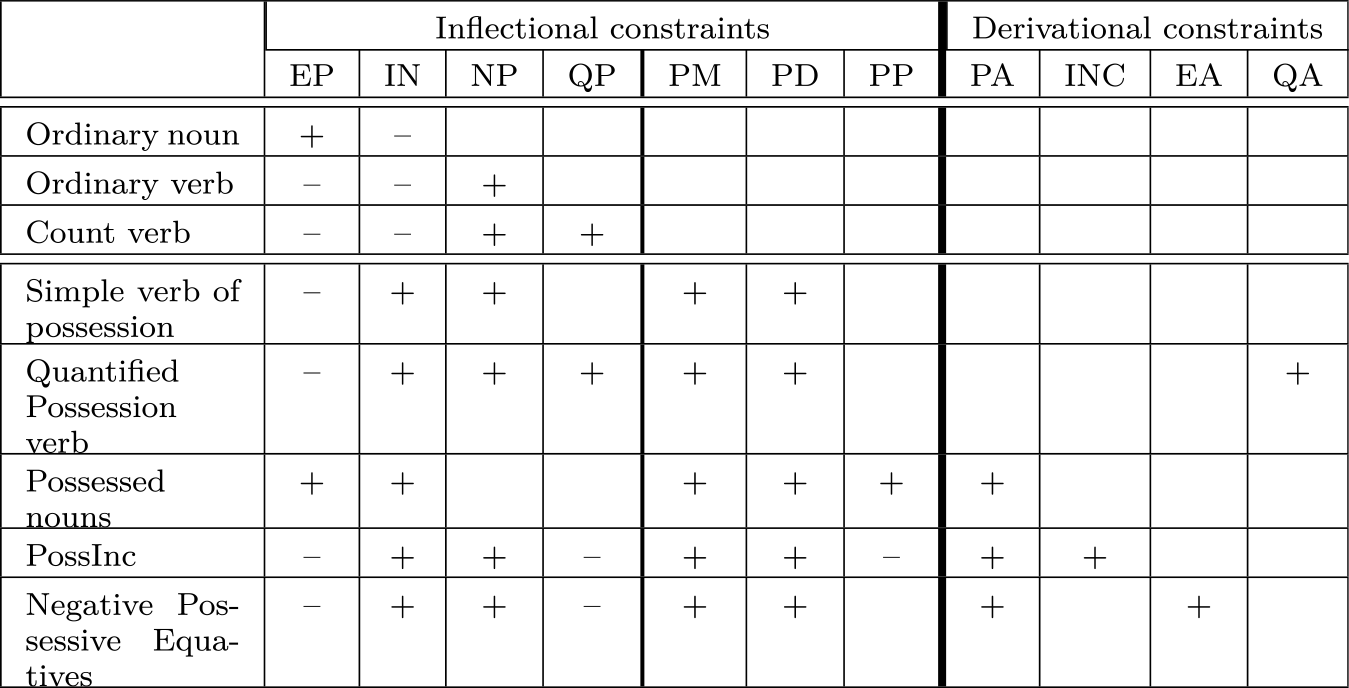
We have presented several ways in which the grammar of possession in Oneida differs from grammatical patterns that apply to verbs and nouns that do not include a possession relation in their semantic content. Of particular interest to us is that what is special about the grammar of possession in Oneida pertains to several grammatical dimensions: argument referencing, exponence, derivational morphology, negation, quantification, and in each area, several constraints interact, some general across the grammar of Oneida, some general across the grammar of possession, and some specific to a particular possession-related message structure. Table 2 summarizes which constraints apply to which set of stems and to which message structure.
General-purpose and possession-specific constraints in Oneida; EP = Entity Prefixes, IN = (In)alienability rules, NP = Negative Prefix, QP = Quantity Prefix, PM = Possession Monadicity, PD = Possession Dominance, PP = Possessive Prefixes, PA = Possession Addition, INC = Noun incorporation, EA = Equality Addition, QA = Quantity Addition; a simple verb of possession is a verb of possession that does not include an amount relation in its meaning; a Quantified Possession verb is a verb of possession that includes an amount relation in its meaning.

Rows that are above the double line pertain to classes of stems that do not include possession in their meaning (possession stems, hereafter), which constitutes the general case. Rows that are below the double line pertain to the various classes of possession stems. Columns 2–8 before the heavy bolded line list inflectional constraints while columns 9–12 after the heavier bolded line list derivational constraints, where the word derivational simply indicates a process that contributes meaning to the input (adding a noun meaning or an equative, possession, or amount relation). Finally, columns 2–5 before the lighter bolded line deal with inflectional constraints of relevance to all stems, whereas columns 6–8 after that line deal with inflectional constraints specific to possession stems. As the table makes clear, possession stems are subject to Oneida-wide inflectional constraints. When a relation of possession is used to describe an entity, pronominal prefixes lack a word-initial glide (see Table 1), (intransitive) prefixes that mark possessors fall into either the Agent or the Patient paradigm class, and possession stems that also include negation and equality or amount in their meanings bear the appropriate negative or quantity prepronominal prefixes. Columns 2–5 thus show that the general inflectional patterns of Oneida are preserved for possession stems: the distinction in form between exponents for nouns and verb stems, the assignment of intransitive prefixes to two paradigm classes, the use of an inflectional prefix for negative verbs, and the encoding of quantity via prepronominal prefixes on stems that include an amount relation. Interestingly, though, while possession stems are assigned to either the Agent or Patient paradigm classes, how stems are assigned to Agent and Patient classes differs for possession stems. Rather than a semantically motivated, but not entirely predictable assignment for each individual stem, a productive rule sensitive to (in)alienability predicts assignment of paradigm class for possession stems. In other words, the relevance of the Agent and Patient paradigm classes is preserved, but with an idiosyncratic, albeit more predictive, twist.
Columns 6–8 summarize inflectional constraints that are only relevant to possession stems. Possession Monadicity (pm) ensures that all possession stems take intransitive prefixes even when both the possessor and the possessed are animate. Possession Dominance (pd) is the critical inflectional constraint for the message structures we discuss in this paper, as it ensures that it is an argument of the relation of possession (i.e., the possessor) that is referenced by a pronominal prefix. Possession Dominance (pd) applies vacuously to verbs of possession, as these verbs only include one relation in their meaning, but in all other cases (possessed nouns, possessed noun incorporation, negative equatives, and quantified possession, i.e., rows 5–8), it determines which relation contributes the arguments that are referenced by the pronominal prefix. Importantly, Possession Dominance applies iteratively so that when a possessed noun is incorporated into a verb, it is the possessor of the possession relation included in the possessed noun’s meaning that is referenced inflectionally. Possession Dominance also applies when a further derivational process adds a relation to the meaning of its input. Consider negative equatives. The addition of an equative relation (as well as a negation operator) is dependent on the prior addition of a possession relation to a noun, as only dyadic predicates that describe entities (possessed nouns and kin terms) can be input to the negative equative constraint. However, the output is verbal in nature, as evidenced by the fact that pronominal prefixes do not lose their word-initial glides or the fact that a (verbal) negative prepronominal prefix can occur on negative possessive equatives. Still, the argument that is referenced by the pronominal prefix remains the possessor, as predicted by Possession Dominance. The final possession-specific inflectional constraint – the unique form some pronominal prefixes referencing the possessor take when a stem that includes a relation of possession describes an entity – parallels somewhat the behavior of the Agent vs. Patient paradigm class assignment rules. Exponence rules for possessed nouns follow the constraints on nouns, but with a twist, i.e., they include forms specific to possessed nouns; see, for example, the pattern for the third person feminine-zoic singular yo- (Patient prefix on verbs), o- (Patient prefix on nouns), and ao- (Patient prefixes on possessed nouns). In other words, a single prefix for possessed nouns can both obey the general loss of an initial glide and have a form specific to possessed nouns.
8.2 Discussion
Let us now go back to the question we asked in Section 1: What does the grammar of possession in Oneida tell us about the architecture of grammars? To help with this discussion, it is useful to keep in mind that the constraints summarized in Table 2 interact when a message is encoded. Consider the description of an object and its possessor, as in (3), repeated below in (37).

Aside from the usual lexical access to the representation of the stem, the speaker must coordinate six constraints mentioned in (38) to produce this form:

To express within a single act of predication both that an object is possessed and that it has a particular property (thus making use of the Possessive Noun Incorporation construction) involves following steps (38a)–(38c), but substituting for (38d) the constraint that pertains to pronominal prefix exponents for verb stems, and applying the constraints specific to the Possessive Noun Incorporation construction, in particular noun incorporation (inc).
The interaction of the constraints summarized in Table 2 and that we just illustrated presents several lessons, we believe, for our understanding of the architecture of grammars. First, constraints vary in generality, and there is no level at which constraints for possession in Oneida are idiomatic; so the common dichotomy between regularity/generality and idiomaticity, while convenient, seems a misnomer. The grammar of possession in Oneida involves constraints that are more or less general all the way down. In fact, constraints can be more specific (i.e., apply to a smaller set of stems) and at the same time be more regular or predictable. The Agent vs. Patient paradigm class assignment constraints for possession stems (in) apply to a smaller set of stems but are more regular than constraints for ordinary stems. Second, message structures consist in a unique coordination or conjunction of individual constraints, each of which can be involved in several distinct message structures. Third, message structures can have emergent properties that turn into particular constructions, which must be recorded as first-class objects in the grammar. This is the case with the Possessive Noun Incorporation message structure, which is, from a formal point of view, simply the conjunction of the Possession Addition (pa) and Noun Incorporation (in) constraints but which is associated with a particular, emergent pragmatics that restricts it to particular verbs in ways that cannot be predicted from its formal composition.
The properties we just summarized are nothing new to approaches to syntax where patterns of association between form and meaning at various levels of generality are recognized as first-class citizens of natural language grammars, including, broadly speaking, Categorial Grammar (Steedman Reference Steedman2000), Cognitive Grammar (Langacker Reference Langacker1987), Lexical Functional Grammar (Bresnan & Kaplan Reference Bresnan and Kaplan1982, Asudeh, Dalrymple & Toivonen Reference Asudeh, Dalrymple, Toivonen, Butt and King2008), Role and Reference Grammar (Van Valin & Lapolla Reference Van Valin and Lapolla1997), Head-driven Phrase-Structure Grammar (Pollard & Sag Reference Pollard and Sag1994, Sag Reference Sag1997), Simpler Syntax (Culicover & Jackendoff Reference Culicover and Jackendoff2005), and of course, Construction Grammar in its various forms (Fillmore et al. Reference Fillmore, Kay and O’Connor1988, Goldberg Reference Goldberg1995, Michaelis Reference Michaelis, Boas and Sag2012). But the interaction of constraints within a single specialized domain (possession) across various message structures, which our paper focuses on, illustrates, we believe, something more about the way grammars work. If what we describe above is correct, it suggests that grammars work in a way similar to what Lévi-Strauss calls ‘bricolage intellectuel’ ‘intellectual tinkering’ (p. 577) and that they develop out of a process of tinkering rather than engineering or out of a (quasi-)perfect design, to borrow a phrase from Chomsky (Reference Chomsky1995, Reference Chomsky2013).Footnote [9] Lévi-Strauss focuses on several properties that distinguish tinkering and engineering, but they all stem from the fact that engineers devise tools adapted to their goal whereas bricoleurs ‘tinkerers’ make do with what they have (they use ‘les moyens du bord’ ‘what’s on board’, p. 577). First, there is a prevalence of history (tools that are already there) as tinkerers do not start from scratch: you make it work with the tools you have rather than devise brand new tools. Second, all you can do if the tools you have are not perfectly adapted to a new goal is adapt the tools you have for a new task or combine existing tools in new ways. Lévi-Strauss uses the ‘bricolage’ metaphor in the context of myths. Transposing his metaphor to grammars, individual constraints – in our case, individual constraints for the encoding of a possession relation – are tools and the goal for which these constraints are put (what the tools are used for) is the encoding of a particular message that pertains to possession.
The grammar of possession in Oneida illustrates the prevalence of history in that the standard constraints – constraints on referencing arguments, on expressing negation for stems that describe situations, or on expressing quantification – are reused. For example, the distinction between noun and verb exponents, or the distinction between Agent vs. Patient paradigm classes, is maintained. General constraints are reused as much as possible when encoding new messages (the fact, in our case, that an object is not only described as being a member of a category but that it is also possessed by some animate entity) because tinkerers must make do with the tools they already have. The grammar of possession in Oneida also illustrates the need to adapt or recombine tools in new ways for a new goal (a new message). Take the existence of two paradigm classes for intransitive prefixes; the two classes are preserved in the case of possession stems, but the assignment of stems to one or the other paradigm classes is adapted. Otherwise, take the Possessive Noun Incorporation construction. As we pointed out, no new morphological constraint is needed to produce a Possessive Noun Incorporation verb. The general noun incorporation construction and the addition of a possession relation to noun roots are enough to license the incorporation of a possessed noun root into a verb, given Possession Dominance. But these already existing tools are put to new use as their combination encodes a particular discourse function, namely that the possessor’s possession characterizes him or her. To sum up, as in the case of tinkering, given a new task, the reuse of old tools requires adaptation or a unique combination of old tools.
Of course, metaphors for how grammars evolve or work – the bricolage metaphor we are proposing or any other metaphor – are only suggestive. However, it is interesting that the bricolage or a very similar metaphor has been used in other areas of linguistics, historical linguistics and sociolinguistics, respectively. The view we articulate has parallels in the notion of rule constellation as used in Janda & Joseph (Reference Janda and Joseph1986) and Joseph & Janda (Reference Joseph, Janda, Hammond and Noonan1988). Both articles discuss reduplication in Sanskrit and the fact that there is not a single general rule for reduplication in Sanskrit, but instead several particularized rules. While all rules share one formal feature, each reduplication rule includes additional constraints, both phonological and, crucially, lexical (applying to only some stems and/or some morphological contexts). Janda and Joseph further show that such fragmentation of a unitary reduplication rule into a rule constellation is the result of a preference for ‘analyses which focus on individual morphological and lexical elements, rather than alternative analyses which are generalized over broader, less idiosyncratic classes of grammatical elements’ (Joseph & Janda Reference Joseph, Janda, Hammond and Noonan1988: 206–207). They also stress the role of morphologization of phonological processes in this fragmentation.
There are several interesting parallels between Janda and Joseph’s notion of rule constellation and the bricolage metaphor we borrow from Lévi-Strauss. First is the fact that rules in their case, message structures in our case, can share some constraints, but not others. Second is the fact that speakers have a tendency to particularize rules or structures, which our discussion of the Possessive Noun Incorporation construction illustrates. Finally, there is the idea of morphologization of phonological alternation playing a role in the particularization or fragmentation of a single rule. Morphologization might explain the existence of distinct forms of pronominal prefixes marking possessors of possessive nouns if we reconstruct forms with ao in Table 1 as the earlier form of the relevant Patient prefix, with loss of the first vowel, along the lines Postal (Reference Postal1968: 144) proposes for Mohawk.Footnote [10] The preservation of the untruncated form in ao forms for possessive prefixes would then be exactly the kind of morphologization driven by the tendency to particularize general rules that Janda and Joseph mention as one of the factors underlying the fragmentation of reduplication in Sanskrit. The fact that grammars work like bricolage might, thus, be part of the explanation for the tendency Janda and Joseph mention: while speakers make use of the general constraints at their disposal, they latch onto lexically coherent lexical classes and adapt tools (modify or posit additional constraints) to encode distinct message structures.
In a totally distinct field of research, Eckert (Reference Eckert2008, Reference Eckert2019) uses the term bricolage to describe the process of combining the use and adaptation of sociolinguistic variables to index a field of potential meanings. Just as constraints are combined in the message structures we discuss in this paper, sociolinguistic variables, according to Eckert, are combined to create a new more complex meaning. As she puts it, ‘stylistic practice is a process of bricolage (Hebdige 1984) [see Hebdige Reference Hebdige1979: 102–106, JPK–KM], in which individual resources (in this case, variables) can be interpreted and combined with other resources to construct a more complex meaningful entity’ (Eckert Reference Eckert2008: 456–457). It is intriguing to speculate that the kind of constraint interaction we find in the grammar of possession in Oneida and the choice of (linguistic) style teenagers in California make might be based on the same kind of cognitive operations. At this point, though, we can offer nothing more than tantalizing speculation.
We take the usefulness of the notion of bricolage or rule constellation in modeling contextual language use or historical change as providing additional support for the conclusion we draw from how specialized-domain grammars seem to work. The view of the architecture of grammars we just articulated clearly differs from approaches that assume language is optimally designed and tools are optimally designed for the goal (thought for Chomsky). Although the metaphorical nature of architectural claims about language or grammars makes it difficult to evaluate them – at this level of generality, concrete predictions are hard to come by – an existing alternative approach to one of the structures we discuss in this paper – the Possessive Noun Incorporation construction – can help sharpen the comparison between these two conceptions of grammars. Baker (Reference Baker, Payne and Barsh1999), whose analysis of possessed noun incorporation we discussed in Section 5, takes the view, typical of an approach where language is a perfect design and thus unlikely to contain generalizations specific to particular domains and particular message structures, that cross-linguistic variations come from distinct values of general parameters, as the following quote illustrates.

Is Baker (Reference Baker, Payne and Barsh1999) correct in his assessment of the Mohawk pattern and, more importantly, the several Oneida structures we discussed? If he is – i.e., if the ‘tools’ we listed are parametrized versions of universal principles – the grammar of possession in Oneida might, after all, reduce to universal principles cum parameters. If he is not, bricolage might be a good analogy to understand how domain-specific grammars might arise.
Crucially, several properties of the grammar of possession in Oneida are not predicted. They must be learned and cannot follow from general or universal (parametrized) principles of the interface between semantics and morphology or syntax, even if they may be motivated in Lakoff’s (Reference Lakoff1987) sense. For example, it makes sense for Possessive Patient prefixes to be formally distinguished, but it cannot be predicted. There may be reasons for the differential encoding of possessors (via Patient Possessive prefixes in Oneida) and there is even more motivation within Oneida since the only mark that a noun is possessed is the form of the pronominal prefix. However, fluent speakers of Oneida must still learn the existence of, and the specific form of, pronominal prefixes marking possessors of nouns; after all, not all Northern Iroquoian languages distinguish Possessor Patient prefixes from ordinary verb Patient prefixes. Similarly, while the fact that only possessors are marked, and not possessed objects, may be motivated by the fact that most of what we possess is inanimate (and therefore is unmarked in Oneida), it cannot be predicted that this restriction extends to cases where what is possessed is clearly animate, like kins, since in all other cases where a verb can take either inanimate or animate proto-patient arguments, the pronominal prefix references the animate proto-patient argument. Finally, the phonologically unmarked derivational processes that account for Negative Possessive Equatives and quantification over possessed entities are productive, but quite restricted in their input, and obviously must be learned as any derivational process must be.
Finally, Possession Dominance must also be learned and does not follow from general or universal (parametrized) principles. Except in the case of possession verbs, Possession Dominance involves key shifts. Although key shift is motivated (without it, nothing would mark the addition of a possession relation since there is no derivational affix marking the addition of a possession relation), the fact that key shift is how possession is marked has to be learned. Nothing in the rest of Oneida grammar helps predict that a shift in key is how a derivationally added possession relation is marked. In other words, Possession Dominance is a message structure-specific tool. It seems that in the case of Possession Dominance too, then, the grammar of possession in Oneida is not predicted by universal principles cum parameters and is not just some peripheral crud either. It does appear that it works like (possibly motivated) bricolage on Oneida’s word structure.
8.3 Conclusion
In this paper, we described several patterns/constructions of Oneida that all pertain to one semantic area, possession. The grammar of possession in Oneida is unique as compared with other domains in that only possessors are referenced by pronominal prefixes even if the possessed entity is animate, constraints that select Agent versus Patient prefixes are particular to possession, as are the rules that output the form of possessive prefixes on nouns, and there exist special negation and quantification structures. At the same time, verbs and nouns whose meaning includes possession, whether due to a predicate of possession or to a derivational process that covertly adds a possession relation to a predicate, share certain structural properties with all verbs and nouns, such as the fact that arguments are referenced via pronominal prefixes, and there is a general construction for incorporation. We describe this interesting mix of general and specific constraints or tools in terms of a metaphor originally applied by Lévi-Strauss to the construction of myths. He used the term bricolage, which we borrow. We suggest this notion, which in this paper we have developed in terms of an explicit model in Head-driven Phrase-Structure Grammar (see the Appendix for a formal presentation of the model we use), aptly captures the properties of message structures that include a relation of possession and provides an alternative way of conceiving of the grammars of specialized domains to a view where only general/universal, possibly parametrized, principles are countenanced.
Appendix
In this Appendix, we provide explicit representations of the constraints mentioned in the text. Following Koenig & Michelson (Reference Koenig, Michelson and Müller2014), we assume the syntax of Oneida does not include formal syntactic features. Oneida signs (within Head-driven Phrase-Structure Grammar) only include semantic and pragmatic information (that are the values of the content and background attributes); they do not include a syntax attribute (see Ginzburg & Sag Reference Ginzburg and Sag2001 or Sag Reference Sag, Boas and Sag2012 for the interpretation of most of the features we include in our representations and for introductions to Head-drive Phrase-Structure Grammar and Sign-based Construction Grammar, respectively).

In contrast to phrases, stems and words in Oneida include information relevant to their form, i.e., morphological information (the value of morph in (40)). That information consists of featural and realizational information. The morphological feature information (the value of morph-feat in (41)) includes information about pronominal prefixes, prepronominal prefixes, aspect suffixes, and stem forms, the four pieces of information relevant to Oneida’s inflectional processes. (We refer readers to Koenig & Michelson Reference Koenig, Michelson, Baerman and Corbett2015b for the features relevant to pronominal prefixes; lid abbreviates lexical identity.) The value of realization includes (to simplify a bit) the realizational rules a particular word form instantiates (see Crysmann & Bonami Reference Crysmann and Bonami2016 for details).

The morphological information most relevant to this paper pertains to pronominal features (the value of pro in (42)) as their expounding ensures the referencing of semantic arguments, and prepronominal prefix information (the value of prepro in (42)). The feature affix-type records the Agent vs. Patient paradigm classes a nominal or a verbal stem belongs to, while the feature active records the active vs. stative status of verb stems. The feature agr records the
 $\unicode[STIX]{x1D719}$
-properties of up to two indices of arguments of stems. It is this list of indices that rules of exponence realize as pronominal prefixes.
We assume that the semantic component of grammars is an underspecified description of fully specified logical formulas, following the work in Minimal Recursion Semantics (Copestake, Flickinger, Pollard & Sag Reference Copestake, Flickinger, Pollard and Sag2005) and Lexical Resource Semantics (Iordǎchioaia & Richter Reference Iordǎchioaia and Richter2015). We follow for the most part the signature of Iordǎchioaia & Richter (Reference Iordǎchioaia and Richter2015) provided in shortened and somewhat simplified form in (43) except that we take the value of main to be a list of meaningful expressions, as Oneida stems can include more than one relation. The signature of content also includes the attribute key to model Possession Dominance, i.e., the fact that one of the members of the main list is relevant to the selection of pronominal prefixes. (…are used to represent an arbitrary member of main.)

Below we repeat each constraint described informally in the text before providing a more formal representation as well as an English rendering of this more formal representation for readers who are not familiar with HPSG. We discuss individual features or sorts of values used in individual constraints as they become relevant. It is important to keep in mind that the value of the attribute key determines which semantic arguments are referenced by pronominal prefixes. For ease of reading, we use …in the statement of constraints to abbreviate the path morph|morph-feat.


(46) provides the default constraint on how the index of semantic arguments is linked to members of the agreement list. (47) is the possession-specific agr constraint. We use a syntactic variable f over attributes to stand in for a relation over an arbitrary path of length one in RSRL (we thank Frank Richter, p.c., for clarifying this issue). We also shorten for readability into one attribute-value matrix the conjunction of the negation of the sort possess-rel and the constraint on the animacy of arguments that are members of the agr list.


In (48b) and other constraints below, we use, for readability, a typical first-order predicate logic representation for predications (e.g.,  , rather than an attribute-value matrix representation.


 $\oplus$
in (51b) denotes list concatenation; as in (46b), we use a syntactic variable f over attributes to stand in for a relation over an arbitrary path of length one.


In the rule in (53), the value of ms (for Morphosyntactic feature Set, see Crysmann & Bonami Reference Crysmann and Bonami2016) lists the morphosyntactic features that are expounded in a given word form. (53) thus says that the neg feature is one of the inflectional features that are realized in negative possessive equatives. See Diaz, Koenig & Michelson (Reference Diaz, Koenig and Michelson2019) for a description of the inflectional rules for prepronominal prefixes in Oneida. We use …as a shorthand for membership in the morphosyntactic feature set in (53) and (55)–(56).


We mentioned in passing in Section 7 the general inflectional constraints on the number of what is being counted. (55) states these constraints. The constraint in (55) states that if an amount relation is part of the main content of a word and its morphosyntactic feature set includes the repetitive, dualic, or partitive feature, the count must be 1, 2, or 3 or more, respectively.

Finally, the constraint in (56) states that if the main content of a word includes an amount relation, its morphosyntactic feature set must include the repetitive, dualic, or partitive.


 .