


1. Introduction
In this article, I will argue for a rethinking of the idea of ‘post-modal’ meanings and functions in terms of a broader model of grammatical and semantic change.Footnote 1 The concept of the ‘post-modal’ was broached in a seminal paper by van der Auwera and Plungian (Reference van der Auwera and Plungian1998) on the semantic map of modality. It is part of a pre-modal—modal—post-modal dimension that is seen as definitory for modality, especially in its diachronic aspects. However, this concept presents a number of empirical and logical problems that cast doubt on its validity, or at least on its usefulness. I will argue that it is more fitting to speak in terms of increasing discourse orientation, as proposed in Narrog (Reference Narrog2012), Narrog and Heine (Reference Narrog and Heine2021), and elsewhere. I will also suggest a different take on other dimensions of the ‘semantic map of modality’.
The argumentation will proceed as follows. Section 2 will dissect the semantic map of modality proposed by van der Auwera and Plungian (Reference van der Auwera and Plungian1998). For this purpose, we will go back to the material it is based on, namely Bybee et al. (Reference Bybee, Perkins and Pagliuca1994), and take a closer look at the categories involved in the map, including their validity in the light of more recent research and of alternative interpretations of the categories and the data. In section 3, I will present a different arrangement of the categories and the data that promises to be both theoretically and empirically valid and avoid some of the problems inherent in the semantic map. Finally, in section 4, I will take a closer look at what kind of change in and out of modality exists in light of the model presented in section 3, before a summary in section 5.
2. Post-modality
2.1 The ‘semantic map of modality’ and its sources
A semantic map, according to Haspelmath (Reference Haspelmath and Tomasello2003: 213), is “a geometrical representation of functions in ‘conceptual/semantic space’ that are linked by connecting lines and thus constitute a network”. In this case, we deal with the “conceptual/semantic space” of modality. Within that space, the concept of ‘post-modal’ that was at the centre of the 2022 conference that led to this special issue and is at the centre of this contribution goes back to the research of van der Auwera and Plungian (Reference van der Auwera and Plungian1998). It belongs to one of three dimensions of modality in the underlying concept of that research, although its visual representation is necessarily only two-dimensional.
The map is represented in Figure 1. From left to right, we see a diachronic dimension going from pre-modal (left of the box) to modal (in the box) to post-modal (right of the box). Vertically, we have possibility on top and necessity at the bottom. Furthermore, there is a third dimension of participant-internal vs. participant-external, which is integrated into the two-dimensional representation.
van der Auwera and Plungian (Reference van der Auwera and Plungian1998: 98) “Unifying the possibility and necessity paths”.

Figure 1 Long description
The diagram illustrates a conceptual map of modal and pre-modal expressions, organized within a box. On the left, various expressions such as ′be strong′, ′know′, ′arrive at′, ′finish′, ′die′, ′be permitted′, ′dare′, ′be′, ′become′, ′happen′, ′befall′, ′stand′, ′I don′t know′, ′desire′, ′movement toward′, ′wish′, ′if it becomes′, ′fit′, ′protect′, ′owe′, ′duty′, ′belong′, ′be good/proper′, ′have′, ′be supposed′, ′need′ are listed vertically. These expressions are linked to different modal concepts within the box. At the top of the box, ′participant-internal possibility′ and ′participant-external possibility′ are shown, connected to ′deontic possibility′. Below, ′epistemic possibility′ is linked to ′epistemic necessity′, which further connects to ′condition′, ′concession′ and ′complementation′. At the bottom, ′participant-internal necessity′ and ′participant-external necessity′ are connected to ′deontic necessity′. Arrows indicate the flow from pre-modal expressions to modal concepts, with ′future′ and ′imperative′ positioned outside the box, connected to various modal concepts within. The diagram visually represents the relationships between different modal expressions and their participant dimensions.
Before digging deeper into each category, I want to take a look at the empirical foundation of this map: the large-scale study, mostly based on internal reconstruction, on the grammaticalization of tense, aspect and modality/mood in the world’s languages by Bybee et al. (Reference Bybee, Perkins and Pagliuca1994). The rationale for this study with respect to modality was formulated by Bybee et al. (Reference Bybee, Perkins and Pagliuca1994: 176) as follows: “[M]ood is best viewed as a set of diachronically related functions, and […] a real understanding of modality [will] emerge from a study of these diachronic relations”. That is, diachronic change is a fundamental, if not the most fundamental dimension of modality and mood, an idea that is also reflected in van der Auwera and Plungian’s (Reference van der Auwera and Plungian1998) map by its prominent, left-to-right representation of a pre- to post-modal directionality of change.
On the other hand, except for the diachronic, all of Bybee et al.’s (Reference Bybee, Perkins and Pagliuca1994) criteria for modality are quite different from those in van der Auwera and Plungian’s study. Bybee et al. (Reference Bybee, Perkins and Pagliuca1994) posit the following four categories of modality:
▪ Agent-oriented modality: Obligation, ability and possibility
▪ Speaker-oriented modality: Imperative, optative, hortative…
▪ Epistemic modality: Possibility and probability
▪ Subordinating moods: Concessives, complementation…
These are traditional functional clusters defined variously by source (speaker-oriented, epistemic) and target of modality (agent-oriented), or an absence of source and target (subordinating). Furthermore, in Bybee et al. (Reference Bybee, Perkins and Pagliuca1994), the diachronic dimension is defined purely by the data, and not by concepts such as pre- and post-modality. Overall, there are no systematic dimensions or parameters. The arrangement is dictated by diachrony. Bybee et al. (Reference Bybee, Perkins and Pagliuca1994) then do the following:
▪ Find lexical sources for markers in each of the above categories of modality and mood;
▪ Find the meanings and functions emerging from these categories (these steps are both based mainly on internal reconstruction, which, in turn, is sometimes based on actual historical examples from languages like English);
▪ Identify paths between the various meanings/functions.
The network of paths towards epistemic possibility in Figure 2 below is just one such network of paths. The largest network of paths is that towards obligation (p. 240).
Bybee et al. (Reference Bybee, Perkins and Pagliuca1994: 199) “A path to epistemic possibility”.

If we compare the arrangement by van der Auwera and Plungian (Reference van der Auwera and Plungian1998) in Figure 1 with the example of a network by Bybee et al. (Reference Bybee, Perkins and Pagliuca1994) in Figure 2, we can see the differences in choices made by the authors.
None of the three parameters chosen for van der Auwera and Plungian’s (Reference van der Auwera and Plungian1998) representation – pre-modal vs. modal vs. post-modal, possibility vs. necessity, and participant-internal vs. participant-external – were present as a criterion in Bybee et al.’s (Reference Bybee, Perkins and Pagliuca1994) data and representation. Only the terms ‘possibility’ and, rather rarely, ‘necessity’ are found in the original data, but they do not appear systematically; rather, they are only two of many category labels, all based on labelling traditions. Each of van der Auwera and Plungian’s (Reference van der Auwera and Plungian1998) three parameters is a choice and not a necessity, and it can be argued that, at least depending on the goals, there may be better choices. In the remainder of this section, I will point out salient problems with these choices, before presenting an alternative in section 3.
2.2 Problem 1: What is modal?
Bybee et al. do not present their own definition of modality, but they note that a “definition often proposed is that modality is the grammaticization of speakers’ (subjective) attitudes and opinions” (Reference Bybee, Perkins and Pagliuca1994: 176). For them, it is the diachronic extension of a category that effectively defines it as a result, rather than a given definition. This is in contrast to van der Auwera and Plungian, who put forward the following definition: “We propose to use the term ‘modality’ for those semantic domains that involve possibility and necessity as paradigmatic variants, that is, as constituting a paradigm with two possible choices, possibility and necessity” (Reference Bybee, Perkins and Pagliuca1998: 80).
These are two entirely different definitions. In the definition adopted by Bybee et al. (Reference Bybee, Perkins and Pagliuca1994), ‘speaker attitude’ is expressed throughout the sentence through great variety of grammatical and lexical categories. If taken seriously, it might be impossible to identify a grammatical category or set of categories thus defined, since the grammatical and lexical means involved are just too numerous and diverse. In contrast, ‘paradigms of possibility vs. necessity’ are a line of thought harking back to modal logic. It is not without problems: some natural language modal categories are easier to construe in terms of possibility and necessity than others. Expressions of volition/desire, evidentials, and some epistemics are apparently not strictly bound to either necessity or possibility (in fact, some are not included by van der Auwera and Plungian Reference van der Auwera and Plungian1998). It is therefore surprising to see that van der Auwera and Plungian (Reference van der Auwera and Plungian1998) could use the very same data (linguistic forms and expressions) as Bybee et al. (Reference Bybee, Perkins and Pagliuca1994) for their study.
‘Speaker attitudes’ and ‘possibility and necessity’ are only two possible ways of defining modality. Another, no longer common, concept from logic is the relationship between subject and predicate as modality (e.g., Sweet Reference Sweet1900). Fillmore (Reference Fillmore, Bach and Harms1968) defined modality in terms of extra-propositional elements, another concept without many followers nowadays. Arguably, the most promising approach is the one variously termed ‘factivity’ (Lyons Reference Lyons1977), ‘factuality’ (Palmer Reference Palmer1986), ‘realis/irrealis’ (Mithun Reference Mithun1999), or ‘reality’ (Portner Reference Portner2009), which, despite the different names, fall into one basket. These notions may be generalized as follows:
“Modality is a linguistic category referring to the factual status of a proposition. A proposition is modalized if it is marked for being undetermined with respect to its factual status, i.e. is neither positively nor negatively factual.” (Narrog Reference Narrog2012: 6)
Unlike ‘speaker attitude’, this definition is not overly broad and unconstrained. It also does not presuppose that our linguistic categories are based on modal logic. It retains, however, the traditional expressions of possibility and necessity as the core. The rest of this article will use this definition of modality unless otherwise mentioned.
2.3 Problem 2: Pre-modal vs. post-modal
‘Pre-modal’ categories: Returning to the map in Figure 1 by van der Auwera and Plungian (Reference van der Auwera and Plungian1998), we see a number of clearly lexical meanings in the ‘pre-modal’ area (‘be strong’, ‘know’, ‘happen’, etc.), as well as some that may also be grammatical (‘desire’, ‘need’, ‘dare’, etc.), while the future is already grammatical. Here, though, we encounter a major contradiction, because in the data in Bybee et al. (Reference Bybee, Perkins and Pagliuca1994) on which van der Auwera and Plungian (Reference van der Auwera and Plungian1998) base their argument, the future has a modal definition, namely in terms of a prediction of the speaker:
“We regard the focal use of future as equivalent to a prediction on the part of the speaker that the situation in the proposition, which refers to an event taking place after the moment of speech, will hold.” (Bybee et al. Reference Bybee, Perkins and Pagliuca1994: 244, emphasis added)
Arguably, even in necessity/possibility terms, future should be considered as modal, since future is often expressed as a necessity, as in English shall and will.
‘Post-modal’ categories: The ‘post-modal’ categories on the map are ‘future’, ‘condition’, ‘concession’, ‘complementation’, and ‘imperative’. However, both in terms of factuality/reality and speakers’ attitudes, all of these categories, except for parts of complementation (as complementation can be factual or non-factual), are modal. In fact, in Bybee et al.’s (Reference Bybee, Perkins and Pagliuca1994) original approach, these categories are all labelled as such (‘speaker-oriented modality’, ‘subordinating moods’). Again, the future is modal in necessity/possibility terms, which is indicated by the fact that the future is often expressed with a form for necessity (e.g., will).
Thus it is obvious that the categories ‘pre-modal’ and ‘post-modal’, and the double appearance of future in both domains, are an artifact of the categorization in van der Auwera and Plungian (Reference van der Auwera and Plungian1998).
The problem that arises when the future is considered as ‘pre-’ and ‘post-modal’ becomes even more obvious in an application of van der Auwera and Plungian’s (Reference van der Auwera and Plungian1998) map to modals in three Slavic languages, as in Figure 3 (Hansen Reference Hansen2004: 253).
In Hansen’s (Reference Hansen2004) map, future is represented as a post-modal target domain, but then change from the future goes right back into modality, overturning the directionality from left to right that the map otherwise exhibits.
Hansen (Reference van der Auwera and Plungian2004: 253) “Modality’s semantic map”.

Figure 3 Long description
A black and white textual illustration laid out as a semantic map with many arrows. A tall central area is divided into three horizontal regions, with the top labelled Necessity, the middle labelled Volition and the bottom labelled Possibility. The middle region is shown as a shaded band. Near the top of the central area is the text High probability. Near the bottom of the central area is the text Medium probability. On the left side, stacked labels read Obj. necessity, Eth.-jur. obligation, Obligation, Want, Capability, Obj. possibility and Eth.-jur. permission. Near the bottom centre is the label Permission. On the right side, stacked labels read Future, Conditional, Hearsay, Destinative future, Impending action, Prohibitive slash imperative and Realised possibility. Multiple arrows run from the left side labels across the central regions toward the right side labels, with several arrows converging toward the right side list.
2.4 Problem 3: Other parameters: Possibility vs. necessity, participant-internal vs. -external
The other two dimensions in van der Auwera and Plungian’s (Reference van der Auwera and Plungian1998) map, besides pre-modal vs. modal vs. post-modal, are possibility vs. necessity and participant-internal vs. participant-external modality. Possibility and necessity are traditional concepts of logic that are prevalent in formal approaches to modality. These are valid concepts, but their use as a fundamental dimension is not a necessity. While possibility and necessity cover a large number of non-factual expressions, sometimes languages have expressions that do not clearly belong to either, for example, high possibility or general ‘speculative’ or ‘inferential’ markers (e.g., Japanese daroo, cf. Narrog Reference Narrog2009: 105). Furthermore, there is no diachronic directionality between possibility and necessity. For example, the original ‘possibility’ expressions motan ‘to be capable of, be allowed or have to’ in Old English and muozan ‘have space’ in Old High German shifted to necessity (Mod E must, Modern German müssen), as shown by Traugott and Dasher (Reference Traugott and Dasher2002: 120), who suggested unidirectional change from possibility to necessity. In contrast, OHG thurfan ‘need, necessity’ (Modern German dürfen ‘may’), and probably also the Indo-European modal infinitive, extended their use towards possibility (cf. Narrog Reference Narrog2012, ch. 6 for further details on diachronic change between necessity and possibility).
Van der Auwera and Plungian (Reference van der Auwera and Plungian1998) also integrated a dimension of participant-internal vs. participant-external in their map, and posited unidirectional change from internal to external. For example, Old English cunnan originally denoted an ‘ability’, that is, participant-internal possibility, and changed to Modern English can as a ‘general possibility’ (e.g., Bybee Reference Bybee, Joseph and Janda2003: 607), and OE magan, reconstructed as ‘being physically or mentally able’, already functioned as an expression of general possibility in OE (cf. Standop Reference Standop1957: 18–29). However, the reverse is also observed: So-called ‘emerging possibility’ expressions (e.g., dây ‘become’ in Thai) changed from external to internal possibility, and ‘acquisitive modality’ expressions (‘get’ – modals; “How do you get to watch TV?”) from participant-external to -internal in Nordic and other languages, and in Chinese (dé) (details in Narrog Reference Narrog2012; ch. 6). ‘Need’ in English also started out from participant-external (physical) to acquire internal (mental) uses (Loureiro-Porto Reference Loureiro-Porto and Dury2008, Reference Loureiro-Porto2009).Footnote 2
Another problem with ‘participant-internal’ vs. ‘participant-external’ as a fundamental category is that its expressions are very unevenly distributed. Both participant-internal and participant-external are common in the area of possibility, but cross-linguistically, there are hardly any forms dedicated to participant-internal necessity (cf. Narrog Reference Narrog, Nuyts Jan and van der Auwera2016: 98, 100). Lastly, in some languages (e.g., Japanese), the distinction is hardly made – that is, there are hardly any forms dedicated to either one of these modalities. Thus, participant-internal vs. participant-external may be important terms for some languages and some categories, but cannot be considered truly fundamental, especially diachronically.
3. An alternative arrangement – overview
Based on the same data as Bybee et al. (Reference Bybee, Perkins and Pagliuca1994) and van der Auwera and Plungian (Reference van der Auwera and Plungian1998), I have posited two different underlying dimensions for modality and its diachronic change: The first one, volitive vs. non-volitive, is a reflection and revision of the traditional ‘deontic – epistemic’ distinction. Like van der Auwera and Plungian’s ‘possibility – necessity’, it does not constrain the directionality of change in modality, but it is arguably descriptively more interesting. The second one, discourse orientation, constrains the directionality of change: The claim is that cross-linguistically, there is no tendency of change from discourse-oriented modality to event-oriented modality, only the reverse. With respect to van der Auwera and Plungian’s (Reference van der Auwera and Plungian1998) model, this means that change is typically not from modal to ‘post-modal’ but from core propositional modality to discourse- or text-oriented types of modality. In the remainder of this section, the model and the concurrent claims are outlined in more detail.
3.1 Volitive vs. non-volitive
This dimension of modality is inspired by the traditional binary concepts of ‘epistemic vs. deontic’ and ‘epistemic vs. root’ modality, which have traditionally dominated modality studies (e.g., Coates Reference Coates1983, Palmer Reference Palmer1986). This outlook is intuitive and in some cases insightful, but these categories have not been conducive to stringent categorization, since only some modal categories really fit the labels ‘epistemic’, viz. ‘deontic’. This problem can be solved by revisiting Jespersen (Reference Jespersen1992: 312–21), and adopting his idea that all types of modality can be classified as either containing or not containing an ‘element of will’. Since this is a criterion that can be applied unambiguously to all common types of modality, it allows for a more consistent classification.
(i) Containing an element of will: deontic modality (obligation, permission), teleological modality (purpose), boulomaic modality (volition/intention)
(ii) Not containing an element of will: epistemic modality (likelihood, probability), participant-internal possibility (ability) and necessity, circumstantial/situational possibility, evidential modality (indirect evidence)
Volitive vs. non-volitive is arguably more interesting diachronically than possibility vs. necessity, or participant-internal vs. participant-external, because change between these categories, that is, change from volitive to non-volitive and vice versa is quite common (cf. Narrog Reference Narrog2012: 155–170), while change from possibility to necessity or vice versa is rather rare (cf. Narrog Reference Narrog2012: 185–199). Change between participant-internal and participant-external is arguably also not very common, but this may be due simply to it not having traditionally attracted much interest and therefore not being documented much. That cannot be said of typical change between volitive and non-volitive categories. In particular, it has been thought that volitive (deontic) modality always changes into non-volitive (epistemic) modality (e.g., Shepherd Reference Shepherd and Ahlqvist1982), which turns out not to be correct (Narrog Reference Narrog2012).
3.2 Discourse orientation
The original inspiration for the second dimension of modality comes from research into subjectification and intersubjectification as an overarching tendency of semantic change (e.g., Traugott and Dasher Reference Traugott and Dasher2002). The concept of these tendencies was further refined for modality and for grammaticalization research in Narrog (Reference Narrog2012), Narrog and Heine (Reference Narrog and Heine2021), and elsewhere, under the label of ‘discourse orientation’.
Discourse orientation has three sub-tendencies:
I. increasing orientation towards the speaker’s perspective (increased speaker orientation)
II. increasing orientation towards the speech situation including the hearer (increased hearer orientation)
III. increasing orientation towards speech (text) and discourse itself
I. Increase in speaker orientation
Increase in speaker orientation means an increase in orientation towards the speaker’s perspective. This has been otherwise known under the term ‘subjectification’ in its various guises. Concretely, this implies:
▪ increase in semantic association with (a) speaker commitment, (b) speaker deixis, or (c) information only accessible to speaker;
▪ increasing constraints on the use of a form in terms of morphosyntactic combinability;
▪ increasing use in constructions associated with the speaker; and
▪ increasing use in contexts associated with the speaker.
There are plenty of examples of increase in speaker orientation in the literature, as there is a rich literature on ‘subjectification’. One well-known example is the development of English be going to as a future marker. Based on corpus data, Budts and Petré (Reference Budts and Petré2016) sketch the shift from the subject’s intentional movement to prediction, as in (1).

Other examples would include the development of the English progressive from Old to Middle English (Kranich Reference Kranich2010), or of noun-modifying adjectives in English from descriptive to intensifying or evaluative uses (Ghesquière Reference Ghesquière2014).
II. Increase in hearer orientation
Increase in hearer orientation means an increase in orientation towards the speech situation including the hearer. Concretely, this implies:
▪ Increase in semantic association with (a) attention towards the addressee, or (b) hearer deixis (hearer-speaker deixis)
▪ Like speaker orientation, manifestation in (a) morphosyntactic combinability, (b) use in specific constructions, (c) use in specific contexts
The most prominent and example for this development may be the development of social deictics, especially addressee honorifics, as discussed in detail in Traugott and Dasher (Reference Traugott and Dasher2002). For instance, the Old Japanese verb samorap- ‘wait on’ had by Middle Japanese developed through a stage of referent honorific function into an addressee honorific auxiliary signifying politeness, as in (2).

Other examples would include the development of intersubjective stance markers in English (e.g., Fitzmaurice Reference Fitzmaurice2004) or intersubjective uses of mental state verbs in the same language (Facchinetti and Adami Reference Facchinetti and Adami2009).
III. Increase in discourse orientation
Increase in discourse/textual orientation means an increasing orientation towards speech (text) and discourse itself(cf. Narrog and Heine Reference Narrog and Heine2021: 92-108). Concretely, this implies:
▪ Increase in meanings/functions that serve the organization of discourse and text, both in a super-sentential sense of connecting elements of discourse across sentences and discourse units with speaker and hearer, and an intra-sentential sense of creating grammatical cohesion;
▪ Likewise, association with (a) changes in morphosyntactic combinability, (b) use in specific constructions, and (c) use in specific contexts;
▪ Often, association with loss in speaker/hearer-expressive meanings;
▪ At the same time creating ultimate speaker- and discourse-deixis, and helping to construct the speaker-internalized world of grammar itself.
Examples for an increase in discourse orientation include the development of discourse markers (e.g., Heine et al. Reference Heine, Kaltenböck, Kuteva and Long2021, Rhee et al. Reference Rhee, Shibasaki and Chen2021), and of complex sentence constructions (e.g., Narrog Reference Narrog, Brems, Ghesquière and Van de Velde2014). The English discourse marker anyway, linking units in discourse, as in (3), has developed its discourse functions from an originally clause-internal adverbial use with the meaning ‘in any way or manner, by any means’ (Heine et al. Reference Heine, Kaltenböck, Kuteva and Long2021: 97–98).

3.3 The two dimensions combined
Discourse orientation is both logically and empirically independent of the other dimension, namely volitivity. That is, both in volitive (stereotypically deontic) and non-volitive (stereotypically epistemic) modality, there are specific grammatical forms, or specific uses of such forms, that are more event-oriented or more discourse-oriented. For example, deontic must can be both event-oriented and discourse-oriented, as in examples (4) and (5) (the latter being hearer-oriented):

The basic claim with respect to diachrony, then, is that the event-oriented uses precede the discourse-oriented ones (or at least rise simultaneously). This is the diachronically relevant dimension of modality, rather than the ‘pre-modal’ vs. ‘modal’ vs. ‘post-modal’ in van der Auwera and Plungian’s (Reference van der Auwera and Plungian1998) model of modality.
The two dimensions of volitivity and discourse-orientation can be combined in various manners, for example, by representing the diachronically relevant dimension as the x-axis from left to right, as van der Auwera and Plungian (Reference van der Auwera and Plungian1998) did. I chose a vertical orientation for the diachronically relevant dimension (discourse orientation), while the non-directional (i.e., diachronically less relevant) dimension occupies the horizontal axis. This results in a map like in Figure 4 (Narrog Reference Narrog2012: 59).
The overarching idea is that both volitive and non-volitive modalities historically change towards more discourse-oriented categories. There may be and there actually is crossover between volitive and non-volitive in terms of historical change, but it is predicted that change from volitive to non-volitive and vice versa will always be in the direction of increased discourse orientation (cf. Narrog Reference Narrog2012). Furthermore, at the upper end of the figure, mood categories (including subordinating moods) and illocutionary categories are typical outcomes of change of modal categories. In van der Auwera and Plungian’s (Reference van der Auwera and Plungian1998) terms, they are labelled as ‘post-modal’. This depends on the definition of modality.
Lastly, let it be noted that, in contrast to the rightward orientation in van der Auwera and Plungian (Reference van der Auwera and Plungian1998), the vertical orientation of the diachronic dimension corresponds to the idea of layers of clause structure entertained in many theories of grammar. In other words, semantic diachronic change is, as a rule, also change ‘upwards’ in sentence structure (cf. Narrog Reference Narrog2012).
3.4 Unidirectionality
Figure 4 contains the claim, in the shape of arrows, that diachronic change will always be towards more discourse-oriented (including speaker- and hearer-oriented) categories. In this section, I will give two brief examples of such change from the literature. The first is English can and the second its Romanian functional equivalent putea.
The two dimensions combined.

According to Bybee (Reference Bybee, Joseph and Janda2003: 607–608), the historical predecessor of Contemporary English can, Old English cunnan, had two central meanings/functions: ‘to know’ and ‘to know that (+ proposition)’. The second meaning can sometimes be interpreted as an ability, as in (6):

In Middle English, this ability use becomes dominant. It then extended to a possibility based on external factors, as in (7):

‘Can catch’ in (7) is not possible, obviously because of the speed of the horse. At least the possibility is not solely based on the ability of the subject. From the 17th century on, quasi-epistemic readings emerge, as in (8):

Can in (8) refers not to any event participant but to the event as a whole. However, it can still be interpreted as referring to the existence of objective conditions, enabling the event. It is not an unambiguous epistemic use.
Later, permission uses as in (9) also emerged (the OED’s first example is from the 19th century):

A functionally close equivalent to can in English, Romanian putea, which according to language descriptions is also an ability/possibility marker, developed even further. Hill (Reference Hill2011) claims that Romanian putea (< Vulgar Latin posse), which otherwise has the same functional range as can, has additionally not only acquired full epistemic uses but also ‘pragmatic marker’ uses. Example (10) shows the original core modal use.

Example (11) shows the more advanced use, which is not found with Contemporary English can.

On the face of it (if we follow the English translation), poate in (8) is an epistemic modal adverb. According to Hill (Reference Hill2011: 42), it is already in a higher structural position than in its core auxiliary use, and even functions as a pragmatic marker.
One possible representation of the development of can and putea is shown in Figure 5. Can has come to cover ability, situational possibility, and permission, and putea, additionally, epistemic possibility. This is indicated by the perforated arrow from situational to epistemic possibility. By most accounts, this additional extension did not take place with can.
The development of can and potea.

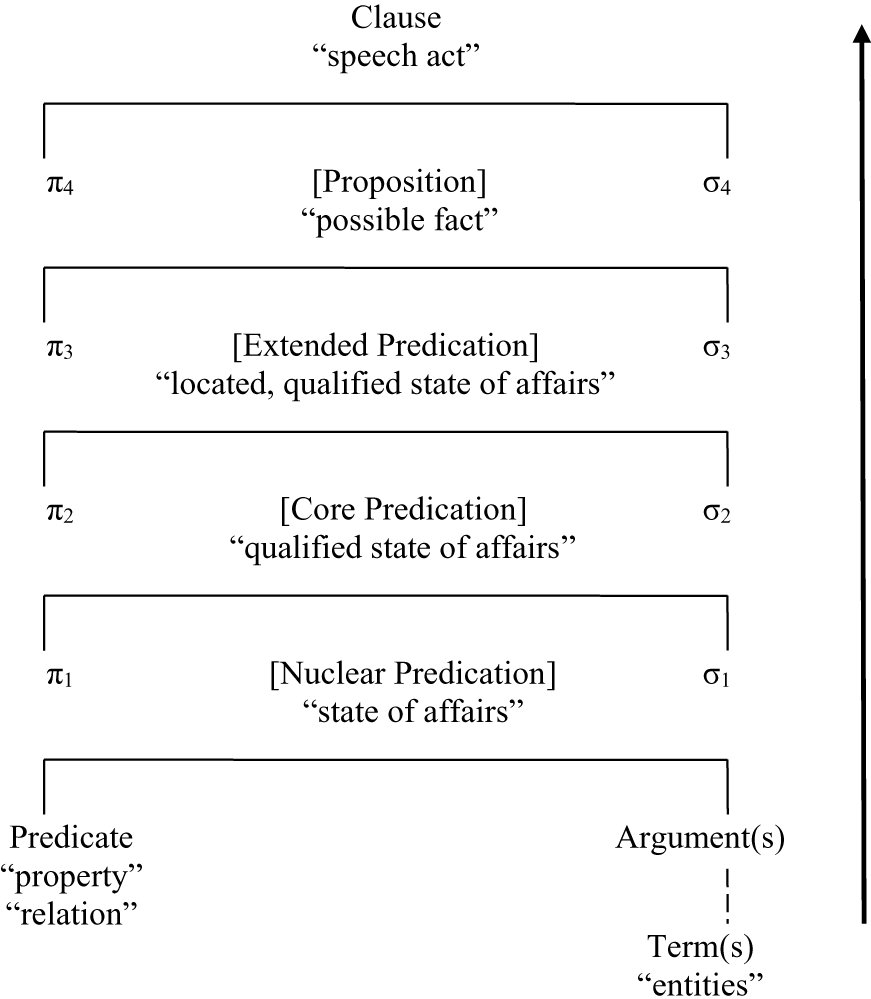
In the model proposed here, it is further claimed that increasing discourse orientation also results in higher clause positions (Narrog Reference Narrog2012, Narrog and Heine Reference Narrog and Heine2021). In fact, corresponding claims about semantic and functional change can be found in parallel in the literature on diachronic aspects of syntactic structure (cf. Narrog and Heine Reference Narrog, Heine, Ledgeway and Roberts2017). The first scholar to propose this directionality of change in syntax was Hengeveld (Reference Hengeveld1989: 142), who suggested that “[d]iachronic developments in the field of operators tend to follow the direction π1 > π2 > π3 > π4”. Within this model of Functional Grammar, this idea can be represented as in Figure 6. Layers of clauses are arranged vertically, with the directionality of change going upwards, in this type of representation.
Layered structure of the clause in FG, according to Dik (Reference Dik1997: 50), with directionality of change (Hengeveld Reference Hengeveld1989: 142) indicated by an arrow.

Similar claims can be found in generative grammar (e.g., Roberts and Roussou Reference Roberts and Roussou2003, van Gelderen Reference van Gelderen2004) and Role-and-Reference Grammar (Matasović Reference Matasović, Kailuweit, Wiemer, Staudinger and Matasović2008). In other words, unlike in van der Auwera’s and Plungian’s (Reference van der Auwera and Plungian1998) hierarchy, the posited direction of change also corresponds to independent analyses of grammar.
While a fair amount of literature trying to identify counterexamples to grammaticalization (de-grammaticalization, anti-grammaticalization) has developed, research trying to identify counterexamples to speaker orientation/subjectification and hearer orientation/Intersubjectification is rather sparse, and literature on presumptive de-textualization or decrease of discourse orientation is to my knowledge almost non-existent. A discussion of the most prominent examples of that literature is provided in Narrog and Heine (Reference Narrog and Heine2021). What has been most frequently claimed is presumptive de-subjectification or objectification (e.g., Herring Reference Herring1991, Kranich Reference Kranich2010, Kinuhata Reference Kinuhata2012). Without going into detail, what has been observed in most cases is a decrease of ‘subjective’ uses of a grammatical form that highlight the speaker’s evaluation or opinion. In fact, it turns out that these uses are typical of relatively early stages of grammaticalization. If a grammatical expression becomes more tightly integrated into grammar and discourse, these ‘subjective’ uses tend to fade away, which is indeed a type of de-subjectification, and might pose a problem for a model of semantic change that posits one-sided increase in subjectivity, especially of the ‘expressive’ type. However, what is posited here is an increasing integration into the internalized world of grammar and speech, with discourse/textual orientation as its pinnacle. It turns out that all examples of loss in expressive speaker or hearer orientation indeed accompany an increase in discourse/textual orientation, thus fitting the model proposed here. Ultimately, it is up to further empirical research to come up with counterexamples.
4. In and out of modality
Lastly, in order to complete this presentation of an alternative view of the ‘pre-’ and ‘post-modal’, in this section, I will address in a little more detail than in section 2 the sources and targets of modal expressions and their place in the diachronic change of modal meanings and functions. I will start with the post-modal (4.1), then discuss the pre-modal (4.2), and finally bilateral change between non-modal and modal categories (4.3).
4.1 The ‘post-modal’
As was already pointed out in section 2.3, very few of the so-called ‘post-modal’ meanings or functions in van der Auwera and Plungian’s (Reference van der Auwera and Plungian1998) semantic map of modality are in fact non-modal; at least, if modality is taken as the expression of undetermined factuality, including possibility and necessity, then most ‘post-modal’ categories are still modal. In fact, the same holds for modality in Bybee et al.’s (Reference Bybee, Perkins and Pagliuca1994) terms of ‘speaker attitude’, since most ‘post-modal’ categories in the semantic map of modality are categorized as modality in Bybee et al. (Reference Bybee, Perkins and Pagliuca1994), also by virtue of their diachronic relationship with core modality.
However, many ‘post-modal’ meanings and functions do differ from core meanings and functions, as typically expressed by auxiliaries in the European languages. Namely, rather than directly expressing the speaker’s estimate of the factuality status of an event, they create discourse or text, and the factuality is only a side effect. In other words, they are discourse-oriented, in the sense broached in this paper (section 3).
This description applies primarily to ‘moods’ such as subjunctive, conditional, and imperative, and clause-connecting functions such as conditional, concessive, or complementation. In the case of the imperative, the discourse orientation is typically in terms of hearer orientation. In the case of all other functions, it is typically in terms of textual orientation – in other words, they are used to connect and build larger pieces of text and discourse from smaller pieces.
To show how far undetermined factuality (i.e., modal status) can extend, I wish to refer to a prominent use of modals in English and other European languages that is not found in Bybee’s data or on van der Auwera and Plungian’s (Reference van der Auwera and Plungian1998) map, one that can easily be interpreted as ‘non-modal’ and therefore ‘post-modal’ but is in fact still strictly speaking ‘modal’. I am referring here to conditional and concessive uses of modals, as in (12):

In these uses, the modals should and may actually refer to facts. In this sense, they would no longer be modal. However, these facts are presented linguistically as factually uncertain, with the modals having the pragmatic function of mitigation or concession. They still contribute to the hearer-speaker interaction and discourse formation on the merit of their original non-factuality.
One anonymous reviewer has volunteered a pragmatic explanation, based on Geurts (Reference Geurts2019) and Verhagen (Reference Verhagen, Dąbrowska and Divjak2015), for this kind of development towards discourse orientation: by default, asserting a proposition commits the speaker to its truth, and invites the addressee to accept its consequences, in other words the relevant inferences. By using a modal expression when a proposition is known to be factually uncertain, speakers automatically reduce the strength of their commitment to the truth of the proposition, as well as the argumentative strength of the utterance. The latter effects, especially when recurrent in language use, allow modal expressions to be used to reduce the strength of speaker commitment as well as hearer-oriented argumentation when the propositions are known to be factually true.
In this way, while such ‘post-modal’ functions refer to real-world facts, their specific use within language is still based on factual indeterminacy. In the case of functions such as subjunctive, conditional, and so on, this should be much less controversial. Finally, as already stated in section 2.2, the future is clearly modal, in that prediction (factual indeterminacy) is an essential part of its meaning. At the same time, it also has temporal function, but there is nothing that precludes a morpheme from concurrently belonging to two categories. Future is a hybrid category that is both a reference to an event located after the time of speech and a prediction about this event, and thus factually indeterminate.
4.2 The ‘pre-modal’
The hierarchical model of grammar advocated here definitely contains linguistic expressions that are ‘pre-modal’, in the sense of being both diachronically prior to and (in terms of event/discourse orientation) lower than modality. In this respect, it presents no significant difference from the model by van der Auwera and Plungian (Reference van der Auwera and Plungian1998). The ultimate sources of grammatical expressions are typically lexical ones, and this also holds for modality (cf. Kuteva et al. Reference Kuteva, Heine, Hong, Long, Narrog and Rhee2019). In the case of modality, source lexical items include a wide range of verbs, adjectives, and sometimes even nouns. Van der Auwera and Plungian (Reference van der Auwera and Plungian1998) include verb meanings such as ‘know’, ‘become’, and ‘happen’ on their map. The World Lexicon of Grammaticalization (Kuteva et al. Reference Kuteva, Heine, Hong, Long, Narrog and Rhee2019) has numerous others as well, such as ‘take’, ‘give’, ‘get’, ‘arrive’, etc. These are doubtlessly ‘pre-modal’, in the same way that, for example, lexical verbs feeding into tense or aspect would be ‘pre-temporal’.
From the perspective of grammatical categories, what might be more interesting here is that other grammatical categories sometimes feed into modality, and even do so rather systematically. I wish to mention here two that are not represented on the semantic map of modality, at least not explicitly, namely voice (passive, spontaneity, potential) and possession.
In a previous study (Narrog Reference Narrog2010a), I found that, in a 200-language sample, with voice categories as the source:
▪ In 10 languages the passive extended to possibility;
▪ In 7 languages spontaneity extended to possibility; and
▪ In 3 languages the passive extended to necessity.
Example (13) illustrates the extension from passive to possibility in the South Asian language Marathi.

It is quite typical that this extension takes place through negation (Narrog Reference Narrog, Nuyts Jan and van der Auwera2016): a thing not being done by someone invites the inference that that someone is unable to do that thing, and this inference may become a habitual part of the expression.
Likewise, possession often extends to modality. Concretely, in 11 languages a possession construction extended to the expression of necessity (cf. English ought to). Ex. (14) illustrates such a case in Amharic:

This also is quite a typical case. A nominalized proposition is attributed to a person via a preposition, and this person incurs the obligation to perform the event described in the proposition. Note that English also has a possession-derived modal (ought to). Again, the acknowledgment of a ‘pre-modal’ area is the one point where the model proposed here does not significantly differ from van der Auwera and Plungian (Reference van der Auwera and Plungian1998). But it is certainly worth noting that there are also a number of other grammatical categories that feed into modality.
4.3 In and out of modality
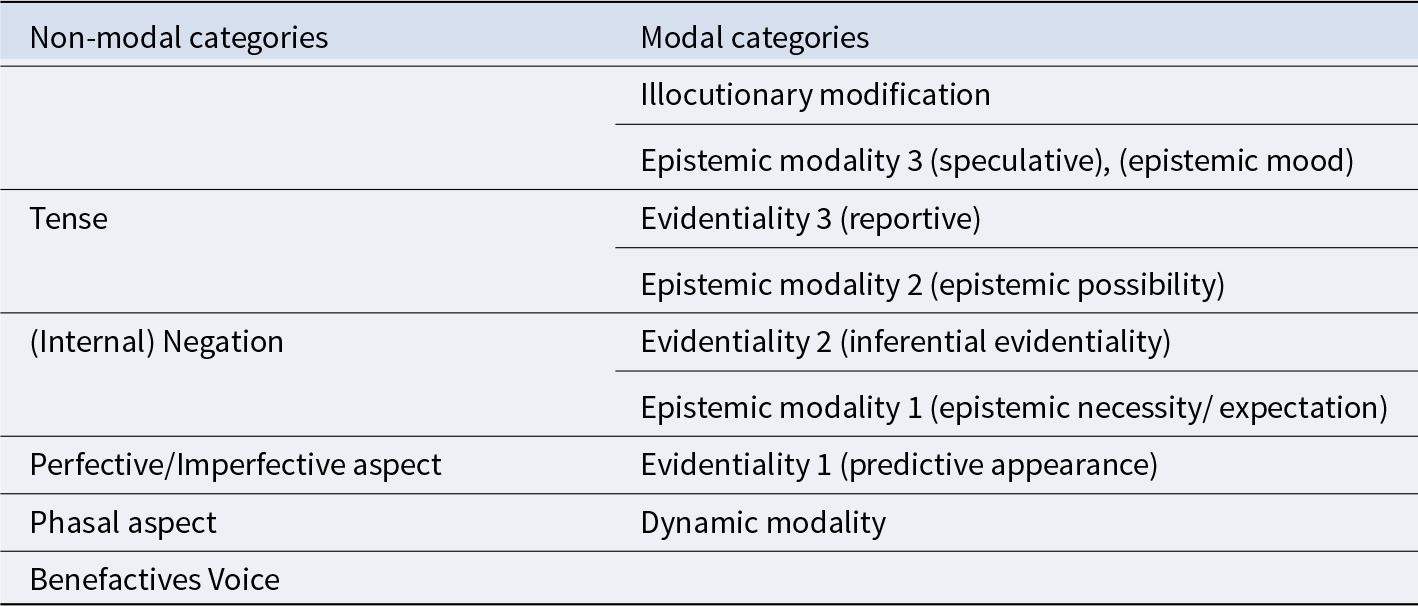
The most intriguing cases of change involving modality may be those where one category serves both as a source and a target for specific modal categories. The treatment of these cases differs distinctly in the model proposed here from that in van der Auwera and Plungian (Reference van der Auwera and Plungian1998). The latter seem to suggest that there is a single layer of modality that has the ‘pre-modal’ as an entrance and the ‘post-modal’ as the exit. However, as discussed briefly in Section 3.4, in models of grammar that analyze sentence structure in terms of layers or levels in some detail, it is clear that modality does not form a single layer but is instead intertwined with other categories such as tense, aspect and negation. Table 1 shows the relationship between modality and other categories in terms of layering based on a set of corpus data from Japanese.Footnote 3
Layering of modality and other categories

Table 1 Long description
Two columns compare non modal categories with modal categories. Under non modal categories, the listed items are tense, epistemic modality 2 with epistemic possibility, internal negation, perfective and imperfective aspect, phasal aspect, and benefactives voice. Under modal categories, the listed items are illocutionary modification, epistemic modality 3 with speculative and epistemic mood, evidentiality 3 with reportive, evidentiality 2 with inferential evidentiality, epistemic modality 1 with epistemic necessity and expectation, evidentiality 1 with predictive appearance, and dynamic modality. Some rows have an entry in only one column, including tense paired with evidentiality 3 reportive, and benefactives voice with no modal category entry.
Generally speaking, it is possible for a category to both feed into modality and be the target of modality, because modality is such a wide category with many subcategories that spread across many levels of clause structure. If the interacting category is also spread across several levels of clause structure that are partially parallel to modality, it is only natural that they both become each other’s source and target. This is the case, for example, with aspect. Similar to modality, this is also a category with many subcategories, spreading across layers, as Table 1 shows, illustrating the layering of modality vis-à-vis other categories. Aspect overlaps with lower levels of modality, enabling change in both directions without violating the principle of change in the direction of discourse orientation (for details about the modal categories, see Narrog Reference Narrog2010b, Reference Narrog2012). In this manner, linguistic expressions may enter and exit modality, but in the latter case, they do not enter a ‘post-modal’ zone. They simply shift into a category that overlaps with modality in terms of layering.
The most prominent case of this different take on the categories in van der Auwera and Plungian’s (Reference van der Auwera and Plungian1998) map (and other maps based on it) is the future. However, as argued above, the future is, in a sense, only a strawman, since the future itself is modal – it is a hybrid modal and temporal category. Future morphemes may extend to serve as the source of epistemic expressions of high probability (cf. Narrog Reference Narrog2012). At the same time, expressions of intention and volition may come to serve a future function. In both cases, the direction of change is towards a more discourse-oriented category that is located higher in the hierarchy of categories, but, arguably, neither source nor target are ‘outside’ of modality.
A grammatical category that likewise interacts with modality both as a source and as a target, and that is genuinely not modal, is aspect. First, there are specific aspectual categories that may extend to modal meanings and functions. Thus, phasal aspect may change into modality. This is the case when a habitual or iterative or stative marker acquires possibility meaning, something that can be observed in a number of languages around the world, as seen in (15) with the Papuan language Imonda.

Here, the pluractional marker uõl has acquired a possibility reading. It is worth mentioning here that cross-linguistically, many possibility markers apparently start out in negated contexts, that is, as negative possibility (cf. Narrog Reference Narrog2010a).
Similarly, proximative markers may acquire evidential meanings, as is the case with ‘threaten’-verbs in a number of Indo-European languages (cf. Heine and Miyashita Reference Heine and Miyashita2007, Reference Heine and Miyashita2008). Not all types of evidentiality are also modal (that is, imply indeterminate factuality), but the type of inferential evidentiality resulting from the extension of proximative markers is.
The apparent opposite, namely a change from a modal expression to an aspectual expression, is observed when a marker of intention acquires proximative meaning. This has been claimed at least for Lakota (Pustet Reference Pustet, Abraham and Leiss2008), and can be illustrated with (16):

According to Pustet (Reference Pustet, Abraham and Leiss2008), the verb níca underwent a change from ‘lack’ to ‘want’ and then to the aspectual meaning of ‘be about to’. Verbs of ‘intention’ like ‘want’ are low in grammaticalization and discourse orientation, and thus may extend to an aspectual category.
In conclusion, then, there is not modality with ‘pre-modal’ and ‘post-modal’ zones on either side, but there is modality resulting from grammaticalization from lexical and sometimes grammatical categories and overlapping with other categories. While there are certainly categories located lower than modality that feed into it and might be called ‘pre-modal’, there is no well-defined ‘post-modal’ area, since modality seems to feed primarily into categories that, upon closer scrutiny, are revealed as either still modal (Section 4.1), or, if not, on a level that intertwines and overlaps with modality (this section). Categories can serve both as a source and a target if they (partially) overlap with modality in terms of sentence structure and degree of discourse orientation, and the change does not violate the principle of increase in discourse orientation.
5. Summary
This article dealt with the main topic of the conference from which it emerged, namely van der Auwera and Plungian’s (Reference van der Auwera and Plungian1998) semantic map of modality, and suggested a different representation of the category, based on an alternative interpretation of the data.
This alternative model is based on the two dimensions of volitivity and discourse orientation. Among the two, discourse orientation, rather than the sequence ‘pre-modal’—‘modal’—‘post-modal’, is definitional for directionality of change. Furthermore, discourse orientation is related to layered (hierarchical) models to sentence structure.
This has a number of ramifications that show diachronic data concerning modality in a fundamentally different light. The one thing that remains virtually unchanged between these models is the fact that modal categories grammaticalize from lexical ones, as all other grammatical categories do, and, more rarely, from other grammatical ones. These categories can be called ‘pre-modal’, but there is nothing that really unifies them.
On the other hand, the perception of modality itself and of the categories it may change into is radically different. Modality consists of many sub-categories that stretch across a wide range of degrees of event orientation vs. discourse orientation, and likewise across several layers of sentence structure, apparently to a greater degree than any other category except negation. As seen in Section 4.3, when modality overlaps with the temporal categories of tense and aspect, which also range across several layers of sentence structure, it can be both source and target of change, so long as the direction of the concrete change is towards more, or at least not less, discourse orientation. In the light of these facts, the view of modality as a closed field, with sources that are all ‘pre-modal’ and targets that are all ‘post-modal’, appears rather misleading. Rather, modality is interconnected with other categories at the same level of discourse orientation and of sentence structure. Furthermore, as argued in Section 4.1, few of the categories that develop in the later stages of the life of modal expressions are actually ‘post-modal’. Most are simply more discourse/text-oriented than the categories typically associated with core modal expressions such as the English modals, but remain fundamentally still modal. However, these are areas that are both theoretically and empirically still underexplored.
Acknowledgements
I wish to thank two anonymous reviewers for their substantial input to this paper. The research on which this paper is based was supported by grant number 24K03859 of the Japanese Society for the Promotion of Science.