Introduction
Compassion fatigue (CF) is often described as the cost of caring by those caregivers [i.e., healthcare providers (HCPs) who perform direct clinical activities with patients] who experience trauma and suffering, as well as a caregiver's emotional burden of being unable to resolve suffering (Boyle and Bush, Reference Boyle and Bush2018; Sullivan et al., Reference Sullivan, Crabtree and Baker2019). CF, according to the Professional Quality of Life Scale V, consists of both secondary traumatic stress and burnout (Stamm, Reference Stamm2010). Secondary traumatic stress is defined as stress related to learning about other people's previously suffered trauma (Stamm, Reference Stamm2010). Secondary traumatic stress is often associated with difficulty sleeping, intrusive images, and avoiding situations that remind the person of the stressful events (Stamm, Reference Stamm2010). Burnout, which is more gradual, is associated with hopelessness and difficulty doing one's work (Stamm, Reference Stamm2010). CF is linked with depression, exhaustion, anger, frustration, decreased job satisfaction, intrusive thoughts, and hopelessness (Stamm, Reference Stamm2010; Sullivan et al., Reference Sullivan, Crabtree and Baker2019). HCPs as caregivers are at high risk of developing CF. Factors that increase HCPs’ likelihood of developing CF include unresolved guilt and trauma, having limited experience in the healthcare profession, and utilizing ineffective coping skills (Wu et al., Reference Wu, Singh-Carlson and Odell2016; Boyle and Bush, Reference Boyle and Bush2018; Sullivan et al., Reference Sullivan, Crabtree and Baker2019). Ultimately, CF often predicts HCPs’ increased absenteeism and tardiness, providers’ decreased work performance, and providers leaving their position (Boyle and Bush, Reference Boyle and Bush2018). Because CF is intricately linked with provider burnout, scholars recommend that researchers consider both constructs simultaneously (Wu et al., Reference Wu, Singh-Carlson and Odell2016).
In contrast to CF is compassion satisfaction, which is the pleasure a person obtains from their work and from helping other people (Stamm, Reference Stamm2010). Some research in HCPs indicates that CF can be mitigated by increasing resilience, the psychological concept that describes a person's ability to overcome negative experiences through personal growth and change (Zander et al., Reference Zander, Hutton and King2013). In one study of resilience, Zander et al. (Reference Zander, Hutton and King2013) found that HCPs believe that resilience is a skill that can be cultivated life long, using their past positive and negative experiences, and various self-care strategies including talking, seeking out support, and self-care.
A population of HCPs at particularly high risk of developing CF is those who work in pediatric hematology, oncology, and bone marrow transplant (PHOB). PHOB HCPs have elevated CF risk related to their repeated exposure to patients with significant morbidity and mortality (Boyle and Bush, Reference Boyle and Bush2018). Some PHOB HCPs may sacrifice their own psychological well-being for their patients, and these providers can develop long-standing relationships with families because of patients’ prolonged, complex treatment courses (Wu et al., Reference Wu, Singh-Carlson and Odell2016). Additionally, PHOB HCPs must often cope with emotional burden as part of patient care, including burden associated with chemotherapy and other medical treatments, moral and ethical dilemmas, grief, bereavement, and managing boundaries with patients and families (Zander et al., Reference Zander, Hutton and King2013). Pediatric cancer, impacting children from birth through age 19, impacts approximately 300,000 children per year worldwide (World Health Organization, 2018). Cancer occurs globally; therefore, it is critically important that medical institutions recruit and retain enough HCPs to care for patients’ physical and emotional needs. CF and workplace stress among PHOB HCPS occur globally, which can increase staff turnover and decrease the availability of providers for the vulnerable pediatric oncology population (Gi et al., Reference Gi, Devi and Kim2011).
This paper presents an integrative review of what is known about CF in PHOB HCPs. As stress is a precursor to and is intricately linked with CF and burnout, a review of stress in PHOB HCPs is included. The following specific research questions guided the review: (1) “What leads to CF in PHOB HCPs and (2) What interventions are best to decrease CF in this population?” Although CF research among PHOB HCPs is limited, (Sullivan et al., Reference Sullivan, Crabtree and Baker2019) a clear synthesis of best available evidence to characterize HCPs who are at the highest CF risk, identify risk factors and effective and emerging CF interventions may help guide clinical and policy decision-makers.
Methods
The integrative review followed the methodology of Whittemore and Knafl (Reference Whittemore and Knafl2005). The search strategy was developed in consultation with a medical librarian. The following databases were used to search the literature: PubMed, Cumulative Index to Nursing and Allied Health Literature (CINAHL), PsycINFO, and Web of Science MEDLINE. The search was performed in September 2020 with no limits placed on age, publication date, language, or type of article initially. The search strategy included the keywords “child” OR “adolescent” OR “infant” AND “physician assistant” OR “nurse” OR “nursing staff” OR “physician” AND “neoplasm” OR “hematologic diseases” OR “oncology” AND “CF” OR “vicarious trauma” OR “burnout” as Medical Subject Headings (MeSH) and individually as text words in titles and abstracts. Synonyms were included and truncation was used when appropriate to broaden the search.
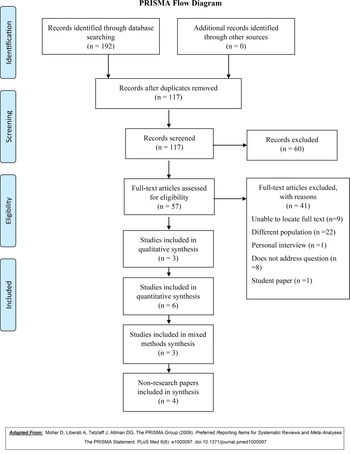
The Preferred Reporting Items for Systematic Reviews and Meta-Analysis (PRISMA) flow diagram in Figure 1 provides an overview of the process (Moher et al., Reference Moher, Liberati and Tetzlaff2009). COVIDENCE software was used to streamline and organize the review. The database search resulted in 192 records, with no other records added from other sources. After duplicates were removed, 117 records remained. Titles and abstracts were assessed for eligibility based on the following inclusion criteria: English language and PHOB population. Records were excluded for the following reasons: did not address question, wrong study population, mixed study population where PHOB HCPs were only part of the population, articles about moral distress as this is a similar but not the same topic as CF, conference abstracts, and book chapters. The remaining 57 full-text articles were further reviewed. Additional reasons for exclusion on full-text review included inability to locate full text, personal interviews, and student course papers. For full articles that could not be located, an extensive search was completed to attempt to locate including contacting the authors and using the medical librarian. Sixteen records were included in the final synthesis (Figure 1).
PRISMA flow diagram.

Results
Characteristics of selected articles
A total of 16 articles published between 1997 and 2020 met the inclusion criteria for this review and were included in the final analysis. The Johns Hopkins Nursing Evidence-Based Practice (JHNEBP) model was used to evaluate the quality and strength of records (Dang and Dearholt, Reference Dang and Dearholt2017). This model, developed by Johns Hopkins University, guides the researcher to ask a question, search the evidence for answers, and critically appraise the evidence for value and relevance and helps the researcher to incorporate new findings into patient care (Dang and Dearholt, Reference Dang and Dearholt2017). The studies included the following designs: literature review, quality improvement project, qualitative descriptive, quasi-experimental, mixed methods, and non-experimental.
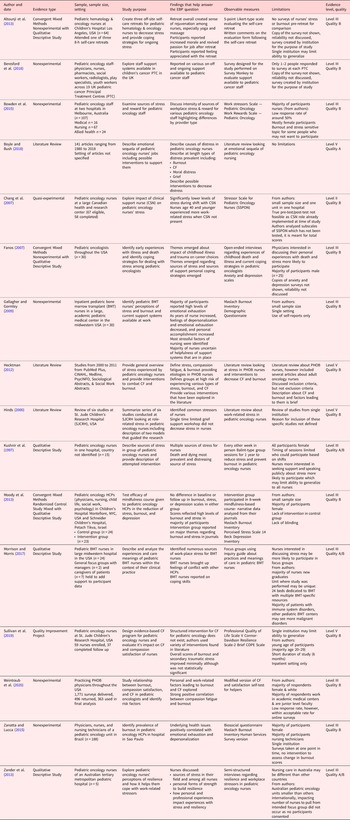
Using the JHNEBP approach, articles were classified as research or non-research. Out of the included articles, three were qualitative, six were quantitative, three were mixed methods, and four were non-research papers. Research studies were given an evidence level of I, II, or III, while non-research articles were given a level of IV or V. Studies ranged from level III to V except for one study with evidence rating II. All studies had quality ratings of A/B or B except for one study with quality rating A. Refer to Table 1 for a summary of the evidence.
Individual evidence summary

Studies took place in Australia (2), Brazil (1), Canada (1), Israel (1), the UK (1), and the USA (8). Studies included various types of PHOB HCPs, including nurses, nursing technicians, physicians, social workers, pharmacists, psychologists, and child life specialists. Ten articles focused solely on nurses. In two studies, participants worked only in pediatric bone marrow transplant. Except for Fanos (Reference Fanos2007), who reported majority male participants, studies had a majority of female participation. Three distinct themes were identified: (1) groups at high risk of experiencing stress, (2) common sources of stress in PHOB HCPs, and (3) workplace interventions to mitigate stress.
High-risk populations for PHOB HCPs
PHOB HCPs with fewer years of work experience, especially those with less than 5 years of work experience, and those under age 40 years, were at higher risk than their colleagues of developing CF (Chang et al., Reference Chang, Kicis and Sangha2007; Gallagher and Gormley, Reference Gallagher and Gormley2009; Hecktman, Reference Hecktman2012; Boyle and Bush, Reference Boyle and Bush2018). Those who work the night shift reported higher levels of stress and perceived having less emotional support than day shift colleagues (Chang et al., Reference Chang, Kicis and Sangha2007; Gallagher and Gormley, Reference Gallagher and Gormley2009). Females tended to report greater depressive symptoms (Fanos, Reference Fanos2007) and have higher rates of CF than men (Weintraub et al., Reference Weintraub, Sarosi and Goldberg2020). PHOB HCPs with a history of a close friend or family member's death and/or unresolved trauma in their personal lives were more likely to experience burnout and CF (Fanos, Reference Fanos2007; Boyle and Bush, Reference Boyle and Bush2018). Personal history of health issues including childhood illness was associated with increased emotional exhaustion (Fanos, Reference Fanos2007; Zanatta and Lucca, Reference Zanatta and Lucca2015).
Sources of stress in PHOB HCPs
Not surprisingly, working with children who are dying and frequently witnessing multiple deaths in a short time were the most stressful facets PHOB HCPs reported about their career (Kushnir et al., Reference Kushnir, Rabin and Azulai1997; Fanos, Reference Fanos2007; Gallagher and Gormley, Reference Gallagher and Gormley2009; Zander et al., Reference Zander, Hutton and King2013; Bowden et al., Reference Bowden, Mukherjee and Williams2015). Additionally, HCPs reported that witnessing suffering while feeling helpless to fix it and witnessing patients’ deterioration following relapse are stressful (Kushnir et al., Reference Kushnir, Rabin and Azulai1997; Fanos, Reference Fanos2007; Zander et al., Reference Zander, Hutton and King2013; Bowden et al., Reference Bowden, Mukherjee and Williams2015; Boyle and Bush, Reference Boyle and Bush2018).
Nurses, specifically, reported additional sources of stress. These included having complex role responsibilities because of the demanding field in which they work (Hecktman, Reference Hecktman2012; Zander et al., Reference Zander, Hutton and King2013; Boyle and Bush, Reference Boyle and Bush2018). Other causes for increased stress were frequent short staffing, shift work, and conflicts with colleagues (e.g., perceiving that their opinions are not valued by management and/or medical staff) (Kushnir et al., Reference Kushnir, Rabin and Azulai1997; Gallagher and Gormley, Reference Gallagher and Gormley2009; Hecktman, Reference Hecktman2012; Zander et al., Reference Zander, Hutton and King2013; Morrison and Morris, Reference Morrison and Morris2017; Weintraub et al. (Reference Weintraub, Sarosi and Goldberg2020) similarly reported conflicts with colleagues as a source of stress for physicians. Because of the nature and chronicity of the diagnoses, many PHOB HCPs described having complex relationships with patients’ families, sometimes perceiving that they have been surrogate caregivers (i.e., performing the parental role) for patients when parents cannot be at the bedside. The advent and increasing usage of social media exacerbate these issues, leading to the increasingly common blurring of professional boundaries with families (Kushnir et al., Reference Kushnir, Rabin and Azulai1997; Gallagher and Gormley, Reference Gallagher and Gormley2009; Hecktman, Reference Hecktman2012; Morrison and Morris, Reference Morrison and Morris2017; Boyle and Bush, Reference Boyle and Bush2018). Social media leads to increased opportunities for the crossing of professional boundaries by allowing HCPs to have relationships with patients and their families outside of work. Through social media, HCPs share personal information, pictures, and videos and write messages to families outside of work, which may impact their personal life (Boyle and Bush, Reference Boyle and Bush2018). All of this that has been found about social media is consistent with decades of research that has shown nurses are at particularly high risk of breaching therapeutic relationships with their patients (Manfrin-Ledet et al., Reference Manfrin-Ledet, Porche and Eymard2015).
Workplace interventions to mitigate stress in PHOB HCPs
Per the integrative review, most interventions to mitigate PHOB provider stress have not been widely studied. Various types of group offerings, such as debriefing sessions following patient deaths and support groups, appear to have some benefit for PHOB HCPs (Kushnir et al., Reference Kushnir, Rabin and Azulai1997; Beresford et al., Reference Beresford, Gibson and Bayliss2018; Boyle and Bush, Reference Boyle and Bush2018). However, Hinds (Reference Hinds2000) reported that a single group workshop without continued follow-up may be harmful because such an offering could bring stressful feelings to the forefront of the HCPs’ minds without a further outlet. Specific for nurses, having access to a clinical support nurse (CSN) may decrease nurses’ work-related stress (Chang et al., Reference Chang, Kicis and Sangha2007; Hecktman, Reference Hecktman2012; Boyle and Bush, Reference Boyle and Bush2018). The CSN does not have a patient assignment, but rather provides additional assistance to nurses and patients, thus increasing nurses’ perceptions of workplace support (Chang et al., Reference Chang, Kicis and Sangha2007). Social workers, psychologists, and chaplains are important parts of intervention programs to provide additional expertise and support (Hecktman, Reference Hecktman2012; Beresford et al., Reference Beresford, Gibson and Bayliss2018; Boyle and Bush, Reference Boyle and Bush2018). Education regarding sources of stress and ways to mitigate stress also appears to decrease PHOB HCPs’ stress levels (Boyle and Bush, Reference Boyle and Bush2018; Sullivan et al., Reference Sullivan, Crabtree and Baker2019).
Published studies discussed several unique, comprehensive intervention programs. Moody et al. (Reference Moody, Kramer and Santizo2013) reported on an 8-week mindfulness-based course for PHOB HCPs, for which subjective data from diaries show benefits of the course with decreased stress, more inner peace, fewer somatic complaints, and improved compassion and joy. Altounji et al. (Reference Altounji, Morgan and Grover2013) trialed a full-day retreat away from the hospital for PHOB nurses consisting of multiple presentations and discussions, yoga, massage, and a walk on the beach with participants reporting rejuvenation and revived passion for their job following the retreat. Sullivan et al. (Reference Sullivan, Crabtree and Baker2019) created a program that included various types of education (i.e., sleep hygiene, nutrition, and CF), development of a respite room with yoga mats for PHOB HCPs, and monthly remembrance times to honor deceased patients. The utility of such programs is variable. Despite the subjectively reported benefits of these comprehensive interventions to decrease provider stress and burnout, objective findings are less consistent. For example, Sullivan et al. (Reference Sullivan, Crabtree and Baker2019) and Moody et al. (Reference Moody, Kramer and Santizo2013) did not find statistically significant decreases in objectively assessed burnout and stress.
Discussion
Minimizing the PHOB HCPs’ CF is imperative for healthcare organizations because it can lead to a myriad of HCPs’ physical and psychological problems that can predict provider burnout, provider absenteeism, and HCPs leaving their positions (Stamm, Reference Stamm2010; Boyle and Bush, Reference Boyle and Bush2018; Sullivan et al., Reference Sullivan, Crabtree and Baker2019). PHOB is a field with constant exposure to suffering, death, relapses, difficult family scenarios, and challenging treatment regimens, all of which increase the likelihood of provider CF (Zander et al., Reference Zander, Hutton and King2013; Boyle and Bush, Reference Boyle and Bush2018). Although PHOB HCPs should learn personal techniques to cope with stress, hospitals should proactively have interventions in place to minimize the stress and CF for which this vulnerable population is at risk. This integrative review highlights sources of stress for PHOB HCPs as well as interventions that may mitigate PHOB HCPs’ CF.
Four of 16 included articles found that younger HCPs and those newer to the field are at particularly high risk of stress that may contribute to developing CF (Chang et al., Reference Chang, Kicis and Sangha2007; Gallagher and Gormley, Reference Gallagher and Gormley2009; Hecktman, Reference Hecktman2012; Boyle and Bush, Reference Boyle and Bush2018). Organizations should be aware of CF risk and should tailor interventions for new employees. Additional research is needed to determine whether new PHOB HCPs would benefit from education about CF, CF resources, and appropriate CF coping during new-employee orientation, as part of a broader intervention. Future studies may also evaluate whether new PHOB HCPs could benefit from CF-specific mentorship from a more senior member of their department. Future studies may evaluate the relative value of education, mentorship, and other sources of support for new employees. Additionally, given that there tends to be more support available during the day, nightshift HCPs often report additional stress in comparison to their dayshift colleagues (Chang et al., Reference Chang, Kicis and Sangha2007; Gallagher and Gormley, Reference Gallagher and Gormley2009). When looking at interventions to decrease CF, organizations should be aware and should look at interventions that are available for nightshift as well, to ensure that all staff are equally supported.
This integrative review sought to answer the question “What leads to CF in PHOB HCPs?” The literature uncovered multiple likely contributors to PHOB HCPs’ stress. Although factors such as witnessing death and suffering cannot be changed, HCPs report several potentially modifiable sources of workplace stress, including short staffing, shift working, and conflict with colleagues (Kushnir et al., Reference Kushnir, Rabin and Azulai1997; Gallagher and Gormley, Reference Gallagher and Gormley2009; Hecktman, Reference Hecktman2012; Zander et al., Reference Zander, Hutton and King2013; Morrison and Morris, Reference Morrison and Morris2017; Weintraub et al., Reference Weintraub, Sarosi and Goldberg2020). Management should be aware of the impact of short staffing and conflict on the psychological health of their employees and do their best to minimize these experiences from occurring. Future research should evaluate whether team-building exercises, conflict resolution training, and/or rounding meetings in which HCPs can voice staffing/shift concerns with administrators could help mitigate PHOB HCPs’ workplace stress and, ultimately, their CF.
Although not yet studied, factors associated with HCPs’ self-selected career paths (e.g., individual characteristics and personality traits) could also explain variance in HCPs’ CF over time. Using non-HCP samples, previous studies have found that personality characteristic variation tends to predict workplace stress and burnout (Alarcon et al., Reference Alarcon, Eschleman and Bowling2009). Furthermore, scholars have posited that HCPs’ personality traits play a role in their choice of healthcare discipline and subspecialty (Vijendren et al., Reference Vijendren, Yung and Sanchez2016), making HCPs’ personality characteristics a potential confound in evaluating CF across disciplines. Consistent with the notion that some HCPs may self-select their discipline and subspecialty based on preexisting individual characteristics, researchers have found that a subset of nurses enters the nursing profession as an opportunity to care for other people and that nurses tend to be high in traits related to empathy and altruistic ideals (Eley et al., Reference Eley, Eley and Bertello2002). Regarding physicians, extant research has shown that physicians’ personality traits tend to differ by subspecialty (Pappas et al., Reference Pappas, Gouva and Gourgoulianis2016; Surbeck et al., Reference Surbeck, Samuel and Spieler2020), but that physicians, in general, may be particularly high in extroversion compared to other personality dimensions (Kwarta et al., Reference Kwarta, Pietrzak and Miśkowiec2016). Individual characteristics, like personality traits, that vary across and within different HCP subspecialties may play a role in the extent to which some HCPs may be at greater CF risk than others. Indeed, HCPs’ individual characteristics, including characteristics that may have influenced their decision to enter their chosen discipline and field, may offer an important avenue for future research to identify potential CF predictors. Further research is needed to further identify individual characteristics that predict CF as well as whether CF intervention effectiveness may be moderated by these individual characteristics. This integrative review also sought to answer the question “What interventions are best to decrease CF in PHOB HCPs?”. The literature identifies various interventions to combat PHOB HCPs’ CF. Unfortunately, most interventions lack robust empirical efficacy data, and additional research is needed to identify specific protective mechanisms of change in these interventions. These data are similar to that found in adult oncology nurses. In an integrative review of interventions to combat CF for adult oncology nurses, Wentzel and Brysiewicz (Reference Wentzel and Brysiewicz2017) found that single-day retreats, yoga, education-based classes, use of psychosocial professionals in interventions, music-based interventions, and mindfulness-based courses were the most effective. Although multi-day courses may be of benefit, when they occur outside regular work hours, they may be challenging for staff who must balance their demands at home with work life. For single-day retreats, employers should consider offering several sessions and should work with staff to allow adequate clinical coverage for everyone interested in attending the retreat. Given that many PHOB HCPs are consistently exposed to stressors that put them at risk of developing CF, additional studies of interventions that span greater periods are warranted. These studies should also longitudinally track PHOB HCPs’ stress, burnout, and CF to evaluate whether initial intervention gains persist over time (Boyle and Bush, Reference Boyle and Bush2018).
Multiple studies about PHOB HCPs reported on the benefit of debriefing after patient deaths and noted the importance of including psychological support in any intervention to combat CF (Kushnir et al., Reference Kushnir, Rabin and Azulai1997; Hecktman, Reference Hecktman2012; Beresford et al., Reference Beresford, Gibson and Bayliss2018; Boyle and Bush, Reference Boyle and Bush2018). Hospitals can implement regular group debriefing sessions for PHOB HCPs following patient deaths and challenging patient experiences in collaboration with social workers, psychologists, and chaplains. Additionally, hospitals may implement one-on-one sessions for PHOB HCPs with psychological support staff for individual concerns. Due to the benefit of a CSN in decreasing stress for PHOB nurses, PHOB institutions should consider opening a position of CSN to offer additional support to the bedside nurse (Chang et al., Reference Chang, Kicis and Sangha2007; Hecktman, Reference Hecktman2012; Boyle and Bush, Reference Boyle and Bush2018). In general, the CSN is a more senior nurse who does not hold a clinical assignment that day, which nurses report aids in decreasing work-related stress (Chang et al., Reference Chang, Kicis and Sangha2007). For hospitals that are unable to hire CSNs, nurses with greater experience in the field and leadership potential may be able to fill the functions of this role. For example, charge nurses and other senior nurses in leadership positions are often available to assist bedside nurses, even in the absence of a true CSN.
Based on current literature, it is unclear which interventions are the best to reduce PHOB HCPs’ CF. Findings from this paper should be taken as suggestions until additional research is able to replicate the findings. Interventions may be different for everyone, and some staff may not require interventions. A combination of several of the interventions discussed may be beneficial to ensure that all staff can benefit. PHOB leadership should consider the specific needs of their staff, funding, and their organization's feasibility when identifying interventions to combat CF. Management must consider the financial implications of these programs, and institutions may need to seek grant funding for more costly intervention programs (e.g., retreats and multi-session courses). These financial considerations should consider the financial burden associated with PHOB provider burnout and turnover, which may be mitigated by effective CF intervention programs. Given that some institutions do not have funding to devote to CF interventions, research is needed to identify low-cost and no-cost interventions.
A gap in this literature is that most of the research on PHOB provider CF is specific to nurses. In this review, 10 of the articles were specific to nurses, 2 focused on physicians only, and 4 included multiple types of caregivers, including physicians, nurses, psychologists, child life specialists, and social workers. Although physicians were in only a minority of the studies, these studies were included as the paper aimed to evaluate the role of the interdisciplinary team on CF. Similar to the research in nurses, Fanos (Reference Fanos2007) discovered that physicians find the time of relapse and death to be the most stressful time. Additionally, male physicians struggle to discuss their emotions more than female physicians, similar to the literature with nurses (Fanos, Reference Fanos2007). Physicians with a history of personal life-threatening illness, loss of loved one, and survival of violence have higher rates of CF and burnout (Fanos, Reference Fanos2007; Weintraub et al., Reference Weintraub, Sarosi and Goldberg2020). PHOB physicians find a variety of ways to cope with the stress of the career, including focusing on the patients who survive, immersing themselves in research, exercise, engaging in creative arts, prayer, socializing with others, and developing hobbies (Fanos, Reference Fanos2007; Weintraub et al., Reference Weintraub, Sarosi and Goldberg2020). Nurses are at the patient bedside at all hours day and night, while other HCPs may more readily come and go, which may explain why much of the CF literature focuses solely on nurses. Additional research is needed to further explore CF in physicians, physician assistants, nurse practitioners, and other members of the team, including factors that predict CF and interventions to mitigate CF, as sources of stress may be different from those of bedside nurses. Future work may also choose to evaluate CF among the psychosocial team members who support PHOB populations, as a dearth of literature has explored this group's risk factors.
Limitations
There were several limitations of this integrative review. Five of the articles occurred outside of the USA, although all in Western countries, with a sixth (Moody et al., Reference Moody, Kramer and Santizo2013) set in both the USA and Israel. Given the vast differences in healthcare delivery worldwide, results may vary based on the nationality of each study's sample. The settings and outcomes of interest varied widely across studies, making a comparison between the studies challenging. Articles including both PHOB and non-PHOB HCPs in the study population were excluded, which may have eliminated some CF intervention studies. Additional research is needed to determine whether the unique stressors associated with PHOB care provision do place PHOB HCPs at heightened risk of CF and burnout. As the interventions discussed are not replicated and are not of high quality, they should be taken as suggestions until additional research is completed about interventions to decrease CF.
Conclusion
This integrative review provides a better understanding of which HCPs are at greatest risk for CF precursors (i.e., stress and burnout), specific predictors of PHOB HCPs’ CF, and interventions to help mitigate CF. Repeated exposures to death, dying, relapse, and suffering without agency to mitigate these family stressors have been linked with PHOB HCPs’ secondary trauma responses. Unfortunately, although researchers have begun evaluating several interventions to minimize PHOB HCPs’ CF, the literature does not support a specific approach. Rather, multiple interventions, including retreats, education sessions, mindfulness training, debriefing sessions, use of a CSN, and inclusion of psychosocial team members (e.g., chaplains, psychologists, and clinical social workers), are likely to have the greatest impact. Additional research is needed to identify the most efficacious and effective interventions to combat CF, including interventions that can feasibly be offered regularly. Research about CF specific to disciplines other than nurses, including physicians, physician assistants, nurse practitioners, and psychosocial team members, is needed to better understand CF causes, correlates, and universality of intervention approach effectiveness. The psychological health of employees is vital to the functioning of healthcare institutions. Hospital leaders can use the information presented in this integrative review to better evaluate CF risk for their PHOB staff and to create appropriate interventions to alleviate this concern.
Funding
This research received no specific grant from any funding agency, commercial, or not-for-profit sectors.
Conflict of interest
The authors have no disclosures to report.