Presentations of abstracts at national meetings provide a venue to allow for rapid dissemination of new research. The ultimate goal of these abstract presentations should be eventual publication to allow for further in-depth analysis of the research performed and move the field forward. Previous studies have shown various abstract publication rates depending on which meeting was evaluated. In addition, multiple variables have been associated with improved likelihood for eventual journal publication.Reference Chand, Rosenfeldt and Pepe 1 – Reference Fosbol, Fosbol, Harrington, Eapen and Peterson 5
Data exist for publication rates from paediatric meetings, as well as from general cardiovascular and cardiovascular sub-speciality meetings.Reference Chand, Rosenfeldt and Pepe 1 – Reference Manuck, Barbour, Janicki, Blackwell and Berghella 4 , Reference Abuzeid, Fosbol and Fosbol 6 – Reference Wong, Wong and Wong 9 These data suggest that type of presentation, subject matter investigated, and research methodologies are just some variables that may affect subsequent publication. No data exist concerning publication rates of paediatric cardiac sub-speciality abstracts.
The goal of this study was to document the manuscript publication rate for paediatric cardiac echocardiography abstracts presented at a national meeting and to determine whether there were differences between abstracts that were published versus those not published.
Methods
This retrospective study involved review of paediatric abstracts presented at the annual American Society of Echocardiography Meeting. This is the largest meeting in the United States of America dealing specifically with cardiovascular imaging. The abstract selection process for this meeting is double-blinded. The Nationwide Children’s Hospital Institutional Review Board determined that this study did not fit the definition of human subjects research under 45 CFR part 46.102(f); therefore, Institutional Review Board evaluation was waived.
All abstracts presented from 2007 through 2011 at the annual American Society of Echocardiography Meeting were reviewed by two reviewers (A.M. and J.K.). Both reviewers had to agree to include the abstract for review. If there was a disagreement, a third reviewer made the final decision to include the abstract for review or not (C.C.). An abstract was either accepted or rejected to be reviewed only when all three reviewers came to a unanimous agreement on its suitability. The time frame allowed at least 5 years for subsequent publication of the most recent abstracts presented. Abstracts were obtained from the Journal of the American Society of Echocardiography, which routinely publishes accepted abstracts one month before this meeting. Abstracts were considered to be paediatric if they were included in the paediatric sub-section of the meeting. In addition, abstracts presented in other sub-sections of the meeting, but had a strong paediatric congenital component within the abstract, were also included for analysis. For example, abstracts involving adult congenital heart patients but presented in another sub-section were included for analysis. Again, if there were any questions about an abstract, all three reviewers had to come to a unanimous agreement on the suitability of the abstract.
PubMed was used as the search engine to determine whether an abstract was published or not. The last name of the first author was entered into PubMed. If no match was obtained, the last name of the senior author was entered. If no match occurred again, keywords within the abstract were used for search parameters. This algorithm allowed for the largest search parameter available.Reference Fosbol, Fosbol, Harrington, Eapen and Peterson 5 If no matching results appeared, the abstract was considered not to be published. If a match was found using this algorithm, the abstract and article were analysed to determine whether this was an appropriate match. Articles assessing the same end points in the same number of study groups of the same or slightly increased sizes, leading to the same conclusions, with similar authors compared with the respective abstract were considered published.Reference Winnik, Raptis and Walker 8 A.M. and J.K. used the exact same algorithm for the search process as described. If there were any concerns about abstract and paper correlation, all three reviewers again had to unanimously agree either to accept or reject the match.
Abstracts were divided into various categories that have previously been documented to predict subsequent publication. The year of abstract presentation, type of presentation (oral versus poster), and subject material studied were recorded. Furthermore, each abstract was evaluated to determine whether it was a prospective versus a retrospective study or a clinical versus basic science study. These variables were analysed to determine whether there were differences between published versus unpublished abstracts.
Dates and times from presentation until publication were documented for published abstracts. The publishing journal and corresponding 2016 impact factor, as determined by the citation indexing and search service of the ISI (Institute of Scientific Information) Web of Science (Thomson Reuters), were recorded. Additionally, published abstracts were evaluated by type of presentation – oral versus poster – and methodology – prospective versus retrospective – to determine whether there were differences in time until publication or impact factor of the journal.
All data are presented as means and standard deviations unless otherwise stated. Fisher’s exact tests or χ2 tests were used for analysis as appropriate. First “Time to Publication” analysis was performed. Presentations were grouped by type: oral or poster. Kaplan–Meier type curves were generated using the time to publication in years as the event, with a limit of 5 years. Presentations that were not published or not published within 5 years of presentation were censored. Comparisons of the curves generated were performed using the log-rank (Mantel–Cox) test. All analyses were conducted using GraphPad. p<0.05 was considered statistically significant.
Results
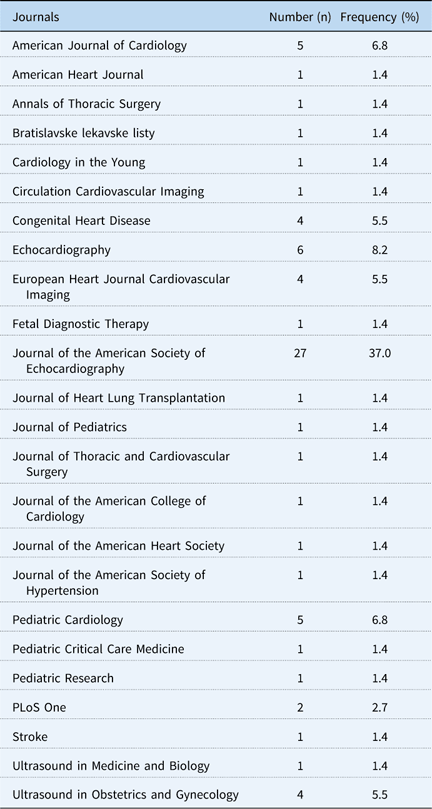
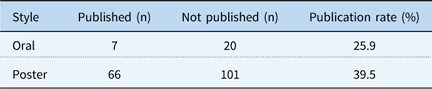
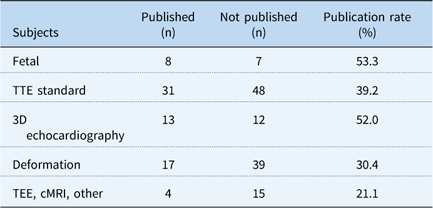
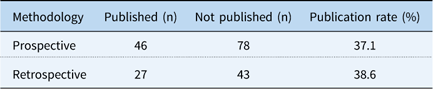
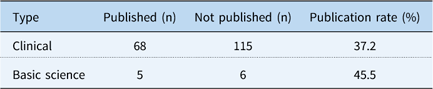
A total of 194 abstracts were reviewed. In all, 27 abstracts were oral presentations and 167 were poster presentations. A total of 124 abstracts were prospective studies and 70 were retrospective studies; 11 abstracts were basic science studies and 183 were clinical studies. Altogether, 25 abstracts dealt with three-dimensional echocardiography, 15 with fetal echocardiography, 56 with deformation analysis, 79 with standard transthoracic echocardiography, and 19 were categorised as “other”. A total of 73 abstracts were subsequently published – with a 37.6% publication rate – 2.1±1.7 years after presentation. The majority of the abstracts were published in the Journal of the American Society of Echocardiography (Table 1).
Journals.

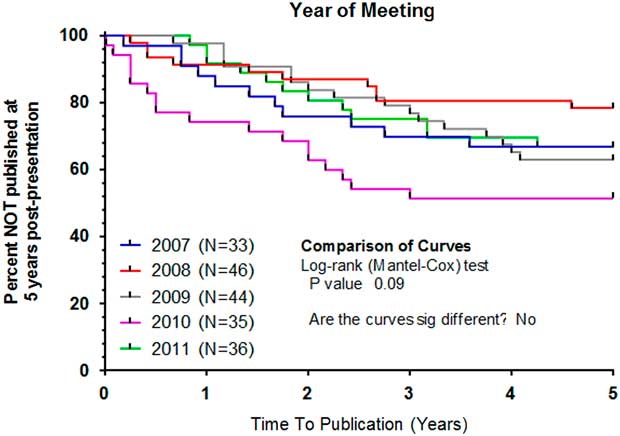
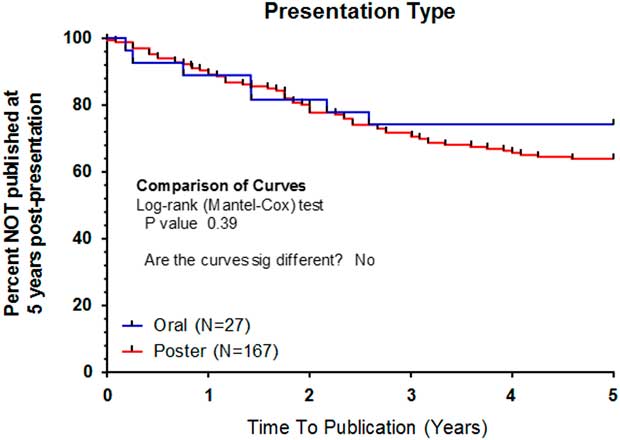
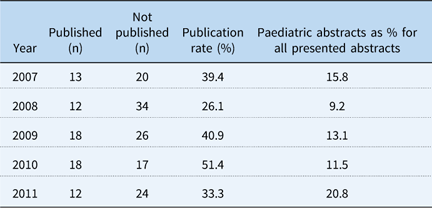
There were no significant differences in publication rates based on abstract presentation year, p=0.20 (Table 2) (Fig 1). Oral versus poster presentation also did not have a difference in publication rates, p=0.20 (Table 3) (Fig 2). In addition, there were no differences in subject material studied, p=0.23 (Table 4), methodology, p=0.88 (Table 5), and clinical versus basic science abstracts, p=0.75 (Table 6), between published versus unpublished abstracts. No abstract reviewed was based on a randomised controlled study method.
Publication rates based on abstract presentation year over time.

Publication rates based on abstract presentation type over time.

Abstract presentation year.

p=0.20
Abstract presentation style.

p=0.20
Abstract presentation subject material.

3D=three dimensional; cMRI=cardiac MRI; TEE=transoesophageal echocardiography; TTE=transthoracic echocardiography
p=0.23
Abstract presentation methodology.

p=0.88
Abstract presentation type.

p=0.75
There were no significant differences in journal impact factor between oral versus poster presentations – 3.8±0.4 versus 3.4±2.1, p=0.63 – or time to publication – 1.3±0.9 years versus 2.2±1.7 years, p=0.15. Similarly, there were no significant differences in prospective versus retrospective studies journal impact factor – 3.6±1.2 versus 3.4±3.0, p=0.65 – or time to publication – 2.0±1.8 years versus 2.4±1.6 years, p=0.40.
Discussion
Depending on the conference and medical discipline evaluated, publication rates may vary from 10 up to 80.Reference Scherer, Langenberg and von Elm 10 Specifically, in the adult cardiac field, publication rates vary from 25 to 50%.Reference Fosbol, Fosbol, Harrington, Eapen and Peterson 5 , Reference Abuzeid, Fosbol and Fosbol 6 , Reference Winnik, Raptis and Walker 8 , Reference Wong, Wong and Wong 9 In addition, certain characteristics of presented abstracts have been shown to be different for abstracts that eventually get published such as prospective, randomised studies, basic science studies, and oral presentation.Reference Macdonald, Parsons and Davenport 3 – Reference Abuzeid, Fosbol and Fosbol 6 , Reference Winnik, Raptis and Walker 8 , Reference Wong, Wong and Wong 9 , Reference Castagnetti, Subramaniam and El-Ghoneimi 11 In this study, the publication rate for paediatric abstracts presented at the American Society of Echocardiography meeting between 2007 and 2011 was 37.6%, with the time to publication approximately 2 years. In addition, there were no characteristic differences between published versus unpublished abstracts, which is contrary to previous reports.
The publication rate of 37.6% falls within the range of publication rates for abstracts presented at major cardiology meeting.Reference Fosbol, Fosbol, Harrington, Eapen and Peterson 5 , Reference Abuzeid, Fosbol and Fosbol 6 , Reference Winnik, Raptis and Walker 8 , Reference Wong, Wong and Wong 9 One study noted that there were no paediatric cardiology abstracts that were subsequently published when analysing these abstracts as a subset of the entire Canadian Cardiovascular Congress Meeting,Reference Abuzeid, Fosbol and Fosbol 6 and thus these data are reassuring in the sense that paediatric cardiology abstracts that are presented at a major cardiovascular meeting may eventually get published. However, when evaluating the major electrophysiologic cardiology sub-speciality meeting, another paper documented a 47.7% publication rate.Reference Wong, Wong and Wong 9 There was no comment about paediatric cardiology electrophysiology in the latter meeting. The data from this current study could be considered a sub-sub-speciality as it involved paediatrics within the imaging field within the general cardiology field. The other papers cited did not analyse paediatric cardiology sub-speciality abstract characteristics as a variable, and thus no comment can be made about paediatric publication rates for those meetings.Reference Fosbol, Fosbol, Harrington, Eapen and Peterson 5 , Reference Winnik, Raptis and Walker 8 , Reference Wong, Wong and Wong 9 The reasons for the lack of publication may be manifold and mostly based on conjecture, but in general likely fall into two possibilities: a paper never being written from the abstract or a paper being written but subsequently rejected after the peer review process. That being said, one way to negate the first possibility is for meetings to require investigators to send a full manuscript describing the work if the abstract is accepted for presentation. This option would likely lead to a decrease in abstract submissions. The question then arises, what is the goal for abstract presentations at meetings; rapid dissemination of new research despite possible multiple flaws in the research in the hopes of stimulating more research or publication of abstracts into manuscripts with a more in-depth analysis of the study. Ideally, both would occur, but if only one is possible organisers of meetings need to decide their priority. Regardless, this is beyond the scope of this paper.
Contrary to previous reports, there were no specific variables that were different between published versus unpublished abstracts in this study. The most often cited variables from previous studies that were different for subsequent published abstracts were prospective, randomised studies, basic science studies, and oral presentations.Reference Dahllof, Wondimu and Maniere 2 – Reference Abuzeid, Fosbol and Fosbol 6 , Reference Winnik, Raptis and Walker 8 , Reference Wong, Wong and Wong 9 , Reference Castagnetti, Subramaniam and El-Ghoneimi 11 The field of paediatric imaging does not lend itself well to prospective, randomised trials. That being said, even prospective, non-randomised studies did not appear to have a higher publication rate than retrospective studies. Basic science abstracts did have a higher acceptance rate in this study, but this was not significant. Interestingly, although not significant, oral presentations had a lower publication rate than poster presentations. This was a little surprising as oral presentations are in general deemed a higher quality than poster presentations and thus are more likely to be published.Reference Dahllof, Wondimu and Maniere 2 , Reference Abuzeid, Fosbol and Fosbol 6 There may be multiple reasons for the lack of significance in these variables. Even though 5 years’ worth of abstracts were evaluated, it was still an overall small number analysed compared with the adult data that studied hundreds to thousands of abstracts in each of those studies.Reference Fosbol, Fosbol, Harrington, Eapen and Peterson 5 , Reference Abuzeid, Fosbol and Fosbol 6 , Reference Winnik, Raptis and Walker 8 , Reference Wong, Wong and Wong 9 It is possible that if more abstracts were evaluated significance may have been found. Another possibility is that the topic of paediatric imaging is so specialised that the other variables are not robust enough to affect overall publication rates. There are likely other possibilities yet to be determined that may explain the lack of significance compared with previous studies.
In a similar vein, there were no significant differences in oral and prospective abstracts being published sooner or in higher-impact journals than poster and retrospective studies, respectively.Reference Fosbol, Fosbol, Harrington, Eapen and Peterson 5 This would suggest that presentation type and methodology play a minimal role in subsequent publication of these abstracts for this meeting. In addition, the mean of 2.1 years until publication is only slightly longer than previous reports of medians of 1.2–1.9 years until publication in the adult cardiology studies.Reference Chand, Rosenfeldt and Pepe 1 , Reference Goldman and Loscalzo 12 , Reference Liu and Danziger 13 Nevertheless, an average time of 2 years is still not ideal when trying to advance scientific information. Further work is needed to determine how to accelerate the process of publishing scientifically sound material.
There are multiple limitations to this study. The main limitation of this study is that owing to focussing on a small sub-speciality, the number of abstracts analysed was low, and therefore some of the analysis may be underpowered to detect differences. However, the p values obtained were relatively high, and thus a much higher “n” would be required to make findings significant. It is also possible that publication rates may have been underestimated if the search algorithm missed corresponding manuscripts. Only one search engine was used, PubMed; therefore, publications may be present in other databases such as EMBASE or Google Scholar. Although a minimum of 6 years have passed since the most recent abstracts, it is possible that publications may still be forthcoming from these abstracts. However, one would have to question how relevant a 5-year-old publication would be to the scientific field. The abstracts evaluated are from a paediatric sub-speciality field within cardiology, and thus general statements to other paediatric meetings cannot be made. Finally, this study could not answer the question as to how many abstracts were never written in manuscript form, how many abstracts were written, but were subsequently rejected after the peer review process, or how many abstracts that were rejected for presentation at this meeting subsequently were published. One would have to assume that the latter publication rate would be even lower than the rate currently documented.Reference von Elm, Costanza, Walder and Tramer 14
In conclusion, a paediatric cardiac echocardiography abstract publication rate of 37.6%, 2.1±1.7 years after presentation is comparable to previous documented publication rates and timing for other meetings. No differences in variables analysed were noted between published versus unpublished abstracts. Further research is needed to determine how to improve the rate and speed of publication for scientifically sound studies.
Acknowledgements
None.
Financial Support
This research received no specific grant from any funding agency or commercial or not-for-profit sectors.
Conflicts of Interest
None.
Ethical Standards
This study did not involve the use of any human or animal subjects. The Nationwide Children’s Hospital Institutional Review Board determined that this study did not fit the definition of human subjects research under 45 CFR part 46.102(f); therefore, Institutional Review Board evaluation was waived.