1 Introduction
Residual properties have been widely discussed for infinite discrete groups. Let
$\mathcal C$
 be a class of groups. A group G is said to be residually
$\mathcal C$
 if for every
$g \in G\setminus \{e\}$
 , there exists a homomorphism
$f: G \to C$
 onto some group
$C \in \mathcal C$
 such that
$f(g)$
 is nontrivial. The property of residual finiteness admits several generalisations, most notably the concept of LERF: a group G is said to be locally extended residually finite (LERF) if for any finitely generated subgroup
$H \leq G$
 and any
$\gamma \in G \setminus H$
 , there is a homomorphism f from G onto a finite group such that
$f(\gamma )\notin f(H)$
 .
The LERF-ness of groups is a property closely related to low-dimensional topology and has been widely studied. Large classes of groups are known to be LERF: for example, finitely generated free groups [Reference Hall6], closed orientable hyperbolic surface groups [Reference Scott13], compact Seifert fibre space groups [Reference Scott13], Sol manifold groups [Reference Mal’cev8] and hyperbolic 3-manifold groups [Reference Agol1, Reference Wise19]. In fact, by [Reference Sun15], a compact (with empty or tori boundary) orientable irreducible 3-manifold M has
$\pi _1(M)$
 LERF if and only if M supports one of Thurston’s eight geometries. Moreover, by [Reference Wilton17], limit groups are LERF, which generalises both the cases of free groups and surface groups. However, nontrivial graph manifold groups are not LERF [Reference Niblo and Wise11], noncompact arithmetic hyperbolic m-manifold groups with
$m>3$
 , and compact arithmetic hyperbolic m-manifold groups with
$m>4$
 (except when defined by octonions with
$m=7$
 ) are not LERF [Reference Sun15].
The LERF-ness admits a broader generalisation through the restriction of its finite quotients to a more specific class, for example, the class of alternating groups
$\mathcal A$
 and symmetric groups
$\mathcal S$
 .
Definition 1.1. Let H be a subgroup of a finitely generated group G and let
$\mathcal C$
 be a class of groups. We say that H is
$\mathcal C$
 -separable in G if for any finite set
$\{\gamma _1, \ldots , \gamma _n\} \subset G \setminus H$
 , there is a surjective homomorphism f from G to a group in
$\mathcal C$
 such that
$f(\gamma _i) \notin f(H)$
 for all i.
Note that
$\mathcal C$
 -separability is a property of a certain subgroup. In particular, if the trivial subgroup of G is
$\mathcal C$
 -separable, then G is residually
$\mathcal C$
 .
Notation. Throughout this paper,
$F_r$
 is a free group of rank
$r>1$
 and
$H^g=gHg^{-1}$
 is the conjugation of a subgroup H by g. For a set V,
$|V|$
 denotes the cardinality of V.
In [Reference Wilton18], Wilton showed that the finitely generated infinite-index subgroups of free groups are
$\mathcal A$
 -separable.
Theorem 1.2 [Reference Wilton18, Theorem A]
Let H be a finitely generated subgroup of infinite index in the free group
$F_r$
 and let
$\{\gamma _1, \ldots , \gamma _n\}$
 be any finite set of
$F \setminus H$
 . Then, there is a surjection f from
$F_r$
 to some finite alternating group
$A_k$
 such that
$f(\gamma _i) \notin \, f(H)$
 for all i.
Wilton also conjectured that the conclusion of Theorem 1.2 holds for closed orientable hyperbolic surface groups. In 2021, Buran [Reference Buran2] confirmed Wilton’s conjecture. Moreover, he generalised this result to right-angled Coxeter groups, and provided a complete characterisation of the
$\mathcal A$
 -separability and the
$\mathcal S$
 -separability of convex-cocompact subgroups.
We investigate the residual properties and the
$\mathcal C$
 -separability of free products of groups. It is well known that both the residual finiteness and LERF-ness are preserved under taking free products (see [Reference Burns3, Reference Romanovskii12]). In 1984, Tamburini and Wilson [Reference Tamburini and Wilson16] studied the residually alternating property of the free products of residually finite groups.
Theorem 1.3 [Reference Tamburini and Wilson16, Theorem 1]
Let G be a free product of at least two nontrivial residually finite groups. Then, G is residually alternating unless G is the infinite dihedral group
$\mathbb Z/2\mathbb Z\ast \mathbb Z/2\mathbb Z$
 .
Note that LERF groups are residually finite and if the trivial subgroup of G is
$\mathcal A$
 -separable, then G is residually alternating. It is natural to ask the following question.
Question 1.4. Which kinds of subgroups are
$\mathcal A$
 -separable or
$\mathcal S$
 -separable in free products of LERF groups?
By combining the methods in [Reference Gitik5, Reference Wilton18], we show that there exists a class of
$\mathcal A \cup \mathcal S$
 -separable subgroups in the free product of a LERF group with a free group
$F_r$
 of rank
$r>1$
 .
Theorem 1.5. Let G be a LERF group and let
$H\leq F_r\ast G$
 be a finitely generated subgroup. Then, H is
$\mathcal A \cup \mathcal S$
 -separable in
$F_r\ast G$
 if one of the following holds:
-
(1) $H \cap F_r^{\gamma }=1$
 for every
$\gamma \in F_r \ast G$
; or
-
(2) $H \cap F_r^{\gamma } \neq 1$
and has infinite index in
$F_r^{\gamma }$
for some
$\gamma \in F_r \ast G$
.


Since every finitely generated infinite-index subgroup of
$F_r$
 satisfies the hypothesis in Theorem 1.5, the following immediate corollary represents a generalisation of Theorem 1.2 regarding the
$\mathcal A$
 -separability of free groups.
Corollary 1.6. Any finitely generated infinite-index subgroup of
$F_r$
 is
$\mathcal A \cup \mathcal S$
 -separable in the free product
$F_r \ast G$
 , where G is a LERF group.
Note that
$\mathcal A \cup \mathcal S$
 -separable means the quotient is required to be either an alternating or a symmetric group. Since G is an arbitrary LERF group, no uniform modification method seems to exist that would guarantee the quotient is precisely an alternating group. Moreover, the hypothesis of ‘infinite index’ is essential. The following example shows there exist finite-index subgroups that are not alternating separable in such a free product.
Example 1.7. Let
$F_2=\langle a,b \mid - \rangle $
 ,
$G=\langle c \mid c^2\rangle $
 . We consider
$\phi : F_2 \ast G \to \mathbb Z/2\mathbb Z$
 given by
$\phi (a)=\phi (b)=1$
 ,
$\phi (c)=0$
 . Then,
$\ker \phi $
 is a finitely generated normal subgroup of
$F_2\ast G$
 of index 2. For any surjection
$f: F_2\ast G \to A_n$
 ,
$f(\ker \phi )$
 is normal in
$A_n$
 with index at most 2. If
$n=3$
 or
$n\geq 5$
 , then
$A_n$
 is simple and, hence,
$f(\ker \phi )=A_n$
 ; if
$n=4$
 , then
$f(\ker \phi )$
 is again
$A_n$
 because the only proper normal subgroup of
$A_4$
 is of index 3. Thus,
$\ker \phi $
 is not
$\mathcal A$
 -separable.
To prove Theorem 1.5, we construct a relative Cayley graph of
$F_r \ast G$
 . This graph corresponds to the 1-skeleton of a primary sheeted cover of the representation complex associated with
$F_r \ast G$
 . The action of
$F_r \ast G$
 on its vertex set is then used to demonstrate
$\mathcal A \cup \mathcal S$
 -separability.
This paper is organised as follows. In Section 2, we review some topological tools, such as labelled graphs and precovers, to prepare for proving the main results. In Section 3, we review the specific construction of Wilton in [Reference Wilton18] and bring in Jordan’s theorem. In Section 4, we introduce the Markus-Epstein algorithm to provide a more concrete characterisation of the structure of subgroups defined by labelled graphs. Finally, in Section 5, we employ Wilton’s construction and the Markus-Epstein algorithm to prove Theorem 1.5.
2 Preliminaries
In this section, we review some notions and properties of LERF-ness and the topology of graphs. Let
$G=\langle X \mid R \rangle $
 be a group and

2.1 Labelled graphs and embedding
A graph is a one-dimensional CW-complex consisting of two sets
$\mathrm {V}$
 and
$\mathrm {E}$
 representing the 0-cells and 1-cells, respectively, and two functions
$\mathrm {E} \to \mathrm {E}$
 and
$\mathrm {E} \to \mathrm {V}$
 . We call
$e \in \mathrm {E}$
 an edge and
$v \in \mathrm {V}$
 a vertex. For each
$e \in \mathrm {E}$
 , there is an element
$\bar {e} \in \mathrm {E}$
 and an element
$\iota (e)\in \mathrm V$
 , satisfying
$\bar {\bar {e}}=e$
 and
$\bar {e} \neq e$
 . A map of a graph consists of a pair of functions preserving the structure, and mapping edges to edges and vertices to vertices.
A graph
$\Gamma $
 is called a labelled graph (with the group
$G=\langle X \mid R \rangle $
 ) if it is equipped with a labelling function,
$\mathrm {Lab}: \mathrm {E}(\Gamma ) \to X^\ast $
 , satisfying
$\mathrm {Lab}(\bar {e})=\mathrm {Lab}(e)^{-1}$
 and the immersion condition:
$e_1=e_2$
 provided
$\mathrm {Lab}(e_1)=\mathrm {Lab}(e_2)$
 and
$\iota (e_1)=\iota (e_2)$
 . The label of a path
$p=e_1 e_2\cdots e_n \subset \Gamma $
 is defined by
$\mathrm {Lab}(p) \equiv \mathrm {Lab}(e_1)\cdot \mathrm {Lab}(e_2)\cdots \mathrm {Lab}(e_n)\in G$
 .
If, in addition, any path p with
$\mathrm {Lab}(p)=1$
 is closed, then
$\Gamma $
 is called G-based. For each vertex v and each word
$g \equiv x_1 x_2 \cdots x_n$
 , since
$\Gamma $
 is a labelled graph, there is a unique path p in
$\Gamma $
 originating from v with
$\mathrm {Lab}(p) \equiv x_1 x_2 \cdots x_n$
 . The subgroup

is called the subgroup of G determined by the graph
$\Gamma $
 .
Let
$x \in X^\ast $
 . A vertex
$v \in \mathrm {V}(\Gamma )$
 is called x-saturated if there exists
$e\in \mathrm {E}(\Gamma )$
 with
$\iota (e)=v$
 and
$\mathrm {Lab}(e)=x$
 . If
$\Gamma $
 is x-saturated for any
$x \in X^\ast $
 at any
$v \in \mathrm {V}(\Gamma )$
 , then
$\Gamma $
 is called
$X^\ast $
 -saturated.
A map
$\pi : \Gamma \to \Delta $
 of two labelled graphs is an immersion if it is injective on the set
$\{e \in \mathrm {E}(\Gamma ) \mid \iota (e)=v\}$
 of all vertices of
$\Gamma $
 . In addition, if
$\pi $
 preserves the labels of edges, then it is called a morphism of labelled graphs. If
$\pi $
 is an injective morphism, then it is called an embedding and we say
$\Gamma $
 embeds in the graph
$\Delta $
 .
Remark 2.1. A labelled graph is also called a well-labelled graph (see [Reference Markus-Epstein9, Reference Markus-Epstein10]). Any labelled graph of a free group
$F_r$
 is
$F_r$
 -based.
2.2 Relative Cayley graph
For a group
$G=\langle X \mid R \rangle $
 , we denote the Cayley graph of G with respect to the given generating set X by
$\mathrm {Cay}(G)$
 . Recall that
$\mathrm {Cay}(G)$
 is an oriented graph with the vertex set
$\mathrm {V}(\mathrm {Cay}(G))=G$
 and the edge set
$\mathrm {\mathrm {E}}(\mathrm {Cay}(G))= G \times X^\ast $
 . An edge
$(g,x) \in \mathrm {E}(\mathrm {Cay}(G))$
 originates at g and terminates at
$gx$
 .
For any subgroup
$H\leq G$
 , we denote by
$\mathrm {Cay}(G,H)$
 the Cayley graph of G relative to the subgroup H of G, which is an oriented graph with vertex set consisting of all the right cosets of H,
$\mathrm {V}(\mathrm {Cay}(G,H)):=\{Hg\mid g\in G\}$
 , and edge set
$\mathrm {E}(\mathrm {Cay}(G,H))=\mathrm {V}(\mathrm {Cay}(G,H)) \times X^\ast $
 . We write
$\mathrm {Cay}(G,H,H \cdot 1)$
 when the base point
$H \cdot 1$
 is emphasised. An edge
$(Hg,x)$
 originates from the vertex
$Hg$
 and ends at
$Hgx$
 . Moreover, a path p originating from
$Hg$
 must end at
$Hg\mathrm {Lab}(p)$
 . This gives the following result.
Lemma 2.2. Let
$H\leq G$
 be a subgroup of G. A path p originating from the base point
$H\cdot 1$
 in
$\mathrm {Cay}(G,H, H \cdot 1)$
 is a loop if and only if
$\mathrm {Lab}(p)\in H$
 . Hence,

The following lemma shows that G-based graphs are subgraphs of the relative Cayley graphs.
Lemma 2.3 [Reference Gitik5, Lemma 1.5]
Let
$G=\langle X \mid R \rangle $
 be a group and let
$(\Gamma ,v_0)$
 be a graph labelled with X. Denote
$\mathrm {Lab}(\Gamma ,v_0)=H$
 . Then:
-
(1) $\Gamma $
is G-based if and only if it can be embedded in
$\mathrm {Cay}(G,H,H \cdot 1)$
; -
(2) $\Gamma $
is G-based and
$X^\ast $
-saturated if and only if it is isomorphic to
$\mathrm {Cay}(G,H,H \cdot 1)$
.


Note that
$\mathrm {Cay}(G)$
 and
$\mathrm {Cay}(G,H)$
 are naturally labelled with the generating set X of G, and there are natural actions of G on
$\mathrm {V}(\mathrm {Cay}(G))$
 and
$\mathrm {V}(\mathrm {Cay}(G, H))$
 given by left translation. The relative Cayley graph
$\mathrm {Cay}(G,H)$
 can be defined as the quotient of
$\mathrm {Cay}(G)$
 by the action of H. Moreover,
$\mathrm {Cay}(G,H)$
 can be viewed as the 1-skeleton of a covering space of the representation complex of G, so we follow the terminology of Gitik [Reference Gitik5] and refer to the ‘cover’ as the relative Cayley graph.
Scott [Reference Scott13] described the residually finite and LERF properties by the embeddability from subgraphs to covers. Gitik [Reference Gitik5] rephrased Scott’s result as follows.
Theorem 2.4 [Reference Gitik5, Theorem 1.1]
Let
$G=\langle X \mid R \rangle $
 be a group:
-
(1) G is residually finite if and only if for any finite tree $\Gamma $
, which is a subgraph of the Cayley graph of G, there exists a finite-index subgroup
$H_0$
of G such that
$\Gamma $
can be embedded in
$\mathrm {Cay}(G,H_0)$
; -
(2) G is LERF if and only if for any finitely generated subgroup H of G and for any finite connected subgraph $(\Gamma ,H \cdot 1)$
of
$\mathrm {Cay}(G,H, H \cdot 1)$
, there exists a finite-index subgroup
$H_0$
of G such that
$(\Gamma ,H \cdot 1)$
can be embedded in
$\mathrm {Cay}(G,H_0,H_0 \cdot 1)$
.


2.3 Precover
The notion of precover was defined by Gitik in [Reference Gitik5] and then actively employed by Markus-Epstein to study algorithmic problems in amalgams of finite groups in [Reference Markus-Epstein9, Reference Markus-Epstein10].
Let
$G_1$
 and
$G_2$
 be two groups with generating sets X and Y, respectively, such that
$X^\ast \cap Y^\ast = \emptyset $
 , and let
$A=G_1 \mathop {\ast } G_2$
 be the free product of
$G_1$
 and
$G_2$
 .
Definition 2.5. Let
$\Gamma $
 be a graph labelled with
$X \cup Y$
 .
-
(1) A subgraph of $\Gamma $
is called monochromatic if it is labelled only with X or only with Y. An X-component (respectively Y-component) of
$\Gamma $
is a maximal connected subgraph of
$\Gamma $
labelled with X (respectively Y). -
(2) A vertex v in $\mathrm {V}(\Gamma )$
is called X-monochromatic (respectively Y-monochromatic), if all edges connected to v are labelled with X (respectively Y). Otherwise, v is called bichromatic. -
(3) We call $\Gamma $
a precover of A, if it is A-based, and each X-component of
$\Gamma $
is a cover of
$G_1$
and each Y-component of
$\Gamma $
is a cover of
$G_2$
.


There is an equivalent description of an A-based graph as follows.
Lemma 2.6 [Reference Gitik5]
If
$A=G_1 \ast G_2$
 is a free product, then any graph labelled with
$X \cup Y$
 is A-based if and only if each
$G_i$
 -component is
$G_i$
 -based for
$i=1,2$
 . In particular, it is A-based if each monochromatic component is a cover of the corresponding free factor.
Lemma 2.7. Let
$\Gamma $
 be a finite, connected, A-based graph labelled with
$X \cup Y$
 and
$\Gamma _1$
 be an X-component. Let P be a loop in
$\Gamma $
 starting from
$v_1 \in \Gamma _1$
 . If
$1 \neq \mathrm {Lab}(P) \in G_1$
 , then there is a loop
$P'$
 in
$\Gamma _1$
 starting from
$v_1$
 such that
$\mathrm {Lab}(P')=\mathrm {Lab}(P)$
 .
Proof. We denote
$P = P_1P_2 \cdots P_n$
 , where each
$P_j\, (1\leq j\leq n)$
 is a maximal connected subpath labelled only with X or Y. Then,
$\mathrm {Lab}(P_j) \in G_i$
 for some
$i\in {1, 2}$
 . Since
$\mathrm {Lab}(P) =\mathrm {Lab}(P_1)\mathrm {Lab}(P_2)\cdots \mathrm {Lab}(P_n) \in G_1$
 and A is a free product of
$G_1$
 and
$G_2$
 , we have
$\mathrm {Lab}(P_i)=1$
 for each
$P_i$
 labelled with Y. Then,
$P_i$
 must be closed because
$\Gamma $
 is A-based. Moreover, as
$P_i$
 is maximal, both
$P_{i-1}$
 and
$P_{i+1}$
 are contained in X-components with
$\tau (P_{i-1})=\iota (P_{i})=\tau (P_{i})=\iota (P_{i+1})$
 . This implies
$P_{i-1}$
 and
$P_{i+1}$
 are contained in the same X-component. So we can remove
$P_i$
 and combine
$P_{i-1}$
 with
$P_{i+1}$
 as a new monochromatic component. After removing all such
$P_i$
 , we obtain a loop
$P'$
 that starts from
$v_1$
 and is contained in the X-component
$\Gamma _1$
 such that
$\mathrm {Lab}(P')=\mathrm {Lab}(P)$
 .
The precover of free products has a key property.
Lemma 2.8 [Reference Gitik5, Lemma 2.4]
For any groups
$G_1=\langle X \mid R \rangle $
 and
$G_2=\langle Y \mid T \rangle $
 , each precover of
$G_1 \ast G_2$
 can be embedded in a cover of
$G_1\ast G_2$
 with the same set of vertices.
2.4 Pushout and folding
Pushout, considered by Stallings [Reference Stallings14], is an effective way of constructing a new graph from old graphs. For example, in the category of labelled graphs, if
$\alpha _1:\Gamma \to \Delta _1$
 and
$\alpha _2:\Gamma \to \Delta _2$
 are injective maps, then the amalgam of
$\Delta _1$
 and
$\Delta _2$
 denoted by
$\Delta _1 \mathop {\ast }\limits _{\Gamma } \Delta _2$
 is given by the pushout of
$\alpha _1$
 and
$\alpha _2$
 :

In general, none of the graphs need be connected and none of the maps need be injective. Pushouts do not always exist. The pushout of
$\alpha _1:\Gamma \to \Delta _1$
 and
$\alpha _2:\Gamma \to \Delta _2$
 exists if and only if there are orientations of
$\Gamma $
 ,
$\Delta _1$
 and
$\Delta _2$
 which are preserved by
$\alpha _1$
 and
$\alpha _2$
 . If we only consider the case in which both
$\alpha _1$
 and
$\alpha _2$
 are injective maps, the amalgam can be constructed by performing foldings.
Let
$f: \mathrm {E}(\Gamma ) \to X^\ast $
 be a function on the graph
$\Gamma $
 such that
$f(\bar {e})=(f(e))^{-1}$
 . For any two distinct edges
$e_1, e_2\in \mathrm {E}(\Gamma )$
 with
$\iota (e_1)=\iota (e_2)$
 and
$e_1 \neq \bar {e}_2$
 , if
$f(e_1)=f(e_2)$
 , then the folding
$(e_1,e_2)$
 is the projection of
$\Gamma $
 onto the quotient graph
$\Gamma _1$
 which is constructed by identifying
$e_1$
 with
$e_2$
 and
$\tau (e_1)$
 with
$\tau (e_2)$
 . After performing a finite sequence of foldings as far as possible, the corresponding graph of
$\Gamma $
 is indeed a labelled graph. It can be easily seen that the above amalgam of
$\alpha _1$
 and
$\alpha _2$
 can be constructed by taking the disjoint union of graphs, identifying
$\alpha _1(\Gamma )$
 with
$\alpha _2(\Gamma )$
 and then performing a finite sequence of foldings until a labelled graph is obtained.
3 Wilton’s proof for free groups
In this section, we recall the specific structure of Wilton’s proof that any finitely generated infinite-index subgroup of a free group with rank greater than one is
$\mathcal A$
 -separable.
3.1 Jordan’s theorem
An action of a group H on
$\{1,2,\ldots ,n\}$
 is called symmetric or alternating according to whether the image of
$H\to S_n$
 is
$S_n$
 or
$A_n$
 . A subgroup
$G \leq S_n$
 is called transitive if it acts transitively on
$\{1,2,\ldots ,n\}$
 , and it is called primitive if, in addition, it does not preserve any nontrivial partition.
The main tool for proving Lemma 3.3 is Jordan’s theorem, which gives a criterion for an action to be symmetric or alternating.
Theorem 3.1 (Jordan’s theorem [Reference Dixon and Mortimer4])
For each
$k> 2$
 , there exists N such that if
$n> N$
 ,
$G \leq S_n$
 is a primitive subgroup and there exists
$\gamma \in G \setminus \{e\} $
 which moves fewer than k elements, then
$G=S_n$
 or
$A_n$
 .
Note that if
$G \leq S_n$
 is transitive, then the cardinality of any partition preserved by G divides n. Therefore, if p is prime, then
$G\leq S_p$
 is primitive if and only if G is transitive. The next result is an immediate corollary of Theorem 3.1.
Lemma 3.2. For each
$k> 2$
 , there exists N such that for any prime
$p>N$
 and any transitive subgroup
$G \leq S_p$
 , if there exists
$\gamma \in G \setminus \{e\}$
 which moves fewer than k elements, then
$G=S_p$
 or
$A_p$
 .
3.2 Finite covers and Wilton’s construction
Let
$F_r$
 be a free group of rank
$r>1$
 with the generating set
$X=\{x_1,\ldots ,x_r\}$
 . Stallings [Reference Stallings14] showed that any finite graph labelled with X can be embedded into a cover without increasing the number of vertices. Wilton made a modification in the construction to force the action of
$F_r$
 on the vertex set of the covering to be alternating or symmetric (see [Reference Wilton18, Lemmas 18 and 19]). We summarise these results in the following lemma and describe Wilton’s specific construction in detail in the proof. We use the same approach in our proof of Theorem 1.5.
Lemma 3.3. Let Z be a finite, connected graph labelled with X. If Z is not
$X^\ast $
 -saturated, then there is a finite cover Y of
$F_r$
 such that Z embeds in Y and the action of
$F_r$
 on
$\mathrm {V}(Y)$
 is alternating or symmetric.
Proof. Suppose Z has k vertices. By Lemma 3.2, there exists a sufficiently large prime p for
$k+5$
 such that for any transitive subgroup
$G\leq S_p$
 , if there exists
${\gamma \in G \setminus \{e\} }$
 which moves fewer than
$k+5$
 elements, then
$G=S_p$
 or
$A_p$
 . We shall construct a finite cover Y with p vertices such that
$F_r$
 acts on
$\mathrm {V}(Y)$
 transitively and there is an element of
$F_r$
 moving fewer than
$k+5$
 vertices.
Since Z is not an
$X^\ast $
 -saturated graph, there are (not necessarily distinct) vertices
$a,b$
 and some
$x \in X$
 such that Z is not x-saturated at a and not
$x^{-1}$
 -saturated at b. Without loss of generality, we take
$x=x_1$
 .
We begin by constructing two particular labelled graphs
$W_n$
 and
$V_s$
 with
${n=p-k-4}$
 and
$4$
 vertices, respectively, such that
$x_i\in X$
 acts trivially on
$\mathrm {V}(W_n)$
 for each
$i \geq 2$
 and
$x_2$
 acts nontrivially on
$\mathrm {V}(V_s)$
 .
The construction of
$W_n$
 is as follows. We first take an interval with n vertices, denoted by
$w_1,\ldots ,w_n$
 and denote the
$n-1$
 edges by
$e_1,\ldots ,e_{n-1}$
 . We label all edges with
$x_1$
 and orient these edges by

Then, for each generator
$x_i \in X\, (i \geq 2)$
 and each vertex
$w_j\, (1 \leq j \leq n)$
 , we attach an oriented edge labelled with
$x_i$
 from
$w_j$
 to itself. The resulting labelled graph is
$W_n$
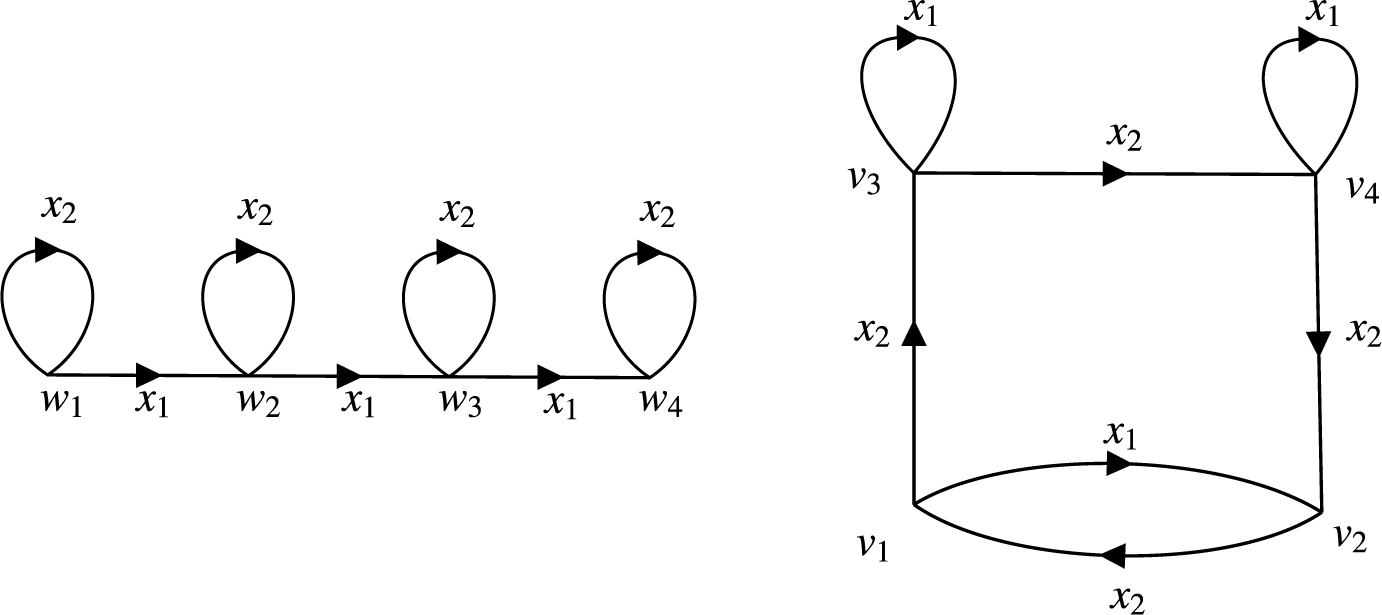
 . (See the left-hand side of Figure 1.) For each
$i \geq 2$
 ,
$x_i$
 fixes all vertices of
$W_n$
 and, hence, acts trivially on
$\mathrm {V}(W_n)$
 . Note that the unsaturated vertices in
$W_n$
 are
$w_1$
 and
$w_n$
 ;
$w_1$
 is not
$x_1^{-1}$
 -saturated and
$w_n$
 is not
$x_1$
 -saturated.
The graph
$W_4$
 on the left and
$V_{+1,-1}$
 on the right.

Figure 1 Long description
The left panel shows a directed graph with four nodes labeled w one to w four arranged in a horizontal line. Each node has a loop labeled x two. Arrows labeled x one connect w one to w two, w two to w three, and w three to w four. The right panel shows a directed graph with four nodes labeled v one to v four arranged in a square. v one connects to v two with an arrow labeled x two, v two connects to v four with x two, v four connects to v three with x two, and v three connects to v one with x two. There are loops labeled x one at v three and v four, and an arrow labeled x two from v one to v three. An arrow labeled x one connects v one to v two.
The construction of
$V_s$
 is as follows. Here, s denotes an r-tuple
${(s_i) {\kern-1pt}\in{\kern-1pt} \{\pm 1\}\, (1 \leq i \leq r)}$
 . We first take four vertices, denoted by
$v_1,v_2,v_3,v_4$
 and attach an edge labelled with
$x_1$
 from
$v_1$
 to
$v_2$
 . For each
$i>2$
 , we attach a loop labelled with
$x_i$
 to both
$v_1$
 and
$v_2$
 . For each
$i \neq 2$
 , if
$s_i=1$
 , we attach a loop labelled with
$x_i$
 to both
$v_3$
 and
$v_4$
 ; if
$s_i=-1$
 , we attach two edges both labelled with
$x_i$
 , from
$v_3$
 to
$v_4$
 and from
$v_4$
 to
$v_3$
 , respectively. If
$s_2=+1$
 , we attach four edges labelled with
$x_2$
 , from
$v_1$
 to
$v_3$
 , from
$v_3$
 to
$v_1$
 , from
$v_2$
 to
$v_4$
 and from
$v_4$
 to
$v_2$
 , respectively; if
$s_2=-1$
 , we attach a loop of length four with vertices
$v_1,v_2,v_3$
 and
$v_4$
 , each edge is labelled with
$x_2$
 . (See the right-hand side of Figure 1.) The resulting labelled graph is
$V_s$
 and
$x_2$
 acts nontrivially on
$\mathrm {V}(V_s)$
 . Note that the unsaturated vertices in
$V_s$
 are
$v_1$
 and
$v_2$
 ;
$v_1$
 is not
$x_1^{-1}$
 -saturated and
$v_2$
 is not
$x_1$
 -saturated.
We now construct the desired Y by attaching some edges to
$Z\cup W_n\cup V_s$
 as follows. First, for the six unsaturated vertices a, b in Z,
$w_1$
 ,
$w_{n}$
 in
$W_{n}$
 and
$v_1$
 ,
$v_2$
 in
$V_s$
 , we attach three edges labelled with
$x_1$
 : one from a to
$w_1$
 , one from
$w_{n}$
 to
$v_1$
 and one from
$v_2$
 to b. The resulting graph
$Y'$
 has
$k+n+4=p$
 vertices and it is a labelled graph. Finally, by adding some edges to
$Y'$
 , we obtain the finite cover Y without adding new vertices:

Note that Y is connected and the vertices
$w_1,\ldots ,w_{n}$
 in Y are fixed by the action of
$x_2$
 . It follows that
$F_r$
 acts on
$\mathrm {V}(Y)$
 transitively and
$x_2$
 moves fewer than
$p-n+1=k+5$
 vertices. Therefore, Y meets the requirements specified in the first paragraph and the proof is complete.
Remark 3.4. To connect
$W_n$
 to Z, we require the existence of an unsaturated vertex on Z, meaning that Z is not a cover of
$F_r$
 . If there are multiple monochromatic components, we correspondingly require that a certain
$F_r$
 -component is not a cover.
4 Kurosh decomposition structure derived from the precover
In this section, we introduce the Markus-Epstein algorithm (see [Reference Markus-Epstein10]), which provides a method for constructing Kurosh decompositions of subgroups via precovers. We employ this approach to characterise the structure of subgroups defined by labelled graphs.
Theorem 4.1 (Kurosh subgroup theorem [Reference Kurosch7])
Suppose
$G = \ast _{i \in I} G_i$
 is a free product and H is a subgroup of G. Then,
$H\cong (\ast H_j)\ast F$
 , where each
$H_j$
 is isomorphic to an intersection
$H \cap G^{k_i}_i$
 of H with a conjugate of some
$G_i$
 . Further, the set
$\{H_j\}$
 is unique up to conjugation and re-indexing, and the rank of the free group F is uniquely determined.
Let
$G=G_1 \ast G_2$
 be the free product of
$G_1$
 and
$G_2$
 with generating sets X and Y, respectively. Let
$\Gamma $
 be a finite graph labelled with
$X\cup Y$
 and
$v_0$
 be the base point of
$\Gamma $
 . Furthermore, we assume that
$\Gamma $
 is connected, G-based and denote
$\mathrm {Lab}(\Gamma ,v_0)= H \leq G$
 .
For a monochromatic component C of
$\Gamma $
 with base point
$v \in \mathrm {V}(C)$
 , let
$T(C)$
 be a spanning tree of C with root vertex v. Since
$\Gamma $
 is connected, there is an approach path
$P_v$
 from
$v_0$
 to v, which we denote
$\mathrm {Lab}(P_v) \equiv g_v$
 . Without loss of generality, we can assume that
$P_v \cap C=\{v\}$
 . (Otherwise, since C is connected, we can assume the subpath
$P_c=P_v \cap C$
 is connected, and then change v to be the initial point of
$P_c$
 and remove
$P_c$
 from
$P_v$
 .) If
$v_0 \in \mathrm {V}(C)$
 , we choose
$v=v_0$
 . Let
$\Gamma '$
 be a connected subgraph of
$\Gamma $
 obtained by removing edges in
$\mathrm {E}(C)\setminus \mathrm {E}(T(C))$
 . More precisely,

Following these assumptions, Markus-Epstein’s algorithm is based on the following result [Reference Markus-Epstein10, Lemma 4.2].
Lemma 4.2. We have
$H{\kern-1pt}={\kern-1pt}\langle g_v \mathrm {Lab}(C,v) g_v^{-1}, \mathrm {Lab}(\Gamma ', v_0)\rangle {\kern-1pt}={\kern-1pt}g_v \mathrm {Lab}(C,v) g_v^{-1}{\kern-1pt}\ast{\kern-1pt} \mathrm {Lab}(\Gamma ', v_0)$
 .
Lemma 4.2 shows that every monochromatic component C with nontrivial
$\mathrm {Lab}(C,v)$
 corresponds to a free factor
$g_v \mathrm {Lab}(C,v) g_v^{-1}$
 of
$\mathrm {Lab}(\Gamma ,v_0)$
 . This gives the following free decomposition of
$\mathrm {Lab}(\Gamma ,v_0)$
 .
Lemma 4.3. Let
$\Gamma $
 be a finite, connected, G-based graph labelled with
$X\cup Y$
 . If there are finitely many monochromatic components
$C_i\, (1 \leq i \leq k)$
 which are not trees, then

where
$P_{i}$
 is an approach path from the base point
$v_0$
 of
$\Gamma $
 to the base point
$v_i$
 of
$C_i$
 , the subgraph
$\Delta $
 is obtained from
$\Gamma $
 by removing all edges in each component
$C_i$
 that do not belong to its spanning tree
$T(C_i)$
 and
$\mathrm {Lab}(\Delta ,v_0)$
 is a free group that does not conjugate into
$G_1$
 or
$G_2$
 .
Proof. Let
$\mathrm {Lab}(P_{i})=g_{i}$
 . We proceed by induction on the number k of monochromatic components which are not trees. Since there are finitely many such monochromatic components, the process is finite. When
$k=1$
 , by Lemma 4.2,

so that
$\Gamma '$
 is the required
$\Delta $
 .
When
$k>1$
 , we start from the monochromatic component
$C_1$
 containing the base point
$v_0$
 of
$\Gamma $
 such that
$v_1=v_0 \in \mathrm {V}(C_1)$
 . By Lemma 4.2,

Since
$\Gamma "$
 embeds in
$\Gamma $
 and has fewer monochromatic components which are not trees than
$\Gamma $
 , by the induction hypothesis,

By [Reference Markus-Epstein10, Lemma 5.2],
$\mathrm {Lab}(\Delta ,v_0)$
 is a free group that does not conjugate into
$G_1$
 or
$G_2$
 . Combining the above two equations completes the proof.
The free decomposition in Lemma 4.3 coincides with the standard Kurosh decomposition.
Lemma 4.4. In Lemma 4.3, each free factor

for some
$k \in \{1,2\}$
 and
$\mathrm {Lab}(C_i,v_i) \leq G_k$
 .
Proof. Since
$C_i$
 is a monochromatic component,
$\mathrm {Lab}(C_i,v_i)\leq G_k$
 for some
$k \in \{1,2\}$
 and clearly
$L_i \leq \mathrm {Lab}(\Gamma ,v_0) \cap G_k^{\mathrm {Lab}(P_i)}$
 . Next, we show
$ \mathrm {Lab}(\Gamma ,v_0) \cap G_k^{\mathrm {Lab}(P_i)}\leq L_i.$

For any
$\gamma \in \mathrm {Lab}(\Gamma ,v_0)\cap G_k^{\mathrm {Lab}(P_i)}$
 , we can denote
$\gamma =\mathrm {Lab}(P_i) g \mathrm {Lab}(P_i)^{-1}$
 for some
$g\in G_k$
 . Since
$\gamma \in \mathrm {Lab}(\Gamma ,v_0)$
 , there is a loop
$P_\gamma $
 starting from
$v_0$
 with
$\gamma = \mathrm {Lab}(P_{\gamma })$
 . Thus,
$g = \mathrm {Lab}(P_i)^{-1} \mathrm {Lab}(P_{\gamma })\mathrm {Lab}(P_i)=\mathrm {Lab}(\bar {P}_iP_{\gamma }P_i) \in G_k$
 , where
$\bar {P}_iP_{\gamma }P_i$
 is a loop starting from
$v_i$
 . By Lemma 2.7, there is a loop
$P_{g} \subset C_i$
 starting from
$v_i$
 such that

This implies that
$g \in \mathrm {Lab}(C_i,v_i)$
 and then
$\gamma \in L_i$
 .
5 Proof of the main theorem
In this section, we employ Wilton’s construction and Markus-Epstein’s algorithm to establish Theorem 1.5.
Let
$F_r=\langle X \mid -\rangle $
 be a free group of rank
$r>1$
 ,
$G=\langle Y \mid R \rangle $
 a group and

For any finite set
$\{\gamma _1,\ldots ,\gamma _m\} \subset (F_r\ast G)\setminus H$
 , we pick a finite connected subgraph
$\Gamma $
 of
$\mathrm {Cay}(F_r \ast G,H)$
 ,

where all the loops
$p_i$
 and paths
$p^{\prime }_j$
 have the same initial point
$H \cdot 1$
 , and the labels of
$p_i$
 and
$p^{\prime }_j$
 are given by
$h_i$
 and
$\gamma _j$
 , respectively. Note that
$\Gamma $
 is an
$F_r\ast G$
 -based labelled graph because it embeds in the
$F_r\ast G$
 -based graph
$\mathrm {Cay}(F_r \ast G,H)$
 . Moreover, any
$F_r$
 -component of
$\Gamma $
 is
$F_r$
 -based and any G-component of
$\Gamma $
 is G-based by Lemma 2.6.
Lemma 5.1. We have
$\mathrm {Lab}(\Gamma , H \cdot 1 )=\mathrm {Lab}(\mathrm {Cay}(F_r \ast G,H), H \cdot 1)=H$
 .
Proof. The last equality follows from Lemma 2.2. Since
$\Gamma $
 is the subgraph of
$\mathrm {Cay}(F_r \ast G,H)$
 , each loop in
$\mathrm {Lab}(\Gamma , H \cdot 1 )$
 is again a loop in
${\mathrm {Lab}(\mathrm {Cay}(F_r \ast G,H), H \cdot 1)}$
 , that is,
$\mathrm {Lab}(\Gamma , H \cdot 1 ) \leq \mathrm {Lab}(\mathrm {Cay}(F_r \ast G,H), H \cdot 1)$
 . Conversely, since the labels of the loops
$p_i\ (1 \leq i \leq n)$
 are given by the generators
$h_i$
 of H, we clearly have
$H \leq \mathrm {Lab}(\Gamma , H \cdot 1)$
 .
We can describe the
$\mathcal A \cup \mathcal S$
 -separability of H via the embedding property of
$\Gamma $
 .
Proposition 5.2. If there exists a subgroup
$H_0\leq F_r \ast G$
 with prime index p for
$k=|V(\Gamma )|+2$
 as in Lemma 3.2, such that
$(\Gamma , H\cdot 1)$
 can be embedded in
${\mathrm {Cay}(F_r \ast G,H_0,H_0\cdot 1)}$
 , and there is a
$\gamma \in F_r \ast G$
 acting on
$\mathrm {V}(\mathrm {Cay}(F_r \ast G,H_0))$
 nontrivially and moving fewer than k vertices, then H is
$\mathcal A \cup \mathcal S$
 -separable in
$F_r \ast G$
 .
Proof. Following the notation above, we show that there exists a surjection f from
$F_r \ast G$
 to an alternating or symmetric group such that
$f(\gamma _j) \notin f(H)$
 for
$1 \leq j \leq m$
 .
By the hypothesis, there exists a subgroup
$H_0\leq F_r \ast G$
 with prime index p as in Lemma 3.2 such that
$(\Gamma , H\cdot 1)$
 embeds in
$\mathrm {Cay}(F_r \ast G,H_0,H_0\cdot 1)$
 . Note that

the action of
$F_r \ast G$
 on
$\mathrm {V}(\mathrm {Cay}(F_r \ast G,H_0))$
 is transitive and there exists
$\gamma \in F_r \ast G$
 which moves fewer than k vertices, so we have a homomorphism
$f: F_r \ast G\to S_p$
 with
$f(F_r \ast G)=S_p$
 or
$A_p$
 by Lemma 3.2. Moreover, since for any
$j=1, \ldots , m$
 ,

the path
$p^{\prime }_j$
 is not closed in
$\Gamma $
 and, hence, not closed again in
$\mathrm {Cay}(F_r \ast G,H_0)$
 . Therefore, the action of
$\gamma _j$
 on
$\mathrm {V}(\mathrm {Cay}(F_r \ast G,H_0,H_0\cdot 1))$
 does not fix the base point
$H_0 \cdot 1$
 while the action of H does. This implies that
$f(\gamma _j) \notin f(H)$
 for
$1 \leq j \leq m$
 .
Lemma 5.3. If
$H \cap F_r^{\gamma }\neq 1$
 has infinite index in
$F_r^{\gamma }$
 for some
$\gamma \in F_r \ast G$
 , then there is an
$F_r$
 -component in
$\Gamma $
 which is not a cover of
$F_r$
 .
Proof. By Lemma 5.1,
$H=\mathrm {Lab}(\Gamma , v_0)$
 with base point
$v_0:=H \cdot 1$
 . Combining the Kurosh subgroup theorem with Lemma 4.4 shows that there is an X-component C of
$\Gamma $
 such that
$\gamma \mathrm {Lab}(C,v)\gamma ^{-1}=H \cap F_r^{\gamma }$
 , where
$\gamma =\mathrm {Lab}(P)$
 for P an approach path from the base point
$v_0$
 to the base point v of C. Hence, the index

It follows that the X-component C is not a finite cover of
$F_r$
 . In fact, C is not a cover of
$F_r$
 because it is finite.
Proof of Theorem 1.5
By Proposition 5.2, we seek a subgroup
$H_0\leq F_r\ast G$
 , or equivalently, a cover
$\widetilde {\Gamma }:=\mathrm {Cay}(F_r\ast G,H_0,H_0\cdot 1)$
 , whose index
$[F_r\ast G: H_0]=|\mathrm {V}(\widetilde \Gamma )|$
 is a sufficiently large prime p, such that
$\Gamma $
 in (5.1) embeds into the finite cover
$\widetilde \Gamma $
 and there exists an element
$\gamma \in F_r\ast G$
 moving fewer than a certain number of vertices in
$\widetilde {\Gamma }$
 . We construct
$\widetilde \Gamma $
 in the following four steps.
Step 1. Embedding of each monochromatic component into a finite cover. Since
$\Gamma $
 is finite, there must be finitely many monochromatic components in
$\Gamma $
 ; we denote them by
$\Gamma _1,\ldots ,\Gamma _\ell $
 .
If hypothesis (1) holds, either there is no
$F_r$
 -component in
$\Gamma $
 (that is,
$\Gamma $
 is Y-monochromatic) or every
$F_r$
 -component in
$\Gamma $
 is a finite tree. In the former case, we denote the base point
$H\cdot 1$
 by
$\Gamma _1$
 and re-index the only Y-monochromatic component as
$\Gamma _2$
 . In the latter case, we assume
$\Gamma _1$
 is such an
$F_r$
 -component and not a cover of
$F_r$
 .
If hypothesis (2) holds, then by Lemma 5.3, there is an
$F_r$
 -component in
$\Gamma $
 which is not a cover of
$F_r$
 . Without loss of generality, we again assume it is
$\Gamma _1$
 .
Recall that each finite connected labelled component
$\Gamma _i$
 is
$F_r$
 - or G-based, so that
$\Gamma _i$
 can be embedded in a cover of
$F_r$
 or G by Lemma 2.3. Moreover, by Theorem 2.4, since both
$F_r$
 and G are LERF, every
$\Gamma _i$
 can be embedded in a finite cover
$\widetilde \Gamma _i$
 of
$F_r$
 or G.
Step 2. Construction of
$\Gamma ^\ast $
 . We now consider the pushout of the embedding
$\alpha _2: \bigcup _{i\geq 2}\Gamma _i\hookrightarrow \bigcup _{i\geq 2}\widetilde \Gamma _i$
 :

Note that every
$\Gamma _i$
 embeds in
$\widetilde \Gamma _i$
 and
$\Gamma _i$
 is a monochromatic component of
$\Gamma $
 , so no foldings occur between distinct
$\widetilde \Gamma _i$
 . It follows that
$\Gamma _i$
 embeds in
$\Gamma ^\ast $
 . Moreover, every monochromatic component of
$\Gamma ^\ast $
 is
$F_r$
 - or G-based. Hence,
$\Gamma ^\ast $
 is
$F_r\ast G$
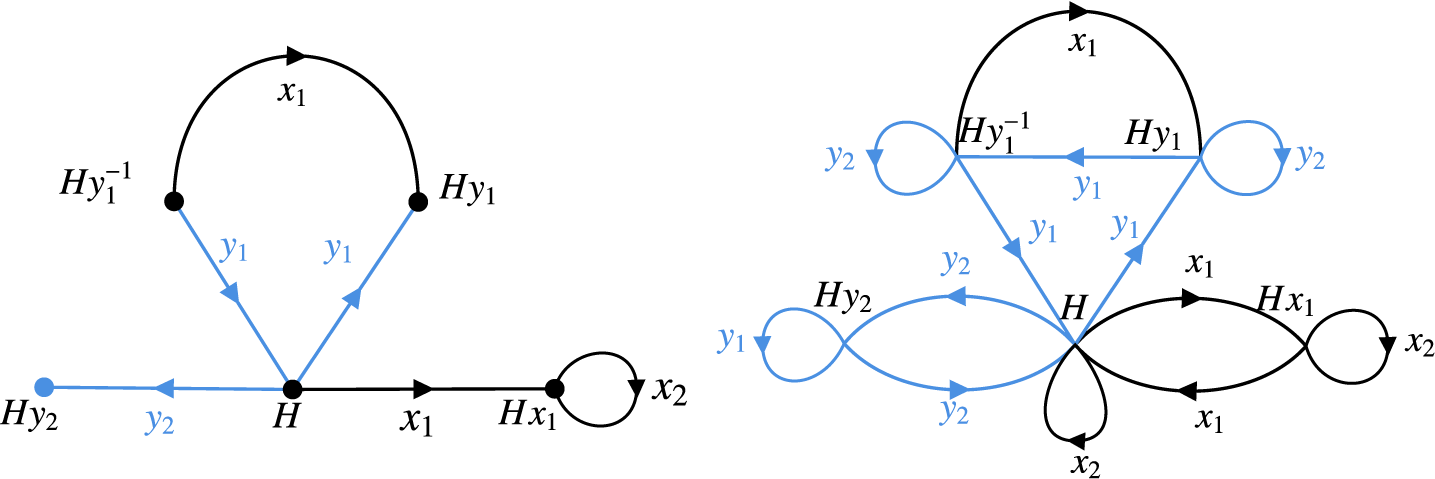
 -based by Lemma 2.6 (see Figure 2).
An example for
$\Gamma $
 and
$\Gamma ^\ast $
 when
$X=\{x_1,x_2\}$
 ,
$Y=\{ y_1,y_2 \}$
 . We take
$H=\langle y_1x_1^{-1}y_1, x_1x_2x_1^{-1}\rangle $
 and
$\gamma _1=y_2$
 .

Figure 2 Long description
The left panel shows a directed graph with central node H. Outward, three black nodes are connected by black arrows labeled x one and x two, and blue arrows labeled y one and y two. H connects to H x one by x one, to H y one by y one, and to H y two by y two. H y one connects to H y one inverse by x one, and H x one has a loop labeled x two. H y two is at the far left, connected by y two. The right panel expands the structure: H remains central, with additional loops and connections. H connects to H x one by x one, to H y one by y one, and to H y two by y two. H y one connects to H y one inverse by x one, and H x one has a loop labeled x two. H y two has a loop labeled y two. Multiple blue arrows labeled y one and y two form cycles among H, H y one, H y one inverse, and H y two. Black arrows labeled x one and x two form cycles among H, H x one, and H y one inverse. All labels are typeset in italic.
Step 3. Modify
$\Gamma _1$
 to obtain a precover
$\Gamma '$
 of
$F_r\ast G$
 . Denote
$|\mathrm {V}(\Gamma ^\ast )|=k$
 . Since the labelled graph
$\Gamma _1$
 is
$F_r$
 -based and not a cover, it is not an
$X^\ast $
 -saturated graph by Lemma 2.3. From Wilton’s construction in Lemma 3.3, after attaching some graphs
$W_n$
 and
$V_s$
 , the graph
$\Gamma _1$
 can embed in a cover
$\widetilde \Gamma _1$
 of
$F_r$
 with

We now take a sufficiently large prime p for
$k+5$
 as in Lemma 3.2 and let
$n=p-k-4$
 . We construct the pushout of the embedding
$\alpha _2':\Gamma _1 \hookrightarrow \widetilde \Gamma _1$
 as shown:

Since
$\Gamma _1$
 embeds in
$\widetilde \Gamma _1$
 and
$\widetilde \Gamma _1$
 is monochromatic, no foldings occur between
$\widetilde \Gamma _1$
 and
$\Gamma ^\ast $
 , and both
$\Gamma ^\ast $
 and
$\widetilde \Gamma _1$
 embed in
$\Gamma '$
 . Since
$\Gamma ^\ast $
 is
$F_r \ast G$
 -based and
$\widetilde \Gamma _1$
 is
$F_r$
 -based,
$\Gamma '$
 is
$F_r\ast G$
 -based by Lemma 2.6 and every monochromatic component is a cover. Thus,
$\Gamma '$
 is a precover of
$F_r\ast G$
 .
Step 4. Construction of the final cover
$\widetilde {\Gamma }$
 . By Lemma 2.8, the precover
$\Gamma '$
 can embed in a cover
$\widetilde {\Gamma }$
 of
$F_r \ast G$
 without adding new vertices, so
$\Gamma $
 itself embeds in the cover
$\widetilde {\Gamma }$
 with
$|\mathrm {V}(\widetilde {\Gamma })|=p=k+n+4$
 . Since
$x_2$
 acts trivially on
$\mathrm {V}(W_n)$
 and acts nontrivially on
$\mathrm {V}(V_s)$
 , there must be fewer than
$k+5$
 vertices (lying in
$\Gamma ^\ast \cup V_s$
 ) in
$\widetilde {\Gamma }$
 which are moved by
$x_2$
 . Therefore, the cover
$\widetilde {\Gamma }$
 is precisely what we need and the proof is complete.
Acknowledgements
The authors would like to thank Qian Chen very much for his comments. Thanks are also extended to the anonymous referee.