Introduction
Alcohol use and problems are complex phenotypes that are influenced by both biological (e.g. genetic) and environmental factors (Goldman et al. Reference Goldman, Oroszi and Ducci2005; Kendler et al. Reference Kendler, Gardner and Prescott2011b ). Risk factors for the development of alcohol problems (AP) include exposures experienced during childhood, adolescence and adulthood (Prescott et al. Reference Prescott, Neale, Corey and Kendler1997; Sher et al. Reference Sher, Grekin and Williams2005; Henkel, Reference Henkel2011); furthermore, factors at the level of the individual, the family and the peer/community environment are all relevant to risk. These factors are probably interrelated over development. Delineating the complex cascades of risk over time is critical to improving our understanding of the etiology of AP, as well as to refine programs aimed at education, prevention and early intervention.
Family history – a reflection for both genetic risk and familial–environmental risk – has been robustly associated with AP (Cloninger et al. Reference Cloninger, Bohman and Sigvardsson1981; Kendler et al. Reference Kendler, Gardner and Prescott2011b ), as have childhood physical and/or sexual abuse and neglect (Kendler et al. Reference Kendler, Bulik, Silberg, Hettema, Myers and Prescott2000; Fergusson et al. Reference Fergusson, McLeod and Horwood2013). The role of early socio-economic status (SES) is inconsistent (Hanson & Chen, Reference Hanson and Chen2007), potentially because the relationship might vary across different alcohol use outcomes (Kendler et al. Reference Kendler, Gardner, Hickman, Heron, Macleod, Lewis and Dick2014). Environmental risk factors for adolescent alcohol use include peer group deviance (Hoffmann & Bahr, Reference Hoffmann and Bahr2014) and low parental monitoring (Dick et al. Reference Dick, Pagan, Viken, Purcell, Kaprio, Pulkkinen and Rose2007).
Individual-level risk factors for AP have often been conceptualized as reflecting two major pathways: externalizing and internalizing (Cloninger et al. Reference Cloninger, Bohman and Sigvardsson1981; Babor et al. Reference Babor, Hofmann, DelBoca, Hesselbrock, Meyer, Dolinsky and Rounsaville1992; Del Boca & Hesselbrock, Reference Del Boca and Hesselbrock1996; Windle & Scheidt, Reference Windle and Scheidt2004). For example, Windle & Scheidt (Reference Windle and Scheidt2004) describe a ‘negative affect’ subtype and a ‘chronic/antisocial personality’ subtype, which are distinguished in part by their presentation of higher levels of anxiety and depression (the former subtype) v. higher levels of alcohol consumption and impairment, along with symptoms of adult antisocial behavior (the latter). The use of other substances, generally considered a manifestation of externalizing tendencies, has often been associated with AP (Babor et al. Reference Babor, Hofmann, DelBoca, Hesselbrock, Meyer, Dolinsky and Rounsaville1992; Blanco et al. Reference Blanco, Krueger, Hasin, Liu, Wang, Kerridge, Saha and Olfson2013). This is probably due at least in part to genetic and/or environmental risk factors common to alcohol and other drug use (Kendler et al. Reference Kendler, Aggen, Knudsen, Roysamb, Neale and Reichborn-Kjennerud2011a ; Wetherill et al. Reference Wetherill, Agrawal, Kapoor, Bertelsen, Bierut, Brooks, Dick, Hesselbrock, Hesselbrock, Koller, Le, Nurnberger, Salvatore, Schuckit, Tischfield, Wang, Xuei, Edenberg, Porjesz, Bucholz, Goate and Foroud2015). Personality and temperament are also indicators of risk (Sher et al. Reference Sher, Grekin and Williams2005): neuroticism (Prescott et al. Reference Prescott, Neale, Corey and Kendler1997), impulsivity (McGue et al. Reference McGue, Slutske, Taylor and Iacono1997) and extraversion (Prescott et al. Reference Prescott, Neale, Corey and Kendler1997; Kilbey et al. Reference Kilbey, Downey and Breslau1998) have all been associated with AP.
In the current study, we examine the effects of a wide variety of environmental, familial and individual-level factors on risk of early adult AP in a comprehensive longitudinal model. We utilize a large, prospectively assessed cohort from the UK where dense phenotypic information is available. Our design offers critical advantages over previous studies. While prior research has examined different aspects of the model described in the current study, few previous studies have had the opportunity to include such a wide range of potential risk/protective factors collected on a single sample. In many cases, we are also able to examine multiple measures of constructs potentially implicated in the etiology of AP, thereby determining if effects are time-specific. Another important advantage of our design is that participants are prospectively assessed, eliminating the possible risk of recall bias. Finally, the Avon Longitudinal Study of Parents and Children (ALSPAC) sample is community based, improving the likelihood of generalizability of findings, and the size of the study enables us to detect modest effect sizes, which is especially important in the context of a comprehensive model.
Method
Sample
ALSPAC is a cohort-based sample recruited in southwest England. ALSPAC recruited 14 541 pregnant women resident in Avon, UK with expected dates of delivery from 1 April 1991 to 31 December 1992; 14 541 is the initial number of pregnancies for which the mother enrolled in ALSPAC and had either returned at least one questionnaire or attended a ‘Children in Focus’ clinic by 19 July 1999. Of these initial pregnancies, there was a total of 14 676 fetuses, resulting in 14 062 live births and 13 988 children who were alive at 1 year of age. Subsequent phases of enrollment increased the sample size over time. The phases of enrollment are described in more detail in the cohort profile papers (Boyd et al. Reference Boyd, Golding, Macleod, Lawlor, Fraser, Henderson, Molloy, Ness, Ring and Davey Smith2013; Fraser et al. Reference Fraser, Macdonald-Wallis, Tilling, Boyd, Golding, Davey Smith, Henderson, Macleod, Molloy, Ness, Ring, Nelson and Lawlor2013). For the current analyses, full or partial data were available for 9720 participants. The study website contains details of all the data that are available through a fully searchable data dictionary (http://www.bris.ac.uk/alspac/researchers/data-access/data-dictionary/). Ethical approval for the study was obtained from the ALSPAC Ethics and Law Committee and the Local Research Ethics Committees.
Measures
Other than sex, values for each predictor variable were sum scores derived from a series of individual items (see below and online Supplementary material). Where the focal individual provided non-missing responses for at least half of the items for a particular variable, a pro-rated score was calculated (exceptions noted in online Supplementary material). If necessary, variables were transformed to reduce skewness and were converted to Z-scores so that all were on a similar metric.
Outcome variables
The major outcome variable for these initial analyses was age 20 years AP, which was derived from 20 self-reported items regarding problematic alcohol use. These items and the approach to deriving scores have been previously described (Salvatore et al. Reference Salvatore, Aliev, Edwards, Evans, Macleod, Hickman, Lewis, Kendler, Loukola, Korhonen, Latvala, Rose, Kaprio and Dick2014). Briefly, these items are from the Alcohol Use Disorders Identification Test (AUDIT), items aimed at assessing Diagnostic and Statistical Manual of Mental Disorders, fourth edition (DSM-IV) alcohol dependence criteria, and additional items reflecting negative consequences due to drinking. Factor analysis in Mplus version 6.11 (Muthén & Muthén, Reference Muthén and Muthén1998–2011) indicated that a single-factor model provided an adequate fit to the data (factor scores are provided in online Supplementary Table S1). Higher factor scores represent endorsement of a variety of alcohol-related behaviors that would be widely considered problematic, but which generally fall below diagnostic thresholds. Scores were square-root transformed and converted to Z-scores for use as outcome variables in the current analyses.
Although age 20 years AP was the major outcome variable for our model, we also included age 17.5 years AP in our model, due to the strong association between AP across ages. We reasoned that risk factors relevant to age 17.5 years AP could potentially provide critical context in the multivariate model with age years 20 AP as the final outcome. In addition, this approach allowed us to test whether some risk factors were also important in late adolescence/early adulthood or if age 20 years AP would only be predicted by age 17.5 years AP. Thus, in univariate analyses with AP at age 17.5 or age 20 years as the outcome variable, we examined the effects of predictors described below.
Predictive variables
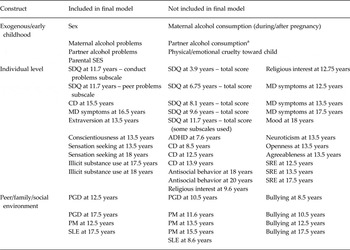
A broad range of potentially predictive factors, many of which were assessed at multiple ages, was tested for their association with age 17.5 or age 20 years AP in univariate models; these are listed here and in Table 1. Those variables included in the final model are also described in additional detail in the online Supplementary material. Early-life/exogenous factors included maternal and paternal alcohol consumption and AP; parental SES; and parental physical or emotional cruelty.
Variables tested for association with age 17.5 years or age 20 years alcohol problems

SES, Socio-economic status; SDQ, Strengths and Difficulties Questionnaire; MD, major depression; CD, conduct disorder; ADHD, attention-deficit/hyperactivity disorder; SRE, Self-Reported Effects of Alcohol; PGD, peer group deviance; PM, parental monitoring; SLE, stressful life events.
a ‘Partner’ refers to the focal child's mother's partner. At the first Avon Longitudinal Study of Parents and Children assessment, the partner was the child's father in >99% of cases.
Peer/family/social environmental factors tested were stressful life events, parental monitoring, bullying and peer group deviance. Individual-level predictive variables included scores on the Strengths and Difficulties Questionnaire (total and/or subscales; Goodman et al. Reference Goodman, Ford, Simmons, Gatward and Meltzer2000); symptoms of attention-deficit/hyperactivity disorder; symptoms of conduct disorder and antisocial behavior; religious interest; symptoms of major depression; personality constructs from the International Personality Item Pool (Ehrhart et al. Reference Ehrhart, Roesch, Ehrhart and Kilian2008), which included openness, agreeableness, conscientiousness, neuroticism and extraversion; a modified version of Arnett's Inventory of Sensation Seeking (Arnett, Reference Arnett1994); scores on the Self-Rating of the Effects of Alcohol (SRE) questionnaire (Schuckit et al. Reference Schuckit, Smith and Tipp1997); and illicit substance use.
Predictive variables were based on self-reports, maternal reports and maternal partner reports; as described in the online Supplementary material, the measures of parental AP were based on multiple reporters. Variables were prospectively assessed; see Table 1 for average age at assessment.
Statistical modeling
Predictive variables from the initial univariate analyses were retained for inclusion in the first iteration of the multivariable structural equation model if they were associated with the outcome at p < 0.05. In the multivariate model, variables were arranged as follows. Early-life/exogenous variables were ordered first (earliest) in the model. All other variables were placed in the model in order of their age of measurement. After the variable order was established, we constructed a saturated model where each upstream variable had paths to all downstream variables. We then sequentially pruned paths from the model as follows. First, starting from the top down, we removed all variables with p values greater than 0.5 (for the null hypothesis that the ‘true’ value of the path was zero). We then performed a second pass removing all with p values greater than 0.2. Similar iterations were performed of p values of 0.1, 0.05, and 0.01.
We next pruned based on standardized path coefficients to determine which paths to set to 0. First, we removed all paths with effect sizes less than 0.05. This was repeated using 0.06, and finally 0.071 (which corresponds to 0.5% of the variance) as minimum standardized path coefficients. Thus all paths that remain in the final model have p values less than 0.01 and contributed to at least 0.5% of the variance in the dependent variable. By using this approach we were able to obtain a final model that was simplified as much as possible without seriously degrading model fit or loss of explanatory power for the outcome variables of interest.
To deal with problems of missing data, models were fit with maximum likelihood. Thus we are operating under the assumption that missing values are missing at random. Under this assumption, we assume that missing values come from the same covariance matrix as the observed values so that missing values are ‘predictable’ (with a measurable level of uncertainty) from the observed variables for the proband.
Results
Model fitting
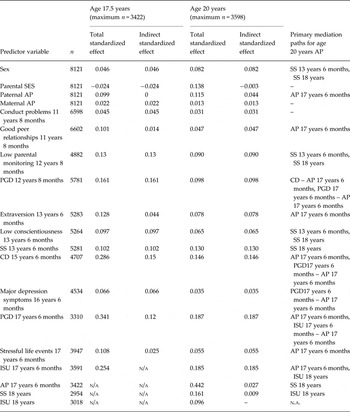
Model fitting resulted in a final model with acceptable fit (comparative fit index = 0.968, Tucker–Lewis index = 0.948) that explained 30.7% of the total variance of age 20 years AP, and 30.6% of the total variance of age 17.5 years AP. The model-fitting process resulted in the exclusion of many potential predictors, including parental cruelty, childhood physical abuse, scores on the SRE scale, and all but one measure of internalizing problems. Variables retained in the final model are described below and listed in Table 1, which also lists variables that did not meet inclusion criteria for the final model. Table 2 provides total and indirect effect sizes between each predictor and AP at age 17.5 and age 20 years. We focus on the association between risk factors and age 20 years AP below, as that was the primary outcome of interest.
Standardized total and indirect effects on age 17.5 years and age 20 years AP a

AP, Alcohol problems; SS, sensation seeking; SES, socio-economic status; PGD, peer group deviance; CD, conduct disorder; ISU, illicit substance use; n.a., not applicable.
a Where appropriate, the most pronounced mediation paths between predictors and age 20 years AP are described.
Early-life predictors
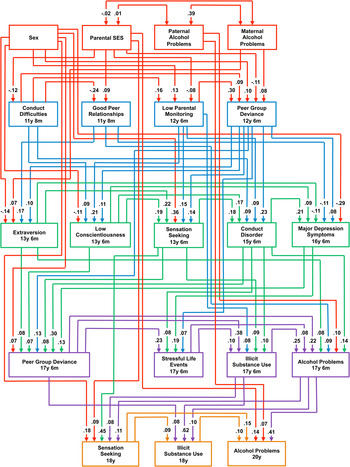
Four exogenous or early-life predictors (sex, parental SES, paternal AP and maternal AP) remained in the final model (Fig. 1). Of these, paternal AP and parental SES had direct effects on AP at age 20 years, which accounted for 62% and 98% of their total effect sizes, respectively (Table 2). Men were more likely to have AP than women, as were participants with higher parental SES.
Final full model with standardized path estimates. Variables and their corresponding paths are color-coded by approximate developmental time-frame. SES, Socio-economic status; y, years; m, months.

Other variables measured prior to the age of 13 years that remained in the final model were conduct problems, positive peer relationships, low parental monitoring and peer deviance. Positive peer relationships were associated with greater AP; higher levels of conduct problems and peer deviance, and lower levels of parental monitoring predicted higher levels of AP. The effect size of this early measure of conduct problems, an individual-level factor, was lower than those of the familial/peer environment measures.
In mid-adolescence (ages 13–16.5 years), only individual-level variables were predictive of AP in the final model. The personality constructs of extraversion and low conscientiousness, sensation seeking, and symptoms of major depression and conduct disorder were all positively associated with AP.
In late adolescence (age 17.5 years and older), both individual-level and environmental variables were predictive of age 20 years AP. Peer group deviance and stressful life events were positively associated with the outcome, with the former having a reasonably large effect size. Age 17.5 years AP and illicit substance use also predicted age 20 years AP. As expected, the former was by far the strongest predictor in the model: it had the highest effect size of any predictor, and only 6% of the effect was indirect. Finally, two individual-level variables assessed at age 18 years, sensation seeking and illicit substance use, were associated with age 20 years AP.
As shown in Table 2, nearly all variables’ effects were mediated to some extent. Indeed, only five (of 19) predictors in the final model had a direct effect on age 20 years AP: higher parental SES, paternal AP, age 17.5 years AP, and age 18 years sensation seeking and illicit substance use (only direct effects were possible for the last two). Primary mediators included conduct problems, peer group deviance and the predictors most temporally proximal to age 20 years AP.
Discussion
This report describes a comprehensive developmental model delineating the complex pathways leading to early adult AP. Our use of a large, longitudinal population-based cohort, densely assessed across 20 years for a broad range of risk factors, represents a substantial advance over previous studies that have been limited by sample size, scope and/or reliance on retrospective reporting. Our results provide important insight to the contextual effects of environmental and individual risk factors for AP. The final model accounted for over 30% of the variance in age 20 years AP, a figure comparable with several previous studies of older adults (Dubow et al. Reference Dubow, Boxer and Huesmann2008; Pitkanen et al. Reference Pitkanen, Kokko, Lyyra and Pulkkinen2008; Kendler et al. Reference Kendler, Gardner and Prescott2011b ), and higher than a model of adult alcohol consumption in a British sample (Maggs et al. Reference Maggs, Patrick and Feinstein2008). Below, we detail our most noteworthy findings.
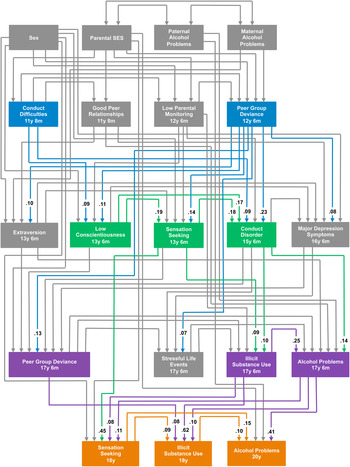
First, we found strong evidence of a developmental externalizing pathway to AP (Fig. 2), beginning in early adolescence with conduct difficulties at age 11 years 8 months and peer deviance at 12.5 years. This continues into the mid- to late-teen years as exemplified by low conscientiousness (age 13.5 years), sensation seeking (ages 13.5 and 18 years), subsequent conduct problems (age 15.5 years), and substance use (ages 17.5 and 18 years). In addition, conduct problems and sensation seeking are prominent mediators of many other predictors. These results are consistent with prior reports of associations between externalizing problems and alcohol use/AP (Hesselbrock & Hesselbrock, Reference Hesselbrock and Hesselbrock2006; Fergusson et al. Reference Fergusson, Horwood and Ridder2007; Pardini et al. Reference Pardini, White and Stouthamer-Loeber2007; Zucker, Reference Zucker2008; Whelan et al. Reference Whelan, Watts, Orr, Althoff, Artiges, Banaschewski, Barker, Bokde, Buchel, Carvalho, Conrod, Flor, Fauth-Buhler, Frouin, Gallinat, Gan, Gowland, Heinz, Ittermann, Lawrence, Mann, Martinot, Nees, Ortiz, Paillere-Martinot, Paus, Pausova, Rietschel, Robbins, Smolka, Strohle, Schumann and Garavan2014), including in some (but not all; Copeland et al. Reference Copeland, Angold, Shanahan, Dreyfuss, Dlamini and Costello2012) samples that have been longitudinally assessed (McGue & Iacono, Reference McGue and Iacono2008; Hicks et al. Reference Hicks, Iacono and McGue2014), and studies that have used the current sample (Heron et al. Reference Heron, Maughan, Dick, Kendler, Lewis, Macleod, Munafo and Hickman2013; Kendler et al. Reference Kendler, Gardner, Edwards, Hickman, Heron, Macleod, Lewis and Dick2013). These individual-level externalizing problems mediate, and are mediated by, low parental monitoring and peer group deviance, similar to previous reports (Patterson et al. Reference Patterson, DeBaryshe and Ramsey1989; Steinberg et al. Reference Steinberg, Fletcher and Darling1994; Hussong, Reference Hussong2002; Nash et al. Reference Nash, McQueen and Bray2005). Critically, we provide evidence that this externalizing pathway is robust to the inclusion of a wide variety of other risk factors, thereby demonstrating its unique predictive ability.
Variables falling under the rubric of ‘externalizing’ are highlighted (with other variables in gray), along with the corresponding path estimates, to illustrate the externalizing pathway from early adolescence to age 20 years alcohol problems. SES, Socio-economic status; y, years; m, months.

Second, we observe a strong, and almost entirely direct, relationship between AP at age 17.5 years and age 20 years. Thus, understanding risk for late adolescent AP is quite informative for predicting risk for age 20 years AP. However, it is not sufficient: not only do factors assessed at age 18 years (sensation seeking and illicit substance use) have substantial effects on age 20 years AP, but some earlier risk factors’ primary mediation paths do not principally involve age 17.5 years AP. This demonstrates that, despite the fact that adolescent AP is considered a robust risk factor for problems in adulthood (McCambridge et al. Reference McCambridge, McAlaney and Rowe2011), the developmental pathways leading to AP extend beyond late adolescence. This finding has potential implications for prevention efforts, in that it reveals that preventing problems at the age of 17.5 years does not entirely mitigate risk for later problems.
Third, we demonstrate that effects of sex and the early-life influences of parental SES and paternal AP are persistent, making an impact on early adult AP via both direct and indirect paths. We conducted post-hoc multi-group analyses to further investigate the potential effect of sex. In those analyses, the sexes were modeled separately and we tested whether parameter estimates differed significantly across sex; results indicated that they did not. Thus although males are more likely to develop AP, our results suggest that pathways to AP are consistent across the sexes. A previous study using this sample reported a complex relationship between parental SES and alcohol outcomes at the ages of 16 and 18 years (Kendler et al. Reference Kendler, Gardner, Hickman, Heron, Macleod, Lewis and Dick2014); the current results, in which the direction and magnitude of effect differ for age 18 years and age 20 years AP, further confirm that the association is nuanced. Previous work suggests that higher parental SES confers easier access to alcohol among adolescents, thereby acting as a risk factor for misuse (Richter et al. Reference Richter, Leppin and Nic Gabhainn2006; Humensky, Reference Humensky2010), though not all studies support this hypothesis (Lowry et al. Reference Lowry, Kann, Collins and Kolbe1996; Lemstra et al. Reference Lemstra, Bennett, Neudorf, Kunst, Nannapaneni, Warren, Kershaw and Scott2008).
Maternal AP are a much less robust risk factor than paternal problems. Findings from previous studies have been inconsistent with respect to the impact of paternal v. maternal drinking problems (e.g. Bohman et al. Reference Bohman, Sigvardsson and Cloninger1981; Cloninger et al. Reference Cloninger, Bohman and Sigvardsson1981). In less extensive models examining the relationship between parental and offspring AP in the current sample, parent-specific effects were less discrepant (Kendler et al. Reference Kendler, Gardner, Edwards, Hickman, Heron, Macleod, Lewis and Dick2013), raising the possibility that the true effects of parental AP must be considered through the lens of comprehensive developmental models such as that described here. These results warrant follow-up.
Fourth, despite previous reports of an ‘internalizing subtype’ of AP (Del Boca & Hesselbrock, Reference Del Boca and Hesselbrock1996; Hesselbrock & Hesselbrock, Reference Hesselbrock and Hesselbrock2006), we found only modest evidence of such a pathway. Despite the examination of multiple measures of internalizing symptoms, across various ages, only age 16 years 6 months symptoms of major depression was retained in the final model. Previous studies of the ALSPAC sample have demonstrated a positive relationship between internalizing problems and alcohol misuse (Edwards et al. Reference Edwards, Joinson, Dick, Kendler, Macleod, Munafo, Hickman, Lewis and Heron2014), but those effects apparently diminish in the context of externalizing-related predictors. Studies in other samples have also demonstrated more extensive positive relationships between various manifestations of internalizing problems and AP (Prescott et al. Reference Prescott, Neale, Corey and Kendler1997; Kendler et al. Reference Kendler, Gardner and Prescott2011b ; Mezquita et al. Reference Mezquita, Ibanez, Moya, Villa and Ortet2014). Notably, those studies have focused on samples that are generally older than the ALSPAC sample, which might contribute to the observed inconsistencies.
Additional risk factors were peripheral to the central externalizing pathway to AP. Positive peer relationships, assessed at age 11.7 years, could confer risk by increasing exposure or access to alcohol, given that alcohol use during this period frequently occurs within the context of peer groups (Hussong, Reference Hussong2000, Reference Hussong2002). Similarly, the positive association between extraversion and AP could be related to peer interactions, as has been demonstrated in previous research (Knyazev, Reference Knyazev2004). We also note that stressful life events, which were assessed at age 17.5 years, were predictive of AP. The events included in this scale range from a death in the family to academic problems to problems with parents; future analyses might examine whether specific events are riskier or whether the accumulation of stressors is more important, regardless of the nature of those events.
Finally, we note that a number of previously implicated AP risk factors were not supported in the current model. Childhood abuse and neglect were insufficiently predictive of AP to warrant inclusion in the final model, contrary to previous studies’ reports of their relationship with AP (Herrenkohl et al. Reference Herrenkohl, Hong, Klika, Herrenkohl and Russo2013; La Flair et al. Reference La Flair, Reboussin, Storr, Letourneau, Green, Mojtabai, Pacek, Alvanzo, Cullen and Crum2013; Mezquita et al. Reference Mezquita, Ibanez, Moya, Villa and Ortet2014; Potthast et al. Reference Potthast, Neuner and Catani2014). We also found no support for a unique relationship between scores on the SRE scale and AP, despite evidence that SRE scores are related to earlier drinking measures and peer drinking in this sample (Schuckit et al. Reference Schuckit, Smith, Trim, Heron, Horwood, Davis, Hibbeln and Team2008a , Reference Schuckit, Smith, Trim, Heron, Horwood, Davis, Hibbeln and Team b ). Furthermore, in many cases only one assessment of a given risk factor was included in the final model – e.g. conduct disorder at 15.5 years was included, but not at the ages of 8.5, 12.5 or 13.9 years (see Table 1). Similarly, antisocial behavior at ages 18 and 20 years was not included in the final model. These exclusions are possibly due to the close relationships among these variables and those that were included in the final model (e.g. conduct problems, low conscientiousness, sensation seeking, illicit drug use), largely rendering the excluded variables redundant.
Limitations
The findings reported here should be considered in light of several limitations. First, the ALSPAC sample is relatively young and not yet through the risk period for the development of AP. Some individuals will develop such problems later in life via pathways distinct from those observed here. Indeed, the internalizing subtype of AP probably has a later onset (Del Boca & Hesselbrock, Reference Del Boca and Hesselbrock1996), potentially explaining why support for an internalizing pathway to AP was limited in this young sample. Accordingly, later waves of data collection may reveal other diverse pathways of risk. In addition, drinking behaviors could differ between US and UK populations, particularly given the earlier legal drinking age in the UK; thus these results warrant replication in a US sample.
In some cases, our modeling approach was limited by the availability of variables at different ages. For example, personality characteristics are evident prior to the available measure at age 13.5 years, and might actually influence conduct difficulties at age 11.7 years. Furthermore, our model-trimming approach involved excluding measures based on their predictive power, rather than on the age at assessment. Thus, although symptoms of major depression were assessed at age 12.5 years, they did not strongly predict risk until later in adolescence, so only the later measure was retained. We do not intend to imply that the risk pathway cannot begin prior to the appearance of each factor in the final model. Despite these idiosyncrasies of model fitting, a shift in ordering of these factors in the model would be unlikely to dramatically make an impact on the substantive findings of the study, i.e. an externalizing pathway to AP would probably remain evident.
Our AP outcome is not a diagnostic measure. However, age 20 years AP is strongly correlated with age 20 years alcohol dependence symptom count (r = 0.65, p < 0.0001) and with an age 20 years alcohol dependence diagnosis (r = 0.46, p < 0.001), suggesting that our measure of AP is a useful indicator of clinical risk. Attrition in the ALSPAC sample is of some concern, though we have made an effort to address this by using maximum likelihood in our modeling. In addition, we conducted tests to determine whether parameter estimates changed substantially if individuals were weighted based on parental SES (which was predictive of attrition), and found only minimal shifts, with increases in effect size being more common than decreases. Thus, we are confident that the biases in results reported due to attrition are modest. Finally, different approaches to modeling are possible and could lead to varying conclusions. For example, we tested related predictors (e.g. conduct problems/antisocial behavior) independently rather than as trajectories, in part due to inconsistencies in assessment items over time. In addition, our structural equation model assumes that the predictor variables act additively and linearly in their impact on AP, which in some cases may be unrealistic.
Conclusions
In summary, using a prospective sample densely assessed from birth to the age of 20 years, our comprehensive developmental model indicates that factors at the level of the family environment, social environment and individual combine to influence risk to early adult AP. Early-life factors, such as parental AP and SES, have long-lasting effects on AP. In early adolescence, an externalizing pathway to AP is initiated, which involves conduct problems, association with deviant peers, sensation seeking and illicit substance use. The lack of evidence for several previously implicated risk factors merits additional study in the current sample as well as replication in other samples using comparable methods.
The multifactorial nature of these predictors, and in particular the predictive utility of extrinsic factors such as parental SES and peer group deviance, indicates that reductive biological models will fail to sufficiently explain developmental risk for AP. Rather, consistent with findings from twin and family studies indicating that approximately half the variance in AP is due to genetic factors (Verhulst et al. Reference Verhulst, Neale and Kendler2015), the model described here provides support for the importance of both biologically influenced, individual-level factors (e.g. personality constructs, psychopathology) and environmental factors, which affect risk through complex and intertwined relationships. To further understand the etiology of AP, both domains must be considered jointly.
Supplementary material
For supplementary material accompanying this paper visit http://dx.doi.org/10.1017/S0033291715002457
Acknowledgements
This research was specifically funded by the National Institutes of Health – National Institute on Alcohol Abuse and Alcoholism (A.C.E., AA021399; K.S.K, AA018333, 1P50AA022537 and R37AA011408). The UK Medical Research Council and the Wellcome Trust (grant reference 092731) and the University of Bristol provide core support for ALSPAC. This publication is the work of the authors and A.C.E. will serve as guarantor for the contents of this paper.
We are extremely grateful to all the families who took part in this study, the midwives for their help in recruiting them, and the whole ALSPAC team, which includes interviewers, computer and laboratory technicians, clerical workers, research scientists, volunteers, managers, receptionists and nurses.
Declaration of Interest
None.