INTRODUCTION
The goal of the current review is to describe some of the major questions and findings in the field of cognitive aging. It is obviously impossible to be exhaustive in a short review such as this, and the interested reader is referred to other recent sources for more information (e.g., Cabeza, Nyberg, & Park, Reference Cabeza, Nyberg and Park2005; Craik & Salthouse, Reference Craik and Salthouse2008; Dixon & Backman, Reference Dixon and Backman2004; Salthouse, Reference Salthouse2010a). Nevertheless, the topics discussed below were selected because they represent some of the most important questions concerned with the aging of cognition at the current time.
What Cognitive Variables and Abilities Are Affected?
Several different classification systems and labels have been proposed to characterize which types of cognitive variables “hold” and which “don’t hold” with advancing age in adulthood. The most common terminology is probably that based on the distinction between crystallized and fluid abilities (Cattell, Reference Cattell1943), but these labels are somewhat misleading for summarizing age trends because within the psychometric literature other abilities, such as memory and speed, are distinguished from fluid ability, and yet are highly sensitive to age. Some researchers rely on the presumed neuroanatomical locus of task performance, such as the frontal lobe or the medial-temporal complex, as the basis for classifying different types of cognitive variables (e.g., Glisky, Polster, & Routhieaux, Reference Glisky, Polster and Routhieaux1995), but this classification system is crude because of the lack of a one-to-one relation between cognitive variable and neuroanatomical region.
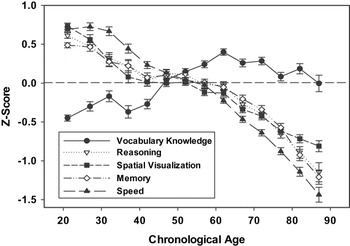
Although different descriptive terminology has been used, there is consensus on the general pattern of cross-sectional age-cognition relations. On one hand, there is increase, at least until people are in their 60s, for measures representing products of processing carried out in the past, such as vocabulary or general information in which the relevant acquisition occurred earlier in one’s life. On the other hand, there is nearly linear decline from early adulthood on measures representing efficiency or effectiveness of processing carried out at the time of assessment, usually involving manipulations or transformations of abstract or familiar material.
These two patterns are illustrated with data from my laboratory in Figure 1. (Details about the tests and samples are reported in the published studies, several of which are cited in the references.) To express all of the variables in the same scale, in this and other figures in the article the vertical axis is in Z-score units (i.e., [score – mean]/standard deviation, or in T-score units in which the Z-scores are transformed to have a mean of 50 and a standard deviation of 10). Bars above and below the symbols represent standard errors around the means to indicate the precision of the estimates. The age trends in Figure 1 closely resemble those in various large-scale studies (e.g., Figure 4.7 in Schaie, Reference Schaie2005), in the recent WAIS IV and WMS IV normative samples (e.g., Salthouse, Reference Salthouse2009a), and in other standardized tests in which the samples used to establish the test norms were selected to be representative of the U.S. population (see Figures 1.6 to 1.8 in Salthouse, Reference Salthouse2010a). These patterns have now been replicated so many times that they can be considered to represent the prototypical cognitive aging profile.
Means and standard errors for composite scores in five abilities as a function of age based on data from studies by Salthouse and colleagues (e.g., Salthouse, Reference Salthouse2009a). Sample sizes ranged from 2369 to 4149.

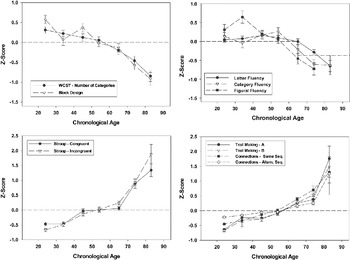
In light of the robust patterns with cognitive abilities, it is natural to ask whether similar age trends are apparent with other types of variables, such as measures of performance in various neuropsychological tests. The available information suggests that the answer to this question is yes, as Figure 2 portrays the age relations for a variety of neuropsychological variables, including the Wisconsin Card Sorting Test, Block Design, various fluency tests, and the Stroop and Trail Making tests. The sample sizes with these variables are smaller than those for the data in Figure 1, which is probably responsible for the somewhat noisier age functions. Nevertheless, in each case there are nearly monotonic age-related declines beginning in early adulthood. Similar patterns with various neuropsychological variables are evident in other studies involving moderately large samples of adults across a wide age range (e.g., Borella, Carretti, & De Beni, Reference Borella, Carretti and De Beni2008; Clark et al., Reference Clark, Paul, Williams, Arns, Fallahpour and Handmer2006; Dore, Elias, Robbins, Elias, & Brennan, Reference Dore, Elias, Robbins, Elias and Brennan2007; Van der Elst, Van Boxel, Van Breukelen, & Jolles, Reference Van der Elst, Van Boxtel, Van Breukelen and Jolles2006).
Means and standard errors for scores on various neuropsychological tests based on data from studies by Salthouse and colleagues (e.g., Salthouse, Atkinson, & Berish, Reference Salthouse, Atkinson and Berish2003; Salthouse, Fristoe, & Rhee, Reference Salthouse, Fristoe and Rhee1996; Salthouse & Meinz, Reference Salthouse and Meinz1995; Salthouse, Pink, & Tucker-Drob, Reference Salthouse, Pink and Tucker-Drob2008). Sample sizes ranged from 269 to1455.

A possible implication of these findings is that because the age relations in many cognitive and neuropsychological variables are so well-established, they might be considered the baseline against which age relations in other variables should be evaluated. That is, rather than ignoring these robust relations, it may be productive to compare the results with new variables with these well-documented results to determine if, and how, the new findings differ from what has already been discovered.
How Many Distinct Age-Related Influences Are Operating?
Because many different types of cognitive and neuropsychological variables have been found to have roughly similar relations with age, it is reasonable to ask how many different mechanisms are contributing to the age differences in measures of cognitive and neuropsychological functioning. Two general approaches have been used to address this question. The most direct approach consists of examining correlations among longitudinal changes in different cognitive variables. Several studies with sensitive measures of change based on factor or composite scores, and powerful analytical methods such as latent change or growth models, have found significant correlations among the changes in different cognitive abilities (e.g., Hultsch, Hertzog, Dixon, & Small, Reference Hultsch, Hertzog, Dixon and Small1998; Lindenberger & Ghisletta, Reference Lindenberger and Ghisletta2009; Wilson et al., Reference Wilson, Beckett, Barnes, Schneider, Bach and Evans2002). In each of the studies, the authors suggested that the results were consistent with the existence of a single general factor of cognitive change, above and beyond any ability-specific changes that might also be occurring.
Only indirect methods of investigating distinct age-related influences are possible with cross-sectional data. The most common method involves using statistical procedures to control the variance in one variable when examining the relations of age with other variables. A finding that the age relations are reduced when the variance in one variable is controlled has been interpreted as consistent with an inference that the cross-sectional age differences on the two variables are not independent of one another. Many studies with different types of cognitive and neuropsychological variables have reported substantial attenuation of cross-sectional age relations with these types of methods (e.g., Bugg, Zook, DeLosh, Davalos, & Davis, Reference Bugg, Zook, DeLosh, Davalos and Davis2006; Head, Rodrigue, Kennedy, & Raz, Reference Head, Rodrigue, Kennedy and Raz2008; Schretlen et al., Reference Schretlen, Pearlson, Anthony, Aylward, Augustine and Davis2000). Furthermore, several studies by Salthouse and colleagues have reported that statistical control of the variance in reasoning, memory, speed, and vocabulary abilities substantially reduces the age relations on a wide variety of cognitive and neuropsychological variables, including many measures of memory (e.g., Salthouse, Berish, & Siedlecki, Reference Salthouse, Berish and Siedlecki2004; Salthouse, Pink, & Tucker-Drob, Reference Salthouse, Pink and Tucker-Drob2008; Salthouse, Siedlecki, & Krueger, Reference Salthouse, Siedlecki and Krueger2006; Siedlecki, Salthouse, & Berish, Reference Siedlecki, Salthouse and Berish2005) and executive functioning (e.g., Salthouse, Reference Salthouse2005; Salthouse, Reference Salthouse2010b; Salthouse, Atkinson, & Berish, Reference Salthouse, Atkinson and Berish2003; Salthouse & Davis, Reference Salthouse and Davis2006; Salthouse & Meinz, Reference Salthouse and Meinz1995; Salthouse & Siedlecki, Reference Salthouse and Siedlecki2007).
It may never be feasible to provide a specific number as an answer to the question of the number of separate age-related influences, because it is impossible to include all cognitive variables in the analyses. Nevertheless, it now seems clear that the number of distinct influences contributing to both age differences and age changes in cognitive functioning is considerably smaller than the number of variables exhibiting age relations. A possible implication of these findings is that researchers should be cautious about interpreting age differences observed in a particular variable in terms of task-specific processes or mechanisms until more general influences have been considered. That is, unless the variable is examined in the context of other variables, it is impossible to determine the extent to which the age-related effects on a given variable are independent of age-related effects on other variables.
Are Age-Related Declines in Mean Level of Performance Associated With Increases in Between-Person Variability?
It is often assumed that the differences between people increase with age, and that only some people experience cognitive declines, while many other people either remain stable or improve throughout most of their lives. This is obviously an important possibility to consider because the implications for interpretation would be quite different if only some people are affected, or if the phenomenon corresponds to a shift of the entire distribution.
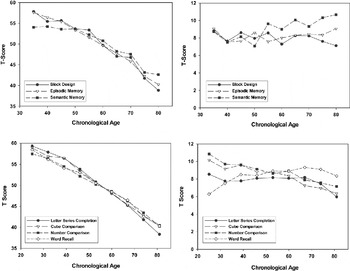
Results from two recent projects can be used to illustrate typical patterns regarding age and between-person variability in cross-sectional comparisons of cognitive functioning. A project by Ronnlund and colleagues (i.e., Ronnlund & Nilsson, Reference Ronnlund and Nilsson2006; Ronnlund, Nyberg, Backman, & Nilsson, Reference Ronnlund, Nyberg, Backman and Nilsson2005) involved data from approximately 1000 adults between 30 and 80 years of age on the Block Design test (2006), and on Episodic Memory and Semantic Memory factors (2005). A project by Schaie (Reference Schaie2005) involved data from 2476 adults on many cognitive variables, with four of them considered here. Means as a function of age in the two projects are portrayed in the left panels of Figure 3, and between-person standard deviations for the same data are portrayed in the right panels of the figure. Notice that although there are large age-related declines in mean performance in every variable (left panels), the magnitude of the individual differences in performance across this age range was nearly constant (right panels).
Mean T-scores for various cognitive test scores as a function of age (left panel) and standard deviations of the scores as a function of age (right panel). Data from Ronnlund and colleagues (Reference Ronnlund, Nyberg, Backman and Nilsson2005, Reference Ronnlund and Nilsson2006), and from Schaie (Reference Schaie2005).

Very similar patterns of large age differences in mean performance with little or no age differences in variability are also apparent in Figures 1.12 to 1.14 in Salthouse (Reference Salthouse2010a) based on analyses of data from studies by Salthouse and data from various commercial test batteries. All of these samples likely excluded many older adults with poor levels of cognitive performance attributable to health problems or diagnosed pathologies, and thus the results should not be interpreted as indicating that between-person variability never increases with increased age. However, the important point is that little or no differences in between-individual variability are apparent in the same samples in which moderate to large age-related declines are evident in the average level of performance. These results are consistent with an interpretation that the cross-sectional age differences reflect a shift in the entire distribution, rather than an increase in the breadth of the distribution as would be expected if only some people declined whereas others remained stable. Of course, longitudinal data with sensitive measures of change are needed to determine whether some individuals remain stable while others decline, but the cross-sectional data clearly indicate that mean declines can, and do, occur without accompanying increases in between-person variability. An implication of these findings for researchers interested in age-related cognitive declines is that mechanisms need to be identified which contribute to a shift in the entire distribution, in addition to those which affect people differentially and result in an increase in the breadth of the distribution.
What Is Responsible for the Discrepancy Between Cross-sectional and Longitudinal Age Trends?
Although the prior figures indicate that cross-sectional age trends are apparent from early adulthood, interpretation of these results has been controversial because different age trends are sometimes found in comparisons of the same person at different ages, and in comparisons of different people at different ages. Specifically, within-person longitudinal comparisons sometimes reveal stability or an increase in cognitive performance, whereas between-person cross-sectional comparisons typically reveal nearly monotonic declines from early adulthood.
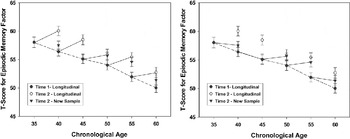
The existence of different age trends in cross-sectional and longitudinal contrasts has naturally led to the question of what is responsible. This issue is still being actively debated, and there is not yet a consensus on the explanation. However, one factor that clearly seems to be involved in the discrepancy is an influence of practice associated with prior test experience in longitudinal comparisons. Practice influences have been estimated by comparing scores of the longitudinal sample on a second test with scores from a new sample of participants of the same age who were recruited from the same population and tested for the first time at the time of the second test in the longitudinal sample (e.g., Schaie, Reference Schaie2005). Ronnlund and colleagues (Reference Ronnlund, Nyberg, Backman and Nilsson2005) reported an example of this type of contrast with a composite episodic memory variable, and some of their data are portrayed in the two panels of Figure 4. The left panel contains solid lines connecting longitudinal observations, and dotted lines connecting cross-sectional observations. Consistent with other reports, the two types of comparisons reveal different age trends as there are monotonic decreases in the cross-sectional data but increases in the longitudinal data. The data from the new sample of adults tested at the time of the second test in the longitudinal sample are represented in the figure with triangles. In the right panel of Figure 4, the solid lines connect the scores from individuals within the same birth cohort, but instead of the scores from the true longitudinal participants, the second data point in each set is based on the scores from individuals not previously tested. This pseudo-longitudinal contrast can be postulated to approximate the within-cohort trend without an influence of prior test experience, and it is noteworthy that, at least at some ages, the pattern is more similar to the cross-sectional trends than to the original longitudinal trends.
Means and standard errors for composite memory scores at two test occasions and for a new sample tested at the second occasion, based on data from Ronnlund and colleagues (Reference Ronnlund, Nyberg, Backman and Nilsson2005).

Similar patterns of sizable practice effects and a relatively small discrepancy between the cross-sectional and practice-adjusted longitudinal age trends have also been reported across different cognitive variables and different analytical methods in recent studies by Salthouse (Reference Salthouse2009b, in press). These results not only suggest that longitudinal data are influenced by practice effects and thus do not provide pure measures of maturational change, but in addition they suggest that some of the discrepancy between cross-sectional and longitudinal age trends in cognitive functioning is likely attributable to prior practice inflating the second scores in longitudinal assessments.
The research focusing on practice effects is an example of how one of the factors postulated to contribute to the discrepancy between cross-sectional and longitudinal age trends in cognitive functioning has been investigated. Further progress in resolving the discrepancy will likely occur when other hypothesized factors, such as cohort influences, are also operationalized and investigated to determine the effects they have on the age trends in cross-sectional and longitudinal comparisons.
How Can Causes of Age-Cognition Relations Be Investigated?
Unlike the prior questions, this question does not directly concern substantive findings, but rather deals with the methodological approaches that can be used to investigate the question. That is, the issue here is what analytical methods can be used to investigate causes of the relations between age and cognitive functioning.
As is well known, the ideal method to investigate cause and effect relations involves random assignment and experimental manipulation of the relevant factor, and when the interest is on effects on rate of aging, the research participants must be monitored over a long enough time to examine effects on rates of cognitive change. However, because experimental methods with long-term follow-up are seldom feasible with humans, correlation-based procedures have been used to investigate causal relations.
Causal relations are sometimes inferred on the basis of simple correlations, such as correlations between age andz a neurobiological variable (e.g., volume in a particular neuroanatomical region), and between that variable and performance in a cognitive or neuropsychological test. Unfortunately, because correlation does not imply causation, simple correlations are not sufficient to draw causal inferences. Nevertheless, because causation does imply correlation, correlation-based procedures can be used to examine the implications of causal hypotheses. In particular, mediation analyses (Baron & Kenny, Reference Baron and Kenny1986) can be conducted to examine whether the results are consistent a particular set of relations among the variables. For example, if a neurobiological variable is hypothesized to mediate much of the relations of age on a neuropsychological variable, one would expect the relation of age to the neuropsychological variable to be reduced, or even eliminated, when people are statistically equated in the level of the hypothesized mediating variable.
Although more informative than simple correlations, two limitations of mediation analyses are often not recognized. One limitation is that results of mediation analyses are only consistent with the hypothesized model, and the results could be equally consistent with alternative models of the relations among the variables. A second limitation is that mediation results might not be interpretable if there is evidence of moderation, in which the mediator-target relations are different at different ages, because this would suggest that the meaning of the mediator varies as a function of age. Mediation analyses can also be complicated with longitudinal data because the results of the analyses could vary when the lag between changes in the two variables does not match the interval between observations, or if there is a threshold level that must be exceeded before changes in the presumed cause trigger changes in the presumed effect.
There is no simple solution to these problems, and it is important that researchers recognize that all analytical methods have limitations. Nevertheless, progress is possible by examining alternative models of the relevant variables, investigating moderation as well as mediation, and trying to converge on conclusions with multiple analytical methods based on different combinations of assumptions.
SUMMARY
Cognitive aging is a very active area of research, and considerable progress has been made in characterizing the basic phenomenon. Although preliminary answers are available to some questions, many important questions about the causes of the phenomenon have not yet been answered, and they will have to be addressed before age differences and changes in cognitive functioning are fully understood. Among the suggestions for how this might be best accomplished are to take existing results into consideration when analyzing and interpreting results with new variables, investigating the validity of even commonly held assumptions such as those concerning relations of age to between-person variability and causes of discrepant age trends in cross-sectional and longitudinal comparisons, and basing conclusions on results derived from multiple methods.
ACKNOWLEDGMENTS
Preparation of this manuscript was supported by a grant from the National Institute on Aging (R37 024270). The information in this manuscript has not been previously published, and the author has no conflicts of interest.