INTRODUCTION
This study investigated the interactional skills of children aged seven to twelve in initiating the openings of a task in which they had differential access to information. The task required them to work in pairs by talking to each other to achieve the goal of drawing a path on a map. The purpose of the study was to track differences between the two groups with respect to how they structured their openings, how they oriented to who had rights to start, how they dealt with any problems that arose as a result of the differential access to information, and how these actions were achieved collaboratively.
Children's skills in referential communication tasks, where there is informational asymmetry and children are required to achieve some kind of goal, are important because they are analogous to some of the kinds of tasks that children experience in the classroom (Baines & Howe, Reference Baines and Howe2010). Among the skills required to succeed in these tasks is the ability to take the perspective of the other speaker and attribute epistemic states to them. The attribution of epistemic states requires understanding that a speaker has and is able to access given or new information (Sauvaire & Vion, Reference Sauvaire and Vion1989) so that appropriate and clear instructions can be given and understood.
Children's ability to attribute knowledge states to speakers by differentiating between what is given and what is new information has been shown to be present in children between the ages of three to five in referential communication tasks (Nilsen, Graham, Smith & Chambers, 2009), although Resches and Pérez Pereira (Reference Resches and Pérez Pereira2007) maintain that such skills are in place earlier in children who have a well developed Theory of Mind (ToM).
There is a great deal of disparity in the findings with respect to children's referential skills, as Graf and Davies (Reference Graf, Davies and Matthews2014) note. This, they maintain, is largely as a result of the different paradigms within which the studies are based and the different approaches taken. There is agreement, however, that infants are able to track (from the age of 12 months) and steer (from the age of 14 to 18 months) their co-participant's attention through pointing, gaze, and/or vocalization (Filipi, Reference Filipi2009, Reference Filipi and Matthews2014; Liszkowski, Carpenter & Tomasello, Reference Liszkowski, Carpenter and Tomasello2008; Moll & Tomasello, Reference Moll and Tomasello2007; Poulin-Dubois, Sodian, Metz, Tilden & Schoeppner, Reference Poulin-Dubois, Sodian, Metz, Tilden and Schoeppner2007). Children's ability to take the other speaker's perspective and ascribe knowledge states starts at around the age of two (Graf & Davies, Reference Graf, Davies and Matthews2013). Using the micro-analytic methods of conversation analysis, Filipi (Reference Filipi2015) shows how this ability in fact starts to develop at the age of 18 months in a bilingual child who negotiates the choice of language with her English-speaking father or Italian-speaking mother. Filipi maintains that such an ability requires developing an awareness that speakers speak different languages by constructing utterances in the appropriate language for the speaker. This ability underscores the ascription of knowledge of another language to a co-speaker.
It is not enough, however, to merely ascribe knowledge states. It is also important to understand what aspects of assumed knowledge or information are appropriate to give, and how to best convey the information. In other words, speakers need to give the appropriate amount of information designed specifically for their co-participant, as well as evaluate the quality of the information. Indeed, with respect to the latter, five year-old children have acquired a set of expectations about what constitutes an appropriate amount of information in referential expressions, as their initiation of repair, when these expectations are not met, demonstrates (Morisseau, Davies & Matthews, Reference Morisseau, Davies and Matthews2013).
Investigations into the quality and appropriateness of information in children's communication show the important role of a co-participant's feedback to the development of children's acquisition of knowledge and their understanding that speakers have differential perspectives and access to information. Repair in interaction and the accumulated experience of responding to repair initiations is particularly important in the development of this understanding (Astington & Baird, Reference Astington and Baird2005; Carmiol & Vinden, Reference Carmiol and Vinden2013; Harris, Reference Harris, Astington and Baird2005; Tomasello, Reference Tomasello1999). Repair is also important in helping young children develop and improve their referential strategies (Matthews, Lieven, Theakston & Tomasello, Reference Matthews, Lieven, Theakston and Tomasello2006; Matthews, Lieven & Tomasello, Reference Matthews, Lieven and Tomasello2007).
In research in conversation analysis, repair is a very important part of the organization of turn-taking. Through repair, speakers are able to establish and maintain inter-subjective understanding or common ground when breakdown occurs. This is achieved as the talk unfolds turn by turn, where displays of understanding are offered in reaction to the previous turn (Schelgloff, Reference Schegloff1992; M. H. Goodwin, Reference Goodwin1980). As an action in talk, repair is particularly powerful in revealing how cognition as a situated action in interaction emerges through the collaborative actions of the speakers. There is a now a rich body of research about children's skills in repair from this perspective, to which the current investigation will contribute (see, for example, Filipi, Reference Filipi2009; Forrester, Reference Forrester2008; the collection in Gardner & Forrester, Reference Gardner and Forrester2010, for young children; and M. H. Goodwin, Reference Goodwin1980, for older children).
One specific area related to referential communication that has been a rich source of research interest is spatial referencing. An early impetus for investigations in this field was Piaget, Inhelder, and Szeminska's (Reference Piaget, Inhelder and Szeminska1960) claim that children's earliest route knowledge is sensorimotor. Such a claim has stimulated debate about communication particularly as it pertains to strategy use within a developmental perspective. A key underlying concern of these studies has been to get at what children actually do when they are placed in a position of having to communicate route directions to either a real or imagined co-participant, and what this might look like at different stages of development. This has been considered to be important because the ability to give successful directions is related to the ability to take the other speaker's perspective.
A growing picture of children's skills at particular stages of development has emerged through various studies of children's spatial strategies. In comparative studies, children aged seven to nine show some differences, particularly in terms of style and content. For example, Flavell, Green, and Flavell (Reference Flavell, Green and Flavell1985) and Lloyd (Reference Lloyd1991) report that seven-year-olds do not provide as much listener feedback as twelve-year-olds because they are less able to locate specified referents (Lloyd, Reference Lloyd1991) or because they are less open to ambiguous information (Flavell et al., Reference Flavell, Green and Flavell1985).
Younger children have also been reported to produce less successful instructions than older children. In this vein, Blades and Medlicott (Reference Blades and Medlicott1992) found that six-year-olds' directions were vague, explained by their use of landmarks as they focused on movement from a map rather than direction in the environment. By contrast, the twelve-year-olds used directional terms and road descriptions at choice points, resulting in greater accuracy. Another factor that may contribute to these differences is in the use of redundancy, which permits for information to be presented in different ways (Blades & Medlicott, Reference Blades and Medlicott1992; Lloyd, Reference Lloyd1991). These studies report a greater presence of redundancy in the communication styles of adults' interactions when compared with children's.
Also concerned with task success, as defined by accurate map rendering and the communication strategy adopted, Anderson's (Reference Anderson, Gernsbacher and Givón1995) study (based on a map similar in design to the one in the current study) compared the interactions and the accuracy of completed maps of three groups of children (seven-year-olds, ten-year-olds, and twelve-year-olds) and one group of adults. She identified the ‘question introduction’ as a successful strategy, used less often by the younger children. Anderson, Clark, and Mullin (Reference Anderson, Clark and Mullin1991, Reference Anderson, Clark and Mullin1994) were also interested in the association between the strategies adopted and the task success of the interactions of children aged 7;5 to 13;7. They reported that the younger children used fewer of the identified strategies that were linked to a successful outcome, such as questions, open discussion of problem points, and provision of reliable listener feedback. These strategies were implicated in establishing common ground. Filipi and Wales (Reference Filipi, Wales, Coventry, Tenbrink and Bateman2009) similarly found that there was not a single instance of a shift to come from go in the interactions of seven-year-olds, a strategy associated with establishing a jointly arrived at common reference point on the map after protracted trouble.
Moving away from the map task and direction giving to tasks requiring collaboration and the achievement of a specific goal, Baines and Howe (Reference Baines and Howe2010) take issue with the deficit model present in research of children's abilities which may in part be due to the contexts and methods used. They argue that interactions arising out of interaction in tasks that one might find in educational contexts rather than casual interaction provide a greater opportunity for children to show how they manage interactional problems and collaborate with each other precisely because tasks involve a joint purpose in problem-solving that requires cooperation. In developing tasks for four-, six-, and nine-year-olds requiring such cooperation, Baines and Howe were able to show children's skills in managing topics. These included the finding that older children were using greater agreement and response tokens and requests for confirmation, while the younger children were much more inclined to direct and inform or listen.
The analytic interest of this paper is to describe the actions of the participants in interaction as they go about opening a map task. Opening and closing phases of talk constitute an important area of research in a range of interactions (see, for example, Filipi, Reference Filipi1998; Filipi & Wales, Reference Filipi and Wales2010; Schegloff & Sacks, Reference Schegloff and Sacks1973). In the context of the map task, the opening in particular is important because it sets up a turn-taking procedure that if successful will be adopted by the speakers during the main direction-giving task.
The current study builds on work looking at the organization of discourse through sequence organization and assessment sequences in closing phases (Filipi & Wales, Reference Filipi and Wales2004, Reference Filipi, Wales, Coventry, Tenbrink and Bateman2009, Reference Filipi and Wales2010). In order to avoid the inevitable pitfalls of extrapolating findings to talk in other settings, the analytic focus will be driven by what participants need to know in order to achieve a successful opening and commencement of the map directions. Psathas’ (Reference Psathas, Boden and Zimmerman1991) work on direction-giving provides a basis for making comparisons. His 1991 paper, in particular, in which he identifies the structure of the openings and closings of direction-giving, is relevant to the current study. Psathas states that because direction-giving is a social action, which is achieved through talk, it is analyzable for its recurring patterns and sequential organization. Therefore the opening provides an opportunity for examining inferences that the children make about each other's states of understanding and knowledge, and need for information, and how these emerge through the ways in which they collaborate to structure the opening. This builds on work in children's referential communication skills (as reviewed above) but within an interactional context.
Skills in structuring phases in a larger sequence of activity is as yet an area largely unchartered within this broader focus of referential communication skills using the map task. Filipi and Wales’ (Reference Filipi and Wales2010) study, using the same data, compared the closing or assessment phase of adults' and children's map tasks. They found that while all groups produced first assessments or evaluations of activities or events (for example that was hard), adults produced immediate second assessments in response to them (see Pomerantz, Reference Pomerantz, Atkinson and Heritage1984, for a discussion about how first assessments generate second ones), and held off talk about the map rendering while the children did not. They concluded that the children were much more intent on results or the outcome of the task, and were more open and direct in their fault-finding either with the self or with the other.
Understanding children's abilities to structure their discourse at various stages of their lives as they interact with each other in both ordinary conversation and in more structured contexts that are likely to be found in educational contexts, and isolating the sorts of activities that might give rise to particular sets of skills, are important because they contribute to the growing picture of children's interactional skills across age groups. Within the context of spatial language, the openings also provide an insight into how the children orient to both instruction-giving and to their co-participant in establishing joint understanding.
RESEARCH DESIGN AND METHODS
The analytic tools and findings of conversation analysis (CA) will be applied to the exploration of the issues identified despite the fact that the data was derived from a constrained rather than a naturally occurring context. The interactions are social in orientation. Thus, while the conclusions drawn need to be considered within the constraints provided by the setting and the nature of the data collection method, the task itself is based on a pedagogic one used in the second-language classroom under the rubric of ‘information gap’ activities (Brown, Anderson, Shillock & Yule, Reference Brown, Anderson, Shillock and Yule1984).
The use of the map task is well established as a research tool for the study of communication strategies and listening skills of students in an English as a Foreign Language classroom (Ogane, Reference Ogane1999). It provides a source of constrained but spontaneously produced interactions, and its appeal lies in the possibility for researchers to conduct studies of communication using both qualitative methods and quantitative measures. Some findings might therefore have greater bearing on talk in educational settings, while others are tied to the task itself.
Data collection
The data are derived from the interactions of sixteen children. Their ages ranged from 7;6 to 12;10. The children were placed in two groups. In the younger group were eight children ranging in age from 7;6 to 7;11. The second group was composed of eight children aged between 10;4 and 12;10.
The task provided an information gap that required speakers to work in pairs using a map that the other could not see. The children were asked to assume the roles of the instruction-giver (henceforth IG) or the instruction-follower (henceforth IF). The IG's map had a path marked on it. The IF had a similar map without a path. The position, existence, and names of landmarks were also differences between the maps. (The map for the older children is from ANDOSL, Millar et al., Reference Millar, Vonwiller, Harrington and Dermody1994, while the younger children's map has been slightly modified to suit the age group as explained below.) The IG's role was to instruct the IF to draw the path onto her or his own map. Each pair performed in both speaker and listener roles using a different map each time.
There were some differences in the design of the maps, and in procedures for the younger children in the corpus. For example, landmarks were included that were more congruent with the children's experience, such as park and school; the finish (denoted by an ‘X’ and a picture) was marked on the IG's map, and a context for finding the trail left by the beach ball or kite was also created – in both cases the children were told that the path was created by the IG's beach ball or kite as they were blown by the wind. (See ‘Appendix 1’ for a sample of the younger children's map beginnings for tour 1.) Prior to commencement of the task, the author sat with the younger children individually and checked that these landmarks were familiar to them by asking them to read the labels under the drawings.
In addition to the general instructions to the children for doing the task prior to commencement, the children were told that on completion of the task they could exchange maps and talk about the completed product. The following are the instructions provided to the younger children:
I am going to give each of you a map. You will need to work together by talking to each other to complete this task. You must not show each other your maps until the very end when you will have completed the task.
• (Name) you will have a map with a path that leads to where a beach ball (map 1) (or kite, map 2) has ended up. (Name) you will have a similar map but only with pictures of objects or places such as a park or a landmark such as a fountain. You won't have a path or line on your map that shows the path taken by the beach ball (tour 1) (or kite, tour 2).
• (Name) you will be explaining to (Name) where the path goes to reach the beach ball/kite and (Name) you will be following (Name's) instructions to draw the path on your map.
• Don't think that you will both have the same landmarks, objects, or places drawn on your maps. They may be different or the same. If they are the same they may be placed in a different position on your map.
Remember not to show each other your maps while you are drawing the path … you need to talk to each other only. Do you have any questions?
The children were filmed and audio-recorded in a family home by the author and a technical assistant. Having access to film as a medium was an important feature of the children's interactions because there were occasions when it was important to ascertain who was being addressed: the co-participating child or the task administrator.
Full verbal transcripts were made of all interactions using the transcription conventions of CA. Non-verbal features were transcribed as well (see ‘Appendix 2’). Each pair of participants is identified by a number that appears in the header of each transcript. IG refers to Instruction-Giver, IF refers to Instruction-Follower and TA to Task Administrator. Each child's age in years and months appears in the header as well.
Analytic focus
In Psathas’ (Reference Psathas, Boden and Zimmerman1991) study of the openings of direction-giving in conversation, he states that while speakers may use multiple entry devices in the task of route construction, a primary entry point is initiated by a request by the direction-seeker. This presents an important difference with the data in the current study. To begin with, as noted above, while generating spontaneous interactions, the task is nonetheless constrained and not naturally occurring. Speakers may thus not be familiar with what is being asked of them. Second, the design of the task imposes differential access to information on the speakers; the IG has a map with all the information including a clearly marked path. The IF's map is devoid of a path and only contains a series of landmarks. As stated, speakers are told that the landmarks may not be the same on the maps, and if they are, that they may not necessarily be located in the same positions on the maps. In real-life situations, speakers also have differential access to knowledge about locations and landmarks. They formulate location (Schegloff, Reference Schegloff and Sudnow1972) by carrying out a location analysis, a topic analysis, and a membership analysis (which Stokoe, Reference Stokoe2010, defines as the ways in which speakers display the formation of and subsequent claims of identity categories when interacting with each other). This is reflected in the conversational resources they use.
From the analysis, the first problem that confronts the participants in the current data sample relates to who should start the task. This is not made explicit in the verbal instructions prior to commencement. The second problem is how to start the task. This problem may be further complicated by the design of the task that requires the speakers to do the task twice, each time with a different map and by swapping roles. This may generate a possible need to first establish that the participants are in fact working with the same map.
It is evident that the children have to juggle a number of potential interactional problems in the openings of the map task if they are to succeed in getting started. The analytic interest in this study is thus to examine how the children go about solving these problems if and when they arise. To begin the analysis, we start with an unproblematic, troublefree opening.
ANALYSIS AND DISCUSSION
The first excerpt is typical of the more successful openings in the dataset. (A successful opening is defined as one that is achieved efficiently in a minimal number of turns and without the need for repair.)
Excerpt 1 Pair 1 (IG 10;1, IF 12;3)
1 IG: okay. (0.4) do you have shee:::r cli:::ffs,
2 (0.3)
3 IF: ↑ye:::s.
4 (0.3)
5 IG: 6 well- (0.1) go:: (0.2) where the start ↓here sign is, and go (0.3) ↑dow:::n.
7 (0.2)
8 IF: to the sheer cliffs?
The IG opens the task with the discourse marker okay followed by a pause. This serves to indicate a change in activity (closure of the instructions for doing the task by the TA) and a readiness to begin to the IF. The IG then starts with a question that attempts to establish whether the first landmark is shared. It is an effective strategy and sets a pattern for subsequent instructions. On receiving an affirmative answer, the IG is then able to provide an accurate shared starting position on the map, thereby minimizing problems later as directions are given. This last action successfully locates a shared starting point so that the instructions can begin.
This unproblematic opening or pre-start (Psathas, Reference Psathas, Boden and Zimmerman1991) thus has three phases: the marking of readiness to begin through a discourse marker, the establishment of a common starting point on the map through a question/answer sequence, and the actual commencement of the instructions for the path rendering. Each of these stages will now be discussed.
Phase 1: readiness to begin
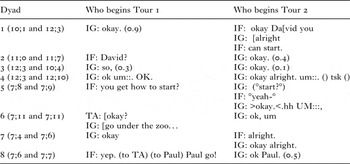
With the exception of one child, the children need to openly mark the beginning of the task both verbally and non-verbally by closing the preceding activity in which the TA explained the task, and by signalling readiness to begin a new activity. There are differences in the way children mark this phase. As can be seen in Table 1, the most frequent verbal device is the use of the discourse marker okay, which occurs in different prosodic and positional configurations, and works to close and/or open a new activity. (See Filipi and Wales, Reference Filipi and Wales2003, for the function and organization of these markers in a map task.) Non-verbally, the children turn their bodies and gaze away from the TA and look at each other, then shift their gaze from each other to their maps. This is true for both age groups. In four cases, the children actually address their co-participant through the use of their first name. In using these actions, the children are establishing recipiency, or their availability to interact with each other in the task.
Phase 1 – who opens the task and how

As noted, there was only one instance where the beginning of the task was not marked.
Excerpt 2 Pair 8 (IG 7;11, IF 7;11)
1 TA: [okay?
2 IG: [go under the zoo, (0.3) yeah go under the zoo.
The IG can be seen to immediately start the instructions without any preliminary talk at all. She also starts in overlap with the TA's request for confirmation that the instructions have been understood. This request lapses as the TA exits the room having assumed that there are no problems. Thus there is no pre-start. This organization deviates from all other fifteen openings.
Phase 2: establishing a common starting point on the map
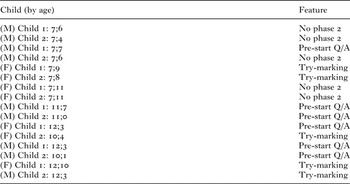
The second phase of the more successful openings is the establishment of a shared starting point so that instructions for drawing the path can begin. This can include establishing the first common landmark, an actual starting point marked with an X, the name of the tour, and/or direct reference to the top of the page. This is most successfully achieved through the ‘try-marking’ device (where a referent is uttered with upward intonation, an action that invites confirmation that the referent is mutually recognized; Sacks & Schegloff, Reference Sacks, Schegloff and Psathas1979) or a preliminary question and answer (Q/A) pre-sequence (Schegloff, Reference Schegloff and Sudnow1972, Reference Schegloff1980, 2007) (and identified as a pre-start by Psathas, Reference Psathas, Boden and Zimmerman1991, in map talk, as illustrated in Excerpt 1, lines 1 to 3). These features involve actions by both speakers. The latter, referred to as a question introduction by Anderson (Reference Anderson, Gernsbacher and Givón1995), has been identified as a strategy that strongly correlates with task success because it minimizes the need for repair (Anderson, Reference Anderson, Gernsbacher and Givón1995).
As can be seen in Table 2, the Q/A pre-start was the most common feature of the older children's interactions, followed by three try-marks. In the younger children's openings, only one child produced a Q/A pre-start about location, while for five interactions there was no phase two. Clearly this phase is tied specifically to the map-giving instructions, unlike the use of discourse markers to indicate readiness and change of activity. This suggests that there are some differences between the younger and older children with reference to the task but not with respect to pragmatic function.
Phase 2 – how the children locate a starting point for the directions

The fact that the task is done twice with a different map each time (referred to as Tour 1 and Tour 2) produces an additional potential problem for the participants. The issue is the need to make sure that both speakers are working with the same map. Two features are used to do this work: try-marking (Sacks & Schegloff, Reference Sacks, Schegloff and Psathas1979) reference to the name of the tour on the map (see Excerpt 4) or explicitly asking a question (Excerpt 3). (Of course the participants can also merely assume that they are working with the same map; to be discussed below.)
Excerpt 3 Pair 5 (IG: 11;0, IF: 11;7)
1 IG: → {okay:::. (0.9) have you got tour one starts here with a big X?
2 {((Looks at the map.))
3 IF: → yes.
4 (0.2)
5 IG: → okay:. (0.2) ya go dow::n …
In this opening, after the stretched discourse marker followed by a long pause (during which the IG is looking down at his map), the IG initiates a Q/A pre-sequence. The specific work being done through this device is to ensure that both the IG and IF are working with Tour 1. Once an affirmative response is received by the IG, the speakers are ready to commence the actual instruction-giving. We note again the use of okay in line 5, where it functions to close the pre-sequence.
In the next three excerpts we analyze sequences where the IG begins by inferring (with different degrees of certainty) that the IF has the same landmark and/or map. Carletta and Mellish (Reference Carletta and Mellish1996) would characterize such an approach as risk-taking because if the inference turns out to be incorrect, then time will be taken up in repair later. In Excerpts 4 and 5 the children are using the same map – Tour 1 – the map that is used to do the task the first time. The first landmark (the zoo) happens to be a shared one and is also located on the same position on both the IG's and IF's maps. Tour 2 (Excerpt 6) is used the second time. The first landmark on this map is not a shared landmark, therefore there is potential for trouble even though in the instructions about the task before commencement all children were told that they could not assume that their maps had the same landmarks or that the landmarks would be in the same position on their maps.
In comparing Excerpts 4 and 5, it is evident that despite the shared landmark there is trouble in Excerpt 5 requiring a suspension of the route instructions in order to deal with it, whereas in Excerpt 4 the speakers are able to successfully avoid the need for repair. This is due to the IG's action of try-marking her instruction through a slightly rising intonation which receives a positive if minimal response from the IF in line 9 but which nonetheless establishes the landmark as commonly shared.
Excerpt 4 Pair 8 (IG: 7;9, IF: 7;9)
5 IG: ok{ay. (0.4) what ↑you do- (.) i::s hh (.) you start off
6 {((Looks down.))
7 {(0.1) at the start of the {zoo↑ to the entrance¿=
8 {((IF at the map.))
9 {((IF looks at IG then down.))
10 IF: =mm hm¿
11 IG: ( ) entrance. (0.2) you walk past….
Excerpt 5 Pair 11 (IG: 7;8, IF: 7;6)
1 IF: ((Looks at the IG then down.))
2 (1.2)
3 IG: there's (path ba{lloon.) you- you go {round the
4 {((Looks at IF.)) {((Looks down.))
5 {zoo {animals
6 {((Looks at IF.))
7 IF: {((Looks at IG, away.))
8 (0.4)
9 IF: ah::: I don't {know where you started.
10 {((Looks at IG.))
11 (0.5)
12 IG: {at the…(0.8) [tsk at the {top of the page.
13 IF: {((Looks down.)) {((Looks at the map, then down.))
14 IG: [( )
15 (0.4)
16 IF: {what¿
17 {((Looks at IG then down.))
18 IG: at the {top of the page,
19 {((Looks at F.))
20 IF: yeah.
21 (0.4)
22 IG: and then you go around the animals,
The main problem in Excerpt 5 is the vagueness of the instruction as to where to start (there's a path a balloon you go round the zoo animals), as the IF's turn in line 9 – I don't know where you started – shows. The IG's repaired instructions in line 12, in which he adds top of the page, provides evidence that the IG himself has correctly understood the source of the problem and self-corrects. The unclear instruction mirrors Blades and Medlicott's (Reference Blades and Medlicott1992) conclusion that six-year-olds produce vague directions with respect to twelve-year-olds because the six-year-olds focus on landmarks and the map rather than the direction of the environment. According to Lloyd, Mann, and Peers (Reference Lloyd, Mann and Peers1998), the skill to produce clearer instructions shows development between the ages of five and eleven years. Resches and Pérez Pereira (Reference Resches and Pérez Pereira2007) maintain further that socio-cognitive abilities of children with a well-developed ToM is an important factor in considering children's skills in producing clear, unambiguous directions. These rely on a capacity to take into account the co-speaker's perspective, understand a speaker's own role in the task, and ‘regulate’ the co-speaker's activity efficiently.
In Excerpt 5 we can see the consequences of not considering the co-speaker's perspective. However, we also see the IG's ability to reformulate his original instruction (in response to the IF), and not merely repeat it. Furthermore, in both Excerpts 4 and 5 we see the IFs' actions (as listener) in taking an active role in seeking information by alerting the IG to a problem early on through repair initiation (in Excerpt 5), and by minimally responding (in Excerpt 4). These actions provide evidence of children giving feedback as listeners, which is asserted to be important to children's development of referential skills (Matthews et al., Reference Matthews, Lieven, Theakston and Tomasello2006; Matthews et al., Reference Matthews, Lieven and Tomasello2007). However, an important point here is that these skills do not merely ‘reside’ in one speaker or the other, but rather are given space to emerge through interaction and the actions of the speakers as they work together to establish common understandings (Goodwin, Reference Goodwin, Atkinson and Heritage1984). We will come back to this point shortly.
In the next excerpt, the children are working with the second map after having just completed the first.
Excerpt 6 Pair 7 (IG: 7;6, IF: 7;7)
((The boys are holding the map in front of their faces.))
1 IG:→ okay james. (0.5) fir↑::st you just (trail) (0.2) and you
2: go:: to aunt petu- past aunt petunia's ↑toy::s. you go around
3 aunt petunia's ↑toy::s¿
4 IF: → so:::, (1.0) u::m=
5 IG: =you do a straight line and then go under- aunt petunia's toys
6 and then you go after m- a- over malfoy's ↑hou::se?
7 (0.8)
8 IF: → but isn't there:: (.) hog↑wart's mountain¿
The specific problem here is the absence of the landmark Aunt Petunia's toys from the IF's map. This landmark is being used as a reference point by the IG. In line 4, we note the first sign of trouble in the design of the IF's utterance – his stretched so followed by a long gap and the latched um. The IG correctly interprets these features as indicating some kind of trouble. However, his inference that the instruction was not specific enough (as indicated by a more elaborate instruction to draw a straight line that goes under Aunt Petunia's toys in his next turn) is incorrect as the IF's response in line 8 makes clear. This is constructed with the contrastive but that indicates he has a different landmark in this position. The ensuing talk over nineteen turns is invested in sorting out how to get around this glitch. Again, we have evidence of the IG's skill in understanding a trouble source and perceiving the need to redo the instructions for the listener, even though his inference that they share a landmark is incorrect.
The next excerpt provides a further example of inference as the IG proceeds as if the starting point for the path is the same as for the first map.
Excerpt 7 Pair 11 (IG: 7;8, IF: 7;6)
1 IF: {alright.
2 {((Looks at IG, then down.))
3 IG: → {°okay::.° (0.3) alright. you start from the same place you
4 started before {((Looks at IF, then down.))
5 (0.2) you go down past hogwart's mountains. (.) you go
6 under (0.1) aunt petunia's toys:¿
7 (0.5)
8 IF: → wait wait wait wait wait! (0.4) what
9 {is it?
10 {((IG looks at IF, then down.))
11 (0.3)
12 IG: you start from where you started [before.
13 IF: [hogwart's mountains?
14 (0.2) and then where d'you go?
The IG begins the task by locating the IF's starting point at the same place as on the first map – that is at the cross at the top of the page. The IF's directive and question in line 9 indicate that there is a problem. The IG interprets the problem as one of mishearing because the IF's question does not provide any information about the source of trouble. He therefore repeats his original instruction. In line 14, the IF interrupts the IG and it becomes evident that the starting point is not the trouble source. Rather the problem is the absence of the landmark aunt petunia's toys from the IF's map, as it was in Excerpt 6. The assumption that the maps started with a similar reference point (the cross which remains nameless) has thus paid off even though the subsequent talk reveals a problem that arises with the assumption that the first landmark is shared.
With respect to repair, it is evident that the children have very good skills in being able to identify signs of trouble and to initiate repair. Indeed, there is now convincing research that the skill of being able to initiate repair starts to develop very early (e.g. Filipi, Reference Filipi, Rendle-Short and Neville2007, Reference Filipi2009; Forrester, Reference Forrester2008; Gardner & Forrester, Reference Gardner and Forrester2010, all of whom apply CA; and Lizskowski et al., Reference Liszkowski, Carpenter and Tomasello2007, Reference Liszkowski, Carpenter and Tomasello2008). However, in interpreting the problem, the young IGs are making assumptions that the problem is one of hearing or of their own instructions needing further elaboration to meet the IF's needs. Equally, the IFs are assuming a problem with an overlooked landmark.
All examples of openings where the IG assumed a shared starting point or landmark occurred in the younger children's openings. There were no examples in the older children's openings, suggesting that this part of the TA's instruction (that they could not assume that their maps contained the same landmarks) was not attended to by the younger children. The older children all oriented to the possibility that the landmarks might not be shared from the outset, either through the Q/A check or by try-marking.
Phase 3: instructions begin
As noted above, in the successful openings, once a common starting point was established, the instructions could begin as illustrated in both Excerpt 1 (lines 5 to 7) and Excerpt 3 (line 5). The need for both speakers to contribute to creating a successful task is evident in these openings regardless of who has the map with all the information. The successful commencement of the task relies on both participants contributing to the achievement of mutual orientation.
The next excerpt illustrates quite nicely what happens when, despite cautious approaches and the use of devices such as the Q/A pre-start (which as noted has been shown to be associated with success by Anderson, Reference Anderson, Gernsbacher and Givón1995), trouble can still ensue if only one participant works on the instructions. Of interest in this regard are the longer periods of silence (lines 6 and 7) as the IG searches for a solution to the problem of successful orientation.
Excerpt 8 Pair 9 (IG: 12;3, IF: 10;4)
1 IG: is the:::{(0.4) g-gala open cut mi::nd (0.2) really
2 {IF looks at the map.))
3 {clo:se (0.3) to tour 1 starts here¿
4 {((IG looks at IF.))
5 IF: → {no.
6 {((Shakes her head then both look up at each other briefly.))
7 → (2.2)
8 IG: → we::ll, (1.2) {go to the::: (0.6) go to the object clo::sest to
9 {((IF looks at IG then down.))
10 {tour 1 starts …
11 {IG ((fans and beats hands, looks at IF.))
After offering a reply in the negative without any further elaboration in line 5 to the IG's question about the proximity of the landmark to the tour's name, the talk simply lapses for a decidedly long period of 2.2 seconds as a solution is sought. The withholding of talk by the IF could indicate that the solution is being perceived as one that the IG should resolve. It could also indicate that she is unfamiliar with the task and therefore may not know how to go about contributing to finding a solution.
This contrasts with the response of the IF in Excerpt 9 below. The participants are working with the same map as the pair above. However, in contrast to the IF's simple negative followed by silence in reaction to the differently named landmark, in this excerpt the IF offers a solution by stating that although it is named differently it is most likely the same landmark – i've gotta a dingo open cut mine but it's- would probably be the same as yours. Indeed this turns out to be the case. The solution to the problem in the latter example is one that is offered by the IF (to be accepted or rejected by the IG), and, while there is some risk involved, it turns out to be a successful and efficient strategy, and the IG is able to proceed.
Excerpt 9 Pair 6 (IG: 12;10, IF: 12;3)
((IG turns away from the TA who leaves the room then faces the IF.))
1 IG: alright. um::: (0.3) tsk (0.4) up the top¿
2 IF: mh [mm?
3 IG: [there's a:: tour start thing?
4 IF: °ye[p°,
5 IG: [°keep going?°
6 (0.6)
7 IG: do you have a galah ope::n (0.2) cut mind?
8 IF: → i've gotta dingo open cut mine but it's- would probably be the
9 same as yours,
10 IG: well go around the left.
These two excerpts show that, in interaction, the actions of one speaker are not divorced from those of the other. The map task, as is the case with any task that has some kind of information gap, presents a particular set of problems that needs to be resolved in collaboration. Successful strategies used in the openings are not successful per se, just as the impact on the interaction by less successful strategies can be minimized relatively quickly by the actions of the speakers. We will take up this issue in more detail in the ‘General discussion’.
The problem of who starts
It is the IG in the main who initiates the task opening. However, there are a few instances when the IF begins. In three occasions this is done as a go ahead, and examples are present in both age groups.
Excerpt 10 Pair 5 (IG: 11;7, IF: 11;0)
1 IF: → {okay mi[chael,
2 {((Looks up at the IG.))
3 IG: → [alright-
4 IF: → {you can start.
5 {((Looks down.))
6 IG: → okay:::. do you have a little cross saying (0.) to[ur …..
7 IF: [(yeah] yes).
Excerpt 11 Pair 7 (IG: 7;7, IF: 7;6)
1 IF: → {°yep.° (0.2) {james go!
2 {((Looks at the TA.)) {((Turns and looks at the IG.))
3 (0.3)
4 IG: → {um:: (0.2) d'you see the X¿=
5 {((Looks at the map.))
In both of these excerpts we note that although the IFs have initiated the opening by giving the go ahead (you can start; James go) and displaying a show of readiness in line with the use of other features discussed above, such as the discourse marker okay used by the IG, they are still orienting to the IG as being the one who should begin the task.
One instance of the IF starting up as a display of possible trouble comes from the younger children's data. It is a check that the IG has understood how to begin the task. This is an action that appears to be prompted by a perception of a state of uncertainty as to how to approach the opening, as indicated by the long silence of one second in line 2 of Excerpt 12 . It also provides the IF with the possibility of receiving confirmation that the IG shares her understanding of the TA's just-completed instructions.
Excerpt 12 Pair 8 (IG: 7;9, IF: 7;9)
1 IF: huh huh okay.
2 (1.0)
3 IF: → {ya get how to start off?
4 {((Looks at IG and gestures with her hand.))
5 IG: (0.3) ((Nods slightly.))
6 → ok{ay. (0.4) what ↑ya do- (.) is↓ hh (.) ya start off {(1.2) at the
7 start of .…
8 {((Looks down.))
9 IF: {((Looks at the map.))
Of note is the IF's initial turn in line 1 uttered just after the TA has exited. It begins with her giggling. This is followed by the marker okay. We note that it closes the preceding sequence and activity of the TA's instructions. The long silence here of one second prompts the question ya get how to start off?, which co-occurs with a nod and hand gesture as the IF orients to a possible source of trouble. It is an embodied organization (Goodwin, Reference Goodwin2000) that asks for confirmation through the head nod and indicates that she perceives that there may be some uncertainty about procedures, although clearly she is orienting to the IG as the one who should begin. Jefferson (Reference Jefferson, Bull and Roger1989), in describing a metric for a ‘standard maximum’ silence, states that the maximum sits around the one-second mark. The IF appears to be orienting to this metric, and at the lapse of one second, launches a question to indicate that an account for the delay is appropriate.
The check itself is contained in a Q/A pre-sequence. In line 5, the IG does not answer the IF's question verbally. Instead, she nods and utters okay, which closes the pre-sequence, and after a pause the IG begins her instructions. Clearly, her actions provide confirmation that indeed the IG does know how to start. The design of her utterance thus treats the prior talk as a pre-start. However, the interactional work here, unlike the other excerpts analyzed thus far, is to clarify whether there are any misunderstandings, rather than to locate whether they are working with the same map or whether they have a common landmark.
In the map task, as per the TA's instructions, the children know from the outset that they are assigned the roles of IG and IF in order to do the task, and that the IG's map is complete. However, the issue of who starts is still a matter that can cause problems. This is particularly the case when the speakers may not have done this task before and are unsure of how to go about starting, as is evident in Excerpt 12. In Goodwin's (Reference Goodwin1995) study on work in navigation settings, and in his study of story-telling (1984), he shows how participants contribute jointly to the construction of interaction. As they do so their roles become fluid. In the excerpts analyzed, the labels of IG and IF are task constructs. However, the participants orient to the roles assigned to them. This is particularly true of the role of IG. This is not to say that there is no negotiation of information. Indeed, a successful opening requires precisely this kind of joint enactment and interactive negotiation of information.
GENERAL DISCUSSION
This study set out to investigate the interactional skills of children aged seven to twelve in the opening sequences of a map task. The principal aim was to track differences between the two groups with respect to how they structured their openings, how they orientated to who had rights to start, how they dealt with any problems that arose as a result of their differential access to information, and how their interactional accomplishments were the result of the actions of both speaker and listener. The following summarizes the key findings.
Comparisons with naturally occurring openings in route-giving talk
There are parallels between route-giving talk that is naturally occurring and route-giving talk that is experimentally derived, as in the map task in this study. The most obvious parallel is the fact that route-giving talk requires speakers to interact in order to complete some kind of goal. The goal may be context dependent. It could, for instance, be a destination, the location of a particular landmark, or the accurate rendering of a path to an endpoint, as is the case in the map task. Another parallel is in the organization of the talk that has a patterned and sequential structure with recognizable openings and internal sets of operations. These features are universal or context-free (Psathas, Reference Psathas, Boden and Zimmerman1991), but require the collaboration of both speakers even if explanations and assumptions are incorrectly given or made in order to solve the source of any trouble that may arise as a result.
Who should start, and phases of the opening
Analysis revealed the possibility of three phases: marking the beginning of the task, establishing a common location from which to start, and managing the transition to the route instructions. This three-part pattern occurred in all the openings of the older children and in three of the younger children's.
Two issues emerged in the openings for some of the children. One was the issue of who should begin and the other was where to start the instructions on the map. The former is not a problem in naturally occurring interactions because it is inevitably the person seeking a location who initiates the interaction (Psathas, Reference Psathas, Boden and Zimmerman1991). However, in the map task the question about who should start can cause problems, particularly if the task is unfamiliar to the participants, as was the case in one of the openings (Excerpt 12). In the majority of cases the IG initiated the task, as might be expected. However, the first time the task was done, in three cases the IF started – achieved twice through a go ahead. It was argued that the go ahead offered an explicit display of readiness and availability to begin; while in Excerpt 12, by starting, the IF was orienting to possible trouble because of the long delay. In the second task the IF initiated the opening in two cases, but again this was to give the IG the go ahead. In all cases the children displayed an orientation to the IG as having the right to start the instructions.
The second issue was determining where to start on the map (phase two). The majority of children started by establishing a common starting point. Three possible trajectories for doing this emerged. One was a risk-taking option (Carletta & Mellish, Reference Carletta and Mellish1996). This involved assuming a common starting point (based on the information on the IG's map) and then dealing with any problems as they arose. There were two less risk-taking options. One was try-marking (Sacks & Schegloff, Reference Sacks, Schegloff and Psathas1979) and the other was the use of the question introduction (Anderson, Reference Anderson, Gernsbacher and Givón1995) or pre-start (Psathas, Reference Psathas, Boden and Zimmerman1991). The IG either try-marked her instruction through a slightly rising intonation, which received a minimal response from the IF, or she asked a question to establish a common starting point or landmark, and/or to make reference to the top of the page. Structurally, in conversation analysis terms, the question was housed in a pre-sequence (Schegloff, Reference Schegloff and Sudnow1972, Reference Schegloff1980, Reference Schegloff2007). The pre-sequence is an important structural feature in route-giving talk. It is in this locus that talk about the path or route occurs (Filipi & Wales, Reference Filipi and Wales2004). In natural conversation, speakers also make both a locational and membership analysis in this position which then enables a speaker to choose the ‘right formulation’ in describing a route (Schegloff, Reference Schegloff and Sudnow1972).
An interesting finding with respect to the Q/A pre-start was that, with the exception of one boy, all the older boys used this strategy exclusively, while only one of the older girls did. This prompts the question: Is it a quirk of the data in this study or are there differences between girls and boys with respect to discourse organizing strategies? This is a question outside the scope of the present study that indicates an area for further research in task-based activities.
Analysis of the data also revealed that five of the eight younger children launched straight into the direction-giving without first attempting to establish shared landmarks and reference points from the outset. Thus phase 2 was absent. This was a ‘hit or miss' strategy that worked where assumed shared features turned out to be correct as displayed in the next turn. Of course where there were divergent features and landmarks, the commencement of the direction-giving had to be suspended or postponed as the children worked to repair the problems that such inferences caused. This approach suggests that some of the younger children were focused on formulating the instructions based on their own maps without giving thought to establishing what information needed to be gleaned about map differences first. They were not intent on working out what features they might have had in common that they could then use to minimize effort for their co-speaker and for themselves. This finding concurs with other findings in the literature with respect to children and spatial tasks. For example, Anderson et al. (Reference Anderson, Clark and Mullin1991) talk of a ‘separatist’ view that underlies the actions of the children in the roles of speaker and listener. They claim that children act as though they have sole responsibility for introducing information and expect the other speaker to merely interpret, as is made evident by the absence of checks. Anderson et al. (Reference Anderson, Clark and Mullin1991) and Anderson (Reference Anderson, Gernsbacher and Givón1995) suggest that a reason for this may be that the task itself is cognitively demanding. Thus while the seven-year-olds were making wider assumptions about what could be deemed to be shared knowledge or understanding consonant with findings in research on younger children, particularly with respect to task difficulty (see Graf & Davies, Reference Graf, Davies and Matthews2014, for a review), by the age of twelve children have acquired the ability to take into account their co-participant's perspective and knowledge states, as evidenced through the ways in which they structured their talk through Q/A pre-starts.
Differences between the two age groups were also found by Filipi and Wales (Reference Filipi, Wales, Coventry, Tenbrink and Bateman2009), who used the same data set as in the current study, to examine shifts in the verbs come and go. These deictic verbs of motion reinforce a point of view: come signifies movement towards a point of view while go signifies a movement away from it (Ziegler, Mitchell & Currie, Reference Ziegler, Mitchell and Currie2005). Filipi and Wales (Reference Filipi, Wales, Coventry, Tenbrink and Bateman2009) found that a shift in these verbs was aligned to the shifts in spatial perspective and to the speaker's stance to their co-participant with respect to information owned and shared, especially where there was a problem to be solved. No evidence of verb shift was found in the interactions of the seven-year-olds who used go exclusively to describe the path.
Flavell et al.,'s (Reference Flavell, Green and Flavell1985) and Lloyd's (Reference Lloyd1991) findings that seven-year-olds are less able to provide listener feedback than twelve-year-olds in spatial tasks, and Baines and Howe's (Reference Baines and Howe2010) claims that the younger children were more inclined to direct and inform their co-participant without creating opportunities for collaboration and discussion to avoid or solve problems, might suggest that young children are less concerned with considering their co-participant's role in interaction and the overall goal of the task. However, these conclusions were not supported by the current study. Differences in the methods for getting at what children actually do, rather than what they might do when faced with odd tasks that do not necessarily involve interacting with another, is an important factor, as are the micro-analyses that methods such as CA permit in uncovering the structure and organization of talk as co-constructed and beyond what is said on the surface. This may explain why even though there was a tendency for the majority of the younger children to refer to their own maps and make assumptions about shared knowledge, nonetheless they were all very skilled in being able to solve trouble when it occurred, and importantly to adjust their subsequent strategy.
As noted, the Q/A pre-start is equated with the successful drawing of the path (Anderson et al., Reference Anderson, Clark and Mullin1991, Reference Anderson, Clark and Mullin1994; Anderson, Reference Anderson, Gernsbacher and Givón1995). In cognitive approaches it is considered to be a more cautious approach that lessens the load on the listener (Carletta & Mellish, Reference Carletta and Mellish1996). However, we found that, despite its deployment, trouble could still surface, as was evident in two of the three cases we identified where speakers did indeed deploy the Q/A pre-start. This suggests that some care should be applied in drawing a conclusion that question introductions or pre-starts per se correlate with success. Although they may be important features, there may still be others in the moment-by-moment interaction that may contribute to a trouble-free interaction. Therefore, it is important to analyze how each speaker contributes to the interaction. By focusing on the actions of both speakers, the analysis has shown that there are occasions when this cautious approach is not enough on its own to ensure a trouble-free opening. The IF must be prepared to offer more information that can help the IG to shape her next action. Nor is the strategy of making an assumption about a shared landmark (characterized as high risk) completely problematic when the landmark turns out not to be a shared one. The actions of the IF in exposing the potential problem in the IG's assumption, or in abstaining from providing any information beyond a simple negation to the question about a landmark (as demonstrated in Excerpt 8), show very clearly that a successful opening makes demands on both speakers to contribute, and to problem-solve where trouble arises. Tasks are thus interactionally accomplished (Goodwin, Reference Goodwin, Atkinson and Heritage1984, Reference Goodwin1995). This calls into question the validity of classifying strategies in themselves as either successful or unsuccessful without regard to the local interactional context. Categorizing types of action in this way overlooks the fact that the local context and how speakers work together determine whether a strategy works or fails.
As noted, in the younger children's openings, only one child produced a Q/A pre-start about location, and two used a try-mark. Clearly, the second phase of the opening is tied specifically to the map-giving instructions, unlike the use of discourse markers to indicate readiness and change of activity. As stated, this suggests that there are some differences between the younger and older children with respect to perspective-taking in the task itself, but not with respect to pragmatic function. What five of the younger children did not do was avoid problems by checking perspective-taking at the level of information relevant to the map. However, they certainly were able to display a sensitivity and orientation to possible trouble and deal with it as it arose. So it was at the level of content that the differences emerged, and not at the level of interaction.
Where a third phase of the opening was structurally present, there were no differences between the younger and older children. Both marked the shift to route commencement through a discourse marker. As was the case for the first phase, okay was the most frequent of these markers, as it carried out the work of shifting the activity.
Contributions to previous research
This study contributes to children's discursive practices, which have been noted to vary widely with respect to age and gender as well as contexts of activity (Kyratzis & Ervin-Tripp, Reference Kyratzis and Ervin-Tripp1999). With the exception of one younger child, all the children in the current study opened the task by marking the start. This was overwhelmingly achieved through different configurations of okay. Okay was also used by the children to close the Q/A or try-marked pre-start. Depending on their position (where they co-occurred with other markers such as um or occurred on their own), or whether they were marked prosodically, okay could be both backward-looking in closing a preceding sequence and forward-looking in initiating a new one (Filipi & Wales, Reference Filipi and Wales2003).
Discourse markers are strong indicators of a shift to a co-speaker, and therefore play an important part in interaction in predicting what might come next and in indicating readiness to proceed. Kyratzis and Ervin-Tripp (Reference Kyratzis and Ervin-Tripp1999) noted that children aged seven were able to use discourse markers at boundaries in narratives. This is certainly supported by the current study. However, the different properties of these markers are also noted, and the different interactional work being done by them. This level of detail is worth pursuing in future studies, but it seems that all the children have well-established skills in using discourse markers to mark (as current speaker) and to be ready to understand that a shift is forthcoming (as current listener). For the listener these are equally important because they indicate recipiency.
A second noteworthy feature was that all the children had very good repair skills. These repair skills became important in the sequences where the children (particularly the seven-year-olds) initiated their openings by assuming a common landmark, which as their talk unfolded turned out to be a mistaken assumption. As stated earlier, repair is important in establishing and maintaining inter-subjective understanding when breakdown occurs (Schelgloff, Reference Schegloff1992; M. H. Goodwin, Reference Goodwin1980). This finding adds to the growing field of studies of older children's repair skills in conversation analysis, but also indicates a fruitful area for further research through developmental maps of this skill. The finding also adds to the research on repair and its importance to ToM (Resches & Pérez Pereira, Reference Resches and Pérez Pereira2007) and the developmental literature, particularly with respect to the interplay between listener feedback and adjustment in referential skills (Matthews et al., Reference Matthews, Lieven, Theakston and Tomasello2006; Matthews et al., Reference Matthews, Lieven and Tomasello2007). It points to the growing importance of approaches that examine the joint activities of children as they take turns in speaking and listening.
Finally, any differences noted between the two groups in this investigation were more evident with reference to the task itself rather than with respect to pragmatic function; that is, the older children were all able to take the other speaker's perspective by establishing common landmarks or starting points on a page, but there was variation between the younger children in their ability to do this. This finding is consistent with previous work (Anderson et al., Reference Anderson, Clark and Mullin1991, Reference Anderson, Clark and Mullin1994; Filipi & Wales, Reference Filipi, Wales, Coventry, Tenbrink and Bateman2009, Reference Filipi and Wales2010; Resches & Pérez Pereira, Reference Resches and Pérez Pereira2007), which may provide further evidence for Sonnenschein and Whitehurst's (Reference Sonnenschein and Whitehurst1984) claim that children's abilities to take the listener's perspective is established by the age of ten. Certainly this is true for content and information sharing relevant to the task.
CONCLUSION
As Alamillo, Colletta, and Guidetti (Reference Alamillo, Coletta and Guidetti2013) maintain, there is still a great discrepancy in research interest with respect to very young children's language, and that of children of school age, particularly with reference to the use of gestures and their development, as the paucity of research on the latter demonstrates. The same can be said about children's abilities to deal with referential tasks that require giving and understanding instructions, explanations, and directions (Rindahl & Stadler, Reference Rindahl and Stadler2011), as well as their abilities to organize and frame their instructions. Lloyd et al. (Reference Lloyd, Mann and Peers1998) argue that the kinds of interactions that occur in referential communication tasks are comparable to the kinds of interactions that occur in the classroom because, in both, children are required to transmit and process decontextualized verbal messages.
Increasingly, curricula are paying attention to interactional skills that children are expected to demonstrate at different levels of schooling. As one example, the new Australian Curriculum in English for children from Foundation (children aged 5–8) to year 10 (children aged 15) require Year 2 students (aged 7–8) to demonstrate the ability to “Listen for specific purposes and information, including instructions, and extend students' own and others' ideas in discussions” (ACARA, 2011). However, they remain general, and teachers are left to interpret them and make them workable at the local level. While turning these outcomes into locally workable ones is an important pedagogical principle, nonetheless there is a need for empirically based research to inform curriculum in more detail. This is necessary so that a clearer picture emerges of what children actually do while interacting in the classroom on the myriad tasks they are exposed to, and, for the field, to keep teachers informed of these developments in a process of ongoing professional development. Micro-analytic approaches provide powerful methods for getting at these skills and children's ability to organize their interaction as collaborative action at different stages of language and pragmatic development.
APPENDIX 1

APPENDIX 2
Notations used in the transcripts
- =
a latched turn
- -
a cut-off
- ¿
slightly rising intonation, not as pronounced as a full question
- °
talk that is quieter than the surrounding talk
- [ ]
overlapped talk
- ( )
talk that is unclear
- :::
a stretched sound
- CAPS
talk that is louder than the surrounding talk
- →
something that is of interest in the transcript
- (0.0)
gaps or pauses measured in tenths of a second
- {
onset of a particular non-verbal feature and/or parallel actions
- _
underlining indicates stress