


Scholars of orthodox Indian philosophy widely agree about how to reconcile the seemingly contradictory claims that (a) desire is required for action; and (b) desire is an obstacle to mokṣa (liberation). It couldn't be that all actions further bind the agent to saṃsāra. So it must be that only some desires are prohibited and others are permitted. There is much less agreement about which desires are prohibited and permitted. One common view is that desires that are phenomenologically salient are prohibited, and desires that lack phenomenological saliency are permitted. The theories of motivation in the Nyāyasūtra and Brahmasiddhi seem to support this interpretation.
My thesis is that the prohibition on desire in the Nyāyasūtra and Brahmasiddhi is much broader than this. The texts prohibit any desire that so much as disposes the agent to phenomenological sensations, and this means that they prohibit all of those mental states to which we normally use the word ‘desire’ to refer. So contrary to the common view, all desire is an obstacle to mokṣa, and desire is not required for action. While both texts advocate eliminating desire and acting for other reasons, the details of their theories of motivation diverge in ways that have not been clearly understood. In each case, the authors draw a distinction that their opponent fails to notice, and these distinctions are critical to understanding the prescriptions for achieving mokṣa.
For the Vedāntins, the distinction is between counting some fact as a reason for acting (icchā) and counting one's desire (rāga) as a reason for acting. In order to act, one must count some fact as a reason for acting, but one's reason need not be, and should not be, the fact that one desires something. Instead, one should count facts about what is valuable as one's reason for acting. For the Naiyāyikas, the distinction is between desiring to avoid some state of affairs (dveṣa) and believing that some state of affairs is unimportant (vairāgya). One's evaluative belief that the pleasures of the world are not worth pursuing ought to motivate one to act, not one's desire to attain or avoid them.
The Nyāya–Vedāntin debate
The debate between the Naiyāyikas and Vedāntins over whether all action is motivated by rāga (desire)Footnote 1 occurs within the debate over how to characterize mokṣa. The Vedāntins argue that mokṣa is a state of pure, eternal bliss. The Naiyāyikas deny this and argue that mokṣa is the complete absence of pain.
In his commentary to Nyāyasūtra 1.1.22, Vātsyāyana summarizes the Vedāntin position. ‘Some say that in mokṣa, the eternal bliss of the self is manifested in its infinite dimensions. The completely liberated [person] is happy due to that [eternal bliss] having become manifest.’Footnote 2 Uddyotakara, a later Nyāya commentator, paraphrases the argument for this claim: ‘Here in this world a person acts for the sake of obtaining a desirable object. Likewise, those who are liberating themselves act. Their activity also must be for the purpose of obtaining the desirable object. This very activity is purposeful for the sake of eternal pleasure, not otherwise’.Footnote 3 Since all actions are performed for the sake of attaining pleasure, the mumukṣu (liberation seeker) also acts for the sake of pleasure. If the goal of the mumukṣu is pleasure, then mokṣa must be pleasurable, because this is what the mumukṣu pursues.Footnote 4
More needs to be said about why the Vedāntins claim that the bliss of mokṣa is eternal and pure, but the details can be filled in rather easily. All people seek only pleasure. The wiser one is, the better one is at succeeding at this fundamental human task; indeed, this is part of what it means to be wise. The mumukṣus are the wisest of all. Hence that which they pursue must be the most pleasurable. Since they pursue mokṣa, mokṣa is the most pleasurable state of affairs possible.
Uddyotakara objects to the Vedāntin view. ‘If one is thinking “in liberation there is eternal bliss”, then he acts from the rāga for bliss and he would not be liberated … . After all, rāga is acknowledged as a fetter.’Footnote 5 Maṇḍanamiśra, a Vedāntin, summarizes the Nyāya objection in this way: ‘Some [say that] if Brahman is the nature of bliss, then the activity of the liberation seeker is due to the rāga for bliss, and since action based on rāga is a seed of saṃsāra, it would not lead to liberation’.Footnote 6 If mokṣa is pure, eternal bliss, as the Vedāntins claim, then the mumukṣu is motivated by rāga. If the mumukṣu is motivated by rāga, then he is bound to continued rebirth. If the mumukṣu is bound to continued rebirth, then he cannot achieve mokṣa. So under the assumption that mokṣa is bliss, mokṣa is unattainable, which is absurd. So mokṣa is not blissful.
The Naiyāyikas avoid the conclusion that mokṣa is unattainable by drawing a distinction between acting for the sake of pleasure and acting for the sake of avoiding pain. Uddyotakara explains that ‘there are two kinds of activity known in the world: that for the sake of obtaining the desirable, and that for the sake of eliminating the undesirable’.Footnote 7 Since the pursuit of that which is pleasurable precludes mokṣa, it must be that the mumukṣu acts for the sake of avoiding pain. So mokṣa is the complete absence of pain.
The Vedāntins reply that the Nyāya objection to their view, if cogent, also refutes the Nyāya view. If all actions carried out for the sake of attaining pleasure are motivated by rāga, and if rāga precludes liberation, then likewise all actions carried out for the sake of avoiding pain are motivated by dveṣa (aversion),Footnote 8 and dveṣa precludes mokṣa as well. Uddyotakara paraphrases the objection: ‘Even if one acts from dveṣa, thinking “I will eliminate duḥkha [suffering]”, even then he would not be liberated, since the bondage of dveṣa is acknowledged. For it is said that “rāga and dveṣa are fetters”.’Footnote 9 So the Naiyāyikas face the same problem that the Vedāntins face, namely the problem of explaining how one can be motivated to pursue something (whether it be a positive state of bliss or the negative state of the absence of pain) without precluding mokṣa.
Having paraphrased the Vedāntin objection, Uddyotakara offers an overly concise reply:
That [claim, namely the claim that if mokṣa is the absence of pain, then it will be unattainable] is not the case because it is not counter-productive. [That is] the avoidance of pain is not counter-productive. Moreover, this [person] is not dveṣṭi [the adjective formed from dveṣa] to suffering, and he, acting without dveṣa, attains the elimination of pain that is not counter-productive.Footnote 10
The reply is clear insofar as it unequivocally denies that acting for the sake of avoiding pain entails dveṣa. It is much less clear about how this is possible. If the agent is not motivated by rāga or dveṣa, then what is it that moves her? Vācaspatimiśra, a later commentator, answers that the properly motivated mumukṣu is moved by vairāgya, the absence of dveṣa (and rāga).Footnote 11
Maṇḍana replies to the objection that acting for the sake of acquiring pleasure entails rāga and rāga precludes mokṣa in the same way: to pursue the pleasure of mokṣa is not counter-productive, and the mumukṣu is not rāga. ‘It is false that action [aimed at pleasure] is [necessarily] based on rāga, for it is not the case that mere icchā is rāga … the icchā of the mind arising from the purification brought about by the seeing of reality does not fall on the side of rāga.’Footnote 12 While rāga is an obstacle to liberation, mere icchā is not, and the latter, not the former, is what moves the successful mumukṣu.
The Nyāya and Vedāntin positions are unequivocal to this extent: The Naiyāyikas claim that the Vedāntin position is false because if it were true, the attainment of mokṣa would be impossible. The blissfulness of mokṣa entails that she who pursues it is motivated by rāga, and being motivated by rāga makes the achievement of mokṣa impossible. The Vedāntins respond that if the Nyāya argument is sound, a parallel problem arises. From the assumption that mokṣa is the complete absence of pain, it follows that she who pursues mokṣa is motivated by dveṣa, and from this it follows that the achievement of mokṣa is impossible.
It is also clear that both deny the first conditional in the argument of the other. The Naiyāyikas deny that acting for the sake of avoiding pain entails dveṣa, and the Vedāntins deny that acting for the sake of avoiding pleasure (at least the pleasure of mokṣa) entails rāga. By denying the first conditional, each disputes the cogency of the argument as a whole. Both accounts are less clear, however, in their explanations of why these conditionals are false and how the agent is motivated in the absence of both rāga and dveṣa. What is the criterion that distinguishes icchā from rāga, vairāgya from dveṣa?
The standard interpretation
The standard interpretation is that both the Naiyāyikas and Vedāntins draw a distinction between motivational states that are phenomenologically salient and those that are not, and endorse the latter. On this reading, the difference between the two positions is that the Naiyāyikas claim that the successful mumukṣu is motivated by aversions that are not phenomenologically salient, and the Vedāntins claim that she is motivated by desires that are not phenomenologically salient. Hence rāga means phenomenologically salient desire, dveṣa means phenomenologically salient aversion, icchā refers to a desire that lacks phenomenological saliency, and vairāgya is an aversion that lacks phenomenological saliency.
R. Balasubramanian,Footnote 13 for example, claims that Maṇḍana's distinction between icchā and rāga is a distinction between the ‘desire for the highest bliss which arises from the tranquil mind of the seekers of truth’ and an ‘intense and passionate longing’, respectively. According to Balasubramanian, Maṇḍana admits that the pursuit of mokṣa is motivated by a desire, but denies that the required desire precludes mokṣa. The required desire is not rāga, because rāga is a desire that is phenomenologically salient; it is ‘intense’ and ‘passionate’. Since the endorsed motivation is not phenomenologically salient – it is consistent with a ‘tranquil’ mind – it is not rāga, and therefore need not preclude mokṣa in the way that rāga does. Icchā, on this reading, is a desire without phenomenological saliency.
Balasubramanian paraphrases the Nyāya position in this way: ‘Realizing the futility of the things of the world, a person becomes detached’, but this is ‘not dveṣa, which means hatred’.Footnote 14 His use of the word ‘hatred’ comes from Vācaspati, who explains that dveṣa is synonymous with ‘anger’ (krodha) and ‘rage’ (manyu). ‘Dveṣa, “anger”, and “rage” are not different in meaning. For it [dveṣa] has the nature of a blazing fire.’Footnote 15 Balasubramanian takes this passage to mean that it is the phenomenological feel – the blazing-fire aspect – that is the essential criterion of the prohibited aversions. Hence, for Balasubramanian, just as Maṇḍana permits desires that are not phenomenologically salient, the Naiyāyikas permit aversions that are not phenomenologically salient.
Arindam Chakrabarti seems to interpret the two positions in the same way.Footnote 16 Having reviewed the disagreement between the Naiyāyikas and Vedāntins, he concludes that ‘neither a violent ‘fiery’ aversion towards the sufferings and evils of worldly existence, nor a passionate attachment to (however pure or permanent – or profound) pleasure, can be the right motive for mokṣa’.Footnote 17 This suggests that it is the phenomenological saliency of certain motives that is problematic; any desire that is salient is impermissible. Instead of acting from a violent, fiery aversion or desire, one should be motivated by ‘a state of “colourlessness”’.Footnote 18 Presumably these are states devoid of phenomenological feel. So, according to Chakrabarti as well, the distinction between permissible and impermissible motivations is a distinction between desires that lack phenomenological saliency and those that possess it.Footnote 19
Other passages support the standard interpretation. When Maṇḍana first states the Nyāya objection that the pursuit of pleasure entails rāga, and rāga precludes mokṣa, he assumes that the basis of the objection is rāga's tendency to disrupt the tranquility of the agent. In paraphrasing the objection, Maṇḍana says ‘it is said [by an opponent] that for someone who is calm and controlled there is a seeing of the self. Acting from the rāga for pleasure [however], one is not tranquil.’Footnote 20 This suggests that Maṇḍana understands the sense of the objection to be that rāga is inconsistent with tranquility, and if one is not tranquil, one cannot attain – and has not attained – mokṣa. Since he responds to this objection by drawing the distinction between icchā and rāga, he must mean that icchā does not disrupt tranquility the way that rāga does, and is permissible for this reason.
In his subcommentary on Maṇḍana's Brahmasiddhi, Śaṇkhapāni also mentions the equanimity requirement. He says that even if the opponent refuses to accept Maṇḍana's linguistic distinction between icchā and rāga, and insists that icchā is just a kind of rāga, ‘even then, that [kind of rāga] is not prohibited by the śruti [scripture] on equanimity’.Footnote 21 This suggests that what is essential to the endorsed mental state is its lack of phenomenological saliency. The opponent can categorize this motivating state as rāga if he likes. The point remains that there is a subset of motivational states that are consistent with equanimity, and it is this subset that Maṇḍana endorses. Since Maṇḍana agrees with the ‘fiery’ criterion of the Naiyāyikas, his conception of and elaboration of the criterion most likely reflects his interpretation of the Nyāya view. So his concern with equanimity implies that he takes equanimity to be the main issue for the Naiyāyikas as well, and this supports the standard interpretation of the Nyāya position.
Since the word ‘desire’ in English is not restricted to phenomenologically salient desires, the standard interpretation of the Indian position states that desire (or aversion) is a necessary condition of action, and that the prohibition on desire is only a prohibition against a subset of desires – namely phenomenologically salient desires. According to this account, the Naiyāyikas and Vedāntins do not deny that desire (or aversion) is required for action. The prohibition on desire is a prohibition on a subset of desires, and some other subset is permitted and required. If one acts without any phenomenologically salient desire or aversion, one is still motivated by desire or aversion that lacks phenomenological saliency. All of this is consistent with the standard resolution to the apparent inconsistency mentioned at the beginning of this paper.
Objections to the standard account
There is a good deal of evidence for the claim that the Naiyāyikas and Vedāntins prohibit phenomenologically salient aversions and desires. Like most classical orthodox Indian texts that deal with motivation and action, the Nyāyasūtra and Brahmasiddhi are concerned with the preservation of equanimity. Desire sensations are inconsistent with equanimity. Since phenomenologically salient desires are accompanied by desire sensations by definition,Footnote 22 they are inconsistent with the equanimity requirement.
The problem with the standard account of the prohibition, however, is that it is not broad enough. If equanimity is to be preserved, then any desire that so much as disposes an agent to the sensations that are inconsistent with equanimity must be eliminated. My calm desire for a coffee later this afternoon lacks phenomenological saliency, but it disposes me to sensations that are inconsistent with the equanimity requirement just because it makes me more likely to have those sensations under certain circumstances, even if those circumstances never arise.
If, for example, I wait too long to go to the café, I begin to crave coffee. If I find the café is closed, I am frantic. If I discover then that the open sign was turned off by mistake, I am greatly relieved. None of this is consistent with equanimity. If the desireless person is eternally equanimous, then in addition to lacking any phenomenologically salient desire, she lacks non-phenomenologically salient desires that dispose her to sensations that disrupt her equanimity. Otherwise her equanimity is tenuous and short-lived. Another way of putting this is that if the desireless person is eternally equanimous, it cannot be the case that she has mental states that dispose her to lose her equanimity, just because she is not disposed to lose her equanimity.
This more robust requirement is explicit in the Bhagavadgītā. The Gītā characterizes the equanimous person as ‘impartial to success or failure’ (2.48). This suggests that she is not only equanimous before she acts and while she acts, but after she acts as well (unlike me in my quest for coffee). Whatever motivates her action, it does not additionally dispose her to sensations that disrupt her equanimity. In success the liberated agent is not joyful, in failure she is not disappointed (2.57). This means that the liberated agent is without both desires that are phenomenologically salient and desires that dispose her toward sensations that are inconsistent with equanimity. Verse 18.26 states the criterion even more strongly: The liberated person is ‘unchanged in success and failure’ (emphasis added). If she does not experience joy or disappointment depending on the outcome, then she is not disposed toward joy or disappointment depending on the outcome, and this means that she does not have states that dispose her in this way.
Some of Chakrabarti's claims reflect this broader interpretation of the prohibition. He claims that the desireless agent is motivated by a state ‘which guarantees its own peaceful effect’ (emphasis added).Footnote 23 The word ‘guarantees’ is important here. In order for the equanimity of the agent to be guaranteed, the agent must not only be without states that are inconsistent with equanimity, she must also be without states that dispose her toward the loss of equanimity. If she is disposed toward losing her equanimity, her equanimity is not guaranteed. This means that the class of desires that are prohibited is much broader than the standard interpretation allows. Any desire that either (a) is phenomenologically salient, or (b) disposes the agent toward sensations that are inconsistent with equanimity is prohibited.
This dispositional quality is part of what it means to be a desire (or aversion), however, at least as the word ‘desire’ is ordinarily used in English. It would contradict our expectations from the standpoint of ordinary language if I claimed to desire a coffee but denied that the subtlest sensation of joy or disappointment could even possibly arise from my success or failure.Footnote 24 Indeed, one of the things that I typically do as a means of determining whether I desire something is imagine having it or not having it, and check for pleasure sensations. If there is no scenario in which I would feel joy on achieving some end, then I just don't desire it.
Another reason to reject the standard interpretation is that it is an implausible interpretation of the earlier part of the debate. If it were accurate, the original Nyāya objection to the Vedāntins would be that mokṣa cannot be bliss because if it were, one would be motivated to pursue it by a phenomenologically salient desire for bliss. Since, when interpreted this way, the claim is so obviously false, it cannot be the sense of the Nyāya objection. Nor can it be the sense of the Nyāya interpretation of the scripture that prohibits desire. It is much more plausible to take the original formulation of the objection to be that mokṣa cannot be bliss because if it were, one would be motivated to pursue it by a state that disposes an agent toward sensations that are inconsistent with equanimity. The prohibition on desire, then, amounts to a prohibition on all desire.
The revised account
The claim that the Nyāyasūtra and Brahmasiddhi prohibit all desires might seem controversial. After all, the Humean theory of motivation, according to which action arises as a result of a desire for some end and a belief about how best to achieve that end, is generally taken as self-evidently true among Western philosophers (and non-philosophers), and this interpretation ascribes a view to the Nyāyasūtrabhāṣya and Brahmasiddhi that is not consistent with that assumption.Footnote 25
Additionally, most contemporary interpreters of Indian philosophy argue that the Indian systems in general accept desire as a necessary condition of action. J. N. Mohanty, for example, claims that ‘the common structure [of action theory] from which [all orthodox schools] started may be represented as:

Footnote 26B. K. Matilal takes the same basic position. He claims that ‘the simplest connection between beliefs, desires, and action is this. Beliefs generate desires, and desire generates action to obtain results’.Footnote 27 Hence,

Footnote 28In each case, desire is a necessary condition of action. Yet on my interpretation, the Nyāyasūtra and Brahmasiddhi deny this.
So there are two objections to my revised account of the theory of motivation in the Nyāyasūtra and Brahmasiddhi. The first is that it is not consistent with the self-evident Humean view; the second is that it is not consistent with the widely accepted interpretation of the theory of motivation in the Indian systems more generally.
The first thing to notice, however, is that the standard account of the Indian theory of motivation itself is already inconsistent with the Humean account. According to the Humean view, belief can produce a desire only with the help of an additional desire. My desire for coffee either arises without deliberation (and hence independent of my beliefs), or it arises as a result of the combination of my beliefs and desires.Footnote 29 I desire to remain alert for the rest of the afternoon and believe that coffee is a means to this, and thereby desire a coffee; the belief by itself is motivationally inert. So on the Humean view it cannot be the case that:

as it is on the standard Indian view. Instead,
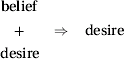
The latter desire might then combine with another belief and produce action. My desire for coffee, derived from my desire to remain alert and my belief that coffee has this effect, combines with my belief about where the café is, and I am motivated to walk up the street. Hence,
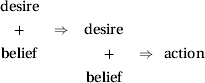
All of this is importantly different from the standard interpretation of the Indian theory of motivation in general. On the standard interpretation of the Indian account, belief can produce desire without additional desires, and desires can produce actions without the help of additional beliefs.
One might think that the Indian account must correspond more closely with the Humean account, just because the Humean account is so obviously true. It must be that the Indian systems endorse the model according to which belief produces desire only with the help of an additional desire. This cannot be the account however. If an additional desire must combine with the agent's belief in order to produce the desire seen in the diagram of Matilal's interpretation, then the additional desire will be a desire for some end. In the coffee case, the additional desire is for alertness, and alertness is the end toward which coffee is a means. Yet some of the most important Indian texts prohibit an agent from desiring that toward which her action is a means, and this amounts to a denial of the claim that a desire for some end is a necessary condition of any desire that is produced by belief.
Instead, these texts endorse establishing one's ends based on facts (known only by means of beliefs) about what one should do. The Bhagavadgītā, for example, repeatedly characterizes the prohibited class of desires as desires for outcomes or ends. This means that an agent should not determine her goals based on her desires, and that once an agent has determined her goal she should not desire that which she pursues. Instead, the Gītā advocates determining one's goals based on facts about what is to be done. This alternative is stated most clearly at 16.23–24:
He who, having abandoned the injunctions of scripture, pursues [goals] according to his desires, /
He achieves neither perfection, nor joy, nor the ultimate goal. //
Hence your goal [should be] established according to scripture, [in accord with] that which is to be done (kārya) and that which is not to be done (akārya). /
Knowing what scripture states [in terms of] injunctions, here you should perform those actions. //
The claim here is unequivocal: facts about what is ‘to be done (kārya)’ ought to determine one's goals and actions, not facts about what one desires.Footnote 30 This means that beliefs on their own must be able to produce the desire that motivates action (if a desire is required at all). If another desire were required, it would be a desire for the end of one's action. The Gītā insists, however, that one can act without a desire of this kind.
Medhātithi draws the same distinction in his commentary to Manusmṛti 2.5.Footnote 31 He explains that when an agent performs nitya or naimittika ritual actions (daily or occasional ritual actions enjoined by the Veda, but for which no results are mentioned), a desire for the outcome of the action is prohibited.Footnote 32 Instead of performing a nitya or naimittika action for the sake of some desired state of affairs, ‘the motive [should be] the fulfilment of the vidhi (injunction)’.Footnote 33 In the Gītā, this prescription applies to all actions, not just nitya and naimittika actions.Footnote 34
This is a rather straightforward point, and is in accord with a widely held moral intuition. It would be strange to hear a parent explain that she saved her child from drowning because it was a means to some desire of her own. The expectation is that the parent acts rightly insofar as she saves the child for the child's own sake – that is, because the child's life is valuable – regardless of her own desires. In a case where a parent saves her own child rather than the child of a stranger (where she must choose between one or the other), it is the fact that the first is her child that justifies her action (if anything does), not the greater strength of her desire for the survival of her own child.
As far as I can tell, this is the sense of the extremely common, although not always clearly explained claim that Indian philosophy advocates performing ‘duty for duty's sake’. Tara Chatterjea, for example, claims that ‘[a]ctions should spring from the sense of duty. It [that is, the sense of duty] replaces the desire for the fruits of action’.Footnote 35 This can only mean that the agent does what she does because it is what is to be done, not because in doing what she does some desire of hers is satisfied. In other words, her goal is the doing of what is right, not the satisfying of her own desire. As Chakrabarti says, the agent performs ‘individual acts prescribed by the scriptures because they are so prescribed and with no ulterior motive’ (emphasis in original).Footnote 36 While this sort of account of motivation meets a lot of resistance in the contemporary Western literature on motivation,Footnote 37 it is surely not so obviously false that an interpreter is required by the principle of charity to read these Indian texts so that they correspond to the Humean view. Yet this is just what the first objection implies.Footnote 38
In order for the standard account of the general Indian theory to be consistent with the passages from the Gītā and Manu, the desire that is produced by belief must not be a desire for the end of one's action. One alternative that has some textual support is that the agent's beliefs produce a desire for the means to the agent's ends. The parent desires to dive into the water, which is a means to her end of saving the child, but she need not – and should not – additionally desire that she succeed, because if she does she will be disposed toward joy and disappointment. She does, however, desire to do what she is doing; she desires the means to her end.
In his commentary to Manu 2.5, Medhātithi says that ‘in the case of nityakarma, a desire characterized by the desire for ends [is prohibited]. Indeed [however], the fulfilment of the means is to be desired’.Footnote 39 Additionally, verse 2.4 of the Manusmṛti itself states that ‘never at any time is any action of one without desire ever observed. Whatever one does, that deed is of one who desires that’ (emphasis added).Footnote 40 In both cases, the claim seems to be that the desire to do what one is doing is entailed by action, but a desire for the end of one's action is not. This means that the fact that my interpretation of the motivation theories of the Nyāyasūtra and Brahmasiddhi contradicts the Humean claim that an agent's ends are always established by her desires is not controversial. What is controversial is my claim that the accounts prohibit all desires, and therefore desires for the means to one's ends as well as desires for one's ends.
My main argument in defence of this position is the one I have already offered. The problem with permitting desires for means is that they dispose the agent to joy and disappointment, and therefore sensations that are inconsistent with equanimity, just as desires for ends do. Arjuna's desire to fight in the battle – even if it is only a means to his end of doing what is morally required of him because it is morally required of him – disposes him to feel disappointed in the event that he is unable to fight. He might, after all, be struck with appendicitis before he begins, and be crippled with physical pain. States that dispose the agent in this way are prohibited. Hence the liberated agent is without all desires. This means that neither icchā nor vairāgya can be translated as desires or aversions of a particular sort.
One alternative is to understand icchā and vairāgya as evaluations. A number of Chakrabarti's claims suggest this interpretation. He defines vairāgya as the ‘quiet and profound recognition of the valuelessness or emptiness of the transient goods of this finite physical world’ (emphasis added).Footnote 41 This suggests that vairāgya is a value judgment – a judgment of the absence of value in worldly goods – that motivates one to avoid the trappings of saṃsāra. Elsewhere he defines vairāgya as a ‘quiet cognition of dispensability’ (emphasis added),Footnote 42 which suggests that it is a belief about the relative unimportance of earthly ends that motivates the successful mumukṣu. Vācaspati's qualification of vairāgya supports this interpretation. He says that dveṣa has the nature of a blazing fire but that vairāgya does not. ‘It [namely, vairāgya] is the thought “enough”.’Footnote 43
Wilhelm Halbfass understands icchā in a similar way. He characterizes Maṇḍana's distinction between rāga and icchā as a distinction between passion and ‘a cognitive wishing and inclination’ towards mokṣa, respectively.Footnote 44 This suggests that the mumukṣu is motivated to pursue mokṣa by a belief in its ultimate value. The belief ‘inclines’ the agent, much as a desire would, toward bringing about the valued state of affairs.
If icchā and vairāgya are evaluative beliefs, then we might think that an accurate diagram of the theories of motivation in the Nyāyasūtra and Brahmasiddhi will show beliefs producing action without any intermediary, since evaluative beliefs are beliefs. Hence,

A desire or aversion might be part of the explanation of an action, but it is not a necessary condition of action. A revised diagram captures this conception of the optional role of desire and aversion:

This diagram does not accurately represent Maṇḍana's position, however. Maṇḍana says that an icchā arises from the seeing of reality,Footnote 45 and this suggests that icchā is produced by, and subsequent to, beliefs about the nature of reality. This means that the endorsed state is something other than one's conception of the exact nature of things. Hence a diagram of Maṇḍana's position must list icchā as an additional, intermediary stage between belief and action:

If icchā is an evaluative belief, then the diagram reads:

In order to avoid the appearance of redundancy, one might clarify that ‘belief’ refers to non-evaluative belief(s). Hence,

On this interpretation, the agent sees that the pleasure of the world is fleeting, believes that the pleasure of mokṣa is permanent, and then judges (that is, believes) that the permanence of the pleasure of mokṣa is important – both to pursue and attain – and thereby acts in a suitable way.
Of course, Maṇḍana also admits that rāga might motivate action. Rather than judging the permanence of the pleasure of mokṣa important, one might just want it. In order to allow for this, one might say that non-evaluative beliefs can produce evaluative beliefs (icchā) or desire (rāga), and that either can be an intermediary between non-evaluative beliefs and action. Hence the diagram of Maṇḍana's position reads:

This strategy is problematic, however. First, Śaṇkapāni, in his commentary on the passage in which Maṇḍana draws the distinction between icchā and rāga, explains that ‘not all icchā is rāga. Rather, rāga is an icchā that has a false object’.Footnote 46 This means that rāga is a subset of icchā, and that there are examples of icchā that are not also rāga. Hence the category of icchā is broader than that of rāga and contains at least some, and probably all, rāga. So Halbfass is incorrect to contrast icchā and rāga the way he does. An icchā is not necessarily a ‘cognitive wishing’ to be contrasted with passion. It might just be a passion. The second stage in the diagram just above, then, should not be a disjunction of icchā and rāga, but a disjunction of icchā that is rāga and icchā that is not rāga:

If icchā is a category of mental state that includes desire but is not exhausted by desire, however, then ‘evaluative belief’ is not an accurate translation of icchā, just because desires are not a subset of evaluative beliefs. What is needed instead is an English word that refers to a class of mental states or events that includes but is not exhausted by desire. One promising candidate is Donald Davidson's term ‘pro attitude’, under which, he says, ‘are to be included desires, wantings, urges, promptings, and a great variety of moral views, aesthetic principles, economic prejudices, social conventions, and public and private goals and values' (emphasis added).Footnote 47 A pro attitude might be a desire (a desire, a wanting, an urge), but it might also be an evaluative belief (a moral view, an aesthetic principle, an evaluation).Footnote 48
A less technical way to refer to this class of states is to call them ‘motivating states’, where it is understood that motivating states need not be desires. The sense of the English phrase ‘motivating states’ matches both Maṇḍana's and Śaṇkapāni's descriptions of icchā as a category that includes but is not limited to desires, and which plays an intermediary role between beliefs about the nature of the world and action. In some cases, the motivating state will be a desire, but in others it will be an evaluation, and both are subsequent to one's assessment of the brute facts. The parent might be moved by her desire that her child live, but she might also be moved by her belief that her child's life is inherently valuable. It is the latter that Maṇḍana endorses.
The theory of motivation in the Brahmasiddhi, then, can be diagrammed in the following way:

The agent considers her circumstances, comes to be motivated to pursue some state of affairs that she believes she is capable of achieving, and then acts. The state that motivates her is an icchā – a motivating state – and the icchā is either an evaluative belief (and therefore not rāga) or a desire (that is, rāga). She acts so as to bring about some state of affairs either because she believes it is valuable, or because she desires it.
This interpretation does not avoid the second problem, however. Its separation of non-evaluative and evaluative beliefs into distinct stages is dubious. Chakrabarti makes the important point that it might be a mistake to take duḥkha and sukha – ordinarily translated as ‘pain’ and ‘pleasure’ – as non-evaluative, purely ‘descriptive hedonic term[s]’. Instead they should be taken as evaluative terms with ‘the same objectivity … that “good” or “beautiful” and (according to some) “true” does’.Footnote 49 This means that evaluative beliefs belong in the category of states that Maṇḍana claims precedes icchā. Evaluative beliefs constitute, in part, the ‘seeing of reality’ that gives rise to icchā. Hence any interpretation of Maṇḍana's view that entails that he takes evaluative beliefs to be derived from non-evaluative beliefs is implausible.
In order to avoid this, the first stage in the diagram – belief – should be taken to include both evaluative and non-evaluative beliefs. This means that icchā cannot be an evaluative belief because if it were, it would not be subsequent to one's conception of reality. The best way to avoid this problem and still preserve all of what is right in the account is to translate icchā as ‘reason’ or ‘counting some fact as a reason’, rather than ‘motivating state’. On this interpretation, the view is that the agent chooses between counting some fact about what she desires as a reason for acting or counting facts about what is valuable as a reason for acting. The parent still chooses between whether to save her child because she desires that her child live or because her child's life is inherently valuable, but it is her choosing which of these facts counts as a reason for acting – if either does – to which icchā refers.
An additional benefit of this interpretation is that it allows that beliefs or desires can establish the ends of the agent. As I mention above, the Humean is quick to point out that the absence of ‘desire’ alongside ‘belief’ in the standard diagram seems odd. Even if the Indian systems allow belief to produce desire without the help of additional beliefs, surely this is not the most common way for desire to arise. On this interpretation, this problem is avoided, because the desires of the agent are known by means of the beliefs that constitute the first stage of acting. Since the desires of the agent can be the object of the agent's beliefs, the diagram allows that in some cases – undoubtedly in most – desires do establish the agent's end. It is only in the extraordinary cases that an agent acts from beliefs about what is valuable.
Finally, then, the theory of motivation that I ascribe to the Brahmasiddhi is this:

Beliefs take facts about what is valuable and facts about what agents desire, along with a wide range of other sorts of facts, as their objects. The agent must then choose which facts are reasons for acting. This counting of a fact as a reason for acting is icchā. Not all icchā is rāga. This means that not all reasons are desires. Not all counting of facts as reasons are counting of facts about what one desires as reasons.
Maṇḍana also seems to admit that there are reasons for acting other than desires and positive evaluative facts.Footnote 50 In defending his own view, he argues that the Naiyāyikas must allow his distinction between icchā and rāga because their own view depends on a parallel distinction between udvega and dveṣa. Mere icchā is not rāga, he says, ‘just as the udvega brought about by the vision of the unreality of saṃsāra would not be on the side of dveṣa’.Footnote 51 Presumably by udvega he means to refer to the counting of facts against acting. These facts will include, then both dveṣa (desires to avoid) and negative evaluations (for example, the belief that returning the call is not important). So for Maṇḍana, the class of motivating states includes: (1) icchā that is rāga; (2) icchā that is not rāga; (3) udvega that is dveṣa; and (4) udvega that is not dveṣa. When one acts, one of these four states is entailed. When one acts rightly, (2) is entailed.
It is tempting to interpret the Naiyāyikas' vairāgya in a way that parallels the interpretation of icchā and assume that vairāgya is equivalent to Maṇḍana's udvega, since the two accounts have been perfectly parallel to this point. As I have just said, Maṇḍana himself assumes that the two accounts are parallel. Balasubramanian simply attributes Maṇḍana's distinction between udvega and dveṣa to the Naiyāyikas and ignores the term vairāgya altogether.Footnote 52
If this were an accurate interpretation of the Nyāya view, then vairāgya would include, but not be exhausted by, dveṣa just as icchā includes, but is not exhausted by, rāga. Vairāgya is importantly different from Maṇḍana's icchā and udvega, however. Vairāgya is mentioned in contrast to dveṣa, and is never characterized as a type of state that might also be dveṣa. On the contrary, Vācaspati specifies that whereas dveṣa has the essential nature of a blazing fire, vairāgya does not.Footnote 53 It cannot be, then, that some vairāgya is also dveṣa, as in the case of icchā. Vairāgya and dveṣa are mutually exclusive categories that more closely parallel the distinction between icchā that is not rāga and icchā that is rāga, than the distinction between icchā and rāga.
Another difference between the Nyāya and Vedāntin views is that the Naiyāyikas never claim that vairāgya arises from belief, as Maṇḍana says about icchā. Instead, Vācaspati says that vairāgya just is a belief – a belief that the goods of the world are not worth pursuing. This means that a diagram of the Nyāya view need not include an intermediary state between belief and action:

The Naiyāyikas admit, of course, that desire and aversion can be one's motive, however. It is an optional additional stage, for those who are not motivated by their beliefs. Hence,

Vairāgya belongs among beliefs, but dveṣa (and rāga) do not. One fundamental difference between the two views, then, is that the Vedāntins assert, but the Naiyāyikas deny, that some stage in addition to belief is required for action. Where the Naiyāyikas admit an intervening state or event, it is not something general like a reason or the counting of a reason (which is an event, perhaps, and not a state). It is an unnecessary state – one needed only by those who are not motivated by vairāgya.
Chakrabarti is correct, then, insofar as he says that vairāgya is a ‘quiet cognition of dispensability’ and a ‘quiet and profound recognition of the valuelessness or emptiness of the transient goods of this finite physical world’. He is wrong, however, to say that this state ‘flows from a true awareness of the exact nature of things’. Vairāgya is part of this true awareness. He is also wrong – and this mistake is more important – to contrast vairāgya with ‘feeling aggressively scornful’Footnote 54 toward that which one desires to avoid. It is the desiring to avoid (or attain) that is problematic, not the intensity of that desire.
Presumably the Naiyāyikas accept all four of the basic categories of motivating states that Maṇḍana accepts. One might act from: (1) a desire to acquire; (2) a desire to avoid (an aversion); (3) a belief that something is valuable; or (4) a belief that something is not valuable. If one acts, then a motivating state is entailed. Unlike the Vedāntins, however, the Naiyāyikas argue that when one acts rightly, (4) is entailed.
Despite these important differences, the Naiyāyikas and Vedāntins both accept the same basic theory of motivation, according to which no desire of any sort – positive or negative – is a necessary condition of action. They allow that desires to acquire and desires to avoid sometimes motivate action, but deny that they must. It might be that when Matilal says that ‘beliefs generate desire and desire generates action’, he means to say that desire is a sufficient, but not necessary condition of action. This is consistent with allowing that other states or events are also sufficient.Footnote 55 Even if this is correct, however, much of the complexity of these accounts of motivation is missed in both Matilal's and Mohanty's diagrams.
One final objection worth considering is the objection that counting some fact as a reason for acting dispose the agent toward joy and disappointment, and is therefore a disposition toward the loss of equanimity, just as desires are. I think there is something right about this, but there is a satisfying and straightforward reply. A number of authors argue that since desire is a necessary condition of action, the prohibition on desire cannot be a prohibition on all desire. The argument goes as follows: desires are a necessary condition of acting. The Indian tradition advocates acting. Hence the tradition cannot prohibit all desires. The prohibition on desire, then, cannot amount to a prohibition on all desire.
I have argued that this line of reasoning is not cogent. A parallel line of reasoning, however, which concludes that the counting of some fact as a reason cannot be prohibited, is cogent. Counting some fact as a reason for acting is a necessary condition of non-accidentally doing the right thing. The Indian tradition advocates non-accidentally doing the right thing. Hence the tradition cannot prohibit counting facts as reasons. The prohibition on being disposed toward joy and disappointment, then, cannot amount to a prohibition on counting facts as reasons. If counting some fact as a reason disposes the agent to lose her equanimity, then we must put up with it, for just the reasons that the authors I refer to above believe weigh in favor of putting up with certain desires. In their case, however, the reasoning is not convincing.
The same line of argument can be advanced in defence of evaluative beliefs. Evaluative beliefs are necessary conditions of non-accidentally doing the right thing. Without them, we do what is right only by chance. Since non-accidentally doing the right thing is required, evaluative beliefs are required. If they dispose us to joy and disappointment, we must put up with them anyway.Footnote 56
 aṇkhapāni (Delhi: Sri Satguru Publications, 1984), 1, ll. 13–14.


