

INTRODUCTION
The cultivated Citrus spp. are believed to be native of tropical and subtropical regions of south-east Asia (probably north-eastern India, Burma and southern China), where they have been cultivated since remote times. It seems probable that citrus originated in the drier monsoon areas rather than in tropical rainforests, since citrus does not normally grow as well in the very humid tropics. Man took into cultivation those species with palatable juice. Natural hybridisation then occurred between cultivars and species, producing an array of complex hybrids. The cultivated citrus has now spread throughout the tropics and subtropics. Most of the commercial production is now in subtropical regions at latitudes greater than 20°N and 20°S, but less than 45°N and 35°S, and between sea level and 600–750 m (Purseglove, Reference Purseglove1968; Roose et al., Reference Roose, Soost, Cameron, Smart and Simmonds1995).
A great deal of research has been reported on the water relations of Citrus spp. This paper attempts to synthesise this research from an independent perspective, and to do so in practically useful ways. It follows the format used in previous reviews in this series, including those plantation crops grown for their fruit, notably coffee (Carr, Reference Carr2001), banana (Carr, Reference Carr2009), coconut (Carr, Reference Carr2011a), cocoa (Carr and Lockwood, Reference Carr and Lockwood2011) and oil palm (Carr, Reference Carr2011b). The paper begins with a description of the stages of crop development (including roots) in relation to water availability, followed by reviews of plant water relations, water requirements, water productivity and irrigation systems.
Several reviews have previously been published on aspects of the water relations of citrus but, apart from a detailed review of factors influencing photosynthesis in citrus grown in the subtropics (with particular reference to Brazil) by Ribeiro and Machado (Reference Ribeiro and Machado2007)Footnote 1, none recently. In date sequence, Doorenbos and Kassam (Reference Doorenbos and Kassam1979) focused on practical ways of estimating the yield responses to water. Kriedemann and Barrs (Reference Kriedemann, Barrs and Kozlowski1981) published a detailed and comprehensive review of the water relations of citrus, but without drawing clear, useful conclusions. Later, Jones et al. (Reference Jones, Lakso and Syvertsen1985) reviewed, from a fundamental perspective, the physiological aspects of the control of the water status of citrus alongside other temperate and subtropical fruit trees. Shalhevet and Levy (Reference Shalhevet, Levy, Stewart and Nielsen1990) focused on the irrigation of Citrus spp., while Syvertsen and Lloyd (Reference Syvertsen, Lloyd, Schaffer and Andersen1994) concentrated on their physiological responses to the environment, with a focus on gas exchange. To minimise duplication, the principal points of interest arising from these reviews are briefly summarised at relevant points in the body of this paper, which concentrates on research published since 1990.
SPECIES AND CENTRES OF PRODUCTION
The common cultivated Citrus spp. include the following, which are listed with their principal uses and their important cultivars:
• Sweet orange (C. sinensis): Fresh fruit, juice, squash, flavouring, oils, pectin, pulp (residue left after squeezing for juice) and peel used as cattle feed. Cultivars: Valencia, Washington Navel.
• Grapefruit (C. paradisi): Fresh fruit, juice. Cultivars: Marsh, Thompson.
• Lemon (C. limon): Drinks, flavouring, garnish, cosmetics, oil, citric acid, pectin. Cultivars: Eureka, Lisbon, Villafranca.
• Lime (C. aurantifolia): Fresh fruit, flavouring, drinks, marmalade, lime oil (from peel). Cultivar: Mexican.
• Mandarin/tangerine (C. reticulata): Fresh fruit. Cultivars: Satsuma group, mandarins (Emperor) and tangerines (Clementine).
• Seville (sour) orange (C. aurantium): Marmalade, flavouring, liqueurs, oils for perfumery. Extensively used as a rootstock for lemon, sweet orange and grapefruit.
• Pomelo (pummelo) (C. grandis): Dessert fruit.
• Citron (C. medica): Flavouring.
In 2008, the total planted area of citrus was about 5.4 million ha, of which oranges covered 4.2 million ha, lemons and limes together 1.02 million ha and grapefruit with pomelo 0.25 million ha. Oranges represented 80% of the total (=86 million t) world citrus production, lemons and limes combined 15% and grapefruit (with pomelo) 5%. The largest producers were as follows:
• Oranges: Brazil (18.5 million t) followed by the United States, India, Mexico and China.
• Lemons and limes: India (2.4 million t) followed by Mexico, Argentina, Brazil and China.
• Grapefruit: the United States (1.4 million t) followed by China, Mexico, South Africa and Israel (FAOSTAT, 2011).
The different species are initially considered together and later individually.
CROP DEVELOPMENT
To minimise the duration of the juvenile phase of growth, when the trees are unproductive, and to impart other characteristics, most citrus orchards are now planted with composite plants in which the favourable attributes of a scion are matched with those of a rootstock (Davies and Albrigo, Reference Davies and Albrigo1994). Important rootstocks include the following:
• Rough lemon (C. jambhiri)
• Alemow (C. macrophylla)
• Rangpur (C. limonia hybrid)
• Sour orange (C. aurantium)
• Trifoliate orange (Poncirus trifoliata)
• Citranges; inter-generic hybrids of sweet orange and trifoliate orange
Vegetative
Citrus spp. are small, evergreen shrubs or trees. In the subtropics, shoot growth occurs in a series of discrete flushes initiated by a rise in air temperature (>12.5 °C) or, in the tropics, where the flushes are less discrete, by the availability of water (Davies and Albrigo, Reference Davies and Albrigo1994). Seasonal variations in the vegetative growth of Hamlin sweet orange in subtropical Brazil (22.5 °S) have been described by Ramos et al. (Reference Ramos, Ribeiro, Machado and Machado2010), while the influence of water on the growth and development of young trees is illustrated by the following experiments in Florida and Spain.
Irrigation, at up to four- to six-day intervals, of Hamlin sweet orange (C. sinensis) grafted on to a sour orange rootstock (C. aurantium), during the first year after planting on a sandy soil, enhanced many components of vegetative growth, including leaf area, canopy volume and trunk cross-sectional area. The date of initiation of the first (spring) growth flush was little affected by the irrigation treatment, in each of the three years the experiment was repeated, but the second (summer) and third (autumn) flushes were delayed, or failed to happen, when irrigation intervals were extended (Marler and Davies, Reference Marler and Davies1990).
Similar results were obtained in Spain with eight-year-old Clementina de Nules mandarin trees (C. clementina grafted on to Carrizo citrange rootstock) by Ginestar and Castel (Reference Ginestar and Castel1996). Withholding irrigation in the spring (1 March to 13 June) had no effect on shoot extension in the first (spring) flush, but water stress in the summer (14 June to late July/early August) reduced shoot growth in the second (summer) flush or even stopped it occurring. Water stress in the late summer/early autumn had a similar effect, but trees irrigated at this time, having previously been droughted, produced an abundant second (summer) flush composed mainly of flowers. Shoot elongation ceased when the integrated shoot water potential reached about 35-day MPa (average pre-dawn leaf water potential within a given interval summed above maximum recorded value, see below).
Summary: vegetative growth (includes previous reviews)
1. Shoot growth occurs in distinct flushes initiated by a rise in temperature (subtropics) or availability of water (tropics) (Jones et al., Reference Jones, Lakso and Syvertsen1985). Water stress can delay the initiation of the summer and autumn flushes.
2. Shoot and root growth alternate (Bevington and Castle, Reference Bevington and Castle1985; Jones et al., Reference Jones, Lakso and Syvertsen1985; Syvertsen and Lloyd, Reference Syvertsen, Lloyd, Schaffer and Andersen1994).
3. Although citrus cultivars are evergreen, leaves are shed throughout the year and continual leaf replacement occurs as the trees grow. The age at which a leaf drops is variable but is usually between nine and 24 months: leaves of all sizes are shed usually in the months immediately following blossoming (Kriedemann and Barrs, Reference Kriedemann, Barrs and Kozlowski1981).
4. Leaf abscission is observed in field-grown trees when pre-dawn leaf water potentials are around –2.75 MPa (Ribeiro and Machado, Reference Ribeiro and Machado2007).
5. There are two abscission zones: the base of the petiole, and (at times of severe stress) between the lamina and the petiole (Kriedemann and Barrs, Reference Kriedemann, Barrs and Kozlowski1981).
6. Canopy development and stem growth are both restricted by water stress (Kriedemann and Barrs, Reference Kriedemann, Barrs and Kozlowski1981; Shalhevet and Levy, Reference Shalhevet, Levy, Stewart and Nielsen1990). Water stress during periods of vigorous vegetative growth should be avoided (Doorenbos and Kassam, Reference Doorenbos and Kassam1979).
7. There is evidence of a direct causal link between stimulation of ethylene production by water stress and citrus leaf abscission (Kriedemann and Barrs, Reference Kriedemann, Barrs and Kozlowski1981).
8. There is a poor correlation between trunk size and canopy development (Shalhevet and Levy, Reference Shalhevet, Levy, Stewart and Nielsen1990).
9. Sun-exposed leaves represent only about 20% of the total leaf area of an orange tree canopy. The internal canopy does not receive more than 10% of the total photosynthetic photon flux density (PPFD) received at the canopy surface. Citrus leaves can reach temperatures of around 42 °C in the summer (Ribeiro and Machado, Reference Ribeiro and Machado2007).
10. Excess vegetative growth can reduce fruit yields (Shalhevet and Levy, Reference Shalhevet, Levy, Stewart and Nielsen1990).
Flowering and fruiting
An overview of the physiology of flowering and fruiting in citrus has recently been published by Iglesias et al. (Reference Iglesias, Cercós, Colmenero-Flores, Naranjo, Rios, Carrera, Ruiz-Rivero, Lliso, Morillon, Tadeo, Talon and DaMatta2010). According to this overview, it takes two to five years from planting for a citrus tree to reach a stage when it can produce flowers. In subtropical areas, flowering takes place after a period of bud quiescence as a result of exposure to low temperatures in winter. In the tropics, and in areas with a dry season, rehydration after a period of water stress triggers the flowering process. The inflorescence may be leafless (flower buds only) or leafy (vegetative and flower buds both present on the same shoot). The degree of fruit set is dependent on the type of inflorescence formed. In general, leafless inflorescences emerge first and contain a bouquet of flowers with a low likelihood of setting fruit. By contrast, flowers in leafy inflorescences are commonly associated with a better fruit set (the fewer the number of flowers on a stem the higher the proportion that form fruits). In seeded cultivars, pollination (mainly by bees) and fertilisation are necessary to initiate fruit development, but not in the seedless cultivars (Iglesias et al., Reference Iglesias, Cercós, Colmenero-Flores, Naranjo, Rios, Carrera, Ruiz-Rivero, Lliso, Morillon, Tadeo, Talon and DaMatta2010). The practical aspects of evaluating the intensity of flowering in citrus have been studied by Ribeiro et al. (Reference Ribeiro, Rolim, Azevedo and Machado2008).
In most Citrus spp. grown in the subtropics, flowering takes place in the spring and the subsequent formation of fruit can extend, depending on the cultivar, until mid-winter. Citrus fruits are a special type of berry (known as a hesperidium), with two morphologically distinct regions: the pericarp (commonly known as the peel or rind) and the endocarp (the juicy pulp, which is edible).
Growth and development of a fruit follows a typical sigmoid curve that can be divided into three phases. The initial phase following anthesis is a two-month period of cell division and slow growth. The second phase is a four- to six-month period of rapid growth as the cells enlarge and accumulate water. Finally, there is the maturation period (a non-climacteric process in citrus), when fruit growth slows and external (colour change) and internal (a decline in acidity and an increase in sugars) ripening processes occur (Iglesias et al., Reference Iglesias, Cercós, Colmenero-Flores, Naranjo, Rios, Carrera, Ruiz-Rivero, Lliso, Morillon, Tadeo, Talon and DaMatta2010).
Citrus trees bloom profusely (e.g. for sweet orange as many as 250,000 flowers tree−1 can be formed). This number is considerably reduced by the abscission of flower buds, flowers and ovaries, mostly at the beginning of phase 1. In addition, developing fruits are lost during phase 1 (a process known as the June drop in the northern hemisphere, and as the December drop south of the equator). Although fruit abscission is considerably less during phases 2 and 3, less than 1% of flowers reach maturity (Iglesias et al., Reference Iglesias, Cercós, Colmenero-Flores, Naranjo, Rios, Carrera, Ruiz-Rivero, Lliso, Morillon, Tadeo, Talon and DaMatta2010). Previously, Erickson (Reference Erickson, Reuther, Batchelor and Webber1968) had presented detailed data on the number of flower buds per tree (Washington Navel 200,000 tree−1, and Valencia 70 000 tree−1) and the number of mature fruit (419 and 708 tree−1, respectively). For these two cultivars of sweet orange these are equivalent to 0.2% and 1.0% success rates, respectively. The control of fruit set and abscission in citrus is complex, being regulated by genetic, metabolic and environmental factors acting sequentially, simultaneously or superimposed on each other, and is not yet fully understood (Iglesias et al., Reference Iglesias, Cercós, Colmenero-Flores, Naranjo, Rios, Carrera, Ruiz-Rivero, Lliso, Morillon, Tadeo, Talon and DaMatta2010).
The influence of water availability and its timing on the flowering process is illustrated by the observations made in Spain on clementine trees by González-Altozano and Castel (Reference González-Altozano and Castel2000). Withholding water during the spring (flowering and fruit set phase) reduced shoot extension in the first flush, and increased the loss of flower buds and small fruits when full irrigation was introduced in early summer (relative to the well-watered control treatment). This treatment also resulted in more off-season flowering in the second and third flushes, which led to 10% off-season fruit (with no commercial value). Similar treatment combinations applied during the summer (early fruit enlargement phase) resulted in some off-season flowering in the autumn flush but not as much as when the treatments were applied during the fruit growth and maturation phases.
The abscission of leaves and fruits occurs suddenly after their rehydration following the alleviation of water stress. The process is associated with increases in the content of abscisic acid (ABA) in the roots and the subsequent accumulation of ethylene in the aerial parts of the plant (Iglesias et al., Reference Iglesias, Cercós, Colmenero-Flores, Naranjo, Rios, Carrera, Ruiz-Rivero, Lliso, Morillon, Tadeo, Talon and DaMatta2010).
The relative sensitivity of fruit expansion to water availability is shown by the results of a series of field trials in Israel. Fruits (of grapefruit) continued to accumulate dry matter when subjected to water stress even when the fruits no longer increased in volume, indeed even when shrinkage occurred (Cohen and Goell, Reference Cohen and Goell1988). Upon re-watering, fruits from droughted trees expanded faster than those from trees that had been watered regularly, reaching a final size determined (in part) by the quantity of accumulated dry matter.
Subsequently, Huang et al. (Reference Huang, Huang and Gao2000) investigated the mechanisms responsible for this phenomenon of compensatory growth. Mild water stress was imposed on pot-grown tangerine trees (C. sinensis Blanco cv. Zhuju) during the early juice sac expansion phase. Water stress resulted in a decline in the fruit water potential as a result of the loss of water from the fruit to transpiring leaves, together with an increase in the soluble solid content of the fruit juice (and also the fruit skin), causing the osmotic potential to drop (osmotic adjustment). There was also evidence of cell wall loosening in the fruit skin, which caused a further reduction in fruit water potential (loss of turgor). As a result of these changes in water potential, the fruits expanded faster than those in the well-watered control treatment upon re-watering, and grew to a larger size. The timing and duration of the stress is critical to this (compensatory) process.
Summary: flowering and fruiting (mainly from previous reviews)
1. For flowering to occur a ‘rest period’ is necessary. This can be provided by low temperature (in the subtropics) or by drought (tropics) (Doorenbos and Kassam, Reference Doorenbos and Kassam1979).
2. Rain/irrigation after drought induces flowering (which is undesirable in mid-season) (Shalhevet and Levy, Reference Shalhevet, Levy, Stewart and Nielsen1990).
3. In (some parts of) the subtropics, the ‘rest period’ is induced by two successive months with mean air temperatures (presumably) at 10 °C (or less), and in the tropics by water stress (monthly rainfall less than 50–60 mm). Too much stress can result in the production of too many flowers, which may lead to biennial bearing (Doorenbos and Kassam, Reference Doorenbos and Kassam1979).
4. For lemons, allowing a water deficit to occur in the summer is commonly used to initiate flowering for year-round fruit production (Doorenbos and Kassam, Reference Doorenbos and Kassam1979).
5. Water stress during flowering increases shedding of flower buds and flowers before fruit is set. These effects are due to weakening of the (two) pre-formed abscission zones at the points of attachment (Jones et al., Reference Jones, Lakso and Syvertsen1985). Water stress during flowering reduces fruit set, and can lead to a heavy June/December drop (Doorenbos and Kassam, Reference Doorenbos and Kassam1979).
6. Water stress during the early yield-formation phase (June or December, depending on latitude) can increase fruit shedding and reduce the rate of fruit growth (Doorenbos and Kassam, Reference Doorenbos and Kassam1979).
7. Water stress during the fruit expansion phase affects final fruit size (but can increase the content of the total soluble solids (TSS) and acids) (Doorenbos and Kassam, Reference Doorenbos and Kassam1979).
8. In addition, severe stress during fruit expansion can trigger flowering, which is undesirable at this phase (except for lemons) (Doorenbos and Kassam, Reference Doorenbos and Kassam1979).
9. Satsuma fruits stop growing when the pre-dawn leaf water potential reaches –0.8 MPa (Kriedemann and Barrs, Reference Kriedemann, Barrs and Kozlowski1981).
10. From flowering to fruit maturity takes 7–14 months (Doorenbos and Kassam, Reference Doorenbos and Kassam1979). Less than 1% of flowers (up to 250,000 tree−1) produce fruit.
11. Lemon has a longer flowering period than other Citrus spp., and its fruit is harvested throughout the year (Doorenbos and Kassam, Reference Doorenbos and Kassam1979).
Roots
Most Citrus spp. have a single tap-root, with lateral roots forming a dense mat in the surface layers (Morgan et al., Reference Morgan, Obreza and Scholberg2007; Purseglove, Reference Purseglove1968). Despite the important role that rootstocks play in their culture, there is little recent published research on root systems. A few examples are given below.
In a comparison between two tree planting densities in Florida (cv. Hamlin orange on Milam lemon rootstock, seven-year old; drip-irrigated), roots were traced to depths of 1.65 m (the maximum depth of observation) in both the populations. Root densities were greater in the high population treatment (889 trees ha−1) than in the lower population treatment (370 trees ha−1) at all depths, but particularly in the top 0.5–0.7 m of soil (Whitney et al., Reference Whitney, Elezaby, Castle, Wheaton and Littell1991).
In Florida, Morgan et al. (Reference Morgan, Obreza and Scholberg2007) excavated the root systems of 18 trees with tree canopy volumes (TCV) ranging from 2.4 to 34.3 m3, on two different rootstocks and growing in well-drained sandy soils. The roots were sampled in a systematic pattern extending 2 m away from the trunk and 0.9 m deep. Trees grown on Swingle citrumelo (C. paradisi Macf. × Poncirus trjfoliata (L.) Raf) rootstocks had significantly greater fibrous root length density (FRLD) in the top 0.15 m (up to 2 cm cm−3) than trees on Carrizo citrange (C. sinensis (L.) Osbeck × P. trifoliata (L.) Raf.) (up to 1.2 cm cm−3). Conversely, Carrizo citrange had greater FRLD from 0.15 to 0.75 m below the soil surface (up to 0.6 cm cm−3 cf. up to 0.3 cm cm−3). The FRLD was significantly greater for Hamlin orange trees grown on Swingle citrumelo rootstock at distances <0.75 m from the tree trunk compared with those on Carrizo citrange. Fibrous roots of young citrus trees developed a dense root mat above soil depths of 0.3 m that expanded both radially and with depth with time as the trees grew and the TCV increased.
In Brazil, roots of seven-year-old irrigated lime trees (C. latifolia), grafted on to C. limonia rootstock, reached depths of 1.5 m, with the bulk of the roots in the top 0.40 m (Marin and Angelocci, Reference Marin and Angelocci2011). Similar observations were made by Hutton and Loveys (Reference Hutton and Loveys2011) on mature Navel oranges (C. sinensis) in New South Wales, Australia.
Measurements made in Bahia State, Brazil by Santana et al. (Reference Santana, Souza, Souza and Fontes2006) showed how root densities varied (range from 0.75 to 0.05 cm cm−3) with the physical properties of the soil (Yellow Latosol and a Grey Argosol).
Summary: roots (almost entirely based on previous reviews)
1. Seedlings have a well-defined tap-root (unless it is damaged in the nursery) (Kriedemann and Barrs, Reference Kriedemann, Barrs and Kozlowski1981).
2. There is uncertainty about root depth and distribution. As a general rule, roots extend in depth to 1.5 m. However, roots of mature trees have been found at 3–5 m (with a rough lemon rootstock) (Kriedemann and Barrs, Reference Kriedemann, Barrs and Kozlowski1981; Shalhevet and Levy, Reference Shalhevet, Levy, Stewart and Nielsen1990).
3. Fibrous roots occur in bunches on pioneer/structural roots, with the greatest mass in the top 0.4 m (Kriedemann and Barrs, Reference Kriedemann, Barrs and Kozlowski1981).
4. Root hairs are numerous but they are abnormally short (Kriedemann and Barrs, Reference Kriedemann, Barrs and Kozlowski1981).
5. Root length densities vary with soil depth, distance from the trunk, soil physical properties and cultivar.
6. The scion, as well as the rootstock, influences the root system to varying extents (e.g. grapefruit has a greater effect on a root system than does orange) (Kriedemann and Barrs, Reference Kriedemann, Barrs and Kozlowski1981).
7. For root growth to occur, the minimum soil temperature is reported to be c. 6 °C, the optimum c. 26 °C and the maximum c. 37 °C (Kriedemann and Barrs, Reference Kriedemann, Barrs and Kozlowski1981).
8. Interconnections in the root system appear to ensure that water applied to one part of the root system becomes available to the whole tree (Kriedemann and Barrs, Reference Kriedemann, Barrs and Kozlowski1981). The main resistance to water flow in a plant is in the root system (Jones et al., Reference Jones, Lakso and Syvertsen1985).
9. Vesticular–arbuscular mycorrhizae are believed to increase water and nutrient uptake by plant roots (Jones et al., Reference Jones, Lakso and Syvertsen1985). The mucilage present on young feeder roots contains microorganisms (Kriedemann and Barrs, Reference Kriedemann, Barrs and Kozlowski1981).
PLANT WATER RELATIONS
Stomata
While citrus is considered to be a typical mesophyte (not specifically adapted to wet or dry conditions), the leaves have many xeromorphic characteristics. Their upper surface, for example, is covered by a thick waxy cuticle. Stomata occur mainly on the lower (abaxial) leaf surface, at a density of 800 mm−2, compared with 40 mm−2 on the upper (adaxial) surface (Spiegel-Roy and Goldschmidt, Reference Spiegel-Roy and Goldschmidt1996). By contrast, Erickson (Reference Erickson, Reuther, Batchelor and Webber1968) recorded stomatal densities for the abaxial surface of between 360 and 620 stomata mm−2 for a selection of Citrus spp. at four locations in California.
In Brazil, stomatal conductances were observed to decline rapidly once the leaf water potential (as recorded at 1400 h) was less than –1.0 MPa. In this pot experiment with 30-month-old Pera orange trees (C. sinensis) grafted onto Rangpur lemon rootstock (C. limonia), the concentration of abscisic acid in the leaves began to increase at the same level of water stress (Gomes et al., Reference Gomes, Lagôa, Medina, Machado and Machado2004).
In a controlled-environment experiment in Florida, Brakke and Allen (Reference Brakke and Allen1995) confirmed previous reports that midday reductions in stomatal conductance and carbon dioxide assimilation rates in Citrus spp. are associated with high temperatures/dry air. When soil water was not readily available, photosynthesis by citrus was more sensitive (reduced carbon dioxide uptake) to high temperatures and saturation deficits (SD) (37 °C/3.6 kPa) than at lower values (29 °C/2.4 kPa). In Brazil, Magalhães Filho et al. (Reference Magalhães Filho, Machado, Machado, Ramos and Ribeiro2009) demonstrated the role that the soil/substrate temperature can play in controlling gas exchange, photochemical activity and water relations of sweet orange in a controlled-environment study (root temperatures compared 10, 20 and 30 °C; air temperature = 25/20 °C day/night).
By monitoring sap flow (using the compensation heat-pulse technique) as a measure of transpiration, Nicolás et al. (Reference Nicolás, Barradas, Ortuño, Navarro, Torrecillas and Alarcón2008) were able to show the control that the stomata exerted on transpiration by young lemon trees growing in the open (i.e. there was strong coupling of the crop canopy with the environment). The level of control was less with plants artificially shaded (with nets) although shading improved instantaneous water-use efficiency by reducing transpiration while maintaining photosynthesis.
Sap flow gauges were also used by Oguntunde et al. (Reference Oguntunde, van de Giesen and Savenije2007) to estimate transpiration by seven-year-old sweet orange trees in a rain-fed orchard in tropical Ghana (07°20ʹN 1°16ʹW; alt 210 m) to develop a model for predicting stomatal control of transpiration. When well watered, the saturation deficit of the air was the dominant regulator of transpiration (recorded at half-hour intervals), explaining 80% of the variation in canopy conductance, with partial stomatal closure occurring at saturation deficits in excess of 1.2 kPa. There was also a hyperbolic relationship between transpiration and solar radiation with light saturation in the region of 400 W m−2 (PAR equivalent = 900 μmol m−2 s−1).
Through their impact on the hydraulic conductivity of a tree, rootstocks can influence the rate of sap flow in the scion. For example, in Japan, Yonemoto et al. (Reference Yonemoto, Matsumoto, Furukawa, Asakawa, Okuda and Takahara2004) showed how sap flow rate differed in branches of Shirakawa Satsuma mandarin trees (C. unshiu) depending on the rootstock. Sap flow rates were least with the dwarfing rootstock ‘Flying Dragon’ trifoliate orange (Poncirus trifoliata, cv. Monstrosa) and greatest with trifoliate orange (P. trifoliate). Sap flow rates were also consistently less in trees bearing a large quantity of fruit compared with those with a smaller yield.
Osmotic adjustment
There is some limited evidence that osmotic adjustment may play a role in mitigating the effects of drought stress. For example, in Spain, Rodríguez-Gamir et al. (Reference Rodríguez-Gamir, Primo-Millo, Forner and Forner-Giner2010) compared the responses to extreme drought stress of the citrus hybrid rootstock Forner-Alcaide no. 5 (FA-5) with those of its parents, Cleopatra mandarin and Poncirus trifoliate as nine-month-old seedlings, or when each rootstock was grafted with Valencia orange scions as 15-month-old trees. The plants were grown in coarse sand in pots in a greenhouse and watered with nutrient solution. Drought stress was imposed by withholding irrigation. Based on a series of detailed measurements of plant water status and gas exchange processes, they concluded that FA-5 was more resistant to drought than either of its parents. As a rootstock, it also influenced the performance of the scion through the process of osmotic adjustment. It remains to be seen how representative these results derived from pot experiments are of field conditions where water stress develops more slowly.
Osmotic adjustment was also observed in a short-term (four-month) field experiment in south-eastern Spain. Mature Fino 49 lemon trees (C. sinensis, grafted on to C. macrophylla Western rootstock), when irrigated with saline water, maintained leaf turgor and gas exchange processes through osmotic adjustment (uptake of Cl− ions). By contrast, there was no evidence of osmotic adjustment in droughted trees, which reacted to water deprivation by closing the stomata to restrict transpiration while maintaining leaf turgor (Pérez-Pérez et al., Reference Pérez-Pérez, Robles, Tovar and Botía2009b).
Stem shrinkage
Stem water potentials are also related to the degree of stem shrinkage that occurs when a tree experiences water stress. Thus, in Murcia, Spain (38°6ʹN 1°2ʹW), Ortuño et al. (Reference Ortuño, Brito, Garćia-Orellana, Conejero and Torrecillas2009) showed how there was a close negative linear relationship between maximum daily trunk shrinkage (MDS, that is the difference between the maximum trunk diameter early in the morning and the minimum trunk diameter early in the afternoon) and stem water potential. This relationship, which was developed for well-watered lemon trees (C. limon cv. Fino) grafted on to sour orange rootstock (C. aurantium), was independent of season and crop load. This paper followed earlier ones describing the relationships between various plant-based indicators of water stress as recorded on potted young lemon trees (C. limon), also grafted on to sour orange rootstock (C. aurantium), grown in a greenhouse in Spain (Ortuňo et al., Reference Ortuňo, Alarcón, Nicolás and Torrecillas2004) or in the field (Ortuňo et al., Reference Ortuňo, Alarcón, Nicolás and Torrecillas2005). Similar preliminary results and conclusions were reported by the same team for mature lemon trees subjected to a single cycle of water stress (50 d) and a subsequent 16-d recovery period at the same site (Ortuño et al., Reference Ortuño, Garćia-Orellana, Conejero, Ruiz-Sánchez, Alarcón and Torrecillas2006a). In a separate paper, Ortuño et al. (Reference Ortuño, Garćia-Orellana, Conejero, Ruiz-Sánchez, Mounzer, Alarcón and Torrecillas2006b) presented the relationships between the same three-plant water status indicators (maximum daily stem shrinkage, sap flow and stem water potential) and weather variables collected throughout a 277-day period for a mature, well-watered lemon crop. Maximum daily trunk shrinkage was again best correlated with mean daily air temperature, and sap flow and stem water potential with reference crop evapotranspiration (ETo). Thus, an increase in ETo reduces the stem water potential and increases the trunk shrinkage. It was suggested that continuous sap flow and maximum daily trunk shrinkage measurements together could provide the basis for the development of automatic irrigation scheduling systems for citrus trees (see below).
Summary: plant water relations (mainly based on previous reviews)
1. Stomata are found mainly on the lower leaf surface, e.g. 800 (lower):40 (upper) stomata mm−2: some pores are filled with loosely fitting wax plugs; there is uncertainty about whether stomata with plugs remain functional (Kriedemann and Barrs, Reference Kriedemann, Barrs and Kozlowski1981).
2. There are no active stomata on the adaxial surface of a leaf, apart from a few along the midrib; the adaxial surface is covered by a thick cuticle (Shalhevet and Levy, Reference Shalhevet, Levy, Stewart and Nielsen1990).
3. Stomata in citrus are relatively small and numerous compared with other species; the lowest recorded value is 326 stomata mm−2 (C. aurantifolia), and the highest is 873 stomata mm−2 (C. medica); leaves in the sun have a greater stomatal density than those in the shade (Kriedemann and Barrs, Reference Kriedemann, Barrs and Kozlowski1981).
4. Stomata are present on fruit at a density of c. 70 mm−2 (and function like leaf stomata) (Kriedemann and Barrs, Reference Kriedemann, Barrs and Kozlowski1981).
5. Cyclic oscillations of stomatal conductance and photosynthesis are observed in the laboratory and in the field with a periodicity of about 20–40 min (Kriedemann and Barrs, Reference Kriedemann, Barrs and Kozlowski1981; Syvertsen and Lloyd, Reference Syvertsen, Lloyd, Schaffer and Andersen1994).
6. Epicuticlar wax is present on the outermost surface of a leaf; it builds up during a period of four months; it suppresses cuticular transpiration; and also means that it is difficult to wet a leaf surface (Kriedemann and Barrs, Reference Kriedemann, Barrs and Kozlowski1981).
7. The highest stomatal conductances are found mid-morning (0900 to 1030 h). Earlier than this time, light intensity is the limiting factor, afterwards it is dry air (saturation deficit > 1.5 kPa) (Jones et al., Reference Jones, Lakso and Syvertsen1985; Ribeiro and Machado, Reference Ribeiro and Machado2007).
8. Stomatal conductances vary between seasons at the same PPFD even in well-watered trees (they are lower in the winter) (Ribeiro and Machado, Reference Ribeiro and Machado2007).
9. Low air (at night) and soil temperatures in the winter are also thought to play an important role in stomatal regulation in citrus, induced by hydraulic and/or chemical signals (Ribeiro and Machado, Reference Ribeiro and Machado2007; see also Magalhães Filho et al., Reference Magalhães Filho, Machado, Machado, Ramos and Ribeiro2009).
10. Photoinhibition (light-induced reduction in photosynthetic quantum efficiency) in citrus occurs in warm regions during the summer, partly a consequence of the low-light saturation of photosynthesis (at about 25% of full sunlight) (Ribeiro and Machado, Reference Ribeiro and Machado2007; Syvertsen and Lloyd, Reference Syvertsen, Lloyd, Schaffer and Andersen1994).
11. Both the leaf water potential (LWP) and stomatal conductance are sensitive to SD of the air (Kriedemann and Barrs, Reference Kriedemann, Barrs and Kozlowski1981).
12. Stomatal closure can result in higher LWPs in moderately water-stressed trees compared with well-watered trees (Jones et al., Reference Jones, Lakso and Syvertsen1985).
13. Stomata close at LWPs below –0.7 MPa at low SD, and at less than –1.2 MPa at high SD (based on records from Valencia orange with non-limiting soil water) (Shalhevet and Levy, Reference Shalhevet, Levy, Stewart and Nielsen1990).
14. Diurnal changes in LWP are similar to those of other fruit tree species with minimum values of between –1.0 MPa and –2.5 MPa in early afternoon (Jones et al., Reference Jones, Lakso and Syvertsen1985).
15. Throughout a year, stem water potentials varied between –0.20 MPa (pre-dawn) and –1.75 MPa (at 1400 h) in irrigated trees and down to –2.30 MPa in unirrigated plants (Ribeiro and Machado, Reference Ribeiro and Machado2007).
16. There is little difference between minimum LWP values achieved in well-watered trees in humid and arid environments, indicating effective physiological control of LWP through control of the rate of transpiration (Jones et al., Reference Jones, Lakso and Syvertsen1985).
17. Transpiration by trees having a high boundary layer conductance is more sensitive to changes in total leaf conductance than are short crops with a low conductance (Jones et al., Reference Jones, Lakso and Syvertsen1985).
18. There is only limited evidence that osmotic adjustment occurs in citrus when experiencing water stress (Jones et al., Reference Jones, Lakso and Syvertsen1985).
19. Rootstocks can influence the rate of sap flow in the scion.
CROP WATER REQUIREMENTS
In recent years, a diversity of methods has been used to measure the actual water use (ET) of citrus. These methods include the water balance approach (with orange) in subtropical southern Uruguay, and the aerodynamic method in Brazil (lime), Italy (clementine) and Spain (clementine). The sap flow technique has been used to estimate transpiration in Brazil and Italy. Lysimeters and porometry have also been used.
The water balance method was used by Garcia Petillo and Castel (Reference Garcia Petillo and Castel2007) in southern Uruguay (34°39ʹS 56°46ʹW; alt 30 m), in a three-year period, to measure the actual water use by mature orange trees (C. sinensis cv. Valencia) grafted on to trifolia rootstock (C. trifoliata). In a carefully monitored trial, annual water use averaged 767 mm from drip-irrigated trees and 620 mm from rain-fed trees (spaced 6 × 4 m, 416 trees ha−1; crop cover increased from 30 to 50% during the course of the experiment). Seasonal potential evapotranspiration rates (ETc) increased from 1.3 mm d−1 in the winter to 2.8 mm d−1 (spring) to 3.0 mm d−1 (summer) before declining in the autumn (1.0 mm d−1). Peak ETc rates occurred in December (3.3 mm d−1 or 80 l tree−1 d−1). These values are similar to those recorded in Florida, Valencia (Spain) and in less arid areas of Israel, but less than those reported from Texas, Arizona, South Africa and Iran (see Table 3 in Garcia Petillo and Castel, Reference Garcia Petillo and Castel2007), where reference ETo were estimated from a USWB Class A evaporation pan with an appropriate pan factor (Allen et al., Reference Allen, Pereira, Raes and Smith1998). The average annual value of the crop coefficient (Kc = ETc/ETo) for the irrigated trees was 0.69. The crop coefficient varied with the season, with a minimum value in the summer (0.60), intermediate values in the spring and autumn (0.80 and 0.77, respectively) and a maximum in the winter (0.87). There was some evidence that in months when ETo was large (January), ETc rates were limited by stomatal control, and Kc was reduced to 0.51.
In southern Brazil (22°42ʹS 47°30ʹW; alt.546 m), Marin and Angelocci (Reference Marin and Angelocci2011) monitored the water use of seven-year-old irrigated (with under-tree micro-sprinklers) acid lime trees (C. latifolia, grafted on to C. limonia rootstock) over a (dry) winter and a (wet) summer season. Evapotranspiration from the orchard (tree spacing 7 × 8 m, 178 trees ha−1), which included inter-row vegetation, was measured using the aerodynamic method, and transpiration (T) from individual trees (4.5-m tall; leaf area index = five) by the sap flow technique. Reference crop evapotranspiration was computed using the Allen et al. (Reference Allen, Pereira, Raes and Smith1998) version of the Penman–Monteith equation. In the winter, ETc averaged about 0.6 mm d−1 and in the summer about 2.5 mm d−1 (range 1.0 to 4.6 mm d−1). By comparison, ETo averaged about 2.5 mm d−1 in the winter and 4.5 mm d−1 in the summer (range 1.3 to 6.5 mm d−1). The corresponding values of the crop coefficient (Kc = ETc/ETo) were 0.24 ± 0.12 (winter) and 0.65 ± 0.11 (summer). Because the inter-row vegetation was dry, ETc and T had similar low values during the winter. In the summer, as a result of the sensitivity of the stomata to the dryness of the air, the base-line coefficient (Kcb = T/ETo) varied with the potential evaporation rate. Thus, when ETo < 3 mm d−1, Kcb = 0.46 ± 0.09, and when ETo = 5.0–6.5 mm d−1, Kcb = 0.34 ± 0.06. This reduction of Kcb with increase in ETo demonstrates the close coupling of citrus trees to the atmosphere. Again in Brazil, Filho et al. (Reference Filho, Angelocci, Campeche, Folegatti and Bernades2005) had previously compared the stem heat balance method for measuring sap flow (in young, acid lime plants) with transpiration measured with a weighing lysimeter and a porometer. Agreement between the three methods was good, particularly over 24-h intervals, providing attention was given to possible sources of error. The problems associated with the use of the heat dissipation method for continuous measurement of sap flow in containerised nursery plants, as an aid to irrigation management, have been highlighted by Girardi et al. (Reference Girardi, Filho, Delgado-Rojas and Araújo2010).
A similar comparison of ways of estimating actual water use in a drip-irrigated citrus (clementine) orchard (Citrus reticulata) in the semi-arid climate of southern Italy (40°58ʹN 17°8ʹE) was reported by Rana et al. (Reference Rana, Katerji and Lorenzi2005). Transpiration (T) was measured using the sap flow technique, with the estimates of T carefully scaled up from a branch to a tree to an orchard, and evapotranspiration (ET) with the eddy covariance method. Agreement between the two methods, over a 12-month period, was good. A Penman–Monteith-type model for predicting evapotranspiration from a clementine orchard in the Mediterranean climate was calibrated and successfully evaluated. Evapotranspiration rates reached 6–8 mm d−1 in mid-summer. The value of Kc was found to vary between 0.8 and 1.2 depending on the growth stage. The high Kc value occurred during spring and early summer (coinciding with bud burst and flowering). By comparison, for the same conditions, Allen et al. (Reference Allen, Pereira, Raes and Smith1998) suggest that Kc has a constant value of 0.75.
Rather different values of Kc were obtained by Villalobos et al. (Reference Villalobos, Testi and Moreno-Perez2009) in Spain (37°13ʹN 6°8ʹW; alt 52 m). Evapotranspiration (ET) was measured in a large, drip-irrigated plantation of mature clementine mandarin trees (spacing 6 × 5 m, 333 trees ha−1) using the eddy covariance method, while evaporation (E) from the bare soil surface was measured using micro-lysimeters. Transpiration (T) was found by the difference between ET and E. The leaf area index was 2.2. Measurements were made during two separate months, August and the following May, when ET averaged 2.6 mm d−1 and 2.1 mm d−1, respectively. The corresponding Kc values were 0.44 and 0.43 and the base-line coefficients (Kcb = T/ETo) were 0.30 and 0.25. After calibrating a derived model, a linear relationship (slope = 0.7) was found between T/ETo and ground cover.
At a commercial level, a comparison of actual measured quantity of (supplementary) irrigation water applied by citrus growers in the Southwest Florida Water Management District (SFWMD) throughout the period 1994 to 2005 with the theoretical requirement was reported by Romero et al. (Reference Romero, Dukes, Baigorria and Cohen2009). Water balances were calculated based on estimates of ETo (short grass, Penman equation) derived from the data collected at two meteorological stations, and rainfall recorded at 50 sites across the three counties covered. Two sets of locally derived monthly Kc values, ranging from 0.70 to 1.05, were compared, and also two assumptions were made concerning the wetted area under the trees (40 or 60%). The conclusion was that actual water applications (average annual range 240 mm, wet year to 410 mm, dry year, including cold/frost protection) were within the SFWMD permitted levels (300–560 mm, which excluded irrigation for cold protection), and that the simulated estimates were generally less than the values for individual districts, which in turn were reasonable. Similarly, Wheaton et al. (Reference Wheaton, Parsons and Morgan2006) used a water balance approach to simulate the effects of a selection of variables, in particular the ‘allowable’ depletion of available water at different growth stages, on the annual irrigation requirements of a Hamlin orange orchard (C. sinensis grafted on to Carrizo citrange rootstock) planted on a free draining sandy soil in Lake County, Florida.
In their Food and Agriculture Organization (FAO) reference manual, Allen et al. (Reference Allen, Pereira, Raes and Smith1998) allowed for the effects of stomatal closure on transpiration rates when potential evaporation rates were high by reducing the value of Kc in mid-season from 0.75 to 0.70 (for an orchard with 70% crop cover). When considering humid and sub-humid climates, they suggested that the Kc values listed should be increased by 0.1–0.2.
Summary: crop water requirements
1. It is not easy to quantify the water requirements of an orchard crop like citrus or to compare the results of measurements taken under different conditions and with different methods.
2. However, it appears to be accepted that low stomatal/canopy conductance restricts water use of Citrus spp. compared with other crops (Shalhevet and Levy, Reference Shalhevet, Levy, Stewart and Nielsen1990, p. 967).
3. Recently reported research, summarised in Table 1, indicates that potential water use (ETc) by mature orange trees in the subtropics ranges from 1.0 (autumn) to 3.0 mm d−1 (summer, maximum ETc = 3.3 mm d−1, which is equivalent to 80 l tree−1 d−1). The corresponding Kc values are 0.77 (autumn) and 0.60 (summer).
4. For seven-year-old lime trees in Brazil: ETc (summer) = 2.5 mm d−1 (Kc = 0.65? this may be an error), and ETc (winter) = 0.6 mm d−1 (Kc = 0.24, a low value due to dry inter-row vegetation).
5. In contrast, ETc rates for clementine reached 6–8 mm d−1 in Italy with a correspondingly high crop coefficient (up to 1.2). In Spain, the equivalent Kc values were much lower at c. 0.4.
6. For comparison, Kriedemann and Barrs (Reference Kriedemann, Barrs and Kozlowski1981, p. 398) had earlier cited values for (the equivalent of) Kc = 0.7 (summer) and 0.6 (autumn) in south Australia, as well as seasonal Kc mean values of 0.83 (in Arizona) and 0.68 (in Israel).
7. Similarly, Shalhevet and Levy (Reference Shalhevet, Levy, Stewart and Nielsen1990, p. 968) cited ETc/Epan ratios in Arizona of 0.40 (winter) and 0.62 (summer), with ETc reaching 5.2 mm d−1.
8. For immature trees, the recommendation in Israel was to apply 10, 15, 25, 45, 65 l tree−1 day−1 during mid-summer in years one to six after planting, respectively, and afterwards 100 l tree−1 day−1, which is equivalent to 4–4.5 mm day−1 (Shalhevet and Levy, Reference Shalhevet, Levy, Stewart and Nielsen1990 p. 968).
9. Given the variability in some of the results reported, and until more is known about citrus water requirements, the approach proposed by Allen et al. (Reference Allen, Pereira, Raes and Smith1998) seems reasonable.
Crop water requirements: summary table showing the results of four experiments.

1Petillo and Castel (Reference Garcia Petillo and Castel2007); 2Marin and Angelocci (Reference Marin and Angelocci2011); 3Rana et al. (Reference Rana, Katerji and Lorenzi2005); 4Villalobos et al. (Reference Villalobos, Testi and Moreno-Perez2009).
ETo: reference crop evapotranspiration; ETc: potential evapotranspiration from a citrus orchard; Kc: crop coefficient (Kc = ETc/ETo); T: transpiration. ? means value uncertain. Evaporation units are mm d−1.
WATER PRODUCTIVITY
The role that the so-called ‘deficit irrigation’ (the application of water below maximum (ETmax) levels) can play in improving the water productivity of field crops has been reviewed by Fereres and Soriano (Reference Fereres and Soriano2006). In particular, they emphasised how ‘regulated’ deficit irrigation can increase farm profits, particularly in fruit trees and vines. With Citrus spp., it has become a popular area of study and a large number of experiments have been reported in which the aim was to identify at what stages in the development of the crop water applications can be reduced below the maximum without a proportional loss in marketable yields (this assumes that there are yield-determining processes that are differentially sensitive to water deficits). As Fereres and Soriano (Reference Fereres and Soriano2006) stated, research linking the physiological basis of these responses (generally well understood for Citrus spp.) to the design of practical ‘regulated deficit irrigation strategies’ could have a significant impact in water-limited areas (or where it is expensive to deliver water to the field). A tall, aerodynamically rough crop like citrus is also better coupled to the atmosphere than a short field crop so that a decline in stomatal conductance will be translated into a corresponding reduction in transpiration (and to a lesser extent photosynthesis). The results of some of these experiments are considered in the order orange, lemon and lime and clementine.
Orange
In south-east Spain (37°45ʹN 0°38ʹW; alt. 30 m), Pérez-Pérez et al. (Reference Pérez-Pérez, Romero, Navarro and Botía2008a, Reference Pérez-Pérez, Romero, Navarro and Botíab) compared the responses of two popular drought-tolerant rootstocks (Cleopatra mandarin (C. reshni) and Carrizo orange (C. sinensis × Poncirus trifoliata) with a common eight-year-old sweet orange scion (Love-late, C. sinensis) to deficit irrigation over three seasons. At this (previously irrigated) site, the average annual (winter) rainfall is 283 mm and ETo is 1238 mm. Water was withheld at two stages of fruit growth (during phase 1, cell division, and during phase 3, ripening) but fully irrigated during phase 2, i.e. cell expansion. The control treatment was fully irrigated throughout fruit growth. In all the attributes of drought tolerance tested (water uptake, xylem water potential at midday, CO2 assimilation and vegetative growth) ‘Cleopatra’ out-performed ‘Carrizo’ when the deficit treatment was applied. However, despite these indicators, deficit irrigation reduced yields from both rootstocks, when averaged over the three seasons, by similar amounts, from 45.0 to 42.2 kg tree−1 for ‘Carrizo’ and from 38.8 to 35.9 kg tree−1 for ‘Cleopatra’ compared with the control (plant density = 833 trees ha−1). Deficit irrigation increased the water-use efficiencies (based on irrigation applied) from 6.4 kg m−3 (for the fully irrigated control treatment) to 8.6 kg m−3 for ‘Carrizo’ and from 5.6 to 7.2 kg m−3 for ‘Cleopatra’. The authors recommended both rootstocks for use in semi-arid areas. The results of this experiment were afterwards subjected to an economic analysis (Pérez-Pérez et al., Reference Pérez-Pérez, García, Robles and Botía2010). After making realistic assumptions about costs of production on a typical 10-ha orchard in the Murcia region of south-eastern Spain, deficit irrigation was shown to be profitable for both rootstocks, especially when the price of water was high. The ‘Carrizo’ rootstock was more profitable than ‘Cleopatra’.
In a similar experiment at the same site in south-eastern Spain, Pérez-Pérez et al. (Reference Pérez-Pérez, Robles and Botía2009a) investigated during two seasons the influence of deficit irrigation during phase 3 (maturation to harvest) of fruit development in a late maturing variety of sweet orange, Lane Late (C. sinensis) grafted on to Carrizo citrange rootstock. Although the results were influenced by winter rainfall, the main effects of withholding irrigation during phase 3 (1 October to 1 March) were to increase the TSS and titratable acids (TA) without influencing the maturity index (TSS/TA ratio) thereby allowing harvesting to be delayed, a requirement of the international fresh fruit market.
In southern Uruguay (34°39ʹS 56°46ʹW; alt. 30 m), Garcia Petillo and Castel (Reference Garcia Petillo and Castel2004) undertook a similar study in an area of relatively high rainfall (the average rainfall over the five years of the experiment was 1174 mm, range 796–1362 mm). In a comparison of five, daily-drip-irrigated treatments (Valencia orange grafted on to Poncirus trifoliata), the largest yield (five-year average 36.7 t ha−1) of export quality fruit (diameter > 69 mm) was obtained from the treatment in which ETc (based on Allen et al. (Reference Allen, Pereira, Raes and Smith1998)) loss was replaced by 100% (average annual application 262 mm). This yield was compared with 19.2 t ha−1 from the unirrigated control and 31.6 t ha−1 from the treatment in which only 50% ETc was applied (152 mm). Applying 50% excess water (150% ETc, 405 mm) increased the tree size but did not increase fruit yield. Withholding irrigation for two months (180 mm) during phase 2 of fruit growth (expansion) reduced yields by 22% to 28.6 t ha−1 compared with the fully irrigated treatment. The corresponding irrigation water-use efficiencies were 6.7 (100% ETc), 3.4 (50% ETc) and 4.5 kg m−3 (water withheld). In this case, deficit irrigation did not increase water-use efficiencies.
Long-term effects (nine years) of supplementary irrigation on the yield of navel oranges (C. sinensis cv. Spring on Poncirus trifoliata cv. Rubidoux rootstock) were studied in an experiment in north-west Uruguay (32°S 58°W; average annual rainfall 1300 mm). Irrigation (with microsprinklers) was beneficial during fruit growth phases 1 (beginning from bud swelling) and 2 and, in some years, phase 3 by increasing the final (marketable) fruit size. It also attenuated biennial bearing and led to cumulative yield increases with time. Satsuma mandarin cv. ‘Owari’ responded in similar ways to navel orange (Goñi and Otero, Reference Goñi, Otero, Ortega-Farias and Sellles2011).
In another regulated deficit irrigation experiment, this time in south-west Spain (37°44ʹN 5°12ʹW) with mature orange trees (cv. Salustiana) grafted on to Carrizo Citrange rootstocks, differential irrigation treatments (0.75, 0.65 and 0.50 times the full water requirement) were applied from early June to mid-October. Yields of fresh fruit from all three treatments (average c. 100 kg tree−1) during the three years of the experiment were similar to those from the well-watered control (100% × ETc = 0.7 × ETo, with an average annual application of 515 mm). The principal beneficial effect of deficit irrigation was to improve the quality of the fruit by increasing the TSS, TA, and peel thickness. Irrigation water productivity was increased from 0.15 (control) to 0.25 (50% replacement) kg fruit tree−1 mm−1 (averaged over three years). At a planting density of 416 trees ha−1, these are equivalent to 6.2 kg m−3 and 10.4 kg m−3, respectively. The midday stem water potential was rarely less than –1.2 MPa in any of the treatments. The soil was a sandy clay loam with an effective depth of 0.6 m, although roots went deeper than this depth (García-Tejero et al., Reference García-Tejero, Jiménez-Bocanegra, Martínez, Romero, Durán-Zuazo and Muriel-Fernández2010a). The results of the same experiment were reported again by Garcia-Tejero et al. (2011c), but this time yields from four years (2004–2008), rather than three, were included. A linear relationship was presented between the four-year average irrigation water productivity (range 0.11 to 0.34 kg fruit tree−1 mm−1, or 4.5–14 kg m−3) and the average annual depth of water applied (range 700 to 340 mm).
A similar experiment was described by García-Tejero et al. (Reference García-Tejero, Romero-Vicente, Jiménez-Bocanegra, Martínez-García, Durán-Zuazo and Muriel-Fernández2010b). Deficit irrigation (45% less water applied compared with the well-watered control) during (1) the flowering phase reduced the number of fruit from 600 to 500 tree−1, (2) the fruit expansion phase reduced the size of the fruit from 270 to 210 g fruit−1 and (3) the fruit maturation phase affected certain quality parameters, including increases in the TSS and TA. The response was greatest in the second year of the experiment.
The same team of authors also reported the results of a group of three similar experiments (sweet oranges cvs. Salustiana and Navaelina, both grafted on to Carrizo Citrange rootstocks) conducted in the same locality, the Guadalquivir river basin in south-west Spain (García-Tejero et al., Reference García-Tejero, Durán-Zuazo, Jiménez-Bocanegra and Muriel-Fernández2011a). These findings confirmed the water savings that were possible (c. 100–130 mm, 20–30%) through carefully programmed deficit irrigation, without loss in fruit yield. Irrigation water-use efficiencies ranged between 7 kg m−3 and 12 kg m−3, and averaging 9 kg m−3 across all 12 treatment combinations.
Yet another similar experiment from south-west Spain was reported by Muriel et al. (Reference Muriel, Garcia-Tejero, Jiménez, Durán, Romero, Hernández, Ortega-Farias and Sellles2011). A regulated deficit treatment (60% replacement) was compared with a control (100% replacement) and with another deficit treatment based on shoot water potential measurements (how is not specified). A weakness in the methodology described is the empirical way in which the quantity of water to apply to 10-year-old orange trees (C. sinensis cv. Navelina on Carrizo Citrange: 416 trees ha−1) was calculated:

where ETo is reference crop evapotranspiration (Penman–Monteith), Kc is a crop factor (0.55), Kr is a reduction coefficient (0.7, it is not clear what Kr represents); rain = effective rain (0.7 × actual rain). Presumably, this calculation gave the depth of water to apply to the control treatment and the regulated deficit treatment was 60% of this arbitrary value (60% of what? This is the fundamental question). After one year, there was no difference in irrigation water productivity between these two treatments, both averaging about 2.5 kg fresh fruit m−3.
In New South Wales, Australia, Treeby et al. (Reference Treeby, Henriod, Bevington, Milne and Storey2007) monitored the effects of deficit irrigation on the yield and quality of fruit from Bellamy Navel Orange grown on five rootstocks during two seasons. Applying half the quantity of water at each irrigation event on both sides of the tree, or applying half the quantity of water alternatively either side of the tree, resulted in a larger number of small fruit compared with the well-irrigated control, although the total fruit yield was the same. Both deficit irrigation treatments increased the TSS and TA content of the fruit due to passive concentration. The incidence of albedo breakdown (folding of the outer coloured portion of the rind) was reduced, but the degree of reduction varied considerably between rootstocks, being greatest for Sweet Orange and least for Carrizo Citrange. There is therefore a trade-off between the number of fruit suitable for the fresh market in terms of (improved) rind quality (depending on rootstock) and (reduced) fruit size. Again in New South Wales, Hutton et al. (Reference Hutton, Landsberg and Sutton2007) showed that, although shoot growth was reduced by extending the interval between irrigations from three to 17 days during fruit growth stages 2 and 3, fruit yield was unaffected, despite a marginal reduction in fruit size, and irrigation water productivity was increased.
In Florida, mechanical harvesting of citrus fruit by shaking the tree is expected to increase as labour costs increase. At the same time, industry wants the current harvesting period to be extended (beyond March). If harvest is delayed to May/June, late-season cultivars, such as Valencia, will have immature green fruit (for harvesting next year) on the tree at the same time as mature fruit (for harvesting in the current year). Delaying harvest would mean that, with non-selective mechanical harvesting, immature fruit would be removed from the tree as well as mature fruit, prejudicing next year's crop. By artificially imposing water stress during the winter (from December to February/March), Melgar et al. (Reference Melgar, Dunlop, Albrigo and Syvertson2010) were able to delay flowering by two to four weeks. As a result, the immature fruit were still small enough in June (c. 25-mm diameter) to remain on the tree without a loss in yield (or quality) in either year. It is not known how water stress would be imposed in an orchard on a large scale.
Lemon and lime
The responses of 20-year-old Verna lemon trees (C. limonium, grafted on to a sour orange rootstock; spacing 6 m × 6 m, 278 trees ha−1) to a selection of fixed interval irrigation regimes (from four to 12 applications per year at 85 mm per application), compared with a daily drip irrigated treatment, were recorded in Murcia, Spain for three years (Sánchez Blanco et al., Reference Sánchez Blanco, Torrecillas, León and Del Amor1989). The drip-irrigated crop consistently out-yielded the other treatments (205 kg tree−1 compared with 174 kg tree−1 from the best flood irrigated crop, monthly applications, and 68 kg tree−1 from the driest treatment). The effects on fruit quality were largely inconsistent, except that frequent irrigation tended to increase fruit size. The results of this experiment (as presented) have limited generic value.
In São Paulo State, Brazil (22°42ʹS 47°49ʹW; alt. 511 m), a weighing lysimeter was used to measure the actual water use (ETc) of young (one to four years old) Tahiti acid lime trees (C. latifolia) grafted on to Swingle citrumelo rootstocks. Differential irrigation was applied with drip irrigation at 0.25, 0.50, 0.75 and 1.0 ETc. Yields were recorded over a two-year period. All four irrigated treatments outyielded the unirrigated control (by an average of 21 kg tree−1 in 2004 and by 10 kg tree−1 in 2005), but, because of tree-to-tree variability, yield differences between the irrigated treatments were not consistently significant (coefficient of variation 32% and 24%, respectively). There was no effect of irrigation on fruit quality (Alves et al., Reference Alves, Folegatti, Silva, Sila and Evangelista2011). There are probably opportunities to analyse the data in more detail.
Clementine
In eastern Spain, Ballester et al. (Reference Ballester, Castel, Intrigliolo and Castel2011) sought to justify the recommendation to growers that deficit irrigation was a practical means of saving water. In a field experiment (C. clementina, cv. Clementin de Nules, eight to 10 years old) two deficit irrigation treatments were compared with a fully (daily) drip-irrigated control over three seasons (average annual ETo = 1070 mm, Penman–Monteith; rainfall = 450 mm). In the mild deficit treatment, water was withheld from the end of the physiological fruit drop (mid-July) for up to 69 days while keeping the midday stem water potential above –1.3 to –1.5 MPa, a previously determined threshold value for avoiding fruit size reduction. In the severe deficit treatment the threshold value was taken to be –1.5 to –1.7 MPa. Averaged over the three years, there was a 15% water saving in the mild deficit treatment (309 mm compared with 364 mm) and an 18% saving in the severe one (298 mm). Because of compensatory growth that occurred when full irrigation was re-introduced at the end of the mild deficit period (for three months before harvest), average yields (41 t ha−1) and fruit size were similar to those of the control treatment (42 t ha−1), while other aspects of fruit quality were even improved, and vegetative growth was reduced. The severe deficit treatment reduced yields (36 t ha−1). The mild deficit strategy was therefore recommended to growers as a commercially worthwhile management system.
Again in Spain (30°30ʹN 0°24ʹE), drought during the periods of flowering and early fruit set reduced yields from the same variety of clementine. This was a result of fewer fruit reaching maturity. Water stress later in the season reduced the size of the fruit and aspects of quality, including an increase in skin thickness, TSS and TA content (Ginestar and Castel, Reference Ginestar and Castel1996). However, following Doorenbos and Kassam (Reference Doorenbos and Kassam1979), when yields for the two years of the experiment (n = 6 × 2) were expressed as the relative yield reduction, and plotted against the corresponding relative evapotranspiration deficit, there was a common linear function (despite considerable yield differences between the two years) with a slope of 2.0 (the yield response factor, Ky). This value suggests extreme sensitivity to water stress regardless of the stage of growth.
In a subsequent experiment conducted in the same 10-year-old, drip-irrigated orchard, a selection of regulated deficit irrigation treatments were compared, again only over a two-year period, at three different growth stages, corresponding to spring, summer and autumn (González-Altozano and Castel, Reference González-Altozano and Castel1999, Reference González-Altozano and Castel2000). As with similar experiments referred to earlier, applying 75% or 50% less water than was needed in the spring reduced fruit yields by 60% and 28%, respectively (fewer fruit). Modest savings in water in the summer period (7–14%) had no effect on yield or quality relative to the control, well-irrigated treatment (due partly to compensatory growth on re-watering) providing that the pre-dawn leaf water potential did not fall below –1.3 MPa. Deficit irrigation in the autumn reduced fruit size and quality (and value) and was not recommended. Applying only 44% of the water requirement (as determined by a weighing lysimeter) throughout the year only reduced yields by 17% (smaller fruit), but increased TSS and acids in the juice without affecting the maturity index or creasing of the skin. The water-use efficiencies (yield divided by irrigation + rainfall) of this treatment averaged about 4.0 kg m−3 compared with 3.3 kg m−3 for the control. The corresponding values for the two summer deficit treatments (considered by the authors to be the best time to apply deficit irrigation) were similar to the control at 3.4 and 3.7 kg m−3. As with many of these experiments, long-term treatment effects, important for tree crops, are not reported.
In the Western Cape region of South Africa (34°S 19°E; alt. 100 m), tensiometers were used to decide when to irrigate and how much water to apply to six-year-old Mihowase satsuma mandarin trees (C. unshiu grafted on to Troyer citrange rootstock) during the period beginning one to four weeks after the ‘December fruit drop’ up to the first selective harvest. Irrigation before the soil water potential was less than –60 kPa at a depth of 0.60 m maintained yields at levels achieved with more frequent irrigation applications of smaller quantities of water (soil profile returned to field capacity at each irrigation event) on both the soils tested (sandy-loam and clay-loam) while increasing the TSS content, the desired goal (Peng and Rabe, Reference Peng and Rabe1998).
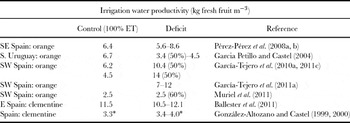
Table 2 summarises the irrigation water-use efficiency values given in the text above. There is no consistent convincing evidence that deficit irrigation leads to higher water productivities. For 100% replacement, the water-use efficiency for fresh oranges is probably in the region of 6–7 kg m−3. The comparable partial replacement of ET values range from 3–14 kg m−3. Complications arise as a result of the timing of the deficit treatments in relation to the phase of fruit growth, and the ways in which ET is determined. Is the deficit treatment a percentage of a realistic ETc value?
Summary of irrigation water productivity values from a selection of ‘deficit’ irrigation experiments with Citrus spp. Control is 100% replacement of ET. Deficit shows percentage replacement where given.

Note: *Rainfall plus irrigation.
By contrast, in a detailed report of a five-year drip irrigation experiment in New South Wales, Australia (34°36ʹS 146°25ʹE; alt.136 m), ‘partial root zone drying’ increased the water-use efficiency of mature Navel orange trees (C. sinensis). This technique allowed the clay-loam soil to dry out on one side of the tree while keeping the other side wet. After four weeks the positions were reversed. By so doing the average amount of water applied annually was about 40% less than that applied in the conventional drip treatment (290 mm cf. 480 mm). As there was only a small reduction in yield (–9%) water-use efficiency was increased. However, since both fruit size and juice percentage were reduced, the technique was considered to be most appropriate for the production of fruit juice. Supporting measurements confirmed the belief that the fully hydrated roots in the wet portion of the root zone maintained a favourable plant water status (allowing plant development to continue as normal), while a chemical signal (e.g. abscisic acid), originating in the dried roots, induced stomatal regulation of transpiration, thereby conserving water. Stomatal conductance was at its maximum from daybreak to approximately 0900 h after which conductance declined to very low levels by midday (in response to an increase in the saturation deficit of the air, range 1–8 kPa), where it remained for the rest of the day (Hutton and Loveys, Reference Hutton and Loveys2011).
Summary: water productivity
1. A number of similar deficit irrigation experiments have been reported, mainly with orange (but on different rootstocks), and predominantly in Spain and Uruguay.
2. There is no clear evidence to show that deficit irrigation increases water productivity, but indications are that ‘partial root zone drying’ might given appropriate circumstances.
3. For fully irrigated crops, the yield responses to water applied are in the range 6–7 kg fresh fruit m−3, and for partially irrigated crops they are between 3 and 14 kg m−3. These values compare with the estimate by Doorenbos and Kassam (Reference Doorenbos and Kassam1979) of between 2 and 5 kg fresh fruit m−3.
4. As there are problems in defining how much water to apply even in the 100% replacement treatments, it is not always clear which comparisons are valid.
5. Many experiments were of limited duration, so with one or two exceptions it was not possible for the cumulative benefits to be assessed.
6. There is no consensus view on the degree of deficit irrigation and its timing, which is likely to benefit farmers, nor of its value in terms of water saving and improvements in water-use efficiency. When is it financially worthwhile?
7. Withholding irrigation during phase 1 of fruit growth reduces the number of fruit reaching maturity.
8. Withholding irrigation during phase 2 of fruit growth reduces fruit size, but applying full irrigation afterwards results in compensatory growth and a similar final fruit size.
9. Withholding irrigation during phase 3 of fruit growth increases TSS and TA contents of the fruit but without influencing the TSS/TA ratio, thereby allowing harvesting to be delayed. Skin thickness is also increased. Deficit irrigation may also reduce albedo breakdown of the rind. Fruit size may be reduced.
10. ‘Partial root zone drying’ increases the water-use efficiency of mature Navel orange trees.
11. Water stress in the winter delays flowering, thus facilitating mechanical harvesting.
12. To avoid fruit size reduction, the midday stem water potential should not be less than –1.3 MPa.
13. Fruit yield is influenced by the plant water status level in the previous year as well as by water status in the current year (Doorenbos and Kassam, Reference Doorenbos and Kassam1979).
14. Changes in fruit quality can be seen in one season whereas yield is cumulative and slow to develop (Shalhevet and Levy, Reference Shalhevet, Levy, Stewart and Nielsen1990).
15. Water availability influences the following aspects of fruit quality: physical attributes such as fruit size, peel thickness, colour, juice content; chemical factors, including acid and sugar contents, and minor constituents that influence palatability (Shalhevet and Levy, Reference Shalhevet, Levy, Stewart and Nielsen1990).
IRRIGATION SYSTEMS
Citrus orchards can be irrigated in many different ways. For example, in Florida, solid-set sprinkler systems, rainguns, flood and subsurface methods have all been used. It was in the 1980s that microirrigation systems became popular not only in new plantings but also in existing orchards where microirrigation displaced other methods, particularly rainguns (Smajstria, Reference Smajstrla1993). The term ‘microirrigation’ is used to describe irrigation systems that use low flow rate-emitting devices (emitters) that place the water on (or just below) the soil surface close to the plant. These systems are characterised by the use of small diameter, polyethylene lateral pipes, with low flow rates at each emitter, and operated at low pressures. Specific types of microirrigation systems include drip (trickle) and microsprinklers (under-tree). These systems allow small quantities of water to be applied at frequent intervals, usually to only part of the root zone. In Swaziland, largely because of the opportunities it offers for labour saving, water saving and power saving, microirrigation (particularly drip) has replaced under-tree drag-line sprinkler systems (Pyle, Reference Pyle1985). In areas prone to frosts (e.g. Florida), microsprinklers can also provide some protection against frost damage to young trees (Rieger et al., Reference Rieger, Davies and Jackson1986).
Irrigation scheduling
Many different approaches to scheduling irrigation (timing and amount of water to apply) in citrus orchards have been advocated, but how widely any of them have been or are used commercially by growers is uncertain. These schedules are based on measurements of plant water status, such as fruit expansion, stomatal opening, trunk diameter, leaf/stem water potential and/or soil water status (content or water potential) and/or estimates of the soil water deficit based on calculated evapotranspiration rates (Shalhevet and Levy, Reference Shalhevet, Levy, Stewart and Nielsen1990). For example, Snyder and Meyer (Reference Snyder and Meyer1992) and Ramsey (Reference Ramsey2007) describe and recommend the use of the water balance approach for citrus growers in California and Australia, respectively, while in Florida, Morgan et al. (Reference Morgan, Hanlon and Obreza2009) are promoting a web-based water-balance citrus Irrigation Scheduler. However, unfortunately, many of these methods are too complex to be used routinely by farmers without assistance. This view is supported by the results of a detailed survey by Stevens (Reference Stevens2007) in South Africa. He found that only 18% of irrigation farmers (including citrus growers) make use of an objective irrigation scheduling method. The rest rely on subjective criteria such as intuition, observation, local knowledge and experience. Different perceptions of the concept of ‘irrigation scheduling’ led, in part, to a communication gap between scientists and farmers.
Despite the limited uptake of objective scientific method, the research continues. A few publications describing recent developments in irrigation scheduling techniques for citrus are summarised below.
In São Paulo Sate, Brazil, Da Silva et al. (Reference Da Silva, Folegratti, da Silva, Junior, Souza and Ribeiro2005) used physiological criteria to identify when to irrigate ‘Tahiti’ acid lime trees (Citrus latifolia) on ‘Swingle’ citrumelo root-stocks. By allowing the (clay) soil to dry for 40 days, and comparing the values relative to those from well-irrigated (drip) trees, they identified the threshold depletion levels of available water in c. 1.0 m soil depth (total 125 mm m−1). Actual evapotranspiration, determined with a weighing lysimeter, was restricted when the degree of depletion reached 57%. By contrast, stomatal conductance, photosynthesis, transpiration and leaf water potential all declined at 40% depletion, which corresponded to a pre-dawn leaf water potential measurement of –0.62 MPa.
The value of several plant water status-based indicators for deciding when to irrigate Satsuma mandarin trees (Citrus unshiu) was determined in South Africa (33°56ʹS 18°52ʹE; alt.157 m) by Dzikiti et al. (Reference Dzikiti, Verreynne, Stuckens, Strever, Verstraeten, Swennen and Coppin2010). Midday leaf water potential measurements (made on young potted trees) were considered to be too variable (range of fluctuation 2.0 MPa) because of stomatal oscillation (the severity of which increased when the saturation deficit of the air reached c. 3 kPa). Oscillations are a characteristic of most Citrus species. By comparison, midday stem water potential measurements were more representative of tree water status (corresponding range c. 0.3 MPa). In contrast, pre-dawn leaf water potential measurements, although not affected by oscillations, were not sufficiently sensitive to register mild water stress. No statistically valid relationship was found between canopy reflectance and the water status of mature trees, and there was only limited success with young trees and that when they were experiencing severe water stress.
On their own, remotely sensed spectral data were therefore unlikely to be of value for scheduling irrigation of citrus orchards. Subsequent studies by Dzikiti et al. (Reference Dzikiti, Verreynne, Stuckens, Strever, Verstraeten, Swennen, Tharon and Coppin2011) at the same location however suggested that, as reflectance was an indicator of relative changes in the contribution of internally stored water to daily transpiration (up to 25% in mature Midnight Valencia orange trees), changes in canopy reflectance, in selective wavelength bands, could (potentially) be used for irrigation scheduling. This response was despite seasonal variation in reflectance (from 15% in winter to 22% in summer) associated in part with changes in tree phenology.
The use of stem shrinkage measurements to schedule irrigation was evaluated in Spain (39°30ʹN 0°24ʹE; alt. 68 m) by Velez et al. (Reference Velez, Intrigliolo and Castel2007) in an orchard planted with Clementina de Nules (C. clemantina) grafted on to Carrizo citrange (C. sinensis). The aim was to ensure that the maximum daily trunk shrinkage did not exceed 125% of the value for the well-watered control tree during the three months following the ‘June drop’. In practice, this requirement also meant that the midday stem water potential did not fall below –1.3 MPa, a previously determined threshold value. In the two years the experiment ran, the deficit irrigation treatment resulted in seasonal water savings of 87 mm and 43 mm equivalent to 18% and 12%, respectively of the total water application (excluding rainfall) without any loss in yield, and without affecting fruit weight distribution. Variation in daily trunk shrinkage was best correlated with solar radiation (not mean daily air temperature as originally reported). A minimum of six trees were needed to obtain reasonable mean values to base decisions on when to irrigate.
The results of a similar study in south-west Spain were reported by García-Tejero et al. (Reference García-Tejero, Durán-Zuazo, Muriel-Fernández and Jiménez-Bocanegra2011b). Measurements made during a season in a deficit irrigation experiment in a commercial orchard of sweet orange (cv. Nevelina) indicated how the difference in temperature between the crop canopy (Tc) and ambient air (Ta) (Tc – Ta, range up to 6 °C) was a sensitive indicator of tree water status as was the maximum daily stem shrinkage (range 130–300 μm). Since these variables were not only highly correlated with each other but also with midday stem water potentials (range –0.5 to –2.8 MPa) and stomatal conductances (range 40–240 mmol m−2 s−1), the authors were of the view that measurements of (Tc – Ta) with an infra-red thermometer could be used to monitor crop water status and to schedule irrigation.
In Florida, Fares and Alva (Reference Fares and Alva2000) evaluated the use of capacitance probes for irrigation scheduling of three-year-old citrus trees growing in fine sand. Capacitance probes were used to monitor continuously soil water content at different depths within and below the root zone, and allowable depletion levels were specified. Throughout most of the growing season the soil water content in the root zone was maintained within the specified limits. Capacitance probes are now being used in Florida with success.
Fertigation
Advances in microirrigation techniques (e.g. drip and under-tree sprinklers) have facilitated the adoption of fertigation (the application of nutrients through the irrigation system) of citrus. The benefits of fertigation include the frequent delivery of nutrients in soluble form, together with water, directly into the root zone. Good irrigation management is necessary to minimise leaching of nutrients. In a detailed review of the topic, Alva et al. (Reference Alva, Mattos and Quaggio2008) summarised the results of the limited number of long-term fertigation trials with citrus (orange and grapefruit) in terms of growth responses of young trees, and yields and nutritional status of fruit-bearing trees. Some of the practical problems associated with this method of fertiliser application were also highlighted.
An advanced form of this method of irrigation was developed in Spain and has since been commercialized in several countries, including Australia, South Africa and the United States. Known as ‘Open Hydroponics’, citrus trees are planted at a high density (>750 trees ha−1) and irrigated (with drip) by short duration, low-volume pulses throughout daylight hours with fertiliser injected into the water (except on rainy days). In this way, water and nutrients are readily available within the wetted soil volume where a mat of roots develops (Falivene, Reference Falivene2005). After two years’ commercial experience in Florida with what is called the ‘Advanced Citrus Production System’, the observed benefits included early production of high-quality fruit (at 24 months) with the opportunity to achieve potential yields when the trees mature. As there is a limited reserve of available water in the (restricted) root zone, especially in sandy soils, the system is vulnerable to breakdowns. Good management is essential. Looking to the future, there are opportunities to extend the system to very high-density citrus production under cover (Schumann, Reference Schumann2011).
Summary: irrigation systems
1. Many different methods of irrigation have been used to irrigate citrus. Microsprinklers and drip are now the generally preferred systems, both of which can be used for fertigation.
2. Many different ways of scheduling irrigation have been advocated but how many are used in practice is uncertain. Capacitance probes are used in Florida.
3. Stem water potentials are related to the degree of stem shrinkage, which occurs when a tree experiences water stress.
4. A method of irrigation scheduling based on the degree of daily stem shrinkage has been evaluated. This practice has resulted in water savings of 12–18% compared with a well-watered control.
5. To ensure that water stress is not a yield-limiting factor, the midday stem water potential should not fall below –1.3 MPa.
6. The limiting soil water depletion ratio was estimated to be 0.4 during the period from flowering to fruit drop, and afterwards 0.6–0.7 (Doorenbos and Kassam, Reference Doorenbos and Kassam1979).
7. On their own, remotely sensed spectral data are unlikely to be of value for scheduling irrigation of citrus orchards.
8. An advanced form of fertigation, known as ‘Open Hydroponics’, has been commercialised in several countries.
GENERAL CONCLUSIONS
Citrus spp. originated in south-east Asia and are grown commercially mainly in the subtropics where irrigation is necessary, but where there is also great pressure to conserve water. Compared with most crops, research on citrus is complicated by the complexity of its taxonomy and the diverse range of species and cultivars that are grown. This complexity is further complicated by the choice of rootstock. Drawing generic conclusions from the research reported is therefore not straightforward because of possible genotype/environment interactions. In summary, as a result of this review, our current state of knowledge of the water relations of citrus appears to be as follows:
1. The effects of water availability on vegetative growth are understood in general terms, but the relationships have not yet been quantified.
2. The need for a ‘rest period’ to induce flowering is understood, but its magnitude (in terms of a drought stress index or day-degrees) does not appear to have been specified with precision.
3. Similarly, the effects of drought on flower and fruit formation and retention is understood in general terms, but again the relationships have not been quantified in useful ways for specific cultivars.
4. Rooting depth and distribution have only been described in a limited number of situations. Much remains to be done to quantify root distribution in relation to soil water availability in order to compare the contribution of specific rootstocks to drought tolerance (for example).
5. Environmental factors influencing stomatal conductances are generally well described and relationships with some growth processes established.
6. Compared with other crops, low stomatal/canopy conductance restricts water use of Citrus spp. Some (limited) progress has been made in quantifying crop water requirements under specific conditions.
7. Despite many recent attempts to specify how little water can be applied at specific growth stages to optimise water productivity through regulated deficit irrigation, no consensus view has emerged. This dilemma may, in part, be due to the difficulty of quantifying actual crop water use and allowable soil water deficits.
8. The yield response to ‘full’ irrigation is of the order 6–7 kg fresh fruit m−3 as a result of an increase in the number of fruit of marketable size. There are also improvements in fruit quality.
9. The most effective way of irrigating a citrus orchard is with a microirrigation system (drip or microsprinklers). Both methods require answers to the question: what proportion of the root zone needs to be irrigated? Both methods, especially drip, allow water to be applied (with fertigation) at frequent intervals (including several times a day – open hydroponics), although formal evidence of the benefits to be obtained from this level of intensification is lacking.
Acknowledgements
Dr. Rob Lockwood kindly provided copies of some of the papers cited here, and commented on a draft of this paper. The two anonymous referees provided detailed and constructive advice on how the paper could be improved. I am grateful to all three for their help.