INTRODUCTION: ANNIVERSARIES IN 2022
For the Signet Library in Edinburgh, 2022 will mark both the 300th anniversary of its foundation as a collection and the 200th anniversary of the famous ‘Palace of Books’ on the Royal Mile which is its home. The library and the building are both the creations of one of the world's oldest legal organisations, the Society of Writers to Her Majesty's Signet (or WS Society for short), and the building also serves as the WS Society's headquarters and as a centre for legal activity for lawyers of all kinds from across Scotland and beyond. Although for most of its history the building and its library have been privately owned, the Society's tradition of liberal open access for researchers and scholars is as famous as the architecture of the Signet Library's reading rooms, and the Signet Library has a rich history of involvement in the intellectual life of the country it serves.
THE WS SOCIETY AND ITS ORIGINS
The WS Society takes its origins from a group of lawyers working at the Scottish Royal Court, and although there is no known date for its foundation its activities can be traced back as far as the fourteenth century. The Society was incorporated into Scotland's new College of Justice in King James V's legal reforms of 1532, and with the opening of a new minute book in 1594 the Society took on its recognisable modern form. Shortly after it had acquired its first permanent premises in Writers Court in 1694, the Society was presented with its first book – Writer to the Signet George Dallas's 1697 A system of stiles, as now practicable within the kingdom of Scotland (a collection of legal forms and precedents) which would remain an important Scottish legal text until well into the nineteenth century. Perhaps in response to the renaissance in Scottish printing and in legal publishing, the Society took the decision in 1722 to acquire all Scottish legal textbooks and all printed legislation, and 1722 is now considered to mark the library's moment of foundation.
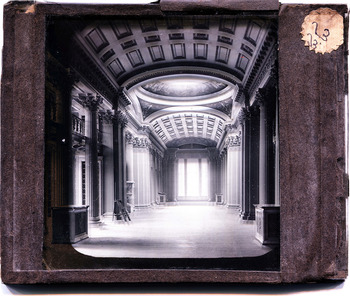
A Victorian glass slide of the Signet Library Upper Hall taken by photographer George Washington Wilson in 1867.

EXPANSION OF THE LIBRARY
With the Scottish Enlightenment at its height in 1778 the WS Society took the decision to expand the library into a general collection, with the aim of bringing together the best available books to cover all fields of human knowledge. This began a period of immense expansion and growth, and by 1833 the library had grown fifty-fold and occupied brilliant new premises on Edinburgh's Royal Mile. The Signet Library, as it was now known, could boast the presence of the first of a series of famous scholar-librarians, Macvey Napier, the editor of the Encyclopaedia Britannica and the Edinburgh Review. His successor was the historian and bibliographer David Laing, under whom the Signet Library became the centre for the great Scottish literary, historical and text publication societies such as the Abbotsford Club and the Wodrow Society.
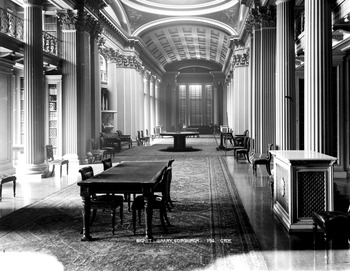
The Signet Library Upper Hall in 1867.

For most of this period, and indeed for most of the Signet Library's existence, it has sought to serve not just its members’ legal needs but their intellectual and reading lives as a whole, and the legal collection was just one amongst several that were maintained to the highest standards. However, the impact of two world wars in the first half of the twentieth century on the WS Society and its Library was profound and prompted a top to bottom review. The decision was taken in 1958 to reorientate the Signet Library into a first class legal collection for the Society's use, with a supporting world class collection of books and papers relating to Scottish history and affairs. Parts of the existing collection outside these core areas were sold and the proceeds used to restore the building and conserve the retained collections.
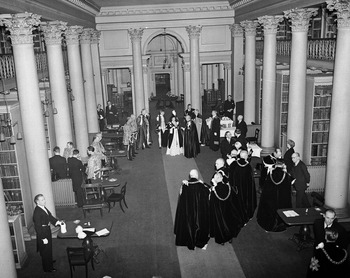
The Signet Library Lower Hall during a Royal visit in 1953.

RECENT HISTORY
Since 1980 Signet Library services have maintained a consistent form. The Library's prime role is to serve the legal information and research needs of the WS Society's members (who number c. 1000 in a typical year) and WS firms (Scottish law firms with half or more of their partners being members of the WS Society, or firms with whom the Society has enjoyed a long relationship). To do this, it maintains a full collection of current Scottish legal titles and journals, with a strong collection of material relating to the English and Welsh jurisdiction and some representation of jurisdictions in Europe and beyond. Members and firms may borrow material for an official period of two weeks, liberally interpreted, in addition to which the library will deliver information by email or by post. Staff will undertake legal research on behalf of members and firms and provide reports on the findings. The library is open during weekday office hours during which members can make in-person visits to the reading room. About 50,000 bound volumes of legal material are held in twelve separate rooms or stores, and access is available within the building to Westlaw and LexisNexis services. The library holds a further 40,000 volumes of material relating to the history, culture and geography of Scotland, and offers prearranged access visits to bona fide researchers and academics with recognised institutions. Much early legal material has now crossed the invisible barrier between the current and the historic and this is increasingly recognised by the arrangement of the book stock within the premises.
ADAPTING TO CHANGE
Although the core aims of the service have held steady, the Scottish legal world that the Library serves has not. The combination of the sales and the arrival of a series of exceptional legal librarians meant that the Signet Library was in the perfect place to take advantage of the renaissance in Scottish legal writing and publishing that began late in the 1970s. This trente glorieuses saw a burgeoning in Scottish legal texts and journals from a wide range of enthusiastic and committed publishers as the profession refreshed and reformed. Writers to the Signet played a significant part in this rebirth and the Library adapted to meet it, introducing a computer catalogue and extending its opening hours to meet the demand. Although use of the historic collection dropped off during this period, young lawyers began to rediscover parts of it for modern use, with interest in the Signet Library's vast collection of eighteenth century Court of Session Papers reviving in particular. At the same time, digital resources such as Westlaw and Lexis Nexis were successfully brought in and incorporated into the Library's research workflow.
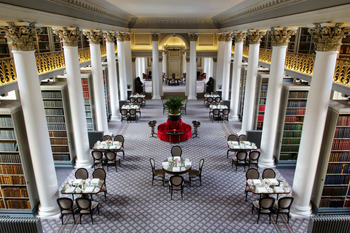
The Signet Library Lower Hall today.

Other changes in the years following the Millennium were less positive. Many law firms moved into a new business district to the west of the city centre; firm takeovers and mergers meant fewer, larger firms providing their own digital information workflows; online information services climbed in cost as their use became both ubiquitous and essential. With these and other trends, Library footfall went into decline.
NEW CHALLENGES
It was recognised early that these new challenges were existential in nature. Chief Executive of the WS Society Robert Pirrie led a decade of reforms, named ‘Project Renaissance’, that reimagined the WS Society through the core values of excellence, integrity and permanence, with the Signet Library becoming a major centre for legal education and professional development. This has been followed by the ‘New Enlightenment’ project, which seeks to restore the Signet Library as a centre both for legal and cultural life and for debate and discussion, making use of the incredible architectural, artistic and cultural heritage present within it for the benefit of the wider society of Scotland and beyond.
Key to the New Enlightenment project are efforts to reach new audiences and entering into fruitful collaborations with universities, museums and galleries and other organisations. A new reading room designed around the needs of modern lawyers and scholars alike has opened in the west of the building, and we have launched a summer scholar scheme for legal students giving them opportunities to experience professional legal research and teamwork whilst meeting and learning from leading professionals in the field. The opening of our restaurant, ‘Colonnades’ (in partnership with our venue managers Heritage Portfolio) has restored the Signet Library as the social centre of the Scottish legal world whilst giving the public regular access to the beautiful Lower Hall for the first time in over a century.
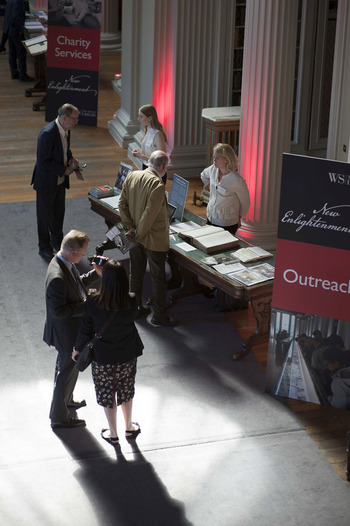
A scene at the Signet Library “New Enlightenment” showcase of 2019.

We provide work experience for students of librarianship along with volunteering opportunities and the chance to gain experience through our programme of regular exhibitions. A digitization programme is underway to widen access to our most important historical materials.
Challenges remain. The professional impact of the Covid-19 emergency has vastly accelerated the existing trend towards remote working and reliance on digital resources. Although we remained open for business throughout the crisis and managed to port our education programme and other services across to online delivery, demand for legal information services is only now beginning to recover.
THE FUTURE
In amongst the challenges have been achievements. The WS Society became a registered charity in the summer of 2021, and with a new structure and clear objectives both the Society and the Signet Library face the future with confidence.