INTRODUCTION
During 2014, an estimated 36.9 million people worldwide were infected with HIV, 69.9% of whom lived in Sub-Saharan Africa (United Nations Joint Programme on HIV/AIDS, 2016). AIDS-related deaths have declined by an estimated 42% since the 2004 peak, but the disease burden continues to increase as antiretroviral therapy (ART) enables many patients to live decades longer than they could have without it.
In Botswana, the rate of vertical HIV transmission has declined from 30% before the implementation of preventative ART programs to 3.9% in 2008 and to 2.1% in 2013 (National AIDS Coordinating Agency, 2014). The national prevalence rate for the general population of Botswana was 18.5% during 2013 (National AIDS Coordinating Agency, 2014), when an estimated 320,000 people were living with HIV and 213,953 were on ART (Farahani et al., Reference Farahani, Vable and Lebelonyane2014; National AIDS Coordinating Agency, 2014).
During 2011, according to Botswana's Ministry of Health (Ministry of Health, 2011), a total of 165,701 patients were on highly active antiretroviral treatment (HAART) in the public and private healthcare sectors. The government implemented several programs to address the HIV epidemic, including behavior change information and communication, prevention of vertical HIV transmission, routine HIV counseling and testing, multiple concurrent partnership (MCP) counseling, safe male circumcision, home-based care programs, and antiretroviral treatment (ART). According to the World Health Organization (1998), quality of life (QoL) refers to an individual's perception of his/her position within the context of the culture and value system in which he/she lives in relation to the individual's goals, expectations, standards, and concerns. The impact of HIV/AIDS on the dimensions of HRQoL has become an important issue for people living with HIV/AIDS (PLWHA). Degroote et al. (Reference Degroote, Vogelaers and Vandijck2014) indicated that HRQoL among PLWHA is influenced by several determinants that impact on a person's perceived HRQoL.
ART has improved survival rates, enabling PLWHA to live 20 to 35 years after commencement of treatment, and it has decreased the number of opportunistic infections (e.g., tuberculosis). Adherence to an ART regimen is essential to derive the full benefits of treatment (Sarna et al., Reference Sarna, Pujari and Sengar2008; Ndubuka & Ehlers, Reference Ndubuka and Ehlers2011). Frequent treatment adherence counseling and using adherence partners/treatment supporters have been associated with good ART adherence levels among 116 HAART Botswanan patients (Ndubuka & Ehlers, Reference Ndubuka and Ehlers2011). ART adherence levels have been correlated with patients' CD4 cell counts and with viral loads. The known factors that have an impact on ART patients' HRQoL can be grouped into three broad interrelated categories—sociodemographic, clinical, and psychological (Tsevat, Reference Tsevat2006; Reda & Biadgilign, Reference Reda and Biadgilign2012; Degroote et al., Reference Degroote, Vogelaers and Vandijck2014).
ART patients face many challenges, including stigmatization, adherence to ART, treatment side effects, disclosure-related issues, socioeconomic hardships, feelings of being rejected by society, and the temptation to engage in behaviors that increase the risk of HIV reinfection (Cloete et al., Reference Cloete, Strebel and Simnayi2010; Sendagala, Reference Sendagala2010; Stutterheim et al., Reference Stutterheim, Bos and Pryor2011). ART patients need to develop strategies to cope with these daily challenges. Coping mediates social support, and ART adherence affects a person's HRQoL. Identified coping strategies used by ART patients include focusing on other persons and being actively involved in spiritual activities (Ogbuji & Oke, Reference Ogbuji and Oke2010; Hodge & Roby, Reference Hodge and Roby2010; Chaudoir et al., Reference Chaudoir, Norton and Earnsaw2012), as well as focusing on present/current issues rather than on past occurrences or future possibilities (Vyavaharkar et al., Reference Vyavaharkar, Moneyham and Tavakoli2007). The major benefits of ART include stopping and even reversing disease progression and thereby prolonging life. However, this treatment regimen can produce serious side effects that can adversely affect patients' HRQoL (Burgoyne & Tan, Reference Burgoyne and Tan2008), which can be even more burdensome since ART implies lifelong treatment adherence. There is limited information available on Botswanan patients who have undergone ART for five years or longer. Our study attempted to assess the HRQoL of patients who had had ART for at least five years in Botswana's public healthcare system and to identify the factors associated with their HRQoL scores.
METHODS
Ethical Considerations
The Health Research and Development Committee of the Botswanan Ministry of Health granted permission for this study (ref. no. PPME-13/18/1 Vol VII 318). The managers of the six participating health facilities offered their approval. Ethical clearance was granted by the Higher Degrees Committee of the Department of Health Studies of the University of South Africa (ref. no. HSHDC/7/2012). Written informed consent was obtained from each respondent before being interviewed. Participation was voluntary, and respondents could stop an interview at any point without incurring negative consequences. Unique code numbers were employed instead of names, ensuring the anonymity of respondents, and information entered into a computer was protected by a secure password on a system to which only the researchers and statisticians had access.
Study Setting and Population
Interviews were conducted at six ART clinics in southeastern Botswana. During April of 2012, when data collection commenced, a total of 11,003 patients (Ministry of Health, 2011) were receiving HAART at these six sites, who comprised the population for our study. We approached a total of 545 eligible ART patients for interviews. Out of this number, 13.6% (f = 74) refused to consent or did not respond. Some 15 (2.8%) eligible respondents' interview schedules were incomplete and could not be used for data analysis. We discarded all incomplete interview schedules. A total of 456 (83.7%) of the 545 eligible respondents completed the interviews at the six study sites.
Study Design and Participant Recruitment
We employed multistage sampling to select the six public ART clinics that participated in our study. The calculated sample size was based on the estimated proportion of patients on ART for at least five years at each site. Eligible patients were selected by using systematic random sampling and were requested to consider being interviewed during their clinic visits or at another time and place acceptable to them. The sample included 456 adult ART patients who had been on ART for at least 5 years and who were at least 21 years old (in order to be able to provide legal consent for participating in the study).
Measures and Instruments
Eligible respondents were interviewed by using a 59-item structured interview schedule and the WHOQoL–HIV–BREF instrument. Both data-collection instruments were translated into the local language (Setswana) and then back-translated into English. The translations were approved by an English–Setswana translator.
Structured Interview Schedule
The interview schedule's five sections attempted to obtain information about respondents' sociodemographic and clinical characteristics. The sociodemographic characteristics included age, gender, marital status, number of children, educational level, religion, and employment status. The clinical information included most recent CD4 cell count and viral load, year when ART was commenced, year of HIV diagnosis, HIV status disclosure, duration of ART, and recorded opportunistic infections. Respondents' coping mechanisms and self-reported ART adherence were also recorded. Clinical data were obtained from respondents' medical records. The Cronbach's α coefficient for this instrument was 0.87.
WHO Quality of Life Questionnaire
The WHOQoL–HIV–BREF, a shortened version of the WHOQoL-100 instrument, was developed by the World Health Organization's Quality of Life–HIV Group for crosscultural application to PLWHA. The WHOQoL–HIV–BREF includes 31 items that address 6 domains: physical (4 items), psychological (5 items), level of independence (4 items), social relationships (4 items), environment (8 items), and spirituality (4 items), and two additional items (overall HRQoL and general health) (WHOQoL HIV Group, 2004; Skevington et al., Reference Skevington, Norweg and Standage2010). All items were rated on a 5-point Likert-type scale, with “1” indicating the lowest negative feelings or perceptions and “5” the highest level of positive feelings or perceptions. This instrument contained questions about “how satisfied, how much, how completely, how bothered” respondents felt about specific aspects of their lives during the previous two weeks.
We calculated the domain and overall quality-of-life scores based on the WHOQoL–HIV–BREF scoring and coding methodology (World Health Organization, 2002). Items were scored through summative scaling, and each item contributed equally to the domain score. We conducted individual interviews in private rooms at the six participating ART clinics in either English or Setswana, depending on the respondent's preference. The structured interview schedule was pretested on 10 ART patients who met the eligibility criteria. Patients could respond to all items, and no changes were required. The results of these 10 preliminary interviews were not utilized during data analysis in the actual study.
Statistical Analysis
The data were analyzed using Statistical Analysis System software (SAS, v. 9.2). Descriptive statistics (means, standard deviations, ranges, frequency distributions, contingency tables, and percentages) were generated to describe the demographics and health characteristics of respondents. Chi-square and Fisher's exact tests were utilized for categorical data, and independent t tests were employed for continuous variables.
Means with standard deviations of the HRQoL outcome variables (physical, psychological, level of independence, social relationships, environment, and spirituality) were reported. Spearman's correlation coefficient (ρ) was utilized to assess the relationships between specific variables. In order to understand the factors associated with study outcomes, a series of bivariate associations was performed, selecting key variables related to respondents' demographic and clinical characteristics, coping with the challenges of HIV, ART adherence, and the healthcare system. All the independent covariates were first tested for a relationship with each HRQoL outcome and with total QoL scores. All significant independent covariates, at univariate regression analyses, were included in subsequent multivariate regression models. A stepwise forward model-building strategy was applied, and interactions between factors in the multivariate models were examined. The level of statistical significance was set at p < 0.05.
RESULTS
Sociodemographic and Clinical Characteristics of Respondents
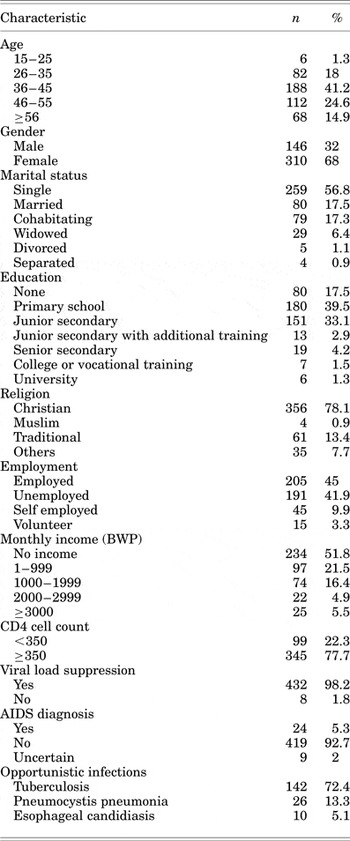
Table 1 presents respondents' sociodemographic and clinical characteristics. Out of the 456 respondents, 310 (68.0%) were females and 146 (32.0%) males, and the mean age was 43.9 years (SD = 9.8). The demographic characteristics of our study population are consistent with the results of Botswana's AIDS Impact Survey's findings that females continue to be disproportionately affected by HIV. Botswana has a gender ratio of 95.5 males to 100 females (Government of Botswana, 2014), but females have a higher reported HIV prevalence rate of 19.2%, compared to 14.1% for males (Republic of Botswana, 2013).
Sociodemographic and disease-related characteristics of respondents (n = 456)

With respect to age groupings, the results from the Botswana AIDS Impact Survey IV indicate that the national HIV prevalence is highest among the 35–39 age group at 43.7%. Botswana's national age pattern of HIV prevalence is high among the 30–34 years age group (33.9%) but reaches a maximum of 43.7% in the 35–39 years range, 41.8% in the 40–44 years range, and 42% in the 45–49 years range, respectively (Republic of Botswana, 2013).
Concerning respondents' marital status, 259 (56.8%) were single, 80 (17.5%) were married, and 79 (17.3%) were cohabiting. Some 180 (39.5%) respondents had a primary school education, 19 (4.2%) had progressed to senior secondary education, and 6 (1.3%) had fulfilled tertiary education qualifications. All respondents had disclosed their HIV-positive status to at least one other person. With respect to respondents' clinical situations, 345 (77.7%) had CD4 counts exceeding 350 cells per mm3, 432 (98.2%) had full viral suppression, and 24 (5.3%) were suffering from AIDS. Tuberculosis was the most frequently recorded opportunistic infection (72.4%). Respondents' other characteristics are summarized in Table 1.
Health-Related Quality-of-Life Scores of Respondents
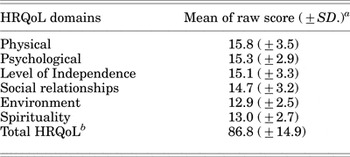
Table 2 provides respondents' mean HRQoL scores with standard deviations. Moderate scores were obtained across six HRQoL domains: physical, psychological, level of independence, social relationships, environment, and spirituality. The highest mean score was observed in the physical domain (mean = 15.8, SD = 3.5) and the lowest in the environment domain (mean = 12.9, SD = 2.5).
Respondents' mean HRQoL scores with standard deviations

a Total HRQoL = sum of all six outcomes.
b Higher scores indicate better quality of life.
Coping with the Challenges of HIV/AIDS
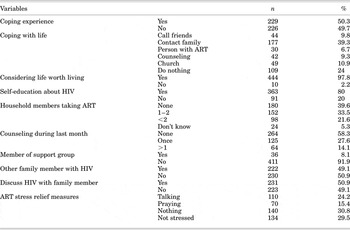
Table 3 summarizes respondents' coping strategies. Half of our respondents (n = 229) reportedly had previously overcome challenges other than being HIV-positive. The vast majority (97.8%, n = 444) felt that life was worth living, and 80.0% (n = 363) had educated themselves about HIV and AIDS. Although most respondents (92.0%) did not belong to any community support groups, only 39.5% (n = 134) were not stressed as a result of ART. The most commonly utilized coping strategy was to contact a family member when facing HIV-related difficulties.
Coping with the challenges of HIV

Association Between Respondents' Characteristics and HRQoL Domains
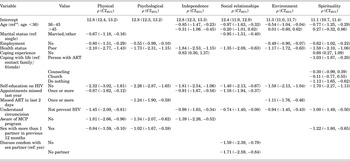
Table 4 presents the associations between respondents' characteristics and HRQoL domain scores. Self-education about HIV was significantly associated with physical HRQoL scores (ρ = –2.3, CI 95% = –3.0, –1.6) after controlling for other significant factors. Poor health status showed a 2.1 × lower likelihood of being associated with physical HRQoL scores (CI 95% = –2.77, –1.43) after controlling for other significant factors. Among coping factors, respondents with previous coping experiences had a 1.5 × higher physical HRQoL score compared to those without any previous coping experiences (ρ = 1.5; CI 95% = 0.8, 2.1). Respondents who indicated that life was not worth living and had no HIV self-education showed lower physical HRQoL scores than their counterparts (–5.0 and –4.0, respectively).
Factors associated with respondents' HRQoL (n = 456)

a ref = reference group.
Respondents who had poor health status scored 1.8 points lower on the psychological HRQoL domain (CI 95% = –2.31, –1.15). With respect to the HRQoL independence domain, older respondents had lower scores compared to younger ones. Respondents who missed clinic appointments during the previous 12 months had a 0.9-point lower independence QoL score compared to respondents who had not done so after controlling for other significant factors (CI 95% = –1.67, –0.16). Compared to single persons, married respondents had 0.95-point lower social HRQoL scores after controlling for other significant factors (CI 95% = –1.51, –0.40). In relation to the spirituality domain, the factors of age, employment status, perceived health status, previous coping experiences, coping with life's challenges, and understanding circumcision for prevention of HIV were significantly associated with HRQoL scores (adjusted R 2 = 0.40).
DISCUSSION
Our study demonstrated that, overall, ART patients' HRQoL scores were moderate across six HRQoL domains, with the physical domain (measuring pain and discomfort, energy and fatigue, and sleep and rest) showing the highest mean QoL scores, while the lowest scores were obtained in the environment domain (measuring physical safety and security, home environment, financial resources, quality and accessibility of health and social care, freedom, opportunities for acquiring new information and skills, and participation in recreation/leisure activities).
Self-education about HIV-related issues was significantly associated with HRQoL physical scores. This finding has potential public health implications because ART programs should develop educational interventions at regular intervals to assist ART patients to maintain positive behaviors that enhance their physical well-being. Boateng et al. (Reference Boateng, Kwapong and Agyei-Baffour2013) and Campbell et al. (Reference Campbell, Skovdal and Madanhire2011) reported that knowledge about HIV/AIDS (including the benefits of ART adherence and the serious negative consequences of not adhering to one's ART regimen) encouraged patients' positive behaviors and decreased ART default rates.
Most of our respondents were satisfied with their physical health, were adjusted psychologically to their life on ART, and could cope with their work and daily activities. McInerney et al. (Reference McInerney, Ncama and Wantland2008) also reported the highest mean QoL scores for the physical domain (mean = 98, SD = 10.01) among respondents in KwaZulu–Natal, South Africa. Similarly, a study of 150 HIV-positive patients in Nigeria (Folasire et al., Reference Folasire, Irabor and Folasire2012) reported that mean QoL scores were high in both the physical (71.60 ± 13.90) and psychological domains (71.60 ± 18.4).
The high psychological domain scores that we found could be attributed to the fact that all respondents had been on ART for at least five years, providing sufficient time for ART-related psychological adjustments. The finding that HIV-related self-education significantly improved psychological domain scores implies that more knowledge improved respondents' coping abilities. Employment apparently helped to improve scores in the psychological domain of the HRQoL, as employed respondents had higher scores than unemployed ones.
Our respondents scored poorly in the social relationships, environment, and spirituality domains. The social relationships of respondents included social support, personal relationships, and satisfaction with sexual relations, as well as participation in social activities/events. The lower HRQoL social domain scores might indicate that PLWHA experienced stigma and/or discrimination. We assessed the spirituality domain by addressing respondents' personal religious beliefs, future concerns, blame, and forgiveness. The low environmental and spiritual HRQoL domain scores might indicate a lack of family support, more severe insecurity, poor living conditions, and belief systems that are too weak to support respondents. Other QoL studies, conducted on PLWHA in Nigeria and Brazil, also reported lower environmental and social relationship QoL scores (Folasire et al., Reference Folasire, Irabor and Folasire2012; Fatiregun et al., Reference Fatiregun, Mofolorunsho and Osagbemi2009; Morandi dos Santos et al., Reference Morandi dos Santos, Franca and Lopez2007). However, our findings apparently do not support those of other researchers, as Tran (Reference Tran2012) reported high environmental domain scores (13.8 ± 2.8) and Sekabira et al. (Reference Sekabira, Nankya-Mutyoba and Makumbi2012) reported high social relationships domain scores (12.71 ± 3.67).
Our younger respondents (aged <36 years) had higher scores than older respondents in all of the QoL domains. This result is similar to those of other studies that reported an association between age of ART patients and QoL (Abasiubong et al., Reference Abasiubong, Ekott and Bassey2010; Munsawaengsub et al., Reference Munsawaengsub, Khair and Nanthamongkolchai2012).
Employment was an important factor associated with overall HRQoL scores in our respondents. Their educational levels were not associated with their HRQoL scores, similar to the findings reported by Figuero et al. (Reference Figuero, Luque and Martín2011), who found an absence of any significant relationship between HRQoL and educational status in a cohort of patients in Spain.
The respondents in our study adopted various HIV-related coping strategies: attending counseling sessions, contacting other ART patients, talking to friends and significant others, and going to church and praying. Based on multivariate regression analyses, participants' self-education about HIV-related issues was significantly associated with high scores in all HRQoL domains. Thus, respondents sought HIV-related information to make informed decisions and to manage their stress levels. Utilization of similar coping strategies by PLWHA were reported by other researchers (Hodge & Roby, Reference Hodge and Roby2010; Ogbuji & Oke, Reference Ogbuji and Oke2010; Chaudoir et al., Reference Chaudoir, Norton and Earnsaw2012).
LIMITATIONS OF THE STUDY
As we adopted a cross-sectional design, temporal relationships among the variables of interest and measured HRQoL scores could not be ascertained. Our conclusions are therefore based on associations and not on causality. Respondents' self-reported ART adherence levels might have been subject to recall bias.
Our study was conducted at six healthcare facilities, so that the results might not be generalizable to the whole of Botswana without conducting further similar studies at randomly selected ART facilities throughout the country.
The WHOQoL–BREF instrument, which relies on self-reported HRQoL during the two weeks prior to the interview, might have introduced recall bias.
RECOMMENDATIONS
Qualitative studies should be conducted to explore the perspectives of Botswana's ART patients regarding their HRQoL in order to improve our understanding of ART patients' lived experiences and thus enhance the development of a holistic ART program for PLWHA in Botswana.
Ongoing longitudinal HRQoL studies should be conducted at randomly selected study sites throughout the country so that temporal relationships and potential causality can be ascertained. These findings would also enable healthcare professionals to identify and address individual ART patients' unique needs.
CONCLUSIONS
Moderate HRQoL scores across all six domains were obtained by ART patients in Botswana. Respondents who acquired knowledge of HIV-related issues through self-education perceived their health status as being good. ART patients utilized such different coping strategies during stressful situations as contacting family members, friends, and significant others.
DECLARATIONS
The authors hereby declare that they are unaware of any conflicts of interest that might have influenced them in any way whatsoever while conducting the research and writing this manuscript. In addition, our paper is not under consideration for publication by any other journal.
ACKNOWLEDGMENTS
The authors thank the University of South Africa for granting a bursary to the first author that paid for some of the costs incurred while conducting the study. We are also grateful to Professor D.K. Shangodoyin for the statistical analyses, Mr. Sikhulile Moyo for the preliminary statistical analyses, Ms. Kelebogile Binda for coordinating the data-collection process, the research assistants who conducted the interviews, and the patients who agreed to be interviewed.