Introduction
Thyroglossal duct cysts are the most common cause of midline neck lumps in children.Reference Foley and Fallat1 They account for 70 per cent of all paediatric neck swellingsReference Oomen, Modi and Maddalozzo2 and occur in approximately 7 per cent of the population.Reference Kurt, Ortug, Aydar and Ortug3 During gestation, the thyroid gland descends from the foramen caecum at the junction of the anterior two-thirds and posterior one-third of the tongue, and passes very close to the hyoid bone before settling on the anterior trachea.Reference Pollock and Stevenson4 The fibrous tract connecting the thyroid to the foramen caecum is obliterated under normal circumstances. However, it occasionally persists as a thyroglossal duct, allowing the formation of mucus-filled cysts within it.Reference Thompson5 As such, the cyst presents as a midline neck mass that moves on deglutition and protrusion of the tongue, which often yields the clinical diagnosis.Reference Prasad, Dannana and Prasad6 Very rarely, the cyst may represent an ectopic thyroid or contain the only thyroid tissue in the body,Reference Hanmayyagari, Guntaka and Ravilala7 and surgical excision would inadvertently cause hypothyroidism, necessitating lifelong medication. Therefore, an ultrasound scan is usually requested to differentiate these pathologies.Reference Gupta and Maddalozzo8
Surgery is recommended for preventing recurrent infection and cervical fistulisation,Reference Hawkins, Jacobsen and Klatt9 as well as providing a histological diagnosis, as there is a 1 per cent risk of carcinoma.Reference Dedivitis and Guimarães10 In 1920, SistrunkReference Sistrunk11 presented his procedure based on the embryology of the disease. It is eponymously known as the Sistrunk procedure, which involves excising the cyst, the body of the hyoid, and a core of tissue up to and including the foramen caecum without breaching the oral mucosa. Using this method, the recurrence rate was reduced from 40 per cent to 5 per cent. Histological studies have shown that the main duct may have many microscopic lateral, superficial and deep branches, which may give rise to recurrent cysts if inadequately excised.Reference Horisawa, Niinomi and Ito12 Based on these findings, several authors have described a modification of the Sistrunk procedure with the addition of a wide central neck dissection to excise the tract and all possible branches en bloc.Reference Kim, Pawel and Isaacson13,Reference Howard and Lund14
The main challenges involved in this condition include: (1) diagnosis, as typical clinical signs may be absent and radiology may be inconclusive; and (2) recurrence of disease in those who have undergone surgical intervention.Reference Ibrahim, Alnoury, Varma and Daniel15 We report the clinical outcomes following surgery for thyroglossal duct cysts performed at our tertiary referral paediatric centre.
Materials and methods
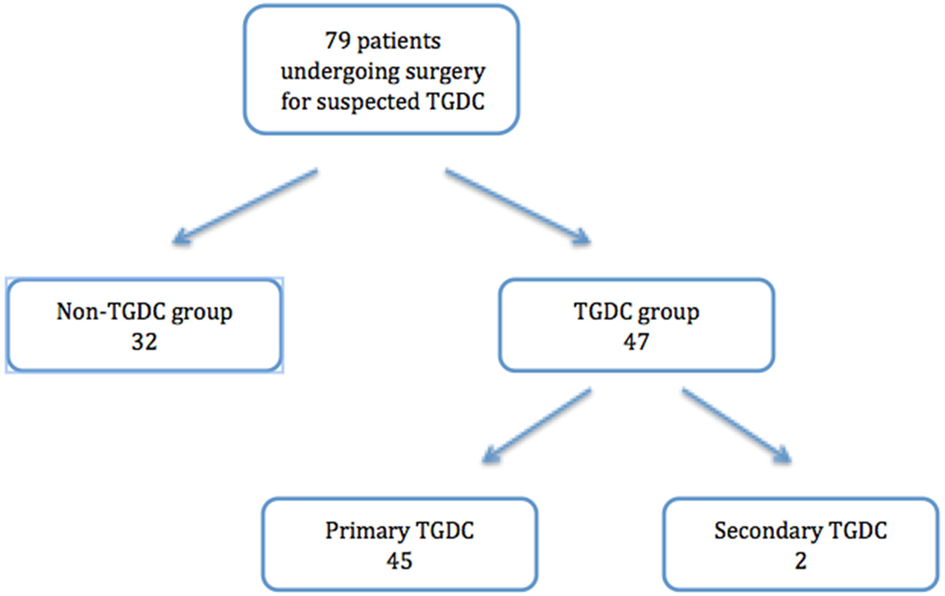
Our local audit department provided a list of patients who had undergone surgery for a suspected thyroglossal duct cyst between July 2014 and November 2018. Patients who underwent surgery before July 2014 were excluded because of difficulty in accessing case notes. This returned 79 patients, whose electronic notes were then reviewed for histological confirmation of thyroglossal duct cyst. This revealed 47 cases of histologically confirmed thyroglossal duct cyst and 32 cases in which the histology was either inconclusive or inconsistent with a diagnosis of thyroglossal duct cyst.
This created two study groups – a thyroglossal duct cyst group and a non-thyroglossal duct cyst group. In the thyroglossal duct cyst group, two were recurrent thyroglossal duct cysts and were excluded from the study. The total final number was 45 in the thyroglossal duct cyst group and 32 in the non-thyroglossal duct cyst group (Figure 1). Although two groups were created, the study's main focus was the outcomes in those confirmed to have thyroglossal duct cyst. However, important results identified from the non-thyroglossal duct cyst group have also been presented.
Formation of thyroglossal duct cyst and non-thyroglossal duct cyst groups (digits indicate numbers of cases). TGDC = thyroglossal duct cyst.

Data were extracted from electronic case notes, including demographics, symptoms, pre-operative investigation results, surgery performed, post-operative complications, post-operative antibiotic administration, histology, recurrence and final outcome. The sensitivity, specificity, positive predictive value and negative predictive value of radiological evaluation were calculated.
Procedures performed in our series included the classic Sistrunk procedure, the modified Sistrunk procedure with central neck dissection, and cystectomy. Definitions of these procedures documented in the literature are inconsistent. In our series, we defined: (1) classic Sistrunk procedure as resection of the cyst and the body of the hyoid (with or without a core of suprahyoid soft tissue), and a wedge of tongue base musculature, the amount of which can vary up to the foramen caecum without breaching the oropharyngeal mucosa; (2) modified Sistrunk procedure with central neck dissection as resection of the same structures as in classic Sistrunk procedure, but including a cuff of strap musculature, and the resulting en bloc resection of the cyst, straps, hyoid and tongue base wedge; and (3) cystectomy as cyst excision alone.
Results
Demographics
The mean patient age was six years. There were 28 males and 17 females, with a male:female ratio of 1.6:1. The mean follow-up period was 6.6 months, with a range of 2 weeks to 58 months.
Symptomatology
All cases presented with a midline neck swelling. Nine out of 44 (20.5 per cent) presented with pain or tenderness, 7 out of 44 (15.9 per cent) presented with sinus or discharge, and 21 out of 43 (48.8 per cent) had a preceding history of infection. None of our patients had dysphagia or airway symptoms. Data for 1 out of 45 patients (2.2 per cent) were unavailable. The mean duration of symptoms before presentation was 8.1 months. Movement on swallowing was observed in 9 out of 14 patients (64.3 per cent) (data unavailable in 31 out of 45 cases) and on tongue protrusion in 14 out of 19 patients (73.7 per cent) (data unavailable in 26 out of 45 cases).
Diagnostic investigations
Pre-operative investigation results were unavailable in 2 out of 45 cases (4.4 per cent). Pre-operative ultrasonography was performed in 42 out of 43 cases (97.7 per cent), thyroid function tests in 6 out of 43 (14.0 per cent), magnetic resonance imaging in 4 out of 43 (9.3 per cent), nuclear medicine imaging in 1 out of 43 (2.3 per cent) and fine needle aspiration in 0 out of 43 (0 per cent).
Radiological evaluation
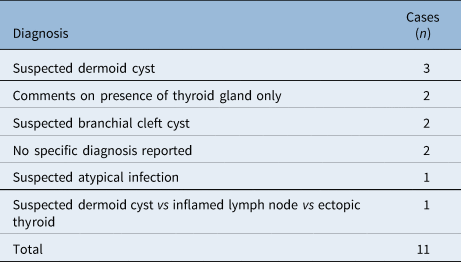
In the thyroglossal duct cyst group, radiological examination confirmed thyroglossal duct cyst in 32 out of 43 scans (74.4 per cent). The findings of the remaining 11 out of 43 cases (25.6 per cent) are shown in Table 1.
Alternative radiological diagnoses in thyroglossal duct cyst group

The non-thyroglossal duct cyst group comprised 32 cases. Within this group, radiology results were unavailable for 1 out of 32 cases, and these were excluded. Radiology suggested thyroglossal duct cyst as the most likely diagnosis in 17 out of 31 cases (54.8 per cent) and other diagnoses as more likely in 14 out of 31 cases (45.2 per cent).
Therefore, the sensitivity and specificity values for the radiological evaluation of thyroglossal duct cyst were 74.4 per cent and 45.2 per cent, respectively. The positive predictive value and negative predictive value were 65.3 per cent and 56.0 per cent, respectively (Table 2).
Sensitivity, specificity, positive and negative predictive values of radiological evaluation of thyroglossal duct cyst

*n = 43; †n = 31. TGDC = thyroglossal duct cyst; PPV = positive predictive value; NPV = negative predictive value
Procedures and intra-operative findings
Thyroglossal duct cyst surgery was performed by ENT surgeons in 35 out of 45 cases (77.8 per cent), by paediatric surgeons in 9 out of 45 (20.0 per cent) and by plastic surgeons in 1 out of 45 (2.2 per cent). Classic Sistrunk procedure was performed in 27 out of 45 cases (60.0 per cent), modified Sistrunk procedure with central neck dissection in 16 out of 45 (35.6 per cent) and cystectomy in 2 out of 45 (4.4 per cent). Cysts were located in the midline in 22 out of 45 cases (48.9 per cent), right paramedian in 15 out of 45 (33.3 per cent) and left paramedian position in 8 out of 45 (17.8 per cent). Cysts were suprahyoid in 20 out of 45 cases (44.4 per cent) and infrahyoid in 25 out of 45 cases (55.6 per cent). The hyoid bone and wedge of tongue base musculature were excised in 42 out of 44 cases (95.5 per cent) (data unavailable in 1 out of 45) and 26 out of 42 cases (61.9 per cent) (data unavailable in 3 out of 45), respectively. The cyst was ruptured at surgery in 6 out of 42 cases (13.0 per cent) (data unavailable in 3 out of 45).
Post-operative complications
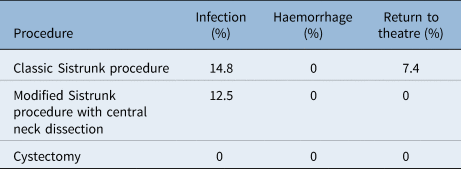
Post-operative complications included: infection, in 6 out of 45 patients (13.3 per cent), and a return to the operating theatre, in 2 out of 45 (4.4 per cent). The indication for a return to the operating theatre in both cases was post-operative infection. There were no cases of post-operative haemorrhage. Table 3 demonstrates the rates of specific post-operative complications according to type of procedure performed.
Rates of post-operative complications according to procedure performed

Post-operative antibiotic prescription
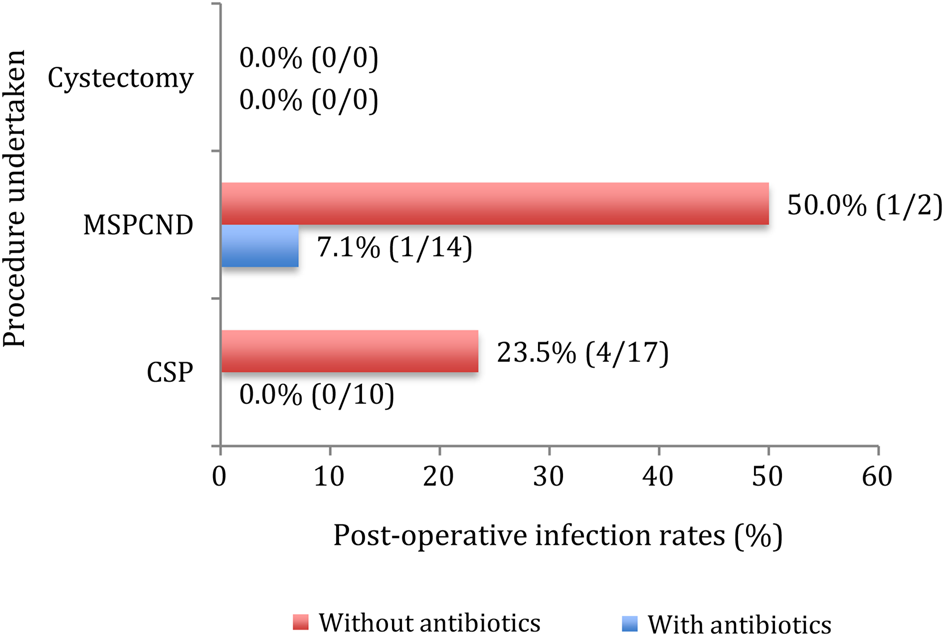
Data were unavailable for 2 out of 45 cases (4.4 per cent). Post-operative antibiotics were prescribed in 24 out of 43 cases (55.8 per cent). Of those patients prescribed antibiotics, 1 out of 24 (4.2 per cent) developed post-operative infection, compared with 5 out of 19 (26.3 per cent) of those who were not. Of the 2 out of 45 patients (4.4 per cent) who returned to the operating theatre because of infection, neither received post-operative antibiotics. Figure 2 demonstrates the rates of post-operative infection between different procedures for those who did and did not receive antibiotics. Those who received post-operative antimicrobial therapy received between 5 and 7 days of oral co-amoxiclav.
Rates of post-operative infection according to procedure undertaken (with and without prophylactic antibiotics) (digits in parentheses indicate numbers of cases). CSP = classic Sistrunk procedure; MSPCND = modified Sistrunk procedure with central neck dissection.

Disease recurrence
Recurrence occurred in 7 out of 45 cases (15.6 per cent). Of these, six recurrence patients (85.7 per cent) had undergone a classic Sistrunk procedure and one (14.3 per cent) had undergone cystectomy. Of the classic Sistrunk procedure cases that recurred, the hyoid was excised in six out of six cases (100 per cent), whilst a wedge of tongue base musculature was excised in three out of six cases (50 per cent). The only other patient who underwent cystectomy in the thyroglossal duct cyst group did not have recurrence. In all 16 patients who underwent modified Sistrunk procedure with central neck dissection, none experienced recurrence. A revision operation was required in six out of seven cases (85.7 per cent). A second recurrence occurred in two out of six patients (33.3 per cent), one of which was the cystectomy patient who, for the second time, underwent a procedure sparing the hyoid and tongue base musculature and ultimately underwent a modified Sistrunk procedure with central neck dissection as a third procedure. They are still under review.
Outcome
Of the total number of patients, 37 (82.2 per cent) were discharged, 5 out of 45 (11.1 per cent) are still under review and 3 out of 45 (6.7 per cent) were lost to follow up.
Non-thyroglossal duct cyst group
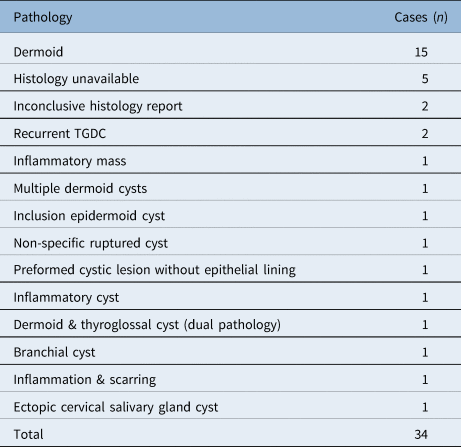
In the non-thyroglossal duct cyst group, 5 out of 32 histology reports were unavailable. Of the reports available, 25 out of 27 radiology reports were inconsistent with the final histology. Table 4 shows the radiological diagnoses in this group.
Histopathology of non-thyroglossal duct cyst group

TGDC = thyroglossal duct cyst
In this group, 15 out of 32 patients (46.9 per cent) had a classic Sistrunk procedure. Of these, data were unavailable for 2 out of 32 (6.3 per cent). Therefore, excluding these, 15 out of 30 patients (50.0 per cent) underwent a classic Sistrunk procedure. Radiology reports were available for 9 out of 15 cases (60.0 per cent), and, of these, 5 out of 9 reports (55.6 per cent) suggested thyroglossal duct cyst as the most likely diagnosis.
Eight out of 32 patients (25.0 per cent) in this group had a modified Sistrunk procedure with central neck dissection. Data were unavailable for 2 out of 32 patients (6.3 per cent). Therefore, excluding these, 8 out of 30 patients (26.7 per cent) had a modified Sistrunk procedure with central neck dissection. Radiology reports were available for six out of eight cases (75.0 per cent), and, of these, four out of six reports (66.7 per cent) suggested thyroglossal duct cyst as the most likely diagnosis.
Discussion
Synopsis of key or new findings
There were no cases of recurrent thyroglossal duct cyst following modified Sistrunk procedure with central neck dissection. This procedure is associated with reduced rates of post-operative infection and return to the operating theatre compared with classic Sistrunk procedure. Radiological evaluation cannot accurately diagnose thyroglossal duct cysts. Post-operative infection was lower in those who received antibiotics compared with those who did not.
Study strengths
This study included patients who presented to a tertiary referral centre over a four- to five-year period, who underwent a procedure of interest to surgeons from different specialties. Because of the diversity of surgical practice in our hospital, we were able to compare outcomes between different surgeons, procedures and post-operative management methods.
Study limitations
This study was retrospective and therefore no causal analysis could be performed. Data in some instances were incomplete because of the unavailability of some patient health records. No statistical analysis was performed, so we are unable to comment on the statistical significance of the results.
The average length of follow up was 6.6 months, which may limit our knowledge of recurrence or other complications in our population. Similarly, data were collected up until the date of the most recent clinic appointment. More recent cases will have a reduced follow-up period compared with older cases, which may introduce a lead-time bias.
Our data included different specialty surgeons performing a number of different procedures. Experience of the operating surgeon and a lack of standardisation in the procedure performed may introduce bias. Despite defining our procedures in this paper, it was clear from case note review that there was variation from surgeon to surgeon in how classic Sistrunk procedure and modified Sistrunk procedure with central neck dissection were performed. This was corroborated by a review of the literature, which revealed varying descriptions of central neck dissection. It is therefore inappropriate to draw firm conclusions from this study by comparing our results to those in the literature. However, we have commented on this, as studies on this subject are limited.
Whilst our study includes one of the largest published series of modified Sistrunk procedure with central neck dissection for primary paediatric thyroglossal duct cysts, it still has a limited sample size and will require further prospective study with a larger patient cohort.
Comparisons with other studies
Clinical outcomes following surgery for paediatric thyroglossal duct cysts are well documented.Reference Hussain, Henney and Tzifa16,Reference Kepertis, Anastasiadis, Lambropoulos, Mouravas and Spyridakis17 This literature review will therefore focus on studies relating to outcomes following central neck dissection.
Ahmed et al.Reference Ahmed, Leong, Jonas, Grainger and Hartley18 reported no recurrences in 23 primary paediatric thyroglossal duct cyst patients who underwent a modified Sistrunk procedure with central neck dissection. They performed the procedure in a further 15 recurrent paediatric cases and reported only one recurrence in this subgroup.
Two studies have reported data on central neck dissection for primary simple (non-infected) thyroglossal duct cysts. In 1986, Howard and LundReference Howard and Lund14 reported no increase in morbidity following central neck dissection for 14 thyroglossal duct cysts. No data regarding demographics or recurrence were given. More recently, Ubayasiri et al.Reference Ubayasiri, Brocklehurst, Judd and Beasley19 demonstrated no recurrences following central neck dissection in 12 patients. Demographic data were not provided.
A further two studies, by Kim et al.Reference Kim, Pawel and Isaacson13 and Isaacson,Reference Isaacson20 reported no recurrences following central neck dissection for children with primary complex (infected) or recurrent thyroglossal duct cysts.
Five studies have published data concerning central neck dissection for recurrent thyroglossal duct cysts only. Pucher et al.Reference Pucher, Jonczyk-Potoczna, Kaluzna-Mlynarczyk, Kurzawa and Szydlowski21 investigated 73 patients who had undergone either a central neck dissection or a modified Sistrunk procedure. They demonstrated a recurrence in 1 out of 45 patients and post-operative haematoma in 2 out of 45 patients who had undergone a modified Sistrunk procedure with no post-operative complications following central neck dissection. Whilst Pucher et al. state that central neck dissection is a safe procedure, they recommended its use for revision cases only because of the risk of injury to the carotid artery, vagus nerve and larynx. These complications were not observed in our study. Similar to Pucher et al., there were no recurrences reported by: O'Neil et al.Reference O'Neil, Gunaratne, Cheng and Riffat22 in 7 adults, Yao et al.Reference Yao, Chen, Liang, Zhang, Luo and Zhang23 in 28 children, Pastore and BartoliReference Pastore and Bartoli24 in 7 children, or Mickel and CalcaterraReference Mickel and Calcaterra25 in 20 patients.
In comparison, two authors had less success with central neck dissection in recurrent paediatric thyroglossal duct cyst cases. Perkins et al.Reference Perkins, Inglis, Sie and Manning26 reported recurrences in 33.3 per cent and Ibrahim et al.Reference Ibrahim, Alnoury, Varma and Daniel15 reported recurrences in 20 per cent of children. However, interestingly, they both found a 0 per cent recurrence rate following a suture-guided transhyoid pharyngotomy procedure.
The vast majority of the literature corroborates our recurrence rate following central neck dissection. However, most studies report on complex primary or secondary thyroglossal duct cysts, with only a few reporting outcomes for simple primary disease. Few studies evaluated other post-operative complications such as haemorrhage or infection. Only six studies overall investigated children specifically. All studies included a limited sample size.
Clinical applicability of study
This paper describes the second largest published series investigating the effectiveness of the modified Sistrunk procedure with central neck dissection for primary paediatric thyroglossal duct cysts. Data regarding this area of research are limited, and it is our hope that this study will encourage further work in this area.
The modified Sistrunk procedure with central neck dissection was associated with a low complication rate and did not result in any disease recurrence compared with classic Sistrunk procedure. This should be taken into consideration when managing thyroglossal duct cysts, as this approach may help to prevent disease recurrence without compromising post-operative morbidity.
Radiological investigations are requested to confirm the presence of a normal thyroid gland when a clinical diagnosis of thyroglossal duct cyst has been reached. However, in our series, these investigations suggested alternative diagnoses in many cases, which may have influenced surgical decision-making. This encouraged us to evaluate the accuracy of diagnostic radiology in the pre-operative investigation for thyroglossal duct cyst. We found that radiological evaluation for thyroglossal duct cysts had a sensitivity of 74.4 per cent, specificity of 45.2 per cent, positive predictive value of 65.3 per cent and negative predictive value of 56.0 per cent. In the non-thyroglossal duct cyst group, 23 out of 32 patients (71.9 per cent) had either a classic Sistrunk procedure or a modified Sistrunk procedure with central neck dissection. In these cases, the radiology results were positive for a thyroglossal duct cyst in 17 out of 31 cases (54.8 per cent), which may explain why so many in this group had a Sistrunk-related procedure. In the remaining 14 out of 31 patients who had imaging suggestive of an alternative diagnosis (45.2 per cent), explanations for undergoing Sistrunk-related procedures may include a strong clinical suspicion overriding imaging results or intentional aggressive surgery to prevent recurrent disease in the presence of diagnostic uncertainty.
These findings suggest that imaging for paediatric thyroglossal duct cysts cannot be used in isolation with confidence when diagnosing thyroglossal duct cysts pre-operatively. Therefore, a full clinical evaluation should be used in conjunction with imaging during surgical decision-making. Further studies are required to improve the accuracy of pre-operative diagnosis of thyroglossal duct cysts.
Post-operative infection was lower in those who received antibiotics compared with those who did not. The two patients requiring a return to the operating theatre for an infective complication did not receive antibiotics. These findings may suggest benefit for routine antibiotic administration following thyroglossal duct cyst surgery. However, the potential benefit must be weighed against the deemed cost-effectiveness and risk of antimicrobial resistance.
Further study
Studies to improve the accuracy of pre-operative diagnosis of thyroglossal duct cysts are required. In addition, multicentre randomised controlled studies to assess the efficacy and safety of modified Sistrunk procedure with central neck dissection in primary paediatric thyroglossal duct cysts, and the role of post-operative prophylactic antibiotics, would be helpful.
• This study describes the second largest series of primary thyroglossal duct cyst paediatric patients undergoing modified Sistrunk procedure with central neck dissection
• Modified Sistrunk procedure with central neck dissection may be more effective than classic Sistrunk procedure for preventing recurrent thyroglossal duct cyst
• Modified Sistrunk procedure with central neck dissection had a low complication rate
• Prophylactic antibiotics for thyroglossal duct cyst surgery may reduce post-operative infection rates
• Imaging is important in determining normal thyroid glands pre-operatively, but radiological diagnosis of thyroglossal duct cyst was unreliable in this study
• Clinicians should consider full clinical assessment findings, along with imaging results, to minimise misdiagnosis, incorrect procedures and recurrences
Conclusion
Modified Sistrunk procedure with central neck dissection for primary thyroglossal duct cyst was not associated with any increase in morbidity compared with the classic Sistrunk procedure, and it appears to have a lower risk of recurrence. Therefore, we suggest that this is the most appropriate surgical procedure for paediatric primary thyroglossal duct cysts. Peri-operative antibiotics appear to decrease the risk of post-operative infection. Radiological evaluation is not accurate in the pre-operative diagnosis of thyroglossal duct cyst.
Acknowledgements
We would like to acknowledge the general and plastic surgery departments at Alder Hey for the inclusion of their patients in our study population.
Competing interests
None declared