




No CrossRef data available.
Article contents
No taming the vernacular! Insights from the relatives in northern Britain
Published online by Cambridge University Press: 16 February 2005
Abstract
In this article we conduct a quantitative analysis of the markers used to introduce relative clauses in three vernacular varieties of English in Britain. In each variety there is a surprisingly low frequency of WH words in subject relatives and negligible use in nonsubject relatives, suggesting that the WH forms have not yet penetrated the respective vernaculars. Variable rule analyses of the multiple factors conditioning that and zero relative markers reveal that the varieties pattern quite similarly with respect to significance of factors. For the zero variant, there is a favoring effect of (1) sentence structure and (2) indefinite antecedents; however there are dialect specific differences in some nuances of the constraint ranking of factors. On the other hand, the use of zero is also highly correlated with contextual constraints relating to surface level processing, that is, clause length, as well as clause complexity, across all communities. Taken together, these findings provide evidence for both dialect specific and universal constraints on relative marker use, which can be used to further elucidate the task of conducting broad cross-community comparisons. The results also provide support for an important distinction in linguistic change – those changes that are imposed from the outside (like the WH relative markers) and those that arise from within (like that and zero relative markers) proceed very differently in mainstream as compared to peripheral varieties.The first author acknowledges with gratitude the generous support of the Economic and Social Research Council of the United Kingdom (the ESRC) for research grant #R000239097, Back to the Roots: The Legacy of British Dialects. We thank our colleagues Karen Corrigan and Anthony Warner for stimulating and insightful discussion of this article, which greatly improved the final version it has taken. We also are indebted to Jonathan Hope, Terttu Nevalainen, Ronald Macaulay, Helena Raumolin-Brunberg, Suzanne Romaine, and James Walker for comments, as well as two anonymous reviewers. We dedicate this article to the “northerners” in Cumnock, Culleybackey, Maryport, and Portavogie who took the time to share their stories with us, providing this legacy of British dialects for the future.
Information
- Type
- Research Article
- Information
- Copyright
- © 2005 Cambridge University Press
Relative clauses exhibit a variety of different introductory markers in English.1
The term used to name these introductory markers varies in the literature. The term relative marker (Romaine, 1982b) will be used here in keeping with Denison's (1998:276) observation that it is a “useful cover term.”

We refer to these corpora by the names of the communities where the data were collected. Codes in parentheses refer to the community. CMK stands for Cumnock, MPT for Maryport, CLB for Cullybackey, and PVG for Portavogie. After the back slash, the three digit numeric codes refer to the speaker number and the single digit characters refer to the individual speaker.
A tremendous amount of research has been done in this area of the grammar, both in historical written data (e.g., Ball, 1994, 1996; Montgomery, 1989; Nevalainen & Raumolin-Brunberg, 2002) and present-day standard varieties (e.g., Quirk, 1957; Tottie, 1995, 1997). Taken together, however, these reveal a striking discrepancy with regard to the use of the WH forms. According to Romaine (1982a:212) “the infiltration of WH into the relative system can be seen as completed in the modern written language … but it has not really affected the spoken language.” In a study of the British National Corpus (BNC), Tottie (1997:470–471) reported that “the system of relative markers in the BNC differs from that of Quirk (1957) and the LLC3
The “LLC” refers to the London Lund Corpus of English Conversations recorded in the 1960s and 1970s. These are typically “adult educated speakers” (see http://khnt.hit.uib.no/icame/manuals/LONDLUND/INDEX.HTM).
In this article we attempt to contribute to an understanding of these issues, as well as to provide a thorough analysis of the English relative marker system, by conducting a large-scale quantitative analysis of the markers used to introduce relative clauses in three vernacular varieties of English in Britain. In the first instance, we seek to answer two main questions arising from earlier research:
- Have the WH forms “infiltrated” these varieties, and to what extent?
- Is there is any identifiable “vernacular norm” in the use of relative markers in these dialects?
Further, because of the location and circumstances of the sociocultural and economic history of these particular communities, situated in peripheral locales in Lowland Scotland, Northern Ireland, and Northwest England, we may also explore other issues of language variation and change. Perhaps the most foundational contribution is to provide further evidence for the enterprise of cross-variety comparison (e.g. Montgomery, 2001).
If there is a “norm” across these varieties, is it shared by others?
First, we will offer preliminary descriptions of specific community dialects that have never to our knowledge been studied from a linguistic perspective.4
All the regions in which these communities are located were surveyed in earlier dialect studies.
First, however, the rich prescriptive tradition in this area of grammar and the extensive research on the development of the English relative marker system provide an important backdrop for this study.
THE DIACHRONIC PICTURE
The diachronic trajectory of the English relativization system has been the focus of extensive examination. This comprehensive body of literature covers a wide-range of methodologies and data sets. A concise history of the English relative markers can be found in Nevalainen and Raumolin-Brunberg (2002). Here, we briefly introduce the backbone of this development.
In the first part of the Middle English (ME) period, the two main relative markers in English were that and zero (Dekeyser, 1984, 1986; Denison, 1998:276–283; Traugott, 1972:153). That was originally used in both restrictive and nonrestrictive relative clauses (Dekeyser, 1984:61; Romaine, 1982a:61; Strang, 1970:142), but came to be used with restrictive relative clauses in late ME (Romaine, 1982a:69).
Zero has been a relative strategy since Old English and continued in Middle English (Mustanoja, 1960:205; see also, Poussa, 1985). By Early Modern English zero subject relatives, as in (2), are relatively infrequent, for example, 5% in Shakespeare (Hope, 1994:34–35).

However, by the Early Modern English period, zero relatives were more commonly used in nonsubject position (Bever & Langendoen, 1971:442; Visser, 1963–1973:538), as in (3).

The WH forms developed much later and are said to have developed from the interrogative WH pronouns (Jespersen, 1961:80; Romaine, 1982a:59). The first of the WH relatives were which, whom, and whose, which appeared in Early Middle English from the 12th century onwards (Dekeyser, 1984:61; Mustanoja, 1960:195; Traugott, 1972:154). The form which was used across all types of antecedents at the early stages of its entry to the relative system, that is, with both human, as in (4a–b) and nonhuman antecedents, as in (4c–d) (e.g., Mustanoja, 1960:195; Romaine, 1982a:61).

Translations of Chaucer examples were taken from http://www.concordance.com.
A number of regionally delimited relative markers occur as well, including what, as in (5a–b), which occurred predominantly in more southern areas (e.g., Poussa, 1985), at, which occurred in the north, as in (5c), as well as as, as in (5d) in Western Central dialects (Nevalainen & Raumolin-Brunberg, 2002:112).6
There is quite a lot of evidence for 20th-century dialectal use of these forms, particularly what, in more southerly regions of Britain in the Survey of English dialects (Orton & Halliday, 1963). Competition between that and what is attested in Norfolk, Suffolk, Essex, Kent, and Sussex. As we shall see however, our synchronic dialect data contained a mere smattering of these forms.

Who was the very last relative to develop (Nevalainen & Raumolin-Brunberg, 2002; Romaine, 1982a:223), entering the grammar as a marker in the early 15th century.7
The reason for the late development of this form is thought to result from its specialized context of use, that is, singling out personal antecedents in subject position (Ball, 1996:246–247; Nevalainen & Raumolin-Brunberg, 2002:110).

Figure 1 shows the trajectory of change in the use of WH relatives over time in Ball's (1996) extensive corpus of materials from the 16th to 20th century.8
These consist of treatises, essays and fiction, and 20th–century spoken data from Britain and North America.

WH in subject restrictive relatives according to type of antecedent across centuries (from Ball, 1996, Figures 3 and 4).
Ball (1996:247) summed up this developmental trajectory. These “two changes – the replacement of which by who and the assignment of that to nonpersonal antecedents – laid the foundation for the modern dominance of who for personal subject restrictive relatives.” However, did the same development happen in the vernacular? With the historical trajectory in mind, we now turn to the varieties under investigation in this study.
THE DATA
The four communities under study are situated in Lowland Scotland, Northwest England, and Northern Ireland, as shown on the map in Figure 2. The extensive fieldwork conducted in these communities forms part of the Back to the Roots project (Tagliamonte, 2001–2003). Aside from the intrinsic interest in studying these dialects for their own sake, for adding to the available materials on northern British dialects, and further for conducting cross-variety analyses among them, our goal was also to collect appropriate data for comparative research. Such materials, for example, provide a critical addition to the study of other related British dialects (e.g., Beal, 1993; Corrigan, 1997b; Kirk & Baoill, 2001; Macaulay, 1991; McCafferty, 2001; Milroy, 1981; Milroy & Milroy, 1993). Moreover, because these varieties have evolved in situ through (presumably) normal processes of transmission, they also provide an important perspective for comparative studies of transported varieties of English.

Map showing the location of the communities under investigation.
Our main criteria in the selection of informants for the present study were age (the oldest living generation in each community) and insularity. This was because comparable machine-readable corpora from elsewhere in the world tend to be biased toward the oldest generation and/or the most insular speakers (e.g., Poplack & Tagliamonte, 2001). Moreover, consistent with the tenets of standard historical linguistic inquiry, we sought communities that most closely approximated the characteristics of the relic area (Anttila, 1989:294; Hock, 1986:442): (1) peripheral geographic location and (2) isolated social and cultural circumstances. Further, all four locations have close-knit cultures typically associated with the traditional industries of mining, fishing, and farming, as well as the type of multiplex social networks that are well known to preserve local lingustic features (Milroy, 1980).
Maryport, in Northwest England, is an ex-trading port on the north Cumbrian coast 27 miles from Carlisle with a population of 11,500. It was settled around the mid-18th century with peoples from the surrounding areas. It developed along with the main industries of coal mining, fishing, and shipbuilding, but in recent years these traditional industries have dramatically declined. Unlike some areas of Cumbria, Maryport was not included in the tourist boom of the last century and still remains off the traditional tourist route.
Cumnock is a small ex-mining town in Ayrshire in Lowland Scotland with a population of 11,000. The nearest substantially sized town is Ayr, 16 miles to the west. The area has been settled for at least 800 years. In the 18th century there were substantial industrial developments, and a railway link established Cumnock as a growing mining community in the 19th century. The collapse of this industry in the 1980s has resulted in high unemployment and a break-up of the traditional fabric of the community.
The Northern Irish data come from two communities in different parts of Northern Ireland – Cullybackey in County Antrim and Portavogie in County Down. The village of Cullybackey, with a population of 2500, is situated 30 miles northwest of Belfast in County Antrim, Northern Ireland. The main industries are agriculture, retail, and the manufacturing service. The Environmental Improvement Plan for the area states that “despite its picturesque setting, Cullybackey has not developed its potential as a leisure/tourist destination, or stopping off point.” Portavogie is even smaller than Cullybackey, with a population of 1500, and is situated on the Irish Sea coast of the Ards Peninsula, 21 miles south of Newtonards. It is a fishing port, still wholly reliant on this trade for its livelihood.
The sociohistorical setting
There are strong sociocultural and historical links among the three dialect areas. First, the dialects of Lowland Scotland and Northwest England have a common origin in the Northumbrian dialect of Old English (Murray, 1873). This, coupled with proximity to Scotland, “is reflected in the linguistic characteristics of the area” (Beal, 1993:187–188), which shares many of its features with the Scots. Lowland Scotland is intimately connected with Northern Ireland. The Ulster Plantations of 1610 (Gregg, 1985:9; Leyburn, 1962:94) led to a dominance of Scottish migrants in certain areas of Northern Ireland. This formative founder population led to the development of a unique variety – Ulster Scots (Barry, 1981:59). This variety is notably different from other varieties in the Republic of Ireland, which, in contrast, developed out of contact with settlers from (southern) England. It should be noted that in Northern Ireland, as well, there are areas that were predominantly settled by English migrants (e.g., Gregg, 1985), thus there is no monolithic Northern Irish variety. However, the specific locales from which our data come (County Antrim and northeast County Down) were settled predominantly by Scots (Gregg, 1985; Harris, 1993).
Finally, the sheer ecological setting of the four communities, situated on the borders of the Irish Sea, Lowland Scotland, Northern Ireland, and Northwest England (see map in Fig. 2), has led to centuries of seaboard economic and social interdependence, producing what has been referred to as “a single cultural region” (Fischer, 1989:622). Thus, although the communities in our sample span three different countries – Scotland, Ireland, and England – their vernaculars may well share salient linguistic similarities.
As mentioned earlier, these materials may also provide a worthy backdrop for broader comparative studies of varieties of English world-wide, an enterprise that has garnered considerable attention in recent years (e.g., Bauer, 1994; Hickey, 2004; Trudgill et al., 2000). Indeed, any study of varieties of English elsewhere in the world must be attentive to what the source dialects in Britain may have been like during the early founder period of the colonial setting (Mufwene, 1996, 1997, 1999, 2000, 2001). In this context, the varieties under investigation figure among those that are particularly germane. The counties of Derry, Antrim, and Down in Northern Ireland; Ayr, Dumfries, and Wigtown in Scotland; and Cumberland and Westmorland in Northwest England are the regions of Britain from which the vast majority of British migrants to North America originated between 1717–1775 (Fischer, 1989:622; Leyburn, 1962:94).9
While more southerly regions of Britain figured in the input populations to North America (e.g., Kytö, 1993; Le Page & Tabouret-Keller, 1985; Wright, 2004); the vast majority of settlers who immigrated between 1717–1775 originated from the lowlands of Scotland, Northern Ireland, and the northern counties of England (Campbell, 1921:8; Fischer, 1989:619; Landsman, 1985:51).
Given the sociohistorical circumstances of the evolution of these communities from that period onward, and their ongoing separation from the mainstream, the dialects spoken by the inhabitants of these communities may retain some traditional features of an earlier stage in the history of the dialects. Indeed, preliminary inventories of the general linguistic characteristics of the dialects reveals a plethora of archaic features. For example, the for to complementizer, as in (7), the deictics yon and thon, as in (8), and a number of (relatively) conservative past tense forms, as in (9).10
The relative conservatism of forms is an interesting consideration in and of itself, for example, the form teached is historically innovative, attested to from the 14th century. Taught, however, is even older, going back to Old English. The forms taen and haen are forms of the verb take and have, respectively.

Both Lowland Scotland and Northwest England have a smattering of double modals, as in (10). The form yan for one is shared by the Northern Irish and Northwest England communities, as in (11). Note too that Portavogie in Northern Ireland retains velar fricatives such as nicht, in (11b). Northwest England is particularly replete with traditional forms, as demonstrated in (12).

Thus each variety retains features recorded in the history of English, which have since become obsolescent or moribund in mainstream varieties. This conservatism in the linguistic inventory of the varieties together with the ecology of their sociocultural settings, suggests that evidence from linguistic analysis may shed light on the origins of North American varieties, which developed out of population influxes from these areas.
Sample constitution
The result of our fieldwork is a corpus of 114 hours of audio-taped conversations ranging from approximately one to two hours in length from 110 speakers. This represents over one million words, as summarized in Table 1. The individual community members who make up our sample all come from the oldest generation (60+) and were born and raised in their respective communities. An important characteristic of these data is that most of the material was collected either by in-group community members or interviewers who shared salient cultural characteristics with the interviewees.11
In Cumnock, the second author carried out the interviews. In Portavogie, the third author carried out the interviews alongside a local helper.
Within these examples, the single-digit numeric codes (e.g., [1]) identify the interviewer(s), whereas multidigit numeric codes (e.g., [001]) are the speakers.

The “ROOTS” corpora (Tagliamonte, 2001–2003)

A comparative approach
The foundation of our methodological approach to these materials is modeled on the comparative method of historical linguistics (Baldi, 1990; Hoenigswald, 1960; Meillet, 1967) married with the methodological innovation of sociolinguistic analysis (Poplack & Tagliamonte, 2001:7–8). In the former, genetic relationships among languages are established by reconstructing earlier forms from evidence in descendant languages. However, success in this endeavor is dependent on preservation of such earlier forms in those languages. This possibility is, of course, hampered by any number of developments, including independent linguistic changes in one variety or the other, or differential external change – cultural, social, political, demographic, or any other. Nevertheless, where varieties preserve features as well as patterns, and there are a significant number of these, genetic affinity may be successfully established. As argued by Poplack and Tagliamonte (2001:95), “the basis for reconstruction, in historical linguistics, as in evolutionary biology, is shared retentions.”
Here, incorporating the variationist notion of constraint hierarchy into the comparative method, we invoke conditioning of factors constraining the linguistic variability to inform our analyses. Thus, if these four communities share a feature, as well as the details of its distribution and patterning, then this will provide evidence that they share the same grammar for the marking of relative clauses. If they do not, then this will impel us to seek other explanations. Of course, there is also the possibility of varying degrees of parallelism, as deduced by the lines of evidence available through variable rule analysis (Poplack & Tagliamonte, 2001:93–94; Tagliamonte, 2002a:733), and this too will provide further evidence for building an explanation for the results, as we shall see.
METHOD
Circumscribing the variable context
The English relative marker system presents a diverse set of problems that must be addressed in order to circumscribe the variable context appropriately, as well as to ensure both comparability with previous findings and replicability for future research. In other words, what is to be included in the analysis and what excluded? At the outset, for relative clauses in particular, it is extremely important to isolate the restrictive relative clauses. Nonrestrictive relative clauses differ on a number of counts from restrictive relative clauses, and thus cannot be considered in the same analysis. First, they hardly ever appear with that or zero (Dekeyser, 1986; Guy & Bayley, 1995:150; Lass, 1987:188; Poussa, 1993:190; Poutsma, 1904/1926:976; Strang, 1970:101; Visser, 1963–1973:539). Second, their semantic function differs: as “the information in non-restrictives is presented as supplementary, separate from that expressed in the rest of the sentence” (Huddleston & Pullum, 2002:1035; Quirk, Greenbaum, Leech, & Svartvik, 1985:1239; Rissanen, 1984:420; see also Romaine, 1982a:81). Moreover, nonrestrictives are “characteristically marked off prosodically” (Huddleston & Pullum, 2002:1035). If these were to be included in a sample of data focusing on variability in relative clause markers, the effect would be to raise the percentage of WH-forms and lower the percentage of the others, for example, that and zero. Such proportions would be inappropriate to compare with other data where only restrictive relatives were studied. Thus, this study includes restrictive relative clauses only.
Restrictive relative clauses were distinguished from nonrestrictives in a number of ways – both intonational and semantic. First, our extraction procedure involved listening through the audio recordings. In this way, intonation and prosodic cues were available to aid in disambiguating restrictive versus nonrestrictive relative clauses.13
Fox and Thompson (1990) argued that audio cues do not fully disambiguate the distinction between restrictive and nonrestrictive relative clauses.

Adverbial relatives, as in (17), were not included. These allow relative markers such as where and when, and are thus not part of the same variable context as other relatives (e.g., Tottie & Harvie, 2000:206).

We also excluded tokens of WHIZ deletion, in which the relative marker and the verb be are deleted, as in (18a) (see also, Tottie & Harvie, 2000:206), as well as unfinished relative clauses, as in (18b), and clauses with resumptive pronouns, as in (18c).

Following these procedures, 1922 restrictive relative clauses were extracted from the data and coded for a series of factors known to influence the choice of relative marker in English. In the following analyses, Portavogie and Cullybackey are considered together, as separate analyses showed that their patterns of use for relative markers were the same.
Distributional analysis
Table 2 shows the overall distribution of relative markers in restrictive relative clauses across the entire data set. The vast majority of restrictive relative clauses – a full 64% – appear with the marker that. The next most common marker is zero at 28%. Note that WH forms in general are rare – all together only 8% (N = 160) of the data. The proportion of which, what, whose, and whom is infinitesimal (less than 1%). Even the most frequent WH form, who, represents only 7% of the data. These overall results provide a first indication that the WH forms have not made tremendous inroads in the (spoken) relative marker system in these data.
Overall distribution of relative markers

However, Table 2 shows the relative clauses with all the communities combined. Perhaps the grouped data is masking individual differences in the dialect regions. Therefore, we next separate the communities by region, as in Table 3.
Distribution of relative markers by community

Table 3 confirms that the predominance of that is consistent across all communities, as are the frequency of zero and the infrequency of who. The other WH forms are barely apparent, including the dialect form, what.14
It is perhaps not surprising that there are few examples of what in these materials. According to the Survey of English Dialects [SED] (Orton & Halliday, 1963), there is a concentration in the East Midlands, but very little in the North. Of the most northerly locales, one is only 40 miles from the community of Maryport, namely, Coniston, Lancashire. The SED reports that what appeared when relative who or whose was being elicited. In these data, three of the what tokens are animate and four are inanimate.
Perhaps the most problematic of all hidden variables in the study of English relative markers is the interaction of the grammatical role of the gap or trace in the restrictive relative clause (subject, object, etc.), and the type of antecedent (human, nonhuman, etc.). These two factors have strongly constrained the choice of relative marker, at least since early-modern English. Indeed, for every combination of antecedent type and grammatical role, there are very different frequencies of that, zero, and WH. Ball's (1996:233) large-scale quantitative historical study provided the best discussion and demonstration of this fact and showed that the interaction of antecedent type and grammatical role are so different as to represent “different populations.” Therefore, the next step in analysis of this variable is to separate subject relatives, as in (19), from nonsubject relatives, as in (20).

Tables 4 and 5 show the distribution of relative markers for clauses where the grammatical role of the gap is subject and nonsubject, respectively. In these tables we show only the main forms: that, Ø, and who as the other forms represent less than 10 tokens per community.15
The total Ns in Tables 4 and 5 represent all of the restrictive relative clauses, regardless of marker. These totals include the rare which, what, whom, and whose forms, which are not listed in the table for simplicity of illustration.
Distribution of relative markers in SUBJECT function by community

Distribution of relative markers in NONSUBJECT function by community

Table 4 shows that there are 1279 subject relatives. A full 70% are that. The next most common variant is zero at 19% and who represents only 10%. Table 5 shows that there are 643 nonsubject relatives.16
The distribution of relative markers in nonsubject function are overwhelmingly of two types: direct object (73%, N = 484) and object of a preposition (20%, N = 133). These were not differentiated sufficiently to warrant separate treatment. The other types were too infrequent to establish patterns: object of phrasal verb (N = 18), indirect object (N = 3), object of preposition (pied-piping, N = 6), and object of demonstrative phrase (N = 17).
Who occurs only once, and in a context that involves a reformulation, and may thus be treated as anomalous: There were an old woman going up in there, that's someone who we were at school was- there were one sat with me you-know. (CLB/q)
Perhaps the most remarkable finding arising from the combined results in Tables 4 and 5 is the absence of WH forms. Even in subject function, where who is supposed to be the foremost marker, it is quite rare. In Lowland Scots and Northwest England it appears at a frequency of only 10% and 14%, respectively, and in Northern Ireland at a rate of only 5%.
However, it must be kept in mind that this view of the data obscures the critical humanness factor. Could it be that the lack of WH we observe here for the subject function relatives (Table 3) is simply the result of a lack of animate subjects in the data?
The humanness factor
Much of the writing on the relative system in Early Modern and Modern English appears to take for granted that who is used for animate/human subjects in English. According to contemporary grammar books, who occurs with human (or personal) antecedents, and which occurs with nonhuman (or nonpersonal) antecedents (Quirk, 1957:97–98). Typical statements read as follows:

This so-called modern distinction for who as the most frequent form for human antecedents, as well as which with nonhuman antecedents, and zero mainly in nonsubject relatives (e.g., Quirk, 1957) would certainly be expected to operate in these 21st century data. Yet clearly it does not. Which is not used for “things” in any general sense because it barely occurs at all. However, what about who? The next step is to separate out the antecedents in the subject relative data according to semantic qualities of humanness and animacy. We coded separately for five different types: humans, as in (21), collective nouns that represented humans, as in (22), the frequent lexical item people, as in (23), inanimate “things” as in (24), and finally nonhuman animates (e.g., animals), a category that crosscuts the −human/+animate dimensions, as in (25), to determine what semantic distinction is being encoded.

If the “modern function” for who is in operation, we would thus expect to find a correlation with human subjects. Further, if humanness is the underlying semantic quality of relevance, humans should pattern independently of animals. If, on the other hand, animacy is the quality of relevance, then humans and animals should pattern similarly.
Table 6 shows the distribution of subject relative markers by the humanness of the antecedent separated by community. First, Table 6 shows that there is no lack of human subject relatives in our data. Indeed, these represent 65% of all the antecedents, a finding that is consistent with most studies of relative clauses. As we have seen, the frequency of who in these data is very low in general (Tables 2 and 3). Table 6 reveals that when who is used at all, it marks human subjects the vast majority of the time. Thus, for example 42/75 (56%) of the who tokens in Lowland Scotland are human; 45/65 (69%) in Northwest England, and 13/17 (77%) in Northern Ireland. However, when all the human subjects in the data are taken into account, it is readily apparent that there is no tendency for who to mark human subjects. Indeed, in every locality who is actually the least likely relative marker to mark the human antecedents – 13% in Lowland Scotland, 17% in Northwest England, and only 6% in Northern Ireland.
Distribution of relative markers (SUBJECT FUNCTION ONLY) by the animacy of the antecedent by community

Notice, however, that in Northwest England and Lowland Scotland who is used much more frequently with the specific lexical item people, as in (23). In these contexts, who is used at well over twice the frequency (33%, 40%) than it is used with human subjects (13%, 17%). Although the number of examples with people is small (N = 18 CMK; N = 42 MPT), the fact that who is so frequent for them suggests that it may be somewhat formulaic here – perhaps a lexicalized insertion in a highly restricted collocational context.
In fact, given the small number of who tokens overall (N = 130), it may be the case that there are other anomalies in its use that can provide further insight into its function in these communities. A closer look at every individual use of who in each of the communities proves revealing from a more sociolinguistic perspective.
In Lowland Scotland, who is used by less than half (44%) of the speakers (18/41). More tellingly, out a total of 58 tokens of who in this dialect, nearly 60% come from two speakers only. The remaining who forms are used once or twice each by the other speakers who use it. In Northwest England, who is used by only about half the speakers as well (20/43, 50%). Here, out of a total of 77 tokens, four speakers are prevalent users, but the rest use it less than five times each. Finally, in Northern Ireland, only 41% of the speakers use who (12/29). Here, out of a total of 25 tokens, one speaker produces a third of the tokens. In other words, in each community, use of who is not representative of community norms, but is circumscribed, either to specific lexical items like people, or to specific individuals. Interestingly, these are the individuals with a bit more education, and who are implicated in local affairs.18
Similar individual behavior was found in a study of Tyneside English (Beal & Corrigan, 2002) in which certain speakers' use of who was entirely atypical of the majority of speakers. Here the individuals' behavior derived from middle-class associations (personal communication, Karen Corrigan).
In sum, despite the fact that WH forms have been attested, even championed, as being the marker for subject relatives for the last two centuries, their use is limited in frequency, surprisingly infrequent in its most favored function, lexically marked, and highly circumscribed sociolinguistically in these data. Such qualitative and quantitative patterns of use bear the characteristics of a prestige form imposed from the outside, rather than a productive part of the community's vernacular grammar.
Summary of distributional analysis
Given these overall distributions, we are now in a position to return to the first question posed at the beginning of this article. How far has the WH relative marker penetrated spoken data, in particular, vernacular dialects? First, the sheer lack of WH forms in these data confirms Romaine's suggestion that “the infiltration of WH into the relative system can be seen as completed in the modern written language … but it has not really affected the spoken language” (Romaine, 1982a:212). Indeed, the only WH form that occurs with any frequency at all is who.
But the question is: Why would this be true? Is it simply that these materials represent a particular dialect region whose inventory of relative markers is somehow different from other vernaculars (Northern Scots, Irish English, and English; see e.g., Montgomery, 1989:114)? Alternatively, can the results be more usefully explained when put into context with the history and development of the English relative markers more generally? We now consider the first possibility – that the propensity for that in these data is related to geographical distribution.
A dialect explanation?
Of course, we cannot avoid the possibility that the distribution of relative markers in these materials is unique to their geographic locale. After all, each community is positioned in a particularly well-defined region in northern Britain – not simply geographically, but historically, socially, and culturally, as well. And indeed, there are considerable reports from the literature to suggest the use of WH words is regionally delimited in Britain. For example, the historical record attests to the fact that northern dialects have favored that as a relative since at least as far back as Middle English (Jones, 1972:140; Nevalainen & Raumolin-Brunberg, 2002:112). Further, Jones (1972:140) claimed that northern British dialects have continued to favor the pæt/that relative over time in comparison to their southern counterparts. Romaine's large-scale analysis (1982a:222) confirmed this in observing that “certain non-standard varieties of English, like Scots, have lagged behind standard English in implementing the use of the WH system into written and spoken language.” These observations are supported by numerous reports of a propensity for that relative markers in Scots (Aitken, 1979:105; Macaulay, 1991; Murray, 1873:197; Wilson, 1915:91) and Irish (Garvin, 1977:110; Harris, 1984:131; Miller & Brown, 1982:16–17). The results reported here, which come from Scotland, Ireland, and Northwest England, may be interpreted as simply following along with the expected pattern for these climes – propensity for that relatives and lack of WH relatives.
However, one of the most consistent observations about spoken British English, more generally, as well as nonstandard dialects, in particular, is the same propensity for that and concomitant lack of WH words (Harris, 1967; Tagliamonte, 2002b; Tottie, 1997; Tottie & Harvie, 2000; Van den Eynden, 1993). In contrast, research that reports high rates of WH words is typically based on much more standard varieties of English (Guy & Bayley, 1995:153; Kikai et al., 1987; Quirk, 1957; Sanders, 2002; Tottie, 1995).
To set these overall frequencies within the context of historical change, sociocultural circumstance, and stylistic considerations, we now return to consider the trajectory of development of the WH forms in English and how and why they entered the system in the first place.
A change from outside?
The trajectory of change for the use of who indicates that this marker penetrated the grammar of English as a change from above. Mustanoja (1960:199–200) suggested that WH was adopted from the Romance acrolects of French and Latin. Romaine (1982a:212) agreed, as “the entrance of WH by way of the most complex styles of writing and syntactic positions does suggest a pattern of external prestige borrowing or ‘change from above’ in Labov's terms.” Moreover, there is a great deal of consensus that the WH forms came into the relativization system through formal registers (Dekeyser, 1984:76; Montgomery, 1989; Peters, 1996:125–126; Romaine, 1982b:234; Tottie & Rey, 1997:465). Dekeyser (1986:293) suggested that even once established, the WH forms remained high-register variants. Barber (1997:214), for example, found little use of who in Restoration comedy, leading him to conclude that “the growing dominance of who is typical of a formal literary style. In informal style, and probably in speech, that remained the dominant relative pronoun.” Thus, all indications are that the rise of the WH forms for relativization in British English was a “learned change” (Nevalainen & Raumolin-Brunberg, 2002:110).
The interpretation of WH relative markers as a change from above is supported by quantitative data from the historical record. Analysis of early English correspondence reveals sociolinguistic conditioning from the very beginning (Nevalainen & Raumolin-Brunberg, 2002:120). Use of who begins in highly formulaic contexts, such as closing formulae for letters or reference to deities (Nevalainen & Raumolin-Brunberg, 2002:115–116). Hope (1994:35) offered a sociolinguistic interpretation for the lower rates of who between Shakespeare and the later playwright Fletcher: “although ‘who’ is a rising form … Fletcher avoids it, probably because of it's formal connotations.” Even later, in 17th century American English, there is a marked difference in use between who and that in texts: the ratio between who and that is 12:33 in formal texts and 1:17 in the informal ones (Rissanen, 1984:429). Rissanen concluded that “who is more popular in [formal] texts than in the ones representing a more colloquial style” (Rissanen, 1984:429).
If the introduction of WH was a change from above, it is not surprising that diachronic studies also report “a clear lag between the more literary texts and spoken usage” (Ball, 1996:248). Thus, the question becomes, has this situation changed in the intervening centuries? Tottie's (1995, 1997) extensive research on contemporary varieties of English showed a heavy correlation with education level and situational context, and Macaulay's (1991:65) study of spoken Scots reported an extreme difference between middle-class and working-class speakers.
Table 7 attempts to synthesize the available data in the literature by comparing the reported use of who in subject relative clauses across a number of data sets, from which this information can be recouped from the presentation of data.Virtually all the data representing older, peripheral (conservative) varieties and speakers have the very same tendencies – a low frequency of WH. This is especially revealing given the southern geographic locations of Suffolk, Dorset, Devon, and Somerset. Thus, put in context with available dialect data, the relative marker patterns in Lowland Scotland, Northern Ireland, and Northwest England may not simply be the result of Scots or Irish or northern varieties in Britain having a propensity for that. The lack of WH may instead be a reflection of the more general dichotomy between such linguistics features, as rural versus urban; spoken versus written; standard versus non-standard language; and core versus periphery (Poplack & Tagliamonte, 2001).
Overall frequency of who in subject relatives across British studies

Thus, we suggest that the trajectory of linguistic change in the (written) historical record (e.g., Ball, 1996) made it appear that the WH forms were the favored forms in English and would eventually take over as the dominant relative markers. However, these results show nonstandard dialects – and these northern Scots, Irish, and English ones in particular – steadfastly resisting that trajectory. The WH forms have not yet penetrated their vernaculars; and may never do so.
Notwithstanding the lack of WH forms however, there is tremendous variability between zero and that (see Table 5). The next step then is to explain the alternation between that and zero. What is the status of these forms in the grammar of these northern British dialects?
Pronouns or complementizers?
It is important to keep in mind that the variants of WH, that and zero, are thought to have different categorical status in the syntax of English (e.g., Denison, 1998:276). WH relative markers are commonly agreed to be pronouns (Cofer, 1975:14–15; Huddleston, 1984, 1988:156; Quirk, 1957:98–99; Quirk et al., 1985:366; Radford, 1988:480; Romaine, 1982a:234; Sigley, 1997). On the other hand, that and zero are said to be more like complementizers (Dekeyser, 1984, 1988; Huddleston, 1971:229, 1988:156; Van den Eynden, 1993:65–66).
WH relative markers are considered pronoun-like because they are marked for (1) case, who and whom, and (2) humanness, who and which.19
The dialectal variant what is an anomaly here. In more recent dialects it is considered a TH form, although in Middle English it was more like a WH. We owe this observation to a reviewer of this manuscript.

From these differing forms and distributional patterns, we might hypothesize that, unlike the WH forms, that and zero are governed by the same set of constraints, and are merely “optional” from a syntactic viewpoint. However, if they are the same syntactically, then what is the reason for the robust variability between them? These data present an opportunity to uncover the underlying constraints governing the choice of one over the other. Thus, for the remainder of the article we will focus on the productive variability between that and zero.
Subject relatives
Perhaps the most striking difference between that and zero is their frequencies in subject and nonsubject relatives. Although use of the zero form is acceptable in Standard English when the relative marker's function is an object (Denison, 1998:280; Quirk et al., 1985:420), when it is a subject, zero is acceptable only in informal or colloquial styles (Quirk et al., 1985:420).
Indeed, subject zero relatives20
These are also known as “subject contact relatives” (e.g., Henry, 1995).
Sentence structure
Perhaps the most widely attested factor favoring the zero relative is sentence structure. Existential constructions, as in (28), clefts, as in (29), and possessives have and got constructions, as in (30), are well-known contexts propitious to the zero form.

Because the frequency of the zero variant in these contexts differs so much from all other constructions, as well as in discourse function, their syntactic status as relatives is controversial (Ball, 1996:235; Quirk et al., 1985:1407).
With clefts, Quirk et al. (1985:416) stated that WH markers are rare in this context compared to that and zero. From a discourse level perspective, existentials and clefts also differ from prototypical restrictive relative clauses in that they introduce new information in the discourse (Henry, 1995:125).
However, Ball's (1994:198) quantitative analysis of clefts in the historical record led her to the conclusion that “they are not syntactically distinct” from other types of relatives. In a more recent analysis (Ball 1996:236) however, she excluded them, given the “slightly lower observed frequencies for WH in clefts over time.”
Here, we include all these constructions in order to view their different distributional patterns in the data compared to other constructions, as well as to compare these patterns with those found in earlier dialect studies.
Length of relative clause
Cofer (1975:31) suggested that an overt relative marker (WH or that) is used when the relative clause is long. He claims that this clarifies the structure and aids comprehension of what follows. In other words, processing constraints operate. Following well-known procedures in psycholinguistics, we coded for number of words in the following relative clause, as in (31–32)(Clark & Clark, 1977:58). These were coded based on word count (e.g., one word, two words, etc. up to ten words and over). However, distributional analysis revealed that the dividing line in usage patterns of that and zero was between what we term short clauses (1–3 words), as in (31), and longer clauses (4+ words), as in (32).

However, length does not directly map onto complexity (Chomsky, 1975). To test for both length and complexity, we coded for whether the relative clause was simple, that is, a verb and its nonclausal arguments, as in (33); or complex, that is, containing a clausal argument, as in (34).

Crosstabulation of our data revealed that these two factors were highly interactive. Predictably, most of the long clauses were complex. However, short clauses, which could be either simple or complex, were split dramatically with respect to the appearance of an overt relative marker, as we shall see. These interactions made analysis with the two factor groups together unreliable.21
Indeed, the regression revealed that the factor weights flipped from favoring to disfavoring and back again, depending on whether or not the two factor groups (length and complexity) were run together in the analysis.
We excluded from consideration short, more complex clauses as these, not surprisingly, were highly infrequent.
Type of antecedent
Another important constraint relating to the appearance of relative markers is the type of antecedent. Huddleston (1971) reported that indefinite antecedents favor the overt relativizers WH and that, whereas definites as well as pronominal antecedents more generally are said to favor the zero form (Guy & Bayley, 1995:151; Tottie & Harvie, 2000:214). On the contrary, Tottie and Harvie (2000:209) found that indefinites favored zero in subject position, and Kautzsch (2002:178) reported a rather mixed pattern of use across his five data sets in this environment.23
There materials come from transcribed interviews with elderly African Americans conducted in the 1930s, 1940s, and 1970s (see Kautzsch, 2002).
However, we discovered that definite pronouns, as in (35), rarely figure as antecedents for relative clauses in these data.24
In total, 38 pronouns in subject function with definite reference were found. Most of these were marked with an overt relativizer.

Adjacency
Adjacency is another factor that has been mentioned in the literature as constraining the use of a relative marker. It is claimed that an overt marker is favored in cases where there is intervening material, as this makes the boundary between the matrix and subordinate clause clearer (Cofer, 1975; Guy & Bayley, 1995:155). To capture this distinction, we distinguished adjacent antecedents, as in (39a), from those that were nonadjacent, as in (39b).

Variable rule analysis
We now test these factors in a variable rule analysis of the variation between Ø versus that by means of goldvarb 2.0 (Rand & Sankoff, 1990).25
Given the marginal status of WH relatives across each community, as well as their skewed distribution across individuals, these have been excluded from the following analysis.
Table 8 shows three independent multivariate analyses of the contribution of factors to the probability of zero in subject relative markers across the three communities. Sentence structure strongly conditions the occurrence of the zero variant across communities. Not only is it selected as significant, the range is very high in each case (79, 82, 67). Moreover, the constraint ranking is very similar for each community – existentials are most highly favored, possessives and clefts are next, and other types are highly disfavored.26
The exception to this is Northern Ireland, where clefts are more highly favored than possessives (compare .76 vs. .50). However, in the case of possessives there are very few tokens (N = 2/12), so little can be made of this difference. It is likely the artifact of the small cell size for the category of ‘possessive’ in this data.
Three independent multivariate analyses of the occurrence of zero in subject relative clauses in three communities

Type of antecedent NP presents a mixed picture from a cross-variety perspective. It is selected as significant in Lowland Scotland but not elsewhere. Note, however, that the constraint ranking between indefinite and definite NPs is the same across the board – indefinite NPs are ranked higher for zero than definite NPs.
The interaction factor group complexity/length of the relative clause exerts a statistically significant effect on the zero form across all communities. Moreover, the direction of effect is parallel. Zero is favored in simple, short clauses, but disfavored in simple, long clauses. Complex, long clauses lie in between.
Adjacency is not selected as significant in any community. This indicates that processing, as measured by intervening material between the antecedent and gap, does not influence the use of an overt relative marker.
We now turn to the same analysis, this time for nonsubject relatives. Table 9 shows three independent multivariate analyses of the contribution of factors to the probability of zero in nonsubject relative markers across the three communities. Here, unlike subject relatives, sentence structure does not condition the occurrence of the zero variant in every community. In Northern Ireland it is not significant, but note the small Ns – clefts (N = 15), existentials (N = 14), and possessives (N = 8). The data set is likely just too small to provide sufficient data for statistical significance. Yet, with subject relatives we can still observe a constraint ranking that is quite similar for each community – with existentials favoring, possessives disfavoring, and other constructions around the mean. These results, in conjunction with those of the subject relatives (Table 8), suggest that certain syntactic constructions (e.g., existentials, possessives, clefts) may be regionally differentiated with respect to relative markers. However, note the overall low numbers for existentials and possessive constructions in all the communities. This may be the reason that this factor group does not have the same consistency of effect with nonsubject relatives, as with subject relatives.
Three independent multivariate analyses of the occurrence of zero in nonsubject relative clauses in three communities

The interaction factor group of complexity/length of the relative clause exerts a statistically significant effect across all communities here, as well. Once again, the direction of effect is the same: short clauses favor zero and long clauses disfavor zero. This parallels the result for subject relatives. Finally, neither the type of antecedent nor adjacency exerts a statistically significant effect for nonsubject relatives, nor is there a consistent trend across communities.
In sum, Tables 8 and 9 have provided analyses of the internal constraints on the use of that and zero across the three communities. We are now in a position to return to our second question regarding the use of relative markers, namely, is there “no vernacular norm” in their use in nonstandard dialects? Our analyses show that the frequency of forms is actually quite regular across dialects. Moreover, a number of internal constraints pattern similarly. In the next section we consider each of the contextual factors in turn.
Sentence type
The strongest of the internal constraints is sentence type. Three types of constructions are set apart from the others – existentials, possessives, and clefts. In general these favor the zero form, although there are certain differences across communities.
In subject position the use of the zero relative in these constructions is widely attested and acceptable as informal or colloquial (Quirk et al., 1985:1407). In these nonstandard dialects use of zero hovers close to or near 20%. However, it is important to keep in mind that the occurrence of zero is virtually restricted to these specific constructions – existentials, clefts, and possessives.27
Subject zeros in other constructions are exceptionally rare: 1% (N = 3) in Cumnock, 1% (N = 4) in Maryport, and 5% in Northern Ireland (N = 11).
In nonsubject position, where zero is a standard variant, sentence structure was also shown to condition the use of zero, but the constraint ranking for sentence type is somewhat different. First, possessives consistently disfavor zero, unlike in subject position where they consistently favor zero. Existentials and possessives are relatively rare. Second, clefts favor zero in Lowland Scotland and Northwest England, and the zero form is favored in existential constructions for Lowland Scotland and Northwest England only. Finally, sentence type is not selected as statistically significant in Northern Ireland. Such differences hint at certain cross-variety differences in the use of zero in the various syntactic constructions and provide additional evidence that they may well have differential status in the syntax of different dialects.
Although it is difficult to provide an explanation for such low-level differences here, such cross-variety anomalies pinpoint areas of grammar that may be worth pursuing from a dialect-syntax perspective. For example, Henry (1995:135) raised the possibility that, “different phrasal categories may be a dimension that differentiates dialects.” Such differences may be the case here.28
The presentational nature of the three constructions (existentials, clefts, and possessives) may be a pragmatic option related to topic prominence. Indeed, there is thought to be a propensity for the use of clefts in Irish-English (e.g., Filppula, 1991, 1999). On the other hand, in some schools of thought, earlier varieties of English are also thought to have been more topic-prominent, as well. Thus, Irish vernaculars may retain a topic-prominent character better than English English vernaculars, because of both substratal influence and colonial lag. We owe this observation to Karen Corrigan.
As far as the historical record is concerned, there is little evidence for the particulars of nonsubject use of zero aside from their confinement to focal constructions (Erdmann, 1980:149). Thus, whether the observed patterns – the favoring effect of clefts (Lowland Scotland, Northwest England) and the favoring effects of existentials (all communities) – is a reflex of older patterns of use cannot be established. However, the general result here is that as far as sentence structure is concerned, Northern Ireland appears to be differentiated from Northwest England and Lowland Scotland. The Northern Ireland results, where there is little differentiation in sentence structure (and thus nonsignificant, see Table 9) are reminiscent of Ball's (1994) results for historical data, where clefts were found not to be distinct from other constructions. Thus, it may be that Northern Ireland is preserving this older pattern.29
We note here that the communities in Northern Ireland are themselves descendents of a former colony, whereas those in Maryport and Cumnock are not. Although a degree of dialect mixing must have gone on in these locales as a result of the port status of Maryport and the industry of both, the Northern Ireland communities differ on at least one critical measure. In this case, there was language mixing. In many cases the plantation schemes for removing the natives from the land to be occupied by the colonists were not entirely successful and they remained for generations. This would have potentially added elements of language transfer into the mix. The fact that the Northern Ireland data patterns differently in some cases points to this possibility. We owe these observations to Karen Corrigan.
Complexity/length of relative clause
What can explain the effect of the combined complexity/length of the relative clause, which is consistent across subject and nonsubject function and parallel in constraint ranking in every community? Recall Cofer's (1975:31) claims that an overt relative marker (in this case that) helps to clarify the structure and meaning of a complex relative clause. Moreover, “long complex elements put an extra burden on the parser” (Wasow, 1997:94). In our data, short simple clauses did indeed favor zero, just as this hypothesis would predict. Indeed, this tendency is very strong. However, complex, long clauses did not show a strong tendency for an overt relative marker, and this is found regardless of community or grammatical context. Instead, they patterned in an intermediate way. Thus, contrary to expectation, there is no definitive contrast between simple and complex clauses with respect to the occurrence of an overt relative marker. Instead, clause length explains more of the variation. Indeed, the consistency of this effect lends support to an explanation of the variation based on surface-level processing.
Recall that in the theoretical literature that is considered a complementizer. If so, then the constraints we have found here for relative marker that may be the same as those that would be expected for the appearance of complementizer that. A comparison of relative and complement clauses based on the same set of constraints may provide empirical evidence for this claim (Tagliamonte & Smith, to appear).
A note on cross-variety differences
What perspective have we gained from the comparison across three varieties in three distinct regions of Britain? The overwhelming observation is the number of similarities. The parallels are not only with respect to the frequency of that, but more importantly in the ranking of factors constraining its use – length, type of antecedent, complexity, and to varying degrees, sentence structure for subject relatives. Thus, instead of “no vernacular norm” in the use of relative marker that, its use is highly structured, and there are actually considerable similarities across these dialects.
This raises a fundamental question: How far do the similarities between the communities from these geographically delimited areas match those of other varieties within Britain and elsewhere in the world? In the next section, we attempt to answer this question.
Comparison to other varieties?
First, the overall findings that that predominates as the relative marker in these northern British dialects provide some insight as to why there is an overwhelming tendency for use of relative that in North America (Tottie & Rey, 1997). It may simply be the product of the fact that that was the preferred and more prevelant form in the founder populations.30
It is not the case that the “prestige” of the northern settlers to North America overrode an earlier Southern or South-Eastern British dialect influence, as suggested by one reviewer of an earlier draft of this paper. Indeed, the “northerners” were considered a highly nonprestigious population [e.g., Fischer, 1989].
Yet despite the overwhelming presence of that in both contemporary and historical reports on British dialects, as well as in North American dialects, there is also the relative marker what to consider. According to the SED, it survived across quite a wide range of southern British dialects (Orton & Halliday, 1963). Some of these varieties also figured in the migrations into North America (Kytö, 1993; Le Page & Tabouret-Keller, 1985; Wright, 2004). So, why did what not get selected into colonial varieties of English in North America? Indeed, recent research shows that what is an extremely common variant in two independent studies of Early African American Vernacular English. It occurs 50% of the time in both subject and nonsubject contexts for Samaná English (Tottie & Harvie, 2000:213), and at rates as high as 51% in the early African American corpora studied by Kautzsch (2002:162). Why relative what would be selected in these varieties and not in other North American dialects studied so far is an enticing question for future cross-variety comparison.
For now, however, we shall restrict our comparisons to the shared retentions across dialects (the two relative markers that and zero) and the constraints that operate on them. Unfortunately, there is a paucity of information on the ranking of constraints for relative markers in nonstandard dialects in North America, which prevents detailed comparison. However, two internal constraints can be extrapolated from the claims and observations in the existing literature. Martin and Wolfram (1998:32) reported that zero subject relatives in subject function in African American Vernacular English “tend to be favoured with copula structures” and are “particularly prominent” in existentials. Further, existentials are said to have the highest frequency of zero relatives. The same patterning can be observed in the constraint ranking across these northern British dialects. Both constructions consistently favor zero in subject function across all varieties under investigation at frequencies that are fairly high. Moreover existentials overwhelmingly outrank clefts in subject/function (see Table 7).
Interestingly, the two sources of comment on the use of subject zero relatives provide dramatically different explanations for the presence of this feature. Martin and Wolfram (1998:32) argued that this patterning represents an area of “notable difference between AAVE and other English vernaculars.” On the other hand, Henry (1995) argued that the availability of the same constructions in Belfast English is a result of the “strongly topic-prominent nature of that dialect.” The same favoring effect for existentials and clefts is reported for Somerset (Ihalainen, 1980:189) and Dorset (Van den Eynden Morpeth & Hogeschool, 2002).31
Moreover, the propensity of subject zeros for existentials and clefts is also present in Shakespeare (Hope, personal communication).
On the other hand, Tottie and Rey (1997) found higher rates of zero in constructions other than existentials and clefts in Early African American Vernacular English. This feature is not consistent with the British dialect data we have considered here, and thus may be an independent development in this particular variety.
Another factor, noted in North American research at least, is the favoring effect of indefinite antecedents. Tottie and Harvie (2000) found that indefinites tended to favor the zero relative in subject relatives in Early African American Vernacular English. Although not selected as significant in our data (see Table 7), the same trend is visible. In every variety, there is a higher propensity for zero relatives with indefinites. Thus, there appears to be no consistent cross-variety pattern for this factor. However, in other corpora, such as those studied by Kautzsch (2002), there is no consistent pattern across varieties. What would explain such discrepancies?
Cross-tabulation of our own data revealed interaction between existential constructions and indefinite antecedents. As Table 10 shows, the vast majority of existential constructions have indefinite antecedents, as in (40).

Distribution of antecedent types in existential constructions by community

This means that the divergent results for indefinite antecedents across varieties may simply be an artefact of the number of existential constructions in the particular data set under consideration, and further, whether or not the dialect in question has a tendency towards zero relatives in those contexts.
In sum, there are at least two factors that constrain that and zero relative markers – length/complexity and syntactic construction. Which additional varieties share these constraints and whether in fact there are any other constraints that typify vernacular dialects are important areas for further exploration. Thus, for example, length effects might be expected to be universal, as these are dependent on cognitive processing constraints, which are presumably shared by all speakers (Fodor, 1998). On the other hand, tendencies of that or zero for clefts and/or existentials may be dialect specific. If so, their ranking vis-à-vis other constructions for relative marker use may prove to be valuable diagnostics of origins and/or interdialectical relationships. It also remains for future research to compare and contrast the internal details of the constraints found here with varieties in North America to assess which are universal and which may be traced back to dialect-specific roots.
CONCLUSION
A number of major findings have arisen from this large-scale quantitative analysis of relative markers in three “northern” dialect regions in the British Isles. First, in each variety there is a low frequency of WH forms in subject relatives and negligible use of WH forms in nonsubject relatives. Second, the dialects pattern quite similarly with respect to significance of factors. For the zero variant, there is a favoring effect of (1) sentence structure and (2) indefinite antecedents; however, there are community-specific differences in some nuances of the constraint ranking of factors. On the other hand, the use of zero is also highly correlated with contextual constraints relating to surface-level processing (clause length and complexity) across all communities and regardless of grammatical function of the relative clause. Future comparisons with complement clauses in the same data will explore this patterning further.
The scarcity of WH forms in these dialects is almost certainly the product of resistance to or general “distance” from changes taking place in mainstream varieties. As Romaine (1982a:151) suggested, WH entered the language in syntactically complex structures such as oblique and genitive forms. At the outset, this suggests a correlation with learned writing and this is confirmed in the findings of historical data (e.g., Hope, 1994; Nevalainen & Raumolin-Brunberg, 2002; Rissanen, 1984; Tottie & Harvie, 2000). Consistent with this trajectory, we found that WH forms were highly restricted to certain individuals, not surprisingly were those with more education and those implicated in local affairs. We concluded that in these varieties at least, WH forms are an overlay from outside the vernacular grammar, and that they are essentially foreigners. In other words, the scant number of WH forms in the dialect did not result from language-internal processes, but are impositions from above. Moreover, as we argued earlier, they may never be adopted wholesale into the vernacular in these locales. Indeed, given these findings, it may well be the case (contra Ball, 1996:246) that that never shifted away from personal subjects in these varieties in the first place. Instead, it is still holding its own as the universal relative marker (Baugh, 1935:296).
The internal constraints on the variation between that and zero also lead us to reconsider Ball's (1996:243) observation that there is “no vernacular norm, for either British or American English with respect to the distribution of relative markers.” Although it is true that frequencies, and thus distribution of forms may vary, there is a major constraint that operates on that and zero relative markers – length of the relative clause; and this is parallel across the three Northern British varieties. Moreover, sentence structure influences the use of relative markers in each variety to a greater or lesser degree. Similar constraints are also shared by some dialects both within and outside the British Isles: (1) the favoring effect of existentials and clefts for the zero form for subject relatives and (2) the favoring effect of indefinite antecedent NPs for subject relatives, although as we demonstrated, these two constraints may well overlap. Many more similarities to be found, both within Britain and elsewhere, will be profitable areas to explore in future research. Indeed, the nuances of community differences revealed in these data may provide important evidence in further broad cross-community comparisons.
Finally, these findings provide support for an important distinction in linguistic change – those changes that are imposed from the outside (like the WH relative markers) and those that arise from within (like the that and zero relative markers) proceed very differently in mainstream compared with peripheral varieties. The relative marker system provides a particularly good example of this. Indeed, these findings demonstrate how resistant the vernacular can be in the face of “extraneous” (Dekeyser, 1984:76) standard norms.
References
REFERENCES
Aarts, F.
(1993).
Who, whom, that and Ø in two corpora of spoken English.
English Today
9:19–21.Google Scholar
Aitken, A. J.
(1979).
Scottish speech: A historical view with special reference to the
Standard English of Scotland. In
A. J. Aitken &
T. McArthur (eds.),
Languages of Scotland.
Edinburgh:
W. and R. Chambers.
85–118.
Alford, H.
(1864).
A plea for the Queen's English: Stray notes on speaking and
spelling.
London:
Strahan.
Anttila, R.
(1989).
An introduction to historical and comparative linguistics.
Amsterdam:
Benjamins.
Baldi, P.
(1990).
Introduction: The comparative method. In
P. Baldi (ed.),
Linguistic change and reconstruction methodology, 45.
Berlin:
Mouton de Gruyter.
1–13.
Ball, C.
(1994).
Relative pronouns in it-clefts: The last seven centuries.
Language Variation and Change
6:179–200.Google Scholar
Ball, C.
(1996).
A diachronic study of relative markers in spoken and written
English.
Language Variation and Change
8(2):227–258.Google Scholar
Barber, C.
(1997).
Early Modern English.
Edinburgh:
Edinburgh University Press.
Barry, M. V.
(1981).
The southern boundaries of northern Hiberno-English speech. In
M. V. Barry (ed.),
Aspects of English dialects in Ireland.
Belfast:
Queen's University.
52–95.
Bauer, L.
(1994).
Watching English change: An introduction to the study of linguistic
change in standard Englishes in the twentieth century.
London and New York:
Longman.
Baugh, A. C.
(1935).
A history of the English language.
New York:
Appleton-Century.
Beal, J.
(1993).
The grammar of Tyneside and Northumbrian English. In
J. Milroy &
L. Milroy (eds.),
Real English: The grammar of English dialects in the British Isles.
New York:
Longman.
187–213.
Beal, J. C., &
Corrigan, K. P.
(2002).
Relatives in Tyneside and Northumbrian English. In
P. Poussa (ed.),
Relativization on the North Sea Littoral.
Munich:
Lincom Europa.
125–134.
Bever, T. G., &
Langendoen, D. T.
(1971).
A dynamic model of evolution of language.
Linguistic Inquiry
2(4):433–465.Google Scholar
Campbell, J. C.
(1921).
The southern highlander and his home land.
New York:
Russell Sage foundation.
Cheshire, J.
(1982).
Variation in an English dialect: A sociolinguistic study.
Cambridge:
Cambridge University Press.
Chomsky, N.
(1975).
The logical structure of linguistic theory.
New York:
Plenum.
Clark, H. H., &
Clark, E. V.
(1977).
Psychology and language: An introduction to psycholinguistics.
New York:
Harcourt Brace Jovanovich.
Cofer, T.
(1975).
Performance constraints on relative pronoun deletion.
Linguistics
157:13–32.Google Scholar
Corrigan, K.
(1997a).
The acquisition and properties of a contact vernacular grammar. In
A. Ahlqvist &
V. Caplov (eds.),
D n do Oide.
Dublin:
Linguistics Institute of Ireland.
75–94.
Corrigan, K. P.
(1997b).
Intralinguistic and extralinguistic aspects of subject-verb concord
in South Armagh English.
Manuscript.
University of Newcastle.
December 1997.
Curme, G. O.
(1947).
English grammar.
New York:
Barnes and Noble.
Dekeyser, X.
(1984).
Relativi[z]ers in Early Modern English: A dynamic
quantitative study. In
J. Fisiak (ed.),
Historical Syntax.
Berlin:
Mouton de Gruyter.
61–87.
Dekeyser, X.
(1986).
English contact clauses revisited: A diachronic approach.
Folia Linguistica Historica
7:107–120.Google Scholar
Dekeyser, X.
(1988).
Preposition stranding and relative complementiser deletion:
Implicational tendencies in English and other Germanic languages.
Folia Linguistica Historica
7:107–120.Google Scholar
Denison, D.
(1998).
Syntax. In
S. Romaine (ed.),
The Cambridge history of the English language, 1776–present
day
(Vol. 4).
Cambridge:
Cambridge University Press.
92–329.
Doherty, C.
(2000).
Clauses without “that”: The case for bare sentential
complementation in English.
New York:
Garland.
Erdmann, P.
(1980).
On the history of subject contact-clauses in English.
Folia Linguistica Historica
1:139–170.Google Scholar
Filppula, M.
(1991).
Urban and rural varieties of Hibero-English. In
J. Cheshire (ed.),
English around the world.
Cambridge:
Cambridge University Press.
51–60.
Filppula, M.
(1999).
The grammar of Irish-English.
London:
Routledge.
Fischer, D. H.
(1989).
Albion's seed: Four British folkways in America
(Vol. 1).
New York:
Oxford University Press.
Fodor, J. D.
(1998).
Learning to parse?
Journal of Psycholinguistic Research
27(2):285–319.Google Scholar
Fox, B. A., &
Thompson, S. A.
(1990).
A discourse explanation of the grammar of relative clauses in
English conversation.
Language
66:297–316.Google Scholar
Geisler, C.
(2002).
Relativization in Ulster English. In
P. Poussa (ed.),
Relativization on the North Sea Littoral.
Munich:
Lincom Europa.
135–146.
Gregg, R. J.
(1985).
The Scotch-Irish dialect boundary in the province of Ulster.
Ottawa:
Canadian Federation for the Humanities.
Guy, G. R., &
Bayley, R.
(1995).
On the choice of relative pronouns in English.
American Speech
70:148–162.Google Scholar
Harris, J.
(1984).
English in the north of Ireland. In
P. Trudgill (ed.),
Language in the British Isles.
Cambridge:
Cambridge University Press.
115–134.
Harris, J.
(1993).
The grammar of Irish English. In
J. Milroy &
L. Milroy (eds.),
Real English: The grammar of English dialects in the British Isles.
New York:
Longman.
139–186.
Harris, M.
(1967).
The phonology and grammar of the dialect of South Zeal, Devonshire.
Doctoral dissertation,
University of London.
Henry, A.
(1995).
Belfast English and Standard English: Dialect variation and
parameter setting.
New York:
Oxford University Press.
Hickey, R. (ed).
(2004).
Legacies of colonial English: Studies in transported dialects.
Cambridge:
Cambridge University Press.
Hock, H. H.
(1986).
Principles of historical linguistics.
Amsterdam:
Mouton de Gruyter.
Hoenigswald, H. M.
(1960).
Language change and linguistic reconstruction.
Chicago:
University of Chicago Press.
Hope, J.
(1994).
The authorship of Shakespeare's plays: A sociolinguistic study.
Cambridge:
Cambridge University Press.
Huddleston, R.
(1971).
The sentence in written English.
Cambridge:
Cambridge University Press.
Huddleston, R.
(1984).
Introduction to the grammar of English.
Cambridge:
Cambridge University Press.
Huddleston, R.
(1988).
English grammar: An outline.
Cambridge:
Cambridge University Press.
Huddleston, R., &
Pullum, G. K.
(2002).
The Cambridge grammar of the English language.
Cambridge:
Cambridge University Press.
Ihalainen, O.
(1980).
Relative clauses in the dialect of Somerset.
Neuphilologische Mitteilungen
81:187–196.Google Scholar
Jespersen, O. H.
(1961).
A modern English grammar on historical principles: Part III: Syntax.
2. London:
Allen & Unwin.
Jones, C.
(1972).
An introduction to Middle English.
London:
Holt, Rinehart & Winston.
Kautzsch, A.
(2002).
The historical evolution of earlier African American English: An
empirical comparison of early sources.
Berlin:
Mouton de Gruyter.
Kikai, A.,
Schleppegrell, M., &
Tagliamonte, S.
(1987).
The influence of syntactic position on relativization strategies.
In
K. M. Dennin,
S. Inkelas,
F. C. McNair-Knox, &
J. R. Rickford (eds.),
Variation in Language: NWAV-XV at Stanford.
Department of Linguistics, Stanford University.
266–277.
Kirk, J., &
Baoill, D. Ó. (eds.).
(2001).
Language links. The languages of Scotland and Ireland.
Belfast:
Queen's University.
Kytö, M.
(1993).
Third-person present singular verb inflection in early British and
American English.
Language Variation and Change
5(2):113–139.Google Scholar
Labov, W.
(1972).
Sociolinguistic patterns.
Philadelphia:
University of Pennsylvania Press.
Landsman, N. C.
(1985).
Scotland and its first American colony 1683–1765.
Princeton, NJ:
Princeton University Press.
Lass, R.
(1987).
The shape of English: Structure and history.
London:
Dent.
Le Page, R. B., &
Tabouret-Keller, A.
(1985).
Acts of identity: Creole-based approaches to language and ethnicity.
Cambridge:
Cambridge University Press.
Leyburn, J.
(1962).
The Scotch-Irish: A social history.
Chapel Hill:
University of North Carolina Press.
Macaulay, R. K. S.
(1991).
Locating dialect in discourse: The language of honest men and
bonnie lasses in Ayr.
New York:
Oxford University Press.
Martin, S., &
Wolfram, W.
(1998).
The sentence in African-American Vernacular English. In
S. Mufwene,
J. Rickford,
G. Bailey, &
J. Baugh (eds.),
African-American English.
London:
Routledge.
11–36.
McCafferty, K.
(2001).
Ethnicity and language change: English in (London)Derry, Northern
Ireland.
Philadelphia:
Benjamins.CrossRef
Meillet, A.
(1967).
The comparative method in historical linguistics.
Paris:
Librairie Honoré Champion.
Miller, J., &
Brown, K.
(1982).
Aspects of Scottish English syntax.
English World Wide
3(1):3–17.Google Scholar
Milroy, J., &
Milroy, L.
(1993).
Real English: The grammar of English dialects in the British Isles.
New York:
Longman.
Milroy, J.
(1981).
Regional accents of English: Belfast.
Belfast:
Blackstaff Press.
Milroy, L.
(1980).
Language and social networks.
Baltimore:
University Park Press.
Montgomery, M. B.
(1989).
The standardization of English relative clauses. In
J. B. Trahern (ed.),
Standardizing English: Essays in the history of language change, in
Honor of John Hurt Fisher.
Knoxville:
University of Tennessee Press.
111–138.
Montgomery, M. B.
(2001).
British and Irish antecedents. In
J. Algeo (ed.),
The Cambridge History of the English Language: Volume VI: English
in North America. 6.
Cambridge:
Cambridge University Press.
86–151.
Montgomery, M. B., &
Chapman, C.
(1992).
The pace of change in Appalachian English. In
M. Rissanen,
O. Ihalainen,
T. Nevalainen, &
I. Taavitsainen (eds.),
History of Englishes: New methods and interpretations in historical
linguistics.
Berlin:
Mouton de Gruyter.
624–639.
Mufwene, S. S.
(1996).
The founder principle in creole genesis.
Diachronica
13(1):83–134.Google Scholar
Mufwene, S. S.
(1997).
The legitimate and illegitimate offspring of English. In
M. L. Forman &
L. E. Smith (eds.),
World Englishes 2000.
Honolulu, HI:
The University of Hawaii Press.
182–203.
Mufwene, S. S.
(1999).
North American varieties of English as by-products of population
contacts. In
R. Wheeler (ed.),
The workings of language: From prescriptions to perspectives.
Westport, MA.:
Greenwood Publishing Group.
15–37.
Mufwene, S. S.
(2000).
Population contacts and the evolution of English.
The European English Messenger
9:9–15.Google Scholar
Mufwene, S. S.
(2001).
The ecology of language evolution.
Cambridge:
Cambridge University Press.
Murray, J. A. H.
(1873).
The dialect of the Southern Counties of Scotland: Its
pronunciation, grammar and historical relations.
London:
Philological Society.
Mustanoja, T. F.
(1960).
A Middle English syntax.
Helsinki:
Société Néophilologique.
Nevalainen, T., &
Raumolin-Brunberg, H.
(2002).
The rise of relative who in early Modern English. In
P. Poussa (ed.),
Relativisation on the North Sea Littoral.
Munich:
Lincom Europa.
109–121.
Orton, H., &
Halliday, W. J.
(1963).
Survey of English dialects.
Leeds, UK:
E. J. Arnold.
Peet, W.
(1974).
Omission of subject relative pronouns in Hawaiian English
restrictive relative clauses. In
R. W. Shuy &
C.-J. N. Bailey (eds.),
Towards tomorrow's linguistics.
Washington, DC:
Georgetown University Press.
253–266.
Peitsara, K.
(2002).
Relativizers in the Suffolk dialect. In
P. Poussa (ed.),
Relativization on the North Sea Littoral.
Munich:
Lincom Europa.
167–180.
Peters, H.
(1996).
Early modern English who: Discourse function and
standardization.
North-Western European Language Evolution (NOWELE)
27:67–135.Google Scholar
Poplack, S., &
Tagliamonte, S.
(2001).
African American English in the diaspora: Tense and aspect.
Malden, MA:
Blackwell.
Poussa, P.
(1985).
Historical implications of the distribution of the zero-pronoun
relative clause in Modern English dialects: Looking backwards towards
OE from Map S5 of the lingusitic atlas of England. In
S. Jacobson (ed.),
Papers from the third Scandinavian symposium on syntactic variation.
Stockholm:
Almqvist & Wiksell.
99–117.
Poussa, P. M.
(1993).
Relativization and settlement history in North Norfolk.
Doctoral dissertation,
University of Sheffield.
Poutsma, H.
(1904/1926).
A grammar of Late Modern English.
Groningen:
Noordhoff.
Quirk, R.
(1957).
Relative clauses in educated spoken English.
English Studies
38:97–109.Google Scholar
Quirk, R.,
Greenbaum, S.,
Leech, G., &
Svartvik, J.
(1985).
A comprehensive grammar of the English language.
New York:
Longman.
Radford, A.
(1988).
Transformational grammar: A first course.
Cambridge:
Cambridge University Press.
Rand, D., &
Sankoff, D.
(1990).
GoldVarb: A variable rule application for the Macintosh, Version 2.
Montreal, Canada:
Centre de recherches mathématiques, Université de
Montréal.
Rissanen, M.
(1984).
The choice of relative pronouns in 17th century American English.
In
J. Fisiak (ed.),
Historical syntax.
Berlin:
Mouton de Gruyter.
417–435.
Romaine, S.
(1982a).
Socio-historical linguistics: Its status and methodology.
Cambridge:
Cambridge University Press.
Romaine, S. (ed.).
(1982b).
Sociolinguistic variation in speech communities.
London:
Edward Arnold.
Rydén, M.
(1983).
The emergence of who as a relativizer.
Studia Linguistica
37:126–134.Google Scholar
Sanders, D.
(2002).
Family dynamics: The behaviour of relatives in contemporary spoken
standard English.
Unpublished MA dissertation,
University of York.
Shnukal, A.
(1981).
There's a lot mightn't believe this…. Variable
subject relative pronoun absence in Australian English. In
D. Sankoff &
H. R. Cedergren (eds.),
Variation omnibus.
Edmonton:
Linguistic Research.
321–328.
Sigley, R.
(1997).
The influence of formality and informality on relative pronoun
choice in New Zealand English.
English Language and Linguistics
1:207–232.Google Scholar
Strang, B. M. H.
(1970).
A history of English.
London:
Methuen.
Swan, M.
(1995).
Practical English usage.
Oxford:
Oxford University Press.
Tagliamonte, S. A.
(2001–2003).
Back to the roots: The legacy of British dialects.
Research Grant.
Economic and Social Research Council of the United Kingdom (ESRC).
#R000239097.
Tagliamonte, S. A.
(2002a).
Comparative sociolinguistics. In
J. Chambers,
P. Trudgill, &
N. Schilling-Estes (eds.),
Handbook of language variation and change.
Oxford:
Blackwell.
729–763.
Tagliamonte, S. A.
(2002b).
Variation and change in the British relative marker system. In
P. Poussa (ed.),
Relativisation on the North Sea Littoral.
Munich:
Lincom Europa.
147–165.
Tagliamonte, S. A., &
Smith, J.
(to appear).
No momentary fancy! The zero ‘complementizer’ in English
dialects.
England Language and Linguistics.
Tottie, G.
(1995).
The man ø I love: An analysis of factors favouring zero
relatives in written British and American English. In
G. Melchers &
B. Warren (eds.),
Studies in Anglistics.
Stockholm:
Almqvist and Wiksell.
201–215.
Tottie, G.
(1997).
Relatively speaking: Relative marker usage in the British National
Corpus. In
T. Nevalainen &
L. Kahlas-Tarkka (eds.),
To explain the present: Studies in the changing English language in
honour of Matti Rissanen.
Helsinki:
Société Néophilologique.
465–481.
Tottie, G., &
Harvie, D.
(2000).
It's all relative: Relativization strategies in early African
American English. In
S. Poplack (ed.),
The English history of African American English.
Oxford:
Blackwell.
198–230.
Tottie, G., &
Rey, M.
(1997).
Relativization strategies in Earlier African American Vernacular
English.
Language Variation and Change
9(2):
219–247.Google Scholar
Traugott, E. C.
(1972).
A history of English syntax: A transformational approach to the
history of English sentence structures.
New York:
Holt, Rinehart & Winston.
Trudgill, P.,
Gordon, E.,
Lewis, G., &
Maclagan, M.
(2000).
Determinism in new-dialect formation and the genesis of New Zealand
English.
Journal of Linguistics
36:299–318.Google Scholar
Van den Eynden, N.
(1993).
Syntactic variation and unconscious linguistic change: A study of
adjectival relative clauses in the dialect of Dorset.
Frankfurt am Main:
Peter Lang.
Van den Eynden Morpeth, N., &
Hogeschool, L.
(2002).
Relativisers in the Southwest of England. In
P. Poussa (ed.),
Relativization on the North Sea Littoral.
Munich:
Lincom Europa.
181–194.
Visser, F. T.
(1963–1973).
An historical syntax of the English language.
Leiden:
E. J. Brill.
Wasow, T.
(1997).
Remarks on grammatical weight.
Language Variation and Change
9(1):81–105.Google Scholar
Wilson, J.
(1915).
Lowland Scotch as spoken in the lower Strathern District of
Perthshire.
Oxford:
Oxford University Press.
Wright, L.
(2004).
Transported Dialects … Depositions of sixteenth and
seventeenth century Londoners deported to Virginia and the
Bermudas. In
R. Hickey (ed.),
Legacies of colonial English: A study in transported dialects.
Cambridge:
Cambridge University Press.
158–171.
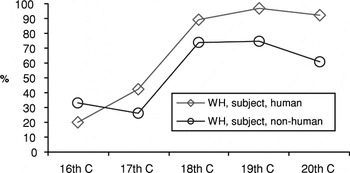
WH in subject restrictive relatives according to type of antecedent across centuries (from Ball, 1996, Figures 3 and 4).
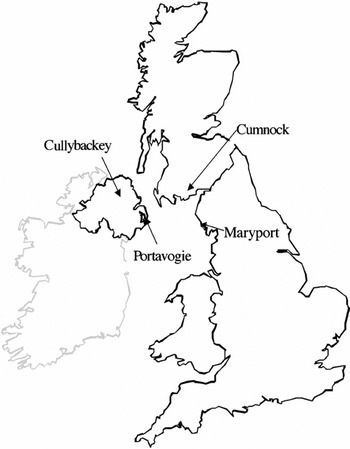
Map showing the location of the communities under investigation.

The “ROOTS” corpora (Tagliamonte, 2001–2003)
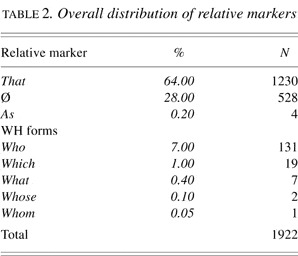
Overall distribution of relative markers
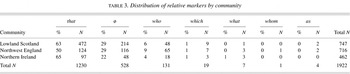
Distribution of relative markers by community
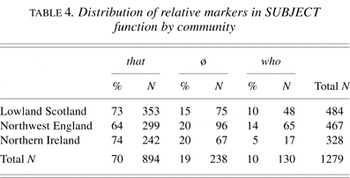
Distribution of relative markers in SUBJECT function by community
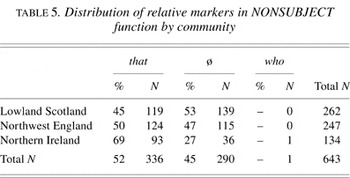
Distribution of relative markers in NONSUBJECT function by community
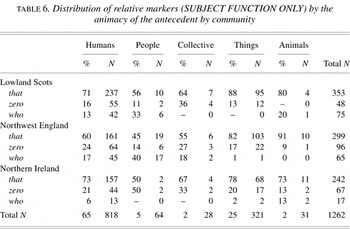
Distribution of relative markers (SUBJECT FUNCTION ONLY) by the animacy of the antecedent by community
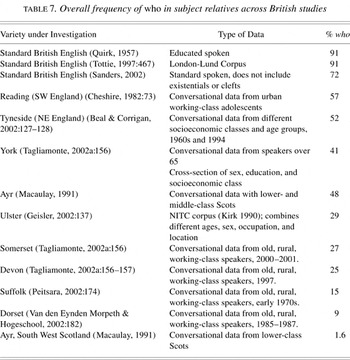
Overall frequency of who in subject relatives across British studies
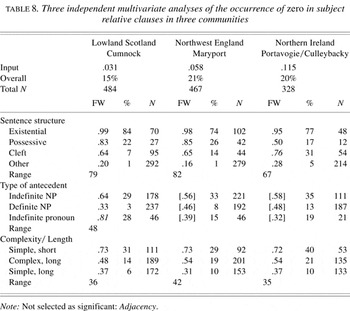
Three independent multivariate analyses of the occurrence of zero in subject relative clauses in three communities
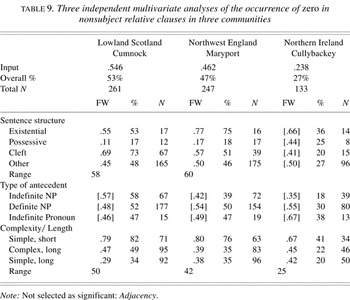
Three independent multivariate analyses of the occurrence of zero in nonsubject relative clauses in three communities
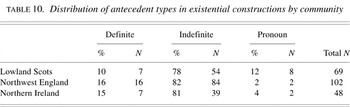
Distribution of antecedent types in existential constructions by community
 You have
Access
- 53
- Cited by