Introduction
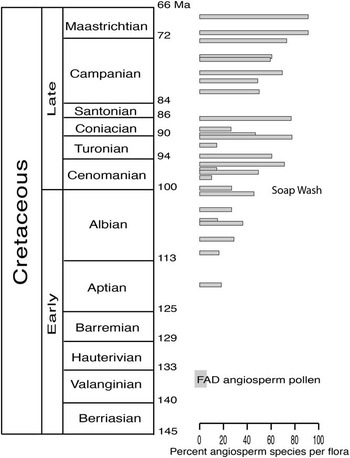
Angiosperms are relative newcomers to the global flora (Crane and Lidgard, Reference Crane and Lidgard1989, Reference Crane and Lidgard1990; Lidgard and Crane, Reference Lidgard and Crane1988, Reference Lidgard and Crane1990; Lupia et al., Reference Lupia, Lidgard and Crane1999) with angiosperm pollen grains first appearing in the fossil record during the Early Cretaceous (late Valanginian or early Hauterivian, Fig. 1, Brenner, Reference Brenner1996; Segev, Reference Segev2009). After five to ten million years of evolution at low paleolatitudes, during which time relatively little diversity accumulated, angiosperms spread rapidly into mid and high paleolatitudes and began to diversify (Crane et al., Reference Crane, Friis and Pedersen1986; Crane and Lidgard, Reference Crane and Lidgard1989; Hickey and Doyle, Reference Hickey and Doyle1977; Upchurch Jr. and Wolfe, Reference Upchurch and Wolfe1987). By the latest Barremian and Aptian, all major angiosperm lineages, including eudicots, were present (Doyle, Reference Doyle1992; Hughes et al., Reference Hughes, McDougall and Chapman1991; Sun et al., Reference Sun, Dilcher, Wang and Chen2011) and angiosperms showed much of their characteristic morphological complexity (Jud and Hickey, Reference Jud and Hickey2013). By the early Late Cretaceous, rapid diversification in foliage and reproductive structures signaled a wider range of ecologies and increased species richness (Crepet et al., Reference Crepet, Nixon and Gandolfo2004; Doyle and Hickey, Reference Doyle and Hickey1976; Friis et al., Reference Friis, Pedersen and Crane2000; Hickey and Doyle, Reference Hickey and Doyle1977; Hochuli et al., Reference Hochuli, Heimhofer and Weissert2006; Lidgard and Crane, Reference Lidgard and Crane1990; Lupia et al., Reference Lupia, Lidgard and Crane1999). By the end of the Cretaceous, both floristic diversity and abundance of angiosperms increased to nearly 40% of local palynofloras (Lupia et al., Reference Lupia, Lidgard and Crane1999); however, angiosperms only dominated ephemeral and disturbed habitats through the end of the Cretaceous (Arens and Allen, Reference Arens and Allen2014; Johnson, Reference Johnson2002; Wing and Boucher, Reference Wing and Boucher1998; Wing et al., Reference Wing, Strömberg, Hickey, Tiver, Willis, Burnham and Behrensmeyer2012).
Geologic timescale for the Cretaceous showing the stratigraphic position of the Soap Wash flora relative to the abundance of flowering plant pollen in a global survey (Lupia et al., Reference Lupia, Lidgard and Crane1999). First appearance of angiosperm pollen after Brenner (Reference Brenner1996). Dating of the Soap Wash locality based on radioisotopic (Cifelli et al., Reference Cifelli, Kirkland, Weil, Deino and Kowallis1997) and biostratigraphic (Tschudy et al., Reference Tschudy, Tschudy and Craig1984) data from nearby localities. Stage names based on the time scale of Gradstein and colleagues (Reference Gradstein2004) with age dates following the International Chronostratigraphic Chart 2015.1 (www.stratigraphy.org). The Soap Wash locality did not yield a palynoflora so is noted here only for stratigraphic and temporal context.

Although this general narrative is well supported, details of the early chapters of angiosperm history are poorly known because only a handful of Early Cretaceous macrofloras have been described. Three aquatic angiosperms from the Barremian (Swisher et al., Reference Swisher, Wang, Wang, Xu and Wang1999) Yixian Formation of northeastern China have been described (Dilcher et al., Reference Dilcher, Sun, Ji and Li2007; Ji et al., Reference Ji, Li, Bowe, Lui and Taylor2004; Leng and Friis, Reference Leng and Friis2006; Sun and Dilcher, Reference Sun and Dilcher2002; Sun et al., Reference Sun, Dilcher, Wang and Chen2011; Sun et al., Reference Sun, Dilcher, Zheng and Zhou1998). A variety of angiosperm reproductive organs are known from the Barremian–Aptian of Portugal (Friis et al., Reference Friis, Crane and Pedersen2011; Friis et al., Reference Friis, Pedersen and Crane1999, Reference Friis, Pedersen and Crane2000), and leaves have been recovered from Albian aged rocks of Alaska (Spicer and Herman, Reference Spicer and Herman2001) and Argentina (Passalia, Reference Passalia2007). The Potomac Group (Aptian–Cenomanian) of eastern North America preserves wood fragments, conifer cones and seeds, and angiosperm leaves and fruits (Crane et al., Reference Crane, Friis and Pedersen1986; Doyle and Hickey, Reference Doyle and Hickey1976; Fontaine, Reference Fontaine1889; Hickey and Doyle, Reference Hickey and Doyle1977; Hochuli et al., Reference Hochuli, Heimhofer and Weissert2006; Jud and Hickey, Reference Jud and Hickey2013; Upchurch Jr. et al., Reference Upchurch, Crane and Drinnan1994). The Dakota Formation (Cenomanian) of the Western Interior of North America preserves an abundant and diverse compression flora (Lesquereux, Reference Lesquereux1891 [1892]; Upchurch Jr. and Dilcher, Reference Upchurch and Dilcher1990; Wang, Reference Wang2002; Wang and Dilcher, Reference Wang and Dilcher2006). In addition, smaller compression floras from the late Early Cretaceous and early Late Cretaceous have been reported from South Carolina (Berry, Reference Berry1914b), Alabama (Berry, Reference Berry1919), New Jersey (Newberry, Reference Newberry1895), Texas (Berry, Reference Berry1922), Wyoming (Brown, Reference Brown1933; Peppe et al., Reference Peppe, Hickey, Miller and Green2008), Washington State (Crabtree, Reference Crabtree1987; Miller et al., Reference Miller, Brandon and Hickey2006; Miller and Hickey, Reference Miller and Hickey2008, Reference Miller and Hickey2010), and the northern Rocky Mountain region (including Wyoming, Montana, and Idaho, and Alberta and British Columbia, Canada, Crabtree, Reference Crabtree1987).
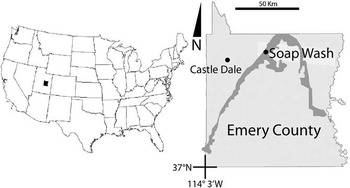
In this paper, we describe a small late Albian to early Cenomanian-aged flora from the Soap Wash locality within the Cedar Mountain Formation of Emery County, Utah (Fig. 2) and place it within the context of other floras of this interval. The Soap Wash flora is significant because it is the first leaf compression flora to be described from the Cedar Mountain Formation in the Western Interior and among the first from the western shore of the Western Interior Seaway during the mid-Cretaceous. It is also one of a relatively small number of dicotyledonous floras from this interval, just before the explosive angiosperm radiation in the Late Cretaceous. We document the diversity of this flora, its biogeographic affinities, and seek clues to its ecology by comparing some aspects of the leaf economic spectrum with similar age floras from the Potomac Group, Winthrop Shale, and Aspen Shale (Royer et al., Reference Royer, Miller, Peppe and Hickey2010).
Soap Wash locality within the Cedar Mountain Formation in the Western Interior of North America. Exposure of the Cedar Mountain Formation redrawn from Cifelli and colleagues (Reference Cifelli, Nydam, Gardner, Weil, Eaton, Kirkland and Madsen1999).

Geological setting
The Soap Wash flora was collected from the upper part of the Cedar Mountain Formation of Emery County, Utah. The locality is adjacent to the Cleveland-Lloyd Dinosaur Quarry road at 39.33°N 110.74°W (Fig. 2, Burke Museum of Natural History locality number B7246 “Stock Pond”). We designate the site where the leaf fossils were collected as the “Soap Wash” locality, referring to the local name of the ephemeral stream near the locality. The Cedar Mountain Formation (Stokes, Reference Stokes1944) is exposed in central Utah and northwestern Colorado, with its type locality on the southwestern flank of Cedar Mountain at the north end of the San Rafael Swell, about 18 km southeast of the Soap Wash fossil site. The Cedar Mountain Formation lies unconformably above the latest Jurassic Morrison Formation and below the Late Cretaceous (Cenomanian) Dakota Sandstone.
The Cedar Mountain Formation consists of two sedimentary facies: the lower Buckhorn Conglomerate, 1–35 m in thickness, and an upper shale unit, 15–40 m in thickness (Currie, Reference Currie1998). The Buckhorn Conglomerate Member consists of black chert pebbles with minor sandstone, shale, and limestone clasts deposited in braided streams (Kirkland et al., Reference Kirkland, Britt, Burge, Carpenter, Cifelli, Decourten, Eaton, Hasiotis and Lawton1997; Nelson and Crooks, Reference Nelson and Crooks1987). Paleocurrent indicators show flow from the southwest across Utah, with streams initiated in the Sevier highlands to the west (Currie, Reference Currie1997, Reference Currie1998; Elder and Kirkland, Reference Elder and Kirkland1994; Heller and Paola, Reference Heller and Paola1989). The upper shale unit was divided into four members by Kirkland and colleagues (Reference Kirkland, Britt, Burge, Carpenter, Cifelli, Decourten, Eaton, Hasiotis and Lawton1997; Reference Kirkland, Cifelli, Britt, Burge, Decourten, Eaton and Parrish1999) from oldest to youngest: the Yellow Cat, Poison Strip Sandstone, Ruby Ranch, and Mussentuchit members. The Yellow Cat Member consists of interbedded mauve limestone and mudstone layers, and preserves a variety of aquatic and terrestrial vertebrates (Britt et al., Reference Britt, Scheetz, Brinkman and Eberth2006; Kirkland et al., Reference Kirkland, Britt, Burge, Carpenter, Cifelli, Decourten, Eaton, Hasiotis and Lawton1997). The Poison Strip Sandstone Member is defined by pale green mudstones that preserve conifer logs and cycadeoid trunks at some localities (Kirkland et al., Reference Kirkland, Britt, Burge, Carpenter, Cifelli, Decourten, Eaton, Hasiotis and Lawton1997). The Ruby Ranch Member includes drab green and mauve variegated mudstones, abundant carbonate nodules, and minor sandstone and limestone layers (Kirkland et al., Reference Kirkland, Britt, Burge, Carpenter, Cifelli, Decourten, Eaton, Hasiotis and Lawton1997). The Mussentuchit Member consists of drab grey mudstone with lenticular sandstones and lignites (Kirkland et al., Reference Kirkland, Britt, Burge, Carpenter, Cifelli, Decourten, Eaton, Hasiotis and Lawton1997; Kirkland and Madsen, 2007; Kirschbaum and Schenk, 2011; Sprinkel et al., 2012). At the Soap Wash locality, lignites interpreted to be part of the Mussentuchit Member are observed in unconformable contact with the overlying Dakota Formation sandstones. Lignites were observed stratigraphically and topographically above the fossil locality within a few hundred meters of the fossil quarry, but without direct line of strike contact with the quarry. Thus, inferred stratigraphic position of the fossil quarry remains tentative. The upper shale members were deposited in fluvial, floodplain, and lacustrine settings (Fiorillo, Reference Fiorillo1999; Nelson and Crooks, Reference Nelson and Crooks1987; Stokes, Reference Stokes1944; Young, Reference Young1987). The Soap Wash locality occurs in the Mussentuchit Member as evidenced by the presence of lignites stratigraphically above the fossil-bearing mudstone at the fossil site. Since exposure is poor in the region around the fossil site, we were unable to determine where within the member the fossil-bearing strata lie.
In this region, the age date of the Mussentuchit Member is fairly well constrained by multiple lines of evidence. Volcanic ash beds approximately 15 m from the top of the Mussentuchit Member in Emery County were dated to 98.39±0.07 Ma (Cifelli et al., Reference Cifelli, Kirkland, Weil, Deino and Kowallis1997). Palynological analysis assigned a late Albian age to the member based on the absence of tricolporate forms (ruling out a Cenomanian age) coupled with a moderate diversity of tricolpate forms, which supported a late Albian age (Tschudy et al., Reference Tschudy, Tschudy and Craig1984). This assessment was corroborated in a separate analysis by Nichols and Sweet (Reference Nichols and Sweet1993). Unfortunately, palynological preparations from the Soap Wash fossil matrix were barren, which did not allow us to confirm the age determination specifically for this locality. Therefore, we estimate that the Soap Wash site likely straddles the Albian–Cenomanian boundary.
Sediments preserving the Soap Wash flora are clay- and carbonate-rich, light gray mudstone that reacts weakly to HCl and might easily be mistaken for limestone in field mapping. The fossil matrix is weakly laminated (laminations 0.3–16 mm thick and differentiated by color, not grain size) and homogeneous in grain size. This suggests some episodic character to deposition. Fossils were preserved as mineral adhesions or as compressions with organic material preserved in specimens where clay minerals predominate. Organic carbon preserved is of very low thermal maturation, thermal alteration index of 1+/2 (Batten, Reference Batten1980). Fossils were recovered from float after the plant-bearing layer was excavated during the creation of a small impound pond. The fossiliferous layer is not exposed in stratigraphic context at the locality and an extensive survey of the area did not reveal rocks of similar lithology in place. This suggests that the fossil-bearing horizon is limited to a few tens of meters in lateral extent. However, lignites of the Mussentuchit Member and the unconformable contact with the over-lying Dakota Sandstone were observed topographically and stratigraphically above the Soap Wash fossil locality within a few hundred meters of the fossil quarry. Soap Wash fossils were probably deposited in a small, perhaps ephemeral, pond on the ancient coastal plain.
Aquatic and terrestrial vertebrates are well known from the Cedar Mountain Formation (Carpenter et al., Reference Carpenter, Kirkland, Burge and Bird1999; Cifelli et al., Reference Cifelli, Nydam, Gardner, Weil, Eaton, Kirkland and Madsen1999; Kirkland, Reference Kirkland1998; Kirkland et al., Reference Kirkland, Britt, Burge, Carpenter, Cifelli, Decourten, Eaton, Hasiotis and Lawton1997; Kirkland et al., Reference Kirkland, Cifelli, Britt, Burge, Decourten, Eaton and Parrish1999). The Cedar Mountain also preserves wood associated with cycadeoids, conifers, dicotyledonous angiosperms, and the enigmatic tree fern Tempskya (Stokes, Reference Stokes1952; Thayn and Tidwell, Reference Thayn and Tidwell1984; Thayn et al., Reference Thayn, Tidwell and Stokes1985; Thayne [sic] et al., Reference Thayne [sic], Tidwell and Stokes1983). Although angiosperm leaf fossils have been previously reported as part of stratigraphic studies within the Cedar Mountain (e.g., Cifelli et al., Reference Cifelli, Kirkland, Weil, Deino and Kowallis1997; Garrison Jr. et al., Reference Garrison, Brinkman, Nichols, Layer, Burge and Thayn2007) none have been described or published.
Materials and methods
Fossil leaves were collected during the summers of 2005, 2007 and 2008 by independent field crews from Hobart and William Smith Colleges and the Burke Museum of Natural History and Culture. The collections were united in 2011. All specimens are permanently catalogued and deposited in the Burke Museum of Natural History and Culture at the University of Washington, Seattle.
Floristic analysis
The resulting collection contains 152 specimens separated into morphotype groups following the protocol and terminology developed by Ellis and colleagues (Reference Ellis, Daly, Hickey, Johnson, Mitchell, Wilf and Wing2009) and the floral catalog model of Peppe and colleagues (Reference Peppe, Hickey, Miller and Green2008). Primary and secondary venation is visible in most specimens; higher levels of vein branching were less common but visible in many specimens. Patterns of venation were given priority over shape, size, margin type, base and apex characters in assigning specimens to morphotype because venation patterns are less phenotypically plastic and more developmentally stable than other aspects of leaf morphology (e.g., size, shape, margin), and are therefore more taxonomically useful than other aspects of leaf form (Hickey, Reference Hickey1978; Hickey and Wolfe, Reference Hickey and Wolfe1975; Jud and Hickey, Reference Jud and Hickey2013). Image-J (http://rsbweb.nih.gov/ij) was used to make measurements of leaf characteristics from size calibrated digital photographs.
For each morphotype description, we observed the following aspects of leaf form: Simple versus compound leaves (when determinable), glands, position of petiole attachment, lamina size class, length:width ratio, lamina symmetry, lobes, margin type (toothed or untoothed) and tooth description (following the character definitions used by the Climate Leaf Analysis Multivariate Program, CLAMP, http://clamp.ibcas.ac.cn/Clampset2.html, accessed in April 2011, and Ellis et al., Reference Ellis, Daly, Hickey, Johnson, Mitchell, Wilf and Wing2009), apex shape, base shape, primary vein network using characters defined by Ellis and colleagues (Reference Ellis, Daly, Hickey, Johnson, Mitchell, Wilf and Wing2009), secondary vein network, intercostal tertiary vein fabric, quaternary vein fabric and areolation if visible.
For the purposes of this report, morphotype numbers (prefaced with CM for Cedar Mountain Formation) are used as the primary form designators and morphotypes are arranged according to margin form (e.g., untoothed and toothed, following Peppe et al., Reference Peppe, Hickey, Miller and Green2008). When possible, we have allied morphotypes with previously described genera and species, but we have not described new species or placed identified morphotypes into traditional Linnean higher taxa, although we do make comments about clade affinity when appropriate. We adopt this non-traditional approach for two reasons. First, the available collection is modest and appears to contain significant diversity. All but two morphotypes contain fewer than ten specimens each, an insufficient number to confidently circumscribe the range of variation expected in a leaf morphospecies. We provide a list of characters that we used to diagnose the morphotypes in this collection and detailed descriptions that can be applied to new material as it becomes available. Second, systematic treatment of these leaves would include placing them into higher taxa, which implies a phylogenetic interpretation. Because this flora occurs near the stratigraphic root of the angiosperm crown group radiation, placing morphotypes in lineages based on leaves alone would be problematic. However, many morphotypes have affinities with forms that have been described previously. Where we have been able to locate a match for Cedar Mountain morphotypes in the literature, we note these affinities and document paleobiogeographic associations. In cases where we do recognize links with previously described taxa, we do not necessarily adopt the associated phylogenetic conclusions (higher taxon assignments) of those authors.
A morphotype quality index (MQI) has also been assigned to each morphotype group (Miller et al., Reference Miller, Johnson and Ellis2005). This score—from 0 to 7—expresses the completeness of the fossil material described. For each morphotype, one point each is scored for the presence of lobes, complete base, complete apex, margin, third-order venation, fourth-order venation, and fifth-order venation. Miller and colleagues (Reference Miller, Johnson and Ellis2005) recommend a score of four or greater for all described morphotypes. The majority of our morphotypes meet this criterion; however, for completeness, we have included all distinct morphotypes regardless of their MQI.
Leaf mass per area analysis
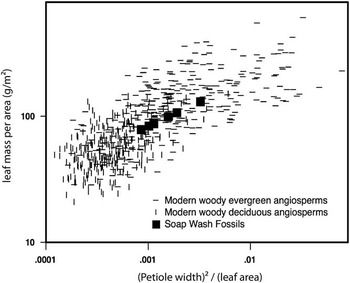
Chemical, physical and physiological properties of leaves have been used to parameterize plant function in response to climate and ecology (Díaz et al., Reference Díaz2004; Reich et al., Reference Reich, Walters and Ellsworth1997; Westoby et al., Reference Westoby, Falster, Moles, Vesk and Wright2002; Wright et al., Reference Wright2004, Reference Wright2005). A coordinated suite of traits defines a leaf economic spectrum (Wright et al., Reference Wright2004), which captures the functional tradeoffs that accommodate varying life history and ecological strategies, and climate conditions. In general, species with high growth and reproductive rates and short lifespan fall at one end of the spectrum, while long-lived species with low growth and reproductive rate reside at the other with a full range of intermediates in between (Wright et al., Reference Wright2004, Reference Wright2005). In a variety of habitats and locations, low leaf mass per area (MA) values are correlated with disturbed, ephemeral or seasonal habitats that favor deciduousness, while plants in stable or aseasonal habitats tend to produce leaves with high MA (Díaz et al., Reference Díaz2004; Reich et al., Reference Reich, Walters and Ellsworth1997; Westoby et al., Reference Westoby, Falster, Moles, Vesk and Wright2002; Wright et al., Reference Wright2004). We use MA to assess the ecological strategy of the Soap Wash angiosperms.
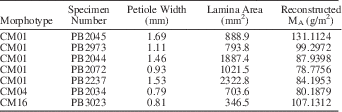
Leaf mass per area cannot be measured directly in fossils, but Royer and colleagues (Reference Royer2007) identified a biomechanical relationship in living plants between petiole width and leaf mass. Using this relationship, we quantified MA in the Soap Wash collection. Following the method described by Royer and colleagues (Reference Royer, Miller, Peppe and Hickey2010), we measured leaf area for all specimens for which a complete lamina and partial petiole were preserved. We measured leaf area and petiole width using Image-J on size calibrated digital images. MA was calculated from best-fit equations published by Royer and colleagues (Reference Royer2007).
Morphotype catalog
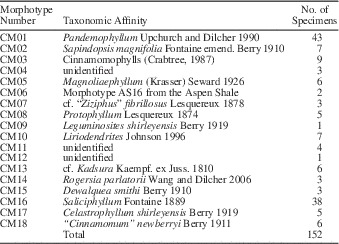
The dicot angiosperm morphotypes identified in this flora are summarized in Table 1.
Overview of dicot angiosperm leaf specimens in the Soap Wash collection

One scrap of poorly preserved conifer foliage, tentatively identified as ?Brachyphyllum (PB19865), was also cataloged but is not illustrated.
Morphotype CM01
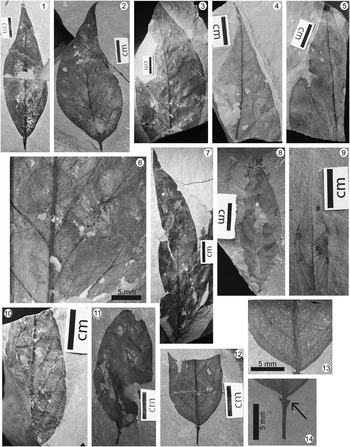
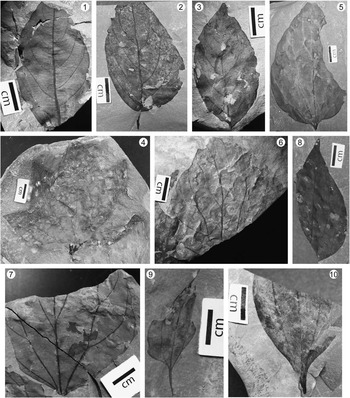
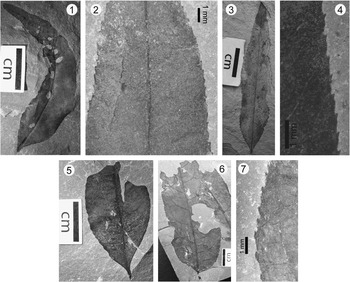
Morphotype CM01 (Pandemophyllum sp.): (1) PB2045, (2) PB2973, (3) PB2070, (4) PB2974, (5) PB2068, (6) vein detail of this morphotype. Morphotype CM02 (Sapindopsis magnifolia): (7) PB3012. Morphotype CM03 (cinnamomopyll): (8) PB2996, (9) PB3033, (10) PB3035. Morphotype CM04: (11) PB2034, (12) PB2241, (13) vein detail of this morphotype; (14) arrows indicate petiolar glands characteristic of this morphotype.

Morphotype exemplars
PB2045, PB2973.
Systematic affinity
Pandemophyllum Upchurch and Dilcher Reference Upchurch and Dilcher1990.
Morphotype quality index
5.
Diagnostic features
Ovate lamina; asymmetrical acuminate apex with one margin weakly concave and the other weakly convex; secondary veins subopposite and range in angle of divergence between 28.3° and 67.2°.
Description
Simple lamina with marginal petiole attachment. Lamina microphyll I and II in size; L:W ratio of 2:1. Lamina is ovate, apically asymmetrical with one margin weakly concave and the other weakly convex; medially and basally asymmetrical with one base wider than the other. Unlobed and margin untoothed. Apex shape acute to acuminate. Base shape cuneate to slightly convex in a few specimens. Base angle acute to obtuse. Pinnate primary venation. Lamina displays weak brochidodromous secondary venation with secondaries spaced uniformly at an average of 4.19 mm apart. Secondaries are subopposite and range in angle of divergence between 28.3° and 67.2° (average approximately 38.6°). Intersecondaries present. Tertiary vein fabric random reticulate to poorly organized alternate percurrent; tertiaries average of 1.48 mm apart. Tertiaries diverge from the primary at an average angle of 68.0˚ and are variable in course, being both convex and sinuous. The fourth vein order forms a regular polygonal reticulate pattern. Petiole is at least 4.95 mm in length.
Specimens examined
PB2032, PB2039, PB2042–PB2045 inclusive, PB2049, PB2051, PB2055, PB2057, PB2060, PB2061, PB2067–PB2072 inclusive, PB2074, PB2080, PB2236, PB2237, PB2971–PB2979 inclusive, PB2998–PB3003 inclusive, PB3030, PB19852–PB19856 inclusive.
Discussion
CM01 is the most abundant morphotype in the Soap Wash collection, represented by 43 well-preserved specimens. These specimens fit the generic description of Pandemophyllum provided by Upchurch and Dilcher (Reference Upchurch and Dilcher1990) in details of size, shape and venation, but they do not correspond to any previously described species. CM01 has an acute and asymmetrical leaf apex that is not mentioned or illustrated for any of the described species of Pandemophyllum. Upchurch and Dilcher (Reference Upchurch and Dilcher1990) noted other Dakota Formation forms, such as “Inga” cretacea Lesquereux Reference Lesquereux1891 (Upchurch and Dilcher, Reference Upchurch and Dilcher1990, pl. 14, fig. 1), that shared similarities with Pandemophyllum and also showed asymmetry in the leaf apex. CM01 shares morphological characteristics with “Ficus” inaequalis Lesquereux Reference Lesquereux1891 from the Dakota Formation of Kansas (Lesquereux, Reference Lesquereux1891 [1892], p. 82, pl. XLIX, figs. 6–8, pl. L, fig. 3). However Lesquereux described the species as craspedodromous, whereas CM01 has brachidodromous secondary venation. Berry (Reference Berry1919, p. 80, pl. XII, fig. 1) reported “Ficus” inaequalis from the Gulf Coastal Plain and illustrated brochidodromous specimens in which secondary vein loops are flattened at the margin in the apical half of the lamina. Gulf Coastal Plain representatives also display a rounded base (Berry, Reference Berry1919), which is circumscribed into the range of variation typical of CM01. The illustrated specimen of “Ficus” inaequalis (Berry, Reference Berry1919, pl. XII, fig. 1) is distinctly symmetrical although the description notes that the species is “inequilateral” (Berry, Reference Berry1919, p. 80). Berry (Reference Berry1919) also segregated two additional species—F. daphnogenoides (Heer) Berry Reference Berry1919 (p. 80, pl. XIII, figs. 6–7) and F. shirleyensis Berry Reference Berry1919 (p. 81, pl. XIII, fig. 8)—that share affinities with Pandemophyllum, but the bases of these species are distinctly and uniquely acute and likely fall within the range of variation circumscribed for Pandemophyllum kvacekii Upchurch and Dilcher Reference Upchurch and Dilcher1990. Therefore, we place CM01 in Pandemophyllum but do not assign it to a previously described species.
Morphotype CM02
Morphotype exemplar
PB3012.
Systematic affinity
Sapindopsis magnifolia Fontaine Reference Fontaine1889 emend. Berry 1910 (Berry, Reference Berry1910b); AS19 from the Aspen Shale, Albian of Wyoming (Peppe et al., Reference Peppe, Hickey, Miller and Green2008).
Morphotype quality index
3.
Diagnostic features
Compound leaf with elliptical leaflets; acute apex; secondary veins spaced and angled uniformly.
Description
Pinnately compound leaf with opposite arrangement of leaflets. Marginal petiole attachment. Microphyll I to II in size; L:W ratio approximately 2:1 with no fully complete specimens preserved. Elliptic lamina; medially symmetrical, basally asymmetrical. Unlobed with an untoothed margin. Apex shape acute; base shape cuneate. Pinnate primary venation. Weak brochidodromous secondary veins. Secondaries spaced and angled uniformly an average of 0.45 cm apart and 33.8˚, respectively. No higher orders of venation preserved. Petiole averages 8.3 mm in length.
Specimens examined
PB2058, PB3012, PB3013, PB19868–PB19871 inclusive.
Discussion
Preservation precludes determining the number and the arrangement of leaflets in the Cedar Mountain specimens.
Sapindopsis Fontaine Reference Fontaine1889 was originally recognized for compound leaves of lanceolate shape from the Potomac Group that had a generally lancet shape, prominent primary vein and untoothed margin. Leaflets occur in opposite pairs with the uppermost pairs of leaflets decurrent. Golovneva (Reference Golovneva2007) described a larger collection from the middle Albian to Cenomanian of Central Asia and western Siberia that circumscribed a wider range of variation, including toothed margins and a wider range in shape in proximal leaflets. In this collection, a single whole leaf (PB3012) with attached leaflets is preserved, but the leaflets are folded over one another so the decurrent attachment cannot be confirmed. Isolated leaflets comprise the remainder of the collection and are allied with specimen PB3012 by venation and shape, although shape, particularly L:W ratio, is variable. Fontaine (Reference Fontaine1889) described several species including Sapindopsis variabilis (p.298, pl. CLI, fig. 1, pl. CLII, figs. 1, 4, pl. CLIII, figs. 2, 3, pl. CLIV, figs. 2–4, pl. CLV, figs. 2–5) and S. magnifolia (p. 297, pl. CLI, figs. 2, 3, pl. CLII, figs. 2, 3, pl. CLIII, fig. 2, pl. CLIV, figs. 1, 5). Together these forms circumscribe the range of variation observed in the small Soap Wash collection. Peppe and colleagues (Reference Peppe, Hickey, Miller and Green2008) reported S. magnifolia (AS19) from the Aspen Shale (Albian) of Wyoming. Some of the specimens that they illustrated (e.g., YPM56073a, Peppe et al., Reference Peppe, Hickey, Miller and Green2008, fig. 19) have slightly obovate, rather than elliptical shape and more rounded apices than those recovered from the Cedar Mountain Formation. This variation may reflect position of leaflets on the leaf and so we place the Cedar Mountain specimens under this name.
Biogeographic and stratigraphic analysis suggests that Sapindopsis evolved in Eurasia during the Albian and migrated to North America during the early–middle Albian climate optimum (Golovneva, Reference Golovneva2007). Hickey and Doyle (Reference Hickey and Doyle1977) reported that Sapindopsis with untoothed margins were among the most common elements of the Albian floras of the Potomac Group of the mid-Atlantic region of North America. Three species of Sapindopsis are reported from the Albian-age Aspen Shale of Wyoming, with two of these, S. magnifolia and S. belviderensis, among the most common elements of the flora (Peppe et al., Reference Peppe, Hickey, Miller and Green2008).
Morphotype CM03
Morphotype exemplars
PB2996, PB3033, PB3035.
Systematic affinity
Cinnamomophylls (Crabtree, Reference Crabtree1987), possibly Cinnamomoides Seward Reference Seward1925.
Morphotype quality index
4.
Diagnostic features
Elongate acuminate apex; angle of secondaries increase toward the apex (43.0° to 61.3°); in the proximal half of the lamina tertiaries perpendicular to the primary with mixed percurrent venation.
Description
Simple leaf with marginally attached petiole. Microphyll I to II in size; L:W ratio 4:1. Ovate lamina is symmetrical, unlobed and the margin is untoothed. Elongate acuminate apex extends nearly half the length of the lamina. Base shape cuneate; base angle acute. Pinnate primary venation. Weak brochidodromous secondary venation with subopposite secondaries. Spacing of secondaries decreases toward the apex on average from approximately 0.58 cm to approximately 0.26 cm. Secondary vein angle smoothly increasing towards the apex on average from approximately 43° to approximately 61°. Intersecondaries absent. Mixed percurrent tertiary vein fabric with straight to sinuous course. Tertiaries perpendicular to the primary an average of 0.49 mm apart. Fourth degree veins form a regular polygonal reticulate fabric. Petiole incomplete.
Specimens examined
PB2064, PB2077, PB2238, PB2996, PB3033, PB3035, PB19874, PB19875, PB31606.
Discussion
Our review of the literature has not revealed a previously described species that matches the range of variation present in this morphotype. Details of secondary venation, particularly the basal pair of secondary veins that branch at low angle, and tertiary venation, particularly tertiaries in the basal half of the lamina that are regularly spaced and more uniformly perpendicular to the midrib ally this form with the modern genus Cinnamomum Schäffer Reference Schäffer1762 in the Lauraceae. Seward (Reference Seward1925) erected the genus Cinnamomoides Seward Reference Seward1925 for Cretaceous age leaves that resembled living Cinnamomum but with dubious alliance to Lauraceae. Cinnamomoides ovalis (Dawson) Bell Reference Bell1956 was described from the Albian of Alberta and British Columbia. Crabtree (Reference Crabtree1987) reported this species from similar age rocks in Montana. A variety of other species have been ascribed to the modern genus including “Cinnamomum” scheuchzeri Heer Reference Heer1856 from the Dakota Formation (Lesquereux, Reference Lesquereux1891 [1892]), and “Cinnamomum” canadense Dawson Reference Dawson1885 from the Albian of Alberta (Crabtree, Reference Crabtree1987). While it seems clear that CM03 is allied with the “Cinnamomophylls” of Crabtree (Reference Crabtree1987), this may be a polyphyletic group with an as yet undetermined diversity in the mid-Cretaceous. In the Cedar Mountain flora, this form is variable in size, shape and the details of venation, particularly at the lamina base. Consequently, it does not fit easily into any previously described species concept.
Morphotype CM04
Morphotype exemplars
PB2034, PB2241.
Morphotype quality index
4.
Diagnostic features
Elliptic lamina with rounded apex and convex base; eucamptodromous primary venation; acropetiolar gland.
Description
Simple leaf with marginal petiole attachment. Microphyll I and II in size; L:W ratio is 2:1. Elliptic lamina, symmetrical, unlobed with an untoothed margin. Apex shape convex; apex angle obtuse. Convex base shape; base angle bordering acute and obtuse. Pinnate primary venation. Eucamptodromous secondary venation with secondaries opposite proximally (basally) and increasingly alternate distally (apically). Secondaries angled uniformly an average of 44.3° from the primary. Spacing of secondaries increases apically from 0.39 cm to 0.92 cm. Intermarginal secondaries present. Tertiaries range from opposite percurrent to mixed percurrent with straight to sinuous course. Tertiaries angle acutely on average 71˚ from the primary and are spaced an average of 0.45 mm apart. No higher orders of venation preserved. Acropetiolar glands present 0.53 mm from the base of the lamina. Petiole incomplete.
Specimens examined
PB2034, PB2241, PB24846.
Discussion
The acropetiolar gland characteristic of this morphotype is obvious and distinct. We have found no other specimens reported in the literature from the Early to mid-Cretaceous that preserve this feature. Therefore, we do not ally CM04 with any previously described taxon.
Morphotype CM05
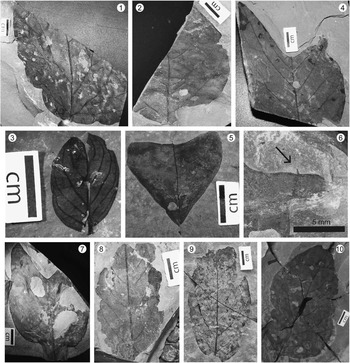
Morphotype CM05 (Magnoliaephyllum sp.): (1) PB2041, (2) PB2235, (3) PB2982. Morphotype CM06: (4) PB2989. Morphotype CM07 (cf. ”Ziziphus” fibrillosus): (5) PB2559, (6) PB2052, (7) PB2983. Morphotype CM18 (“Cinnamomum” newberryi): (8) PB2980, (9) PB2984, (10) PB2240.

Morphotype exemplars
PB2235, PB2982.
Systematic affinity
Magnoliaephyllum (Krasser) Seward Reference Seward1926.
Morphotype quality index
5.
Diagnostic features
Lamina elliptic to ovate with convex margins extending to both the apex and base; acute base; subopposite secondary veins; tertiary veins obtuse to perpendicular.
Description
Simple leaf with marginally attached petiole. Microphyll II in size with a L:W ratio of 1.7:1. Elliptic to ovate lamina. Some specimens symmetrical (e.g., Fig. 4.1) and some display asymmetry at the base (e.g., Fig. 4.2). Lamina unlobed with an untoothed margin. Apex not completely preserved but margins appear to converge (Fig. 4.3) to an acute or attenuate apex. Convex base shape with acute base angle. Pinnate primary venation and weak brochidodromous secondary venation. Secondaries subopposite with their spacing decreasing uniformly from approximately 0.75 cm to approximately 0.44 cm toward the apex. The angle of the secondaries uniformly increases towards the apex from 42.3° to 79.4°. Intersecondaries absent. Intercostal tertiaries are the highest level of preserved venation and are opposite percurrent with a sinuous course. Tertiaries obtuse to perpendicular to the primary on average 90° to 106.5°, and are spaced 1.1 mm apart. Petiole incomplete.
Specimens examined
PB2040, PB2041, PB2056, PB2235, PB2981, PB2982.
Discussion
The shape of the lamina in combination with the characteristics of the secondary and tertiary venation set these specimens apart from others in the Soap Wash collection. The genus Magnoliaephyllum Seward Reference Seward1926 includes leaves that resembled living Magnolia in leaf shape but for which the details of venation were not preserved. In his discussion, Seward (Reference Seward1926) noted that many paleobotanical specimens from the Cretaceous and Tertiary had been ascribed to the modern genus Magnolia without preservation of the details of tertiary, or sometimes even secondary, venation needed to make the link to the extant genus. He therefore erected the genus Magnoliaphyllum for these Magnolia-like leaves. In the case of CM05, tertiary venation is preserved and resembles, but is not identical to, modern Magnolia in having a tertiary vein fabric that is generally opposite percurrent with generally sinuous course. Therefore, we have chosen Seward’s (Reference Seward1926) form genus for these specimens. CM05 is also smaller than most modern members of the genus. Two species of “Magnolia” have been described from the mid-Cretaceous of North America. “Magnolia” alternans Heer 1866 (Capellini and Heer, Reference Capellini and Heer1866) is reported from the Albian of Alberta and British Columbia (Crabtree, Reference Crabtree1987) and the Cenomanian of New Jersey (Newberry, Reference Newberry1895) and Nebraska (Capellini and Heer, Reference Capellini and Heer1866). Dawson (Reference Dawson1885 [1886]) reported “Magnolia” magnifica Dawson Reference Dawson1882 [1883] from the Albian of Alberta. CM05 is consistently smaller than the specimens ascribed to these species; therefore, we do not assign CM05 to them, particularly since the details of venation are not described in the original publications.
Morphotype CM06
Morphotype exemplar
PB2989.
Systematic affinity
AS16 from the Aspen Shale, Albian of Wyoming (Peppe et al., Reference Peppe, Hickey, Miller and Green2008).
Morphotype quality index
4.
Diagnostic features
Ovate lamina with five palmate lobes; palinactinodromous primary venation with all five veins basal; untoothed margin.
Description
Simple leaf with marginal petiole attachment. The two specimens included in this collection are significantly different in size. The first is 8.3 cm in length and 10.0 cm in width giving a L:W ratio of 0.83:1. A second, much larger specimen is incomplete, suggesting significant uncollected size variation in this form. Ovate lamina is symmetrical. Five palmate lobes with the two central sinuses forming an angle of approximately 95° and the two lateral sinuses forming an angle of approximately 107°. Sinuses extend nearly one quarter the length of the lamina. Untoothed margin. Each of the five lobes has an acute apex; base is decurrent. Palinactinodromous primary venation. No higher order venation is preserved. Petiole incomplete.
Specimen examined
PB2075, PB2989.
Discussion
Peppe and colleagues (Reference Peppe, Hickey, Miller and Green2008) reported a similar form from the middle to late Albian Aspen Shale from Lincoln County, Wyoming. Illustrated specimens of AS16 are similar in size to PB2989 from the Cedar Mountain Formation and smaller than the large specimen PB2075. Peppe and colleagues (Reference Peppe, Hickey, Miller and Green2008) assign the form to the Magnoliopsida but do not make a family or genus determination. Crabtree (Reference Crabtree1987) placed similar specimens including those described as “Platanus” (Crabtree Reference Crabtree1987, fig. 10) and Platanoplyllum (Crabtree, Reference Crabtree1987, fig. 11) in his broad Platanophylls category. Without more details of venation, even this assignment would be provisional for CM06. In shape, size and primary venation, CM06 also resembles Aralia eutawensis Berry 1914 (Berry Reference Berry1914b, p. 119, pl. XX, fig. 7) from the Late Cretaceous Eutaw Formation of Georgia and A. newberryi Berry Reference Berry1907 (p. 201, pl. XV, fig. 1) from the Late Cretaceous Raritan Formation of New York and New Jersey, the Magothy Formation of New Jersey, and the Black Creek Formation of North Carolina. Both A. eutawensis and A. newberryi are quinquelobate with the two basal lobes directed outward perpendicularly from the midvein and the other three directed laterally. As in CM06, Berry’s (Reference Berry1907, Reference Berry1914b) specimens do not preserve venation other than the palmately compound primaries, which make allying CM06 with these forms tentative. Most previous taxonomic assignments appear to have been based on overall shape of the leaf because the details of secondary and more detailed venation are poorly preserved. Since a diversity of described forms display quinquelobate shape, we are reluctant to ally CM06 to any previously described taxon based only on shape.
Morphotype CM07
Morphotype exemplars
PB2559, PB2983.
Systematic affinity
“Ziziphus” fibrillosus Lesquereux Reference Lesquereux1878.
Morphotype quality index
3.
Diagnostic features
Actinodromous primary venation with at least four basal primary veins; simple agrophic veins; tertiary veins perpendicular to the primary veins.
Description
Simple leaf with marginally attached petiole. Microphyll II and III in size with a L:W ratio of 1.7:1. Lamina ovate in shape and symmetrical. Unlobed and untoothed margins. Apex shape straight with an acute apex angle. Base shape rounded with an obtuse angle. At least four basal actinodromous primary veins. Eucamptodromous secondary vein framework with simple agrophic veins. Secondaries angled uniformly at an average of 43.5°. Intersecondaries absent. Opposite percurrent tertiary venation with mostly sinuous but also convex course. Tertiaries average 1.34 mm apart and diverge perpendicular to the primary. Alternate percurrent fourth-order venation. Petiole incomplete.
Specimens examined
PB2052, PB2559, PB2983.
Discussion
Simple, unlobed leaves with actinodromous venation are common in the latest Cretaceous and Tertiary floras of the mid and high latitudes of the Northern Hemisphere (Crane et al., Reference Crane, Manchester and Dilcher1991) but rare in Early and mid-Cretaceous. Our review of previously described floras yielded no convincing match to CM07 in collections from the Early Cretaceous through the Cenomanian. In his dissertation, Miller (Reference Miller2007) erected the new genus Paterosia Miller and Hickey in the Piperales to include simple, unlobed leaves with actinodromous venation. Miller (Reference Miller2007) described five species of Paterosia from the Albian-age Winthrop Formation of Washington State. As of this writing, this work, and the new taxa erected as part of it, has not been formally published and only text descriptions, not illustrations, are available for comparison. Verbal descriptions of Paterosia are consistent with CM07 in having 3–5 basal primary veins, a marginal petiole, simple agrophic veins and tertiary vein networks that may be opposite percurrent and oriented perpendicular to the primary veins. However, Miller (Reference Miller2007) defines secondary venation as brochidodromous and festooned brochidodromous rather than eucamptodromous as in CM07. Miller (Reference Miller2007) further noted that Paterosia species are commonly asymmetrical and have a deeply cordate or lobed base, both features absent in CM07. Therefore, we do not align CM07 with this Paterosia.
The closest match to CM07 that we were able to locate is “Zizyphus” fibrillosus Lesquereux Reference Lesquereux1878. Note that Lesquereux’s spelling of the genus name (Zizyphus versus Ziziphus, the spelling commonly used for the extant form) seems to be used interchangeably in the literature and many contemporary databases (e.g., Paleobiology Database, https://paleobiodb.org) with “Ziziphus” fibrillosus, which is favored by most 20th Century authors publishing on this fossil form. “Ziziphus” appears to be preferred based on the extant genus Ziziphus Miller 1754 (Sprague, Reference Sprague1929), which defers to a spelling used before formal, Latinized names were standardized for species. Lesquereux (Reference Lesquereux1878) described Z. fibrillosus with both a rounded (p. 276, pl. LII, figs. 1, 3, 4) and cordate (p. 276, pl. LII, fig. 2) base and acute apex. Margin lacks teeth. Lesquereux (Reference Lesquereux1878) described three basally palmate primaries with a pair of lesser veins emerging from the point of divergence (p. 276, pl. LII, fig. 1). Simple agrophic veins are illustrated and opposite percurrent veins emerging at right angles to the primaries are described and illustrated. This form is described from the Late Cretaceous (Maastrichtian) Wyoming (Lesquereux, Reference Lesquereux1878), North and South Dakota (Johnson, Reference Johnson2002), the Paleocene of Montana and Colorado (Johnson and Ellis, Reference Johnson and Ellis2002; Wilf et al., Reference Wilf, Labandeira, Johnson and Ellis2006), and the Eocene of Wyoming (Knowlton, Reference Knowlton1899). This species has not previously been reported from the Early Cretaceous, therefore assigning CM07 to this form taxon would be a significant range extension. However, a broadly similar form, “Zizyphus” lamarensis Berry Reference Berry1912, is reported from the Woodbine and Tuscaloosa formations of mid-Cretaceous age. Given our few and incomplete specimens, assignment to “Ziziphus” fibrillosus should be considered provisional.
Morphotype CM18
Morphotype exemplars
PB2240, PB2980.
Systematic affinity
“Cinnamomum” newberryi Berry 1911 (Berry, Reference Berry1911a).
Morphotype quality index
3.
Diagnostic features
Basal acrodromous primary venation with three primaries emerging from the petiole.
Description
Simple leaf with marginally attached petiole. Microphyll II and III in size with a L:W ratio of 1.6:1. Lamina ovate in shape and symmetrical. Unlobed and untoothed margins. Apex acuminate. Base cuneate to convex with an acute to obtuse base angle. Three basal acrodromous primary veins. Eucamptodromous secondary venation, in which veins arise marginward of the lateral primary veins, is poorly preserved. Secondaries are the highest order of venation preserved. Petiole incomplete.
Specimens examined
PB2030, PB2063, PB2240, PB2980, PB2984, PB19872.
Discussion
Placing this morphotype in a previously described taxon is complicated by the absence of preserved venation. Berry (Reference Berry1911a) proposed the name “Cinnamomum” newberryi for leaves previously described by Newberry (Reference Newberry1895) as Cinnamomum intermedium from the Early Cretaceous Amboy Clays. Specimens illustrated by Newberry (Reference Newberry1895) included actinodromous (p. 89, pl. XXIX, figs. 1–5) and acrodromous (p. 89, pl. XXIX, figs. 6, 10) primary venation. All specimens had acute basal and apical angles (Newberry, Reference Newberry1895). Berry (Reference Berry1911b) illustrated a similar specimen from the Raritan Formation that had an acute base, three actinodromous primary veins, and clearly developed agrophic veins (p. 150, pl. XVI, fig. 3). In 1925, Berry further expanded the concept of “Cinnamomum” newberryi by erecting several subspecies. Among these were specimens with obtuse base angles, acute apical angles and basally acrodromous primary venation (e.g., Berry, Reference Berry1925, p. 77, pl. XVI, fig. 6, “Cinnamomum” newberryi minimum). Although C. newberryi minimum is smaller in size (3.5 cm in length, 1.2 cm in width) than the average specimens of CM18 (approx. 6 cm in length, 3 cm in width, but note PB2984, Fig. 4.9, which matches Berry’s Reference Berry1925, p. 77 measurements), conforms to the description and illustration in most other respects. Uncertainty arises because the details of agrophic veins, secondaries and tertiary veins are not preserved in CM18.
“Cinnamomum” newberryi is described from the Cenomanian age Raritan Formation of New Jersey (Berry, Reference Berry1911b) and subsequently from the Dakota Formation of Kansas (Albian to Cenomanian), the Magothy Formation of New Jersey, Delaware, Maryland and New York (Santonian), and the Late Cretaceous Black Creek Formation of South Carolina and the Tuscaloosa Formation of Alabama (Knowlton, Reference Knowlton1919). The small form, C. newberryi minimum Berry Reference Berry1925, that best matches CM18, was reported as a single specimen from the Ripley Formation (Campanian-Maastrichtian) from Tennessee (Berry, Reference Berry1925).
Morphotype CM08
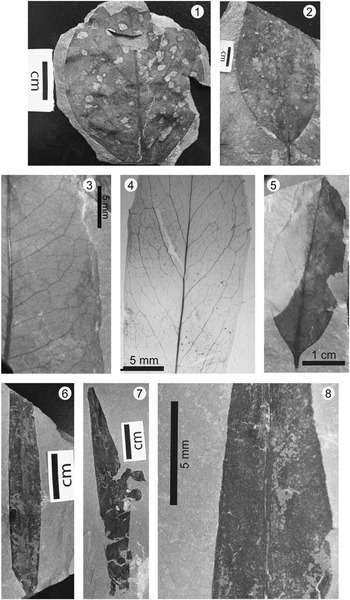
Morphotype CM08 (Protophyllum sp.): (1) PB2558, (2) PB2990. Morphotype CM09 (Leguminosites shirleyensis): (3) PB2995. Morphotype CM10 (Liriodendrites sp.): (4) PB2991, (5) PB2073, (6) arrow indicates location of spine that extends past the leaf margin in the center of the sinus, (7) PB2992. Morphotype CM11: (8) PB2986, (9) PB2987, (10) PB2985.

Morphotype exemplar
PB2558.
Systematic affinity
Protophyllum Lesquereux Reference Lesquereux1874.
Morphotype quality index
3.
Diagnostic features
Ovate lamina with strong primary vein; craspedodromous secondary venation; untoothed sinuous margin; secondaries opposite to subopposite.
Description
Simple leaf with marginal petiole attachment. Microphyll III in size. No complete specimens but L:W ratio approximately 2:1. Ovate lamina, symmetrical, with unlobed, and untoothed sinuous margin. Apex not preserved. Base not completely preserved but margins converge in a way that suggests a rounded, truncate or slightly cordate base with an obtuse angle. Pinnate primary venation. Craspedodromous secondary venation with compound agrophic veins. Uniform secondary spacing on average 1.67 cm. Angle of secondaries smoothly decreases from 77.8° to 53.5° toward the apex. Secondaries opposite at the base, subopposite to alternate distally. Intersecondaries absent. Minor secondaries present, with simple craspedodromous course. Mixed percurrent tertiary fabric with sinuous tertiaries an average of 0.59 mm apart and perpendicular to the primary. Tertiaries are the highest vein order preserved. Petiole incomplete.
Specimens examined
PB2048, PB2059, PB2558, PB2990, PB24848.
Discussion
The particular combination of characters that typify CM08 coupled with the lack of complete specimens makes assignment to previously described morphospecies difficult. CM08 most nearly fits Protophyllum Lesquereux Reference Lesquereux1874 described from the Dakota Formation (Cenomanian) of Kansas. Lesquereux (Reference Lesquereux1874) segregated this genus from Credneria because the leaves of Protophyllum lacked the horizontal secondary veins at the base of the leaf that characterize Credneria (Tschan et al., Reference Tschan, Denk and Von Balthazar2008; Zenker, Reference Zenker1833). Lesquereux (Reference Lesquereux1874) further distinguished Protophyllum from Pterospermites because the latter has peltate petiole attachment while the former has subpeltate or marginal attachment. Protophyllum is variable in many of the features characteristic of CM08. For example, P. rugosum (Lesquereux Reference Lesquereux1874, p. 105, pl. XVII, figs. 1–2) has a cordate base and subpeltate petiole attachment while P. haydenii (Lesquereux, Reference Lesquereux1874, p. 106, pl. XVII, fig. 3) has a concavo-convex base shape and marginal petiole attachment. All described species of Protophyllum have craspedodromous secondary venation in which veins terminate on the leaf margin and compound agrophic veins. Margins vary from untoothed and smooth to sinuous. When tertiary vein fabric is described and illustrated, it is mixed percurrent with sinuous course (Lesquereux, Reference Lesquereux1874). CM08 most nearly resembles Protophyllum quadratum (Lesquereux Reference Lesquereux1874, p. 104, pl. XIX, fig. 1), but CM08 differs from P. quadratum in appearing to have a marginal, rather than subpeltate petiole attachment. However, some specimens of CM08 have the deeply undulate margin that characterizes P. quadratum (Lesquereux, Reference Lesquereux1874). The difference in petiole attachment precludes assignment of these specimens to P. quadratum, however the variation observed in CM08 fits well within the range described for members of the genus from the Dakota Formation.
Morphotype CM09
Morphotype exemplar
PB2995.
Systematic affinity
Leguminosites shirleyensis Berry Reference Berry1919.
Morphotype quality index
4.
Diagnostic features
Elliptic leaflet, leptophyll in size; brochidodromous secondary venation with secondaries strongly arched toward the apex.
Description
Isolated lamina with marginal petiole attachment. Leptophyll II in size with a L:W ratio of 1.5:1. Elliptic lamina, asymmetrical at the base, unlobed and with an untoothed margin. Apex not completely preserved. Base round with an obtuse base angle. Pinnate primary venation. Brochidodromous secondary venation arched toward the apex. Secondaries opposite with spacing abruptly increasing toward the apex from 0.17 cm to 0.33 cm. Secondaries diverge from the primary uniformly at 44.6° but become slightly more obtuse toward the base. Intersecondaries absent. Opposite percurrent tertiary venation. Tertiaries are convex, perpendicular to the primary and spaced an average of 0.56 mm apart. No higher venation preserved. Petiole incomplete.
Specimen examined
PB2995.
Discussion
Bowerbank (Reference Bowerbank1840) erected the genus Leguminosites for seeds from the London Clay (Early Eocene) that resembled those of the “Leguminosae” in the modern Fabaceae. However, since Bowerbank (Reference Bowerbank1840) could not confidently ascribe the fossil specimens to any living genus, he chose to create a name for fossils that he felt confident were members of the legume clade. Heer (Reference Heer1874) first applied Leguminosites to small, rounded leaflets from the Green River Formation (Eocene) and Lesquereux (Reference Lesquereux1891 [1892]) applied the name to specimens from the Dakota Formation (Cenomanian). Lesquereux (Reference Lesquereux1891 [1892]) also noted “Colutea” primordialis Heer Reference Heer1882 from the Dakota Formation and used this name for legume-like leaflets with rounded bases. “Colutea” primordialis was also illustrated from the Raritan, Magothy (Berry, Reference Berry1911b) and the Woodbine (Berry, Reference Berry1922) formations of mid-Cretaceous age. Our single specimen is identical to Leguminosites shirleyensis Berry Reference Berry1919 from the Tuscaloosa Formation of Alabama, which Berry deemed identical to Diospyros rotundifolia Lesquereux Reference Lesquereux1891 from the Dakota Formation. Both Lesquereux (Reference Lesquereux1891 [1892]) and Berry (Reference Berry1919) allied such small, rounded leaflets with the modern Fabaceae.
Morphotype CM10
Morphotype exemplars
PB2073, PB2991, PB2992.
Systematic affinity
Liriodendrites Johnson Reference Johnson1996.
Morphotype quality index
5.
Diagnostic features
Lamina bilobed; primary vein breaks through the margin of the central sinus to form a small spine; uniform secondary vein angles (51.1°); fourth-order veins form regular polygonal aerols.
Description
Simple leaf with marginally attached petiole. Two size classes of leaves are included in this morphotype. Small leaves (Fig. 5.5) average approximately 2 cm in length by 3.5 cm in width (microphyll II) for a L:W ratio of 0.4:1. Large leaves (Figs. 5.4, 5.7) average approximately 7 cm in length by 5 cm in width (mesophyll I and II) for a L:W ratio of 1.4:1. Leaves of this morphotype are obovate, bilobed and laterally symmetrical with an untoothed margin. Apex straight with an acute angle. Base cuneate with an acute base angle. Primary vein terminates as a small spine that extends beyond the leaf margin between the two lobes. Secondary venation eucamptodromous, in which secondaries alternate close to the base and become subopposite distally. Spacing of secondaries decreases toward the apex from 1.94 cm to 0.82 cm. Secondaries are parallel and some bifurcate toward the margin. Secondary vein angles are uniform and on average 51.1°. Weak intersecondaries are present. Tertiaries form a regular polygonal reticulate fabric with tertiaries spaced an average of 3.03 mm apart. Tertiaries acutely angled an average of 67.3° from the primary and vary from mostly sinuous to convex course. Fourth-order veins form a regular polygonal reticulate fabric with areoles that average 5.9×10⁻³ cm2. Petiole incomplete.
Specimens examined
PB2046, PB2073, PB2991–PB2994 inclusive, PB19873.
Discussion
A variety of generic names have been applied to bilobed fossil leaves that resemble modern Liriodendron in shape. Liriophyllum Lesquereux Reference Lesquereux1878 was restricted to leaves in which the midvein dichotomizes with one strand entering each of the two lobes (Dilcher and Crane, Reference Dilcher and Crane1984). Liriodendropsis Newberry Reference Newberry1895 had secondary veins that were regularly and closely spaced, while “Liriodendron” has been applied to some fossil leaves with more than two lobes (Newberry, Reference Newberry1895). From the Cenomanian floras of the Dakota Formation, many species of bilobed “Liriodendron” have been described, including L. primaevum Newberry Reference Newberry1895, L. semialatum Lesquereux Reference Lesquereux1891, L. giganteum Lesquereux Reference Lesquereux1891, and L. intermedium Lesquereux Reference Lesquereux1891. L. intermedium (Lesquereux, Reference Lesquereux1891 [1892], p. 207, pl. XXV, fig. 5) differs from CM10 in that it has multiple oblong, lanceolate lobes rather than two broad lobes. CM10 differs from L. giganteum (Lesquereux, Reference Lesquereux1891 [1892], p. 206, pl. XXV, fig. 1, pl. XXVI, fig. 5, pl. XXVII, fig. 1) in that the sinus of L. giganteum is broader and the lobes more oblique than observed in the Soap Wash specimens. Similarly, L. semialatum (Lesquereux, Reference Lesquereux1891 [1892], p. 204–205, pl. XXV, figs. 2–4, pl. XXIX, fig. 3) is not bilobed like those of the Soap Wash flora and the sinus of L. primaevum (Lesquereux, Reference Lesquereux1891 [1892], p. 203–204, pl. XXIV, fig. 4, pl. XXVI, figs. 1–4) is more shallow than those observed from Soap Wash. Newberry (Reference Newberry1895) described two “Liriodendron” species from the Amboy Clays of New Jersey. L. quercifolium Newberry Reference Newberry1887 (Newberry, Reference Newberry1895, p. 81, pl. LI, figs. 1–6) and L. oblongifolium Newberry Reference Newberry1887 (Newberry, Reference Newberry1895, p. 81–82, pl. LII, figs. 1–5) differ from CM10 in that the New Jersey forms have more than two lobes with acute, pointed apices and shallow sinuses. Liriodendropsis simplex Newberry Reference Newberry1895 (p. 83, pl. LIII, figs. 1–4, 7) has shallower lobes—some that approximated an emarginated apex—than CM10, an acute base and distinctly different venation. L. angustifolia Newberry Reference Newberry1895 (p. 84, pl. LIII, fig. 8) also has an elongate lamina, acute base and emarginated apex with closely spaced secondaries. Therefore, none of these previously defined species concepts can be applied to CM10.
Johnson (Reference Johnson1996) distinguished Liriodendrites for leaves from the upper Maastrichtian with a bilobed shape and deep sinus similar to those of living Liriodendron. Liriodendrites bradacii Johnson Reference Johnson1996 from the Hell Creek Formation of North Dakota has a wide range of morphological variation and compares favorably with many features of CM10. L. bradacii (Johnson, Reference Johnson1996, p. 3–4, fig. 1–13) is bilobed, has a deep sinus, rounded apices of lobes, and brochidodromous and eucamptodromous secondary venation. Among those specimens illustrated by Johnson (Reference Johnson1996), base shape ranges from convex (Johnson, Reference Johnson1996, fig. 2) to truncate (Johnson, Reference Johnson1996, figs. 5–7) to cordate (Johnson, Reference Johnson1996, figs. 1, 4). The base of CM10 is uniformly acute. Due to morphological differences and the significant age difference between the Soap Wash flora and North Dakota specimens used to define L. bradacii, we hesitate to assign the Soap Wash morphotype to this species. Moreover, CM10 of the Soap Wash retains a spine that extends past the leaf margin in the center of the sinus (Fig. 5.6) where the primary vein of L. bradacii is terminates at the margin. The sinus spine is distinct, present in all specimens of CM10 and differs from all described species of Liriodendron, both living and fossil, all species of Liriophyllum and Liriodendropsis, and from Liriodendrites bradacii.
CM10 preserves evidence of insect damage.
Morphotype CM11
Morphotype exemplars
PB2985, PB2986, PB2987.
Morphotype quality index
4.
Diagnostic features
Ovate lamina with an oblong mid-section; brochidodromous secondary venation.
Description
Simple lamina with marginal petiole attachment. Leaf size ranges from microphyll III to mesophyll I; L:W ratio is 1.5:1. Ovate shape with the mid-section of lamina elongate to produce straight, parallel margins. Lamina symmetrical, unlobed and with an untoothed margin. Apex is not preserved. Cuneate base shape with angles varying from acute to obtuse. Pinnate primary venation. Weak brochidodromous secondary venation. Spacing of secondaries increases from 0.65 cm to 1.87 cm toward the apex. Uniform secondary vein angle averages 49.3°. Weak intersecondaries present. Opposite percurrent tertiary venation averaging 3.59 mm apart. Tertiaries perpendicular to the primary with a convex course. The fourth-order veins form a regular polygonal reticulate fabric. The largest well-developed areole is 0.022 cm2. Petiole incomplete.
Specimens examined
PB2985–PB2988 inclusive.
Discussion
We did not find a convincing match to this morphotype among the literature that we surveyed. The simple lamina with untoothed margin and weakly developed brochidodromous venation suggests affinities with the subclass Magnoliidae as defined by Hickey and Wolfe (Reference Hickey and Wolfe1975). Their pre-phylogenetic classification would include the modern magnoliid clade (Cantino et al., Reference Cantino, Doyle, Graham, Judd, Olmstead, Soltis, Soltis and Donoghue2007, Angiosperm Phylogenetics Group, 2009) and basal clades such as Amborella and Austrobaileyales because Hickey and Wolfe (Reference Hickey and Wolfe1975) specifically included Chloranthus, Illicium and Austrobaileyaceae within the Magnoliidae in their classification of leaf morphology. CM11 resembles a number of species of “Magnolia” that have been described from the Upper Cretaceous sediments of the Atlantic Coastal Plain and Gulf Coast. In particular, “Magnolia” capellinii Heer 1866 (Capellini and Heer, Reference Capellini and Heer1866, p. 21, pl. III, figs. 5–6), which was originally described from the Dakota Formation of Nebraska, shares broad similarity with CM11 but differs in some details of shape (e.g., acute rather than rounded base) and venation, which precludes assignment to this taxon. Given that the genus “Magnolia” in the Cretaceous fossil record has become a wastebasket for entire-margin leaves with brochidodromous venation and a generally “primitive” (sensu Hickey and Wolfe, Reference Hickey and Wolfe1975) venation, provisional assignment of CM11 to this genus as a new form does not clarify its identity or relationships. Therefore, we do not assign this morphotype to a previously described taxon.
This morphotype preserves evidence of extensive insect damage.
Morphotype CM12
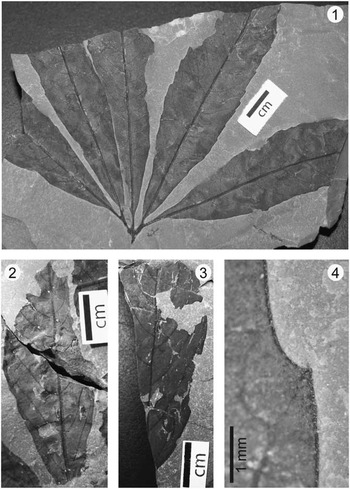
Morphotype CM12: (1) PB3037. Morphotype CM13 (cf. Kadsura sp.): (2) PB3006, (3) PB19866, (4) Kadsura oblongifolia Merr. (extant) from Hainan, China UCH612215 (http://clearedleavesdb.org/), (5) PB3004. Morphotype CM14 (Rogersia parlatorii): (6) PB2054, (7) PB2053, (8) vein detail of this morphotype.

Morphotype exemplar
PB3037.
Morphotype quality index
1.
Diagnostic features
Obovate lamina; L:W ratio of 1.1:1; secondary vein angles smoothly increase toward the apex (33.9°–57.7°).
Description
Simple leaf with marginal petiole attachment. The single specimen is 3.6 cm long and 3.4 cm wide (microphyll II), giving a L:W ratio of 1.1:1. Obovate lamina is symmetrical, unlobed with an untoothed margin. Apex and base not preserved, but extension of margins suggest a cuneate base with an acute base angle and a rounded apex. Pinnate primary venation. Secondary venation eucamptodromous. Distance between secondaries increases from 0.42 cm to 0.87 cm toward the apex. Secondary vein angles smoothly increase toward the apex from 33.9° to 57.7°. Intersecondaries absent. Higher vein orders not preserved. Petiole incomplete.
Specimen examined
PB3037.
Discussion
Berry (Reference Berry1919) described a species of fungus, Sphaerites alabamensis Berry Reference Berry1919 (p. 49, pl. V, fig. 1) infecting a leaf from the Tuscaloosa Formation of Late Cretaceous age from Alabama. The figured, but unidentified, leaf is identical to the single specimen of CM12 found at Soap Wash. Unfortunately, Berry (Reference Berry1919) did not identify the figured leaf, saying only that the fungus commonly infects specimens of Platanus shirleyensis Berry 1914 (Berry, Reference Berry1914a, p. 5, fig. 4), which does not correspond to CM12 in shape, margin or venation. In addition to shape, margin and venation, the specimen figured in Berry’s (Reference Berry1919) description of the fungal infection shows a pattern of damage that is identical to that observed in the Soap Wash specimen (Fig. 6.1). Thus, we are confident that CM12 corresponds to the form reported by Berry (Reference Berry1919) from Alabama, but our review of the literature and museum records could not identify the leaf taxon into which Berry (Reference Berry1919) intended to place the illustrated leaf fossil. Therefore, we leave the leaf morphotype CM12 unidentified. The damage observed to this specimen is the topic of ongoing research.
Morphotype CM13
Morphotype exemplars
PB3004, PB3006.
Systematic affinity
Kadsura Kaempf. ex Jussieu Reference Jussieu1810.
Morphotype quality index
3.
Diagnostic features
Ovate lamina; decurrent base; weak brochidodromous secondary venation with secondaries that are proximally subopposite and grade to alternate distally; secondary vein angles uniform.
Description
Simple leaf with marginal petiole attachment. Leaf ranges in size from microphyll I to microphyll III. No complete specimens are preserved but L:W ratio is approximately 3–4:1. Ovate lamina is symmetrical, unlobed and with an untoothed margin. Apex not preserved. Base decurrent. Pinnate primary venation. Weak brochidodromous secondary venation with secondaries that are distally alternate and increasingly subopposite to opposite toward the base. Spacing of secondaries uniform or increases toward the apex, ranging from 0.22 cm to 1.7 cm. Secondary vein angles are close to uniform, ranging on average from 38.5° to 43.5°. Intersecondaries present with an irregular course in which veins branch and disappear toward the margin. Random reticulate tertiary venation. On average, tertiaries are 1.03 mm apart and acutely angled at approximately 57°. Irregular reticulate quaternary vein fabric. When preserved, petiole averages 4.79 mm in length.
Specimens examined
PB3004–PB3007 inclusive, PB19851, PB19866.
Discussion
These specimens differ from the other specimens of the Soap Wash in their lamina and base shape, and venation. Like CM11, CM13 has a simple lamina with an untoothed margin and weakly developed brochidodromous venation that suggests affinities with the subclass Magnoliidae as defined by Hickey and Wolfe (Reference Hickey and Wolfe1975), which includes the modern concept of the magnoliid clade plus the basal angiosperm clade, Austrobaileyales (Cantino et al., Reference Cantino, Doyle, Graham, Judd, Olmstead, Soltis, Soltis and Donoghue2007, Angiosperm Phylogenetics Group, 2009). CM13 is provisionally assigned to the living genus Kadsura based on the acute base, thick, apparently fleshy petiole, and similarity with the secondary, tertiary and quaternary vein fabrics (see Fig. 6.4 for comparison to the venation of modern Kadsura oblongifolia Merr.), which is best observed in the partial specimen PB19866 (Fig. 6.3). Although Kadsura oblongifolia illustrated in Figure 6.4 has glandular teeth, several species of living Kadsura (e.g., K. acsmithii, K. celebica and K. borneensis) have untoothed margins and others (e.g., K. philippinensis) have both toothed and untoothed margins. Therefore, the absence of marginal teeth does not exclude CM13 from the genus.
Morphotype CM14
Morphotype exemplars
PB2053, PB2054.
Systematic affinity
Rogersia parlatorir Wang and Dilcher Reference Wang and Dilcher2006.
Morphotype quality index
3.
Diagnostic features
Lanceolate lamina with length five to six times longer than width; an untoothed margin; acute base and attenuate tip.
Description
Simple leaf with marginal petiole attachment. Leaf size microphyll I and II. No complete specimens but L:W ratio approximately 5–6:1. Eliptic lamina with distinct lanceolate shape, symmetrical, unlobed with an untoothed margin. Apex attenuate, base cuneate with an acute base angle. Pinnate primary venation and brochidodromous secondary venation. Secondaries are opposite, decurrent and diverge at acute angles. Secondaries diverge from the midrib at irregular intervals. Intersecondaries common. No higher order venation is preserved. Petiole incomplete.
Specimens examined
PB2053, PB2054, PB19863.
Discussion
Fontaine (Reference Fontaine1889) erected the fossil genus Rogersia for leaves from the Potomac Group that were long and narrow with untoothed margins. Rogersia angustifolia Fontaine Reference Fontaine1889, with which CM14 is aligned, is the most common constituent of the angiosperm flora from some localities of the Patuxent Formation of Virginia, particularly at Fredericksburg (Fontaine, Reference Fontaine1889, p. 288, pl. CXLIII, fig. 2; pl. CXLIX, figs. 4, 8; pl. CL, figs. 2–7). The fossil form also appears in the Cenomanian-age Dakota Formation of Nebraska and Kansas (Wang and Dilcher, Reference Wang and Dilcher2006). Wang and Dilcher (Reference Wang and Dilcher2006) synonymized Rogersia angustifolia Fontaine Reference Fontaine1889 with “Andromeda” parlatorii Heer 1866 (Capellini and Heer, Reference Capellini and Heer1866) to produce the new combination Rogersia parlatorii, and placed it in the Laurales clade. We apply Rogersia parlatorii to CM14 because it matches Wang and Dilcher’s (Reference Wang and Dilcher2006) description and illustrations.
Morphotype CM15
Morphotype CM15 (Dewalquea smithi): (1) PB2997, (2) PB3014, (3) PB3015, (4) tooth detail of this morphotype.

Morphotype exemplar
PB2997.
Systematic affinity
Dewalquea smithi Berry 1910 (Berry, Reference Berry1910a).
Morphotype quality index
4.
Diagnostic features
Compound leaf with trifurcate petiole; lateral two petiole branches bifurcated into two leaflets, the central of which leads to a single leaflet, for a total of five leaflets; asymmetrical bases; distinct concave-convex and concave-straight teeth with spinose apices; teeth absent on the basal one quarter of each leaflet.
Description
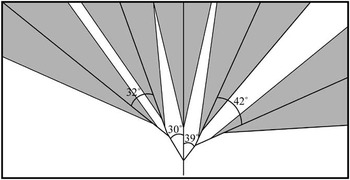
Palmately compound leaf with the marginally attached petiole divided into three branches. The lateral two branches bifurcate a second time into two laminae while the center branch terminates with a single lamina, producing a total of five leaflets (Fig. 8). Each leaflet is at least 11.7 cm long and 1.7 cm wide, producing laminae that are microphyll II in size; L:W ratio greater than 4:1. Each leaflet is elliptic. The two pairs of lateral leaflets are asymmetrical at the base, where the lamina extends farther down the petiole on the side of the leaflet closest to the central leaflet. Basal asymmetry is most pronounced in marginal leaflets. Leaflets are unlobed and untoothed in the proximal quarter (approx. 3 cm) of the margin and serrate distally. Apex not preserved. Decurrent base. Both regular and irregular teeth are present on the same lamina displaying both concave-convex and concave-straight tooth shape. Apices of teeth are spinose. Pinnate primary venation. Craspedodromous secondary venation with secondaries opposite proximally and subopposite to alternate toward the apex of the leaflet. Uniform spacing of secondaries averages 4.44 mm; secondaries angled uniformly with an average of 62.0° from the primary. Intersecondaries absent. Tertiary venation is mixed percurrent with tertiaries averaging 1.38 mm apart. Tertiaries acute to perpendicular to the primary with a sinuous course. The highest order of venation is four; fourth-order veins are opposite percurrent and form areoles that average 0.003 cm2. Petiole is at minimum 5.47 mm in length.
Schematic sketch of the lamina divergence angles for CM15, Dewalquea smithi Berry from Soap Wash specimen PB2997.

Specimens examined
PB2997, PB3014, PB3015.
Discussion
This morphotype appears identical to Dewalquea smithi Berry 1910 (Berry, Reference Berry1910a, p. 36, fig. 1). This species is abundant in the Late Cretaceous of the Middendorf arkose member of the Black Creek Formation in South Carolina (Berry, Reference Berry1914b) and the Late Cretaceous Tuscaloosa Formation of western Alabama (Berry, Reference Berry1919). Other members of the genus are described from Dakota Formation sediments (Lesquereux, Reference Lesquereux1891 [1892]). The divergence of the petiole into three branches, the lateral two of which bifurcate into two leaflets and the central branch leading to a single leaflet, is consistent with the original descriptions of D. smithi (Berry, Reference Berry1910a, p. 36, fig. 1). Additionally, the presence of serrate margins on the apical three-quarters of each lamina and craspedodromous secondary venation is consistent with later descriptions and illustrations (Berry, Reference Berry1914b, Reference Berry1919).
Dewalquea smithi is distinct from another common compound leaf in Early and mid-Cretaceous floras, Sapindopsis (e.g., CM02) in being palmately compound, where Sapindopsis is pinnately compound with leaflets in opposite to subopposite arrangement (Fontaine, Reference Fontaine1889, p. 296). In specimens where only the three top leaflets of Sapindopsis are preserved, the form may appear palmately compound. However, specimen PB2997 clearly shows the petiole arrangement of CM15 (Fig. 7.1) in which the lateral petioles bifurcate. This arrangement is a good match for the original illustration of the species (Berry, Reference Berry1910a, fig. 1) and distinct from described species of Sapindopsis that we identified in our review of the literature.
Morphotype CM16
Morphotype CM16 (Saliciphyllum sp.): (1) PB2082, (2) PB3023, (3) PB3025, (4) tooth detail of this morphotype, (5) PB3036. Morphotype CM17 (“Celastrophyllum” shirleyensis): (6) PB2065, (7) PB2066.

Morphotype exemplars
PB2082, PB3023, PB3025, PB3036.
Systematic affinity
Saliciphyllum Fontaine Reference Fontaine1889 and AS28 from the Aspen Shale, Albian of Wyoming (Peppe et al., Reference Peppe, Hickey, Miller and Green2008).
Morphotype quality index
4.
Diagnostic features
Lanceolate lamina that tapers to an acute or attenuate apex; decurrent base; finely serrate margin with generalized glandular teeth.
Description
Simple leaf with marginal petiole attachment. Microphyll I in size; L:W ratio 6:1. Lanceolate lamina symmetrical and ovate to linear. Lamina unlobed with a toothed margin. Apex shape straight with an acute angle. Base decurrent. Teeth regularly spaced, close and concave-flexuous or concave-straight in shape, with non-specific glandular apices. Pinnate primary venation. Secondaries are thin and indistinct. Secondaries are craspedodromous to semicraspedodromous straight, regularly spaced and diverge from the midrib at a consistent angle of approximately 45°; secondaries course straight toward the margin and curve toward the apex at the margin in the case of semicraspedodromous veins; craspedodromous veins terminate in a tooth. No higher orders of venation preserved. Petiole at least 3.81 mm in length and curved convexly at the tip.
Specimens examined
PB2033, PB2035, PB2047, PB2050, PB2062, PB2081–PB2084 inclusive, PB2089, PB2091, PB3008–PB3011 inclusive, PB3016–PB3028 inclusive, PB3031, PB3034, PB3036, PB19857–PB19862 inclusive, PB24847.
Discussion
This linear to ovate lanceolate morphotype was one of two dominant forms in the Soap Wash flora, with 38 well-preserved specimens. CM16 is identical to morphotype AS28 reported by Peppe and colleagues (Reference Peppe, Hickey, Miller and Green2008) from the Albian-age Aspen Shale of Wyoming. AS28 was not assigned to any previously described taxon (Peppe et al., Reference Peppe, Hickey, Miller and Green2008) and our independent survey of the literature did not yield any convincing matches with described species. In leaf shape and venation, CM16 resembled any of several described species of fossil “Salix” from the mid-Cretaceous, for example “Salix” flexuosa Newberry Reference Newberry1868. Newberry’s (Reference Newberry1868) written description matches CM16 precisely except that margin type is not mentioned; Newberry (Reference Newberry1868) provided no illustrations. Illustrations associated with subsequent reports of “Salix” flexuosa show an untoothed margin (Newberry, Reference Newberry1878, p. 21, pl. I, fig. 4). Subsequent reports follow this diagnosis (e.g., Berry, Reference Berry1914b, p. 32, pl. VII, figs. 14–16 from the Atlantic coastal plain). Other species, such as “Salix” lesquereuxii Berry Reference Berry1909 (p. 252) and illustrated subsequently (Berry, Reference Berry1914b, p. 33, pl. VII, figs. 11–13), also lack marginal teeth. Thus, we cannot place CM16 in these previously described species.
The teeth of CM16 strongly resemble the marginal teeth of some living members of Salix (e.g., Salix fragilis L. and S. alba L., which are native to Europe and western Asia, and S. petiolaris J.E. Smith and S. sericea Marsh from North America). These modern species are also very similar to CM16 in shape, L:W ratio, base, apex and some aspects of primary and secondary venation, suggesting either evolutionary affinities with the willow clade or extensive convergence. CM16 also lacks stipules, which further allies it with a subsection of extant European and North American willows. However, modern Salix species generally share percurrent tertiary vein fabric; tertiary venation is not preserved in CM16. Therefore, we do not assign this form to the modern genus.
Fontaine (Reference Fontaine1889) erected the genus Saliciphyllum to include abundant but poorly preserved willow-like forms from the Potomac Group. We have adopted this name for CM16 because of CM16’s similarities with some regional variants of modern willow. Fontaine’s (Reference Fontaine1889) original publication included a description of the venation of S. longifolium (p. 302, pl. CL, fig. 12) that indicates mixed to brochidodromous secondary venation. CM16 does not conform to this species. Margin form is also not mentioned in either the genus or species description (Fontaine, Reference Fontaine1889), nor was it mentioned in subsequent use of the genus (Ward, Reference Ward1905).
Morphotype CM17
Morphotype exemplars
PB2065, PB2066.
Systematic affinity
Celastrophyllum Göppert Reference Göppert1853, compares favorably with Celastrophyllum shirleyensis Berry Reference Berry1919.
Morphotype quality index
3.
Diagnostic features
Oblong lamina; convex base; glandular concave-flexuous teeth; festooned semicraspedodromous secondary venation.
Description
Simple leaf with marginal petiole attachment. Microphyll II in size. No complete specimens are preserved but L:W ratio is approximately 2.5:1. Oblong, elliptical lamina is symmetrical and unlobed. Serrate margins. Teeth spaced regularly, close and are convex/convex (rounded) in shape. Tooth tips are preserved in a variety of states, commonly all represented on the same specimen. Teeth may be tipped by a dark, rounded structure or recurved into spines. Apex not preserved. Convex base with an obtuse base angle. Pinnate primary venation. Festooned semicraspedodromous secondary venation with secondaries subopposite proximally and increasingly alternate toward the apex of the lamina. Spacing of secondaries increases toward the apex from approximately 0.5 cm to approximately 0.9 cm. Angle of secondaries ranges from 55.4° to 80.3°. Secondaries initially extend toward the margin and then shift course toward the apex as they approach the leaf margin. Intersecondaries present but poorly developed. No higher degree of venation preserved. Petiole incomplete.
Specimens examined
PB2065, PB2066, PB2078, PB19864, PB19867.
Discussion
Göppert (Reference Göppert1853) published the generic name Celastrophyllum without description or illustration and followed with a formal description (Göppert, Reference Göppert1854, p. 52). The genus was created for fossil forms that resembled modern Celastrus L. but were both ancient and did not conform to the modern concept in all details of higher-order venation. A variety of fossil species have been erected for forms from the Cretaceous and Paleogene. CM17 conforms closely to the single specimen of Celastrophyllum shirleyensis Berry Reference Berry1919 (p. 107, pl. XXVI, fig. 8) described and illustrated from the Tuscaloosa Formation of Alabama. CM17 shares similar shape and base, primary and secondary venation and the diagnostic tooth form. No other previously described species matches CM17 in both venation and tooth form.
Results
Table 2 lists the seven specimens in our collection of 152 fossils for which a complete lamina and some petiole was preserved and leaf mass per area (MA) reconstruction could be completed. Figure 10 plots the MA reconstruction for the seven Soap Wash specimens along with MA measurements from 468 extant species of woody angiosperms from 65 geographically and climatically diverse sites sampled by Royer and colleagues (Reference Royer2007). These modern analog samples were used to develop and calibrate the MA reconstruction for Cretaceous-age plants (Royer et al., Reference Royer, Miller, Peppe and Hickey2010) and to create a morphospace for the range in variation among extant angiosperms (Royer et al., Reference Royer2007).
The relationship between normalized petiole width (PW2/leaf area) and calculated leaf mass per area (MA) for a sample of extant woody angiosperms compiled by Royer and colleagues (Reference Royer2007). Complete specimens from the Soap Wash that preserved whole petioles were mapped onto this distribution using measured normalized petiole width and the best-fit regression equation provided by Royer and colleagues (Reference Royer2007).

Specimens from three morphotypes for which leaf lamina was complete and some petiole was preserved, allowing leaf mass per area (MA) calculation based on the modern analog study of Royer et al. (Reference Royer2007)
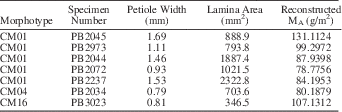
Discussion
No leaf floras from the Cedar Mountain Formation have been studied in detail, although angiosperm leaves have been noted by stratigraphers (e.g., Cifelli et al., Reference Cifelli, Kirkland, Weil, Deino and Kowallis1997; Garrison Jr. et al., Reference Garrison, Brinkman, Nichols, Layer, Burge and Thayn2007). Wood from angiosperms (Thayn et al., Reference Thayn, Tidwell and Stokes1985; Thayne [sic] et al., Reference Thayne [sic], Tidwell and Stokes1983) and conifers (Thayn and Tidwell, Reference Thayn and Tidwell1984; Tidwell and Thayn, Reference Tidwell and Thayn1985) has been reported from the formation. Trunks of the tree fern Tempskya are also known from this unit (Katich, Reference Katich1952; Stokes, Reference Stokes1952; Tidwell et al., Reference Tidwell, Thayn and Roth1976). The stems of dicotyledonous lianas have been discovered intertwined with the adventitious root mantle of Tempskya (Tidwell et al., Reference Tidwell, Ash and Britt2010), but leaves of these vines are not preserved. Furniss and Tidwell (Reference Furniss and Tidwell1972) tentatively reported cycadeoid trunks from the Cedar Mountain Formation near Moab, Utah. The Soap Wash leaf locality is well known to amateur collectors in the area and it is likely that many specimens are already in private hands.
The flora is broadly similar to others from the Albian and Cenomanian. Upchurch and Wolfe (Reference Upchurch and Wolfe1987) noted that floras from this time are characterized by leaves that are unlobed, pinnately veined, with untoothed margins, microphyllous average leaf size, and include few species with drip-tips. The Soap Wash dicots parallel this description in many respects, suggesting that they are morphologically consistent with other floras of their time.
More specifically, the Soap Wash flora shares taxa with a variety of other North American localities of similar age. For example, CM02 (Sapindopsis magnifolia) and CM03 (allied with the Cinnamomophylls of Crabtree, Reference Crabtree1987) are shared with the Albian deposits of the Western Interior, including Wyoming, Montana, Idaho, Washington state and Alberta, Canada (Crabtree, Reference Crabtree1987). Albian sediments of Wyoming preserve CM02 and CM06 in common with the Soap Wash flora (Peppe et al., Reference Peppe, Hickey, Miller and Green2008). The Winthrop Formation (Albian) of Washington State also shares CM02 with Soap Wash (Miller, Reference Miller2007). The Cenomanian-age Potomac Group rocks of the Mid-Atlantic region share forms in common with the Soap Wash collection including CM02 (Fontaine, Reference Fontaine1889) and CM09 (Leguminosites shirleyensis) (Berry, Reference Berry1911b), bilobed forms with affinities to CM10 (Liriodendrites sp.) (Newberry, Reference Newberry1895), CM14 (Rogersia parlatorii) (Fontaine, Reference Fontaine1889), CM08 (Proterophyllum sp.) (Berry, Reference Berry1911a), and CM15 (Dewalquea smithi) (Berry, Reference Berry1910a). Cenomanian-age sediments from the Dakota Formation of Nebraska and Kansas have also yielded floras with taxa in common with Soap Wash. For example, CM01 (Pandemophyllum inaequalis) is reported as one of the most abundant forms at a number of Dakota Formation localities (Upchurch Jr. and Dilcher, Reference Upchurch and Dilcher1990; Wang, Reference Wang2002; Wang and Dilcher, Reference Wang and Dilcher2006). CM08 (Lesquereux, Reference Lesquereux1874, Reference Lesquereux1891 [1892]), legume-like leaves similar to CM09 (Lesquereux, Reference Lesquereux1891 [1892]), bilobed leaves with affinity to CM10 (Newberry, Reference Newberry1868), CM11 (Capellini and Heer, Reference Capellini and Heer1866) and CM14 (Wang and Dilcher, Reference Wang and Dilcher2006) are reported from Dakota Formation localities. Other Late Cretaceous sediments from the Atlantic Coastal Plain (e.g., Georgia and South Carolina) and the Gulf Coastal Plain (e.g., Alabama and Texas) share a number of forms with Soap Wash including CM09, CM11, CM12, CM14, and CM17 (Celastrophyllum shirleyensis) (Berry, Reference Berry1907, Reference Berry1911a, Reference Berry1911b, Reference Berry1914b, Reference Berry1919). CM10, CM15, and CM17 share at least genus-level affinity with leaves described from the Woodbine Sand, Cenomanian of Texas (MacNeal, Reference MacNeal1958).
This summary makes clear that there were a number of cosmopolitan and widely distributed elements in the mid-Cretaceous (Albian–Cenomanian) flora of North America including taxa with affinities to Liriodendrites, Leguminosites, “Cinnamomum” (or Cinnamomophylls more broadly Crabtree, Reference Crabtree1987), Sapindopsis, and Rogersia. Some forms, such as CM01 (Pandemophyllum), that were abundant at other localities of similar age also dominated the Soap Wash flora (Upchurch Jr. and Dilcher, Reference Upchurch and Dilcher1990). We can conclude that the Soap Wash collection is floristically similar to other North American floras of its time, although it does preserve some forms that have not been reported elsewhere (e.g., CM04 and CM16 Saliciphyllum) or only from younger rocks (e.g., CM07 “Ziziphus” fibrillosus).
A surprising aspect of the Soap Wash flora is the nearly exclusive (one very poorly preserved conifer fragment, PB19865, ?Brachyphyllum, was collected but not illustrated due to its poor condition) presence of dicot angiosperms. All previously reported compression floras and palynofloras from Albian–Cenomanian rocks include many, abundant non-angiosperms, particularly conifers, ferns and cycads (e.g., Berry, Reference Berry1911b, Reference Berry1919, Reference Berry1922; Capellini and Heer, Reference Capellini and Heer1866; Dawson, Reference Dawson1885 [1886]; Fontaine, Reference Fontaine1889; Lesquereux, Reference Lesquereux1891 [1892]; Lupia et al., Reference Lupia, Lidgard and Crane1999; Miller and Hickey, Reference Miller and Hickey2008, Reference Miller and Hickey2010; Newberry, Reference Newberry1878). Thus, the all-angiosperm flora from Soap Wash is unexpected.
Compression floras like Soap Wash provide limited spatial and temporal perspective on vegetation (Burnham, Reference Burnham1994), while palynology provides a more regionally integrated picture. Repeated efforts to prepare pollen from the Soap Wash fossil matrix yielded no identifiable microfossils, although wood fragments were abundant. This is likely due to the carbonate content of the sediment. Other facies from the Cedar Mountain have yielded palynofloras. Tschudy and colleagues (Reference Tschudy, Tschudy and Craig1984) described a poorly preserved palynoflora from a brown mudstone collected near the top of the Upper Shale Member (lithologically consistent with the Mussentuchit Member of the Cedar Mountain Fm., Kirkland et al., Reference Kirkland, Britt, Burge, Carpenter, Cifelli, Decourten, Eaton, Hasiotis and Lawton1997) from a locality approximately 30 km southwest of the Soap Wash. Although the main purpose of their work was biostratigraphic, they described and illustrated a diverse palynoflora including ferns (e.g., Cyathidites, Gleicheniidites, Lygodiumsporites, and Laevigatosporites), conifers (e.g., Podocarpidites, Cedripites, Taxodiaceaepollenites, and abundant Classopollis, which is interpreted as a conifer, following Traverse, Reference Traverse2004), horsetails (e.g., Equisetosporites), and other seed plants (e.g., Cycadopites). Only about 68% of the palynomorphs were identifiable, but of those that could be identified, 47% belonged to angiosperms and 41% were forms produced by conifers (Tschudy et al., Reference Tschudy, Tschudy and Craig1984). This is consistent with compilations of palynological taxonomic richness that showed floras of this latitude average about 45% angiosperms by the Albian–Cenomanian transition (Lupia et al., Reference Lupia, Lidgard and Crane1999).
Since wind-dispersed conifers and ferns are expected to be over-represented in palynofloras, these palynological data (Tschudy et al., Reference Tschudy, Tschudy and Craig1984) suggest a landscape where angiosperms were abundant and diverse, but not yet the dominant elements of the landscape. This would be consistent with analyses of the Cretaceous angiosperm invasion of North America that show angiosperms preferred coastal and river-margin environments, while conifers dominated well drained stable upland soils (Retallack and Dilcher, Reference Retallack and Dilcher1986; Wing and Boucher, Reference Wing and Boucher1998; Wing et al., Reference Wing, Strömberg, Hickey, Tiver, Willis, Burnham and Behrensmeyer2012), and ferns preferred poorly drained organic soils (Wing et al., Reference Wing, Strömberg, Hickey, Tiver, Willis, Burnham and Behrensmeyer2012). Even so, the Soap Wash macroflora remains enigmatic because it preserves only angiosperms. Two hypotheses may explain this observation. First, the absence of other plant groups may be an artifact of limited collecting. Although three separate field crews spent approximately 15 person-days collecting a relatively small site, our collection includes only about 150 identifiable specimens. Many morphotypes are represented by one or a few specimens (Table 1). On each of the collecting trips to this locality, it was clear that others had recently worked the site. We hope that this publication will bring some of the material collected by others to scientific attention. A larger collection might yield a wider range of taxa and fill out the range of variation within the described morphotypes. Second, sedimentological observations suggests that the Soap Wash flora was deposited in a small, possibly ephemeral pond on the ancient floodplain. Angiosperms might have dominated this habitat while conifers, other seed plants, and ferns were relegated to areas farther from sites of active deposition (Retallack and Dilcher, Reference Retallack and Dilcher1986). This hypothesis is consistent with angiosperms dominating streamside habitats in the contemporaneous strata of the Potomac Group (Doyle and Hickey, Reference Doyle and Hickey1976; Hickey and Doyle, Reference Hickey and Doyle1977). Angiosperm preference for recently or regularly disturbed habitats seems to persist well into the Late Cretaceous (Wing et al., Reference Wing, Hickey and Swisher1993; Wing et al., Reference Wing, Strömberg, Hickey, Tiver, Willis, Burnham and Behrensmeyer2012), and may be a more general feature of Cretaceous angiosperm ecology (Wing and Boucher, Reference Wing and Boucher1998). Although the Soap Wash site preserves no direct sedimentological evidence of disturbance, seasonal filling and drying of ephemeral ponds, which has been reported throughout the Mussentuchit Member (Kirkland et al., Reference Kirkland, Scheetz and Foster2005), would constitute water-stress disturbance to plants growing along the shoreline. Indeed, climatological analysis of this site based on its angiosperm flora yielded significant seasonality in precipitation (Arens and Harris, Reference Arens and Harris2015). Seasonal variation in precipitation and water level could constitute the sort of transient habitat favored by fast-growing Cretaceous angiosperms. Seasonal drought might also disfavor ferns, which are notable in their absence because they are important disturbance plants on other substrates (Wing et al., Reference Wing, Strömberg, Hickey, Tiver, Willis, Burnham and Behrensmeyer2012).
If the Soap Wash flora represents weedy colonizers in an ephemeral habitat, we predict that the leaves should have low leaf mass per area (MA) values characteristic of fast-growing, low-investment leaves (Wright et al., Reference Wright2005). All but one of the specimens from Soap Wash for which the MA calculation was performed (Table 2) produce values below the 125 g/m2 value considered to represent a low MA in the modern flora and characteristic of fast-growing, low-investment ecology. Wright and colleagues (Reference Wright2005) noted that among deciduous leaves, higher MA values characterized climates with warmer mean annual temperature. MAT for Soap Wash is reconstructed between 16°C and 26°C with no freezing season (Arens and Harris, Reference Arens and Harris2015), which is consistent with MA values near the middle of the range of modern angiosperm variation. MA values for Soap Wash are, on average (95 g/m2), similar to but slightly more dense than those of contemporaneous floras from the Winthrop Formation, Patapsco Formation (Potomac Group) and Aspen Shale (Royer et al., Reference Royer, Miller, Peppe and Hickey2010), suggesting similar, weedy ecology but perhaps under a somewhat warmer climate setting.
Conclusion
The Soap Wash flora from the Cedar Mountain Formation of Emery County, Utah provides a window into angiosperm diversity and ecology at the Albian–Cenomanian transition from the Western Interior of North America. This assemblage is floristically similar to other sites of this age, with the majority of the genera shared with contemporaneous floras of the Mid-Atlantic region (Potomac Group), the Atlantic Coastal Plain (Georgia and South Carolina), the Gulf Coastal Plain (Alabama and Texas) and the Dakota Formation of Kansas and Nebraska. Nonetheless, three of 18 morphotypes identified in this collection appear not to have been previously described (Table 1), suggesting some regional variation in the composition of an otherwise cosmopolitan mid-Cretaceous flora. Despite these biogeographic similarities, the Soap Wash flora is unusual for its time because it is overwhelmingly dominated by angiosperms, which is likely due to flowering plant dominance of the ephemeral pond-side habitat. Leaf mass per area analysis confirms that the Soap Wash angiosperms were most likely fast-growing, short-lived, low-investment plants that preferred disturbed or ephemeral habitats, a conclusion that is supported by the sedimentological interpretation of the site. If seasonal drought was the main agent of disturbance in this habitat, as suggested by climatic analysis (Arens and Harris, Reference Arens and Harris2015), then this also explains the lack of disturbance-loving ferns in the collection.
Further investigation will address some of the remaining questions that surround this flora: (1) Is this all-angiosperm macroflora representative of this place and time? Since macrofloras generally give a narrow spatial and temporal window on vegetation, palynological work on correlative sediments will be needed to address this question. (2) Is the all-angiosperm flora typical of the pond-side habitat? Locating additional macrofloras from this region preserved in similar lacustrine environments and in other depositional facies will allow us to recognize spatial and habitat heterogeneity and habitat specificity in the mid-Cretaceous flora. While no other assemblages of fossil leaves have been described from the Cedar Mountain Formation, other localities with similar lithology are known, suggesting that additional field work could yield new floras that would expand our understanding of mid-Cretaceous plant communities.
Acknowledgments
Thanks to E. Cochran, D. Hopkins, D.C. Kendrick, and R.R. Parker for assistance with fossil collection. D.C. Kendrick and C.A. Caron provided helpful comments on various versions of this manuscript and we are grateful to D. Peppe and several anonymous reviewers for helpful suggestions. We also wish to acknowledge the Google Books project for making available in electronic form a wide variety of 19th and early 20th century literature that would otherwise be inaccessible to us at a small liberal arts college. This work was partially supported by the Department of Geoscience at Hobart and William Smith Colleges, the Summer Science Program at Hobart and William Smith Colleges, and an American Chemical Society Petroleum Research Fund grant (ACE-PRF 49336-UR8 to N.C.A.).