L'honneur c'est comme les coquilles Saint-Jacques, Gros: bien lavé ça ressert
—San-AntonioSome anthropologists can argue that it is impossible to separate the social organizational (the realm of groups or aggregates—e.g., households, lineages, and farms) from the cultural (e.g., norms, rules, values, ideologies, and the like—hereafter, normative mental representations) and that the distinction between social and cultural anthropology is therefore an artificial one. To the contrary, others can argue that the social organizational (or “groupal”) and cultural perspectives refer to two analytically separate albeit intertwined levels of reality, sometimes shed a different light on a single phenomenon, and have different analytical value. This distinction I show through the study of the notion of “honor” and its relation to the gender division of labor and to the status of women in Tunisia.
Much has been written about the concept of honor in the Mediterranean and Middle East.Footnote 1 Social scientists have drawn attention to its various manifestations. Yet it has always been understood as a cultural code—the famous “code of honor”—that is to say, a set of normative representations aimed at the regulation of (inter)action. This is no more explicit than in David D. Gilmore's claim that “the honor/shame syndrome regulates both inter- and intrasex relations.”Footnote 2
This cultural perspective raises problems, and I propose a social organizational reading of honor, focused on the dynamics of the peasant household. I test its analytical usefulness on the process of “feminization” of agriculture in northwest Tunisia and its impact upon the status of women.Footnote 3 In the process I give elements of reflection for a reexamination of traits that form a part of the cultural imagery of the Middle East and North Africa (MENA): the zināʾ–fitna relation, the values of individualism and autonomy, women and houses as ḥarām domains, hospitality, and the preoccupation with agnatic purity.
HONOR: AN EXAMINATION
Behind the several manifestations of honor (sharaf, ʿirḍ), it seems possible to distinguish three broad dimensions: spatial, normative and behavioral, and status related.
The spatial dimension refers to a division between a “public” and a “private” space and the assignation of one and the other to men and women respectively. MENA women's range of action, in terms of space, is limited when compared to that of men, and households whose women remain in or around the dwelling possess a higher prestige. This centripetal orientation, however, by no means presumes the nature of the tasks allotted to genders. Here, location is more important than the intrinsic nature of the task.
For reasons that will be discussed, difficulties arise when we impart to this spatial orientation a normative and behavioral one, which refers to the existence of a set of rules driving individuals to (inter)act in a certain manner and determining a whole set of gendered tasks: men and women perform this or that activity (e.g., farmwork for the former, domestic tasks for the latter) because a code of honor compels them to do so. This code would function on a rigid, dichotomous basis. Expressions like “women's separate world,” “gap between the sexes,” or “women's subsociety,”Footnote 4 to name but a few, testify to the way gender (and honor, as an example) generally has been conceptualized.
Modesty (ḥishma) has for a long time been conceptualized as the complement of honor, the former being associated with women, the latter with men. It has been suggested that both are in fact one and the same thing: modesty is the “honor of the weak,” or the honor displayed by the underprivileged, mainly women and youngsters.Footnote 5 Both concepts are but two sides of the same coin; they refer to ideal standards and express a series of values and moral principles that differ only in their form. Whereas honor spells exhibition and ostentation, modesty implies discretion and concealment. In the end, however, both are normative representations organizing (inter)action.
The third, status-related dimension of honor refers to individual reputations and to their inscription into a hierarchy. This dimension is articulated around the idea of prestige (or esteem, reputation) and is twofold. A first aspect refers to the subjective estimation of oneself (self-esteem). In that sense, it appears akin to, or symmetrically inverse to, shame (ʿār). Both notions refer to individuals' assessment of their own value, except that this assessment is positive in one case and negative in the other. A second aspect of honor qua prestige relates to the value one acquires in the eyes of one's peers, according to one's capacity to conform to norms; it then functions as a ranking device.Footnote 6 It explains, for example, why households with women who have traditionally remained secluded enjoy a higher prestige than those with women who work outside the house.
This dimension and the idea it conveys do not seem to me problematic, for they refer only to what one has—prestige being understood as a “symbolic capital”—regardless of what one does (actual behavior). They circumvent the paradoxical aspect of honor, that there is sometimes inconsistency between honor qua code and honor qua prestige. Actual behavior sometimes differs from culturally defined norms but without affecting reputation.
A further examination of honor qua prestige, however, surreptitiously brings us back to behavior and its regulation. Honor as prestige would entitle individuals to a “right to pride” and a just treatment in return for their conduct,Footnote 7 an idea Frank H. Stewart echoes when writing of honor as a “right to respect.”Footnote 8 Yet a right for oneself is a duty for others. Honor qua prestige is then no less than a normative device determining the behavior one's peers ought to adopt toward oneself. Furthermore, it dictates the type of behavior the “man of honor” ought to adopt. The more prestige one has, the more one should behave in accordance with the norms of honor.Footnote 9 Honor qua prestige indirectly brings us back to honor qua code. The notion of shame is no different. It represents a personal assessment of one's own value but expressed negatively. As such, and most of all if self-assessment is supported by social sanctions, shame acts as a “brake” on antisocial behaviors.Footnote 10 In other words, it constitutes yet another regulatory device.
Overall, under the guise of honor and its correlates we find norms dictating behavior and interaction. Yet, a classical tradition of social anthropology made a sharp distinction between the realm of groups (social organization) and that of normative representations regulating interpersonal behavior. The two perspectives define different types of problems and yield diverging results. A look at the changes that have occurred in the Tunisian countryside and their impact upon the status of women helps to illustrate this.
FEMINIZATION OF AGRICULTURE AND THE STATUS OF WOMEN IN TUNISIA: PRELIMINARY OBSERVATIONS
In Tunisia, women's involvement in agriculture goes back a long time,Footnote 11 although it was limited in terms of space and range of activities and concerned the neediest fringe of the population. In the 18th and 19th centuries the peasantry's gender division of labor seemed characterized by a sharp dichotomy. On the one hand, men were associated with the outside world and were responsible for all farmwork (plowing, harvesting, threshing, etc.); on the other hand, women were responsible for domestic tasks and confined to their house and its immediate proximity, except for fetching water and wood.Footnote 12 Such a separation between the male and female realms was still observed in the 1960s, from the peasant villages of the Mejerda valley in the north to the southern oases. In the oasis of Shebika, for instance, Jean Duvignaud observed that even spouses hardly spoke to each other.Footnote 13 Jean Cuisenier made the same observations in the lower Mejerda valley.Footnote 14 In Pierre Bardin's study of the upper Mejerda valley, women's worlds revolved around the dawwār (hamlet) while field work devolved to men exclusively.Footnote 15
Research conducted in the 1970s presents a slightly different picture. Sophie Ferchiou states that women play, and have always played, an important role in agriculture in south Tunisia but that it has always remained underestimated, even denied.Footnote 16 Mira Zussman, working in the same region as Cuisenier, reports that women's places were in the house and courtyard; nonetheless some women worked as farm laborers, although this was considered dishonorable, which echoes Nicholas S. Hopkins's observations in Testour.Footnote 17 Pierre Robert Baduel, in the Nefzawa (south Tunisia), noted that a growing number of women were recipients of their husbands' remittances and that, although they did not work the land, these women commanded the khammāsa (sharecroppers) and day laborers.Footnote 18
Studies testify to the expansion of female labor in the agricultural sector as a result of male labor migration.Footnote 19 This phenomenon is important in the northwest, as Laroussi Amri's study demonstrates.Footnote 20 The research from which this paper is drawn was conducted in that area, more specifically in the region of Nefza.
There, the inability of the agricultural sector to provide for the needs of the population and the lack of job opportunities in the region have led to male labor migration.Footnote 21 Even before the establishment of the French protectorate in Tunisia (1881), 10 to 15 percent of Nefza's men went to work in the region of Beja, the current capital of the Beja governorate.Footnote 22 This proportion has increased ever since, and much agricultural work has thereby devolved to women. This is the case in Rmayniyya, a small peasant village typical of the region. In 2002, in this community of smallholders, internal pendular migration concerned 83 percent of men aged between twenty-one and forty-five, most of whom worked in the Tunis region in the building sector and came back home for a few days on a monthly or bimonthly basis (sometimes less frequently). Ninety percent of the people working on the farms were women.
This process has had several repercussions. First, women now execute tasks “traditionally” assigned to men. Second, they have acquired greater decision-making powers within the household. Third, a majority of women publicly introduce themselves as farm heads. Finally, the improvement of women's self-perception has in turn helped transform the public and cultural representations of women and somewhat redressed the traditional and yet prevailing gender asymmetry.
Before delving further into these observations, let us first ask how they can be interpreted in the framework of honor understood as a cultural code. That is, how can women take over agricultural work and redefine their roles where a code precludes them from doing so? How can one explain that women have gained prestige while transgressing the very boundaries of the gender division of labor? There can only be one logical answer: because gender roles and the code of honor have changed.
This raises problems. Normative mental representations, a dimension of the notion of culture, could be considered a set of rationalizations of observable facts (either emerging or actual).Footnote 23 By definition, rationalizations are ex post facto. Let us assume that we can identify conditions of emergence of a given collective practice; this could be said to amount to an “explanation,” and normative mental representations would be the ideological superstructure that made sure that this practice kept on being carried out. These representations are not what explains but what should be explained. Such ideological superstructure may surely account for resistance to change (albeit at the cost of a tautology: women do not work in agriculture because it is shameful, and it is shameful because women are not expected to work in agriculture), but it could hardly be said to explain anything, including the feminization of agriculture.
This process and the consequent improvement of women's status within the family farm and the society (as well as “traditional” gender roles) can be better understood when, while keeping its spatial and status-related dimensions, we jettison the normative aspect of honor and define the latter in relation to the internal dynamics of the peasant household.
HONOR: A SOCIAL ORGANIZATIONAL READING
Household Sovereignty and Symbolic Capital
In daily speech, the people of Rmayniyya hardly ever use the word “honor.” Uni Wikan made the same observation in Oman and Egypt.Footnote 24 This is no reason, however, to disqualify the notion altogether. People are more likely to sanction inappropriate acts than to emphasize proper ones. As Gideon Kressel remarks, “The elementary course of socialization . . . deters more than it encourages.”Footnote 25 In Rmayniyya, “Shame (on you)” (ʿĀyb [ʿalīk]), “Be modest” (ʾAḥsham), or “S/he is worth nothing” (Mā t/yaṣlaḥsh) are more commonly heard expressions. Instead of “honor,” people use synonyms such as “reputation” (sumʿa) or “value” (qīma), namely, notions reflecting exactly what is meant by “honor.”Footnote 26
Borrowing from Pierre Bourdieu's lexicon, I define honor as “symbolic capital.”Footnote 27 Symbolic capital (henceforth used interchangeably with honor and prestige) refers to an intangible property reflecting the value of an individual. It is not expressed in absolute terms but in relative terms and works as a ranking device. This intangible property has the particularity of being granted by others as a result of their perception and judgment.
However, on what basis is one's symbolic capital measured? The answer lies in the dynamics of the peasant household.
Prior to the French protectorate, the authority of the former beylik state over the mountain populations of northwest Tunisia was limited. The relationship the populations had with the central power was restricted mostly to tax payment, which was subject to negotiations and contestations.Footnote 28 Households were practically autonomous in economic and political matters and acted as “family-nations,” to borrow Paul Pascon's image.Footnote 29 Local leaders, shaykhs, merely acted as primi inter pares in the village assemblies (miʿād, jamāʿa); their authority was limited and their position uncertain. Allegiance was owed first to one's own household and then to close kin and neighbors (very often kin). Distant kin and strangers were treated with more suspicion. Household sovereignty, coupled with the hostility of the environment, resulted in a climate of rivalry and distrust that only the need of alliances could curb.Footnote 30 Raids and pillaging were frequent.
This type of organization recalls what Jane Schneider, after Edward C. Banfield, called “familism,” which Gilmore, inspired by Arthur J. Rubel and Harriet J. Kupferer, later rephrased in terms of “social atomism.”Footnote 31 In my view, these concepts—like the values of egalitarianism, personal autonomy, and individualism, believed to characterize the MENAFootnote 32—reflect and underscore the household's autonomy, which also serves to explain women's centripetal orientation. In contexts of economic and political stress as in the MENA, the protection of women and their relegation to the household was, as Louise E. Sweet argues, “an attitude consistent with boundary defense of a social system composed of relatively exclusive social units (familial or household).”Footnote 33 Where rivalry between independent households was equaled only by their suspicion of one another, women's tendency to move inside the house or within its immediate proximity could not be seen as a form of deprivation.Footnote 34 Rather, households appeared as a haven.
In my opinion, the sacred and forbidden (ḥarām) character bestowed upon women and housesFootnote 35 stems from this feature. Likewise, the belief in the anthropology of the Arab world according to which fornication (zināʾ) entails social disorder (fitna) could simply underline and derive from the fact that it breaches the household's sovereignty and violates boundaries, more or less amounting to a declaration of war.
In those days, and up to the establishment of a strong state apparatus, the value of symbolic capital reflected the group's capacity to exert control over its boundaries and to defend (and expand) its productive resources (land, cattle, and labor) as well as its reproductive resources, namely, women (who also served to conclude or maintain political alliances). Protection of these means of (re)production allowed the family farm to maintain or reinforce its prestige. The everyday life of women of large landowners and of the upper class revolved around the house and its immediate proximity, where they carried out domestic tasks and worked wool; their menfolk and/or hired laborers took care of the fields and animals. Only poor women worked in the fields—their own or, still more dishonorable, those of larger landowners.
The Tunisian state has now replaced the household as sovereign political unit, but this does not necessarily mean that the notion of honor has radically changed. Indeed the current political organization of the country has maintained some of its former aspects. First, the Rassemblement Constitutionnel Démocratique (the political party at the head of the government) is present in the smallest of villages thanks to its widespread cells (shaʿba), and this makes it possible to retain the political sphere close to the household (e.g., conflict arbitration). Second, the authoritarianism of the Tunisian state and the fear of informers have also contributed to maintaining a climate of suspicion that goes beyond the political sphere, permeating economic and matrimonial exchanges in particular. Trust (thiqa) forms the basis of personal relationships and is a good that one lends with discernment, which an informant aptly illustrated by quoting the saying, “Three things do not exist: the ogre, the phoenix, and the best friend.” However, the degree of trust between two individuals is a function of the degree of kinship and spatial distance between them. As it happens, because of inheritance rules and patrilocality, kinship proximity (in the present case, agnatic) and spatial proximity are often closely related.
If households are no longer autonomous politically, they nevertheless seek to retain their economic autonomy and translate this autonomy in terms of sovereignty.Footnote 36 Of course economic autonomy does not spell self-sufficiency because family farms, however productive they may be, are involved in the wider market economy. Economic autonomy here refers to the decision-making power concerning the use of the means of production, the destination of products, and the way money is spent; it also refers to the group's ability to satisfy immediate and deferred consumption needs. In brief, it still refers to some kind of sovereignty households exert over their dominions (which vary in size and strength). As Hopkins observed in Testour, there is a link between the value of being “free” (ḥurr) and being a man.Footnote 37 Conversely, were peasants (and more so their womenfolk) to work on someone else's farm, they would be despised by their fellow villagers, for this would testify to their poverty and inferior status.
Rmayniyyans continue to represent economic autonomy in terms of sovereignty because symbolic capital still designates the importance of the household's “estate.” As before, the household's honor is measured by its ability to defend (and increase) its material and social capital, and the image of a household as a state is still anchored in people's minds. One day, for instance, while talking about family matters, I asked an informant why a man always wishes for many male offspring. He answered straightforwardly, “So that he becomes a state!” (Bēsh ʾiwellī dawla). It is interesting that former Tunisian president Habib Bourguiba had drawn the same parallel.Footnote 38
Drawing up an exhaustive hierarchical chart of the village on which one could read the position of each household and of its members is impossible. The extremes, however, are more easily identifiable. At the bottom of the hierarchy, for instance, one finds landless households or very small landowners, the unemployed and small-wage earners, couples married precipitately because the woman had been pregnant before marriage, and households wherein a woman was suspected of prostitution, and so forth (needless to say, a single household can combine several of these features). On the upper scale of the hierarchy one finds larger households comprising more than one family unit, those possessing important means of production (e.g., a tractor and/or land, especially if kept in joint ownership) or a business, those whose members attended high school at a period when this was infrequent, and those whose members play an active role in the local Destourian cell and who are asked for advice, who arbitrate conflicts, and who act as intermediaries with local authorities, and so forth.
Relative status is often revealed at the moment of public ceremonies (or during conflicts). Betrothals and marriages, circumcisions, funerals, and so forth are occasions when the host ostensibly displays both his material capital (through the food offered, the clothes worn by group members, especially women, the entertainment, etc.) and his social capital (through the number and prestige of the people attending the gathering).Footnote 39
Women and Symbolic Capital
Raids and pillaging and ensuing insecurity now belong to the past. Neither material goods nor lives are threatened as they used to be. However, to a certain extent men see women as “potential sexual objects,”Footnote 40 representing a threat to their physical (read, sexual) integrity. Relationships between men and women, more so nonkin, incur suspicion of sexual transgression. As an informant said, “In the meeting of a man and a woman the Devil is always present.” Therefore they avoid having contact; the household's social boundaries and honor are at stake. The weight of this belief lessens as women grow older and approach menopause, as they have more liberty of movement and talk more freely to men.
My understanding of honor borrows from Carol Delaney's observations in a Turkish peasant village, although I derive from social organizational considerations what she refers to as cultural representations.Footnote 41 In Turkey (as in Tunisia) procreation is traditionally conceived of in terms of seed and soil; the role of men is to plant the seed whereas that of women is limited to gestation. Although the comparison with soil is a correct translation, the image of a field would be more accurate, Delaney argues, “[for] a field is enclosed or ‘covered’ by ownership.”Footnote 42 In accordance, women appear as a “property” that needs to be fenced in.
What is at stake here then is what Delaney calls the “legitimacy of paternity,” better described as men's obsession with the certainty that they are the true genitors of their wives' children. Just like a field, “the female soil must be enclosed if a man is to know unquestionably that the produce, that is, the child, is his own.”Footnote 43 Women's honor lies in their capacity to guarantee the security of their husband's seed whereas that of men derives from their ability to generate this seed and prevent access to their wives. From this, Delaney derives a whole series of practices—women's seclusion, veiling, clitoridectomy, early marriage, and the gender division of labor.
Delaney does not explicitly account for people's concern with agnatic purity, and the latter appears as an aim in itself. Delaney nonetheless implicitly provides an explanation. She observes that villagers have no equivalent terms for “procreation”; they use the words uremek and coğalamak, which both mean “to increase and multiply.” Both are used interchangeably to denote what in social sciences we refer to as “production” and “reproduction.” From this she draws two conclusions. First, what is important is not the distinction between production and reproduction but the devaluation of women in these processes.Footnote 44 Second, the role of men and women in production and reproduction obeys the same logic and—and this explains the importance of the legitimacy of paternity—has the same finality: perpetuating and increasing the household.Footnote 45 In short, Delaney first presents honor as a code having its basis in the indigenous theory of procreation, a cultural representation whose stake is the legitimacy of paternity. However, when it comes to explaining why legitimacy of paternity is so fundamental, we are brought back to the household and its rationality.
Furthermore, her emphasis on the legitimacy of paternity may justify people's concern for women's fidelity, but it fails to explain their preoccupation with female virginity. That is to say, the legitimacy of paternity helps to understand the cuckold's dishonor; he cannot prove that the child is his. For the same reason, we may understand the man who refuses to marry an unmarried girl who is no longer a virgin. However, this argument cannot explain the humiliation of the household with an unmarried daughter who has been made pregnant.
Delaney falls short of an answer because she does not truly focus on the whole group—the household—but rather on the husband/wife relationship. She therefore excludes daughters from the estate. However, the analogy between women and land, as well as people's concern for women's fidelity and virginity before marriage, can all be articulated and explained in terms of household sovereignty and social boundaries, which include both wives and daughters as part of the household's dominion (in addition to men, it should be stressed, and all other assets). When reinterpreted from a group perspective, Delaney's claim that “[a] man's honor is . . . related to his power to protect the inviolability of what is his”Footnote 46 fully makes sense. If honor is not merely a man's but a whole household's responsibility, then the concern with agnatic purity, with married women's fidelity and unmarried women's virginity, necessarily follows.Footnote 47
The danger with such a representation of honor is objectifying women by reducing them to the status of reproducers. Yet, as a whole literature shows, MENA women are active agents who exert power within the household, which my own observations in Tunisia confirm. What should be stressed is that women have the peculiarity of being at once object and subject of the household's dominion; they are at the same time a coveted resource and the guardians of this resource. This is what Schneider suggests when she asserts that women are “contested resources” who nonetheless “can be socialized to bear part of the ‘defensive burden’ themselves.”Footnote 48 I believe that shame and modesty, usually associated with women, should precisely be considered as a defensive and policing device aimed at preserving the inviolability of the group's frontiers. This would partly explain women's association with the house and its immediate proximity.Footnote 49
This reinterpretation of honor in terms of households-cum-family-farms helps us to rethink the gender division of labor by translating in terms of spatial orientation (defined around the house) what has been conceived of in terms of dichotomous, gendered norms and behaviors. By definition, center and periphery are but vectors defining spatial horizons within which men and women's activities tend to be performed. This tendency presupposes poles, but these poles do not determine the nature of activities, apart from the fact that some tasks can be executed only in some places. This tendency does not imply that men and women never perform the same activity (together or separately) or that the former do not work near their house and the latter beyond this space. The fact remains that within a single space some activities are considered exclusively male or female. Why?
I have hitherto defined symbolic capital as relating to the household and its dominion, measured in terms of social and material capital. In addition to this type of symbolic capital, there is another one, related to the symbolic asymmetry between the genders. In the Arab world (as elsewhere), men qua category possess a greater symbolic capital than womenFootnote 50 and therefore keep for themselves activities considered prestigious.
This takes us back to the gender division of labor, which I now reexamine in the dual light of symbolic capital defined according to the expansive dynamics of the household and spatial orientation and of symbolic capital defined previously in terms of the symbolic asymmetry between genders. I then extend the analysis to the process of feminization of agriculture in Tunisia and its repercussions upon women's honor and status.
FEMINIZATION OF AGRICULTURE AND WOMEN'S STATUS IN TUNISIA: CONTINUITY AND CHANGE
Women's Work and Spatial Orientation: Social Boundaries and Symbolic Asymmetry Preserved
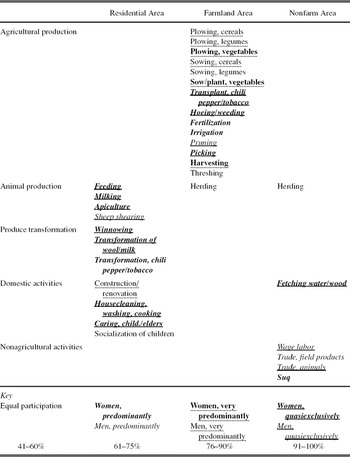
To reexamine the gender division of labor in terms of house and space (see Table 1), I have divided the latter into three concentric circles: the residential area, including the house, outbuildings, and immediately adjacent land; the farmland area, encompassing the farm's estate but excluding the residential area; and the nonfarm area, referring to all areas located beyond the farm's estate (mountains, marketplace, etc.).
The gender division of labor according to space

As Table 1 shows, most of the activities women perform take place within the residential area; therefore women still appear to “tend” toward the house. These activities also rank among the most time consuming. A detailed analysis of the figures provided by a survey on the time budget of rural Tunisian householdsFootnote 51 reveals that a little more than half of the 12.6 hours spent daily on farmwork by women in the northwest is restricted to activities performed within the residential area. Read differently, this implies that they nonetheless spend nearly half of that time away from the residential area (one fourth in the farmland and another fourth in the nonfarm areas). They can be seen herding animals through the mountains and on fallow land, and many of them also go to the town of Nefza and attend its weekly market.
Yet women's presence in these spaces is not without restrictions—and is more often than not furtive. For reasons of security (fear of wild boars, notably) but also in order to mutually control each other and/or avoid gossip, women prefer going to the mountain in groups of two or more. Wandering about aimlessly in the marketplace is not proper for upright women.
As for female wage labor in nonagricultural sectors, it is not frequent in Rmayniyya but increasing. When work is necessary in times of hardship, women try to conform to the requirements of honor by avoiding jobs that imply working with men. Some young women work as seamstresses alongside other women in Tunis textile factories and live with kinspeople. If it is impossible to work in an exclusively female environment, women seek to work with kinsmen, alongside a father or brother in a Tunis factory, for instance, or on the east coast. As for young adults who work as servants, they move within the relatively closed confines of a family. Although this may not protect them from being harassed or sexually abused by an unscrupulous employer, the parents of these women try to ensure that they will be well treated by the host family; their only guarantee is trust. Domestic service is less valued than other wage labor, however.
Of all Rmayniyyan women who work, only two are regularly in contact with unrelated men, and this takes place within a particular context. One of them is a trader in local markets throughout the region and has no choice but to work. Her husband is ill, has no land, and works only occasionally. Because she is in contact with many men (those who accompany her, by truck, and take her merchandise at the market, or those she meets at the market) and because she goes far away from home, she does not enjoy an uncompromised reputation.
The situation of the other, younger working woman is different. She works in a restaurant that belongs to her brother and works with his wife in the agglomeration of ʿAyn al-Arnub, located downstream from Rmayniyya. She is considered to be working for her family, ḥurr, and not for someone else. Her brother is relatively well off and respected in the area. She is not only related to her coworker but is also frequently visited by male kin. In addition, during the week she sleeps at her brother's house, near the restaurant, and goes directly home after work, through a pathway taken by women that avoids the front of cafés. The nature of the relationship both between the two women and to the owner, in addition to the protection of male kin and the proximity of her brother's house, allows the young woman to work in a male context without tarnishing her reputation. The situation of working upper-class women in ʿAyn al-Arnub is similar.Footnote 52
How can we reconcile these observations with honor as defined in terms of spatial orientation? The more that women work in or around their houses the greater their prestige. Such is the case of households with enough men to let all or part of their womenfolk stay in the house. In Rmayniyya this applied to very few households and only temporarily (daughters on the verge of getting married, newlywed or pregnant daughters-in-law, women too old to work). Such is also the case of Rmayniyyan women married to men who (or their parents) have moved to the city, become rich, and possess greater prestige. These women do not work outside their house, even if they did before marriage, and become “girls of the house” (bnāt dār, respectable housewives). For instance, when they go back to the village for marriages, in some cases wearing the hijab, they and members of their household are treated with great care.
Most Rmayniyya women, however, work in the fields, but this does not mean that their and their households' honor has been diminished. By coming out of the house, moving into farmland areas, and increasingly into the nonfarm areas, they no longer seem “fenced in”; yet, the farther one moves away from the residential area, the fewer women there are. However, men have more or less vacated both the residential and the farmland areas and spend most of their time on labor migrations. Most men, especially the most “dangerous” ones (those between twenty-one and forty-five years old, whom people consider more sexually active), work primarily in the nonfarm areas, as migrant wage earners. Those who remain in the village are either retired or young and considered inoffensive, so to speak. In short, the spatial frontier separating men and women's worlds has been pushed further, but the frontier remains. Work has been “respatialized” in such a way as to keep the genders separated and the household's dominion protected; to that extent, honor remains safe.
Honor remains safe in yet another way, as male wage labor is considered prestigious. As agriculture has become female dominated, it has also been devalued, thus preserving the gender asymmetry. Yet even when men work on the farm, they keep control over prestigious tasks—that is to say, extraordinary activities, those requiring specialized knowledge or use of sophisticated technology, those related to money, and those involving public representation. How does this translate into the division of labor?
Domestic tasks, some activities relating to animal production (feeding animals, milking cows, apiculture), and activities of transformation (drying tobacco and chili peppers, transforming milk and wool) are usually considered to belong to the female sphere. These tasks are executed within the residential area, more because of women's spatial orientation than because of the activities' nature. Also, men perform some domestic tasks, although ones rarely designated as such, namely, house building and renovation; these activities are symbolically important and require special knowledge. Men also participate in socializing their children, but because most are out of the village the majority of the time, this responsibility largely reverts to women.
Men also participate in different stages of drying tobacco, a lengthy operation stretching over several months, although men are more particularly involved toward the end of the process, when smaller bundles of tobacco are put together to form larger ones and sold to the Régie Nationale du Tabac et des Allumettes. Perhaps men get involved at this stage because the bundling, as Amri found for the harvest of cereals, is in fact “the antechamber of conversion into money.”Footnote 53
A similar line of reasoning could be applied to sheep shearing. This task also requires physical strength, strong arms in particular. It is interesting that the “localization” of physical strength among men and women emerges as the only radically cultural element that seems to have an influence on the division of labor. Peasants believe that men's strength is located in their arms whereas women's is in their back and hips.Footnote 54 Sometimes this belief may simply dictate the way in which a task is executed, such as carrying heavy loads: women put a load on their backs while men carry it in their arms (or use a mule or a wheelbarrow).
Many authors (e.g., Bourdieu and Delaney) associate plowing and sowing with men because these activities are assimilated with the act of procreation. However, this association is not clear cut. Women sometimes plow and sow, albeit in particular circumstances, such as plowing only with a hoe and on small plots. A woman is never seen driving a swing plow or a tractor. Two reasons may be invoked: driving a tractor requires knowledge men keep for themselves, and driving the swing plow requires the use of two strong arms. In addition, in the hierarchy of technologies plow and tractor are considered superior to the hoe, especially the tractor, a symbol of modernity and economic success.
Although sowing cereals is very predominantly a male activity, this is not necessarily true for other produce, such as broad beans. Again, broad beans have a lower symbolic value than cereal grains, which are a main staple and involve smaller plots. Also, according to peasants, sowing broad beans requires less skill than sowing cereals. Men thus appropriate knowledge or at least display a semblance of knowledge.
It is often believed that activities that aim at “nurturing” the land devolve to women. Even though women do indeed perform many of these activities (transplanting, hoeing, weeding, and digging up), men also take part in them at times, mostly when the work is mechanized or when it requires specific technical knowledge or the use of a modern or recently introduced technology, as in the cases of irrigation, threshing, and tree pruning. In all these cases, the activity as such does not determine which gender executes it; again, it is the manner in which it is performed and most often the technology involved that is the determining factor.
The irrigation of tobacco and chili peppers, for instance, requires the installation of motor pumps that take the water from the river up to the land plot, where it is distributed by a person who connects and disconnects the pipes. Although the owner, a man, starts the engine, water distribution is predominantly executed by a woman.
Threshing knows almost the same division of labor. Although some peasants still carry out this operation by means of a tractor, which tramples down the cereals as a horse used to do, most use the combine harvester. Because land plots are too small for the combine to enter the fields, farmers park the machine by the roadside, where women bring the cereals in distinct piles. Each household then takes turns threshing its grain. With a pitchfork, women throw the cereals in the harvester; they then bring back home the heavy grain bags on their backs, as they do for the mechanically bundled straw. The men present sometimes help, notably, the younger ones in order to accelerate the work (the harvester is rented at an hourly rate). The role of the elderly is more to make sure that turns are respected and to intervene in the event of squabbles. Tree pruning, for which a special knowledge is supposedly necessary, is exclusively a male task.
As for harvesting, from a normative standpoint only men are allowed to use the sickle. The role of women is limited to following the men and picking up what they have cut; this echoes Bourdieu's and Ferchiou's observations about olive picking—men stand tall and knock down the fruit, which is then picked up by women bent over on the ground below.Footnote 55 However, direct observation shows that in order to cut with the traditional sickle, men have to bend over as women do when picking olives. One could reinterpret this division in harvesting as a manifestation of men's desire to appropriate the produce as they appropriate the children their wives have borne. If so, what about picking vegetables, fruits, and tobacco, mostly done by women? Again, the ultimate explanation may have less to do with the cultural notions evoked than with the fact that harvest is “the antechamber of the conversion into money” and is, therefore, more prestigious and more politically charged vis-à-vis the outside world.
Yet, in Rmayniyya at harvest time it is mostly women who are in the fields. Most men present are old and merely help; others who still cut stalks do so alongside the women. The speed with which the operation must be performed, for fear of the havoc wild boars may cause, explains this collaboration.Footnote 56 When it comes to picking tobacco, chili peppers, and other vegetables, which do not require the mobilization of a large workforce at a given time, only women are involved.
Bourdieu and Ferchiou's descriptions of olive picking do not correspond to the way it is carried out in Rmayniyya. Here women do not hesitate to climb trees to make the fruit fall or even to saw off branches when the fruit is out of reach. The only men I saw joining in were old and stayed on the ground, sitting against the trees and picking up the fruit that had fallen at the hands of women. In one single but eloquent case, a man in his thirties was keeping an eye on his sister's children (a female task) while she was busy picking up olives.
Let us take stock. When reinterpreted in terms of the household, of gendered spatial orientation, and of a symbolic asymmetry placing men above women, the “traditional” spatial orientations have on the whole been respected. Concerning honor, the feminization of agriculture suggests there is continuity within change whereas from a normative perspective one would see a change in norms, a redefinition of gender roles. Actually the dominions and social boundaries of households have remained intact, as has men's relative position in society.
Women's relative position has nonetheless changed in absolute terms. They may still be “house oriented,” but their status has improved. How could this be?
Women's Power, Self-perception, and Social Recognition: Symbolic Asymmetry Challenged
The main reason women have gained symbolic capital vis-à-vis their husbands lies in their having taken over a prestigious task, namely, the management of everyday affairs within the household. No doubt women act and take over agricultural work partly to survive economically and to preserve and increase the household's patrimony and therefore its honor. Even though agriculture now has less importance than wage labor in people's eyes, this has increased women's decision-making power within the household, as several studies have shown and as my findings corroborate.Footnote 57 This decision-making power further expresses itself in women's relationship to land and their accession to household headship.
In Tunisia, as in the whole of the MENA, women bring neither land nor cattle to their husbands upon marriage, are not expected to work for wages, and rarely inherit despite their right to do so. Women, in principle, are economic dependents; the role of provider reverts to men.Footnote 58 However, are propertyless women in Rmayniyya more powerless?
Far from being disinterested in land, women make decisions about it, rhetorically and symbolically appropriating it. For instance, when asked about the reasons why she had not demanded her share of her father's patrimony, a woman replied: “Why would I? I do have land!” (ʿAlāsh? ʿIndī al-ʾarḍ!), referring to that of her husband. With a similar reasoning, single women living with their married brothers had ceased to work the patrimonial lands and left the burden of farmwork to their brothers' wives, arguing that the land would eventually be “hers.” I also asked a boy about the owner of a certain plot; he answered that it belonged to X, a woman, whereas it was actually her (living) husband's property. Considering land's symbolic importance, all of this is quite meaningful.
In the logic of household honor, a woman jealously protects her husband's patrimony and even tries to acquire more in order to increase her honor and that of her household. It is not considered dishonorable or immodest to do so. Although women may not be the official protagonists in conflicts over land, they are nonetheless important actors, if not the ones who initiate conflicts. In addition, although women do not participate overtly in negotiations, they pressure their husbands and give weighted advice. Men may be reluctant to fulfill their own ambitions. The adverse party is likely to be kin, a “natural” ally by whom they are supposed to stand. Married virilocally and hence potential strangers to these considerations, women encourage their husbands to assert their interests. Furthermore, in doing so, women consolidate (or extend, as the case may be) an estate that their son(s) will eventually inherit, son(s) with whom they expect to live in their old age.
On the land they work, women cultivate what they wish or at least proffer forceful opinions. They also manage the workforce and daily schedules based on their own priorities. Likewise, they rent plots of land to (or from) whoever they want. Farming associations are contracted on women's initiative or must at least receive their seal of approval. At work in the fields and constantly informed of what goes on in the village, women know who is looking for a plot to rent or who is currently renting out his land. Above all, they decide with whom to partner. A woman thus explained that even if her husband wanted to rent a plot to his best friend, he could not do so without her approval and ultimately ought to give in to her wishes “even if he dies [from it]”!
Women are likewise often the decision makers in livestock transactions. In front of a trader who had come to the village, a woman thus prohibited her husband from selling him some animals, claiming that the proposed price was too low. Instead, she sold the animals to another trader while her husband was away. Another woman, wishing to lighten her workload, had started selling goats. When asked what her husband thought of it, she replied, “What would he say? I exhausted myself looking after them!” (Wish ta ʾigūl? Ana ʿadhbit ʿalāhum!). Wives may send their husbands to the suq to sell (or buy) animals, sometimes accompanying them simply to know the exact amount for which the animal had been sold, as one woman confided. That men officially conclude economic transactions should not conceal the fact that those transactions may be initiated or overseen by women.
Competence and actual managerial responsibilities have given women authority. In Rmayniyya ownership per se is not solely what gives authority; the actual labor input also does. That is to say, the owners' (men's) overt claims are in reality mitigated by the effective control of women, who organize and do the work. This is especially the case when, as in Rmayniyya, revenues from agriculture amount to more than 40 percent of the household's total income. Without it, men would lose all honor.
If a husband restricts his wife to domestic tasks on the grounds that Islam grants him the duty of provider or if a woman refuses to perform agropastoral tasks, demanding that her husband fulfill his obligation with his sole earnings, the group would in the end lose out for want of an adequate income. In order to keep up with constant inflation and emulation (e.g., marriage payments), women have had to team up with their husbands, taking over tasks previously executed by men to preserve the household's symbolic capital and, therefore, their own.Footnote 59
Among the Awlad ʿAli Bedouins of Egypt, Lila Abu-Lughod observed that “economic dependence limits women's capacity for independent action” and “limits their gadr, or power, a key element of honor.”Footnote 60 The situation seems to be symmetrically inverse in Rmayniyya—women's economic contribution gives them both bargaining power and recognition.
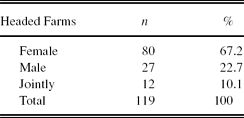
Women of Rmayniyya are not only de facto farm heads but also more and more prone to define themselves as such (Table 2). More than three out of four farms are said to be managed by a woman, either exclusively or in association with a man. These findings echo the results of studies that have observed that male migration and women's increased contribution to household economy have had a favorable impact on women's self-perception.Footnote 61
Farm headship according to gender
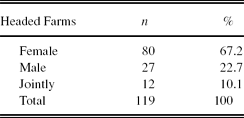
By preserving the economic autonomy of their household-cum-family-farm, women have maintained a quantum of honor that has tilted increasingly in their favor. Their share of honor depends on the household's overall quantum of that commodity, to which their labor is essential.
Moreover, women moving relatively more freely out of their houses and being more present in nonfarm areas has had repercussions upon people's perceptions of women's relationship to public space and wage labor. Among the younger generations, mixed schooling and a national education campaign have heightened Tunisians' awareness of gender equity.
The Weight of Tradition in Law
Women's empowerment, combined with improvement of couples' financial means, has accelerated household nuclearization (the transition from patrilocal extended households to monofamilial, “nuclear” ones), bringing spouses closer together and reinforcing the conjugal bond.Footnote 62 Husbands and wives communicate and cooperate more than what Cuisenier or Duvignaud observed some decades ago. Expressions such as “we consult each other” (nitshāwrū) and “we come to an agreement” (mitfāhmīn, mitwāfqīn) are commonly heard. Bringing the law in line with reality, Article 23 of the Tunisian Code du Statut Personnel was modified in 1993 in order to abrogate the wife's obligation to obey her husband and to introduce the notions of mutual “benevolence” and “cooperation” between spouses.
These modifications, however, did not question the juridical status of men as “family head.” An expression of this is the upholding of the country's laws of inheritance, largely inspired by Islamic rules; they provide men and women (of equal genealogical status) with respectively two shares and one share of the decedent's estate.Footnote 63 Another manifestation of women's inferior juridical status is the underestimation of the number of female farm heads in official statistics.
The main statistical studies concerned with agriculture in Tunisia are conducted by the Institut National de la Statistique (INS) and the Ministère de l'Agriculture (MA). Their respective definitions of “farm head” diverge. On the one hand, the INS systematically considers as farm heads family heads de jure (i.e., men, except in cases of widowhood or female celibacy) who possess land even if no one works it.Footnote 64 The census of 1984, the only one to contain some information about household composition, even denied the status of family head to wives of migrants working abroad, simply registering them as “married women with children.”Footnote 65 On the other hand, in its 1994–95 study, the MA defined as “farm heads” individuals who answered “myself” or “manager” to the question, “Who manages this land?” As questionnaires were given to family heads (yet again, men), who had only one choice apart from “myself” or “manager” (namely, “other”), they were strongly tempted to answer “myself” even if another household member, perhaps a woman, actually ran the farm. The land belongs to them, not to an undefined “other.” In sum, statistics underestimate the real number of female farm heads.
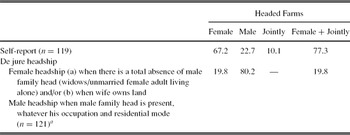
Let us build on these definitions and consider as de jure farm heads women who possess the juridical status of family head (widows or unmarried female adult living alone) and/or who are de jure landowners. Table 3 compares those rates to those we gathered by self-report. The rate of self-reported female farm head is nearly three and a half times higher than that of female head de jure. This figure is nearly four times higher when we consider women who manage the farm either exclusively or jointly with a man.
Farm heads according to gender: Self-reported and de jure headship compared (%)

aDiscrepancies in numbers are due to cases in which husband and wife (without brothers and having inherited) possess land separately. When the husband lives permanently in the village, whatever his occupation, he is automatically considered the farm head, but so is his wife. At the juridical level, and for statistical purposes, each spouse is considered head. Two couples are in this situation in Rmayniyya, and thus there are 119 farms but 121 landowners.
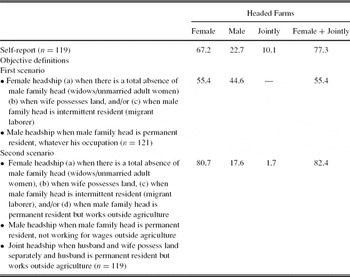
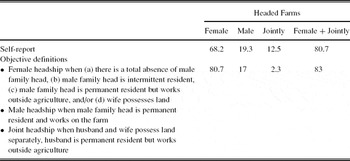
Let us extend the definition of farm heads de jure and apply it to heads de facto, who are defined according to objective criteria: family status and land ownership, as stated previously, plus the husband's residential mode and occupation. Two scenarios have been imagined (Table 4). The second one allows us to measure the maximum potential rate of female farm heads if we consider as such women whose husbands work outside agriculture.
Farm headship according to gender: Self-reported and objectively defined headship compared (%)

Table 4 shows that the rate of self-reported exclusive female farm heads (67.2%) is nearly 15 percent less than the potential maximal rate we would obtain if all women whose husbands work outside agriculture claimed running the farm (82.4%). The gap is reduced when we consider women who manage the farm jointly with a man (77.3%). Some still hesitate to declare themselves as head despite the crucial role they play on the farm. The cultural representations placing men above women, a factor of resistance to change, still prevent a number of women from assuming this title.
There is yet another factor, to wit household composition. In a previous paper I have shown that women living in patrilocal extended households are less prone to declare themselves as heads.Footnote 66 This is because in such groups in Rmayniyya the male household head is always present and enjoys the respect due to his age and gender and because people believe it is not advisable to let a woman run the farm, at least openly, in order to avoid disputes among women and therefore the household's possible division. Headship is assumed by a man, at least nominally, thus preventing the group from breaking up (until tensions become too untenable).
Table 5 describes the situation prevailing among elementary households (i.e., monofamilial and conjugal households, or couples with or without children, respectively, and incorporated monofamilial households, or families with fostered children or handicapped unmarried adults). When comparing the maximum potential rate of female heads from an objective definition (80.7%) to that obtained through self-report (68.2%), we observe that the gap is somewhat reduced, at least as far as women exclusively running the farm are concerned. It is interesting that the rate of women exclusively heading a farm or jointly with a man (80.7%) is almost equivalent to the maximal potential rate (83%) and identical to the maximum potential rate of women heading a farm exclusively. When living alone with their husbands, women are more prone to claim themselves as farm heads. As the movement toward nuclearization intensifies, the rate of female farm heads will likely increase.
Farm headship according to gender among elementary households: Self-reported and objectively defined headship compared (%, n = 88)

In brief, not all women who could potentially claim to head their farm because their husband is an intermittent resident and/or works outside agriculture lay claim to this title. This rate, however, is higher than what official statistics suggest. Women play a crucial role on the farm, and many of them assume this title, thus reinforcing their status within the household and society.
Almost everywhere in the world, men enjoy a greater symbolic value; Tunisia is no exception. Actual gender equity lags behind equity in law, which is unachieved—women are not yet totally relieved from the weight of tradition. However, the empowerment of an increasing number of women has had an impact within their household and upon their social recognition. The symbolic capital they have effectively gained as individuals has reverberated upon their self-perception and, at the level of cultural representations, upon the symbolic capital of women as a whole. The gap between the genders has been somewhat reduced.
CONCLUSION
Honor has always been conceived of as a cultural code, a set of coercive mental representations regulating behavior. As such it fails to explain the changes in the status of women in northwest Tunisia brought about by the feminization of agriculture. Reassessing the notion of honor in social organizational terms and recasting family farms as sovereign groups, with their dominion and boundaries, has allowed me to shed a new light on the “traditional” spatial occupation of women and the gender division of labor. I have also shown that the transformations that may initially appear as contradicting norms nonetheless remain consistent with the social organizational logic of the peasant household. This rethinking has the further advantage of giving elements for a renewed appreciation of some MENA cultural traits (e.g., the zināʾ–fitna relation, the ideals of individualism and autonomy, women and houses as ḥarām domains, hospitality, and preoccupation with agnatic purity).