The last two decades have seen a renewal of interest in vocabulary and a surge in the number of studies on second-language (L2) lexical acquisition. Despite this progress, L2 lexical studies frequently remain uninformed by current psycholinguistic research. Nowhere is this more evident than in the case of lexical testing and the linguistic and psycholinguistic frameworks within which lexical testing is conducted. Standardized, valid, and reliable vocabulary measures are still scarce, particularly so when one considers languages spoken outside the few countries able to sustain lexical testing research. As would be expected, the situation is the best in the case of English, for which there are now quite a few lexical tests available, many of which have undergone numerous cycles of empirical testing and improvement. Nonetheless, the existence of disparate views of what it means to “know” a word as well as the lack of attention to the development and use of L2 lexical knowledge has led to depth of knowledge tests that are incompatible with the findings of psycholinguistic research in noticeable ways and/or that have not been validated by native-speaker (NS) performance on these tests. This paper reports our findings on the performance of first-language (L1) English undergraduates on the Qian and Schedl (Reference Qian and Schedl2004) test, administered to arrive at baseline data for the purposes of comparing the performance of speakers of Romanian and Vietnamese on lexical size and depth tests.Footnote 1 Data were collected from NSs under two conditions: instructions that specified the number of correct answers per item (in terms of both correct hits and correct misses) and, in order to minimize “guessability,” instructions that had no such specifications.
DEPTH AND BREADTH OF VOCABULARY KNOWLEDGE
In keeping with the view that vocabulary knowledge is not a unidimensional construct, one distinction often made is between receptive and productive vocabulary (Nation, Reference Nation2001). Another useful distinction is between the number of words known, or breadth of knowledge, and how well these words are known, or depth of knowledge (Nation, Reference Nation2001; Read, Reference Read, Bogaards and Laufer2004). This distinction has been widely recognized in vocabulary research and testing, but not with complete terminological clarity, particularly in the case of depth. Due to the different operationalizations, Read (Reference Read, Bogaards and Laufer2004), along the lines of Cronbach (Reference Cronbach1942), suggests that it might be time to stop treating depth as a single trait and to break it down into smaller (albeit overlapping) components: (a) precision of meaning (i.e., whether the knowledge of a word's meaning is vague or specific); (b) the comprehensiveness of word knowledge (e.g., polysemy, word syntax, likely collocates); and (c) network knowledge (i.e., how the meaning of a word connects with the meanings of related words). Read admits that this breakdown itself is not without problems. For instance, even in their L1 people do not know all words with the same level of precision. Consider, for instance, the average English speaker's knowledge of classical concepts such as triangle versus probabilistic ones such as furniture. (For other discussions of the construct of word knowledge, see Chapelle, Reference Chapelle, Bachman and Cohen1998; Henriksen, Reference Henriksen, Albrechtsen, Haastrup and Henriksen2008; Jiang, Reference Jiang2000; Nation, Reference Nation1990, Reference Nation2001; and Qian, Reference Qian2002.)
Meara (Reference Meara, Brown, Malmkjær and Williams1996) hypothesized that breadth might be the only relevant trait of lexical knowledge for small vocabularies and that dimensions related to depth may become important only once a certain size threshold has been achieved. Meara (Reference Meara, Brown, Malmkjær and Williams1996) and Zareva and colleagues (Zareva, Reference Zareva2007; Zareva, Schwanenflugel, & Nikolova, Reference Zareva, Schwanenflugel and Nikolova2005) set this threshold at approximately 5,000–6,000 and 9,000 words, respectively. The notion that breadth is a more basic dimension of lexical proficiency than depth is in line with the predictions of a class of models of L2 vocabulary acquisition based on Kroll and Stewart's (Reference Kroll and Stewart1994) revised hierarchical model (see also Heredia & Brown, Reference Heredia, Brown, Bhatia and Ritchie2006; Jiang, Reference Jiang2000; but, for a differing perspective, see also Kroll & Dijkstra, Reference Kroll, Dijkstra and Kaplan2002). These models have in common the claim that L2 vocabulary acquisition starts with the establishment of a direct link between a newly acquired word form and what is perceived as its translation equivalent in the L1 and then gradually progresses toward deeper lexical knowledge.
The existence of a correlation between breadth and depth of vocabulary knowledge in intermediate to advanced second-language users has been demonstrated empirically (Greidanus, Bogaards, van der Linden, Nienhuis, & de Wolf, Reference Greidanus, Bogaards, van der Linden, Nienhuis, de Wolf, Bogaards and Laufer2004; Wesche & Paribakht, Reference Wesche and Paribakht1996; see also Qian, Reference Qian1999, Reference Qian2002; Qian & Schedl, Reference Qian and Schedl2004). However, despite this correlation, there are studies which suggest that these two dimensions still make separate contributions at intermediate to advanced levels to performance on measures of proficiency such as Test of English as a Foreign Language (TOEFL) reading scores (Qian, Reference Qian1999, Reference Qian2002; Qian & Schedl, Reference Qian and Schedl2004) and cloze test scores (Schoonen & Verhallen, Reference Schoonen and Verhallen2008). Furthermore, Wesche and Paribakht (Reference Wesche and Paribakht1996) found only a moderate positive correlation (r = .53) between scores on their test of lexical depth (Vocabulary Knowledge Scale) and the Eurocentres Vocabulary Size Test, a breadth test (Meara & Jones, Reference Meara and Jones1990).
BREADTH AND DEPTH TESTS AND THE DEPTH OF VOCABULARY KNOWLEDGE (DVK) MEASURE
Depth of lexical knowledge, no matter how it is operationalized, is notoriously difficult to test in a feasible way. As Read (Reference Read2000) pointed out, the testing of depth inevitably involves a trade-off between the number of targeted items and the number of dimensions of depth that can be assessed in a practicable fashion. It is not particularly surprising, therefore, that most lexical tests to date, L1 or L2, have focused on the measurement of breadth. Some well-known examples include the Peabody Picture Vocabulary Test (Dunn, Reference Dunn1997), used in L1 and L2 research with children; the Vocabulary Levels Test (Nation, Reference Nation1990; Schmitt, Schmitt, & Clapham, Reference Schmitt, Schmitt and Clapham2001); and the Eurocentres Vocabulary Size Test (Meara & Jones, Reference Meara and Jones1990).
Most available tests of lexical depth adopt either the self-report scale or word-association format. The first type involves responses on a graduated scale, as used by Dale (Reference Dale1965) with English-speaking fifth graders, Zareva (Reference Zareva2007) with L1 and L2 English speakers, and Wesche and Paribakht (Reference Wesche and Paribakht1996) for L2 speakers. In the last case, for example, participants identify their degree of acquaintance with the test item on a 5-point Vocabulary Knowledge Scale. The first two levels elicit receptive knowledge, and the three highest levels require producing a definition/translation or an example sentence.
Another kind of depth test adopts various forms of the fixed-choice word-association format as exemplified by the Euralex French Tests, developed by Meara (Reference Meara1992). In these tests, test takers are required to identify pairs of words (60 in all) as being connected or not (ratio between items = 2: 1). Connections can be semantic (synonymy, hyponymy, and antonymy) or syntagmatic (fixed expressions and culture-specific associations).
In its various incarnations, the Word Associates Test (WAT) format is perhaps the most widely used and investigated test of depth of L2 lexical knowledge, developed by Read to test the depth of students’ knowledge of the University Word List (Nation, Reference Nation1990; Xue & Nation, Reference Xue and Nation1984). The original WAT, aiming to address some of the methodological weaknesses of word-association tasks noted in Meara (Reference Meara1983), examined L2 users’ ability to identify syntagmatic (collocational), paradigmatic (involving synonymy), and analytic (words used in dictionary definitions) knowledge of L2 lexical items (for a summary of the genesis of the WAT and an account of the various improvements made to the format, see Read, Reference Read2000, pp. 180–187). The WAT format has been used by a number of researchers both with L1 and L2 speakers of languages other than English. Variations have included word frequency, number of choices per item, type of distractors, and number of correct responses, whether fixed or varied (Greidanus, Beks, & Wakely, Reference Greidanus, Beks and Wakely2006; Greidanus et al., Reference Greidanus, Bogaards, van der Linden, Nienhuis, de Wolf, Bogaards and Laufer2004; Henriksen, Reference Henriksen, Albrechtsen, Haastrup and Henriksen2008; and Schoonen & Verhallen, Reference Schoonen and Verhallen2008).
A series of modifications of the WAT by Qian (Reference Qian1998, Reference Qian1999, Reference Qian2002) and Qian and Schedl (Reference Qian and Schedl2004), conducted as part of the TOEFL 2000 project, yielded a version of this format called the DVK measure. The test consists of 40 items, each an adjective selected from a pool of pre-1995 TOEFL vocabulary items. For each item, eight potential answers are provided. They are grouped in two four-item boxes, the one on the left containing potential paradigmatic associates (synonyms or near synonyms) and the one on the right containing potential syntagmatic associates (nouns that might be modified by the target adjective). The number of correct choices in each of the four-item boxes can be one, two, three, or four, so that there are always four correct answers and four distractors per item. This is explicitly stated in the test instructions.
Qian and Schedl (Reference Qian and Schedl2004) report high reliability for the overall test (α = 0.91) and for its components: the paradigmatic (α = 0.83) and syntagmatic (α = 0.86) parts of the test. DVK scores were highly correlated (r = .84) with TOEFL vocabulary scores. Moreover, both sets of scores were highly correlated with TOEFL reading scores (r = .74 for the DVK, r = .75 for the TOEFL vocabulary test, with the difference between the two correlations not reaching statistical significance).
The majority of the participants in Qian and Schedl's (Reference Qian and Schedl2004) study reported having little difficulty with the test format and instructions. The authors reported that all the interviewed participants but one agreed that “it was rather difficult to guess” the correct answers (p. 44) because the number of correct answers in each box varied from item to item (e.g., a headword could have three paradigmatic responses and one syntagmatic one, whereas another headword could have two paradigmatic and two syntagmatic responses). Qian and Schedl conclude that “the improved DVK format has considerably reduced the potential for successful guessing” (p. 44). Note that their conclusion runs counter to Read's report on the guessability of items in the WAT (Read, Reference Read1993, Reference Read2000).
Our review of the literature reveals that the existing word-association tests for L2 speakers of English have mostly bypassed several important issues without which these psychometric instruments can be neither understood nor optimized (see also Meara, Reference Meara2009). One such issue centers on the organization of the mental lexicon and the links therein (e.g., tight and loose semantic and collocational ties within networks) in both stable L1 lexicons and developing L2 ones. A second issue is one frequently invoked in psycholinguistic research but, thus far at least, rarely investigated in the second-language research on testing: the nature of lexical activation processes such as the role of items competing for selection and the inhibition of irrelevant candidates. In light of the realities of lexical activation, some of the features of the WAT/DVK may actually make it harder for test takers to access appropriate answers to test items in semantic memory, for example, selecting nouns for adjectival headwords instead of vice versa (Schriefers, Reference Schriefers1993), placing orthographically and/or phonologically similar headwords continguously (e.g., perceptual and perpetual) or using polysemous headwords that trip up the learners by activating nontargeted meanings (e.g., a core nominal meaning, as in mountain peak, rather than peak as an adjective, as in peak time).
In addition, it remains unclear in what ways performance might vary when the constraint on the number of correct responses is lifted (as in the depth tests of French in Greidanus et al., Reference Greidanus, Beks and Wakely2006; and Greidanus & Nienhuis, Reference Greidanus and Nienhuis2001). Finally, how NSs might fare on this test remains unknown. Although those working on non-English depth tests have used NS data for comparative purposes (e.g., Greidanus et al., Reference Greidanus, Beks and Wakely2006; and Henriksen, Reference Henriksen, Albrechtsen, Haastrup and Henriksen2008), the DVK has not been previously validated with NSs of English.
When data are analyzed at the level of group, NSs usually provide relatively consistent responses on word-association tasks (Fitzpatrick, Reference Fitzpatrick2007; Meara, Reference Meara1983; but see the Discussion for a crucial caveat). We strongly believe that L2 tests where NSs (whether monolingual or bilingual) struggle with various items or end up with less than 90% consistency in responses should not be used to evaluate L2 speakers. (However, this does not exclude the possibility of using such tests to simply compare and contrast NS and L2 speakers for exploratory, nonprescriptive, or nonevaluative purposes.) With these issues in mind, we set out to answer the following research questions regarding the performance of native English speakers on Qian and Schedl's (Reference Qian and Schedl2004) version of the WAT/DVK:
1. Do NSs perform differently when there is no constraint on the number of correct responses in the instructions and guessing is minimized?
2. What is the relationship between NSs’ performance on the paradigmatic and syntagmatic segments of the test?
3. Do NSs score at least 90% on the DVK and its subsections?
As noted above, the study reported here is part of a larger research project investigating bilinguals’ and monolinguals’ performance on various L2 tests of English lexical breadth and depth. Some of these tests were newly designed by our team, whereas others, such as the one under scrutiny here, had been published by other researchers
METHOD
Participants
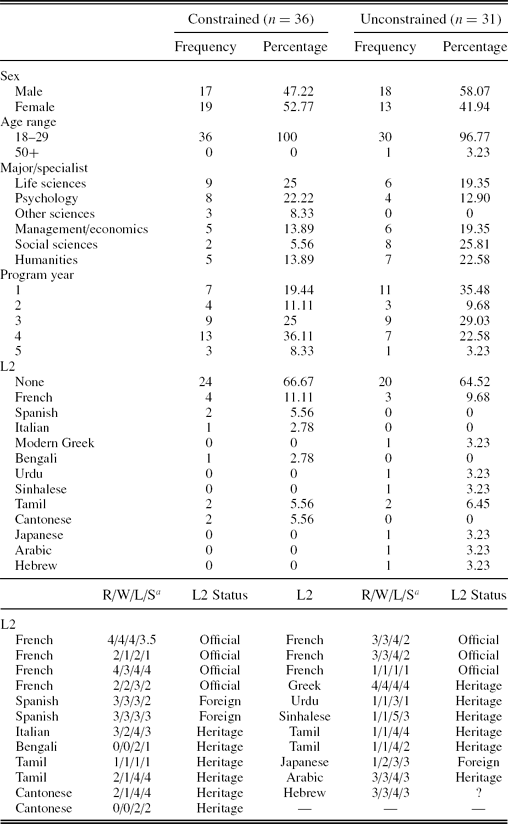
The participants in the present study (see Table 1) were undergraduate students whose L1 was English in terms of both chronology and language dominance, studying on the campus of a major university in Canada. In order to reflect the range of disciplines on the campus, participants were recruited through notices in the study areas of the main library. The screening criteria required them to be speakers of English and to be enrolled in an undergraduate program at the university.
Participant data

Note: Official is French as a second language (L2), learned in the Canadian school system.
a Proficiency self-ratings for reading (R), writing (W), listening (L), and speaking (S).
The group that completed the test with the constrained number of responses (the “constrained group”) consisted of 36 NSs (17 males, 19 females). Independent of the constrained group, the “unconstrained group” consisted of 31 NSs (18 males, 13 females). All of the students belonged to the 18–29 age range with the exception of one student in the 50-plus range in the unconstrained group. Careful examination of this individual's test data revealed that she performed very close to the average for her group, and was, therefore, behaviorally, a typical member of the unconstrained group. In the constrained and unconstrained groups, there were 12 and 11, respectively, who reported speaking a second language. The most frequently claimed second language was French, as is to be expected in Ontario, with a smattering of heritage languages such as Tamil, Sinhalese, Urdu, and Arabic, reflecting the demographic profile of the larger community in which this campus is embedded. We suspect that there might have been others with a minimal knowledge of a language such as French who did not report this in the questionnaire.
In a city such as Toronto, a large urban center that is the destination of immigrants from every corner of the globe and where French is routinely taught in the public school system, “pure monolinguals” of the kind that might have existed in previous decades are a conspicuous minority and generally belong to a very narrow social stratum and age group. Therefore, for the purposes of this study, it was decided that the NS groups would include those who might have a second language but not those whose second language had ended up being stronger than their first (here English). In reality, there were no participants who had to be excluded for this reason.
Instruments
Questionnaire
The questions (see Appendix A) were used for the purposes of conducting a guided interview with participants. The interviews were run by three research assistants who were in their final year of a psycholinguistics specialist program at the same university and who had a strong background in linguistics, language acquisition, and bilingualism. Participants who had undergone the initial screening were asked to provide details about their language background, discipline, program year, and age range. If participants had a second language, they needed to specify their level of proficiency in each of the four skills (reading, writing, listening, and speaking) on a 5-point Likert scale. The research assistants were instructed to ask additional questions about a participant's language background if they felt unsure of a participant's language status. Conducting the screening in this fashion helped to confirm that English was a speaker's dominant language (e.g., based on an informal gauging of his or her communication skills).
Constrained test
This test was identical in content to Qian and Schedl's (Reference Qian and Schedl2004) test, with minor differences in format (circling answers rather than blackening corresponding letters from A to H; for Qian and Schedl's entire test, see pp. 50–52 of their paper). The 40 headwords in this test are bare adjectives, selected from vocabulary in a pre-1995 TOEFL test. Participants were instructed to choose four correct answers out of a total of eight choices for each headword. The four correct items could consist of between one and four synonyms (in the column on the left) and between one and four collocates (in the column on the right). For example, the adjectival headword “celebrated” has three synonyms (“renowned,” “well known,” and “famous”) and only one collocate (“play”), amounting to a total of four correct answers. The remaining four are distractors.
Celebrated
(A) renowned (B) festive (C) well known (D) famous
(E) persuasion (F) recognition (G) understanding (H) play
See Appendix B for the instructions given to participants in the constrained group.
Unconstrained test
The only difference between the constrained and unconstrained versions of the test was in the instructions, which in the case of the latter stated that participants could pick one to eight correct answers per item. Note that, because the test was identical to the constrained one, in theory only four hits (correct answers) per headword were supposed to be correct. (See Appendix C for the instructions given to participants in the unconstrained group.)
Procedure
Following the initial screening, participants filled out the questionnaire. Those confirmed as NSs were asked to complete a vocabulary size task (for validating a lexical test that was part of the larger research project in which the current study is embedded) and then randomly assigned the constrained or unconstrained version of the DVK test.
Although the tasks were unpaced, most participants completed the constrained and unconstrained versions of the DVK in around 20 and 25 min, respectively. The DVK data were inputted manually into a spreadsheet, with each of the eight possible answers to a headword prompt in its own column. Each participant's responses were coded as one of the following: (a) hit, (b) correct rejection, (c) false alarm, or (d) miss. For example, in the case of “celebrated,” circling “famous” as a synonym would be a hit and not circling “festive” would be a correct rejection; in contrast, circling “festive” would be a false positive (incorrect hit) and not circling “famous” would be a miss.
RESULTS
The first research question asked how NS judgments differed when there was no constraint on the number of correct responses versus a constraint of four correct answers per headword. The second question asked if NSs’ performance differed on the paradigmatic and syntagmatic segments of the test.
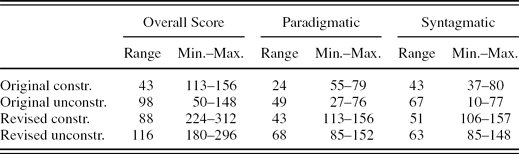
To answer these questions, each participant's score was calculated out of a maximum of 160 because there were 40 headwords and each of the headwords had four correct associates and four distractors. To ensure comparability with previous WAT/DVK research, we report overall scores here. (The problems with reporting overall DVK scores will be discussed later.) The maximum possible score on the paradigmatic subtest was 79, whereas the maximum on the syntagmatic subtest was 81. As mentioned above, participants in the unconstrained group were told that there were between 1 and 8 possible correct answers per item. This meant that, with a scoring method where only (correct) hits were awarded a point, a participant could, at least in theory, circle all answers and obtain a maximum score. To safeguard against this potential test-taking strategy, we computed an additional set of scores wherein each hit and each correct rejection was awarded a point. Note that this diverges from Qian and Schedl's scoring method. Thus, a participant could achieve a maximum overall score of 320, with the maximum possible paradigmatic score being 160 (79 hits and 81 correct rejections) and the maximum syntagmatic score being 160 (81 hits and 79 correct rejections). Where necessary, we will refer to the latter set of scores as “revised scores,” whereas we will reserve the term “original scores” for the former. The ranges as well as minimum and maximum raw original scores and revised scores achieved on the test by the constrained and unconstrained groups are summarized in Table 2.
Ranges, minimum, and maximum scores on the Depth of Vocabulary Knowledge measure for the constrained and unconstrained groups
Note: Min.–Max., minimum–maximum score.
The unconstrained condition elicited more variability in the overall scores as well as on each of the subtests. In addition, the syntagmatic subtest yielded more variability in the scores compared to the paradigmatic subtest. In other words, participants’ performance was more homogeneous when they knew the number of possible correct answers per headword and when they had to match words based on meaning rather than judge collocability of the headword.
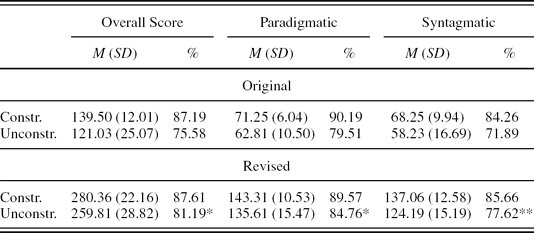
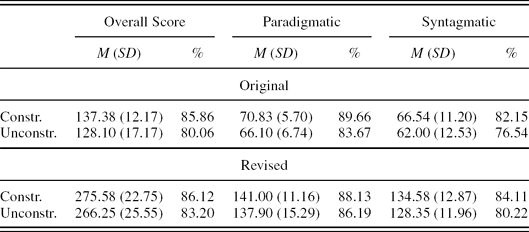
Table 3 summarizes the means and standard deviations of the overall original and revised scores and the original and revised scores achieved on the two subtests. The means are reported as both raw scores and percentages.Footnote 2 (See Table 4 and Table 5.)
Means and standard deviations of the original and revised Depth of Vocabulary Knowledge measure scores for the constrained and unconstrained groups
Note: The means are reported as raw scores and percentages for three comparisons. The α level is corrected to 0.017 (Bonferroni).
*Significantly different from the corresponding original score at p = .001.
**Significantly different from the corresponding original score at p = .014.
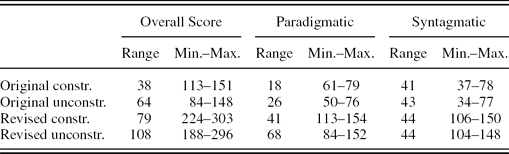
Ranges, minimum, and maximum scores on the Depth of Vocabulary Knowledge measure for the constrained (n = 24) and unconstrained (n = 20) groups

Note: The scores are for only those participants who did not report knowledge of a second language. Min.–Max., minimum–maximum score.
Means and standard deviations of the original and revised Depth of Vocabulary Knowledge measure scores for the constrained (n = 24) and unconstrained (n = 20) groups
Note: The means are reported as raw scores and percentages and they are for only those participants who did not report knowledge of a second language.
As can be seen from Table 3, participants in the constrained condition achieved consistently higher scores than those in the unconstrained condition. An independent-samples t test confirmed the difference in the overall original scores as significant, t (41.64) = 3.75, p = .001. The effect size d of 0.94 was large. Likewise, the difference in overall revised scores was also significant between the conditions, t (65) = 3.30, p = .002, also with a large effect size (d = 0.83). In other words, when the participants knew how many correct answers there were, they achieved higher scores on the DVK. Furthermore, the scores on both subtests were higher in the constrained condition than in the unconstrained one. In addition, in each of the two groups, the scores on the paradigmatic subtest were higher than those on the syntagmatic subtest.
It can be seen from Table 3 that this overall pattern of results also holds for the revised scores. Percentage-wise, the original scores and revised scores are almost identical in the constrained condition. However, when it comes to the unconstrained version of the test, the difference between original scores and revised scores appears quite pronounced and is statistically significant for the overall scores, t (30) = 3.77, p = .001, with a medium effect size, d = 0.68; for the paradigmatic scores, t (30) = 3.75, p = .001, with a medium effect size, d = 0.67; and for the syntagmatic scores, t (30) = 2.60, p = .014, with a medium effect size, d = 0.47. In each case, the participants scored better when the revised scoring system was used. The Bonferroni-corrected alpha level for these three comparisons was 0.017.
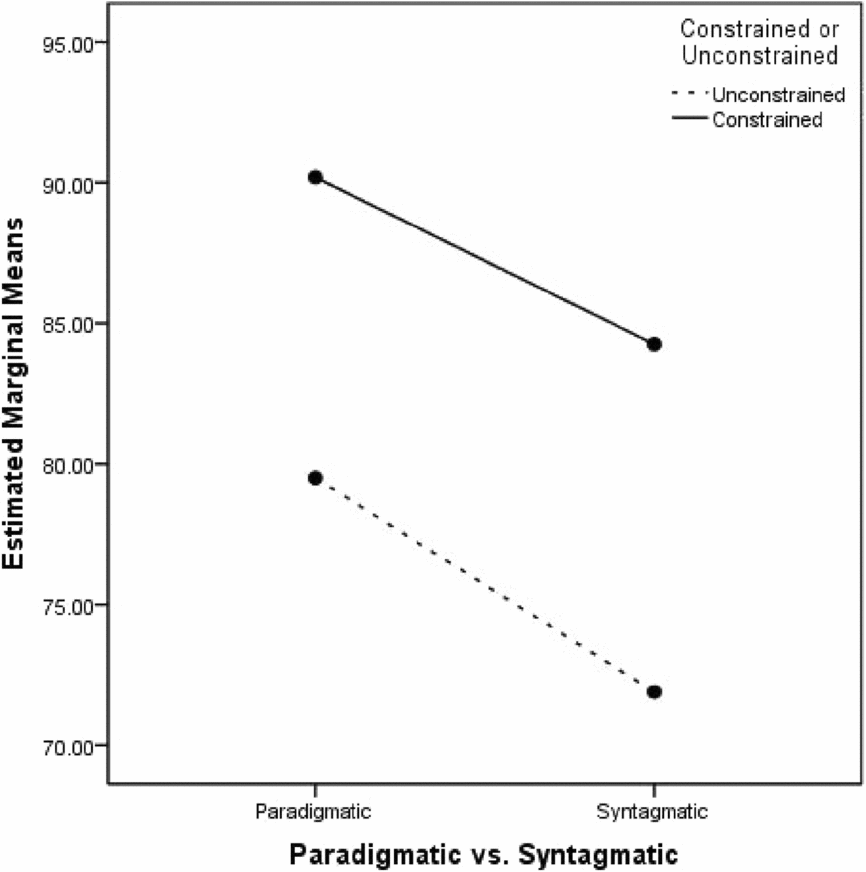
In terms of the original scores on the two subtests, a repeated-measure analysis of variance (ANOVA) revealed a significant main effect of group, F (1, 65) = 15.54, p < .001. The η2p value of 0.19 indicated that this was a medium-sized effect, meaning that group accounted for 19% of the variance in scores on the two subtests. In addition, there was a significant main effect of subtest (i.e., type of association, paradigmatic vs. syntagmatic): F (1, 65) = 14.59, p < .001. This effect was also medium-sized (η2p = 0.18); subtest accounted for 18% of the variance in the scores. The interaction between group and subtest was not significant (see Figure 1).
An analysis of variance plot for the original scores.
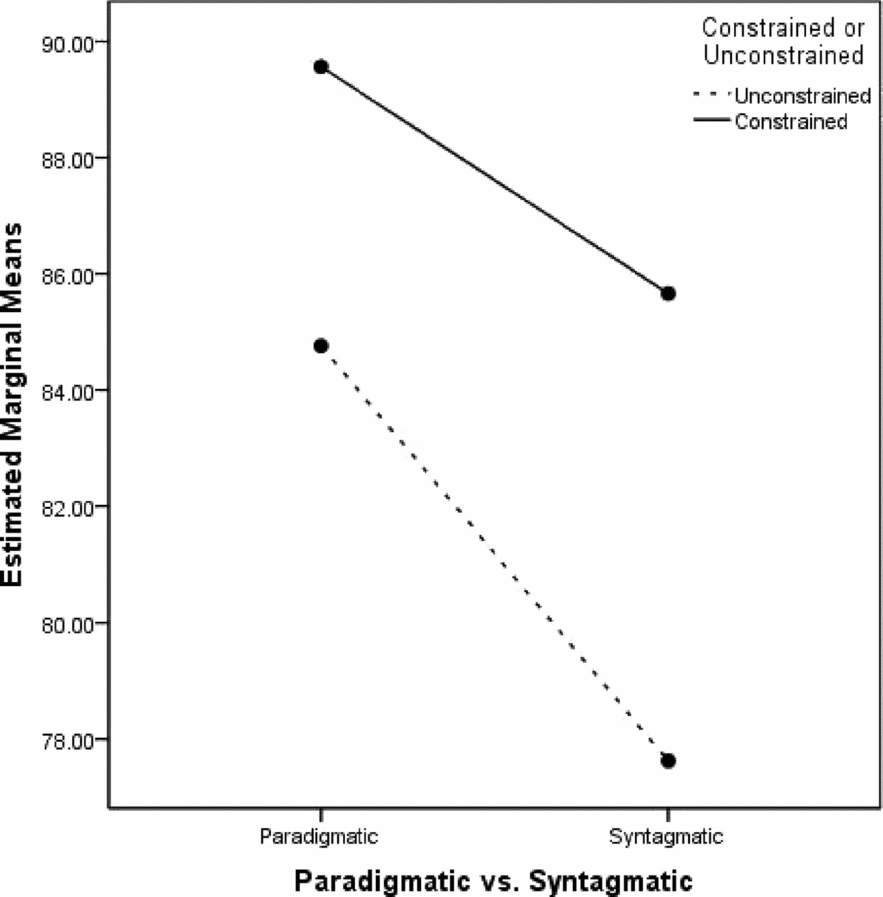
In terms of the revised scores on the subtests, a repeated-measure ANOVA revealed a significant main effect of group (constrained vs. unconstrained), F (1, 65) = 10.86, p = .002. The η2p value of 0.14 indicated that this was a medium-sized effect, meaning that group accounted for 14% of the variance in scores on the two subtests. In addition, there was a significant main effect of subtest (i.e., type of association, paradigmatic vs. syntagmatic): F (1, 65) = 68.31, p < .001. The effect was large (η2p = 0.51); subtest accounted for 51% of the variance in scores. The interaction between group and subtest was significant, F (1, 65) = 5.85, p < .02, but with a small effect size (η2p = 0.08; see Figure 2). This interaction indicates that the paradigmatic and syntagmatic revised scores were not equally affected by the introduction of the unconstrained condition, with syntagmatic scores being more negatively affected than their paradigmatic counterparts.
An analysis of variance plot for the revised scores.
In light of the usual expectation in L2 testing that NSs should be able to achieve at or above the 90% mark (see, e.g., Klein-Braley, Reference Klein-Braley1997), the results demonstrated that this was mostly not the case. Under the original scoring method, the 90% criterion would translate into the following mean scores: an overall score of 144, a paradigmatic score of 71.1, and a syntagmatic score of 72.9. With respect to the revised scoring scheme, the corresponding scores would be 288 (overall), 144 (paradigmatic), and 144 (syntagmatic). All of the mean scores except the original scores on the paradigmatic subtest for the constrained group were below the 90% mark. A series of one-sample t tests (the Bonferroni-corrected alpha level was 0.01 for the constrained group and 0.0083 for the unconstrained group, with 30 and 35 degrees of freedom, and five and six comparisons, respectively) showed that four of the five original scores that were under the 90% mark were significantly different from the expected NS performance, overall unconstrained, t (30) = 5.10, p < .001, d = 0.92; paradigmatic unconstrained, t (30) = 4.40, p < .001, d = 0.79; syntagmatic constrained, t (35) = 2.81, p = .008, d = 0.47; and syntagmatic unconstrained, t (30) = 4.90, p < .001, d = 0.88. Although the mean score was below the 90% criterion, due to the (conservative) Bonferroni correction of the alpha level, the overall constrained scores were not significantly different from the expected minimum NS performance, t (35) = 2.25, p = .03, but the difference did still approach significance. In other words, in terms of original scores, participants met the 90% criterion only when they knew how many correct answers there were per item and only with the overall and paradigmatic scores.
The revised scores closely mirrored the above pattern. Four of the five revised scores under the 90% mark were significantly different (the Bonferroni-corrected alpha level was 0.01 for the constrained group and 0.0083 for the unconstrained group, with 30 and 35 degrees of freedom, and five and six comparisons, respectively) from the expected NS performance, overall unconstrained, t (30) = 5.45, p < .001, d = 0.98; paradigmatic unconstrained, t (30) = 3.02, p < .005, d = 0.54; syntagmatic constrained, t (35) = 3.31, p < .002, d = 0.55; and syntagmatic unconstrained, t (30) = 7.26, p < .001, d = 1.30). Although the mean score was below 90%, and the difference approached significance, the overall constrained revised score was not significantly different from the expected minimum NS performance, t (35) = 2.07, p = .046 under the imposed Bonferroni adjustment. In other words, in terms of revised scores, participants were unable to meet the 90% criterion when they did not know how many correct answers there were per item.Footnote 3 In addition, they were not able to perform at 90% on the syntagmatic subtest regardless of the instructions they were given.
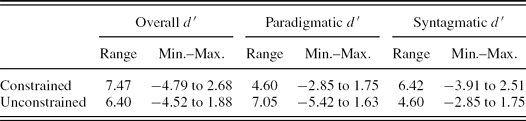
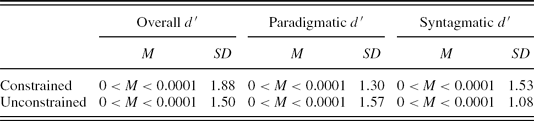
Apart from including both original and revised DVK scores in our analysis, we also computed three d′ scores for each participant, one for the overall test, one for the paradigmatic subtest, and one for the syntagmatic subtest. In signal detection theory (see, e.g., Macmillan & Creelman, Reference Macmillan and Creelman1991), the d′ score, the difference between a person's standardized hit and false alarm rates, is a measure of an individual's ability to discriminate between signal and noise, or, in terms of the present test, to accurately identify a large number of correct answers while keeping low the proportion of distractors wrongly selected as answers. A d′ score of 0 (or near 0) would indicate chance-level performance, whereas a high absolute d′ value is an indicator of sensitivity to the difference between signal and noise. Table 6 summarizes the ranges and minimum and maximum d′ scores for the entire test as well as for the two subtests. Table 7 summarizes the means and standard deviations of the d′ scores.
Ranges, minimum, and maximum d′ scores for the constrained and unconstrained groups
Note: Min.–Max., minimum–maximum score.
Means and standard deviations of the d′ scores for the constrained and unconstrained groups
As can be seen from Tables 6 and 7, both the constrained and unconstrained groups included participants that performed at chance level as well as those with a good ability to discriminate between the correct answers and distractors on the DVK. In both groups, all six mean d′ scores were not significantly different from 0. Due to the presence of a number of outliers (six in each group, two per each of the group d′ scores), the d′ score distributions were Winsorized at the 5th and 95th percentile levels. An independent samples t test and a repeated-measures ANOVA performed on the Winsorized data indicated that there was still no difference between the constrained and unconstrained groups in terms of d′ scores. (A parallel analysis of the non-Winsorized data implied the same, which means that the outliers did not significantly impact the d′ scores.) In other words, participants were equally likely to employ random guessing as a test-taking strategy regardless of the instructions they were given. Therefore, random guessing appears not to have been the source of the observed differences between the groups and subtests.
To investigate whether the scores on the paradigmatic and syntagmatic tests were related, we computed Spearman correlations between these scores for both groups (the normal distribution assumption for Pearson correlations was not met). In the case of the original DVK scores, for the constrained group, there was no significant correlation between the paradigmatic and syntagmatic subtests. A closer inspection of the data revealed that two participants who had achieved very high paradigmatic scores (among the highest in their group) simultaneously obtained the two lowest syntagmatic scores (at or below 40%). When these two influential data points were disregarded, there emerged a moderate correlation between the syntagmatic and paradigmatic subtests for the constrained group (r = .383, p = .025). This means that less than 15% of the variance in syntagmatic DVK scores is explained by paradigmatic scores and vice versa. It is important to note, however, that the biographical data reveal no obvious reason why the two participants’ scores should be excluded from the analysis. For the unconstrained group, there was a moderate correlation between the paradigmatic and syntagmatic subscores (r = .46, p = .01), indicating that around 21% of the variance in one subscore could be predicted by the other. In contrast, the revised paradigmatic and syntagmatic scores were highly correlated for both the constrained (r = .88, p < .001) and unconstrained groups (r = .76, p < .001), indicating that 77% and 57% of one score could be predicted by the other.
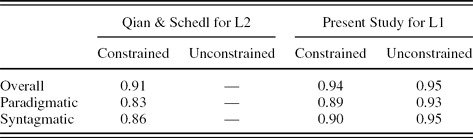
Table 8 presents the alpha reliability scores for the overall DVK as well as for the two subtests in the constrained and unconstrained conditions in the present study together with reliability data from Qian and Schedl's study (Reference Qian and Schedl2004). (Note that the latter study only featured a constrained condition.) As can be seen from the table, the DVK consistently appears to yield high or acceptable alpha reliability scores, particularly in the unconstrained modality.
Alpha reliability scores for the Depth of Vocabulary Knowledge measure
Note: The scores are according to Qian and Schedl (Reference Qian and Schedl2004) and the present study. L2, second language; L1, first language.
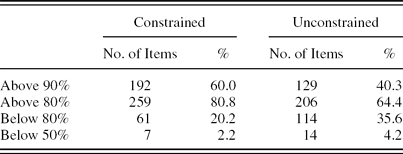
A breakdown of the percentages of correct NS responses in each of the test conditions appears in Table 9 (eight per headword when both correct hits and misses are scored; in other words, the revised scoring system was used for the purposes of item analysis). Only 60% of all items were answered correctly by more than 90% of participants in the constrained condition compared to 40.3% in the unconstrained one.
Item analysis: Numbers and percentages of items with correct native-speaker responses
Note: There were 320 items (choices) in the test, four correct and four incorrect per headword.
DISCUSSION
The results of this study bring to light a few pitfalls of a WAT-type test, of which some are easily remedied whereas others remain intractable.
One of the main findings of the present study was the substantial inconsistency of NS responses on various items in both versions of the test, but especially so in the unconstrained one. This remained true even when we used a revised scoring system, which led to enhanced scores. If a criterion of 90% of correct NS answers is adopted as a measure of minimal acceptable discriminative validity for an item in an L2 proficiency test, it can be concluded that a large proportion of the items in this test fall short of this criterion. Whereas 60% of the items in the constrained condition were answered with above 90% consistency, only 40.3% of the items in the unconstrained version met the 90% criterion. Although a smattering of idiosyncratic responses can be expected from NSs even on robust test items, a certain minimum criterion of consistency of NS responses must be imposed if any test is to be a valid indicator of L2 proficiency. This obviously implies that any test of lexical depth that adopts the WAT format must include items that are checked for frequency in an appropriate corpus, for example, the British National Corpus (BNC) or the Corpus of Contemporary American English, especially in the case of multiword items such as collocates. In addition, the test needs to undergo extensive piloting with NSs of a range of varieties of the target language before its use with L2 speakers is even considered. For instance, take Headword 7 (insufficient), for which one of the intended correct collocates was need. Although insufficient need is a possible adjective–noun combination, a search of three corpora, the BNC, Corpus of Contemporary American English, and Collins Wordbanks Online, yields zero hits for this combination, suggesting that insufficient need does not qualify as a collocation. Thus, it is not surprising that only 61.11% of the participants in the constrained group and as few as 12.9% in the unconstrained group chose this as a “normal” combination (for instructions that ask participants to pick “normal combinations,” see Qian and Schedl, Reference Qian and Schedl2004, p. 50). Likewise, in the case of Headword 34 (terse), for which one of the intended meanings associates is concise, 50% of the participants selected concise as an associate of terse in the constrained condition versus only 29.03% in the unconstrained condition, possibly because many of the participants did not know the meaning of terse. In both cases, we might conjecture that the higher scores in the constrained condition were simply the result of educated guessing (by elimination) because participants knew that they needed to come up with the four least problematic answers per headword.
Although it was long an accepted view that NSs generally display very consistent word-association behavior (Postman & Keppel, Reference Postman and Keppel1970), which was also the basis and rationale for the creation of the numerous available word association thesauri (e.g. Kiss, Armstrong, Milroy, & Piper, Reference Kiss, Armstrong, Milroy, Piper, Aitken, Bailey and Hamilton-Smith1973; Nelson, McEvoy, & Schreiber, Reference Nelson, McEvoy and Schreiber1998; Postman & Keppel, Reference Postman and Keppel1970), recent studies have found that this is the case only when L1 responses are analyzed at the level of group (Fitzpatrick, Reference Fitzpatrick2007). Our findings, as well as those of Wilks and Meara (Reference Wilks, Meara, Daller, Milton and Treffers-Daller2007), convincingly demonstrate that NSs exhibit a considerable degree of variation on receptive word-association tasks, which is probably a function of individual response styles. Our findings, furthermore, suggest that syntagmatic associations may be particularly inconsistent within groups of seemingly comparable speakers. This inconsistency across speakers is also found on productive tasks (Fitzpatrick, Reference Fitzpatrick2007). Individuals are quite consistent in their word-association behavior across administrations of the same task and, for bilinguals (particularly more advanced ones), even across languages (Fitzpatrick, Reference Fitzpatrick2007, Reference Fitzpatrick, Fitzpatrick and Barfield2009).
Guessing and scoring
Our findings support Read's (Reference Read1993, Reference Read2000) misgivings about guessing being an inherent flaw in the WAT format. Our d′ analysis shows that guessing does occur in this type of test. However, although we had expected the unconstrained condition to bring the various items grouped under each headword closer to true independence, thereby reducing potential for guessing, participants were equally likely to employ guessing as a test-taking strategy regardless of the instructions they received. (In other words, those who will guess will guess.) Therefore, the significant difference in the DVK scores that we observed between the constrained and unconstrained conditions cannot be attributable to random guessing. Rather, we believe that it was largely due to the fact that test takers in the unconstrained condition tended to be more conservative when selecting associates. (Recall that numerous intended answers in the DVK test are less than optimal in terms of real-life language usage.) Conversely, the constrained condition was likely to force test takers into choices they would otherwise have been reluctant to make (e.g., insufficient need), as they were aware that they needed to find 4 associates per headword.
With regard to the desirability of guessing, although Bogaards (Reference Bogaards2000) rightly points out that the willingness and ability to infer the correct answer might be reflective of a heightened ability to cope with real-life language comprehension issues, this skill is not what is supposed to be targeted by WAT-type tests. In addition, because guessing is demonstrably an issue with this test format, there is a greater need than ever to create a fine-tuned scoring system that takes not only “hits” into consideration but also correct rejections, false alarms, and misses, because such a system can identify the degree of random guessing that participants are engaging in. It would also seem that the unconstrained format could significantly reduce the skewing of test results brought about by participants’ awareness of the desired number of correct answers per headword.
NS syntagmatic and paradigmatic associations
Another important finding of the present study is that NSs identify meaning (paradigmatic) relationships between words on this test more accurately and more consistently than collocational (syntagmatic) ones irrespective of whether the scoring is as per the original test or our revised method. In contrast with Qian's (Reference Qian1998) finding of a strong correlation (r = .80, p = .05) between the paradigmatic and syntagmatic scores for nonnative speakers, the present study did not find such a correlation for NSs when the original scoring system was used; there was a positive correlation only when the scoring was revised. The implication of this finding is that, at least as far as these NSs of English are concerned, knowledge of collocability and knowledge of semantic relations such as synonymy and polysemy might represent two different dimensions of lexical depth. This finding also reflects the commonsense observation that it is at least theoretically possible to have a speaker who knows a lot about word meanings and little about how these words combine with other words. However, one would sooner expect to find such a discrepancy in an L2 speaker than in an L1 speaker (e.g., see Greidanus & Nienhuis, Reference Greidanus and Nienhuis2001), as L1 speakers largely acquire word meaning and usage naturalistically through exposure to massive amounts of input and ample opportunity for interaction. It is difficult to imagine how L2 speakers, generally having had considerably less opportunity to acquire collocational knowledge, could demonstrate a higher correlation between paradigmatic and syntagmatic lexical knowledge. More important, if there is a correlation with one group of test takers and not with another or one way of scoring and not another, syntagmatic and paradigmatic scores are best not collapsed into a single score.
Linguistic structure mapping onto conceptual structure (problem with adjectives as headwords)
Noun phrases are built around nouns. Nouns dictate the choice and/or form of their specifiers (e.g., articles), modifiers (e.g., adjective phrases), and complements (e.g., prepositional phrases) within the noun phrase. For instance, whether an indefinite article is used in an English noun phrase depends on such factors as the countability and number of the head noun. Moreover, in languages with adjective–noun agreement (such as French, Dutch, or Serbo-Croatian), the form of the adjective depends on one or more properties of the noun, such as gender, number, case, or definiteness. Noun phrase production in natural speech requires that the noun lemma be accessed first in order to compute the form of any accompanying specifiers and modifiers (for a study on Dutch, see Schriefers, Reference Schriefers1993). Put succinctly, adjectives are about nouns; not the other way around, irrespective of whether the adjective is prenominal or postnominal. However, the WAT format requires the test taker to begin with an adjective and determine whether the supplied nouns are a potential fit, which is the opposite of what probably happens in natural speech production, with the exception of extremely tight collocates that can be treated as chunks, for example, “constitutional rights” or “(no) running water.” (For mapping of conceptual structure onto linguistic structure, see Jackendoff, Reference Jackendoff1990; and Levelt, Roeloefs, & Meyer, Reference Levelt, Roeloefs and Meyer1999.)
Interference and continuous design
Mature mental lexicons are characterized by a dense network of connections within the lexical level of representation as well as between the lexical and conceptual levels (Bock & Levelt, Reference Bock, Levelt and Gernsbacher1994; Collins & Loftus, Reference Collins and Loftus1975). For each lexical entry in the mental lexicon, the pertinent phonological, orthographic, morphological, semantic, and syntactic knowledge is interconnected. There are also numerous links of varying strength between a lexical entry and its synonyms, antonyms, hyponyms, hypernyms, cohyponyms, meronyms, phonological and orthographic neighbors, collocates, and so forth (Levelt, Reference Levelt1989; Collins & Quillian, Reference Collins and Quillian1969). Within such a network view of the mental lexicon, the testing of lexical depth can be defined as the quantitative and qualitative probing of any number of the above types of connections.
The WAT-DVK is a highly metalinguistic test, and taking it in one short sitting requires repeated evaluation of adjective meanings and judgments of the acceptability of adjective–noun combinations. The fact that it employs a continuous design (i.e., all the potential meaning and collocational associates of a headword are presented together without intervening items) leads to the repeated activation and selection of each headword. In word comprehension, a semantic facilitation effect would be expected whenever semantically related words are presented in quick succession (Meyer & Schvaneveldt, Reference Meyer and Schvaneveldt1971; Neely, Reference Neely, Besner and Humphreys1991). However, note that the process of taking a WAT-type test not only entails comprehension processes but inevitably also involves articulating various word combinations vocally or subvocally (both to test meanings in the paradigmatic column and to determine potential syntagmatic collocates in the other). In short, this process is in many ways akin to speech production. In speech production, when two semantically related lexical items are activated in close temporal proximity, the selection of the second item becomes more difficult if both words belong to the same level of semantic organization, as is the case with synonyms (Schriefers, Meyer, & Levelt, Reference Schriefers, Meyer and Levelt1990; see also Alario, Segui, & Ferrand, Reference Alario, Segui and Ferrand2000; Costa, Alario, & Sebastián-Gallés, Reference Costa, Alario, Sebastián-Gallés and Gaskell2009; Vitkovitch, Rutter, & Read, Reference Vitkovitch, Rutter and Read2001; and Wheeldon & Monsell, Reference Wheeldon and Monsell1994).
Although the exact underlying neural architecture of this interference effect is still under dispute (i.e., whether it happens through competition among lexical items during spreading activation or through inhibitory links in the mental lexicon), its behavioral manifestations remain a fact (Levelt et al., Reference Levelt, Roeloefs and Meyer1999; see also Dell & O'Seaghdha, Reference Dell and O'Seaghdha1991; Ferrand, Reference Ferrand1999; and Finkbeiner & Nicol, Reference Finkbeiner and Nicol2003). Therefore, we can conceive of the possibility that a similar or stronger semantic interference effect might exist between the various senses of a polysemous word, for example, when the test taker is expected to pick separate meanings of a headword such as obscure in quick succession: “unclear” as in “an obscure fact” or “unknown” as in “an obscure musician” (DVK Item 9; Qian & Schedl, Reference Qian and Schedl2004). In other words, it may become increasingly difficult to access alternate meanings of a word with each new attempt when these attempts occur in close succession. A similar interference effect may come into play with polysemy involving contiguous collocates of a headword prompt (e.g., fine day and fine athlete in Item 22). Furthermore, contiguous orthographically/phonologically similar headwords such as perceptible and perpetual (Items 38 and 39) may interfere with each other in receptive lexical access (Rastle, Reference Rastle and Gaskell2009). We believe that the effects outlined above may be one reason why NSs performed worse than expected on the DVK, especially in the unconstrained version of the test.
Another reason why a continuous design might not be the best solution for a word-association test is that the frequent repetition of a stimulus word could perhaps cause this word to temporarily lose some of its meaning for the test taker. This semantic satiation effect has been the subject of psycholinguistic and psychological inquiry for a long time (e.g., Black, Reference Black2001; Cohene, Smith, & Klein, Reference Cohene, Smith and Klein1978; Fillenbaum, Reference Fillenbaum1964; Pynte, Reference Pynte1991). Although the satiation effect is reminiscent of selective adaptation (the process whereby the repetition of a sensory stimulus reduces sensitivity to it), event-related potential research suggests that semantic satiation can be a separate effect occurring in semantic memory, independently of perceptual adaptation (Kounios, Kotz, & Holcomb, Reference Kounios, Kotz and Holcomb2000).
CONCLUSION
The WAT format has a number of obvious virtues. It is quick to administer, easy to score, and appears to have face validity (as also determined by Qian & Schedl, Reference Qian and Schedl2004). Furthermore, WAT-type tests created for L2 learners of English in the last 20 years (e.g., by Read, Reference Read1993; and Qian & Schedl, Reference Qian and Schedl2004) have been pioneering in the context of L2 lexical testing and have provided much-needed additions to the narrow repertoire of potential depth tests. However, the present study highlights some of the pitfalls of fixed-answer WAT-type tests, some of which can be remedied through a reformulation of test format and content (for L2 speakers of French, as in Greidanus et al., Reference Greidanus, Bogaards, van der Linden, Nienhuis, de Wolf, Bogaards and Laufer2004, Reference Greidanus, Beks and Wakely2006) as well as analysis (Fitzpatrick, Reference Fitzpatrick, Fitzpatrick and Barfield2009). Yet other problems appear to have no easy solutions and are major enough to cast doubt on the use of WAT-type tests as valid instruments of lexical depth assessment.
As discussed above, the current design of these tests may place unusual and unnatural strain on the language-processing system because it involves the repeated activation of headwords and their associates in quick succession and without meaningful context. Such a task may be especially burdensome for L2 learners, for example, because switching from core meanings of polysemous words to peripheral meanings can be expected to be particularly difficult when lexical semantic networks are being newly built. The issues related to activation, however, can be resolved through scrambling the various headword meanings and collocations so that any two items linked to a headword are well separated. Furthermore, to remedy the variability in the quality of individual items, the class of the headword can be chosen in accordance with psycholinguistic principles (e.g., verbs rather than their arguments, or nouns rather than their modifying adjectives, as has been done by Greidanus & Nienhuis, Reference Greidanus and Nienhuis2001). In addition, the test creator can ensure that these word classes are unambiguous and do not have potential responses that could trip learners up. (The headword “celebrated” in the DVK, for example, could easily be interpreted as a verb rather than a deverbal adjective; if so, an incorrect response such as “festive” could become a distracting choice for semantic reasons.) There are also good reasons for keeping syntagmatic and paradigmatic scores separate and avoiding forcing test takers into unnatural choices by leaving the number of correct answers unconstrained (as in Greidanus et al., Reference Greidanus, Bogaards, van der Linden, Nienhuis, de Wolf, Bogaards and Laufer2004).
A more serious problem with WAT-type tests lies in the choice of associations accompanying headwords, especially when these are collocational. Ideally, associations need to be developed with reference to large corpora of spoken and written language, such as the BNC or the COBUILD Bank of English corpus, with careful attention to the frequency of headwords and the use of typical rather than marginal collocations. Certainly test developers’ intuitions alone will not suffice because NS judgments can exhibit considerable variability (e.g., Dronjic, Reference Dronjic2008). Furthermore, these tests need to be piloted with not just L2 speakers but also NSs from a variety of backgrounds (e.g., in terms of level of education, socioeconomic status, or language background), followed by statistical analysis of item difficulty and reliability.
However, the problem that remains is that in any language both meaning and collocation vary from speaker to speaker across various dimensions such as personal cognitive or response style, dialect, age, gender, socioeconomic status, and profession. Consider, for example, the new meaning of radical or the dialectal variation in the use of phrases such as get ill, get pregnant, and fall ill, fall pregnant. Moreover, collocations tend to vary in terms of fixedness; some can be rather loose and others very tight (Moon, Reference Moon, Schmitt and McCarthy1997), reflecting the constant tension between two opposing forces that govern lexical patterning: the open-choice principle and the idiom principle (Sinclair, Reference Sinclair1991). Thus, it is unlikely that the choice of collocations will ever fit all contexts or will remain stable for more than a few years. Even more serious questions arise when L2 speakers’ culture-specific responses are to be evaluated. We feel that it is probably unreasonable in many instances to treat bilinguals’ responses as being nontargetlike (i.e., defective in some sense) simply because they do not dovetail with monolingual NS’ responses (Meara & Wolter, Reference Meara and Wolter2004; Wilks & Meara, Reference Wilks, Meara, Daller, Milton and Treffers-Daller2007). This may be an especially grave concern when a test is receptive and not productive, that is, involving judgments rather than actual spontaneous production.
If only the most robust associates were to be chosen, it is not clear whether the test could make fine-tuned distinctions between learners of varying lexical abilities. As our findings as well as those of Fitzpatrick (Reference Fitzpatrick2007, Reference Fitzpatrick, Fitzpatrick and Barfield2009) and Wilks and Meara (Reference Wilks, Meara, Daller, Milton and Treffers-Daller2007) suggest, it may simply not be justified to evaluate individuals based on whether their personal word-association behavior conforms to that of a majority of speakers in their group or not, as much of this behavior appears not to depend on proficiency but idiosyncratic response preferences. Fitzpatrick's (Reference Fitzpatrick, Fitzpatrick and Barfield2009) finding that bilinguals tend to converge on their own L1 word-association style with increasing L2 proficiency seems to suggest that the only potentially valid way of evaluating L2 speakers based on the WAT format would be to also collect data in their L1. Although this may be possible in some contexts (e.g., research or evaluation in the context of a monolingual L2 class), it will be highly impractical in others (e.g., heterogeneous classes with people from numerous L1 backgrounds). At any rate, much more theoretical inquiry into this will be necessary before we start seeing the first valid and reliable testing applications of these interesting findings.
The most vexing issue is whether WAT-type tests, which are predominantly receptive, measure lexical depth. To expect learners to know the meaning of words within an appropriate frequency band or register is reasonable, as in the case of the DVK's paradigmatic column no spontaneous production is involved. In terms of collocational knowledge, the lack of production is even more grave because a learner's ability to distinguish between native and nonnative collocations receptively is barely relevant to using these collocations meaningfully in spontaneous production, and we believe that collocations are meaningful test items only in production (e.g., being able to come up with “torrential rain” in discourse rather than picking “torrential rain” rather than *“torrential snow” receptively).
If lexical depth includes a fine-tuned knowledge of the grammatical behavior of words, their connotations or stylistic nuances, as well as the richness of the associational networks in the mental lexicon, a test that does not entail spontaneous production but instead conducts a spot check of a learner's ability to pick out a limited number of preassigned options that are presumed correct, a WAT-type test is not a test of depth. (Note that the subvocal or vocal testing of collocates discussed earlier is not spontaneous production.) In this sense, Wesche and Paribakht's (Reference Wesche and Paribakht1996) Vocabulary Knowledge Scale is superior because the maximum score for an item includes its use in a sentence, displaying not only word syntax but possibly also collocational knowledge. Furthermore, the collocational selections made in a multiple choice type context are made with the help of what Bialystok (Reference Bialystok and Ellis1994) would call “analyzed knowledge,” as is the case when learners complete grammaticality judgment or cloze tests. In cases where the learner is simply guessing, this might not even be “analyzed knowledge” but “indeterminate knowledge” (Ellis, Reference Ellis1991). As for providing multiple meanings of polysemous words, the task is akin to completing some types of crossword puzzles, where the solution lies in falling upon extended or peripheral meanings of otherwise common words.
In light of these concerns we recommend that word-association tasks are best used for exploratory purposes, that is, to explore the organization and functioning of the L2 mental lexicon, paralleling what has been traditionally done in L1 contexts, or to ascertain what similarities and differences exist between the L1 and L2 lexicons (Fitzpatrick, Reference Fitzpatrick2007; Henriksen, Reference Henriksen, Albrechtsen, Haastrup and Henriksen2008; Meara, Reference Meara1983, Reference Meara2009). Particularly valuable in this respect are free, timed L2 word-association tasks, which can reflect group-level quantitative differences between L1 and L2 associations (e.g., Zareva, Reference Zareva2007) as well as qualitative differences (e.g., Wolter, Reference Wolter2006), which are to be expected for both interlingual linguistic reasons and cultural ones. In other words, these L2 association tasks are probably much more suitable for descriptive purposes, that is, investigating the structure and functioning of the mental lexicon, than for prescription or evaluation.
APPENDIX A
Questionnaire for participants
1. What year of university are you in? 1st 2nd 3rd 4th other
2. What program(s) are you in (i.e., your major/specialization)?
3. What is the very first language that you learned (i.e., chronologically first)?
- 4.
a. If you speak another language, what language is it? (Note: This should be your second strongest language.)
b. Please rate your proficiency in this language on a scale of 1 (beginner) to 5 (nativelike):
5. What age group are you in?
6. Research assistant's notes:


APPENDIX B
The following are the instructions for the constrained version of the DVK, which is based on Qian and Schedl (Reference Qian and Schedl2004, p. 50).
Directions: In this test, there are 40 items. Each item looks like this:
Sound
There are eight words in the two boxes (A–H) in the 40 items below. Please highlight only four correct/appropriate answers. In each case there are only four answers that are correct/appropriate.
In the case of the “sound” in the example above, the answers would look like this:
Sound

APPENDIX C
The following are the instructions for the unconstrained version of the DVK.
Directions: In this test, there are 40 items. Each item looks like this:
Sound
There are eight words in the two boxes (A–H) in the 40 items below. Please highlight any number of correct/appropriate answers. In each case there could be one to eight answers that are correct/appropriate.
In the case of the “sound” in the example above, the answers would look like this:
Sound

ACKNOWLEDGMENTS
This research was funded by SSHRC Standard Reseach Grant 410-2004-2000 (to R. H.-P.). We thank Maria Claudia Petrescu, Claudette D'Souza, Ellen Moore, Anna Nirukshi Arulampalam, and Hyeyoon Cho for their kind assistance with data collection and proofreading. In addition, the authors are indebted to Xi Chen, Denis Burnham, and three anonymous reviewers for useful insights that enriched the analysis of the data and the interpretation of the results. Of course, any remaining shortcomings of the article should be attributed to the authors alone.