Introduction
As pointed out by Colin Renfrew: “since archaeology, or at least prehistoric archaeology, recovers almost all of its basic data by excavation, every archaeological problem starts as a problem in geoarchaeology” (Renfrew, Reference Renfrew, Davidson and Shackley1976). Whilst the term ‘geoarchaeology’ covers a wide range of activities (Pollard, Reference Pollard1999), it well reflects the close relation between archaeology and various geo-scientific disciplines. Many of the raw materials (e.g. clays, sands, rocks or metals) that contributed to prehistoric human societies across the globe were derived ultimately from geological sources. Where to find these materials has been an eternal challenge confronted by all human groups across time and space. Equally challenging, in addition to the necessary extractive technologies, was the need for a suitable social organisation associated with procurement and production of finished objects. Geoscientists are very familiar with the question of provenance and a variety of provenancing methods are shared between geology, geochemistry and archaeology (Degryse and Bentley, Reference Degryse, Bentley and White2018).
However the marriage between geology and archaeology is not always successful, often as a consequence of the different nature of the questions being asked. Sourcing the raw materials of archaeological objects is potentially more complex than sourcing geological materials. The most obvious reason for this is that the creation of archaeological objects involves human actions and choices (Soressi and Geneste, Reference Soressi and Geneste2011; Sainsbury and Liu, Reference Sainsbury and Liu2022). One good example is seen in the study of archaeological bronzes. Various high-temperature processes such as smelting, refining, alloying, recycling and casting can have significant effects on the chemical and isotopic fingerprints that might otherwise represent a direct relationship between ores and objects. A typical Chinese cast bronze object contains (wt.) 80% copper, 10% lead and 10% tin. As Chinese copper ingots typically contain some lead (<1% Pb; Yu et al., Reference Yu, Chen, Chang, Chen, Huang and Li2016) the measured lead isotope composition of the bronze, even if it is made from fresh metal (i.e. metal directly from smelting and refining), will therefore be a mixture between the lead isotope value of the impurity lead in the copper and the value in the added lead. The latter will obviously dominate if they are different. Given the complex circulation patterns of metals in Bronze Age China (Pollard et al., Reference Pollard, Bray, Hommel, Hsu, Liu and Rawson2017a), it is possible that both the copper and the lead originate from more than one ore source. Thus, the measured lead isotopic composition of the bronze may actually be derived from a mixture of lead from several sources. Depending on the status of the owner and the function of the object, many bronze castings in addition could include a proportion of recycled, as opposed to fresh, metal, which could further increase the number of potential sources of lead contributing to the isotopic composition of the object. Any provenance study in archaeology cannot simply be thought of as a ‘match – no match’ issue between object and ore source, and one needs to combine multiple lines of evidence in order to establish or exclude possible links between metal and mine (Ceuster and Degryse, Reference Ceuster and Degryse2020). This more nuanced relationship between geological source and archaeological object has been recognised for many years in terms of trace element chemistry, where processing of both metals and ceramics are known to affect this relationship (Pernicka, Reference Pernicka, Young, Pollard, Budd and Ixer1999). This thinking is less well-developed in isotopic systems. Several authors have emphasised the importance of the geological constraints on lead isotope ratios in any archaeological interpretation, and the dangers of simply treating lead isotope data as numerical attributes of the object, in the same way as trace-element compositions (Cattin et al., Reference Cattin, Guénette-Beck, Besse and Serneels2009; Albarède et al., Reference Albarède, Desaulty and Blichert-Toft2012; Killick et al., Reference Killick, Stephens and Fenn2020). We completely endorse this proposition, but only in circumstances where the above complications are not applicable. In such simple cases, a geological lead isotope plot (e.g., 206Pb/204Pb vs. 207Pb/204Pb) is all that is necessary to calculate the geological age of the lead or copper deposit, and to provide a ‘match–no match’ means of identifying the sources. The effect of the mixing of lead and copper from different sources in an object is likely to perturb the matching between source and object by shifting the isotopic data slightly in a particular direction, or, in extreme cases, generate a spurious source signal which is not characteristic of any of the real sources.
In archaeology, different questions are often asked, which are primarily centred on observing change in the material record, marking an underlying change in social or economic structures. It has been argued (Pollard et al., Reference Pollard, Bray, Hommel, Liu, Pouncett and Saunders2018, p. 150) that the same is true of lead isotope data in archaeological artefacts. A change in the lead isotopic ratios of assemblages of objects (by time, space, or by culture group) can signify a change in the underlying circulation and processing of metals in society. Hence, detection of change in isotopic compositions is important in itself, even if we cannot explain exactly what has caused the observed change. This could be a change in ore source, but it could also be a change in the metal circulation network, or processing technology, or social requirements. That is not to say that a knowledge of the underlying sources of metal is not important or interesting (and best studied by ‘conventional’ lead isotope diagrams), but merely to point out that detection of change is itself a valuable contribution. The fundamental objectives of provenance in geology and archaeology are therefore not exactly the same, and nor are they subject to the same constraints. For this reason, over recent years we have explored new ways of interpreting lead isotope data, which differ substantially from those employed in mainstream geochemistry (e.g. Pollard and Bray, Reference Pollard and Bray2015).
In order to highlight the contrast between archaeological and geological uses of lead isotopes, this paper presents a broad overview of the long and on-going debate surrounding highly radiogenic lead discovered in the bronze objects of the Chinese Shang dynasty (ca. 1600–1045 BCE) and the subsequent search for its geological provenance. Whilst its exact geological source still remains unclear, we nevertheless argue that using these different approaches to the lead isotopic data has thrown new light on questions of relevance to the broad archaeological narrative.
Metallurgical development in early China: from the Yellow River to the Yangtze River
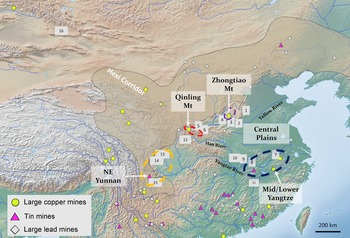
The Shang dynasty played a central role in the development of early Chinese history. Substantial information on the Shang dynasty can be gleaned from the well-known historical document Shiji (Records of the Grand Historian) written, albeit nearly 1500 years later, by Sima Qian (ca. 145–86 BCE) of the Han dynasty (206 BCE–220 CE). As with the mysterious Xia dynasty (ca. 2100–1600 BCE), the very existence of the Shang was once seriously questioned until the discovery of the oracle bones (cattle shoulder bones or turtle shells inscribed with ancient Chinese characters used for divination or records) in the early 1900s, at the present-day site of Anyang city, which has since been shown to be the last capital of the Shang dynasty (Fig. 1). Archaeological excavations at Anyang over the last hundred years have revealed a highly developed and hierarchical society. Whilst almost all of the royal family burials had been looted in antiquity, one can still see the remarkable wealth accumulated by the top Shang elites from some cases, such as the tomb of Fu Hao, the only intact royal tomb discovered so far (Fig. 2). As recorded in the inscribed texts on oracle bones, Fu Hao was one of the consorts of King Wu Ding (reigned ca. 1250–1192 BCE), but was an important general in her own right, who once led a large troop of ca. 13,000 soldiers and defeated the minority groups of people in the north and northwest of China. Her tomb, which has an area of only 20 m2, has yielded 1.6 tonnes of bronze (195 ritual vessels and 271 bronze weapons), 755 jades, 110 objects of marble, turquoise and other stones, 564 objects of carved bone, 15 pieces of cowries, 3 ivory cups and 11 pottery vessels. It is reasonable to assume that the funeral contents in the much larger King's tombs were significantly richer (Bagley, Reference Bagley, Shaughnessy and Loewe1999). In order to accumulate this remarkable material wealth, the Shang elites obviously needed a sophisticated social organisation to control a large number of labourers and craftspeople, and also to manage the supply of the raw materials, since the Central Plains are bereft of mineral resources. Compared to these elite tombs, what can be found in the tens of thousands of civilians’ tombs in the Shang are often only a few pieces of pottery.
Location of the sites and regions mentioned in the text (the brown shaded area between the Central Plains and the Steppe is the Arc); Archaeological sites: 1. Anyang 2. Zhengzhou (Erligang) 3. Erlitou 4. Yuanqu 5. Laoniupo 6. Huaizhenfang 7. Tongling 8. Tonglvshan 9. Panlongcheng 10. Shijiage 11. Xin'gan Dayangzhou 12. Hanzhong 13. Sanxingdui 14. Jinsha 15. Haimenkou 16. Tianshanbeilu. The dashed circles represent the four possible sources of highly radiogenic lead; orange – SW China including NE Yunnan, blue – Mid and Lower Yangtze River, red – the Qinling Mountain, purple – the Zhongtiao Mountain.

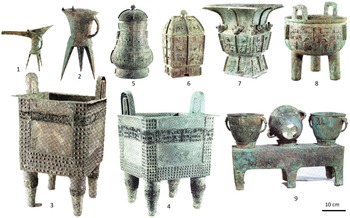
Bronze ritual vessels in Erlitou (1–2), Zhengzhou/Erligang (3–4) and Anyang (Fuhao: 5–9).

Although Anyang is probably one of the best representations of the Shang material culture, many of its characteristics can be traced back to its predecessors, such as Erligang (ca. 1500–1400 BCE) and Erlitou (ca. 1800–1500 BCE). Both these sites were discovered in the 1950s. Together with Anyang, they form a continuous standard sequence of the material culture of Shang archaeology (and also the later part of the Xia dynasty). Erlitou, often associated with the capital of the semi-mythical Xia dynasty, began a new chapter in the bronze metallurgy of central China. It probably adopted this new metal-making technology from the Steppe (present-day northern and north-western China, such as the Mongolian steppe or the Hexi corridor), but very quickly adapted it to the local social context (Mei, Reference Mei2003; Linduff and Mei, Reference Linduff, Mei, Roberts and Thornton2014; Rawson, Reference Rawson2017), and created something uniquely Chinese. The fact that the metallurgical workshop was located close to the palatial area of Erlitou indicates royal support and control of this new technology. Erlitou craftspeople soon developed the casting of the bronze ritual vessels, initially in imitation of the shapes of late Neolithic ceramics, using a completely novel piece-mould technology rather than the lost-wax or stone-mould casting of the Steppe. This created a distinctive Chinese metalworking tradition which survived for 2000 years and influenced some metal production in central Asia. These bronze ritual vessels started to perform essential roles in the ritual and political system of the Shang and later dynasties, which also continued for over two thousand years. Another important invention of the Erlitou metallurgists was the use of leaded bronze as the main alloy (Hsu et al., Reference Hsu, Bray, Hommel, Pollard and Rawson2016; Pollard et al., Reference Pollard, Bray, Hommel, Hsu, Liu and Rawson2017b; Huan, Reference Huan2021). In stark contrast to the preceding Steppe metallurgy, which was significantly dependent on arsenic and/or tin as the major alloying elements, leaded tin bronze soon became the standard alloying recipe in central China. It remains unclear whether this choice was due to accidental smelting of polymetallic ores or arose from the deliberate addition of alloying elements, perhaps with the intention of controlling the fluidity of the melt, or the colour, or increasing the weight of these ritual objects. Nevertheless, this ternary alloying recipe spread rapidly across a vast region from the Yellow River to the Yangtze and continued for over two thousand years of the Chinese Bronze Age, until the rise of the Qin (221–206 BCE) and Han empires (202 BCE–220 CE), when iron became widespread.
As the capital of the early Shang dynasty after Erlitou, Erligang witnessed a much larger expansion of metallurgical production. Although it is still impossible to estimate the overall scale of metal production at the moment, since the whole ancient site is under the modern Zhengzhou city, the bronzes recovered from the three hoards at Erligang shed light on a small tip of this iceberg (Henan Institute of Archaeology and Zhengzhou Institute of Archaeology, 1999). For instance, two remarkable Ding vessels were recovered from one of the hoards (Fig. 2: 3–4), with weights of 86.4 kg and 64.25 kg, respectively. They were significantly larger and heavier than the previous Erlitou metalwork. Moreover, the concept of using ritual vessels in graduated sets was already highly developed (Rawson, Reference Rawson, Shaughnessy and Loewe1999). The increasingly stable alloying pattern suggests a more sustainable supply network of tin and lead facilitated by much broader social and technological networks. The size of the overall site is approximately three times that of Erlitou, suggesting that Erligang was capable of employing a greater population and supporting a larger communication network. The Erligang culture even reached the Yangtze River, ca. 500 km to the south, where they established a military outpost at Panlongcheng (Fig. 1), probably to secure the metal supply, particularly of tin, for the Central Plains.
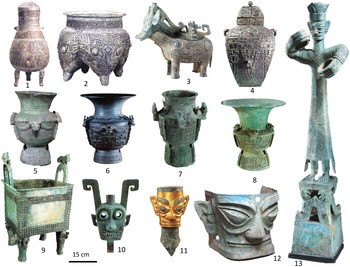
Metallurgy was very likely introduced into a much broader area of the Han River and Yangtze River basins from the Central Plains of China, as many local regions started producing or acquiring bronze ritual vessels resembling those of Erligang and Anyang. The most well-known case is probably the two ceremonial pits excavated in the 1980s at Sanxingdui, where enormously rich materials including bronzes, ivories and ceramics were recovered (Bagley, Reference Bagley1988). Although a few bronze ritual vessels certainly reveal direct or indirect linkage to the Central Plains, probably via the middle and lower Yangtze, what is most striking here are the giant bronze figures unlike anything else known from China (Fig. 3). Some of their iconographic features such as the abstract human faces can be traced back to the jades found in the late Neolithic Shijiahe culture (ca. 3000–2300 BC) along the middle part of the Yangtze, but they become much more striking when made of metal and in much larger sizes. Local variations can also be encountered around the upper Han River and the middle Yangtze. In the pit of Sucun Xiaozhong in the Hanzhong basin, two proper Anyang bronze ritual vessels (Fig. 3: 4) were discovered together with hundreds of masks and weapons with distinctive local styles. Bronze ritual vessels also gained popularity in almost all of the key sites along the Yangtze River, though often decorated with distinctive animal patterns. Some were even cast in animal shapes as a whole piece. The function of these ritual vessels also appears different from those in the Central Plains. Regardless of the local stylistic variation from the inner Mongolian Steppe to the southern Yangtze River valley, two things were held in common across Bronze Age China – the unique method of casting bronze objects using multi-part piece moulds, and the overwhelming reliance on leaded bronze as the material of choice. All regions were therefore confronted by the same question: where to source the copper, tin and lead?
Examples of bronzes outside the Central Plains (Hanzhong: 1–4, Mid and Lower Yangtze: 6, 9–10, Sanxingdui: 5, 7–8, 11–13).

Provenance versus mixing and recycling: highly radiogenic lead in Bronze Age China
“If you can't grow it, you have to mine it”. As this well-known saying states, the ultimate source of metal is of course from the metal mines. However, in archaeology, recycling offers another possible source of metal, or, at least, a way of reducing the demand for new metal. It is also crucial to note that recycling requires much less time, effort, organisation and energy than mining, smelting and casting, particularly if these activities take place at a distance from the metal sources. Apart from these economic considerations, recycling can be also associated with ritual and political concerns. A vivid example was recorded by Sima Qian and various other Han and later historians, who state that that Qin Shihuang, the first Chinese emperor (259–210 BCE), collected all of the weapons of his enemies after the unification of China and cast them into twelve gigantic figures erected in the front of his court. In this case, recycling served more as a political statement and a means of control rather than addressing a demand–supply balance. In addition to recycling, it is highly likely that multiple sources of metal were exploited to enable the mass production of Chinese bronzes. The heaviest object so far discovered from the Chinese Bronze Age is the Houmuwu Ding vessel (previously called Simuwu), which is around 832 kg. Mixing of metal from different sources in this case should by no means be ruled out.
Lead isotopic analysis is one of the most widely employed techniques to source metal in archaeometallurgy. One of its distinct advantages over trace elements is the lack of fractionation in high-temperature process such as smelting and casting, although small changes have been recorded (Gale and Stos-Gale, Reference Gale and Stos-Gale1982; Cui and Wu, Reference Cui and Wu2011). Ideally, the lead isotopic ratios present a fingerprint that allows a unique link to be established between a specific mining site and a metal object. However, the isotopic overlap between different metal sources poses extra challenges to interpretation of the lead isotopes, in addition to the complexities posed by deliberate mixing and recycling. An early and important observation on the lead isotope composition of Chinese bronzes (Cu–Sn–Pb alloys) was the frequent use of lead characterised by a highly radiogenic isotopic signal, first reported by Jin Zhengyao and his team in the 1980s in the Anyang bronze objects, including those of Fu Hao (Jin, Reference Jin and Jin1987). This is in marked contrast to the isotopic composition of European bronzes (Liu et al., Reference Liu, Rawson and Pollard2018a, Fig. 1). In Chinese archaeology, highly radiogenic lead is defined in relative terms as lead with isotopic ratios as follows: 206Pb/204Pb over ca. 19.5; 207Pb/204Pb over ca. 15.75; and 208Pb/204Pb over ca. 39.0. This suggests that the geological environment in which this lead formed contained significant amounts of both uranium and thorium. Jin immediately pointed out that this lead isotopic signature appears unique in the context of Chinese geology (Jin, Reference Jin and Jin1987). The geological source(s) of the lead must have been formed in very old tectonic plates (ca. 2.5 Gya) and only four regions across China fit this criteria: Northeast Yunnan; the middle and lower Yangtze; the Qinling Mountains; and the Zhongtiao Mountains (Zhu and Chang, Reference Zhu and Chang2002; Zhu, Reference Zhu2010). Jin and his colleagues carried out a wide range of comparative studies of the lead isotopic data of the objects with various metal mines in these areas. Based on the limited number of lead isotopic data on ores available in the 1980s, Jin et al. suggested that Northeast Yunnan showed the closest data to those of the objects, therefore appearing to be the most likely source of highly radiogenic lead for the Shang dynasty (Jin, Reference Jin and Jin1987; Reference Jin2008). This provoked extensive debate in Chinese archaeology. The linear distance between NE Yunnan and Anyang is nearly 2000 km, ignoring formidable mountain ranges such as Qinling (Fig. 1). Little archaeological evidence supports any cultural communication between Yunnan and the Central Plains during the Shang dynasty. This remains largely true, even though many more sites have now been excavated in Yunnan. In the twenty years since the discovery of bronzes containing highly radiogenic lead and the proposal of Yunnan as the source of this lead, a number of crucial excavations have been carried out at Sanxingdui, Jinsha, Hanzhong, Panlongcheng and Xin'gan Dayangzhou (see Fig. 1). All of their bronze assemblages have been confirmed to contain highly radiogenic lead, and appear to form a series of points on the map linking Yunnan to the Central Plains. Particularly, Jinsha is the latest dated site (equivalent to early Western Zhou, ca. late 11th–10th century BCE) which shows a notable proportion of bronze objects containing highly radiogenic lead, thereby, according to Jin et al., rendering extra support for the idea that Yunnan, or the broader region of Southwest China, could be the source of such lead. Two routes were hypothesised for the movement of highly radiogenic lead from NE Yunnan to the Central Plains. These routes diverged in the Sichuan Basin, represented by Sanxingdui and Jinsha. The southern route could take advantage of the river transportation of the Yangtze and changed to overland transportation somewhere near Panlongcheng. The northern route would seem to be the more difficult as it had to cross the Daba and Qinling Mountains before reaching the Wei River Valley, then into the heartland of the Shang dynasty (Jin Reference Jin2008). In Jin's theory, the lead signature found in the metal assemblages between Yunnan and the Central Plains were the direct results of the dynamic shifts between the northern and southern routes, however the ultimate impetus that underpinned these trade routes was the need for tin (for which Yunnan is a rich source), whereas copper and lead were only a secondary consideration (Jin Reference Jin2008, p. 39–43). Nonetheless, the proposal of Yunnan as the source of highly radiogenic lead, even with the two-route hypothesis, was still unable to satisfy the archaeologists. With regards to this model, questions remain to be answered as to why the Shang people chose to rely on metals from Yunnan while much nearer mines such as those in the Zhongtiao Mountain and middle and the lower Yangtze River were already known to them. A further assumption was made by Jin, namely that this long-distance transport was ultimately driven by the need for tin, which is geologically much rarer than copper and lead. According to his view, copper and lead were involved only because the minerals extracted in Yunnan were polymetallic. Up to now, there is still a lack of any solid archaeological evidence from Yunnan to prove this long-distance transport hypothesis (Liu et al., Reference Liu, Pollard, Lv, Huan, Zhang and Ma2021).
The second possible source of highly radiogenic lead is attributed to the Qinling mountains, which was initially proposed by Saito et al. (Reference Saito, Han and Sun2002) and recently restated by Chen et al. (Reference Chen, Mei, Rehren, Liu, Yang and Martinón-Torres2019). The Hanzhong metal assemblage is a special case in the Chinese Bronze Age as many objects contain a variety of different major elements which are rarely encountered anywhere else, such as arsenic, antimony and nickel. These were probably a result of unconscious (co-)smelting of pollymetalic ores (e.g. tennantite–tetrahedrite) or different types of ores mixed together. A few other objects were made from pure copper, which is also rare in central China (Chen et al., Reference Chen, Rehren, Mei and Zhao2009). More intriguingly, all of these objects show not only highly radiogenic lead compositions but also strong indigenous styles (e.g. sickles, sceptres, human/animal masks). Whilst no smelting and casting remains have yet been discovered in the Hanzhong basin, it is reasonable to believe that these objects were made locally. In the site of Laoniupo, located on the northern edge of the Qinling Mountain, some clay-moulds have been recovered which show the exact same patterns as the animal masks in Hanzhong. It is not yet entirely certain whether these moulds at Laoniupo were made to produce or just imitate the local objects in Hanzhong (Chen et al., Reference Chen, Mei, Rehren and Zhao2016). However, the Qinling proposal for the origin of highly radiogenic lead has been strongly criticised. So far, no such lead has been detected in the samples of bronze and slags from the major Shang smelting sites surrounding Qinling, such as Laoniupo and Huaizhenfang (Fig. 1). Moreover, very few special alloyed objects at Hanzhong contain lead up to the level as those in the Central Plains and other regions. Even though these objects indeed originated to the Qinling mountains, they might only represent the highly radiogenic copper in Qinling, rather than the Shang highly radiogenic lead (Zhangsun et al., Reference Zhangsun, Jin, Feng, Tian, Wang and Zhao2021). Whilst it is always difficult to be convinced that absence is evidence in archaeology, more chemical and lead isotopic analyses of the Hanzhong bronzes and relevant smelting and casting remains are certainly necessary in the future.
The third possible source of highly radiogenic lead is the middle and lower Yangtze River (Peng et al., Reference Peng, Sun, Huang, Zhang, Liu and Lu1997). This area is well-known for the abundant metal copper deposits. Additionally, the tin deposits to the south of the Yangtze are probably the closest to the Central Plains (Chen, Reference Chen2012; Liu et al., Reference Liu, Pollard, Rawson, Tang, Bray and Zhang2019). A variety of ancient mining and smelting sites have been identified along the banks of Yangtze, including Tonglvshan (literarily translated as ‘Copper Green Mountain’) and Tongling (Zhang, Reference Zhang1988; Huangshi Museum, 1999). Recent excavation shows that some of them can be dated to as early as the later phases of the Erlitou culture (Cui et al., Reference Cui, Li, Chen, Xu and Gong2020). In this scenario, the establishment of Panlongcheng on the Yangtze River was a crucial strategy to secure the supply of metal resource from the Yangtze to the Central Plains (Bagley, Reference Bagley1977; Liu and Chen, Reference Liu and Chen2009; Liu et al., Reference Liu, Pollard, Rawson, Tang, Bray and Zhang2019). A large number of the historical textual records also described the Yangtze River (i.e. the Chu state in the Eastern Zhou period) as a rich source of metal. However, it remains uncertain whether it was any of these large mines that produced the highly radiogenic lead (or copper). Although many metal object assemblages in this region show a highly radiogenic signature, almost all of the measurements of ores and slags so far are common lead (Jin et al., Reference Jin, Liu, Rawson and Pollard2017; Hsu and Sabatini, Reference Hsu and Sabatini2019).
The same situation also applies to the fourth, though perhaps the most important, candidate source, the Zhongtiao Mountain in the Central Plains (Cui et al., Reference Cui, Tong and Wu2012; Tong, Reference Tong2012; Qin et al., Reference Qin, Wei and Huang2020). It is undoubtedly the nearest metal source to the Shang court. Similar to Panlongcheng, Shang people established a walled site (Yuanqu) in the foothills of the Zhongtiao, probably to secure its supply of metal to Zhengzhou and Anyang. The earliest mining activity in Zhongtiao can be now dated to the Erligang period. An increasing number of new data suggests that sporadic copper mines in the Zhongtiao mountain could contain highly radiogenic lead, however this still cannot explain the source of such lead (Xu et al., Reference Xu, Wang, Li and Guo2005). The most recent contribution to this debate was published by Sun et al. (Reference Sun, Zhang, Guo, Li, Jiang and Zartman2016), who claimed that highly radiogenic lead could even have come from Africa. This is probably one of the best examples reflecting the difficulties in the cooperation between archaeologists who show general interests in science and geochemists who are specialised in science but show little interest in any other archaeological information, such as the huge quantities of slag and mould fragments discovered along the Yellow and Yangtze Rivers. The idea that hundreds of tons of metal could have been supplied from Africa to China in the Bronze Age in the absence of a shred of any other supporting archaeological evidence seems ludicrous to most archaeologists (Liu et al., Reference Liu, Rawson and Pollard2018a; Reference Liu, Chen, Rehren, Mei, Liu and Killick2018b; Sun et al., Reference Sun, Zhang, Guo, Li and Zhang2018). Nevertheless, the situation still remains that none of the potential Chinese candidate sources is able to satisfy all the necessary criteria raised by geoscientists and archaeologists. The wide distribution of highly radiogenic lead in Shang dynasty bronzes also reinforces the key archaeological question, namely whether it came from a single source with centralised distribution, or were multiple sources involved, but then why and how did all regions synchronously switch to the exploitation of such lead? Clearly, this question is more archaeological than geological: by what mechanism was this metal distributed over such a large area – centralised control over procurement, manufacture and distribution, or a synchronous exploitation of multiple sources containing highly radiogenic lead? A more detailed review of this can be found in Jin et al. (Reference Jin, Liu, Rawson and Pollard2017).
In terms of archaeology, the temporal and spatial pattern of the use of highly radiogenic lead is still of great scholarly interest, even without knowing its exact source(s). Jin (Reference Jin2008, table 2.3) illustrated the first attempt to sketch the rise and fall of such lead in the Central Plains, for the earliest Chinese dynasties. In order to better present the changes in the lead isotopic data to archaeologists, a different visualisation method has been proposed by the FLAME team (Pollard et al., Reference Pollard, Bray, Hommel, Liu, Pouncett and Saunders2018). Instead of following the traditional approach of plotting two lead isotopic ratios, we replace one axis with archaeologically relevant information, primarily chronology. Although some geological information such as that produced from isochrons is inevitably lost, we suggest that these diagrams offer more straightforward representations of variation in metal supplies related to archaeology. In our experience, the new form of illustration is more easily appreciated by archaeologists and promotes mutual dialogue and cooperation.
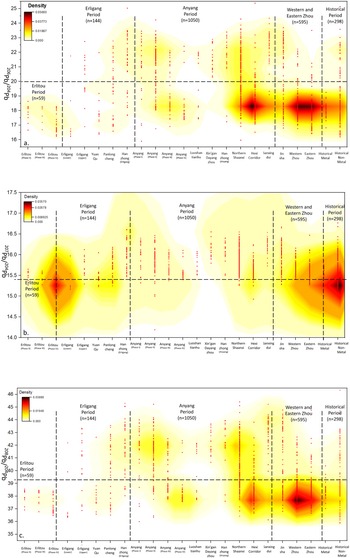
The variation of lead isotopic analyses of bronze objects from regions which saw the use of highly radiogenic lead in Bronze Age China is summarised in Fig. 4, with some supplementary data from metal and non-metal materials dated to the later historical periods of China. The coloured background is based on kernel density analysis (Pollard et al., Reference Pollard, Ma, Bidegary, Liu, Pollard, Armitage and Makarawicz2022). The diagram is based on that presented in Pollard et al. (Reference Pollard, Bray, Hommel, Liu, Pouncett and Saunders2018), however the addition of the kernel density modelling makes it easier to appreciate the location of the greatest density of datapoints. Focusing on the 206Pb/204Pb ratio, the shape of the kernel density rendition suggests a decrease in the lead isotopic values in bronze objects from Erlitou Phase II/III (206Pb/204Pb = ca. 18.25) to Erlitou Phase IV (206Pb/204Pb = ca. 16.5). Unfortunately, for the Erlitou data, not all of the objects with lead isotope measurements have been reported with associated lead concentrations, however in the subset that does, the higher lead isotopic values (ca. 18.25) might derive from lead in a copper source whereas the lower isotopic values represent the ratios in the source of the added lead. This is deduced from another representation of lead isotope data (Fig. 5), where we plot one lead isotope ratio against the inverse of the lead concentration on each object (Pollard and Bray, Reference Pollard and Bray2015). On the left-hand side of this diagram (1/Pb <1%), the isotopic values cluster around 206Pb/204Pb = 16.5, whereas for 1/Pb >1 the values are closer to 18.5. As 1/Pb <1 implies Pb > 1% in the object, we assume that these lead isotope values are associated with the source of the lead added to the bronze (since any added lead will dominate the lead isotope signal), i.e. the added lead has an isotopic value around 206Pb/204Pb = 16.5, whereas for 1/Pb >1 (Pb < 1%) it is more likely that no additional lead was added, and that the ratio (18.5) represents that of the trace lead in the source of copper. The tendency for the lead isotope ratio to decrease from an average of 206Pb/204Pb ca. 18.5 in Erlitou Phase II to ca. 16.5 in Phase IV is a reflection of a gradual change in the casting practice, whereby an increasing the amount of lead is added to the alloy in Phase IV.
Variation of lead isotopic data in bronze objects from China (apart from the last column, which includes lead isotope measurements on non-metallic objects (see text). Each figure plots one lead isotopic ratio against a chronological series of archaeological sites (see text for further explanation; data sources can be found in the Supplementary material together with a high resolution version of this figure).

Plot of lead isotopes and lead concentrations for the Erlitou bronze assemblage (data from Jin, Reference Jin2008).

In Fig. 4a, the sources of lead and copper used in the Erlitou period continued to be used during the Lower Erligang period, though appear to have been restricted only to the sites in the Central Plains (i.e. Erligang and Yuanqu; Panlongcheng and Hanzhong are already using a source containing highly radiogenic lead). The Erligang Upper period then witnessed a clear rise in the use of this lead, which then shows use across a vast geographical area, from the Central Plains to the Han and Yangtze Rivers. The kernel around Anyang Phase II shows further dominance of highly radiogenic lead in the metal supply network to the Central Plains. However, during Anyang Phases III and IV the lead isotopic ratio in the bronzes is reduced to that of the range of common lead. There is a general trend towards an increase in added lead in the bronzes from Yinxu II to IV (Liu et al., Reference Liu, Rawson and Pollard2018a), suggesting that the added lead has a common lead signature which dominates the isotopic ratio in the object. This makes it difficult to know whether the lead source providing the highly radiogenic lead in the earlier phases is completely abandoned during Yinxu III and IV, or whether it is simply masked by the dominant common lead.
The decline of highly radiogenic lead in the bronzes is even more obvious in the periods of the Western (ca. 1045–771 BCE) and Eastern Zhou (ca. 771–256 BCE). Except for the metal assemblage at Jinsha and a few objects made at Anyang but captured and redistributed by the early Western Zhou conquerors (known from documentary sources and inscriptions), almost all other bronzes were made using common lead. In fact, the early Zhou governors established a number of key states in their new territory and the interregional communication network was extended significantly, such as to include the Yan state in northeast China (around modern Beijing). Although this means that new sources of metal may have become available, it is possible that the decline in the use of highly radiogenic lead is because the mine(s) providing this lead had become exhausted owing to the immense amount of metal consumed from Erligang to Anyang Phase III.
One further observation can be made by comparing the three components of Fig. 4. It appears as if the patterns reflecting the isotopes of 206Pb/204Pb and 208Pb/204Pb co-vary across time – periods of utilising highly radiogenic lead as indicated in the 206Pb/204Pb diagram are matched by higher values in 208Pb/204Pb. In contrast, although following the same basic pattern, the variation in 207Pb/204Pb is less exaggerated. Given that 206Pb derives from 238U, 207Pb from 235U and 208Pb from 232Th, one might expect 206Pb/204Pb and 207Pb/204Pb to show stronger covariation than that of either with 208Pb/204Pb. That this does not appear to be the case suggests that there is further information to be extracted from these data.
The reverse side of the same coin: disentangling the human–metal interaction through mixing and recycling of the metal
It has been recognised widely that the potential existence of mixing and recycling could place serious obstacles for provenancing metal in antiquity (Pernicka, Reference Pernicka1995; Wilson and Pollard, Reference Wilson, Pollard, Brothwell and Pollard2001; Sainsbury and Liu, Reference Sainsbury and Liu2022). So far, however, very few scientific techniques have enabled scholars to directly distinguish between freshly made objects and those made from mixed and recycled metal. We also argue that mixing and recycling needs to be placed in a wider context in order to understand the underlying motivation as well as the associated social implications (e.g. the twelve giant figures cast by Emperor Qinshihuang, discussed above).
In this process, the archaeological information should be treated as equal to (if not more important than) scientific analysis of trace elements and isotopes. When it comes to China, consideration of mixing and recycling is dependent mainly on the presence or absence of the highly radiogenic lead. For example, Jin and his colleagues contend that there was no large-scale mixing between the metal used by the Shang and the Western Zhou. Otherwise, the two types of lead isotopic signatures would have converged (Tian, Reference Tian2013). As noted above, however, this conclusion needs to be evaluated in terms of the mass balance of lead from different sources, in addition to the measured isotope ratios in the objects, and this is yet to be done. Moreover, although it has been speculated based on historical documents and bronze inscriptions that the conquering Western Zhou demolished the temples and looted the elite tombs of the late Shang, and hence very probably melted down their ritual bronzes, the fact that Western Zhou bronzes do not contain highly radiogenic lead has been taken to suggest that this is unlikely. This conclusion has to be seen as only an interim opinion, however as the fact remains that very few elite bronzes of the late Shang – identifiable by inscription – survive. This means that either they have yet to be found, or that they were melted down and recycled, but sufficient common lead was added to the products that the radiogenic lead was diluted. This might be seen as a case of archaeological evidence superseding the chemical data.
A more recent case study pertaining to mixing and recycling in China was published by Liu et al. (Reference Liu, Pollard, Cao, Liu, Sainsbury and Howarth2020). A considerable difference is noted through characterisation and comparison of the metal assemblages between the top elites and lower elites at Anyang, where ‘top elites’ denotes very rich tombs with royal associations, and ‘lower elite’ implies tombs with a few bronzes, which nevertheless must represent individuals of some status. The variation in the percentage of alloying elements in the top-elite assemblage are significantly narrower than that in the objects of the lower-elites, suggestive of more carefully controlled and targeted alloying recipes used during the production process. Better control of the alloying composition in the final products is more easily achieved by using fresh metal of good quality, as recycling inevitably introduces a greater range of compositions into the melt. In other words, one feature that most likely signifies mixing and recycling in an assemblage of objects would be a much wider range of alloying element distribution. This model is also supported by the trace-element patterns in the objects, which are primarily associated with the copper base. The copper base used for the top-elite metal assemblage appears to be extremely free of trace elements, whereas that of the lower elites contain a variety of impurities in different proportions.
However, this does not yet fully address the problems of mixing and recycling at Anyang. The variety of the geological sources of the lower elite metal may account for its more complicated trace-element patterns. Meanwhile, the top-elite objects were more likely to have been made in a relatively restricted number of workshops, or even by individual craftsman, as most of these top-elite bronzes are inscribed with the owner's name as part of the casting process, meaning that the craftsman knew exactly for whom the bronzes were being made before casting. The social status of top elites was associated closely with the bronzes they possessed, which undoubtedly affected the selection of individuals, technologies and raw materials involved in the production process. By contrast, lower elites could acquire bronzes from multiple workshops and they may not have been able to afford top quality alloyed objects. Occasionally, such objects went into lower-elite tombs, perhaps as a consequence of gifting or rewarding from the top elites. As a result, the diversity in the chemical composition of the lower elite metal is rooted in not only mixing and recycling, but also by their place in the social network.
The identification of an association between those individuals having the social status of top elite and their use of non-recycled bronzes highlights yet again one of the largest issues that must have confronted the Anyang rulers – how to obtain a sufficient supply of raw metal. Despite being one of the most effective approaches to easing this supply pressure, it seems that mixing and recycling was restricted strictly to objects available to the lower-elite. This implies that mixing and recycling was related to multiple aspects of Anyang society, including not only a simple supply–demand economic concern, but also a wider picture of ritual practice and social polarisation. For modern archaeologists, it also suggests that the objects of the higher elites are more likely to provide an unequivocal answer in terms of provenance.
Conclusions and future perspectives
The common interests in provenance of raw materials have brought together geoscientists and archaeologists for nearly two hundred years. The debate on the highly radiogenic lead used in China provides another example where sometimes provenance is not an easy task. However if we look at the bigger picture, provenance is not necessarily the only objective of the research, but simply a stepping stone to explore other wider questions. Whilst the exact source(s) of the highly radiogenic lead (and copper) are not yet identified to the satisfaction of all, its rise and fall, which happened synchronously with the major political changes in central China and other regions, is a manifestation of the important role of metal and its underlying powerful network. Although mixing and recycling has always been assumed to add an additional layer of complexity to the overall discussion, if it can be tackled (as at Anyang during the Shang), then it can reveal interesting information on resource management and availability in ancient societies.
We are left with a number of difficult, but interesting, questions to resolve. How and why did highly radiogenic lead simultaneously enter the metal supply of the Shang period, and why did its use cover such a wide area? Similarly, why did its use virtually cease with the Zhou conquest of the Shang, also simultaneously over a wide area? Was there a single source of highly radiogenic lead, or multiple sources? Is the reason that we cannot simply identify the source of this lead evidence of centralised control and the extent of the Shang metal supply system, implying extensive mixing of raw materials from multiple sources at the Shang capital? Did the Zhou change this metal supply system? These questions require much more data, particularly combining chemical and isotopic measurements on the same object, so that we can begin to tease apart trace lead in copper from deliberately added lead. This need sits alongside a need for more geochemical data from potential ore sources, as well as archaeological evidence from mining and smelting sites. Perhaps even more significantly, this represents a growing and more mature relationship between archaeology and the geosciences, where evidence from whatever source can be combined and evaluated in the round.
We noted in the introduction that we recognise that lead isotopic data are not just numbers, in the sense that the values are constrained by geochemical parameters, and yet we do use them as ‘just numbers’ in subsequent alternative presentations of data. This illustrates the point of this paper – under some circumstances and under certain conditions it is important to use isotopic data as geochemically-constrained data – specifically when there is little evidence of anthropogenic mixing/recycling, and the objective is to derive the geological age of the ore deposit, and match these data to specific ore sources. In archaeology, however, we cannot always be certain that this is legitimate, and hence have used different techniques to visualise changes over time, which is, arguably, of equal importance with knowing the geological source of the metal.
Acknowledgements
We acknowledge the support of the European Research Council Horizon 2020 (ERC advanced project FLAME, Flow of Ancient Metal Across Eurasia, 670010). We are grateful for the helpful comments of a number of anonymous reviewers and also the editor. This work also carries a huge debt to the many scholars in China and elsewhere who have considered the archaeological and geochemical issues associated with metal production and use in the Bronze Age. More specifically, we would like to pay tribute to Peter Williams, who mentored one of the authors in chemistry for several years in Cardiff, and taught him the phrase ‘How would you know if you were wrong’ (best delivered in a strong Australian accent!). Thanks Pete.
Supplementary material
To view supplementary material for this article, please visit https://doi.org/10.1180/mgm.2022.32.