Implications
The climate of northern Europe has changed over the past several decades and will continue to do so for the foreseeable future. These changes will have an impact directly and indirectly on livestock farming systems, the animals themselves and the pests and pathogens that constrain them. We need to remain vigilant to such changes, through enhanced veterinary investigation and disease surveillance services. We also need to implement more sustainable disease control programmes, which are robust and flexible enough to cope with future changes.
Introduction: climate change and animal agriculture
It is now widely accepted that climate change is happening and that it represents one of the greatest threats faced by our planet, its population and economies. Agriculture is in the front line and among the first to feel the effects of a changing climate. Impacts are likely to be most severe in developing countries but no less important in Europe. The ‘perfect storm’ of real and projected rising atmospheric CO2 and global temperatures, changes in annual and seasonal precipitation and extreme weather events will undoubtedly affect the yield, quality and stability of food production The projected changes offer opportunities and challenges but will undoubtedly lead to risk and uncertainty in agricultural production, food prices and farm incomes. Responses to climate change include ‘adaptation’ to reduce vulnerability of agricultural systems to change, and ‘mitigation’ to reduce the extent of the change. Adaptation has always been an integral part of the history of farming. Farmers have always adapted to change, whether climatic, economic or societal; this is based on a sound knowledge and understanding of their crops and livestock and the environment in which they live and work. Many farmers have already begun adapting their farming practices and strategies in response to recent changes in weather patterns and will continue to do so, both to exploit new opportunities, for example, increasing demand for their products, and to avoid or reduce any negative consequences of change. Adaptation options include, for example, production adjustments, diversification, intensification, changing land-use, altering timing of operations and so on. However, it is anticipated that, although projected climatic changes are not expected to severely disturb overall EU agricultural production until the ∼2050s, the extent of change in the coming decades may overload individual farmers’ capacity to adapt (EU, 2009). That said, strategies to adapt to the potential changes in climate are not without precedent nor do they need to be developed entirely de novo. The climatic conditions likely to apply in Europe, even under high emission scenarios, already exist in other countries, for example, South Africa and Australia, thereby providing the basis for the adaptive strategies likely to be appropriate under such conditions.
Therefore, the effects of climate change on livestock production and the health and welfare of animals in production systems, as well as the contribution of farmed animals to climate change through greenhouse gas (GHG) emissions, pose some of the major questions relating to the global issue of ‘sustainable food production in a changing world’ (Garnett, Reference Garnett2013; Smith and Gregory, Reference Smith and Gregory2013). Livestock are also central to the Food Security and ‘Sustainable Intensification’ agendas (Beddington, Reference Beddington2011), that is, the requirement for increased food production, with less waste and environmental impact to feed a growing world population, estimated to reach 9 billion by the 2050s. Demand for meat and dairy products, in particular, is projected to increase markedly as the developing world becomes more affluent (Gill et al., Reference Gill, Smith and Wilkinson2010; Thornton, Reference Thornton2010).
For the purposes of this review, we focus specifically on sheep, cattle, pigs and poultry and restrict our coverage to temperate northern European regions. The direct effects of the predicted changes in climatic conditions, weather, frequency of extreme events and altered thermal environments will potentially have an impact on animal production efficiency and through the imposition of stress, resulting in consequences ranging from increased mortality to stress-induced pathologies, altered disease resistance and poor welfare (Gaughan et al., Reference Gaughan, Lacetera, Valtorta, Khalifa, Hahn and Mader2009). Livestock will also be affected indirectly through changing exposure to important livestock diseases. The sectoral reports of both UK and Scottish Climate Change Risk Assessments (CCRA), for example, specifically mention livestock disease risk as a direct (negative) consequence of climate change (e.g. Moran et al., 2009; Knox et al., Reference Knox, Hurford, Hargreaves and Wall2012).
Animal disease issues can have devastating consequences for the livestock sector and the wider economy, as exemplified by the UK BSE crisis in the late 1980s and the foot and mouth disease outbreak in 2001. Many of the diseases considered important in a northern European context have little or no obvious climate dimension, other than that they contribute to loss and waste in the system and increase the carbon footprint of livestock farming. However, others, most notably vector-borne diseases, such as those caused by Bluetongue and Schmallenberg viruses, do have an obvious climate dimension, through an increased range of their biting midge vectors. Incursions of such ‘exotic’ pathogens have received most attention in the farming and scientific literature (e.g. Baylis, Reference Baylis2006). However, arguably, the greatest constraint on efficient, sustainable livestock production comes from endemic rather than exotic pathogens. All sheep and cattle, in particular, are exposed to helminth parasite (or ‘worm’) infections and infestations by arthropod ectoparasites while grazing. Losses associated with increased infection intensity can be substantial.
In this review, we explore the complex interactions of direct and indirect effects of climate change on parasites, hosts and farm management practices and the implications for animal health and welfare. Such a review can never be comprehensive, and therefore we have chosen specific examples to help illustrate key points.
Direct effects of climate change on animal health, welfare and production
Predicted changes in climatic conditions, frequency and intensity of extreme events and altered thermal environments will have an impact directly on animal production efficiency and have likely knock-on deleterious effects on animal health and welfare. The severity of these effects may be forecast by examining the available climate change predictions for the appropriate time scales and periods and on the basis of the different emission scenarios and the estimated likelihoods, probabilities and uncertainties currently being modelled. A range of approaches may be used to determine the severity of impacts and their regional distributions (e.g. Rivington et al., Reference Rivington, Matthews, Buchan, Miller, Bellocchi and Russel2013).
In response to the changing climate, it will be necessary for agriculture and, indeed, the whole of society to adopt and implement reliable strategies for adaptation. Adaptation strategies are needed at all levels of administration, from the local to the international level (EC – Europa, 2012 and Defra, 2013). It is acknowledged that the currently predicted rates of change in climate variables will exceed the capacity of the traditional spontaneous adaptations by communities and animal species, and new and scientifically based strategies must be developed (IFAD, 2010). Analysing the impacts of climate change on animal well-being is complex. Even more complicated is the prediction of the direct effects on animal health and welfare of any associated adaptations that might be implemented by the animal production industry in response to reduced productivity and efficiency, increased losses, falling profits and changes in animal health. This also applies to concerns relating to the well-being of livestock in systems unable to cope with the climate change challenges or in response to adaptive changes that may alter their welfare status. For the purposes of the current review, we focus on warming scenarios and their potential impacts on livestock production systems in the United Kingdom, as an example broadly representative of northern temperate regions. We further examine the potential adaptations that might be required to minimise the deleterious effects of the stressors imposed by climate change.
Extensive and intensive production systems
In relation to adaptation strategies and their impacts, the important differences between extensive and intensive systems for livestock production need to be considered. Thus, although all livestock production systems are likely to be sensitive to the threats posed by predicted climate change scenarios, intensive animal production, specifically meat poultry and pig systems, might be of particular concern in terms of direct adverse thermal effects. The size of the pig and meat poultry industries in the United Kingdom alone indicates the importance of reliable analysis of the climate change impacts and their likelihood and the development of effective and efficient adaptations. As indicated above, pigs raised in indoor systems are less vulnerable to changes in outdoor conditions, as long as the magnitude of any imposed thermal challenge does not exceed the capacity of the building design and ventilation system (McGlone and Pond, Reference McGlone and Pond2003). Similar arguments may be offered for intensive broiler production. However, as indicated elsewhere, it is unlikely that current climate control systems and production/husbandry practice will be adequate in the face of the challenges presented under some of the climate change projections currently in place.
In addition, animal transportation, including the movement of slaughter meat animals from intensive systems, constitutes a component of the process that may be considered particularly vulnerable to the thermal challenges imposed by all climate change scenarios and, in particular, increased incidence of extreme events. Animal transportation may present opportunities for the design and implementation of a wide range of adaptation options by the industry, to ameliorate or minimise the effects of the impacts resulting from the climate change scenarios.
Intensive production and animal transport systems present some complex challenges in terms of prioritisation of adaptations and assessment of such strategies in relation to the true cost–benefit. Indoor intensive systems require various degrees of environmental control and are thus deemed less sensitive to changes in external environments or meteorological conditions; however, current systems may not have the capacity for effective control in the face of large changes in thermal challenges or during an increased incidence of extreme events. In addition, the adaptations required under such conditions, for example, improved house design and structures, ventilation systems and insulation, water provision and husbandry practices and procedures have economic costs, energy costs, welfare costs and consequences for the carbon footprints of the systems.
Thus, adaptation strategies must be based on factors other than production indices and animal health and welfare, including socio-economic factors and socio-cultural values (Thornton, Reference Thornton2010). In the case of animal transportation, the same issues must be addressed, but it is proposed that the time course of implementation of adaptations may be significantly shorter as the impacts of warming will become apparent even before 2020 (Haskell et al., Reference Haskell, Kettlewell, McCloskey, Wall, Hutchings and Mitchell2011). Adaptations should be designed to concurrently maximise productive efficiency and ensure animal health and welfare status. However, current policy must also consider other consequences and sequelae of the adaptations; thus, for each system, it is important to model holistically all aspects of the adaptive strategies. A study by Turnpenny et al. (Reference Turnpenny, Parsons, Armstrong, Clark, Cooper and Matthews2001) recognised the importance of examining the impacts of climate change on intensive systems and has proposed models that facilitate identification of risks of thermal stress and identifies some adaptations (e.g. changing stocking densities and improved ventilation regimes that might reduce such risks).
Thermal stress – impacts and adaptations
The UKCCRA (Knox et al., Reference Knox, Hurford, Hargreaves and Wall2012) has concluded that there is a significant risk of heat stress affecting dairy production in the United Kingdom under specific prediction scenarios but that major effects would not be encountered until 2050. Referring specifically to the study by Haskell et al. (Reference Haskell, Kettlewell, McCloskey, Wall, Hutchings and Mitchell2011), Knox et al. (Reference Knox, Hurford, Hargreaves and Wall2012) acknowledge that failure to assess the impacts of the predictions on intensive production of pigs and poultry is an important omission, indicating that ‘In particular, pigs and poultry could be more severely affected by heat stress’.
Haskell et al. (Reference Haskell, Kettlewell, McCloskey, Wall, Hutchings and Mitchell2011) reviewed the impacts of climate change on livestock and included dairying, beef cattle, pigs and poultry. Their evidence relates primarily to the direct impacts of thermal stress on animal well-being and health, as well as indirect climate impacts, including impacts on feed availability, competition for land-use and climate-induced consequences on animal transport. The study by Haskell et al. (Reference Haskell, Kettlewell, McCloskey, Wall, Hutchings and Mitchell2011) reports that the effect of climate change on the welfare of dairy cows may be primarily a consequence of increased temperature, although the magnitude of this effect is difficult to predict from currently available data. Heat stress during summer months, at which time the majority of the UK dairy cattle graze outside on pasture, may not be a concern until 2050 in areas such as the south-west of England, but may be of more significance under the scenarios predicted for 2080. Animals grazed outdoors are expected to suffer some effects from high ambient temperatures, high direct and indirect solar radiation and high humidity, particularly during heat waves, all stressors that will negatively affect welfare. It is interesting to note that, in a more recent comprehensive review of climate change and dairy farming in Central Europe (Gauly et al., Reference Gauly, Bollwein, Breves, Brugemann, Danicke, Das, Demeler, Hansen, Isselstein, Konig, Loholter, Martinsohn, Meyer, Potthoff, Sanker, Schroder, Wrage, Meibaum, von Samson-Himmelstjerna, Stinshoff and Wrenzycki2013), the authors identified feed availability and quality as key constraints. They argue, however, that the effects on farm economy could be neutralised if effective adaptation and mitigation strategies, such as management, nutrition, animal health, plant and animal breeding, are implemented.
In contrast, it is thought that beef cattle will be spared the major effects of heat stress, as the geographical areas in which the majority are reared (west and north) will not see major temperature increases until 2080 under the high emission scenario. In any of the predicted scenarios, providing an appropriate environment can reduce heat stress. Adaptations suggested have been the provision of shade or the use of active cooling mechanisms such as sprinklers, increasing air velocity and provision of cool drinking water. In many cases, the provision of shade may be the most economical solution of reducing high heat load. It is suggested that a well-designed shade structure should reduce the total heat load by 30% to 50%. Shade can be provided in many different ways, for example, shade can be natural (trees) or artificial. It has been suggested that shade from trees is more effective and is preferred by cattle. Air movement is an important factor in the relief of heat stress. Air movement is critical if cooling is to be effective, whether outside or inside a building. The use of natural ventilation in animal buildings should be maximised through the use of open-sided sheds. Direct access to water such as rivers and pools is effective in cooling animals in a grazing situation, as animals will stand in the water or splash it over themselves. The use of sprinklers, misting and fogging is believed to reduce heat load. Body temperature can be reduced by a few degrees for perhaps 3 to 4 h following a substantial wetting of cattle.
Intensive production systems and transportation – adaptation strategies
Therefore, for present purposes, it may be proposed that, in the United Kingdom, extensively produced (outdoor) livestock will not be at risk of primary thermal stress for most of the currently predicted scenarios and that the focus should be on the requirements, nature and additional implications of adaptations required in the intensive production of pigs and poultry. It is therefore proposed that it is important to consider all aspects of the adaptations required by the EU poultry and pig intensive production sectors both in relation to the production or housing requirements and transportation of animals by road to slaughter.
Animal transportation may be considered to be extremely vulnerable to changes in average and maximum temperatures and to any change in the frequency and/or severity of extreme events. It may be proposed that the thermal micro-environment within the transport containers or vehicles is extremely vulnerable to changes in external thermal conditions. As such, in response to any potential increase in thermal load it poses the greatest threat to the animals’ welfare and well-being (Appleby and Lawrence, 1999; Mitchell and Kettlewell, Reference Mitchell and Kettlewell1998; Cockram and Mitchell, Reference Cockram and Mitchell1999; Mitchell, Reference Mitchell2006). Adverse thermal conditions resulting in either heat or cold stress may lead to reduced welfare, overt tissue damage or injury and increases in mortality in transit (Mitchell, Reference Mitchell2006; Mitchell and Kettlewell, Reference Mitchell and Kettlewell2006; Mitchell and Kettlewell, Reference Mitchell and Kettlewell2008). The thermal micro-environment in transport containers or vehicles may be complex and results from the interactions of several factors. These include the external climatic conditions, heat and water production of the animals, ventilation regimes, the distribution and flow rates of air movement and any additional external sources of heat and/or moisture. The metabolic heat and water production of animals in transit is a major determinant of the ‘on-board’ thermal environment and this can be of vital importance, if external conditions and/or inadequate ventilation are likely to precipitate heat stress (Kettlewell et al., Reference Kettlewell, Hampson, Green, Teer, Veale and Mitchell2001a, Reference Kettlewell and Mitchell2001b and Reference Kettlewell, Hoxey, Hampson, Green, Veale and Mitchell2001c).
We will now examine the direct effects of climate change on intensive pig and poultry production and the transportation of these animals to slaughter, identify potential adaptations, as well as their secondary costs and consequences.
Current animal housing design and operation assures a controlled environment (temperature control) and this in turn involves or influences a number of other variables. Thus, houses may be mechanically ventilated and supplementary heating and/or cooling may be supplied. Some facilities will have natural ventilation where control is very limited. The houses require water supplies, bedding and/or litter, the condition of which is influenced by the hygrothermal environment and thus ventilation regime. The houses accumulate waste and contamination that require removal, storage and disposal. The houses require cleaning and disinfection and disease control measures. All of the factors are intimately linked, and changes in climate necessitating alterations in the operation or specification of the primary control systems will have far-reaching consequences. Thus, if the thermal demands placed on an intensive system (e.g. a broiler production shed) by a ‘heat wave’ or long-term increase in maximum temperature exceed the ventilation capacity, then, in addition to potential heat stress on the birds, other variables will be affected. Water usage by the stressed birds will increase (May and Lott, Reference May and Lott1992; Belay and Teeter, Reference Belay and Teeter1993), litter quality may deteriorate, this will result in increased incidence of pathology and losses (Bessai, Reference Bessai2006; Manning et al., Reference Manning, Chadd and Baines2007; Meluzzi et al., Reference Meluzzi, Fabbri, Folegatti and Sirri2008; Alain et al., Reference Alain, Mirabito, Arnould, Colas, Le Bouquin, Lupo and Michel2009; Kyvsgaard et al., Reference Kyvsgaard, Jensen, Ambrosen and Toft2013) and the final wet litter will present problems of emissions and disposal (Topper et al., Reference Topper, Wheeler, Zajaczkowski, Gates, Xin, Liang and Casey2008; Singh et al., Reference Singh, Casey, King, Pescatore, Gates and Ford2009). Obviously, during animal transport (catching/handling/ loading/in transit) and the associated procedures, similar factors will determine the on-board environment for the animals and their effects. Climate change scenarios involving significant warming (increased average temperature and changes in average, min/max) and increased incidence of extreme events will have direct impacts on pigs/birds in the shed or in transit. These will include:
(1) losses, that is, mortality and ‘dead on arrival’; (2) poor welfare; (3) growth penalty/product quality; (4) reduced feed conversion efficiency; (5) increased diseases’ susceptibility; and (6) reduced bedding/litter quality (with associated lesions, infections and pathologies).
The potential adaptations necessary to mitigate against the climate change-induced problems will be: (1) improved mechanical ventilation systems/regimes; (2) additional cooling/heating systems; (3) changes in stocking density; (4) slower growing pigs/birds (to reduce thermal loads and incidence of growth-associated pathologies); (5) more heat-tolerant lines/strains (genetic selection/genomic strategies); and (6) nutritional measures.
It is immediately apparent that some of these adaptations to reduce the impact of climate change are themselves likely to contribute to climate change. Thus, the efficacy of each of these approaches requires consideration along with any environmental impact and an assessment of the real costs and therefore definition of the most cost-effective strategies for adaptations in intensive production systems. It is immediately apparent that a major investment in building structures and perhaps an increase in the scale of production are important options and costs. The installation of higher-capacity ventilation or environmental control systems in new or existing housing will have a very significant cost. The energy (electricity, gas) and water requirements of such higher-capacity/performance systems will be a major concern. The GHG/emissions or carbon footprints and pollution and waste generation potential associated with these systems and perhaps implemented in larger-scale production systems will require estimation and incorporation in holistic, integrative models. Such models must also be applied to animal transportation including costs for improved vehicle design and operation. For housed animals, the engineering solutions must be analysed in the context of management of the animals and their bedding or litter. The short-term alternatives to technological adaptations such as reducing stocking densities and/or growth rates must be carefully evaluated. The modelling of these adaptation strategy costs must also consider the effects on disease and health status of the animals and any likely impacts on zoonoses. Other factors that might be incorporated in a long-term strategy include the likelihood of new regulatory requirements (animal health and welfare) as applied to new and improved production systems and the benefits or otherwise of relocation of production systems or trade-based solutions to avoid the impacts under consideration.
Unfortunately, at present, it is not possible to provide definitive answers to any of the questions raised. There are a number of studies and programmes in place where modelling of the impacts on intensive livestock and the costs of potential adaptations are to be addressed and assessed. The key issue is to recognise that intensive animal production can be a key component of the building of sustainable animal protein supply in the future. Intensive production should offer a degree of protection against changing climates and, in particular, thermal challenges. However, current climate change predictions indicate that additional adaptations may be required and these will have secondary consequences that require very detailed and comprehensive assessment before identification of the most cost-effective policies and strategies.
Climate change and livestock pathogens – some examples, with a focus on parasites
The impacts of climate change on the lifecycle and distribution of insects, and subsequently on vector-borne diseases, are becoming increasingly common in livestock. Climate change also has well-documented effects on the lifecycle of ticks, with warming scenarios generally favouring development and increased spread of tick-borne infections, which threaten both humans and animals (e.g. White et al., Reference White, Sutherst, Hall and Whish-Wilson2003; Gray et al., Reference Gray, Dautel, Estrada-Pena, Kahl and Lindgren2009). Extreme weather events, for example, flooding can carry a risk of Cryptosporidium parasites and/or enterohaemorrhagic Escherichia coli emerging as diffuse pollution in a run-off from agricultural land. This poses an obvious threat to other livestock and is also a zoonotic risk to humans through contamination of water supplies. Future challenges in the control of parasitic zoonoses, including those related to climate change, deserve increasing attention alongside production-limiting disease (Polley and Thompson, Reference Polley and Thompson2009). Extreme weather events can also lead to animal health problems, even in housed animals. For example, infestation of laying hen houses with the poultry red mite, Dermanyssus gallinae, is thought to cost the EU poultry industry ∼€130 millions/year (Maurer and Baumgartner, Reference Maurer and Baumgärtner1992). During extreme weather events, red mite populations can become uncontrollable in both laying hen systems and broiler production units and have been implicated in the deaths of large numbers of hens during the summer heat wave of 2003.
Although extreme weather events pose specific challenges, gradual changes in climate can also have a major impact on animal health. The effects of climate change on infectious diseases of farmed animals, and the complex interactions determining whether animal health, production and welfare will be compromised, are arguably best demonstrated by the example of helminth parasites of ruminants. Several different species of gastrointestinal nematodes (roundworms), notably Ostertagia (Teladorsagia) spp, Haemonchus contortus, Nematodirus battus and Trichostrongylus spp, can be found on most ruminant farms globally. Similarly, the liver fluke, Fasciola hepatica, is a highly pathogenic flatworm parasite of sheep and cattle and is responsible for considerable disease, death and economic losses (e.g. Schweizer et al., Reference Schweizer, Braun, Deplazes and Torgerson2005; Sargison and Scott, Reference Sargison and Scott2011). Because it requires a small mud snail intermediate host to complete its lifecycle and disseminate infectious stages onto pasture, fluke has typically been reported in the wetter areas, for example, north-west Europe. Heavy infestations of livestock with some of these parasites can prove fatal but more commonly they cause lower-level infections resulting in sub-acute or chronic disease, for example, anorexia, diarrhoea, weight loss and reduced milk yield in production animals. Associated losses to the meat and milk producing industry are very significant. For example, chronic roundworm infections of sheep, and their prevention, have been estimated to cost the GB sheep industry £84 millions/year (Nieuwhof and Bishop, Reference Nieuwhof and Bishop2005). In recent years, the diagnostic incidence of both acute and chronic helminth disease in cattle and sheep in the United Kingdom, where surveillance records enable meaningful analysis, has increased threefold to fourfold (van Dijk et al., Reference van Dijk, Sargison, Kenyon and Skuce2010). Parasite species such as the rumen fluke (or paramphistomes), which traditionally caused no measurable production losses, have recently been diagnosed as the cause of acute disease and death in young sheep and cattle in the United Kingdom (Mason et al. Reference Mason, Stevenson, Cox, Dick and Rodger2012; Millar et al., Reference Millar, Colloff and Scholes2012). Rumen fluke have also become a significant problem over recent years in other EU countries, such as Spain, France, Italy and Ireland (González-Warleta et al., Reference González-Warleta, Lladosa, Castro-Hermida, Martínez-Ibeas, Conesa, Munoz, López-Quílez, Manga-González and Mezo2013). In the United Kingdom, rumen fluke outbreaks have been specifically associated with flooded farm land; hence, infection and transmission may be exacerbated by extreme weather, that is, rainfall events. These most alarming trends are also accompanied by a change in the seasonality of these parasites, with, in general, more diseases being witnessed later in the grazing season (van Dijk et al., Reference van Dijk, David, Baird and Morgan2008). Moreover, the spatial distribution of various species appears to be changing with a northwards spread of H. contortus, a parasite originating in the tropics, and west-to-east spread of the liver fluke, F. hepatica. Part of the overall increase in the abundance of these parasites has been ascribed to the ever-increasing problem of anthelmintic resistance (as reviewed by Wolstenholme et al., Reference Wolstenholme, Fairweather, Prichard, von Samson-Himmelstjerna and Sangster2004), which, before the recent arrival of the first new commercially available anthelmintic compounds for a generation, was already driving some sheep farmers out of business (Sargison et al., Reference Sargison, Jackson, Bartley and Moir2005). However, some of the trends described above, and the simultaneous increase in the abundance of so many different worm species, cannot be explained by anthelmintic resistance alone. Climate change has been shown to be a likely significant driver of the problems experienced (van Dijk et al., Reference van Dijk, David, Baird and Morgan2008; Fox et al., 2011); combating this is currently the subject of substantial research efforts across Europe (e.g. http://www.gloworm.eu/project).
The lifecycle of the pathogenic helminths, for example, the sheep/cattle liver fluke F. hepatica (Figure 1), consists of parasitic and non-parasitic stages. The latter are voided onto pasture as eggs and need to undergo a period of development, to the infective stage larvae, at pasture. The dependence of the developmental success and survival of these stages on climatic factors (O'Connor et al., Reference O'Connor, Walkden-Brown and Kahn2006), as well as the complexity involved in predicting the overall, often contrasting, effects of climate change on the abundance of infective larvae (van Dijk et al., Reference van Dijk, Sargison, Kenyon and Skuce2010; Morgan and van Dijk, Reference Morgan and van Dijk2012) have been reviewed in detail. Briefly, increases in environmental temperature will increase the proportion of parasite populations being able to develop, as well as development rates of those populations. Simultaneously, the death rate of the (pre-) infective stages is increased for most pathogens infecting ruminants. In temperate regions, increases in developmental success will generally outweigh the negative effects. Thus, for example, the proportion of H. contortus eggs developing successfully to the infective L3 stage in the laboratory rises from around a quarter at 15°C to half at 25°C, falling back to a third at 35° because of elevated mortality (van Dijk, Reference van Dijk2008). This magnitude of change in the number of larvae reaching the herbage is likely to have substantial effects on infection pressure for sheep. Eggs and larvae also need a certain amount of moisture to be able to develop and subsequently migrate onto herbage. Moisture present in faeces and soil is normally sufficient to cover early development of nematodes (van Dijk and Morgan, Reference van Dijk and Morgan2011). Soil is also likely to buffer desiccation. However, especially when development occurred during warm, dry days, free water may subsequently be needed for the larvae to migrate out of the faeces (van Dijk and Morgan, Reference van Dijk and Morgan2011). The overall effect of the total amount of rain falling in fewer rain events is the subject of current mathematical modelling efforts but for now is difficult to predict. These changing rainfall patterns are likely to have a significant effect on the free-living stages of F. hepatica (and rumen fluke). On the one hand, if new water bodies are formed, new parasite habitats may be established. On the other hand, dry periods may make parasite development and survival less predictable. Furthermore, negative effects of changing rainfall patterns may be offset by positive influences of increased temperature on the development of both pre-infective stages and the intermediate snail host.
The life-cycle of Fasciola hepatica, the sheep/cattle liver fluke, showing the respective environmental stages, that is eggs, miracidia, snails, cercariae and cysts.

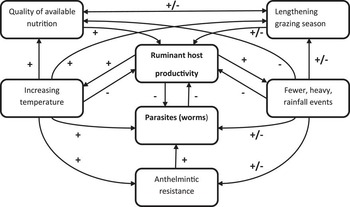
When the overall abundance of pathogenic helminths on farms is increased, a complex network of interactions subsequently determines the extent to which this leads to increases in disease prevalence. Some examples are given in Figure 2. In general, larger worm burdens will require increased efforts of the immune system of the host and, especially in growing animals; apart from reduced growth rates, this may lead to a reduced ability to combat other infective organisms. At the cost of meat and milk production, the host population may be able to dampen the increase in the parasite population (Hudson et al., Reference Hudson, Cattadori, Boag and Dobson2006). As the traditionally seasonal availability of infective stages is altered for all different worm species, co-infection patterns are likely to change, with parasite species competing with others to inhabit the same host (van Dijk et al., Reference van Dijk, Sargison, Kenyon and Skuce2010). If the host becomes overwhelmed by worms, the negative feedback mechanism of host immunity on the worm population will be diminished. As sheep and cattle hosts become less-efficient production animals, their GHG emission to production ratio, and thereby their contribution to climate change, will increase (O'Mara, Reference O'Mara2012). On warm days, temperature increases experienced by hosts, especially sheep, are likely to decrease their feed intake, as animals congregate in the shade for large parts of the day, although the impact of this may be offset by grazing during cooler periods or at night. Similarly, periods of heavy downpours have been shown to have a negative effect on herbage intake (Champion et al., Reference Champion, Rutter, Penning and Rook1994), although they would rarely be sufficiently prolonged to seriously affect animal production or body condition. A decreased energy and protein intake will, in turn, negatively affect the immune system (Sargison et al., Reference Sargison, Scott and Jackson2002; Houdijk, Reference Houdijk2008).
Effects of changing temperatures and rainfall patterns on host–parasite interactions: examples of the complex interactive pathways and feedback loops co-determining the effects of climate change on the grazing ruminant host.

Climate change and farm management factors
Host–parasite interactions will not only be directly affected by climate change but also through alterations to farm management. If farmers are to maintain productivity under future climate change scenarios (Bell et al., Reference Bell, Eckhard and Cullen2012), while limiting GHG emissions (Eckhard and Cullen, 2011), plasticity in farm systems is desirable (Rodriquez et al., Reference Rodriquez, de Voil, Power, Cox, Crimp and Meinke2011). For the dairy industry, the need to decrease CH4 and N2O emissions is likely to speed up the move towards zero-grazing and diets with a lower forage-to-concentrate ratios, among other mitigation options (Aguerre et al., Reference Aguerre, Wattiaux, Powell, Broderick and Arndt2011; Novak and Fiorelli, Reference Novak and Fiorelli2011). This may solve the problem of helminth-associated production losses, at least in adult cattle, although the effects of prolonged housing on the transmission of other infectious diseases, for example, bovine tuberculosis and calf pneumonia, remain to be investigated. However, it needs to be remembered that such cattle are less immune to these parasites, as a result of decreased exposure, and serious diseases can be expected when they are sold to farms where cattle are pastured. There may also be animal welfare considerations of prolonged housing. On those farms that are likely to have seen stock increased in recent years, total GHG emissions may be lowered by the creation of both intensely grazed and animal-free pastures (Schonbach et al., Reference Schonbach, Wolf, Dickhofer, Wiesmeier, Chen, Hongwei, Gierus, Butterbach-Bahl, Kogel-Knabner, Susenbeth, Zheng and Taube2012). Intensively grazed pasture systems will inevitably depend on anthelmintic treatment for worm control. Anthelmintic resistance, the development of which itself may further be enhanced by climatic changes limiting the survival of free-living stages (Papadopoulos et al., Reference Papadopoulos, Himonas and Coles2001; Waghorn et al., Reference Waghorn, Miller, Oliver and Leathwick2009), may threaten the sustainability of these farm systems.
Temperature increases will quite likely lengthen the grass growth season and farmers will be tempted to turn out stock earlier and to delay housing in autumn. However, lengthening the grazing season without increasing the hectarage of land grazed may negatively affect sward quality and herbage utilisation (Roca-Fernandez et al., Reference Roca-Fernandez, O'Donovan, Curran and Gonzalez-Rodriguez2011), especially later in the grazing season (Kanneganti and Kaffka, Reference Kanneganti and Kaffka1995). Climate change may also negatively influence herbage utilisation through increased growth rates of unwanted plants at pasture (Tiley, Reference Tiley2010) and unpredictable rainfall patterns/periods of drought. Unless animals are supplemented at pasture, a relatively lowered energy intake, over lengthened grazing seasons, may constrain the immune system of hosts. Especially in the beef and sheep sector, both direct climatic effects and changing farm management may change the breed composition of national herds and flocks (Aby et al., Reference Aby, Aass, Sehested and Vangen2012). Different breeds may be more susceptible but could also be more resilient to parasites.
The effects of changing farm management on parasites
A lengthening grazing season may markedly alter the epidemiology of helminths. The earlier animals are turned out onto pasture, the higher the initial infection with over-wintered larvae will be. These larvae would normally die off rapidly during the late spring in temperate regions (van Dijk et al., Reference van Dijk, De Louw, Kalis and Morgan2009). In addition, with grass growth and parasite development occurring above very similar temperature thresholds, more parasite generations become possible per grazing season, potentially leading to sharply increased worm burdens. Bringing lambing forward may appear to be advantageous in that hosts infected in autumn will be older and more ‘immunocompetent’ (Morgan and van Dijk, Reference Morgan and van Dijk2012). Similarly, longer growing seasons would be expected to offer better quality (or at least cheaper) nutrition, which may, in turn, improve the resilience of stock to helminth infections. However, across the different worm species, more diseases are witnessed in autumn in the United Kingdom (van Dijk et al., Reference van Dijk, David, Baird and Morgan2008), suggesting that increased worm abundance at pasture regularly overwhelms the immune system of hosts. If these trends continue, then autumnal parasite transmission success itself may provide a negative feedback on the length of the grazing season. Changes to farm management also provide opportunities to combat the effects of climate change on parasite populations (Morgan and Wall, Reference Morgan and Wall2009). Earlier mowing of pastures ought to greatly enhance the spring die-off of larvae (Charlier et al., 2005; van Dijk et al., Reference van Dijk, De Louw, Kalis and Morgan2009), and strategic alterations to the timing of the application of anthelmintic treatment may be able to nullify the effects of the lengthening transmission season (Morgan and Wall, Reference Morgan and Wall2009).
Adapting future parasite control strategies
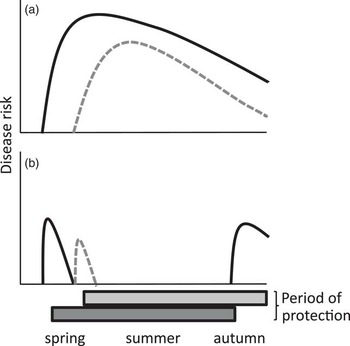
Given the complexity and uncertainty of possible effects of climate change on parasite epidemiology, it is difficult to design new strategic treatment or prophylactic regimes that will be robust to future scenarios. Moreover, increased use of chemical protection is almost certainly unsustainable, as resistance typically outpaces the development of new active compounds (Kaplan, Reference Kaplan2004). In many cases, longer seasons of parasite challenge will force farmers into difficult choices. For example, countering early emergence of Lucilia sericata blowflies by early chemical treatment or shearing can eliminate predicted spring peaks of fly strike in sheep in warmer conditions, but also lead to new unprotected periods of risk in autumn (Figure 3; Wall et al., Reference Wall, Rose, Ellse and Morgan2011). Rather than seeking to protect livestock more comprehensively at all times of the year, parasite control strategies that are well adapted to future threats will take a risk-based approach. Although mathematical modelling can help to identify high-risk periods and to explore likely effectiveness of control strategies, uncertainties inherent in their performance on individual farms might encourage farmers to include a monitoring component in future parasite management plans. In some cases, for example, sheep scab or louse infestations, this might be based on appearance of clinical signs, whereas in others, notably gastrointestinal nematodes, this could be routine parasitological and production monitoring. Applied at group level, such monitoring enables treatment at appropriate times, whereas at an individual level it is the bedrock of targeted selective treatment (TST). Such strategies target anthelmintic treatments to only those individuals or groups in need of treatment (or most likely to benefit from treatment) and are designed to preserve drug efficacy and susceptibility in the parasite population (van Wyk, Reference Van Wyk2001; Kenyon and Jackson, Reference Kenyon and Jackson2012).
Potential for elongated season of challenge to undermine parasite management of disease risk. In the top graph (a), the solid line represents earlier emergence or build-up of parasite challenge in spring under warm conditions relative to the present (broken line). In the bottom graph (b), treatment with persistent or repeated parasiticide (light shaded bar) must commence sooner (dark shaded bar) to control disease, leaving a new window of risk in autumn. Increased duration of coverage is costly and risks strengthening selection for drug resistance. This general schematic does not take into account system-specific parasite population dynamics, but finds theoretical and empirical support from myiasis in sheep (Wall et al. Reference Wall, Rose, Ellse and Morgan2011).

TST approaches have so far been most developed for small ruminants (Kenyon and Jackson, Reference Kenyon and Jackson2012), and uptake is variable because monitoring costs often exceed proximal benefits from treatment savings, whereas economic benefits of prolonging the useful life of individual drugs are hard to quantify. Much work remains to be conducted on the economics of production loss from endemic animal disease, before risk monitoring can be optimised to future scenarios. At present, an increasingly sound evidence base for sustainable general practices is being developed (e.g. Leathwick et al., 2009 and 2012), which will provide a platform for context-specific approaches. Considerable local adaptation to take account of climate and management will be needed. For example, strategic and selective treatments should take account of climate not only in determining when livestock should be treated, but also in how intensively refugia-based approaches should be applied at a given time of the year. This is because the fate of offspring of parasites left in refugia will depend strongly on climate. As ever, simple solutions that are based on sound science will be needed by producers, but the current state of the art is unequal to the task of designing such solutions from the top down, not least because system behaviour will be locally specific (Dobson et al., Reference Dobson, Finnie and Randolph2011). It is for this very reason that seeking to emulate production and parasite control systems from warmer parts of the world is a simplistic approach to climate change adaptation, and one that is likely to meet with limited success. Drivers and constraints on farm management systems are legion, and their depth and complexity makes it difficult to overturn established practice, which itself might have arisen for sound reasons of local adaptation (de Rancourt et al., Reference de Rancourt, Fois, Lavin, Tchakerian and Vallerand2006; Sturaro et al., Reference Sturaro, Cocca, Gallo, Mrad and Ramanzin2009). Trade-offs between immediate productivity and long-term sustainability also provide justified disincentives to farmers to change practice too quickly (Waghorn et al., Reference Waghorn, Leathwick, Miller and Atkinson2008). It is possible that placing better tools in the hands of farmers for local risk assessment and appropriate responses will be more useful in enabling them to quickly and sustainably adapt to unpredictable changes in parasite epidemiology. Options for adaptation, which are more creative than simply altering treatment strategies, are available and should be fully used, for example, altering patterns of reproduction, housing, grazing and even breed selection (White et al., Reference White, Sutherst, Hall and Whish-Wilson2003).
The Red Queen – coming soon to a farm near you?
Like farmers, parasites are unlikely to stand still in the face of climate change. Direct effects of climate on development and survival of life-cycle stages outside the definitive host, as well as indirect effects on fitness acting through host availability and susceptibility, for example, as a result of the management changes discussed above, will exert selective pressure. Therefore, parasite life histories could evolve to become better adapted to their new surroundings. High-effective population sizes, high levels of genetic diversity and short generation times mean that parasites are potentially better equipped than their hosts to adapt rapidly to environmental change, especially when small changes in prevailing conditions could markedly affect the chances of individuals finding a host. Potentially rapid evolution in response to strong selective pressure is abundantly illustrated by the emergence of anthelmintic resistance among gastrointestinal parasites of livestock (Kaplan, Reference Kaplan2004; Wolstenholme et al., Reference Wolstenholme, Fairweather, Prichard, von Samson-Himmelstjerna and Sangster2004). Other evolutionary responses of parasites could, although less obvious, have significant practical implications for parasite control in a changing climate.
Direct evidence for the adaptation of parasite life history in response to changes in management or climate is hard to find, but geographic variation in life traits of epidemiological importance suggest that it occurs, and could have a bearing on the success of efforts to adapt future disease control strategies to changing climates. In some cases, this could involve upregulation of mechanisms of protection against environmental noxes (Baker et al., Reference Baker, Britton, Roberts, Loer, Matthews and Nisbet2012). In others, the targets of selection could be subtle and not the most obvious. Thus, free-living stages of H. contortus from sheep in Sweden had very similar characteristics to the populations in Africa, even though improved ability to develop or survive at lower temperatures might have been expected to enhance the ability of northern isolates to colonise cooler areas (Troell et al., Reference Troell, Waller and Hoglund2005 and Reference Troell, Tingstedt and Hoglund2006). However, northern populations made greater use of developmental arrest or hypobiosis within the host to improve the efficiency of overwinter survival. The plasticity of this species therefore allows it to ensure transmission in widely different climates, and we should not be surprised by its ability to adapt to rapidly changing climates in future. Similar variation was found in the propensity of Ixodes ricinus ticks to enter diapause in winter, depending on prevailing climate (Dobson et al., Reference Dobson, Barnes, Tyrrell, Hosking, Larsen, Besier, Love, Rolfe and Bailey2011). In this case, models predicting the abundance and seasonality of ticks in the United Kingdom had to be altered to take into account presumed differences in diapause in populations in Spain to provide a satisfactory fit to local data. This is likely to be the result of genetic differences between populations that underlie phenotypic variations in life history. Experimental work to elucidate mechanisms and rates of adaptation to climate change in parasites of veterinary importance is limited; in other systems, this suggests that responses at low and high temperatures can differ and affect ability to adapt to environmental conditions in different parts of a parasite's geographic range (Ford and Chintala, Reference Ford and Chintala2006) and, by extension, to climate change.
A particularly interesting example of phenotypic variation, which could indicate the potential for rapid parasite adaptation to climate change, is seen in the intestinal nematode of lambs, N. battus. In this species, eggs shed by lambs in spring develop slowly through the summer and typically do not hatch until after they have experienced a period of cold exposure over winter, followed by a rise in temperature in spring. In this way, infection is carried over from year to year, while adult worms are rapidly eliminated from lambs by an effective immune response. However, recent work found that there is an upper temperature threshold above which hatching ceases, such that under rapid spring increases in ambient temperature in southern England, hatching is often interrupted (van Dijk and Morgan, 2008). This removes the advantage to the parasite of delaying hatching until after winter, and in these populations a proportion of eggs does not require chilling in order to hatch (van Dijk et al., Reference van Dijk, Sargison, Kenyon and Skuce2010). As there is no evidence for genetic segregation of worms whose offspring hatch with or without chilling, this appears to be a form of ‘bet hedging’, such that parasite genotypes are well equipped to deal with reliable spring conditions for hatching, leading to efficient infection of young, susceptible lambs, while also retaining the ability to hatch in autumn, such that adverse weather conditions in a particular year are not disastrous for transmission (van Dijk and Morgan, Reference van Dijk and Morgan2010). Crucially, management change that seeks to decrease opportunities for parasite transmission, such as alternating grazing of lambs on a particular pasture between years to avoid spring peaks in N. battus larvae, are destined to select for parasite phenotypes that are able to cope with those conditions. This example also shows that parasite adaptation strategies can be very refined and flexible, and given that hatching behaviour of N. battus appears to have diverged in northern and southern United Kingdom over only a few decades, adaptation can be rapid. Parasite control strategies that are well adapted to anticipate future conditions but that ignore the ability of parasites to change could fail sooner and more comprehensively than expected.
General discussion – knowledge gaps and research priorities
It is clear that climate change has had both direct and indirect impacts on livestock production, animal health and welfare over the past number of decades. If even the most modest climate change projections are to be realised over the coming decades, then further changes will be inevitable. It is, however, important to appreciate that the direct and indirect effects discussed in this review do not operate independently but are inter-related, with many knock-on effects and feedback loops, and often with unforeseen or consequences. For example, climate change may bring increased incidence or intensity of endemic disease, which in turn has an impact on production efficiency, which in turn contributes to climate change through unnecessary GHG emissions from unproductive livestock. Similarly, putting animals outdoors to prevent heat stress may bring a greater risk of pasture-borne diseases and parasites, whereas bringing animals indoors to avoid extreme weather and enhance productivity may bring an increased risk of housing-associated diseases. More needs to be done to integrate measures aimed at improving animal welfare and productivity under climate change with the animal health implications. To ensure future sustainability of the livestock industry, even in temperate regions, the industry must be able to adapt to the challenges and opportunities presented. This requires, first, a detailed understanding of the interactive network of drivers, and second, a calculation of costs and benefits of adaptation options at the individual farm- and industry level. Such analyses involve sophisticated modelling of the likely climate change scenarios, their effects on individual drivers and their interaction at a local, regional and international level. Given the between-year variability in weather conditions, it will be a great challenge to design strategies that are cost-effective overall. If such strategies are to be adopted, detailed risk analyses, followed by clear communication of risk, will be required from researchers. In the context of livestock disease, our ever-increasing understanding of the epidemiology of important disease-causing pathogens and diagnostics can now be interfaced with very sophisticated geographic information system technology and both statistically and process-based modelling approaches to produce risk maps for disease at an appropriate tempero-spatial scale (e.g. Cornell, Reference Cornell2005; Bergquist and Rinaldi, Reference Bergquist and Rinaldi2010; Fox et al., 2012). However, there are still gaps in our knowledge in relation to the biology of parasites and pathogens and how they will respond to changing climatic conditions. Much of the published work has focused on responses to increasing temperatures, linking rainfall, evapotranspiration rates, etc. to the ecology of parasites and vectors that remains a challenge. It goes without saying that epidemiological models are only as good as the assumptions they are based on. Assumptions, which may be valid in certain experimental settings, have to be appropriate for all spatial and temporal scales modelled. In the short-medium term, we need to validate models and quantify trends, through improved surveillance, ideally active rather than passive, of animal health disease issues, whether exotic or endemic. This places a requirement on improved diagnostic capabilities, with the potential to be rapid, high-throughput and cost-effective at an appropriate regional/national/international scale. In the context of the endoparasites and ectoparasites specifically, vaccines to protect animals from infection, although not a complete solution, would be highly desirable. However, development of such vaccines has proven to be extremely technically demanding for a number of reasons (e.g. Vercruysse et al., Reference Vercruysse, Schetters, Knox, Willadsen and Claerebout2007). Until such time as vaccines do become available, we need to reduce the usage of and reliance on chemical treatments and promote more sustainable parasite control strategies. Climate change is an obvious driver in some of these scenarios of change but we also need to gain a better understanding of the impact of other confounding factors, such as global economic change, CAP reform, anthelmintic resistance, changing farm management practices, etc. and their implications for the EU livestock sector. The key to combating the effects of climate change will be embracing change ourselves.
Acknowledgements
The authors acknowledge the financial support of the Scottish Government Strategic Research Programme, the ClimateXChange Centre of Expertise (M.M. & P.J.S.) and the EU FP7 GLOWORM project no. 288975 (E.R.M., J.v.D. & P.J.S.).
This paper was published as part of a supplement to animal, publication of which was supported by the Greenhouse Gases & Animal Agriculture Conference 2013. The papers included in this supplement were invited by the Guest Editors and have undergone the standard journal formal review process. They may be cited. The Guest Editors appointed to this supplement are R. J. Dewhurst, D. R. Chadwick, E. Charmley, N. M. Holden, D. A. Kenny, G. Lanigan, D. Moran, C. J. Newbold, P. O'Kiely, and T. Yan. The Guest Editors declare no conflict of interest.