When we showed Imam [Khomeini] the photos of the large solidarity rally in Beirut, his face lit up and he asked, “Is this all against the Shah?” “Yes,” we said. He began to count the shaykhs at the rally and noticed with a beaming smile that the number of Sunni shaykhs in the photo exceeded the number of Shi`i shaykhs by one.Footnote 1
This conversation took place in the waning days of Iran's Pahlavi monarchy when a group of Lebanese clerics paid a solidarity visit to Ayatollah Khomeini in Paris. Shiʿi cleric Sayyid Hani Fahs, who recounts the story in his reminiscences, along with other Lebanese clergy, was visiting Khomeini in his Paris exile to express support for the growing protests in Iran. In the wake of the 1978–79 Iranian Revolution, these clerics emerged at the heart of an ecumenical network of Sunni and Shiʿi ʿulamaʾ from Iran, Lebanon, and Palestine who sought to spread the revolution to Lebanon.
By conceptualizing revolution as an international and ideological force, this paper argues that these ʿulamaʾ utilized the pan-Islamic and anti-imperial ideas of the 1978–79 revolution to transcend sect and seed a revolution in Lebanon.Footnote 2 They adapted the ʿulamaʾ-led and mosque-based model of the 1978–79 revolution, which I call the Khomeinist script, to establish the Association of Muslim ‘Ulama’ in Lebanon (Tajammuʿ al-ʿUlamaʾ al-Muslimin fi Lubnan, hereafter AMUL) to rally the masses against the Israeli invasion.Footnote 3 This ecumenical script was seminal in the spread of the Iranian Revolution to Lebanon and in laying the foundation of Hizbullah, which relied, especially during its 1982–85 formative stage, on AMUL's network to publicize, recruit, and mobilize against the invasion. In the second half of the 1980s, AMUL gradually lost its initial central role, due in no small part to clerical factionalism within the Islamic Republic and the removal of Ayatollah Husayn ʿAli Montazeri from the position of Ayatollah Khomeini's designated successor in 1989.
After 1979, Lebanon was central to the Iranian internationalists who were in pursuit of establishing the “Islamist International,” asserting that the revolution did not recognize borders and belonged to the downtrodden and all Muslims, irrespective of their sects.Footnote 4 The internationalists’ effort to export the revolution to Lebanon began as early as spring 1979 and transpired against the backdrop of revolutionary sentiments and activism that flared up with the overthrow of the Shah. Given the strategic location and sizable Shiʿi population of Lebanon, which hosted the Palestine Liberation Organization (PLO) and Palestinian refugees, the country was, in the words of Sayyid ‘Ali Akbar Muhtashami, the former Iranian ambassador to Damascus, “the primary launching pad for the revolution” and central to these internationalists’ endeavor to forge an alliance with Palestinians and revolutionary groups in the Arab world.Footnote 5 The internationalists sent delegates to Lebanon to assess the situation and cultivate relations with pro-Khomeini factions. The first people the Iranians contacted and offered assistance to were Sunni and Palestinian activists.Footnote 6 To further cooperation, the Lebanese and Palestinian activists and clerics began to visit Iran and attend conferences that gathered liberation groups and Muslim ʿulamaʾ from across the world to enhance Shiʿi–Sunni unity.Footnote 7 At the heart of the activities to export the revolution to Lebanon lay the burgeoning network of Sunni and Shiʿi clergy, who sought to foster a united front against the Israeli occupation and overthrow the sectarian political order of the country.
AMUL was established against this backdrop, in response to the June 1982 Israeli invasion, by several Shiʿi and Sunni clerics. The latter included Shaykhs Mahir Hamud, Ahmad Zayn (both from Sidon), ʿAbd al-Nasir Jabri, and Salim al-Lababidi.Footnote 8 They also coordinated with Shaykh Saʿid Shaʿban, who was an influential Sunni cleric and the leader of the Islamic Unification Movement (Haraka al-Tawhid al-Islami) in northern Lebanon.Footnote 9 Within a year, by May 1983, this nucleus expanded to contain more than twenty Lebanese and Palestinian clerics, who embraced Islamic unification as an “identity” and a “strategy” to mobilize against the invasion and the “Maronite-dominant” political order of Lebanon.Footnote 10 This loose-knit network of religious leaders was supported primarily by Ayatollah Montazeri, who was a key advocate of exporting the revolution and was Khomeini's heir designate between 1984–89, and Sayyid ‘Ali Akbar Muhtashami, who was the Iranian ambassador to Syria between 1981–84.Footnote 11 Linking cities, villages, neighborhoods, and the Palestinian refugee camps in Beirut, the north, the south, and Bekaa, AMUL did not have a highly centralized structure. AMUL's clerics held weekly meetings to coordinate their activities, using “mosques, ḥusayniyāt [the Shiʿi social and religious centers, sing.; ḥusayniyya], and streets as loci for popular activism” to spread their message and agitate against the Israeli invasion.Footnote 12 They viewed their activism as in line with the Iranian Revolution and coordinated on key issues with the Islamic Republic.
Drawing on oral history interviews with these clerics and archival research in Iran and Lebanon, this paper explores what motivated Shiʿi and Sunni ʿulamaʾ to establish AMUL. How did they describe their narrative of Islamic solidarity? Extensive interviews I conducted with Iranian, Lebanese, and Palestinian clerics, current and former members of AMUL and Hizbullah, and the Islamic Revolutionary Guards Corps (IRGC) helped both overcome the challenge posed by the lack of available written sources on the Iranian Revolution's internationalism and provide insight into the worldview of these internationalist ʿulama.ʾFootnote 13
The transnational network of these Shiʿi–Sunni ʿulamaʾ was the ideological and organizational product of the internationalism of the 1978–79 revolution, indicating that they acted within a supranational context to achieve their goals.Footnote 14 The logic of revolutionary ideology is universalist, because revolutions legitimate themselves by an appeal to general, abstract principles such as freedom and independence.Footnote 15 The ideology of the 1978–79 revolution was not sectarian and not merely confined to Shiʿi traditional discourse. Alongside its Shiʿi and nationalist components, the revolution's worldview emphasized the unity between different Islamic sects and, particularly through support for the Palestinian cause, sought to create a united Islamic front against the common enemies of the umma (the Muslim community), primarily US imperialism and Israel.Footnote 16
Central to the revolution's internationalism was the ‘ulama’-led and mosque-based Khomeinist script. Informed by the concept of revolutionary script as a framework for political action, this study argues that the Khomeinist script inspired many Shiʿi and non-Shiʿi ‘ulama’ and lay Islamists outside Iran. A script “constitutes a frame within which a situation is defined and a narrative projected; the narrative, in turn, offers a series of consequent situations, subject positions, and possible moves to be enacted by the agents within that frame.”Footnote 17 The Khomeinist script exalted the virtues of clerical political engagement, assertiveness, agitation, and leadership, which Khomeini exemplified. It stipulated that the ‘ulama’ should rise against tyrants and imperial powers and lead the masses toward establishing an Islamic political order. Enacting this script entailed turning mosques into locations of collective action, following the example of the popular mobilization against the Shah.
The scripting concept also underlines the self-conscious awareness of actors who transform and adapt the script to their purposes—in the Lebanese context, to fight the Israeli occupation and overthrow the sectarian political order of Lebanon.Footnote 18 After the downfall of the Shah, to many clerics in Lebanon and elsewhere in the Muslim world the elixir for success of popular uprisings and winning power appeared to be vanguard ‘ulama’. Yet the Palestinian and Lebanese ‘ulama’ who modeled their actions on the Khomeinist script were not passive receivers of the revolution's example and ideas. Indeed, this research seeks to show the multiplicity of voices among Shiʿi and Sunni religious leaders and highlight the agency of AMUL ‘ulama’, who viewed their relationship and cooperation with Iran as a resource for their own national struggle.Footnote 19 This research asks how these ‘ulama’ shaped their self-image and explained their role in the Khomeinist script they were propounding. How did the trans-sectarian script unfold in the Lebanese context, especially following the 1982 Israeli invasion?
It is important to note that the Khomeinist script was by no means the only model of activism in the 1978–79 revolution. Marxist, nationalist, and liberal ideas and forces also played out in the revolution against the Shah. However, as the Islamic Republic consolidated and suppressed these rival forces, the Khomeinists came to prevail in the revolutionary regime.Footnote 20
Alongside the international impact of ideas and example, revolutionary regimes tend to use domestic resources to export revolution through ideological, political, and military means.Footnote 21 The present study shows that it was first and foremost the anti-Israeli and anti-imperialist ideas of the 1978–79 revolution that influenced Lebanese and Palestinian ʿulama.ʾ Attempts to export the revolution to Lebanon began shortly after the overthrow of the Shah and gained ground in the wake of the June 1982 Israeli invasion, when the IRGC forces arrived in Lebanon to train in coordination with pro-Khomeini clerics, the embryonic forces of Hizbullah, ushering the revolution's armed internationalism into Lebanon. AMUL and then Hizbullah, both rooted in the revolution's internationalism, emerged out of the devastating invasion and evolved, as this paper explores in the Iranian and Lebanese contexts, along two diverging paths in the 1980s.
This article contributes to the historiography of how the Iranian Revolution came to Lebanon in two ways. First, whereas the scholarship is overwhelmingly focused on Hizbullah, the present study illuminates how AMUL's network played a core but overlooked part in exporting the 1978–79 revolution and in Hizbullah's later formation and success. H. E. Chehabi, Joseph Daher, Ahmad Nizar Hamzeh, and Richard Norton highlight the role of the religious leadership in the emergence of Hizbullah, but do not discuss the role of AMUL and its trans-sectarian network.Footnote 22 Hassan Fadlallah only briefly touches upon the role of the clerical network in spreading the revolution to Lebanon, and works by Masʿud Assadullahi, Eitan Azani, and Magnus Ranstorp pay little attention to the role of AMUL in the formative stage of Hizbullah and in launching the “Islamic resistance” in 1982.Footnote 23 Rodger Shanahan and Waddah Shararah explore the role of clerical leaders and seminaries in spreading the ideas of Khomeini to Lebanon, but with only a passing discussion of AMUL's activities after 1982.Footnote 24
Second, this research challenges the Shiʿi-centric and sectarian narratives that either question the exportability of the 1978–79 revolution (because of the specifically Shiʿi and Persian identity of Iran) or confine its internationalism to Shi'i communities outside Iran. The dominant historiography ignores or downplays the revolution's influence on Sunni movements. For example, the collection of articles in The Shi‘a Worlds and Iran analyzes the internationalism of the revolution in a Shiʿi context. In one of the articles, Olivier Roy asserts that the revolution failed to transcend the Shiʿi–Sunni divide to any substantial degree.Footnote 25 Rainer Brunner also asserts that the impact of the revolution on Sunni movements was ephemeral, and that its reach was limited to “a small number of Sunnis.”Footnote 26 Likewise, Shaul Bakhash states that “age-old Arab-Iranian and Sunni-Shiʿi animosities” limit the Iranian example to Shi‘a in the region.Footnote 27 Vali Nasr argues that a Shiʿi–Sunni divide forms the undercurrent of politics in the Middle East and the regional consequences of the Iranian revolution should be analyzed in the context of the “old feud between Shias and Sunnis.”Footnote 28 Aside from these scholarly works, there is a plethora of journalistic and nonacademic writings that portray the international ramifications of the 1978–79 revolution and the formation of Hizbullah in sectarian terms and in the context of a Shiʿi–Sunni schism.Footnote 29 The present study argues that the Khomeinist script was in both content and implementation ecumenical and highly appealing to Shi‘i and non-Shi‘i Islamists, enabling Iran to gain a trans-sectarian legitimacy and successfully export its revolution to Lebanon. By shedding light on AMUL, this paper also seeks to further understanding of revolutionary Iran's regional policies and connection with Lebanon beyond the cliché, prevalent in many popular writings, of Iran's pursuit for a “Shi‘a Crescent” in the region.
I start by exploring the ideological impact of the Iranian revolution on Shiʿi and Sunni actors who used the Khomeinist script as a model to establish the AMUL ‘ulama’ vanguard. I then investigate how the 1982 Israeli invasion became the decisive push toward the military export of the revolution to Lebanon, setting the stage for the rise of AMUL and Hizbullah. Then I will examine how AMUL's structure and role evolved in the context of developments in Lebanon and Iran.
The Unfolding of the Khomeinist Script in Lebanon
The symbolism of revolutionary ‘ulama’ standing at the vanguard of the uprising against the Shah was an inspiring model to clergy and Islamist lay activists outside Iran.Footnote 30 Following the overthrow of the Shah, the revolutionary ayatollahs promulgated this cleric-led and mosque-based script for activism, similar to their own anti-Shah activities between 1963 and 1979. They advocated for uprisings in other countries in the manner of the 1978–79 revolution, which in their view had proved the crucial role of clerical leadership in mass mobilization.Footnote 31 This script transcended sectarian divides, offered an Islamic framework for political action under the guidance and leadership of the ‘ulama’, and envisioned establishing an Islamic Republic.
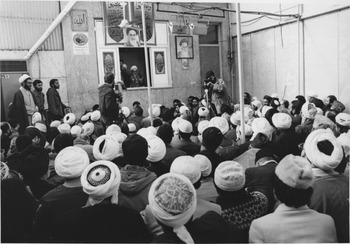
Ayatollah Khomeini argued that mosques and Friday congregational prayer were locations of politics and advocacy and exhorted clergy to be at the forefront of spreading political awareness and activism.Footnote 32 Similarly, before a gathering of Iranian and non-Iranian Shiʿi and Sunni clerics who visited Qom to attend the Global Assembly of ʿUlamaʾ and Friday Prayer Leaders, Ayatollah Montazeri remarked, “Today the East and West superpowers are fearful of you clerics, of you yourselves! You, spiritual leaders! You, ʿulamaʾ, should realize what [influential] status you have” (Fig. 1).Footnote 33 Montazeri told a visiting delegation of Hizbullah and AMUL in Qom that “had ʿulamaʾ led the Muslim nation of Egypt, the Egyptian regime would have surely collapsed.”Footnote 34 And in a message for International Quds Day he proclaimed: “The Muslim nation of Palestine should . . . be aware that the experience of the revolution in Iran shows that Islam and religion, in contrast to the Eastern and Western colonial myths of nationalism and racism, are able to mobilize [the masses] and lead [them] to victory.”Footnote 35 This line of argument influenced, to various degrees, major transnational Islamic forces, from the Muslim Brotherhood (especially its younger generation) to the al-Da‘wa party and the Shirazi movement.Footnote 36 It inspired the founders of the Palestinian Islamic Jihad to speak of “Khomeini as the alternative solution” and kindled popular rallies around the spiritual leader of the Iraqi al-Da‘wa, Sayyid Muhammad Baqir al-Sadr, and the leader of the Shirazi movement, Sayyid Muhammad Shirazi—their supporters spoke of them as “the Khomeini of Iraq.”Footnote 37 It roused the Syrian Muslim Brotherhood to appeal to Syrian ʿulamaʾ to wage an Islamic revolution against Hafiz al-Asad and the Lebanese and Palestinian ʿulamaʾ to organize a joint popular campaign against the 1982 invasion of Lebanon.Footnote 38
Ayatollah Montazeri speaking to a group of Iranian and non-Iranian Shiʿi and Sunni clerics at his office in Qom in 1984. From private collection of author.

At the time of the 1978–79 Iranian Revolution, the Lebanese Shiʿi community suffered from sectarian discrimination, internal disunity, and external aggression.Footnote 39 Upon the disappearance of Sayyid Musa al-Sadr, the founder of the Supreme Islamic Shiʿi Council and Amal (Ḥarakat Amal, lit. Hope Movement, aka Movement of the Dispossessed), in August 1978 in Libya, the community had split in different directions.Footnote 40 In the absence of a unifying religious-political leadership, many young Shiʿi elites regarded the community's leaders as incompetent and “lagging behind their ambitions and goals.”Footnote 41 The Lebanese Shiʿi radicals aspired to overthrow the sectarian system in Lebanon using a revolutionary model like Iran. They dismissed the localist view of Amal and the Supreme Islamic Shiʿi Council—both entrenched and reformist Shiʿi forces—arguing that “the Lebanese issue is not independent from Iran or Iraq and other countries in the Islamic world.”Footnote 42 In contrast, Shaykh Muhammad Mahdi Shams al-Din, who presided over the Supreme Islamic Shiʿi Council, believed that any solution to the social and economic disadvantages of the community should be sought within the Lebanese sectarian political order.Footnote 43 Thus, Shams al-Din opined that the Iranian Revolution could not be a model for Lebanon.Footnote 44 Early on, this inspired controversy and conflict within the Shiʿi community, which, as the first secretary-general of Hizbullah recounts, led to establishment of pro-Khomeini organizations in Lebanon:
After the creation of the Islamic Republic, there were long debates between us and Shaykh Shams al-Din about many issues. We did not see eye to eye over many points, such as the relationship with the Islamic Republic. Shaykh Shams al-Din had points of view different from ours. Our disagreements were political. [After 1979] . . . the Supreme Islamic Shi`i Council was in a position far from the Iranian stance and for this reason we believed that the Supreme Islamic Shi`i Council and its clerical branches were not able to play the role we believed they had to. As a result, we decided to establish clerical and political bodies that would be in line with our stances and direction.Footnote 45
The distrust of Shams al-Din ran deep among the Iranian internationalists, going back to the simmering tensions between the pro-Khomeini revolutionaries and Sayyid Musa al-Sadr in the 1960s and 1970s, over al-Sadr's ties with the Shah and tense relationship with the “Palestinian revolution” in Lebanon.Footnote 46 Although al-Sadr expressed sympathy for Palestinian resistance, he did not want Palestinian fedayeen to open a front in the south against Israel and expose the Lebanese in that region to Israeli retaliations. Al-Sadr accused the Palestinians of creating anarchy in the south, and over time Amal increasingly became the umbrella for opposition against Palestinian activities.Footnote 47 This soured the relationship between al-Sadr and many Khomeini followers, especially Muhammad Montazeri and ‘Ali Akbar Muhtashami, who came to embrace Palestinians as their ally in Lebanon after 1979. Therefore, in their effort to export the revolution, the internationalists backed pro-Palestinian individuals, like many of the founding members of AMUL, who did not see in al-Sadr, despite his clerical leadership of the Lebanese Shiʿa, an example to emulate. After 1979, al-Sadr's fraught past with pro-Khomeini internationalists and his reformist approach, which Shams al-Din inherited, came to be viewed as the antithesis to the Khomeinist script, which advocated radical and sweeping change in the political system of Lebanon.Footnote 48
The collaboration between Iranian and Lebanese radical clerics was a challenge to the authority of “Imam Shams al-Din,” who, according to Shaykh Adib Haydar, a former member of Amal, “regarded himself as the Khomeini of Lebanon.”Footnote 49 Shams al-Din believed that Iran's policies were detrimental to the Shiʿi interests in Lebanon and the Persian Gulf and demanded that the Islamic Republic coordinate its policies in Lebanon with him, as the highest religious Shiʿi figure in the country. But the Supreme Islamic Shiʿi Council, in the wake of al-Sadr's disappearance, lacked the hegemony it wished to claim. Even more, Shaykh Shams al-Din had to fight back increasing criticism in Lebanon and Iran for his ambivalence toward joining the military resistance against the June 1982 Israeli invasion.
The weakness of the traditional Shiʿi institutions and the leadership crisis after Musa al-Sadr's disappearance paved the way for a stronger Iranian influence to augment pro-Khomeini forces within the community. As Muhtashami explains, “The Shiʿa lacked central leadership and power, and after Imam Musa al-Sadr did not have any wise leader. However, this did not mean that we should have focused exclusively on the Shiʿa and widened the rifts between Shiʿa and Sunnis.”Footnote 50 Cooperation with Sunni Lebanese and Palestinian clerics was crucial to ignite an Islamic revolution in Lebanon. As Ayatollah Montazeri emphasized, a sectarian approach would be doomed since “neither Shiʿa, nor Sunnis, nor Maronite have the majority. But if we speak of Muslims, then both Shiʿa and Sunnis together have the majority.”Footnote 51
The Islamic Republic and Sunni Forces in Lebanon
The Khomeinist script had in one sense an even more profound impact on Sunni ‘ulama’ and lay Islamists, who had long struggled with the question of why ʿulamaʾ in the Sunni world were incapable of staging a successful revolt to seize power. No wonder that the very success of ʿulamaʾ in Iran in taking power was a great inspiration to Sunni Islamists, who hoped that they could accomplish something similar in their own struggles.Footnote 52 Khomeini's pan-Islamic and anti-imperial message resonated with many Sunni activists. To many Sunni clerics, like Shaykh Saʿid Shaʿban, the leader of the Islamic Unification Movement in Tripoli, the revolution in Iran was an example of the victory of Islam over the West and the pro-Israeli Shah of Iran.Footnote 53 Thus, in Shaʿban's view, Iran was “an axis that all Muslims should gather around” in their struggle to “shed the narrowness of sectarianism for the vastness of Islam.”Footnote 54 As Shaykh Ahmad al-Zayn, a Sunni cleric and the former qadi of Sidon, says, what inspired him and his cohort to join ranks with Khomeini was Iran “embracing the Palestinian cause and standing up to the Israeli enemy.”Footnote 55 Palestine was at the heart of the Islamic unification to which revolutionary clerics aspired. The symbolism of the Palestinian cause was such that Fathi al-Shiqaqi, the founder of the Islamic Jihad in Palestine, argued that “the unification” and “Palestine” “constitute the two sides of the Islamic agenda” in the face of “fragmentation [al-tajz'ia] and the Zionist entity; the two sides of the colonial agenda.”Footnote 56
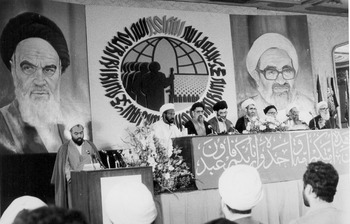
The Islamic Republic's efforts to cultivate relations with Sunni ʿulamaʾ around the world led to Unification Week (haftih-yi vaḥdat).Footnote 57 Declared by Ayatollah Montazeri, this ecumenical initiative laid the ground for outreach to Sunni ʿulamaʾ and the organization of meetings and events in revolutionary Iran to bring together Shiʿi and Sunni clergy from inside and outside Iran (Fig. 2). Montazeri, who emerged in the 1980s as a powerful advocate of Islamist internationalism, made an extensive effort for inter-sectarian rapprochement and established joint Sunni–Shiʿi clerical platforms to promote the example of the clergy-led revolution in other Muslim countries. “I declared Unification Week to end the Shiʿi and Sunni conflict which smears the name of Islam,” says Ayatollah Montazeri. “I used the metaphor of these five fingers, each of which has a particular function. These five fingers should turn into a fist against the enemy. The five schools [of Islamic jurisprudence, mazāhib-i khamsa] are like these five fingers.”Footnote 58
The Islamic Unification assembly in Tehran, held during Unification Week in 1984. Attendees included Palestinian Shaykh Ibrahim Ghunaym (first on the right), the then-president Khamenei (fifth from the right), and Shaykh Hassan Ibrahimi, who is delivering Ayatollah Montazeri's message from the podium. From private collection of the author.

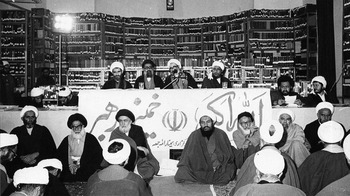
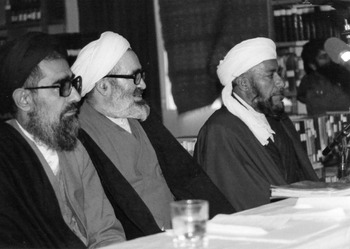
Montazeri also introduced other ecumenical platforms to reinforce ties with Sunni clergy and movements, like the Global Assembly of ʿUlamaʾ and Friday Prayer Leaders (Kungirih-yi Jahan-yi Aʾimih-yi Jumʿih va Jamaʿat /al-Mu'tamar al-ʿAlami li-A'imat al-Jumʿa wa-l-Jamaʿat), to gather ʿulamaʾ across the world in the capital of the revolutionary Iran to “surmount the obstacles to unification” (Figs. 3 and 4).Footnote 59 Montazeri's office and the Iranian government also organized a series of conferences and seminars in Tehran called Islamic Thoughts (Kunfirans-i Andishiha-yi Islami/Mu'tamar al-Fikr al-Islami) with the participation of Sunni ʿulamaʾ from Iran and other Muslim countries.Footnote 60
The Global Assembly of ʿUlamaʾ and Friday Prayer Leaders, held in 1980 in the library of Fayziyyah Seminary in Qom. From https://kadivar.com/15209, accessed 13 September 2020.

Montazeri, flanked by a Sunni cleric from Kurdistan Province in Iran (right) and Sayyid Jalal al-Din Tahiri (left), who was the Isfahan Friday prayer leader at the Global Assembly of ʿUlamaʾ and Friday Prayer Leaders held in 1980 in the library of Fayziyyah Seminary in Qom. From private collection of the author.

Given the diverse religious mosaic of Lebanese society, including the large Palestinian refugee population, Montazeri viewed Lebanon as a key place to promote ecumenical contact between Shiʿa and Sunnis. In 1985, in an open letter to Lebanese and Palestinian clerics, he declared that “exaggerating and intensifying differences between Shiʿi, Sunni, Lebanese, and Palestinian groups” is religiously forbidden, adding that the “paramount duty” of the Lebanese and Palestinian ʿulamaʾ “is unifying the Shiʿi and Sunni groups and factions against the international Zionist usurpers.”Footnote 61 He also advocated the overthrow of the Maronite-dominated political system in Lebanon:
Time and again I've told the `ulama' and dignitaries of Lebanon that nowadays governments should follow the majority's will. . . . Muslims have the clear majority in Lebanon. . . . Why should we defer to the wrongdoing of the French colonizers . . . ? The rule in Lebanon must become Islamic . . . one which protects the rights of Christian, Druze, and Jewish minorities.Footnote 62
To further the clerical activities, Montazeri's associates began to develop a trans-sectarian network of ʿulamaʾ across Lebanon. Shaykh Ismaʿil Khaliq, Montazeri's representative in Lebanon, and other individuals like Sayyid ‘Isa Tabataba'i, who worked in association with Montazeri's office in Lebanon, led these activities.Footnote 63 Through their connections with members of the al-Jamaʿa al-Islamiyya, the Lebanese branch of the Muslim Brotherhood, and Sunni clergy such as Shaykh Saʿid Shaʿban, Shaykh Muharram al-ʿArifi, Shaykh Mahir Hamud, and Shaykh Ahmad Zayn, they sought to lay common ground to promote the revolution and the anti-Israeli resistance.Footnote 64 Other Sunni clerics who were associated with this network were Shaykh Ibrahim Ghunaym, in the Badawi and Nahr al-Barad camps in northern Lebanon, and Shaykh Salim al-Lababidi in Beirut.Footnote 65
The Association of Muslim ʿUlamaʾ in Lebanon
The creation of AMUL was an echo in Lebanon of the Khomeinist script and the ecumenical ideas of the 1978–79 revolution.Footnote 66 The association sought to bridge the Shi‘i–Sunni and Lebanese–Palestinian rifts in Lebanon. Central to the charter of AMUL were Islamic unification and the Palestinian cause, which “lies at the core of the conflict between Islam and the global arrogance (al-istikbār al-ʿālamī, i.e., imperialism).”Footnote 67
It was during the Israeli army's invasion that Lebanese and Palestinian clerics who gathered in Tehran to attend the June 1982 conference of liberation movements began to discuss establishing this association. The IRGC's Islamic Liberation Movements Unit (Vahid-i Nihzatha-yi Azadibakhsh-i Islami-yi Sipah-i Pasdaran-i Inqilab-i Islami /Maktab Harakat al-Taharrur), which was under pro-Montazeri internationalists, hosted the conference to mark the Global Day of the Downtrodden (Ruz-i Jahan-yi Mustazʿafin /Yawm al-Mustadʿafin al-ʿAlami) in solidarity with anti-imperialist and anti-Israeli struggles.Footnote 68 “There were five or six [individuals], including me, Shaykh Saʿid Shaʿban, Shaykh Ahmad al-Zayn, Shaykh Mahir Hamud, and al-ʿAllama [Sayyid Muhammad Husayn] Fadl Allah,” recounts Shaykh Subhi al-Tufayli. “We met to discuss the Israeli invasion and methods of resistance against the Israeli army.”Footnote 69
In fact, ever since the revolution in Iran, partly inspired by Khomeini's ecumenical statements, the idea of setting up a joint platform of Shiʿi and Sunni ʿulamaʾ was floated among Lebanese religious leaders. However, the decisive moment came with the 6 June 1982 Israeli invasion, which took place as the Lebanese and Palestinian ʿulamaʾ were arriving in Tehran. “No one expected that the invasion would reach such an extent. We had thought that there would be aerial attacks, but we did not expect an invasion,” recounts Shaykh Mahir Hamud, one of the founding members of AMUL.
When we arrived in Tehran and the news began to arrive, the whole conference began to focus on the issue. There, the idea of resistance began to percolate and the Sunni and Shi`i `ulama' who had come from Lebanon met and decided to unify their actions against the occupation. This led to [establishing] the Association of Muslim `Ulama'.Footnote 70
Shaykh Ahmad al-Zayn, a Sunni cleric from Sidon, read out the first statement of AMUL at the conference.Footnote 71 At the end of the conference, these ʿulamaʾ met Montazeri in Qom to discuss their decision. “Ayatollah Montazeri supported this idea,” says Shaykh Subhi al-Tufayli. “Following its establishment, his representatives in Beirut helped [politically and financially] the Association of Muslim ʿUlamaʾ.”Footnote 72
Before returning to Lebanon, the Lebanese and Palestinian clerics (the latter refugees in Lebanon) agreed after an hours-long debate on a plan, whereby once they returned to their cities and villages they would embark on an anti-occupation campaign and coordinate their field operations and initiatives with the Islamic Committees (al-Lijan al-Islamiyya).Footnote 73 Shaykh ʿAli al-Khazim, a young cleric at the time who was present at the conference, says:
The dearth of resistance against Israel made it clear to the `ulama' who came from different corners of Lebanon that they could and should have a significant role in mobilizing the people. When we came back to Lebanon, Israel had already occupied major parts of the country. The Association of Sunni and Shi`i Muslim `Ulama' in Lebanon announced its establishment and started its activities at mosques, because it did not have any center or headquarters.Footnote 74
What these clerics sought to carry out was in line with Khomeini's credo that mosques “should not only be places of prayer, but rather, as in the Prophet Muhammad's time, should be centers of political, cultural, and military activities.”Footnote 75 Like the process of the 1978–79 revolution in Iran, when religious sermons played a key role in spreading the words of Khomeini, the Lebanese clerics chose mosques and ḥusayniyāt to encourage resistance against the Israeli invasion of Lebanon.Footnote 76 Clerics like Shaykh Raghib Harb in the southern village of Jebchit and Shaykh Mahir Hamud in Beirut delivered fiery speeches from the pulpits of mosques and ḥusayniyāt against the Israeli occupying army and invited people to join the resistance. Given the lack of resources and organizational tools at the time, this mosque-based communication network proved to be very effective in mobilizing people and spreading the word about the resistance. The clerical endeavors played out as the first contingent of the IRGC began to arrive in Lebanon— a significant turn toward armed internationalism in the export of the revolution to Lebanon.Footnote 77
The Army of Khomeini Arrives
Shortly after the Israeli occupation, a contingent of around one thousand IRGC forces arrived in the Bekaa to assist the Lebanese with military preparation and training. They utilized the Imam ʿAli mosque and the al-Imam al-Muntazar seminary in Baalbek for recruiting, training, and public outreach.Footnote 78 “People flew white flags on rooftops all over Baalbek,” recounts Shaykh ʿAli al-Kawrani, the former leader of the Lebanese branch of the al-Da‘wa party, visiting the area with an IRGC commander, ʿAli Shamkhani. “Shamkhani exclaimed ‘Why are they flying white flags? We want them to fly the red flags [of Imam Husayn].’ ‘Inshallah it will be so,’ I said. The prevailing mood was surrender to Israel.”Footnote 79 As the IRGC militants began to enter the area, the clerics who were associated with AMUL declared the arrival of “the army of Khomeini” in their sermons and exhorted the youth to rush to the training camps of the IRGC, such as Janta Camp, located twenty-two kilometers south of Baalbek and close to the Syrian border, to prepare themselves for battle against the occupation. According to the secretary-general of Hizbullah:
There were no institutions like now, no large organization or specialized departments. There was only a group effort concentrating on . . . banding together young men, training and organizing them into small groups, and then dispatching them to the occupied areas from where they were instructed to carry out attacks.Footnote 80
Sayyid ʿAbbas al-Musawi, the head of the al-Imam al-Muntazar seminary in Baalbek (who was to become the second secretary-general of Hizbullah, from 1991 until his assassination by Israel in 1992), Shaykh Mahir Hamud, in his mosque in the heart of the Sunni district of Beirut, and Shaykh Raghib Harb in the ḥusayniyya of Jebchit, a village in the south, were among the most vocal preachers and agitators in Lebanon.Footnote 81 Al-Musawi attracted Sunni and Shiʿi youth from the south and Beirut and dispatched them for training and logistical assistance to Baalbek.Footnote 82 Harb, who asserted that “unifying all Muslims [is the] path of resistance and continuity of the Islamic Revolution” in Lebanon, emerged as one of the principal leaders of resistance in the south, from 1982 until his assassination in February 1984.Footnote 83 Although he remained aloof and distant from both AMUL and Hizbullah, Harb became the main link between the south and the IRGC bases in Bekaa.Footnote 84
In pursuit of creating “a combatant society against the occupation,” mosques and seminaries turned into centers for indoctrinating and recruiting youth for military training.Footnote 85 These clerical activities were in line with the IRGC's plans in Bekaa to “recruit and mass mobilize people to confront the occupation”—a duplication of the Iranian basīj (mobilization) model for popular mobilization.Footnote 86 “This originated from our experience in Iran,” says Mansur Kuchak Muhsini, the then-IRGC commander in Lebanon, in reference to utilizing networks of mosques, seminaries, and religious institutions to rally the support of the public against the Shah and later for the Iran–Iraq War effort.Footnote 87 “We believed that this was the path of resistance, [which] was based on a popular basīj, and began from mosques. And [we believed] in its effectiveness.”Footnote 88
Soon after the IRGC opened its training bases, the first group of 180 volunteers arrived in Baalbek to receive training. This group, which included a number of future leaders of Hizbullah, like Sayyid ʿAbbas al-Musawi, was followed by hundreds of other youth from different regions of the country.Footnote 89 The then-IRGC commander in Lebanon, who oversaw establishing the Pasdaran training camps in the Bekaa, explains how they sought to empower the local people:
We taught them how to work on the youth, how to create districts [in rural and urban areas for recruits] similar to what we did here [in Iran]. Hizbullahis started to do this by making brigades and training camps. We told them you should perform cultural and educational outreach and [after] going through these stages, set up the district (nāḥīyih), and then the battalion (gurdān), and finally create the staff (sitād).Footnote 90
Within three months, according to Kuchak Muhsini, the Basij (volunteer paramilitary force) of the Baalbek region took its final form: “Its mosque, its district, training location, and ammunition depot were established the way we had done in Iran. [It was] such that if Israel would attack Baalbek, the Hizbullahis knew how to use weapons.”Footnote 91
Whereas related studies on the role of the IRGC in the formation of the Lebanese resistance concentrate generally on its military dimension, the present study demonstrates how the Khomeinist script of clerical leadership and reliance on religious networks underpinned the IRGC's recruitment and training in Lebanon.Footnote 92 The origin of the Islamic resistance and Hizbullah should be traced back to the pulpit, not the IRGC.Footnote 93 In the absence of any organized Lebanese resistance, a network of clergy, mosques, ḥusayniyāt, and seminary schools managed to fill the gap left by an embattled PLO, unassertive Amal, and uninspired Supreme Islamic Shiʿi Council. “In that first stage, we managed perfectly to mobilize people in their villages and cities. These activities led to the idea of Hizbullah,” Shaykh Mahir Hamud says, an allusion to the weakness of established organizations at the time.Footnote 94
Countering the 17 May Agreement
Amal and the Supreme Islamic Shiʿi Council were wary of the Iranian internationalists’ credo of backing the Palestinian revolution in Lebanon, a slogan that hardly resonated with many Shi'a in southern Lebanon who had suffered from the antagonistic tactics of Palestinian guerrillas and Israeli retaliation. In June 1982, anti-PLO attitudes in the south were so prevalent that even some Shi‘a greeted the Israeli soldiers, believing that they would eventually rid them of the fedayeen.Footnote 95 But they grew disillusioned as president Amin Gemayel signed, under US pressure, a peace agreement with Israel on 17 May 1983. The southern Shiʿa's initial optimism during the June invasion began to yield to furor over the brutal practices of the Israeli forces. A turning point came in October 1983, when an Israeli military convoy clashed with a large procession of ʿAshuraʾ mourners who gathered in the southern town of Nabatiyya to commemorate the martyrdom of Imam Husayn, killing at least two people and wounding several more.Footnote 96 A year into the invasion, the prevailing mood in the south became one of the militant resistance that AMUL and pro-Khomeini clerics had preached in the southern occupied villages and cities.
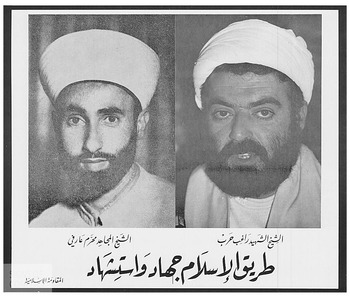
Early on, the Israelis realized the power of this emerging clerical network, which a member of Ayatollah Khomeini's office describes as “a new political weight.”Footnote 97 The Israeli forces unleashed a campaign of arrests and assassinations to undermine AMUL. Israeli soldiers arrested Shaykh Raghib Harb in March 1983 and Shaykh Muharram al-ʿArifi, the imam of al-Battah mosque and a leading agitator in Sidon, in December 1983 (Fig. 5). Israel also tried to assassinate Sayyid ‘Abd al-Muhsin Fadl Allah and Shaykh Husayn Surur, and forced other clerics out of their villages.Footnote 98 In February 1984, Shaykh Raghib Harb was assassinated in Jebchit. The murder of Harb, who was thereafter known as Shaykh al-Shuhada’ (Master of All Martyrs), fueled the growing insurgency in the south.Footnote 99 Iranian clergy saw the popular reaction as proof of their success. “This demonstrated,” Muhtashami says, “the influence of those ʿulamaʾ among people. Arresting and expelling them gave birth to a new wave as many youth left the south and rushed to receive military training [in Bekaa] in order to go back to the south and carry out operations against the occupation.”Footnote 100
“The path of Islam is jihad and martyrdom,” reads a poster published in 1985 by the Islamic Resistance that portrays “the combatant Shaykh Muharram al-ʿArifi” and “the martyr Shaykh Raghib Harb.” From http://www.signsofconflict.org/ar/Archive/poster_details/1894, accessed 3 December 2020.

One such operation was the suicide bombing of the Israeli military headquarters in Tyre on 11 November 1982. Recruited by Hizbullah, Ahmad Qasir from the southern city of Tyre drove a car packed with explosives into the eight-floor Israeli army headquarters and killed dozens of soldiers, including top military commanders. For Israel, this was an entirely new kind of resistance.Footnote 101 Originating from mosques and ḥusayniyāt, it was much more lethal than what Israel had faced from the PLO. On 23 October 1983, the month of the Nabatiyya clash, Beirut awoke to “the largest non-nuclear explosion that had ever been detonated on the face of the earth.” A truck, laden with 15,000 to 21,000 pounds of TNT, hit the US Marine barracks, killing 241 Marines. A faceless Islamic Jihad, with obscure ties to Iran, claimed responsibility for the attack.Footnote 102
As the mounting number of Israeli casualties increased pressure on Israeli leaders to withdraw, a joint US-Israeli effort was underway to extract political concessions from the besieged Lebanese government. Iran and Syria sought to deny Israel any such gains. The US-backed 17 May 1983 agreement aimed to bring Lebanon into the sphere of Arab countries that had made peace treaties with Israel.Footnote 103 This was met with strong condemnation from both Tehran and Damascus, and Islamic and nationalist forces in Lebanon rejected the pact, which they viewed as the surrender of southern Lebanon to Israeli control. However, objections came foremost from AMUL, whose ʿulamaʾ, as a member of Hizbullah puts it, took upon themselves the duty of “awakening the nation” to the danger of the “lesser Satan.”Footnote 104 They launched a popular campaign coordinated with Muhtashami against the agreement and President Gemayel, “the shah of Lebanon.”Footnote 105 On May 13, AMUL issued a stark statement against the draft of the agreement and urged ‘ulama’ to take “the stance that their leadership role behooves them.”Footnote 106 In addition to agitation from mosque pulpits, AMUL ‘ulama’ organized protests, such as a march in al-Dahiyya al-Janubiyya (the predominantly Shiʿi southern suburb of Beirut). Fronted by AMUL clergy and future leaders of Hizbullah like Shaykh Na'im Qasim, who is now the party's deputy secretary-general, the crowd chanted against Gemayel, Israel, and the US, carrying a large banner reading in English, “Choultez [sic], it's better for you to go back.”Footnote 107
By this time, AMUL had assumed a more organized structure by expanding its network to about twenty Shiʿi and Sunni members.Footnote 108 Clerics, such as Shaykh ʿAli al-Khazim (originally a member of the student battalion, al-Katiba al-Tulabiyya, a branch of al-Fatah for religious student members) and Shaykh Salim al-Lababidi (a Palestinian member of the Islamic Combatant movement), formally joined AMUL.Footnote 109 The association was expanding its activities with steady support from Ayatollah Montazeri and his liaisons, like Shaykh Ismaʿil Khaliq, Shaykh Hassan Ibrahimi, and Sayyid ‘Isa Tabataba'i. In Damascus, Ambassador Muhtashami, who was Khomeini's point person in Bilad al-Sham, also was involved with AMUL's undertakings.Footnote 110 He held regular meetings with the Lebanese and Palestinian ʿulamaʾ, who visited Damascus to discuss the situation in Lebanon and coordinate policies.
Amid widespread criticism of President Amin Gemayel, who in the eyes of many Lebanese Muslim leaders had relinquished the sovereignty of his country by signing the 17 May agreement, AMUL clerics began to call for a mass protest and exhorted people to take to the streets against the agreement.Footnote 111 The ʿulamaʾ-led protests unfolded in coordination with Muhtashami, who says that the clerical activities proved to be “influential in derailing the negotiations between the Lebanese government and Israel”:
I personally met tens of Lebanese clerics to discuss the situation and warn them about the sensitivity of the issue. Clerics, such as Shaykh Sa`id Sha`ban from north Lebanon, Shaykh Ibrahim Ghunaym, `ulama' of Bekaa, Sidon, the south, and Beirut, met with me and I warned them about the challenges that they faced. I also met Sayyid Muhammad Husayn Fadl Allah and Shaykh Shams al-Din in Syria, and little by little a new environment was created.Footnote 112
The campaign that started from mosques and Friday prayer sermons culminated in a sit-in strike at the al-Imam al-Rida mosque in al-Dahiyya al-Janubiyya, where Sayyid Muhammad Husayn Fadl Allah preached to crowds about the Islamic revolution and resistance. No sooner had the fiery speeches against Gemayel and the negotiations with Israel finished, than protesters gathered inside and around the mosque took to the streets of the southern suburbs. In the ensuing clashes with the Lebanese army, one person was killed, and several others were wounded.Footnote 113 Similar demonstrations were held in the Bekaa to protest the talks with Israel. “This was very effective,” says Muhtashami. “As for the negotiations, the first group which expressed its condemnation was the Association of Muslim ʿUlamaʾ and clergy like Shaykh Raghib Harb, who were in touch with the Islamic Republic.”Footnote 114 Very soon, the wave of protests became so strong that even the taciturn Shaykh Shams al-Din had to join the calls to abrogate the 17 May agreement.
AMUL, Iranian Policy, and the rise of Hizbullah
The trans-sectarian resistance and cooperation between Iranian, Lebanese, and Palestinian ʿulamaʾ steadily emerged as a crucial lynchpin in shaping the Islamic Republic's policies in Lebanon. Unlike the conservative Supreme Islamic Shiʿi Council, AMUL was loyal to the Val-yi Faqih, Iran's leader.Footnote 115 Given the disinterest of most influential Shiʿi ʿulamaʾ, like Shams al-Din, in the Iranian Revolution and overthrowing the Lebanese political order, AMUL provided a spiritual mantle for Tehran's policies in Lebanon.Footnote 116 The organization also conferred on Iran a trans-sectarian legitimacy, which allowed Tehran to make inroads into Lebanese politics despite the resistance of conservative Lebanese factions. “Most of these clerics were young,” says a member of Ayatollah Khomeini's office about the pro-Khomeini clergy. “By contrast, generally the older clerics who were mired in Lebanese politics, like Shaykh Shams al-Din and Mufti Hassan Khalid, had conceded to the negotiations [with Israel].”Footnote 117
As much as the 1982 invasion and its aftermath marked the rise of radical clerics in Lebanon, it also revealed the waning influence of the conservative Supreme Islamic Shiʿi Council and Amal. This was evident in the “comprehensive civil resistance” declaration of Shams al-Din in response to the Israeli invasion.Footnote 118 It only further isolated him. Shaykh Subhi al-Tufayli, who was one of the founders of AMUL, describes this passivity as a basic motive behind establishing the association: “the Supreme Islamic Shiʿi Council was against opening any front to counter Israel, and after the 1982 invasion they only called for civil resistance.”Footnote 119
The ʿulamaʾ-led struggle and street marches, in parallel with the military operation of the hitherto underground Hizbullah against Israeli and Western targets, successfully disrupted the American efforts to consolidate the client regime of Amine Gemayel and the implementation of the 17 May agreement. By February 1984, the US Marines left Lebanon, and a month later the Lebanese government had to abrogate the agreement.
A year later, on 16 February 1985, the anniversary of Shaykh Raghib Harb's assassination, Hizbullah published its manifesto.Footnote 120 The public debut marked Hizbullah's transition from “secret resistance” to a political-military party, ushering in a new era for AMUL.Footnote 121 The network of AMUL ʿulamaʾ, which had its inception in the first days after the June 1982 invasion at the International Liberation Movements Conference in Tehran, was the cornerstone of Hizbullah's formation and success. The underground organization, in its 1982–85 formative stage, relied on AMUL's “mass-oriented, ʿulamaʾ-led, and mosque-based method” to recruit and mobilize against the occupation.Footnote 122 In the words of Shaykh Mahir Hamud, “We were doing what Hizbullah did later.”Footnote 123
In the second half of the 1980s, political factionalism in Iran and struggle over control of Tehran's foreign policy impinged on AMUL. Internationalist clerics, like Ayatollah Montazeri, sought to spread the Islamic revolution and safeguard it against outside threats by nurturing ties with international radical forces and sparking other Islamic revolutions in the region. Creating a transnational and trans-sectarian network of religious leaders was central to the internationalists’ pan-Islamic quest. However, the foreign and intelligence ministries, supported by the pragmatists Akbar Hashemi Rafsanjani (who was the parliament speaker) and the then-president, Sayyid ʿAli Khamenei, sought to assert control over the international relationships of the Islamic Republic, especially Iran's connections with liberation movements.Footnote 124 The controversy over export of the revolution coupled with clerical factionalism, which came to a head in the late 1980s over who would succeed Khomeini, left a deep mark on Iranian foreign relations and the approach to Lebanon. The power struggle culminated in the removal of Montazeri as the heir designate of Khomeini in March 1989.Footnote 125
The official restrictions on Montazeri's role in foreign policy, followed by the post–March 1989 crackdown on all the religious and political institutions associated with him, enmeshed AMUL in factional antagonism within Iran. The Iranian government confiscated institutions and schools that were under Montazeri's supervision and restricted the activities of his representatives in Lebanon, like Shaykh Ismaʿil Khaliq. “The Iranian Intelligence Ministry did not want him to play a significant role and was trying to limit him in Lebanon,” says Montazeri's former chief of staff. “Their security concerns did not allow much maneuverability for loose-knit clerical activities. This led to the gradual exclusion of Khaliq [from political activity in Lebanon].”Footnote 126 Many members of AMUL were unhappy to see that Montazeri's spiritual and political influence was under attack. Shaykh Saʿid Shaʿban was so upset that, according to Ayatollah Montazeri, he said:
Did you see that after 1400 years our argument proved right that politics ousted ʿAli and brought Abu Bakr [to power]? Now it turned out that we are right: that if politics necessitates, even one who is righteous will be deposed. Abu Bakr was brought to power because prudence [maṣliḥat] takes precedence over truth [ḥaqīqat], and you too did the same [by removing Montazeri].Footnote 127
Some AMUL members intended to issue a public statement to denounce the pressure on the ayatollah.Footnote 128 Nevertheless, AMUL was able to survive Montazeri's removal—the culmination of sharp disagreements that had opened a deep rift between Khomeini and Montazeri over contentious issues, like the execution of many leftist prisoners by revolutionary courts and the Iran–Iraq War.Footnote 129
Hizbullah's public debut in 1985 and the increasing influence of the Iranian foreign and intelligence ministries over Iranian foreign policy gradually diminished the overall importance of the cleric-led activities in Lebanon, on which the Islamic Republic had relied since 1979. The steady bifurcation of AMUL and Hizbullah into two distinct entities transferred the association's political role to Hizbullah and made the clerical organization a lesser political force. AMUL, in the words of one of its members, “became more and more focused on ʿulamaʾ-based spiritual activities, rather than popular [political] action.”Footnote 130 Sayyid Hani Fahs, who later parted ways with AMUL, puts this in a more straightforward tone, saying “it became an institution,” hinting that the association had lost its initial revolutionary and all-embracing ecumenical appeal.Footnote 131
To date, AMUL has remained a platform for ecumenical activism and promotion of Iranian interests in Lebanon—an example of the lasting intellectual and political impacts of the 1978–79 revolution and its pan-Islamic origins.Footnote 132 The ouster of Ayatollah Montazeri, the towering theologian and revolutionary, dealt a crippling blow to the internationalists who advocated for Islamic revolutions in Lebanon and other Muslim countries. It also highlighted a turn away from pan-Islamic internationalism to realpolitik in Tehran which, under the leadership of Khamenei, who became supreme guide following Khomeini's death in June 1989, shifted to a vigorous pursuit of reaching a modus vivendi with Damascus in Lebanon and reconciliation between Hizbullah and Amal within the Lebanese sectarian political order. Had Montazeri succeeded Khomeini in 1989, AMUL and Hizbullah, rather than integration in the Lebanese political system could have posed a bigger challenge to the post–al-Ta‘if sectarian power-sharing arrangement that has underpinned the Lebanese political system since 1989.Footnote 133
Epilogue: AMUL and the Limits of Sectarian Narratives
The Khomeinist script with the supreme vanguard of ‘ulama’ at its core inspired the creation of AMUL, which lay the groundwork for Hizbullah in Lebanon. The script made the Iranian Revolution highly appealing among Islamists and exportable beyond the Shi'i communities outside of Iran's borders. Despite the shrinking influence of AMUL and diminishing appeal of Iran among Sunni forces in the subsequent years, the importance of Islamic ecumenicalism in the formative years of the Islamic Republic's involvement in Lebanon challenges narratives that neglect or downplay the pan-Islamic dimensions of the revolution and confine its international impact to Shiʿi forces. Sunni–Shi'i unification and the Palestinian cause were key to the formation of AMUL and Hizbullah and have offered Iran a unique influence in Lebanon. From the standpoint of Shiʿi and Sunni clerics, AMUL's ecumenical network was so important at the time that, in the words of Hani Fahs, “confronting [the Israeli occupation] could not have been accomplished without the unification of Sunnis and Shi'a.”Footnote 134 Israeli aggression has been instrumental to Shiʿi–Sunni cooperation in Lebanon and AMUL's initial success and longevity to this date. The trans-sectarian adaptation of the Khomeinist script in the context of the complex relationships between anti-Iran Shiʿi and pro-Khomeini Sunni clerics shows how sectarian models rob indigenous actors of agency and gloss over diversity within the ʿulamaʾ, revealing the limits of sectarian narratives when analyzing the dynamics of Sunni–Shiʿi relationships and Iranian regional policies.Footnote 135
Acknowledgments
This article is a convergence of my Masters and PhD research. I would like to thank Mary C. Wilson, Ervand Abrahamian, Jennifer Heuer, Monika Ringer, John Waterbury, Joshua Landis, Karim Makdisi, Maziar Behrooz, Parviz Piran, Daniel S. Chard, and Hossein Bashiriyeh for their inspiration, valuable critiques, and support at different stages of my research that spanned Iran, Lebanon, and the United States. I also thank David Siddhartha Patel and other colleagues at the Crown Center, Brandeis for their incisive feedback and helpful insight. I am immensely indebted to the IJMES editor Joel Gordon and the three anonymous reviewers, whose comments and suggestions made this a much better article. This research was supported by the Ogilvie Memorial Grant for Foreign Language Study, Richard Gassan Memorial Scholarship, and grants from the Department of History at the University of Massachusetts Amherst.