INTRODUCTION
Pediatric traumatic brain injury (TBI) represents a large public health concern, with an estimated 750,000 new cases of pediatric mild TBI (mTBI) occurring each year (Zemek et al., Reference Zemek, Grool, Rodriguez, DeMatteo, Rothman, Benchimol and Macpherson2017). Most TBI diagnostic criteria, such as the World Health Organization or American Congress of Rehabilitation Medicine, require that individuals experience an external force to the head followed by some alteration in mental status (Mayer, Quinn, & Master, Reference Mayer, Quinn and Master2017). In contrast, other diagnostic criteria such as the Concussion in Sport Group guidelines only require the emergence of one or more post-concussion symptoms to diagnose mTBI, even in the absence of altered mental status (McCrory et al., Reference McCrory, Meeuwisse, Dvorak, Aubry, Bailes, Broglio and Vos2017). Indeed, recent studies highlight the variability that exists in both diagnosing whether a child experienced an mTBI (7.1–98.7% classified as mTBI across 17 definitions; Crowe et al., Reference Crowe, Hearps, Anderson, Borland, Phillips, Kochar and Babl2018) or experienced persistent symptomatology (48.7% range across six definitions; Mayer et al., Reference Mayer, Stephenson, Dodd, Robertson-Benta, Pabbathi Reddy, Shaff and Quinn2020). For this study, the terms mTBI and concussion will be used synonymously.
Although recent blood-based biomarkers (Bazarian et al., Reference Bazarian, Biberthaler, Welch, Lewis, Barzo, Bogner-Flatz and Jagoda2018) and imaging findings have shown diagnostic potential (Mayer, Kaushal, et al., Reference Mayer, Kaushal, Dodd, Hanlon, Shaff, Mannix and Meier2018), TBI, and especially mTBI, is typically diagnosed based on retrospective self-report of injury characteristics such as duration of loss of consciousness (LOC), post-traumatic amnesia (PTA), retrograde amnesia (RGA), and the presence of new symptoms in lieu of medical records (Carroll, Cassidy, Holm, Kraus, & Coronado, Reference Carroll, Cassidy, Holm, Kraus and Coronado2004; Mayer et al., Reference Mayer, Quinn and Master2017; McCrory et al., Reference McCrory, Meeuwisse, Dvorak, Aubry, Bailes, Broglio and Vos2017; Menon, Schwab, Wright, & Maas, Reference Menon, Schwab, Wright and Maas2010). Semi-structured interviews improve recall and elicit more accurate information about diagnostic characteristics of TBI relative to self-report measures, thereby improving the validity of self-reported information (Corrigan & Bogner, Reference Corrigan and Bogner2007; Vanderploeg, Groer, & Belanger, Reference Vanderploeg, Groer and Belanger2012). Semi-structured interviews also exhibit good to excellent inter-rater reliability (Corrigan & Bogner, Reference Corrigan and Bogner2007) and improve test–retest reliability of recalled information in adults (Bogner & Corrigan, Reference Bogner and Corrigan2009; Bogner et al., Reference Bogner, Whiteneck, MacDonald, Juengst, Brown, Philippus and Corrigan2017). However, no such semi-structured interviews currently exist for use in pediatric populations for retrospective diagnosis of TBI beyond acute care settings (Gioia, Collins, & Isquith, Reference Gioia, Collins and Isquith2008).
Test–retest reliability is a critical psychometric property for understanding the stability of a construct over time (Lexell & Downham, Reference Lexell and Downham2005). Eighty-five percent of military service members were consistent in reporting whether or not they experienced altered mental status (i.e., confusion/disorientation), LOC, or if they remembered the head injury up to 1-year post-deployment (Nelson et al., Reference Nelson, Anderson, Thuras, Kehle-Forbes, Arbisi, Erbes and Polusny2015). A civilian TBI (Sherer et al., Reference Sherer, Sander, Maestas, Pastorek, Nick and Li2015) study showed that most participants self-reported longer LOC (66%) and PTA (84%) durations than medical records, potentially impacting diagnostic accuracy (e.g., moderate-to-severe TBI). Similarly, athletes with orthopedic injuries are more accurate in reporting on global information, such as whether or not they had an injury, rather than reporting specifics, such as injury location and even diagnoses (Gabbe, Finch, Bennell, & Wajswelner, Reference Gabbe, Finch, Bennell and Wajswelner2003; Vanderlei et al., Reference Vanderlei, Barbosa, Machado, Bastos, Vanderlei, Junior and Pastre2017). Indeed, several factors may affect reliability, such as time since injury, biases in recall (e.g., good old days), and the severity of the head injury and impact on memory consolidation.
The aim of the current study was therefore to assess the test–retest reliability for the retrospective assessment of self-reported TBI history through a newly developed, pediatric-focused, semi-structured interview (New Mexico Assessment of Pediatric Traumatic Brain Injury; NewMAP TBI; see Appendix A). The NewMAP TBI purposefully incorporated the Post-Concussion Symptom Inventory (PCSI; Sady, Vaughan, & Gioia, Reference Sady, Vaughan and Gioia2014), a validated pediatric-specific assessment of symptomatology following trauma, to avoid establishing a new assessment of common PCS. The psychometric properties of TBI characteristics (i.e., number of head injuries, LOC, PTA, RGA, alterations of mental status, and PCS) obtained during a semi-structured interview were assessed for both the instance of mTBI resulting in study enrollment (hereafter referred to as the Qualifying mTBI, injured group only) and lifetime history of TBI (hereafter referred to as Remote TBIs, for both injured and healthy control [HC] groups).
We hypothesized that test–retest reliability coefficients would be higher for binary (presence vs. absence) and categorical characterization of injury characteristics relative to self-reported durations (Gabbe et al., Reference Gabbe, Finch, Bennell and Wajswelner2003; Sherer et al., Reference Sherer, Sander, Maestas, Pastorek, Nick and Li2015; Vanderlei et al., Reference Vanderlei, Barbosa, Machado, Bastos, Vanderlei, Junior and Pastre2017). Multiple statistical techniques were used to quantify test–retest reliability due to non-normality (Mayer et al., Reference Mayer, Stephenson, Dodd, Robertson-Benta, Pabbathi Reddy, Shaff and Quinn2020) and the different distributions of data types (binary vs. categorical vs. continuous). Finally, PCS are typically greatest at the time of injury and decrease with recovery (Eisenberg, Meehan, & Mannix, Reference Eisenberg, Meehan and Mannix2014; Yeates et al., Reference Yeates, Taylor, Rusin, Bangert, Dietrich, Nuss and Jones2009). Thus, as a preliminary check of the construct validity of self-reported symptoms, we hypothesized that PCS burden shortly after the injury would be higher than symptom burden on both the day of formal assessment (approximately 1 week post-injury in the current study) and when compared to retrospectively rated symptoms (1 month prior to injury).
METHODS
Participants
Children and adolescents with mTBI (8–18 years) were consecutively recruited from local emergency department and urgent care settings between July 2016 and February 2020 for this prospective cohort study. Inclusion criteria were based on the American Congress of Rehabilitation Medicine (Kay et al., Reference Kay, Harrington, Adams, Anderson, Berrol, Cicerone and Harley1993) and Concussion in Sport Group guidelines (McCrory et al., Reference McCrory, Meeuwisse, Dvorak, Aubry, Bailes, Broglio and Vos2017), with the former being used as the higher threshold and the latter as the lower threshold for sustaining an mTBI. Specifically, all mTBI participants experienced head trauma and one of the following: an alteration in mental status, LOC (if present) ≤ 30 min, PTA (if present) ≤ 24 hr, or at least two new PCS. Glasgow Coma Scale Scores, if available, were ≥13. All Qualifying mTBI were diagnosed by qualified medical personnel at the time of hospital admission and confirmed by the senior author (ARM). Matched HC were recruited from the local community through flyers and word of mouth.
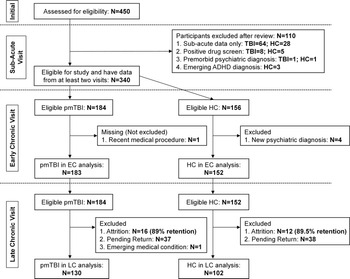
The larger parent study is ongoing. Participants were included in this study (Figure 1) if they had completed the first two study visits by the end of February 2020. Exclusion criteria for the mTBI group were: (1) a history of (a) a neurological diagnosis other than TBI, (b) previous moderate or severe TBI with >30 min LOC, (c) developmental disorder (i.e., autism spectrum disorder or intellectual disability), (d) any psychiatric disorders other than adjustment disorder, or (e) substance abuse/dependence; (2) a non-English-speaking child/adolescent or guardian; or (3) a positive urine-based drug screen at any of the three visits. HC had identical exclusion criteria as well as: (1) diagnosis of attention-deficit/hyperactivity disorder or a learning disability and (2) sustained mTBI within 6 months of their initial visit. All participants provided informed consent or assent according to institutional guidelines at the University of New Mexico School of Medicine. All study procedures were completed in accordance with the Helsinki Declaration.
A flow chart displaying the eligibility, inclusion, and exclusion steps for both healthy controls (HC) and pediatric mild traumatic brain injury (pmTBI) patients for the study. Sample sizes and exclusion criteria are presented separately for the subacute (SA), early chronic (EC), and late chronic (LC) visits.

Materials and Procedures
Trained staff members administered the NewMAP TBI (see Appendix A and Figure 2) in tandem to both the parent and child/adolescent at subacute (SA: 7.43 ± 2.17 days post-injury; range=1–11), early chronic (EC: 130.66 ± 15.15 days post-injury; range=101–194), and late chronic (LC: 371.17 ± 34.23 days post-injury; range=238–489) post-injury phases in an outpatient setting. Staff read the interview prompts and recorded participants’ verbatim responses electronically. The NewMAP TBI is conceptually similar to existing semi-structured interviews for adults, such as the Ohio State University TBI-ID, the Virginia Commonwealth University retrospective concussion diagnostic interview, blast version, and an adult version of this interview (Corrigan & Bogner, Reference Corrigan and Bogner2007; Mayer, Hanlon, et al., Reference Mayer, Hanlon, Claus, Dodd, Miller, Mickey and Hutchison2018; Walker et al., Reference Walker, Cifu, Hudak, Goldberg, Kunz and Sima2015), but incorporated pediatric-specific scales (i.e., PCSI) and language. The first step of the NewMAP TBI involved a global recording of the four most recent potential head and/or neck injuries. Information obtained during the semi-structured interview includes a narrative of the circumstances related to the head injury, approximate date and year of the injury, type of injury classified based on previously published categories (e.g., fall vs. motor vehicle crash, Haarbauer-Krupa et al., Reference Haarbauer-Krupa, Arbogast, Metzger, Greenspan, Kessler, Curry and Master2018), whether or not the injury was sport- or recreation-related (Rice, Reference Rice2008), and details about injury severity (i.e., LOC, PTA, RGA, confusion/disorientation). The trained technician then determined whether the injury met minimal diagnostic criteria for mTBI (McCrory et al., Reference McCrory, Meeuwisse, Dvorak, Aubry, Bailes, Broglio and Vos2017). If criteria were met, both the parent and child/adolescent completed a more thorough assessment of the PCS experienced acutely following the injury using a slightly modified version of the PCSI (i.e., temporal flag of “Yesterday and Today” removed) for adolescents (13–18 years old), hereafter referred to as the acute-PCSI measurement. When more than one TBI was reported at any of the visits, two raters (authors DH and VS) separately read each description and indicated which reported injuries were the same across study visits.
In addition to the semi-structured interview, all children/adolescents and parents independently completed separate and age-appropriate modified child/adolescent and parent versions of the PCSI self-report questionnaire (see Supplemental Materials) to rate PCS retrospectively 1 month prior to the SA visit (R-PCSI) and for the day of the initial visit (SA-PCSI). The PCSI was modified with author (GG) permission as follows: (1) the version of the PCSI for 13–18 years old (adolescent version) was also administered to 12-year-old participants to equate the response scale across the 1-year follow-up and (2) all references to an injury were removed from questionnaires and instructions to avoid response bias in HC. Participants who were 8–11 years old completed the older child self-report form. The following formula (Barlow, Crawford, Brooks, Turley, & Mikrogianakis, Reference Barlow, Crawford, Brooks, Turley and Mikrogianakis2015) was used to equate symptom burden for analyses given the different number of items between parent and child/adolescent versions of the PCSI (child range: 0–21; parent range: 0–20): PCSI symptom burden scores = (Total PCSI/Total Possible PCSI Score) × 100.
Participants also completed a short version of the Test of Memory and Malingering (TOMMe10) as an independent measure of performance validity (Denning, Reference Denning2012; see Figure 2 for study procedures).
Statistical Analyses
T-test and chi-square tests compared demographic variables and the number of individuals scoring below recommended cut offs on a measure of performance validity (TOMMe10) between mTBI and HC, as well as those who completed three versus two visits. Four main TBI characteristics were examined for both Qualifying and Remote TBIs: LOC, PTA, RGA, and confusion/disorientation. Analyses of Qualifying TBI data were limited to mTBI participants to better control for time since injury, while Remote TBI analyses included both groups. Each TBI characteristic was examined using a range of precision: (1) self-reported duration of time (continuous converted to minutes), (2) a conversion of self-reported duration to categorical variables, and (3) binary endorsement for present or absent. Categorical classifications for LOC, PTA, RGA, and confusion/disorientation were identical to a previous adult study (Mayer, Hanlon, et al., Reference Mayer, Hanlon, Claus, Dodd, Miller, Mickey and Hutchison2018) and based on previously published (Lezak, Reference Lezak1995; Ruff & Jurica, Reference Ruff and Jurica1999) categorical classifications (see Table 1).
TBI characteristics.

EC = Early Chronic; LC = Late Chronic; LOC = Loss of Consciousness; PCS = Post-Concussive Symptoms; PCSI = Post-Concussion Symptom Inventory; PTA = Post-Traumatic Amnesia; SA = Subacute; SD = Standard Deviation; TBI = Traumatic Brain Injury. *Remote TBI analyses include pmTBI patients and HCs that reported a remote TBI at any of the three visits.
The distributions for LOC, PTA, RGA, confusion/disorientation, number of symptoms (range=0–21), and symptom burden (range=0–126) were zero-inflated and positively skewed. Data were, therefore, log-transformed following the addition of a constant. Intraclass correlation coefficients (Shrout & Fleiss, Reference Shrout and Fleiss1979) were used to examine test–retest reliability [two-way random effects, absolute agreement, single measurement; ICC(2,1)] for continuous self-report variables. Gwet’s AC1 estimation evaluated test–retest reliability of binary variables (Gwet, Reference Gwet2008). Gwet’s AC2 estimation evaluated test–retest reliability of categorical variables and the reported number of Remote TBIs. All reliability estimates were categorized as poor (≤0.39), fair (0.40-0.59), good (0.60-0.74), or excellent (≥0.75) based on previous guidelines (Cicchetti, Reference Cicchetti2001), with reliability coefficients of ≥0.60 (i.e., good or excellent ranges) operationally defined to be acceptable. Because estimates of test–retest reliability (i.e., Gwet’s AC1/AC2 and ICCs) are not mathematically equivalent, reliability coefficients for all variables (binary, categorical, and continuous) and algorithms are presented for thoroughness in Supplemental Materials.
Secondary analyses compared the acute-PCSI (derived from the NewMAP TBI) to the R-PCSI and SA-PCSI using generalized estimating equations (GEE) with a negative binomial distribution to establish preliminary evidence for construct validity (i.e., highest symptom burden at the time of injury). These analyses were limited to participants aged 12 and older to minimize the impact of parent–child version differences in scoring (Mayer et al., Reference Mayer, Stephenson, Dodd, Robertson-Benta, Pabbathi Reddy, Shaff and Quinn2020).
RESULTS
Participants
One-hundred and eight-four mTBI and 156 statistically matched (age/sex) HC were included in the study. HC parents had significantly higher educational attainment than mTBI parents. Additionally, fewer HC scored below the recommended cut off on a measure of performance validity (See Table 2). There were no differences in demographic or severity of injury characteristics between mTBI completing all three versus two visits (all p’s>0.10; See Supplemental Table 1). Eleven HC reported a previous Remote TBI at the SA visit. Ten mTBI reported new head injuries that occurred between visits. New injuries sustained after the first visit were not included in the following reliability analyses. Importantly, some mTBI reported LOC or PTA outside the mild severity range for their Qualifying or Remote TBI during the NewMAP TBI administration, along with other anomalies (see Supplemental Materials for full details). These data points were purposefully included in the analyses given the primary test–retest reliability aim.
Demographic information for the full sample.

ADHD = Attention-Deficit/Hyperactive Disorder; LD = Learning Disability; HC = Healthy Controls; pmTBI = Pediatric Mild Traumatic Brain Injury; TOMMe10 = Test of Memory Malingering short version. *Data are missing for one participant.
Qualifying TBI Analyses
The primary mechanisms of injury (Haarbauer-Krupa et al., Reference Haarbauer-Krupa, Arbogast, Metzger, Greenspan, Kessler, Curry and Master2018) for the Qualifying TBI were motor vehicle crashes (24.7%), falls (30.8%), strikes by objects (15.4%), strikes by people (18.7%), assaults (4.4%), bicycle accidents (5.5%), and other types of injuries (0.5%), with 61% sport- or recreation-related. Binary LOC, RGA, and confusion/disorientation variables had good to excellent reliabilities (See Tables 1 and 3), while binary PTA variables had fair reliabilities. For categorical variables, LOC, PTA, and RGA variables exhibited good to excellent test–retest reliabilities across visits, while categorical confusion/disorientation variables had fair reliabilities. Continuous LOC variables had good reliability from SA to EC, excellent reliability from EC to LC, and fair reliability from SA to LC. Conversely, continuous PTA, RGA, and confusion/disorientation variables had poor to fair reliabilities. Finally, the acute-PCSI number of symptoms and symptom burden scores exhibited fair to good reliabilities across all visits. Supplemental Table 2 provides reliability coefficients (Gwet’s statistics, ICC and transformed ICC) for all combinations of TBI characteristics and algorithms for the Qualifying TBI.
Test–retest reliability coefficients for TBI characteristics.

EC = Early Chronic; LOC = Loss of Consciousness; LC = Late Chronic; PCSI = Post-Concussion Symptom Inventory; PTA = Post-Traumatic Amnesia; RGA = Retrograde Amnesia; SA = Subacute; TBI = Traumatic Brain Injury. *Actual value was negative, but constrained to zero to increase interpretability; 1Gwet’s AC1; 2Gwet’s AC2; 3Intraclass correlation coefficient (log transformed) +1.
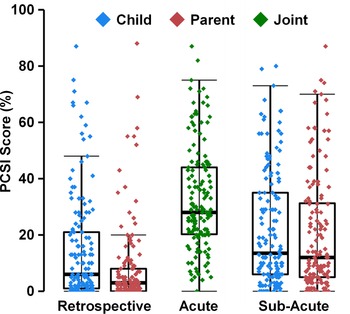
Secondary analyses revealed the expected, significant linear trend in symptom burden for both parent (Wald χ2=115.81; p<0.001) and adolescent (Wald χ2=91.22; p<0.001) PCSI ratings (see Figure 3). Specifically, the highest PCSI symptom burden scores (all p’s<0.001) were reported on the acute-PCSI (32.89 ± 18.58) followed by the SA-PCSI (20.49 ± 20.39) and R-PCSI (7.97 ± 14.36) for parent-rated version. Similarly, the acute-PCSI had the highest symptom burden scores (32.66 ± 18.52) relative to SA-PCSI (22.14 ± 20.35) and R-PCSI (14.53 ± 18.75; all p’s<0.001) for the adolescent-rated version.
A flow chart displaying the procedures for a study visit for both healthy controls (HC) and patients with pediatric mild traumatic brain injury (pmTBI) through the subacute visit (SA). Parental interactions are represented by a solid arrow, whereas child/adolescent interactions are represented by a dashed arrow. NewMAP TBI = New Mexico Assessment of Pediatric Traumatic Brain Injury; PCSI = Post-Concussion Symptom Inventory.

Box and scatter plots demonstrating construct validity for symptom reporting on the NewMAP TBI. The percent of total scores from the Post-Concussion Symptom Inventory (PCSI) scores are reported on the Y-axis. Child and parent ratings were retrospectively acquired for 1 month prior to injury (retrospective) and on the first study visit (subacute). Children and parents jointly completed the semi-structured interview, in which they were asked if the child experienced each PCS following the injury (acute-PCSI). Both parent and child ratings exhibit the expected pattern of acute > subacute > retrospective symptom burden .

The Effect of Different Parents/Guardians
One potential source of variability is different parents or guardians completing the NewMAP TBI with the child/adolescent across multiple visits. However, test–retest reliabilities (Supplemental Table 3) for the reduced sample with different parent raters (n=30) were generally consistent with the overall sample. Exceptions included continuous LOC, which was reduced across all time points from the good to fair range from SA to EC, fair to poor range for SA to LC, and excellent to fair range from EC to LC. Continuous PTA reliability coefficients also were reduced from fair to poor from SA to EC and from EC to LC. Lastly, acute-PCSI number of symptoms and symptom burden scores had good reliability from SA to EC and EC to LC; however, reliability was poor for acute-PCSI number of symptoms while symptom burden had fair reliability from SA to LC.
Remote TBIs Analyses
Test–retest reliability coefficients for the number of Remote TBIs were excellent across the three visits (See Table 3) for the overall sample as most individuals (85.8%) reported no Remote TBI history. For the subset of individuals who reported a history of Remote TBI at any of the three visits, the test–retest reliability was good from SA to EC, fair from SA to LC, and excellent from EC to LC (Table 3). Notably, of the 82 Remote TBIs that were reported during at least one of the visits, 36 (44%) were not consistently reported across each visit. In examining the reliability of Remote TBIs characteristics that were consistently reported, all binary variables had good to excellent reliabilities. Categorical LOC, PTA, and RGA all had excellent reliabilities, while confusion/disorientation variables had fair to good reliability. Compared to reliabilities for the Qualifying TBI analyses, reliabilities for continuous variables for LOC decreased across visits, with fair reliability from SA to EC, poor reliability from SA to LC, and good reliability from EC to LC. For PTA, the reliability of SA to EC and SA to LC was similar to the Qualifying TBI analyses; however, the reliability from EC to LC improved to the good range. Both RGA and confusion/disorientation continuous variables had similar reliability to the Qualifying TBI, except reliability improved from SA to LC from poor to good for RGA and poor to excellent for confusion/disorientation. Reliability also improved from fair to good for RGA for EC to LC. The reliability of acute-PCSI number of symptoms and symptom burden scores at the time of injury was fair to excellent across visits (See Table 3). Supplemental Table 4 provides reliability coefficients (Gwet’s statistics, ICC and transformed ICC) for all combinations of TBI characteristics and algorithms for the Remote TBI.
Impact of Reliability Algorithms
The statistical properties (zero inflation, skew) of the TBI characteristics could potentially impact reliability, and estimates of test–retest reliability (i.e., Gwet’s AC1/AC2 and ICCs) are not mathematically equivalent. Therefore, reliability estimates were compared across algorithms to determine the impact of these factors on the results. Specifically, Supplemental Tables 2 and 4 indicate that Gwet’s AC1 and AC2 produced the same values for binary variables as expected. For both the Qualifying and Remote TBI, Gwet’s AC2 typically resulted in the highest value among all algorithms, although this was likely due to differences in the algorithms (e.g., Gwet’s AC2 vs. ICC; see the following paragraph) as well as reflecting increased reliability for the transformed categorical data. Specifically, when the continuous variables were converted into categories, ICC values increased. When using a base 10 logarithmic transformation on the continuous data with an added constant of 1, ICC values also increased if the original distribution was skewed and zero inflated (e.g., LOC, PTA). When the original distribution was normal (acute-PCSI data), log-transformed and original data produced similar ICCs.
Calculations on simulated data were therefore conducted to determine how estimated reliabilities for both ICC and Gwet’s AC1/AC2 can be moderated by different data types (binary, categorical, and continuous), which have different distributions and varying degrees of “true” correlations. For continuous distributions, values were randomly sampled from a bivariate normal distribution across varying levels of correlation strength (i.e., the ICC; 0.0–0.9 in increments of 0.1). This sample distribution was then transformed by converting all negative values to zeros, thus mirroring the obtained data from the semi-structured interview, in which half of the bivariate sample report zeros. Simulation of categorical variables was performed in two different ways with zeroes from the previously created distribution remaining as zeroes and the remaining values split into four categories as either an even distribution or a distribution weighted toward lower ordinal categories.
Simulation of binary variables was achieved by splitting the original bivariate normal distribution below (0) and above (1) the medians for the X and Y values. Supplemental Table 5 shows how reliability estimates were impacted by applying different types of transformations to the bivariate normal distribution sample. The calculations showed that converting zero-inflated continuous data into a binary variable attenuated the ICC. However, the categorization of the zero-inflated data gives results comparable to the zero-inflated continuous data. For binary data, AC1 equaled AC2. AC2 is much larger than ICC for categorized data when ICC was small or moderate. The AC2 increased with the value of ICC but not as rapidly as the ICC based on categorized scores.
DISCUSSION
Several diagnostic schemes (e.g., ACRM, WHO) predominantly rely on TBI characteristics to determine the severity level (e.g., mild vs. moderate; Carroll et al., Reference Carroll, Cassidy, Holm, Kraus and Coronado2004; Mayer et al., Reference Mayer, Quinn and Master2017; McCrory et al., Reference McCrory, Meeuwisse, Dvorak, Aubry, Bailes, Broglio and Vos2017; Menon et al., Reference Menon, Schwab, Wright and Maas2010), with recent expert consensus panels basing diagnosis predominantly on post-injury symptom burden for mTBI (McCrory et al., Reference McCrory, Meeuwisse, Dvorak, Aubry, Bailes, Broglio and Vos2017). However, there are currently no validated semi-structured interviews for assessing pediatric TBI. Only a handful of studies have evaluated the psychometric properties of recalled information for commonly reported TBI characteristics in adults (Bogner et al., Reference Bogner, Whiteneck, MacDonald, Juengst, Brown, Philippus and Corrigan2017; King et al., Reference King, Crawford, Wenden, Moss, Wade and Caldwell1997; Mayou, Black, & Bryant, Reference Mayou, Black and Bryant2000; McMillan, Jongen, & Greenwood, Reference McMillan, Jongen and Greenwood1996; Nelson et al., Reference Nelson, Anderson, Thuras, Kehle-Forbes, Arbisi, Erbes and Polusny2015; Roberts, Spitz, Mundy, & Ponsford, Reference Roberts, Spitz, Mundy and Ponsford2019; Roberts, Spitz, & Ponsford, Reference Roberts, Spitz and Ponsford2016; Sherer et al., Reference Sherer, Sander, Maestas, Pastorek, Nick and Li2015), and no studies have examined these factors in pediatric TBI.
Current results indicated that for both Qualifying and Remote TBIs, binary reporting (present/absent) of confusion/disorientation, LOC, and RGA had acceptable test–retest reliabilities, whereas the binary reliability for PTA was below the acceptable range. In contrast, the majority of TBI characteristics did not achieve acceptable test–retest reliabilities when durations were rated on a continuous basis. LOC was the only exception, which achieved acceptable reliability in half of the time points assessed for both Qualifying and Remote TBIs when data were log-transformed to account for skew (see Table 3). Importantly, LOC, RGA, and PTA all had acceptable test–retest reliabilities when continuous self-report data were separated into more discrete categories based on previously published criteria (Lezak, Reference Lezak1995; Ruff & Jurica, Reference Ruff and Jurica1999), whereas categorical ratings of disorientation/confusion were below the acceptable range (see discussion on distribution properties). Test–retest reliabilities for TBI characteristics were not strongly affected when children/adolescents were accompanied by different parents at each appointment. Thus, current results suggest that continuous self-report may contribute to inconsistency in the diagnosis of pediatric TBI severity, which has recently been highlighted as a major clinical concern (Crowe et al., Reference Crowe, Hearps, Anderson, Borland, Phillips, Kochar and Babl2018).
Although preliminary support for the construct validity of retrospective ratings of PCS severity was obtained (acute injury > subacute period > pre-injury period), the recall of PCS burden (number of symptoms and total burden) exhibited acceptable reliability in only approximately half of the instances as a function of time post-injury for both Remote and Qualifying TBIs. Symptoms mimicking PCS frequently occur in healthy individuals as well as other non-TBI-related conditions such as learning disabilities, attention deficit hyperactive disorder, and depression (Iverson & Lange, Reference Iverson and Lange2003; Iverson et al., Reference Iverson, Silverberg, Mannix, Maxwell, Atkins, Zafonte and Berkner2015). This increases the challenges of correctly recalling when symptoms truly occurred post-injury relative to a variety of documented recall biases (Caplan et al., Reference Caplan, Bogner, Brenner, Arciniegas, Silverberg, Iverson and Aquino2016; Gunstad & Suhr, Reference Gunstad and Suhr2001; Lange, Iverson, & Rose, Reference Lange, Iverson and Rose2010; Ruff, Iverson, Barth, Bush, & Broshek, Reference Ruff, Iverson, Barth, Bush and Broshek2009). Notably, the time between appointments (e.g., 4 months or 1 year) was associated with slight decreases in reliability coefficients. This is consistent with previous studies that report much higher test–retest reliabilities across 1–6 week reporting windows (Mailer, Valovich-McLeod, & Bay, Reference Mailer, Valovich-McLeod and Bay2008; Mayer et al., Reference Mayer, Stephenson, Dodd, Robertson-Benta, Pabbathi Reddy, Shaff and Quinn2020; Sady et al., Reference Sady, Vaughan and Gioia2014).
Current results also suggest that the underlying statistical properties (zero inflation, skew) of the TBI characteristics and the choice of reliability algorithm may have a large impact on test–retest reliability coefficients. Specifically, as exhibited in Table 1, most TBI characteristics have a zero inflated (i.e., high percentage of cases with “None” responses), positively skewed distribution. The ICC is the most commonly used metric to evaluate test–retest reliability but is designed for continuous, normally distributed data (Lexell & Downham, Reference Lexell and Downham2005). Log transformations of the continuous self-report data improved reliability in some instances (i.e., LOC, PTA) due to reduced skew of the data. The ICC, however, is not appropriate for estimating reliabilities of binary or categorical responses, as these data require an approach that takes into account the overall agreement of endorsing a particular category across time (Gwet, Reference Gwet2008). Therefore, the statistical properties of the TBI characteristic being assessed should drive the choice of the appropriate algorithm for determining test–retest reliability coefficients.
Similar to past studies of mTBI (Castile, Collins, McIlvain, & Comstock, Reference Castile, Collins, McIlvain and Comstock2012; Delaney, Lacroix, Leclerc, & Johnston, Reference Delaney, Lacroix, Leclerc and Johnston2002; Guskiewicz et al., Reference Guskiewicz, McCrea, Marshall, Cantu, Randolph, Barr and Kelly2003), confusion/disorientation was the most commonly endorsed TBI characteristic (82.4% of the sample) followed by LOC (49.4%), PTA (37.8%), and RGA (15.0%). These statistical properties may explain why confusion/disorientation’s test–retest reliability was highest when it was binarized, whereas reliability for other variables improved following categorical transformations. Similarly, calculations based on numerical simulations indicated that the rate of convergence between the ICC and Gwet’s statistics were partially determined by the initial distributions of the data (frequencies of responses in different categories), illustrating the complex interplay that occurs between the data distribution, algorithm choice, and reliability coefficients.
Another potential explanation for differences in reliability coefficients is that participants may not understand nuances associated with different TBI characteristics, and/or may conflate similar symptoms. It can be challenging to distinguish PTA from attention deficits, confusion, and/or psychogenic amnesia or dissociation post-injury from a lay perspective (Corrigan & Bogner, Reference Corrigan and Bogner2007; Ruff et al., Reference Ruff, Iverson, Barth, Bush and Broshek2009; Stuss et al., Reference Stuss, Binns, Carruth, Levine, Brandys, Moulton and Schwartz1999; Vanderploeg et al., Reference Vanderploeg, Groer and Belanger2012). Similarly, disorientation (e.g., “Where are you right now?”) can also occur as a result of RGA (Ruff et al., Reference Ruff, Iverson, Barth, Bush and Broshek2009). Furthermore, prior to the full recovery of continuous, episodic memory, individuals may have isolated memories (e.g., brief memory of being transported to the hospital, but no memory again until hospital discharge) that may be forgotten over time, which can lead to inconsistent reporting of PTA (Roberts et al., Reference Roberts, Spitz, Mundy and Ponsford2019). The term “post-traumatic confusional state” has been proposed instead of “post-traumatic amnesia” to encompass all of these medical conditions (Kristman et al., Reference Kristman, Borg, Godbolt, Salmi, Cancelliere, Carroll and Cassidy2014; Stuss et al., Reference Stuss, Binns, Carruth, Levine, Brandys, Moulton and Schwartz1999). In contrast, a LOC, or lack thereof, may be more obvious (bystanders) or memorable to nonmedical personnel. Previous studies using semi-structured interviews show adequate test–retest reliability of LOC in adult civilian (Bogner et al., Reference Bogner, Whiteneck, MacDonald, Juengst, Brown, Philippus and Corrigan2017) and prison (Bogner & Corrigan, Reference Bogner and Corrigan2009) populations with moderate to severe TBI when asked if LOC exceeded 30 min. Self-reported Remote TBI history, including whether or not individuals sustained LOC, has been shown to have adequate test–retest reliability in older adults as well (Wilmoth et al., Reference Wilmoth, LoBue, Clem, Reddy, Hynan, Didehbani and Cullum2018). However even in adults, test–retest reliability for LOC duration within the mild range has not been thoroughly investigated (Corrigan, Yang, Singichetti, Manchester, & Bogner, Reference Corrigan, Yang, Singichetti, Manchester and Bogner2018).
Finally, most participants did not report a history of Remote TBIs (85.8%), resulting in excellent test–retest reliability for this characteristic across the entire sample. Test–retest reliability was much lower when limiting analyses to individuals who reported a history of Remote TBIs, with a significant portion of the sample failing to report the same number of Remote injuries across all three visits (36/82, 44% of Remote TBIs not reported across all visits). This can be concerning for both clinical work and research in the assessment of multiple TBIs, particularly when trying to determine whether multiple TBIs are associated with worse or long-term impairment (Kerr, Thomas, Simon, McCrea, & Guskiewicz, Reference Kerr, Thomas, Simon, McCrea and Guskiewicz2018; Manley et al., Reference Manley, Gardner, Schneider, Guskiewicz, Bailes, Cantu and Iverson2017).
Limitations
Although medically diagnosed with mTBI for their Qualifying injury, a small portion of our sample (5.9%) reported LOC or PTA outside the mild severity range during at least one of their visits. These cases were included given the aim of the current manuscript, with similar findings reported in adult samples (Sherer et al., Reference Sherer, Sander, Maestas, Pastorek, Nick and Li2015). Because all participants were seen in emergency care settings and diagnosed with mTBI, additional studies are required to examine reliability of self-report among children and adolescents with either more severe TBI or in other medical settings. Furthermore, the number of lifetime TBIs reported in this sample was low, so that results may not generalize to a sample of participants with a high number of lifetime TBIs. Inter-rater reliability could not be assessed as rater information was not recorded. This limitation needs to be addressed in subsequent studies. Also, as discussed in detail in the sections above, there are many statistical perils for trying to establish rates of test–retest reliability among non-normally distributed data types. Additional methodological studies are required to determine the full impact of these limitations. Finally, while the study did include a performance validity measure, there was no measure of symptom validity and therefore information is unavailable regarding potential under- or overreporting of self-reported symptoms.
Future Directions
Based on current findings, slight alterations will be made to the NewMAP TBI to improve the reliability of self-reported TBI characteristics (updated version presented in Appendix A). This includes providing categories for the duration of TBI characteristics to participants since current results suggest that the exact duration of reporting was generally unreliable. In the instructions for PTA and RGA, additional formal prompts were provided for interviewers (e.g., “What was the first/last memory you remembered after/before the injury? Do you remember being on site of the injury/in the car/in the hospital?”). These questions may elicit a more accurate temporal reporting of PTA and RGA to better help individuals understand the differences among these phenomena relative to confusion (Ruff et al., Reference Ruff, Iverson, Barth, Bush and Broshek2009; Vanderploeg et al., Reference Vanderploeg, Groer and Belanger2012). Additional studies in different pediatric TBI samples (e.g., with premorbid conditions such as the presence of psychiatric or neurodevelopmental disorders, substance use) will be needed to further examine the reliability and validity of the NewMAP TBI under these use cases.
CONCLUSIONS
In summary, reliable self-report is critical for accurate diagnosis and prognosis of TBI (Asken et al., Reference Asken, McCrea, Clugston, Snyder, Houck and Bauer2016; Haran et al., Reference Haran, Bressan, Oakley, Davis, Anderson and Babl2016; McCrory et al., Reference McCrory, Meeuwisse, Dvorak, Aubry, Bailes, Broglio and Vos2017; Sarmiento, Gioia, Kirkwood, Wade, & Yeates, Reference Sarmiento, Gioia, Kirkwood, Wade and Yeates2019). Binary or categorical variables of TBI characteristics for both Qualifying and Remote TBIs had acceptable reliabilities, whereas most continuously reported data were at or below traditional levels of acceptable reliability. Although slight reductions based on the time from injury were observed, test–retest reliability of the NewMAP TBI was relatively robust to duration between assessments (4 months vs. 1 year) and different parent/child raters. Current results suggest that discretizing continuous variables may provide the best balance between psychometric properties and clinical information that are needed to diagnose injury severity.
SUPPLEMENTARY MATERIAL
To view supplementary material for this article, please visit https://doi.org/10.1017/S1355617721000928.
FUNDING
This research was supported by grants from the National Institutes of Health to Andrew R. Mayer (grant numbers NIH 01 R01 NS098494-01A1, R01 NS098494-03S1A1, and P30 GM122734). The NIH had no role in study review, data collection and analysis, decision to publish, or preparation of the manuscript.
CONFLICTS OF INTEREST
The authors have nothing to declare.