Introduction
The assessment of performance status (PS) is important in palliative care practice. There is a strong association between PS and survival in patients with life-threatening illnesses, and it may be used individually as a prognostic tool (Su et al., Reference Su, Barbera and Sutradhar2015; Simmons et al., Reference Simmons, McMillan and McWilliams2017; Baik et al., Reference Baik, Russell and Jordan2018). Because of its strong predictive value, PS has been incorporated as well in many palliative care survival prediction tools like the Palliative Prognostic Index (PPI), the Palliative Prognostic Score (PaP), the PROgnostic Model for Advanced Cancer (PRO-MAC), and others (Simmons et al., Reference Simmons, McMillan and McWilliams2017; Hum et al., Reference Hum, Wong and Yee2019).
In addition to its use as a prognostic tool, PS has other applications in palliative care. For example, PS assessment helps in identifying patients with palliative care needs (Maas et al., Reference Maas, Murray and Engles2013; Lee et al., Reference Lee, Park and Lim2019), and it is frequently included in the criteria of referral to outpatient palliative care (Hui et al., Reference Hui, Meng and Bruera2016). Furthermore, the PS of patients may have an impact on their decision-making preferences (Ghoshal et al., Reference Ghoshal, Damani and Muckaden2019).
One of the PS assessment tools that are used frequently in palliative care practice is the Palliative Performance Scale (PPS), which is a modification of the Karnofsky Performance Score (KPS) (Karnofsky et al., Reference Karnofsky, Abelmann and Craver1948). The PPS was developed by Anderson et al. (Reference Anderson, Downing and Hill1996) to measure the PS of palliative care patients based on the assessment of six parameters: ambulation, activity, evidence of disease, self-care, intake, and consciousness. The second version of the PPS (PPSv2) is exactly the same as the first one with some modifications to make it clearer and easier for use (Victoria Hospice: Clinical Tools).
Since its development, the PPS has been validated in different settings and among different patient populations (Baik et al., Reference Baik, Russell and Jordan2018). In patients with advanced cancer, the PPS is the most studied prognostic tool and was found to be of prognostic significance (Simmons et al., Reference Simmons, McMillan and McWilliams2017). The prognostic value of PPS is not limited to advanced cancer patients, as it predicts the survival of patients with other life-threatening illnesses, e.g. patients with terminal heart failure (Masterson Creber et al., Reference Masterson Creber, Russell and Dooley2019) or end-stage renal disease (O'Connor et al., Reference O'Connor, Dougherty and Harris2013).
With the wide use of PPS, it was necessary to translate it into different languages (Victoria Hospice: Clinical Tools) including Arabic. Palliative care is developing in Arabic-speaking countries, and a number of studies from these countries reported the use of PPS (Al-Shahri et al., Reference Al-Shahri, Eldali and Al-Zahrani2012; Al-Saleh et al., Reference Al-Saleh, Al-Awadi and Soliman2017; Seedhom and Kamal, Reference Seedhom and Kamal2017). However, none of these studies reported the validation of an Arabic translation for the PPS. Although English is used as a language of communication in health care in many Arab countries, health care professionals are not native English speakers. This carries the risk of nonuniformity and possible flaws in applying the PPS in Arabic countries. Furthermore, in some Arab countries, health care professionals communicate only in Arabic like many nursing staff in Egypt. Hence, it was important to have a validated Arabic PPS translation for use in the Arab World with a population exceeding 400 million (World Bank, 2019).
The aim of this work was to translate the PPSv2 into Arabic and to test the reliability and validity of the Arabic PPSv2 (PPS-Arabic).
Methods
The study protocol was approved by the Scientific Ethics Committee of Kasr Al-Ainy Center of Clinical Oncology and Nuclear Medicine, Kasr Al-Ainy School of Medicine, Cairo University (Cairo, Egypt). The permission of Victoria Hospice (British Columbia, Canada), the copyright owner of the PPSv2, was obtained to translate the tool into Arabic and to conduct a study to test the reliability and validity of the translation. Participating patients (or a proxy for patients with impaired consciousness) signed/fingerprinted a written informed consent. All included patient were native Arabic-speaking adults (>18 years of age) and had cancer.
Translation
The translation of the PPSv2 into Modern Standard Arabic, which is the official language in Arab countries, was completed during January and February 2018. A “forward–backward” translation procedure was implemented (Wild et al, Reference Wild, Grove and Martin2005).
The forward translation into Arabic was done by two professional translators (from the Centre for Foreign Languages and Professional Translation — Cairo University) and two native Arabic-speaking physicians fluent in English (a palliative care physician [S.A.] and a clinical oncologist [A.A.]).
The reconciled forward Arabic translation was backward translated into English by another two professional translators. The backward English translation was reviewed by the forward translators and compared with the original PPSv2.
The Arabic translation of the PPSv2 (PPS-Arabic) was reviewed by a group of native Arabic-speaking health care professionals (four physicians, three nurses, one social worker, and one clinical pharmacist) for readability and clarity. The final version of the PPS-Arabic was proofread, and the final report was submitted to Victoria Hospice.
Reliability and validity
The reliability and validity of the PPS-Arabic were tested in the period from March to June 2018.
Inter-rater and intra-rater reliabilities were tested in a pilot study to ensure the possibility of repeating the measurement within the predetermined interval range. A sample size of 20 patients for the pilot study with two observations per patient was enough to detect an intraclass correlation coefficient (ICC) of at least 0.8 with a 0.05 significance level and 90% power. For each patient, two physicians performed two PPS-Arabic assessments with a two- to three days interval (a total of 80 PPS-Arabic assessments). The two physicians were native Arabic-speaking clinical oncologists who received training in using the PPS-Arabic. The short interval between the two assessments is similar to that adopted by Barallat et al. (Reference Barallat, Nabal and Canal2017) who validated the Spanish version of the PPS. We choose a short interval because of the possible rapid decline in the PS of patients, especially those receiving best supportive care.
Validity was tested in a cross-sectional study that included a purposive convenience sample of 150 cancer patients for whom the PPS-Arabic was assessed once (a total of 150 PPS-Arabic assessments). In order to perform hypothesis-testing construct validity, the 150 patients were divided according to their treatment intent into three groups, 50 patients each. The first group (in-remission) included patients who have no evidence of disease and either ended or receiving anti-cancer treatment with curative intent. The second group (palliative anti-cancer) had incurable cancer and were receiving anti-cancer treatment with palliative intent. The third group (best supportive care) had incurable cancer and were receiving best supportive care only and no anti-cancer treatment. The in-remission patients and those receiving palliative chemotherapy were recruited from the outpatient clinic. The best supportive care patients were recruited from both the outpatient clinic and the inpatient oncology ward. We hypothesized that the PS measured by the PPS-Arabic would differ significantly between these three groups, being best for the in-remission group and worse for the best supportive care group.
Criterion validity was tested by correlating the PPS-Arabic to the KPS. The KPS is the origin of the PPSv2 and since its development in 1948; it has been used extensively to assess the PS of cancer and noncancer patients in different settings.
Convergent validity was tested by correlating between the performance scores measured by the PPS-Arabic and those measured by the Eastern Cooperative Oncology Group (ECOG) performance scale (Oken et al., Reference Oken, Creech and Tormey1982), which is a widely used tool to assess the PS of cancer patients. Convergent validity was further tested by correlating between PPS-Arabic and the Physical Functioning (PF2) and Role Functioning (RF2) scales of the European Organization for Research and Treatment of Cancer quality of life questionnaire (EORTC QLQ-C30) that measures the physical performance of cancer patients. We hypothesized that a tool that measures the PS accurately would correlate significantly with the PF2 and RF2 scales.
Statistical analysis
All statistical methods were performed using the SPSS software, version 14 (SPSS Inc, Chicago, IL). The Kruskal–Wallis test was used to compare the age and the scores of the PPS-Arabic, KPS, ECOG scale, and EORTC QLQ-C30 PF2 and EORTC QLQ-C30 RF2 between the three groups of patients. The percentages of categorical variables were compared using a χ 2-square test. The ICC was used to assess inter-rater and intra-rater reliabilities, and Cronbach's alpha was used to assess internal consistency. Spearman's correlation test was used to test inter-item correlation and to correlate between PPS-Arabic scores and the scores of KPS, ECOG scale, and EORTC QLQ-C30 PF2 and RF2 scales.
Results
The Arabic version of the PPSv2 (PPS-Arabic) can be found on the Clinical Tools page of Victoria Hospice (https://www.victoriahospice.org/i-am-health-care-professional/clinical-tools).
During the translation process, some modifications were done to make the PPS-Arabic more practical. “Drowsy” in Arabic means “sleepy.” We felt that the level of consciousness described by “sleepy” in Arabic is better than what is intended by the PPSv2. Consequently, we replaced it with the translation of “stupor” which reflects the intended low level of consciousness better. In the PPS-Arabic use instructions, the exact expressions in the PPS table were used and written in bold font within quotation marks to connect PPS words/sentences to their explaining text in a more clear way. Another modification in the instructions section was that all sentences referring to “left” were replaced by “right” because Arabic is written from right to left. In PPSv2, while explaining “Activity and Extent of Disease”; playing different levels of Golf was used to explain the decline in activity. However, Golf is not a popular game in Arab countries and even those who know what is “Golf” are not aware of the Golf rules. For this reason, the Golf scenario was omitted, and “different levels of walking” was used to explain the decline in activity.
The final version of the PPS-Arabic was judged readable and clear by the multiprofessional review group and approved by Victoria Hospice.
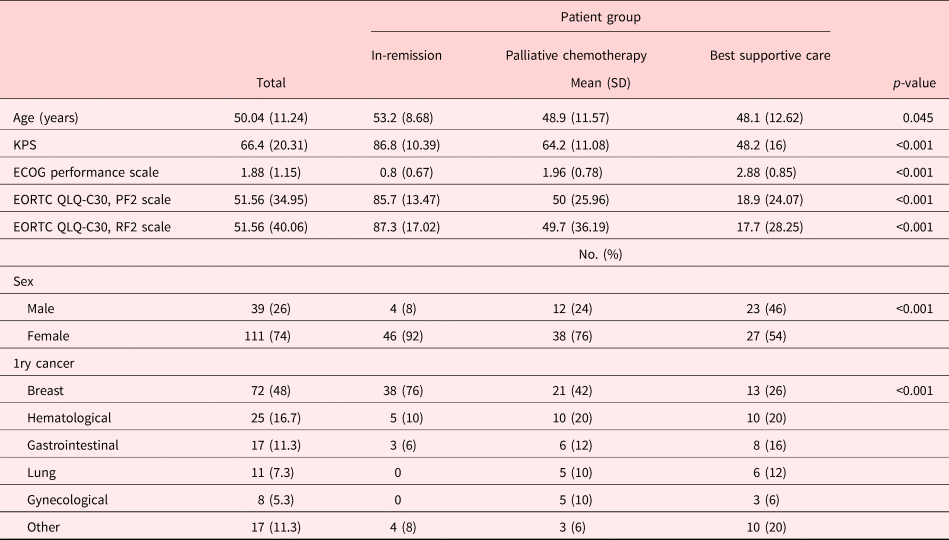
The characteristics of 150 patients enrolled in the validation study are illustrated in Table 1.
Characteristics of the three patients’ groups according to the treatment plan

KPS, Karnofsky Performance Status; ECOG, Eastern Cooperative Oncology Group; EORTC QLQ-C30, PF2 scale, Physical Functioning scale of the European Organization for Research and Treatment of Cancer quality of life questionnaire; EORTC QLQ-C30, RF2 scale, Role Functioning scale of the European Organization for Research and Treatment of Cancer quality of life questionnaire.
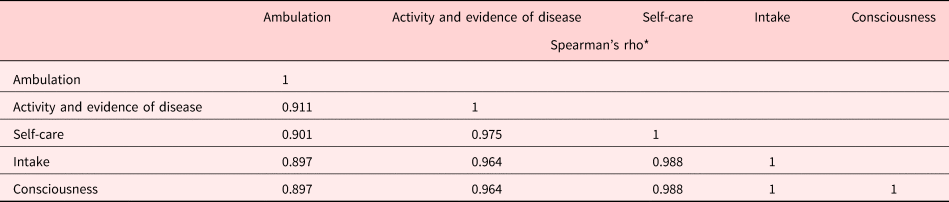
The intra-rater, test–retest, ICC was 0.935 (95% CI: 0.88–0.965; p < 0.001). The inter-observer ICC was 0.965 (95% CI: 0.934–0.981; p < 0.001). The internal consistency Cronbach's alpha was 0.986. The inter-item correlations are shown in Table 2. All correlations were statistically significant (p < 0.001).
PPS-Arabic inter-item correlation

* All p-values < 0.001.
The Karnofsky Performance Scale, the ECOG performance scale, and the EORTC QLQ-C30 subscales PF2 and RF2 differed significantly between the three treatment groups and were highest (best performance) in the in-remission group and lowest (worst performance) in those with incurable cancer and receiving best supportive care only (Table 1).
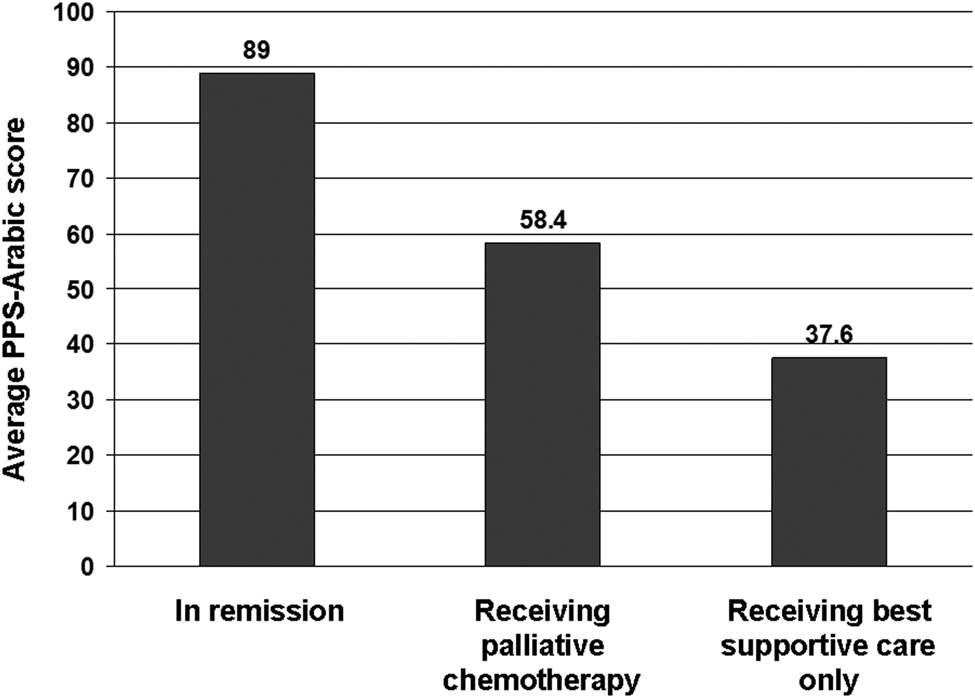
Hypothesis-testing construct validity was illustrated by the highly significant difference in the PPS-Arabic score between the three treatment groups. The average PPS-Arabic score was 89 (±14.46), 58.4 (±11.13), and 37.6 (±15.98) for patients in-remission, those receiving palliative chemotherapy, and those with incurable cancer receiving best supportive care, respectively (p < 0.001), as illustrated in Figure 1.
Average PPS-Arabic score in the three treatment groups.

In criterion validity testing, the PPS-Arabic scores correlated significantly with those of the KPS (Spearman's rho = 0.919, p < 0.001).
Convergent validity was confirmed by the highly significant correlation between the PPS-Arabic and ECOG performance scores (Spearman's rho = −0.887, p < 0.001). Similarly, there was a highly significant correlation between the scores of the PPS-Arabic and the EORTC QLQ-C30 PF2 scale (Spearman's rho = 0.904, p < 0.001) and EORTC QLQ-C30 RF2 scores (Spearman's rho = 0.812, p < 0.001).
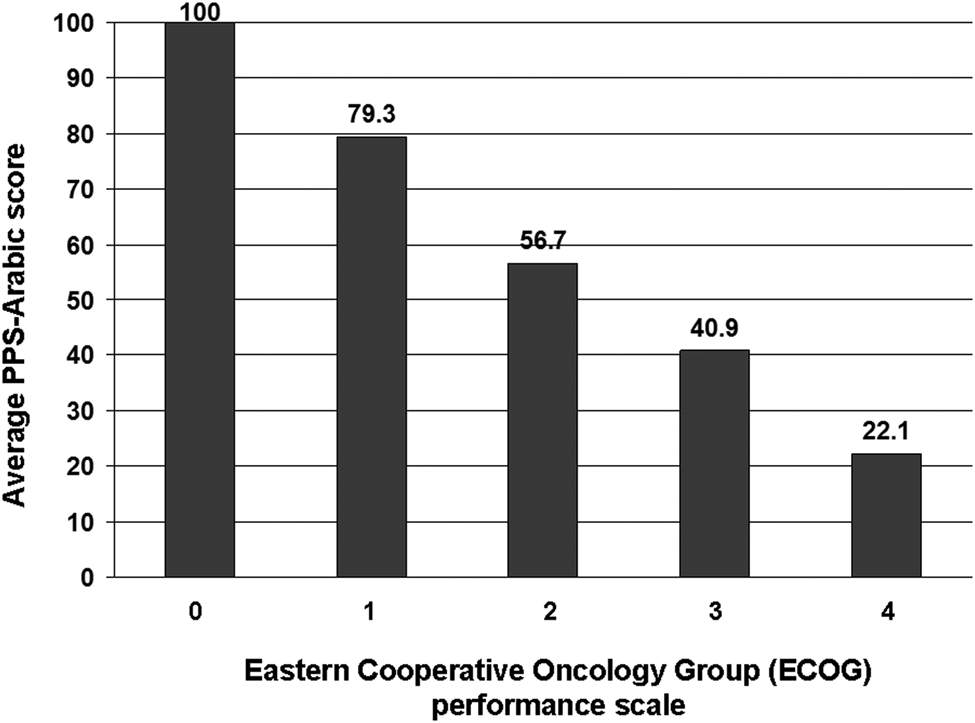
The ECOG performance score corresponded to approximately 20% increments of the average PPS-Arabic (Figure 2).
Average PPS-Arabic score according to the ECOG performance scale.

Discussion
In the current study, the PPSv2 was translated into Modern Standard Arabic, the PPS-Arabic. The intra-rater, inter-observer, and internal consistency reliability tests demonstrated high reliability of the PPS-Arabic. Criterion and construct validity tests confirmed its validity.
The PPSv2 had been translated into more than 10 languages including this Arabic translation. However, not all PPS translations underwent validation (Victoria Hospice: Clinical Tools). Among the validated translations are the Thai (Chewaskulyong et al., Reference Chewaskulyong, Sapinun and Downing2012) and the Spanish (Barallat et al., Reference Barallat, Nabal and Canal2017), and both translations were reliable which are similar to our findings.
The Spanish study included hypothesis-testing and correlation of the PPS-Spanish to functional assessment tools (Barallat et al., Reference Barallat, Nabal and Canal2017).
In the hypothesis-testing construct validity analysis, the PPS-Arabic was able to discriminate well between three groups of patients according to their treatment intent: patients in-remission, those receiving palliative chemotherapy, and those receiving best supportive care. In their cross-sectional validation study, for hypothesis-testing, Barallat et al. (Reference Barallat, Nabal and Canal2017) included three groups of patients according to the setting of service, outpatient, inpatient, and emergency room. Although the PPS-Spanish score differed significantly between the three groups, it was close between the inpatient and emergency room groups. Unlike Barallat et al. (Reference Barallat, Nabal and Canal2017) and in order to illustrate the discriminative ability of PPS-Arabic, we included three groups based on the treatment intent rather than the setting of care. One of the three groups was not a palliative care population, the in-remission group, to insure the inclusion of patients with high PPS-Arabic scores.
PPS-Arabic external criterion validation was successful. There was a significant positive correlation between PPS-Arabic scores and KPS scores. This significant positive correlation was also in other studies (de Kock et al., Reference de Kock, Mirhosseini and Lau2013; Barallat et al., Reference Barallat, Nabal and Canal2017) which showed that PPS is highly correlated to KPS. There was about 20% decrease in PPS-Arabic with each increase in the ECOG scale. This confirms the interchangeability of PPS-Arabic and ECOG which was shown in another study (de Kock et al., Reference de Kock, Mirhosseini and Lau2013).
One of the limitations of this study is its conduction in a single center in one of the Arab countries, Egypt. Another limitation is that the PPS-Arabic was tested in cancer patients only and in the outpatient and inpatient settings. In addition, breast cancer was the most common type of cancer in the in-remission and palliative chemotherapy groups; consequently, the number of females was higher than males. However, these limitations do not undermine the strengths of the current study. The PPSv2 was translated into Modern Standard Arabic, which is the official language of other Arab countries. In addition, the PPS-Arabic was proved to be highly reliable and strongly valid.
Conclusion
The PPS-Arabic is a reliable and valid tool for the assessment of the PS of the cancer patient. To standardize the assessment of PS using the PPS in Arabic countries, we recommend using the PPS-Arabic. Future studies are needed to test the reliability and validity of the PPS-Arabic in other Arab countries among different patient populations and settings.
Conflict of interest
The authors report no conflicts of interest.