Introduction
We live in an ‘information age’, where anyone from anywhere can obtain information on almost anything. This can be very empowering for individuals who are self-directed in enhancing their own care. However, this can also challenge health professionals, who are not effectively trained to present information in the most efficient and effective way.
Individuals may use multiple sources to obtain health information. Some individuals rely on family or friends, others search the internet, many look to professional organizations, others seek out information from books or the library, and some even rely on recommendations from health professionals.Reference Vieder, Krafchick, Kovach and Galluzzi1, Reference Dolovich2 While it may be tempting to assume that older adults rely on less-technologically advanced forms of health information, this has been refuted by demonstrating an increasing number of older adults becoming more engaged with technology, and more involved with their own healthcare.
Although a minority of the population, older adults have a number of co-morbidities and are prescribed a high number of medications, resulting in a disproportionate use of, and interaction with, the health care system. Their treatments involve drug therapies, rehabilitation, surgery, supports placed in the home, or other interventions. Providing care for these patients is complex. Because of the number of different disease states and the complex care required, older patients will often leave a doctor's office with an overwhelming amount of information.Reference Vieder, Krafchick, Kovach and Galluzzi1, Reference Radecki, Kane, Solomon, Mendenhall and Beck3–Reference Bronson, Costanza and Tufo5 Therefore, providing understandable information to these patients is critical for optimal care and safety, and the sustainability of the healthcare system.
Some advocates have encouraged patients to demand patient information leaflets, or product package inserts (US).Reference Smith6 Smith also recommends that patients expect written information from their pharmacist.Reference Smith6 The assumption is that patient information is useable, readable and informative. For these goals to be met, information must be presented in a way that allows all readers to see the information and digest it. This requires an appropriate level of literacy and a readable document. While not required in all jurisdictions, many countries are leading the way with legislation requiring that readable health information is provided to patients.
Although good information design is important for patients, these principles have recently been applied to physicians. The FDA modified the package inserts (product monographs) so they were easier to read by physicians, with the intention of allowing the physician to more readily transmit that important information to patients.Reference Mitka7 If highly educated health professionals can benefit from well designed information that can be quickly grasped, it is even more important, then, that the principles of good design apply to a high-needs, vulnerable population, such as older adults.
A comparison could be made with other forms of intervention. When a medication is prepared for inhalation, injection or topical administration, the delivery of the product is extensively studied and the correct formulation is designed and tested. When the studies are published describing the medication's effect, the study includes a description of the delivery system, noting if the medication was injected, swallowed, inhaled, etc. For a surgical study, the methods do not simply state that a fracture was repaired. The study authors usually provide details as to the types of surgeries done, so that a reader would be able to appreciate a particular technique or instrument that was used for a certain type of surgical intervention. In contrast, when information is given, the focus in the studies is primarily on the content of the information, and not on the delivery process. In many studies the content will be highlighted (e.g. counselling regarding cancer screening, information about side effects to medication), but the delivery process verbally, in writing, or through another means of technology, is often missing. If provided, the details are limited, with some studies simply stating that an information leaflet was provided. The research conducted on counselling and dissemination of information should be treated with greater rigour in terms of methodological details.
This review is based upon a literature search using the following key words: health information, health literacy, legibility, leaflets, elderly, aged, geriatrics, vision, visual impairment, knowledge, decision making, and medication labels. Databases searched included CINAHL (1937–2010), Medline (1950–2010), and EMBASE (1980–2010).
The importance of information
The process of making a decision with health information is complex. Patients obtain information and then integrate that information based on its source, content and pre-existing beliefs. It is therefore essential that health professionals assist patients in making the best decisions by providing the highest quality useable information.Reference Elwyn, Edwards and Britten8, Reference Ray and Thomson9 However, it should be noted that ‘providing information’ is not the same as ‘education’.Reference Keller and Carroll10
The World Health Organization recognizes that knowledge is an important contributor to adherence.11 It has been shown, years ago, that a lack of information leads to poorer adherence.Reference Blackwell12 Since Blackwell's publication, there have been numerous studies demonstrating that a lack of knowledge leads to poorer decisions and lower adherence. In support of this, there are examples where increased education also leads to improved outcomes in terms of fewer complications.Reference Kagansky, Knobler, Rimon, Ozer and Levy13 Interestingly, in an anticoagulation study, poor education led to worse outcomes than no education at all.Reference Kagansky, Knobler, Rimon, Ozer and Levy13 An important finding is that patient information can improve patient outcomes, increase knowledge, and lead to greater patient satisfaction and control regarding encounters with the healthcare system.Reference Sheard and Garrud14
Health professional sources of information
There has been significant debate regarding the sharing of medical records with patients. Medical records contain the full patient health record, but from a health professional perspective. The content is written and designed for health professionals. However, Bronson and colleagues demonstrated that sending patients a copy of the physician-dictated progress note increased their knowledge of medical conditions.Reference Bronson, Costanza and Tufo5 Of note, the information was sent in a typed format and did not include any acronyms or short forms of medical terms. The notes were approximately 1/3 of a page and addressed one or two problems. In contrast, this same group had not had as much success with comprehensive health evaluations that were 2–3 pages long with multiple problems addressed.Reference Bouchard, Tufo, Walker, Hurst and Woody15 Physician referral letters have also been evaluated, as the National Health Service Plan in the UK recommended that from April 2004, letters should be copied to patients.16 However, discussion with health professionals indicates that the style and content may have to change in order for the letters to enhance patient care.Reference White, Singleton and Jones17 There has been little research involving patient perspectives in this type of information dissemination. Providing patients with copies of communications intended for other health professionals requires further study, as such information could be daunting for a non-health professional to digest, and may have adverse consequences.
Few patients have adequate knowledge of their health conditions or medications upon hospital discharge. This, despite the fact that improved knowledge of medications, for example, is associated with fewer drug changes and fewer drug-related problems.Reference O'Neil and Poirer18 A small study from New York found that after discharge with a discharge summary form from a teaching hospital, only 28% of patients could correctly state the names of their medications, and 14% could list the common side-effects of their medications.Reference Makaryus and Friedman19 The authors found that older adults had the poorest recall of the information, possibly due to poorer memory and also an increased complexity of the medication regimen. Interestingly, only 8.3% of patients over the age of 65 knew all the names, purpose, and adverse effects of their medications, but 41.7% of this age group knew their diagnoses. The findings of this study are similar to others, where patients had minimal retention of information from discharge plans.Reference King, Schommer and Wirsching20, Reference Calkins, Davis, Reiley, Phillips, Pineo, Delbanco and Iezzoni21 This may indicate that patients view some information as more important than others, and some markers of information uptake, such as drug name, may not be associated with good health in some situations. As the authors noted, this may also demonstrate that additional verbal counselling and input from other health professionals (e.g. nurses, pharmacists) would provide greater benefit for patient retention of information. One possibility that the authors did not discuss is poor formatting and presentation of the written information that is given to patients upon discharge. Interestingly the authors did not describe the format or design of the information given to patients.
Another situation where design and format have been largely ignored relates to patient consent forms. A recent commentary emphasizes patient-centredness in terms of content on the consent form, but provides no recommendations on formatting and design to best transmit that important information to vulnerable patients making critical decisions regarding procedures.Reference Krumholz22
Gaps in knowledge
One study found that older age was associated with poorer knowledge of medications.Reference Persell, Heiman, Weingart, Burdick, Borus, Murff, Bates and Gandhi23 There appears to be poor understanding of medications and directions by older adults.Reference Gray, Sager, Lestico and Jalaluddin24 These findings are important, as poorer knowledge has been associated with lower rates of adherence, and therefore poorer health outcomes.11 In addition to gaps in health and medication knowledge, patients using over-the-counter (OTC) products were found to have low knowledge of these products. Although 2/3 of older people use an OTC product, very few had actually read the patient information leaflet.Reference Hughes, Whittlesea and Luscombe25 OTC products in general have less accessible information, with physicians traditionally demonstrating limited knowledge of these products.Reference Wilkinson, Darby and Mant26
With regard to settings and discharge plans, a number of studies have identified gaps. For example, one study of older adults being admitted to a geriatric rehabilitation unit found poor knowledge of what the experience would entail. As noted above, patients of all ages have poor knowledge of their discharge plan,Reference Makaryus and Friedman19–Reference Calkins, Davis, Reiley, Phillips, Pineo, Delbanco and Iezzoni21 confirming that communication with older adults is generally poor.Reference McKain, Henderson, Kuys, Drake, Kerridge and Ahern27
Problems with verbal counselling
Patients receive a significant amount of information after a physician visit, and recall less than half of the physician recommendations.Reference Flocke and Stange28 Verbal counselling also results in poor retention, as one study found that only 3 of 11 pieces of information were recalled.Reference Wilson, Robinson, Blenkinsopp and Panton29 Unfortunately, the retention from verbal information is exceedingly low.Reference Bronson, Costanza and Tufo5 Most patients have poor recall of particular aspects of discussions, such as risks.Reference Kalet, Roberts and Fletcher30, Reference Bogardus, Holmboe and Jekel31 Even in non-emotionally charged issues, patients have difficulty understanding the medical information presented.Reference Lerner, Jehle, Janicke and Moscati32, Reference Hadlow and Pitts33
There are deficits with regard to verbal communication and written information when either is used in isolation. There is much greater impact when reinforcement is used (i.e. verbal counselling and written information).Reference O'Connor, Bennett, Stacey, Barry, Col, Eden, Entwistle, Fiset, Holmes-Rovner, Khangura, Llewellyn-Thomas and Rovner34, Reference Couldridge, Kendall and March35
Health professionals may also have a different perception of their communication abilities. Physicians reported spending more time with patients discussing discharge care than patients reported. In addition, these physicians felt that almost 90% of patients had a good understanding of possible medication adverse effects, while less than 60% of those patients concurred.Reference Calkins, Davis, Reiley, Phillips, Pineo, Delbanco and Iezzoni21 This provides evidence that health professionals may not accurately self-assess their communication abilities.
There is a significant amount of research on the issue of health professionals and verbal counselling. There are deficits commonly noted, despite the fact that the education and resources available to health professionals in relation to communication emphasize verbal interaction. Sadly, this may be due to attitudes of health professionals, which historically have been quite poor, noting that patient counselling is without reward.Reference Webber36 There is even less research regarding the education of health professionals in relation to written patient information. While health literacy is a topic incorporated into health curricula, design is often ignored completely. As noted by Makaryus and Friedman,Reference Makaryus and Friedman19 effective communication takes time and training, which should begin at the earliest stages of undergraduate health professional education.
How material is presented
Depending on the content or issue, the material should be presented in a particular way. For example, older adults better understood a pictorial representation of probability and risk.Reference Fuller, Dudley and Blacktop37 In contrast, a review found that icons (pictograms) were not effective,Reference Shrank, Avorn, Rolon and Shekelle38 but a more recent study found that icons were helpful for individuals with low literacy.Reference Wolf, Davis, Bass, Curtis, Lindquist, Webb, Bocchini, Bailey and Parker39 There is also variability in how health professionals use information resources. One study conducted with a small sample of pharmacists (n = 10) found that pharmacists presented some information verbally, and often referred to the drug information leaflet when speaking of adverse effects. However, in this study only half of the pharmacists used the leaflet.Reference Dyck, Deschamps and Taylor40 The study provided no description of the format or design of the leaflet.
There are many textbooks, presentations and articles on how to communicate with older adults. Most focus on verbal communication tips, such as speaking at a lower pitch to accommodate for hearing impairment in older adults. However, details about providing appropriate written information are limited. One review for family physicians, for example, encourages doctors to write down instructions. However, no mention of how written information could be best presented is provided to the reader.Reference Robinson, White and Houchins41 The assumption may be that any form of written information is acceptable, but great detail should be paid to verbal communication.
What patients want
Research demonstrating that patients frequently report receiving little of the information they desire has been published over the past 20 years.Reference Philipp, Hughes, Wood, Burns-Cox, Cook and Fletcher42, Reference Martens43 Information gaps have been found in a variety of settings, with patients or surrogates reporting a desire for information that was never provided by health professionals.Reference Philipp, Hughes, Wood, Burns-Cox, Cook and Fletcher42, Reference Nelson, Mercado, Camhi, Tandon, Wallenstein, August and Morrison44 Patients of all ages want information, and it has been shown that people prefer pharmacies that provide more information.Reference Whitehead, Atkin, Krass and Benrimoj45 The Medication Information Line for the Elderly (MILE), a telephone-based resource from Winnipeg, Canada, provides evidence that older people will seek out sources of information if not provided directly by health professionals.Reference Grymonpre and Steele46 With regard to multiple disease states, individuals consistently reported difficulty in obtaining information from health professionals.Reference Smith, Francis and Rowley47 This is most significant for older adults, who most commonly suffer from multiple co-morbidities, yet note that most written information is focused on just one disease or one medication.
In some instances health professionals may be surprised at what patients actually want to know. For example, a study in seriously ill older adults found that these patients did not necessarily want full disclosure about their illness, and may not have been ready to receive prognostic information.Reference Fried, Bradley and O'Leary48 The authors noted that this contradicted previous studies supporting full disclosure. However, this emphasizes the need to conduct communications research in patients of all ages, as older adults near the end of life may choose to be provided with different information than a younger adult population. Generalizing findings from a younger population may not be appropriate when caring for older adults.
There have been some studies done to determine what content patients want. In relation to medications, this has been found to include side-effects and risks, what the medication does, how it is used and taken, range of treatment options, length of treatment period, costs, and suitability of the medications.Reference Dickinson and Raynor49–Reference Ziegler, Mosier, Buenaver and Okuyemi51 A systematic review found that patients across all ages prefer a logical pattern of presentation, with use and benefits followed by warnings and possible adverse effects.Reference Shrank, Avorn, Rolon and Shekelle38 Often what health professionals want to tell patients is not what they would like to know about their medications.Reference Berry, Gillie and Forster52, Reference Grime, Blenkinsopp, Raynor, Pollock and Knapp53 Berry found that when patients ranked information categories they wanted to know about, they ranked side-effects first, but physicians ranked this only 10th.Reference Berry, Gillie and Forster52 Physicians are inconsistent in providing information that patients deem useful in relation to medications.Reference Tarn, Heritage, Paterniti, Hays, Kravitz and Wenger54 Physicians discussed side-effects only 35% of the time, and instructions on how to take the medications was presented only 58% of the time.Reference Tarn, Heritage, Paterniti, Hays, Kravitz and Wenger54
In communicating with physicians, patients noted that clarity was a priority.Reference Ong, de Haes, Hoos and Lammes55 However, they wanted health professionals to be aware that information overload is common, especially when new medications or a new diagnosis was given.Reference Schommer, Doucette and Worley56 This issue of information overload is important, especially when one views resources from AHRQ (Agency for Healthcare Research and Quality, USA) which has provided a long checklist of information that patients should obtain for each medication.57, 58 Further research is required to determine the appropriate ‘dose’ of information provided at a given time.
Some patients may not use health information provided. For example, a study of patient use of information leaflets in New York City found that older patients were less likely than younger patients to regularly use information leaflets supplied with medications.Reference Nathan, Zerilli, Cicero and Rosenberg59 The study also investigated reasons for not using the leaflets, and many of those reasons, such as ‘print too small’, or ‘confusing’, relate to legibility. The low rates of patients who reported reading the information in this study is consistent with other studies internationally. However, the reasons for not reading material should be further investigated. Koo and colleagues have noted that it is usually younger and better-educated individuals who use drug information and engage in activities that promote health.Reference Koo, Krass and Aslani60 These findings may be interpreted that older adults are not as engaged with their health or as responsible in making decisions. However, these results could be interpreted that information is not presented in an accessible or useable format for older adults, which is a fault of the healthcare system, and of health professionals.
Health literacy
Literacy, as defined by the National Institute for Literacy (USA), is ‘an individual's ability to read, write and speak in English, compute and solve problems at levels of proficiency necessary to function on the job and in society, to achieve one's goals, and develop one's knowledge and potential’. The American Medical Association defines health literacy as the ability to ‘read, understand, and act on healthcare information.’ The issues of numeracy, financial literacy, and statistical literacy may also apply to provision of health information, but there is much less research on these subtypes of literacy.
Literacy is an important consideration for older adults, as poor literacy is more common in older adults compared with the younger population.Reference Speros61 In addition, lower levels of health literacy are associated with decreased adherence to therapies, increased hospitalizations, healthcare costs and mortality.Reference Speros61
Health literacy is often a consideration in the development of written information. Health research ethics boards require that consent forms or information letters are no more than a certain reading level. Other forms used in health institutions may also have undergone scrutiny to determine the exact reading level. This requirement is in place to ensure that individuals can obtain the necessary information required to make an informed choice, and this can only be ensured if the patient receives information at a level that can be comprehended.
There are multiple methods of determining readability.Reference Wilson62 Some focus on word and sentence length. Three commonly used scales are the SMOG,Reference McLaughlin63 the Flesch-Kincaid,Reference Kincaid, Fishburn, Rogers and Chissom64 and the Flesch Reading Ease.Reference Flesch65 The SMOG and Flesch-Kincaid generate a reading level by educational grade. The Flesch Reading Ease scale generates a score from 0 (very difficult) to 100 (very easy to read). To specifically test patients’ health literacy there are multiple tools, with two most commonly used - the REALM (rapid estimate of adult literacy in medicine)Reference Davis, Crouch, Long, Jackson, Bates, George and Bairnsfather66 and the S-TOFHLA.Reference Parker, Baker, Williams and Nurss67 Asking patients or health professionals to rate literacy is often inadequate. Often adults will overestimate their literacy by 3–5 grades.Reference Andrus and Roth68, Reference Davis, Crouch, Wills, Miller and Abdehou69 Doctors are also inaccurate when estimating the literacy of their patients.Reference Marcus70
Although these tools are available, written material continues to be developed that cannot be accessed by individuals with low literacy. In 2005 Breese and colleagues evaluated the readability of notice of privacy forms, finding them to be similar in reading level to medical journals.Reference Breese and Burman71 Even though there are guidelines recommending a reading level of grade 6,Reference Doak, Doak and Root72, Reference Duman73 much of the information provided is at a level higher.Reference Andrus and Roth68, Reference Buck74 In addition, information leaflets often include complex structure, which may lead to poorer comprehension of the material.Reference Petterson75, Reference Wong76
Vision changes in older adults
Visual impairment is common in older adults. It is estimated that one in nine older adults has vision impairment. With the demographic shift with the baby-boomers, the number of individuals with impaired visions is expected to grow.
Significant changes occur simply due to ageing.Reference Carter77, Reference Watson, Halter, Ouslander, Tinetti, Studenski, High and Asthana78 The loss of accommodation, increased sensitivity to glare, and loss of low-contrast acuity are examples of changes that can have an impact on an older adult. In addition, loss of attentional visual field and increased difficulty with reading may lead to an older individual not being able to obtain the required information from written material. All of these factors support design of written information that is specific for older adults.
Legibility
In some studies the term ‘readability’ is used to describe either reading level (literacy), or legibility. Due to the lack of specificity using these terms, it is suggested that ‘literacy’ or ‘reading level’ be used to describe the content, and ‘legibility’ be used to describe the formatting and presentation.
Due to changes with ageing or diseases of the eye, it is important that written information provided to older people is formatted in a way that considers their ability to use the information. There are a number of suggested sources for formatting written materials in a way that is meaningful for individuals. In the UK, the Royal National Institute for the Blind (RNIB) has clear print guidelines. In Canada, the Canadian National Institute for the Blind (CNIB) has a review regarding typeface legibility. In the US, there are multiple sources that are referenced. The American Council for the Blind (ACB), the American Printing House for the Blind (APH), and the Arlene R. Gordon Research Institute within Lighthouse International all have guidelines on how to make text as legible as possible. These guidelines are for English language only. While there is some concern that these organizations may focus only on individuals who are blind, the guidelines and recommendations provide support for individuals with any sort of decline in visual function, which makes these guidelines applicable for older adults.
Evaluation of written materials
The evaluation of written patient information is a challenge.Reference Krass, Svarstad and Bultman79 Some tools focus primarily on the content of the information, with little emphasis on formatting or readability. A testing process for readability was developed in relation to the European Commission Guideline. Since 2008 all medication leaflets require testing for legibility.80, 81
Evaluation of written information requires assessment of content and the design and format. To assess this, direct methods that have been studied include patient focus groups, interviews, or questionnaires. Using consumer or patient testing has been found to be beneficial in terms of improving the quality of the written product.Reference Pander and Lentz82–Reference Dickinson, Raynor and Duman84 Previous instruments that incorporate design into the evaluation include the Bernier Instructional Design Scale (BIDS),Reference Bernier85 Baker Able Leaflet Design (BALD),Reference Baker86 the readability assessment instrument (RAIN),Reference Kirkpatrick and Mohler87 and the Suitability Assessment of Materials (SAM).Reference Doak, Doak and Root72 Krass and colleagues have validated other tools, including the medication information design assessment scale (MIDAS), and the consumer information rating form (CIRF).Reference Krass, Svarstad and Bultman79 At the present time, there is not one agreed-upon method of evaluation, nor is there one unifying tool that provides a single score of acceptability or utility.
A number of studies evaluating written material have been conducted. A recent study involved the evaluation of leaflets collected from community pharmacies and clinics within a particular region in Alberta. The results showed that only 25% of leaflets met the standards for the guidelines for legibility as set by the RNIB, CNIB and AC.Reference Chubaty, Sadowski and Carrie88 These findings are consistent with other studies.
The internet
There is a negative association between age and use of the internet for information.Reference Voelker89 Rates of internet use are increasing in older adults, and with the baby-boomers reaching their geriatric years, we can expect expanded use of technology to provide medical information. Fortunately there are resources available that provide information on senior-friendly website design. The National Institute of Aging (NIA) in the US has a website designed for older people (www.nihseniorhealth.com), which includes a number of senior-friendly features. For example, older people in the past have demonstrated difficulty with scrolling, so the NIH seniors health page includes just one paragraph per page.
Examples of good resources and helpful sources
Often individuals may find a stigma associated with not being able to read materials. This is unfortunate, as it is often the design of the information, not the patient, that is problematic. There is an ageism that is prevalent in Western culture. In the past, older adults have remained quiet rather than seeking clarification, partly due to social order and respect for physicians.Reference Breemhaar, Visser and Kleijnen90–Reference Blanchard, Labrecque, Ruckdeschel and Blanchard92 Fortunately there is ample guidance for patients and health professionals with regard to well-designed health information.
In 1988 Morrow and colleagues wrote a review related to adherence and medication instructions, which highlighted appropriate formatting of written information for older adults, which remains relevant to this day.Reference Morrow, Leirer and Sheikh93 Newer materials from the CNIB and RNIB are excellent examples to follow. Another useful example is the JAMA patient page. Although this is on a white background, which can increase glare, the material is in a format that is well structured and easy to read for any individual. Other sources of direction include Health Canada and their Communicating with Seniors report (http://www.phac-aspc.gc.ca/seniors-aines/alt-formats/pdf/publications/public/various-variee/comm/comsen_e.pdf), and the National Institute of Health Tips publication on Making Your Printed Health Materials Senior Friendly (http://www.nia.nih.gov/NR/rdonlyres/D8994383–6F06–4C07-B560–2A32247D3991/9571/NIA_Health_Materials_TipSheet51308.pdf). A 17-question checklist has been developed by the Area Health Education Centre in Maine, which includes four main areas to address in terms of written information, including organization, writing style, appearance, and appeal.Reference Wilson62 Wilson, in the same article, summarizes how to prepare appropriate patient written information in seven key points.Reference Wilson62
Medication labels
Medication labels are notorious for having a significant amount of critical information in a very small space. A recent study in the US found that the most prominent item on labels was the pharmacy name or logo. The font size for medication instructions was 9.3 point, with auxiliary labels measuring only 6.5 point.Reference Shrank, Agnew-Blais, Choudhry, Wolf, Kesselheim, Avorn and Shekelle94 Unfortunately the inability to read the prescription label or the auxiliary label is associated with poorer compliance with medications.Reference Murray, Darnell, Weinberger and Martz95 A study involving both younger and older patients found that the older group had reduced recall and understanding of medications if using small font labels.Reference Wogalter and Vigilante96
The RNIB found that 73% of individuals had difficulty or could not read their medication labels, due to the small print size.97 In Alberta, Canada, the cancer centres underwent a review of their medication labels. The labels are now more legible due to the changes that occurred, included enboldening and enlarging the size of some information, separating the dose from other numerical information, standardizing label placement, and removing unnecessary words to create more white space. The label changes have been well received by staff and patients.98
In 2005 in the US, the Target chain changed their labels to be more patient friendly. Key features included using a flat surface (instead of a round vial), larger type for information that patients find important, and easier to follow directions. These changes were created by a designer, and based on feedback through a Target-commissioned survey. However, one study looking at adherence based on prescription refills did not find a significant difference between patients who used the Target-labelled vials or vials from other pharmacies.Reference Shrank, Gleason, Canning, Walters, Heaton, Jan, Patrick, Brookhart, Schneeweiss, Solomon, Avorn and Choudhry99 However, adherence is a complex, multi-factorial problem, and a single focused intervention is not likely to have an extraordinary effect.11 Since that time there have been changes happening in other settings, focusing on changes to information that is highlighted, reducing the size of distracting information, and increasing the size and type of the font.
Culture and language
The issues of culturally competent materials can be improved by looking at other sources for direction on cultural competence. Cultural competence involves much more than just language, although this is a starting point. Many pharmaceutical companies, patient advocacy societies, and governments are producing information in multiple languages. For example, the Canada Food Guide is published in 12 languages. To make the Food Guide more relevant to the immigrant population, additional food choices have been added that include common foods within certain ethnic groups.
Given the changes in immigration and globalization, health professionals require information in many languages to provide optimal information to patients. There are a number of resources for pharmacists and other health professionals regarding the translation of material.
Conclusions
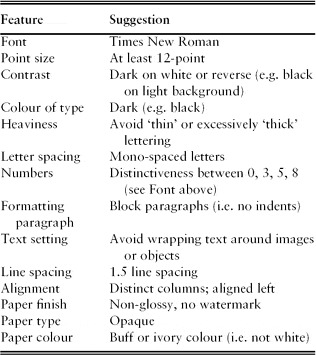
It is necessary for any individual developing written information for older people to become familiar with the guidelines and recommendations (Table 1). There is evidence to support the use of good design in written information to improve patient knowledge, adherence, and overall care. Unfortunately there is not one unified tool that can score the overall readability and formatting of an object, but adherence to the guidelines is an appropriate starting point.
Issues to consider in providing written information to older adults

We can conclude that patients require information to make informed decisions. While older adults may be less challenging of the health professional than other age groups, they still require this information. The content of the material provided must be tailored to what patients want and need, versus what health professionals think the public needs. The content must be targeted broadly so that an audience with a range in literacy can use the material. Finally, the design must be considered. There are guidelines and excellent examples of good legibility. A quality product will take into account all of these factors, to best support older adults in their quest for health information.
Conflicts of interest
The author has no conflicts of interest to declare.