Schizophrenia and Attention-Deficit/Hyperactivity Disorder (ADHD) are heritable (Sullivan et al. Reference Sullivan, Kendler and Neale2003; Nikolas & Burt, Reference Nikolas and Burt2010) developmental disorders (Fatemi & Folsom, Reference Fatemi and Folsom2009; van Os & Kapur, Reference van Os and Kapur2009; APA, 2013; Friedman & Rapoport, Reference Friedman and Rapoport2015). They share common (Hamshere et al. Reference Hamshere, Stergiakouli, Langley, Martin, Holmans, Kent, Owen, Gill, Thapar, O'Donovan and Craddock2013) and rare genetic risk factors (Sebat et al. Reference Sebat, Levy and McCarthy2009; Lowther et al. Reference Lowther, Costain, Stavropoulos, Melvin, Silversides, Andrade, So, Faghfoury, Lionel, Marshall, Scherer and Bassett2014) as well as early life risk factors (Abel et al. Reference Abel, Wicks, Susser, Dalman, Pedersen, Mortensen and Webb2010; Johnson et al. Reference Johnson, Hollis, Kochhar, Hennessy, Wolke and Marlow2010; Silva et al. Reference Silva, Colvin, Hagemann and Bower2014). Dopamine system abnormalities are involved in both ADHD (Swanson et al. Reference Swanson, Kinsbourne, Nigg, Lanphear, Stefanatos, Volkow, Taylor, Casey, Castellanos and Wadhwa2007) and schizophrenia (Howes et al. Reference Howes, Kambeitz, Kim, Stahl, Slifstein, Abi-Dargham and Kapur2012). The basic dopamine model views these disorders as problems on opposite sides of the dopamine spectrum (Yanofski, Reference Yanofski2010), whereas the complex dopamine model suggests that schizophrenia might be the result of low tonic dopamine levels leading to increased burst responses (Grace, Reference Grace1991) similar to what is observed in ADHD (Sikstrom & Soderlund, Reference Sikstrom and Soderlund2007; Yanofski, Reference Yanofski2010). The associations between schizophrenia and ADHD include increased rates of ADHD in offspring of parents with schizophrenia (Ross & Compagnon, Reference Ross and Compagnon2001; Keshavan et al. Reference Keshavan, Montrose, Rajarethinam, Diwadkar, Prasad and Sweeney2008) and in first-degree relatives (Keshavan et al. Reference Keshavan, Diwadkar, Montrose, Rajarethinam and Sweeney2005). Further, attention deficits in the offspring of parents with schizophrenia are a risk marker for later schizophrenia (Erlenmeyer-Kimling et al. Reference Erlenmeyer-Kimling, Rock, Roberts, Janal, Kestenbaum, Cornblatt, Adamo and Gottesman2000). Aspects of attention, ADHD, and externalizing psychopathology are associated with perceptual aberration, magical ideation, and schizotypal symptoms in relatives of subjects with schizophrenia (Vollema & Postma, Reference Vollema and Postma2002; Johnson et al. Reference Johnson, Tuulio-Henriksson, Pirkola, Huttunen, Lonnqvist, Kaprio and Cannon2003; Keshavan et al. Reference Keshavan, Sujata, Mehra, Montrose and Sweeney2003, Reference Keshavan, Montrose, Rajarethinam, Diwadkar, Prasad and Sweeney2008). In children and adolescents with (very) early onset of schizophrenia, high rates of prior inattention and hyperactivity, ADHD, and disruptive behavior disorders have been observed (Russell et al. Reference Russell, Bott and Sammons1989; Alaghband-Rad et al. Reference Alaghband-Rad, McKenna, Gordon, Albus, Hamburger, Rumsey, Frazier, Lenane and Rapoport1995; McClellan et al. Reference McClellan, Breiger, McCurry and Hlastala2003). Similarly, a follow-back analysis suggests an association between adult schizophreniform disorder and prior ADHD (Kim-Cohen et al. Reference Kim-Cohen, Caspi, Moffitt, Harrington, Milne and Poulton2003). Prospective studies find ADHD associated with increased risk for later schizophrenia (Biederman et al. Reference Biederman, Monuteaux, Mick, Spencer, Wilens, Silva, Snyder and Faraone2006; Dalsgaard et al. Reference Dalsgaard, Mortensen, Frydenberg, Maibing, Nordentoft and Thomsen2014; Maibing et al. Reference Maibing, Pedersen, Benros, Mortensen, Dalsgaard and Nordentoft2015). High rates of ADHD have also been reported among subjects with childhood-onset schizophrenia (Ross et al. Reference Ross, Heinlein and Tregellas2006) and the majority of patients with youth-onset psychosis display broadly defined ADHD-symptoms (Karatekin et al. Reference Karatekin, White and Bingham2010).
Another similarity between schizophrenia and ADHD is their multitude of cognitive deficits (Frazier et al. Reference Frazier, Demaree and Youngstrom2004; Willcutt et al. Reference Willcutt, Doyle, Nigg, Faraone and Pennington2005; Nieto & Castellanos, Reference Nieto and Castellanos2011). Shared levels of impairments of attention have also been reported (Groom et al. Reference Groom, Jackson, Calton, Andrews, Bates, Liddle and Hollis2008; Karatekin et al. Reference Karatekin, White and Bingham2008, Reference Karatekin, White and Bingham2010; Brodsky et al. Reference Brodsky, Willcutt, Davalos and Ross2014), while those of divided attention are larger in youth-onset psychosis than ADHD (Karatekin et al. Reference Karatekin, White and Bingham2008). Verbal memory impairments are shared (Oie et al. Reference Oie, Sundet and Rund1999) or more pronounced in schizophrenia (Groom et al. Reference Groom, Jackson, Calton, Andrews, Bates, Liddle and Hollis2008). The impairments of speed of response inhibition and spatial working memory are shared between schizophrenia and ADHD (Karatekin & Asarnow, Reference Karatekin and Asarnow1998; Groom et al. Reference Groom, Jackson, Calton, Andrews, Bates, Liddle and Hollis2008; Brodsky et al. Reference Brodsky, Willcutt, Davalos and Ross2014), while verbal working memory deficits are significantly worse in schizophrenia (Brodsky et al. Reference Brodsky, Willcutt, Davalos and Ross2014). Such results and the findings of overlapping genetic susceptibility across schizophrenia and a range of other neurodevelopmental disorders such as autism spectrum disorders, mental retardation, and ADHD have led to the proposal that these disorders are not completely unrelated and discrete entities, and can be ordered along a major continuum with a gradient of neurodevelopmental impairment (Craddock & Owen, Reference Craddock and Owen2010; Owen et al. Reference Owen, O'Donovan, Thapar and Craddock2011).
Impulsivity can be fractionated into distinct forms (Evenden, Reference Evenden1999; Enticott & Ogloff, Reference Enticott and Ogloff2006; Dalley et al. Reference Dalley, Everitt and Robbins2011). Two categories are impulsive decision-making and impulsive action, and their regulation involves various components within the frontostriatal loops (Winstanley et al. Reference Winstanley, Eagle and Robbins2006). The dopamine neurotransmission is a factor in impulsive behavior, although other neurotransmitter systems are also involved (Pattij & Vanderschuren, Reference Pattij and Vanderschuren2008). Impulsivity is a core feature of ADHD (APA, 2013) but also a factor in the etiology of aggression, violence, and substance use in subjects with schizophrenia (Ouzir, Reference Ouzir2013). Our primary study aim was to identify overlapping and disease specific forms of impulsivity in early-onset, first-episode psychoses and ADHD. We hypothesized that ADHD and psychosis in adolescence share impaired response inhibition, pre-decisional information gathering, and trait impulsivity.
Methods
The study was approved by the Ethical Committee of the Capital Region of Denmark (H-C-2008-076). Informed consent was obtained from the legal holders of custody and the participants. The study was carried out in accordance with the Helsinki declaration.
Participants
Patients were recruited from in- and outpatient units at the Child and Adolescent Mental Health Center, Capital Region of Denmark. The inclusion criteria for patients with psychosis included a DSM-IV-TR (APA, 2000) diagnosis of schizophrenia, other non-affective psychosis, or affective psychosis; a score ⩾4 on a minimum of one (or ⩾3 on a minimum of two) of the following items of the Positive and Negative Syndrome Scale (PANSS): Delusions (P1), Conceptual disorganization (P2), Hallucinatory behavior (P3), Grandiosity (P5), Suspiciousness/persecution (P6), or Unusual thought content (G9) (Kay et al. Reference Kay, Fiszbein and Opler1987); maximum 12 months cumulative psychopharmacological treatment. Exclusion criteria for the psychosis, ADHD, and healthy control (HC) group included a history of significant head injury or neurologically illness, alcohol or substance dependence according to the DSM-IV-TR criteria, and hearing impairment. The inclusion criteria for patients with ADHD were a DSM-IV-TR diagnosis of ADHD. Exclusively for the ADHD group, ongoing medical treatment for the last 3 months and a co-morbid autism spectrum disorder diagnosis were additional exclusion criteria. The inclusion criteria for the healthy controls were no psychiatric illness according to DSM-IV-TR criteria, no ongoing medical treatment, and no history of a psychotic disorder or ADHD in first-degree relatives.
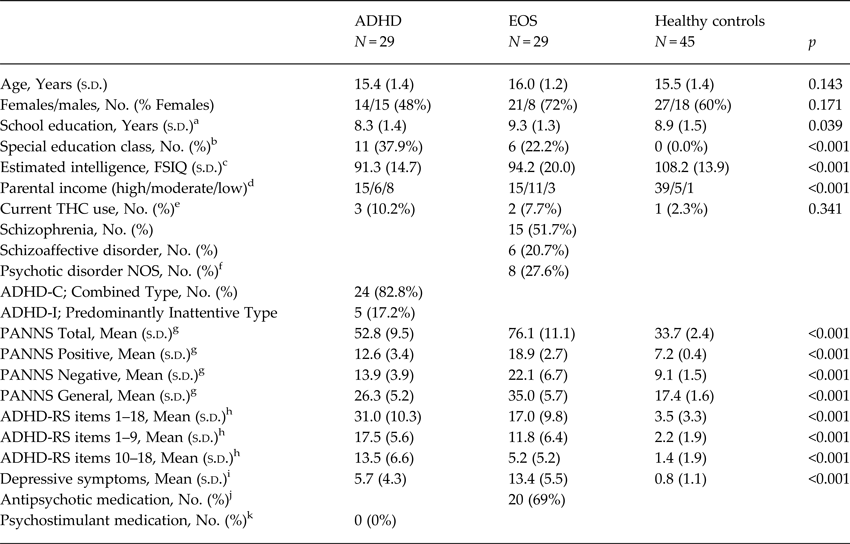
The early-onset psychosis group included patients with schizophrenia, schizoaffective disorder, and psychotic disorder not otherwise specified, i.e. early-onset schizophrenia spectrum disorders (EOS) (see Table 1). Sixty nine percent of the EOS group was currently treated with antipsychotic (AP) medication (see Table 1); three participants with EOS had co-morbid ADHD. The majority of participants with ADHD were diagnosed with ADHD, Combined Type (ADHD-C) and fewer with ADHD, Predominantly Inattentive Type (ADHD-I); 90% of the participants with ADHD had never been treated with psychostimulant medication (see Table 1).
Socio-demographic, academic, intellectual, current use of cannabis, psychopharmacological treatment, and psychopathological characteristics of the ADHD, EOP, and healthy control group

a Current number of years in school excluding the preschool year; ADHD: N = 29; EOS: N = 27; Controls: N = 45. EOS > ADHD = HC.
b Placement in a special education class ever; ADHD: N = 29; EOS: N = 27; Controls: N = 45.
c Estimated intelligence level based on four subtests from the WISC-IV or WAIS-III. EOS = ADHD < HC. In the ADHD group, the IQ ranged from 72 to 147, in the EOS group from 65 to 141, and in the Healthy Control group from 77 to 137.
d Parental household income (the household where the participant primarily lives) was based on information from a parental interview.
e Tetrahydrocannabinol (THC) was measured with a urine test (Rapid Response, Jepsen HealthCare); ADHD: N = 29; EOS: N = 26; Controls: N = 44.
f Psychotic disorder not otherwise specified.
g PANNS Total: EOS > ADHD > HC. PANNS Positive: EOS > ADHD > HC. PANNS Negative: EOS > ADHD > HC. PANNS General: EOS > ADHD > HC.
h ADHD-RS items 1–18 reflect the overall ADHD symptoms severity; ADHD-RS items 1–9 reflect the ADHD inattention symptoms severity; ADHD-RS items 10–18 reflect the ADHD impulsive-hyperactive symptoms severity; ADHD: N = 28; EOS: N = 26; Healthy controls: N = 45. ADHD-RS items 1–18: ADHD > EOS > HC (ADHD v. HC: Cohens d = 3.6). ADHD-RS items 1–9: ADHD > EOS > HC. ADHD-RS items 10–18: ADHD > EOS > HC.
i Bech (Reference Bech1993) characterized the Hamilton rating scale for depression (HAM-D17) total score 0–7 as no depression; 8–12 as mild depression; 13–17 as less than major depression; 18–29 as major depression; 30+ as more than major depression, psychotic. Depressive symptoms: EOS > ADHD > HC.
j Number of patients with EOS currently treated with one (N = 18) or two antipsychotic medications (N = 2): aripripazole (N = 6), risperidone (N = 1), quetiapine (N = 5), quetiapine prolong (N = 4), olanzapine (N = 1), ziprasidone (N = 1), quetiapine prolong + aripripazole (N = 1), clozapine + ziprasidone (N = 1).
k N = 26 participants with ADHD had never been treated with psychostimulants while N = 3 participants with ADHD had previously been treated with methylphenidate.
Performance and trait measures of impulsivity
Barratt Impulsiveness Scale (Version 11) (BIS-11) is a well-validated, 30-items, and self-report questionnaire on personality traits/behavioral constructs of impulsiveness (Patton et al. Reference Patton, Stanford and Barratt1995; Stanford et al. Reference Stanford, Mathias, Dougherty, Lake, Anderson and Patton2009). The BIS-11 subscales reflect Attentional, Motor, and Non-planning Impulsiveness subtraits (Patton et al. Reference Patton, Stanford and Barratt1995). We administered the Danish version of the BIS-11 (Cunha-Bang et al. Reference Cunha-Bang, Stenbaek, Holst, Licht, Jensen, Frokjaer, Mortensen and Knudsen2013). The construct of reflection impulsivity refers to the tendency to gather and evaluate information before decision making (Clark et al. Reference Clark, Roiser, Imeson, Islam, Sonuga-Barke and Sahakian2003, Reference Clark, Robbins, Ersche and Sahakian2006). The reflection-impulsivity dimension was originally defined as a cognitive disposition to make quick decisions as opposed to be slower and reflective in situations with high response uncertainty (Kagan, Reference Kagan1965, Reference Kagan1966). The jumping to conclusions (JTC) response style, in which a subject arrives at a conclusion in the presence of little information (Garety & Freeman, Reference Garety and Freeman1999; Fine et al. Reference Fine, Gardner, Craigie and Gold2007) is similar to lack of reflection on the Information Sampling Task (IST) (Huddy et al. Reference Huddy, Clark, Harrison, Ron, Moutoussis, Barnes and Joyce2013). The IST (CANTAB, 2012) is a test of pre-decisional processing and subjects are instructed to play a game for points and decide, which of two colors shown in panels at the bottom of the screen is in the majority of 25 gray boxes presented in a 5 × 5 matrix. The boxes open when touched and reveal one of the two colors and remain open for the rest of the trial to remove working memory demands. Subjects are told to open as many boxes as they wish in their own rate before they make their decision. The amount of points won or lost is then shown. IST has a fixed win (FW) and a decreased win (DW) condition (each consisting of ten trials) that were presented in a counterbalanced order within each group. In the FW condition subjects win or lose 100 points on each trial independent of the number of boxes opened. In the DW condition, the amount of points to be won decreases from 250 points in 10 point steps with each box opened and an incorrect decision costs 100 points, i.e. a conflict between reinforcement and certainty is introduced. The coefficient p(correct) is the probability of making a correct response at the point of decision and indexes reflection-impulsivity. For a more detailed description, see Clark et al. (Reference Clark, Robbins, Ersche and Sahakian2006). All analyses presented are based on the p(correct) estimates derived from the Clark et al. (Reference Clark, Robbins, Ersche and Sahakian2006) formula. Due to a current discussion on the computation of p(correct) (Bennett et al. Reference Bennett, Oldham, Dawson, Parkes, Murawski and Yu2016, Reference Bennett, Yücel and Murawski2017; Axelsen et al. Reference Axelsen, Jepsen and Bak2017), the group mean p(correct) estimates based on the Bennett et al. (Reference Bennett, Oldham, Dawson, Parkes, Murawski and Yu2016) formula are also presented.
Response inhibition was assessed using the Stop Signal Task (SST) (Aron et al. Reference Aron, Fletcher, Bullmore, Sahakian and Robbins2003; Turner et al. Reference Turner, Robbins, Clark, Aron, Dowson and Sahakian2003; CANTAB, 2012). The stop signal reaction time (SSRT) reflects the time it takes to internally suppress a response (Aron et al. Reference Aron, Fletcher, Bullmore, Sahakian and Robbins2003) and is an estimate of the length of the delay between a go stimulus and a stop stimulus at which the subject inhibits the response on 50% of trials.
The Intelligence Quotient (IQ) was estimated using the Vocabulary, Similarities, Block Design, and Matrix Reasoning subtests from the age-relevant Danish version of Wechsler Adult Intelligence Scale, Third Edition (Wechsler, Reference Wechsler1997) or Wechsler Intelligence Scale for Children, Fourth Edition (Wechsler, Reference Wechsler2003). These subtests show substantial correlations with the sum of scaled scores for full scale IQ (Wechsler, Reference Wechsler2002). Before each test session, all subjects were interviewed about recent cigarette smoking, use of alcohol, drugs, and drinks containing caffeine to avoid putative effects on cognitive test performance and self-rating.
Psychopathological evaluations
In all three groups the diagnostic status was confirmed with The Schedule for Affective Disorders and Schizophrenia for School-aged Children – Present and Lifetime Version (Kiddie-SADS-PL) (Kaufman et al. Reference Kaufman, Birmaher, Brent, Rao, Flynn, Moreci, Williamson and Ryan1997). The severity of psychotic and general psychopathology was evaluated using the PANSS (Kay et al. Reference Kay, Fiszbein and Opler1987). The severity of depressive symptoms was assessed with the Hamilton rating scale for depression (HAM-D17) (Hamilton, Reference Hamilton1960) and interpreted according to Bech (Reference Bech1993) (see Table 1). Inattention and impulsivity-hyperactivity symptoms were assessed with the Attention deficit/Hyperactivity Disorder – Rating Scale (parental ratings) (DuPaul et al. Reference DuPaul, Power, Anastopoulos and Reid1998; Barkley et al. Reference Barkley, Edwards and Robin1999). Diagnoses and psychopathological severity scores were based on consensus ratings between experienced clinicians (JR and JRMJ).
Data analysis
Chi square test, Mann–Whitney test, univariate analyses of variance, and Kruskal–Wallis test were used to compare the socio-demographic, academic, and clinical characteristics between the groups. The test raw scores and self-reported measures of impulsivity were all positive skewed and logarithmically transformed (Lg10) to approximate a normal distribution. For the between-group comparison of the main IST variables, a multivariate analysis of (co)-variance (MAN(C)OVA) with age, test presentation order, and household income as the covariates was initially performed. In case of a significant effect of group, the next step in the between-group comparison of these IST variables was a repeated measures analysis of covariance with the p(correct)DW and p(correct)FW as within-subjects variables, the three diagnostic groups as the between-subjects factor and the household income categories, age, and the IST presentation order (DW-FW, FW-DW) as the covariates. Whenever the data violated the sphericity assumption, we report the results of the Greenhouse-Geisser test. In case of a significant result, the three groups were compared pairwise using the repeated measures analysis of (co)variance with p(correct)DW and p(correct)FW as the within-subjects variables, the two diagnostic groups as between-subjects factor, and retaining the covariates with a significant effect. In case of a significant result, univariate analyses of (co)variance were used to compare the groups. Additionally, the potential effects of IQ on the between-group differences in p(correct)DW and p(correct)FW were assessed using an repeated measures analysis of covariance with IQ as the covariate. In case of missing data in the BIS-11 questionnaire (four subjects with ADHD, one subject with EOS, and two healthy controls each missed one item; one subject with EOS missed two items), a score based on the rounded mean of the remaining scores in that first order factor was imputed (Patton et al. Reference Patton, Stanford and Barratt1995). The SSRT and BIS-11 subscales scores were compared between the groups using multivariate analysis of (co)variance (MAN(C)OVA) with household income and age as the covariates and Scheffé’s post hoc significance tests. Additionally, the potential effects of IQ on the between-group differences in SSRT and BIS-11 subscale scores were assessed using a MANCOVA with IQ as the covariate. Potential associations between the significantly impaired impulsivity indices and clinical characteristics (estimated IQ, the psychopathological severity scores of PANSS, PANSS item P1 (Falcone et al. Reference Falcone, Murray, Wiffen, O'Connor, Russo, Kolliakou, Stilo, Taylor, Gardner-Sood, Paparelli, Jichi, Di, David, Freeman and Jolley2015), Hamilton, ADHD-RS, and the chlorpromazine equivalent) were assessed with Spearman's ρ and considered explorative. Also explorative, to assess if current AP medication status (treatment v. no treatment) influenced the performance and self-reported impulsivity scores in the EOS group, a multivariate analysis of covariance with age as the covariate was performed. Potential associations between the performance based and the self-reported indices of impulsivity were assessed with Pearson correlation analyses within each group.
Results
Table 1 shows the demographic, academic, intellectual, and clinical characteristics of the ADHD, EOS, and HC group. The estimated IQ in the patient groups did not differ significantly but each demonstrated a significantly lower mean IQ than the HC group. Thirty one percent of the participants with ADHD did not have any comorbidity whereas the remaining 69% had either one (28%) or two or more (41%) comorbid disorders. Twenty four percent of the patients with EOS did not meet the criteria for any comorbid diagnosis but the remaining 76% had either one (24%) or two or more (52%) comorbid disorders.
Group analyses of reflection impulsivity
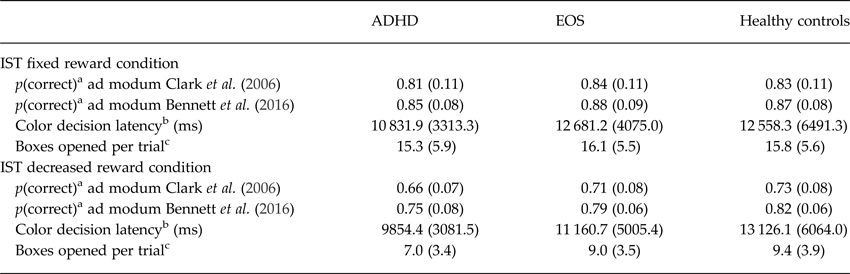
After excluding household income, age, and test presentation order as non-significant covariates, a MANOVA revealed a significant effect of group [F (4,198) = 4.2, p = 0.003; Wilks’ λ = 0.850]. After excluding household income, age, and test presentation order as non-significant covariates, a repeated measures analysis of variance revealed a significant main effect of group [F (2,100) = 3.239, p = 0.043] and condition [F (1,100) = 189.468, p < 0.001] as well as a significant condition × group interaction [F (2,100) = 3.077, p = 0.050] on the two IST p(correct) scores. Subsequently, the IST p(correct) scores of the ADHD and HC group were compared using a repeated measures analysis of variance, which indicated a significant main effect of group [F (1,72) = 6.325, p = 0.014], a significant effect of condition [F (1,72) = 132.055, p < 0.001], and a significant condition × group interaction [F (1,72) = 5.898, p = 0.018]. In contrast, the comparison between the ADHD and EOS group revealed a non-significant main effect of group [F (1,56) = 3446, p = 0.069], a significant effect of condition [F (1,56) = 133.888, p < 0.001], and a non-significant condition × group interaction [F (1,56) = 0.870, p = 0.355]. Finally, the comparison of the p(correct) scores of the HC and the EOS group indicated a non-significant main effect of group [F (1,72) = 0.180, p = 0.672], a significant effect of condition [F (1,72) = 112.437, p < 0.001], and a non-significant condition × group interaction [F (1,72) = 1.989, p = 0.163]. The univariate analyses of variance showed no significant difference between the ADHD group and the healthy controls in p(correct)FW [F (1,72) = 0.696, p = 0.407], whereas the ADHD group performed significantly worse than the HC group in terms of p(correct)DW [F (1,72) = 15.568, p < 0.001]. Excluding patients with ADHD-I did not change these results. Excluding three patients with EOS and co-morbid ADHD did not change the results. An additional repeated measures analysis of covariance with IQ as a covariate was performed and it revealed no significant main effect of IQ [F (1,99) = 0.007, p = 0.935] and no significant condition × IQ interaction [F (1,99) = 2.193, p = 0.142].
The p(correct) estimates were recalculated ad modum Bennett et al. (Reference Bennett, Oldham, Dawson, Parkes, Murawski and Yu2016) (see Table 2) which did not change the between-group results (data not shown).
IST reflection impulsivity, trial duration, and number of boxes opened per trial in the ADHD, EOS, and healthy control group

Data are presented as mean (standard deviation).
a Reflection impulsivity is based on the p(correct) coefficient (the mean of the per-trial probability value over all trials within the specified win condition) and indexes the quality of the information gathered.
b Color decision latency reflects the time elapsed between the start of a trial and the time point of color selection and indexes the mean trial duration.
c The number of boxes opened per trial are not subjected to analysis and included for information.
Group analyses of SSRT and BIS-11 scores
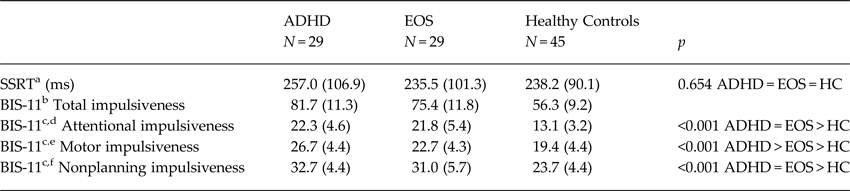
The SSRT and BIS-11 data are presented in Table 3. After excluding household income and age as non-significant covariates a subsequent MANOVA revealed a significant main effect of group [F (8,194) = 15.903, p < 0.001], and a significant effect of group was found on Motor Impulsiveness [F (2,100) = 26.27, p < 0.001], Non-planning Impulsiveness [F (2,100) = 35.161, p < 0.001], and Attentional Impulsiveness [F (2,100) = 59.588, p < 0.001] but not on the SSRT [F (2,100) = 0.427, p = 0.654]. Scheffé’s post hoc significance tests revealed that the Motor Impulsiveness score of the ADHD and EOS group differed significantly from each other and from the healthy controls. In terms of the Non-planning Impulsiveness score both patient groups differed significantly from the HC group but there was no significant difference between them (Cohen's d = 0.1). Both patient groups scored significantly different from the healthy controls on the Attentional Impulsiveness score but there was no significant difference between them (Cohen's d = 0.3). Excluding patients with ADHD-I did not change these results. Excluding three patients with EOS and co-morbid ADHD did not change the results. To assess the potential effects of differences in IQ on the between-group differences in the SSRT and BIS-11 scores, a MANCOVA with IQ as the covariate revealed a non-significant effect of IQ [F (4,96) = 1.1, p = 0.380; Wilks’ λ = 0.958].
Stop Signal Reaction Time (ms) and the four BIS-11 impulsiveness scores in the ADHD, EOS, and healthy control group

Data are presented as mean (s.d.).
a Stop signal reaction time.
b Barratt Impulsivity Scale, Version 11, total raw score is not analyzed and included for information.
c Barratt Impulsivity Scale 2nd order factor sum raw score.
d ADHD (N = 29) v. HC (N = 45) p < 0.001; EOS (N = 29) v. HC (N = 45) p < 0.001; ADHD (N = 29) v. EOS (N = 29) p = 0.852.
e ADHD (N = 29) v. HC (N = 45) p < 0.001; EOS (N = 29) v. HC (N = 45) p = 0.003; ADHD (N = 29) v. EOS (N = 29) p = 0.005.
f ADHD (N = 29) v. HC (N = 45) p < 0.001; EOS (N = 29) v. HC (N = 45) p < 0.001; ADHD (N = 29) v. EOS (N = 29) p = 0.427.
Associations between significantly impaired indices of impulsivity and clinical characteristics
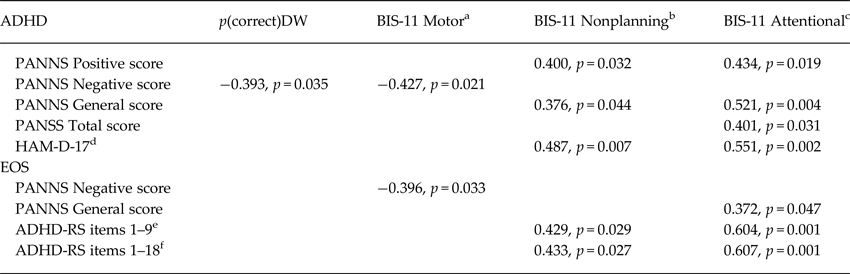
Although purely explorative, the statistically significant correlation estimates between the impaired indices of impulsivity and clinical characteristics are shown in Table 4. All other correlation coefficients within the two clinical groups were statistically non-significant.
Statistically significant Spearman correlation estimates between the impaired indices of impulsivity and clinical characteristics in the ADHD and EOS group

a BIS-11 Motor Impulsiveness score.
b BIS-11 Nonplanning Impulsiveness score.
c BIS-11 Attentional Impulsiveness score.
d Hamilton rating scale for depression.
e ADHD-RS items 1–9 reflect the severity of ADHD inattention symptoms.
f ADHD-RS items 1–18 reflect the overall severity of ADHD symptoms.
In the subgroup of patients with EOS who were currently treated with AP medication (N = 20), no significant correlations were observed between the chlorpromazine equivalent and any of the impulsivity indices (−0.213 < ρ < 0.345, p > 0.136). After excluding age as a non-significant covariate a MANOVA revealed no significant difference between the EOS subgroups with and without current treatment with antipsychotic medications in any of the performance or self-report impulsivity scores [F (6,22) = 0.76, p = 0.607; Wilks’ λ = 0.83].
Supplementary analyses
To support the interpretation of the IST p(correct) results, the mean trial length (color decision latency) under each IST condition was compared between the ADHD and HC group (see Table 2). After exclusion of household income and test presentation order as non-significant covariates, a repeated measures analysis of variance revealed a significant main effect of group [F (1,72) = 4.784, p = 0.032] and a significant condition × group interaction [F (1,72) = 5.533, p = 0.021]. The univariate analyses of variance showed no significant difference between ADHD and the HC group in the FW condition mean trial length [F (1,72) = 0.940, p = 0.336], whereas the ADHD group performed the trials significantly faster than the HC group in the DW condition [F (1,72) = 9.636, p = 0.003]. Excluding subjects with ADHD-I did not change these results. In the ADHD group, no significant gender difference in the mean SSRT was found, and the SSRT did not correlate significantly with p(correct)DW (data not shown).
Within the ADHD group none of the performance-based impulsivity indices correlated significantly with any of the self-reported impulsivity indices; however the SSRT correlated at trend level with the BIS-11 Motor Impulsiveness (r = 0.356, p = 0.058). In the EOS group, the SSRT correlated significantly with the BIS-11 Motor Impulsiveness (r = 0.368, p = 0.050). Within the healthy control group the BIS-11 Nonplanning Impulsiveness correlated significantly with p(correct)DW (r = −0.404, p = 0.006) and the SSRT (r = 0.385, p = 0.009). All other correlations were non-significant.
Discussion
Compared with the healthy controls the ADHD group, with 90% participants never treated with psychostimulants, demonstrated significantly impaired ability to gather and evaluate information prior to decision making, i.e. heightened reflection impulsivity, under a condition with conflict between reward and certainty. In contrast, the patients with EOS showed reflection impulsivity that neither differed significantly from the HC nor from the ADHD group under that test condition. No significant reflection impulsivity was observed in the ADHD or EOS group under the condition where higher certainty could be obtained without penalty. These results question our hypothesis that EOS and ADHD share increased reflection impulsivity as it appeared specific for ADHD.
The increased reflection impulsivity observed in our adolescents with ADHD contrasts the normal information sampling observed in younger children with ADHD on the IST (DeVito et al. Reference DeVito, Blackwell, Clark, Kent, Dezsery, Turner, Aitken and Sahakian2009). The reduced information sampling in our ADHD group may neither be explained by executive dysfunctions as it was unrelated to reponse inhibition (SSRT) nor by the lower IQ in that group. Information sampling appears unrelated to the intelligence level, and it does not rely on inhibitory control processes (Caswell et al. Reference Caswell, Morgan and Duka2013). Also, continued box opening may be more prepotent than switching to the decision response (Clark et al. Reference Clark, Robbins, Ersche and Sahakian2006). Although purely explorative, the significant association between the PANSS negative symptom score and the heightened reflection impulsivity in our ADHD group may suggest a motivational factor in their impaired information gathering performance (Foussias & Remington, Reference Foussias and Remington2010; Foussias et al. Reference Foussias, Siddiqui, Fervaha, Mann, McDonald, Agid, Zakzanis and Remington2015). According to the motivational delay aversion model of ADHD, impairments of the signaling of delayed rewards leads to a desire to avoid and escape from delays (Sonuga-Barke, Reference Sonuga-Barke1994, Reference Sonuga-Barke2003, Reference Sonuga-Barke2005). Indeed, our ADHD group only performed faster than the healthy controls in the IST DW condition. Thus, the observed heightened reflection impulsivity (i.e. increased JTC tendency) in ADHD may be a consequence of a delay-averse motivational style. Although reflection impulsivity has been observed in major depressive disorder (Taylor Tavares et al. Reference Taylor Tavares, Clark, Cannon, Erickson, Drevets and Sahakian2007), the severity of the currently observed reflection impulsivity in ADHD was unrelated to the severity of depressive and ADHD symptom severity, neither was it related to intelligence. Contrary to the IST DW condition, successful information gathering on the IST FW condition may only demand careful attention to and evaluation of the color information successively disclosed during the later trials. Thus, the subjects with ADHD may have engaged in task-irrelevant behaviors during the information gathering in the early trials in order to relieve an experience of delay (Sonuga-Barke et al. Reference Sonuga-Barke, De, De, Ajzenstzen and Holland2004). Similarly, they may have sought external stimulation during waiting, which has a positive effect on delay aversion in children with ADHD (Antrop et al. Reference Antrop, Stock, Verte, Wiersema, Baeyens and Roeyers2006). Thus, the delay-averse motivational style may not have significantly affected the information gathering in the IST FW condition in the ADHD group.
The essential normal reflection impulsivity in our EOS patients, who were symptomatically moderately ill (Leucht et al. Reference Leucht, Kane, Kissling, Hamann, Etschel and Engel2005), is in line with an earlier IST finding in patients with psychosis (Huddy et al. Reference Huddy, Clark, Harrison, Ron, Moutoussis, Barnes and Joyce2013). However, the current results contrast the consistent observation of a JTC tendency in deluded patients (Fine et al. Reference Fine, Gardner, Craigie and Gold2007; Garety & Freeman, Reference Garety and Freeman2013; Evans et al. Reference Evans, Averbeck and Furl2015) when using a traditional data-gathering task, the Beads task (Phillips & Edwards, Reference Phillips and Edwards1966; Huq et al. Reference Huq, Garety and Hemsley1988). A motivational experience of greater cost for gathering more data unlikely influences the JTC tendency in patients with schizophrenia (Moutoussis et al. Reference Moutoussis, Bentall, El-Deredy and Dayan2011). Further, the JTC tendency is independent of negative symptoms in schizophrenia (Ochoa et al. Reference Ochoa, Haro, Huerta-Ramos, Cuevas-Esteban, Stephan-Otto, Usall, Nieto and Brebion2014). In line with these results, an essentially normal information gathering was observed in our EOS group in spite of motivational issues as reflected in their negative symptoms. It has been hypothesized that the JTC tendency in schizophrenia is a behavioral consequence of one or more cognitive deficits (Fine et al. Reference Fine, Gardner, Craigie and Gold2007). Working memory deficits are reliably observed in EOS (Nieto & Castellanos, Reference Nieto and Castellanos2011) and associated with the JTC tendency in subjects with either schizophrenia (Ochoa et al. Reference Ochoa, Haro, Huerta-Ramos, Cuevas-Esteban, Stephan-Otto, Usall, Nieto and Brebion2014), first-episode psychosis (Falcone et al. Reference Falcone, Murray, Wiffen, O'Connor, Russo, Kolliakou, Stilo, Taylor, Gardner-Sood, Paparelli, Jichi, Di, David, Freeman and Jolley2015), or clinical high-risk for psychosis (Broome et al. Reference Broome, Johns, Valli, Woolley, Tabraham, Brett, Valmaggia, Peters, Garety and McGuire2007). Similarly, a significant JTC tendency was only observed in patients with schizophrenia using a memory-unaided task version (Menon et al. Reference Menon, Pomarol-Clotet, McKenna and McCarthy2006). Thus, the unimpaired information gathering seen in our EOS group may be explained by the negligible demands on working memory placed by the IST (Clark et al. Reference Clark, Robbins, Ersche and Sahakian2006). The reflection impulsivity may worsen with increasing age in our young subjects with EOS relative to that of the typically developing subjects. Abnormal maturational growth of executive functions and attention has been observed in EOS during late adolescence and early adulthood (Frangou et al. Reference Frangou, Hadjulis and Vourdas2008; Jepsen et al. Reference Jepsen, Fagerlund, Pagsberg, Christensen, Nordentoft and Mortensen2010; Oie et al. Reference Oie, Sundet and Rund2010), which may lead to relatively less effective supervisory control of motivated behavior (Ernst et al. Reference Ernst, Pine and Hardin2006).
Impulsivity as a diminished ability to stop an already selected and initiated motor response (Dalley et al. Reference Dalley, Everitt and Robbins2011) was indexed by the SSRT. No significant SSRT impairment was observed in our ADHD group which conflicts the meta-analytic evidence of a medium sized SSRT impairment in ADHD (Willcutt et al. Reference Willcutt, Doyle, Nigg, Faraone and Pennington2005; Lipszyc & Schachar, Reference Lipszyc and Schachar2010). Possibly, our adolescents with ADHD may represent less severe cases than those diagnosed at an earlier age. However, the overall ADHD symptoms severity (see Table 1) reflects a very large effect size as compared with the healthy controls, and the SSRT was unrelated to the severity of ADHD symptoms. Gender is a borderline significant moderator of SSRT in ADHD (Lipszyc & Schachar, Reference Lipszyc and Schachar2010) and the rate of females in our ADHD group is relatively high but no statistical significant (or substantial) gender difference in SSRT was observed within the ADHD group.
The non-significantly impaired SSRT in our EOS group is in line with the negative result in adolescents with EOS where only the subgroup with worse negative symptoms showed significant SSRT impairments (Bellgrove et al. Reference Bellgrove, Chambers, Vance, Hall, Karamitsios and Bradshaw2006). However, our negative result contrasts the prolonged SSRT observed in both children with childhood-onset psychosis (Brodsky et al. Reference Brodsky, Willcutt, Davalos and Ross2014) and adults with schizophrenia (Lipszyc & Schachar, Reference Lipszyc and Schachar2010; Yun et al. Reference Yun, Hwang, Kim, Lee, Kim and Jung2011; Shin et al. Reference Shin, Kim, Shin, Jung, Hur, Byun, Jang, An and Kwon2013). Thus, SSRT impairments may appear later in the development in adolescents with EOS due to abnormal cognitive maturation during late adolescence and early adulthood.
All three BIS-11 subtraits of impulsivity were significantly heightened in both ADHD and EOS as compared with the HC group which appeared unrelated to the between-group differences in intelligence. The reports of our adolescents with ADHD or EOS may suggest similarly increased non-planning and attentional impulsivity whereas the ADHD group showed significantly more motor impulsivity than the EOS group.
These findings suggest that EOS in adolescence is associated with significant impulsive behavioral tendencies and possibly more so than in adults with schizophrenia because results on the subtraits of motor- and non-planning impulsivity in the latter are inconsistent (Schiffer et al. Reference Schiffer, Muller, Scherbaum, Forsting, Wiltfang, Leygraf and Gizewski2010; Kaladjian et al. Reference Kaladjian, Jeanningros, Azorin, Anton and Mazzola-Pomietto2011; Zhornitsky et al. Reference Zhornitsky, Rizkallah, Pampoulova, Chiasson, Lipp, Stip and Potvin2012; Reddy et al. Reference Reddy, Lee, Davis, Altshuler, Glahn, Miklowitz and Green2014). Only the severity of motor impulsivity was associated with that of negative symptoms in our EOS patients. Thus, the subtraits of attentional and non-planning impulsivity seem to reflect psychosis-independent cognitive and behavioral impulsivity tendencies. Similarly, other forms of impulsivity are unrelated to positive symptoms and only inconsistently related to negative symptoms in both adolescents and adults with schizophrenia (Shurman et al. Reference Shurman, Horan and Nuechterlein2005; Heerey et al. Reference Heerey, Robinson, McMahon and Gold2007; Ahn et al. Reference Ahn, Rass, Fridberg, Bishara, Forsyth, Breier, Busemeyer, Hetrick, Bolbecker and O'Donnell2011; Holmen et al. Reference Holmen, Juuhl-Langseth, Thormodsen, Ueland, Agartz, Sundet, Andreassen, Rund and Melle2012). The validity of subjective rating of impulsivity in our adolescents with EOS is supported by the significant associations between their attentional and non-planning impulsivity scores and the parental ADHD-RS scores.
The significant subtraits of impulsivity in our ADHD group are consistent with the increased attentional and motor subtraits of impulsivity earlier reported in adolescents with ADHD (Nandagopal et al. Reference Nandagopal, Fleck, Adler, Mills, Strakowski and DelBello2011). The severity of the significantly increased forms of impulsivity in the ADHD group was unrelated to that of the ADHD symptom dimensions and may thus reflect independent cognitive and behavioral impulsivity tendencies in ADHD. The increased personality subtraits of attentional and non-planning impulsivity are shared between ADHD and EOS in adolescence and may reflect diagnostic non-specific neurodevelopmental impairments. The increased subtrait of motor impulsivity also cuts across these disorders although worse in ADHD, which also may reflect a diagnostic non-specific but more pronounced neurodevelopmental impairment in ADHD than EOS in this developmental age.
The dosing of AP medication in the currently treated EOS subgroup was not associated with any aspect of impulsivity. Additionally, the EOS subgroup currently treated with AP medications did not score significantly different on any impulsivity measure than the EOS subgroup not currently treated with AP medications, which is in line with the independency between AP medication and impulsivity in adults with schizophrenia (Heerey et al. Reference Heerey, Robinson, McMahon and Gold2007). The significant association between the SSRT and self-reported Motor Impulsiveness in the EOS group and between the p(correct)DW and self-reported Nonplanning Impulsiveness in the healthy control group support the construct validity of these tasks.
Strengths of the study include concurrent inclusion of EOS and ADHD and the administration of both behavioral and self-report measures. Our results cannot be generalized to subjects with ADHD and co-morbid ASD. A more detailed analysis of potential associations between impulsivity and antipsychotic medication suffers from an underpowered subsample and a non-random allocation to medication status. The subjective importance of social desirability may differ between the groups and differentially bias the self-reported data (Verdejo-Garcia et al. Reference Verdejo-Garcia, Lawrence and Clark2008). In spite of modest effect sizes and statistically non-significant differences between the ADHD and EOS group in the BIS-11 Attentional and Nonplanning subscales, this study has insufficient power to interpret these results as robust indications of shared aspects of impulsivity. Thus, these results must be confirmed in larger studies. To obtain a more comprehensive, cross-diagnostic evaluation of shared and non-shared cognitive impairments among the neurodevelopmental disorders, future studies should not be restricted to compare only two neurodevelopmental disorders, as the current study.
These findings suggest that impaired pre-decisional information gathering is specific for ADHD, which may point to neurodevelopmental impairments specific for ADHD that reflect non-shared risk factors between ADHD and schizophrenia. Our results also suggest shared and increased subtraits of attentional and non-planning impulsivity in ADHD and schizophrenia which, if confirmed in larger studies, may reflect diagnostically non-specific neurodevelopmental impairments and shared risk factors. These latter results may challenge the view of ADHD and schizophrenia as unrelated diagnostic entities and seem to support the theory that schizophrenia should be classified among the neurodevelopmental disorders.
Acknowledgements
We thank Center for Integrated Molecular Brain Imaging (CIMBI), Neurobiology Research Unit, Copenhagen University Hospital, Rigshospitalet, Copenhagen, Denmark for kindly letting us use the Danish version of the BIS-11.
This work was supported by a Ph.D. scholarship from the Research Foundation of Mental Health Services in the Capital Region of Denmark (JR); Post.Doc. scholarship from the Research Foundation of Mental Health Services in the Capital Region of Denmark (JRMJ); Lundbeck Foundation Center for Clinical Intervention and Neuropsychiatric Research (CINS)(JR, R25-A2701); Læge Gerhard Linds Legat (JR); Fru C. Hermansens Legat (JR); Slagtermester Wörzners og Hustru Inger Wörzners Mindelegat (JR); and Psykiatrisk Forskningsfond af 1967 (JR).
Declaration of Interest
None.
Ethical Standards
The authors assert that all procedures contributing to this work comply with the ethical standards of the relevant national and institutional committees on human experimentation and with the Helsinki Declaration of 1975, as revised in 2008.