

In the 1920s and 1930s Benito Mussolini's fascist government devoted considerable time and expense to large-scale architectural and urban endeavours in its effort to fashion a new Italy. The construction of new town halls, train stations, post offices, recreational facilities and so forth justified the clearance of urban slums, helped to relieve unemployment among an unskilled labour force, expanded access to modern conveniences and broadcast the authority of the fascist state. These projects typically went hand in hand with new master plans that were intended to transform radically the historic centre of Italian cities and communicate fascist values of order, hierarchy and control. The scale, formal attributes and monumental character of such projects has sometimes been used as evidence of the fascist regime's monolithic approach to design and uncontested authority. However, close examination of individual undertakings reveals that government-sponsored initiatives were often shaped by competing forces, conflicting ambitions and local circumstances. Although scholars have considered the degree to which this was manifest in cities such as Rome and Naples, where the central government played a very direct role in the administration of public works projects, and have looked at the example of Turin, where alliances between the state and the city's industrial base had important consequences for its inter-war history, the example of Milan has been largely overlooked.Footnote 1 In contrast to these examples, Milan's entrenched social and political structure and diverse economy created an environment in which urban change was uniquely contentious.
The fascist government's commitment to transforming the Italian landscape was perhaps nowhere more evident than in Milan. Indeed, Mussolini directed the municipal government to begin the process of aligning Milan's urban core with the functional and representational needs of fascism shortly after he was appointed prime minister. Just over a decade later, he approved a master plan that required the destruction and rebuilding of over 50 per cent of the historic centre.Footnote 2 Although scholars have shown that the interests of building societies and private landowners played a role in shaping the city's form, how the conflicting agendas of the various agencies involved in the buildings process operated against the background of the representational concerns of government officials and civic leaders has been given insufficient attention.Footnote 3 The project for the new business district, the Piazza degli Affari (1928–39) and the related Exchange (1928–31) designed by Paolo Mezzanotte, provides an opportunity to examine the fascist government's use of architecture and urbanism to reconfigure the centre of Italy's commercial capital and the role played by multiple centres of power in this process (Figure 1).
Paolo Mezzanotte with Vittorio Mezzanotte, Exchange (Palazzo delle Borse), 1928–31, Milan. From O. Lissone and S. della Morte, La Milano voluta dal duce e la vecchia Milano (Milan, 1935).

In December of 1925 the industrialist Angelo Salmoiraghi, the president of the Provincial Economic Council, the newly created state-run business association, began to take serious steps to build a new Stock Exchange in the centre of Milan. The Stock Exchange had outgrown its home in Piazza Cordusio and, to make matters more pressing, its lease was set to expire in September of 1931.Footnote 4 Salmoiraghi anticipated that the new Exchange would be the most significant feature of a major urban complex centred on a new public square in the heart of the city. In a politically astute letter to Giuseppe Belluzzo, the minister of national economy, Salmoiraghi, explained that the building should be undertaken within the context of the ‘organic and rational development of the city centre’.Footnote 5 In keeping with current plans to invest in Milan's infrastructure, the Council president saw the project not as an isolated event but rather as part of a co-ordinated effort in which the transformation of one of the ‘most vital areas of the great Lombard metropolis’ would aid in the formation of the new ‘city’.Footnote 6 Although Salmoiraghi framed his argument in contemporary terms, his strategy to make the building a major feature of the urban core relied on nineteenth-century planning techniques.
In the late nineteenth century, Milan emerged as the leading commercial and financial centre in Italy. In a climate of civic pride and economic expansion, the liberal city council commissioned the municipal engineer Cesare Beruto to develop the city's first master plan. Named for its creator but strongly influenced by Milan's industrial elite, the Beruto Plan (1884–89) offered city fathers an opportunity to make commerce an explicit part of the symbolic structure of the Lombard capital.Footnote 7 Via Dante encapsulated this effort (Figure 2). This new street connected two of the principal historical monuments of Milan: the medieval Castello Sforzesco, which held the city's museums, libraries and other cultural institutions, and the Duomo, the city's major religious structure and representational focus. In the fashion of Haussmann's Parisian boulevards, the city required builders to construct regular façades along the straight Via Dante to link the Castello to the newly designed Piazza Cordusio. The elegant oval piazza held the ornate curved façade of the Stock Exchange (1901) as well as leading credit and insurance companies.Footnote 8 Other financial institutions and related commercial activities clustered along the adjacent streets in handsome new buildings. From Piazza Cordusio the road angled and passed through Piazza dei Mercanti, the traditional market centre, before ending in Piazza del Duomo. In keeping with the city's desire for self-promotion, the prominent position of the Exchange and the location of commercial structures within this axial sequence underscored Milan's position as a principal force in the national economy. In the 1920s, planners and civic leaders recognized this scheme as a local model for thinking about how architecture and urban design could be successfully co-ordinated to direct the symbolic order of the city.
Via Dante is indicated by the arrow. The site for the new Exchange is indicated by the circle. From Baedeker's Northern Italy (New York, 1909).

Despite the optimism of Salmoiraghi's correspondence, multiple factors impeded the president's ability to secure rapidly a new home for the Exchange. First was the Council's requirement that the new building be located in the city centre where there were the limited opportunities to build. To complicate matters further, Salmoiraghi wanted to consolidate all of Milan's markets into a single structure. Therefore, the new site had to be large enough to house the Stock Exchange (Borsa Valori), Commodities Exchange (first Borsa Cereali, later Merci) and the numerous other markets scattered throughout the city.Footnote 9 With several conditions guiding the process, the Council president worked with Mayor Luigi Mangiagalli to identify an available site.Footnote 10 In the end, the Council purchased two adjacent buildings located to the west of Piazza Cordusio: the nineteenth-century Palazzo Turati by Ernesto Pirovano, which fronted Via Meravigli, and an undistinguished contiguous building, which faced one of the many narrow cobblestone streets that ran through the dense quarter (see Figure 2).Footnote 11 The Council planned to demolish this building and to incorporate the façade and some interiors of the historic Palazzo Turati into the new construction.Footnote 12 The proximity to Piazza Cordusio and the commercial centre of the city preserved the institution's standing and assured that traders would have easy access to related businesses and financial services.
In addition to the proposed new building, the Council envisioned a large piazza facing the Exchange closed to vehicular traffic and lined by ‘grand porticos destined to hold market-goers’.Footnote 13 As the plan for the district developed under Mayor Mangiagalli, the municipal government agreed to tear down the dilapidated residential Casa Colombo and other existing buildings to free space for two new squares, the Piazza degli Affari and the smaller Piazzetta dei Grani. Together, the two squares measured approximately 3,000 square metres and would face the main front of the new Exchange.Footnote 14 The opening was to provide ample space for commercial activity in what had been a crowded residential section of the city. This strategy of expropriating residential property of modest stature to make room for architectural centrepieces once again shows the legacy of nineteenth-century planning. However, the scale of the task, and the government's decision to consolidate previously independent organizations, and to cluster related services, offers an early example of the policies that city planners and government agencies would adopt in the inter-war period.
In 1926, under the leadership of Ernesto Belloni, the city's first appointed fascist mayor after the abolition of elective governance, the municipal government sponsored a competition for a new master plan for Milan. Although a new master plan would not be approved until 1934, the competition made clear the city's intent to alter radically the urban core and made it possible to enlarge the scope of the project. Against this background, Cesare Albertini, the head of the newly created Planning Office and author of the 1934 master plan, proposed a major new east–west axis to connect Piazza Cordusio and Piazza San Ambrogio. The new road effectively linked the Exchange to an existing network and would have facilitated the flow of traffic to and from the new business district (Figure 3). In addition, the new axis would have directed residents’ and visitors’ attention toward a series of institutions and monuments that resonated with the ambitions of the new regime. Intersecting with Via Dante at the Piazza Cordusio, this operation both related the new political order to the bourgeois city and undermined the authority of the nineteenth-century promenade.
Master plan for the centre of Milan showing the proposed new road from Piazza Cordusio to Piazza San Ambrogio. The arrow indicates the new road. 1. Piazza Cordusio, 2. Site of the new Exchange, 3. Piazza San Ambrogio. From Milano, Aug. 1929.

A plan drawn up by the Planning Office and Mezzanotte dated to October 1927 suggests both were aware of the political implications of this sequence (Figure 4). The plan named important institutions in the district: the Exchange, the Central Post Office, the Bank of Italy, the anticipated new Palace of Justice and Mezzanotte's recently completed regional Fascist Party Headquarters (1926–27). Although not included in this plan, the Monument to the Fallen (1924–28) designed by Giovanni Muzio and others was being built in Piazza San Ambrogio (see Figure 3). At the far end of the piazza stood the spare brick early Christian Basilica of San Ambrogio, a reminder of Milan's historical importance as a centre of religious and political authority. Movement through the city along the proposed new axis would thus have presented a sequence of structures dedicated to the economic (Exchange), social/political (Fascist Party Headquarters), judicial (Palace of Justice) and spiritual (Monument to the Fallen) life of the nation. This urban strategy not only distinguished the Lombard capital from Rome, the national capital, by encouraging viewers to focus on a sequential rather than axial display, but also evoked the fluid nature of mechanized movement through the modern city.
Plan showing the new street from Piazza Cordusio to Piazza San Ambrogio indicating important institutions in the area, Oct. 1927. Reproduced with the kind permission of ASCC.

Despite its apparent sympathy with the government's aims, in subsequent months the city quietly dropped the ambitious plan to link Piazza degli Affari to Piazza San Ambrogio, although it later reappeared in Albertini's 1934 master plan.Footnote 15 This was likely a consequence of new leadership in the local administration. At the end of 1928, Mussolini removed Mayor Belloni from office in an effort to stabilize local politics following apparently credible accusations that Belloni's administration had mismanaged city funds.Footnote 16 Belloni's actions reflected poorly on the Fascist Party: he was a leading member of the party in Milan, a friend of Mussolini's brother and confidant Arnaldo and in regular contact with Mussolini throughout his tenure as mayor.Footnote 17 To replace Belloni, Mussolini appointed the well-regarded Marquis Giuseppe De Capitani d'Arzago, the president of the Lombard Savings Bank, and the first of a series of mayors from Milan's noble families. An able manager, De Capitani brought respectability and fiscal restraint to the city government and continued close relations with Mussolini.Footnote 18 No doubt due to the anticipated cost of the project, De Capitani asked planners to reconsider the street connecting Piazza degli Affari to Piazza San Ambrogio. Nevertheless, the mayor maintained the Exchange as an important feature of the city centre and supported the Planning Office's intent to create a large arcaded piazza. Indeed, he even helped to fund the project.Footnote 19 It was against this background of mutual agreement between the municipal government and the Council that Mezzanotte designed the classically inspired Exchange and began to work out a solution for the urban dimension of the project.Footnote 20
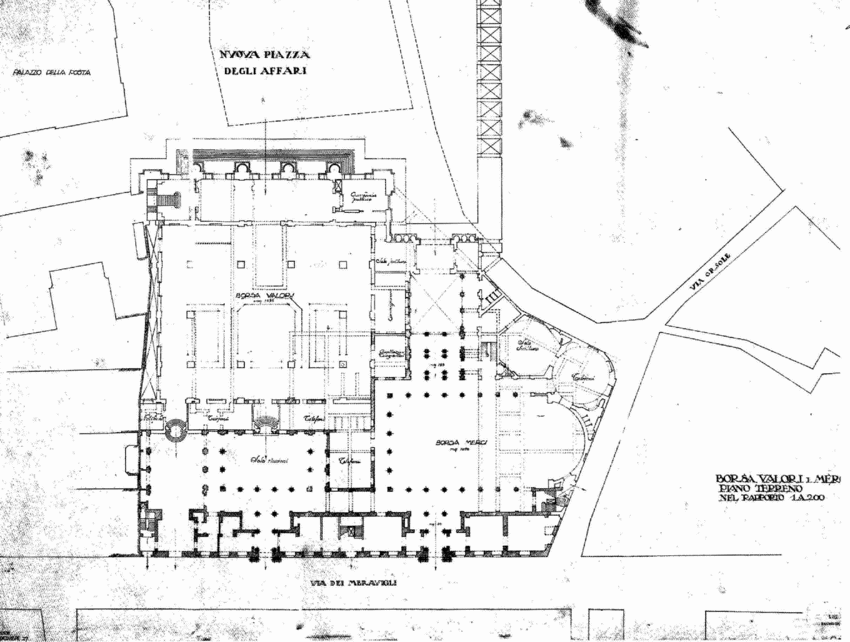
Mezzanotte's earliest plans featured two squares: the larger Piazza degli Affari, which faced the Stock Exchange, and the more modest Piazzetta dei Grani, which preceded the Commodities Exchange. With encouragement from the Provincial Economic Council, the city had already approved ‘the setting up of a large piazza, closed to vehicular traffic and surrounded by palazzi containing porticos and underpasses’.Footnote 21 The piazza was intended to accommodate a large number of buyers and sellers and to evoke the ‘antique and rational model of the Italic and Mediterranean market’.Footnote 22 Suggesting that the Milan Exchange might serve as a national model for the building type, the authoritative Enciclopedia Italiana, edited by philosopher Giovanni Gentile, stipulated that Italian exchanges should include a large piazza surrounded by a portico or other sheltering element a few years later.Footnote 23 Not surprisingly, Mezzanotte included a portico along the western side of Piazzetta dei Grani but left the eastern edge of the piazza untouched in an initial plan of December 1927 (Figure 5). In the autumn of that year, Albertini asked the architect to rework the project in order to mask the asymmetrical façade of the Central Post Office, which would front the eastern edge of the proposed square. The agency felt that this irregularity was not in keeping with the ‘importance’ of the piazza and again signalled that the city saw the new building and square as related endeavours.Footnote 24
Plan of the Exchange and northern half of Piazza degli Affari and Piazzetta dei Grani showing portico along western edge of the piazza, Dec. 1927. Reproduced with the kind permission of the Archivio Paolo Mezzanotte.
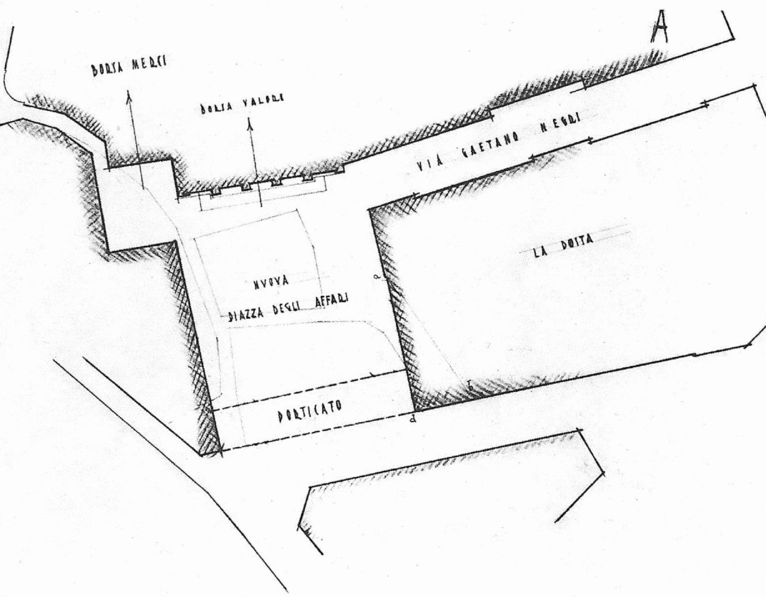
With new guidelines in place, Mezzanotte reconsidered the project. In December of 1928, Mezzanotte presented a regular piazza and introduced a portico to separate Piazza degli Affari from Via della Posta (Figure 6).Footnote 25 The regularity of the square subordinated the irregular shape of the Central Post Office to the geometric order of the proposed plan and the representational importance of the Exchange. In keeping with the wishes of the Provincial Economic Council, the portico prevented vehicular traffic from entering the piazza. It also framed the view of the classically inspired travertine front of the Exchange from Via della Posta. The arrangement recalled the ancient Roman colonnade in front of San Lorenzo, one of Milan's most important churches, and the screen surrounding the Monument to the Fallen designed by Muzio in Piazza San Ambrogio. Mezzanotte's earliest proposals thus sought to establish an aesthetically and programmatically coherent public space and to relate this space to the urban fabric through carefully chosen formal and spatial references.
Plan for Piazza degli Affari, Dec. 1928. Reproduced with the kind permission of ASCC.
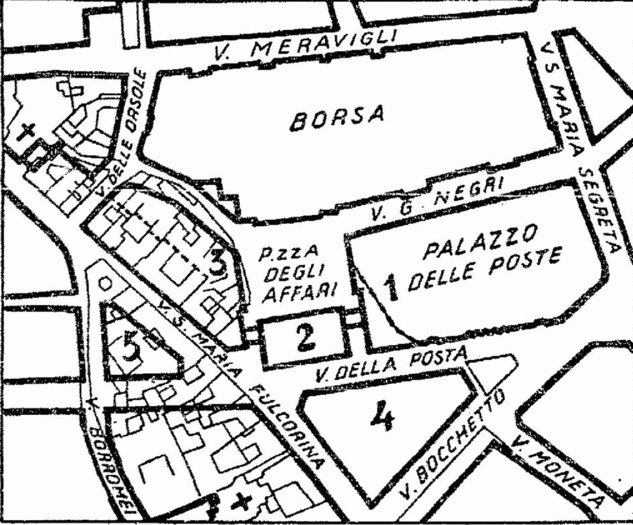
Despite the apparent support of the city, Piazza degli Affari proved to be problematic from the start. The several versions of the project published in local newspapers and journals in the following months showed that there was never consensus about the form or scale of the square. The Milan-based newspaper Corriere della Sera published one version on 26 December 1928 (Figure 7). In contrast to the earlier unpublished plan discussed above, this arrangement showed a much smaller Piazza degli Affari and a building penetrated at either end by covered passages (marked A and B) instead of the portico along the southern boundary. This solution notably reduced the city's financial commitment by limiting the size of the piazza and allowing speculators to develop more land. In 1929 Albertini, Mezzanotte and Deputy Mayor Giuseppe Gorla agreed on another version of the piazza (Figure 8).Footnote 26 This solution included a portico along the western edge of the piazza and reintroduced the portico between the piazza and the adjacent Via della Posta. While both of these projects represented a significant compromise in terms of the size of Piazza degli Affari, they preserved the integral relationship between the Exchange and the piazza.
Plan for Piazza degli Affari, 26 Dec. 1928. From Corriere della Sera, 26 Dec. 1928.

Plan for Piazza degli Affari, 1929. Reproduced with the kind permission of ASCC.

In January of 1929, the Milan-based architecture journal Rassegna di Architettura published yet another version by Mezzanotte (Figure 9). Out of step with the proposals recently endorsed by the city, the solution represented Mezzanotte's attempt to accommodate the speculative developers who held the rights to the properties along the southern and western edge of the piazza and to rehabilitate the original scale and intent of the piazza. In this project, Mezzanotte eliminated the extension of Via della Posta and pushed new construction to the south in order to restore the size of Piazza degli Affari.Footnote 27 In addition, he included a portico around three sides of the square. His goal was to create a uniform architectural composition that met the practical and representational needs of Milan's most important financial institution and satisfied the economic motivations of private developers. This solution offers an early indication of how the competing interests of the Planning Office and speculative developers would shape the project.
Plan for Piazza degli Affari, 1929. From Rassegna di Architettura, 1929.

Under Mayor Duke Marcello Visconti di Modrone the city began to scale back its plans to create the business district. Unlike previous mayors, the industrialist Visconti di Modrone did not enjoy a personal friendship with Mussolini, and he travelled infrequently to Rome to discuss city business.Footnote 28 In an environment where friendships and casual meetings often directed the flow of funds and applied the necessary pressure to motivate an entrenched bureaucracy, this lack of engagement undoubtedly influenced the city's ability to support major urban undertakings. Other factors contributed as well. The collapse of the American stock market and the resulting world economic depression had serious consequences for Milan from the autumn of 1929. Unemployment rose sharply, trade declined and the city could no longer rely on loans from American banks.Footnote 29 Nevertheless, negotiations between the growing number of parties invested in the square facing the Exchange continued.
In January of 1930, Albertini notified Mezzanotte that the city could not proceed with the 1929 plan.Footnote 30 The city later explained that the Ministry of Communications, responsible for the Central Post Office, wanted their building to remain freestanding. To accommodate the Ministry, the Planning Office preserved Via San Vittore al Teatro, which separated the rear façade of the Central Post Office from the proposed new construction at the southern end of the piazza (Figure 10). Although this new plan disrupted the geometry of the piazza, the Planning Office argued that it was necessary to create an opening on the opposite side of the new building for the sake of symmetry. The Immobilare Bocchetto Society objected that it would be impossible for them to recoup expenses with the two openings and central portico planned for the southern end of the piazza.Footnote 31 To increase the potential for profit the developer offered to finance the demolition of the block of buildings that still occupied the centre of what was to be Piazza degli Affari, provided the city would enlarge the area on which they were allowed to build. Already deeply in debt and bound by contracts, the city capitulated.Footnote 32 To accommodate developers, the Planning Office reduced the dimension of the Piazza degli Affari, eliminated the porticos and removed Piazzetta dei Grani. Open to vehicular traffic, the proposed piazza not only compromised the formal integrity of the project but also limited the square's utility as a market and meeting place. In Milan, as in other Italian cities, speculative interests played a determining role in urban development.
Plan for Piazza degli Affari, spring 1931. From L'Ambrosiano, 4 Jun. 1931.

Frustrated and disappointed, Mezzanotte criticized the city's economic aims, drew attention to the plan's aesthetic failures and endeavoured to restore the city's interest in the earlier programme. He objected most strongly to the Planning Office's decision to get rid of Piazzetta dei Grani, a feature of the project since 1927. Without the piazza, Mezzanotte did not have sufficient room to complete the entrance façade for the Commodities Exchange, and he protested that its removal created ‘an unpleasing triangular area with a form that is totally opposed to the norms of urban planning’.Footnote 33 The architect argued that it was possible to maintain the character of the piazza as it had been first conceived and to address the financial needs of the building societies. To prove his point, he sent multiple proposals to the mayor and the Planning Office.Footnote 34 However, his appeals were in vain. Mayor Visconti di Modrone and the influential deputy mayor, Cesare Dorici, met with the vice president of the Council Carlo Tarlarini to resolve the issue at the end of July 1930.Footnote 35 Despite this show of collaboration, Mezzanotte was notably absent from this meeting. In the end, the city maintained its position and modified the plan to accommodate private interests and to limit its own financial participation.Footnote 36
Although the totalitarian ambitions of fascism discouraged public discourse and obscured individual agency, the year after the Planning Office first announced its plans to alter significantly Piazza degli Affari, debate over the appropriate form of the piazza entered the public arena. Il Popolo d'Italia, a newspaper edited by Mussolini's younger brother Arnaldo until his death in December 1931, criticized the city for reducing the piazza ‘to an area of little more than 2,000 square metres’ thus making the piazza a traffic centre rather than gathering place, and for eliminating the Piazzetta dei Grani, resulting in the loss of the ‘majestic’ arched entrance.Footnote 37 The Milanese critic, architect and planner Ferdinando Reggiori published three articles, each entitled ‘The aesthetic value of the new Exchange’ in the local paper L'Ambrosiano.Footnote 38 Reggiori criticized the city for backing away from the scale and formal order of the piazza as it had developed from 1928 to 1930. Echoing Mezzanotte's concerns, he argued that the design was governed by the vagaries of speculative interest rather than planning principles and described the scheme as ‘terrible from the point of view of the plan’ and lamented that ‘its setting and aesthetic aspects will be even worse’.Footnote 39 The head of the National Syndicate of Fascist Architects, Alberto Calza-Bini, as spokesman for the Superior Council of Public Works, noted, ‘the piazza in front of the Exchange has become a burning question among interested parties and scholars’.Footnote 40 Calza-Bini concluded that the current solution failed to meet the needs of either the city or the Exchange. He urged the administration to reconsider the plan even if it was not possible to break existing contracts. Despite objections, Albertini continued to support the 1930 proposal, and this arrangement appeared in his master plan for Milan, which Mussolini would approve in 1934. Nevertheless, the conflicting interests of private and public agencies, local opposition and the city's lack of engagement with the master plan delayed resolution of the project.
Mussolini inaugurated the Exchange during his visit to Milan in October of 1932, as part of an elaborate series of celebrations in honour of the tenth anniversary of the March on Rome.Footnote 41 Mezzanotte had added a large fascio to the pediment of the Stock Exchange during the final stages of construction.Footnote 42 Although fascism's influence was already apparent in the reorganization of the markets, in the scale and monumentality of the project and in some of its formal aspects, this prominent symbol of the Fascist Party unquestionably connected the operations of the Exchange to the regime. A few days after the inauguration, Mezzanotte complained that he felt bitter about having ‘my person and my name forgotten in a solemn moment, a moment I had been anticipating with faithful patience for years’, and that he felt humiliated by having to provide ‘simple explanations’ to ‘polite questions’.Footnote 43 Mezzanotte's frustration was no doubt augmented by his already strained relations with municipal leaders. Although the building was largely complete, precisely how the new complex would relate to the surrounding urban network remained unclear.
It was not until 1935 under the leadership of Guido Pesenti and then Gian Giacomo Gallarati Scotti that the city renewed its effort and financial commitment to develop the city centre. Pesenti enjoyed personal ties to Mussolini and the status that came from being a sansepolcrista, one of the original members of the Fascist Party.Footnote 44 To tackle Milan's urban problems, Pesenti formed an advisory board to review Albertini's master plan. The board focused on the projects that most substantially altered the form and character of the city centre, such as the reorganization of Piazza San Babila and Piazza Diaz. The board also gave attention to Piazza degli Affari. In 1938 the municipal government released a modified master plan that showed a regular Piazza degli Affari with a new building along its southern edge. A loggia connected this building to the adjacent structures and prevented traffic from entering the piazza. The regular rear façade of the Post Office indicates that the mayor's office had been able to resolve the Ministry of Communications’ earlier objections. In 1939, under the administration of Mayor Gian Giacomo Gallarati Scotti, the city approved the final plan (Figure 11).Footnote 45 The architect Emilio Lancia's building along the southern edge of the piazza preserved the original intention of the programme by including a loggia along its lower level. However, the adjacent buildings lacked porticos or other sheltering elements and their utilitarian monumentality did little to bring life to the square.
Plan for Piazza degli Affari, 1939. From Corriere della Sera, 10 Aug. 1939.
Although the city restored some of the features of the earlier plans, Piazzetta dei Grani was not included in the final version. Anticipating its removal, Mezzanotte had begun to work on a new solution for the entrance to the Commodities Exchange in the autumn of 1930.Footnote 46 In place of the travertine triumphal arch originally projected, Mezzanotte designed an unornamented brick arch that lacked the classical pretensions of the earlier solution (Figure 12).Footnote 47 Next to the monumental stone façade of the Stock Exchange and intended as a temporary solution, the entrance assumed the quality of an architectural fragment or ruin, echoing the artist Mario Sironi's contemporary paintings. As executed, the arch stands in sharp contrast to the monumental permanence of the principal travertine façade and offers a quiet commentary on what was to have been a major feature of the city.
Mezzanotte, entrance to the Commodities Exchange (author).

At the end of the 1920s, the president of the Provincial Economic Council envisaged that the new Exchange and related business district would be a significant element of the municipal government's plans to reconfigure central Milan. The new building offered the business community much needed new facilities and the state a means of presenting the commercial success of Milan in fascist terms. The urban dimension of the project was to provide additional space for trading activities, redevelop a depressed area of the city centre and place the Exchange within the representational context of the city as a whole. The failure to complete the project along its original lines was the result of numerous factors. Certainly, the Ministry of Communications and speculative developers contributed to the final shape of the project.Footnote 48 However, it seems that conflicts between the various agencies involved in the project, criticism from leading cultural figures, the variable direction of the municipal administration and the absence of a powerful local patron ultimately created an environment in which the project was allowed to stagnate while the city invested its time and money elsewhere. For example, in the same years that the project for Piazza degli Affari floundered, the municipal government oversaw the completion of Corso Littorio (now Corso Matteotti) and the related Piazza Crespi (now Piazza Meda), which was developed by a number of major banks and the Crespi family, a local industrial dynasty and the owner of Corriere della Sera. Even a bribe from the minister of finance, who oversaw the Stock Exchange, failed to restore the municipal government's interest in the Piazza degli Affari.Footnote 49
The example of Piazza degli Affari demonstrates that not only did Milan's urban transformation require constant negotiation but also that the new political order had only limited control over established economic, cultural and political forces. Even after the rise of fascism, traditional power structures remained in place and created an environment in which the political objectives of fascism were always conditioned, sometimes quite dramatically, by local circumstances. Although Piazza degli Affari drew together a particularly diverse cast of characters, the difficulties encountered in completing the project point to some of the distinctive characteristics of inter-war Milan. The Exchange with its incomplete monumental travertine façade and modest urban square is therefore best understood not as a symbol of the authority of the fascist regime, but rather as a record of the competing forces and conflicting interests that composed Italy's commercial centre in the inter-war period.



