Background
In the normal course of life, people experience the death of others who have been meaningful and significant to them. Most people reconcile themselves to their loss and, after a difficult period of acute grief, accommodate and regain normal thinking, emotions, and behaviors (Bowlby, Reference Bowlby1980; Bonanno et al., Reference Bonanno, Wortman and Nesse2004). A small yet significant proportion of bereaved individuals have more difficulty with this adaptation, continuing with severe and lasting symptoms that exceed social norms and cause impairment in daily functioning. This constellation of intrusive symptoms constitutes prolonged grief disorder (PGD) (Prigerson et al., Reference Prigerson, Vanderwerker and Maciejewski2008). PGD involves ‘separation distress’, characterized by significant emotional suffering and yearning, in addition to cognitive, emotional, and behavioral symptoms, more than 6 months after a significant loss (Prigerson et al., Reference Prigerson, Horowitz, Jacobs, Parkes, Aslan, Goodkin, Raphael, Marwit, Wortman, Neimeyer, Bonanno, Block, Kissane, Boelen, Maercker, Litz, Johnson, First and Maciejewski2009). PGD presents as a coherent set of symptoms distinct from bereavement-related depression (Prigerson et al., Reference Prigerson, Frank, Kasl, Reynolds, Anderson, Zubenko, Houck, George and Kupfer1995), major depressive disorder (Prigerson et al., Reference Prigerson, Bierhals, Kasl, Reynolds, Shear, Newson and Jacobs1996b), anxiety (Prigerson et al., Reference Prigerson, Bierhals, Kasl, Reynolds, Shear, Newson and Jacobs1996b), or post-traumatic stress disorder (Boelen et al., Reference Boelen, van de Schoot, van den Hout, de Keijser and van den Bout2010). It has been documented worldwide (Schaal et al., Reference Schaal, Jacob, Dusingizemungu and Elbert2010; Field et al., Reference Field, Strasser, Taing, Horiuchi, Chhim and Packman2014; Heeke et al., Reference Heeke, Stammel and Knaevelsrud2015; Xiu et al., Reference Xiu, Maercker, Woynar, Geirhofer, Yang and Jia2016; Coelho et al., Reference Coelho, Silva and Barbosa2017; Pohlkamp et al., Reference Pohlkamp, Kreicbergs, Prigerson and Sveen2018) and is associated with diminished health and quality of life (Boelen and Prigerson, Reference Boelen and Prigerson2007; Prigerson et al., Reference Prigerson, Horowitz, Jacobs, Parkes, Aslan, Goodkin, Raphael, Marwit, Wortman, Neimeyer, Bonanno, Block, Kissane, Boelen, Maercker, Litz, Johnson, First and Maciejewski2009). Increasingly accepted as a clinical diagnosis (Maercker et al., Reference Maercker, Brewin, Bryant, Cloitre, Reed, van Ommeren, Humayun, Jones, Kagee, Llosa, Rousseau, Somasundaram, Souza, Suzuki, Weissbecker, Wessely, First and Saxena2013), PGD is included in ICD-11 (World Health Organization, 2018).
Understanding risk for more severe grief responses and PGD can help allocate scarce resources to those who most need them and maximize the efficacy of those efforts (Parkes and Weiss, Reference Parkes and Weiss1983; Schut et al., Reference Schut, Stroebe, van den Bout, Terheggen, Stroebe, Hansson, Stroebe and Schut2001; Mancini et al., Reference Mancini, Griffin and Bonanno2012; Roberts et al., Reference Roberts, Holland, Prigerson, Sweeney, Corner, Breitbart and Lichtenthal2017). Considerable research has examined risk factors for more extreme grief under various pathologic descriptors consisting of traumatic grief, complicated grief, prolonged grief, and persistent complex bereavement disorder. Several informative analytic frameworks have been proposed to organize the identified elements of the loss experience that inform adaptation (Bonanno and Kaltman, Reference Bonanno and Kaltman1999; Stroebe et al., Reference Stroebe, Folkman, Hansson and Schut2006), including the categorization of elements as either situational factors related to the particular circumstances of a death, personal factors in the bereaved, or interpersonal factors related to the availability and nature of support for the bereaved from others (Stroebe and Schut, Reference Stroebe, Schut, Stroebe, Hansson, Stroebe and Schut2001). Some have concluded that the influence of the circumstances of death is minimal in comparison with personal features of the bereaved (Cleiren et al., Reference Cleiren, Diekstra, Kerkhof and van der Wal1994). This research investigated personal factors and PGD.
Personal factors identified by research to enhance the risk for PGD have included demographic variables, for example, sex (Goodenough et al., Reference Goodenough, Drew, Higgins and Trethewie2004), poverty (Goldsmith et al., Reference Goldsmith, Morrison, Vanderwerker and Prigerson2008; McCarthy et al., Reference McCarthy, Clarke, Ting, Conroy, Anderson and Heath2010), education (Ostfeld et al., Reference Ostfeld, Ryan, Hiatt and Hegyi1993), or age (Wijngaards-de Meij et al., Reference Wijngaards-de Meij, Stroebe, Stroebe, Schut, Van den Bout, Van Der Heijden and Dijkstra2008), and variables reflecting the kinship relationship of the bereaved to the deceased, for example, motherhood (Dyregrov and Dyregrov, Reference Dyregrov and Dyregrov1999; Michon et al., Reference Michon, Balkou, Hivon and Cyr2003), the death of a child (Kersting et al., Reference Kersting, Brahler, Glaesmer and Wagner2011), or the centrality of loss (Boelen, Reference Boelen2009; Papa et al., Reference Papa, Lancaster and Kahler2014). In previous research, we investigated young mothers whose seemingly healthy infants died suddenly and unexpectedly from the sudden infant death syndrome (SIDS) because they concentrate many personal risk factors and, as an experimental model, have a relatively uniform exposure to their child's death without variations in illness or treatment experience. In a cross-sectional study of 356 mothers bereaved when their infants died from SIDS, we found an overall prevalence of PGD in 50% of mothers 6–48 months after their infant's death, with a rate of PGD of 57.1% at 1 year and 41.3% in the third year post-loss (Goldstein et al., Reference Goldstein, Lederman, Lichtenthal, Morris, Human, Elliott, Tobacco, Angal, Odendaal, Kinney, Prigerson and Network2018). In comparison, a recent meta-analysis appraising 14 studies of non-psychiatric adult populations exposed to non-violent bereavement observed a pooled prevalence of PGD in 9.8% 1 year following loss (Lundorff et al., Reference Lundorff, Holmgren, Zachariae, Farver-Vestergaard and O'Connor2017). The generalizability of the SIDS-related findings was supported by nearly identical prevalence rates of PGD symptoms between two studied populations of bereaved mothers living in highly disparate social circumstances, from women living in informal settlements outside of Cape Town, South Africa to middle class US populations, with the exception that mothers with more limited resources reported less persistent feelings of shock that their infant had died.
Prospective research on grief
Prospective research to identify features in those who will go on to be most strongly affected by grief have yielded complicated findings. Studies examining grief in caregivers of dementia patients had conflicting conclusions about associations with pre-loss measures of depression (Givens et al., Reference Givens, Prigerson, Kiely, Shaffer and Mitchell2011; Nielsen et al., Reference Nielsen, Neergaard, Jensen, Vedsted, Bro and Guldin2017) while also reporting that grief symptoms were greater before the patient's death than after it (Nielsen et al., Reference Nielsen, Neergaard, Jensen, Vedsted, Bro and Guldin2017). Others similarly reported greater depression-related symptoms prior to death than during bereavement (Schulz et al., 2003). Such prospective efforts to understand how personal factors contribute to grief may be susceptible to confounding by functional and perceptual changes that accompany the experiences of caregivers as patients near death (Lotterman et al., Reference Lotterman, Bonanno and Galatzer-Levy2014), including recall bias in pre-loss estimates and changed internal assessments of how caregivers remember themselves before their present circumstances (Toedter et al., Reference Toedter, Lasker and Campbell1990). The likelihood of death following a life-limiting diagnosis or after arriving at a certain stage of life may lead to anticipatory grief and a context in which death is regarded as being in the normal course of events (Nielsen et al., Reference Nielsen, Neergaard, Jensen, Bro and Guldin2016). It is difficult to assemble cohorts that provide prospective data uninfluenced by the presence of serious illness or the likelihood of possible loss, reducing our ability to genuinely examine personal features in caregivers before the illness experience.
There are some notable exceptions where pre-loss data were collected prior to the diagnosis of illness. Bonanno et al. examined pre-loss variables of depressive symptoms, qualities of the marriage, coping resources, and world view in 205 bereaved life partners, using data collected when husbands living independently became 65 years old (Bonanno et al., Reference Bonanno, Wortman, Lehman, Tweed, Haring, Sonnega, Carr and Nesse2002). The authors identified basic bereavement patterns, while also finding that subjects with prolonged grief and chronic depression symptoms were symptomatically similar and that both were notably depressed pre-loss. Other prospective research examined pregnancy loss, finding that women with higher symptom scores for depression, anxiety, somatization and obsessive–compulsive behavior or who did not have another child at the time of the loss experienced greater grief intensity (Janssen et al., Reference Janssen, Cuisinier, de Graauw and Hoogduin1997). Toedter et al. (Reference Toedter, Lasker and Janssen2001) similarly found correlations between pre-loss mental health and prolonged grief at 2 years of follow-up. Neugebauer et al. found that miscarriage triggered depression in 54% of mothers who had previously experienced clinical depression (Neugebauer et al., Reference Neugebauer, Kline, Shrout, Skodol, O'Connor, Geller, Stein and Susser1997). Although pregnancy loss research may raise questions about generalizability to deaths in life partners, livebirths, or children, this research makes rare contributions to understanding the influence of personal factors on bereavement, especially given the limited impact from intervention fidelity, anticipatory grief, or death occurring in ‘the normal course of things’.
Current study
SIDS is the leading cause of post-neonatal mortality in high-income countries. A seemingly well infant is discovered dead after a sleep period. While SIDS rates have declined since the 1990s, it causes more mortality than cancer or heart disease in children aged 0–19 years in the USA (Centers for Disease Control and Prevention, 2017). The circumstances and risk factors for SIDS are many of the risk factors for prolonged grief disorder, including the situational factors of relationship with the deceased (Cleiren et al., Reference Cleiren, Diekstra, Kerkhof and van der Wal1994), young age of the deceased (Zetumer et al., Reference Zetumer, Young, Shear, Skritskaya, Lebowitz, Simon, Reynolds, Mauro and Zisook2015), lack of preparation for the death (Barry et al., Reference Barry, Kasl and Prigerson2002), and suddenness of the death (Dyregrov et al., Reference Dyregrov, Nordanger and Dyregrov2003).
In this study, we analyzed pre-loss data collected during pregnancy in mothers whose infants ultimately died from SIDS, to identify characteristics of risk and its outcomes for PGD. We hypothesized that vulnerability factors (anxiety, depression, previous loss, alcohol use, younger age, and lack of other children in the home) in a mother when the possibility of child loss was remote would predict PGD after sudden unexpected loss. Given previously reported high rates of PGD in mothers after SIDS loss and the accompanied modest decreases of PGD over time, we hypothesized that the effects of pre-loss characteristics would become less significant over time.
Methods
Study design
The Safe Passage Study (SPS) was a prospective multi-centered study of 12 000 women at high risk for SIDS, examining aspects of infants and their mothers during pregnancy and their first year of life, including pre-loss vulnerability factors for PGD. Participants were recruited from informal settlements near Cape Town, South Africa and in or near Pine Ridge Indian Reservation (Northern Plains), USA, populations sharing extremely impoverished living standards, high rates of maternal alcohol drinking and approximately seven times the overall US SIDS rate (Dukes et al., Reference Dukes, Burd, Elliott, Fifer, Folkerth, Hankins, Hereld, Hoffman, Myers, Odendaal, Signore, Sullivan, Willinger, Wright, Kinney and Network2014). This ancillary study enrolled participants who were otherwise terminated from the study following their infant's death, comparing bereavement outcomes to personal and psychological data collected prospectively from pregnancy through bereavement.
Participants
Participants were mothers whose infants died from SIDS or unascertained causes of death in their first year of life after healthy discharge from birth hospitalization, with comparison data from those whose infants survived. Maternal and fetal/infant dyads were followed throughout pregnancy until 1 year post-delivery from August 2007 until January 2015. Bereaved mothers were enrolled after their infant's SIDS death from May 2013 until July 2016. This research was approved by the Institutional Review Boards at Dana-Farber Cancer Institute (protocol 13-207); The Eunice Kennedy Shriver National Institute of Child Health and Development, Bethesda, Maryland; Stellenbosch University, Stellenbosch, South Africa; Sanford Health, Sioux Falls, South Dakota; Oglala Sioux Tribe and Great Plains Institutional Review Board.
Procedures
Surveys were administered by project professional staff at each site. Pre-loss data were obtained at the earliest prenatal visit following enrollment, including the Edinburgh Depression Scale, the Spielberger State-Trait Anxiety Inventory, alcohol use, previous pregnancy loss or death of their child, and demographic measures. Post-loss data were obtained on bereaved mothers between 2 and 48 months after their infant died, with three separate grief inventories administered separated by 6-month intervals. Maternal age when the infant died, and the presence of another living child in the home at the time of the infant's death were collected post-loss.
Measures
Demographics
Basic demographic data were collected including age, race, education, and poverty. Poverty in South Africa was determined using the South African upper bound poverty line (income insufficient to purchase food and essentials meeting a daily minimum energy intake of 2100 kilocalories) (Statistics South Africa, 2015). Poverty in Northern Plains participants was defined using 2015 US poverty levels for a family of 4.
Survey instruments
Spielberger State-Trait Anxiety Inventories (STAI-T and STAI-S) were used to measure trait anxiety, the characterological predisposition to anxiety, and state anxiety, anxiety in response to a specific situation at the time of measurement (Cattell, Reference Cattell and Spielberger1966; Littleton et al., Reference Littleton, Breitkopf and Berenson2007). Reported median reliability coefficients for the trait anxiety scale vary from 0.695 to 0.765 in samples of working adults, college students, high school students, and military recruits (Spielberger, Reference Spielberger1983). Normative data are available but various cut-offs and criteria have been used through the literature to identify higher risk. Trait anxiety was used for the analysis as our interest was in stable pre-loss personality characteristics.
We used the Edinburgh Depression Scale, a widely used and validated scale originally designed to screen for post-partum depression (Cox et al., Reference Cox, Chapman, Murray and Jones1996). Its reliability and validity have been demonstrated in diverse international samples (Affonso et al., Reference Affonso, De, Horowitz and Mayberry2000). This research used the cut-off value of 13, the value typically used for post-partum depression screening, in efforts to more closely identify pathology with greater specificity (Su et al., Reference Su, Chiu, Huang, Ho, Lee, Wu, Lin, Liau, Liao, Chiu and Pariante2007), recognizing that a lower cut-off is sometimes used during antenatal screening (Bergink et al., Reference Bergink, Kooistra, Lambregtse-van den Berg, Wijnen, Bunevicius, van Baar and Pop2011; Kozinszky and Dudas, Reference Kozinszky and Dudas2015).
A Timeline Follow-Back (TLFB) method was used at the intake prenatal interview to measure alcohol consumption (Sobell and Sobell, Reference Sobell and Sobell1992). This methodology collected a detailed alcohol consumption history for the last drinking day and 30 days prior (Brick, Reference Brick2006). We used a cut-off of drinking frequency in the upper quartile to differentiate higher alcohol intake.
The Parental Bereavement Questionnaire (PBQ) was used to measure symptoms of PGD. The PBQ is a modification of the Prolonged Grief Disorder 13-item inventory (PG-13) (Prigerson et al., Reference Prigerson, Horowitz, Jacobs, Parkes, Aslan, Goodkin, Raphael, Marwit, Wortman, Neimeyer, Bonanno, Block, Kissane, Boelen, Maercker, Litz, Johnson, First and Maciejewski2009), adapted for language specific to the loss of a young child and including other factors identified to be of particular concern to parents after the death of a pediatric-aged child. The PBQ measures diagnostic criteria for PGD in 18 items, with items addressing separation distress (yearning and emotional pain), and cognitive, emotional, and behavioral symptoms, including confusion about one's role in life or diminished sense of self, difficulty accepting the loss, avoidance of reminders about the reality of the loss, inability to trust others since the loss, difficulty moving on with life (e.g. making new friends and pursuing interests), emotional numbness since the loss, and feeling stunned, dazed, or shocked by the loss. Adaptations incorporating parent-specific language into the PG-13 were pilot tested on a sample of Massachusetts parents (Goldstein and Rimer, Reference Goldstein and Rimer2013), and input from local focus groups was used to increase reliability for local language preferences specific to Cape Town. Source PG-13 items have a sensitivity of 1.00 and specificity of 0.99 for PGD (Prigerson et al., Reference Prigerson, Horowitz, Jacobs, Parkes, Aslan, Goodkin, Raphael, Marwit, Wortman, Neimeyer, Bonanno, Block, Kissane, Boelen, Maercker, Litz, Johnson, First and Maciejewski2009). Internal consistency of the PBQ is α = 0.92. Reliability (Kuder–Richardson) was 0.72 for PGD criteria in this sample.
Statistical analysis
Pre-loss continuous psychometric scores were compared between mothers whose child died from SIDS and a control group of mothers from the SPS whose infants did not die (1:3 case:control ratio matching age, race, and location) using two-sample t tests. Pre- and post-loss psychometric scores were compared using paired t tests.
We dichotomized continuously and ordinally distributed risk factors in order to assess the trajectories of PGD in mothers with and without risk factors across a continuous measure of time since child loss. We used a median cut-off for STAI-T (score ⩾39) and maternal age at loss (⩾29 years of age). A cut-off of ⩾13 was used for the Edinburgh Depression Scale to provide greater specificity (see above). High alcohol use was defined as drinking at least two times per week as measured during the intake/pregnancy interview.
We used generalized estimating equations (GEE, logit link, binomial family) with robust standard errors and an exchangeable correlation structure to model the trajectories of PGD by the presence or absence of pre-loss risk factors over time. Time was defined as months from child loss and ranged from 2 to 48 months. Three observations that were >4 years after loss were excluded as they were considered beyond the observation period of interest. Each model predicting PGD had seven terms: risk factor (dichotomous), time (continuous), quadratic time, interaction of risk factor by time, interaction of risk factor by quadratic time, cohort, and a constant. Linear combinations of the three terms containing the risk factor were used to determine the effect of the risk factor at 6-month intervals since the loss of the child. In addition to individual risk factors, we created a count of risk factors and then trichotomized this count based on a delineation of risk for PGD that was observed between 0–1, 2–3, and >4 risk factors. We calculated a C-statistic (area under the curve for a receiver operating characteristic analysis) based on predicted scores from a GEE model with the six individual risk factors as independent variables, restricted to observations between 6 and 24 months from loss. All tests were two-tailed and alpha was set at 0.05.
Results
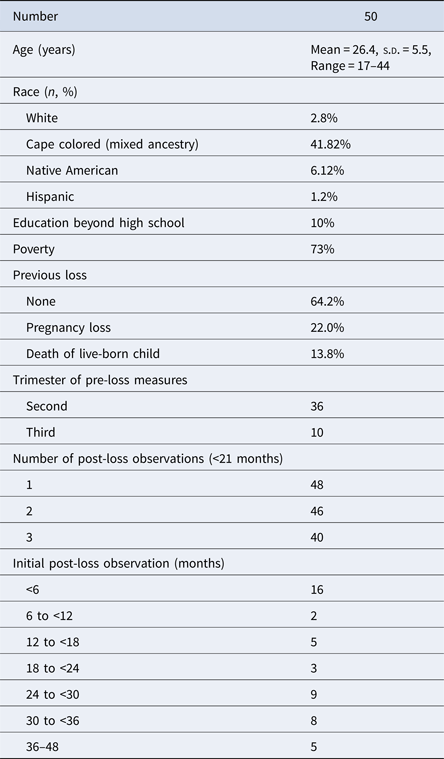
Pre-loss data were collected in 11 892 participants (59% South Africa). Cause was not determined in 55 infants who died during the enrollment period. Five mothers declined participation, and complete pre-loss psychometric data were available for 44 participants. Fewer Northern Plains deaths reflected relative enrollment, and also coincident prevention efforts leading to SIDS rates (Table 1). Mothers who ultimately lost a baby to SIDS had no significant differences in STAI composite scores, Trait Anxiety scores, or Edinburgh scores during pregnancy than controls. In the mothers whose infants died from SIDS, anxiety scores were higher during bereavement than pre-loss (p < 0.001), with a similar trend for depression (p = 0.09) (Table 2). During the period of >6 months after their infant's death, 65.3% of the bereaved mothers had at least one interview where criteria for PGD were met. Overall, symptom criteria for PGD were met in 47.3% of the observations.
Demographics of participants

Pre- and post-loss anxiety and depression scores

Comparison of Spielberger and Edinburgh scores in bereaved mothers (n = 44) and controls, and comparison pre- and post-loss scores in bereaved mothers.
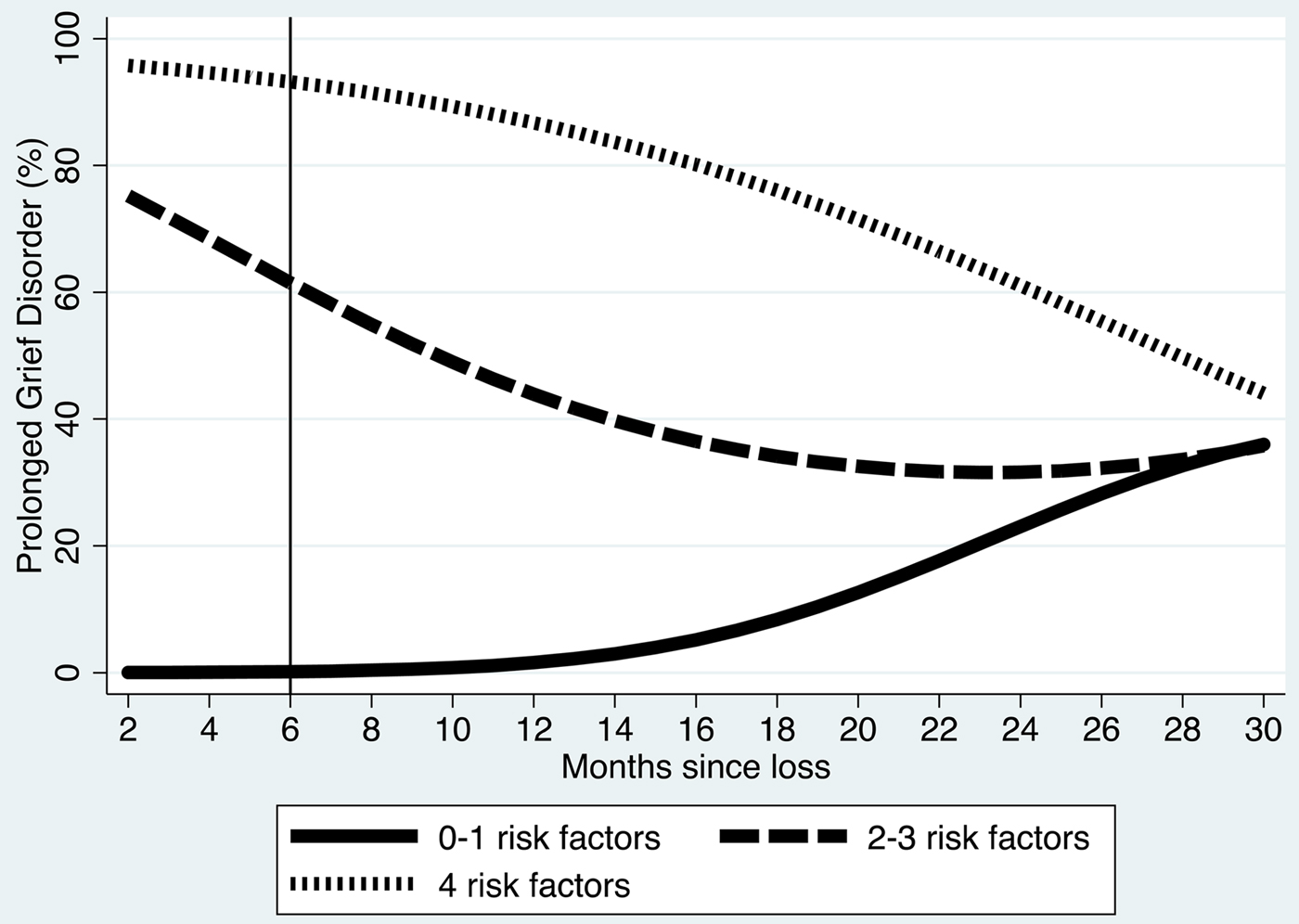
Stratifying by number of pre-loss risk factors measured (anxiety, depression, alcohol use, previous loss, living child in the home, and maternal age), two or three risk factors predicted significantly greater risk for PGD for 12 months after the loss and four risk factors predicted significantly greater risk for PGD for 24 months following the infant's death (Fig. 1), in comparison to the low-risk group. No participant had more than four risk factors. A transition occurred at approximately 24–30 months post-loss, as rates of PGD increased in those with fewer risk factors with a trend toward convergence at a high rate. This trend toward an increased rate of PGD began 12 months in the low-risk group and at 22 months in the middle-risk group. The C-statistic using predictions from the GEE model restricted to 6–24 months after loss using the six factors (anxiety, depression, alcohol, previous loss, child in home, and age at death) was 0.83 (CI 0.71–0.95). Predictions from a simplified model of only risk factors that survived backward deletion at p < 0.15 (age, alcohol, and depression) still provided good discrimination (0.80, CI 0.68–0.93).
Cumulative pre-loss risk factors and PGD. Symptoms criteria meeting PGD are displayed from 6 months post-loss through 30 months, until significant statistical differences are no longer seen. Symptom intensity consistent with PGD but not meeting diagnostic criteria for post-loss time interval for PGD are displayed from 2 to 6 months.

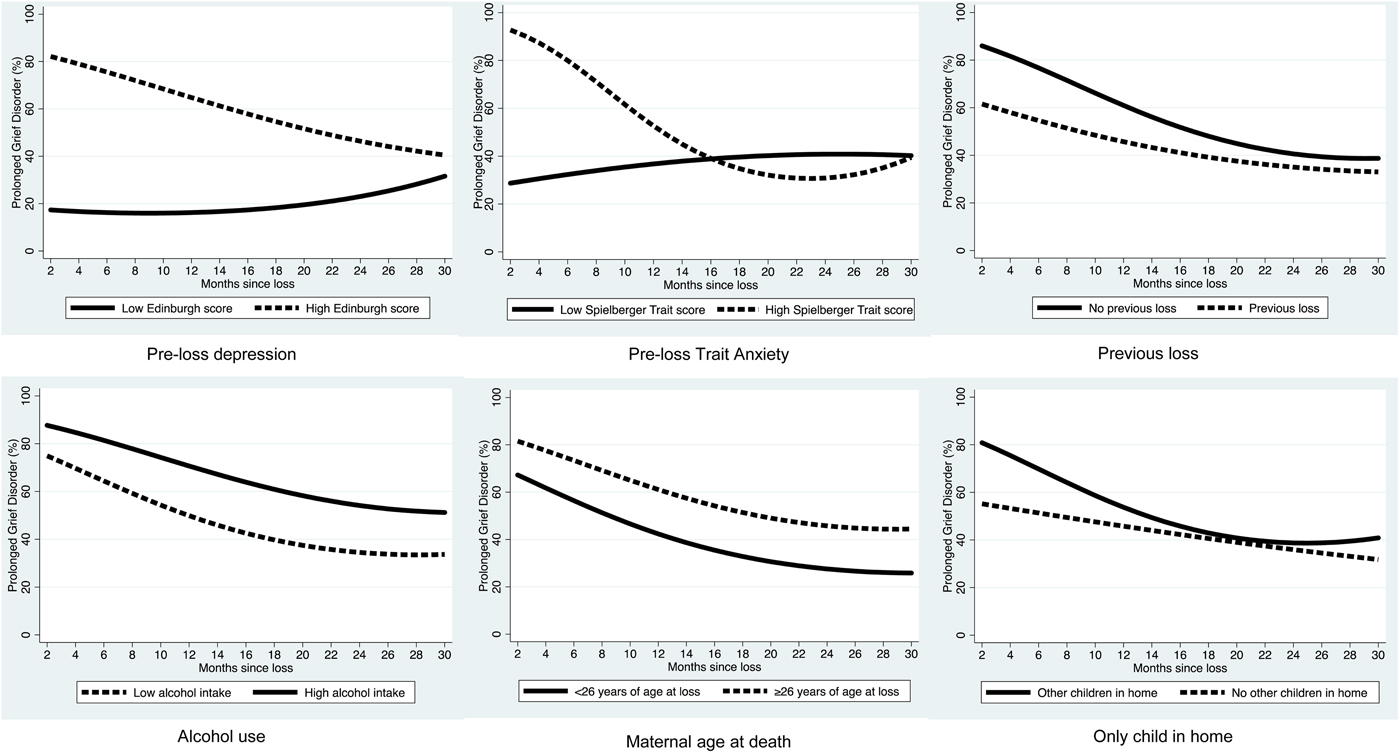
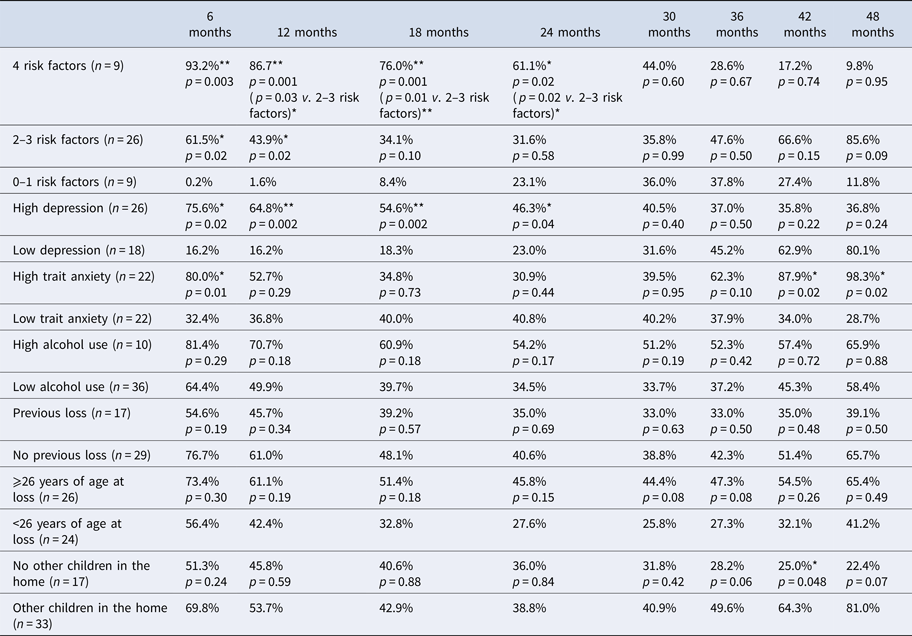
Analysis of individual risk factors in 30 months post-loss showed differences associated with each pre-loss risk factor and their trajectories for PGD, demonstrating differing contributions to PGD during that period after the infant's death (Table 3, Fig. 2). Pre-loss depression symptoms were significantly associated with PGD for 2 years into bereavement, with odds ratios (OR) over 2.8. When depression and grief were measured concurrently at visit 1, 60% of those with PGD had elevated depression scores while 40% of those without PGD had elevated depression scores (p = 0.16). Anxiety predicted the greatest degree of acute grief symptoms but not a significant difference in PGD, which has symptom criteria of >6 months post-loss. Mothers who had experienced prior loss of a pregnancy or child showed non-significantly lower rates of PGD, a constant effect over time. Higher prevalences of PGD across time were predicted in mothers who drank alcohol at least 2 days each week (OR>2.0) and older maternal age (OR>2.0), but not to statistical significance. The presence of other living children in the home was not shown to have a protective effect on PGD. Findings for cumulative risk factors, depression, and anxiety remained statistically significant after a sensitivity analysis removed Northern Plains participants.
PGD and individual personal factors. Trajectories of PGD for individual risk factors and their absence until 30 months post-loss. Symptom intensity consistent with PGD but not meeting diagnostic criteria for post-loss time interval for PGD are displayed from 2 to 6 months.
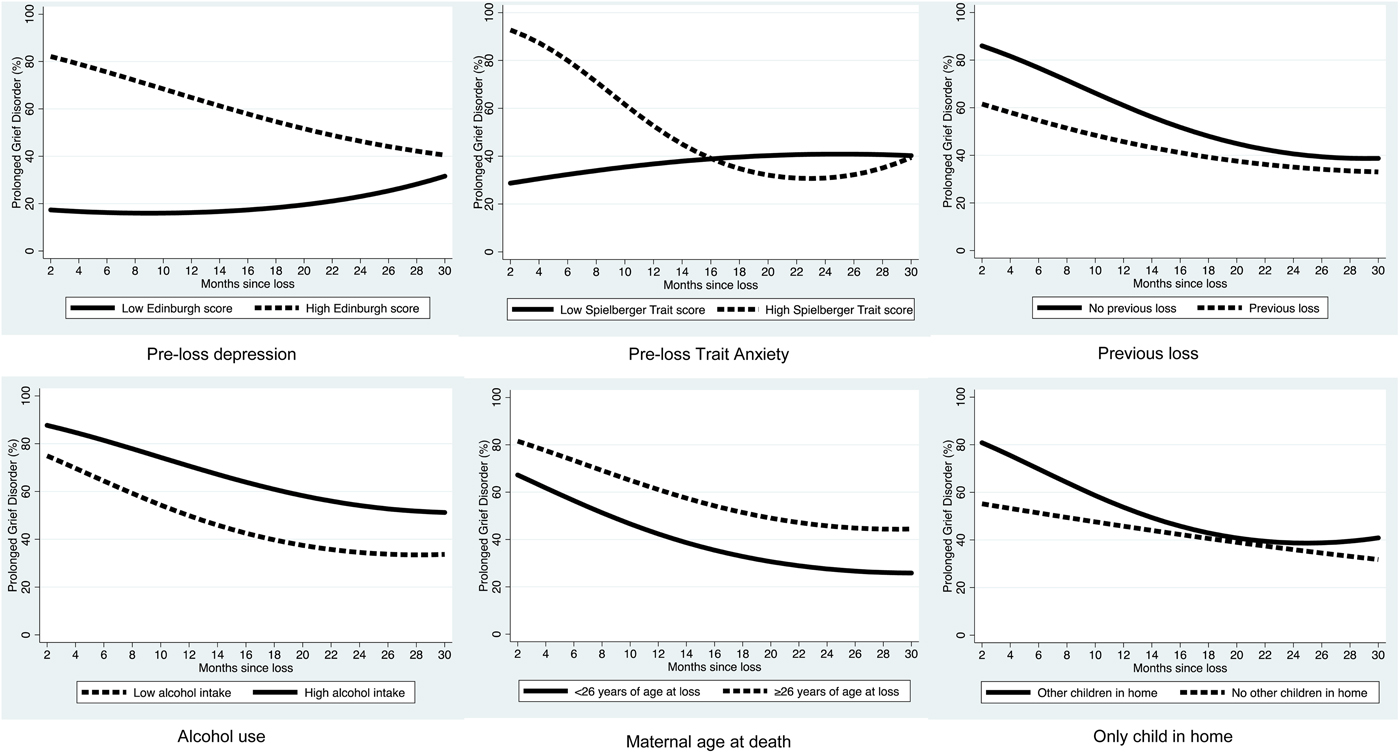
Personal risk factors and PGD over time

The upper section shows strata of cumulative risk factors from 6 to 48 months post-loss with prevalence of PGD and p values in comparison with lower risk groups. The lower section shows rates of PGD by individual risk factor over time, displaying p values
Discussion
Less than 0.1% of mortality occurs in children (Centers for Disease Control and Prevention, 2016), reflecting historic advances in medicine and prevention. The parents of pediatric-aged children who die nonetheless experience important and persistent consequences during bereavement (Rando, Reference Rando1986; Rogers et al., Reference Rogers, Floyd, Seltzer, Greenberg and Hong2008), including increased mortality (Li et al., Reference Li, Precht, Mortensen and Olsen2003), mental health hospitalizations (Li et al., Reference Li, Laursen, Precht, Olsen and Mortensen2005), and alterations in future parenting (Warland et al., Reference Warland, O'Leary, McCutcheon and Williamson2011). The rarity of child death in the 21st century contributes to this difficulty, while increasing the challenges of assembling prospective cohorts. This research focused on the contribution of personal factors existing prior to loss on rates of PGD in mothers following the sudden unexpected death of their infants, using standardized metrics in a cohort with limited variation in many variables influencing grief outcomes. The risk profile generated by the six prospective risk factors had a strong ability to discriminate between mothers who would ultimately suffer from PGD and those who would not. Our data show that a bereaved mother's response to loss is significantly determined before the loss occurs, and that pre-loss vulnerability factors act with cumulative, albeit time-limited, effects.
A unique aspect of these data is its genuinely prospective collection before the infant's death, when the participants were pregnant and without any expectation of their baby's death. This well-characterized sample with an elevated risk for PGD had limited variation in personal risk factors, while the collection of pre-loss psychometrics allowed us to look specifically at six pre-loss personal risk factors: anxiety, depression, alcohol use, previous loss, living child in the home, and maternal age. No <16.2% (low Edinburgh score at 12 months) of participants were predicted to have PGD when no specific risk factor was present. Personal risk factors unrelated to circumstances of death predicted PGD in the first 30 months following the infants’ deaths, the time following loss when more attention is conventionally offered to the bereaved. Greater than two risk factors significantly predicted PGD in the year after the infant's death and four risk factors predicted PGD for 2 years.
Although some have argued that grief does not resolve uniformly (Stroebe et al., Reference Stroebe, Schut and Boerner2017), it was notable that PGD increased in those at lower risk over time and converged at a high rate without regard for risk. Although requiring further study, the effect size estimated in the model was large and clinically significant. This may not be inconsistent with previous research on grief trajectories (Maciejewski et al., Reference Maciejewski, Zhang, Block and Prigerson2007), because that analysis removed subjects with PGD, likely affecting symptom trajectories. Others have reported persistently high symptom levels in significant subpopulations (Maciejewski et al., Reference Maciejewski, Maercker, Boelen and Prigerson2016, Prigerson et al., Reference Prigerson, Horowitz, Jacobs, Parkes, Aslan, Goodkin, Raphael, Marwit, Wortman, Neimeyer, Bonanno, Block, Kissane, Boelen, Maercker, Litz, Johnson, First and Maciejewski2009, Zisook and Shuchter, Reference Zisook and Shuchter1985) and delayed symptom peaks at approximately 2 years (Zisook et al., Reference Zisook, Devaul and Click1982). In our participants, these later increases in PGD may in part be related to typical spacing between children, and reflect ambivalence when a mother considers a subsequent pregnancy and the birth. Mothers may scrutinize their relationship with the deceased while bonding with their next baby or when the infant reaches the age of the deceased; alternatively, they may experience heartache as peers expand families. In exit interviews, mothers identified the emotional difficulties that come with time, as their child is less remembered by others and attention to the presence of their child becomes more difficult for themselves. Mothers report high and persistent levels of role confusion following SIDS loss (Goldstein et al., Reference Goldstein, Lederman, Lichtenthal, Morris, Human, Elliott, Tobacco, Angal, Odendaal, Kinney, Prigerson and Network2018).
Pre-loss factors have different associations with grief. Higher trait anxiety had a more significant effect on acute grief symptoms (<6 months) than PGD, which is diagnosed 6 months following loss. Higher depression scores were strongly associated with PGD but the imperfect overlap was not consistent with confounding. Alcohol use and maternal age at loss showed a consistent effect size and, arguably, the lack of statistical significance may reflect the limited power of the sample size to demonstrate the effect. While it is not uncommon for bereaved parents to report the affirmative narrative that their other children helped them cope with their grief, our data suggest a modest effect. Finally, we did not find a strong risk in mothers who experienced prior loss during pregnancy or after the death of a live-born child, but instead found a trend toward a protective effect.
Depression significantly predicted PGD for 2 years following loss but while co-occurring, was not collinear. SIDS is a loss that threatens and devalues a bereaved mother's core role, features strongly implicated in depression (Kendler et al., Reference Kendler, Karkowski and Prescott1998; Kendler et al., Reference Kendler, Hettema, Butera, Gardner and Prescott2003), while bereavement itself increases risk for the onset of many psychiatric disorders (Keyes et al., Reference Keyes, Pratt, Galea, McLaughlin, Koenen and Shear2014). Nonetheless, PGD symptoms and diagnosis have been shown to be distinct from symptoms and diagnosis of major depressive disorder (Prigerson et al., Reference Prigerson, Horowitz, Jacobs, Parkes, Aslan, Goodkin, Raphael, Marwit, Wortman, Neimeyer, Bonanno, Block, Kissane, Boelen, Maercker, Litz, Johnson, First and Maciejewski2009), demonstrating a coherent structure with distinct components (Prigerson et al., Reference Prigerson, Frank, Kasl, Reynolds, Anderson, Zubenko, Houck, George and Kupfer1995; Prigerson et al., Reference Prigerson, Bierhals, Kasl, Reynolds, Shear, Newsom and Jacobs1996a). PGD and depression are understood to have different etiologies and risk factors, and predict different outcomes (Prigerson et al., Reference Prigerson, Bridge, Maciejewski, Beery, Rosenheck, Jacobs, Bierhals, Kupfer and Brent1999). Our data are consistent with prior observations that PGD and depression demonstrate incremental validity, where, for example, grief was associated with a fivefold greater likelihood of suicidal ideation after controlling for depression, while comorbid grief and depression were not (Prigerson et al., Reference Prigerson, Bierhals, Kasl, Reynolds, Shear, Day, Beery, Newsom and Jacobs1997).
There was a trend toward less PGD when mothers had experienced a prior loss. Other prospective studies have concluded that prior loss was associated with worsened grief during the subsequent loss (Janssen et al., Reference Janssen, Cuisinier, de Graauw and Hoogduin1997). Conceptually, however, the ameliorating influence we observed is consistent not only with the notion of desensitization to stressors but also with the understanding of grief as an attachment reaction. In qualitative research, Warland has observed paradoxical parenting in parents after SIDS, a tendency to hover and overattend to subsequent children while maintaining a more distant attachment style (Warland et al., Reference Warland, O'Leary, McCutcheon and Williamson2011). While sample size limitations make this a matter for speculation, we suggest that parental attachment in subsequent children after a loss compensates for the vulnerability that was experienced.
This study is limited by its sample size. This small and seemingly idiosyncratic sample required following 12 000 mothers whose infants experienced a leading form of child mortality. Nonetheless, the lack of power for risk factors may fail to detect true associations (type 2 error). Power considerations aside, however, caution should be exercised about the generalizability of the findings. Prior research provided evidence that findings from this sample are generalizable to mothers after SIDS in other settings (Goldstein et al., Reference Goldstein, Lederman, Lichtenthal, Morris, Human, Elliott, Tobacco, Angal, Odendaal, Kinney, Prigerson and Network2018). With regard to other causes of a child's death and PGD, there is little reason to conclude that the risk factors described in the sample operate differently. However, whether conclusions from this specific cohort who experienced a sudden, unexplained loss at a maternal moment of extremely strong attachment behavior can be generalizable to death in adults, notably elderly life partners, is uncertain. Yet a separation of this experience from mainstream grief research begs the question of how parental grief in young families is different and whether it thus warrants separate considerations as a psychological category. Finally, we note that the discrimination in our risk predictions may not be as strong when tested outside of the sample used to develop it.
Although lacking power to determine whether relationships vary by cohort, our finding remained significant when we conducted a sensitivity analysis removing Northern Plains participants. With ~350 births per year, Pine Ridge contributed many fewer subjects, but we chose to include its participants because they were central to the prospective design of SPS, out of respect for the fact that the research was supported by the Oglala Sioux tribe, and because of our desire to include a population not generally included in medical research by virtue of race and poverty [lowest per capita income by county in the USA (United States Census Bureau, 2017)].
This research documents that personal risk factors measured in mothers during the course of a normal pregnancy predict significantly higher risk for PGD following the sudden unexpected deaths of their infants. The risk factors had a cumulative, time-limited effect, with decreased significance after 2 years and convergence of PGD at high levels. Although limited by statistical power, we found differences in effect size and prevalence trajectories for PGD based upon pre-loss factors. Our risk prediction results showed excellent discrimination between mothers who did and did not develop PGD. Personal and psychological characteristics present in mothers before bereavement significantly influence PGD.
Author ORCIDs
Richard D. Goldstein https://orcid.org/0000-0002-6694-3699
Acknowledgements
The authors are extremely grateful to the mothers who took part in this study, and the many support staff who made their participation possible. The authors are especially grateful to the parents of Bode Wolfe, whose kind donation helped feed, transport, and provide incentives for the bereaved mother participants.
Financial support
The authors have no financial relationships relevant to this article to disclose. This study was supported in part by the Bode Wolfe Memorial Fund, CJFirst Candle, and National Institutes of Health grants U01HD055154, U01HD045935, U01HD055155, U01HD045991, and U01AA016501 funded by the Eunice Kennedy Shriver National Institute of Child Health and Human Development, National Institute on Alcohol Abuse and Alcoholism, and the National Institute on Deafness and Other Communication Disorders.
Conflict of interest
None.