Significant outcomes
-
∙ Autoimmune thyroiditis was the most frequent autoimmune disorders in patients with neuromyelitis optica (NMO).
-
∙ Systemic lupus erythematosus (SLE) with systemic sclerosis and juvenile idiopathic arthritis (JIA) were also presented in patients with NMO.
-
∙ Epidemiological, clinical, and laboratory features of the NMO patients did not differ according to the anti-aquaporin 4 (AQP4) status, presence of autoimmune disorders, and seropositivity of autoantibodies.
Limitations
-
∙ The cohort of patients with NMO is small in order to make significant comparison with previous reports.
Introduction
NMO is an inflammatory demyelinating autoimmune disease of the central nervous system (CNS) that most commonly affects the optic nerves and spinal cord causing blindness and paralysis but usually spares the brain, unlike multiple sclerosis (MS) (Reference Sellner, Hemmer and Mühlau1). The disease affects primarily young women, accounting for roughly 85% of cases. Relapsing NMO is more frequent in female, but both sex can develop monophasic NMO. The median age at presentation is 39 years and rarely occurs in adolescents (Reference Jacob, Matiello, Wingerchuk, Lucchinetti, Pittock and Weinshenker2–Reference Wingerchuk, Lennon, Lucchinetti, Pittock and Weinshenker6). The prevalence of NMO is lower than that of MS and is higher in non-Caucasians. Within demyelinating disorders, NMO can affect up to 48% of patients of East Asia, and its prevalence decreases among African-Brazilians (15%) and Europeans (1.5%) (Reference Wingerchuk, Lennon, Lucchinetti, Pittock and Weinshenker6,Reference Jarius, Jacobi and De Seze7). The serum IgG autoantibody against the major water channel of the CNS localised in the astrocyte foot processes, named AQP4, was implicated in the pathogenesis of NMO as the main aetiologic agent of this autoimmune disease (Reference Lennon, Kryzer, Pittock, Verkman and Hinson8).
There is a strong recognised association between NMO and both non-organ-specific and organ-specific autoimmune diseases, including rheumatoid arthritis, SLE, Sjögren syndrome, antiphospholipid antibody syndrome, myasthenia gravis, anti-neutrophil cytoplasmic autoantibodies (ANCA)-associated diseases, hypothyroidism, type 1 diabetes mellitus, coeliac disease, pernicious anaemia, ulcerative colitis, idiopathic thrombocytopenic purpura, primary sclerosing cholangitis, and sarcoidosis (Reference Brusse and Tijssen9–Reference Zhang, Zhong and Wang19). Some mechanisms could explain the association between NMO and other autoimmune conditions, such as environmental and genetic factors that predispose to autoimmunity and the immunopathological mechanisms of vasculopathy of the systemic rheumatologic diseases that could facilitate the pathogenesis of NMO (Reference Wingerchuk and Weinshenker16). Concurrent incidence of NMO and other autoimmune diseases has been reported in different populations worldwide, mostly among the individuals from North Hemisphere (Reference Jarius, Paul and Franciotta13,Reference Pittock, Lennon and De Seze20–Reference Nagaishi, Takagi and Umemura22) and has not been extensively investigated in South Hemisphere populations (Reference Leite, Coutinho and Lana-Peixoto14).
Aims of the study
The aim of this study was to report the frequency of autoimmune disorders and the seropositivity for autoantibodies, as well as whether the seropositivity for autoantibodies differs between anti-AQP4 positive and anti-AQP4 negative patients with NMO from Southern Brazilian population.
Materials and methods
Study design
The protocol was approved by the Institutional Research Ethic Committee of the State University of Londrina (CEP/UEL 165/2013). The enrolled individuals voluntarily agreed to participate in the study, and a written informed consent was obtained from all of them. In total, 22 patients with NMO diagnosed according to the 2006 revised Wingerchuk criteria (Reference Wingerchuk, Lennon, Pittock, Lucchinetti and Weinshenker23) were included by consecutive evaluation in the Neurology Outpatient Department of the Outpatient Specialties of University Hospital, State University of Londrina, South Brazil. This cohort corresponded to the entire population with NMO attended at this clinic and no exclusion criteria was included. Non-organ-specific and organ-specific autoimmune diseases were diagnosed by neurologists, rheumatologists, and endocrinologists of the University Hospital, State University of Londrina, according to the specific criteria and guidelines (Reference Hochberg24–Reference Aletaha, Neogi and Silman26). The diagnosis of JIA was made according to the International League of Associations for Rheumatology criteria (Reference Petty, Southwood and Manners27).
Demographic and clinical data
Demographic and clinical data were obtained using a standard questionnaire and from medical records. The disability was evaluated using the Expanded Disability Status Scale (EDSS) (Reference Kurtzke28). All the 22 patients were treated with prednisone in combination with other therapy, such as azathioprine (n=21) or mycophenolate mofetil (n=1), and none of them presented acute attacks during the study.
Autoantibodies
The autoantibodies were evaluated from serum samples using standardised methods and were performed according to the manufacturers’ instructions and reference values. Anti-AQP 4 were detected using the indirect immunofluorescence assay (IFA; anti-aquaporin 4 IFT; Euroimmun, Lübeck, Germany), antinuclear antibodies (ANA) were detected using IFA with HEp2 cells as substrate fixed in slides (ANA Hep2 Test System; MBL Bion Enterprises Ltd, Des Plaines, IL, USA); the title and fluorescent pattern were reported and positive result was considered when the titre was ≥1 : 160. Anti-double-stranded DNA (anti-dsDNA) antibodies were detected using two methods: IFA with Crithidia luciliae as substrate fixed in slide (anti-DNA; Imuno-CON, WAMA Diagnóstica, São Carlos, SP, Brazil) and positive result was considered when the titre was ≥1 : 10; and enzyme linked-immune sorbent assay (ELISA) and positive result was considered when the titre was ≥20 IU/ml. Anti-nucleosome antibodies were evaluated using ELISA and values ≥20 U/ml were considered positive. Anti-thyroperoxidase (anti-TPO) and anti-thyroglobulin (anti-Tg) were detected using quantitative chemiluminescence assay (Architech™; Abbott Laboratory, Abbott Park, IL, USA), and values ≥5.6 IU/ml and ≥4.0 IU/ml, respectively, were considered significant. Antibodies against thyroid-stimulating hormone receptor (TRAb) were quantitatively detected using electrochemiluminescence assay and positive values were considered when >1.75 IU/l. Rheumatoid factor (RF) was determined using nephelometry (Nephelometer II™; Dade Behring-Siemens Healthcare Diagnostics Inc, Deerfield, IL, USA) and values ≥10 IU/ml were considered significant. Anti-Sjögren’s Syndrome antigen A or Ro antigen (anti-SSA/Ro), anti-Sjögren’s Syndrome antigen B or La antigen (anti-SSB/La), anti-Sm, anti-ribonucleoprotein antigen (anti-RNP), and anti-Scl70 were determined using ELISA (Orgentec Diagnostica, GmBH, Germany) and values ≥25 U/ml were considered positive. ANCA was determined using IFA with neutrophils fixed with ethanol as substrate (IFA Anti-cANCA, Human Granulocyte IgG assay; SCIMED, Denville, NY, USA) and values ≥1 : 20 were considered significant. Anti-cyclic citrulinatte peptide (anti-CCP) was detected using chemiluminescent assay and values ≥5.0 U/ml were considered significant.
Hormones measurements
Thyroid-stimulating hormone (TSH) and free thyroxin (FT4) were measured by quantitative chemiluminescence assay using the reference values of the manufacturer for TSH ranging from 0.35 to 4.94 μIU/ml, and FT4 ranging from 0.70 to 1.48 ng/dl.
Statistical analysis
Analyses of contingency tables (χ2 test) were employed to check the associations between categorical variables according to the anti-AQP4 status. Categorical variables were expressed as absolute number (n) and percentage (%) and continuous variables were expressed as mean±standard deviation. We assessed the differences in continuous variables between groups using Student’s t-test. The Shapiro–Wilk test was used to assess normality of distribution. Logarithmic transformation of continuous data was used in the analyses when the variables were not normally distributed or when there was heterogeneity of variance (as assessed with the Levene test). The Pearson’s rank correlation test was performed to investigate the relationship between the EDSS values and the seropositivity for anti-AQP4. Odds ratio (OR) and 95% confidence interval (CI) were also demonstrated. Values of p<0.05 were considered statistically significant. The statistical analysis was performed with SPSS for Windows, version 20.0 (SPSS Inc, Chicago, IL, USA) and significance was defined as p<0.05.
Results
Characteristics of the study participants
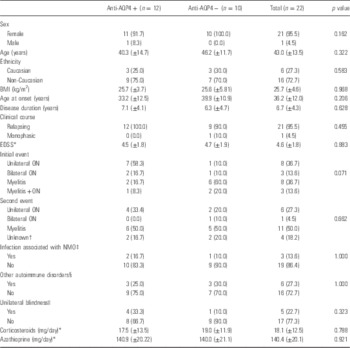
The demographic and clinical characteristics of the NMO patients evaluated in the present study did not differ according to their anti-AQP4 serological status (Table 1). The majority were women (95.5%) and non-Caucasians (72.7%). The mean age of the patients was 43.0 (13.5) years, the mean age at disease onset was 36.2 (12.0) years, the disease duration was 6.7 (4.3) years, and the EDSS mean was 4.6 (1.8). The relapsing clinical course was more frequent (95.5%), three (13.7%) patients had infections associated with NMO, such as human immunodeficiency virus type 1 (HIV-1) infection, tuberculosis, and Human herpesvirus type 3 (HHV-3) infection. Moreover, six (27.3%) patients presented other autoimmune disorders.
Demographic and clinical characteristics of patients with neuromyelitis optica from Southern Brazilian population, according to the anti-aquaporin 4 (AQP4) status

Anti-AQP4−, anti-AQP4 negative; anti-AQP4+, anti-AQP4 positive; BMI, body mass index; EDSS, Expanding Disability Status Scale; NMO, neuromyelitis optica; ON, optical neuritis.
* Logarithmic transformation of continuous data was used in the analyses when the variables were not normally distributed or when there was heterogeneity of variance (as assessed with the Levene test).
† Data were missing in four patients.
‡ Human immunodeficiency virus, tuberculosis, and herpes zoster.
§ Hypothyroidism, hyperthyroidism, juvenile idiopathic arthritis, systemic lupus erythematosus, systemic sclerosis, Raynaud’s phenomenon.
|| None of the patients had bilateral blindness. Categorical variables were expressed as absolute number (n) and percentage (%) and assessed by χ2 test or Fisher Exact test (p<0.05). Continuous variables were expressed as mean and±SD. The differences in continuous variables between groups using Student’s t-test.
The seropositivity for anti-AQP4 was obtained in 12 (54.5%) patients. No association was observed between the seropositivity for anti-AQP4 and the disability EDSS (OR: 0.3636, 95% CI: 0.0279–4.742, p=0.852). Moreover, no correlation was observed between the levels of anti-AQP4 and the EDSS (Pearson’s correlation, r= −0.1962, p=0.5410).
Frequency of autoimmune disorders and autoantibodies
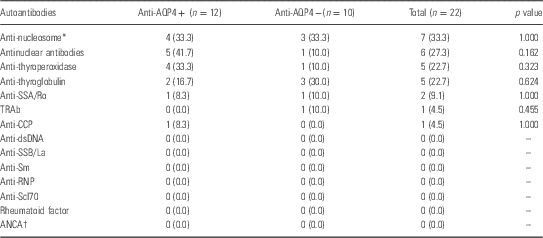
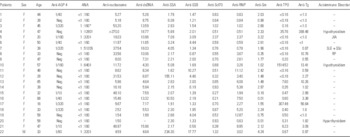
As Table 2 shows, the frequency of autoantibodies did not differ according to the anti-AQP4 serological status of NMO patients. Among them, seven (33.3%) were seropositive for anti-nucleosome antibodies, six (27.3%) for ANA, and five (22.7%) for anti-TPO. The anti-dsDNA evaluated using IFA and ELISA and RF were not detected in all the 22 patients with NMO; ANCA was negative in 21 (95.5%) patients and inconclusive in one (4.5%) patient (Patient 4) that also presented seropositivity for ANA. Anti-CCP was detected in one (4.5%) patient (Patient 18), although in low levels (5.6 U/l). Table 3 shows the serum levels of other autoantibodies of NMO patients that presented other autoimmune conditions. With the frequency of seropositivity for thyroid autoantibodies and the thyroid hormone serum levels, two (9.0%) NMO patients were diagnosed with autoimmune hypothyroidism (Hashimoto thyroiditis) and one (4.5%) with autoimmune hyperthyroidism (Grave’s disease). Other autoimmune disorders observed were JIA (n=1), SLE, and systemic sclerosis (n=1) and Raynaud’s phenomenon (n=1).
Seropositivity for autoantibodies in patients with neuromyelitis optica from Southern Brazilian population, according to their anti-aquaporin 4 (AQP4) status

ANCA, anti-cytoplasmic neutrophil antibodies; anti-AQP4−, anti-AQP4 negative; anti-AQP4+, anti-AQP4 positive; anti-CCP, anti-cyclic citrullinated peptide; anti-dsDNA, antibodies to double-stranded DNA; anti-RNP, anti-ribonucleoprotein antibodies; anti-Sm, anti-Smith antibodies; TRAb, thyroid-stimulating hormone receptor antibodies.
Data were expressed as absolute number (n) and percentage (%) and were evaluated using Fisher Exact test.
* Anti-nucleosome were evaluated in 21 patients.
† One patient had inconclusive ANCA pattern because he was also seropositive for antinuclear antibodies.
Serum levels of autoantibodies obtained from patients with neuromyelitis optica from Southern Brazilian population

ANA, antinuclear antibodies, indirect immunofluorescence assay with HEp2 cells, positive when values ≥1 : 160; anti-AQP 4, anti-aquaporin 4, indirect immunofluorescence assay; anti-dsDNA, anti-double-stranded DNA; anti-RNP, anti-ribonucleoprotein antibodies; anti-Sm, anti-Smith antibodies; anti-Tg, anti-thyroglobulin antibodies; anti-TPO, anti-thyroid peroxidase antibodies; F, female; JIA, juvenile idiopathic arthritis; M, male; age expressed as years; Neg, negative; RP, Raynaud’s phenomenon; SLE, systemic lupus erythematosus; SSc, systemic sclerosis.
* Nucleolar fluorescent pattern.
† Homogeneous nuclear fluorescent pattern.
‡ Speckled nuclear fluorescent pattern.
§ Centromere fluorescent pattern; anti-nucleosome and anti-dsDNA: enzyme immunoassay, positive when values >20 U/ml; anti-SSA/Ro, anti-SSB/La, anti-Smith antibodies (anti-Sm), anti-RNP, anti-Scl70: enzyme immunoassay, positive when values ≥25 U/ml; anti-TPO and anti-Tg were positive when values were ≥5.6 and ≥4.0 IU/ml, respectively.
When the epidemiological, clinical, and laboratorial characteristics of the NMO patients were compared according to their presence or absence of autoimmune disorders, only the presence of antinuclear autoantibodies was more frequent among those with autoimmune disorders (n=4) compared with those without autoimmune disorders (n=2) (χ2 test, p<0.05). When the NMO patients with seropositivity for, at least, one autoimmune antibody (n=18) were compared with those without autoantibodies (n=4), difference was not observed in the clinical forms of NMO, EDSS, and age at onset of disease (χ2 test, p>0.05); however, NMO patients with autoimmune antibodies showed a trend towards higher frequency of unilateral optical neuritis (ON) when compared with those without seropositivity for the autoantibodies (χ2 test, p=0.059).
Discussion
The main finding of the present study was that autoimmune thyroid diseases were the most frequent autoimmune disorder among the NMO patients, followed by SLE with systemic sclerosis, JIA, and Raynaud phenomenon. This result underscores that autoimmune thyroid diseases are the most common autoimmune diseases associated with NMO (Reference Wingerchuk and Weinshenker16), such as Graves’ disease, benign thyroid tumours, and Hashimoto’s thyroiditis (Reference Zhang, Zhong and Wang19). One patient of the present study was seropositive for anti-Tg and anti-nucleosome antibodies and exhibited Raynaud’s phenomenon, which has been described in association with several autoimmune diseases or conditions, mostly autoimmune rheumatic diseases (Reference Kayser, Corrêa and Andrade29). In the present study, three patients were simultaneously seropositive for anti-nucleosome and ANA; and four were simultaneously seropositive for anti-nucleosome and anti-AQP4. The only male patient (Patient 22) showed seropositivity for anti-TPO, ANA, anti-SSA/Ro, and anti-AQP4. One patient (Patient 18) who had HIV/AIDS showed also seropositivity for anti-AQP4.
Among the six patients that showed seropositivity for ANA, five of them were simultaneously seropositive for ANA and anti-AQP4 only one had the diagnosis of SLE and systemic sclerosis, simultaneously. Even though neurologic complications of SLE may occur in up to 75% of patients, transverse myelitis is uncommon, occurring in only 2% of patients (Reference D’cruz, Mellor-Pita and Joven30). In 2007, Birbaum et al. (Reference Birnbaum and Kerr31) reported the first example of positive anti-AQP4 to confirm the diagnosis of NMO in an African-American woman with SLE who had several relapses after NMO spectrum disorders onset. The relationship between SLE and CNS inflammatory demyelinating diseases, such as MS and NMO, has been poorly understood (Reference Wingerchuk and Weinshenker16). In 2011, for the first time it was reported a clinical case of a 62-year-old woman who had relapsing anti-AQP4 positive longitudinally extensive transverse myelitis and developed systemic sclerosis (Reference Franciotta, Zardini and Caporali32). Regarding the JIA, it is a chronic inflammatory disease characterised by chronic synovitis, and sometimes associated with extra-articular manifestations, mainly fever, rash, pericarditis, and uveitis. JIA has been reported in patients with other autoimmune diseases, such as thyroid and coeliac diseases (Reference Mihailova, Grigorova and Vassileva33–Reference Stagi, Giani, Simonini and Falcini35). In the present cohort, one NMO patient had JIA, a rare overlapping autoimmune condition, reported also in a cohort of NMO-IgG seropositive children (Reference Mckeon, Lennon and Lotze36).
We also found that the epidemiological, clinical, and laboratory features of the NMO patients did not differ significantly between the anti-AQP4 status, presence of autoimmune disorders, as well as the seropositivity of autoantibodies showed by the NMO patients. Divergent from our results, previous study showed that anti-AQP4 IgG seropositive NMO differs clinically and epidemiologically from seronegative disease: strong predominance in women, more severe clinical attacks, higher spinal cord lesion load, and frequent association with coexisting autoimmunity (Reference Jarius, Ruprecht and Wildemann37).
The epidemiological, clinical, and immunological characteristics of the patients with NMO of the present cohort are consistent with previous studies carried out in different population worldwide, such as to be more frequent among women, non-Caucasians, and higher age at onset of disease than the observed among the Brazilian MS cohorts (Reference Kallaur, Oliveira and Simão38,Reference Lana-Peixoto39), as well as other cohorts (Reference Jarius, Ruprecht and Wildemann37,Reference Flanagan, Cabre and Weinshenker40,Reference Rivera, Kurtzke, Booth and Corona41). The population of the present study showed that a female : male ratio was 21 : 1. This value is much higher than that reported previously (Reference Jarius, Ruprecht and Wildemann37,Reference Flanagan, Cabre and Weinshenker40). The sample of NMO included in the present study corresponded to the entire cohort of the NMO patients attended at the regional reference neurological outpatient clinic and this female preponderance may underscore that female sex hormones are able to affect B cell biology and thus enhance the possibility of autoantibody production (Reference Grimaldi42). Moreover, gender may determine whether NMO follows a relapsing or monophasic course with an association between female and the relapsing course (Reference Wingerchuk43).
The relapsing clinical course was more frequent (95.5%) among the patients of the present study, in agreement with previous reports, which is more commonly in women and associated with older age at onset, longer time interval between index events, less severe motor impairment with the first myelitis attack, and with the presence of systemic autoimmunity (Reference Asgari, Owens, Frøkiaer, Stenager, Lillevang and Kyvik11,Reference Matà and Lolli44).
The present study demonstrated that the seropositivity for anti-AQP4 was 54.5%, smaller than the frequency of 64.3% obtained in a Brazilian sample of 28 patients with NMO (Reference Adoni, Lino, Marchiori, Kok and Callegaro45). NMO patients that do not have detectable levels of NMO-IgG may represent a group for which AQP4 is not the target antigen for autoantibody. Other CNS antigens such as the Kir4.1 present on astrocytes might be targets for autoantibodies in those NMO patients. It is possible that there is a unique and rare specificity of NMO-IgG that is particularly pathogenic but that cannot be detected by current diagnostic techniques (Reference Graber, Levy, Kerr and Wade46).
The lower seropositivity of anti-AQP4, as well as for other autoantibodies obtained in the present study compared with those previously described could be explained by the prednisone treatment of the NMO patients. The patients of the present study had no relapses during the research and were treated with prednisone in association with azathioprine or mycophenolate mofetil. There is evidence that anti-AQP4 levels are reduced in patients under immunosuppressive treatment and without relapses (Reference Takahashi, Fujihara and Nakashima47,Reference Jarius, Aboul-Enein and Waters48). On the other hand, Jarius et al. (Reference Jarius, Aboul-Enein and Waters48) observed that anti-AQP4 antibodies were detected during remission as well as during relapses, both in untreated NMO patients and in patients under immunosuppressive treatment, suggesting that this antibody can be of diagnostic importance independently of treatment status or disease activity.
The lack of anti-AQP4 IgG seropositivity in a subset of NMO patients suggests that the myelitis and ON can be caused by other mechanisms, such as connective tissue disorders (Reference Jarius, Jacobi and De Seze7), paraneoplastic disorders (Reference Jarius, Paul and Franciotta13,Reference Ducray, Roos-Weil and Garcia49), or infectious diseases, providing strong evidence in favour of the hypothesis of NMO being aetiopathogenetically heterogeneous (Reference Brusse and Tijssen9).
In the present cohort, 13.6% NMO patients presented infections that preceded the NMO onset, such as tuberculosis, HIV-1, and HHV-3 infections. These results were in agreement with previous studies (Reference Silber, Willcox, Bowen and Unger50,Reference Sridhar, Chan and Yuen51). NMO following pulmonary tuberculosis has also been reported (Reference Silber, Willcox, Bowen and Unger50) and these authors suggested that the close temporal relationship to pulmonary tuberculosis is not coincidental and the syndrome is most likely due to an immune reaction to tuberculosis rather than the use of anti-tuberculosis medication. Mycobacterium tuberculosis surface antigens may trigger the formation of cross-reactive antibodies against AQP4 (Reference Sridhar, Chan and Yuen51).
NMO without an identified cause can be seen in the course of HIV infection, even at an early stage of the disease, before immunosuppression occurs. Optic neuritis can occur in patients infected with HIV and the role of HIV itself is now well established. Intramedullar involvement in the course of HIV infection may result from HIV itself (vacuolar myelopathy) (Reference Blanche, Diaz, Goert, Sicard, Rivoal and Brezin52). Moreover, several different types of herpes infections, such as HHV-3 and HHV-5 or cytomegalovirus have been reported in patients with apparent NMO (Reference Machado, Amorim, Rocha, Pereira, Lourenço and Pinho53).
Limited information exists about treatment of NMO in patients with infectious diseases, such as tuberculosis and HIV infection. A clinical trial conducted in Chinese NMO patients demonstrated a marked beneficial effect of anti-tuberculosis treatment on the course of patients with steroid refractory NMO (Reference Feng, Guo, Huang, Chen, Sun and Liu54). These authors showed that anti-tuberculosis treatment may lead to the recovery of important neurological functions and all our patients responded positively to therapy. EDSS score and visual acuity improved and abnormalities in the spinal cord, observed by magnetic resonance imaging (MRI), markedly decreased over time. Anti-tuberculosis treatment also significantly reduced the rate of relapse. With the advent of the highly active antiretroviral therapy, immunosuppressants once strictly contraindicated in HIV positive individuals are now attempted, especially in those less immunocompromised (Reference Feng, Guo, Huang, Chen, Sun and Liu54–Reference Salazar, Cerghet, Shad and Markowitz57).
Taken together, the results of the present study underscored that the NMO patients present high frequency of autoimmune disorders and autoantibodies against cellular antigens. Further studies with large number of NMO patients may contribute to improve our understanding of the NMO pathogenesis and the coexisting autoimmunity.
Acknowledgements
The authors thank the patients and the University Hospital of State University of Londrina for technical and administrative supports. Authors’ Contributions: W.L.C.J.P.: conceived and designed the study, enrolled and attended clinically the patients, acquired clinical data, interpreted the results, drafted and revised the manuscript, and gave final approval for the version to be published; E.M.V.R.: conceived and designed the study, interpreted the results, drafted and revised the manuscript, and gave final approval for the version to be published; A.P.K., S.R.O.: acquired demographical, epidemiological, and clinical data, collected and processed the blood samples of the patients, and gave final approval for the version to be published; M.A.B.L., D.F.A., T.F.: acquired laboratory data, performed the laboratory tests, and gave final approval for the version to be published; A.N.C.S.: conceived and designed the study, performed the statistical analysis, interpreted the results; and gave final approval for the version to be published; L.J.V.S., P.R.V.P.R.: enrolled and attended clinically the patients, acquired clinical and imaging data, and gave final approval for the version to be published; D.R.K.-M.: attended the patients, interpreted the imaging data, revised critically the manuscript for important intellectual content, and gave final approval for the version to be published.
Financial Support
The study was supported by Coordination for the Improvement of Higher Level of Education Personnel (CAPES) of Brazilian Ministry of Education; Institutional Program for Scientific Initiation Scholarship (PIBIC) of the National Council for Scientific and Technological Development (CNPq), and State University of Londrina (PROPPG).
Conflicts of Interest
None.