During the millennium prior to European contact, Native North American peoples created societies organized at high levels of sociopolitical complexity. Two sites that portray this complexity are the Mississippian city of Cahokia (ca. AD 1050–1350) and the Ancient Puebloan center at Chaco Canyon (ca. AD 800–1180). The monumental developments at these centers and their influences across large, ideologically unified regions suggest integrated cultural systems that required members of smaller diverse communities to view themselves as belonging to a larger group. At both Cahokia and Chaco, leaders developed parallel social practices to facilitate the scale of coordination needed for these societies to function, including shared belief systems with associated ritual practices and the construction of ideologically laden built environments (e.g., Pauketat Reference Pauketat2013; Van Dyke Reference Van Dyke2007). Here, I present evidence that gambling was another shared technology involved in the creation and perpetuation of ancient North American cultural systems.
Following DeBoer (Reference DeBoer2001), I draw attention to the importance of Native American gaming traditions for interpreting the archaeological record, and I posit that gambling was another mechanism employed at both Cahokia and Chaco Canyon to integrate diverse communities, perform religious ideologies, and circulate/accumulate material goods, labor, and social status. While the sociopolitical importance of the chunkey gameFootnote 1 at Cahokia is known (e.g., DeBoer Reference DeBoer1993; Pauketat Reference Pauketat2004), there has been little discussion of gambling at Chaco Canyon, even though there is extensive evidence in material culture and oral traditions for its presence and importance.
I begin with a discussion of gambling among Native North American societies and other human groups to show how these practices have important social and economic roles in contrast to the Western view of gambling as a recreational activity of limited significance. Next, I introduce Chaco and specific ways that models of its cultural dynamics are enriched by showing how gaming and gambling brought communities together for social and economic exchanges, manifested ritual power, and allowed elites to acquire status.
Finally, I present evidence of gambling at Chaco Canyon from material culture and oral traditions. Following a recent trend in Chaco research that draws on museum collections and archives to achieve new interpretations (e.g., Plog and Heitman Reference Plog and Heitman2015), I offer a description and typological classification of 471 artifacts in museum collections and archives from Pueblo Bonito and other sites in Chaco Canyon that I suggest were used as gambling implements. As an additional form of evidence, I summarize oral traditions concerning a figure known as The Great Gambler related by numerous Navajo individuals over the past 100 years. The stories describe a superbly skilled, tyrannical gambler who defeated the people of Chaco Canyon and the surrounding region in gambling matches, enslaved them, and forced them to build Great Houses. The case study of Chaco, in tandem with the evidence of gambling from Cahokia, provides robust support for the importance of gambling in creating and maintaining social complexity in Native North American societies.
A Cross-Cultural Review of Gambling's Sociopolitical, Ceremonial, and Economic Aspects
DeBoer (Reference DeBoer2001) argues that gambling was an important mechanism of economic exchange in ancient North America. I elaborate upon his work by drawing upon Native American and worldwide ethnography to suggest various social, economic, religious, and political functions for gambling. Since this paper uses Chaco Canyon as a case study, I emphasize historic Pueblo ethnographic accounts of gaming and gambling.
Gambling as Social Technologies of Integration
Gambling can facilitate interactions among diverse individuals, allowing them to come together to exchange information, goods, and marriage partners and to foster a larger group identity. Gambling's characteristics make it an excellent mechanism for transcending social distance: it is exciting, addictive, and does not require players to speak the same language. DeBoer (Reference DeBoer2001:233) draws on Flannery and Cooper's (Reference Flannery and Cooper1946) pioneering study of the Gros Ventre hand game to conclude that “gambling was above all an intervillage and often intertribal activity” that was common across the North American continent, especially at gatherings where groups of people who rarely saw each other came together annually, such as the Ute and Maidu Bear Dances. In the American Southwest, Parsons (Reference Parsons1996:10) states that games and racing matches are one of the few instances of “intertown cooperation” among the Pueblos. Furthermore, gambling was “rampant” at historic Plains Indians trading festivals where goods, marriage partners, and ideas flowed among groups (Wood Reference Wood, Wood and Liberty1980:106).
Some scholars extend gambling's socially integrative function to the archaeological past. Large-scale chunkey games hosted at Cahokia may have engendered a sense of “common home-team mentality and loyalty” among its thousands of inhabitants, many of whom were immigrants (Pauketat Reference Pauketat2004:86). Janetski (Reference Janetski2002) argues that bone gambling pieces at Fremont sites are evidence of gambling fairs where populations congregated and exchanged goods. Indeed, Chaco's contemporary regional system in the Southwest, Hohokam, is also thought to have been integrated through “ball court ceremonialism” (i.e., gaming and associated trade festivals) during the Colonial and Sedentary periods (ca. AD 700–1100; Abbott et al. Reference Abbott, Smith and Gallaga2007).
While gambling can be an effective strategy for integrating diverse groups, it can also create tensions (discussed below). Ethnographically, Native American peoples were hesitant to play and win money from others living in their same village, and games with higher stakes were played between less-related social units given the potential for the results to cause conflict (DeBoer Reference DeBoer2001:233).
Gambling and Religion
Gambling games combine chance and skill to varying degrees, such that the outcome of a match is unpredictable and unknown. It is not surprising, therefore, that an association would develop between gambling practices that allow participants to intimately engage with forces of “chance,” “luck,” or “divine favor” and unpredictable aspects of the natural world such as patterns of rainfall.
Behaviors associated with gambling events are often highly ritualized. A classic example of the role of magic and ritual in gambling in the modern Western world comes from Henslin's (Reference Henslin1967) fieldwork playing craps with St. Louis taxi drivers. The players were convinced of their ability to control the outcome of dice rolls, either by throwing them lightly, rubbing them, or verbally commanding them. Similarly, Stevenson (Reference Stevenson1903:487) observed that even the “professional” gamblers of Zuni Pueblo were sure to pray to the Twin War Gods and breathe onto their reed dice before throwing them.
Numerous ethnographic Pueblo games were ceremonial “doings” related to divination, suggesting that these practices allowed participants to relate to (and perhaps intervene in) the chaotic natural world. At Zuni Pueblo, the hidden ball guessing game was played to forecast both wars and weather patterns (Culin Reference Culin1975:374). At times, two clans played against each other, one of which represented wind (dry conditions) and the other water (fertility), with the winners determining the locations where corn would be planted: “deep and in well-watered places if the wind men won or throughout various stages of the game ‘carried the luck’” (Frank Cushing, quoted in Culin Reference Culin1975:375). Similarly, the Zuni dice game sho’-li-we was considered “a sacred tribal process of divination,” that at one point was “exclusively a game of war divination. . . accompanied by. . . gambling” (Frank Cushing, quoted in Culin Reference Culin1975:215).
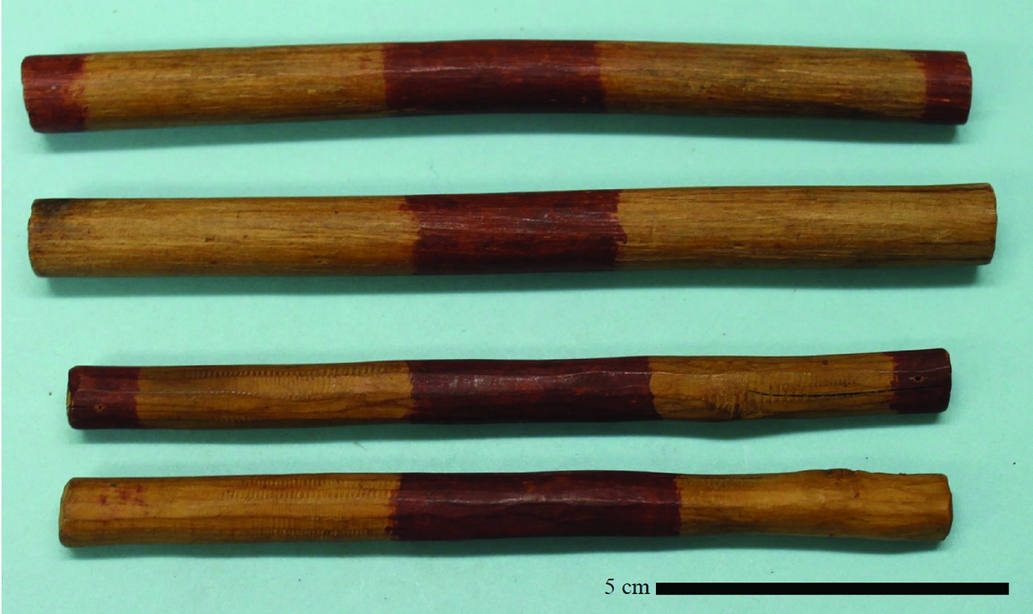
Another central theme of Puebloan gaming is its association with rain-making, rain being of crucial importance to agriculture in the American Southwest yet highly variable. Zuni kick-stick races, which involved players flinging a stick using the top of the foot (see Figure 1) without touching it with their hands, began in spring near planting time and continued until the summer solstice (Hodge Reference Hodge1890:227; Parsons Reference Parsons1996:821; Stevenson Reference Stevenson1903:469). The first races were associated with rain-making, with teams comprised of members of different kivas and clans (Hodge Reference Hodge1890:227; Parsons Reference Parsons1996:821; Stevenson Reference Stevenson1903:470, 473). At Zuni, “[t]he forward kicking of the stick. . . [is linked to] the way the rainwater from summer thunderstorms. . . rushes down the arroyo and spreads over the fields” (Washburn Reference Washburn1999:553), and kick-sticks were sometimes left as offerings for kachina rain-spirits “in hope that as those beings race across the sky playing their favorite kick-stick game they will bring rain” (Ellis and Hammack Reference Ellis and Hammack1968:33).
Ethnographic Zuni kick-sticks (catalog no. E069274; Department of Anthropology, Smithsonian Institution; author's photograph).

Dice games and shinny (a type of field hockey) are also connected with bringing moisture in Pueblo culture. Stevenson (Reference Stevenson1903:480) states that “the Ah'shiwanni [Zuni Rain Priests] considered the [sho’-li-we dice] game so efficacious in bringing rains that they organized a fraternity. . . for the express purpose of playing the game for rain.” In 1904, an Acoma man living at Zuni reported that there was an entire Bish-i society dedicated to playing sho’-li-we in kivas during winter (Culin Reference Culin1975:120). The Twin War Gods were often depicted playing shinny, which was associated with fertility and rain-making and usually played in the spring and early summer (Parsons Reference Parsons1996:306, 494, 794). The connection between shinny and moisture is well demonstrated at Isleta Pueblo, where moieties played against each other after opening the irrigation ditch, and women tossed water onto players running past their houses (Parsons Reference Parsons1996:794).
Gambling as Economic Exchange
DeBoer (Reference DeBoer2001:235) writes: “When viewed on a large scale, it would be hard to devise a better suite of conditions for facilitating the rapid circulation of goods, bodies, and information over large areas” than those provided by gambling. Gambling can operate as a strategy of negative reciprocity, that is, an impersonal “attempt to get something for nothing with impunity” (Sahlins Reference Sahlins2004:195). Thus, it is instructive that gambling in Native North America most commonly took place between, rather than within, tribes (DeBoer Reference DeBoer2001:233); it is easier to rationalize “stealing” (via gambling) from people who are socially distant from oneself.
An ethnographic account of the Hadza hunter-gatherers of Tanzania provides an example of how gambling facilitates social integration and economic exchange. During the six months of the dry season, Hadza bands aggregate into camps where “men spend most of their time gambling with one another, far more time than is spent obtaining food” (Woodburn Reference Woodburn1982:442). They play a dice game that, by nature of the two-sided wooden dice, produces unweighted, non-skill-based outcomes that distribute goods in a relatively equal way. Men only bet items made from materials with restricted distributions, such that gambling is “the major means by which scarce and local objects are circulated throughout the country” (Woodburn Reference Woodburn1982:443).
The wagering of substantial amounts of material goods was a common facet of ethnographic Pueblo games. Cushing (Reference Cushing1883:37) describes “vessels, silver ornaments, necklaces, embroideries, and symbols representing horses, cattle, and sheep” bet on the hidden ball game at Zuni, with the winning team awarded these “mountains of gifts from the gods.” Similarly, items bet on kick-stick races at Zuni include blankets, shawls, calico, silk, belts, jewelry, silver, ponies, sheep, goats, and money (Parsons Reference Parsons1996:822); indeed, “all of the possessions of many are staked” (Stevenson Reference Stevenson1903:476; emphasis added).
Recognizing the large quantities of goods wagered in ethnographic Native North American gambling matches, DeBoer (Reference DeBoer1993) has suggested that Cahokian leaders co-opted the chunkey game—often accompanied by unregulated, small-scale gambling in ethnographic contexts—to exert control over this system of exchange. Bets upon chunkey games hosted at Cahokia could have been a mechanism by which surplus provisions and other goods from throughout the Cahokian world were redistributed by a centralized authority.
But gambling in Native North America did not only involve the exchange of material goods; it could also involve transfers of labor, or even individuals who became slaves. Ethnographic accounts of Hopi gambling saw debts paid off by the women of a losing team cooking meals for the winners, or men who lost to women hauling firewood (Parsons Reference Parsons1996:24–25). In an example of more extreme wagers, ethnographic and oral traditional accounts suggest that “enslavement through gambling was a common feature of indigenous North American societies deep into the Precontact period” (Cameron and Johansson Reference Cameron, Johansson and Voorhies2017:274).
Power, Prestige, and Competition through Gambling
While gambling can serve as an integrative strategy aimed at establishing social harmony, it is also an arena for competition, hostility, and the accumulation of social prestige. Gambling stands alongside potlatches as “the most striking picture of these transfers of wealth with the sole purpose of gaining prestige” (Lévi-Strauss Reference Lévi-Strauss1969:56). Of course, who is allowed to gamble in a given game can also affirm inequality. High-stakes gambling matches in which “bets were raised and re-raised until huge amounts of wealth and property were wagered. . .to challenge the prestige of an opponent or outright enemy” were common in Native North America (Binde Reference Binde2005:459; see also Flannery and Cooper Reference Flannery and Cooper1946).
An example of competition between social groups played out through gambling comes from Geertz's (Reference Geertz1973) analysis of the Balinese cockfight as “fundamentally a dramatization of status concerns,” in which matches “activate village and kingroup rivalries and hostilities. . . coming dangerously and entrancingly close to the expression of open and direct interpersonal and intergroup aggression . . . but not quite, because, after all, it is ‘only a cockfight’” (Geertz Reference Geertz1973:437, 440). Similarly, in Mesoamerica and possibly among the Hohokam, ball games involving large-scale wagering served as a form of competition between social groups (McGuire Reference McGuire and Rice1987:105–109).
The competition and hostility fostered by gambling can also manifest physically. Lévi-Strauss (Reference Lévi-Strauss1966:32) points to a widely shared metaphor in North American mythology that “to win a game is to symbolically ‘kill’ one's opponent.” Races and shinny matches at Ohkay Owingeh Pueblo saw “all of the accumulated frustrations and aggressions of the community. . .vented within the space of a very short time” (Ortiz Reference Ortiz1969:110), and ancient Mississippian iconography of “The Birdman” demonstrates an association between defeat in chunkey matches and decapitation (Brown Reference Brown, Reilly III and Garber2007:88–90). The association of various Pueblo games with the Twin War Gods is worth noting in this regard.
This brief review shows that gambling facilitated social integration, was associated with rain-making and divination, allowed for exchange and competition between groups, and led to the accumulation of status and material wealth, and it suggests some of the functions gambling could have performed in Chacoan society.
The Archaeology of Chaco Canyon: A Case Study for Gambling
Chaco Canyon is well known as a center of sociopolitical, economic, and ideological influence throughout the Ancient Puebloan world during the ninth through twelfth centuries. During the eleventh century, monumental, canonical Great House architecture spread throughout 100,000 km2 of the Colorado Plateau in over 150 “outlier” Great House communities that were significant departures from previous and later Ancient Puebloan architecture and community organization. Scholars variously interpret Chaco as a pilgrimage site (Toll Reference Toll and Lekson2006), a concentration of political elites (Lekson Reference Lekson2015; Sebastian Reference Sebastian1992), large domestic pueblos (Vivian Reference Vivian1990), a house society (Heitman Reference Heitman, Heitman and Plog2015), and a center of ritual and cosmology (Renfrew Reference Renfrew2001; Sofaer Reference Sofaer and Lekson2007; Stein and Lekson Reference Stein, Lekson and Doyel1992; Van Dyke Reference Van Dyke2007), though these models need not be mutually exclusive. Here, I present specific ways that the multifaceted practice of gambling can enhance understandings of social integration, ritualism, economics, and hierarchy at Chaco Canyon.
Social Integration and Ritual Practices
Evidence of ideological unity and economic interdependence across the Chaco World is present in the forms of Great House, Great Kiva, and earthen architecture (Stein and Lekson Reference Stein, Lekson and Doyel1992); shared symmetrical, hachure design patterns on ceramics (Washburn Reference Washburn2012); and the seemingly one-way importation of goods into Chaco Canyon (Judge Reference Judge, Cordell and Gumerman1989; Toll Reference Toll and Lekson2006). The ability of Chaco Canyon to establish and maintain social, economic, and ideological linkages with Great Houses communities, and for these communities to maintain ties with one another, was an important aspect of the Chaco Phenomenon (though the nature and degree of such relationships varied [Kantner and Mahoney Reference Kantner and Mahoney2000]). For example, individuals in outlier communities would likely have needed to seek mates in long-distance networks for their villages to be demographically viable (Kantner and Kintigh Reference Kantner, Kintigh and Lekson2006:174).
Ritual as monopolized by leaders at Chaco Canyon and practiced in Great Houses and Great Kivas is often cited as the mechanism uniting the Chaco World (e.g., Judge and Cordell Reference Judge, Cordell and Lekson2006; Van Dyke Reference Van Dyke2007). The rituals of gaming and gambling between outlier communities, or between outlier communities and groups from Chaco, would have given people who may not have spoken the same language a way to interact and make social connections, exchange goods and information, meet marriage partners, and feel a general sense of connectedness as participants in the Chaco “Big Idea” (Stein and Lekson Reference Stein, Lekson and Doyel1992) or “Dream” (Renfrew Reference Renfrew2001).
Furthermore, ceremonial gambling matches related to rain-making and divination (as known ethnographically among the Pueblos) may have been a ritual vehicle through which Chacoan religious ideology was performed, participated in, and reproduced. Perhaps taking part in ceremonial games at Chaco Canyon, even by losing and thereby “offering” one's goods, labor, or personal freedom, was understood as a righteous undertaking in Chaco as “the place of renewal, the home of the ancestors, [and] the center place around which all in life revolved” (Van Dyke Reference Van Dyke2007:132). The ability to repeatedly win gambling contests, or the outcomes predicted by divinatory games, in fact, occurring, could indicate magical potency and divine favor, providing a possible avenue through which Chacoan leaders demonstrated a special capacity to connect with and influence natural forces.
Economics
Scholars have puzzled over the fact that the inhabitants of Chaco Canyon imported many goods from long-distance networks with little evidence for a corresponding export, aside from possibly turquoise (Judge Reference Judge, Cordell and Gumerman1989), Mesoamerican exotica (Lekson Reference Lekson2015), or compelling religious experiences (Renfrew Reference Renfrew2001). The degree to which Chaco Canyon was a favorable location for maize agriculture remains contentious (e.g., Benson Reference Benson2011, Reference Benson2016; Geib and Heitman Reference Geib, Heitman, Heitman and Plog2015; Tankersley et al. Reference Tankersley, Dunning, Thress, Owen, Huff, Fladd, Bishop, Plog, Watcon, Carr and Scarborough2016), raising questions about the mechanism by which Chacoans acquired important goods.
Over half the utilitarian corrugated wares in the canyon came from the Chuska Mountains, 90 km away (Toll Reference Toll and Lekson2006:125), along with significant quantities of Narbona Pass Chert (Toll Reference Toll and Lekson2006:128) and some maize (Benson et al. Reference Benson, Cordell, Vincent, Taylor, Stein, Farmer and Futa2003). The ~240,000 high-elevation timbers used in Great House construction were also brought 75 km from the Chuska, San Mateo, and Zuni Mountains (Guiterman et al. Reference Guiterman, Swetnam and Dean2016). The ~600,000 pieces of turquoise accumulated at Chaco came from a minimum of 200 km away, as well as from more distant sources in Nevada (Hull et al. Reference Hull, Fayek, Mathien and Roberts2014). Additionally, numerous items of Mesoamerican origin, including scarlet macaws, cacao, and copper bells, were uncovered in the canyon (Lekson Reference Lekson2015).
Gambling provides a potential mechanism by which goods, labor, and people were exchanged, circulated, and accumulated at multiple scales at Chaco Canyon, from small, informal exchanges to high-stakes wagering between groups of greater social distance. The movement of goods via various kinds of gambling will produce multiple archaeological signatures: for example, the redistribution of goods in a relatively equal way (Hadza-type dice games), or large accumulations without a “corresponding export” (prestige and/or “tribute” gambling).
Describing the lack of clear evidence for exchange between Chaco outlier communities, Kantner and Kintigh (Reference Kantner, Kintigh and Lekson2006:173) write: “if one group was bringing in surplus maize. . . it apparently got nothing in return,” a situation that fits well with what would be expected from gambling and negative reciprocity. On the other hand, perhaps large-scale games at Chaco Canyon gatherings were not true competitions, but rather cloaked forms of tribute resulting in the seemingly one-way “importation” of goods there. Pauketat (Reference Pauketat2004:86) has proposed a similar “home-team advantage” scenario for chunkey games at Cahokia, with “the transfer of winnings being a ceremonious but foregone conclusion.” Finally, Chacoan leaders also may have employed gambling to manage the redistribution of monopolized Mesoamerican exotica as highly valued prestige symbols and ceremonial objects within the Chaco world, much as the Hadza use chance-based gambling to circulate desirable goods with restricted geographical distributions.
It is also important to note Cameron and Johansson's (Reference Cameron, Johansson and Voorhies2017) discussion of enslavement through gambling alongside Cameron's (Reference Cameron2013:224–225) recent work investigating the possibility of captives at Chaco. The wagering of labor and/or slaves as repeatedly described in Navajo oral traditions of the Great Gambler at Chaco Canyon (discussed below) may also have been a means of acquiring the enormous amount of labor necessary to quarry stone, mix mortar, carry timbers from distant mountains, and complete other tasks of Great House construction.
Power, Prestige, and Competition
Multiple lines of evidence point toward sociopolitical complexity and hierarchy in Chaco Canyon during the Bonito phase (AD 850–1140). Most commonly cited is the labor and organizational effort needed to construct and maintain multistoried Great Houses with ordered canons of design (Lekson Reference Lekson2015:11; Sofaer Reference Sofaer and Lekson2007), the ability to control long-distance procurement networks, and the existence of a matrilineal dynasty at Pueblo Bonito (Kennett et al. Reference Kennett, Plog, George, Culleton, Watson, Skoglund, Rohland, Mallick, Stewardson, Kistler, LeBlanc, Whiteley, Reich and Perry2017). Some archaeologists interpret the existence of single-story unit pueblos on the south side of Chaco Wash with the simultaneous presence of monumental Great Houses on the north side as evidence of socially distinct populations within the canyon (e.g., Sebastian Reference Sebastian1992; Vivian Reference Vivian1990). This architectural dichotomy is also reflected in burials, with human remains from Pueblo Bonito demonstrating better health, larger stature, and more lavish grave goods than those at small sites (Akins Reference Akins1986:132, 135–136). Other archaeologists point to two middle-aged men interred in Pueblo Bonito's Room 33 with 20,000 pieces of turquoise, multiple conch shells, and other members of the same matrilineal line as the remains of elites themselves (Kennett et al. Reference Kennett, Plog, George, Culleton, Watson, Skoglund, Rohland, Mallick, Stewardson, Kistler, LeBlanc, Whiteley, Reich and Perry2017; Plog and Heitman Reference Plog and Heitman2010).
Prestige gambling may have been one way that people accumulated material wealth (e.g., turquoise) and status in the Chaco world, as described in The Great Gambler myth. Perhaps Chacoan leaders mandated that a portion of goods won in gambling contests had to be offered to venerated ancestors, thereby perpetuating the social status of certain individuals and/or the “house” affiliated with their lineage.
The use of gambling to play out conflicts between groups may also relate to the relative lack of archaeological evidence of violence during the Bonito phase in comparison to previous and subsequent periods in Ancient Puebloan history (Lekson Reference Lekson2015:35). Competitive gambling matches hosted in a (possibly neutral) center at Chaco may have acted similarly to Northwest Coast potlatches, where groups fought “with property” rather than physical violence (Benedict Reference Benedict1934:189).
Archaeological Gaming Implements from Chaco Canyon
If gambling were an important cultural practice at Chaco Canyon, one would expect material evidence to be preserved in the archaeological record. Potential gaming artifacts should conform to two expectations: some standardization of form and size (for use in standardized games), and formal similarity with ethnographically known Native American gaming implements. Cahokian chunkey stones, for example, fulfill both criteria. Gaming implements also (but need not necessarily) lack an alternative functional explanation for their form.
There has been little research on possible gaming pieces from Chaco aside from the original excavators’ brief descriptions (but see Gabriel Reference Gabriel1996:Appendix 3; Mathien Reference Mathien1997; Riggs Reference Riggs and Crown2016). Mathien (Reference Mathien1997:Tables 10.6, 10.9, 10.10, 10.12, 10.14–10.24) provides a valuable and comprehensive catalog of bone and stone “gaming pieces,” though she does not consider wooden gaming pieces or the role that gambling may have played in Chacoan society.
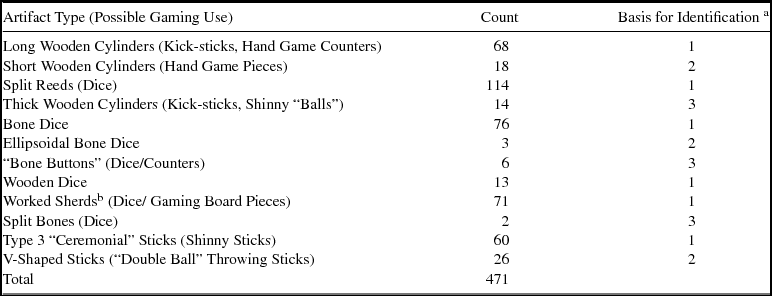
Elsewhere, I provide a description and typological classification of wooden, bone, and reed artifacts recovered from Great Houses and small sites in Chaco Canyon that suggest use as gaming/gambling objects (Weiner Reference Weiner2016:139–165). Since there are over 400 potential gaming implements from Chaco sites (Table 1), I focus here on three artifact types: wooden cylinders (kick-sticks), bone dice, and shinny sticks.
Gaming Artifacts from Chaco Canyon.

a 1 = direct Pueblo/Navajo Indian ethnographic analogy or analogy with Basketmaker examples; 2 = other Native American ethnographic analogy; 3 = no known direct ethnographic analogy, but general analogy.
b See Riggs (Reference Riggs and Crown2016) for a discussion of worked sherd gaming pieces recently excavated from the Pueblo Bonito mounds.
Methods
I queried the database of the American Museum of Natural History (AMNH), the National Museum of Natural History at the Smithsonian Institution (NMNH), and the National Park Service Chaco Museum Collection at the University of New Mexico (National Park Service Chaco Museum 2016) for Chaco Canyon “gaming pieces,” “dice,” “gaming sticks,” and other similar terms. The designation of these artifacts as gaming pieces within museum catalogues is derived from the interpretations of the original excavators, Pepper (Reference Pepper1920) and Judd (Reference Judd1954), both of whom used Culin's (Reference Culin1975) encyclopedic volume Games of the North American Indians. I also draw from Culin (Reference Culin1975) to provide ethnographic North American comparisons for the Chaco objects.
I visited the repositories at the AMNH and NMNH and performed descriptive analysis of all artifacts from Chaco Canyon identified through these searches.Footnote 2 I used calipers to measure the length, width/circumference, and thickness of all possible gaming artifacts returned by the database queries, and also photographed each object. I recorded written notes regarding material, use wear, design elements, shape, and other notable characteristics. Contextual information at the room level was generally available and recorded. In the process of removing objects returned by the database query from the collections cabinets, I encountered other possible gaming pieces and added them to my database.
Wooden Cylinders (n = 68)
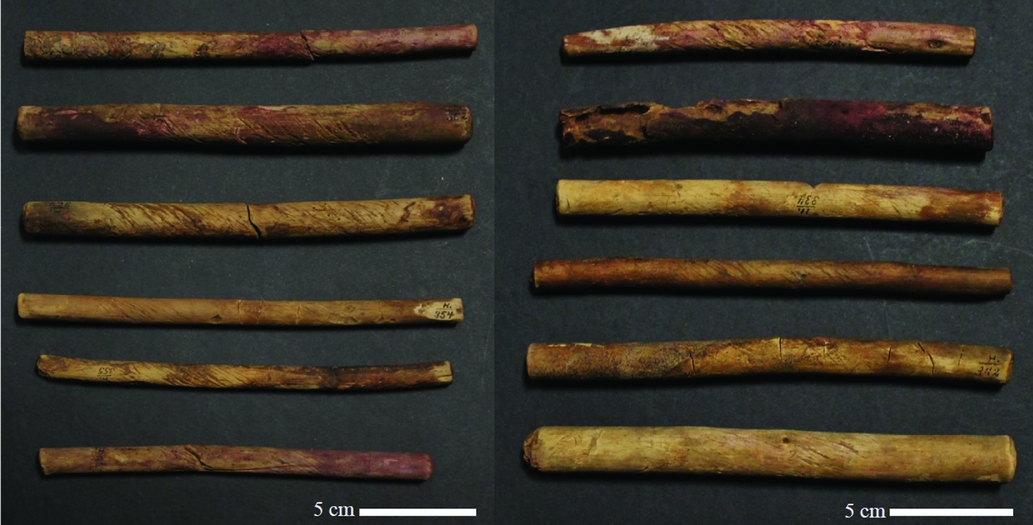
The most common probable gaming artifacts from Pueblo Bonito are cylindrical wooden sticks (Figure 2) showing remarkable consistency in form, measuring on average 19.11 cm in length (σ = 2.68) and 1.34 cm in diameter (σ = 0.26). Fifty-seven of these objects were found in Room 2 of Pueblo Bonito, along with 17 shorter specimens of a similar form (Pepper Reference Pepper1920:35). Room 2 was filled with soil and masonry debris, and the sticks were found “in all parts of the debris. . .lying in all sorts of positions,” suggesting that Room 2’s fill and artifacts had been deposited by the collapse of upper-story rooms (Chaco Research Archive 2017; Pepper Reference Pepper1920: 32, 35).
Long wooden cylinders from Pueblo Bonito (AMNH catalog no.’s H332, H334, H339, H340, H341, H342 H352, H354, H355, H364, H366, H368; author's photograph; Courtesy of the Division of Anthropology, American Museum of Natural History).

Together, short and long “game sticks” account for 30% of the numbered objects recovered from Room 2 (Chaco Research Archive 2017). In association with these sticks were 26 of a different form, which Pepper's Navajo workmen claimed “the Pueblo people formerly used [for gambling]. . . in the same manner as the bone dice” (i.e., rolled on a flat woven “gambling tray”) (Pepper Reference Pepper1920:36). In the same room, Pepper (Reference Pepper1920:36) also found a fragmentary two-rod coil basket with an estimated diameter of 45 cm that he interpreted as a gambling tray. Other goods recovered from Room 2 include arrows and arrowheads, ceramic bowls, yucca sandals, over 700 small stone “chips,” a copper nugget, galena crystals, and rasping stones (Chaco Research Archive 2017; Pepper Reference Pepper1920:36–39). Pepper (Reference Pepper1920:39) interpreted Room 2 as a workshop or storeroom; I suggest this room (and the fallen room above it) may have stored gambling paraphernalia.
Preliminary analysis revealed that the cylindrical sticks were cut from either cottonwood or willow wood (Chuck LaRue, personal communication 2017). The bark and any twigs were removed and their ends smoothed. Many show a reddish-purple discoloration that I first thought was traces of pigment; however, it is more likely the result of a fungus known to prey on wood in the Southwest (Laurie Webster, personal communication 2016). Pepper (Reference Pepper1920:35), after first calling these objects stick dice, felt they were “not marked in any way that would permit their use in such a game,” and he also cites the lack of “chamfering” as detracting from their interpretation as gaming objects. The sticks are in many cases incised with spiral cutmarks that wind around the length of the object, running always downward from the right (see Figure 2).
Pepper (Reference Pepper1920:35) posited that the objects were used to cut buckskin, but numerous points argue against this interpretation. First, not all pieces show cutmarks, and it is unclear why sticks of soft wood, standardized form, and relatively short length would be needed for cutting buckskin or even whether such sticks would provide a better cutting surface than a flat stone. Second, I have not found any ethnographic references to buckskin cut on cylindrical sticks. Third, some ethnographic Zuni kick-sticks were decorated with incised spiraling (Culin Reference Culin1975:Figure 912). Fourth, no buckskin was found in Room 2. Fifth, Room 2 is located in a section of Pueblo Bonito that likely constituted a sacred portion of the site and housed important ritual artifacts and high-status burials (see below).
In fact, these objects show the greatest similarity to the kick-sticks used in ceremonial races at Zuni Pueblo (Figure 1).Footnote 3 Culin (Reference Culin1975:682–683) lists measurements for five sets of kick-sticks from Zuni averaging 11.81 cm in length (σ = 0.80) and 1.80 cm (σ = 0.29) in diameter. It is of interest, given the associations of kick-stick races with moisture, that both cottonwood and willow trees (from which the Chaco sticks were cut) grow alongside rivers and are associated with water in Pueblo culture, and cottonwood was used ethnographically to craft kick-sticks (Benedict Reference Benedict1935:99; Parsons Reference Parsons1996:274).
Bone Dice (n = 76)
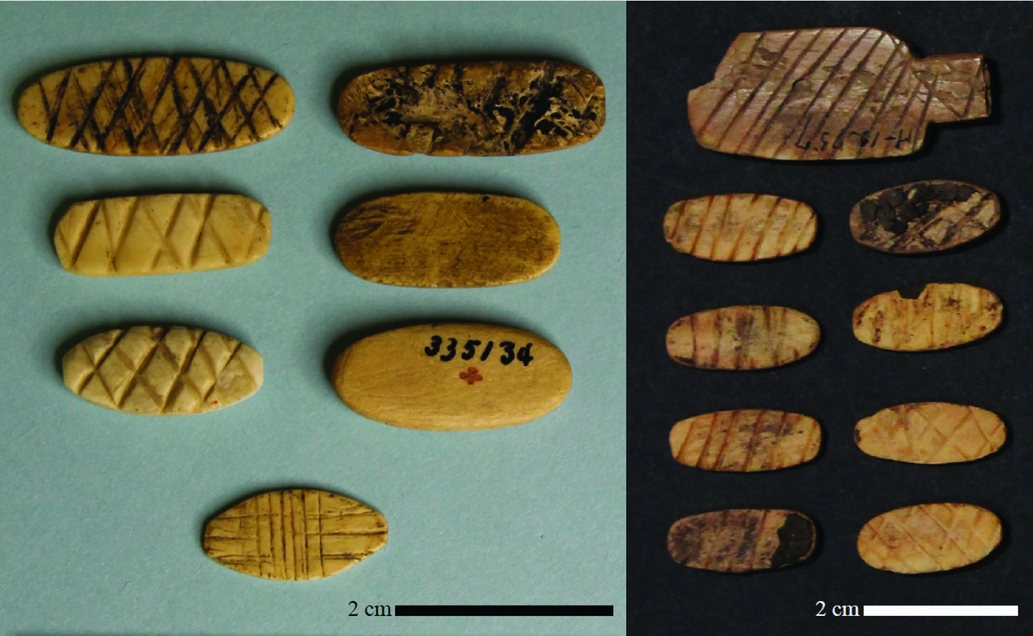
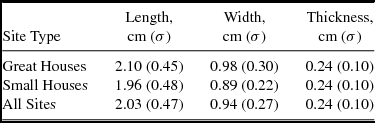
Ovoid and rectangular worked bone dice occur in sites throughout Chaco Canyon, including the Great Houses of Pueblo Bonito, Peñasco Blanco, and Pueblo del Arroyo, as well as small sites (Figure 3; Table 2). The pieces from Pueblo Bonito were scattered throughout different rooms and were not deposited as sets (see Figure 4). Specific find contexts for the 12 Peñasco Blanco bone dice are not available, so they cannot be ruled out as having been found as a set.
Bone dice from Pueblo Bonito (left) (catalog no.'s A335126, A335132, A335134; Department of Anthropology, Smithsonian Institution; author's photograph), and bone dice from Peñasco Blanco (right) (AMNH catalog no.’s H11706, H12757; author's photograph; courtesy of the Division of Anthropology, American Museum of Natural History).

Average Dimensions of 76 Bone Dice from Chaco Canyon.

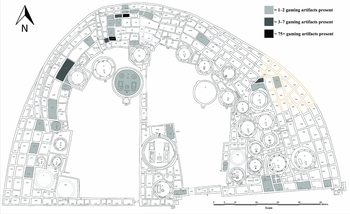
The distribution of gaming pieces throughout Pueblo Bonito. Map courtesy of Richard Friedman.

The average measurements for the 76 ovoid bone dice from AMNH, NMNH, and NPS Chaco Museum are given in Table 2. The overall standardization in size among Chaco's ovoid bone dice is indicated by the low standard deviation values. The average dimensions of both ovoid and rectangular Chaco bone dice conform to a general set of dimensions for prehispanic Four Corners bone dice from the Basketmaker II-III periods, and they also share common decorations (Weiner Reference Weiner2016:129–138). Many of the Chaco bone dice are unmarked on one side and incised on the other, with common motifs of overlapping series of X's, crossing sets of parallel lines, and non-overlapping perpendicular rows of parallel lines (Figure 3).
Bone dice are common in the American Southwest during Basketmaker II-Pueblo II (Chaco-era) times, “but appear to be rare during later [Puebloan] prehistory” (DeBoer Reference DeBoer2001:239), suggesting the intriguing possibility that gambling may have ceased for a time following Chaco's decline. While scholars often emphasize the frequent occurrence of bone dice in Basketmaker II or Pueblo I assemblages, Chaco's specimens (n = 76) are close to the frequently cited large Southwestern bone dice corpora from the Dolores Archaeological Project sites (n = 100) or Talus Village (n = 97; for discussion, see Weiner Reference Weiner2016:131–136, Table 3).
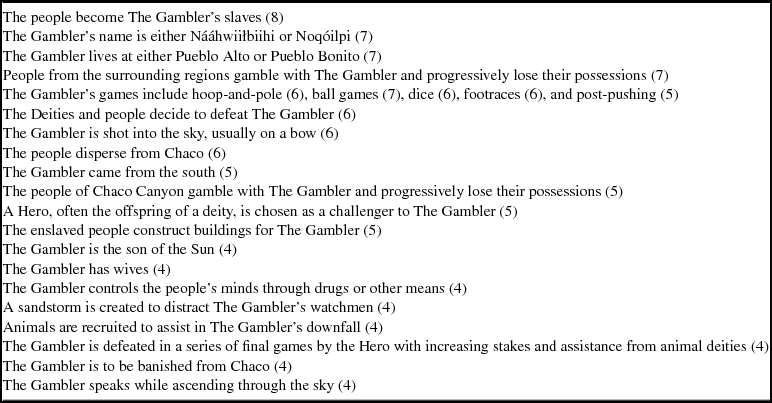
Mythemes Shared across Four or More Versions of The Gambler Story.

Note: Parentheses contain number of versions with this mytheme.
Justification of these artifacts as gaming pieces does not seem necessary given the common identification of such objects as dice within Southwestern archaeology and numerous comparative ethnographic examples (e.g., Culin Reference Culin1975:Figure 188). Culin (Reference Culin1975:45) found dice games “existing among 130 tribes belonging to 30 linguistic stocks,” adding that “from no one tribe does it appear to have been absent.”
Type 3 “Ceremonial Sticks” (n = 54) and V-Shaped Curved Sticks (n = 26)
Pepper (Reference Pepper1920:143) found a cache of over 300 wooden “ceremonial sticks” in the northwestern corner of Room 32 (adjacent to Room 33, which held the high-status burials), along with a disarticulated burial, 81 reed arrows, numerous pottery vessels, and carved hematite objects. He classified the sticks into four types. Type 1 sticks, with upper and lower knobs on one end, resemble canes wielded as authority symbols in Pueblos. Type 2 sticks have “the end carved in the shape of a bear claw,” Type 3 “has the end flattened in the shape of a broad spatula,” and Type 4 “has a wedge-shaped end” (Pepper Reference Pepper1920:143). The possible function of these various “ceremonial sticks” is rarely discussed, though some interpret certain types as “badges of office” (Mills Reference Mills, Preucel and Mrozowski2010:103) or hardwood swords (Lekson Reference Lekson2015:51, note 7).
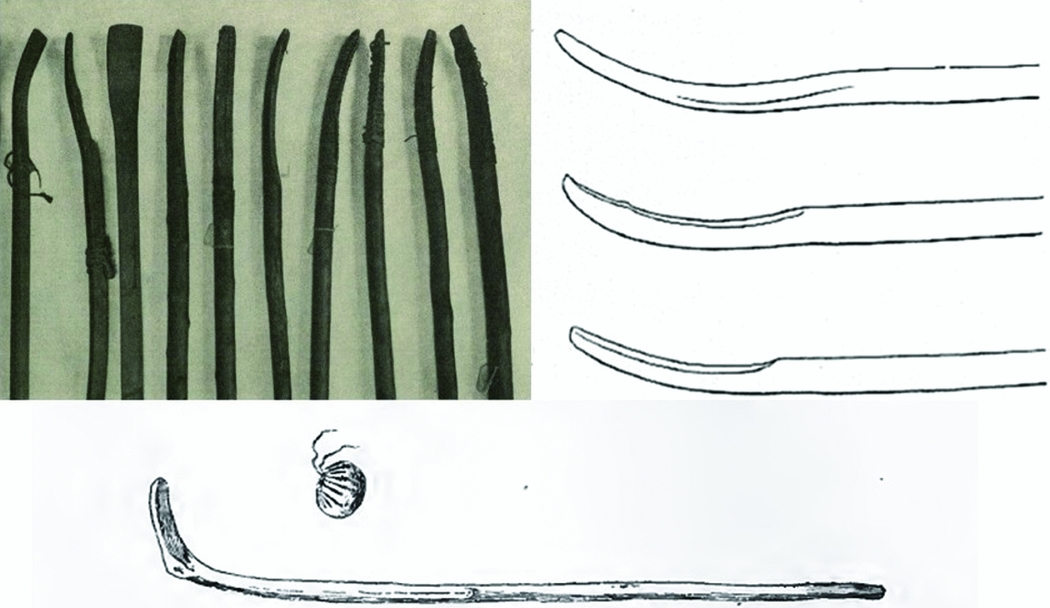
Here, I offer an interpretation of a single class of ceremonial sticks, Type 3, as implements used in shinny games, given their similarity to ethnographically known shinny sticks from Pueblos and other Native American societies. While Types 1 and 2 occur throughout the prehistoric Southwest, Types 3 and 4 are known only from Pueblo Bonito (Judd Reference Judd1954:272), suggesting the possibility that shinny played with Type 3 sticks was restricted to Chaco Canyon.
Pepper found 54 Type 3 sticks in Room 32 and 6 in Room 33 (Pepper Reference Pepper and Stechert1909:206–209; Reference Pepper1920:146). Type 3 sticks are of plano-convex form along their lengths, averaging 1.2 cm in thickness and terminating in a blade-like end averaging 8 cm in length (Figure 5; Pepper Reference Pepper1920:146). The preserved end of one specimen was “almost a counterpart of the small gaming sticks found in Room 2 [long wooden cylinders described above],” such that kick-sticks could have been cut from retired shinny-stick shafts (Pepper Reference Pepper1920:147). Numerous Type 3 sticks are wrapped with cords of yucca, cotton, or buckskin, which Pepper (Reference Pepper1920:146) suggests may have been done to improve grip for use in games. Pepper (Reference Pepper1920:146–147) proposes that Type 3 sticks were used in a divinatory golf-like game known from Zuni Pueblo that was “waged with all the ardor of a battle” and by which “many great events were decided” (Pepper Reference Pepper1920:147).
Type 3 sticks from Rooms 32 and 33 at Pueblo Bonito (top left) and details of their ends (top right) (AMNH Anthropology catalog no.'s H4327, H4301, H4397, H4420, H4422, H4536, H4245, H4243, H4253, H4416, H4217, H4512, and H4418 as represented in Pepper Reference Pepper1920:Figures 58 & 59; Courtesy of the Division of Anthropology, American Museum of Natural History), and a shinny stick and ball from Zuni Pueblo (bottom) (Culin Reference Culin1975: Figures 845).

Also found in association with Type 3 sticks were small V-shaped curved sticks, often with knobbed ends, measuring from 12 to 14.5 cm (Figure 6; Pepper Reference Pepper1920:157–158, Figures 61 and 62). Though no full count is provided, Pepper's (Reference Pepper1920:157) description indicates finding at least 26 of these artifacts. These objects show striking formal similarity to implements used in the Native North American double ball game (Culin Reference Culin1975:667–645; see Figure 6), and Pepper (Reference Pepper1920:157) notes this similarity. In the double ball game, one uses a curved stick to throw two objects attached by a cord.
V-shaped wooden sticks from Room 32 in Pueblo Bonito (left) (AMNH Anthropology catalog no.'s H4477, H4478, H4480, H4490, H4488, H4489, H4481, and H4493 as represented in Pepper Reference Pepper1920:Figure 61; Courtesy of the Division of Anthropology, American Museum of Natural History), and throwing implements used in the double ball game by the Akimel O'Odham (top right), Yurok (middle right), and Maricopa (bottom right) (Culin Reference Culin1975:Figures 870, 880, 882).

Spatial Distribution
Table 1 details the type frequencies of 471 gaming pieces from Pueblo Bonito and other sites in Chaco Canyon, and Supplemental Table 1 provides their find contexts. Figure 4 illustrates the spatial distribution of gaming pieces found in Pueblo Bonito. Most pieces are isolated finds, though two notable exceptions are the caches of Room 2 (57 kick-sticks and 15 hand game pieces) and Room 32 (54 shinny sticks and 26 throwing sticks). Rooms 2 and 32, as well as the densest concentration of rooms containing gaming pieces, are located in Pueblo Bonito's oldest room cluster. Neitzel (Reference Neitzel and Neitzel2003:115) writes that “the presence of the richest burials and largest caches of ritual artifacts in Pueblo Bonito's north-central section strongly suggests that these rooms composed a sacred part of the site” (see also Plog and Heitman [Reference Plog and Heitman2010]). The concentration of gaming pieces in these sacred rooms underscores their significance.
The scattered distribution of other gaming pieces within Pueblo Bonito and other Chaco sites may suggest individual ownership of single dice, possibly as curated Basketmaker heirlooms (H. Wolcott Toll, personal communication 2015). The contrast between large, isolated caches of cylindrical (kick-) sticks and Type 3 (shinny) sticks versus dispersed bone/wooden dice gaming pieces may be evidence of the various levels at which gambling occurred within Chacoan society and restricted access to the implements necessary to play certain games.
The Great Gambler Story
Navajo and Pueblo oral traditions support the notion that gambling was a central cultural practice at Chaco Canyon, and I follow numerous scholars by arguing in favor of combining oral traditions with archaeology to develop a fuller understanding of the past (e.g., Bernardini Reference Bernardini2005; Echo-Hawk Reference Echo-Hawk2000; Ortman Reference Ortman2012; Preucel Reference Preucel2012; Whiteley Reference Whiteley2002).
Here, I describe the general outline of the plot and episodes of the Navajo Gambler story derived from eight versions published over the past 100 years (Begay Reference Begay and Noble Grant2004; Chapin Reference Chapin1940; Goddard Reference Goddard1933; Judd Reference Judd1954; Matthews Reference Matthews1889, Reference Matthews1897; Members of the Rock Point Community Reference Bingham1982; O'Bryan Reference O'Bryan1956; Stein et al. Reference Stein, Friedman, Blackhorse, Loose and Lekson2007; Wetherill and Cummings Reference Wetherill and Cummings1922; Zolbrod Reference Zolbrod1987). While not all the elements described below appear in every version, they are based on the accounts’ most salient themes. Table 3 summarizes a structural comparison of mythemic parallels between eight different versions of the story following the methodologies of Lévi-Strauss (Reference Lévi-Strauss1955) and Vansina (Reference Vansina1985), which supports their derivation from a common source version (Weiner Reference Weiner2016:66–97).
Though not receiving much attention, some scholars of Chaco Canyon have considered the Gambler stories’ archaeological implications (Begay Reference Begay and Noble Grant2004; Cameron Reference Cameron2013:224–225; Gabriel Reference Gabriel1996; Judd Reference Judd1954:251–354; Lekson Reference Lekson2009:200, 331–332n123, Reference Lekson2015:148–149; Stein et al. Reference Stein, Friedman, Blackhorse, Loose and Lekson2007; Windes Reference Windes1987:20–22). Lekson (Reference Lekson2015:149) highlights the “class-structured hierarchy” implied in the Gambler myths, and Begay (Reference Begay and Noble Grant2004:59) suggests that Chacoan society may have been led by “an elite group personified by Nááhwíiłbįįhí [The Gambler]. . . [with] contests between the elites and outsiders from the surrounding region, possibly with a political outcome.” While these and other (Weiner Reference Weiner2016:95–96) intersections between the Gambler myths and Chaco's archaeological past warrant further study, here I simply highlight the stories’ emphasis on gambling as a common undertaking at Chaco Canyon with profound sociopolitical and economic implications.
Navajo stories tell how The Gambler (Nááhwiiłbiihi or Noqóilpi, “He-who-wins-men-at-play”), the son of the Sun, came to Chaco Canyon from the south. He lived at Pueblo Alto and wore a characteristic piece of turquoise jewelry. He was a skilled gambler, and gambled with the people of Chaco. He also introduced addictive, mind-altering drugs to the people. Some of the games he played included hoop-and-pole, dice, a golf-like game, pushing over posts, and footraces. The Gambler always won, and continued to win until the people had gambled away all their possessions. With nothing left to wager, they bet themselves and their family members and eventually became The Gambler's slaves. People from the surrounding regions came and gambled with him. They all lost and eventually they too became his slaves.
The Gambler put the people to work building the Great Houses that now fill Chaco Canyon. Eventually, he aroused the wrath of the Sun, and the deities and the people began to plot The Gambler's downfall. The deities created a Hero to challenge The Gambler. The Hero was made to look identical to The Gambler, and he recruited the assistance of various animal deities to help him defeat The Gambler. The deities created a sandstorm to distract The Gambler's watchmen as the Hero arrived in the canyon.
The Hero then challenged The Gambler to a series of matches. With the assistance of the animal deities, the Hero defeated The Gambler in all the games, with the bets culminating in the Hero winning all The Gambler's slaves and possessions. The people of Chaco decided to banish or kill The Gambler, but the Sun took pity on him and told them to shoot The Gambler into the sky using a magical bow. They shot him up and he landed, in different versions, on the moon or in the south where he came from. As The Gambler ascended into the heavens, he either explicitly stated he would return or implied it by speaking in Spanish or white man's words. The people feared what would happen to them now that the Hero had attained power, but he assured them he was a different sort of person than The Gambler and freed them. The people dispersed from Chaco in the four directions. Eventually, The Gambler returned to the Southwest as the god of the Spaniards/Mexicans.
Keresan Pueblo stories of White House (Kashkahtruutih), a location that both Pueblo people (Ortiz Reference Ortiz and Peck1992) and archaeologists (Lekson and Cameron Reference Lekson and Cameron1995) have linked to Chaco Canyon, are also relevant to the question of gambling at Chaco. One version of the Acoma migration story tells of gambling as a common, ritually important, and problematic undertaking of the people living at White House (Stirling Reference Stirling1942:45–48). Allen (Reference Allen1992:17–18) provides a version of the White House story, told by her Laguna grandmother, that tells how “the men became obsessed and began to gamble away everything . . . neglecting their ritual duties and losing all possessions of value.” It is thus also important to consider the theme of gambling as a symbolic concept employed in descendant oral traditions to describe how Chacoan society became corrupted through the excessive accumulation of power; indeed, the Great Gambler story serves as “the ultimate individual example of societal rot that ate at the culture and beliefs of the Anaasází” among the Navajo (McPherson Reference McPherson2014:123).
The traditional designation of Gambler stories as “Navajo” has probably contributed to the relative lack of attention paid to these stories in Chaco scholarship. Many scholars suggest that an early form of the Navajo language came to the American Southwest through the migration of Dene speakers from Western Canada around AD 1500, approximately 300 years after the Ancient Puebloan migrations away from Chaco Canyon (but see Warburton and Begay Reference Warburton and Begay2005). Apachean populations were present in the Salt Lake City area (Ives Reference Ives, Parezo and Janetski2014) and possibly the Four Corners region (Reed and Horn Reference Reed and Horn1990) by the late 1300s, however, leaving only a century between Ancient Puebloan depopulation of the region and the presence of Apachean populations.
The history of intermarriage, clan adoption, refuge-taking, trade, sharing of maize agriculture and religious principles, and other close interactions between Pueblos and the Navajo over centuries suggest that broad, Western-derived ethnic labels obscure a more nuanced picture of these cultural groups (e.g., Brugge Reference Brugge and Seymour2012; Warburton and Begay Reference Warburton and Begay2005). As Warburton and Begay (Reference Warburton and Begay2005:537) state, not “all Navajo came from all Anasazi [Ancient Puebloans], but. . . some Navajos are descendants of some Anasazis.” Various scholars state that from 20% (Warburton and Begay Reference Warburton and Begay2005:544) to “approximately 40 percent of all Navajo clans claim Pueblo origin” (Towner Reference Towner2003:204). Furthermore, it is significant that six of the eight Navajo individuals who shared versions of the Gambler story belong to one of these Pueblo-derived clans (Weiner Reference Weiner2016: 67–71).
The close social and economic interactions between Pueblo and Navajo peoples across centuries and Pueblo-related clan affiliations of the Navajo informants who shared Gambler stories support the notion that this story has a Puebloan basis. Lekson (Reference Lekson2009:311, note 122) points out that unlike the Pueblos, the Navajo were themselves dwelling in the landscape of sites described in the Gambler story, which may have been kept alive through daily interaction with the locales where the alleged events took place.
Conclusion
In this paper, I have presented evidence from archaeology, oral traditions, and ethnography to augment previous discussions of gambling as an important sociopolitical, economic, and religious practice in ancient Native North American societies using the case study of Chaco Canyon. A tabulation of 471 possible gaming pieces from Chaco, in tandem with Native oral traditions, emphasizes the role of gambling and suggests its presence and importance in the canyon, perhaps especially at Pueblo Bonito. The findings of this paper also support scholars who argue that incorporating indigenous oral traditions enhances archaeological investigations by producing new ways of approaching the archaeological record.
Gambling allows us to consider Chacoan cultural dynamics from the level of a specific practice that drove larger culture processes. From this perspective, dice rolls, shinny games, and kick-stick races between individuals and/or communities (and the skill/chance influencing their outcomes) take on a profound role in the negotiation of power, circulation of goods, and establishment of a monumental center in the eleventh-century American Southwest. In addition, the caching of at least two types of gaming artifact within Pueblo Bonito suggests that the ability to play certain games was restricted in Chacoan society. Whatever individuals or groups controlled gambling at Chaco throughout time—who may have become enshrined in oral tradition as “The Gambler”—would have possessed significant power by regulating a volatile practice with major social and economic consequences.
Gambling's presence at Chaco also lends support to models that suggest gatherings of socially distinct populations within the canyon. Gambling is, according to DeBoer (Reference DeBoer2001:245), “the antithesis of enclosed domestic life,” with matches of high stakes and social significance taking place between (rather than within) villages. Thus, if we are to judge from ethnography, it is most likely that gambling at Chaco and the majority of North American contexts took place between peoples that spent most of the year living apart from each other, a notion that supports pilgrimage models of periodic gatherings at Chaco Canyon. Further research on gaming artifacts from Chaco outliers, however, will help evaluate the role of gambling in Chacoan society.
Finally, while gambling was skillfully employed in perpetuating two of North America's early experiments in social complexity at Chaco and Cahokia, both endeavors ultimately failed and/or were rejected by their ancient inhabitants. The extent to which the demise of these large polities was intertwined with the practice of gambling, and how this might be reflected archaeologically, warrants further study. Nevertheless, gambling persisted in Native American cultures from precontact times through the period of colonization and into the present (both as a traditional practice and in the form of casinos on American Indian reservations), suggesting a complex narrative for gambling in the longue durée of North American history. Continued investigations of gambling's material manifestations in local archaeological traditions, occurrence in Native American oral histories, and relevance for understanding diachronic continent-wide cultural processes is likely to raise the stakes for interpreting the seemingly quotidian gaming piece artifacts of ancient North America.
Acknowledgments
This article is based on research completed at Brown University under the direction of Bob Preucel and John Cherry—dedicated and inspiring advisors of the highest quality. Scott Ortman was a principal mentor, whose guidance was fundamental in developing these ideas. I am very grateful to Rich Friedman for encouraging me to think seriously (and literally) about The Gambler. Anna Sofaer consistently offered creative advice and first suggested a study of Chaco gaming pieces. Cathy Cameron, Wolky Toll, and Marilyn Riggs shared references for which I am grateful. David Hurst Thomas and Anibal Rodriguez at AMNH, James Krakker at Smithsonian–NMNH, and Wendy Bustard at the NPS Chaco Museum graciously supported my collections research, made possible by a grant from the Brown University Dean's Office. I thank the three reviewers who provided helpful feedback leading to a much-improved paper. I was also fueled by positive reception from Tim Pauketat, John Roney, Ed Kabotie, Phillip Tuwaletstiwa, Linda Wheelbarger, Bill Gillespie, Tom Windes, and judges of the 2016 Cordell-Powers Prize Contest. Many colleagues and friends provided feedback on and edited previous drafts. Any errors are my own and do not reflect upon the individuals named above.
Data Availability Statement
The gaming artifacts from Chaco Canyon are stored in the collections of the Anthropology Division of the American Museum of Natural History in New York City, the Museum Support Center of the National Museum of Natural History, Smithsonian Institution in Suitland, Maryland, the Cultural Resources Center of the National Museum of the American Indian in Suitland, Maryland, and the National Park Service Chaco Museum Collection at the University of New Mexico in Albuquerque. Electronic databases listing all known Chaco gaming artifacts and mythemes of the Gambler stories are in the possession of the author and can be made available to qualified researchers on a case-by-case basis.
Supplemental Materials
Supplemental materials are linked to the online version of the paper, accessible at https://doi.org/10.1017/aaq.2017.45.
Supplemental Table 1. Find Contexts of 471 Gaming Pieces from Chaco Canyon.