I. INTRODUCTION
Lithol red, due to its reasonably low price, great tinctorial strength, good working properties, and clean bright hue, was a popular pigment in the early and middle twentieth century. It was used in alkyd resin enamels and lacquers, paper coatings, emulsion paints, polystyrene and amide-based plastics, artists’ materials, colouring plastics (Ash and Ash, Reference Ash and Ash1996), elastomers (Herbst and Hunger, Reference Herbst and Hunger1997), architectural paints, and toy finishes (Alphen, Reference Alphen1998). Under the name lithol red pigment, one can find a family of sodium (PR 49), barium (PR 49:1), calcium (PR 49:2), and strontium (PR 49:3) salts of diazotised Tobias (2-naphthylamine-1-sulphonic) acid coupled with 2-naphthol. The colour of the pigment ranges from yellowish red (sodium salt) to bluish red (strontium salt), depending on the metal cation. The main drawback of lithol red is its very poor lightfastness, which has profound implications for its artistic use. As an example, we can mention Mark Rothko's Seagram and Harvard Murals, painted in the middle of the twentieth century (Standeven, Reference Standeven2008). Nowadays, in cases where brightness, bleed resistance, and low cost are of primary importance, pigments from the group of lithol reds are still used (mainly in the USA) in great quantities in the printing industry.
Sodium salt is the starting compound for production of the other lithol salts by means of a simple ion-exchange process whereby Ba, NH4, Ca, or Sr ions replace the Na ions. This process is inefficient; some Na salt almost always remains. Therefore, it is very difficult to obtain a pure lithol salt. The sodium form is usually present in all of the PR 49 types. This explains the absence of crystallographic characterisations of lithol salts in the PDF files. To date only potassium lithol salt (C20H13KN2O4S, powder diffraction data PDF 46-1638 and PDF 46-1639) is represented in PDF-4+ (ICDD, 2015). However, within the PDF characterisation, only 2θ, interplanar d-spacing and intensities are present. These patterns are not indexed and lattice parameters have not been determined.
II. EXPERIMENTAL
A. Synthesis of lithol salts
1. Synthesis of sodium (E)-2-[(2-hydroxynaphthalen-1-yl)diazenyl]naphthalene-1-sulphonate monohydrate
The sodium lithol salt was prepared by modified literature procedure (Stenger et al., Reference Stenger, Kwan, Eremin, Speakman, Kirby, Stewart, Huang, Kennedy, Newman and Khandekar2010). Initially 2-aminonaphtalene-1-sulphonic acid (8.92 g, 40 mmol) was suspended in a mixture of 160 ml of water and 4.2 ml of concentrated HCl. The mixture was heated to about 90 °C for 30 min and then cooled to 0 °C. To the cooled and vigorously stirred suspension, sodium nitrite NaNO2 (3.1 g, 45 mmol) in 30 ml of water was added dropwise to maintain the reaction temperature as close to 0 °C as possible. Following the addition of sodium nitrite, the reaction mixture was stirred for 20 min and a solution of β-naphthol (6.06 g, 42 mmol) in 100 ml of sodium hydroxide solution (2.4 g, 60 mmol) was added dropwise to maintain the temperature between 0 and 5 °C. After this addition, the reaction mixture was stirred in an ice bath for about 3 h; then the thick suspension was filtered and washed with water and left to dry, yielding 13 g of crude product (86%). For further purification, 2 g of the obtained sodium salt was suspended in 100 ml of distilled water, heated to about 100 °C for 30 min, and then left overnight to cool and settle. The product was then filtered and washed with two 10-ml portions of water and finally with 10 ml of methanol. Following methanol washing, some floating yellow impurities were decanted off. The purified product was dried at approximately 100 °C to yield 1.8 g of pure product (90%). Anal. calcd for C20H13N2NaO4S × H2O: C, 57.41; H, 3.61; N, 6.70; S, 7.66%; found: C, 57.64; H, 3.77; N, 6.66; S, 6.11%.
2. Synthesis of barium (E)-2-[(2-hydroxynaphthalen-1-yl)diazenyl]naphthalene-1-sulphonate trihydrate
The sodium salt obtained in the previous step (500 mg, 1.25 mmol) was added to 75 ml of near-saturated solution of BaCl2 × 2H2O (18.39 g, 75.3 mmol) and heated to about 100 °C for 2 h. At the outset, 5 ml of ethanol was added to increase the solubility and reduce the surface tension of the solution. The suspension was stirred for 3 days and then filtered and washed with two 10-ml portions of water and 10 ml of methanol. Some floating yellow impurities were decanted off during methanol washing. The product was left to dry in the funnel to yield 500 mg of product (90%). Anal. calcd for C40H26BaN4O8S2×3H2O: C, 50.78; H, 3.41; N, 5.92; S, 6.78%; found: C, 50.01; H, 3.45; N, 5.75; S, 6.37%.
3. Synthesis of ammonium (E)-2-[(2-hydroxynaphthalen-1-yl)diazenyl]naphthalene-1-sulphonate monohydrate
Sodium salt (500 mg, 1.25 mmol) was added to 50 ml of ammonium chloride (4.03 g, 75.3 mmol) and heated to about 100 °C for 2 h. The suspension was stirred for 3 days and then filtered and washed with two 10-ml portions of water and 10 ml of methanol. Some yellow impurities floating in the methanol wash were decanted off. The product was dried at about 100 °C, yielding 450 mg of ammonium salt (91%). Anal. calcd for C20H17N3O4S × H2O: C, 58.10; H, 4.63; N, 10.16; S, 7.76%; found: C, 58.14; H, 4.55; N, 10.01; S, 8.06%.
B. Specimen preparation and powder diffraction data collection
X-ray powder diffraction measurements were performed at the Faculty of Chemistry Jagiellonian University, using an X'PERT PRO MPD apparatus, CuKα radiation (λ = 1.541 78 Å) at 40 kV and 30 mA, a diffracted-beam graphite monochromator, and a PIXcel PSD detector in a 2θ range from 5° to 90°, with an interpolated step size of 0.02° [2θ]. The divergence of the incident X-ray beam was 0.25. Prior to each measurement the samples were thoroughly ground and placed from the back side in a sample holder.
III. RESULTS AND DISCUSSION
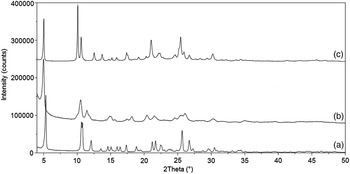
Obtained powder diffraction data (see supplementary material) were elaborated, first with the use of diffractometer software and subsequently with the PROSZKI package (Łasocha and Lewinski, Reference Łasocha and Lewinski1994). Experimental powder diffraction patterns are depicted in Figure 1.
Experimental powder diffraction patterns of the investigated lithol salts. Na lithol red (A), Ba lithol red (B), and NH4 lithol red (C).

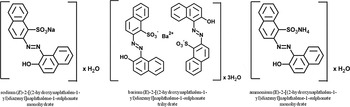
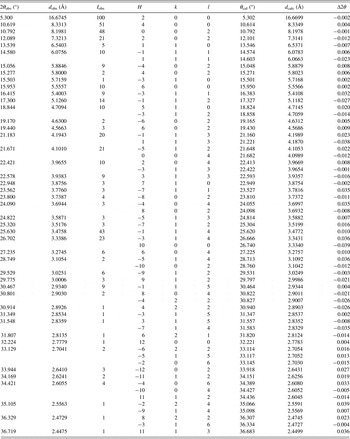
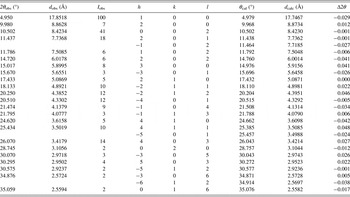
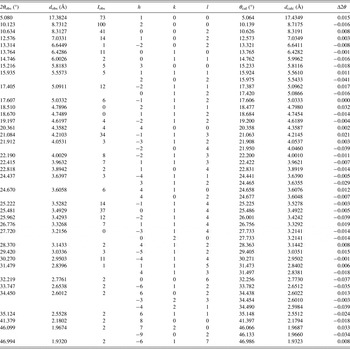
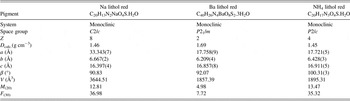
The X-ray powder diffraction data obtained for the investigated compounds are shown in Tables I–III. The crystallographic characteristics and indexing figures of merit (de Wolff, Reference de Wolff1968; Smith and Snyder, Reference Smith and Snyder1979) for all three compounds are collected in Table IV. Figure 2 presents the structural formulas of the investigated compounds.
Structural diagram of the investigated lithol red salts.

X-ray powder diffraction data for sodium (E)-2-[(2-hydroxynaphthalen-1-yl)diazenyl]naphthalene-1-sulphonate monohydrate.

X-ray powder diffraction data for barium (E)-2-[(2-hydroxynaphthalen-1-yl)diazenyl]naphthalene-1- sulphonate trihydrate.

X-ray powder diffraction data for ammonium (E)-2-[(2-hydroxynaphthalen-1-yl)diazenyl]naphthalene-1-sulphonate monohydrate.

X-ray crystal structure data for sodium, barium, and ammonium lithol reds.

The chemistry of lithol red salts turned out to be quite complex (Kennedy et al., Reference Kennedy, Jennifer, Kirkhouse, McCarney, Puissegur, Smith, Staunton, Teat, Cherryman and James2004). Apart from difficulties connected with their preparation using ion-exchange procedures, they are sensitive to the solvents in which the procedure is carried out and usually crystallise in forms containing molecules of solvents in their crystal structures (Stenger et al., Reference Stenger, Kwan, Eremin, Speakman, Kirby, Stewart, Huang, Kennedy, Newman and Khandekar2010). Obtaining pure monophase samples is a demanding task, which is why the results of crystallographic studies of lithol reds are so rarely reported in the literature.
SUPPLEMENTARY MATERIAL
The supplementary material for this article can be found at https://doi.org/10.1017/S0885715617000616.
ACKNOWLEDGEMENTS
The authors are grateful to Professor Philippe Walter from the Laboratory of Molecular and Structural Archaeology, Université Pierre et Marie Curie in Paris, for a fruitful discussion concerning the stability of lithol red pigments, which was the starting point of our interest in the presented research. This study was partially supported by ICDD Grant-in-Aid No. 97-04, 2016/17.