1 Introduction
Studies in syntactic change typically treat change as happening to some abstract object ‘language’. Yet it is individual language users who do the talking and innovate. Innovation, when conventionalized, leads to change (e.g. Croft Reference Croft2000: 166ff). As such, individual language users are, even if they may not generally be aware of it, ultimately also responsible for syntactic change. It is therefore essential that historical syntacticians fully embrace this individual cognitive dimension. While historical sociolinguists have occasionally ventured into intra- and intergenerational grammatical changes in a network of individuals (Fitzmaurice Reference Fitzmaurice, Curzan and Emmons2004; Bergs Reference Bergs2005; Raumolin-Brunberg & Nurmi Reference Raumolin-Brunberg, Nurmi, Narrog and Heine2011, among others), they have generally made use of resources that are quite limited in size, and make it impossible to do quantitative research on incipient stages of change. Linguistic theory has also discussed the importance of the individual dimension to a certain extent. Traugott, in her more recent work (e.g. 2010, this volume) has emphasized the importance of dialogue and the invited inferences typical of spoken language as triggers of syntactic change and grammaticalization. Keller (Reference Keller1994) has argued for the importance of expressivity as a trigger of change in his formulation of the social maxim ‘talk in such a way that you are noticed’. Haspelmath (Reference Haspelmath1999) and Detges & Waltereit (Reference Detges and Waltereit2002) reiterate this with their notions of extravagance and expressivity, and have pointed out that a number of phenomena, such as redundancy or the replacement of short expressions by longer ones (e.g. with a hammer > by means of a hammer), can be directly related to this.
What is still largely lacking is corpus-based research that investigates how this association between grammar and the desire to be noticed is reflected in the changing grammatical behaviour of individuals. The current article addresses precisely this gap (see also Petré Reference Petré2016b) by examining the incipient grammaticalization of progressive [be Ving] in present-tense main clauses in ten seventeenth-century individuals across two generations, and comparing this use to the simple present in contexts where they directly competed. Individuals want to be heard when communicating. But of course, they cannot try to make every single sentence stand out, as this would defeat the very purpose of emphasis. An important challenge in examining innovative language use in historical data from this perspective is how we are to determine when a writer wants their utterance or statement to be particularly noticed and which statements are construed in a more neutral way. When dealing with contemporary data, such a problem has been tackled by established psycholinguistic techniques, or, more recently, by multimodal research that takes into account not only eye-movements but, for instance, also makes use of multiple-angle video recordings (e.g. Brône & Oben Reference Brône and Oben2015). With informants from the remote past, in contrast, the only thing to go on is their written words – yet this information loss may be compensated for by the benefit of data size. Previous studies have compared corpus research and experimental research, and conclude that their findings converge to a certain extent, but also warn against taking corpus evidence as a direct window into cognition (e.g. Arppe et al. Reference Arppe, Gilquin, Glynn, Hilpert and Zeschel2010; see also Gilquin & Gries Reference Gilquin and Gries2009; Gries Reference Gries, Mukherjee and Huber2012). It seems that, since comparison with experimental data is not possible in the case of historical linguistics, corpus linguistics is the only candidate left. Yet I will try in this article to add some ingredients of a more experimental setup to the corpus data (for a different attempt, see De Smet & Van de Velde, this volume), which I will argue help to spot the underlying motivations of historical language users when using a novel construction.
The study is conducted in a constructionist spirit, and the development is considered to minimally involve constructional change and possibly constructional grammaticalization (in the sense of Traugott & Trousdale Reference Traugott and Trousdale2013) if the idea of a ‘new form’ is interpreted broadly as also including phenomena such as the extension to another tense. However, the focus is on the method used, and not so much on the theoretical implications of the findings – although one such implication for coercion is briefly discussed. Section 2 introduces the main hypothesis to be tested, namely that of a correlation between [be Ving] in present-tense main clauses and the signalling of extravagance. Section 3 provides some background information on how progressive [be Ving], i.e. instances of [be Ving] that express states that hold at a single point in time (topic time), extended from mostly being used in past-tense subordinate clauses to present-tense main clauses. In a fourth section, the concrete methodology is developed, which is a corpus-based equivalent of psycholinguistic tests asking participants to choose between two alternatives. The corpus that was used consists of ten prolific authors from the seventeenth century. This section also contains the qualitative analysis of the indices that can be quantified to test the hypothesis: (i) situations in which the authorial voice's referent is directly participating; (ii) adverbials referring to the here and now (adding emphasis); (iii) additional markers of emphasis. The results of the quantitative analysis are presented in section 5, and are further discussed in the concluding section.
2 Hypothesis: extravagance as motivation for innovation
Extravagant linguistic behaviour is selective, and is assumed to be intrinsically connected to the speaker's involvement in the situation referred to (hinted at in Hopper & Traugott Reference Hopper and Traugott2003: 123). Put differently, whenever a speaker feels strongly connected (emotionally) to the contents of their statement, they will want this statement to stand out among other statements by making it somehow more emphatic. Besides conventional means such as intonation and reinforcement by gesturing and other non-verbal means, another way of achieving this is by using unconventional and unexpected language.
Research suggests that [be Ving] in present-tense main clauses was indeed less expected, less familiar than the simple present in the seventeenth century, and was at the time more frequent in past-tense subordinate clauses (see Petré Reference Petré2016a; Wright Reference Wright and Kastovsky1994: 468; Fitzmaurice Reference Fitzmaurice, Curzan and Emmons2004 sees a similar development with so-called ‘subjective progressives’). Starting from this observation, the central hypothesis of this article is as follows:
-
(i) The initial use of [be Ving] in present-tense main clauses was motivated by a desire for making one's expression cognitively more salient, i.e. more noticeable (than its more neutral competitor, the simple present).
The degree of noticeability by the audience cannot be measured on the basis of corpus data. What remains hidden, therefore, is the feedback between audience and speaker/writer, which is most likely a crucial element in the success and further propagation of an innovation. Future research might want to investigate if reflexes of such feedback can be found in corpus data – in the shape of metalinguistic comments, for instance. This study, however, concentrates on the perspective of production. It was proposed that on the cognitive side, emotional involvement is a strong motivation for extravagant linguistic behaviour. This connection leads to the formulation of a second more specific hypothesis.
-
(ii) [be Ving] is expected to be more common (than is the simple present) to refer to situations in which the speaker/writer is directly involved.
Apart from the use of the novel construction itself, it has been noted by Detges & Waltereit (Reference Detges and Waltereit2002) that redundancy is a common linguistic manifestation of extravagant language use, as it makes a statement stand out even more. This assumption may be formulated as the third hypothesis:
-
(iii) [be Ving] is expected to occur more commonly (than the simple present) in conjunction with other markers of emphasis.
Before explaining how these hypotheses can be tested, I will first outline the development of [be Ving] leading up to the situation of the seventeenth century.
3 The run-up: from stative to progressive
The case study I will look into is that of a specific extension of the use of the [be Ving] construction, which, barring some early forerunners, occurred around 1600 (Petré Reference Petré2016a; earlier literature, such as Wright Reference Wright and Kastovsky1994; Fitzmaurice Reference Fitzmaurice, Curzan and Emmons2004, tended to place this development later in time). The specific extension is that of [be Ving] to present-tense main clause contexts, where the construction construes an event as ongoing at the time of speaking, as in the two sentences in (1).
-
(1) ‘Dennis what are you doing?’ ‘I’m eating because I'm very hungry.’
Today the progressive function of [be Ving] is also its main function, but this was not always the case. Petré (Reference Petré2016a) explains how this function developed out of an originally stative one. Indeed, up to the Old English period, [be Ving] was predominantly a member of the group of copular constructions introduced by the copula be , in which the participle behaved like an adjective in both form and function. At this stage, [be Ving] essentially expressed a (temporary) state, as in (2).
-
(2) Wolves are living on the outskirts of Paris, wildlife groups claim.
This original stative meaning remained the basic meaning of the construction throughout Middle English (ME). Apart from stative verbs, other atelic verbs such as activities could also be construed as temporary states. The stative function was also often found in past-tense adverbial clauses that provided some background frame (temporal and/or spatial), during which some foregrounded event took place, which was expressed by the main clause. As this main clause event functions as the focus of the entire sentence, [be Ving] is ‘focalized’ by it (see Killie Reference Killie, Dossena and Dury2008; Petré Reference Petré2016a). Such focalization has the effect that the event expressed by [be Ving] is perceived as ‘in-progress’ at a specific point in time, the so-called ‘topic time’ (Klein Reference Klein1994: 37). A Middle English example is (3).
-
(3) As they were playing togyder, there cam in the olde knyght. (1489)
As argued in detail in Petré (Reference Petré2016a), in Middle English sentences such as (3), the ‘in-progress’ meaning was not yet part of the semantics of [be Ving]. The semanticization of ongoingness can be traced along three stages. The first stage simply consists of the original use, where [be Ving] is essentially limited to stative situations such as (2). Such stative situations are internally homogenous. All temporal phases of the situation are identical. Applied to (2), the alleged habitat of the wolves is the same at time x as it is at time x+1.
Until well into Middle English the stative function remained the primary one. However, Middle English saw a rise of subordinate clauses that provided a background frame to some foregrounded event expressed in the main clause. This rise, and its effects, constitutes the second stage. As [be Ving] was common in such subordinate clauses, its frequency increased along with that rise (see the graph in Petré Reference Petré2016a: 46). When [be Ving] occurs in the subordinate part of such a complex sentence, its functional contribution may become confused, and some kind of form–function reanalysis may occur (as in Croft Reference Croft2000: 141). From a pragmatic point of view, the information conveyed that mattered was not that of predicating a temporary state or quality of a non-agent, but of giving background information on what was going on when something else happened. The other phases of the situation expressed by [be Ving] became deprofiled because they did not coincide with the time of the main clause event. As long as [be Ving]’s presence in subordinate clauses remained relatively low, this functional reinterpretation by pragmatic inference or implicature (it is an open question how much of this is hearer or speaker-based) was not mistaken for a semantic property of the construction. After subordinate contexts became predominant in ME, however, the interpretation of ongoingness was semanticized. This semanticization initiates the third stage. As the reading of ongoingness is detached from the specific syntactic environment of the adverbial framing clause, and attached to [be Ving] itself, it could now be extended to novel environments that were not possible before. Such novel uses start to appear towards the end of the Middle English period. An example is the extension to transitive accomplishments, as in (4). Unlike what is found for states, the internal makeup of accomplishments is not homogenous. Each internal phase differs from the other, which means that a stative reading is no longer possible.
-
(4) So the meanwhyle that thys knyght was makynge hym redy to departe, there com into the courte the Lady of the Laake. (a1470)
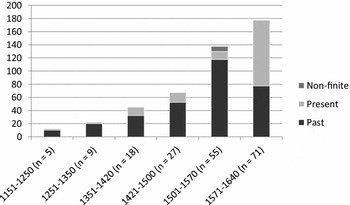
A second manifestation of the actualization of ongoingness is found in the dramatic increase of progressive [be Ving] in the present tense. Figure 1 shows the distribution of unambiguously progressive uses of [be Ving] over tense through time.
Tense of progressive [be Ving], frequencies per million words (graph adopted from Petré Reference Petré2016a; data from LEON 0.3 [Petré Reference Petré2013])

This expansion of the present tense strongly correlates with the increased use of [be Ving] in main clauses. For instance, in the period 1571–1640, 75 per cent (30 out of 40) of the present-tense instances are main clauses, whereas this is only 9 out of 31 (29 per cent) for the past tense. An example of a present-tense main clause is (5).
-
(5) Oh, sweet kisse! but ah, shes waking!
Lowring beautie chastens me:
Now will I for feare hence flee; (1591. Sidney, Astr. & Stella)
The transfer of progressive [be Ving] from past-tense adverbial clauses to present-tense main clauses is explained in Petré (Reference Petré2016a) as a continuation of the semanticization process. The increase of adverbial backgrounding clauses from late Middle English onwards was primarily a matter of past-tense narrative. Progressive [be Ving] was still rare in main clauses, past or present, because such clauses lack the proper combination of syntactically marked ongoing frame (which contains the [be Ving]) plus a focalizing point expressed in the main clause. In the present tense, ongoing situations themselves are typically expressed in a main clause, with the default topic time, the ‘now’, remaining implicit. Prior to semanticization, the lack of an explicit topic time would cause [be Ving] to be understood as stative (denoting a temporary quality of the subject). Only after its semanticization does it become possible for [be Ving] to express ongoingness independently in present-tense main clauses.
Yet the extension to the present tense is not a given. The semanticization of ongoingness in the past was probably largely an automatic outcome of the system dynamics and the cognitive systems of contemporary speakers adjusting their generalizations through the form–function reanalysis of [be Ving]. This new analysis of [be Ving] was increasingly sanctioned by the changed system, in which the stative uses typically served as a frame for a focalizing event. What is particularly interesting for understanding the interplay between the conventional and the unconventional is the observation that this shift in the semantics of [be Ving] actually opened up an opportunity for individual speakers to be extravagant.
This opportunity consisted of the transfer of [be Ving] from its preferred past-tense niche to present-tense main clause uses. Such main clause uses arguably stood out much more than their past-tense equivalents, for the following reasons. First, the past-tense equivalents, although they might also show innovative uses such as the one in (4), were largely a continuation of the original, conventionalized use. In contrast, in the present progressive [be Ving] was entirely novel. Moreover, while it already stood out because of its novelty, [be Ving] had the added quality of being more isomorphic when compared to the usage profile of the simple present at the time. Indeed, the simple present was very versatile in the Early Modern English period (as it still is today), and was used to express at least (i) current action, (ii) future (planned) action, (iii) habitual action or (iv) a generic statement (see, e.g., De Wit & Brisard Reference De Wit and Brisard2014 for a recent contrastive analysis of both constructions in Present-day English). Possibly, the new exclusive association of [be Ving] with ongoingness made the construction more explicit than the simple present. This combination of novelty and functional explicitness seems to fulfil all conditions to function as an expressive and extravagant expression: people using it were certainly noticed (as per Keller's maxim ‘talk in such a way that you are noticed’, 1994: 101), and they were also being more explicit than strictly necessary (Haspelmath Reference Haspelmath1999).
In sum, the gradual increase of [be Ving] in past-tense focalized contexts may explain how the extension to present-tense clauses was made possible, which resulted in the semanticization of ongoingness. Yet the account in terms of pragmatic implicature and subsequent semanticization does not itself explain why the further expansion to the present tense was successful. The mere fact that there is an opportunity for change does not mean it has to take place. It is not because a construction has become polysemous in one usage niche that the novel meaning is automatically generalized beyond that niche. The remainder of this article will put forward extravagance as a plausible motivation for this shift.
4 Methodology and qualitative analysis
This section outlines the methodology that was developed to test if progressive [be Ving] in the present tense is initially predominantly used when the authorial voice wants to put particular emphasis on a message. In order to measure this, two conditions need to be met. First, we can only verify that [be Ving] behaves in a peculiar way, if we are able to compare it with what is hypothesized to be a more neutral alternative. Section 4.1 explains how this comparison is operationalized. Second, we need to be able to categorize the various constructs in non-extravagant and extravagant statements in an objective way. This means we must not use criteria such as the presence of [be Ving] itself – which would be circular – nor intuition, which will inevitably be biased or at the very least, highly personal. Section 4.2 outlines three indices of extravagance that are in line with the major hypotheses of section 2.
4.1 Experimental corpus research
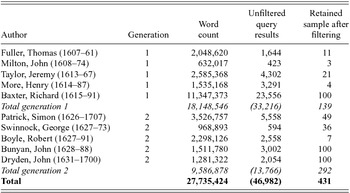
The corpus consists of the collected works of ten prolific authors from two different generations born in the seventeenth century, at the time when the extension of [be Ving] to progressive semantics in present-tense main clauses was gaining momentum. The texts are partly drawn from Early Modern Multiloquent Authors (EMMA, Petré et al. Reference Petré, Anthonissen, Budts, Manjavacas and Strik2017), partly from the corpus used in Petré & Van de Velde (Reference Petré and Van de Velde2017). The main criterion for inclusion was the size of each author's corpus, which was set to minimally 500,000 words. Use of present-tense progressive [be Ving] was not a criterion, but all authors do use the construction at least occasionally. Additionally, all authors were highly educated and well connected to the London-based elite. While they wrote in different domains, their professions, and hence genre-distribution, are balanced between the two generations. Each generation contains one literary author (Milton/Dryden), one predominantly scientific/philosophical author (More/Boyle), and three predominantly religious authors. Of course their oeuvre will inevitably differ stylistically and in terms of specific contents, but this is an inevitable downside of large-scale corpus data. Importantly, the individual setup makes it possible to approximate the concept of informants in psycholinguistic research (see also Pentrel, this volume). The final sections, which discuss individual variation and interindividual consistency, will show in what way this approach is particularly rewarding as it reveals patterns that are different from what is found in traditional, aggregate corpus research.
Table 1 gives an overview of these individuals and the respective corpus sizes for each individual.
Author (ordered by birth date) and generation word counts

From this corpus, instances of [be Ving] were retrieved by means of a Perl-script using the following regular expression-type search strings, where \w stands for any word character, and \W for any non-word character:
-
(a?m|a?r[et]|i?s)(\W*n[ˈo]t)?(\W+\w+){0,3}\W+\w+[yi][~n]ge?
-
(s?hee?s|its|the[iy]re|youre|ime?|thoua?rt)(\W*n[ˈo]t)?(\W+\w+){0,3}\W+\w+[yi] [~n]ge?
Basically, these queries search for an instance of the copula be (the second one focusing on clitic forms of be), optionally followed by the negator not (or n't), optionally followed by up to three words, to be finally followed by an instance of [Ving]. The last but one column of table 1 gives the unfiltered amount of data retrieved this way. Instances where [Ving] was immediately preceded by a word that indicates nominal status of [Ving] (elements such as the, a, an, their, your, my, his, its, by, any, in, on, at, all) were then filtered out automatically. The remaining instances were then first sorted randomly, and then looked at manually until either all were processed or a sample of 100 instances was collected.
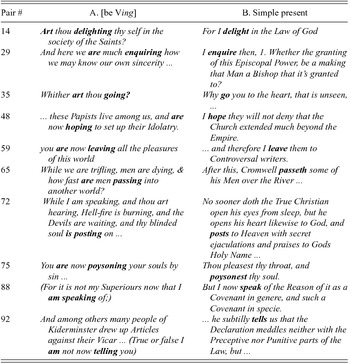
In a second phase data were collected that represent the more neutral alternative to which [be Ving] compares. The simple present had, and still has, a much wider range of uses than did [be Ving]. In addition, verbs have different Aktionsarts, not all of which are equally frequent in either construction (e.g. Brinton Reference Brinton1988). If we want to pinpoint whether [be Ving] is preferred over the simple present for reasons of extravagance, it is essential to limit the analysis to the area of use where the two are really competing with each other. In contemporary linguistics, one might set up a linguistic experiment to achieve this, where a more and a less salient context are shown to the participants in the experiment, asking them to fill in the most appropriate construction (simple present or [be Ving]). This is obviously not possible with historical data. Still, the corpus compiled for this article is large enough to allow the collection of semantically minimal pairs of data that approximate such an experimental setting. A similar method was used in Petré & Cuyckens (Reference Petré, Cuyckens, Bergs and Diewald2008), and helped to show that in English the prefix be- remained productive the longest among Germanic prefixes precisely because it had the most salient constructional properties. Whereas Petré & Cuyckens (Reference Petré, Cuyckens, Bergs and Diewald2008) applied this method to aggregate language data, the method is taken one step further here and is applied to individual language users. To realize this, a randomized sample of the target construction is matched with a mirror sample of the competing construction. Specifically, each sentence containing an instance of [be Ving] was matched with another sentence from the corpus containing the equivalent of this instance in the simple present. The simple present mirror instances were randomly retrieved as follows. Each verb type found in the [be Ving] sample of a specific individual was also searched in the corpus of that individual in its simple present shape. If the exact type was lacking in the mirror sample, a (near-)synonym was selected, such as destroy for demolish or ride for travel.Footnote 2 Out of all tokens found, the same amount was randomly selected as the amount present in the [be Ving] sample. However, to mirror progressive [be Ving], only instances that also expressed an ongoing event at topic time were included. If a randomly selected instance, for example, represented the generic use of the simple present, the search continued, until an appropriate random instance was found. To clarify what the resulting dataset looks like, table 2 provides a random snippet of ten pairs that were collected in this way from one particular author, namely Richard Baxter. Note that, for reasons of space, most of the context has been left out, but more context was taken into account during the analysis.
Random snippet of paired observations

4.2 Indices of extravagance
Taking the two specific hypotheses on extravagance (involvement and redundancy) as points of departure, I first carried out a qualitative analysis of the data in order to identify quantifiable indices of these correlates to extravagance. The hypothesis of involvement can be tested by looking at direct participation of the speaker/writer in the current situation (section 4.2.1). The hypothesis of redundant markers of emphasis is linked to two indices: first, deictic temporal and spatial adverbials emphasizing the ‘here and now’ (section 4.2.2); second, the presence of other markers of emphasis in the co-text (section 4.2.3).
4.2.1 Participation of the author or impersonated first-person referent (actor in a play)
The first quantifiable index is that of emotional involvement of the authorial voice in the situation expressed, assuming that high involvement implies a high desire for the expression to be noticed. Unfortunately, a highly personal concept such as emotional involvement is notoriously difficult to quantify. For instance, if we compare (6) with (7), one might argue that faith is more likely to arouse strong emotions than the question as to whether it is bishops or presbyters (priests) who ordain a clergyman. Yet, no matter how likely this might be, apart from the construction [be Ving] itself, there is no clear (non-circular) linguistic evidence pointing either way.
-
(6) But we are not questioning the instrumentality of the soul now, but of faith. (Richard Baxter [Generation 1], 1658)
-
(7) That the Power of Ordaining is ordinarily only in the Hands of Christ's Ecclesiastical Ministers, I acknowledge (whether Bishops or Presbyters we now question not) and that it is not divolved to any others, but in Case of Necessity. (Richard Baxter [Generation 1], 1672)
To avoid overinterpretation, the label of ‘involved language use’ has therefore only been assigned to instances where the author is not merely likely to be emotionally involved, but also directly physically involved. Such involvement is arguably easier to determine than emotional involvement, and is assumed to correlate strongly with emotional involvement. The following types were distinguished:
-
• Physical participation. The authorial voice's referent is physically participating in the situation. When I refer to ‘authorial voice’ in this context of written materials, I am making a distinction between first-person references which are considered by default authorial, and those which are not. Default authorial contexts either involve the actual writer of the text, or have first-person referents that are construed as the actual authors/speakers in an absolute fashion, i.e. without a narrative frame. This is mostly the case with actors in a play. First-person referents which are part of a framed story, where the author(ial voice) is the narrator instead, are not considered authorial.
-
• Unavoidable affectedness. The authorial voice describes something that is going on in the author's/speaker's environment and affects them either right then, or in their daily lives. One such example is the civil war and the division between religious denominations, which is commonly extensively discussed in sermons of the time.
-
• Text-structuring. This final type consists of statements by which speakers structure their own discourse. Because these statements are ‘physically’ related to the speaker's ongoing discourse, they have also been categorized as a form of participation. However, their behaviour will prove to be distinctively different from the other two.
Instances where the authorial voice is considered not to be directly involved in the situation fall into the following four categories:
-
• Historical present. This tense is used to construe past facts as if happening in the present.
-
• Story or allegory. The present tense can also be used to tell an imaginary story to make a point (this can be, but does not need to be, allegorical). Although the story is presented as if taking place here and now, there is no real connection with the author (or impersonated first-person referent).
-
• Quoted direct speech. This consists of dialogue that is part of a story being told by the author (or actor, if in a play), and of quotations. First-person pronouns in this context do not refer to the authorial voice directly, who distances himself/herself from such identification by means of verbs of speech or quotation marks.
-
• External situation. The authorial voice describes an ongoing activity of somebody else, or a group of people, with whom he/she is (presumably) not interacting directly at that time, or describes the present characteristics of something.Footnote 3
-
• Other. Three instances could not be properly classified.
Any of these contexts may in principle be emotionally charged for that particular speaker/writer in that particular situation, and therefore might require an extravagant construction. However, because this cannot be determined in any objective way, they are not treated as being so charged. The effect is that the analysis provides a conservative approach to emotional involvement as a motivation for the use of extravagant constructions. If such an approach yields a significant correlation between involvement and the use of [be Ving], their real connection will have been even stronger.
In order to further avoid biased annotations, the actual verbal pattern (simple present or [be Ving]) was hidden and replaced by a dummy lemma. Also, a separate label ‘unclear/ambiguous’ was used whenever it could not be determined with any degree of confidence if the actual writer is to be considered the referent of the first person. For instance it might seem as if (8) refers to a real situation, and hence the first person refers to the actual writer. Yet there is no actual dog, and the last sentence makes it clear that it is a small allegory to make a point about faith.
-
(8) For, but observe this Dogg, I hold him out Meat, and my inviting Voice loudly encourages and invites him to take it: ’Tis held indeed higher than he can Leap; and yet, if he Leap not at it, I do not give it him; but if he do, I let it fall half way into his Mouth. Not unresemblingly deals God with us. (Robert Boyle [Generation 2], 1665)
Hence it is somewhat unclear to what extent the actual author construes a narrative frame or not.
4.2.2 Temporal and spatial deixis as emphatic markers
The second hypothesis stated that extravagant constructions are likely to co-occur with other markers of emphasis. A first type of emphatic markers consists of adverbs that deictically refer to the here and now, as such drawing attention to the immediacy and potential urgency of the situation. While immediacy does not imply urgency, urgency implies taking action as soon as possible. The likeliness that urgency therefore correlates with the use of an adverb meaning ‘now’ is lent further credibility by the intensifying function of discourse uses of now (e.g. Defour Reference Defour2007). Prior to the conventionalization of progressive [be Ving] in the present tense, the addition of an explicit focalizing point (topic time) such as now (or here) probably had the additional function of coercing [be Ving] into a progressive reading. Michaelis (Reference Michaelis, Francis and Michaelis2003, Reference Michaelis2004: 25), elaborating on Goldberg (Reference Goldberg1995: 159), defines coercion as the inferential procedure whereby ‘the meaning of the lexical item conforms to the meaning of the structure in which it is embedded’ (see also Traugott & Trousdale Reference Traugott and Trousdale2013: 204–5). In the current case, instead of a lexical item, it is an entire construction ([be Ving]) that is made to conform to the meaning of its embedding structure, i.e. the clause containing now or here. In a constructionist framework, this actually makes much sense. Lexemes in such a framework are also constructions. If they can be coerced, there is no a priori reason to assume that larger constructions cannot undergo the same process. Although not explicitly linked to the concept of coercion, the increased use of an additional element prior to semanticization, which coerces or at least reinforces the right interpretation, is not unknown in the literature. Traugott (Reference Traugott, Cooper and Kempson2008) discusses but and novel cleft-constructions in this perspective, and van de Pol (Reference van de Pol2016) various novel uses of absolute constructions. Once ongoingness is semanticized and conventionalized, an explicit topic time is no longer necessary, because the use of [be Ving] evokes such a topic time (the implicit ‘now’) independently. Subsequently, explicit now is expected to decrease in prominence as time progresses. And indeed, while three out of four present-tense instances in the period 1501–70 in Petré (Reference Petré2016a) have the time adverb now, its presence has dropped to 10 per cent in the period 1571–1640.
One might object that the required co-occurrence of now (or here) indicates that [be Ving] itself is not sufficient, and therefore cannot be extravagant. But that would be mistaking the kind of expressivity that is at stake here. Indeed, the very fact that [be Ving] fails to convey this meaning independently makes its combination with now (or here) particularly extravagant, because hearers do not expect the construction to be used in this way. In this respect, coercion and extravagance may be more closely linked than has been recognized so far.
Within this category, the most important group is that of time adverbials meaning ‘now’ (collectively referred to by means of small caps now). They make up 133 (88 per cent) out of a total of 151 instances of deixis found in the data. Within this group, the adverb now is by far the most frequent one (116 instances). Other adverbs found are at this instant, by this, even now, just, now once again, still, today and yet. The second group consists of adverbs referring to the ‘here’ of the situation. Deictic here is not only used to refer to real location, but also to text location. Apart from here itself, used in both functions, only one other such adverbial phrase (in these nine first Verses) was found. Other adverbials referring to text location, such as in the three former chapters or in the next place have not been included. Along the lines of cognitive linguistics (e.g. Langacker Reference Langacker1991: 61), the different construal in these cases is taken to represent a different perspective by the writer, who in this case chooses not to identify the textual location with a here coinciding with his own ‘mental location’.
4.2.3 Emphatic markers
Apart from coercive spatio-temporal deixis, there are also more general linguistic indications that a speaker wants to draw more than average attention to a particular statement. While obvious candidates such as intonation and volume are lost in written language, various other indices serve a similar purpose of adding emphasis to the expression containing the verbal construct ([be Ving] or simple present). The following emphatic markers were included in this category:
-
• The verbal construct is preceded immediately by an interjection or exclamation or imperative. Examples are Oh!, Hark!, What!, Here's a man!, But behold.
-
• The clause containing the verbal construct ends in an exclamation mark.
-
• The verbal construct is part of a cleft construction (e.g. table 2, 88.A).
-
• The object of the (embedded) verb is fronted (e.g. table 2, 92.A).
5 Results of the quantitative analysis
5.1 By generation
In this first part of the analysis, I examine the relationship between the data aggregated by generation, and how each of the three indices of involvement correlate with the use of progressive [be Ving].
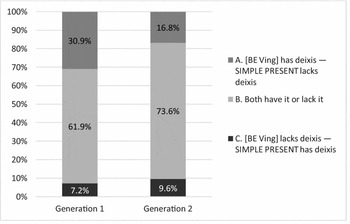
The first index I will discuss concerns the deictic adverbials of here and now. I discuss it first because it seems to have played an important role particularly in generation 1. In figure 2 the behaviour of generation 1 is summarized in the first column, and that of generation 2 in the second. Following the setup approximating a psycholinguistic experiment, each column contains a single value which represents the outcome of a comparison of every observation in the sample of [be Ving] with its matched simple present observation. For instance, whenever the observation with [be Ving] had a time adverb now or a place adverb here, and its simple present match had not, the paired observations are counted as an instance of ‘A. [be Ving] has deixis – simple present lacks deixis’; if the reverse situation holds, ‘C. [be Ving] lacks deixis – simple present has deixis’ is assigned; and category ‘B’ if they show identical behaviour – both possessing or both lacking a deictic adverbial.
Deixis difference in paired observations

As we can see, the situation in which the observation with [be Ving] contains deixis and its simple present match lacks it is more frequent (30.9% and 16.8% respectively) than the reverse situation (7.2% and 9.6%). This holds for both generations, but more so for the first than the second. These results confirm the idea that [be Ving] is used if extravagance is at stake. To test if this difference is significant, I carried out a chi-square test for each generation, which compares the observed pair values to expected values under the null-hypothesis (no relation between [be Ving] and deixis). The difference between observed and expected distribution is highly significant for generation 1 (p < 0.0001), and mildly significant for generation 2 (p = 0.0481).Footnote 4 The high p-value for generation 1 is even more telling given its smaller sample size.
The representation of compared pairs as single values has the added value of enabling the calculation of any change between the generations by means of Kendall's rank correlation test, which is widely used in trend analysis (e.g. Agresti Reference Agresti2010: 196). According to this correlation test, the shift between generation 1 and generation 2 is significant (p = 0.002621). The (admittedly smallish) effect size (the tau-b value) of −0.1408772 is negative. This means that the presence of deixis became less discriminative, less required by progressive [be Ving] in generation 2. Before I attempt a tentative explanation of this development, I will first discuss the other two indices.
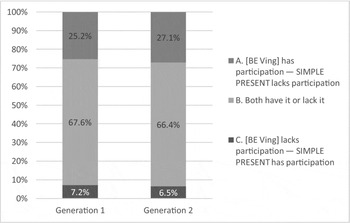
Figure 3 presents the correlation between [be Ving] and the second index, that of the physical participation of the authorial voice's referent in the situation.
Participation difference in paired observations

Similarly to deixis, the situation in which the observation with [be Ving] involves direct participation of the authorial voice's referent and its simple present match lacks such participation is more frequent (25.2% and 27.1% respectively) than the reverse situation (7.2% and 6.5%). Unlike deixis, however, the distribution of participation appears to be nearly identical across the two generations. For both generations, participation seems an equally important motivation for selecting [be Ving] over the simple present, and it is statistically highly unlikely that the high frequency of pairs in which only [be Ving] is used in a participation context is due to chance (p = 0.0005 and p < 0.0001 respectively). The statistics is in line with the hypothesis that extravagance is at stake in the use of [be Ving] in these early stages. That any meaningful change is lacking is confirmed by Kendall's rank correlation test, which yields no significant trend whatsoever (p = 0.6469, tau = 0.02153233).
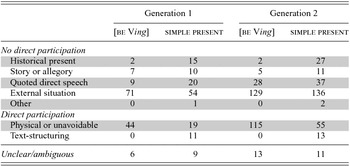
A more detailed examination of the various subtypes of participation lends further credibility to the importance of this index. A pairwise comparison by subtype is not feasible, as it would require many more data points. Taking the more traditional approach of comparing the entire sample of [be Ving] with the entire sample of the simple present yields the raw frequencies of table 3.
Subtypes of (non-)participation

Some interesting trends may be observed. First, the historical present is extremely rare with [be Ving] (for an instance in the simple present, see table 2, 65.B). At the same time, the other categories that lack participation are relatively common with both constructions. This relative commonness, while possible counterevidence to [be Ving] conveying primarily extravagance, may just as well merely show that the conservative calculations leave many cases of (non-physical) emotional involvement out of the picture. First, the writer may have identified himself/herself with the subject referent. For instance, while retelling a story, a writer may ‘live’ the story to such an extent (spontaneously or as a writing technique) that he/she will use the kind of speech that the original speaker would have used in that situation. Similarly, the writer or actor may have strong emotions about the situation described. Neither of these possible connections, however, seem likely in the case of the historical present, which is neither direct speech nor is about something ongoing in the real world that is likely to affect the writer. What the lack of [be Ving] in the historical present also corroborates is the idea that its extravagant quality cannot be reduced to a purely temporal one. Construing the past as the present automatically implies that past situations are represented as ongoing at topic time, and yet this does not trigger the use of [be Ving]. The behaviour of the historical present, then, is a further piece of evidence that (in this early stage), the primary function of [be Ving] was not an aspectual one.Footnote 5
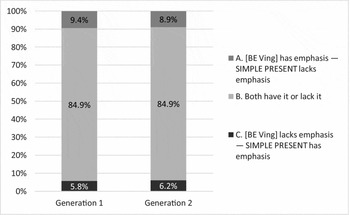
The correlation between [be Ving] and the third index of extravagance, that of co-textual emphatic markers, is visualized in figure 4. A brief glance at figure 4 shows that this index is the least informative of all three. Again it is more often the case that [be Ving] has emphasis where the simple present lacks it than the reverse situation. Yet the distribution does not deviate significantly from a chance distribution (p-value for generation 1 = 0.531; for generation 2 = 0.802). Neither is there a change between the generations. This does not necessarily mean that there is no relationship between emphasis and [be Ving]. Emphatic markers are rare overall, which is likely to be the effect of the written register. With so little data statistical tests are rarely significant, and more data are necessary to establish significance.
Emphasis difference in paired observations

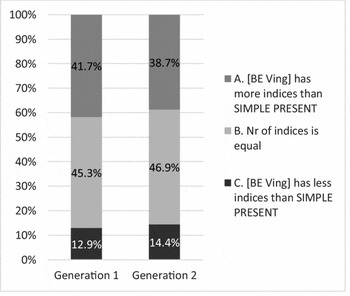
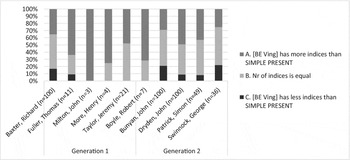
Finally, to assess the cumulative effect of the various indices, they are combined in figure 5. From this figure, it appears that [be Ving] is clearly much more strongly associated with indices of extravagance than is the simple present. P-values for both generations are well below 0.0001. Because a more fine-grained classification would not have been robust, the categorization is limited to a three-way distinction (more/less/equal amount of indices). It is worth pointing out, however, that only [be Ving] is used at all with all three indices (there are nine such cases).
Cumulative difference in paired observations

Overall, there is hardly any change between the two generations (Kendall's tau = −0.02943349, p = 0.5236). This seems somewhat in contrast with the significant decrease of temporal and spatial deixis discussed earlier (figure 2). A preliminary interpretation might be that while the overall motivation for using [be Ving] did not change, the means of achieving extravagance did. In the first generation, the presence of deictic adverbials referring to the (here and) now were still required to coerce [be Ving] into its progressive meaning in the present tense. Increasingly this progressive meaning was semanticized and became easily accessible from a cognitive point of view, and interpreting the construction correctly could now also be more easily achieved without the aid of deictic markers. At the same time, these markers continued to be more frequent with [be Ving] and were now arguably used to truly redundantly mark ongoingness, the type of redundancy that has been associated with extravagant strategies (Detges & Waltereit Reference Detges and Waltereit2002: 179). The construction's semantics had changed, and there was no longer a form–function mismatch causing coercion. Yet this loss of a form–function mismatch need not have led to a decrease in its status of extravagant construction. Its continued correlation with the participation index suggests that it was still perceived by the second generation as being marked and connected to high speaker involvement. While this changed role of deixis, which seems to be masked somewhat in the overall picture, seems an interesting fact from the point of view of the theory of semanticization (which is, essentially, also part of the conventionalization process) and its relation to the loss or preservation of extravagance, the interpretation will need to be reconsidered in light of the analysis of the individual behaviours in the next section, to which I now turn.
5.2 By individual
This section examines whether the general tendencies observed in the aggregate data can also be found at the level of individual language users. Despite the larger amount of data used than has been the case for individual analysis in previous studies, table 1 already revealed that the current corpus size does still not yield robust amounts of data for most of the individuals in the sample. Consequently, the results of this section are bound to be quite tentative.
Figure 6 provides a visual overview of the behaviour of all ten individuals with regard to the cumulative effect of the various indices (equivalent to figure 5). Overall, the graph suggests that there is a fair amount of consistency between all individuals. Every single one of them uses [be Ving] more often with more extravagance indices than the simple present, in line with the aggregate analysis. For the three authors with full sample sizes of 100 paired observations, I also calculated significance levels for the combined data, for deixis and for participation (see table 4). For Richard Baxter and even more so for John Dryden, the likelihood that the distribution is due to chance (the null-hypothesis) is significantly low. However, in the case of John Bunyan the null-hypothesis cannot be rejected for the combined data. A closer look reveals that Bunyan's participation index is the one that comes closest to significance, but this possible correlation effect is lost in the combined index. The reasonably consistent behaviour of participation across the individuals might corroborate the idea that [be Ving] was a marked construction connected to high speaker involvement, also in generation 2.
Cumulative difference in paired observations at individual level

p-values for Baxter, Bunyan and Boyle

There is one noticeable difference between the individual (figure 6) and the aggregate (figure 5) data. The decrease in the association of [be Ving] with the combined extravagance indices between the generations may have been bigger than the aggregate data suggested. The average percentage of paired observations where [be Ving] has more indices than the simple present drops from 64.2 per cent for generation 1 to 43.4 per cent for generation 2. This is a considerably bigger difference (more than 20 per cent) than the one between the aggregate generations, which was a mere 3 per cent. An explanation may be that Richard Baxter, the only individual in generation 1 with a full sample of 100 instances, and also the one with the lowest correlation between [be Ving] and extravagance indices, skewed the aggregate data significantly. Given the very low sample sizes of the other members of generation 1, it is impossible to tell whether Baxter is an outlier or whether it is the other individuals whose samples are not representative. If we assume that the significant decrease between the two generations is real, this has obvious bearings on the overall interpretation. In the previous section I argued that the semanticization of progressiveness explained the decrease in deictic markers, but that it did not necessarily imply a decrease in the extravagant quality of [be Ving]. The decrease in deictic markers is equally present in the individual data (average drops from 40 to 25 per cent), but the overall decrease in the indices combined is, at 20 per cent, even bigger. Based on these figures, one might argue that semanticization does directly correlate with a decrease of extravagance. The precise roles of these various indices and the accompanying semanticization process, therefore, still remain an open question, pending more (and more balanced) data from prolific individuals from this period.
6 Discussion
I proposed a method for approaching experimental conditions in corpus linguistic research on historical data, in order to recover subtle pragmatic differences in the use of innovative patterns. The results proved to be encouraging, though not entirely clear-cut.
The main methodological outcome of the study is that experimental setups may successfully be approximated in historical corpus linguistics. This is encouraging, as it allows us to gain more precise insight (albeit still indirectly) into the cognitive mechanisms underlying speakers’ motivations of the past, and hence to better assess whether motivations that scholars posit on the basis of their own experience and contemporary knowledge had the same status in the past. The two major strengths of the method are (i) the enhanced detection of motivations for competition by making use of minimal semantic pairs extracted from corpora; (ii) the possibility to detect differences between the situation in the language as an aggregate community product and individual language users, and what this may imply for the interpretation of the data. The methodology also has limitations. It requires an enormous amount of data, ideally even more than was available for this article. It also largely leaves out of the picture those uses of the alternating constructions that are not in competition (see Fonteyn, this volume), which obviously also bear on the interpretation. Ideally the method should be complemented with other corpus-based methods.
The main theoretical outcome of the study relates to the concept of extravagance. The results are in favour of the reality of extravagance in syntactic change. In the case of [be Ving], extravagance may first have been the effect of coercion and co-textual elements enabling such coercion. Arguably, the presence of a form–function mismatch itself guaranteed that the statement would stand out. The motivation for this innovative use of [be Ving] has been linked to speaker involvement. Interestingly, speaker involvement remains strongly correlated to [be Ving] in the second generation, even though deictic markers had significantly decreased by then. This may indicate that [be Ving] was at an in-between stage of conventionalization, having semanticized its progressive meaning sufficiently to appear unsupported, but still not a worn-out routine. Only later did it extend to include non-extravagant ongoing situations. While the presence of disambiguating lexical material in the early stage of form–function mismatch has been noticed for a number of other constructions, the two-stage development that is suggested by the current data is a further refinement of our understanding of semanticization and speakers’ motivations. Incidentally, the motivations of these seventeenth-century speakers seem to be in line with some of the hypotheses that have been formulated with regard to innovative constructions in other languages that are similar to the progressive. For the German am-construction, (inter)subjective meanings of intensification, irritation and evasiveness, all of which seem much in line with high speaker involvement, have been recently defended (Anthonissen, De Wit & Mortelmans Reference Anthonissen, Wit and Mortelmans2016), and a similar analysis has been proposed for French (De Wit, Patard & Brisard Reference De Wit, Patard and Brisard2013).
Another outcome is that the temporal semantics of progressive aspect (ongoingness) may not be a direct extension from its original stative meaning. Instead, this development appears to be motivated by an in-between stage where the construction is used to put emphasis on the situation. Its ongoingness in the present tense is mostly a coincidental feature of the speaker/writer feeling involved in the situation. Particularly clear evidence for the primarily non-aspectual meaning of [be Ving] in this early stage is its absence in the use of the historical present. The historical present emphatically construes the past as ongoing, to make it more vivid to the reader. Yet the writer obviously will not typically feel directly involved in the historical events that he/she is describing, hence a clear motivation for using [be Ving] is lacking. The idea that it was extravagance served as the motor for the spread of [be Ving] in the present tense also has bearings on the notion of what has been called the ‘subjective’ progressive, type I'm warning you or he's always drinking, which has also been connected to high speaker involvement. This ‘subjective’ use has so far been treated as an extension of the aspectual meaning of [be Ving], but the present results suggest that the relationship between the two is more complex than this (see Wright Reference Wright and Kastovsky1994: 468; Fitzmaurice Reference Fitzmaurice, Curzan and Emmons2004). For instance, while some subjective uses were also included in my sample because they described current situations, those with always were not, as they were treated as a continuation of the durative/stative use that goes back all the way to Old English. The fact that they also came into vogue as markers of extravagance in the Early and Late Modern English periods raises the question whether the extension to the present tense was a condition for their development. Along with other issues, such as the methodological comparison of the experimental and the traditional corpus approaches, I leave this question for future research.