INTRODUCTION
Cultural heritage is becoming digital heritage: tangible objects in museum collections are being rapidly photographed and made available over the Internet, while documentation of intangible cultural heritage is also being launched into digital environments in the name of safeguarding. These media are now available to diverse networked publics, including to the cultural communities from which they were originally collected.Footnote 1 UNESCO defined “digital heritage” in 2003 as:
… unique resources of human knowledge and expression. It embraces cultural, scientific and administrative resources, as well as technical, legal, medical and others kinds of information created digitally, or converted into digital form from existing analogue resources. Where resources are “born digital,” there is no format but the digital object.Footnote 2
While the tangible and intangible, or the material and immaterial, have been treated largely as separate fields of study, both have been gathered, interpreted and exhibited, considered aspects of cultural performance, understood as cultural symbols, and claimed as cultural property.Footnote 3 Tangible objects have been removed from their cultural and environmental contexts, just as intangible expressions have been selected, documented, and archived in locations both near and far from source communities. As ethnographer Julie Cruikshank points out, the boundary between words and things is ambiguous; while words are ephemeral, they become things when transcribed or recorded, and while diverse audiences can interpret objects in museums in different ways, words are used to give meaning to objects. Importantly, “This blurred distinction underscores the parallel ways in which verbal utterances and material objects are used both to symbolize the past and to stake out positions in discussions about cultural representation, copyright of oral narratives and ownership of cultural property.”Footnote 4
In the era of the born-digital ethnographic object, words and things take on new lives as digital surrogates, copies, and remixes. Anthropologists, curators, and increasingly, local stakeholders who represent their own cultures, languages, histories, and material culture, are some of the agents of this transformation from artifact and intangible expression to digital heritage. I am interested in the entangled but underexplored relationship between the UNESCO Charter on the Preservation of Digital Heritage and the 2003 UNESCO Convention for the Safeguarding of the Intangible Cultural Heritage,Footnote 5 which provides signatory nations with guidelines for the identification, inventory, documentation, preservation, and transmission of endangered, yet viable, intangible forms of cultural expression. Digital cultural heritage is being produced and shared as a range of media, from digital archives, virtual museum exhibits, community web sites, and other online multimedia, to indigenous cultural centers and museums. Yet as the digital proliferates, so does tension over the vulnerability, circulation, and reach of cultural heritage online. World heritage policies further complicate this explosion of cultural projection; the UNESCO Charter on the Preservation of Digital Heritage states: “access to digital heritage materials, especially in the public domain, should be free of unreasonable restrictions. At the same time, sensitive and personal information should be protected from any form of intrusion.”Footnote 6 Yet how, and when, is sensitive or personal digital heritage differentiated from that which is suitable to be circulated in the public domain? How are decisions made about what should be open and what should be closed? How are local cultural property rights discourses articulated and under what conditions? What can be learned from the work of local heritage practitioners who are negotiating diverse approaches to documenting and sharing their cultural heritage in digital environments?
I suggest that applied digital visual anthropology—the practice of visual anthropology that engages a broad spectrum of digital tools and hypermethodologies to create and communicate ethnographic media—is methodologically and theoretically positioned to contribute to discourse on digital heritage and cultural property. I argue here that the community-based production of multimedia aimed at documenting, transmitting, and revitalizing intangible heritage creates space in which these decision-making processes, or local cultural property rights discourses, are initiated and negotiated. I make this argument, first, based on fieldwork carried out with the Doig River First Nation, a Dane-ẕaa community in northeastern British Columbia, Canada, where oral narrative and intangible heritage has been a focus of ethnographic collecting. Recent digitization and community remediation of ethnographic archives has illuminated tensions over the transformation of intangible expression into digital heritage, where issues related to cultural representation, copyright, and ownership of cultural property are amplified by digital circulation. Doig River's media projects have facilitated local heritage and cultural revitalization discourse that has included keeping certain culturally sensitive elements of digital heritage off-line. In the spirit of globalizing heritage policies, I hold the Dane-ẕaa example alongside my recent fieldwork with the Buddhist temple community of Wat Pratupa in Lamphun, northern Thailand, where local documentation strategies and wide-ranging digital circulation of cultural heritage has also facilitated the negotiation of appropriate forms of sharing sensitive cultural property. In both examples, digital heritage and local control over its production is central in debates about cultural property and circulation over the Internet. Juxtaposing these geographically distant articulations of local cultural property rights discourse emphasizes the particularities of local interpretations of the ethics and values of circulating digital heritage. These ethnographic examples hint at a spectrum of possibilities for the articulation of local cultural property rights discourse that are being negotiated in relation to UNESCO's world heritage policies.Footnote 7 In the era of the born-digital ethnographic object, these sites have become as infinitely entangled as words and things.
DIGITAL HERITAGE AND LOCAL CULTURAL PROPERTY RIGHTS DISCOURSE
The 2003 Convention for the Safeguarding of the Intangible Cultural Heritage defines intangible cultural heritage as:
… the practices, representations, expressions, knowledge, skills—as well as the instruments, objects, artifacts and cultural spaces associated therewith–that communities, groups and, in some cases, individuals recognize as part of their cultural heritage. This intangible cultural heritage, transmitted from generation to generation, is constantly recreated by communities and groups in response to their environment, their interaction with nature and their history, and provides them with a sense of identity and continuity, thus promoting respect for cultural diversity and human creativity. For the purposes of this Convention, consideration will be given solely to such intangible cultural heritage as is compatible with existing international human rights instruments, as well as with the requirements of mutual respect among communities, groups and individuals, and of sustainable development.Footnote 8
The Convention further outlines a process by which intangible culture may be protected for future generations. “Safeguarding” in the Convention is represented as:
… measures aimed at ensuring the viability of intangible cultural heritage, including the identification, documentation, research, preservation, protection, promotion, enhancement, transmission, particularly through formal and non-formal education, as well as the revitalization of various aspects of such heritage.Footnote 9
While documentation of intangible heritage is clearly only one aspect of safeguarding, the proliferation of digital tools now available for documentary recording, archiving, and circulation has implicated digital documentation of the intangible in the production of the digital cultural heritage. Local, institutional, and national documentary practices have become spaces of negotiation over ownership and ethical circulation of cultural property; such media collaborations and processes are sites through which local cultural property rights discourse can be formed. Negotiation over cultural property and digital heritage therefore take place in overlapping domains—in documentation of cultural expression, in access to cultural documentation, and in the design of digital archives that both facilitate and limit access to documentation and related information.
For example, in his description of Woodland Native American digital documentary practices in cultural performance and ritual contexts, Jason Baird Jackson points out that as new recording technologies have become available over time, Native peoples in Oklahoma who are concerned with the conservation of ancestral forms of dance, music, and ritual have integrated digital documentation into their production of digital archives for education, cultural revitalization, and personal use. These digitally mediated practices have emerged along with tension and anxiety about the commercialization of documentation and the loss of the authority of ceremonial leaders to control how recordings are used. He makes the case that Woodland Native peoples' digital documentary practices, which include the use of cell phone video cameras and other everyday technologies, “ … have unfolded within a local intellectual property (IP) system rooted more broadly in tribal and regional cultures and social norms.”Footnote 10
Patrick Moore and I identified similar dynamics among members of the Carcross/Tagish First Nation who were involved in the digital documentation of the endangered Tagish language.Footnote 11 Working in partnership with the First Peoples' Cultural Foundation and language archiving web site FirstVoices.com,Footnote 12 participants created an environment in which elders and youth could articulate an indigenous language ideology in resistance to the values and practices of residential schools and control by outside organizations. Local control of language revitalization efforts through First Voices.com placed emphasis on the holistic nature of language and culture, showed preference for traditional modes of social interaction, and demonstrated the centrality of elders' knowledge. Language revitalization in this case was connected to more wide-ranging discourse on political authority, land, and cultural identity, facilitated by a digitally mediated space for Carcross/Tagish control over representation.
In another example, legal anthropologist Guido Pigliasco shows how the collaborative production of a cultural heritage DVD with the Sawau tribe of the island of Beqa, Fiji, was itself a negotiation of intellectual property issues and required the articulation of a local cultural property rights discourse to make decisions about what should be shared, and what should be safeguarded off-line.Footnote 13The Sawau Project is focused on the reclamation of documentation of the vilavilairevo, or Sawau fire-walking, which in recent decades has been widely circulated and commoditized, but is now claimed by the tribe as their own to control and perform.Footnote 14 The DVD project is visually grounded in the geography of Beqa, an archive of repatriated documentation and newly produced video vignettes indicating the origins of the fire-walking traditions. The project is described as an inventory of sites, stories, and shared memories that, in the course of production, “brought to life the awareness of the passage of time, the weight of their grandfathers, and a new self-consciousness.”Footnote 15 Engaging with media and local heritage in a collaborative setting required the negotiation of anxiety and opportunity associated with digital media, and decision making that leaned toward restricting circulation rather than participating in the continued appropriation of practices considered to belong to the Sawau people of Beqa.
In a final example, Kimberly Christen's work with Warumungu people in Australia and Native American tribes in the United States has demonstrated how the collaborative design of digital heritage archives creates opportunities for indigenous articulation of local cultural property discourse, particularly what should be made public, and what should remain private, challenging the emerging status quo of open access. Christen describes how collaboration in the archiving of digital heritage creates opportunities to identify processes for the management of digital materials.Footnote 16 The Mukurtu Archive and the Plateau Peoples' Web Portal are both built on principles of “respectful repatriation” that aim to create digital repositories that support the ethical circulation of cultural knowledge and property. The software developed in support of these archives allows users to customize protocols for access based on cultural parameters, and to change these parameters to reflect their dynamic nature in everyday life.Footnote 17
These examples position the production and circulation of digital heritage as central in debates over indigenous cultural property. However, as Fiona Cameron points out, discourse on digital heritage to date has been largely focused on the status of digital media as heritage, and of original and authentic objects, referencing the writing of Walter Benjamin (Reference Benjamin, Arendt and Zohn1968) and Jean Baudrillard (Reference Baudrillard and Glaser1994).Footnote 18 There has been little critical discourse of digital heritage, even though the “ascription of heritage metaphors to cultural materials in a digital format means that digital media has become embedded in a cycle of heritage value and consumption, and in the broader heritage complex.”Footnote 19 The UNESCO Charter on the Preservation of Digital Heritage is seen by Cameron to exemplify the uncritical induction of digital cultural heritage materials into wider processes of globalization and heterogenization. Of particular issue is the Charter's emphasis on ensuring maximum public access to what has been encoded through UNESCO programming as the “Memory of the World,” or “Information for All.”
At the same time that the Charter advocates open access to digital heritage, it asserts that “sensitive and personal information should be protected from any form of intrusion.”Footnote 20 These statements highlight a key issue in the transformation of intangible heritage into digital cultural heritage; when and how are decisions made about the open or closed nature of cultural documentation? As Michael Brown points out, major policy documents like the Convention for the Safeguarding of the Intangible Cultural Heritage demonstrate a tension between cultural internationalists and cultural nationalists, an ongoing concern with “the balance between heritage as a resource for all of humanity and as something that properly belongs to, and remains controlled by, its communities of origin.”Footnote 21 Jane Anderson has further articulated the anxieties associated with the opening up and digital circulation of colonial archives; at the same time that indigenous communities are demanding recognition as legitimate authors and owners of documents representing their cultures, they are faced with the fact that legal ownership is granted to the individual who made the recording. These archival materials are also anxiety-inducing because they often do not reflect contemporary cultural identifications and desired representation, or their anticipated use and circulation.Footnote 22 These tensions and anxieties are exacerbated in discourse and practices related to the production of digital cultural heritage.
As I will describe, members of the Doig River First Nation in British Columbia made important decisions to keep elements of their digital cultural heritage out of public circulation as a way to maintain the power of particular heritage objects. Their leading participation in local intangible heritage safeguarding projects was crucial in this regard. Members of an ethnic Yong community in northern Thailand, choosing another approach, decided that unlimited circulation of sensitive digital heritage was in the best interest of local knowledge revitalization. As with the creation of ethnographic documents, including the documentation of intangible cultural heritage, digital heritage is shaped by systems of heritage value and subjective evaluation about what to preserve—in this schema, what to make public—and what to keep in private circulation or allow to be lost.
Community participation in documentation—a central moment in decision making about what to circulate publicly and what to manage privately—is important in this regard. A particular irony of the Convention, Michael Brown points out, is that it “portrays intangible heritage as an objectified resource amenable to modern management techniques. In such a legalistic vision, heritage cannot be protected until it is thoroughly documented.”Footnote 23 Indeed, echoing the language of salvage anthropology, the UNESCO Convention for the Safeguarding of the Intangible Cultural Heritage mobilizes a discourse of loss:
Recognizing that the processes of globalization and social transformation, alongside the conditions they create for renewed dialogue among communities, also give rise, as does the phenomenon of intolerance, to grave threats of deterioration, disappearance and destruction of the intangible cultural heritage, in particular owing to a lack of resources for safeguarding such heritage.Footnote 24
The Convention then lays out a State and stakeholder community process of identification, inventory, documentation, and transmission of intangible heritage as a measure of safeguarding intangible cultural heritage from the homogenizing forces of globalization. However, as Brown further notes, the discipline of anthropology “long ago concluded that documentation has only a modest role in the preservation of culture. To think otherwise is to make the classic error of mistaking a map for the territory it represents.”Footnote 25 Digital technologies—including digital video, audio, and photography, as well as computer word-processing programs for field notes, electronic maps and Geographic Information Systems, social media, and digital archives—have become normative tools and economically viable resources for the documentation, preservation, and transmission of intangible cultural heritage and its relationships to material culture, the natural environment, and social, political, and economic conditions. That much of the documentation of intangible cultural heritage around the world will be born digital means that meaningful participation by stakeholder communities in the documentation and safeguarding of their cultural heritage is more important than ever before. This is significant in relation to the discourse of loss of heritage that also permeates the digital heritage charter, in which digital media “is at risk of being lost to posterity” (the threat of loss),Footnote 26 and “unless the prevailing threats are addressed, the loss of digital heritage will be rapid and inevitable” (need for action).Footnote 27 Loss of digital documentation of intangible heritage—as archived on hard drives, tapes, disks, or web sites, to name a few—is unfortunately a frequent occurrence. Local decision making around appropriate and sustainable strategies for the long-term safeguarding of digital heritage must be a part of safeguarding initiatives, and will remain an urgent concern.
It is encouraging to note that such participation from cultural communities, groups, and individuals is emphasized in Article 15 of the Convention, titled “Participation of Communities, Groups and Individuals,” which states that:
Within the framework of its safeguarding activities of the intangible cultural, heritage, each State Party shall endeavor to ensure the widest possible participation of communities, groups and, where appropriate, individuals that create maintain and transmit such heritage, and to involve them actively in its management.Footnote 28
According to Richard Kurin, this represents a shift in perspective on the role of culture bearers in determining best practices for safeguarding:
Governments, or university departments or museums, cannot just assume that they have permission to define intangible cultural heritage and undertake its documentation, presentation, protection, or preservation. Community participation is meant to be significant and meaningful—involving the consent of community leaders, consultation with lead cultural practitioners, shared decision making on strategies and tactics of safeguarding and so on. Article 15 strongly empowers the community in the operation of and realization of the Convention.Footnote 29
During my fieldwork with the Doig River First Nation between 2004 and 2008, I co-curated (with Amber Ridington) a collaboratively produced virtual museum exhibit of the oral narratives and song called Dane Wajich—Dane-ẕaa Stories and Songs: Dreamers and the Land. Footnote 30 The project used digital cultural heritage from the Ridington/Dane-ẕaa Digital Archive. Archival media were exhibited online alongside contemporary documentation of narrative and song that had been created by members of the Doig River community in the course of the project. Dane Wajich used collaborative methodologies that placed elders, youth, and other community participants in leading roles. It modeled a strategy for community involvement in the documentation of intangible heritage that is in keeping with the emphasis of the 2003 UNESCO Charter on the Convention for the Safeguarding of the Intangible Cultural Heritage on roles and responsibilities of local communities in safeguarding what they determine to be endangered and significant.Footnote 31
In the following section, I show how community participation in decision making about which elements of ethnographic documentation to make public in the virtual exhibit, and which to restrict from wider access, made intangible heritage and digital objects central to conversations about ownership and control of cultural documentation. While community leadership in intangible heritage safeguarding efforts made use of available digital technologies to mobilize digital cultural heritage and to create new born-digital objects, it had results that demonstrate local negotiation of culturally appropriate forms of sharing that counter the open-access emphasis of the 2003 UNESCO Charter on the Preservation of Digital Heritage. The example points to the importance of local strategies for the safeguarding of digital cultural heritage and the forms of intangible heritage that it represents, which facilitate decision making about what can be circulated, and what is sensitive and should be kept out the global heritage complex.
THE CREATION OF THE RIDINGTON/DANE-ẔAA DIGITAL ARCHIVE
Unlike tangible objects, intangible cultural expression cannot be carried away by the ethnographer except as inscribed as ethnographic documents in field notes, recordings, film, or drawings.Footnote 32 The act of creation of the ethnographic document, and the act of creation of the ethnographic archive to order and preserve documentation of the intangible is far from neutral; indeed, “what constitutes the archive, what form it takes, and what systems of classification signal at specific times are the very substance of colonial politics.”Footnote 33 The digital ethnographic archive, much more than a mechanical accumulation of information, is a particular and historically specific representation of culture and ownership of cultural documentation.
Robin Ridington began his fieldwork with Dane-ẕaa communities at Prophet River, Halfway River, and with members of the Fort St. John band, who later became the Doig River and Blueberry River First Nations, in 1968. He developed a relationship with Charlie Yahey, an elder who came to be the last-known nááchę (translated as dreamer, or prophet) in the Peace River region. Nááchę are known to have traveled to heaven and received songs (nááchę yinéʔ) and prophecies that provided moral and spiritual guidance to people. Dane-ẕaa oral tradition asserts that nááchę dreamed ahead to locate the trails of game animals, predicted the coming of white settlers to the Peace River region, and the industrialization of the oil-rich landscape.Footnote 34Nááchę yinéʔ received in dreams were publicly performed by dreamers, and today by groups of drummers at world-renewal ceremonies called the Tea Dance, in which Dane-ẕaa bands gather to dance around a fire to ensure the passing of seasons and helping the spirits of the departed find their way along the trail to heaven.Footnote 35 In his early fieldwork, Ridington and Mills recorded many hours of audiotape of Charlie Yahey's oratory and dreamers' songs, Tea Dances, and public expression of the nááchę's sacred knowledge of heaven. He also photographed some of the drawings made by nááchę of their visions of heaven that were shown to him by elders.
When Robin Ridington began documenting Tea Dances, nááchę yinéʔ, and oral narratives, he used a 35-millimeter camera, and an Uher reel-to-reel tape recorder. There were limitations attached to these particular documentary tools; because he had a limited supply of film, tape, and batteries, he turned the recorder off when he thought that “nothing was happening.”Footnote 36 The constraints of available technologies influenced his ideas about what was important to record; the narratives of Dane-ẕaa elders, and the oratory of the nááchę Charlie Yahey were clearly extraordinary, and inevitably took precedence over the documentation of everyday conversations and soundscapes.Footnote 37
In 1999, Robin Ridington and partner Jillian Ridington made a transition in documentary technique. Digital technologies, in the form of audio mini-disk, gave them the ability to record sound virtually endlessly. Minidiscs were inexpensive and long-playing. Battery life had also drastically improved, making remote recording lightweight and easy. In 2001, they also changed their approach to visual documentation, transitioning from still photography to digital photography and video, and experimenting with nonlinear digital video editing.Footnote 38
In 2003, responding to community demand for greater access to their collection, Robin, Jillian, and folklorist Amber Ridington worked with the Doig River First Nation to procure a grant from the British Columbia Museums Association to digitize the Ridingtons' photographic, audio, and video collection of Dane-ẕaa intangible cultural heritage. The entire archive, which by 2003 consisted of approximately 600 hours of audio recordings, 5000 photographs, and 60 hours of digital videotape, was to be made available in as digital copies on a hard drive, and be accessible in the Doig River First Nation's band hall.Footnote 39 The archive was named the Ridington/Dane-ẕaa Digital Archive, and a selection of images from the archive, including series documenting the dreamer Charlie Yahey, and a full catalog of images, text, and audio and video recordings would be accessible through a password-protected online database called the Dane-ẕaa Archive Catalogue (Fig. 1).Footnote 40 For the Ridington family, this represented a leap in their ability to “share ethnographic authority with Dane-ẕaa First Nations.”Footnote 41
Dane Wajich: Dane-ẕaa Stories and Songs: Dreamers and the Land. ⟨http://www.museevirtuel-virtualmuseum.ca/sgc-cms/expositions-exhibitions/danewajich/english/index.html⟩

GAAYĘĄ'S DRUM
In July of 2005, at a Dane Wajich planning meeting in Doig River First Nation's band hall, I videotaped a Dane-ẕaa elder named Tommy Attachie as he spoke about a moose-hide drum skin. The drum skin had been painted with a map of heaven by a Dane-ẕaa nááchę named Gaayęą more than 100 years before. It had been inherited by Garry Oker, who was the Chief of Doig River at that time, and who brought it to the planning meeting. As I have described in detail elsewhere,Footnote 42 Tommy Attachie used Gaayęą's drum at this meeting, and at subsequent planning meetings, to eloquently articulate the connections between Dane-ẕaa material culture, oral narrative, and land. The drum, the material manifestation of the dreamer's medicine power and experience of heaven, was described as integrally connected to successful hunting and survival on the land, as well as to foreknowledge of the drastic changes associated with the colonial settlement of Dane-ẕaa territory. As with other Doig River local projects that were facilitated by the digitization of the Ridington/Dane-ẕaa Digital Archive, such as audio CDs of drumming and singing performances, and video documentaries about history and culture, nááchę songs and drawings have become central foci of the Doig River First Nation's media productions. These media convey the continuity of knowledge and nááchę practices and present an alternative cultural history of the region that competes with colonial and industrial narratives.
Gaayęą's drum was used by Tommy Attachie to define a methodology for documenting Dane-ẕaa intangible heritage; in the following weeks in that summer of 2007, our group traveled to seven places in Dane-ẕaa territory where youth, elders, ethnographers and linguists recorded videos documenting traditional narratives, life histories, and histories of nááchę in Dane-ẕaa Ẕáágéʔ (the Beaver language) and English. These videos and their translations became central elements of the virtual exhibit, and in early drafts of the exhibit, photographs of Gaayęą's drum as a part of the production process, and archival photographs of Charlie Yahey holding a special double-sided drum also made by Gaayęą were also featured prominently throughout the online project. However, at the end of a nearly two-year period of exhibit postproduction and community consultation carried out by co-curator Amber Ridington and me, the decision was eventually made to remove all images of nááchę drums and drawings from the exhibit. Meaningful community participation in digital documentation and presentation of oral narratives opened up local debate over the ownership and control of Dane-ẕaa digital cultural heritage. The debate was centered on (1) ownership of ethnographic documentation, and (2) control over its circulation in digital form.
1. Ownership of Cultural Documentation
As Dane-ẕaa ephemera have become ethnographic objects, they have become physical objects (tapes, film, photographic prints); as these ethnographic documents of intangible cultural heritage have been digitized, they have become digital cultural heritage (digital files and storage devices) that are owned, traded, copied, and remixed. As Dane-ẕaa intangible cultural heritage has been collected, digitized, and made accessible to Dane-ẕaa communities in the form of the Ridington/Dane-ẕaa Digital Archive, it has also been claimed as property. The contents of the Ridington/Dane-ẕaa Digital Archive are “copyrighted by the collectors for their use.”Footnote 43 This can be so because, under the Canadian Copyright Act, the act of the creation of a document—for example, pressing “Play” on a digital audio recorder—is an assertion of ownership and a legal right to control the use of the document.Footnote 44 This technicality has underscored the practice of academic anthropology, where the copyright of the ethnographic object, and by proxy, the legal right to publish, distribute, or even sell these creative works has long rested with the researcher, rather than with the subject of ethnographic study him- or herself.Footnote 45 While the contents of the Ridington/Dane-ẕaa Digital Archive are copyrighted by the collectors for their use, Robin and Jillian Ridington also declared the intention that copyright be shared “by the Dane-ẕaa peoples represented by the four Dane-ẕaa bands” and that permission to use the material be sought by the copyright holders.Footnote 46 In the original grant application to digitize the collection, it was stated that,
Dane-ẕaa heritage is collectively owned, and a great number of generations contribute to our cultural heritage. The documentation of our peoples' heritage in the Ridington/Dane-ẕaa [Digital] Archive represents indigenous intellectual property and although it is collectively owned, it will be curated by the Doig River First Nation at their museum, and will be made accessible to all Dane-ẕaa peoples.Footnote 47
While this statement is meant to protect the rights of the collectors to continue to use the material for academic research and publication, and the rights of Dane-ẕaa peoples to have a say in how and by whom their cultural heritage is used and reproduced, copyright of ethnographic documentation was not transferred from the collectors to its communal owners. The statement illustrates a basic contradiction at the heart of debates over cultural property—that collectively owned intangible expression becomes the property of an individual through the act of documentation. This contradiction was illuminated in the digitization and return of cultural documentation to Dane-ẕaa communities, when indigenous intellectual property rights were granted, but exclusive copyright—ownership—was not. Given the collective nature of ownership of Dane-ẕaa oral narrative, it could not easily have been done.
These issues were further illuminated in the course of digital visual ethnographic production. Because the painted moose-hide drum made by the nááchę Gaayęą was central in defining the methodology for cultural documentation in the Dane Wajich project, a photograph of the nááchę Charlie Yahey holding a painted drum made by Gaayęą was chosen by Doig River project participants from the Ridington/Dane-ẕaa Digital Archive to be featured on the draft home page of the virtual exhibit. However, shortly after this decision was made, co-curator Amber Ridington and I were made aware that descendants of Charlie Yahey at the neighboring Blueberry River First Nation were concerned that photographs of their relative were being used by the Doig River First Nation without their consent. Under the direction of the Doig River Chief and Council, we visited with family members at Blueberry to discuss the use of Dane-ẕaa digital heritage in the project. The family ultimately decided that they did not support the use of these images of Charlie Yahey by Doig River at that time, and the Doig River Chief and Council accordingly agreed that individual stakeholders in cultural documentation, or their descendants, should be consulted for permission to display their cultural heritage, and that this decision should not be made by band councils without specific family permission. All archival media related to Charlie Yahey was subsequently removed from the Dane Wajich exhibit. Community involvement in intangible heritage documentation, and subsequent engagement with digital cultural heritage in this case both identified and challenged national legal regimes of ownership and facilitated the articulation of a local intellectual property rights discourse.
2. Control of Digital Cultural Heritage
The use of the images of nááchę drawings and drums in the exhibit also raised questions about the extent to which the power of tangible objects are translated into digital representations, and, accordingly, the appropriateness of making these images publicly visible elements of digital cultural heritage. During the postproduction of the Dane Wajich exhibit, it was suggested that the drum skin made by the nááchę Gaayęą that had been used by Tommy Attachie to define the project's documentary methodology should be restored and installed in an exhibit in the Doig River First Nation's museum. However, when Amber Ridington and I consulted with local elders about this possibility, we were surprised to find out that some did not think the drum should be displayed publicly at all. As I have described in detail elsewhere,Footnote 48 local protocols for the care and handling of nááchę drums and drawings were raised by some elders as a reason to keep the drum out of uncontrolled public circulation. Some also felt that photographs of the drum should be treated the same way, and kept out of view. While some people, particularly those of younger generations felt that circulating digital images of the drum would have no negative effect, the decision was made to remove all images of nááchę drums and drawings in accordance with more conservative perspectives. Images of nááchę drums were replaced with the unpainted drums made by Dane-ẕaa who are not themselves nááchę, and which are used in contemporary performance at Doig River.
While Dane-ẕaa ethnographic documentation and digital heritage has been interpreted and circulated by anthropologists, it has also been reintegrated into Dane-ẕaa social, religious, and political life. I have often entered someone's home to hear the songs of Charlie Yahey and other elders playing in the background, or see portraits taken of community members displayed on the wall. Charlie Yahey's voice “has become as familiar to people who never knew him as it was to those who attended his Dreamers' Dances.”Footnote 49 Drummers and singers at Doig River, some of whom learned directly from Charlie Yahey and other singers recorded by Robin Ridington, have enriched their repertoire by listening to recordings of their elders. They continue to sing and perform them at Tea Dances for the community and the general public.
These media are also used in significant ways to negotiate unequal relations of power. Digital copies of recordings of nááchę yinéʔ (dreamers' songs), used in culturally appropriate contexts, are considered by some to be powerful tools in their spiritual and political lives. As former Doig River First Nation Chief Kelvin Davis told me in the summer of 2007, when the ability of the band to resist incursions of government-sanctioned industrial development on their land was exhausted, playing the Ridingtons' recordings of nááchę yine from his truck had power, over time, to disrupt the ravenous extraction of oil and gas. When used with proper respect, the power of nááchę as a form of resistance remains embedded in the magnetic tape and digital code of copies from the ethnographic archive:
The recordings of the songs, of the prophet's songs, are very powerful and if … you use it the right way, it will be effective. But if you use it the wrong way, then the meaning of the song and the power of the songs, I believe will be, my mother told me years ago, prophets used to say, “Don't play with these songs.” If the song giver wants to, he can take the—the spirit of the songs back and all it is, is going to be, is just songs, that's it, nothing more.Footnote 50
Chief Davis emphasizes that the power of the nááchę yinéʔ was maintained through proper, respectful use of the songs. Such preservation of power of the songs is dependent on his intangible knowledge of their care, even in digital form. His account of the power of dreamers' songs on tape is consistent with findings of scholars working with indigenous communities and digital cultural heritage in other parts of the world. For example, Maori scholar Deirdre Brown, working with Maori material culture, has shown that the spiritual and cultural meanings in objects can be transferred to the digital copies in the same way that it had been thought to be transferred in analog photographs or film.Footnote 51 The creation of new forms of electronic waka (vessels) to meet cultural needs offers a way of “subverting technologies of domination by cultural institutions.”Footnote 52 In another example from Australia, Kim Christen has shown how Warumungu women balanced the need to document and preserve Dreaming songs with satisfying interest from the public in Warumungu traditions; she describes how decisions were made about the “open” and “closed” nature of certain songs, the most public of which were recorded and distributed on CD.Footnote 53 In these examples, communities with their own requirements for the documentation, safeguarding, and preservation of digital heritage are mobilizing the power of the heritage industry “to become self-determining agents in creating their own autobiographies. That is, to tell their own truths about culture, to embrace and challenge and also resist prevailing heritage regimes of classification.”Footnote 54 Creating space for the articulation of local cultural property rights discourse, exercising agency in the documentation of intangible cultural heritage, and exerting control over the use of new technologies to preserve and safeguard digital heritage, are central in these efforts.Footnote 55
DIGITAL HERITAGE, WAT PRATUPA, AND MUANGLAMPHUN.COM
While my fieldwork with the Doig River First Nation pointed to the importance of participatory media production in creating space for negotiating the circulation of Dane-ẕaa digital cultural heritage, my recent fieldwork with the Buddhist temple community of Wat Pratupa in northern Thailand showed another approach to the circulation of sacred digital cultural heritage to support local safeguarding of intangible cultural heritage. I raise this example both as a point of comparison with the Dane-ẕaa local cultural property rights discourse, and to reinforce community-based multimedia production as a space in which discursive frameworks are negotiated and articulated. The Wat Pratupa example, as I will explain, also speaks to the common challenges of maintaining digital initiatives when technical expertise and funding is in short supply. In the long project of attempting to assess the implications of international heritage conventions and charters, I argue that observing the community-driven, digitally mediated safeguarding strategies—strategies of resistance to loss of local intangible cultural practices—in diverse contexts should inform the application and reworking of international heritage policies. Lila Abu-Lughod's suggestion that we should look to resistance as a “diagnostic of power” is productive in considering the “complexity and nature of forms of domination” impacting the continued transmission and recreation of local cultural practice.Footnote 56
Since 2009 I have worked each summer as a lecturer and resource person in the Intangible Cultural Heritage and Museums Field School in Lamphun, northern Thailand, organized by the Princess Maha Chakri Sirindhorn Anthropology Centre and UNESCO, Bangkok.Footnote 57 I was invited to teach in this field school because of my work with the Doig River First Nation and the questions that this research had raised about the role of digital documentation in the safeguarding of intangible cultural heritage.Footnote 58 The goal of the field school is to introduce heritage workers, community museum curators, and students from the Mekong Delta region (Thailand, Vietnam, Laos, China, Cambodia, and Bhutan, primarily) to a range of practical issues, debates, case studies, and critiques of the 2003 Convention for the Safeguarding of the Intangible Cultural Heritage. In this capacity I was introduced to the community of Wat Pratupa, one of the field school research sites, and worked directly with students and community members at Wat Pratupa over the last two field school seasons.
Wat Pratupa was built in 1758 by ethnic Tai Yong, who fled war in the period that Lanna (Northern Thailand) was under Burmese occupation. When the wars with Burma ended, and King Kawila was restoring the Lanna territory in the nineteenth century, many ethnic Yong were forcibly resettled from Burma to Lamphun. One group resettled with a highly respected monk named Kru Ba Lek, who became the first abbot of Wat Pratupa. The settlers planted mango seeds from their former village, and named the new village Pratupa-muang, which means Mango Forest.Footnote 59 Today the Pratupa community is centered around the cultural, spiritual, and merit-making activities of the Pratupa Buddhist temple. In 2009, field school students documented community-wide preparation for the Salak Yorm festival, in which bundles of offerings and tree-like structures as tall as 17 meters are built and decorated with handicrafts, money, and food. The Salak offerings are then won by monks in a lottery on the festival day. The Salak offering is a significant Buddhist merit-making activity for the families and communities who work together to create the offerings and to improve their karma. In the past, the Salak would be created over many years by a young woman, her family, visitors from other villages, and by potential suitors to make merit for the family and to announce her coming of age as a woman. The Salak demonstrated her handicraft skills and financial resourcefulness, and would be crowned with the gold jewelry that made up her dowry. Today, in Lamphun Province, it is too expensive to produce a Salak offering for each young woman; rather, communities work together to create offerings to be won by monks from several monasteries in the Province, who come together for a single large annual festival that is hosted by a different Lamphun monastery each year. In 2009, field school students observed and documented as older members of the Pratupa community gathered under the supervision of the Wat Pratupa abbot and Assistant Abbot Phra Patiphan Puriphanyo, to create the complex handicrafts used to decorate the towering Salak Yorm. We then attended to Salak festival at Wat Chamadevi in Lamphun and watched as the towering offerings were won by excited monks and claimed from the community members who had created them.
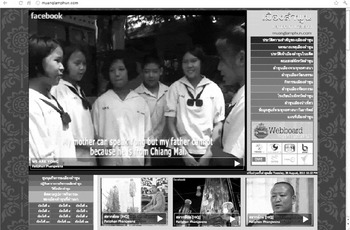
At that time, I learned that Assistant Abbot Phra Patiphan Puriphanyo was the creator and webmaster of a site called www.muanglamphun.com, on which he posted documentation of these events and of the Salak Yorm festival and related activities and traditions (Fig. 2).Footnote 60 The web site, and its related Facebook page, were used as a strategy for documenting and circulating the distinct practices of the Wat Pratupa ethnic Yong community. I continued to learn about local digital media strategies in the second field school in 2010, as I worked with students, the assistant abbot, and the Pratupa community to explore issues related to the safeguarding of one aspect of the Salak Yorm, called the Kap Kalong. The Kap Kalong is a poetic narrative that reiterates the history of the ethnic Yong migration from Burma, and details the contributions of individuals and families to the construction of the Salak offering. In the past, the Kap Kalong told the life story of the woman who labored with her family to create the Salak offering. The Kap Kalong was composed by an individual of great lyrical talent and fluency in the Lanna language, and transcribed by the composer in Lanna script. In a key moment of merit-making, the Kap Kalong would be performed by members of the contributing family or community at the Salak Yorm before presenting the Salak to the monk who had won it in the festival lottery. Documentation of the Kap Kalong script and recordings of performance were being circulated on www.muanglamphun.com. In the third field school in 2011, I worked with the assistant abbot and members of the Pratupa community to produce a short documentary video that could be used to promote awareness of the need to revitalize the Yong language. This video, and the assistant abbot's photo documentation of our collaborative process, was also quickly made available on www.muanglamphun.com.
Wat Pratupa's former web site, “Muang Lamphun.”

In the course of our fieldwork, we learned from the assistant abbot, community educators, Kalong performers, handicraft artisans, and school children that the Kalong is threatened on several fronts. A gradual shift from the local Yong dialect to the Central Thai dialect is creating greater distance between young Yong community members and their Yong heritage. Few people who have not been ordained as monks are fluent in the Lanna language, which was and continues to be used to represent the Yong language. Thai Yong people are now educated in the Thai Central dialect, meaning Kalong scripts in Lanna language cannot be understood, and education of new composers of the Kalong is obstructed by Lanna illiteracy. Second, the Lamphun Provincial government recently chose to promote the Salak Yorm as a tourist event, and to provide financial incentives for Lamphun monasteries to participate in the festival. Non-Yong Thai communities and monasteries have been creating Salak offerings, and participating in the festival, but do not practice the Kap Kalong. Further, expensive and time-consuming Salak handicrafts are being replaced with cheap commercial decorations. From the perspective of Wat Pratupa representatives, the Salak Yorm festival and associated traditions have been appropriated by non-Yong communities and the provincial government, marginalizing the role of the Kap Kalong and Lanna language expression. Exacerbating the problem, contemporary economic conditions drive young Yong to seek employment in factories far away from their home communities, preventing them from participating in the activities of the Wat Pratupa community and speaking the Yong dialect with their families.
Faced with these challenges, Assistant Abbot Phra Patiphan Puriphanyo has focused on the facilitation, digital documentation, and circulation of representations of Wat Pratupa's Salak Yorm, Kap Kalong traditions, and language revitalization initiatives. He was using the www.muanglamphun.com web site as a way to communicate Wat Pratupa's ethnic Yong identity and Buddhist practices to local people, to community members working out of the province in factories, and to diasporic Yong people who are interested in the traditions of their home community. The conceptualization and production of www.muanglamphun.com facilitated local discussion about what local heritage is appropriate for sharing over the Internet, and the utility of the Internet in supporting heritage revitalization initiatives. According to Assistant Abbot Phra Patiphan Puriphanyo, “We believe in one saying: ‘sharing leads to sustainability.’ The more you share your knowledge, the more that knowledge will live on. It's like the case of an herbal medicine expert. If he dies, his knowledge dies with him.”Footnote 61
Wat Pratupa's current approach to sharing was largely shaped in the course of producing www.muanglamphun.com. The web site first included extensive photographic documentation of the Salak Yorm festival, historical photographs collected by the assistant abbot from members of the community, and representations of other traditions that were thought of as needing protection. However, it was the decision to document and share images of sacred material culture owned by Wat Pratupa—the contents of a Buddhist palm-leaf manuscript cabinet and a wooden Buddha carving—and the outside interest that they generated, which stimulated discussion about the role of digital documentation in safeguarding heritage. After images of the manuscripts and Buddha image were posted on the web site, villagers were surprised when nonlocal documentary filmmakers arrived wanting to make a film about Wat Pratupa's valuable collection. With new awareness of the digital visibility of the objects, community members became concerned about the safety of the original objects. Assistant Abbot Phra Patiphan Puriphanyo described to me how these events facilitated the articulation of local discourse around digital circulation:
It was a challenge at first. There were worries that things could be stolen after display. That doubt also existed within this temple in regards to the Buddha image. As an alternative, it was decided that although some objects could not be physically displayed, their photographs could be shown instead. People were worried that if the library were open for public view, the cabinet might risk thievery. So I said, think about this. If there were three keepers whose responsibility was to lock up this cabinet and Buddha image in a safe place forever, would there be any chance that they would completely forget about them? Wouldn't it be better if we allowed other people to know that they existed, if we let them live through retelling, remembrance, and documentation? It would be a pity if they were left to be forgotten. There's an idiom saying, “If you swallow, it disappears; if you spit it out, it remains.” No matter how wise you are, if you don't have a disciple, your wisdom goes to waste. But if you teach your disciples, your knowledge transcends your own life. It doesn't matter if replicas were created, because a genuine is still a genuine. In fact, there are even more watchers than before because there are more people who are aware of these significances. A sense of ownership keeps growing, which may lead to two different strategies: increased security measures, or increased studies and revitalization. The decision depends on the conservators and the community. Just keep this fact in mind, “If you swallow, it disappears; if you spit it out, it remains.” Let the knowledge spread within the community.Footnote 62
While the web-based documentation activities of Wat Pratupa were central in defining local cultural property rights, using online resources to spread knowledge within the community were ultimately met with significant challenges. Wat Pratupa's use of www.muanglamphun.com continued until early 2012, when the cost of hosting and maintaining the popular web site became prohibitive. The extensive archive of historical photographs, audio recordings, and videos are no longer accessible to the public online. The loss of the web site has driven home the difficulty of maintaining local digital community archives, which require stable sources of funding, expertise, and stewardship. The domain name was lost to another user, and Wat Pratupa's online activities were migrated to their existing Facebook page and to the assistant abbot's personal Facebook page. The ownership and intellectual property-related consequences of posting community content to Facebook, as opposed to a web site owned and maintained by Wat Pratupa community, remains to be explored. However, while the role of www.muanglamphun.com in the preservation of the community's digital heritage is diminished, Facebook-based online sharing activities have continued with dedication from the assistant abbot and colleagues, and still function to promote local activities and practices related to the transmission of intangible cultural heritage. While the original web site played a central role in the articulation of a local cultural property rights discourse, these newly amplified Facebook activities continue to function in an analogous way—helping to “spread knowledge within the community.” At Wat Pratupa, the emphasis of digital intangible heritage safeguarding activities has shifted from the creation of a web-based archive to the use of social networking opportunities provided, free of charge, by Facebook—a solution that seems to meet the needs of local practitioners at this time.
CONCLUSION
While the Wat Pratupa and Dane-ẕaa examples are geographically and culturally distant, they highlight global challenges inherent in attempts to safeguard intangible heritage using digital documentary technologies. They demonstrate how diverse cultural communities are negotiating appropriate strategies for the documentation and transmission of their heritage, from sharing widely over public social networks like Facebook, to restricting culturally sensitive or sacred material to off-line community use. Both ethnographic sites exemplify media production spaces in which, as Cruikshank articulates, positions in discussions about cultural representation, copyright, and ownership of cultural property are being staked out.Footnote 63 Both examples further support Abu-Lughod's assertion that studies of cultural resistance should be understood as diagnostics of power, rather than romantic evidence of failures of structures of power; she writes, “… we respect everyday resistance not just by arguing for the dignity or heroism of the resistors but by letting their practices teach us about the complex interworking of historically changing structures of power.”Footnote 64 The Dane-ẕaa and Wat Pratupa examples affirm the centrality of digitization and mediation initiatives in both raising awareness of the impact of new technologies on local heritage and traditions, and in generating discussion and negotiation about the value of these technologies in particular cultural communities. As made visible in the Wat Pratupa example, and an ongoing challenge in the Dane-ẕaa context, is the serious issue of preservation and persistence of intangible heritage documentation and digital heritage.
While the UNESCO Convention for the Safeguarding of the Intangible Cultural Heritage mandates community involvement in safeguarding initiatives, digital tools implicate intangible heritage documentation as digital heritage. Digital code, which at its most primary function is programmed to make copies, has displaced the natural duplication constraints of analog media,Footnote 65 making the articulation of local cultural property rights discourse a significant element of community-based safeguarding efforts. In the era of the born-digital heritage object, the safeguarding of intangible cultural heritage and the preservation of digital cultural heritage are not separate projects. As with the ambiguous boundary that distinguishes verbal utterances from objectFootnote 66—efforts to document and safeguard what UNESCO has defined as intangible cultural heritage must be understood, and critiqued, in relation to the UNESCO discourse on the preservation of digital heritage. Both of these policy instruments—the Convention for the Safeguarding of the Intangible Cultural Heritage and the Charter on the Preservation of Digital Heritage—should be considered and implemented with awareness of the complexities of local cultural property rights discourse and appropriate strategies for archiving documentation. Accordingly, heritage workers, practitioners, and community members should take steps to ensure that meaningful participation in digital documentary initiatives includes space for the negotiation and articulation of diverse local approaches to ownership and circulation of heritage, as well as long-term planning for the most appropriate archival forms and modes of access. The multiple methods and ontologies through which indigenous peoples around the world are appropriating new technologies to articulate their own social, cultural, and political visionsFootnote 67 demonstrate the importance of sustained attention to and facilitation of meaningful community participation in efforts to safeguard their digital cultural heritage.