Introduction
Spotted-wing drosophila, Drosophila suzukii Matsumura (Diptera: Drosophilidae), is a recently introduced invasive pest of thin-skinned fruits in North America and Europe (Hauser Reference Hauser2011; Cini et al. Reference Cini, Ioriatti and Anfora2012; Asplen et al. Reference Asplen, Anfora, Biondi, Choi, Chu and Daane2015). Drosophila suzukii has a very wide host range in its native region of Asia (Mitsui et al. Reference Mitsui, Beppu and Kimura2010; Asplen et al. Reference Asplen, Anfora, Biondi, Choi, Chu and Daane2015) as well as in newly invaded regions, as do some other Drosophila Fallén species, e.g., D. melanogaster Meigen. However, unlike other species which oviposit in fermenting or damaged fruit only, D. suzukii is capable of laying eggs in fruit that is unripe or close to ripeness (Mitsui et al. Reference Mitsui, Takahashi and Kimura2006; Poyet et al. Reference Poyet, Eslin, Héraude, Le Roux, Prévost, Gibert and Chabrerie2014; Stemberger Reference Stemberger2015). By ovipositing in fruit prior to harvest, D. suzukii has caused serious economic losses in the fruit industry and is now a serious pest of berry and stone fruits in North America and world-wide (Beers et al. Reference Beers, Van Steenwyk, Shearer, Coates and Grant2011; Hauser Reference Hauser2011; Walsh et al. Reference Walsh, Bolda, Goodhue, Dreves, Lee and Bruck2011). The damage caused by D. suzukii, both economic and ecological, is exacerbated in invaded regions; the fly may avoid competition by using novel resources and likely experiences enemy-free spaces, resulting in high population densities (Rice et al. Reference Rice, Jones, Morrison and Leskey2017). Consequently, D. suzukii foraging and oviposition behaviour may deviate from that observed in its native range in Asia.
At the landscape level, the movement of D. suzukii among wild hosts and crop plants has been studied most commonly using adult traps, and their life history or behaviour inferred from trap captures (e.g., Beppu Reference Beppu2006; Caprile et al. Reference Caprile, Grant, Hamby, Haviland and Rill2016; Thistlewood et al. Reference Thistlewood, Gill, Beers, Shearer, Walsh and Rozema2018; Jaffe and Guédot Reference Jaffe and Guédot2019; Weissinger et al. Reference Weissinger, Schrieber, Breuer and Mueller2019). Low-density populations originating from outside a raspberry (Rubus Linnaeus; Rosaceae) plot (before berries were ripe) were significantly more likely to infest edge rows than centre rows (Rice et al. Reference Rice, Jones, Morrison and Leskey2017). In wild blueberry, Vaccinium angustifolium Aiton (Ericaceae), Drummond et al. (Reference Drummond, Ballman and Collins2019) found D. suzukii more abundantly in traps along edges of fields as compared with interiors. Iglesias and Liburd (Reference Iglesias and Liburd2017) found evidence that D. suzukii populations could be controlled by spraying blueberry orchard borders, because nearby woods are likely overwintering sites for D. suzukii. Leach et al. (Reference Leach, Hagler, Machtley and Isaacs2019) also found evidence of edge effects in blueberry crops when a suitable non-crop host occurred nearby. During a one-week period in each of two years, Evans et al. (Reference Evans, Toews and Sial2017) observed that the majority of fly activity in blueberry fields in peak hours was concentrated in areas around the border and within the centre of blueberry orchards, with little activity in surrounding wooded areas.
In general, where field margins contained alternate hosts, D. suzukii was active much earlier in crops than in regions without such hosts (Dalton et al. Reference Dalton, Walton, Shearer, Walsh, Caprile and Isaacs2011; Pelton et al. Reference Pelton, Gratton, Isaacs, Van Timmeren, Blanton and Guédot2016; Wang et al. Reference Wang, Stewart, Biondi, Chavez, Ingels and Caprile2016; Thistlewood et al. Reference Thistlewood, Gill, Beers, Shearer, Walsh and Rozema2018; Weissinger et al. Reference Weissinger, Schrieber, Breuer and Mueller2019). Similarly, in and around small fruit and stone fruit crops, the numbers of D. suzukii captured in traps declined strongly with increasing distance from the forest margin (Cahenzli et al. Reference Cahenzli, Bühlmann, Daniel and Fahrentrapp2018; Tonina et al. Reference Tonina, Mori, Sancassani, Dall’Ara and Marini2018) and with increasing height above the ground (Tonina et al. Reference Tonina, Mori, Sancassani, Dall’Ara and Marini2018). Tonina et al. (Reference Tonina, Mori, Sancassani, Dall’Ara and Marini2018) also observed more D. suzukii in the orchard interior than at the margins when ripe cherries (Prunus Linnaeus; Rosaceae) were suitable for oviposition.
Unfortunately, it is often reported that current trap technology is insufficient to reliably detect host plant infestation, either temporally or spatially (e.g., Hamby et al. Reference Hamby, Bolda, Sheehan and Zalom2014; Pelton et al. Reference Pelton, Gratton and Guedot2017; Cha et al. Reference Cha, Hesler, Wallingford, Zaman, Jentsch, Nyrop and Loeb2018) and that reproductive status and crop phenology have significant effects upon trap captures (Swoboda-Bhattarai et al. Reference Swoboda-Bhattarai, McPhie and Burrack2017; Cahenzli et al. Reference Cahenzli, Bühlmann, Daniel and Fahrentrapp2018; Tonina et al. Reference Tonina, Mori, Sancassani, Dall’Ara and Marini2018). Kirkpatrick et al. (Reference Kirkpatrick, Gut and Miller2018) suggested that by the time D. suzukii is detectable in a popular trap and lure combination, the population is above the tolerable damage threshold. Clearly, a more precise study of plant infestation is required than when using traps alone, but evaluating the oviposition of D. suzukii, and/or its spatial distribution within noncrop plants, is time consuming and reported much more rarely. A small number of field studies have described the spatial distribution of D. suzukii, and its oviposition, in plants (e.g., Mitsui et al. Reference Mitsui, Takahashi and Kimura2006, Reference Mitsui, Beppu and Kimura2010), or in crops using traps and/or study of plant parts. Using sentinel fruit, the level of crop damage and the density of adult female D. suzukii were found to be higher in sweet cherry (Prunus avium Linnaeus) orchards surrounded by a greater degree of forest cover than elsewhere (Santoiemma et al. Reference Santoiemma, Mori, Tonina and Marini2018). In caged experiments, more adult D. suzukii survived in chambers hanging in the centre of a blueberry (Vaccinium Linnaeus species) orchard, under full-shade, than in areas of the block exposed to partial or direct sunlight (Evans et al. Reference Evans, Toews and Sial2017). In raspberry, a strong preference was observed for fruit aligned at lower, rather than higher heights, and for interior locations of the plant canopy (Rice et al. Reference Rice, Jones, Morrison and Leskey2017). Similarly, D. suzukii larval infestation in blackberry (Rubus Linnaeus; Rosaceae) was highest in the inner portion of the canopy where it was more humid (Diepenbrock and Burrack Reference Diepenbrock and Burrack2016). However, in a cooler temperate and moist climate, and in wild blueberry plants only 25–40-cm high (Drummond et al. Reference Drummond, Ballman and Collins2019), the results differed. They found that D. suzukii were 10-fold more likely to oviposit in non-shaded berries at the top of the plant canopy (< 0.25 m above ground) than in even lower parts (middle and bottom of stems) of the bush. These results together indicate that the trap captures and oviposition of D. suzukii alter in response to shading or temperature effects and can differ between edge and interior rows, particularly when suitable hosts occur near the crop.
Sweet cherry is one of the cultivated fruits most preferred by D. suzukii (Bellamy et al. Reference Bellamy, Sisterson and Walse2013; Wang et al. Reference Wang, Kacar and Daane2019), and devastating infestations can occur in the Pacific Northwest of North America (Beers et al. Reference Beers, Van Steenwyk, Shearer, Coates and Grant2011; Walsh et al. Reference Walsh, Bolda, Goodhue, Dreves, Lee and Bruck2011). The knowledge of their distribution within sweet cherry orchards and trees is limited and has rarely been quantified, in part because of the very high value of the crop and the zero tolerance of markets to any arthropod infestation. Also, the orchard and tree sizes, canopy structure, and agricultural methods differ very much from the smaller trellis system used in berry production. Insights into within-canopy and within-orchard oviposition patterns of D. suzukii can refine management programmes, particularly behavioural approaches such as attract-and-kill, or push-pull tactics (Rice et al. Reference Rice, Jones, Morrison and Leskey2017). An understanding of the spatial dynamics of D. suzukii within cropping systems is vital for the development of a wide range of management methods and to mitigate its impact on the fruit industry.
An unusual opportunity became available in an insecticide-free research orchard in the Okanagan-Columbia Basin (British Columbia, Canada), where D. suzukii had been extensively trapped and its dynamics investigated earlier by Thistlewood et al. (Reference Thistlewood, Gill, Beers, Shearer, Walsh and Rozema2018). The semi-arid environment of this warm summer, cold winter, region supports a wide range of temperate fruit crops within irrigated sites on slopes at lower elevations, in a landscape with non-crop plant hosts (Thistlewood et al. Reference Thistlewood, Rozema and Acheampong2019). The goal of our study was to determine the distribution of juvenile life stages of D. suzukii within the fruit and canopy of a sweet cherry orchard. Our objectives were to determine (1) if D. suzukii oviposition varies with respect to canopy location (height and aspect) and position within the orchard (row) when noncrop hosts are present; (2) if that variation is affected by time of harvest (i.e., from early-ripening to late-ripening cultivars), population density, or stage of the fruit ripeness (assessed by total soluble solids or ºBrix); and (3) to assess the pattern of oviposition of D. suzukii among individual cherries, and any effect of the presence of other fruit-infesting arthropods, if found.
Materials and methods
Description of site and foliar treatments
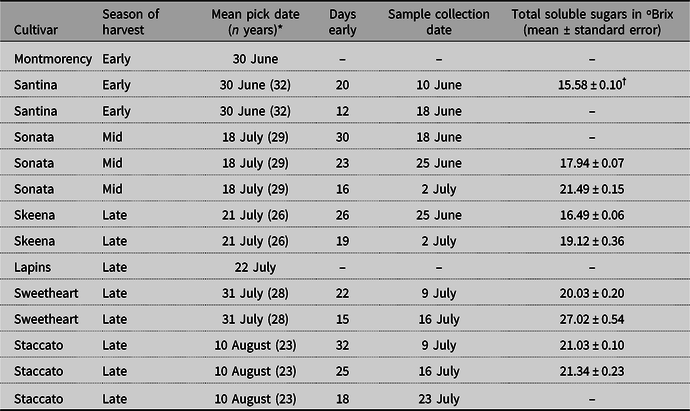
The study was conducted in an experimental orchard at the Summerland Research and Development Centre in Summerland, British Columbia. This site (49°33′37.90"N, 119°38′32.66"W, elevation 419 m) is made up of seven contiguous blocks of cherry trees planted to ripen along a gradient of harvest times (Table 1). Sour cherry trees (Prunus cerasus Linnaeus) of cultivar Montmorency are at the western end, followed by six cultivars of sweet cherry: Santina, Sonata, Skeena, Lapins, Sweetheart, or Staccato, west to east (Fig. 1). The orchard was established in 2004 as a planting of 30 trees of each cultivar (except Montmorency, 63 trees) 4–5 m apart in a 9 × 7 checkerboard pattern, totalling 252 trees (6–9 m tall) in a 160 m ×110 m rectangle (Fig. 1, top row). The trees sampled amongst the seven rows forming the orchard were selected from row one at the southern exterior of the orchard, row four in the centre (interior), and row seven at the northern exterior; the intervening four rows were not monitored (Fig. 1). The site is approximately 230 m from Okanagan Lake, on a grassy bench or plateau, surrounded on two sides (north, south) by steep cliffs, and on the east by a flat uncultivated area, all of which support wild plant hosts of D. suzukii (Thistlewood et al. Reference Thistlewood, Rozema and Acheampong2019) including snowberry (Symphoricarpos albus (Linnaeus) Blake; Caprifoliaceae), Oregon-grape (Berberis aquifolium Pursh; Berberidaceae), mahaleb cherry (Prunus mahaleb Linnaeus), or choke cherry (P. virginiana Linnaeus). On the west side are orchards of apple (Malus domestica (Suckow) Borkhausen; Rosaceae) and pear (Pyrus communis Linnaeus; Rosaceae).
Cherry cultivars and harvest season, mean date of commercial pick, number of days earlier than normal, sampling dates, and total soluble sugars measured in fruit at harvest.

* Average picking date as recorded by Fruit Breeding Laboratory, Agriculture Agri-Food Canada, Summerland, British Columbia.
† ºBrix % measured on 12 June.
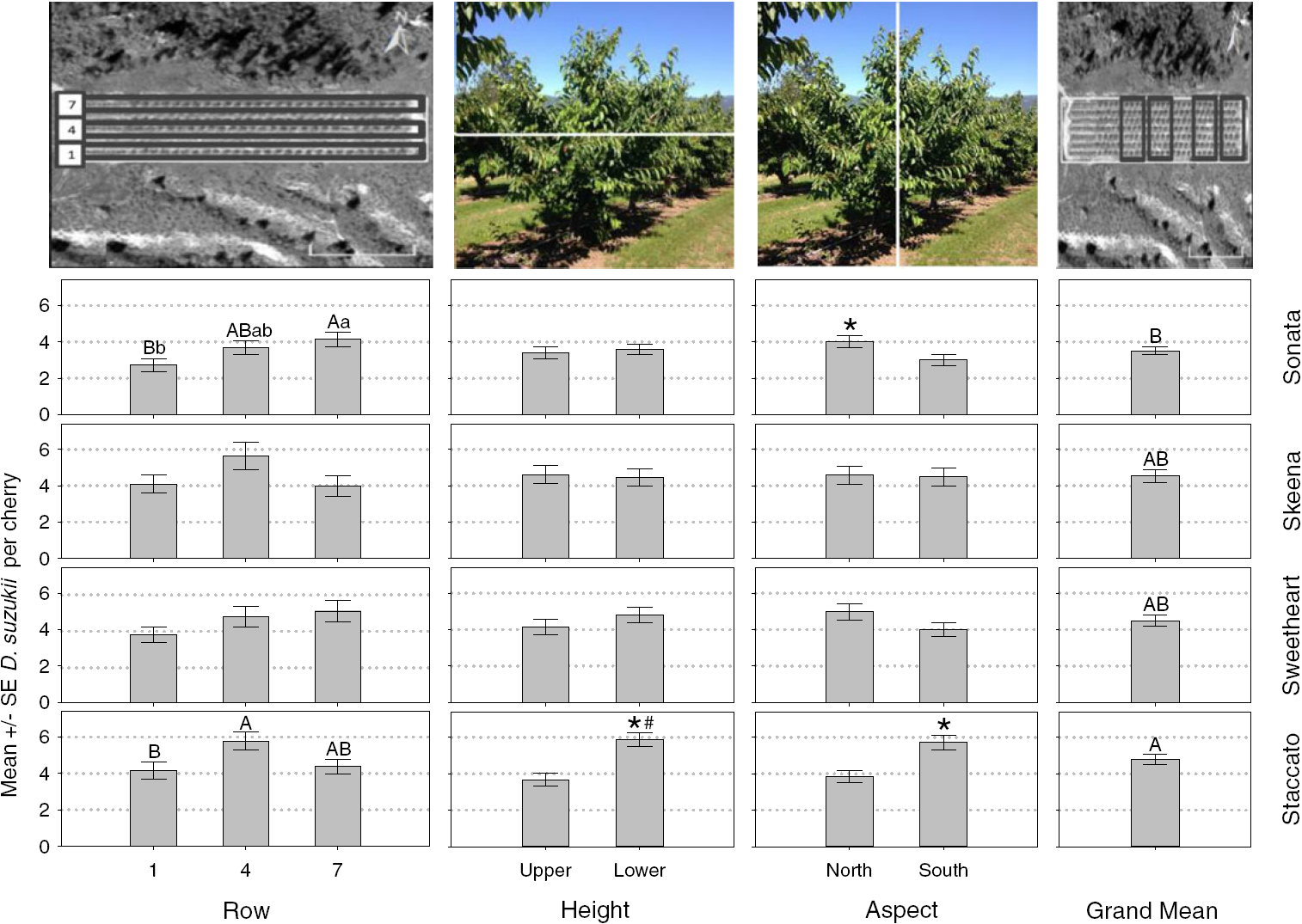
Top row: photographs of orchard rows, height (upper or lower canopy), aspect (north or south face), and locations of the four cultivars sampled (left to right). Succeeding rows show mean (± standard error) number adult Drosophila suzukii emerged per cherry in four sweet cherry cultivars row, height, aspect, and grand mean per cultivar (columns left to right). Uppercase and lowercase letters indicate, respectively, that means within cultivars are not significantly different by Tukey-Kramer post-hoc test or by Dwass-Steel-Critchlow-Fligner mean separation test; * and # indicate significant differences occur between means by two-way analysis of variance, or in a generalised linear model, respectively.

The orchard was treated in 2015, as in prior years, with herbicides and fungicides according to commercial practice (Supplementary Table S1), but has very rarely received any insecticides since establishment. Unusually for this site, during the first two weeks of fruit collections in 2015, some fruit were infected by pathogens. Those collected before 18 June had reduced adult fly emergence, such that only 68 drosophilid adults emerged successfully (nine of which were D. suzukii) from 190 cherries of cultivar Sonata. Consequently, all cherries collected before or on 18 June were excluded from the analysis. The fungicide application of 19 June prevented any rot developing in subsequent cherry collections. No insecticides were applied to control D. suzukii and, consequently, co-infestation with the western cherry fruit fly, Rhagoletis indifferens Curran (Diptera: Tephritidae), was a concern. A spinosad-based fruit fly bait, Naturalyte GF-120 (Dow Agrosciences Indianapolis, Indiana, United States of America) was sprayed weekly from 10 June to 14 July to limit infestation by R. indifferens (Supplementary Table S1). At the rate applied (0.2 g L−1 of active ingredient), the material has not been shown to have any measurable effects on D. suzukii populations in prior trials (H.M.A.T., unpublished results). GF-120 was applied to the canopy in small amounts (approximately 60 mL per tree). Adult tephritids are arrested and feed on droplets residing on fruit and leaves, but it does not always prevent oviposition of gravid females, and so larvae can still emerge from treated cherries after adult exposure (Yee and Chapman Reference Yee and Chapman2005).
Weather records from nearby reference sites operated by Environment and Climate Change Canada (Summerland CS, 49º33′45.2"N, 119º38′55.3"W, 454.20 m; Penticton A 49º27’ 47.0"N, 119º36′08.0"W, 344.40 m) were used for temperature data, or temperature and precipitation data, respectively.
Fruit and insect collections
The number of emerging adults from Drosophila species breeding substrates has been shown to represent with accuracy their egg distribution in the field (Rohlfs and Hoffmeister Reference Rohlfs and Hoffmeister2004). A small number of recent studies have searched for the presence of the characteristic egg spiracles, or breathing filaments, of D. suzukii as proxies for oviposition, e.g., Shrader et al. Reference Shrader, Burrack and Pfeiffer2019, with methodological or cost limits. We employed a rearing process perfected in prior studies (Thistlewood et al. Reference Thistlewood, Rozema and Acheampong2019) and used adult emergence after rearing as a proxy for oviposition.
Given reports that D. suzukii prefers to oviposit in ripe cherries (Lee et al. Reference Lee, Bruck, Curry, Edwards, Haviland, Van Steenwyk and Yorgey2011; Stemberger Reference Stemberger2015) and local confirmation (H.M.A.T., unpublished results), we planned to begin sampling cherries of each cultivar at least two weeks before the typical harvest date of the cultivar (Table 1). Mean harvest dates were provided by the Fruit Breeding Laboratory at Summerland Research and Development Centre from long-term records. At that time, fruit colour typically changes from straw yellow or blush to dark red. To aid in determining when D. suzukii might appear in 2015, we compared the weather with historical results (Thistlewood et al. Reference Thistlewood, Gill, Beers, Shearer, Walsh and Rozema2018) and with a preliminary degree-day model for D. suzukii development (Coop and Dreves Reference Coop and Dreves2015).
Fruits of the earliest cultivar, Santina, were first collected on 10 June and examined to determine whether oviposition had commenced (Table 1, Supplementary Table S2). Before picking, cherry trees in rows one, four, and seven were assessed for the ripest cherries and trees with an even distribution of fruit in the canopy were selected for sampling. Subsequently, we adapted a systematic sampling protocol for canopy arthropods in fruit trees (Stoeckli et al. Reference Stoeckli, Mody and Dorn2008) to examine D. suzukii egg distribution. Trees were selected from candidate cultivars in target rows (1, 4, 7) using a random numbers table, and each tree canopy was divided into four sectors (upper third or lower third, north or south aspects; Fig. 1). Fifteen cherries were collected at random from each sector, for a total of 60 cherries per tree, three trees per cultivar, and two cultivars on each sample date.
An unusually warm growing season in 2015 meant that neither the long-term average picking date nor the preliminary model was useful for timing of sampling. Cherries were collected weekly from at least two cultivars from 10 June to 23 July, to determine the approximate infestation level in each of D. suzukii. Each cultivar was sampled once a week for two to three consecutive weeks. Ten to 30 of the ripest cherries per cultivar were examined for signs of oviposition stings, and characteristic egg filaments of D. suzukii then cut in half to detect the presence of any larvae or pupae. If any infestation of Drosophila species was found, then preliminary sampling was terminated (Supplementary Table S2). Previous experience had shown that by or after 23 July, any remaining cherries were in poor condition, unsuitable for collection (i.e., raisin-like, sticky mass), and D. suzukii were no longer detectable in large samples (H.M.A.T., unpublished results).
Insect rearing from fruit
Drosophila species, and any other arthropods, were reared from individual cherries for at least two weeks under controlled conditions within a growth chamber (Conviron, Winnipeg, Manitoba, Canada) as follows. All the cherries sampled from each sector of a tree were placed individually in 95 × 29 mm vials (Insect Breeding Containers, Greiner Bio-One, North Carolina, United States of America) with approximately 0.3–0.5 g of coarse vermiculite to absorb excess cherry juice and prevent larvae from drowning. The vials were capped with 10–15 cm2 pieces of thin organza (Fabricland, Penticton, British Columbia, Canada) held tightly down with elastics to prevent emergent drosophilids from escaping. Conditions (25 °C, 35% relative humidity, 16:8 light-dark photo cycle) in the growth chamber were monitored by a Sekonic Electric Hygro-Thermograph Model ST-50M (Sekonic Corporation, Japan). After two weeks, the vials were exposed to below-freezing temperatures for at least three hours. Adults, larvae, and intact pupae (pupae already eclosed were not counted) were counted by examining the vial contents on a white background using a probe and paint brush. A small number of vials with mould (e.g., Penicillium Link (Trichocomaceae), Botrytis Michell ex Persoon (Sclerotiniaceae), and Mucor Fresenius (Mucoraceae)) were not processed.
Species identification
Using a binocular microscope, larvae and pupae were identified to family (i.e., Drosophilidae or Tephritidae) as juvenile dipterans are typically undistinguishable at the species level. Immature tephritids were assumed to be R. indifferens, as determined since 2007 at the site (H.M.A.T., unpublished results), and because adult emergence from pupae requires a lengthy diapause before identification. Emerged adult drosophilids were identified using published keys (Bächli et al. Reference Bächli, Vilela, Andersson and Saura2004; Ashburner et al. Reference Ashburner, Golic and Hawley2005; Markow and O’Grady Reference Markow and O’Grady2008; Vlach Reference Vlach2013), and D. suzukii adults were separated by sex. For other species of Drosophila, only males were identified to species using combs on the genitalia and tarsomeres of the prothoracic legs (Kopp and True Reference Kopp and True2002; Kopp Reference Kopp2011). Consequently, the number of larvae and pupae per cherry was not included in the analysis since we could not differentiate between species of juvenile drosophilids. From each collection, a subsample of Drosophila species was confirmed by Bradley Sinclair (Canadian National Collection of Insects, Arachnids, and Nematodes, Ottawa, Ontario, Canada) and some of these, as well as a large subsample collected from cultivars Sweetheart and Staccato, were retained as voucher specimens in the Summerland Research and Development Centre (Summerland, British Columbia, Canada).
Measuring soluble sugar concentrations
The total soluble solids (ºBrix), or sugar level, of five cherries per sector from three trees were measured within each of the two sampled cultivars per collection date (except 18 June; Table 1). Cherries were macerated in cheesecloth until sufficient juice was collected for analysis. Three to 10 readings were taken per fluid sample using a digital refractometer (ATAGO Digital Portable Palette Style Refractometer Model PR-101, Pleasant Prairie, Wisconsin, United States of America), and mean values were calculated.
Data analysis
Distribution of Drosophila suzukii in the tree canopy and orchard. Santina cherries collected on 10 June were removed from the analysis due to differences in sampling protocol. Numbers of male and female D. suzukii per cherry were averaged across all trees per cultivar for each sector of the canopy and its corresponding collection date. We determined if there was a difference in emergence by sex, or differences in mean ºBrix, using a series of independent sample t-tests (or its nonparametric counterpart).
Key features of the distribution of D. suzukii in the tree canopy of cherries were first examined using two-way analysis of variance: row position (rows 1, 4, and 7); height (upper and lower canopy); aspect, (north and south); and their interactions. The interaction effects of row, height, and row × height (model 1) or row, aspect, and row × aspect (model 2), for each cultivar were considered separately. Differences between means were separated with Tukey-Kramer’s honest significant difference test and considered significant when P ≤ 0.05. Separate analyses for each sample week were not included because the same significant patterns were observed over collection periods. Analysis proved very challenging as the adult population density of D. suzukii within cultivars increased rapidly during the study period (Thistlewood et al. Reference Thistlewood, Gill, Beers, Shearer, Walsh and Rozema2018). Consequently, the results of significance tests that assume a fixed sample size were affected. However, the oviposition preference of D. suzukii did not increase continuously and was linked to cultivar ripeness and other variable factors, as explained below.
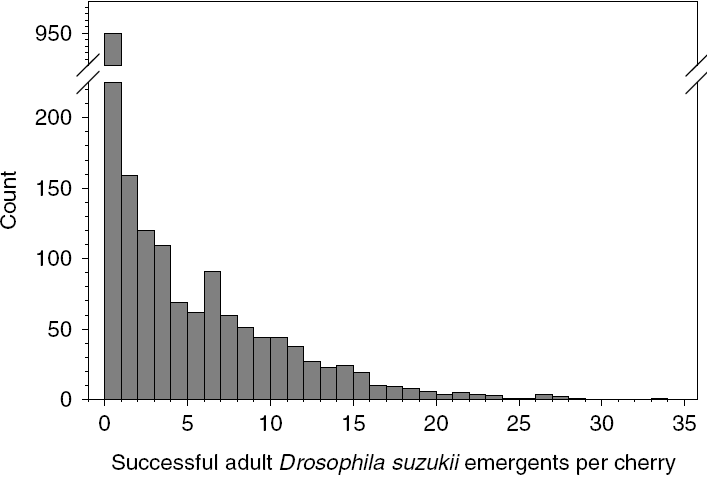
The oviposition preference for each cultivar was inferred by adult emergence from individual cherries collected from the orchard rows and canopy locations. The count data were not distributed normally (Fig. 2), even after square root and log transformations, rendering analysis by analysis of variance inappropriate. Consequently, we conducted a generalised linear model regression with a Poisson error distribution and a log link function (Agresti Reference Agresti2013), and the model was adjusted for overdispersion. We determined if row position, height, and aspect had significant effects on D. suzukii oviposition preference, with row position, height, and aspect as main fixed effects, and included all two-factor and three-factor interactions. The lower canopy, south aspect, and row seven were used as baseline comparisons. A difference between effects was equivalent to testing whether the corresponding variance components were greater than zero. The best models were determined using backwards elimination, beginning with a complex model and sequentially removing insignificant terms by comparing model deviances using goodness-of-fit statistics. Different models (by cultivar) were compared using the Akaike information criterion, for which lower numbers indicate a better relative fit. Differences between means were separated using Dwass-Steel-Critchlow-Fligner mean separation test because of violation normality. Separate analyses for each sample week were not included because there were varying groups of early- or late-ripening cultivars with ripe fruit on any given week (A.C.C., unpublished results). Data were first averaged over sample dates for all cherries of a cultivar.
Distribution of numbers of adult Drosophila suzukii reared from cherries in all orchard rows and canopy locations. When subsampled by cultivar, orchard row, or canopy location D. suzukii distribution retains a right skew.

Coexistence of arthropods
The most common index used to describe intraspecific egg aggregation in drosophilids is J, and the proportional increase in the average number of conspecifics encountered relative to a random distribution (Ives Reference Ives1988; Sevenster Reference Sevenster1996; Toda et al. Reference Toda, Kimura and Tuno1999):
 $$J = {{({s^2}/x) - 1}\over x}$$
where x is the mean and s 2 is the variance of emerging adults per fruit (Ives Reference Ives1988). We measured interspecific aggregation with parameter C, or the proportional increase in the average number of heterospecific competitors encountered relative to a random distribution (Sevenster Reference Sevenster1996), where cov is the covariance of the numbers per patch of the two species, x 1 and x 2:
 $$C = {{cov}\over {{x_1}{x_2}}}$$
We assessed the intra- and interspecific egg distribution of D. suzukii using both parameters J and C. Cherry collections were separated by month to represent two distinct biotic scenarios D. suzukii may experience in the field: (1) D. suzukii sharing single-patch resources with larger (more competitive) Rhagoletis indifferens larvae and (2) D. suzukii sharing single-patch resources with similar-sized native Drosophila larvae.
Rhagoletis indifferens infestation predominated in June (eliminated thereafter by selective insecticide application). The very few June samples in which both D. suzukii and native Drosophila emerged from the same cherry as R. indifferens were removed in order to simplify the analysis and the comparisons of D. suzukii: R. indifferens or D. suzukii: Drosophila species.
Likewise, cherries collected in July, when R. indifferens was almost absent, were used to examine the aggregated egg distribution of D. suzukii and native Drosophila species. A few samples collected in July with emerging R. indifferens larvae were removed, to simplify the analysis. Each parameter, J and C, was pooled by month, respectively, and compared to zero using a one-sample t-test.
To examine the spatial extent of D. suzukii egg aggregation in individual plant hosts, J and C values were calculated for the cherries gathered in each of four sectors of the canopy (two aspects × two heights). Cultivar was used as a replicate, and the data were log-transformed to normalise distribution. A one-way analysis of variance was performed, and significant mean differences were separated with Tukey-Kramer’s honest significant difference test and considered significant when P ≤ 0.05. Parameters J and C were also calculated for the July collections from cultivars Sonata, Skeena, Sweetheart, and Staccato, in the same fashion. The values of J or C in the four sectors were compared (analysis of variance), and significant mean differences were separated with Tukey-Kramer’s honest significant difference test.
Results are given throughout as the sample mean and standard error of the mean, x ± SE. All analyses were conducted using a significance level α = 0.05 and SAS JMP 13 or 14 (SAS Institute, Cary, North Carolina, United States of America).
Results
The weather during the spring and summer of 2015 was much hotter than in previous years (Thistlewood et al. Reference Thistlewood, Gill, Beers, Shearer, Walsh and Rozema2018). The full bloom date of sweet cherry cultivars was advanced by approximately three weeks ahead of normal, and the subsequent development of all cultivars was the earliest observed in 13 years (Table 1; unpublished results from Fruit Breeding Laboratory, Summerland Research and Development Centre).
From 10 to 25 June, a total of 887 cherries were reared individually from cultivars Santina, Sonata, and Skeena. Of these, 457 cherries were infested with arthropods of interest. In total, 1328 arthropods emerged: 881 D. suzukii, 177 of two other Drosophila species (see below) and 270 R. indifferens larvae. Four cherry fruitworm (Grapholita packardi Zeller; Lepidoptera: Tortricidae) larvae emerged singly from individual cherries and are not included in the analysis. During the first three weeks of application of GF120 bait spray for suppression of R. indifferens, some 42–84 tephritid larvae per week (0.14 ± 0.01 larvae per cherry) emerged.
Of 1071 assayed cherries collected from cultivars Sonata, Skeena, Sweetheart, and Staccato between 2 and 16 July, 859 were infested with Drosophila species and a total of 5484 D. suzukii and 4930 native Drosophila emerged. By contrast, only 12 R. indifferens larvae were found in all of the Skeena, Sweetheart, and Staccato cherries, during July. The latter decrease very likely resulted from a combination of cessation of an early emergence of R. indifferens in a warm year (H.M.A.T., unpublished results), and from use of the GF120 bait spray.
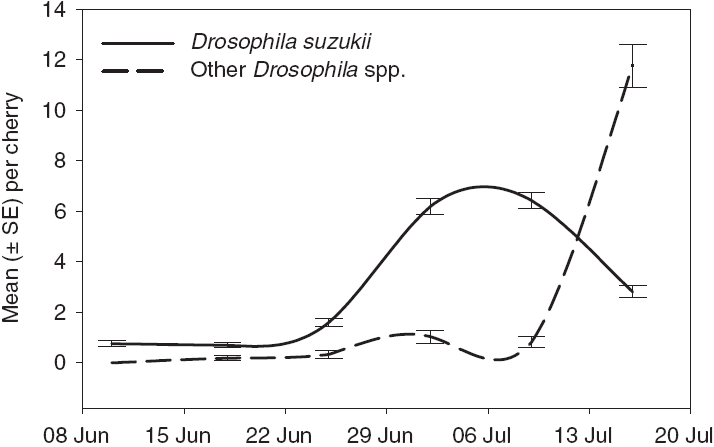
Drosophila species demographics. We collected 2160 sweet cherries from five cultivars. (Santina are not shown in Fig. 1 for reasons given below), during seven weeks in 2015, from which 1958 were reared successfully as described above. Drosophila species were detected throughout the sampling period, but only D. suzukii occurred in all cultivars and dates (Fig. 3). As the season progressed, D. suzukii population densities gradually increased, hitting peak densities in early July. Drosophila species other than D. suzukii were not present in the first week of sampling of three cultivars: Santina, Sonata, or Skeena. Native Drosophila populations were at their maximum on the last sampling date, 16 July, when cherries were rotten throughout the orchard (Fig. 3).
Mean numbers per cherry (± standard error) of Drosophila suzukii, and of all other Drosophila species pooled, collected from the canopy of a sweet cherry orchard in 2015.

Of the 1958 assayed cherries, 1422 produced one or more drosophilid adults, primarily D. suzukii, D. melanogaster, and D. pseudoobscura. The majority of Drosophila species that emerged were D. suzukii (6365 of 11 472 adults). Of the remaining 5107 adult Drosophila, 2455 were male and amongst them we identified 2110 D. melanogaster and only 22 D. pseudoobscura. We removed from the study the results for males too damaged to identify to species (n = 323). There was no difference between the number of male and female emergents per cherry of D. suzukii (55.2% female) nor of other Drosophila species (51.6% female). For the remaining analyses, total numbers of males and females were pooled in each of two groups: D. suzukii, and all other Drosophila species, and are presented as such.
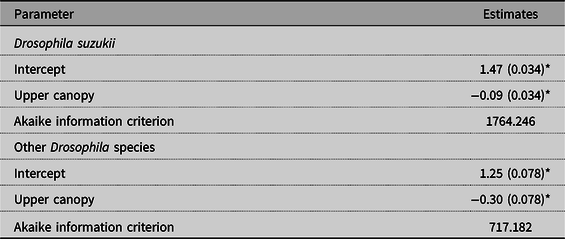
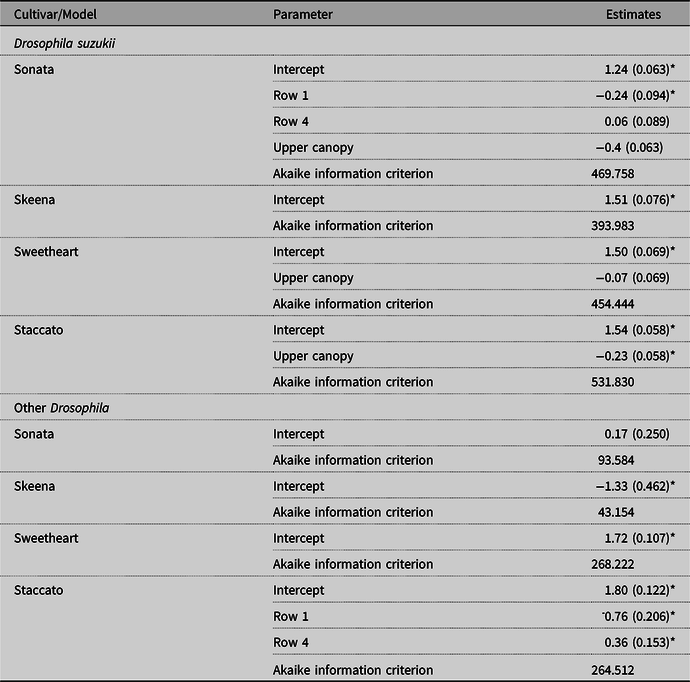
Distribution of Drosophila suzukii in the tree canopy and orchard. We compared the effects of row, height, and aspect, by cultivar in two stages: first in preliminary analysis of variance analyses (Fig. 1; Supplementary Tables S3–S10), followed by analysis with generalised linear models (Tables 2–3, Supplementary Tables S11–S15).
Estimated fixed effects for the Drosophila suzukii model where cultivars are pooled. Estimated standard error is in parentheses.
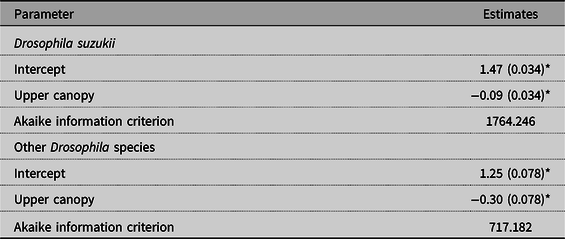
* Indicates that the parameter is significantly different from zero at the 0.05 level of significance.
Estimated fixed effect variances for two models. Estimated standard error is in parentheses.
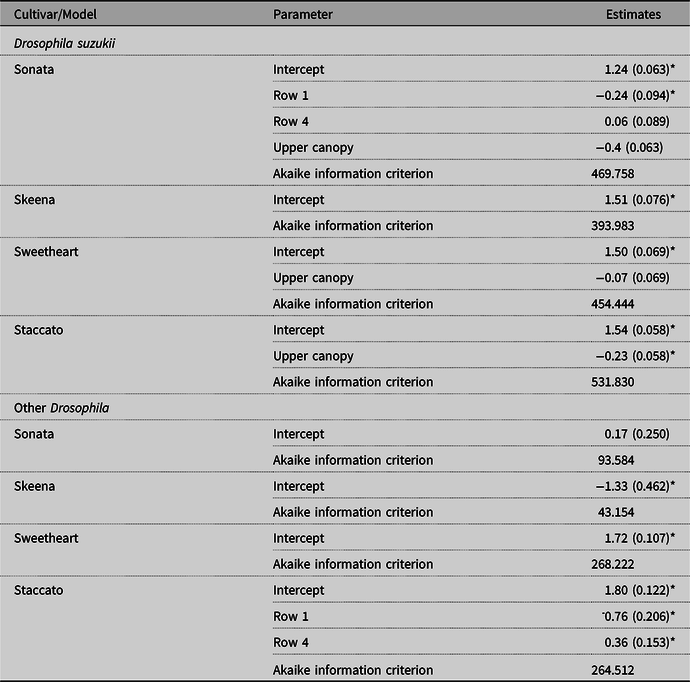
* Indicates that the parameter is significantly different from zero at the 0.05 level of significance.
Row position within the orchard (Fig. 1) affected D. suzukii oviposition the most frequently across all cultivars examined. More D. suzukii emerged from cherries collected in rows four (central row) and seven (northern border) of Sonata, Skeena, and Staccato (Fig. 4A, Row), but no significant differences were found in samples from Sweetheart when either model was used (model 1: two-way analysis of variance: F(5,363) = 0.96, P = 0.4423; model 2: two-way analysis of variance: F(5,363) = 1.21, P = 0.3006). In the early-ripening Sonata cherries, the north-facing row seven (mean ± standard error = 4.15 ± 0.40) had significantly more emerging flies than row one, the southernmost (2.73 ± 0.36), but did not differ significantly from the central row four (3.69 ± 0.37; model 2: row: two-way analysis of variance: F(5,298) = 3.34, P < 0.0219). Similarly, in late-ripening Staccato cherries, those collected from the central row four (5.78 ± 0.51) and from northern row seven (4.37 ± 0.41) had the highest number of successful adult D. suzukii emergents (model 2: row: two-way analysis of variance: F(5,361) = 5.23, P = 0.230).
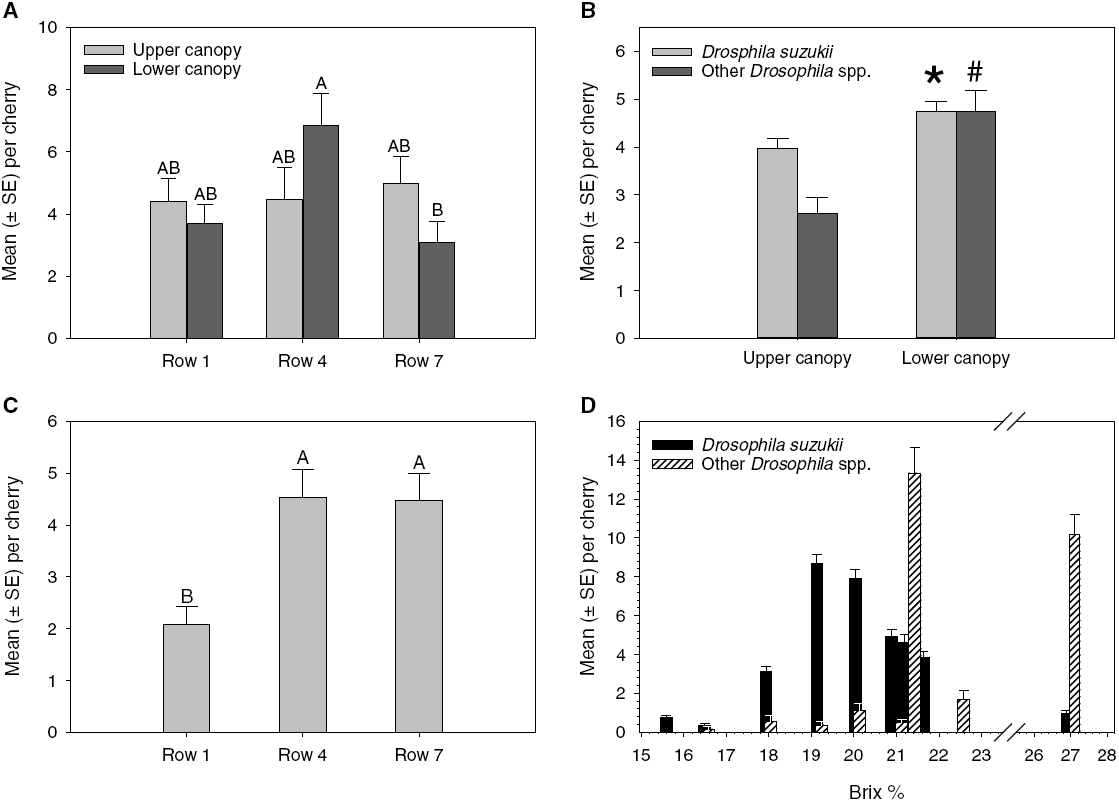
Group means (± standard error) of number of adults emerged from single cherries. A, Drosophila suzukii from three orchard rows and two canopy heights, in cultivar Skeena only; B, D. suzukii and for all other Drosophila species, from two canopy heights and all cultivars pooled; C, all other Drosophila species from three rows and all cultivars pooled; D, D. suzukii, and other Drosophila species, at various ºBrix in fruit samples. For A, C, upper-case letters indicate that means within rows are not significantly different; for B, * and # indicate significant differences occur between means by two-way analysis of variance, or in a generalised linear model, respectively.

Only those general linear models with the best fit are discussed subsequently (Tables 2–3, Supplementary Tables S11–S15). Significant effects were found only in the earliest and latest cultivars, Sonata and Staccato (Supplementary Tables S12, S15). In the earliest, Sonata, we observed a significant difference among rows in the orchard (Fig. 1 row; Supplementary Table S12; row likelihood ratio: χ 2 = 7.73, df = 2, P < 0.0209), whereby 0.95 to 1.41 fewer D. suzukii emerged from cherries collected from row one than from rows four or seven.
Regarding canopy height (Fig. 1 height), the lower canopy was significantly more infested in only the latest-ripening cultivar, Staccato. A higher number of adults emerged from the lower canopy (5.87 ± 0.38) than from the upper canopy (model 1: height: two-way analysis of variance: F(5,361) = 5.20, P < 0.0001). Similarly, analysis using the best linear model revealed height as significantly different in cultivar Staccato (height: likelihood ratio: χ 2 = 16.81, df = 1, P < 0.0001), with 2.19 fewer flies in the upper canopy than in the lower sector of the canopy (Fig. 1 height).
For the remaining cultivars, Sonata (model 1: two-way analysis of variance: F(5,298) = 1.78, P = 0.1170) and Sweetheart (model 1: height: two-way analysis of variance: F(5,363) = 0.96, P = 0.4423), there was no significant difference for populations by canopy height. Interestingly, the row by height interaction was only significant in Skeena (Fig. 4A), when row position was significant between the bottom canopy in rows four (6.84 ± 1.05) and seven (3.09 ± 0.69; Fig. 1 row; model 1: row × height: two-way analysis of variance: F(5,318) = 2.30, P < 0.0367). Unlike the central row four, both exterior rows had more D. suzukii emerge from the upper canopy, but the differences were not significant. When all four cultivars were pooled using linear models, the number of D. suzukii per fruit was significantly greater in cherries from the lower canopy (4.75 ± 0.20), than from the upper canopy (3.97 ± 0.20) (Fig. 4B; Tables 2, Supplementary Table S11; height: likelihood ratio: χ 2 = 7.01, df = 1, P < 0.0081). However, this conclusion may result in large part from the high population density of D. suzukii late in the season, in cultivar Staccato, and its major contribution to fly numbers.
For aspect within the canopy (Fig. 1 aspect), during the early season and in the early-ripening cultivar Sonata, the northern sides of trees were significantly (model 2: aspect: two-way analysis of variance: F(5,298) = 3.34, P < 0.0170) more infested with D. suzukii (4.03 ± 0.32) than the southern aspect. However, late in the season, and in the late-ripening Staccato cherries, the southern sides of trees were more infested (5.71 ± 0.40) than the northern aspect (model 2: aspect: two-way analysis of variance: F(5,361) = 5.23, P < 0.0004). For the middle part of the season, no significant differences were found for D. suzukii by canopy aspect in Skeena (model 2: two-way analysis of variance: F(5,298) = 3.34, P = 3.3428) or in Sweetheart (model 2: two-way analysis of variance: F(5,363) = 1.22, P = 0.3006). By contrast, the best fit using general linear models showed no significant differences for aspect for any given cultivar (Fig. 1 aspect).
Distribution of other Drosophila species in the tree canopy and orchard. The sum total of other Drosophila species, mainly determined as D. melanogaster, was also examined to determine if row position within the orchard or canopy height significantly affected their distribution. We used the same generalised linear model as for D. suzukii. When all four cultivars were pooled, numbers of other Drosophila were significantly different only for the two canopy height positions (Fig. 4B; Table 2; height: likelihood ratio: χ 2 = 15.40, df = 1, P < 0.0001). Fruit collected from the upper canopy (2.61 ± 0.32) had 2.13 fewer flies emerging per fruit than from the lower canopy.
When compared separately by cultivar, significant effects were found for row position in the latest ripening, Staccato. Significantly more other Drosophila species emerged from fruit hanging in row four (8.65 ± 1.50) and row seven (9.04 ± 1.32; row: likelihood ratio: χ 2 = 17.67, df = 2, P < 0.0001). The population level of other Drosophila species in that late season cultivar was high enough to affect significantly the grand means by row in all cultivars (Fig. 4C).
Effect of time or population density on distribution
The numbers of D. suzukii emerging from the canopy differed significantly with time of harvest (i.e., early-ripening to late-ripening cultivars) (Fig. 3). More D. suzukii emerged from southernmost row seven and central row four in the early season, in early-ripening Sonata, but emergence became uniform later in the season (observed in Sweetheart and Skeena cherries). By the end of commercial cherry suitability, in Staccato, adult emergence was significantly higher in the lower canopy than upper (Fig. 1 height). Aspect seems to have had little to no effect on D. suzukii distribution patterns since it was only significant in preliminary analysis of variance analyses (Fig. 1 aspect, Supplementary Tables S7–S10).
As expected, it appears that population density and time of harvest were closely correlated (Fig. 3). More D. suzukii emerged from late-ripening cultivars than earlier ones. However, the only significant differences in mean numbers of D. suzukii per cherry were between the early-ripening and late-ripening cultivars Sonata and Staccato (Kruskal-Wallis test; χ 2 = 11.57, df = 3, P < 0.0090; Fig. 1 grand mean). Interestingly, the pattern of distribution for other Drosophila species was, in general, very similar to that of D. suzukii (Figs. 4B, C, Tables 2–3).
Soluble Sugars. The levels of total soluble sugars (ºBrix) differed throughout the canopy, with slightly higher levels in the upper and south canopy sectors in Sonata, Skeena, and Staccato cherries (Table 4). There was no apparent correlation between ºBrix and emerged Drosophila except in Staccato, where the most D. suzukii emerged from the sweetest cherries in the south canopy. The ºBrix values measured where maximal numbers of D. suzukii, or other Drosophila species, emerged were largely nonoverlapping. Thus, the highest number of adults emerged for D. suzukii, and for other Drosophila species, from sectors with a mean of 19.1 ºBrix (8.67 ± 0.497 per cherry), or of 21.3 (13.34 ± 1.305 per cherry), respectively. In both cases, the canopy sectors of interest contained multiple species of Drosophila.
Mean ± standard error (SE) values of total soluble sugar concentrations (ºBrix), and of Drosophila suzukii emergents by canopy location, season-long in 2015.

na, total.
* Indicates significant differences between mean values for the canopy sector (column) described.
Coexistence of arthropods. Owing to the great differences in arthropod populations between June and July, particularly with regard to presence of R. indifferens, the interactions are generally separated by month in the following analysis.
June and influence of Rhagoletis indifferens
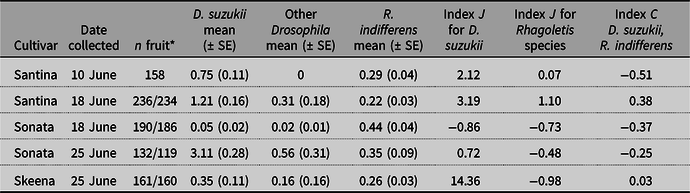
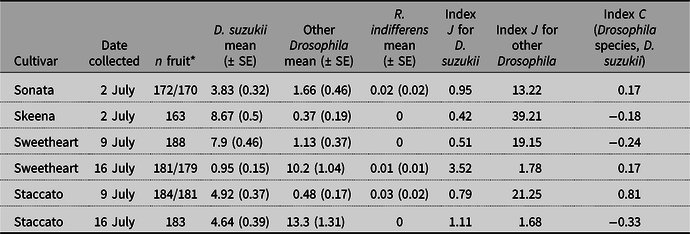
The degree of intraspecific aggregation, J, for D. suzukii was mainly positive in June, with a mean of 3.91 ± 2.70 (Table 5), but did not differ significantly from zero indicating no tendency for aggregated egg distribution (one-sample t-test: t = 1.45, n = 5, P = 0.2217). It was only negative in Sonata cherries on 18 June, when only nine D. suzukii emerged from 190 fruits collected, owing to mould issues in rearing. In Skeena, J = 14.36, suggesting that as the season progressed, and as D. suzukii population densities increased, intraspecific aggregation among D. suzukii increased.
Mean ± standard error (SE) numbers per fruit of Drosophila suzukii, other Drosophila species, and Rhagoletis indifferens pupae, which emerged from sweet cherry fruits as collected by cultivar in 2015, with calculated indices of aggregation, J and C.

* Number of fruits reared individually and without mould or other defects; lower value shows number of fruit selected for correct calculation of indices of aggregation.
Similar aggregation patterns were found for the larvae of R. indifferens. Parameter J was largely negative in June, with a mean of 0.20 ± 0.37 (Table 5), and did not differ significantly from zero (one-sample t-test: t = −0.55, n = 5, P = 0.6109). The results show that more than one R. indifferens larvae were unlikely to occupy an individual cherry simultaneously.
The mean measure of interspecific aggregation, C, for D. suzukii and R. indifferens, was negative at 0.14 ± 0.16 (Table 5), and not significantly different from zero. Such low values of C suggest that the two species rarely developed within the same host (one-sample t-test: t = −0.91, n = 5, P = 0.4139). Contingency analyses also support a negative association between D. suzukii and R. indifferens. The very rare presence of both species within a cherry suggests avoidance by D. suzukii of tephritid-infested fruit or of Rhagoletis species avoiding drosophilid-infested fruit or both types of avoidance (chi-square test; P < 0.0064, odds ratio = 1.61, 95% confidence interval = 1.135–2.284).
July and Drosophila species
The mean value of intraspecific aggregation of D. suzukii, J, was 1.21 ± 0.47 (Table 6) and significantly different from zero. The latter indicates a tendency for D. suzukii to aggregate in the same host, albeit in small numbers (one-sample t-test: t = 2.57, n = 5, P = 0.0499). By contrast, native Drosophila species showed a much more robust tendency for intraspecific aggregation with J = 16.05 ± 5.75 (Table 6) (one-sample t-test: t = 2.79, n = 5, P = 0.0384). All samples had J > 10, except those collected on 16 July when most cherries were rotting or raisin-like.
Mean ± standard error (SE) numbers per fruit of Drosophila suzukii, other Drosophila species, and Rhagoletis indifferens pupae, which emerged from sweet cherry fruits as collected by cultivar in 2015, with calculated indices of aggregation, J and C.

* Number of fruits reared individually and without mould or other defects; lower value shows number of fruit selected for correct calculation of indices of aggregation.
Parameter C, measuring interspecific aggregation between D. suzukii and native Drosophila, was largely negative across sampling dates, with a mean of 0.07 ± 0.17. It was consistently not significantly different from zero (Table 6). This result indicates that D. suzukii did not emerge from cherries infested with other Drosophila species (one-sample t-test: t = 0.40, n = 5, P = 0.3967).
Spatial context of coexistence
The values of J for D. suzukii, and for other Drosophila species, were consistent in observations from all sectors of the canopy, when tested using one-way analysis of variance (Supplementary Tables S16–S18). They did not differ significantly between any sector of the canopy for D. suzukii (one-way analysis of variance: F(3,12) = 0.48, P = 0.7039). Similarly, the values for other Drosophila species did not differ significantly in any sector of the canopy (one-way analysis of variance: F(3,12) = 0.48, P = 0.6993). In addition, the parameter C, measuring interspecific aggregation between D. suzukii and native Drosophila, was stable and did not differ significantly between observations in any canopy sector (one-way analysis of variance: F(3,12) = 0.83, P = 0.5042).
Discussion
Our results are the first direct evidence that the distribution of D. suzukii within sweet cherry orchards is not uniform. Generally, D. suzukii infestation tended to be highest in the exterior north-facing row and interior middle row early in the growing season but, later in the season, row position had less of an effect and canopy height was more important (Fig. 1). Diepenbrock and Burrack (Reference Diepenbrock and Burrack2016) noted that differences in infestation rate between sectors of a plant canopy in berries may be due (1) to oviposition preference by female D. suzukii for fruit in different locations; or (2) by differential mortality of D. suzukii eggs or larvae in those locations during the period between oviposition and emergence; or (3) by a combination of those factors. At the current time, the contribution of differential mortality during the relatively short developmental period of oviposition to emergence is unknown. In the present study, we sum the two effects as oviposition preference, because the cherries were collected when the insect was in egg or larval stages and reared away from further predation or parasitism. To varying degrees among cultivars, D. suzukii survival, or oviposition preference, was affected by fruit location within the tree canopy and by tree location within the orchard.
Marked Drosophila suzukii has been observed to migrate from nearby woodlots and field margins into commercial orchards (Klick et al. Reference Klick, Yang, Walton, Dalton, Hagler and Dreves2016) and over long distances (Tait et al. Reference Tait, Grassi, Pfab, Crava, Dalton and Magarey2018). Many studies have inferred from trap captures that adjacent wild hosts support D. suzukii populations and allow cultivated crops to be re-infested over time (Walsh et al. Reference Walsh, Bolda, Goodhue, Dreves, Lee and Bruck2011; Atallah et al. Reference Atallah, Teixeira, Salazar, Zaragoza and Kopp2014; Lee et al. Reference Lee, Dreves, Cave, Kawai, Isaacs and Miller2015a; Klick et al. Reference Klick, Yang, Walton, Dalton, Hagler and Dreves2016; Pelton et al. Reference Pelton, Gratton, Isaacs, Van Timmeren, Blanton and Guédot2016; Wang et al. Reference Wang, Stewart, Biondi, Chavez, Ingels and Caprile2016; Briem et al. Reference Briem, Dominic, Golla, Hoffmann, Englert, Herz and Vogt2018; Thistlewood et al. Reference Thistlewood, Gill, Beers, Shearer, Walsh and Rozema2018; Drummond et al. Reference Drummond, Ballman and Collins2019). The size and shape of our research orchard (seven rows wide, Fig. 1) are common in high-density, high-value, orchards of British Columbia, and other regions growing sweet cherry. Despite its rectangular shape and limited width of seven rows, a measurable and significant spatial effect was detected in early-ripening Sonata trees; the exterior north-facing row and the central row were more infested than the south-facing row. Presumably, a wider orchard would have experienced even larger effects. Two hypotheses may explain such differences: differences in population pressure of overwintered D. suzukii from the north or south sides, or avoidance of oviposition along the southernmost (sunny and exposed) rows of the orchard. The orchard was located on a narrow bench with steep ravines on three sides, which differed in amounts of shade and vegetation, as is common in the British Columbia interior. We estimated there to be a higher number and diversity of native plant hosts (Thistlewood et al. Reference Thistlewood, Rozema and Acheampong2019) along the north side than the more exposed and dry south-facing ravine, and the former could have provided a suitable overwintering refuge in some, as yet undetermined manner (Thistlewood et al. Reference Thistlewood, Gill, Beers, Shearer, Walsh and Rozema2018).
As small, highly fecund flying insects, D. suzukii increase to high populations during the course of the year in a succession of fruit crops and noncrop hosts in western North America (Lee et al. Reference Lee, Dreves, Isaacs, Loeb, Thistlewood and Brewer2015b; Caprile et al. Reference Caprile, Grant, Hamby, Haviland and Rill2016; Wang et al. Reference Wang, Stewart, Biondi, Chavez, Ingels and Caprile2016, Reference Wang, Kacar and Daane2019; Thistlewood et al. Reference Thistlewood, Gill, Beers, Shearer, Walsh and Rozema2018, Reference Thistlewood, Rozema and Acheampong2019). In the present study, at the start of the sampling period (25 June), 467 D. suzukii had emerged from 293 cherries. By 2 July, 2071 adults had emerged from 335 cherries, easily quadrupling population numbers. For D. suzukii, high population levels within an orchard seem to result in a breakdown of most differences in spatial variation across rows. Such a population effect on spatial variation in orchard trees was noted earlier for codling moth, Cydia pomonella (Linnaeus) (Lepidoptera: Tortricidae) (Stoeckli et al. Reference Stoeckli, Mody and Dorn2008). If temperature alone was the determinant factor in the cool early season, one would expect the sunnier southern row to have had the highest population level of D. suzukii at that time and the lowest density in the late season. Although temperature may not explain the differences observed across rows, it may be a major factor in the differences seen between the lower and upper canopy of the trees, as was found in studies cited earlier. In the late-ripening Staccato cherries, significantly more D. suzukii emerged from fruits in the lower canopy than in the upper canopy.
It is possible that some differences in microclimate existed within our study area, primarily from shading or canopy structure, but we did not monitor temperature or relative humidity by sector or row. A number of studies of insect populations in tree canopies have shown, both at the orchard and tree level, their spatial distribution to be strongly affected by temperature and relative humidity (e.g., Stoeckli et al. Reference Stoeckli, Mody and Dorn2008), as is now known for D. suzukii in small fruits (Diepenbrock and Burrack Reference Diepenbrock and Burrack2016; Evans et al. Reference Evans, Toews and Sial2017; Rice et al. Reference Rice, Jones, Morrison and Leskey2017; Drummond et al. Reference Drummond, Ballman and Collins2019). Presently, the literature includes more than 40 studies of temperature effects on D. suzukii, almost all in laboratory conditions. Moreover, time of day was a significant factor in oviposition in a laboratory study (Shaw et al. Reference Shaw, Fountain and Wijnen2018b) and may interact with shade, temperature, or humidity throughout the day. However, the fly may not react to differences in temperature, or temperature may not be a significant factor, at the time of oviposition site selection and when other factors are at play. Relative humidity is known to influence D. suzukii behaviour significantly in blackberry and raspberry crops (Diepenbrock and Burrack Reference Diepenbrock and Burrack2016; Evans et al. Reference Evans, Toews and Sial2017; Rice et al. Reference Rice, Jones, Morrison and Leskey2017). Differences in infestation rate in blackberry canopies were attributed to physical characteristics of locations rather than fruit availability, mainly to changes in microclimate caused by differences in vegetation structure (Diepenbrock and Burrack Reference Diepenbrock and Burrack2016). In a cooler and more humid climate than the Okanagan Valley, and in wild blueberry plants only 25–40 cm high, Drummond et al. (Reference Drummond, Ballman and Collins2019) observed that D. suzukii were 10-fold more likely to oviposit in non-shaded berries at the top of the plant canopy (< 0.25 m above ground) than in even lower parts (middle and bottom of stems) of the bush.
Drosophilids are more heat tolerant when relative humidity is over 70% and in the field may be able to withstand higher temperatures with further increases in humidity (Evans et al. Reference Evans, Toews and Sial2017). The latter study concluded that the majority of D. suzukii successfully complete their development inside fruit that is fully shielded by the canopy of the blueberry bush, where they were most likely to experience lower temperature and higher humidity. Consequently, later in the season and when fully developed, the lower canopy of cherry trees may be cooler and/or more humid than the upper canopy, which may increase survival of all life stages of D. suzukii, and promote feeding and oviposition behaviours (Rice et al. Reference Rice, Jones, Morrison and Leskey2017). The complexity of interactions of microclimate, time of day, or plant structure, and determining which is the dominant factor in oviposition, is highlighted by the results to date.
Our results show that D. suzukii and other Drosophila, mainly D. melanogaster, share similar distribution patterns within orchards. It is unclear if similar preferences for the lower canopy, and for the central row four and northernmost row seven, occur as a result of the presence of any prior oviposition by one species, leading to an effect on oviposition of the other. Our results suggest that spatial distribution of D. melanogaster is similar to that of D. suzukii, because microclimate, particularly humidity, affects D. melanogaster oviposition in a similar manner. This indicates that within-fruit competition may not influence the number of successful D. suzukii adults emerging (Becher et al. Reference Becher, Flick, Dowska, Schmidt, Hagman and Lebreton2012; Hamby and Becher Reference Hamby and Becher2016; Sampson et al. Reference Sampson, Mallette, Addesso, Liburd, Iglesias and Stringer2016).
It appears that microclimate may have a stronger effect on D. suzukii populations than does fruit quality at oviposition. In one study with a small number of cherries, the firmness, pH, and Brix correlated weakly with larval infestation (Lee et al. Reference Lee, Bruck, Curry, Edwards, Haviland, Van Steenwyk and Yorgey2011). In the same study, choice tests of six different fruits showed optimal ºBrix levels ranging from 9.6 in strawberries (Fragaria Linnaeus; Rosaceae) to 19.4 in cherries (Lee et al. Reference Lee, Bruck, Curry, Edwards, Haviland, Van Steenwyk and Yorgey2011). In the present study, owing to limits of sample processing and rapid changes in plant development, we likely missed a lower range of ºBrix values which is minimally acceptable to D. suzukii for commencement of oviposition (H.M.A.T., unpublished results). However, within the present range of samples, 19.1 ºBrix was optimal and an average of eight D. suzukii adults emerged per cherry from the sector concerned (Fig. 4D). Drosophila suzukii oviposition preference may be influenced by status of fruit maturity in general, but in the present study, the concentration of total soluble sugars had no apparent influence on spatial distribution within the canopy of each cultivar sampled (Table 4).
We also showed that D. suzukii does not usually coexist in fruit with other arthropods either because of strong competition within fruit or avoidance during oviposition. The evidence suggests that D. suzukii maintains coexistence with other Drosophila species in its native continent of Asia by resource partitioning (i.e., exploiting a resource previously untapped by other Drosophila). In Japan, D. suzukii exhibited a random egg distribution on ripe cherries still attached to the tree, while nine other Drosophila species (as well as Chloropidae (Diptera), Sciaridae (Diptera), and a few parasitic Hymenoptera) oviposited on fallen fruits almost exclusively (Mitsui et al. Reference Mitsui, Takahashi and Kimura2006). When ripe fruit is scarce, D. suzukii may oviposit in less favourable, overripe, and fallen fruit and face strong competition from other species, as seen in Japan (Mitsui et al. Reference Mitsui, Takahashi and Kimura2006; Lee et al. Reference Lee, Bruck, Curry, Edwards, Haviland, Van Steenwyk and Yorgey2011; Atallah et al. Reference Atallah, Teixeira, Salazar, Zaragoza and Kopp2014; Rombaut et al. Reference Rombaut, Guilhot, Xuéreb, Benoit, Chapuis and Fellous2017). Intraspecific competition apparently does occur in D. suzukii. An increase in larval density in puréed raspberries (up to 20–40 larvae per host) decreased their development rate and survival to adulthood (Hardin et al. Reference Hardin, Kraus and Burrack2015). Drosophila suzukii primarily oviposits as single egg clutches and as such does not generally experience development under crowded conditions, suggestive of weak larval competitors (Mitsui et al. Reference Mitsui, Takahashi and Kimura2006; Hardin et al. Reference Hardin, Kraus and Burrack2015). Our results similarly showed no evidence of aggregated egg distribution in June. As the season progressed, and as their population density increased, the index of intraspecific aggregation, J, among D. suzukii increased, although at low levels, unlike the pattern observed in the native Drosophila species.
The index of interspecific aggregation, C, reveals that D. suzukii did not co-exist in cherries infested with other Drosophila species. It is currently unproven as to whether ovipositing D. suzukii are capable of distinguishing in the field between intact fruit and fruit previously infested by other insects and whether the presence of other conspecific larvae influences their behaviour. However, it seems likely. Using artificial media, Shaw et al. (Reference Shaw, Brain, Wijnen and Fountain2018a) studied the interaction of D. suzukii with D. melanogaster in the laboratory. The emergence of D. suzukii was significantly reduced when flies were given media to which D. melanogaster had been exposed beforehand, compared with blank media, or when prior exposure to D. suzukii had occurred. Also, significantly more D. suzukii eggs were laid in blank media than in media preinocculated with eggs or larvae of D. melanogaster.
Drosophila suzukii always attacks sweet cherries in British Columbia orchards before other Drosophila species do so (Fig. 3, Table 5; H.M.A.T., unpublished results) and may provide opportunities for native saprophagous Drosophila species to infest healthy, intact fruit that were previously unavailable for their exploitation. Consequently D. suzukii could face competition due to secondary infestations in invaded regions (Stemberger Reference Stemberger2015; Bernardi et al. Reference Bernardi, Andrezza, Botton, Baronio and Nava2017). As mentioned, when ripe fruit is scarce, D. suzukii may oviposit in less favourable, overripe, and fallen fruit and become exposed to interspecific competition (Lee et al. Reference Lee, Bruck, Curry, Edwards, Haviland, Van Steenwyk and Yorgey2011; Atallah et al. Reference Atallah, Teixeira, Salazar, Zaragoza and Kopp2014; Rombaut et al. Reference Rombaut, Guilhot, Xuéreb, Benoit, Chapuis and Fellous2017). In newly fallen and old cherries collected in Japan, some D. suzukii co-emerged with other Drosophila species, showing that direct competition is possible under native conditions (Mitsui et al. Reference Mitsui, Takahashi and Kimura2006). Elsewhere, multiple Drosophila species, in addition to D. suzukii, have emerged from cherries (Beers et al. Reference Beers, Van Steenwyk, Shearer, Coates and Grant2011; Stemberger Reference Stemberger2015). In grapes (Vitis Linnaeus; Vitaceae) and strawberries (Fragaria species) collected from the United States of America and Brazil, respectively, D. suzukii provided entry holes for other species such as D. melanogaster, D. simulans Sturtevant, and Zaprionus indianus Gupta (Diptera: Drosophilidae) (Van Timmeren and Isaacs Reference Van Timmeren and Isaacs2014; Bernardi et al. Reference Bernardi, Andrezza, Botton, Baronio and Nava2017). In France, oviposition stings left by D. suzukii inoculated grapes with sour rot (a disease caused by acetic acid bacteria and yeasts), resulting in subsequent infestation by D. melanogaster (Rombaut et al. Reference Rombaut, Guilhot, Xuéreb, Benoit, Chapuis and Fellous2017). Interestingly, the presence of D. suzukii larvae neither attracted nor repelled D. melanogaster from egg laying in the same grape; oviposition occurred only in grapes with severe rot. However, the situation in grape is complex and as yet unclear; in another study of sour rot initiation, no facilitating effect of D. suzukii infestation on D. melanogaster was detected (Reference Entling and HoffmannEntling and Hoffmann 2020).
Markow and O’Grady (Reference Markow and O’Grady2008) reviewed several factors important in the oviposition of Drosophila species. They noted that site selection is most important, using a wide range of cues. Karageorgi et al. (Reference Karageorgi, Braecker, Lebreton, Minervino, Cavey and Siju2017) have argued that chemical cues drive oviposition preferences in D. suzukii. It is known that frass left by D. melanogaster, a close relative of D. suzukii, contains aggregation pheromones that attract more flies to a suitable host fruit. Once aggregated, the adults feed, mate, and oviposit on said substrate. Larval survival in D. melanogaster has benefited from aggregated oviposition despite longer development time by accelerating decomposition (Wertheim et al. Reference Wertheim, Marchais, Vet and Dicke2002; Poyet et al. Reference Poyet, Eslin, Héraude, Le Roux, Prévost, Gibert and Chabrerie2014; Keesey et al. Reference Keesey, Knaden and Hansson2015).
The distribution pattern of Drosophila suzukii relative to Rhagoletis indifferens indicates that either a behavioural or direct competitive interaction occurs between these two species. In a relevant series of studies on Rhagoletis cerasi (Linnaeus), Levinson (Reference Levinson1977) demonstrated that host finding behaviour is regulated by a sequence of optical, chemical, and tactile stimuli, which reduce the likelihood of oviposition into an unsuitable fruit species or locations. As occurs in other fruit-infesting tephritids (Prokopy et al. Reference Prokopy, Ziegler and Wong1978), R. indifferens showed in the present study a strong tendency to overdispersion (Averill and Prokopy Reference Averill and Prokopy1989), probably mediated by the marking pheromone employed by this species (Prokopy et al. Reference Prokopy, Reissig and Moericke1976). Flies in the genus Rhagoletis Loew that attack small fruits are highly aggressive during the larval stages and will attack and consume (if they can) other fruit inhabitants as a matter of course (Averill and Prokopy Reference Averill and Prokopy1987; Feder et al. Reference Feder, Reynolds, Go and Wang1995). The extreme rarity of D. suzukii larvae emerging from fruits that also produced R. indifferens emergents thus indicates either a high degree of avoidance on the part of ovipositing D. suzukii adults or the absence of such behaviour and high mortality of the much smaller D. suzukii larvae that co-occurred in fruits with larvae of R. indifferens.
In summary, we present the first results concerning oviposition, and/or survival to emergence, of D. suzukii in a spatial context within the canopy of a sweet cherry orchard located in a landscape with nearby non-crop host plants. Its distribution with respect to cherry row, tree height, and tree aspect varied during the season. More D. suzukii were present in exterior, northernmost, and central rows early in the season, when populations are low. Later, it attained a homogenous distribution, as seen in late-ripening Skeena and Sweetheart trees, but when the population was highest, in the latest ripening cultivar Staccato, its distribution was again no longer homogeneous. Staccato was the only cultivar to show a significant difference from early-ripening Sonata trees, whereby D. suzukii infestation levels in July were significantly greater in the lower than in the upper canopy. Drosophila suzukii primarily oviposits single egg clutches with no evidence of aggregated egg distribution in the early season. As the population density increased, intraspecific aggregation increased, but D. suzukii did not co-exist in cherries infested with other Drosophila species, or R. indifferens.
Our study adds to the knowledge of D. suzukii distribution gained from much smaller plants in berry crops (e.g., Diepenbrock and Burrack Reference Diepenbrock and Burrack2016; Rice et al. Reference Rice, Jones, Morrison and Leskey2017; Drummond et al. Reference Drummond, Ballman and Collins2019). Future studies are required to decipher important details of female D. suzukii oviposition behaviour, and the extent of larval competition in host fruit, being critical items for understanding D. suzukii natural history and its success as an invasive species.
Acknowledgements
The authors thank Brigitte Rozema, Maliya Cassels, Jaime Chalissery, and Meaghan Dinney (Summerland Research and Development Centre); Glen Lucas and Marco Sanelli (British Columbia Fruit Growers Association, Kelowna, British Columbia); and Susanna Acheampong (British Columbia Ministry of Agriculture, Kelowna, British Columbia) for assistance. Bradley Sinclair (Canadian Food Inspection Agency, Ottawa, Ontario) verified the drosophilids. Funding was provided in part by Agriculture and Agri-Food Canada Growing Forward 1 and 2 and British Columbia Agriculture, Environment, and Wildlife Fund. Part of this work was presented earlier at entomological meetings.
Supplementary material
To view supplementary material for this article, please visit https://doi.org/10.4039/tce.2020.41.