Introduction
The brush-clawed shore crab Hemigrapsus takanoi Asakura & Watanabe, Reference Asakura and Watanabe2005 is a common species of inner bays and estuaries of East Asia, occurring in oyster beds and under boulders and rocks in the intertidal/subtidal zones (Miyajima & Wada, Reference Miyajima and Wada2017). The native geographic range in East Asia includes the coast of Far East Russia (Marin, Reference Marin2013), the Korean Peninsula (Lee et al., Reference Lee, Lee, Rho and Kim2013) and Japan (Asakura & Watanabe, Reference Asakura and Watanabe2005). Moreover, H. takanoi is an invader of the European Atlantic coast. Since this crab was reported for the first time in 1994 in France (Noël et al., Reference Noël, Tardy and d'Udekem d'Acoz1997), it has expanded its range rapidly in the Bay of Biscay from northern Spain to southern Brittany, and northward in the English Channel, including England (Ashelby et al., Reference Ashelby, Sewell, Rostron, Shrubsole, Child and Clark2017) and the southern North Sea coast from the Cotentin peninsula to the Dutch Delta, the whole Wadden Sea, as well as the western Baltic Sea (Geburzi et al., Reference Geburzi, Graumann, Köhnk and Brandis2015; Wood et al., Reference Wood, Bishop, Davies, Delduca, Hatton, Herbert and Clark2015).
Recently, genetic studies have revealed that European H. takanoi populations are at least partly formed by multiple introductions, likely via shipping lines, from genetically differentiated Asian populations (Makino et al., Reference Makino, Miura, Kaiser, Geffray, Katsube and Urabe2018). Interestingly, these results also revealed that the H. takanoi populations of Bay of Seine (France) consisted of a genetic admixture between populations in Japan and those in the Yellow Sea region, suggesting a high dispersal capability and connectivity of the European populations. In addition to H. takanoi, there are another five species of the family Varunidae H. Milne Edwards, 1853 inhabiting marine and brackish areas of the North-east Atlantic: Asthenognathus atlanticus Monod, 1933; Brachynotus atlanticus Forest, 1957; Brachynotus sexdentatus (Risso, 1827); Eriocheir sinensis H. Milne Edwards, 1853; and Hemigrapsus sanguineus (De Haan, 1835). The last two varunids, E. sinensis and H. sanguineus are also exotic species that were introduced from Asia (Streftaris et al., Reference Streftaris, Zenetos and Papathanassiou2005). The tropical-temperate species A. atlanticus and B. sexdentatus are native from the African Atlantic coasts and Mediterranean Sea, respectively, but both have been introduced into north European coastal waters through shipping, where they likely have been favoured by the warmer conditions (Streftaris et al., Reference Streftaris, Zenetos and Papathanassiou2005; Jourde et al., Reference Jourde, Alizier, Dancie, Dauvin, Desroy, Dubut, Gentil, Grall, Hanin, Lanshere and Thiébaut2012). In the case of B. atlanticus, this species is distributed along the north-western coast of Africa and south of the Iberian Peninsula, not being recorded farther to the north along the European Atlantic coast (D'Udekem d'Acoz, Reference D'Udekem d'Acoz1999; Marco-Herrero et al., Reference Marco-Herrero, Abelló, Drake, García-Raso, González-Gordillo, Guerao, Palero and Cuesta2015).
For most crustacean decapods, dispersal is mainly undertaken during a larval phase (Anger, Reference Anger2006). In this early life history stage, the ocean currents, their own behaviour, and the pelagic larval duration are key factors determining the magnitude of the dispersal capability (Weersing & Toonen, Reference Weersing and Toonen2009). Therefore, larval studies are important to understand the population dynamics, and the complex patterns of connectivity (Selkoe et al., Reference Selkoe, D'Aloia, Crandall, Iacchei, Liggins, Puritz, Von Der Heyden and Toonen2016). In fact, it has been particularly useful for the detection of non-native species in planktonic monitoring programmes conducted in the Mediterranean Sea (Torres et al., Reference Torres, Dos Santos, Cuesta, Carbonell, Massutí, Alemany and Reglero2012; Marco-Herrero et al., Reference Marco-Herrero, Drake and Cuesta2018). However, to date, these studies are not possible for H. takanoi, because its larval development is still completely unknown. The present study aims to provide a full description and illustration of the larval morphology of H. takanoi. Moreover, this article includes a summary of the key characters for the identification of the larval stages for Varunidae in European Atlantic waters to facilitate their detection and record their expansion.
Materials and methods
Location and sampling
The specimens used for this study were collected in Daiba Park (35°38′04″N 139°46′26″E), Tokyo, Japan. In this locality, placed in the innermost part of Tokyo Bay, H. takanoi is the dominant intertidal crab, where the likelihood of finding the sibling species H. penicillatus is less than 1% of Hemigrapus spp. in our samplings, and potential hybrids are low (Mingkid et al., Reference Mingkid, Akiwa and Watanabe2006). In May 2017, ovigerous crabs were collected from the intertidal zone by hand on substrates comprising a mix of mud, oyster shells and gravels. Only ovigerous females with embryos in an advanced stage of development (eyes visible) were collected. In the field, the specimens were identified following the key characters of pigmentation pattern on the ventral face, the abdominal somites, and on the ventral surface of the cephalothorax described by Asakura & Watanabe (Reference Asakura and Watanabe2005). In the laboratory, the identification was confirmed by DNA barcoding (see below). On 10 June 2017, 10 megalopa larvae were collected directly from mussels/oysters patches and preserved in ethanol 80% for DNA identification. After collection, the crabs were transported to the aquarium facilities of the Tokyo University of Marine Science and Technology at Shinagawa Campus.
Culturing and larval rearing
The ovigerous females were placed individually in 2 l plastic buckets containing 1.5 l of 20°C and 25 salinity seawater (field conditions at the time of collection), with aeration and under natural daylight conditions. Every day, the water was changed, and the crabs were fed pieces of the seaweed wakame Undaria pinnatifida Suringar, 1873. Early in the morning, the buckets were checked daily to collect newly hatched larvae. Then, both the larvae and parental females were preserved in ethanol 80% for morphometric analysis.
To describe the morphology of the larval stages of H. takanoi, larvae from two ovigerous females of similar size (carapace length of 12.08 and 12.52 mm, respectively) were cultured in controlled conditions (temperature, salinity and illumination were the same as in the vessels with adult crabs). The hatched larvae were transferred to 2 l plastic vessels (1 larva per 10 ml) using a large pipette. Following the larval culture of H. penicillatus performed by Hwang & Kim (Reference Hwang and Kim1995), rotifers Brachionus sp. were provided as food during the first three larval stages, whereas newly hatched Artemia nauplii were used in the last two larval stages. Before changing water and providing fresh food, the moults and dead larvae were examined every day to track changes in the larval development. If a newly hatched larval stage was found, then 10 undamaged and active swimming larvae were sorted and preserved in ethanol 80%.
Morphometry and larval description
Before dissection for larval description, each larva was placed in lactic acid (about 24 h) to facilitate the observation of the appendages and setae. Specimens were dissected in lactic acid using a stereomicroscope (Olympus SZX7). Close observations were carried out using a microscope (Olympus BX50WI), and drawings were made with the aid of camera lucida. Setal counts and measurements (carapace length, CL) were based on 10 specimens for each larval stage. The general sequence for description was from anterior to posterior, whereas setal pattern of appendages was described from proximal to distal segments and in order of endopod to exopod (Clark et al., Reference Clark, Calazans and Pohle1998; Clark & Cuesta, Reference Clark, Cuesta, Castro, Davie, Guinot, Schram and Von Vaupel Klein2015). The first zoeal stage is described in detail, and only the main differences in subsequent stages are noted. Since only one megalopa was obtained in the culture, the description of this stage was based on both laboratory and field-collected larvae. For the same reason, the minimum duration of the megalopa stage was not possible to estimate. The specimens examined in this study are deposited in the National Museum of Nature and Science of Tokyo (catalogue numbers: NSMT-Cr 25833-25842).
DNA extraction, amplification and sequencing
DNA barcode sequences have been obtained for parental females and megalopae collected in this study. The molecular confirmation and identification of the crab and megalopae were based on partial sequences of the mitochondrial gene 16S. Total genomic DNA was extracted from muscle tissue from the pereiopods following a modified Chelex 10% protocol by Estoup et al. (Reference Estoup, Largiader, Perrot and Chourrout1996).
Target mitochondrial DNA from the 16S rRNA gene was amplified with polymerase chain reaction (PCR) using the following cycling conditions: 2 min at 95°C, 40 cycles of 20 s at 95°C, 20 s at 45–48°C, 45 s at 72°C and 5 min 72°C. Primers 1472 (5′-AGA TAG AAA CCA ACC TGG−3′) (Crandall & Fitzpatrick, Reference Crandall and Fitzpatrick1996) and 16L2 (5′-TGC CTG TTT ATC AAA AAC AT-3′) (Schubart et al., Reference Schubart, Cuesta and Felder2002) were used to amplify 550 bp of 16S. PCR products were sent to Stab-Vida to be purified and then bidirectionally sequenced.
Sequences were edited using the software Chromas version 2.0. With the obtained DNA sequences, a BLAST search was executed at NCBI webpage to get the sequence that best matches. All sequences are deposited in GenBank under the accession numbers MK418855–MK418857.
Results
DNA barcode identification
The DNA barcode sequences have confirmed the identifications of the parental female as well as megalopae. The sequences fit 100% with sequences of H. takanoi from Japan deposited in GenBank under the accession numbers LC333056 and LC333069, and at 99% (2 mutations) with sequences LC333071, and LC333074, all of them obtained in the context of a study about the multiple introductions and genetic admixture of this species in the Northern European coast by Makino et al. (Reference Makino, Miura, Kaiser, Geffray, Katsube and Urabe2018).
Larval description
Order DECAPODA Latreille, 1802
Infraorder BRACHYURA Latreille, 1802
Family VARUNIDAE H. Milne Edwards, 1853
Genus Hemigrapsus Dana, 1851
Hemigrapsus takanoi Asakura & Watanabe, 2005
(Figures 1–7)
ZOEA I
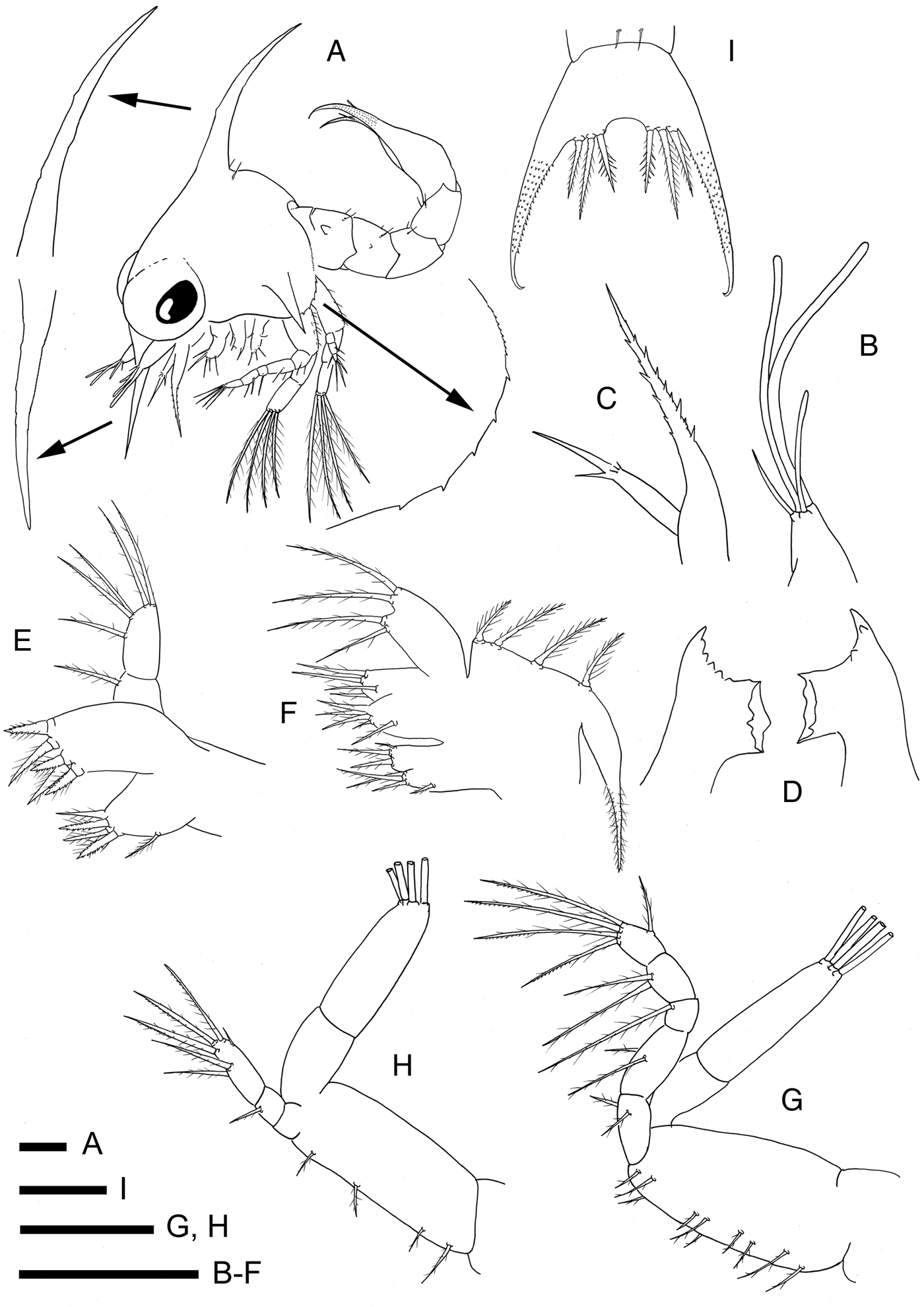
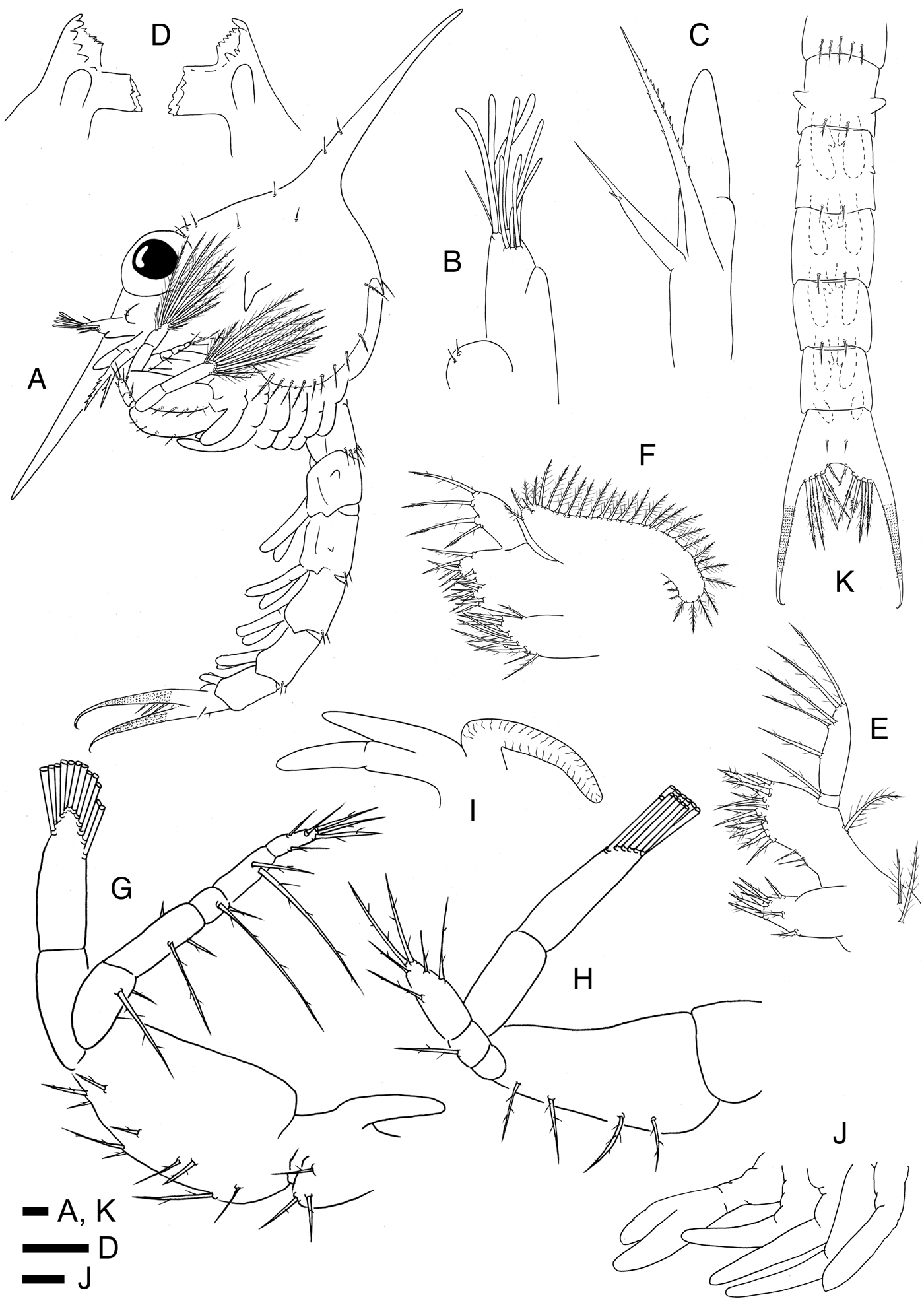
Hemigrapsus takanoi Asakura & Watanabe, Reference Asakura and Watanabe2005 zoea I, (A) general lateral view; (B) antennule; (C) antenna; (D) mandibles; (E) maxillule; (F) maxilla; (G) first maxilliped; (H) second maxilliped; (I) telson. Scale bars = 100 µm.

Size: CL = 0.444 ± 0.021 mm. Minimal duration: 4 days.
Carapace (Figure 1A): Dorsal spine longer than rostral spine, slightly curved, smooth (with 3 small protuberances); rostral spine straight, with small protuberances; lateral spines short, smooth, and slightly pointed downward; 1 pair of posterodorsal setae present; ventral marginal setae absent, each margin with 5 spines, and finely spinulate posteriorly; eyes sessile.
Antennule (Figure 1B): Primary flagellum unsegmented with 2 long, stout aesthetascs, 1 shorter, thinner aesthetasc, and 1 simple seta; accessory flagellum absent.
Antenna (Figure 1C): Uniramous; protopod shorter than rostral spine, with 2 rows of spines on distal half; endopod absent, exopod shorter than protopod, smooth distally, with 1 large and 3 small medial spines.
Mandible (Figure 1D): Asymmetrical, palp absent.
Maxillule (Figure 1E): Uniramous; epipod seta absent; coxal endite with 4 plumodenticulate setae and 1 plumose seta; basial endite with 3 cuspidate and 2 plumodenticulate setae; endopod 2-segmented, proximal article with 1 sparsely, plumose seta, distal segment with 5 (1 subterminal + 4 terminal) sparsely, plumose setae; exopod absent.
Maxilla (Figure 1F): Biramous; coxal endite bilobed, with 4 + 3 plumodenticulate setae; basial endite bilobed, with 5 + 4 plumodenticulate setae; endopod bilobed, with 2 + 2 sparsely, plumose setae; exopod (scaphognathite) with 4 marginal, plumose setae, and 1 distal stout process.
First maxilliped (Figure 1G): Biramous; coxa without seta; basis with 10 setae (2 + 2 + 3 + 3); endopod comprising 5 articles with 2, 2, 1, 2, 5 (1 subterminal + 4 terminal) setae, respectively; exopod comprising 2 articles, with 4 terminal, plumose, natatory setae on the distal segment.
Second maxilliped (Figure 1H): Biramous; coxa without seta; basis with 4 setae (1 + 1 + 1 + 1); endopod comprising 3 articles, with 0, 1, 6 (3 subterminal + 3 terminal) setae, respectively; exopod comprising 2 articles, with 4 terminal, plumose, natatory setae on the distal segment.
Third maxilliped: Absent.
Pereiopods: Absent.
Pleon (Figure 1A): 5 pleomeres; pleomeres 2 and 3 (minute) with 1 pair of dorsolateral processes; pleomeres 2–5 with 1 pair of posterodorsal setae.
Pleopods: Absent.
Telson (Figure 1I): Bifurcated, furcal rami longer than proximal part of telson without dorsal or lateral spines; each furcal ramus, densely spinulated, but with the tip smooth and curved dorsally; posterior margin with 3 pairs of stout spinulate setae (middle pair of setae longest).
ZOEA II
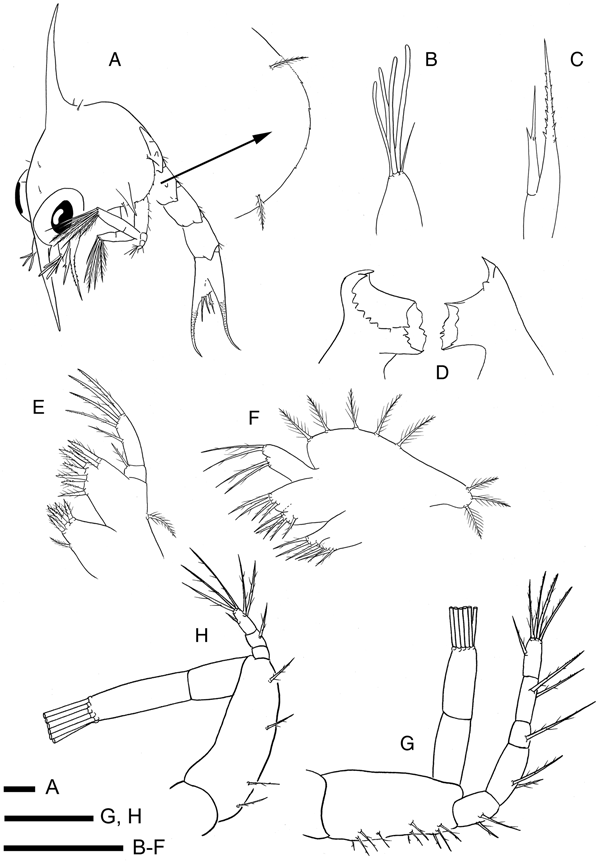
Hemigrapsus takanoi Asakura & Watanabe, Reference Asakura and Watanabe2005 zoea II, (A) general lateral view; (B) antennule; (C) antenna; (D) mandibles; (E) maxillule; (F) maxilla; (G) first maxilliped; (H) second maxilliped. Scale bars = 100 µm.
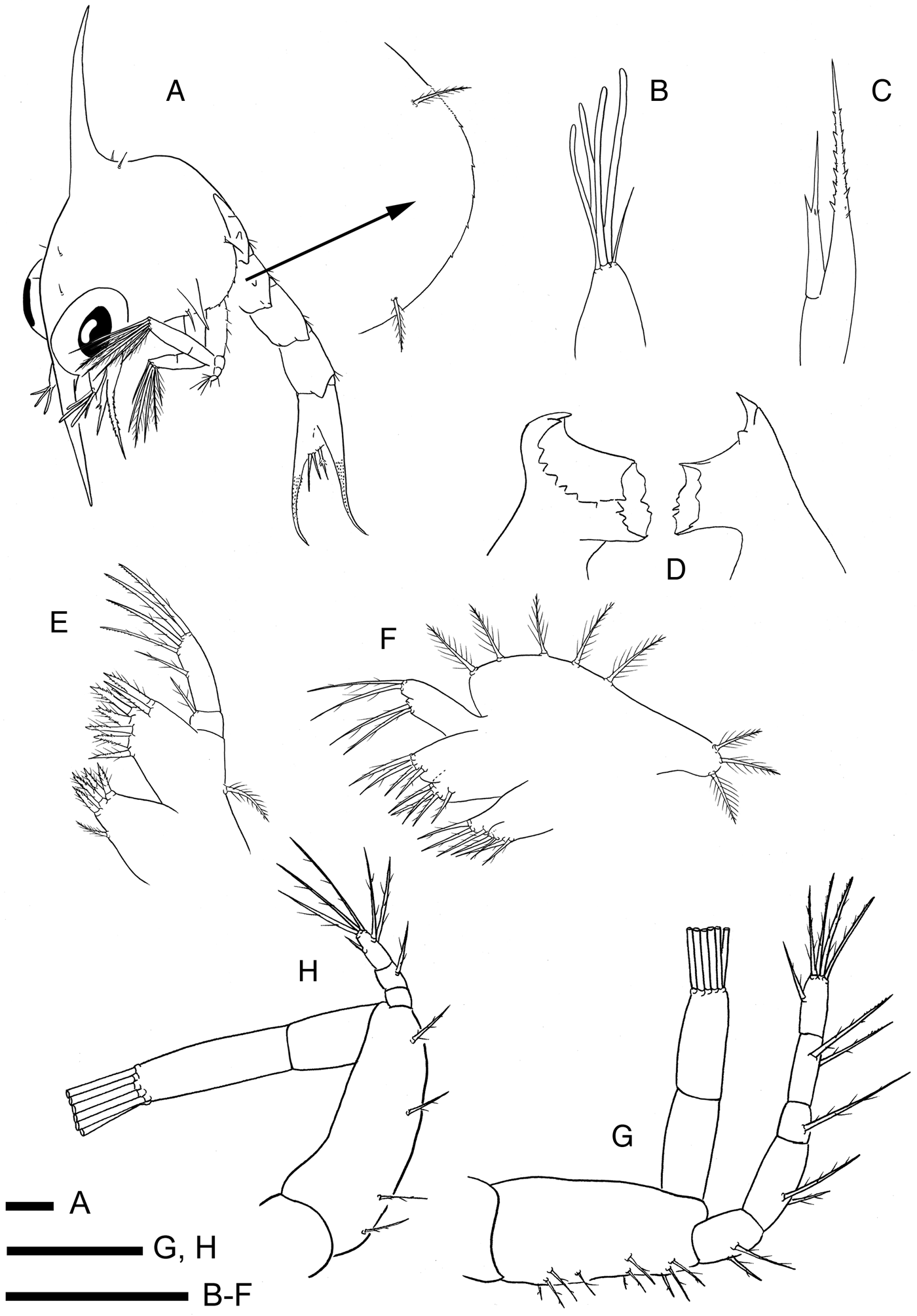
Size: CL = 0.56 ± 0.03 mm. Minimal duration: 4 days.
Carapace (Figure 2A): 2 pairs of anterodorsal setae present; each ventral margin with 1 anterior and 1 posterior setae, 5 spines, and finely spinulate posteriorly; eyes stalked.
Antennule (Figure 2B): Primary flagellum with 4 aesthetascs, and 1 simple seta.
Antenna (Figure 2C): Exopod with 1 large and 2–3 small medial spines.
Mandible (Figure 2D): Unchanged.
Maxillule (Figure 2E): Biramous; basial endite with 7 plumodenticulate setae; exopod seta present.
Maxilla (Figure 2F): Exopod (scaphognathite) with 5 + 3 plumose setae, distal stout process, now reduced in size.
First maxilliped (Figure 2G): Exopod with 6 terminal, plumose, natatory setae on the distal segment.
Second maxilliped (Figure 2H): Exopod with 6 terminal, plumose, natatory setae on the distal segment.
Third maxilliped: Absent.
Pereiopods: Absent.
Pleon (Figure 2A): Unchanged.
Pleopods: Absent.
Telson (Figure 2A): Unchanged.
ZOEA III
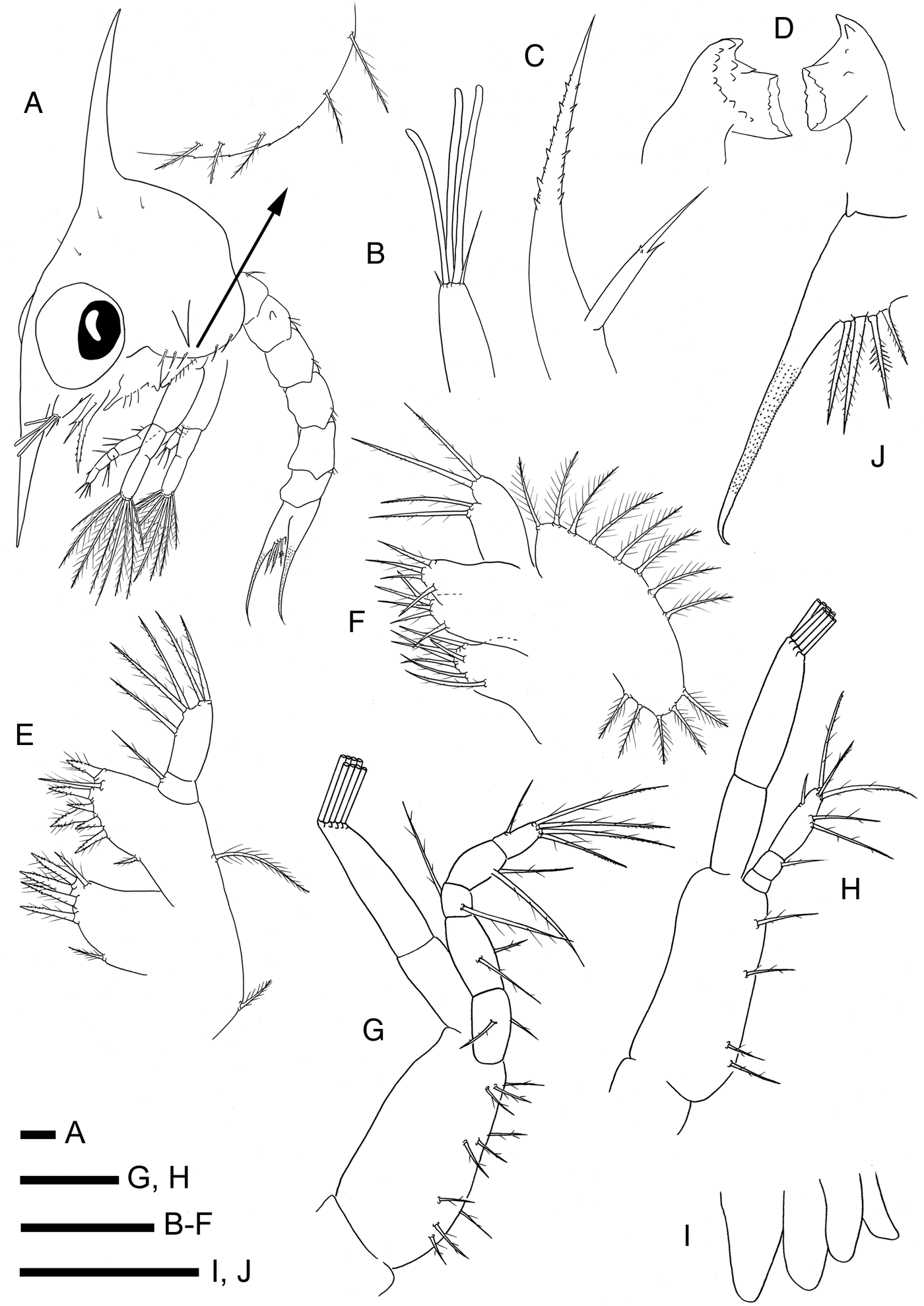
Hemigrapsus takanoi Asakura & Watanabe, Reference Asakura and Watanabe2005 zoea III, (A) general lateral view; (B) antennule; (C) antenna; (D) mandibles; (E) maxillule; (F) maxilla; (G) first maxilliped; (H) second maxilliped; (I) third maxilliped and pereiopods; (J) telson. Scale bars = 100 µm.

Size: CL = 0.74 ± 0.05 mm. Minimal duration: 5 days.
Carapace (Figure 3A): 3 pairs of anterodorsal setae present; ventral margin with 3 anterior and 2 posterior setae, and 4 spines (smaller than in previous stage).
Antennule (Figure 3B): Primary flagellum with 3 aesthetasc, and 2 simple setae (1 long and 1 small).
Antenna (Figure 3C): Unchanged.
Mandible (Figure 3D): Unchanged.
Maxillule (Figure 3E): Coxal endite with 5 plumodenticulate seta and 1 plumose seta; basial endite with 7 plumodenticulate setae and 1 plumose seta; proximal margin with 1 epipodal seta.
Maxilla (Figure 3F): Exopod (scaphognathite) with 8 + 5 plumose setae.
First maxilliped (Figure 3G): Endopod article 3 now with 2 setae including a dorsal seta (2,2,2,2,1 + 4); exopod with 8 terminal, plumose, natatory setae on the distal article.
Second maxilliped (Figure 3H): Exopod with 8 terminal, plumose, natatory setae on the distal article.
Third maxilliped (Figure 3I): Present as bud.
Pereiopods (Figure 3I): Present as buds.
Pleon (Figure 3A): 6 pleomeres present; first pleomere with 1 dorsomedial seta.
Telson (Figure 3J): Posterior margin with 4 pairs of stout spinulate setae (inner pair of setae is smallest).
ZOEA IV
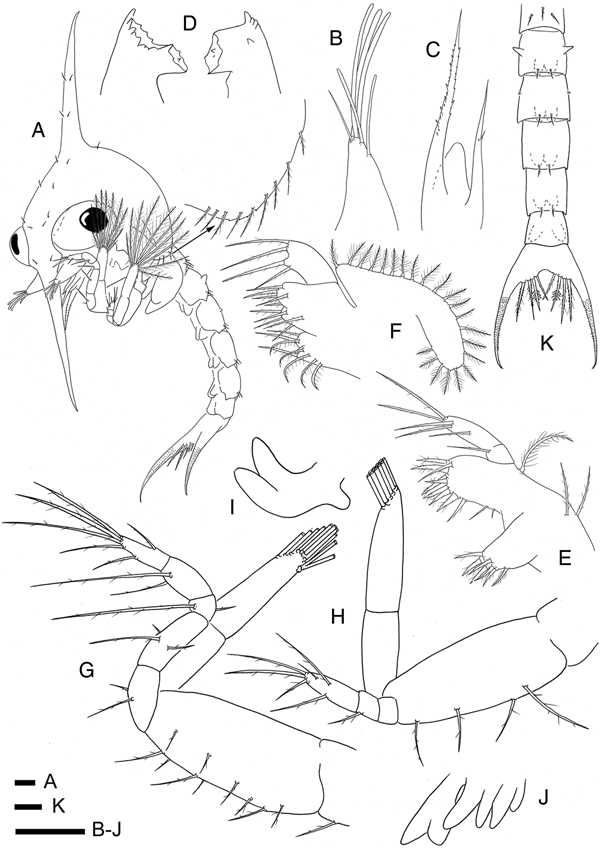
Hemigrapsus takanoi Asakura & Watanabe, Reference Asakura and Watanabe2005 zoea IV, (A) general lateral view; (B) antennule; (C) antenna; (D) mandibles; (E) maxillule; (F) maxilla; (G) first maxilliped; (H) second maxilliped; (I) third maxilliped; (J) pereiopods; (K) pleon and telson. Scale bars = 100 µm.

Size: CL = 0.81 ± 0.04 mm. Minimal duration: 4 days.
Carapace (Figure 4A): Dorsal spine with 2 pairs of setae, 5 pairs of anterodorsal setae present; each ventral margin with 9 setae and 4 minute spines.
Antennule (Figure 4B): Primary flagellum with 5 aesthetascs (3 long, 2 small), and 1 simple seta.
Antenna (Figure 4C): Biramous; endopod bud present; exopod with 1 large and only 1–2 minute medial spines visible.
Mandibles (Figure 4D): Increased number of molar teeth.
Maxillule (Figure 4E): Coxal endite with 6 plumodenticulate setae and 1 plumose seta; basial endite with 9 plumodenticulate setae and 2 plumose setae; proximal margin with 2 epipodal setae.
Maxilla (Figure 4F): Coxal endite with 5 + 3 plumodenticulate setae; basial endite with 6 + 5 plumodenticulate setae; exopod (scaphognathite) with 20–22 plumose setae.
First maxilliped (Figure 4G): Coxa with 1 seta; endopod article 2 now with 3 setae and article 5 with additional ventral subterminal seta (2,3,2,2, 2 + 4); exopod with 10 terminal, plumose, natatory setae on the distal article.
Second maxilliped (Figure 4H): Exopod with 10 terminal, plumose, natatory setae on the distal article.
Third maxilliped (Figure 4I): Biramous with gill bud present.
Pereiopods (Figure 4J): Chela bilobed.
Pleon (Figure 4K): First pleomere with 3 dorsomedial setae.
Pleopods (Figure 4K): Uniramous; present on pleomeres 2–6, endopods absent.
Telson (Figure 4A, K): Unchanged.
ZOEA V
Hemigrapsus takanoi Asakura & Watanabe, Reference Asakura and Watanabe2005 zoea V, (A) general lateral view; (B) antennule; (C) antenna; (D) mandibles; (E) maxillule; (F) maxilla; (G) first maxilliped; (H) second maxilliped; (I) third maxilliped; (J) pereiopods; (K) pleon and telson. Scale bars = 100 µm.

Size: CL = 1.01 ± 0.05 mm. Minimal duration: 5 days.
Carapace (Figure 5A): 6 pairs of anterodorsal setae present; each ventral margin with 15 setae and 2 minute spines.
Antennule (Figure 5B): Primary flagellum with 4 aesthetasc subterminally, and 4 aesthetascs and 1 simple seta terminally; basal region swollen with 1–2 simple setae; accessory flagellum present as a bud.
Antenna (Figure 5C): Endopod enlarged and partially segmented; exopod with 1 large and only 1 min medial spines visible.
Mandible (Figure 5D): Palp present as small bud.
Maxillule (Figure 5E): Coxal endite with 8 plumodenticulate setae; basial endite with 13 plumodenticulate setae, and 3 epipodal setae.
Maxilla (Figure 5F): Coxal endite with 8 + (3 + 1) plumodenticulate setae; basial endite with 8 + 8 plumodenticulate setae; exopod (scaphognathite) with 30–32 plumose setae.
First maxilliped (Figure 5G): Coxa with 3 setae and epipod; exopod with 12 terminal, plumose, natatory setae on the distal segment.
Second maxilliped (Figure 5H): Exopod with 12 terminal, plumose, natatory setae on the distal segment.
Third maxilliped (Figure 5I): Gill more developed.
Pereiopods (Figure 5J): More developed, cheliped prominent.
Pleon (Figure 5A, K): First pleomere with 5 dorsomedial setae.
Pleopods (Figure 5A, K): Enlarged; pleomeres 2–5 with biramous pleopods with endopod buds; pleomere 6 with pleopods (uropods) much smaller than on somites 2–5 and endopod bud absent.
Telson (Figure 5A, K): Dorsal surface with 1 pair of medial simple setae. Posterior margin with 4 pairs of stout spinulate setae, plus 1 pair of thin setae at inner position.
MEGALOPA
(Figures 6A–I, 7A–H)
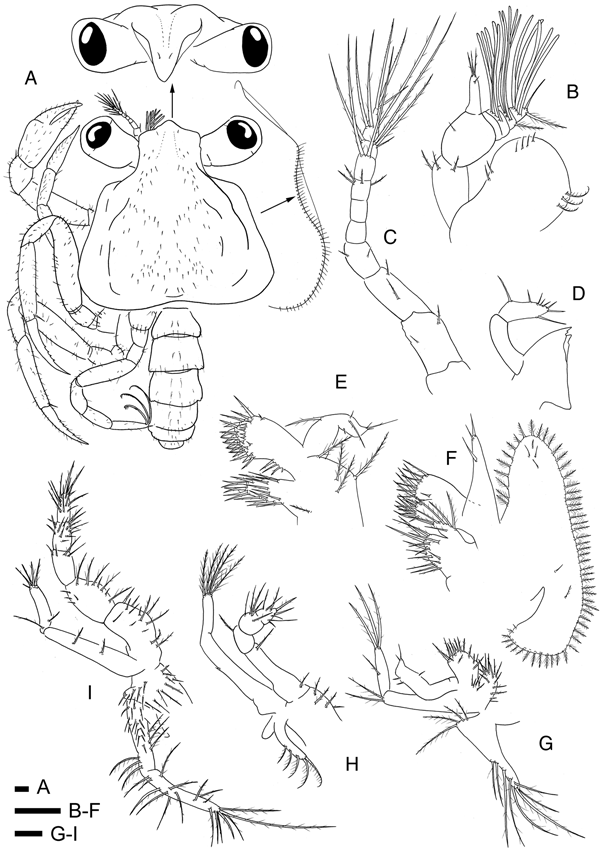
Hemigrapsus takanoi Asakura & Watanabe, Reference Asakura and Watanabe2005 megalopa, (A) general dorsal view; (B) antennule; (C) antenna; (D) mandible; (E) maxillule; (F) maxilla; (G) first maxilliped; (H) second maxilliped; (I) third maxilliped. Scale bars = 100 µm.

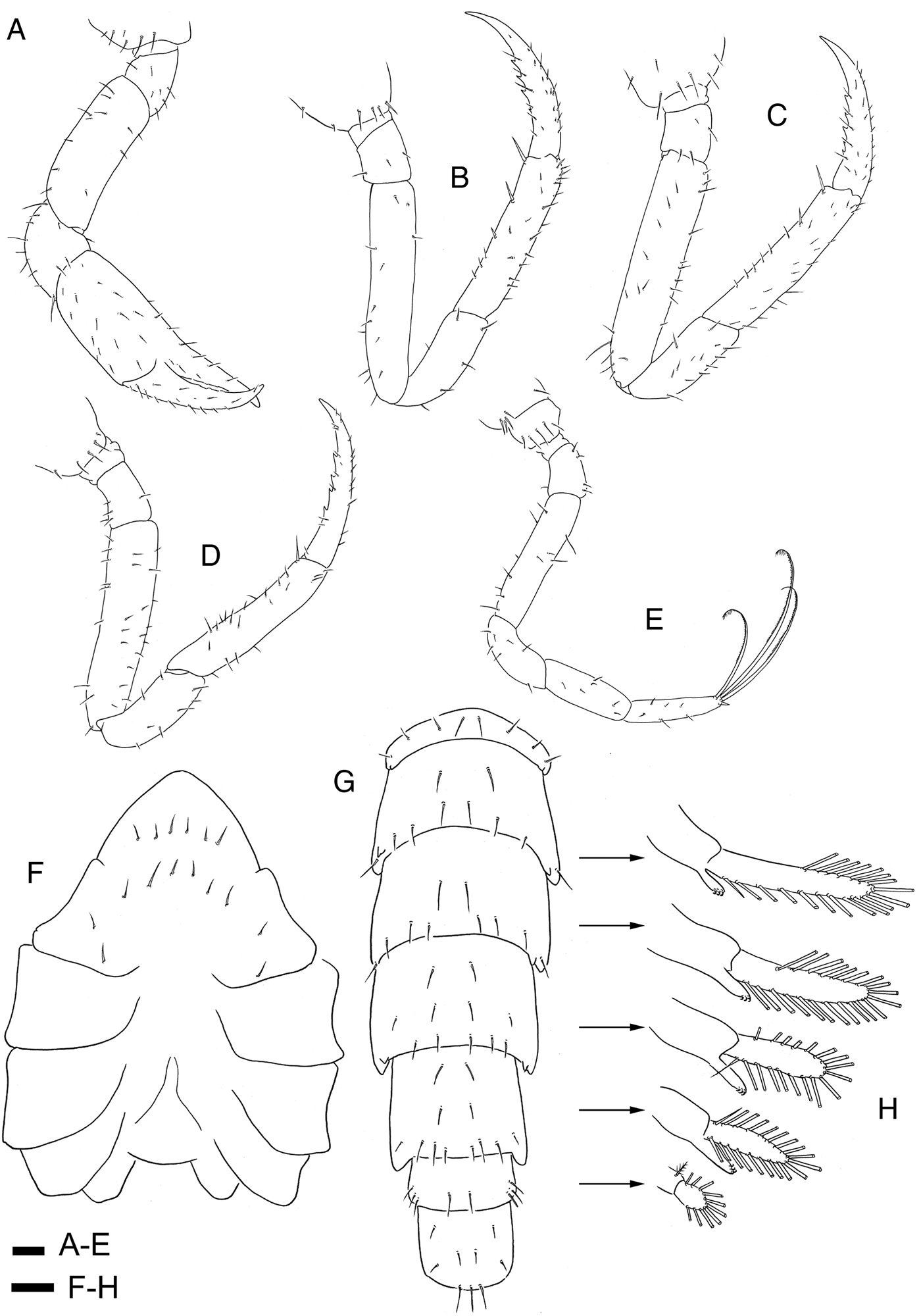
Hemigrapsus takanoi Asakura & Watanabe, Reference Asakura and Watanabe2005 megalopa, (A) first pereiopod; (B) second pereiopod; (C) third pereiopod; (D) fourth pereiopod; (E) fifth pereiopod; (F) sternum; (G) pleon and telson; (H) pleopods 1–4, and uropod. Scale bars = 100 µm.

Size: CL = 1.47 ± 0.26 mm. Minimal duration: unknown.
Carapace (Figure 6A): Pear-shaped, and laterally inflated; surface covered with scattered short simple setae; each ventral margin with more than 40 setae; rostrum short, deflected dorsally and directed ventrally; cornea not wider than ocular peduncle.
Antennule (Figure 6B): Peduncle comprising 3 articles, with 8–9, 3, 1 simple setae; primary flagellum with 4 annuli, with 0, 5 aesthetascs, 5–7 aesthetascs + 1 sparsely plumose seta, 5–6 aesthetascs + 1 sparsely plumose seta + 1 simple seta, respectively; accessory flagellum without annuli, with 1 + 3 simple setae.
Antenna (Figure 6C): Consists of 3 articles with 2, 2, 2 setae, and flagellum with 7 articles with setal formula 0, 0, 4, 2, 4, 3, 3; four distal articles with long serrate setae, remaining articles with simple or sparsely plumose setae.
Mandible (Figure 6D): Palp with proximal article (basis) without seta, and distal article (endopod) with 8 setae.
Maxillule (Figure 6E): Coxal endite with 19–20 plumodenticulate setae; basial endite with 29 marginal setae (11 plumodenticulate, 18 plumodenticulate cuspidate), and 4 lateral setae (3 sparsely plumose, 1 simple); endopod reduced, not articled, with 7 setae; at base of maxillule 5 setae (3 epipodal setae).
Maxilla (Figure 6F): Coxal endite bilobed with 14 + 5 setae; basial endite bilobed, with (10–12) + (12–13) setae; endopod with 3 setae in distal part (sometimes unarmed); scaphognathite with 56–60 plumose marginal setae, with 5–6 simple, lateral setae on surface.
First maxilliped (Figure 6G): Epipod triangular, with 4 setae in proximal part and gill bud present, with 8 plumodenticulate setae in distal part; coxa with 14 plumodenticulate setae; basis with 17 setae; endopod reduced, incompletely articled, with 5–8 setae; exopod comprising 2 articles, proximal article with 2 distal plumose setae, distal article with 1 + 3 terminal plumose setae.
Second maxilliped (Figure 6H). Epipod elongated with 3–5 setae in distal part; protopod with 4 setae; endopod comprising 4 articles, with 2, 1, 5, 8 setae; exopod comprising 2 articles, proximal article with 1 lateral stout spine, distal article with 5 terminal plumose setae.
Third maxilliped (Figure 6I). Epipod long with 15 plumodenticulate setae in proximal part, 21 longer sparsely plumose setae in distal part; protopod with 18 setae; endopod comprising 5 articles, with 13, 11, 4, 13, 12; exopod comprising 2 articles, proximal article with 2 setae, and distal article with 1 + 5 setae.
Pereiopods (Figure 7A–E). Surface with several scattered setae; cheliped short, with dactylus and fixed finger crossed in the apex, and almost smooth in the cutting margin; inner margin of dactylus of pereiopods 2, 3 and 4 with 4, 5, 4 spines (proximal spine always the smallest), respectively; dactylus of pereiopod 5 with 3 long, hooked, serrate setae, and 1 small spine distally; propodus of pereiopods 2, 3 and 4 with 3, 2, 1 strong serrate setae, respectively.
Sternum (Figure 7F). Maxillipeds and cheliped sternites fused with 8 pairs of simple setae.
Pleon (Figure 7G). Consists of 6 pleomeres, covered by simple setae (first with 8 setae, second with 10 setae, third with 10 setae, fourth with 12 setae, fifth with 12 setae, sixth with 8 setae). Pleomeres 2–4 with small posterolateral processes.
Pleopods (Figure 7H). Pleopods present on pleomeres 2–5. Exopods with 18–20 plumose natatory setae; endopods with 3 cincinnuli.
Uropods (Figure 7H). Uniramous, with 1 plumose seta on protopod, and 10 plumose setae on exopod.
Telson (Figure 7G). Nearly rectangular, posterior margin with 3 plumose setae, and 3 pairs of setae on dorsal surface.
Discussion
The larval morphology of Hemigrapsus takanoi follows the general pattern of the Varunidae. This group of crabs was formerly a subfamily of the Grapsidae but, after molecular phylogenetic evidence, supported by both adult and larval taxonomic characters, it was elevated to family status (Schubart et al., Reference Schubart, Cuesta and Felder2002; Ng et al., Reference Ng, Guinot and Davie2008). Of the known 160 species attributed to Varunidae, the larvae are partially or completely described for 37 species (Clark & Cuesta, Reference Clark, Cuesta, Castro, Davie, Guinot, Schram and Von Vaupel Klein2015). Despite the relatively limited number of descriptions, the information on zoeal stages is enough to illustrate a homogeneous morphological pattern within the family that was summarized by Clark & Cuesta (Reference Clark, Cuesta, Castro, Davie, Guinot, Schram and Von Vaupel Klein2015) as follows: (1) presence of dorsal, rostral, and lateral spines on the carapace in most of the species; (2) antennal exopod well developed with medial setae, generally similar in size or longer than protopod; (3) maxillule with setation pattern (1,5) on the endopod; (4) maxilla with setation pattern (2 + 2) on the endopod, and (4 + 1) on the exopod (only zoea I); (5) first maxilliped with setation pattern (2 + 2 + 3 + 3) on the basis, and (2,2,1,2,5) on the endopod (only zoea I); (6) second maxilliped with setation pattern (1 + 1 + 1 + 1) on the basis, and (0,1,6) on the endopod; (7) pleon without lateral expansions and distolateral processes on the fifth pleomere; (8) telson furcated with median notch, and furcal rami unarmed.
The larval development in H. takanoi comprises five zoeal and one single megalopal stages, as in most varunids (Cuesta & Schubart, Reference Cuesta and Schubart1997). The species is a sibling species of H. penicillatus (De Haan, 1835) and the morphological similarities as adults are also visible in the larval stages. Following Lee & Ko (Reference Lee and Ko2008) and the present description, H. takanoi and H. penicillatus can be distinguished from other Hemigrapsus species present in the North Pacific. For instance, the presence of lateral processes on the abdominal pleomeres 2,3 in H. takanoi and H. penicillatus differs from Hemigrapsus sinensis Rathbun, 1929 that also shows lateral processes on the fourth abdominal pleomere. The antennal exopod of H. takanoi and H. penicillatus is smooth, whereas in Hemigrapsus oregonensis (Dana, 1851), and in Hemigrapsus nudus (Dana, 1851)) it is spinulate. Finally, the number of spines on the antennal exopod can also be used to differentiate species since in H. takanoi and H. penicillatus it bears 1 large and 3 smaller medial spines, in Hemigrapsus longitarsis (Miers, 1879) 1 large and 1 small spines, and in Hemigrapsus sanguineus (De Haan, 1835) 1 large and 2 small spines. However, it should be noted that although this last character seems to be useful, it is difficult to observe in H. takanoi. In fact, from zoea II stage the 3 medial spines become small or disappear completely. In the first description of H. penicillatus, Hwang & Kim (Reference Hwang and Kim1995) only illustrated 1 large and 1 small medial spines in all zoeal stages, suggesting that the spines, if present, were small, as in H. takanoi.
The zoeae of H. takanoi and H. penicillatus are similar and larvae can be separated only on minor differences in morphology and appendage setation (Hwang & Kim, Reference Hwang and Kim1995; Lee & Ko, Reference Lee and Ko2008). Thus, H. takanoi seems to show smoother rostral and dorsal spines than H. penicillatus, as well as less evident spines on the ventral margin of the carapace. The number of these spines are lower in H. takanoi (5) than in H. penicillatus (6), but they decrease in size and number from zoea I to zoea V, so their use as a taxonomic character should be restricted to the first zoeal stage. In zoea III, 1 small, simple seta was present on the primary flagellum of the antennule, and 1 complementary plumose seta on the coxa of the maxillule that are not present in H. penicillatus. In zoea V, the differences are visible on the coxa of the first maxilliped, where H. takanoi has 3 setae and H. penicillatus only 2, and in the setation pattern on the primary flagellum of the antennule (5 + 4 in H. takanoi and 6 + 4 in H. penicillatus). Moreover, differences in the timing of appearance of certain setae were observed. For instance, the first seta on the coxa of the first maxilliped appears in the zoea III of H. penicillatus whereas in H. takanoi it is visible in zoea IV. In this appendage, the third seta on the second segment of the endopod was expressed during zoea IV in H. takanoi, whereas in H. penicillatus they are present in the following stage. Another example is the fifth pair of setae on the posterior margin of the telson that appears earlier in H. penicillatus (zoea IV) than in H. takanoi (zoea V).
The morphology of the megalopa stage of H. takanoi follows the diagnostic characters of the Varunidae described by Cuesta et al. (Reference Cuesta, Schubart and Rodríguez2000): antennular accessory flagellum present; antenna with 10 segments; mandibular palp setation 0, 5–13; scaphognathite with 39–90 marginal setae; epipod present on the second maxilliped; pleopod with 3 cincinnuli; uropod setation 1, 8–13. As was discussed by Kornienko et al. (Reference Kornienko, Korn and Kashenko2008) the distinctions between the megalopae of the Hemigrapsus species are greater than in zoea stage, but in most cases, the number of setae on appendages in different specimens of the same species varies and these ranges overlap in different species. However, in many cases the combination of key characters like the number of aesthetascs on the third annuli of the primary flagellum of the antenna, and number of setae on the exopod of the uropod seems to be important for the identification of NW Pacific Hemigrapsus megalopae. For instance, H. sanguineus has 7–9 aesthetascs and 11–12 plumose setae on the exopod of the uropod (Hwang et al., Reference Hwang, Lee and Kim1993), whereas H. takanoi shows 5–7 aesthetascs and 10 plumose setae, respectively. In the case of H. oregonensis megalopa, it is the only Hemigrapsus species that has the margin of telson unarmed (Hart, Reference Hart1935), not showing the typical 3 distal setae. Finally, the number of marginal setae on the scaphognathite is another character that varies among species: 60–72 setae in H. penicillatus, 56–60 setae in H. takanoi, 57–64 setae in H. sanguineus and 51–56 setae in H. longitarsis.
The first description of H. penicillatus megalopa by Hwang & Kim (Reference Hwang and Kim1995) differed greatly from Kornienko's (Kornienko et al., Reference Kornienko, Korn and Kashenko2008), and interestingly showed evident similarities with H. takanoi. For instance, the megalopa stage of H. penicillatus described by Kornienko et al. (Reference Kornienko, Korn and Kashenko2008) has the antennular primary flagellum with 5 annuli, whereas it has 4 annuli in H. takanoi and in the megalopa described by Hwang & Kim (Reference Hwang and Kim1995). Similarly, the megalopa of H. takanoi and the one described by Hwang & Kim (Reference Hwang and Kim1995) bear 3–4 distal setae on the endopod of the maxilla (that is unarmed in other Hemigrapsus species like H. penicillatus). Considering that before its description in 2005 H. takanoi was misidentified as H. penicillatus (Asakura & Watanabe, Reference Asakura and Watanabe2005), it is likely that Hwang & Kim (Reference Hwang and Kim1995) actually described the larval morphology of H. takanoi. In fact, they collected the ovigerous females used to obtain the larval stages from Busan, Korea, which is well within the distribution range of H. takanoi (Makino et al., Reference Makino, Miura, Kaiser, Geffray, Katsube and Urabe2018). Unfortunately, this material was not deposited in any museum for re-examination.
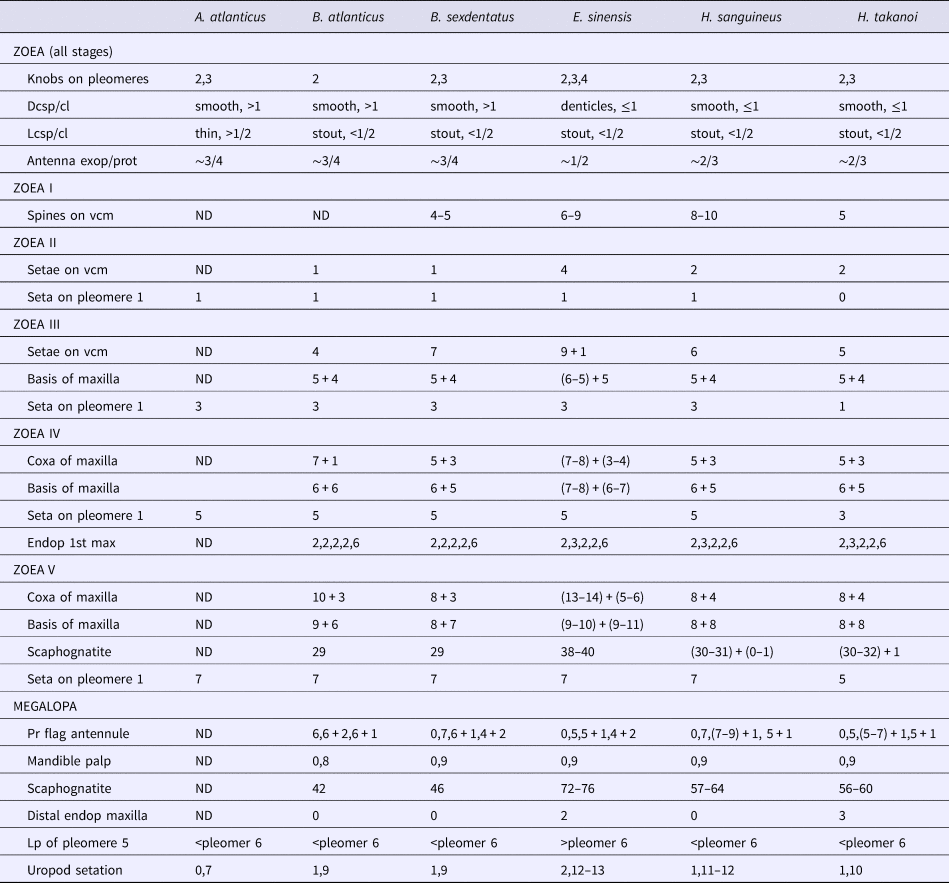
Identification of larval stages of varunid crabs in the Atlantic European coasts
Table 1 summarizes the key taxonomic characters for each zoeal and megalopal stages of the six species of Varunidae along the European coast. According to the literature available, it is relatively easy to identify the larval stages of these species. It is true that the larval description of A. atlanticus by Bocquet (Reference Bocquet1965) is too brief to be compared in detail with that of the other varunids, but the illustrations are still useful, showing distinctive dorsal and lateral carapace spines, as well as interesting information about the number of dorsolateral processes, and the setation on the first pleomere. The larval morphology of E. sinensis has been described by Kim & Hwang (Reference Kim and Hwang1995) and by Montú et al. (Reference Montú, Anger and de Bakker1996), being the most diverging among the rest of varunid species in the area. Table 1 shows that the higher number of pleomeres with dorsolateral processes, the shortest antennal exopod, and the presence of more setae on the ventral carapace margin, coxa and basis of maxilla, separate E. sinensis from Brachynotus and Hemigrapsus species. Rodríguez et al. (Reference Rodríguez, González-Gordillo and Cuesta1992) and Cuesta et al. (Reference Cuesta, Schubart and Rodríguez2000) described the morphology of the larval stages of B. atlanticus and B. sexdentatus, respectively, and showed that the dorsal carapace spine and the antennal exopod is proportionally larger than those of Hemigrapsus (Table 1). Regarding Brachynotus, B. atlanticus shows distinct characters like the presence of 3 annuli on the primary flagellum of the antennule, and the setation pattern of the mandible palp (0,8), that differ from those of B. sexdentatus (4 annuli, and setation 0,9 respectively).
Comparison of the taxonomic characters to identify the zoeal and megalopal stages of varunid crabs present in Atlantic European coasts. cl, carapace length; dcsp, dorsal carapace spine; endop, endopod; exop, exopod; lp, lateral process; lcsp, lateral carapace spine; max, maxilliped; per, pereiopod; Pr flag, primary flagellum; prot, protopod; ts, terminal seta; vcm, ventral carapace margin

The megalopal stages of other varunid species also show distinguishing characters. For instance, E. sinesis is the only species that has the posterior ventrolateral projections on the pleomere 5 longer than the pleomere 6. Particularly useful are also the setal patterns of the scaphognathite, and the dactylus of pereiopod 5. Thus, the number of marginal setae on the scaphognathite in Hemigrapsus is higher than in Brachynotus, but lower than in E. sinensis (Table 1).
Author ORCIDs
Jose M. Landeira, 0000-0001-6419-2046; Jose A. Cuesta 0000-0001-9482-2336.
Acknowledgements
We thank Carlos Strüssmann for providing the rotifers used for the larval culture, and to Kana Banno and Sumireko Sukegawa for their assistance during the sampling. We also thank the anonymous reviewers for their comments and suggestions that significantly contributed to improve the manuscript.
Financial support
This work was supported by the Japan Society for the Promotion of Science (J.M., grant number PE16401; Y.T., J.M., grant number 16F16401).