1. Introduction
Research into online informal language learning has already drawn attention to the fact that learners first exposed to English in the classroom setting frequently become involved in informal target language practices such as chatting or social networking online, downloading or streaming original version television series, and choosing music in English via on-demand services (Sockett, Reference Sockett2011a; Toffoli & Sockett, Reference Toffoli and Sockett2010). These studies suggest that as many as 60% of university students in France regularly download original version films and TV series, while some 30% are involved in social networking in English. Hence the informal learner interacts both with target language media, and with a community of users of the language. These practices often occur in complex and idiosyncratic forms due to interactions between these different factors in the context of a continuing formal learning process (most students in France have required language classes, usually in English, for 24–48 hours per year). Informal learning for these learners is generally incidental (Stevens, Reference Stevens2010; Tissot, Reference Tissot2004; Rieder, Reference Rieder2003), the intention of their activities being communication and enjoyment rather than language learning. Indeed learners themselves may not be aware of the contribution of their activities to language development. As such this type of learning differs from that suggested by Cross (Reference Cross2006), who sees informal learning as conscious steps taken to learn to do one's job.
From a theoretical standpoint the online informal learning of English is best understood within the framework of dynamic systems theory (DST) (Larsen-Freeman & Cameron, Reference Larsen-Freeman and Cameron2008; Van Geert, Reference Van Geert2008). Sockett and Toffoli (Reference Sockett and Toffoli2012) argue that four characteristics of DST are of particular relevance to the field of informal learning. Firstly, initial conditions are seen by Van Geert (Reference Van Geert2008) as key to the evolution of the system. In the online informal learning of English, these now differ for each learner, with their unique repertoires of input and interaction.
Secondly, attractor and repeller states are the basic driving forces in a dynamic system. They may be stable, exerting the same positive or negative influence throughout the learning process. Other types of attractor and repeller states include basins, by which the same phenomenon can first help then later hinder language development as the learning process moves from the initial downslope to the later upslope. The use of native language subtitles is a good example of this type of attractor as it first facilitates access to authentic documents but can later prove to be a distraction from language processing. Chaotic attractors, often illustrated by the rapid changes of direction of a ball bouncing on a very rough surface, are seen as complex combinations of elements which may lead to rapid and unexpected development in the system. The hundreds of different inputs and interactions at play in the online informal learning of English may be an example of this type of attractor.
Thirdly, co-adaptation phenomena are considered important in DST. These are events in which different elements in the system evolve together, allowing unexpected outcomes to emerge from these complex interactions. Sockett (Reference Sockett2012) and Sockett and Toffoli (Reference Sockett and Toffoli2012) describe examples of these phenomena in the online informal learning of English, including the way in which native users of a thematic forum change their practises to accommodate discussions involving non-natives, and the way in which learners develop new ways of using on-demand music services and lyrics websites simultaneously to facilitate comprehension.
Finally, complex systems are characterised by phase transitions in which non-linear development may occur. These are often illustrated by the transition from walking to running, or in language learning, jumps in fluency unrelated to changes in input. Informal learners often report such jumps in their abililty to understand television series, for example, after many hours of viewing (Sockett & Toffoli, Reference Sockett and Toffoli2012).
When Larsen-Freeman and Cameron turn their attention to second language acquisition, their analysis addresses many of the same aspects (op. cit.: 2008:135):
“From a complexity theory point of view, not only do we get a more variegated portrayal of language using patterns, we also get a different, more emic, or learner centered account of their development. Learning is not the taking in of linguistic forms by learners but the constant adaptation of their linguistic resources in the service of meaning-making in response to the affordances that emerge in the communicative situation, which is in turn affected by the learners’ adaptability”.
Set in the context of the online informal learning of English, this extract may firstly serve as a reminder that the experience of each learner is unique in terms of individual differences and repertoires of input and interaction. It also emphasises the fact that language development is an emergent process characterised by phase transitions and non-linear changes as the language system is constantly reorganised in interaction with the communicative context, and examples of co-adaptation can be seen such as the way in which the system changes the learner and vice versa.
Not enough is yet known about language development through online informal activities. The fact that viewing television series online in English, for example, is now a leisure activity which for many students occupies hundreds of hours annually, and that it takes place in interaction with many other listening, reading, writing and sometimes speaking activities, means that the way language learning takes place in this context may be quite different from classroom learning, or even just learning informally from a single source such as subtitled television. (Rupérez-Micola, Bris & Banal-Estañol, Reference Rupérez Micola, Bris and Banal-Estañol2009).
An initial study (Sockett & Toffoli, Reference Sockett and Toffoli2012) has suggested that online informal learners are principally aware of vocabulary gains, as they perceive, encode and often re-use chunks of idiomatic language. This finding is in keeping with the construction grammar view of language (Goldberg, Reference Goldberg1995) which underlies much of complexity theory in the language learning context. Learners also report gains in listening comprehension and fluency skills as a result of listening and online chat activities.
Learning processes in complex dynamic systems are seen as general cognitive processes covering a range of psycholinguistic and sociolinguistic phenomena. Drawing on work by Tomasello (Reference Tomasello2003) and others, Larsen-Freeman and Cameron (Reference Larsen-Freeman and Cameron2008) suggest the following list of such processes in the context of first language learning:
Establish joint attention
Understand the communicative intentions of others
Form categories
Detect patterns, ImitateFootnote 1
Notice novelty
Have the social drive to interact with others.
(op. cit.: 118)
It is interesting to observe similarities between these processes and those observed in second language acquisition, in the field of learner strategy research (O'Malley & Chamot, Reference O'Malley and Chamot1990; Sockett, Reference Sockett2001, for example). The Larsen-Freeman and Cameron list includes a metacognitive process relating to attention, the affective strategy of seeking to understand others, the social strategy of seeking to interact with others, and a number of cognitive processes: forming categories, detecting patterns and noticing novelty, as well as imitation, which can be seen as a cognitive or compensation strategy depending on context.
The ways in which these processes, identified as being at work in first language acquisition, may also be at work in the context of the online informal learning of English as a second language is the subject of the present study.
2. Methodology
From a methodological point of view, learner strategy research saw strategies as explicit traces of underlying mental processes, and as such, available to introspection. This comparison could therefore lead to the adoption of self-report methodologies as a means of ascertaining how language development is taking place in the complex system of online informal learning.
Indeed, while the practices of the informal learning of English online are now well understood, the language acquisition which results requires more detailed research, since attentional constraints and factors such as the private nature of informal language activities make data collection more difficult than in a classroom setting.
Larsen-Freeman and Cameron (Reference Larsen-Freeman and Cameron2008:135) use the term ‘emic’, albeit somewhat weakly to mean learner-centered, but nonetheless point towards the necessary participation of learners in any methodology seeking to understand learning in informal settings. Since emic approaches involve analysing phenomena from the perspective of one who participates in the culture being described (Pike, Reference Pike1954), the term is particularly well suited to studies in a complex systems perspective with their inevitable focus on the use of rich qualitative data to discern the unique perceptions each learner has of the language and the learning process.
Our previous studies (Sockett & Toffoli, Reference Sockett and Toffoli2012) had underlined the fact that learners with little or no knowledge of language acquisition theory had some difficulty in describing their own learning processes in informal settings. It therefore seemed important in any new research to adopt a more emic stance by involving graduate students in applied linguistics and seeking to obtain first-hand insights into the way in which these language learners with a knowledge of language learning theories perceive their own informal learning of English.
In order to look further into how language development is occurring through informal activities, in this study, an emic approach is adopted, using qualitative data from blogs written by students trained in language didactics research, relating to their own informal online learning of English.
Nine female students, with a B2 or C1 level of English according to the levels of the self assessment grid of the the Common European Framework of reference for languages (Council of Europe, 2001) took part in the study in the course of a two-year Masters programme in Language Didactics. The participants were drawn from a class on written academic English which was an option within the foreign language requirement of this degree course. They were asked to write about occasions over a three-month period on which they were involved in online English use informally, with particular reference to skills and knowledge of the language which were gained. The purpose of this approach is to obtain first-hand insights into the way language learners with a knowledge of language learning theories perceive their own informal learning of English.
Participation in the project was on a voluntary basis and the resulting blogs were not graded as part of the assessment of the course from which the participants were drawn. As an incentive to participate, the respondents were, however, not required to do some other written work which was part of the course, in recognition of the time-consuming nature of writing the blog. At the end of the three-month period, the participants were invited to read each other's blogs and add a final entry commenting on them, but apart from this activity, no class time was devoted to discussion of this research project.
Since the complex dynamic systems framework sees language learning as depending on general cognitive processes, it was most appropriate to use the list of processes mentioned above, suggested by Larsen-Freeman and Cameron (Reference Larsen-Freeman and Cameron2008), as categories with which to analyse the learner blogs.
3. Results and analysis
At the end of the three-month period, a corpus of some 35,000 words was obtained. The data presented here represents extracts from the corpus organised into the categories suggested by Larsen-Freeman and Cameron (Reference Larsen-Freeman and Cameron2008). For each extract, the initials of the respondent are given and bold type has been added to emphasise parts of the extract which are subsequently analysed.
3.1 Establishing joint attention through focus on task
The examples in which study participants refer to establishing attention show the importance of the tasks in which they are participating as vectors of attention and learning. Examples 1, 2 and 3 show that learners and their interlocutors are attending to meaning rather than form, and that the purpose of informal tasks is to enjoy communication. Learning in these examples occurs through discussing or negotiating meaning with other language users (examples 1 and 3) and using paraphrases to elicit new vocabulary (example 2).
1. AGA: …my English-speaking friends never correct me when a make a mistake, although I had asked them to do so at first. They only ask me questions when they do not understand what I mean and this is how they help to correct myself. I do not ask myself too much questions because I try to write spontaneously, as if I were speaking face to face with someone, otherwise I would spend too much time trying to find always the best word or the best expression as I demand a lot of myself, and it would spoil the pleasure I take in interacting in English on Facebook!
In example 1, the respondent is involved in Facebook online chat with friends on a particular theme. As with all real-world tasks, there is a cognitive objective, in this case comparing opinions on the theme and there are a number of constraints, in particular the time constraint of real-time chat which influences the choices made by the participants (“to write spontaneously”). The distinction between a “mistake” (form) and “not understanding what I mean” (meaning) is clear to both AGA and her interlocutors and the strategy of questioning is consistent with a desire to understand rather than correct.
2. SDA: Using Messenger helps me to develop a much more spontaneous way of speaking. I also remarked that when I use Messenger, I do not necessarily use an online dictionary to translate a word I do not know. Instead, I use paraphrases to ask my partners the English word or expression for this or that thing. My feelings are different when I write on Messenger. I am not scared to make mistakes because usually the topic of the talk is informal whereas I am more nervous when I want to write an e-mail.
In example 2, SDA, in a similar situation to AGA, uses paraphrases to actively elicit the appropriate expression from her interlocutors. Again, focus is on the task (“the topic of the talk”), and the unstructured nature of the conversation reduces the importance of form-related problems in the mind of the participant.
3. SH1 (watching TV series with an English-speaking friend): … while watching it, we comment what happened or say what we think about this or this character. On top of that, when I don't understand something, I can ask my co-viewer some explanations. According to me, this way of watching a TV show keeps me concentrated on what is actually happening and not on what I might not understand. I'm quiet sure that, in general, I learned, without noticing it, new vocabulary or expressions.
Example 3 shows how SH1 seeks to manage attentional constraints by asking questions while watching TV with a more proficient English user. Again attention is paid to the task rather than the form (“what is happening… what we think of characters…, not what I might not understand”).
3.2 Understanding the communicative intentions: focus on meaning
Levelt (Reference Levelt1989) and others have shown that communicative intention is at the root of language use, and in the second group of examples, learners use strategies such as skimming (example 4) and using additional written resources (example 5) to determine the intentions of others. These strategies enable learners to attribute a status to utterances, such as important or unimportant (example 4) agreement or disagreement with others (example 5).
Through these processes the learner is able to understand the intentions of the communication and if necessary to respond appropriately. In example 4, understanding the intentions of authors through analysis of keywords allows the learner to make a decision to pursue reading the resource or to look elsewhere. The interaction between the intention of the author and that of the reader is also mentioned explicitly, demonstrating that reading is not just an activity but is also a task with a cognitive objective.
4. SS: As I only look for a specific information I do not read every word but I scan the threads for keywords. I read a few words from several postings and I decide which ones are interesting or if I should rather look for the information in another thread. So I learn to read fast and to separate information according to its degree of importance to my intention of reading.
5. NV: More than just the lyrics (that I check on different websites via Google), I am interested in understanding the meaning of the song. Although I understand the words, I find it difficult to get the real meaning behind these poetic phrases, metaphors and cultural allusions. Indeed, a song is often subjective and one can interpret it as he wants. I like to compare what I think of the song, what the other people think and what the artist actually meant. The website Song Facts offers these types of information.
In example 5, as a result of a complex process of choosing, listening to and singing songs via an on-demand music service, NV uses a lyrics website to compare her understanding of the communicative intentions of the author with those of other listeners, demonstrating that awareness of a variety of perspectives is a key aspect of understanding meaning.
In massively multiplayer online role-playing games (MMORPGs), players are involved in joint actions and therefore understanding the intentions of others is at the very centre of the communicative process, as MS illustrates in example 6.
6. MS (Resident Evil 5): …but since I discovered it could be played online with other people from all around the world, I think it is even more gripping. For instance there are special buttons which are devised to give you the opportunity to communicate with your partner in the game: you can tell him to hide, to wait for you, to be careful, to go somewhere, to cover you and so on. When you play these kind of adventure games, you are in contact with numerous correct sentences in real, conversational English.
Here the affordances of the game (in this case buttons which automate certain standard expressions relating to intentions), encourage the players to coordinate their actions and greatly increase the frequency of exposure to these terms
3.3 Forming categories, a task management tool
The third group of examples is similar to the second in that learners group information to facilitate task achievement. In this case the aim of this categorisation is not to understand the intentions of the interlocutor or author, but to facilitate task management by reducing the risk of cognitive overload.
7. SH2: I think that by reading that blog from time to time, I can learn a lot of equestrian vocabulary which I don not really know right now, since each time I come across a new word or expression, I try to understand it by the context. Actually, it is very difficult to find a translation for a word linked to the equestrian sport.
In example 7, the learner identifies a category (“equestrian vocabulary”) within a blog written by a professional rider, and uses the context of the narrative to understand the meaning, rather than looking for a translation. In this case vocabulary learning is helped by the existence of a meaningful task (understanding the story) rather than hindered by the potential overload (learn the vocabulary and understand the story). Placing words in categories enables the learner to focus on the meaning of the text rather than worrying about the specific meaning of the item, which in turn becomes apparent (to one versed in the topic) through reading the text. The fact that informal learning involves choosing documents of personal interest is therefore key to language development.
8. SDA: I first used Google and I found some websites with steps that I should follow to do perfect horror make-up. Rapidly I realised that the presence of some specific vocabulary made me misunderstand the steps of the process. I decided to switch to a more visual explanation and I chose to find a video on Youtube. The specific vocabulary was also used but it was associated with the objects or a gesture. Due to the visualisation of the steps, I was able to understand the technical words used in the writing and the visual explanation. I was also able to see the final result that I was supposed to have.
9. SB: Sometimes, I like playing videogames. While I am playing, I don't understand many words but I quickly associate them to the actions corresponding to them, and after sometime, I understand what those words really mean in English. For some games, everything is in English so I have no choice, I have to understand everything to play and win.
In example 8, a vocabulary category (“technical words”) is identified as a hindrance to task achievement and specific resources (online video) are used to scaffold the task. This categorisation helps the learner to identify aspects of the task requiring extra attentional resources, facilitating the process of learning the words in that category. Similarly in example 9, association of new words with actions allows comprehension and facilitates task achievement.
3.4 Detecting patterns: exposure to real language in real contexts
It has already been suggested that the existence of patterns in language (often as opposed to rules) is at the heart of a construction-based view of grammar (Goldberg, Reference Goldberg1995) which underpins many aspects of complex systems theories of language learning. Exposure to language in rich contexts is therefore essential if the learner is to see how language maps to meaning, how it occurs in idiomatic clusters and how it can vary according to degree of formality or other contextual factors. In the fourth group of examples, a variety of contexts are mentioned such as multilingual documents, television series on different themes and Facebook exchanges with friends.
10. SH1: In the beginning, it was difficult for me to understand all the details, because of the technical and scientific terms. Fortunately, seeing the first seasons in French helped me guessing a bit faster the meaning or the translation of some words. Indeed, I always tried to watch the episodes in one go to catch the global meaning. And after a couple of episodes it began to be easier, or maybe I just got less distracted by the words I didn't understand. Furthermore, I am not sure that when I watch Bones in French I understand all of it either.
In example 10, the existence of different registers corresponding to different contexts helps SH1 to understand the television series Bones, in which technical language is mixed with general conversation. Her final comment indicates an awareness that such pattern recognition is also used in first language communication.
11. NV: At first, it was a rather difficult for me to understand all of it, especially for the series with specific vocabulary, such as medical words in ER and Grey's Anatomy or police expressions in Dexter and Alias. But eventually, I got used to it, I learnt a lot of new vocabulary and now, I can understand it. I also learnt a lot of informal language and slang! Words and expressions that I can use with my friends, in a relaxed and informal situation. …Now, after 3 years, I am able to watch all the series and movies that I want in English and I understand about 75%. One could say that it is because it is an easy and recurrent type of vocabulary that occurs in these movies and series.
12. SS: These series are quite useful to learn vocabulary or other linguistic and pragmatic aspects embedded in a context for example interaction between people, which expressions they use depending on who they talk to, etc. It's a kind of learning by watching models as theorised by Bandura. I also noticed that the same expressions are used over and over which makes me learn or at least understand them.
Similarly, in examples 11 and 12, recurrence of particular structures in similar situations across a range of series helps the development of comprehension and expression skills (see Sockett, Reference Sockett2011b, for a discussion of frequently occurring structures in television series).
13. SH1: In general, when I look for information on Wikipedia, I consult articles referring to the same topic but in different languages to see if all of them are equivalent. I noticed that, most of the time, I learn quiet some vocabulary by comparing the multilingual versions of the articles. When I don't understand a word in the English version of an article, I just try to find the corresponding meaning in the French one before consulting a dictionary. Also, I think that looking for information in English on Wikipedia helped me to improve to skim through a text.
In example 13, in a different context, the patterns of text structure in different languages on Wikipedia enable SH1 to identify “the corresponding meaning” of information without directly seeking a translation of a target item.
3.5 Imitation: interaction that mirrors partner discourse
If current assumptions about mirror neurons are correct, the detection of patterns in language should be closely linked to imitation of those patterns in oral and written expression. Larsen-Freeman and Cameron's (op. cit.: 135) assertion that learning is “constant adaptation of their linguistic resources in the service of meaning-making in response to the affordances that emerge in the communicative situation” demonstrates that in the complex system that is informal language learning, language production is shaped by the communicative context. While it is obvious that what one says and how one says it is influenced by one's interlocutor, it is helpful to realise that this change is itself an indication that learning is taking place.
14. SB: I usually sing at the same time, even if I don't understand all the words. The melody helps me for the pronunciation, especially when I have to emphasis on some syllables. The second advantage is that after some time, when I'm used to the song and the melody, I understand most of the words that I couldn't understand at first. It usually happens when I start to understand the global meaning of the song.
15. SB: when I really love a movie (especially some parts of it) or the actors playing in it and watch it many times, I have a tendency to speak when the actor is speaking with the same accent, the same intonation and without knowing it, I improve my English.
In examples 14 and 15, the respondents comment on how vocalisation, which is made possible by choosing to listen to the same songs or programmes several times, as well as by the repetitive nature of the listening material, helps them to improve their intonation, vocabulary recognition and overall comprehension.
16. AGA: I think that the reason why there has been such a change is that I gradually realized that writing in English and reading my friends’ answers could help me learn vocabulary, but also abbreviations, and above all, new expressions (colloquial expressions, for the most part). … I unconsciously or more exactly naturally reuse my friends’ expressions when I write to them, but also when I am led to speak English, which is a real satisfaction.
17. AM: This is the point: how do we learn a language in an informal environment? If I think of my own experience, I suppose that my English improved since I stopped studying it in a scholar or university environment. But how did this happen? I think that it is by integrating little by little things I hear or read here and there, again and again.
In example 16, the fact that AGA and her Facebook friends were writing on the same theme made the native speaker productions easier to integrate into her own written and spoken language, while in example 17, AM stresses the importance of frequency of the input material and the gradual process of re-using frequently encountered structures.
3.6 Noticing novelty: the good thing about “other foreigner talk”
In this group of examples, learners discuss the way in which interaction with other users of English makes them aware of new structures. These interlocutors may be native or more frequently other non-native speakers whose utterances are identified by the French participants as different from their own.
18. AM: There is also an interaction in exchanging e-mails: I send a message, I get the answer. I noticed that sometimes, when I write something, the way she answers is a little bit different, more “English”, and this is very interesting to me. I think “oh, you could have said this that way, it sounds better!” It is as if she corrected me, but in an informal way.
In example 18, online written interaction involves question and answer structures in which the answer includes a modified version of the question content. Here, “other foreigner talk” is seen as a form of correction, although it is unclear whether the interlocutor's intention was to correct or not.
19. SH1: The little article introducing the new “Director of Studies” was a bit confusing for me. I could understand the whole content, but I found some sentences or some wording very uncommon or even clumsy, such as “she gained her international background” or “she earned her Doctorate”, etc. Apparently, the author of this newsletter is a German speaker and is highly influenced by his/her mother tongue when he/she writes something in English. Reading this letter made me think of my own way of writing in English and I realized that I must have exactly the same problem.
In example 19, SH1 notices a range of structures which she takes to be influenced by her interlocutor's L1. While she is not always correct in her assumptions (“to earn a degree” is a standard English structure), the effect is to make her more aware of potential cases of L1 transliteration in her own production. Several other similar comments were made by other learners.
20. SDA: At first I always watch them in English without the subtitles. If the plot is too complicated or difficult to understand, I watch the episode again in English but with the English subtitles. So it is easier for me to follow and understand the plot. Having the subtitles and the sound helps me to notice unknown vocabulary.
In example 20, noticing novelty is an important part of a repair strategy for understanding a television series. Although most of the participants in the study prefer watching TV series without subtitles, they can as in this case use subtitles to solve comprehension problems when the meaning of the story is difficult to understand.
3.7 Have the social drive to interact with others: involvement in real cognitive tasks
The online informal learning of English has been described as a process driven by the intention to communicate (Sockett, Reference Sockett2011a) with language learning being only a by-product of this communication. In the final set of examples, it is clear that this is also the case for the learners in this study.
21. SDA: Finally, finding some help through the internet also allows people to feel more comfortable regarding the difficulties they can have to express themselves. As they can hide behind their computers people feel more free to chat or post a comment on a wall. Nobody can see who you are and so they cannot judge who you are. The internet changes the way you act when faced with a foreign language.
Example 21 shows how loss of face may be diminished in CMC contexts by the absence of eye contact and often by the use of pseudonyms and avatars. This may promote communication and therefore increase opportunities for language development.
22. MS: I think chatting via social networks like Facebook helps me to maintain a quite good level in English: I re-use many verbs, expressions, idioms and so on. What's more, I noticed that like many people, I learned best from friends and family. Maybe it is because I am relaxed and do not have any pressure from a teacher or from papers to hand in. We have also seen in class that interaction was learning, as it constitutes the language development process in itself and it is a serious attempt to communicate, we do not simulate a situation of communication.
In example 22, attention is drawn to the fact that social interaction often occurs with people who are personally known to the informal learner and that interactions are therefore genuinely based on exchanges of information and opinions, rather than being language tasks designed to have the appearance of real interaction. This distinction is well illustrated by example 23.
23. AGA: I would say that organizing this journey remembers me some tasks I created last year in Master 1, except that it is much more motivating to be in the situation of the learner who is really going to spend its holidays abroad than to be the teacher imagining some activities! Once again, I realize how interesting these tasks can be if they effectively lead to a concrete result.
24. SH2: When I have a question about an expression or anything concerning the English language, he tries to explain it to me as good as he can. However, in this case, I do not speak or write in English because I have to, but because I like to. The language technically only serves to communicate and is not the main subject of or reason for communication.
Finally, example 24 shows that correction is taking place in these online exchanges, but that it is solicited by the learner and remains merely an aid to the communication of meaning.
Through these examples, and many others in the corpus of blogs used in this study, it is therefore possible to see how the general cognitive processes suggested by Larsen-Freeman and Cameron (Reference Larsen-Freeman and Cameron2008) contribute to learning in informal online settings.
4. Discussion
The results presented above bring to light a number of ways in which the processes at issue in this study may be at work in the online informal learning of English.
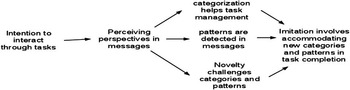
Figure 1 shows how the cognitive processes listed by Larsen-Freeman and Cameron may facilitate different phases of learner interaction around a meaningful task such as an exchange of opinions via social networking. As suggested above, it is firstly the intention to interact with others which drives informal learning, although it can also be argued that other activities such as listening engaged in by online informal learners also more generally reflect the desire to belong to a speech community which they perceive as watching the same shows and listening to the same music.
Phases of learner interaction.

Once involved in interaction with others, online informal learners naturally focus on the perspectives of their interlocutors in order to understand how to engage in the exchange of opinions, or indeed information, or make choices required by the communicative situation. This process is helped by the learner's prior knowledge of the speaker and situation.
Language development takes place as the informal learner uses tools such as categorization and pattern detection to make sense of the situation and compare the messages received with his or her own world and linguistic knowledge. In some cases, noticing novelty in the input forces the learner to reassess existing categories and question their perception of patterns.
Finally, imitation of some of the constructions used in the input, accommodating the new categories and patterns, is necessary in order to interact meaningfully with the other language users, while showing that their point of view has been understood.
The categories presented above are intended as aids to understanding how learners perceive their informal language development. They may also be useful in showing how some of the other tenets of DST discussed in the introduction are at work in the online informal learning of English. In particular, the authentic tasks in which learners engage demonstrate the extent to which learner repertoires are now unique to each language user as they perceive the language through the situations and relationships they have experienced. Examples of co-adaptation that can be seen as novel constructions are used and noticed by other learners, leading them in turn to reassess their own language production.
Stable attractors, such as on-going relationships or the on-going narratives of favourite television series, play an important role in driving the continued interactions which allow second language development to take place.
Many other aspects of learning change through time in online informal activities, through the up-slopes and downslopes of attractor and repeller states, and some of these may be qualitative changes or phase transitions, such as the role of correction in example 1, where the learner first sees correction as an objective, “friends never correct me when a make a mistake, although I had asked them to do so at first”, then comes to consider such focus on form as a hindrance to communication, “otherwise I would spend too much time trying to find always the best word or the best expression […], and it would spoil the pleasure I take in interacting in English on Facebook!” Another example of this is the changing status of unknown words in example 10 which initially inhibit comprehension, but are later ignored or guessed from context. “In the beginning, it was difficult for me to understand all the details, because of the technical and scientific terms […] after a couple of episodes it began to be easier, or maybe I just got less distracted by the words I didn't understand.”
While this study has brought to light several important aspects of online informal learning within the framework of DST, a number of limits to the study should also be acknowledged. Firstly, the relatively small corpus, provided by a small number of learners, all female, and all from the same degree course, means that the results presented here cannot be generalised as applicable to other contexts. Secondly, the emic approach chosen, while indispensable in terms of demonstrating the extreme individualisation which characterises informal learning, only gives access to learner perceptions of what they are doing in their private online use of English. It is however difficult to imagine how a more etic and observational methodology could be used to understand how language learning is taking place in private over hundreds of hours of personal internet use.
Similarly, the status of the participants as graduate students in a language didactics course, while necessary to allow appropriate descriptions of learning phenomena, may have led some participants, because of the blogging task they were carrying out, to adopt a more conscious and deliberate approach to their online informal learning of English through the period of the study.
To take an opposite perspective, although the study sought to use an emic approach, participants were not involved in the selection or analysis of the data from the blogs used in this article. It would therefore be possible to imagine further increasing the degree of learner centredness in the research model.
5. Conclusion
The online informal learning of English is both a highly individualised phenomenon, and one which takes place within communities which (in the case of social networking for example) have an element of privacy, and as such is somewhat more difficult to study than classroom learning phenomena. It is nonetheless an extensive phenomenon, seemingly involving large numbers of learners, extensive periods of time and real involvement in communicative tasks with other English speakers. For these reasons, it is important to continue to study such learning activities, and the qualitative perspective suggested by Larsen-Freeman and Cameron (Reference Larsen-Freeman and Cameron2008) seems to be well suited to this endeavour.
This qualitative study can only hope to show some of the learning processes of a particular group of learners in the French context, and the extent to which their very knowledge of learning processes influences their informal learning activities is difficult to measure.
While this study provides valuable insights into how learning is taking place in these informal settings, much work is yet to be done on establishing data such as the rate at which new constructions are learned and re-used in interactive contexts, and the influence of informal listening activities on production. It is however significant that the affordances of web-based communication today are breaking down various linguistic and geographical boundaries, and allowing learners to engage in meaningful interaction which often leads to language development.
Acknowledgement
The author wishes to express his thanks to the nine students involved in this study, for their invaluable insights into their informal learning processes, and their admirable willingness to spend hundreds of hours watching TV, listening to music and chatting with their friends.