Introduction
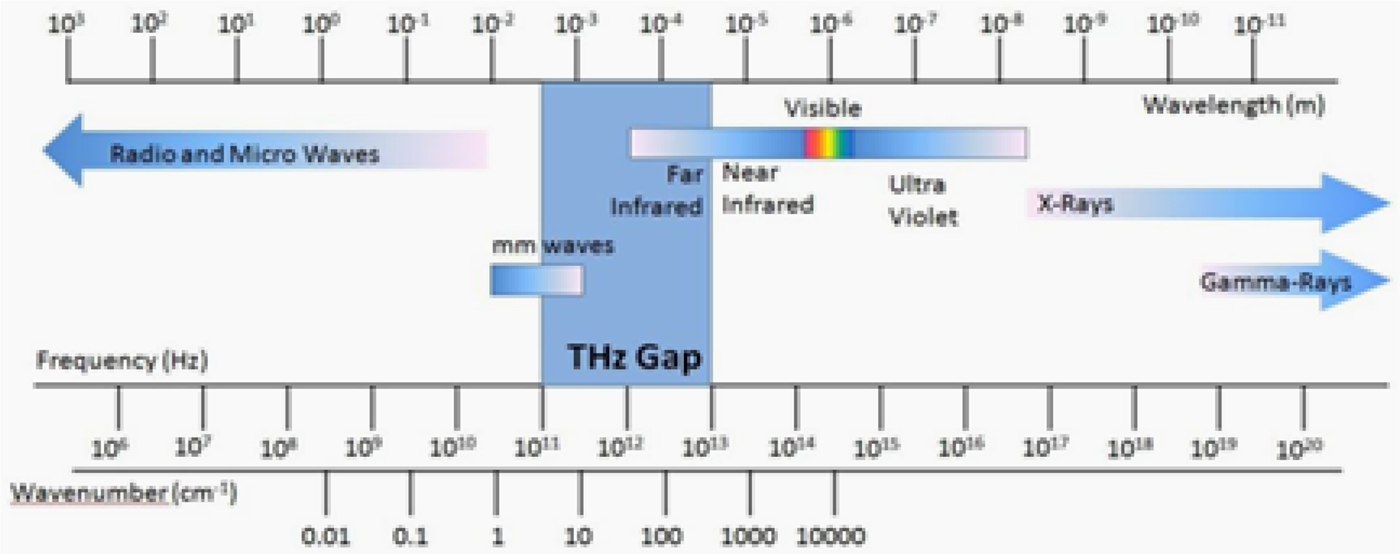
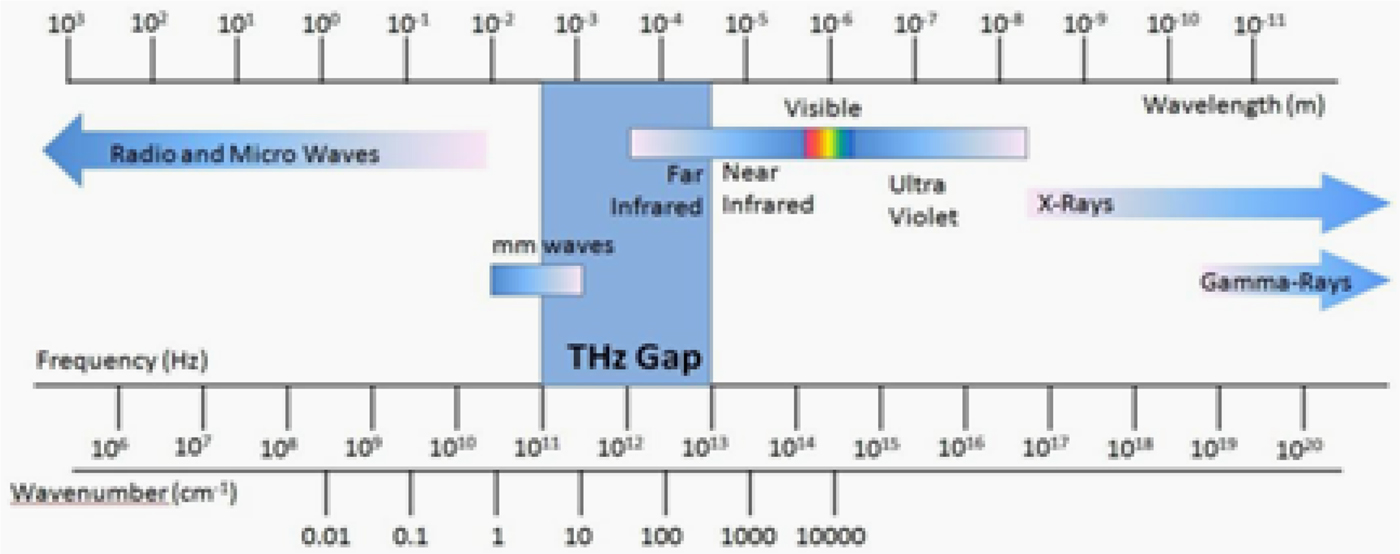
Earlier, in comparison with the relatively well-developed technology at microwave and optical domain of the electromagnetic spectrum, the basic research, new initiatives, and advanced technology developments in the terahertz (THz) band have been very limited and stayed relatively unexplored. As shown in Fig. 1, the electronics (millimeter waves) and photonics (infrared (IR) waves) sandwich the THz band where the semiconductor electronics and the optical technologies find their applications [Reference Zhang1]. The unavailability of reliable, compact, temperature insensitive, and efficient power transmitter antenna and a receiver antenna are the key obstacles in the popularity of THz regime of the spectrum. However, with the progress in technology, in the last two decades, the development of solid-state mode-locked and quantum cascade lasers (QCLs), laser-based THz time-domain spectroscopy (THz-TDS) and microelectronic fabrication such as micron size planar antennas have paved a way in the imaging and sensing technology at the THz frequency band.
The position of terahertz region in the electromagnetic spectrum [Reference Zhang1].
Moreover, the advent of Er+-doped femtosecond fiber lasers has replaced the costly systems made of titanium: sapphire lasers for THz systems [Reference Jansen, Wietzke, Peters, Scheller, Vieweg and Salhi2]. Although the THz radiation exists in nature in abundance, it is difficult to detect them due to incoherence [Reference Zhang, Beigang and Tanaka3]. The use of coherent photon technology, based on optical communication together with THz QCL technology into THz systems is making the use of THz part of the frequency spectrum for both the scientific and commercial applications. Due to low operating temperature, the large-beam divergence, and intrinsic carrier dynamics, the QCL offers certain limitations for its use. However, the performance of QCL as high-power light source in the THz regime of the spectrum with highest output peak power of approximately 1 W in pulsed wave mode at 10 K heat-sink temperature with emission frequency of about 3.4 THz has been reported in [Reference Li, Chen, Zhu, Freeman, Dean, Valavanis, Davies and Linfield4]. In continuous wave mode, the QCL provides highest output peak power in the range 100 mW to 0.23 W with a maximum operating temperature of 200 K for the spectral range 1–5 THz [Reference Liang, Liu and Wang5, Reference Wang, Shen, Jiang, Zhan, Deng, Li, Wu, Yang, Chu and Duan6]. Moreover, with the technological breakthrough in semiconductor physics and technology, the THz band gap is attracting the interest of many researchers [Reference Dhillon, Vitiello, Linfield, Davies, Hoffmann, Booske, Paoloni, Gensch, Weightman, Williams, Camus, Cumming, Simoens, Carranza, Grant, Lucyszyn, Gonokami, Konishi, Koch, Schmuttenmaer, Cocker, Huber, Markelz, Taylor, Wallace, Zeitler, Sibik, Korter, Ellison, Rea, Goldsmith, Cooper, Appleby, Pardo, Huggard, Krozer, Shams, Fice, Renaud, Seeds, Stohr, Naftaly, Ridler, Clarke, Cunningham and Johnston7] to utilize this license-free spectrum for various potential applications. Recently, for the THz regime of the electromagnetic spectrum, various emerging applications have been introduced in biological imaging [Reference Yu, Fan, Sun and Pickwell-MacPherson8], non-destructive testing (NDT) [Reference Amenabar, Lopez and Mendikute9], security scanning [Reference Liu, Fan, Chen and Xie10, Reference Skvortsov11], and process control [Reference Yakovlev, Zaytsev, Dolganova and Yurchenko12] up to the next-generation wireless communication systems (5G) [Reference Federici and Moeller13]. For these applications, the continuous wave (narrowband) or pulsed wave (broadband) THz systems are employed and the classification of such systems is based on the laser source used to generate photocurrent to produce THz radiations.
The enormous inherent potential of THz technology led to a rapid development of THz systems. For many years, there has been an interest in the use of the spectral region that has been referred as the millimeter, near- millimeter, submillimeter, far-IR, or THz region for imaging. A great extent of interest is because this spectral region represents a useful compromise between image resolution and atmospheric/obscurant penetration [Reference Petkie, Casto, De Lucia, Murrill, Redman, Espinola, Franck, Jacobs, Griffin, Halford, Reynolds, O’ Brien and Tofsted14]. Moreover, the potential applications in homeland security, defense, and safety of aviation industry have put a huge demand on the development of advanced imaging systems. While the visible and IR imagery provides outstanding image quality, however, they are hindered by atmospheric obscurants such as cloud cover, fog, smoke, rain, sand, and dust storms. The THz imaging is estimated as an attractive method to reduce, or perhaps even eliminate, the impact of low visibility atmospheric conditions. There are several contributing factors of THz radiations for this optimism in THz imaging, such as:
• Unlike X-ray-based radiological images, the frequency sensitivity of THz absorption can help to identify differences in biological tissues.
• Imaging modalities in optical and IR wavelengths suffer from low penetration depths and are therefore not attractive for non-destructive evaluation applications. However, the THz imaging enables high penetration capability as compared with that of the optical and IR wavelengths.
• The THz band offers improved far-field spatial resolution nearly 300 µm over the millimeter-waves and reduced Rayleigh scattering (wherein intensity, I ∝ λ −4) as compared with the IR [Reference Mickan and Zhang15].
• The THz imaging is a non-ionizing radiation [Reference Woodward, Cole, Wallace, Pye, Arnone, Linfield and Pepper16] which has an advantage over the ionized imaging systems such as positron emission tomography (PET), magnetic resonance imaging, planar X-rays, and X-ray CT scans being presently used.
• In comparison with the IR frequencies, it has low scattering loss due to the longer wavelength as compared with IR, which helps in aligning the wave.
In addition to this, the THz regime of the spectrum is populated by rotational and vibrational energy states of polar molecules either in liquid or gaseous form [Reference Rothman17]. The THz radiation is very sensitive to polar substances, such as water and hydration state. High sensitivity of the efficiency of ionization-induced THz wave production to the molecular angular distribution is due to a strong dependence of the residual current produced in ionization of a polar molecule. However, the physics behind this dependence is the angle-dependent sub-cycle asymmetry of ionization of a polar molecule combined with the effect of the Coulomb potential on the escaping electron. Therefore, the polar molecules interact strongly with a THz wave and due to this property, the water molecules absorb the THz waves very strongly and the depth of penetration of wave is limited in moist substances. However, on the other side, the THz wave is readily detectable even in very low concentrations and these properties make it usable for various applications. The spectral response of various organic and inorganic materials at the low THz frequency is dominated by the dielectric response of materials. At high frequencies, it is dominated by specific intra-molecular or inter-molecular vibrations and rotations similar to those occurring with IR radiation in IR spectroscopy. The imaging has been successfully demonstrated in both the microwave/millimeter wave and IR regions [Reference Han, Tani, Usami, Kono, Kersting and Zhang18] but with the known spectral capabilities of the THz pulse imaging system, it is considered as an important extension of these proven methods. However, a low resolution of 0.3 mm is one of the limitations of THz imaging which can be overcome by using sub-wavelength techniques [Reference Mickan, Abbott, Munch, Zhang and Doorn19].
As the THz waves penetrate dielectric materials such as paper or plastic, reflected by materials with free-electrons like metals and absorbed by molecules with certain vibration levels within the THz band, and thus, THz imaging technology also finds its application in the time-domain spectroscopy (THz-TDS). Using the THz spectroscopy, it becomes possible to detect explosives or illicit drugs even if they are concealed and by comparing the measured reflectivity of THz spectra with the known calibration spectra, one can identify the presence of these agents and distinguish them from benign objects. Several state-of-the-art THz spectroscopy systems rely on ultrafast laser-based systems that are bulky and thus non-portable. Moreover, these THz imaging systems typically employ mechanical raster scans (using single detector) to acquire two-dimensional (2D) images. As such, this scanning process often takes tens of minutes to generate a high-resolution THz picture of a scene. Additionally, such devices tend to be bulky and complicated due to the necessary mechanical parts, and are therefore rather expensive to develop and operate. Consequently, all the electronic-based THz systems are required to minimize the space, weight, and power, and enable its feasibility for future sensing and imaging applications. Moreover, single-frequency imaging systems result in shadowing and specular reflections, and one way to overcome these effects is to illuminate the object with several frequencies and at different angles to create a diffuse effect. Therefore, the imaging system must be wideband and with high efficiency for optimal performance. In Fig. 2, a broadband focal plane array camera for real-time THz imaging application is shown. The THz camera incorporates ultrafast 2.5 THz intrinsic cut-off frequency, antimonide-based hetero-structure backward diodes, which are monolithically integrated with planar THz antennas for each sensor pixel [Reference Trichopoulos, Mosbacker, Burdette and Sertel20].
The THz camera comprising of focal plane array pixels consisting of the broadband slot-type PCA with integrated sensors [Reference Trichopoulos, Mosbacker, Burdette and Sertel20].

Similarly, in the pulsed THz imaging system as shown in Fig. 3, a photoconductive antenna (PCA) is illuminated with the help of a femtosecond laser pulse acting as a source. The generated THz electromagnetic pulse is detected by non-linear crystal made up of ZnTe by means of electro-optic (EO) sampling technique based on the optical pump–probe setup [Reference Karpowicz, Zhong, Xu, Lin, Hwang and Zhang21]. The Coherent RegA laser used in the setup has the characteristic features as: (1) a repetition rate of 250 kHz, (2) an average power of 400 mW, and (3) pulse duration of 200 fs.
Schematic illustration of a pulsed THz imaging system [Reference Karpowicz, Zhong, Xu, Lin, Hwang and Zhang21].
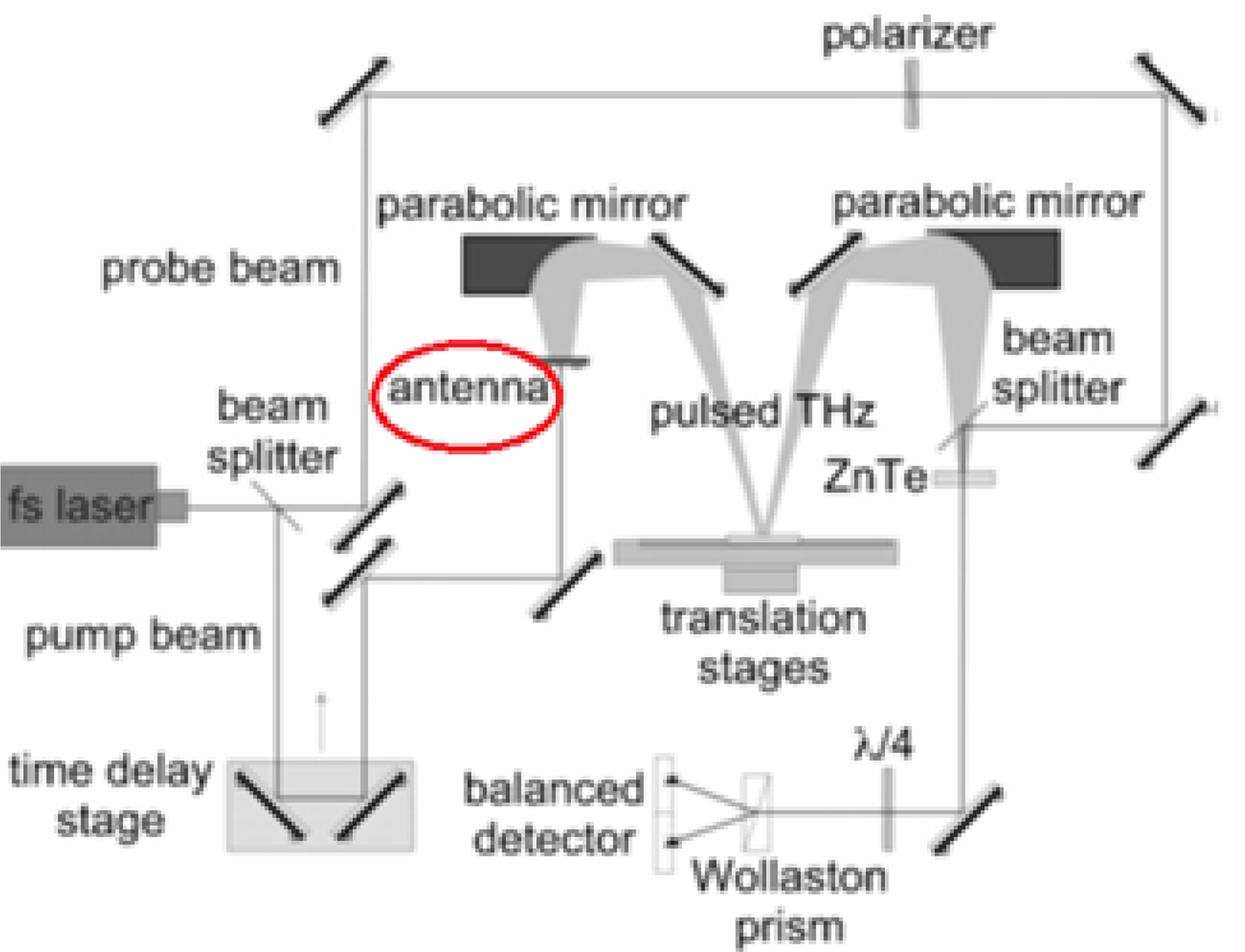
Initially, the THz pulses are generated by a large aperture PCA with a peak frequency of 0.4 THz. The generated THz beam is then focused onto the target using a parabolic mirror which gets reflected by the sample layers and the aluminum substrate. The reflected beam is collected by another parabolic mirror and sends to a ZnTe crystal acting as a THz detector where it overlaps with the probe beam. The probe beam is modulated by the THz field within the ZnTe crystal. This method records the waveform of reflected THz pulses and therefore preserves the phase and amplitude information. Further, it is apparent from the above-stated examples that the key element of the imaging system is the PCA which converts the bandwidth of electrically-driven microwave generators and a near-infrared (NIR) femtosecond laser into the THz frequency range. Therefore, it is necessary to overview the potential developments in THz antenna technology and investigate its potential challenges and opportunities for real-time imaging applications. In this review paper, the author's potential contributions to the THz antenna technology for imaging applications are summarized as follows.
• We have briefly discussed the sate-of-the-art THz applications with sources and detectors and provided a collection of all relevant literature to bring researchers up-to-date on the current state.
• We have investigated the potential challenges of several THz spectroscopy techniques used in THz imaging applications.
• The THz antennas play a significant role in several THz imaging and spectroscopy systems; therefore, the recent developments in the field of THz antennas are explored.
• The prospective challenges of pulsed THz imaging systems are presented and the techniques to overcome these challenges using PCA are suggested.
The remainder of the paper is organized as follows. In Section ‘THz applications’, a brief discussion on THz applications has been presented. Section ‘THz sources and detectors’ includes an overview of THz sources and detectors especially, with respect to the THz PCA. For the THz imaging application, the spectroscopy is a potential technique used to understand the molecular structure of the material and its classification is briefly described in the Section ‘Terahertz spectroscopy for imaging applications’. The potential challenges in terms of performance parameters of pulsed THz imaging applications are discussed in the Section ‘Pulsed terahertz imaging applications’. Moreover, because the THz antennas play a significant role in THz spectroscopy for imaging applications, therefore, recent developments in THz antenna designs are discussed in the Section ‘Terahertz antennas’. The potential challenges related to the THz systems using PCA for imaging applications are briefed in the Section ‘Potential challenges of pulsed terahertz imaging systems and methods to improve the performance of terahertz PCA technology’. Finally, the Section ‘Conclusion and recommendation’ concludes the work and recommends the future directions.
THz applications
Various application scenarios of the THz frequency regime are based on the intrinsic characteristics of this part of the electromagnetic spectrum [Reference Robin, Bouye and Cochard22]. However, the multiple interactions with matter exist within this band, and many chemical, biological, molecular, and physical structures show unique fingerprints and rotational modes at specific frequencies within the THz domain. The high absorption peaks of oxygen molecules and polar liquids such as water [Reference Sy, Huang, Wang, Ahuja, Zhang and Pickwell-Macpherson23] are the main characteristics of this type of radiation. Further, the THz radiation penetrates the fabric, foam, and plastic [Reference Cooper, Dengler, Lombart, Bryllert, Chattopadhyay, Schlecht, Gill, Lee, Skalare, Mehdi and Siegel24], whilst they are almost totally reflected by metals. The photon energy levels of THz rays derive an extra characteristic. The radiations at 1 THz have a photon energy level of 4.1 meV, which is 1 million times weaker than that of the X rays and do not cause harmful effect on biological tissues. The sum of these characteristics has resulted in a variety of applications. Due to the non-ionizing nature of THz radiation coupled with its sub-millimeter scale resolution and their ability to penetrate obscurants such as clothes and polymers makes the THz spectrum ideal for standoff screening applications as well as non-invasive inspection of packaged goods and devices [Reference Gowen, O'Sullivan and O'Donnell25]. Categorically, Fig. 4 shows these potential applications, which fall within either of the material characterization, sensing and imaging, and the communication fields. However, the THz band characteristics itself interlink these applications which are widening gradually.
Potential terahertz wave technology applications areas.

Material characterization
Due to the unique spectral signature characteristics, the THz band finds a number of industrial applications for material characterization. One of the interesting applications of the THz wave in material characterization is in the paper and polymer industries [Reference Rahani, Kundu, Wu and Xin26]. The online production is being efficiently controlled by THz systems where it monitors the thickness and moisture content of the paper during the production process. Mousavi et al. [Reference Mousavi, Haran, Jez, Santosa and Dodge27] have demonstrated two different paper samples, which are differentiated by the THz wave. In addition, the THz systems also find its utility in the polymer industry such as online supervision of polymeric processes (such as a real-time paint meter) [Reference Yasui, Yasuda, Sawanaka and Araki28], quality control of plastic weld joints [Reference Wietzke, Jordens, Krumbholz, Baudrit, Bastian and Koch29], conductive properties of poly-aniline films [Reference Nguema, Vigneras, Miane and Mounaix30], determination of moisture level [Reference Banerjee, Spiegel, Thomson, Schabel and Roskos31], the fiber orientation [Reference Park, Im, Hsu, Jung and Yang32], and the glass-transition temperature of polymers [Reference Kawase, Shibuya, Hayashi and Suizu33]. The detection of unwanted and potentially hazardous objects in food is extremely important in the food industry. The THz systems detect both the metallic and non-metallic contamination [Reference Han, Park, Ahn, Lee and Chun34]. The low water content foodstuff such as chocolate is transparent enough to THz waves and therefore these waves can be used to differentiate contamination in the chocolate bars [Reference Jordens and Koch35]. The study of moisture quantification within an industrial process could be interesting like in the fresh-food industry with packaging protection. For the brewery industry, the detection of corked substance is important. Hor et al. [Reference Hor, Federici and Wample36] demonstrated that the contrast images of the crocked substances are a result of enhanced scattering of the THz radiation by defects, voids, and the variation in the cork-cell structure.
Sensing and imaging
Among the security applications, the luggage and postal mail inspection [Reference Hoshina, Sasaki, Hayashi, Otani and Kawase37] at airports is a major concern. The molecular crystals present specific features in the THz regime of the spectrum; therefore, the explosives [Reference Kemp38–Reference Kurmi and Chaurasia40] or illicit drugs [Reference Lu, Shen, Li, Zhang, Zhang, Liang and Xu41] have been efficiently localized and unambiguously identified within an envelope, a parcel, or a suitcase [Reference Federici, Schulkin, Huang, Gary, Barat, Oliveira and Zimdars42]. The metallic packages are opaque to the THz waves and thus, the spectrometers designed in the THz band are not likely to substitute X-ray scanners. Though, they can offer supplementary information on the sample, mainly for low-density materials and chemical separation. The full-body scanners have been an interest for highly sensitive facilities and public spaces such as airports, governmental compounds, or open space during festivals. Initially, the security screening was either based on metal-detectors, X-ray backscatter, or millimeter wave passive and/or active imaging. Comparatively, the THz radiation is safe relative to that of the X rays due to the much smaller photon energy and it does not damage the living tissues through ionization [Reference Wilmink and Grundt43]. Therefore, the THz radiation seems promising also for the airport non-invasive full-body security scanners [Reference Valkenburg and Ploeg44, Reference Heinz, May, Born, Zieger, Anders, Thorwirth, Zakosarenko, Schubert, Krause, Schulz, Bauer and Meyer45]. The THz system also finds its application in the liquid explosives detection. Several liquids show a very different dielectric response in THz range and distinguishable from the other alcoholic substances [Reference Jepsen, Moller and Merbold46].
The medical and biomedical imaging is also a promising field where the THz imaging technique finds several applications [Reference Son47]. The THz wave exposure intensities of sub-hundred milli-watt per square centimeter or even greater, does not show any significant changes at a cellular and molecular level of the living substance [Reference Wilmink, Rivest, Roth, Ibey, Payne, Cundin, Grundt, Peralta, Mixon and Roach48]. Thus, it facilitates a safer medical imaging for human beings [Reference Son49]. The THz imaging has found its potential application in analyzing breast tumors [Reference Bowman, El- Shenawee and Campbell50], skin hydration and skin cancer [Reference Taylor, Singh, Bennett, Tewari, Kealey, Bajwa, Culjat, Stojadinovic, Lee, Hubschman, Brown and Grundfest51, Reference Woodward, Wallace, Arnone, Linfield and Pepper52], and liver cancer [Reference Zhang, Zhao, Jin, Hou, Chen and Wu53]. Oh et al. [Reference Oh, Huh, SuckSuh, Choi, Haam and Son54] have obtained the diagnostic images of cancerous tumors by employing THz molecular imaging technique, which measured the THz response change by the surface plasmon resonance induced on the surface of nano-particles with the NIR beam irradiation. They have also developed a differential measurement technique in which the NIR beam is directly modulated instead of numerical subtraction of two images. This differential measurement technique eliminates the background noise which results in high signal-to-noise ratio (SNR), and high sensitivity arising from the sensitive interaction of THz waves in the water. Thus, this technique facilitates the target-specific sensing of tumors, and it is also capable of identifying the minuscule differences at a cellular level. Similarly, the benefits of THz radiation are used in the dental imaging and monitoring the tooth-decay. Berry et al. [Reference Berry, Fitzgerald, Zinoviev, Walker, Homer-Vanniasinkam, Sudworth, Miles, Chamberlain and Smith55] developed a catalog of optical properties of tissues exposed to THz-pulsed radiation. The pharmaceutical industries are also using THz radiations in the analysis of tablets and chemicals for the purpose of quality check during their production process [Reference Charron, Ajito, Kim and Ueno56, Reference Shen57]. Since different isomers lead to crystalline structures with varying spectral fingerprints in the THz range, the polymorphic forms can be detected using a THz imaging technique, which is also well suited for quality check of the tablet coatings [Reference Shen and Taday58] and is used to control the release of the active pharmaceutical ingredients [Reference Maurer and Leuenberger59].
The THz radiation can penetrate a variety of non-conducting materials like microwave radiations. This radiation can pass through the clothing, paper, cardboard, wood, plastic, and ceramics. The penetration depth is typically less than that of the microwave radiation; therefore, its applications extend to the inspection of hidden defects, non-uniformity, and cracks that lays on the surface of the material [Reference Guillet, Recur, Frederique, Bousquet, Canioni, Honninger, Desbarats and Mounaix60]. Moreover, the condition-based monitoring of the thermal protection systems for the safe operation of space shuttles is essential to avoid any catastrophic failures such as the NASA Space Shuttle Columbia. The THz beams are capable to detect heat-induced damage in polymer foam tiles. Zhong et al. [Reference Zhong, Xu, Xie, Yuan, Reightler, Madaras and Zhang61, Reference Zhong, Karpowicz, Xu, Deng, Ussery, Shur and Zhang62] have demonstrated the THz time-of-flight tomographic imaging in the non-destructive identification of foam insulation on space shuttle fuel tanks, with pre-fabricated defects. They have also reported the detection of space shuttle insulation foam defects using a 0.2 THz Gunn diode oscillator as the light source, and pyroelectric camera as the detector. Rahani et al. [Reference Rahani, Kundu, Wu and Xin63] have investigated the potential of THz electromagnetic waves in detecting heat-induced damages in the porous materials. By analyzing the transmission characteristics based images which provide THz absorption information, and a large number of defects generated during the manufacturing (fiber content, voids, de-lamination) or in-service process (impact damage, burn damage) can be detected. The THz transmission images of composite materials with sub-millimeter resolution can be obtained due to the fact that these waves can penetrate almost all composite material [Reference Cunningham, Valdes, Vallejo, Hayden, Polishak, Zhou, Luo, Jen, Williams and Twieg64]. Amenabar et al. [Reference Amenabar, Lopez and Mendikute9] have reviewed the most relevant aspects of the THz technology as a tool for NDT inspection of composite materials. The reflection (in conductive materials) and absorption (in polar liquids) phenomenon at THz range lead to a clear observation in the composite inspection field as carbon fibers, which is not penetrated by THz radiation as well as water content in the air/composite itself can compromise on the correctness of the inspection system.
Communication
Due to the growing demand of high-speed and high data rate communication, there is a need for the use of higher operating frequency lying in the millimeter and sub-millimeter range of the electromagnetic spectrum [Reference Nagatsuma, Ducournau and Renaud65]. However, to increase the operating frequency and to set up a communication link in the THz region, there are several design issues which need to be addressed carefully. The antenna plays the crucial role in the wireless communication which needs the due consideration at the THz frequency. The gain of the antenna is an important factor to enhance the overall communication link. Jha and Singh [Reference Jha and Singh66] have reviewed the technical issues of THz antennas with the special attention to the planar technologies which might contribute to the compact, inexpensive, and low-profile future THz wireless communication system design. As, the signal attenuation and power levels are high and low, respectively in this regime of the spectrum, the communication links cause highly directive systems leading to point-to-point communications within short ranges. So far, this may come for the benefit of securing the short-range links where confidential information could be relayed fast and securely. There are different active research area in several application domains of the THz communication systems [Reference Kurner and Priebe67, Reference Chen, Tan, Han, Zhang, Guo, Li, Cao and Liu68], particularly, there have been demonstrations of indoor systems operating point-to-point over several meters [Reference Ducournau, Szriftgiser, Pavanello, Peytavit, Zaknoune, Bacquet, Beck, Akalin and Lampin69, Reference Li, Dong, Yu, Chi, Shao and Chang70], which are largely depending on the integrated circuits to enable these links for portable consumer devices [Reference Song, Kim, Ajito, Yaita and Kukutsu71, Reference Antes, Boes, Meier, Messinger, Lewark, Tessmann, Wagner and Kallfass72]. These systems share the characteristic of relatively short-range communication and fundamentally limited by the strong atmospheric attenuation and the scattering by the building materials [Reference Jansen, Priebe, Moller and Jacob73]. The long-range outdoor point-to-point links now operate in the millimeter-wave band, below 300 GHz. A directive fixed wireless link operating at a center frequency of 240 GHz achieves a data rate of 64 Gbit/s over a transmission distance of 850 m using QPSK and 8PSK modulation in a single-channel approach without the use of spatial diversity concept [Reference Kallfass, Boes, Messinger, Antes, Inam, Lewark, Tessmann and Henneberger74] and a 120 GHz link achieving 10 Gbit/s at 5.8 km [Reference Hirata, Kosugi, Takahashi and Takeuchi75] have been demonstrated in the recent past. However, it is a myth that the millimeter-wave and the THz bands (0.1–3 THz) are impractical for all but short-range links due to severe attenuation by the atmospheric water vapor. Further, the field of submillimeter radio astronomy contradicts it in the large aperture telescopes developed in the dry high-altitude locations. Suen [Reference Suen76] has reviewed the technology and science necessary to develop a terabit-per-second THz satellite link and mentioned that a satellite link offers a good first step toward developing a ubiquitous THz communications. The technical aspects of a link including atmospheric attenuation, aperture and transceiver technology, and earth station properties for the terabit-per-second Satellite link are discussed in his work.
THz sources and detectors
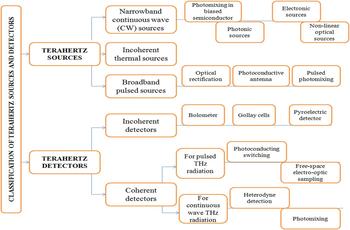
In general, the electronic solid-state sources have limited operating bandwidth due to the transit time of carriers through semiconductor specimen which causes high-frequency roll-off. This makes a limitation in the use of solid-state devices for THz frequencies. Recently, the development of a variety of THz sources is gradually filling the THz gap, providing complementary characteristics in terms of various parameters such as operating frequency, an average and peak power. The classification of THz sources and THz detectors is shown in Fig. 5. The THz radiations are generated by various systems, each with different output powers, sensitivities, and bandwidths. On the basis of spectroscopic techniques used in sensing and imaging applications, the THz sources have been broadly classified in three categories such as: (1) incoherent thermal sources, (2) narrowband continuous-wave (CW) sources, and (3) broadband pulsed sources. The THz detectors are classified into two classes such as: (1) coherent and (2) incoherent detectors.
• The incoherent thermal sources generate THz radiations through a mercury arc lamp or SiC rod (Globar) in an optical interferometer. In the interferometer, the characteristic interference pattern of the sample is measured through scanning the arm length [Reference Griinered77].
• The narrowband continuous wave sources are further classified as photomixing in biased semiconductors, photonic sources, non-linear optical sources, and electronic sources.
• The broadband pulsed sources are classified as optical rectification, PCA, and the pulsed photomixing.
• The incoherent THz detectors are classified as a bolometer, Gollay cells, and pyroelectric detectors.
• The coherent THz detectors are further classified as photoconductive switching, and free-space EO sampling for pulsed THz radiations and heterodyne detection, and photomixing for continuous wave THz radiation, respectively.
Classification of terahertz sources and detectors.

The free-space THz-TDS grew due to the advancement in both photoconductive dipole antennas and EO crystals as sources and detectors [Reference Smith, Auston and Nuss78–Reference Grischkowsky, Keiding, van Exter and Fattinger80]. Moreover, the PCAs [Reference Stone, Naftaly, Miles, Fletcher and Steenson81] are not only used to generate and detect pulsed THz waves but can also be used in the non-linear effects of optical rectification as well as EO sampling [Reference Leitenstorfer, Hunsche, Shah and Nuss82]. The photoconductive approach uses high-speed photoconductors as a transient current source for the radiating antenna. Typical photoconductors include high-resistivity GaAs, InP as well as the radiation-damaged silicon wafers and metallic electrode bias the photoconductive gap and form a THz antenna. The physical mechanism for THz beam generation in a PCA begins with an ultrafast laser pulse having photon energy larger than the bandgap of the material hυ ≥ E g (energy bandgap), which creates electron–hole pairs in the photoconductor. The generated free carriers get accelerated in the static bias field to form transient photocurrent, and the fast time-varying current radiates pulsed THz waves. The basic elements of a PCA, the antenna geometry, the photoconductive switch, the electric bias and the optical pulse can be subsequently varied in many ways to study and improve the generated pulsed THz power, bandwidth, radiation pattern and pulse characteristics. The high SNR of pulsed THz spectrometers is due to high emitter power and sensitive detection.
The availability of high-power, high repetition rate femtosecond laser sources has enabled PCAs to be driven into saturation, and photoconductive substrates with high breakdown voltages permit large bias fields. The maximum power emitted from a PCA depends on the photoconductive substrate and the coupling efficiency of the antenna. The high breakdown voltage, a low optical refractive index, low bandgap, low carrier lifetime, high optical absorption, and carrier mobility are the key features of a photoconductive switching material used in the THz regime. The antenna design and coupling influences the efficiency, bandwidth, and radiation pattern of pulsed THz emission. The researchers have explored many antenna geometries but high-power pulsed THz waves are still generated by coplanar strip lines and large aperture emitters only [Reference Yano, Gotoh, Hirayama, Miyashita, Kadoya and Hattori83]. A broad bandwidth is the second most desirable characteristic of a pulsed THz source, which relies on short THz pulse duration. The PCAs with GaAs substrate typically have a useful bandwidth in the range of 100 GHz–2 THz, which is extendable to 4 THz by injecting carriers close to the band edge. The bandwidths of PCAs extend up to 6 THz, but the pulse duration is still limited by carrier mobility, leading to interest in optical rectification emitters. The radiation pattern of a PCA is important for designing beam-steering optics and imaging systems. In general, the THz radiation from antenna focused into a beam with a hemispherical lens [Reference Nguyen and Park84]. The radiation pattern for the common dipole antenna is essentially dipolar, with a weak quadrupole component perpendicular to the bias field [Reference Rudd, Johnson and Mittleman85], weak elliptical polarization [Reference Rudd, Johnson and Mittleman86], and the field propagates as a Gaussian pulse into the far-field [Reference Giirtler, Winnewisser, Helm and Jepsen87] with high-frequency components concentrate in the center of the beam spectrum.
The pulsed photomixing is another technique used to generate THz signals in the PCAs, CW photomixing, and CW non-linear DFG. The photomixing in PCA uses two pulses from the ultrafast laser and split them in an interferometer with consequent phase control, which provides control over the output pulse shape [Reference Tani, Morikawa, Matsuura and Hangyo88]. The shaping of optical NIR pump pulse enables pulse shaping generated from non-linear optical mixing effects. The method of pulse mixing with another chirp results in a different frequency, depending on the phase delay between two pulses in the arms of the interferometer. The chirped pulse mixing generates relatively narrow band and frequency-tunable pulsed THz waves. In [Reference Stigwall and Wiberg89], Stigwall and Wiberg have presented a novel fiber-based method for the generation of high-frequency signals by means of chirped pulse photomixing.
In the coherent detection technique, the amplitude and phase of the radiation which have great importance in the spectroscopy have been detected, whereas in incoherent detection, only the intensity can be measured. Therefore, the coherent detection is the most commonly used techniques in sensing and imaging applications. The photoconductive sampling, free-space EO sampling, photo mixing, and the heterodyne detection have been widely used as coherent detection methods. Along with the PCA emitters, the photoconductive switching has also been developed for the pulsed THz detection [Reference Duvillaret, Garet, Roux and Coutaz90, Reference Bitzer, Ortner and Walther91].
THz spectroscopy for imaging applications
The spectroscopy with a high spectral resolution of the electromagnetic spectrum at frequencies in THz regime is a powerful analytical tool for investigating the structure and energy levels of molecules and atoms. The spectroscopic imaging is capable of revealing and analyzing various biological and chemical conditions. Lee et al. [Reference Lee, Kim, Kim, Jhon, Kim, Lee, Son and Seo92] have illustrated a highly sensitive and selective detection method for residual pesticide molecules using a nano-scale metamaterial-based THz-TDS system. Further, a nano-scale metamaterial based slot-antenna has been designed for the strong THz resonance at a certain frequency where the specific molecule has intra- or inter-molecular collective vibration mode. The enhanced THz near-field via a nano-scale metamaterial-based antenna strongly increases the absorption cross-section, and this leads to the detection sensitivity up to a parts-per-billion level even in a solution state of pesticide sample. The THz spectroscopy and imaging techniques can also be used to analyze works of art [Reference Fukunaga, Ogawa, Hayashi and Hosako93]. The electromagnetic wave at this frequency can penetrate opaque materials and preparation layers, and thus, the THz spectroscopy shows fingerprint-like spectra similar to IR bands [Reference Hosako and Fukunaga94]. The time-domain reflection imaging uses THz pulses that act as a probe and propagate through an art-work to get its internal structure without requiring sampling of the specimen. In addition, the energy of waves in this domain is low enough and considered as perfectly non-invasive in practice. The first ever non-invasive cross-sectional image of a tempera masterpiece by Giotto was successfully observed [Reference Fukunaga, Hosako, Duling and Picollo95] using a THz spectroscopy technique.
The THz spectroscopy provides information on the basic structure of molecules which is useful in radio astronomy. The rotational frequencies of light molecules fall in the THz spectral region similar to that of the vibrational modes of large molecules with many functional groupings. Moreover, many biologic molecules have broad resonances at the THz frequencies. The THz spectral region accessible via ultrafast optical pulse generation and detection are used in the investigation of THz vibrational modes of crystalline benzoic acid from 0.1 to 4 THz in [Reference Yan, Fan and Zheng96]. Further, considering the progress of THz spectroscopy detection technology, several manufacturers of spectrometers have shown the development of handheld spectroscopy devices such as Terakit-DODS spectrometer produced by Rainbow Photonics Corporation in Switzerland has the spectral range from 0.1 to 20 THz which has the widest spectral range at present and its average power is up to 180 mW and Mini-Z Terahertz Time Domain spectrometer produced by the Zomega Corporation of American, whose size is 10.5×6.25 × 2.75 cm3, is having the spectral range 0.1–4 THz, dynamic range is more than 70 dB, frequency resolution is <500 Hz. This spectrometer is very portable and suits for the on-site component analysis of chemicals and drug inspection [Reference Gao, Degang and Jianquan97].
The low-frequency end of THz spectral region extends to frequencies that are easily achievable using high-precision electronic instruments and long temporal scans are required. To the high-frequency limit above about 10 THz, the Fourier transform spectroscopy (FTS) is used. The pulsed THz spectrometers are inherently broadband systems, a result of using ultrafast optical pulses to generate the THz radiation. THz spectroscopy has determined the far-IR optical properties of the material as a function of frequency, which yield insight into material characteristics for a wide range of applications. Moreover, the FTS is the most commonly used technique for studying molecular resonances which provide an extremely wide bandwidth, enabling material characterization from the THz frequencies to the IR range. The spectral measurements, which have a much higher resolution, have been made using a narrowband system with a tunable THz source or detector. However, both FTS and narrowband spectroscopy are also widely used in passive systems for monitoring the thermal-emission lines of molecules, particularly, in the astronomy applications. The THz spectroscopy has been classified into three categories such as: (1) THz-TDS, (2) THz time-resolved THz spectroscopy (TRTS), and (3) THz emission spectroscopy (TES) [Reference Dexheimer98].
THz time-domain spectroscopy
The THz-TDS measures the change in the time-resolved electric fields of THz pulses propagating through a sample and an equal length of free space. In a THz-TDS, both generation and detection occur in the same system. The system uses an ultrafast laser pulse, which gets divided into two optical beams in the system. One generates the THz pump beam, and the other detects the probe beam. The probe beam explores amplitude of the THz pulse over the time. Thus, the THz waveform is time dependent and it is used as a reference. The THz radiation probes the sample to generate sample waveform and by comparing the two waveforms under Fourier Transform, it gives the spectroscopic information. However, based on the sample geometry, the change in THz pulse shape allows the analytic or numeric calculations of the complex sample index, dielectric permittivity or the conductivity when it is assumed that the linear interaction between the electric field and the sample. Although the spectral resolution of THz-TDS is much coarser than narrowband techniques and its spectral range much lesser than that of FTS and has several advantages that have given rise to some important recent applications. The transmitted THz electric field is measured coherently, which provides both high sensitivity and time-resolved phase information. Moreover, the delay line is a crucial part of every time-domain spectrometer, which needs to carry out the sampling of the electric field over the time. There are a number of uncertainties in TDS measurements, but the delay line uncertainty is significant in the sensing and imaging and thus it has been rigorously analyzed by Oberto and Koch [Reference Oberto and Koch99]. They have modeled the impact of a delay line uncertainty on the acquired THz-TDS data and have emphasized on the effect of a small random deviation in delay-line position on the time axis and the measured electric field. The authors have also shown that in a single measurement, a high SNR is achieved by using a high precision delay line. Any small deviation in the positioning of the delay-line introduces a small uncertainty in the measured THz transient may directly lead to the error in the material property characterization [Reference Jepsen and Fischer100]. In principle, also the delay lines with a lower precision can yield to an overall acceptable SNR if either averaging or the oversampling of the pulse signals can be performed.
Time-resolved THz spectroscopy
The TRTS is an optical-excitation time-dependent THz spectroscopy in which laser is used to change the carriers and permittivity of the sample. The TRTS measures the dynamic properties of the material which differentiates it from THz-TDS. Baxter and Schmuttenmaer [Reference Baxter and Schmuttenmaer101] have determined the THz absorption coefficient, index of refraction and conductivity of nano-structured ZnO using TRTS. Similarly, this spectroscopic technique is used to determine the time scales of generation and recombination of charge carriers as well as their transport properties in solution processed Perovskite-based solar cells [Reference Ponseca, Savenije, Abdellah, Zheng, Yartsev, Pascher, Harlang, Chabera, Pullerits, Stepanov and Wolf102].
THz emission spectroscopy
The TES is another spectroscopic technique which uses the sample under investigation as a THz emitter to decide the THz pulse shape. With this technique, the information related to the optically excited carrier is obtained. The pump–probe systems take into account the change in time-resolved electric fields propagating through sample and free-space; however, the TES investigates the speed and momentum changes. The use of TES technique is made in determination of the carrier–envelope (CE) phase of few-cycle laser pulses in [Reference Ker, Loffler, Thomson, Dorner, Gimpel, Zrost, Ergler, Moshammer, Morgner, Ullrich and Roskos103]. In this, the authors introduced an approach to determine the CE phase by down-conversion of the laser light to THz frequency range by means of plasma generation in ambient air, an isotropic medium where the optical rectification (down-conversion) in the forward direction is only possible if the inversion symmetry is broken by electrical or optical means.
Pulsed THz imaging applications
The THz imaging era has begun after Hu and Nuss developed the first scanning system in 1995 [Reference Hu and Nuss104]. They have demonstrated a practical THz imaging system wherein THz transients are focused to a diffraction-limited spot on the sample and the transmitted THz waveforms are acquired and processed in real time at each point of the sample while the sample is scanned in the x–y translation of target. They used THz pulses to look through the packaging of a semiconductor chip to see the detailed metal tracks inside and to find the water content of tree leaves. Among the concepts for THz imaging, several non-coherent techniques such as micro-bolometer arrays are presented by researchers whereas to increase the measurement speeds, these approaches provide only limited information due to lack of information about the phase. However, due to the rapid development of coherent THz sources, the trend shows the advancement in THz imaging systems and it presents an opportunity for high-resolution, potentially non-invasive imaging suitable for security or quality-control applications [Reference Woolard, Jensen and Hwu105, Reference Zeitler and Gladden106]. The low energy of THz photons and extreme sensitivity to water absorption helps in characterization and imaging of biological systems [Reference Hishida and Tanaka107]. Since the structure of bio-molecules is closely related to their functionality, therefore, the pulsed THz sensing has its various applications in the field of biomedicine, such as the DNA sensing [Reference Fischer, Walther and Jepsen108] and skin cancer detection. Although the pulsed THz radiations are able to penetrate a few millimeter of tissue, 85% of all cancers lie in the epithelium, allowing the THz to sense very small cancers such as basal cell carcinomas. As the breathing modes of DNA caused by the stretching of hydrogen bonds between the two DNA strands such as vibrations, twisting and global stretching modes are excited in the 0.1–10 THz band, the pulsed THz spectroscopy provides information about DNA structure and its dynamics. The THz-based imaging technologies find a unique place in healthcare savings [Reference Fischer, Hoffmann, Helm, Wilk, Rutz, Ostmann, Koch and Jepsen109]. The low-cost, portable systems are helping in detecting skin cancer, reducing the need for costly and traumatic surgery.
The optical properties, refractive index and birefringence, and the dielectric permittivity of the materials are very sensitive to phase transitions and hence depend on temperature. Reuter et al. [Reference Reuter, Vieweg, Koch and Dierking110] investigated this property at THz frequencies. The semiconductors with moderate carrier concentration have a plasma frequency and damping rate between 0.1 and 2 THz, which translates into the ability to sense the presence or character of different materials. This unique form of sensing has now been used to probe the properties and dynamics of semiconductors [Reference Beard, Turner and Schmuttenmaer111], superconductors, other correlated electron materials [Reference Averitt, Rodriguez, Siders, Trugman and Taylor112], and many other materials [Reference Hangyo, Tani and Nagashima113]. Recently, the researchers have focused to investigate the explosives and biological samples which have unique THz spectral signatures. The pulsed THz sensing involves applying the technique to the study of materials by monitoring transmitted or reflected radiation. As the pulsed THz wave can see through envelopes, this technology has been used by the mail sorters to check the biological and chemical hazardous substances [Reference Choi, Bettermann and Wiede114]. Another potential application of pulsed THz imaging is the non-destructive characterization of soot from the internal combustion engine. It is necessary to check the pattern of the soot in the soot-removal filter of an internal combustion engine to design the highly efficient filtering structure and optimize the timing of filter renewal. Shibuya et al. [Reference Shibuya, Suzuki, Suizu and Kawase115] have described a non-destructive inspection method using the millimeter-to-THz wave imaging and computed tomography. With the use of this technology, the soot removal filter's efficiency is increased. The monitoring of filters helps in deciding the renewal timing needed to optimize fuel consumption and to lower particulate emissions. The screening of persons to detect concealed hazardous objects is a common task arising from various security threats to contemporary societies. However, the full-body scanning techniques based on X rays on the other side raise questions about the health issues, thus limiting their acceptance by the public. Another important security need like recognizing a suicide bomber from a safe distance is not met at all by existing technologies. However, the most useful property of imagers operating in the THz range has an ability to detect small temperature differences on the object's surface as well as the ability to see through clothing. Against the background of the radiating human body, reflecting as well as absorbing objects are visible. Hence, the objects concealed under the clothing can also be detected. This applies to metals, which are highly reflective, ceramic materials, and even explosives which show typical absorption spectra in the 0.1–3 THz range [Reference Sheen, Hall, Severtsen, McMakin, Hatchell and Valdez116].
Therefore, due to the potential features of THz radiations in imaging applications, the THz imaging systems on the basis of the type of imagers used in the THz imaging system are classified as: (1) Passive imaging and (2) Active imaging. The THz imagers provide images with low SNR, low spatial resolution and offer a limited distance of imaging. The performance of THz imagers in terms of noise-equivalent temperature difference value is lower and is in the range of 0.5–5 k [Reference Kowalski and Kastek117]. The passive THz imagers record the contrast in radiometric temperature within an object under scene and active THz imagers record the contrast in the scattered radiance within an object when it is illuminated with the THz source. In the active imaging, the imager is used to make the active image which confines all of its illumination to a single mode and the receiver observes the same mode. However, the passive THz imaging systems which are inherently multimode has a small dynamic range in comparison to active THz imaging system [Reference Grossman, Gordon, Novotny and Chamberlin118].
Furthermore, the THz imaging technology faces a number of inherent problems arising from the specular reflections, angular orientation effects, interference effects (“speckles”), and unwanted clothing reflections (“clutter”), which degrades the image quality and resolution. Moreover, certain threat scenarios, such as non-reflecting objects carried directly on the human skin, are in principle a challenge to active imaging techniques. The degradation in THz images caused by speckle as in case of active imaging can be minimized by adding angular diversity or multimode mixing to the illumination THz source [Reference Patrick, Holt, Joye and DeLucia119]. With the advances in TMICs (THz monolithic and array compatible integrated circuits) [Reference Deal, Mei, Leong, Radisic, Sarkozy and Lai120, Reference Radisic, Leong, Mei, Sarkozy, Yoshida and Deal121] operating at room temperature, a fully passive approach is implemented with the use of heterodyne receivers. However, the active imaging system offers an advantage of reducing the sensitivity requirement on the THz receivers and in such case, the receiver can improve the acquisition speed and number of image pixels (format). Friederich et al. [Reference Friederich, Spiegel, Bauer, Meng, Thomson, Boppel, Lisauskas, Hils, Krozer, Keil, Loffler, Henneberger, Huhn, Spickermann, Bolivar and Roskos122] have presented active imaging systems to determine their potential in real-time imaging which includes: (a) active electronic imaging system, (b) optoelectronic THz imaging system, and (c) THz focal plane arrays. Therefore, both the active and passive imaging systems have their respective advantages and their use depends on the application in use.
As in THz imaging system, a THz source plays a significant role and for pulsed THz spectroscopy, the use of photoconductive THz antenna is required. Therefore, it is necessary to analyze the developments occurred so far in the field of THz antennas related to THz sensing and imaging applications. An optimum design of THz array antenna helps to enhance the imaging capabilities to address the considerations such as limited depth-of-field (DoF) that is the distance over which an object is considered in focus and size-weight-and-power (SWaP) of a THz source for imaging applications. These are important considerations for applications like stand-off imaging and surveillance of moving targets where the high angular resolution, as well as extended depth-of-field, is the key for successful detection of hidden explosives and illicit drugs.
THz antennas
The THz antennas are broadly divided into two disparate areas: (1) wavelength scale beam-forming or feed elements and (2) large apertures that are employed to collect the signals and to shape or focus the beams. The THz antennas as beam-forming elements couple energy from the free-space into or out of sub-wavelength generators or receivers. However, large aperture THz antennas are useful for the variety of applications such as high-resolution imaging or scanning to the tremendous light-gathering power needed by large radio telescopes. For the emission or detection of THz waves by diverse optical and electrical methods, a THz PCA is used. However, the THz PCA lacks in harnessing the modern technological advancement for the high-power THz emission. For the advanced imaging and sensing applications, there is a growing interest to develop high-power THz sources and sensitive detectors. The research into the PCA begins in the early 1980s and since then many PCA designs have been developed. The working principle of THz PCA is very much different from the conventional RF/microwave antennas. A general comparison of the difference in both types of antennas is briefly mentioned in Table 1. In PCA, two types of sources are used and the working principle is based on photoconduction technique. However, in RF/microwave antenna the source is applied through a transmission line or coaxial cable as in case of the microstrip antenna. With an increase in operating frequency of an antenna, the ohmic losses increase because the size of the antenna gets reduced and in such case, most of the current just flow on the surface of the metal. However, in case of RF/microwave antenna, the dielectric losses are dominant due to dispersion loss. The availability of high-power, tunable wavelength, and compact optical sources with the pulsed and continuous-wave operation is a major driving force behind the photoconductive THz sources and detectors applications.
Comparison of THz photoconductive dipole antenna with RF/microwave antenna

However, the inherent trade-off between high quantum efficiency and ultrafast operation is the main obstacle in developing high-power source and sensitive detectors using conventional photoconductors. This trade-off is due to the limited carrier transport velocities in the semiconductor substrates which are bounded by the carrier scattering inside the semiconductor lattice. Therefore, for efficient generation/detection of THz radiation in a photoconductive device, the transport time of photo-generated carriers to the device contact electrodes must be the small fraction of the THz oscillation cycle. Moreover, to address this limitation several photoconductive THz sources and detectors based on optical nano-antennas and nano-plasmonic light concentrators have been demonstrated in recent years. In [Reference Jarrahi123], the impact of incorporating optical nano-antennas in the active area of photoconductive THz sources has been presented. Yang et al. [Reference Yang, Watts, Li, Wang, Cojocaru, Gorman, Barry and Jarrahi124] have explored the technique for THz wave generation using a bimodal laser diode and plasmonic photomixer combination. A plasmonic photomixer, consisting of an ultrafast photoconductor with plasmonic contact electrodes integrated to a logarithmic spiral antenna is pumped by the optical signal to generate the THz radiation. The operating frequency is adjusted by the differential biasing of the different sections of the bimodal laser diode. The laser is designed to offer an adjustable THz frequency difference between the emitted wavelengths by varying the applied currents to the laser sections. However, dual wavelength laser sources are one of the key components required for the THz generation through photomixing. If the outputs of two separate laser diodes are coupled together to generate the dual wavelength optical pump signal, the relative frequency drift and disassociated phase noise of the two sources result in the THz signals with poor long-term stability and large phase noise.
Recently, there have been several demonstrations of monolithic and the hybrid integration of dual wavelength laser sources to increase the compactness and/or correlation between the modes to achieve a low phase noise signal. Some of these sources employ distributed feedback (DFB) laser diode structures originally developed to emit light at fiber optic communication wavelengths between 1300 and 1550 nm. In [Reference Yang, Watts, Li, Wang, Cojocaru, Gorman, Barry and Jarrahi124], the authors have used digital-DFB (D-DFB) technology to develop dual-mode laser sources for the THz generation through photomixing. The D-DFB technology uniquely enables producing low-cost, high-quality, single- and dual-mode laser devices by using standard InP microelectronics toolkits and processes. This process allows controlling of high-volume InP electronics manufacturing lines to be leveraged for low-cost laser production at any volume. In order to achieve high optical-to-THz conversion efficiencies, a plasmonic photomixer is used to convert the optical beam from the two section D-DFB laser to THz radiation. A logarithmic spiral antenna is used to achieve a broadband 0.15–3 THz frequency. The induced photocurrent, which has the same frequency components as the envelope of the two section D-DFB laser beam intensity, is then fed to the logarithmic spiral antenna to generate the THz radiation at the beating frequency of the two main spectral peaks of the two section D-DFB laser. The results have shown the tunable THz wave generation in 0.15–3 THz frequency range with 2 MHz line width, and <5 MHz frequency stability over 1 min at useful power levels for the practical imaging and sensing applications. Various research works are being carried on the plasmonic THz antenna. Berry et al. [Reference Berry, Wang, Hashoni, Unlu and Jarrahi125] have reported 50 times higher THz radiated power from a plasmonic photoconductive emitter in comparison to a similar photoconductive emitter with non-plasmonic contact electrodes. Similarly, the plasmonic photoconductive detector offers 30 times higher THz detection sensitivities in comparison to a similar photoconductive detector with non-plasmonic contact electrodes. They have also shared the future prospects of their prototype device that can be further enhanced through the use of the resonant cavities and antennas with higher radiation resistance and bandwidth.
Moreover, the use of high aspect ratio plasmonic contact electrodes embedded inside the photo-absorbing semiconductor allows a larger number of carriers generated in close proximity with photoconductor contact electrodes and, thus enables further THz radiation power and detection sensitivity enhancement. The nano- and micro-fabrication can give many opportunities for increasing the emission power of THz PCAs. Park et al. [Reference Park, Jin, Yi, Ye, Ahn and Jeong126] have demonstrated the enhancement of THz emission power by the optical nano-antennas by tuning the plasmon resonance with the antenna geometry. They have designed an antenna for the high-power THz emission using large-area excitation with multiple inter-digitized microelectrodes under the restricted optical power. The plasmon resonance can precisely be controlled by changing the nano-antenna width. The designed antenna [Reference Park, Jin, Yi, Ye, Ahn and Jeong126] configuration features gold nano-rod arrays between two microelectrodes on a photoconductive semi-insulating gallium arsenide (SI-GaAs) substrate. As the optical nano-antennas increase the light concentration near gold nano-rod arrays at localized surface plasmon resonance and the light confinement in a photoconductive region results in higher photocarriers generation which contributes to THz emission power enhancement. The authors of [Reference Park, Jin, Yi, Ye, Ahn and Jeong126] have integrated the optical nano-antennas on the interstitial micro-gap of a bowtie-type PCA on SI-GaAs by incorporating conventional photolithography, electron-beam lithography, and metal lift-off technology. Zhu and Ziolkowski [Reference Zhu and Ziolkowski127] have discussed three linearly polarized photoconductive THz antenna designed for the THz imaging system. A bow-tie antenna with a finite ground plane and DC biasing lines has been used as the reference design. In [Reference Zhu and Ziolkowski127], the authors compare the performance of three linearly polarized photoconductive THz antennas designed using artificial magnetic conductors (AMC). The use of AMC enhances the gain of the antennas. Nguyen et al. [Reference Nguyen, Han and Park128] have designed a full-wavelength THz dipole antenna supported by a GaAs membrane structure with high input impedance and the radiation efficiency to improve the overall efficiency of a THz photomixer. The authors have also shown the effects of membrane thickness and the diameter of a hole in the ground plane in a back-excitation configuration.
Through the optimization process, they have observed two interesting properties. One observation is that a relatively thin cavity is suitable for antenna designs demanding, particularly, high input impedance, such as THz photomixer antennas. The other is that bulk GaAs substrates show a certain size range within which the antenna performance remains good, i.e., possessing high input impedance and high radiation efficiency. Maraghechi and Elezzabi [Reference Maraghechi and Elezzabi129] have developed a relationship between the bow-tie antenna (type of PCA) length and its THz spectral emission response. The ability to fine-tune the center frequency of the THz photoconductive switch improves the accuracy of detectors and emitters of the spectroscopy, imaging and sensing systems. In [Reference Maraghechi and Elezzabi129], for computing the effective antenna length three approximation methods such as quasi-static, high-frequency and Brown and Woodward have been used and accordingly various bow-tie antennas having different lengths are fabricated and tested [Reference Rutledge, Neikirk and Kasilingam130, Reference Frankel, Gupta, Valdmanis and Mourou131]. The authors have concluded that the simple quasi-static approach to approximate the effective permittivity of the substrate is valid for frequencies up to 1.5 THz. Further, the author's study indicates that this approximation is the most accurate method for computing exact antenna length for a given central frequency with improved operational bandwidth.
Han et al. [Reference Han, Nguyen, Park and Han132] have presented the design of THz Yagi–Uda antennas with high-input resistance. The results show that the designed Yagi–Uda THz antennas have higher input resistance than existing THz antennas by using a full-wavelength straight-line dipole and a full-wavelength U-shaped dipole as driver elements. The authors have minimized the bias line leakage current by applying photonic bandgap structures. They have obtained end-fire radiation patterns with high antenna resistance by designing the antenna on a thin substrate with high dielectric constant. Beck et al. [Reference Beck, Schafer, Klatt, Demsar, Winnerl, Helm and Dekorsy133] have reported an impulsive THz radiator in combination with an amplifier laser system with 36 kV/cm vacuum electric field (1.5 mW average thermal powers) at 250 kHz repetition rate and a high NIR-to-THz conversion efficiency of 2 × 10⁻³. This has been achieved by photo-exciting biased large-area photoconductive emitter with NIR femtosecond pulses of μJ energy. They investigated the THz emission from the acceleration of photo-induced carriers in GaAs at high excitation densities. While photoconductive methods have been used mostly for systems driven by a Ti:sapphire oscillator, amplifier laser systems are usually used with THz sources based on nonlinear effects, owing to large material destruction thresholds and high conversion efficiencies. However, to yield high excitation densities, a PCA with a specific metal–semiconductor–metal (MSM) structure is used. With the use of a specific MSM structure of the photoconductive and a large active area of about 1 × 1 mm2, saturation effects such as bias screening may effectively be reduced, therefore, allowing to ensure an appropriate scattering strength to sustain the eigenmodes with the desired field distribution. By exploiting the excitation of the resonant eigenmodes in an appropriately shaped metallic antenna, a peculiar scattering response can be achieved. Singh et al. [Reference Singh, Rockstuhl, Menzel, Meyrath, He, Giessen, Lederer and Zhang134] have reported the experimental and theoretical study of the resonant eigenmodes of spiral-type THz antennas. The analysis is carried out for a varying number of spiral windings. They have presented the antenna structures which are fabricated by conventional photolithography on a silicon substrate. The spiral-shaped antenna has C4-symmetry which consists of a 6 µm wide wire. To measure the optical properties and to access the resonant behavior, the spirals were arranged in a periodic lattice. The broadband THz time-domain spectrometer (THz-TDS) is used to measure the transmitted amplitude. The results reported in [Reference Singh, Rockstuhl, Menzel, Meyrath, He, Giessen, Lederer and Zhang134] reveal that the antennas equally divide the incident intensity into reflected and transmitted intensities due to the self-complementary geometry. Since this property is independent of the frequency, the structures are seemingly quite promising as potential optical elements in THz optical systems such as wave attenuators or splitters.
Tani et al. [Reference Tani, Hirota, Que, Tanaka, Hattori, Yamaguchi, Nishizawa and Hangyo135] have reported two different types of PCAs: (a) Schottky PCA and (b) multi-contacts PCA. The Schottky PCA is able to detect THz radiation intensity without the time-delay scans. It is useful for applications where spectroscopic information is not important, such as THz intensity imaging. The multi-contacts PCA is useful for the polarization-sensitive THz spectroscopy, such as the THz ellipsometry. The authors have studied the characteristic features of these PCAs by using a THz-TDS system. With a careful design of the contacts (such as a point contact with a metal tip on n-type GaAs), the Schottky barrier diode detects THz radiation. However, the ordinary Schottky diodes are not suitable for the detection of pulsed THz radiation (~ 1 ps) generated by the excitation of a PCA (or other THz emitting devices) with femtosecond laser. This is because they also detect the continuous thermal background radiation whose power is comparable or higher than the average power of the pulsed THz waves. If the Schottky barrier diodes are photo-activated by the same laser pulses used to pump the emitter, the problem can be solved. In other words, if a PCA as a detector is activated by short duration laser pulses then it can rectify the THz signal within a limited time-window while rejecting most of the thermal radiation and can detect the pulsed THz radiation intensity without the time-delay scans. In other multi-contact PCA design [Reference Tani, Hirota, Que, Tanaka, Hattori, Yamaguchi, Nishizawa and Hangyo135], the authors have placed a cross-shaped PCA on an low-temperature-grown GaAs (LT-GaAs) substrate by a standard photolithography and chemical etching method. By applying a bias voltage to the two adjacent electrodes with the other two grounded, the bias electric field in the photoconductive gap is directed to ± 45° from the horizontal axis. When a short pulse light (pump beam) is irradiated to the biased photoconductive gap, the transient photocurrent generates a linearly polarized THz radiation which is directed towards the bias field. By rotating the bias voltages upto 90°, the antenna's electric field polarizes in the orthogonal direction with respect to the previous one. Such a polarization modulator is useful for polarization sensitive THz spectroscopy, such as the THz ellipsometry and THz- vibrational circular dichroism (VCD) spectroscopy. Hara et al. [Reference O'Hara, Zide, Gossard, Taylor and Averitt136] have demonstrated an enhanced THz detection using PCAs based on self-assembled ErAs:GaAs nano-island superlattices. The authors have compared three detectors each fabricated on LT-GaAs, radiation-damaged silicon-on-sapphire (SI-GaAs) and an ErAs:GaAs superlattice. The ErAs:GaAs based detector shows a strong enhancement in the THz detection efficiency with respect to the incident optical power, though optical saturation occurs more rapidly. The results show improved THz bandwidth and SNRs. To reduce the image acquisition time, an array arrangement supported by electronic beam steering is useful in an imaging application. Rivera-Lavado et al. [Reference Rivera-Lavado, García-Muñoz, Generalov, Lioubtchenko, Abdalmalak, Llorente-Romano, Segovia-Vargas and Räisänen137] have reported a design of dielectric rod waveguide antenna array which has a high radiated power useful for high DoF in an imaging application. The design is compact and lightweight and therefore easy to manufacture with low cost.
The PCA is relatively stable against optical and thermal noises in comparison to that of the EO rectification. However, the total antenna efficiency which depends on the multiplication of optical-laser to THz conversion efficiency, impedance matching efficiency, and radiation efficiency is low. To increase the impedance matching efficiency and radiation efficiency, it is required to consider the physical phenomena's contributing to the enhancement of efficiency in the PCA. In [Reference Khiabani, Huang, Shen and Boyes138], the study of the equivalent circuit model of the photoconductive dipole antenna and its use for photomixer are described in detail. The equivalent circuit is determined on the basis of source conductance developed in the photoconductive dipole antenna with laser excitation on the photoconductive gap. The authors have emphasized over modified expression for source conductance which occurs as a physical phenomenon across a photoconductive gap in a photoconductive dipole antenna. The effects of variation of antenna parameters on the conductance are observed which helps to optimize the antenna impedance matching efficiency. A compact planar antenna sources with on-chip fabrication and high directivity in order to achieve large DoF is the prospective demand for the THz imaging application. Therefore, in [Reference Malhotra, Thakur, Pandit, Jha and Singh139] the authors have presented an analytical procedure employing explicit mathematical expression leading to the physical behavior of the small-gap photoconductive dipole antenna to fulfill such applications demand. The effects of biased lines on the antenna performance parameters are also discussed with the help of equivalent circuit model. Moreover, the effect of gap-size on the THz radiated power and on total radiation efficiency from the photoconductive dipole antennas is explored. On the basis of the architecture of PCAs for THz pulsed systems, they are classified as (1) an aperture antennas (large and small compared to the wavelength), (2) spiral antennas, (3) bowtie antennas, and (4) dipole antennas. The main advantage of using the PCA in a pulsed imaging system is that it can be used on both transmitter and receiver side. Only the difference lies in the use of biased voltage. On the transmitter side, the PCA is biased with a fixed external voltage and the optical source however on the receiver side no biased voltage is required. Recently, Malhotra et al. [Reference Malhotra, Jha and Singh140] have analyzed three designs of small gap PCAs as emitter's, to enhance the directivity and radiation efficiency which has the major limitation of significantly low directivity. A synthesis technique is presented to determine the antenna parameters corresponding to 1.5 THz to detect the powdered hidden explosives such as RDX, HMX, and PETN. The simulation results illustrated the use of thin layer superstrate with silicon lens for diffraction limited imaging using THz radiation in the low THz frequency regime of the spectrum. The selection of specific photoconductive materials with necessary EO characteristics is a major factor which enables the PCA for its effective performance in terms of its radiation parameters. Burford and El-Shenawee [Reference Burford and El-Shenawee141] have reviewed the use of different photoconductive materials of antenna fabrication.
Although the LT-GaAs remains the standard for the PCA; however, the potential for all fiber-based spectroscopy systems motivates to develop other photoconductive material systems. To increase the optical-to-THz conversion efficiency, the use of large area THz PCA emitters is proposed. However, the large area emitters have complex fabrication and packaging considerations. The plasmonic nanostructure THz photoconductive dipole antenna offers high device quantum efficiency wherein nano-structured electrodes with large area emitters are designed. However, due to the lack of maturity in nanoscale lithography technology, the fabrication of such ordered metallic nanostructures remains more complex. Moreover, to increase the THz PCA bandwidth the use of broadband antennas is required. In this respect, the use of log spiral and log-periodic antenna patterns to simple face-to-face dipole THz PCA can yield broadband response. To improve the radiation efficiency of THz PCA, a log spiral antenna with nano-structured electrodes is used. However, the factors such as varying polarization and resonant/non-resonant regions across the desired operating band need to be accounted for implementing these complex antenna geometries into practice. Therefore, from the detailed explanation about the THz antennas for imaging applications, it is apparent that there are many avenues to improve the performance of THz PCA technology for the imaging application. In Table 2, the recent developments in THz PCA design with respect to the many imaging applications are summarized. However, there are still potential challenges of generation of pulsed THz using PCA in the imaging system. A photoconductive dipole antenna still being popular in its use due to simplicity in its fabrication, therefore the methods to improve the performance of THz PCA technology related to imaging for THz imaging application are discussed in next section.
Recent developments in THz PCA design with respect to the imaging applications

Potential challenges of pulsed THz imaging systems and methods to improve the performance of THz PCA technology
The THz imaging is an emerging technology which finds diverse applications as discussed in preceding sections. Despite its promising potential, there are many obstacles which stand in the way of its large-scale industrial induction. However, there are some key research areas which invite the researchers to work. Current efforts in the hardware are vital to transform the THz systems based on THz antennas from the laboratory to the industry. The progress in imaging architectures and algorithms are equally important for the exact and quick data processing. The conventional THz imaging systems rely on scanning the sample to get an image which places a severe limitation on the available acquisition speed. The 2D EO sampling has been used together with a CCD (charge-coupled device) camera to increase the imaging speed. However, with the need to accelerate the imaging acquisition speed and the high absorption of many materials, significant advances in terms of compactness of size, cost-effective, and portability are required for THz systems to make real-time imaging feasible. Pradarutti et al. [Reference Pradarutti, Müller, Freese, Matthäus, Riehemann, Notni, Nolte and Tünnermann142] have presented a THz line detection with 16 channels using micro-lens array coupled PCA array, which can improve the acquisition speed. Femtosecond oscillator based THz PCA systems can generate high SNR broadband THz waves and detect them with high sensitivity.
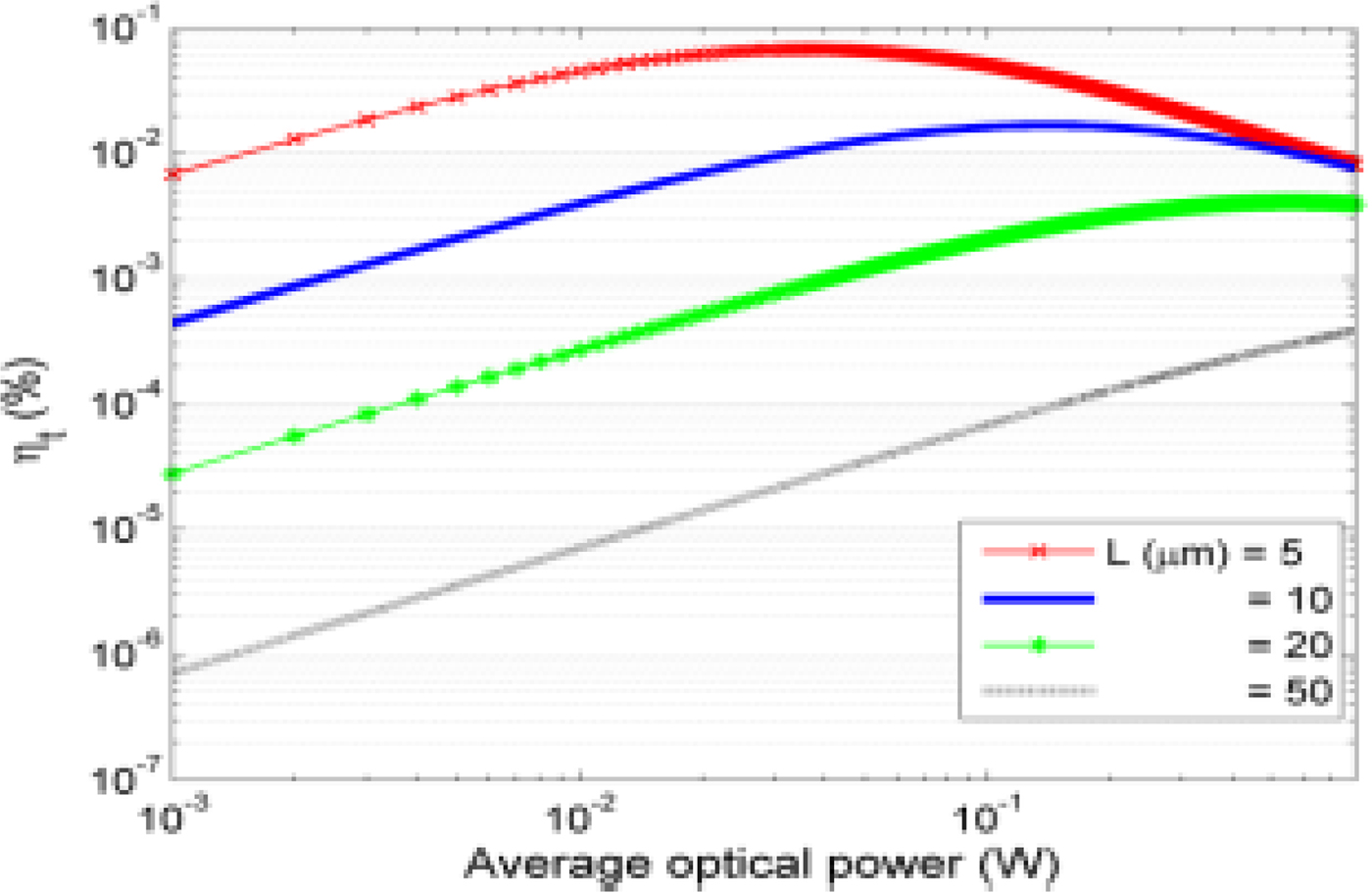
However, one of the major limiting factors of THz PCA technology is saturation at high optical pump powers. To overcome the saturation limits of PCAs, two different approaches can be used.
• Implementation of large device apertures.
• Implementation of interdigitated electrodes.
Although the initial work utilized large aperture PCAs to demonstrate THz beam steering [Reference Hu, Darrow, Zhang, Auston and Smith143], however, these devices have shown the improved power scaling due to the reduction of the saturation effect. The reason of reduced saturation effect in large aperture PCAs is that the electron-holes are not tightly located due to the large illuminated area. Figure 6 reveals that the maximum efficiency of the antenna with a smaller gap occurs at lower optical power levels. However, for large aperture dipoles, higher order of magnitude of the bias voltage is required [Reference Khiabani144]. The implementation of interdigitated electrodes can also overcome the saturation limits of THz PCAs by increasing the device active area [Reference Madeo, Jukam, Oustinov, Rosticher, Rungsawang, Tignon and Dhillon145]. Such configuration consists of a single anode and cathode wherein each electrode is connected to a number of open-ended parallel microstrips. These anode and cathode microstrips are interwoven, so the space between two adjacent anode microstrips is occupied by a cathode microstrip and vice-versa, with a fixed gap between the two electrodes. In [Reference Madeo, Jukam, Oustinov, Rosticher, Rungsawang, Tignon and Dhillon145], using this method, the active areas of 100 µm2 is produced which allows the optical power to spread over a larger area to reduce the saturation effect. Moreover, the use of such electrode configurations in THz PCAs technology also provides high optical-to-THz conversion efficiency even at high optical pump powers.
Dependency of peak optical-to-THz power conversion efficiency with different photoconductive gap-lengths [Reference Khiabani144].

The only limitation to such design is the increased fabrication complexity and the use of such electrodes makes it difficult to incorporate broadband antenna designs [Reference Hale, Madeo, Chin, Dhillon, Mangeney, Tignon and Dani146]. The spatial resolution in THz imaging is principally limited by the diffraction limit that is the function of wavelength and the numerical aperture of the optical system. To improve the aspects of PCA in terms of device performance, the use of gap-located nanostructures has been proposed by Park et al. [Reference Park, Jin, Ye and Jeong147] and Jooshesh et al. [Reference Jooshesh, Smith, Masnadi-Shirazi, Bahrami-Yekta, Tiedje, Darcie and Gordon148]. Such plasmonic nano-structured array could enable efficient absorption of photons with energy significantly below the bandgap of LT-GaAs. Moreover, when the nanostructures are included in PCA gap, the detectors showed an increase of 50% in detected photocurrent [Reference Mitrofanov, Brener, Luk and Reno149]. In addition to THz PCA with gap located nanostructures, the research is conducted on nano-structuring the antenna electrodes directly. In such configuration, the nano-structured regions are made electrically continuous with anode or cathode rather than being electrically isolated. By nano-structuring, the antenna electrodes, the effective area of the near-anode region can be increased so that the full area of the incident optical pump falls in the near-anode region. Moreover, with such technique the plasmonic resonances of the nanostructures can be tuned in such a way so as to concentrate the incident optical pump in the near-field region of the anode which increases the optical absorption inside the photoconductor near the anode [Reference Moon, Lee, Shin, Lee, Kim, Lee, Ko, Han and Park150]. In Table 3, the benefit and limitations of techniques applied to improve the performance of PCA for THz imaging applications are briefly mentioned for easy and quick comparison.
Techniques used to improve the performance parameters of PCA.

Various applications in THz imaging rely on either single plano-convex lens of a spherical shape or off-axial parabolic mirrors. The increase of numerical aperture for the single plano-convex lens of a spherical shape is inefficient which leads to a significant rise in aberrations. However, the off-axial parabolic mirrors have a good aberrational correction and high resolution but suffer from the overlapping of the incident and focused beams [Reference Lo and Leonhardt151]. The THz near-field microscopy is an alternative approach to overcome the diffraction limit. However, numerous disadvantages such as: (i) detection of light scattered on very small diaphragms or confined at a tip apex placed at the object plane requires powerful emitters and highly sensitive detectors; (ii) near-field imaging requires very short object distance, thus, the scanning probe may interact with the sample and even perturb its structure; and (iii) this technique requires a long scanning time, which is inherent to this approach and strongly limits its reliability [Reference Huber, Keilmann, Wittborn, Aizpurua and Hillenbrand152]. Chernomyrdin et al. [Reference Chernomyrdin, Frolov, Lebedev, Reshetov, Spektor, Tolstoguzov, Karasik, Khorokhorov, Koshelev, Schadko, Yurchenko and Zaytsev153] have introduced wide-aperture aspherical lens for high-resolution THz imaging using printed electronic circuit board containing sub-wavelength-scale elements. The concept of image contrast has been implemented to estimate image quality. The observed results of numerical simulations and experimental study show that lens allows resolving two points spaced at a 0.95λ distance with the contrast of 15%, justifying the high efficiency of the proposed lens design. However, using large apertures and lens-based systems results in the volumetric scale to the THz source and also presents challenges from a portability perspective.
The SNR improvement is another potential challenge being faced by THz imaging systems. This is inherently tied to the average power of the THz emitter. In the THz-TDS system, a high SNR can be achieved. However, in the imaging applications, a number of factors combine to dramatically reduce the SNR to the point where it becomes a matter of concern. A high power THz source will improve both the SNR and the dynamic range of imaging and sensing systems by increasing the penetration depth in the scattering or absorbing materials. Over the span of last few years, the THz power has been scaled up by using various methods. One simple method to increase the THz power is to use array configuration of the THz antenna [Reference Döhler, Garcia-Muñoz, Preu, Malzer, Bauerschmidt, Montero-de-Paz, Ugarte-Munoz, Rivera-Lavado, Gonzalez-Posadas and Segovia-Vargas154]. The periodic arrays of dipole electrodes are proposed for improving various aspects of THz PCA performance [Reference Singh and Prabhu155]. Each electrode is individually biased and the periodic array is illuminated with a train of femtosecond optical pulses. In such configuration, by controlling the bias of the individual electrodes, the direction and profile of the emitted THz pulses can be tuned which is favorable for sensing applications. Furthermore, the high-power THz PCA array promise to drastically reduce the data acquisition time at current SNR, which shows the possibility for real-time imaging of objects at the cost of increased optical alignment complexity. In the array arrangement of THz antennas, several types of illumination of the object with THz radiation under investigation are selected such as single frequency, multi-frequency or ultra wide band signals [Reference Camblor-Diaz, Ver-Hoeye, Vazquez-Antuna, Hotopan, Fernandez-Garcia and Las Heras Andres156]. For such arrangement, highly directive and optimum radiation efficiency from the radiating source is essential. Moreover, in the THz imaging applications to yield enhanced DoF for imaging purpose radiating source with the highly directive antenna is required. In general, when the THz source is used for short-range imaging, the millimeter wave systems have a narrow DoF. Consequently, in such case when an individual is moving through a corridor towards an imaging system then their hidden explosives is visible only for the brief moment while they are in the scanning range. However, such scanning over an extended volume could provide security such as in a public marketplace where the security is important but a visible display is not so much important. Therefore for such application of imaging, a compact array structure of THz antenna with a pulsed optical beam from femtosecond laser pulse can be used with highly directive ability of the radiating THz source. Moreover, the noise equivalent power (NEP) of an imaging array depends on the antenna efficiency. Therefore, it is essential that the high-efficiency on-chip antennas should be designed for a low system NEP. Various THz PCA configurations such as spiral type, bow-tie shape are used however the photoconductive dipole antenna is comparatively attractive as the small gap dipole antenna because of its ease of fabrication and are also useful for system-on-chip compatibility in spite of its poor directivity (6–7 dBi).
The use of metamaterials as superstrates for PCA antennas can help to achieve gain and directivity enhancement [Reference Liu, Lei, Shi and Li157]. The artificial electromagnetic materials such as electromagnetic bandgap structures, FSS (frequency-selective surface) [Reference Lee, Yeo, Mittra and Park158, Reference Foroozesh and Shafai159], and left-handed material [Reference Li, Wu and Liang160] are classified as metamaterials. Moreover, the use of planar periodic metallic arrays which behave as AMC surface can enhance the directivity of PCA array as they introduce a zero degrees reflection phase shift to incident waves [Reference Feresidis, Goussetis, Wang and Vardaxoglou161]. Furthermore, a fixed frequency electronic beam steering has a multitude of applications in the imaging system. To accomplish this capability one approach is to design a Fabry–Perot antennas which consist of a resonant Fabry–Perot cavity formed using partially reflective surface and high impedance surface [Reference Guzman-Quiros, Weily, Gomez-Tornero and Guo162]. Further, the on-chip antennas can be implemented with different radiation phenomena such as above-chip radiation, below-chip radiation, below-chip with a dielectric lens and above-chip with focusing techniques as discussed in [Reference Uzunkol, Gurbuz, Golcuk and Rebeiz163]. Uzunkol et al. [Reference Uzunkol, Gurbuz, Golcuk and Rebeiz163] have recommended the use of above-chip radiation from the THz array source due to the low-cost and most robust system as it operates with the low-cost carrier substrate. Moreover, the use of the THz system with above-chip also supports the small SWaP values of a THz source for imaging applications.
The THz source bandwidth is another potential challenge for the imaging system. Ideally, a THz imaging system would allow spectroscopic responses to be measured up in the IR region. This would enable to obtain a broader signature of the object in medical imaging and would also reduce the potential for water attenuation which falls significantly as the frequency increases. Typically, a conventional PCA sources are limited to frequencies below 5 THz. Although narrower pulse widths with a wider available bandwidth are available, high THz frequency losses in the PCA substrate often prevent the extension of bandwidths to higher frequencies using femtosecond excitation [Reference Berry, Hashemi and Jarrahi164]. As shown in Fig. 7, the propagation through the PCA with GaAs substrate has a detrimental effect on the THz bandwidth [Reference Hale, Madeo, Chin, Dhillon, Mangeney, Tignon and Dani146]. This absorption loss is a major limiting factor in the bandwidth of the emitted THz pulses and therefore the use of femtosecond optical pulse excitation in PCA technology does not significantly improve the bandwidth.
The FFT of amplitude as a function of frequency and shows a bandwidth approaching 20 THz [Reference Hale, Madeo, Chin, Dhillon, Mangeney, Tignon and Dani146].

However, the optical rectification does prove a wider bandwidth with demonstrated generation and detection bandwidths in excess of 30 THz which is at the cost of THz power and SNR. Therefore, by employing the established microwave engineering concepts, several research groups are working at implementing multi- and/or broadband dipole structures to improve the radiation efficiencies of the antenna at THz frequencies [Reference Ito, Yoshimatsu, Yamamoto and Ishibashi165, Reference Liu, Shou and Nahata166]. Such structures utilize THz frequency plasmon-polariton resonances along the periodic grooves to produce a narrow with almost two time's greater resonance peak at a single frequency as compared with conventional PCA structure [Reference Yang, Hashemi, Berry and Jarrahi167]. Moreover, the development of THz spectral library databases is something that is still in its infancy. This combined with lowering costs for THz sources and detectors, and faster systems should lead to the increased adoption of THz spectroscopy and imaging for several potential applications.
Conclusion and recommendation
The THz technologies are playing a major role in the field of homeland security, defense, and public health. Recently, the THz imaging applications have drawn significantly more interest with advancements in the imaging methods. The theoretical analysis continues to enable further applications to be investigated. However, the potential challenges in the present THz system include size, cost, output power, SNR, bandwidth, depth penetration, water sensitivity, spatial resolution, speed of data acquisition, and the lack of a THz-frequency knowledge base. The performance evaluation of the characteristic parameters related to the THz imaging system for the feasibility of real-time imaging system with PCA is briefed in Table 4. Even though in the THz imaging, a multi-pixel approach provides an acceleration of THz measurements and therefore it leads to developing attractive system architecture in future. However, severe problems in the alignment process are still a major concern which needs to be considered. Similarly, in the THz spectroscopy, there are the challenges for accumulating THz spectroscopic databases and make it available for processing at a faster rate. Also, the SNR in new THz devices, acquisition rates, and image resolution need to improve. Presently, the main focus is to miniaturize these systems and making them more convenient to use. One of such technique is the use of nanotechnology which helps to overcome the limitations of the feasibility of real-time THz imaging system with THz PCA. The use of quantum wells, quantum dots, and carbon nano-materials enabled high-performance THz sources and detectors which can satisfy the demand of THz imaging systems.
The performance evaluation of various characteristic parameters associated with the feasibility of real-time imaging system with PCA

The PCA being simple in fabrication is the extensively utilized THz source for the pulsed broadband system used in THz imaging and spectroscopy. However, there are certain modalities of improving the conventional THz PCA which are presented in this paper and show the potential for further improvement of THz-TDS systems used for imaging applications. Moreover, the well-designed sub-wavelength (micrometer/nanometer) scale structures show the potential for high output power generation and broadband THz pulse emission which will be useful for the the THz imaging system. The diffraction limit can also be overcome by the use of metamaterial biochips and nanotechnology-based contrast agents. Moreover, to avoid the range ambiguity resulting from the reduction of frequency samples, a random step frequency method can be employed to evaluate the rough range profile of the 3D surface layer. Further, the advancements in the area of THz antenna technology for imaging application will open a new avenue in the biomedical and security applications in the THz regime of the spectrum.
Acknowledgements
The authors are sincerely thankful to the anonymous reviewers for their critical comments and suggestions to improve the quality of the manuscript.
 Isha Malhotra received her B. Tech. (Honors) degree from Punjab Technical University, Jalandhar, Punjab, India in 2004 and M. Tech. in Electronics and Communication Engineering from the Department of Electronics and Communication Engineering, Guru Nanak Dev Engineering College, Ludhiana, Punjab, India in 2010. She had also worked as an Assistant Professor at Electronics and Communication Engineering Department, Chitkara University, Rajpura, Punjab, India. Currently, she is pursuing her Ph.D. degree from the Jaypee University of Information Technology, Waknaghat, Solan, India. Her area of research interests are THz imaging system, photoconductive dipole antenna, gain, and directivity enhancement of conventional THz antennas for imaging application, and frequency-selective surface.
 Kumud Ranjan Jha passed the Under-Graduation and Post-Graduation Examinations in the Electronics and Communication Engineering branch in 1999 and 2007, respectively. Since 2007, he is an Assistant Professor in Shri Mata Vaishno Devi University, Katra, Jammu and Kashmir, India, and before joining this University, he has served in the Indian Air Force. In 2012, he was awarded the Ph.D. degree from Jaypee University of Information Technology, Solan, Himachal Pradesh, India and subsequently, in the same year while working on the concept of the gain and directivity enhancement of the Planar Terahertz Antennas, he was awarded the Raman Fellowship for one year for the Post-Doctoral Study in the United States of America from the University Grant Commission, Government of India, New Delhi, India. He is also a visiting professor at San Diego State University, California, USA. He has published a number of peer-reviewed, research articles in the International Journals and Conferences. His area of research is Microwave/RF passive component design and Terahertz Electronics for the future wireless communication.
 Ghanshyam Singh received Ph.D. degree in Electronics Engineering from the Indian Institute of Technology, Banaras Hindu University, Varanasi, India, in 2000. He was associated with Central Electronics Engineering Research Institute, Pilani, and Institute for Plasma Research, Gandhinagar, India, respectively, where he was Research Scientist. He had also worked as an Assistant Professor at Electronics and Communication Engineering Department, Nirma University of Science and Technology, Ahmedabad, India. He was a Visiting Researcher at the Seoul National University, Seoul, South Korea. At present, he is Professor with the Department of Electronics and Communication Engineering, Jaypee University of Information Technology, Wakanaghat, Solan, India. He is an author/co-author of more than 250 scientific papers of the refereed Journal and International Conferences and four books published by Springer. His research and teaching interests include RF/Microwave Engineering, Millimeter/THz Wave Antennas and its Applications in Communication and Imaging, Next Generation Communication Systems (OFDM and Cognitive Radio), and Nanophotonics. He has more than 14 years of teaching and research experience in the area of Electromagnetic/Microwave Engineering, Wireless Communication and Nanophotonics. He has supervised various Ph. D. and M. Tech. theses. He has worked as a reviewer for several reputed Journals and Conferences.