Introduction
Atrial septal defect refers to openings between the atria other than the foramen ovale. The most common type is the secundum atrial septal defect, typically located in the central portion of the atrial septum. Atrial septal defect is often diagnosed incidentally during physical examination when a murmur is detected. Most patients are asymptomatic and may remain undiagnosed until adulthood.
Left-to-right shunting in atrial septal defect leads to volume overload of the right ventricle, which may result in complications such as atrial fibrillation, tricuspid regurgitation, pulmonary hypertension, and right heart failure. Surgical or percutaneous closure of the defect is recommended to prevent these adverse outcomes.
While percutaneous closure has become an option in recent years for anatomically suitable cases, surgical closure remains a standard treatment approach in both paediatric and adult patients.
In this study, we evaluated early postoperative echocardiographic findings (ejection fraction, tricuspid annular plane systolic excursion, pulmonary artery pressure, mitral regurgitation, tricuspid regurgitation) in 214 adult patients who underwent isolated atrial septal defect repair. We analysed these parameters in relation to age, with the aim of identifying which age groups benefit most from surgical intervention. Our goal was to provide data that could inform the timing of surgical repair in patients who are diagnosed at different stages of adulthood.
Materials and methods
This retrospective study included 214 patients aged 16 to 65 years who underwent surgical repair for isolated atrial septal defect between January 2014 and December 2024 at the Departments of Cardiovascular Surgery and Congenital Cardiac Surgery of Koşuyolu Training and Research Hospital, University of Health Sciences, Istanbul, Türkiye. Only patients with isolated atrial septal defects (without accompanying cardiac anomalies) were included in the study.
Patients were divided into five age groups in 10-year intervals (16–25, 26–35, 36–45, 46–55, and 56–65 years). Patient medical records and echocardiographic data were reviewed retrospectively. Ethical approval was obtained from the institutional ethics committee (2019 .7/24-240), and all procedures were conducted in accordance with the principles of the Declaration of Helsinki. Written and verbal informed consent was obtained from all patients and/or their legal guardians prior to surgery.
In male patients aged over 40 years and in post-menopausal female patients regardless of age, routine preoperative coronary angiography was performed, even if there were no ischaemic symptoms, in accordance with institutional protocol to exclude concomitant coronary artery disease. In selected patients with elevated pulmonary artery pressures on echocardiography or clinical suspicion of pulmonary vascular disease, right heart catheterisation was performed to measure pulmonary vascular resistance, Qp/Qs ratio, and right ventricular (RV) pressure. Surgical repair was deferred in cases with significantly elevated and fixed pulmonary vascular resistance. Therefore, the conclusion that older patients benefit less from atrial septal defect repair is supported by preoperative exclusion of irreversible pulmonary hypertension via catheter-based haemodynamic assessment in relevant cases.
All operations were performed under general anaesthesia via median sternotomy or right anterior thoracotomy. Following systemic heparinization, aortic and bicaval venous cannulation were performed, and cardiopulmonary bypass was initiated. Aortic cross-clamping and antegrade cold blood cardioplegia were used for myocardial protection. Surgeries were carried out under moderate hypothermia. After right atriotomy, the atrial septal defect was identified and closed either primarily or using a patch, depending on the size and type of the defect. Following atrial septal defect closure and right atriotomy repair, patients were rewarmed and weaned off cardiopulmonary bypass. The surgical procedure was completed with standard anatomical closure.
All echocardiographic assessments were performed by experienced cardiologists using standardised transthoracic echocardiography protocols with GE Vivid series devices. Tricuspid regurgitation and mitral regurgitation were graded semi-quantitatively based on jet area, vena contracta width, and flow convergence in accordance with current echocardiographic guidelines. Pulmonary artery pressure was estimated from the peak velocity of the tricuspid regurgitation jet using the modified Bernoulli equation and adding estimated right atrial pressure. Tricuspid annular plane systolic excursion was measured in the apical four-chamber view using M-mode, with the cursor aligned along the lateral tricuspid annulus. No concomitant tricuspid annuloplasty or mitral valve intervention was performed in any patient, as none exhibited moderate or severe valvular pathology that required surgical correction.
Tricuspid and mitral regurgitation were graded semi-quantitatively on transthoracic echocardiography by experienced cardiologists using an ordinal scoring system aligned with international guidelines. Specifically, tricuspid regurgitation severity was categorised as: 1 = trace (physiological), 2 = mild, 3 = moderate, and 4 = severe. This grading was based on an integrative assessment including vena contracta width, jet area relative to the right atrium, hepatic vein flow pattern, and systolic flow reversal when present. Although categorical grades were assigned, mean ± standard deviation values were used in statistical tables to allow for parametric comparisons across groups and time points. This semi-quantitative approach has been validated and widely applied in both clinical and research settings. Reference Zoghbi, Adams and Bonow10 Patients who required intraoperative tricuspid valve intervention, including those with significant annular dilatation or moderate-to-severe tricuspid regurgitation necessitating annuloplasty, were excluded from the study. The aim was to evaluate the natural postoperative course of tricuspid regurgitation after isolated atrial septal defect closure without the confounding effect of concomitant tricuspid valve surgery. Therefore, only patients with mild or functionally moderate tricuspid regurgitation without structural valve abnormalities or annular dilatation were included in the analysis. Reference Murphy, Gersh, Sandberg, Clair, Kurland and Ilstrup11
To evaluate the relationship between age and early postoperative changes in cardiac function, transthoracic echocardiographic measurements were recorded at three time points: preoperatively, and at 1 and 6 months postoperatively. The following parameters were analysed:
-
• Tricuspid regurgitation (TR)
-
• Pulmonary artery pressure (PAP)
-
• Mitral regurgitation (MR)
-
• Left ventricular ejection fraction (LVEF)
-
• Tricuspid annular plane systolic excursion (TAPSE)
Statistical analysis
All statistical analyses were conducted using IBM SPSS Statistics version 25.0 (IBM Corp., Armonk, NY, USA). Descriptive statistics were expressed as mean ± standard deviation (SD) or median (minimum–maximum) for continuous variables, and as frequency and percentage for categorical variables. The normality of continuous variables was tested using the Shapiro–Wilk test.
To evaluate whether there were statistically significant differences between the five age groups (16–25, 26–35, 36–45, 46–55, and 56–65 years) at three time points (preoperative, postoperative 1st month, and postoperative 6th month), a two-way repeated measures ANOVA test was used.
When the assumption of sphericity was violated according to Mauchly’s test, the Greenhouse-Geisser correction was applied to adjust the degrees of freedom. The differences were examined both across time points and between age groups.
For post-hoc analysis in groups with unequal variances, Dunnett’s T3 test was employed to determine which specific age groups were responsible for the observed differences. A p-value less than 0.05 was considered statistically significant. All statistical analyses were reviewed and confirmed by a professional biostatistician.
Results
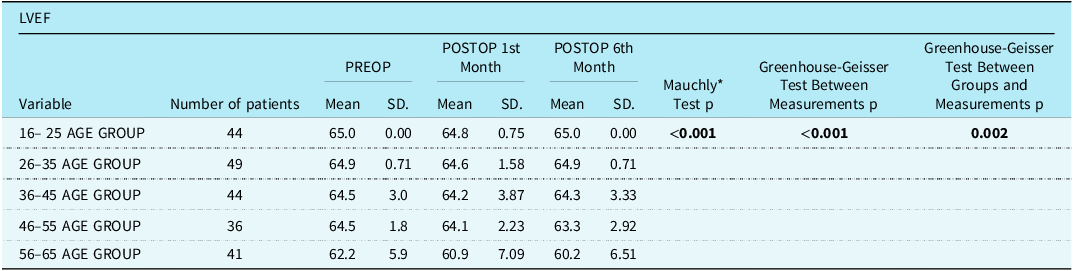
To evaluate changes in left ventricular ejection fraction over time and across age groups, a two-way repeated measures ANOVA was performed. Patients were categorised into five age groups: 16–25, 26–35, 36–45, 46–55, and 56–65 years. Left ventricular ejection fraction was measured at three time points: preoperatively, at 1 month, and at 6 months postoperatively (Table 1).
According to Mauchly’s test, the assumption of sphericity was violated (p < 0.001), and thus, the Greenhouse-Geisser correction was applied. The test showed a significant difference both across time points (p < 0.001) and between age groups over time (p = 0.002).
Pairwise comparisons revealed that the significant change in left ventricular ejection fraction occurred between the preoperative and postoperative 1st month measurements (p = 0.006), while the difference between the 1st and 6th month was not statistically significant (p = 0.093) (Table 2).
When analysed by age groups, the only statistically significant decrease in left ventricular ejection fraction was observed in the 56–65 age group during the postoperative period (p = 0.028 between postoperative 1st and 6th month). No significant left ventricular ejection fraction change was detected in younger age groups (Figure 1).
A post-hoc Dunnett’s T3 test identified the 56–65 age group as the primary contributor to the overall ejection fraction decline. This finding suggests that patients in older age groups may experience a postoperative reduction in left ventricular function, possibly due to age-related myocardial vulnerability.
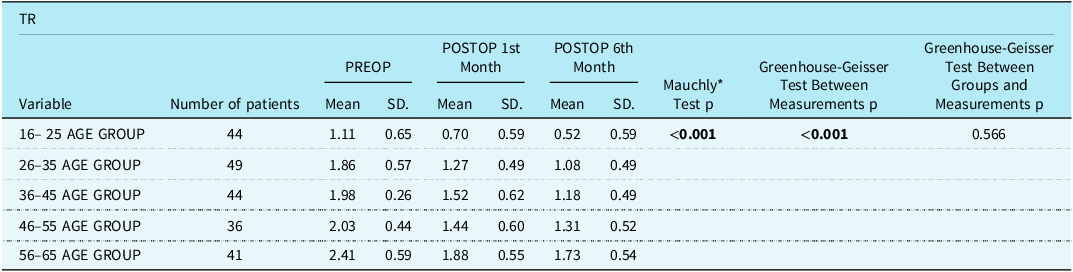
Tricuspid regurgitation (TR) severity was evaluated preoperatively and at 1 and 6 months postoperatively across five age groups using two-way repeated measures ANOVA. Mauchly’s test indicated a violation of sphericity (p < 0.001), and the Greenhouse-Geisser correction was applied (Table 3).
A statistically significant reduction in tricuspid regurgitation severity was observed across all patients between the three time points (p < 0.001). Pairwise comparisons showed that this decrease was significant between the preoperative and postoperative 1st month (p < 0.001), and between the postoperative 1st and 6th months (p < 0.001) (Table 4).
When evaluated by age group, although preoperative tricuspid regurgitation severity increased proportionally with age, the Greenhouse-Geisser test revealed no statistically significant interaction between age group and time (p = 0.566). This suggests that the postoperative improvement in tricuspid regurgitation was consistent across all age groups (Figure 2).
The postoperative decrease in tricuspid regurgitation severity reflects a reduction in right ventricular volume overload after atrial septal defect closure, supporting the effectiveness of surgical repair in relieving right-sided pressure.
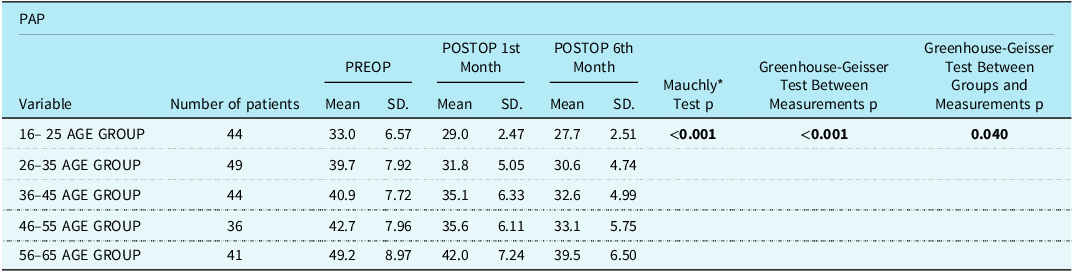
Pulmonary artery pressure was measured preoperatively and at 1 and 6 months postoperatively across five age groups. A two-way repeated measures ANOVA was performed. Mauchly’s test showed a violation of the sphericity assumption (p < 0.001), and the Greenhouse-Geisser correction was applied (Table 5).
There was a statistically significant reduction in pulmonary artery pressure across all time points (p < 0.001), and a significant interaction between time and age group (p = 0.040). Pairwise comparisons indicated that the changes were significant both between the preoperative and postoperative 1st month (p < 0.001) and between the 1st and 6th month (p < 0.001) (Table 6).
The highest preoperative mean pulmonary artery pressure was observed in the 56–65 age group (49.2 mmHg), while the lowest was in the 16–25 age group (33.0 mmHg). Postoperative decreases in pulmonary artery pressure were seen in all groups, with the most pronounced reductions in the youngest (16–25) and oldest (56–65) age groups (Figure 3).
This pattern suggests two phenomena:
-
1. In younger patients, early repair may prevent the development of fixed pulmonary vascular resistance.
-
2. In older patients, despite higher preoperative pulmonary artery pressure values, a measurable reduction can still occur, especially in those without advanced pulmonary vascular disease.
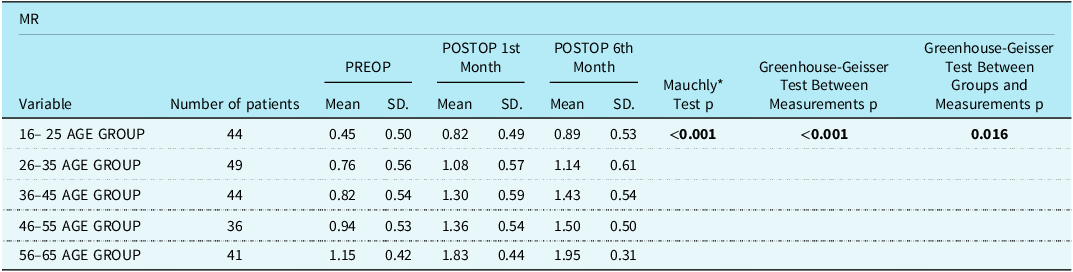
Mitral regurgitation was evaluated preoperatively and at 1 and 6 months postoperatively across five age groups using two-way repeated measures ANOVA. Mauchly’s test revealed a violation of sphericity (p < 0.001), and the Greenhouse-Geisser correction was applied (Table 7).
Statistically significant changes in mitral regurgitation were observed over time (p < 0.001), and a significant interaction between age group and time was also detected (p = 0.016). Pairwise comparisons revealed that mitral regurgitation increased significantly between the preoperative and postoperative 1st month (p < 0.001), and between the 1st and 6th month (p < 0.001) (Table 8).
Although all age groups experienced an increase in mitral regurgitation severity postoperatively, no patient developed moderate or severe mitral regurgitation. When assessed by age group, the greatest increases were observed in the 16–25 and 56–65 age groups. Post-hoc analysis with Dunnett’s T3 test confirmed these two groups as the main contributors to the overall variation (Figure 4).
In young patients, this increase may be due to high left-to-right shunt volumes prior to surgery, leading to an abrupt increase in left-sided preload post-closure. In older patients, the postoperative increase in mitral regurgitation may reflect the exacerbation of pre-existing mild regurgitation due to altered ventricular compliance or valve structure.
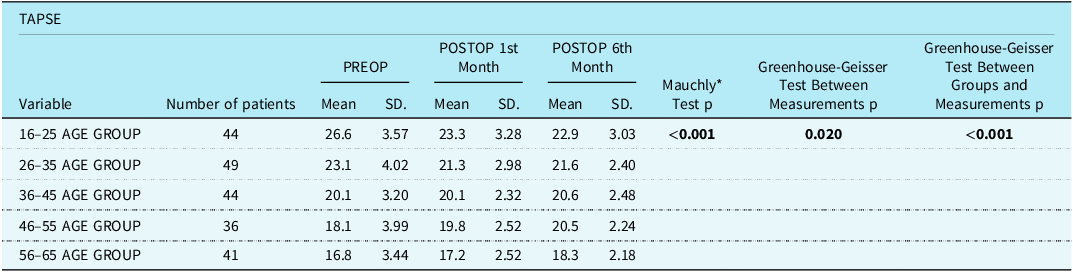
Tricuspid annular plane systolic excursion was measured to assess right ventricular systolic function at three time points: preoperatively, and at 1 and 6 months postoperatively. A two-way repeated measures ANOVA was conducted across five age groups. Mauchly’s test indicated a violation of the sphericity assumption (p < 0.001), and the Greenhouse-Geisser correction was applied (Table 9).
There was a statistically significant change in tricuspid annular plane systolic excursion over time (p = 0.020) and a highly significant interaction between time and age group (p < 0.001). Pairwise comparisons demonstrated that the differences were significant both between the preoperative and postoperative 1st month (p = 0.013), and between the 1st and 6th month (p = 0.001) (Table 10).
Preoperatively, tricuspid annular plane systolic excursion values were inversely proportional to age:
-
• 26.6 mm in the 16–25 age group
-
• 23.1 mm in the 26–35 group
-
• 20.1 mm in the 36–45 group
-
• 18.1 mm in the 46–55 group
-
• 16.8 mm in the 56–65 group
Postoperatively, tricuspid annular plane systolic excursion decreased in the 16–25 and 26–35 age groups, possibly reflecting a normalisation of elevated right ventricular output following shunt closure. In contrast, tricuspid annular plane systolic excursion increased in the 46–55 and 56–65 age groups, indicating functional recovery of the right ventricle due to the relief of chronic volume overload. No significant change was observed in the 36–45 age group (Figure 5).
Post-hoc analysis showed that all age groups exhibited significantly different tricuspid annular plane systolic excursion trajectories over time, with each group contributing uniquely to the overall variation.
Discussion
Atrial septal defects, excluding patent foramen ovale, represent common interatrial communications and are categorised anatomically into secundum, primum, sinus venosus, and coronary sinus types. Among these, secundum atrial septal defect is the most frequent, often remaining asymptomatic until adulthood. Its prolonged haemodynamic burden results in complications such as right ventricular dilation, tricuspid regurgitation, pulmonary hypertension, and atrial arrhythmias, which become more prevalent with advancing age. In this study, we evaluated age-related changes in cardiac function after surgical atrial septal defect repair by analysing serial echocardiographic parameters at three time points (preoperatively, postoperative 1st and 6th month) in 214 adult patients.
Left ventricular ejection fraction (LVEF)
Preoperative left ventricular ejection fraction was comparable across all age groups. However, a statistically significant decline in left ventricular ejection fraction was observed exclusively in the 56–65 age group during follow-up. This deterioration may reflect age-associated myocardial stiffness and reduced compliance, possibly exacerbated by cardiopulmonary bypass-related myocardial stress and impaired perioperative ventricular adaptation in older patients. Reference Sandeep Kumar1,Reference Jani, Verma, Nishtala and Gaur8 These findings underscore the vulnerability of the ageing myocardium to volume and pressure shifts following atrial septal defect closure.
Tricuspid regurgitation (TR)
Preoperative tricuspid regurgitation severity increased proportionally with age, likely due to longstanding right ventricular volume overload. Postoperatively, tricuspid regurgitation severity decreased significantly across all age groups, consistent with unloading of the right heart after atrial septal defect repair. Reference Martin-Garcia, Dimopoulos and Boutsikou2 Notably, although improvement in tricuspid regurgitation was uniform, the role of pharmacological support (e.g., ACE inhibitors or ARBs) must be considered. In our cohort, such medications were not routinely prescribed but used selectively, suggesting that the observed tricuspid regurgitation remodelling primarily reflects anatomical correction rather than pharmacologic modulation. Reference D’Andrea, Scara, Riegler, Salerno, Cocchia and Vriz9
Pulmonary artery pressure (PAP)
Baseline pulmonary artery pressure was highest in the 56–65 age group and lowest in the 16–25 age group. Significant reductions in pulmonary artery pressure were seen postoperatively across all ages, with the most marked improvements in the youngest and oldest cohorts. This pattern may indicate early pulmonary vascular recovery in younger patients and a measurable but possibly incomplete response in older individuals without fixed pulmonary vascular disease. Reference Martin-Garcia, Dimopoulos and Boutsikou2,Reference Gatzoulois, Redington, Somnerville and Shore3
Mitral regurgitation (MR)
A slight but statistically significant increase in mitral regurgitation severity was noted postoperatively in all groups. Importantly, none of the patients developed moderate or severe mitral regurgitation. The increase was most pronounced in the 16–25 and 56–65 age groups. In younger patients, abrupt left-sided volume loading after atrial septal defect closure may transiently disrupt mitral valve competence. In elderly patients, this may represent unmasking of pre-existing mild regurgitation due to altered ventricular compliance or annular geometry. Reference Jeong-Jun, Seung Chul and Joon Bum4,Reference Felt, Edwards, Porter, Allen, Gutgesell, Clark and Driscoll5
Right ventricular function – TAPSE
Tricuspid annular plane systolic excursion measurements, reflecting right ventricular systolic performance, were highest in younger patients preoperatively and declined slightly after surgery, likely due to normalisation of right ventricular motion following volume unloading. In contrast, older patients demonstrated a modest but statistically significant postoperative improvement in tricuspid annular plane systolic excursion, suggesting partial recovery of right ventricular contractile function after chronic volume overload relief. Reference Sandeep Kumar6,Reference Lang, Badano and Mor-Avi12 Nonetheless, tricuspid annular plane systolic excursion values in the older groups remained within the borderline range, raising concerns for subclinical right ventricular dysfunction despite anatomical correction. This blunted response may result from age-related myocardial fibrosis, reduced compliance, and limited contractile reserve. Reference Guazzi, Bandera, Pelissero, Castelvecchio, Menicanti and Ghio13 Thus, tricuspid annular plane systolic excursion appears to behave as both a functional biomarker and an age-sensitive prognostic indicator after atrial septal defect closure.
Study limitations and future directions
One limitation of our study is the absence of right ventricular dimensions (RVEDD, RVESD), which are key indicators of reverse remodelling. Previous echocardiographic and CMR studies have demonstrated that significant reductions in these parameters may occur post-atrial septal defect closure, aiding in assessment of right ventricular structural adaptation. Reference Liang, Shi, Du, Zhang, Ma and Wang7 Additionally, the observed left ventricular ejection fraction decline in elderly patients calls for further mechanistic studies to explore age-related myocardial remodelling, possibly using advanced imaging or tissue characterisation.
Conclusion
Atrial septal defect is the second most common CHD. If left untreated in adulthood, it may lead to complications such as pulmonary hypertension, atrial fibrillation, and paradoxical embolism. Despite advancements in percutaneous techniques, surgical repair remains essential in both paediatric and adult populations.
As age increases, the incidence of atrial septal defect-related complications rises and the benefits of surgical repair diminish. Early surgical correction is crucial to preserve right ventricular function and prevent pulmonary vascular disease.
Patients who undergo repair at a younger age benefit more significantly than those treated later in life.
Distribution of EF measurements by age groups.

Distribution of TR measurements by age groups.

Distribution of PAP measurements by age groups.

Distribution of MR measurements by age groups.

Distribution of TAPSE measurements by age groups.

Mean Ejection Fraction (LVEF) by Age Group and Time Point

* Mauchly’s Test: Test of sphericity.**Greenhouse-Geisser Test Between Measurements: Evaluates differences among repeated measures within subjects. ***Greenhouse-Geisser Test Between Groups and Measurements: Evaluates interaction between age groups and time-based measurements.
Pairwise comparisons of EF by age and time

Mean tricuspid regurgitation (TR) by age group and time point

* Mauchly’s Test: Test of sphericity.**Greenhouse-Geisser Test Between Measurements: Evaluates differences among repeated measures within subjects. ***Greenhouse-Geisser Test Between Groups and Measurements: Evaluates interaction between age groups and time-based measurements.
Pairwise comparisons of TR by age and time

Mean pulmonary artery pressure (PAP) by age group and time point

* Mauchly’s Test: Test of sphericity. **Greenhouse-Geisser Test Between Measurements: Evaluates differences among repeated measures within subjects. ***Greenhouse-Geisser Test Between Groups and Measurements: Evaluates interaction between age groups and time-based measurements.
Pairwise comparisons of PAP by age and time

Mean mitral regurgitation (MR) by age group and time point

* Mauchly’s Test: Test of sphericity. **Greenhouse-Geisser Test Between Measurements: Evaluates differences among repeated measures within subjects. ***Greenhouse-Geisser Test Between Groups and Measurements: Evaluates interaction between age groups and time-based measurements.
Pairwise comparisons of MR by age and time

Mean TAPSE by age group and time point

* Mauchly’s Test: Test of sphericity. **Greenhouse-Geisser Test Between Measurements: Evaluates differences among repeated measures within subjects. ***Greenhouse-Geisser Test Between Groups and Measurements: Evaluates interaction between age groups and time-based measurements.
Pairwise comparisons of TAPSE by age and time