Introduction
Several magnetic resonance imaging (MRI) studies have reported that subjects with first-episode psychosis (FEP) display progressive brain morphological abnormalities during the first years after illness onset, particularly regional grey matter (GM) volume reduction and lateral ventricle (LV) enlargement (Kempton et al. Reference Kempton, Stahl, Williams and DeLisi2010; Olabi et al. Reference Olabi, Ellison-Wright, McIntosh, Wood, Bullmore and Lawrie2011). However, there is considerable dispute as to whether such progressive brain changes are invariably present (Zipursky et al. Reference Zipursky, Reilly and Murray2012), or are driven by specific factors such as unfavourable illness outcome (van Haren et al. Reference van Haren, Hulshoff Pol, Schnack, Cahn, Brans, Carati, Rais and Kahn2008, Reference van Haren, Schnack, Cahn, van den Heuvel, Lepage, Collins, Evans, Hulshoff Pol and Kahn2011), continued use of antipsychotic (AP) medication (Smieskova et al. Reference Smieskova, Fusar-Poli, Allen, Bendfeldt, Stieglitz, Drewe, Radue, McGuire, Riecher-Rössler and Borgwardt2009; Moncrieff & Leo, Reference Moncrieff and Leo2010; Ho et al. Reference Ho, Andreasen, Ziebell, Pierson and Magnotta2011) or co-morbid substance misuse (Rais et al. Reference Rais, Cahn, van Haren, Schnack, Caspers, Hulshoff Pol and Kahn2008; van Haren et al. Reference van Haren, Koolschijn, Cahn, Schnack, Hulshoff Pol and Kahn2010). In addition, it is unclear whether any progressive brain volume changes in FEP are specific to first-episode schizophrenia-spectrum psychoses (FESZ) as there have been fewer MRI studies of first-episode affective psychoses (FEAP) and the results have been mixed (Lim et al. Reference Lim, Baldessarini, Vieta, Yucel, Bora and Sim2013).
We previously reported findings of GM volume deficits and LV enlargement in a large population-based sample of FEP subjects compared to unaffected controls from the same neighbourhood (Schaufelberger et al. Reference Schaufelberger, Duran, Lappin, Scazufca, Amaro, Leite, de Castro, Murray, McGuire, Menezes and Busatto2007; Rosa et al. Reference Rosa, Schaufelberger, Uchida, Duran, Lappin, Menezes, Scazufca, McGuire, Murray and Busatto2010). We also followed up a representative subsample of that cohort (39 FESZ subjects and 52 controls) over a relatively short mean period of time (15 months), and found no evidence of progression of such brain changes. Instead, among patients with a remitting course of illness, we found a pattern of increase in GM in some of the brain regions where volume reductions had been found at baseline (Schaufelberger et al. Reference Schaufelberger, Lappin, Duran, Rosa, Uchida, Santos, Murray, McGuire, Scazufca, Menezes and Busatto2011).
In the current MRI study we examined regional GM changes after a longer (5-year) follow-up period in a subset of the above groups of subjects with FESZ (n = 32), FEAP (n = 24) and controls (n = 34). We used voxel-based morphometry (VBM), an automated method for image processing and statistical analysis that allows voxel-by-voxel comparisons of regional brain tissue density or volume with high reproducibility (Busatto et al. Reference Busatto, Dini and Zanetti2008), using the Statistical Parametric Mapping package SPM2 (Wellcome Department of Imaging Neuroscience, UK). We used both whole-brain and small volume correction (SVC) statistical approaches to investigate GM longitudinal changes across diagnostic and outcome categories, and also to determine whether these brain changes would have been influenced by AP use.
Method
Participants
The cases for the present study were selected from a sample of 200 FEP subjects who took part in a population-based incidence and case–control study conducted in São Paulo, Brazil (Menezes et al. Reference Menezes, Scazufca, Busatto, Coutinho, McGuire and Murray2007). Cases were identified by active surveillance of all people who made contact for the first time with local health services (from a predefined geographical area) due to psychotic symptoms, regardless of their severity (both out-patients and in-patients were recruited), duration of illness or compliance to treatment. Inclusion criteria for patients at baseline were age 18–50 years and a diagnosis of psychotic disorders according to DSM-IV-TR criteria (APA, 2000). Patients with psychosis due to a medical condition and substance-induced psychosis were not included. At both time points, exclusion criteria for patients and controls were: a history of head injury with loss of consciousness, neurological disorders, moderate or severe mental retardation and contraindications for MRI scanning. Controls were also excluded if they fulfilled criteria for current or lifetime psychotic or mood disorders.
In the baseline investigation, MRI data were acquired from 69 subjects with FESZ (47 subjects with schizophrenia, 15 with schizophreniform disorder and seven with schizo-affective disorder), 46 subjects with FEAP (26 with psychotic bipolar disorder and 20 with psychotic unipolar depression) and were compared to data from 94 controls.
The present longitudinal investigation was performed 5 years (s.d. = 10 months) after the initial baseline analysis, and 32 FESZ subjects, 24 FEAP subjects and 34 controls were re-evaluated and included in the present analysis (see online Supplementary Material for a full description on data attrition). All subjects were interviewed using the Structured Clinical Interview for DSM-IV (SCID; First et al. Reference First, Spitzer, Gibbon and Williams2002) at both baseline and follow-up.
Local ethics committees approved this investigation and all subjects gave their signed informed consent before entering the study.
Clinical assessment
Clinical symptoms were assessed using the Positive and Negative Syndrome Scale (PANSS; Kay et al. Reference Kay, Fiszbein and Opler1987). Diagnosis of substance abuse and dependence was assessed using the SCID. Functional outcome was investigated for both patients and controls at the 5-year follow-up with the Global Assessment of Functioning (GAF) scale (APA, 2000). Additionally, patients were categorized into remitting or non-remitting courses during the follow-up according to the DSM-IV course specifiers, assessed with the SCID: remitting course meaning a single psychotic episode in full remission, without new psychotic or mood episodes during the follow-up; and a non-remitting course meaning the presence of either continuous or episodic (mood or psychotic) symptoms, or residual/negative symptoms.
To investigate the effects of AP treatment on longitudinal GM changes in the FESZ group, FESZ patients were divided into two groups based on AP use during the follow-up period: patients who had been on continuous and regular treatment during follow-up (AP subgroup, n = 18); and those who had quit treatment after the baseline evaluation and had been AP free for at least 3 months at the time of the 5-year follow-up assessment (non-AP subgroup; NAP, n = 14). We also calculated the total duration of exposure to AP between MRI examinations (in days). Specific data on AP dosing regimens over the 5 years were not available because of the naturalistic design of this study.
MRI acquisition and processing
Imaging data were acquired both at baseline and at follow-up using two identical 1.5-T MRI scanners (GE Signa, General Electric, USA). The same acquisition protocol was used for all scans: a T1 spoiled gradient recall (SPGR) sequence providing 124 contiguous slices, voxel size = 0.86 × 0.86 × 1 mm, echo time = 5.2 ms, repetition time = 21.7 ms, flip angle = 20o, field of view = 22 cm, matrix size = 256 × 192 mm. Because images were acquired using two MRI scanners, a reliability measure was obtained, as described previously (Schaufelberger et al. Reference Schaufelberger, Duran, Lappin, Scazufca, Amaro, Leite, de Castro, Murray, McGuire, Menezes and Busatto2007): in brief, six healthy volunteers were scanned twice in each scanner, and intraclass correlation coefficients (ICCs) obtained were higher than 0.9 for the neocortical and medial temporal regions (see the online Supplementary Material for details).
The VBM analyses were performed using the SPM2 package, executed in Matlab (Mathworks, USA). A standard template set was created specifically for this study, including both baseline and follow-up datasets for each subject, as performed previously for the 15-month follow-up investigation (Schaufelberger et al. Reference Schaufelberger, Lappin, Duran, Rosa, Uchida, Santos, Murray, McGuire, Scazufca, Menezes and Busatto2011). Subsequently, each follow-up image was co-registered to its baseline image and processed according to the SPM2 optimized VBM protocol (Good et al. Reference Good, Johnsrude, Ashburner, Henson, Friston and Frackowiak2001; Schaufelberger et al. Reference Schaufelberger, Duran, Lappin, Scazufca, Amaro, Leite, de Castro, Murray, McGuire, Menezes and Busatto2007).
Statistical analyses
The statistics for each voxel of the whole GM compartment were transformed to Z scores and displayed as statistical parametric maps (SPMs) in standard space at an initial threshold probability of Z > 3.09 (p < 0.001, uncorrected). The total amount of GM (given by the sum of voxels within the whole GM compartment of each subject) and the interval between scans were entered as covariates in all SPM analyses. When groups differed in gender distribution, this variable was also included as a covariate. A repeated-measures analysis of covariance (ANCOVA) was used for the following comparisons on longitudinal GM volume change: (a) FESZ versus FEAP versus controls, (b) remitted FESZ versus non-remitted FESZ patients versus controls, (c) remitted FEAP versus non-remitted FEAP patients versus controls, (d) non-remitted FESZ versus non-remitted FEAP (see Supplementary Material) and (e) AP-FESZ versus NAP-FESZ versus controls. Post-hoc evaluation of significant between-group differences was then performed with secondary two-tailed t tests.
Initially, hypothesis-driven region of interest (ROI) comparisons were conducted with the SVC tool using the following brain masks: frontal lobes, superior temporal cortices, hippocampus and insula. This aimed to restrict the SPM analyses to specific brain regions where abnormalities have consistently been associated with psychosis (DeLisi, Reference DeLisi2008; Olabi et al. Reference Olabi, Ellison-Wright, McIntosh, Wood, Bullmore and Lawrie2011). We reported significant clusters of voxels that survived family-wise error (FWE) correction for multiple comparisons (p < 0.05) over the specific region. Subsequently, we conducted exploratory between-group GM whole-brain comparisons and report those resulting clusters with peak voxel surviving FWE correction (p < 0.05) over the entire brain. In all analyses, Montreal Neurological Institute (MNI) coordinates from voxels of maximal statistical significance were converted to the Talairach and Tournoux system (Lacadie et al. Reference Lacadie, Fulbright, Rajeevan, Constable and Papademetris2008).
To assess specific effects of outcome on brain changes independently of AP intake or sociodemographic and clinical characteristics, a regression analysis was performed using the general linear model. In this analysis, the GM peak change between scans for each subject (values extracted from the coordinate of maximal statistical significance within each cluster, corrected for the total GM) served as the dependent variable. Age, interval between scans (in months) and AP exposure (total number of days of AP use during the follow-up) were entered as covariates and gender, diagnosis (when the analysis included subjects from both FESZ and FEAP groups), substance misuse and clinical course were entered as fixed factors.
Results
Sociodemographic and clinical characteristics
From the initial sample of 122 patients and 94 controls who participated in the baseline MRI study, 60 patients [32 from the FESZ group (22 with schizophrenia, four with schizophreniform disorder and six with schizo-affective disorder), 24 from the FEAP group (16 with bipolar disorder and eight with unipolar depression, all with psychotic features at baseline) and four with other diagnoses (brief psychosis or delusional disorder)] and 34 controls were rescanned for the 5-year follow-up. The four patients with other diagnoses were not included in the current study. Details regarding data attrition and diagnostic stability are available in the Supplementary Material. There were no significant differences between the subjects who participated in this follow-up investigation (both cases and controls) and those who underwent only the baseline MRI examination in terms of their sociodemographic and clinical characteristics (data not shown).
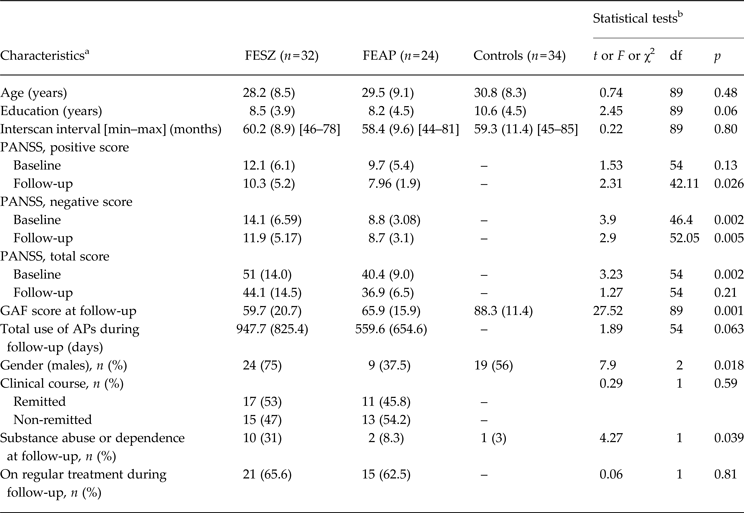
Sociodemographic/clinical data for FESZ, FEAP and controls are displayed in Table 1. Groups did not differ with regard to age and interscan interval. Nevertheless, these groups had different gender distributions and tended to differ regarding years of education (p = 0.06). In addition, as expected, controls had better GAF scores at the follow-up than FESZ and FEAP subjects (both p < 0.0001) whereas FESZ and FEAP groups did not differ in terms of GAF scores at follow-up (p = 0.251). Moreover, FESZ subjects showed significantly higher frequencies of substance abuse and dependence and higher PANSS scores (positive and total scales at follow-up, and negative scores at both baseline and follow-up) than FEAP patients.
Sociodemographic and clinical characteristics of subjects who completed the 5-year follow-up MRI study

MRI, Magnetic resonance imaging; FESZ, first-episode schizophrenia-spectrum psychosis; FEAP, first-episode affective psychosis; df, degrees of freedom; PANSS, Positive and Negative Syndrome Scale; GAF, Global Assessment of Functioning; AP, antipsychotic.
a Continuous variables are expressed as mean (standard deviation), categorical variables as frequency (percentage).
b Continuous variables were analysed with the t test for two samples and with an analysis of variance (ANOVA) for three groups. Categorical variables were analysed with Pearson's χ2 test (and with Fisher's exact test when necessary).
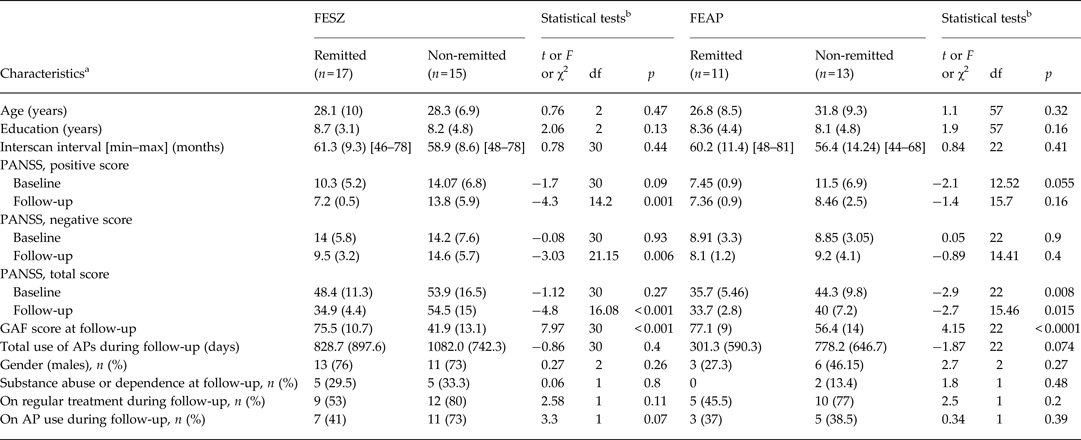
Sociodemographic/clinical data for the remitting and non-remitting subgroups are given in Table 2. Seventeen FESZ subjects and 11 FEAP participants were categorized as fully remitted. Remitted (n = 17) and non-remitted (n = 15) FESZ patients were not different in terms of sociodemographic characteristics, interscan interval, substance misuse or exposure to AP but they differed with regard to follow-up PANSS and GAF scores. Remitted (n = 11) and non-remitted (n = 13) FEAP patients differed in baseline and follow-up total PANSS and GAF scores. Controls had better GAF scores than all subgroups of patients. Further details are available in Table 2 and in the Supplementary Material (Table 5 and text).
Sociodemographic and clinical characteristics of patients according to remission status

FESZ, First-episode schizophrenia-spectrum psychosis; FEAP, first-episode affective psychosis; df, degrees of freedom; PANSS, Positive and Negative Syndrome Scale; GAF, Global Assessment of Functioning; AP, antipsychotic.
a Continuous variables are expressed as mean (standard deviation), categorical variables as frequency (percentage). Data from controls are displayed in Table 1.
b Continuous variables were analysed with the t test for two samples and with an analysis of variance (ANOVA) for three groups (including controls in age and education analyses). Categorical variables were analysed with Pearson's χ2 test (or with Fisher's exact test when necessary), including controls in gender distribution and substance abuse or dependence at follow-up analyses.
Between-group GM volume change over time: FESZ versus FEAP versus controls
When the total diagnostic groups (FESZ and FEAP) were compared to each other and to controls, no significant differences in GM volume change over time were observed in either the hypothesis-driven SVC analyses or the exploratory whole-brain voxel-wise comparisons. This pattern of results did not change when subjects with schizo-affective disorder (n = 6) were excluded from the FESZ group or when subjects with schizophrenia/schizophreniform disorder (n = 26) were compared to those with a history of affective episodes (schizo-affective disorder, psychotic bipolar disorder or psychotic unipolar disorder; n = 30) and to controls.
Clinical course effects on longitudinal GM changes in FESZ patients
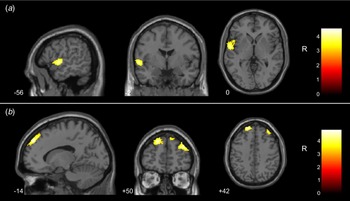
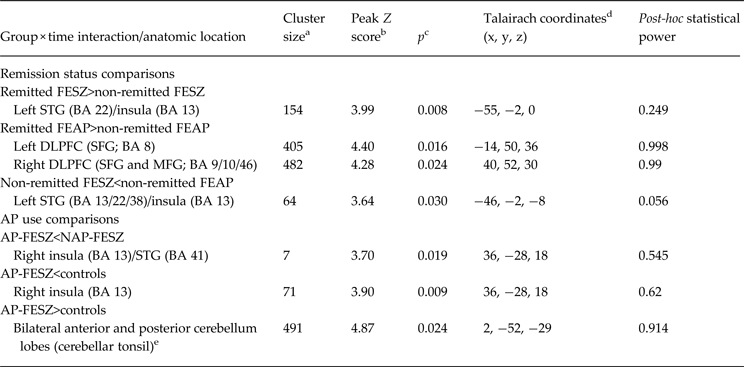
Significant differences in longitudinal GM volume changes between remitted and non-remitted FESZ patients emerged using the hypothesis-driven SVC approach. Non-remitted FESZ patients exhibited a significant GM decrease relative to remitted FESZ patients in a single cluster affecting the left superior temporal gyrus (STG) and the insula (Table 3; Fig. 1a). This result remained significant when the analyses were repeated including age (in years) and scanner distribution as further covariates.
(a) Cluster of significant longitudinal grey matter (GM) reduction in non-remitted versus remitted first-episode affective psychosis (FESZ) patients affecting the left superior temporal gyrus (STG)/insula. (b) Regions of significant longitudinal GM reduction in non-remitted versus remitted first-episode affective psychosis (FEAP) patients affecting the dorsolateral prefrontal cortex (DLPFC) bilaterally. ANCOVA, p < 0.05 family-wise error (FWE) corrected. Colour bars represent Z scores. Extent threshold = 50 voxels. R, Right.

Voxel-based morphometry (VBM) longitudinal between-group analyses: clinical course and antipsychotic (AP) use

FESZ, First-episode schizophrenia-spectrum psychosis; FEAP, first-episode affective psychosis; AP, antipsychotic subgroup; NAP, non-antipsychotic subgroup; BA, Brodmann area; STG, superior temporal gyrus; DLPFC, dorsolateral prefrontal cortex; SFG, superior frontal gyrus; MFG, middle frontal gyrus.
a Total number of contiguous voxels in each region above an initial cut-off of Z > 3.09.
b Z scores for the voxels of maximal statistical significance.
c Repeated-measures ANCOVA, group by time interaction. Statistical significance after correction for multiple comparisons (voxel level). See text for details on peak grey matter (GM) values.
d Talairach and Tournoux coordinates of the voxel of maximal significance within each region.
e Results obtained using the VBM whole-brain approach.
Peak GM values (extracted from the coordinate of maximal statistical significance within each cluster, corrected for the total amount of GM) from this cluster showed a mean volumetric increase of 1.29% over time among the remitted FESZ subjects whereas the non-remitted FESZ patients exhibited a mean volumetric reduction of 4.8% during the follow-up. Regression analyses showed that this peak in GM volume reduction over time was associated with clinical course only, independently of the other variables (Table 4), and that outcome did not interact significantly with AP intake during the follow-up. This regression analysis was repeated including education as another independent variable, and the results did not change. We found no significant group by time interactions in GM volume when we compared remitted FESZ versus non-remitted FESZ subjects versus controls in the exploratory whole-brain analysis.
Regression analysis of the significant between-group grey matter (GM) changes from the voxel-based morphometry (VBM) analysis: effects of clinical course and group diagnosisa

FESZ, First-episode schizophrenia-spectrum psychosis; FEAP, first-episode affective psychosis; BA, Brodmann area; STG, superior temporal gyrus; DLPFC, dorsolateral prefrontal cortex; SFG, superior frontal gyrus; MFG, middle frontal gyrus; CI, confidence interval.
a Analyses performed using the GM peak change between scans for each subject as the dependent variable. Age, interval between scans and antipsychotic (AP) use during follow-up, gender, diagnosis (when analysis included subjects from both FESZ and FEAP groups), substance misuse and clinical course entered as independent variables. We report only variables that reached the statistical threshold (p < 0.05).
b Regression coefficient and its standard error.
c Effect sizes were determined using η 2 values, which represent the proportion of the total variability of the dependent variable attributable to a determined predictor.
d The coefficient of multiple correlations (R 2) was used to describe the model fitness to each set of data.
Clinical course effects on longitudinal GM changes in FEAP patients
The hypothesis-driven SVC approach revealed that non-remitted FEAP subjects had clusters of significant longitudinal GM decrease bilaterally in the dorsolateral prefrontal cortex (DLPFC) relative to the remitted FEAP subjects (Table 3; Fig. 1b). The mean GM volume decrease, extracted from the cluster peaks, was 2.9% in the left and 4.3% in the right cluster among remitted FEAP subjects, and 15.6% in the left and 21.5% in the right cluster for non-remitted FEAP subjects. We repeated this analysis also including age and scanner distribution as covariates, and the results did not change. Linear regression analysis of peak GM variation in these clusters showed that clinical course predicted a decrease in both left and right DLPFC longitudinal GM volume regardless of other clinical variables (Table 4), and that it did not interact significantly with the use of APs during the follow-up. These results did not change after education was included in the regression model as a further independent variable. The exploratory whole-brain VBM analysis did not reveal any significant longitudinal GM differences (group by time interactions) among remitted FEAP subjects, non-remitted FEAP patients and controls.
AP effects on longitudinal GM changes in FESZ
Using the SVC approach, a cluster of longitudinal GM reductions was observed in the AP-FESZ subjects in the right insula/STG in comparison to controls and NAP-FESZ (Table 3). Longitudinal peak GM increases of 0.48% and 2.2% were attributed to controls and NAP-FESZ respectively whereas peak GM volume of AP-FESZ participants decreased by 4.4% in this cluster. The whole-brain voxel-wise analysis revealed that AP-FESZ subjects had a cluster of longitudinal GM increases in the cerebellum compared to controls (changes in peak GM values were + 3.6% and –0.09% respectively) (Table 3). After the addition of age and scanner distribution as covariates, there were no changes in the results of either the SVC-based or the whole-brain analyses (see Supplementary Material for further analyses).
Discussion
To the best of our knowledge, this is the first longitudinal structural MRI study of FEP to include patients with schizophrenia-spectrum and affective psychoses recruited using a population-based design. We used a naturalistic follow-up approach (i.e. patients were referred for treatment at services in the geographical region where they lived in) that allowed us to assess separately the impact of AP intake and clinical course on regional GM volume of patients with FESZ and FEAP over the 5 years of follow-up.
We were able to follow up a subset of the FEP sample that initially displayed, at the time of their first episode, a pattern of significant GM volume abnormalities relative to controls, similar to that described by previous studies (Schaufelberger et al. Reference Schaufelberger, Duran, Lappin, Scazufca, Amaro, Leite, de Castro, Murray, McGuire, Menezes and Busatto2007; de Azevedo-Marques et al. Reference de Azevedo-Marques Périco, Duran, Zanetti, Santos, Murray, Scazufca, Menezes, Busatto and Schaufelberger2011). However, as we reported previously, at the 15-month follow-up, remitted FESZ subjects displayed a GM increase over time in the left STG and in the right insula compared to non-remitted FESZ participants (Schaufelberger et al. Reference Schaufelberger, Lappin, Duran, Rosa, Uchida, Santos, Murray, McGuire, Scazufca, Menezes and Busatto2011). Among the subjects from this first follow-up, 48 patients (28 FESZ and 20 FEAP) and 25 controls were also examined in the current investigation.
As in our previous investigation, this study reports between-group differences according to illness course. However, unlike our previous findings, in which a better illness course was associated with a GM increase, the current investigation evidenced a relative progression of brain decrements in those FESZ and FEAP patients who remained symptomatic during the 5 years of follow-up compared with those who remitted.
This reinforces the view that progressive brain volume changes might not be universally present in schizophrenia or in psychotic disorders in general (Zipursky et al. Reference Zipursky, Reilly and Murray2012). Subjects with FESZ with a more favourable illness course might have some of the brain abnormalities present at illness onset reversed within a short-term period (Schaufelberger et al. Reference Schaufelberger, Lappin, Duran, Rosa, Uchida, Santos, Murray, McGuire, Scazufca, Menezes and Busatto2011; Lappin et al. Reference Lappin, Morgan, Chalavi, Morgan, Reinders, Fearon, Heslin, Zanelli, Jones, Murray and Dazzan2013; Roiz-Santiáñez et al. Reference Roiz-Santiáñez, Ayesa-Arriola, Tordesillas-Gutiérrez, Ortiz-García de la Foz, Pérez-Iglesias, Pazos, Sánchez and Crespo-Facorro2013), but later show longitudinal GM stability. However, although subjects with FESZ with a poorer outcome may not suffer from further regional GM decrements during a short period of time after illness onset, those who failed to show clinical remission in the long term may suffer from more regional GM loss in the left STG/insula than subjects with a remitting course. This topographical pattern is compatible with the results of previous longitudinal MRI investigations that reported findings of regional GM deficits over time in schizophrenia (Vita et al. Reference Vita, De Peri, Deste and Sacchetti2012), and with the evidence that poorer illness outcome is associated with the course of structural brain abnormalities in schizophrenia (van Haren et al. Reference van Haren, Schnack, Cahn, van den Heuvel, Lepage, Collins, Evans, Hulshoff Pol and Kahn2011).
The finding of GM differences according to illness course was not restricted to FESZ patients. Among FEAP patients, those with continuous, recurrent or relapsing mood episodes (regardless of the persistence of psychotic symptoms) showed a large (15.6% for the left and 21.5% for the right hemisphere) and significant GM decrease in the DLPFC bilaterally, in contrast to fully remitted subjects. These findings of progressive volume loss in FEAP psychoses are consistent with the results of previous longitudinal MRI investigations that reported that subjects with bipolar disorder suffer from progressive brain abnormalities particularly affecting the frontal lobe (Lim et al. Reference Lim, Baldessarini, Vieta, Yucel, Bora and Sim2013), and also with hypotheses that associate such progressive brain changes with a poor prognosis (Fries et al. Reference Fries, Pfaffenseller, Stertz, Paz, Dargel, Kunz and Kapczinski2012).
The large amount of regional GM loss among non-remitted FEAP subjects is also in agreement with neuropathological investigations that suggest that, although classic neurodegenerative features are not found among these subjects, there is evidence that continuing pathological processes may occur and possibly be modulated by clinical characteristics (Harrison, Reference Harrison2002). Additionally, DLPFC abnormalities have been reported repeatedly in subjects with major depressive disorder (Savitz & Drevets, Reference Savitz and Drevets2009), also particularly in association with poorer illness outcome (Bora et al. Reference Bora, Fornito, Pantelis and Yucel2012).
We found that some (sub)groups had a relative preservation in regional GM during the follow-up. However, the yearly GM increase was modest and regional GM preservation over time has previously been reported in normal adults (Good et al. Reference Good, Johnsrude, Ashburner, Henson, Friston and Frackowiak2001; Terribilli et al. Reference Terribilli, Schaufelberger, Duran, Zanetti, Curiati, Menezes, Scazufca, Amaro, Leite and Busatto2011).
Unfortunately, the relatively modest size of the present sample prevented us from investigating differences in progression of brain changes between subjects with psychotic bipolar disorder and psychotic unipolar depression and from analysing the effects of their medication exposure.
The epidemiological basis of our sample recruitment meant that we were able to assess a more representative sample of patients with psychosis from the community, many of them showing a good clinical outcome, demonstrated by the large number of remitted patients and also by the lower PANSS scores of our sample, compared with most of the previous follow-up MRI investigations (van Haren et al. Reference van Haren, Hulshoff Pol, Schnack, Cahn, Brans, Carati, Rais and Kahn2008; Zipparo et al. Reference Zipparo, Whitford, Redoblado Hodge, Lucas, Farrow, Brennan, Gomes, Williams and Harris2008), which used mainly poor outcome patients treated at specialized psychiatric centres. In addition, we assessed a more representative sample of community controls, instead of the convenience samples usually assessed in MRI studies.
Several causative mechanisms have been postulated to explain findings of progressive GM loss in psychoses; neither schizophrenia nor mood disorders have been reported to be associated with neuronal loss or gliosis (Andreasen et al. Reference Andreasen, Nopoulos, Magnotta, Pierson, Ziebell and Ho2011), raising the possibility of neurodevelopmental injuries rather than classical neurodegenerative features (Harrison, Reference Harrison2002, Harrison & Weinberger, Reference Harrison and Weinberger2005). Although our findings reinforce the notion that the progression of brain abnormalities may occur both among non-remitted subjects with schizophrenia and among those with affective psychoses, the distinct location of such findings in the FESZ versus FEAP groups, along with the longitudinal GM differences that emerged when we directly compared the non-remitting FESZ and FEAP patients (see Supplementary Material), supports the view that different mechanisms may underlie the progression of brain changes in these disorders (Demjaha et al. Reference Demjaha, MacCabe and Murray2012). These region-specific abnormalities are in line with post-mortem studies on schizophrenia (Schmitt et al. Reference Schmitt, Leonardi-Essmann, Durrenberger, Parlapani, Schneider-Axmann, Spanagel, Arzberger, Kretzschmar, Herrera-Marschitz, Gruber, Reynolds, Falkai and Gebicke-Haerter2011, Reference Schmitt, Reich-Erkelenz, Gebicke-Härter and Falkai2013) and mood disorders (Martins-de-Souza, Reference Martins-de-Souza2012a). Furthermore, they highlight how important in vivo neuroimaging studies may be to identify which brain structures should be targeted in further contemporary post-mortem proteomic investigations into the expression of proteins that regulate neurodevelopmental processes, glial cell functioning and other biochemical pathways of potential interest to models of disease progression for schizophrenia, affective psychoses, or both (Honea et al. Reference Honea, Crow, Passingham and Mackay2005; Martins-de-Souza, Reference Martins-de-Souza2012a, Reference Martins-de-Souzab).
The intake of AP agents is a major potential confounding factor in longitudinal neuroimaging studies in psychoses (Fusar-Poli et al. Reference Fusar-Poli, Smieskova, Kempton, Ho, Andreasen and Borgwardt2013). The naturalistic setting of the present study provided us with the unique opportunity to re-examine a subsample of FESZ patients who did not receive APs for substantial periods of time during the follow-up, whereas another subset of the sample (who remained continuously medicated during the follow-up) was evenly distributed between diagnostic categories and outcome subgroups. There was also no statistically significant outcome by AP intake interactions.
Although we acknowledge that only a few weeks of AP intake can provoke significant brain alterations (Deng et al. Reference Deng, McAlonan, Cheung, Chiu, Law, Cheung, Sham, Chen and Chua2009; Goghari et al. Reference Goghari, Smith, Honer, Kopala, Thornton, Su, Macewan and Lang2013), the NAP-FESZ participants had an AP washout of months and thus such effects should have been minimized (Boonstra et al. Reference Boonstra, van Haren, Schnack, Cahn, Burger, Boersma, de Kroon, Grobbee, Hulshoff Pol and Kahn2011). Furthermore, AP-FESZ and NAP-FESZ had very large differences in AP intake, and brain changes associated with these medications have been reported to be cumulative over time and dosing (van Haren et al. Reference van Haren, Schnack, Cahn, van den Heuvel, Lepage, Collins, Evans, Hulshoff Pol and Kahn2011; Fusar-Poli et al. Reference Fusar-Poli, Smieskova, Kempton, Ho, Andreasen and Borgwardt2013). We found that AP intake during the follow-up among FESZ subjects was associated with regional GM decrements in the right insula and STG. These findings are in agreement with previous studies reporting cortical volume loss due to AP exposure (Ho et al. Reference Ho, Andreasen, Ziebell, Pierson and Magnotta2011; Moncrieff & Leo, Reference Moncrieff and Leo2010). However, we also found increased GM volume in the cerebellum associated with AP use in FESZ subjects, which suggests that the effects of AP exposure are likely to differ across different brain regions.
With the aim of specifying the independent effects of clinical course in our findings, we performed a linear regression analysis. This analysis revealed robust associations between worse outcome and GM decline during the follow-up in both FESZ and FEAP groups, independently of AP intake or substance abuse and dependence. These results strongly suggest that poor outcome is an independent factor associated with the progression of brain abnormalities among both FESZ and FEAP subjects. However, we cannot say whether the brain changes cause the poor outcome or whether the latter causes the apparent progression of brain changes.
Limitations
Although we sought to limit the effects of possible confounders on our analyses, some limitations should be weighted in the interpretation of our results. In this follow-up investigation, we were not able to acquire MRI scans of 48% of the patients and 64% of the controls included in the baseline MRI evaluation. However, the subjects who did not complete the 5-year longitudinal assessment did not differ in terms of baseline sociodemographic and clinical characteristics from those who were included in the current investigation (see Supplementary Material), suggesting that the patients assessed in this study might be regarded as representative of the former, larger group.
It should be noted that the sample size and the highly heterogeneous exposure to medication prevented us from investigating the specific effects of atypical and typical APs and from assessing the volumetric effects of AP, mood stabilizer (e.g. lithium) and antidepressant use among FEAP participants. However, the regression analysis with the duration of AP exposure in the FEAP group during follow-up as an independent variable revealed that, compatible with what we have found for the FESZ sample, AP exposure in FEAP did not predict the GM differences between remitted and non-remitted subjects.
We acknowledge that the sample size was not large enough to allow the investigation of the effects of specific variables such as number of episodes or hospitalizations on brain changes during the follow-up, and also specific outcomes of subjects with schizo-affective or schizophreniform disorder, and that the statistical power was poor for some of our analyses. Thus, we must also acknowledge the risk of type II errors, although the use of the SVC approach for regional inspection of frontal and temporal areas is likely to have attenuated such risk.
Although the use of voxel-based statistics has been criticized for biasing analyses towards group differences (Davatzikos, Reference Davatzikos2004), we applied a relatively conservative level of significance in the statistical procedures with correction for multiple comparisons, a procedure intended to minimize the risk of false-positive results (Honea et al. Reference Honea, Crow, Passingham and Mackay2005). Moreover, we recognize that the paucity of results obtained from the whole-brain VBM analyses may be regarded as a weakness of this study.
In addition, to account for the relatively wide range of the interscan interval, we included this variable as a confounding covariate in each analysis. We used the SPM2 version for the VBM analysis, although later versions of the program have recently become available (Ashburner, Reference Ashburner2012). However, the choice of this software was made with the purpose of maintaining internal consistency of data, allowing direct integration of the results of this second and longer follow-up investigation with the analyses performed using the same SPM version both on the baseline MRI data (Schaufelberger et al. Reference Schaufelberger, Duran, Lappin, Scazufca, Amaro, Leite, de Castro, Murray, McGuire, Menezes and Busatto2007; de Azevedo-Marques et al. Reference de Azevedo-Marques Périco, Duran, Zanetti, Santos, Murray, Scazufca, Menezes, Busatto and Schaufelberger2011) and at the 15-month follow-up (Schaufelberger et al. Reference Schaufelberger, Lappin, Duran, Rosa, Uchida, Santos, Murray, McGuire, Scazufca, Menezes and Busatto2011). However, we recognize that the general linear model may offer rigid assumptions about data variation and about linearity of changes over time (Parzen et al. Reference Parzen, Ghosh, Lipsitz, Sinha, Fitzmaurice, Mallick and Ibrahim2011; Chen et al. Reference Chen, Saad, Britton, Pine and Cox2013).
Finally, this study combined imaging data from two different MRI scanners. Nevertheless, the acquisition protocols for both scanners were the same, and we obtained very high interscanner reliability indices for all brain areas included in this study (Schaufelberger et al. Reference Schaufelberger, Duran, Lappin, Scazufca, Amaro, Leite, de Castro, Murray, McGuire, Menezes and Busatto2007). Furthermore, participants were divided between MRI scans regardless of clinical characteristics, and we included the scanner distribution as a covariate in further analyses.
In conclusion, this population-based 5-year longitudinal morphometric MRI study showed overall no evidence of progressive decrements in GM volume in FESZ or FEAP groups relative to controls. However, we did identify patterns of progressive GM volume reduction in psychosis subjects who remained symptomatic, and these findings were independent from AP effects. We also found patterns of change associated with AP medication, emphasizing the heterogeneity of the causes of longitudinal brain abnormalities after psychosis onset.
Supplementary material
For supplementary material accompanying this paper please visit http://dx.doi.org/10.1017/S0033291714001895.
Acknowledgements
This work was supported by the American Psychiatry Association ‘APA/AstraZeneca Young Minds in Psychiatry International Award’ to M. S. Schaufelberger (Reference Schaufelberger, Duran, Lappin, Scazufca, Amaro, Leite, de Castro, Murray, McGuire, Menezes and Busatto2007), who also received a Postdoctoral Fellowship from CAPES/PRODOC 0097/08-0 (2008–2011). Baseline MRI data were collected with the support of the Wellcome Trust (UK). P. R. Menezes, M. Scazufca and G. F. Busatto are partly funded by CNPq, Brazil.
Declaration of Interest
None.