A representative democracy rests on the principle that the preferences of the citizens drive the actions taken by the representatives. Scholars have translated this idea to the empirical realm using the term congruence (Achen Reference Achen1978; Powell Reference Powell2004a; Golder and Stramski 2010). Consequently, the academic literature on congruence has emphasized some of the positive features of democratic regimes. On the one hand, it has stressed the role of the representatives as links between the citizens and the state. On the other hand, people’s perception of how much political elites listen to public opinion contributes to the durability and legitimacy of democracies via system support.
The relevance of the study of congruence can also be attested to by the substantial production of literature on this topic in recent years. Most of the academic literature on congruence has focused on politics’ superissue: the left-right dimension. These works have offered significant variation in methodological perspectives and contextual applications. The accumulated evidence has uncovered some of the factors that explain congruence in each of the different stages of the representation process: party system, legislative, government, or policy congruence (Golder and Ferland 2018).
Nevertheless, the picture is not complete. On the one hand, the explanation of congruence between parties and voters has focused mainly on systemic elements (Luna and Zechmeister 2005) or partisan characteristics (Mattila and Raunio 2006; Otero-Felipe Reference Otero-Felipe2014; Dalton Reference Dalton2017). Even though individual (citizens) and collective (political parties) entities jointly build congruence, we know very little about how people’s cognitive skills promote or undermine it. On the other hand, the literature on party-voter congruence has not offered a causal argument about the role of parties’ attributes in the relationship between individual characteristics and ideological congruence.
If we accept that cognitive ability is relevant for party-voter congruence (Boonen et al. Reference Boonen, Pedersen and Hooghe2017), what is left to know is how parties’ characteristics moderate this relationship. This article argues that the positive effect of cognitive skills on congruence is reinforced when the parties reduce the uncertainty about their ideological positions. In other words, the effects of these individual factors are moderated (strengthened or attenuated) by partisan features. Therefore, those parties that can reduce the uncertainty about their positions and the voters who are more capable of decoding this information have higher levels of ideological congruence. Because of this refinement, we believe that our analysis offers a more complete perspective on this dimension of political representation and presents a theoretical development of the study of party-voter congruence.
The evidence from Latin America analyzed here shows that citizens’ preferences are not equally represented. For example, people with higher levels of political knowledge and education are more proximate to the parties they voted for. More important, our analyses indicate that some characteristics related to the clarity of the parties’ positions–like party ambiguity or government experience–can reduce or boost the effect of individual features on congruence. We believe that the study of this moderating effect is crucial for understanding this phenomenon and its implications for Latin American democracies.
This article is structured as follows. First it reviews the concept of ideological congruence and the explanatory factors that the literature has proposed. Then it presents an explanatory model of ideological congruence and the research hypotheses. It describes the empirical evidence and the multilevel regression model used to test the hypotheses, then discusses the results of the statistical analyses. The last section comments on the main findings and their implications for further research.
LITERATURE REVIEW
According to Pitkin (1963), political representation is the act of making the voices, opinions, and preferences of the citizens present in the political process. Consequently, the study of representation has received substantial academic attention from both the theoretical and the empirical perspectives. Regarding the latter, Golder and Ferland (2018) argue that in political science, the analysis of representation has focused on its substantive dimension (Pitkin 1963), which is analyzed mainly in terms of congruence and responsiveness (Achen Reference Achen1978; Powell Reference Powell2004b). Congruence is conceptualized as the correspondence of the ideological positions of the representatives and the represented at one point in time. Responsiveness, on the other hand, designates the dynamic process in which the representatives include the citizens’ preferences in the public policies they implement.
The academic study of congruence started with Miller and Stokes’s Reference Miller and Stokes1963 seminal work, which proposed a new approach to the study of political representation through the analysis of the ideological linkages between citizens and their representatives. Since then, the literature on ideological congruence has grown and evolved significantly, encompassing several methodological and empirical strategies. Most of the theoretical development of the study of congruence has focused on the connection between its conceptual dimension and its measurement. As regards the former, the classic studies on congruence emphasize a distinction between dyadic (Achen Reference Achen1978) and collective (Weissberg Reference Weissberg1978) ideological congruence, while the recent literature has provided a more comprehensive typology of these relationships (Golder and Stramski 2010).
The process whereby ideological congruence is built entails various stages, which start with citizens’ preferences and end with the public policies that the representatives carry out (Golder and Ferland 2018). First, the citizens structure their preferences and connect with the political parties, generating the party-voter congruence (Belchior Reference Belchior2012; Otero-Felipe Reference Otero-Felipe2014; Dalton Reference Dalton2017, Boonen et al. Reference Boonen, Pedersen and Hooghe2017) or, in a wider perspective, the party system congruence (Luna and Zechmeister 2005). The next stage, known as legislative congruence, occurs once votes are transformed into seats in parliament. This subject has received significant attention in academia (Golder and Stramski 2010; Andeweg Reference Andeweg, Rosema, Denters and Aarts2011; Lupu and Warner 2017; Boas and Smith Reference Boas and Smith2019). Finally, the transformation of parliamentary seats into governments enables the last phase: government congruence (Huber and Powell Reference Huber and Powell1994; Blais and Bodet 2006).
Once the actors involved in ideological congruence have been identified, the next methodological step has been its operationalization. Some of the most important developments in this literature have addressed the measurement of congruence (Achen Reference Achen1978; Golder and Stramski 2010; Lupu et al. Reference Lupu, Selios and Warner2017). These studies have proposed different approaches to assessing the similarity between two data distributions: one corresponding to the set of citizens’ attitudes and the other to the representatives’ positions. In this sense, all these works have relied on statistical techniques that measure the level of proximity between these two elements.
Despite this diversity in conceptualization and measurement strategies, the literature on congruence has revealed some interesting patterns regarding the determinants of congruence. Nevertheless, in most cases their effect seems to be contingent on the stage of congruence under analysis. For example, legislative congruence is higher in proportional representation systems (Golder and Stramski 2010); however, there is no evidence of the effect of the electoral system on government congruence (Blais and Bodet 2006) or party-voter congruence (Boonen et al. Reference Boonen, Pedersen and Hooghe2017). Other studies have focused on partisan characteristics. They have shown that electoral size, experience in government, and catch-all electoral strategies have an impact on party-voter linkages (Mattila and Raunio 2006; Otero-Felipe Reference Otero-Felipe2014; Dalton Reference Dalton2017).
The literature on congruence has recently paid attention to the characteristics of the principals of representation: the citizens. These studies have focused mostly on the effect of education and income on congruence (Bernauer et al. Reference Bernauer, Giger and Rosset2015; Boonen et al. Reference Boonen, Pedersen and Hooghe2017). This is an essential step toward a complete explanation of this phenomenon. Ideological congruence results from the match between the preferences of the demand side (citizens) and the supply side (parties) of representation.
Moreover, this interaction between the citizens and their representatives underlies the influential Responsible Party Model (RPM). The RPM describes democratic representation as a process in which parties offer coherent policy alternatives to the voters, and the voters contrast them with their policy preferences. Ultimately, the citizens select the party that is closest to their preferences (Pierce Reference Pierce, Miller and Jacques1999; Klingemann et al. Reference Klingemann, Gancheva, Wessels, Harfst, Kubbe and Poguntke2017). This process is the essence of party-voter congruence.
THEORY AND HYPOTHESES
Because uncertainty is ubiquitous in all human activities, it affects political representation, too. Consequently, our main hypothesis is that ideological congruence between voters and parties is stronger when uncertainty is reduced. This happens when citizens with higher cognitive abilities are more aware of the ideological positions held by political parties. Furthermore, the relationship between people’s cognitive skills and congruence varies depending on the party they voted for: the effects of these individual characteristics are moderated (strengthened or attenuated) by partisan features. Specifically, the positive effect of cognitive ability on congruence is reinforced when political parties reduce the uncertainty about their ideological positions.
We put forward a model of ideological congruence that is grounded on the relationship described above. It is based on one of the essential features of Downs’s Reference Downs1957 model of electoral competition: the voters’ ability to understand the parties’ signals about their ideological positions. Concretely, we expect those individuals with higher levels of cognitive ability, and who are more attentive to political affairs, to be more capable of carrying out this task. In this sense, several scholars have shown that there is significant variation in the level of political sophistication among people (Converse Reference Converse and Apter1964; Luskin Reference Luskin1990). Therefore, not all citizens are equally prepared to deal with uncertainty about parties’ positions.
Our model also specifies how party attributes, which pertain to the clarity of their ideological positions, moderate the effect of cognitive skills on congruence. These factors shape the context in which congruence develops. The characteristics that make parties’ positions easier to grasp strengthen the effect of cognitive ability. Conversely, those characteristics that obscure them weaken the effect that cognitive ability has on congruence.
Individual-Level Factors
Some of the most influential studies in public opinion have attested to the importance of education and political sophistication for the comprehension of the political world and the functioning of democracies (Converse Reference Converse and Apter1964; Zaller Reference Zaller1992; Delli Carpini and Keeter 1996). Nevertheless, the effect that cognitive ability has on ideological congruence has received scant attention (Belchior Reference Belchior2012; Boonen et al. Reference Boonen, Pedersen and Hooghe2017). We aim to fill this void by showing that the cognitive skills that help individuals cope with the uncertainty prevalent in politics will also strengthen the ideological linkages between voters and parties. Furthermore, our model depicts how these attributes interact with partisan characteristics.
Our focus is on people’s capability of processing the signals provided by political parties. Some individuals are better prepared to receive those signals, and some lack the appropriate tools to use them. Citizens with more cognitive tools are more capable of learning from the political environment (Dalton Reference Dalton1984). Consequently, people with higher cognitive ability will have a better grasp of parties’ ideological positions. This, in turn, is a catalyst of ideological congruence because of a dual process: it fosters people’s ideological constraint, and it increases their capacity to identify the parties’ ideological positions.
The sources of the cognitive skills that strengthen ideological congruence are education and political sophistication. Some scholars view them as equivalent concepts that relate to individuals’ ability to use political information (e.g., Carroll and Kubo 2018); however, education provides general expertise, whereas political sophistication is a domain-specific skill (Lau and Redlawsk 2006). Consequently, their effect on congruence should be similar but not necessarily of the same magnitude. These effects may also be moderated differently by partisan factors.
Education has a positive effect on congruence because people with higher educational attainment are more aware of both their own and the parties’ ideological positions. Individuals with higher education have more constrained ideologies (Converse Reference Converse and Apter1964; Zaller Reference Zaller1992; Federico and Hunt Reference Federico and Hunt2013). Since these ideological positions are the subject of representation, congruence becomes more feasible when people have well-structured ideologies.
Education raises the capacity to obtain, process, and learn from information, too. Therefore, it provides individuals with cognitive tools that enable them to take advantage of political information and understand the workings of democratic systems (Gordon and Segura 1997; Hillygus Reference Hillygus2005). Highly educated people achieve more ideological congruence with parties because they identify more easily the political option that is closer to their position. Moreover, Lesschaeve (Reference Lesschaeve2017) posits that these individuals find more parties with policy proposals that appeal to them. Consequently, our first hypothesis states:
Hypothesis 1. Highly educated individuals have more ideological congruence with the parties they vote for.
The other source of cognitive ability that affects congruence is political sophistication. Although it is a complex concept (Luskin Reference Luskin1987), two of its dimensions, political knowledge and interest in politics, have received most of the academic attention. The former corresponds to the accumulation of political information, whereas the latter refers to the motivation to use that information (Federico and Hunt Reference Federico and Hunt2013).
Political knowledge has a positive effect on congruence because people with high levels of information are more likely to structure their attitudes and perceptions in ideological terms (Zaller Reference Zaller1992; Delli Carpini and Keeter 1996; Singh and Roy Reference Singh and Roy2014). Individuals who are more knowledgeable about politics have opinions about the issues of public debate that are consistent with ideological positions, which are the basis for party-voter ideological congruence.
People who are better informed about politics are more aware of the ideological positions of the members of the party system (Boonen et al. Reference Boonen, Pedersen and Hooghe2017; Vegetti et al. Reference Vegetti, Fazekas and Zoltán Méder2017; Carrol and Kubo 2018). In addition, citizens who are more sophisticated make deeper informational searches about political topics (Lau and Redlawsk 2006). Individuals who are more knowledgeable about politics use more information in their voting decisions; consequently, they select parties that are closer to their ideological positions. This situation produces higher levels of party-voter congruence.
Hypothesis 2. People with more political knowledge have higher levels of ideological congruence with the parties they vote for.
The other individual-level catalyst of ideological congruence is interest in politics, which motivates individuals to approach politics in ideological terms (Federico and Hunt Reference Federico and Hunt2013; Prior Reference Prior2019). Moreover, political interest helps people develop and consolidate ideological positions (Prior Reference Prior2019). Although interest and knowledge are strongly related (Luskin Reference Luskin1990), they are different, since the former is a motivational form and the latter a cognitive form of political engagement.Footnote 1
Political interest incentivizes people to devote cognitive resources to acquiring political information (Federico and Hunt Reference Federico and Hunt2013). This includes information about public debates and the points of view of relevant political actors, such as members of government, the opposition, leaders of social movements, and the media (Prior Reference Prior2010). Therefore, we expect those persons who are more interested in politics to build stronger ideological linkages with their preferred party.
Hypothesis 3. Citizens who are more interested in politics have more ideological congruence with the parties they vote for.
As we pointed out earlier, our model rests on the idea that these individual predictors are moderated by the partisan characteristics that affect congruence. Therefore, we expect to find higher levels of congruence when those two elements are related in a positive way.
Party-Level Factors
Some attributes of political parties moderate the relationship between cognitive ability and ideological congruence. They are features that affect the clarity of parties’ ideological positions. These characteristics strengthen or attenuate the effect that education and political sophistication have on congruence. The varying degree of uncertainty of each party’s ideological position has diverse sources. In some cases, this uncertainty is endogenous to the parties, whereas in other cases it is the result of party system dynamics (Shepsle Reference Shepsle1972; Page Reference Page1976). Furthermore, some political parties have incentives to highlight their positions on certain issues or to remain ambiguous regarding some others (Rovny Reference Rovny2012; Martin Reference Martin2019).
We posit that parties increase congruence when they present clearer ideological positions to the electorate. Specifically, two sets of attributes affect whether a party offers a stronger signal to voters. The first pertains to its ideological profile and the second to its experience in the political system.
Regarding the ideological profile, the first party characteristic is its level of radicalism. Parties that are on the extreme ends of the left-right spectrum have a well- defined profile and defend specific policies, which make their ideological positions more identifiable. They provide simpler messages because they generally focus on fewer issues, and they assemble their arguments on less complex platforms. Radical parties are, therefore, more likely to issue clearer signals to the voters.
The European literature on congruence has pointed out that radical parties tend to have higher levels of congruence (Lefkofridi and Casado-Asensio 2013; Klingemann et al. Reference Klingemann, Gancheva, Wessels, Harfst, Kubbe and Poguntke2017). We believe that in Latin America, a party’s level of radicalism provides more information to the citizens than the mere use of ideological labels. For most parties in the region, this cue is less informative because they use ideological labels more fluidly than their European counterparts. Therefore, party labels in Latin America are not as helpful to the voters who seek informational shortcuts. Conversely, it is easier for individuals to extract clear signals from parties located at the extremes of the ideological spectrum, which, in turn, increases the likelihood of building congruence, as opposed to centrist parties that are more ambiguous. Therefore, our first hypothesis regarding the moderating role of parties is
Hp1. Party radicalism reinforces the positive effect of cognitive ability on party voter congruence.
The second component of the partisan ideological profile is ambiguity, which is a measure of parties’ lack of coherence in their ideological and programmatic positions. Political parties that do not offer coherent and well-structured platforms are less likely to be accountable during elections, which, in turn, negatively affects the quality of political representation. Conversely, when parties present a structured set of policies to voters, their legislative and government behavior becomes more predictable (Somer-Topcu Reference Somer-Topcu2015; Martin Reference Martin2019).
Political parties that present a unified position to the electorate send a clearer signal to their voters about their position and political program. They become more distinct as a political option, which provides more opportunities to build stronger ideological linkages with their electorate. Consequently, we put forward the following hypothesis:
Hp2. Ambiguity attenuates the positive effect of cognitive ability on congruence.
The second group of partisan characteristics pertains to the experience and relevance of the parties in the political arena. We focus on three of them: parties’ age, participation in government, and electoral size. All these elements refer to the reputation that parties forge through their participation in the political life of a country. Generally, the parties that are better known by the electorate appear to be more reliable; this will reinforce the ideological congruence with their voters.
As political parties compete in elections, voters become more familiar with them (Brader et al. Reference Brader, Tucker and Duell2012). Parties build a reputation through the years by providing people with information about their ideological positions, the policies they support, and whether they fulfill their promises. This process enables citizens to accumulate a larger informational base, which reduces their uncertainty; consequently, it becomes possible for parties and voters to build ideological linkages. On the other hand, new parties must develop a programmatic identity and appeal to their core electorate when they compete for the first time in elections. Latin American party systems include a diverse mixture of old and new parties, and the latter struggle to show clearly defined ideological and programmatic positions to the voters. Therefore, party age has a reinforcing effect on the relationship between cognitive ability and congruence.
Hp3. Party age strengthens the positive effect of cognitive ability on ideological congruence.
Government experience is another attribute that influences the clarity of the parties’ positions that, consequently, affects party-voter congruence. On the one hand, political parties that have governed develop a more solid reputation (Banducci et al. Reference Banducci, Giebler and Kritzinger2017). Therefore, government experience may have a positive impact on ideological congruence when a political party has been responsive to its electorate. On the other hand, a party’s participation in government could force it to abandon its political agenda, break campaign promises, implement unpopular policies, and make decisions that deviate from the preferences of its voters (Brader et al. Reference Brader, Tucker and Duell2012). Parties in the opposition could take safer stances, closer to their voters, due to their lower level of responsibility. Nevertheless, we expect congruence to be greater for political parties that have shown the electorate which policies they support when they have influenced the public policy process.
Hp4. Parties’ government experience increases the positive effect of cognitive ability on ideological congruence.
The last partisan factor included in the model is the parties’ electoral size. Political parties with a higher number of voters send more diffuse signals to the citizens in order to attract a bigger portion of the electorate. Smaller parties have platforms that focus mainly on specific public policies. These platforms have a more consistent ideological structure and are closer to their voters (Klingemann et al. Reference Klingemann, Gancheva, Wessels, Harfst, Kubbe and Poguntke2017). Specifically, the catch-all strategies used by some parties to lure as many voters as possible result in lower ideological and programmatic definition (Mattila and Raunio 2006). Thus, our expectation is that the size of the party debilitates the effect of individual attributes on congruence.
Hp5. Parties’ electoral size weakens the positive effect of cognitive ability on ideological congruence.
Party System
The number of parties competing in the party system is a factor that directly impacts the supply side of representation and, consequently, ideological congruence. When the variety of political options at the party system level is broader, their distinctiveness increases. According to Downs (Reference Downs1957), a bigger partisan supply is an incentive for ideological differentiation among political parties in order to attract voters. This bigger partisan offer makes more information available for the voters, which increases citizens’ opportunities to become sophisticated (Gordon and Segura 1997). A higher number of parties also increases the options available to citizens. This makes it easier for voters to choose a party that better matches their preferences. Therefore, when the party system has more participants, the levels of party-voter congruence will be higher (Klingemann et al. Reference Klingemann, Gancheva, Wessels, Harfst, Kubbe and Poguntke2017).
Hs1. The number of parties in the party system increases ideological congruence.
DATA AND METHODS
The data used in our analyses come from two sources. The first is the Parliamentary Elites in Latin America (PELA) project at the University of Salamanca, from which we obtained data on the positions of members of congress (deputies) in each country analyzed. Legislators offer a reliable representation of parties’ positions. Congress members are some of the most influential party members in Latin America because they are responsible for implementing their parties’ legislative agenda. The public opinion data were obtained from the Latin American Public Opinion Project at Vanderbilt University (LAPOP).Footnote 2 We matched the LAPOP and PELA surveys so that they corresponded to the same period (see table A1 in the appendix).Footnote 3
Most works on congruence have used one of three sources of data to assess parties’ ideological positions: expert surveys, the analysis of electoral manifestos, and public opinion surveys. We believe, however, that the use of elite surveys to obtain their positions represents a clear advantage over previous approaches, for several reasons. First, the question wording is the same in both sets of surveys; consequently, we are confident about the equivalence of concepts in the operationalization of our dependent variable.Footnote 4 Second, since we have the actual positions of the political elites, we do not have to infer them from indirect sources, such as expert opinions or the analysis of campaign programs. These methods might be unreliable, due to experts’ varying degrees of knowledge and the very different contexts being analyzed (Huber and Powell Reference Huber and Powell1994). Third, the use of public opinion surveys to assess parties’ positions is problematic for two reasons. On the one hand, voters tend to project their own positions onto the parties while assessing their placement (Enelow Reference Enelow1988; Golder and Stramski 2010). There is also an anchoring effect, which means that the respondents evaluate the parties based on the assessment of one of them. This is usually the party they intend to vote for or the option that represents the status quo.Footnote 5
Our dependent variable, Ideological congruence, was operationalized by a fourstep process. We obtained, first, each person’s ideological self-placement, taken from the LAPOP surveys. These positions ranged from 1 (extreme left) to 10 (extreme right). Next, we calculated the absolute distance of the individual placements and the mean position of the party they voted for, which was estimated from the elite surveys (PELA).Footnote 6 The previous result was subtracted from 9, the maximum possible distance.Footnote 7 Finally, we divided this score by 9 to have a dependent variable that ranged from 0 to 1. The lowest value represents no congruence and the highest one perfect congruence.
 ${\rm Congruence} = (9 - |Vij-Pj|)/9$
where Vij is the individual’s ideological self-placement and Pj is the mean position of the party they voted for.Footnote 8
The core individual-level predictors pertain to the voters’ capacity to interpret the signals provided by the parties. By contrast, the party-level covariates correspond to the parties’ propensity to provide clear information to the voters about their positions. Table 1 contains all the details about the operationalization of these variables. The individual-level covariates (level 1) are titled Education, Political knowledge, and Follow the news (as a proxy for political interest). The indicators for partisan ideological profile (level 2) are called Radicalism and Ambiguity ; the variables representing the parties’ political experience are Party age, Experience in Government, and Size. The party system predictor (level 3) is the Effective Number of Parties (ENP).
Operationalization of Dependent and Independent Variables

We have also included three sociodemographic covariates in the model that have been used in the literature on congruence: income, sex, and age (Boonen et al. Reference Boonen, Pedersen and Hooghe2017; Lesschaeve Reference Lesschaeve2017). Income has received increasing attention in studies about representation. The consistent finding is that the ideological positions and policy preferences of more affluent people are better represented in most polities (Bartels Reference Bartels2008; Bernauer et al. Reference Bernauer, Giger and Rosset2015; Lupu and Warner 2017). The evidence for sex and age is less robust. Some studies find that men are slightly better represented (Bernauer et al. Reference Bernauer, Giger and Rosset2015), whereas others do not identify a clear pattern (Ferland Reference Ferland2020). Regarding age, Kissau et al. (Reference Kissau, Lutz and Rosset2012) show that policy congruence is lower for older citizens.
To test our hypotheses, which include explanatory factors that correspond to different levels of analysis, we specified a hierarchical linear model (HLM). In this multilevel regression model, lower-level units are nested into higher-level units (Steenbergen and Jones Reference Steenbergen and Jones2002; Hox Reference Hox2010).Footnote 9 Therefore, observations that belong to the same cluster are not statistically independent. Formal clustering does not necessarily cause this dependency; it may be caused by a shared quality of the observations. This means that elements in the same cluster behave in similar ways (Aguinis et al. Reference Aguinis, Ryan K. and Culpepper2013). We put forward a model that has three levels: individuals are nested into parties and parties into party systems.Footnote 10
The complete specification consists of two models. The first one is the Variance Components Model, in which an individual’s level of congruence is a function of the average party-voter congruence and the residual variation at the individual, party, and party system levels. This model provides the variance partition coefficients (VPCs) too. They assess the proportion of the dependent variable’s variance that lies at each level of the model. Next, the full model contains all the individual-level predictors and the partisan and party system covariates.Footnote 11 It also includes the cross-level interactions between the indicators for voters’ cognitive ability and parties’ characteristics, which correspond to the moderation effects. All the random slopes for the individual-level variables involved in a cross-level interaction were included.Footnote 12
As is usually recommended for hierarchical linear models, all independent variables were grand mean-centered (Enders and Tofighi Reference Enders and Tofighi2007; Hox Reference Hox2010). Mean centering the covariates in a regression model improves the interpretability of interactive terms because it creates a real zero for the variables involved. In this case, the mean value for the centered predictors is equal to zero. This way, the effect of each predictor can be assessed considering the different values of a moderating covariate, using its mean value as a reference point.
DISCUSSION
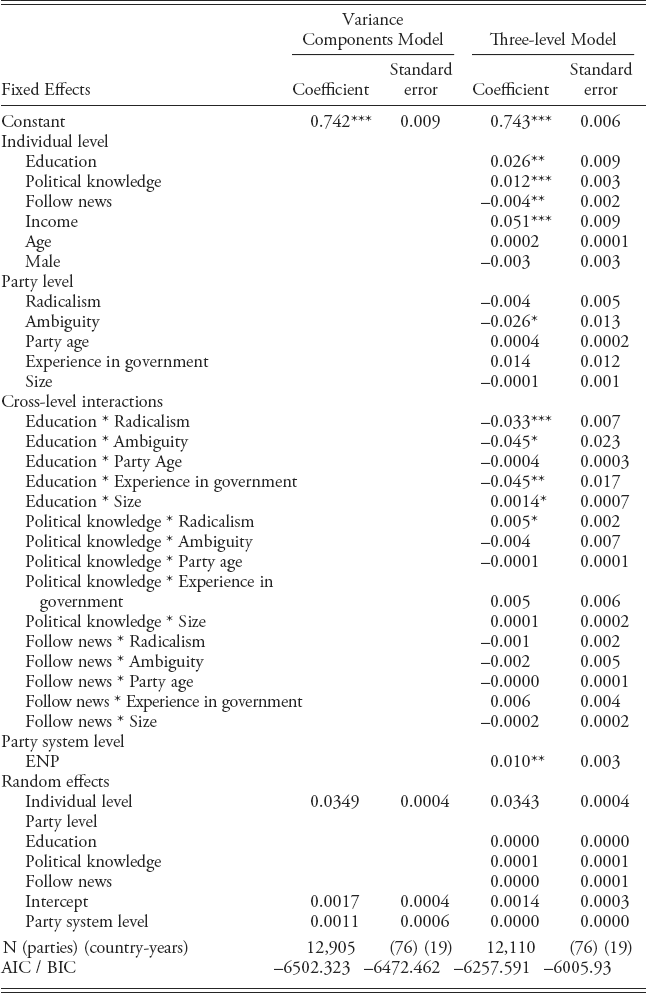
According to the Variance Components Model, the mean level of congruence is 0.742 and the total variance is 0.038 (see table 2). The VPC statistics suggest that most of the variation of congruence lies at the individual level: 92.5 percent of the variance of the dependent variable is due to individual characteristics. Partisan factors and party system elements account for 4.6 percent and 2.9 percent, respectively. Although most of the variation within the dependent variable takes place at the individual level, an understanding of the contextual sources of these differences is relevant from a comparative perspective. Moreover, the empirical Bayes estimates of the random effects indicate that there are parties (14 out of 76) and party systems (5 out of 19) that deviate significantly from their group means (see figures A1 and A2 in the appendix).
Multilevel Models

***p <0.001, ** p <0.01, *p <0.05
In the three-level model, shown in table 2, all the coefficients for the main individual-level predictors are statistically significant. These coefficients represent the effect of the individual-level variables when the party-level predictors are held at their means. Both kinds of covariates are part of cross-level interactions, and they are grand mean-centered.
Educational level and political knowledge have the expected sign. These results support our expectations regarding the positive effect of cognitive ability on congruence (Hi1 and Hi2). The dependent variable increases 0.026 and 0.012 points as a response to a one-unit increase in education and political knowledge, respectively.Footnote 13 Nevertheless, the effect of following the news does not have the expected (positive) sign (Hi3). Each one-unit increment in this predictor decreases congruence by 0.004 points. A possible cause for this result is that, for some individuals, interest in politics does not go along with political knowledge. People might be interested in political affairs but might lack the educational background to process that information and transform it into political knowledge.
One of the control covariates, income, has a significant effect on party-voter congruence. A one-unit increase in personal income is associated with a 0.051-unit increase in the dependent variable. This result concurs with previous works, which have shown that parties cater more to people with higher levels of income (Bartels Reference Bartels2008; Bernauer et al. Reference Bernauer, Giger and Rosset2015; Lupu and Warner 2017).
Most of the party-level covariates do not have a significant effect for people with average cognitive ability. However, party ambiguity deviates from this pattern. Keeping the rest of the predictors constant, a one-unit increase in the level of ambiguity decreases congruence by 0.026 points. This means that political parties that have less variation in their ideological positions show higher levels of congruence. Party-level covariates do have a conditional effect on congruence. The results support some of our hypotheses regarding the moderation effect of the partisan characteristics.
The cross-level interaction terms show that education is the covariate whose effect is moderated by most of the partisan predictors. The coefficient of education is weaker among parties that are more radical. Each one-unit increment in the radicalism scale diminishes the coefficient of education by 0.033 points. Since all the covariates are grand mean-centered, this result suggests that radicalism attenuates the effect of education among parties that have an above-average level of radicalism, whereas it strengthens education’s effect among parties below the mean level of radicalism.Footnote 14
Figure 1a shows that the positive slope of education is reinforced among individuals who vote for the least radical parties. By comparison, the relationship between education and congruence has the opposite sign for voters of very radical parties. This figure suggests that there is no significant effect among individuals who support parties with a moderate level of radicalism. Therefore, as we expected, congruence is higher among people with more years of education. However, contrary to our expectation, party radicalism weakens party-voter congruence.Footnote 15
The effect of education on congruence is also moderated by the ideological ambiguity of parties. The slope of educational level decreases among the more ambiguous parties and increases for those that are less uncertain. Each unit increase in the level of ambiguity decreases the coefficient of education by 0.044 points. This result supports our expectation that parties’ ideological ambiguity weakens the positive relationship between education and congruence (Hp2). Figure 1b presents the conditional effect of education for the levels of party ambiguity. It suggests that education has a positive effect on congruence for the voters of parties that show clear ideological positions to the electorate. Conversely, education does not affect congruence for the electorate of more ambiguous parties.
Effect of Educational Level on Ideological Congruence
Note: Depending on level of party radicalism (1a) and party ambiguity (1b)

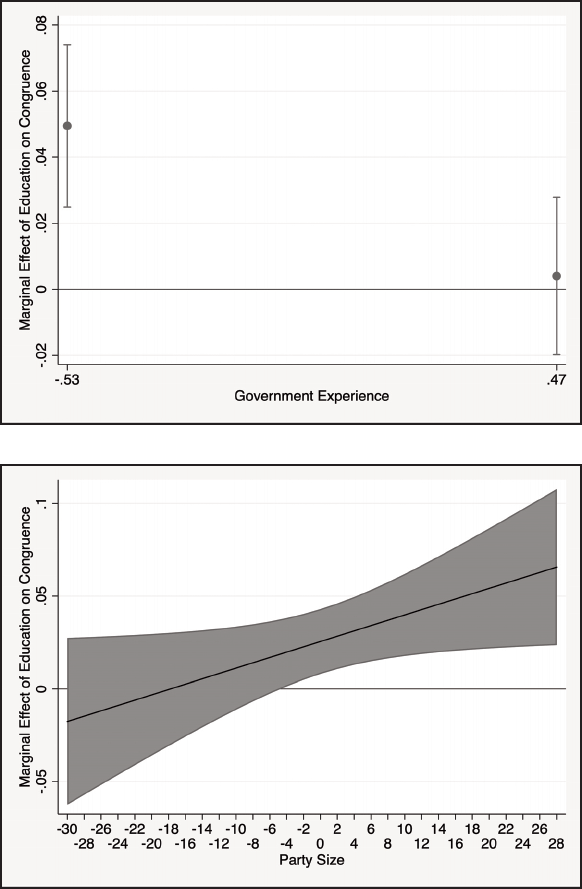
The next party-level covariate that moderates the effect of education is experience in government. The marginal effect of educational level on congruence is 0.045 points lower for the electorate of parties that have participated in government. In other words, the effect of education on congruence is stronger among voters of parties without government experience. Figure 2a shows that the moderating effect of government experience on the slope of education is only significant among parties that do not have government experience. This result suggests that the positive relationship between government experience and congruence, found in some studies (e.g., Klingemann et al. Reference Klingemann, Gancheva, Wessels, Harfst, Kubbe and Poguntke2017), may be contingent on citizens’ level of cognitive ability. It is unavoidable for governing parties to deviate sometimes from ideological principles. The highly educated electorate of these parties might notice such deviations, and this would negatively affect congruence.
The last party-level variable that moderates the effect of educational level is electoral size. The coefficient of education increases 0.0014 points for every one-unit increment in the electoral size of the party. This means that the effect of education is slightly stronger for voters of parties with a bigger electorate. Figure 2b shows that educational level exerts a positive effect on party-voter congruence among people who vote for parties with more electoral support. This moderating effect does not happen among the electorates of smaller parties.
Effect of Educational Level on Ideological Congruence
Note: Depending on government experience (2a) and party size (2b)

Party radicalism also moderates the effect of political knowledge on ideological congruence. The coefficient of political knowledge increases by 0.005 points with every one-unit increment in radicalism. This result agrees with hypothesis Hp1 because the positive relationship between political knowledge and congruence is stronger among parties that are more radical. Figure 3 shows that the conditional effect of these independent variables is statistically significant for most of the range of party radicalism.
Effect of Political Knowledge on Ideological Congruence
Note: Depending on level of party radicalism

In addition, the model shows that a higher number of parties in the system increases the options for the voters to choose one that matches their preferences, which raises the levels of congruence. This finding concurs with hypothesis Hs1. The effective number of parties has a positive effect on ideological congruence: a one- unit increase produces a 0.010 increment in congruence, ceteris paribus.
These results confirm the importance of cognitive ability and political sophistication for the existence of party-voter ideological congruence. They also support the decision to analyze these factors separately because they show different effects on congruence. Furthermore, their effects are moderated differently by the parties’ attributes.
The evidence suggests a profile of voters and parties that have higher levels of ideological congruence in Latin America. In general, people with more years of formal education have stronger linkages with the parties they vote for. Congruence is even higher when they support moderate parties that present a coherent ideological position. These ideological linkages are more robust for voters of parties without government experience but with a bigger electorate. Congruence is also higher for voters who know more about politics and who support parties that are more radical.
CONCLUSIONS
The literature on party-voter congruence has grown remarkably in recent years, producing important methodological developments. However, this is an area of study that still offers several avenues for improvement because of its complex nature. One of them is the analysis of the effect that voters’ characteristics exert on congruence. It also entails the study of how the attributes of political parties affect this relation ship. This is a worthwhile endeavor because party-voter congruence results from the match between citizens’ attitudes and opinions and parties’ positions.
Our study contributes to the understanding of political representation in Latin America. It puts forward an analysis of how uncertainty affects ideological congruence. Accordingly, the multilevel model of congruence is based on the idea that the explanatory factors for party-voter congruence must be found on both the demand and supply sides of electoral politics.
Regarding the demand side, citizens vary in their ability to decode the signals sent by political parties, and this skill is crucial for the explanation of ideological congruence. In other words, individuals have different cognitive abilities that allow them to cope with political information. We argue that people’s level of education, knowledge about politics, and attention to the news are appropriate indicators of these skills.
As regards the supply side of electoral politics, parties provide citizens with information about their ideological positions. The degree of clarity with which political parties communicate their positions is relevant to the process of representation. This information becomes a signal, which is clearer when less uncertainty surrounds it. In this regard, certain characteristics of political parties, such as their ideological ambiguity, their government experience, and their radicalism, contribute to the level of uncertainty surrounding the aforementioned signals. In other words, the partisan context exerts a moderating effect on the relationship between individual characteristics and ideological congruence.
These findings suggest that political representation needs educated and knowledgeable citizens, as well as clear party signals. The multilevel analysis indicates that not all parties represent voters equally but that some are better connected ideologically. For example, more knowledgeable and educated people build stronger ideological linkages with the political parties they support. Furthermore, certain attributes of the parties strengthen or weaken the effect of these cognitive skills. Party-voter congruence depends not only on individual or partisan features separately, as the literature has pointed out, but the latter moderate how cognitive ability affects congruence. People with higher levels of political knowledge, and who vote for parties that are more radical, show higher levels of congruence. When voters’ educational attainment is considered, ideological radicalism has the opposite moderating effect, reducing the positive relationship between education and congruence. Another relevant finding is that parties’ ideological ambiguity attenuates the positive effect of education on congruence. Moreover, political parties’ lack of government experience enhances the effect of education on congruence.
These results have relevant implications for the comparative study of ideological congruence and raise some questions for future research. On the one hand, the effect of people’s cognitive skills (education and political knowledge) can be strengthened if the information obtained regarding the positions of the parties is clear, structured, and coherent. On the other hand, partisan signals shape voters’ choices. Countries with complex and fluid party systems, such as some in Latin America, where parties have a weak and unstable internal structure, increase uncertainty. Consequently, this hinders the representative capacity of political systems.
This research concurs with the literature that points out that party cues are not always effective; they are less helpful if individuals do not have high cognitive ability (Bartels Reference Bartels1986; Álvarez 1997) or in complex party systems (Marinova Reference Marinova2016). Increasing the clarity of parties’ signals provides people with access to better information and helps them make better electoral choices. This process can improve citizens’ ideological linkages with their representatives and boost the quality of Latin American democracies.
The evidence also points toward a possible explanation for the finding that congruence is higher for more affluent people (Bartels Reference Bartels2008; Bernauer et al. Reference Bernauer, Giger and Rosset2015; Lupu and Warner 2017). We believe that this situation occurs because people can devote more resources to their education and can spend more time getting informed about political affairs. The difference between affluent and poorer citizens is more relevant in unequal societies like the ones found in Latin America.
This article has focused on the main dimension of partisan competition: the left-right continuum. This opens the door for a dialogue with the literature that has addressed ideological congruence in other regions of the world. However, the diversity and complexity of political cleavages raise the need to study whether the relationships described here obtain when specific political issues are analyzed.
Our work opens new avenues for research on congruence because the evidence did not support all the hypotheses. For example, following the news has a negative effect on party-voter congruence. Perhaps being more attentive to the news does not ensure more knowledge about political affairs. With so many outlets and different perspectives in journalism, individuals who do not have enough background could get confused. Regarding the attributes of political parties, government experience weakens the effect of education on congruence. It may be the case that more educated citizens demand more coherence from political parties once they are in government. If this expectation is not fulfilled, the ideological linkages between voters and parties may suffer. Future research could delve deeper into these possibilities.
The ideal of democratic representation is based on informed citizens and accountable representatives. In this regard, this study shows that increasing the educational level of citizens and their political knowledge can have a positive impact on the substantive dimension of political representation. The proponents of the cognitive mobilization theory envisioned this process in industrialized societies almost four decades ago (Dalton Reference Dalton1984).
APPENDIX
Empirically Based Estimates of Country-Year Effects

Empirically Based Estimates of Political Party Effects

Box Plot of Ideological Congruence

Legislative Elections and Political Parties Analyzed

SUPPORTING INFORMATION
For replication data, see the authors’ file on the Harvard Dataverse website: https://data-verse.harvard.edu/dataverse/laps