Implications
Although glycerol can be an attractive alternative energy source for animal feed, it has its own limitations in terms of lower energy content than oils, impurities and possible effects on the metabolic activity of the animals. There are still a number of unanswered questions about glycerol. One of the questions is what is the effect of glycerol on gut health? We wanted to investigate the potential physiological effects of glycerol on the intestine of broilers. This research was aimed at determining the effects of crude glycerol levels on the bacterial microflora and morphology of the small intestines in male broilers.
Introduction
Glycerol is a by-product of the processing of oil in the biodiesel. Glycerol can be thought as a source of energy in diets for animal nutrition (Dasari, Reference Dasari2007). Glycerol is a small molecule that is an important component of triglycerides and phospholipids. The glycerol component can be converted to glucose by the liver and kidneys, and provides energy for cellular metabolism (Krebs and Lund, Reference Krebs and Lund1966; Min et al., Reference Min, Yan, Liu, Coto and Waldroup2010). It is known that glycerol is a precursor to glyceraldehyde 3-phosphate, an intermediate in the lipogenesis and gluconeogenesis pathways, and yields energy through the glycolytic and tricarboxylic acid pathways (Lin, Reference Lin1977; Min et al., Reference Min, Yan, Liu, Coto and Waldroup2010). On the other hand, microorganisms have been proposed to utilise glycerol as a carbon source or energy source. Habe et al. (Reference Habe, Konishi, Ikegami, Sakaki and Kitamoto2007) and Da Silva et al. (Reference Da Silva, Mack and Contiero2009) explained that glycerol is used for some short-chain organic acids in industrial microbiology. Glycerol may be transformed into various bioactive compounds or microbial ingredients by the microorganisms present in the digestive organs. Some of these bioactive compounds or microbial ingredients have been reported to affect the intestinal villi (Ni et al., Reference Ni, Zhong, Wang, Xu and Wei2009; Ross et al., Reference Ross, Mills, Hill, Fitzgerald and Stanton2010).
A healthy alimentary tract is the most important guarantee of a healthy life (Losada and Olleros, Reference Losada and Olleros2002). The dietary composition (Teo and Tan, Reference Teo and Tan2007), microflora (Lan et al., Reference Lan, Verstegen, Tamminga and Williams2005), and the interaction between the diet and microflora can affect the intestinal development, mucosal architecture and the mucus composition of the gastrointestinal tract (Apajalahti et al., Reference Apajalahti, Kettunen and Graham2004; Teirlynck et al., Reference Teirlynck, Bjerrum, Eeckhaut, Huygebaert, Pasmans, Haesebrouck, Dewulf, Ducatelle and Immerseel2009). Losada and Olleros (Reference Losada and Olleros2002) found that the intestinal flora naturally contain both healthy and unhealthy bacteria.
Histological changes in the intestines have been proposed to be related to intestinal functions (Shamoto and Yamauchi, Reference Shamoto and Yamauchi2000; Yamauchi and Tarachai, Reference Yamauchi and Tarachai2000) and may be stimulated by diet (Yamauchi et al., Reference Yamauchi, Kamisoyama and Isshiki1996; Shamoto et al., Reference Shamoto, Yamauchi and Kamisoyama1999). Furthermore, the reduced thickness of the intestinal walls as a result of feed additives or nutritional manipulations facilitates the digestion of nutrients, which positively affects the growth performance of the animals (Dibner et al., Reference Dibner, Kitchell, Atwell and Ivey1996; Jamroz et al., Reference Jamroz, Wertelecki, Houszka and Kamel2006). Glycerol can also affect the intestinal wall and microbiology.
There are research studies related to the use of glycerol in industrial microbiology; however, they are not well known for explaining the effect of glycerol on microflora and morphology in the small intestines of animals. Therefore, the aim of this study was to determine the effects of crude glycerol levels in the diet on the bacterial microflora and morphology of the small intestines (duodenum, jejunum and ileum) in male broilers.
Material and methods
Birds and feeding experiments
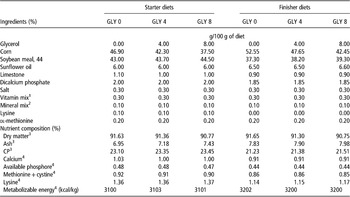
All experimental procedures using animals were conducted in accordance with the European Guidelines for the Care and Use of Animals for Research Purposes. A total of 360 1-day-old mixed-sex broilers (Ross 308) were placed in 12 floor pens (30 birds/pen) and randomly assigned to three dietary treatments (four replicates per treatment). The broilers in Groups GLY 0, 4 and 8 consumed diets containing 0, 40 and 80 g/kg crude glycerol, respectively. The broilers received starter diet (days 1 to 21) and finisher diet (days 22 to 42). Crude glycerol was obtained from a biodiesel production facility that utilised sunflower–corn–soybean oil in a commercial company. The study was conducted over a feeding period of 42 days. The broilers’ requirements were based on the recommendations of the National Research Council (1994). The broilers were given ad libitum access to feed and water. The ingredients and chemical compositions of the broilers’ diets are presented in Table 1.
Ingredients and nutrient composition of experimental diets (%)

GLY 0: 0% glycerol; GLY 4: 4% glycerol; GLY 8: 8% glycerol.
1 Supplying per kilogram of diet: vitamin A, 12.000 IU; vitamin D3, 1.500 IU; vitamin E, 50 mg; vitamin K3, 5 mg; vitamin B1, 3 mg; vitamin B2, 6 mg; niacin, 25 mg; Ca–D–pantothenate, 12 mg; vitamin B6, 5 mg; Vitamin B12, 0.03 mg; folic acid, 1 mg; D-biotin, 0.05 mg; choline–chloride, 400 mg; salinomycin sodium, 60 mg.
2 Supplying per kilogram of diet: Mn, 80 mg; Fe, 60 mg; Zn, 60 mg; Cu, 5 mg; Co, 0.2 mg; I, 1 mg; Se, 0.15 mg.
3 Analysed nutrient values according to Weende analyses system.
4 The nutrient content of diets was calculated according to Dale and Batal (Reference Dale and Batal2003).
At the age of 42 days, 10 male broilers within each pen were randomly selected for the collection of intestinal measurements (40 broilers per treatment). A total of 120 broilers were humanely killed and immediately eviscerated for the analysis of the morphology of small intestine. Of these, 48 broilers (slaughtering for the analysis) were equally selected from each group (four broilers per pen) for the bacterial microflora analysis. First, the contents of the duodenums were immediately collected into sterile glass tubes and subjected to microbial analysis. On the other hand, the tissue samples were collected for the morphometric analysis of the duodenum, jejunum and ileum from (1) the apex of the duodenum, (2) a point midway between the point of entry of the bile ducts and the Meckel’s diverticulum of the jejunum and (3) a point within 10 cm of the caecal junction in the ileum, respectively.
Measurements and analysis
Crude glycerol analysis
The chemical composition of the crude glycerol used in the present research was determined based on protocols developed by the Association of Official Analytical Chemists (AOAC, 1997), and was found to consist of 82.61% glycerol, 0.03% methanol, 11.80% moisture, 0.64% CP, 0.10% ether extract and 4.81% ash.
Microbiological analysis
For each broiler, 1 g of the duodenum content was homogenised in 9 ml of peptone water (Oxoid CM9, Oxoid Ltd, Basingstoke, England) for 2 min at room temperature. Next, the homogenates were serially diluted in 0.1% peptone water and plated on Violet Red Bile Glucose Agar (Oxoid CM 485, Oxoid Ltd), Violet Red Bile Lactose Agar (Oxoid CM107, Oxoid Ltd) and Baird Parker Agar Base (Merck 5406, Merck kGaA 64271 Darmstadt, Germany) with Egg Yolk Tellurite Emulsion (Merck 3785, Merck kGaA 64271) for the enumeration of enterobacteria, coliform bacteria and staphylococci/micrococci, respectively. The Violet Red Bile Lactose Agar, Violet Red Bile Glucose Agar and Baird Parker plates were incubated at 37°C for 1 day.
To determine the incidence of Salmonella spp., 0.1 ml of each intestinal homogenate was inoculated in duplicate into tubes containing 10 ml of Rappaport-Vassiliadis broth (Oxoid CM669, Oxoid Ltd) and was incubated at 42°C for 2 days, as previously recommended (Anonymous, 1989; Cloak et al., Reference Cloak, Duffy, Sheridan, Mcdowell and Blair1999). Brilliant Green Agar (Oxoid CM263, Oxoid Ltd) plates were inoculated with each of the RV broths after 24 to 48 h and were incubated for 18 to 24 h at 37°C, as previously described (De Smedt et al., Reference De Smedt, Chartron, Cordier, Graff, Hoekstra, Lecoupeau, Lindblom, Milas, Morgan, Nowacki, O’donoghue, Van Gestel and Varmedal1991; De Zutter et al., Reference De Zutter, De Smedt, Abrams, Beckers, Catteau, De Borchgrave, Debevere, Hoekstra, Jonkers, Lenges, Notermans, Van Damme, Vandermeersch, Verbraeken and Waes1991). Suspected colonies were confirmed biochemically by inoculation into Triple Sugar Iron Agar (Oxoid CM277, Oxoid Ltd) and Lysine Iron Agar (Oxoid CM381, Oxoid Ltd) slopes incubated at 37°C for 24 h. Salmonella spp. was isolated from suspected colonies and a final confirmation was carried out using specific Salmonella O and H agglutinating antisera (Murex Diagnostic, Kent, UK; Behring, Germany, respectively).
Morphometric analysis
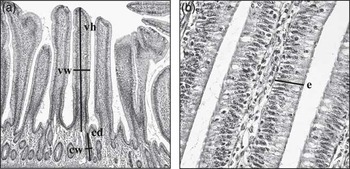
The samples obtained from the broilers were used for histological examinations of the villi in each intestinal segment. The small intestine was dissected free of its mesentery immediately after the animals were slaughtered. After opening the abdominal cavity, samples measuring 1 cm were extracted from the middle segments of the duodenum, jejunum and ileum. For histological examination, the tissues were fixed for 24 h at 4°C in Saint-Marie solution, dehydrated in a graded series of alcohol solutions and embedded in paraffin. Tissue blocks of small intestine samples were sectioned on a Leica-RM 2145 microtome (Leica Microsystems, Nussloch, Germany) at a thickness of 5 µm. After staining with hematoxylin–eosin, measurements of the duodenum, jejunum and ileum villus height (measured from the tip to the base, excluding the intestinal crypt), the villus width (measured halfway between the base and the tip), the crypt depth (measured from the base upward to the region of transition between the crypt and villi), the crypt width (measured at the midline) and the epithelial cell thickness (the distance between the base and tip of the epithelial cell) were determined using an image analyser (LEICA IM50, Imagic Bildverarbeitung AG, Wetzlar, Germany). Sixteen measurements were obtained per sample. The typical arrangement of the villi and crypt, as seen in cross-sections of the intestine, is illustrated in Figure 1.
Cross-section of the intestine, hematoxylin–eosin stained, displaying the measured parameters. (a) Villus height (vh), villus width (vw), crypt depth (cd) and crypt width (cw) (4×). (b) epithelial cell thickness (e) (40×).

Statistical analysis
The experimental data were analysed by ANOVA using the GLM procedure of SAS (SAS, 1999). The differences among the means were tested using Tukey’s multiple comparison test. All findings of significance were based on a probability of P<0.05. Each feature (viable cell counts, viable cell counts of Salmonella spp., epithelial cell thickness, and villus height and villus width) was analysed separately and were displayed together. The experimental unit was a pen.
Results
The effects of diets containing various levels of glycerol on the viable cell counts of bacterial microflora and the presence of Salmonella spp. in the duodenum, as well as the morphometric features of the duodenum, jejunum and ileum of the male broilers, were determined.
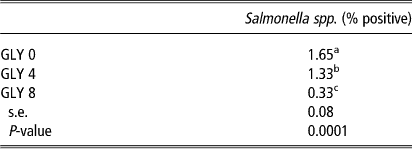
Some pathogenic bacteria in the duodenums of the male broilers were significantly affected by diets containing 4% and 8% glycerol (Table 2). The Coliform bacteria and Enterobacteria counts in the duodenum of GLY 4 were lower than those of the broilers in the other groups (P<0.001). The lowest number of Staphylococci/Micrococci was observed in the duodenums of the GLY 8, whereas the greatest number of Staphylococci/Micrococci was observed in the GLY 0 (P<0.001). Salmonella spp. was isolated from each of the three groups. The incidence of salmonella strains are shown in Table 3. The incidence of Salmonella spp. in the duodenum digesta of the male broilers fed by glycerol was significantly affected by diets containing 4% and 8% glycerol (Table 3). The highest level of Salmonella spp. in the duodenum of the broilers was detected in the GLY 0, and the lowest level of Salmonella spp. was detected in the duodenum of the GLY 8 (P<0.001).
Numbers of bacteria examined in the duodenum digesta of male broilers (log cfu g -1 ) fed by glycerol

nd=none detected.
GLY 0: 0% glycerol; GLY 4: 4% glycerol; GLY 8: 8% glycerol.
a,b,cMeans within treatment groups with no common superscript differ significantly (P<0.001).
The incidence of Salmonella spp. in the duodenum digesta of male broilers fed by glycerol

GLY 0: 0% glycerol; GLY 4: 4% glycerol; GLY 8: 8% glycerol.
a,b,cMeans within treatment groups with no common superscript differ significantly (P<0.001).
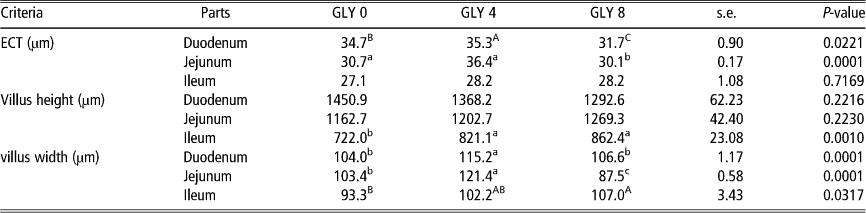
In Table 4, the effects of the addition of glycerol on the thickness of the epithelial cells in the broilers are presented. The thicknesses of the duodenum (P<0.05) and jejunum (P<0.001) epithelial cells in GLY 8 were reduced compared with those of the other groups. Glycerol addition was observed to have no significant effect on the thickness of the epithelial cells in the ileum. Furthermore, the thicknesses of the duodenum and jejunum epithelial cells in the treatment groups did not undergo any change accompanying the increasing levels of glycerol. The effects of the glycerol treatment on the duodenum and jejunum villus height was not determined to be statistically significant, whereas increasing glycerol levels were associated with increased ileum villus height. The ileum villus heights of the GLY 4 and GLY 8 were greater than those of the GLY 0 (P<0.001). The villus height in the ileum increased with the increasing levels of glycerol. When the effect of glycerol addition on villus width was examined, the broilers in GLY 4 demonstrated the greatest villus width in the duodenum and the jejunum (P<0.001). In addition, the broilers in GLY 8 exhibited the greatest ileum villus width (P<0.05). On the other hand, the duodenum and jejunum villus widths in the broilers did not increase with the increasing levels of glycerol, but the villus width in the ileum increased with the increasing levels of glycerol.
The effect of glycerol on the epithelial cell thickness, villus height and villus width in the duodenum, jejunum and ileum

ECT=epithelial cell thickness.
GLY 0: 0% glycerol; GLY 4: 4% glycerol; GLY 8: 8% glycerol.
A,B,CMeans within treatment groups with no common superscript differ significantly (P<0.05).
a,b,cMeans within treatment groups with no common superscript differ significantly (P<0.001).
The effects of glycerol levels on the depths and widths of the crypts of the duodenum, jejunum and ileum are listed in Table 5. The effects of the treatment on the depths and widths of the duodenal crypts, but not the ileum and jejunum crypts, were statistically significant. The depths of the duodenum crypts were determined in the GLY 4, and the crypt depths of the duodenums of the GLY 4 and GLY 8 were observed to be greater than those of the GLY 0 (P<0.05). The effects of the addition of glycerol to the diet on the crypt widths observed in the duodenum, jejunum and ileum were significant. The greatest crypt widths were observed in the GLY 0 and GLY 8 (P<0.01). The greatest crypt widths in the jejunum were detected in the GLY 4 (P<0.001), and the greatest crypt widths in the ileum were observed in the GLY 8 (P<0.01).
The effect of glycerol on the crypta depth and crypta width in the duodenum, jejunum and ileum

GLY 0: 0% glycerol; GLY 4: 4% glycerol; GLY 8: 8% glycerol.
a,b,cMeans within treatment groups with no common superscript differ significantly (P<0.001).
Discussion
Previous studies have demonstrated that the ingredients and nutrient levels of diets fed to broilers affect the enzymatic activity of the gut and alter the morphology and microflora of the intestines (Galfi and Bokori, Reference Galfi and Bokori1990; Knarreborg et al., Reference Knarreborg, Jensen and Engberg2003; García et al., Reference García, Gregori, Hernández, Megías and Madrid2007). On the basis of these observations, and to study the effects of glycerol levels in broiler diets, this study’s treatment diets were isocaloric and isonitrogenic, as the ingredients of the diets were used in the same ratios, except for corn, soybean meal and glycerol.
In the present study, the presence of Coliform bacteria and Enterobacteria in the duodenum of male broilers in the group that consumed the diet containing 4% glycerol was significantly decreased compared with the other groups. The presence of Coliform bacteria and Enterobacteria did not increase with the increasing levels of glycerol, but Staphylococci/Micrococci counts decreased with the increasing levels of glycerol. It was observed that the 4% level of glycerol tended to be a protective effect against pathogenic bacteria, including Coliform bacteria, Enterobacteria, and Staphylococci/Micrococci and pressured their effects in the duodenum; it also decreased the presence of these bacteria. The useful microorganisms in the digestive organs (including Lactobacillus spp. and Bifidobacterium spp.) have been proposed to convert glycerol into helpful metabolites and pressure the investigated microorganisms (except coliform bacteria) in the gut. A previous study obtained results supporting this study’s findings regarding glycerol, as Da Silva et al. (Reference Da Silva, Mack and Contiero2009) declared that microorganisms utilised glycerol as a carbon and energy source and converted it into propionic acid, succinic acid and fumaric acid.
When the effects of dietary glycerol on the presence of Salmonella spp. in the duodenum were evaluated, the addition of 8% glycerol was associated with the least presence of Salmonella spp. in the treatment groups. Increasing levels of glycerol were associated with a decreased presence of Salmonella spp. Salmonella control has been one of the major tasks in poultry production to ensure poultry food safety. Some practices in commercial poultry production impede the normal development of the microbiota, leaving the chicken very vulnerable to colonisation and possible infection by pathogenic bacteria, including Salmonella spp. (Chambers and Gong, Reference Chambers and Gong2011). Therefore, decreasing the presence of Salmonella spp. in the diet and in the intestines is an important factor in protecting animal health. Patterson and Burkholder (Reference Patterson and Burkholder2003) expressed that decreasing the presence of Salmonella spp. affected animal health positively, and as a result, the animals’ growth performance was affected positively. When scrutinising the results related to the small intestinal morphology in the present study, the addition of glycerol was observed to significantly affect the thicknesses of the duodenum and jejunum epithelial cells. The 8% level of glycerol decreased the epithelial cell thicknesses in the duodenum and jejunum compared with the other groups. No relationship was observed between the increased levels of glycerol and epithelial cell thickness, but the relationship between higher glycerol levels and the thickness of epithelial cells should be examined by further studies. Intestinal functions have been demonstrated to affect the histology of the gut. The previous studies investigating these subjects revealed that histological changes in the gut were associated with intestinal functions (Shamoto and Yamauchi, Reference Shamoto and Yamauchi2000; Yamauchi and Tarachai, Reference Yamauchi and Tarachai2000) and were stimulated by the diet (Langhout et al., Reference Langhout, Schutte, Van Leeuwen, Wiebenga and Tamminga1999; Yasar and Forbes, Reference Yasar and Forbes1999). Visek (Reference Visek1978) proposed that decreasing the thickness of the intestinal segments may facilitate the absorption process and that, during this process, absorption by the epithelial cells increases, thus decreasing the metabolic requirements of the digestive system.
In the present study, the levels of glycerol in the diet did not affect the villus height observed in the duodenum and jejunum, but they did significantly affect the ileal villus height; in addition, the increasing levels of glycerol increased the villus heights. Because the microorganisms that utilised glycerol as a nutrition source had produced short-chain fatty acid metabolites, these products may have affected the villus heights. The broilers fed diet with 4% glycerol also exhibited increased villus width in the duodenum and jejunum, but the villus width was not affected by the diet containing 8% glycerol, whereas notable increase in the ileal villus width accompanying the increasing levels of glycerol was observed. The addition of glycerol to the diet only affected the duodenum crypt depths, not those of the jejunum and ileum. Despite the differences observed between the groups regarding the crypt widths in the duodenum, confirming that the difference originated with the addition of glycerol to the diet is difficult. The effects of glycerol levels caused differences in the crypt widths. Only increasing levels of glycerol were observed to increase the width of the ileum crypts. This study’s results regarding the villus height, villus width, crypt depth and crypt width in the duodenum, jejunum and ileum support the findings of previous studies, indicating that the villus height and villus width may vary on the basis of nutrition and that longer villi demonstrate improved absorption of nutrients in the small intestine (Jamroz et al., Reference Jamroz, Wertelecki, Houszka and Kamel2006). Caspary (Reference Caspary1992) reported that long villi present an increased surface area and may exhibit greater absorption. Langhout et al. (Reference Langhout, Schutte, Van Leeuwen, Wiebenga and Tamminga1999) also observed that longer villi are an indicator of enhanced villus function. Kristy et al. (Reference Kristy, Kelly, Swanson, Tappenden and George2005) determined that villus height and crypt depth can be evaluated to assess the function of the intestines and are indicative of the health of the gut. Reducing the thickness of the intestinal wall through nutritional manipulation may facilitate the absorption of nutrients, which may lead to positive growth performance (Dibner et al., Reference Dibner, Kitchell, Atwell and Ivey1996; Jamroz et al., Reference Jamroz, Wertelecki, Houszka and Kamel2006) and the improvement of the feed conversion ratio. However, a thinner gut could actually worsen food safety by increasing gut breakage when harvested. A discussion of these findings is necessarily limited because an insufficient number of studies have investigated the effects of glycerol on the width and depth of the crypt. In the future, according to the results in the present study, to elucidate the factors affecting the intestinal health and morphology of broilers, new studies should be conducted with animals consuming diets containing more than 8% glycerol, and it may be useful that the identities and relative levels of microorganisms are studied in the duodenum, jejunum and ileum.
Conclusion
The diets containing 4% glycerol reduced the presence of Coliform bacteria and Enterobacteria in the duodenum of male broilers. Diets containing increasing levels of glycerol were associated with a decrease in Staphylococci/Micrococci. The presence of Salmonella spp. decreased with the increased levels of glycerol. Finally, the addition of glycerol to the diet affected the Coliform bacteria, Enterobacteria and Salmonella spp. counts in the duodenum of male broilers.
The various levels of glycerol caused varying effects on intestinal morphology (epithelial cell thickness, villus height and width, and crypt depth and width). The broilers that were fed a diet containing 4% glycerol exhibited the increased surface area capable of greater absorption of available nutrients for intestinal morphology
Acknowledgement
This study was conducted in conjunction with a project FBE-08013 supported by Scientific Research Projects Fund of Adnan Menderes University. The authors thank Adnan Menderes University for funding this research.